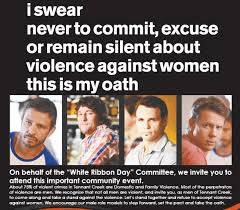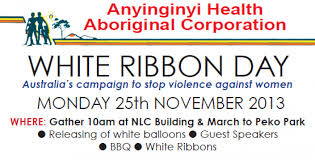
NACCHO supports White Ribbon Day 25 November : Australia’s dark secret -one woman killed every week

WR

“It is certainly the case that violence against women is  very often a manifestation of wider social problems, but there is absolutely no  excuse for it, and I think it sends a powerful message when more and more men  are prepared to stand up and say they are against it on White Ribbon Day.”

TOM CALMA  AO White Ribbon Ambassador

Tom Calma

As an Aboriginal woman you are 45 times more likely to experience domestic  violence than a white woman.

Read more:

It is important to understand how every act of male violence against women can have serious effects on women, families and society as a whole.

Male violence against women can happen anywhere and can take many forms; including physical, sexual, emotional and financial violence and has a profound cost across the personal, social and economic sphere.

BIGCrowd1030910-85041

Picture above Stop the Violence march Congress Aboriginal Health Alice Springs 2010

White Ribbon Australia is uncovering the nation’s most shameful secret; the extent of male violence against women, which claims at least one woman’s life every week[1]. Australia, land of secrets is a new awareness raising campaign launched in the lead up to White Ribbon Day, Monday 25 November.

New Microsoft Publisher Document (2)

FOR MORE INFORMATION

Australia, land of secrets intends to give a voice to the everyday experiences of violence that occur all around Australia. These acts, from inappropriate behaviour or harassment to physical and emotional abuse, are part of a culture of violence in Australia.

Chairman of White Ribbon Australia, Lt. Gen Ken Gillespie (Rtd) says that while Australia is a proud nation and unrivalled for not only its physical beauty but its way of life, it has a dark secret.

“The high incidence of male violence against women in this country is very alarming,” said Ken. “Not only do one in three women over the age of 15 report having experienced physical or sexual violence at some time in their lives,[2] violence is a major cause of homelessness for women and children[3] and costs the economy US$14.7 billion annually in Australia.[4]

“It is important to understand how every act of male violence against women can have serious effects on women, families and society as a whole. Male violence against women can happen anywhere and can take many forms; including physical, sexual, emotional and financial violence and has a profound cost across the personal, social and economic sphere.

“The issue of male violence against women is real, it’s worrying and, in many instances, remains hidden. Every woman, and man, can make a stand and speak up about the issue. Australia, land of secrets calls on men, women and the whole community to help uncover Australia’s secrets, raise awareness and stop violence against women.”

This White Ribbon Day, Monday 25 November, White Ribbon Australia is encouraging people to speak up and uncover stories of violence against women. Australia, land of secrets brings a new creative element to Australia’s only national male-led campaign to end men’s violence against women in its 10th Anniversary year.

White Ribbon Australia will be hosting awareness and fundraising events across the country throughout November. Australians are encouraged to participate in the many events happening in their local area, and to donate to show their support of the campaign.

male-health-summit-Inteyerrkwe-2008

History: 2008 Inteyerrkwe Statement Apology to women

Nearly 400 Aboriginal men took part in the Central Australian Aboriginal Congress Aboriginal Male Health gathering in the NT and issued the  Inteyerrkwe Statement, an apology from men to women for violence and abuse.

Inteyerrkwe Statement

“We the Aboriginal males from Central Australia and our visitor brothers from  around Australia gathered at Inteyerrkwe in July 2008 to develop strategies to  ensure our future roles as grandfathers, fathers, uncles, nephews, brothers,  grandsons, and sons in caring for our children in a safe family environment that  will lead to a happier, longer life that reflects opportunities experienced by  the wider community.

We acknowledge and say sorry for the hurt, pain and suffering caused by  Aboriginal males to our wives, to our children, to our mothers, to our  grandmothers, to our granddaughters, to our aunties, to our nieces and to our  sisters.

We also acknowledge that we need the love and support of our Aboriginal women  to help us move forward.”

NACCHO members such as ANYINGINYI are taking an active role in White Ribbon Day

NT

For more information visit www.whiteribbon.org.au.

Follow this link to view and share the new TVC: www.uncoversecrets.com.au

HOW THE COMMUNITY CAN SUPPORT WHITE RIBBON DAY

White Ribbon invites people to show their support for White Ribbon Day by hosting or attending one of the many White Ribbon events that take place across Australia (www.whiteribbon.org.au/events), sharing the campaign online (www.whiteribbon.org.au/secrets) or purchasing White Ribbon wristbands and ribbons at any Suzanne Grae, The Salvation Army (QLD, NSW, ACT) stores or the White Ribbon shop (www.whiteribbon.org.au/shop).

—————————–ends—————————–

NACCHO AGM News: Prime Minister Tony Abbott sends positive message to open NACCHO AGM in Perth

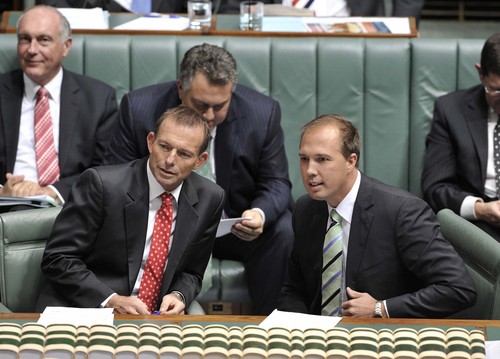
Question Time in the House of Representatives

“New Government,New Approach” was the theme on the opening day of the  NACCHO AGM and members meeting in Perth this week.

BZZ_58zCcAAoCVt

With Parliament sitting in Canberra messages and video addresses were sent from the Prime Minister (see below), Senator the Hon Fiona Nash Assistant Minister of Health ,Samantha Palmer First Assistant Secretary Indigenous Health Service Delivery Department of Health, Maria Jolly Assistant Secretary Health Policy  and John Shevlin Assistant Secretary Health Programmes DPM and C.

Jeff McMullen ,Justin Mohamed and Fred Chaney moderated a very robust discussion on ” the Future of Aboriginal Affairs and Aboriginal Health”

MS13-708 SF 3 925747-1

I send warm greetings to delegates attending the National Aboriginal Community Controlled Health Organisation Annual General Meeting and Members Meeting in Perth.

Every day the 150 local community health organisations that you represent improve the physical and emotional health of Aboriginal communities across Australia. I honour the work that you do.

It is appropriate that you meet only days after the release of the latest Australian Bureau of Statistics data on indigenous life expectancy. While we can all draw some comfort from the improvements in life expectancy, the roughly 10 year gap between indigenous and non-indigenous life expectancy is still disturbing.

It must be our goal as a nation to eliminate this gap within a generation.

Our health is in many ways a reflection of our communities. That is why we have to ensure that children go to schools, adults go to work and the ordinary rule of the land operates in Aboriginal communities.

We need a new level of engagement at every level of society to ensure that Aboriginal people receive better educational, employment, housing and health outcomes. I have brought indigenous affairs into the Department of Prime Minister and Cabinet to achieve exactly that.

I pay tribute to all of you who are working to provide Indigenous Australians with the local health services they need.

I send my best wishes for a successful meeting.

The Hon Tony Abbott MP

Prime Minister of Australia

19 November

NACCHO chair launches Australia’s first Aboriginal Health Newspaper at AGM

Koori Mail Handover

Picture Above: Board Director of the Koori Mail Trevor Kapeen presents the first copy of Australia’s first Aboriginal Health Newspaper to Chair of NACCHO Justin Mohamed on the opening day of the NACCHO AGM in Perth.

Working with Aboriginal community controlled and award-winning national newspaper the Koori Mail, NACCHO aims thru NACCHO Health News to bring relevant information on health services, policy and programs to NACCHO members and key industry stakeholders at a grassroots level.

NACCHO-title-web

NACCHO will leverage the brand, coverage and award-winning production skills of the Koori Mail to produce a 20-28 page three times a year, distributed as a ‘lift-out’ in the 14,000 Koori Mail circulation, as well as an extra 5000 copies to be sent directly to NACCHO member organisations across Australia.

“We have learned that most of the communication around these important Aboriginal health areas tend to float around the top echelons of the government and non-government sectors,” said NACCHO chairman Justin Mohamed.

“Our intention is to broaden the reach of this information, landing in the waiting rooms  and tea rooms of community health clinics, community centres, program offices and other places accessed daily by primary health care workers and our clients .

“While NACCHO’s website and annual report have been valued sources of information for national and local Aboriginal  health care issues for many years, the launch of NACCHO Health News creates a fresh, vitalised platform that will inevitably reach audiences beyond the boardrooms,” Mr. Mohamed said

“This is a tremendous leap for the dissemination of health information across our Aboriginal  population,” Mr Mohamed noted. “Never before has such valuable and relevant health information become so accessible to this sector. If you have a message or job opportunity you want to get into the Aboriginal primary health care sector, NACCHO Health News is your ideal media.”

The first edition of NACCHO Health News hit the presses on November 17 and was promoted heavily via various media channels and social media outlets.

To book an advertisement and/or have your article considered for publication in the April 2014 edition , please contact the NACCHO media team on 02 6246 9309 or email media@naccho.org.au.

NACCHO Aboriginal suicide prevention: Black Dog Institute launches app to try to save lives

BD

ibobbly draws on stories from Aboriginal performers and uses psychological therapies proven to reduce suicidal thoughts

WATCH DETAILS OF THE APP on YOUTUBE

Consider the FACTS

  • Indigenous suicide rates five times higher than non-indigenous youth

  • New mobile app designed to provide culturally-relevant psychological care

  • Clinical trial launched by Yawuru man Patrick Dodson in Broome

Suicide rates in Aboriginal and Torres Strait Islander communities are amongst the highest in the world.

Despite increased funding and implementation of new prevention programs, very few indigenous people will seek help before acting on suicidal thoughts.

Black Dog Institute, in partnership with WA-based suicide prevention group Alive and Kicking Goals, is launching a trial of the world’s first suicide prevention app designed especially for use by indigenous people on mobile phones or tablet devices.

Called iBobbly (a name derived from a Kimberley greeting), the app delivers treatment-based therapy in a culturally relevant way. Based on psychological therapies proven to reduce suicidal thoughts, it draws heavily on indigenous metaphors, images and stories drawn from local Aboriginal artists and performers.

According to Black Dog Institute researcher Professor Helen Christensen, the app format leaps two of the major hurdles to help seeking-Percieved stigma and isolation

We know that indigenous Australians are not seeking face to face mental health care, more than 70% of indigenous suicides occur in people who are not previously known to health services.

“Indigenous youth have a high rate of mobile phone usage  so it makes sense that we engage them on technology they are comfortable with and able to use in their own private time.”

“Once the app is downloaded they don’t need ongoing internet access and the program is password protected, thus maintaining confidentiality if the technology is shared amongst the community.”

“The initial pilot trial being run in WA will allow us to test and refine the program. We hope to expand iBobbly access to indigenous people living in other States later in 2014.”

iBobbly is funded by the Australian Government and NHMRC Centre for Research Excellence in Suicide Prevention. The program was developed in partnership with Alive and Kicking Goals, HITnet Innovations,

Thoughtworks, Muru Marri Indigenous Health Unit UNSW and the Young and Well Cooperative ResearchCentre. Samsung generously donated 150 tablets for the trial.

Interviews are available with Prof Helen Christensen (Black Dog Institute) and Joe Tighe (Alive and Kicking Goals).

Contact Joe Tighe on 0400 240 607 for more information.

Ends

UPDATE :NACCHO Launches new APP

afl 010

The NACCHO  APP promotes the sports healthy futures program that will give Aboriginal youth the opportunity to improve their overall health and wellbeing through active participation in sports.

Research shows that if a young person is happy and healthy they will be able to get the most out of their education, build their confidence and their self-belief and hopefully one day become a well-educated “Indigenous All-star” in the sport or employment of their choosing.” Mr. Mohamed said.

Mr. Mohamed said he is encouraging all  150 NACCHO members and stakeholders to promote the APP to their 5,000 staff and over 100,000 clients so that our community members can really have Aboriginal health in Aboriginal Hands. All ready in first few days over 1,000 Apps have been downloaded from the APP Store and Google Android store.

Here are the URL links to the App – alternatively you can type NACCHO into both stores and they come up!

iPhone/iPad

ios.giveeasy.org/naccho

Android

android.giveeasy.org/naccho

“The NACCHO App contains a geo locator, which will help you find the nearest Aboriginal Community Controlled Health Organisation in your area and  provides heath information online and telephone on a wide range of topics and where you can go to get more information or assistance should you need urgent help “ Mr Mohamed said.

Health help includes:

Ambulance, Alcohol, Babies Breast Cancer, Cancer, Children,  Depression, Diabetes, Domestic Violence, Drugs, eHealth, Eye Health, Gambling, Healthy Eating, Hearing, Male health, Medicare, Mental Health, Prostate cancer, Smoking , Suicide, Teenagers, Women’s Health.

The NACCHO App allows users  to share, connect or contact NACCHO through our social media platforms such as Twitter, Facebook, daily news alerts and the NACCHO website.

– See more at: http://www.naccho.org.au/naccho-app/#sthash.wpLrnSWD.dpuf

NACCHO AGM Perth 2013 health news: Aboriginal life expectancy increases to Close the Gap

C

Life expectancy for Aboriginal and Torres Strait Islander men increased by around one and a half years over the last five years, compared to about one year for non-Indigenous men. Life expectancy for Aboriginal and Torres Strait Islander women increased by about half a year over the period, roughly the same increase as non-Indigenous women.

Life expectancy at birth for Aboriginal and Torres Strait Islanders in 2010-2012 was 69.1 years for men and 73.7 years for women, according to figures released November 15 by the Australian Bureau of Statistics (ABS).

Download ABS life tables report 2013

Download ABS life expectancy FACT SHEET 2013

DOWNLOAD THE DATA in Xcel

healthy-futures-great

Justin Mohamed Chair of NACCHO is reporting to the NACCHO AGM in Perth this week that the NACCHO recently  commissioned Healthy for Life report from the Australian Institute of Health and Welfare  gave a great overview of the success of ACCHOs and delivered the evidence of just how big a contribution NACCHO ‘s 150 members are making to improve health outcomes for Aboriginal people.

Follow the NACCHO chair Justin Mohamed in Perth this week on TWITTER #NACCHOAGM13

DOWNLOAD THE AIHW NACCHO Healthy for LIFE Report Card

“The comprehensive report showed that Aboriginal Community Controlled services provided culturally appropriate primary health care to over 310,000 Aboriginal people each year, around half the Aboriginal and Torres Strait Islander population, and we are credited with three quarters of the health gains made against the Close the Gap targets.” Mr Mohamed said.

ABS Director of Demography, Bjorn Jarvis, said “Life expectancy for Aboriginal and Torres Strait Islander men increased by around one and a half years over the last five years, compared to about one year for non-Indigenous men. Life expectancy for Aboriginal and Torres Strait Islander women increased by about half a year over the period, roughly the same increase as non-Indigenous women,”

“The figures show that the gap in life expectancy of Aboriginal and Torres Strait Islander people compared to non-Indigenous people has narrowed,  but only slightly,” said Mr Jarvis.

The new figures for 2010-2012 show that life expectancy of Aboriginal and Torres Strait Islander men is estimated to be 10.6 years lower than non-Indigenous men, while life expectancy of Aboriginal and Torres Strait Islander women is 9.5 years lower than non-Indigenous women. The gap has reduced by 0.8 years for men and 0.1 years for women over the period.

Response from the Close the Gap  Campaign

Life expectancy for Aboriginal and Torres Strait Islander Peoples still lags behind that of non-Indigenous Australians, according to Australian Bureau of Statistics (ABS) data released today.

Close the Gap campaign co-chair, Mick Gooda, said the small improvement disclosed in the data covers a five-year period during which Closing the Gap policies were implemented.

“The ABS data shows a small but very welcome improvement in Aboriginal and Torre Strait Islander life expectancy. However, a significant gap remains,” Mr Gooda said.

Mr Gooda, who is also the Aboriginal and Torres Strait Islander Social Justice Commissioner, said Aboriginal and Torres Strait Islander Peoples don’t want to the health of Australia’s First Peoples to continue to lag behind the broader community.

“When we started the Close the Gap campaign we knew this was a generational effort. We knew that reducing the life expectancy gap was achievable but would take a concerted effort. That’s why we set the 2030 target and are working with the Government and the Opposition to ensure health equality for all Australians.”

Kirstie Parker, co-chair of the Close the Gap campaign and of the National Congress of Australia’s First Peoples, acknowledged the strong support for closing the gap from all political parties and from the wider Australian community.

“It’s heartening to see Government, Opposition and Greens support for the Close the Gap campaign, and almost 200,000 Australians have pledged their support.  Closing the gap is a national priority and an area of bipartisan support that the Government can build on,” Ms Parker said.

In August, the Close the Gap campaign articulated a platform for the first 100 days of the new Government. With that anniversary fast-approaching, Ms Parker said Close the Gap will work with Government so that it:

  • reports back to Parliament on the first parliamentary day of each year;
  • forges an agreement through COAG for a new National Partnership Agreement on Closing the Gap in Health Outcomes; and
  • establishes a clear process to implement the National Aboriginal and Torres Strait Islander Health Plan 2013-2023.

NACCHO Aboriginal Health news: Diabetes is set to “bankrupt the Australian health system”,

abrown

Professor Alex Brown, head of the Aboriginal Research Unit at the South Australian Health and Medical Research Institute, said a majority of adults over 50 in some Indigenous communities will have it.

“It is probably the leading cause of preventable blindness in Aboriginal Australia,” he said.

A MASSIVE rise in diabetes is set to “bankrupt the Australian health system”, experts warned today after the release of a World Diabetes Atlas showing the looming health catastrophe.

As published in NEWS LTD

Twenty years ago, an alarming rise in the disease led to forecasts it would reach 100 million cases worldwide this year – instead it has rocked to 382 million and is on a trajectory to reach almost 600 million by 2035, or 1 in 10 people.

There will be more than five million deaths from the disease this year and the bill for care, medication and treatment will hit US$548 billion. Plus there are an estimated 175 million cases that are undiagnosed.

Release of the report ahead of the World Diabetes Congress in Melbourne next month shows 1.7 million Australians now have it, a similar number are at risk and by 2035 some 2.3 million Australians will have it.

Congress chairman Professor Paul Zimmet of the Baker IDI Heart and Diabetes Institute said it was a looming catastrophe.

“Unless we do something about it, it is going to have very severe effects on the national economy,” he said.

“Along with obesity it is the largest public health issue the world faces, with the potential to actually bankrupt the Australian health system.”

  The most common form of diabetes – Type 2, which is associated with lifestyle choices such as diet and exercise – was previously only seen in adults but now is being seen in children in Australia.

Complications can include heart disease, stroke, kidney disease, blindness, feet problems leading to amputation, sleep apnoea, and fatty liver. It is also on track to overtake alcohol as the major cause of cirrhosis of the liver.

The atlas shows South East Asia and the Western Pacific as the regions with the highest rates, with up to one in three adults in Pacific island of Tokelau having the disease.

It also shows the heavy impact the disease is having on indigenous peoples around the world as lifestyles and diet change, such as various American Indian tribes as well as Aboriginal and Torres Strait Islander people.

Professor Alex Brown, head of the Aboriginal Research Unit at the South Australian Health and Medical Research Institute, said a majority of adults over 50 in some indigenous communities will have it.

“It is probably the leading cause of preventable blindness in Aboriginal Australia,” he said.

He noted a move by Aboriginal elders in the Kimberley to revert to traditional lifestyles and diet has seen significant improvements in the disease rate but this was unlikely to be a wide-scale solution.

President of the International Diabetes Federation Sir Michael Hirst said diabetes is a disease of development.

“The misconception that diabetes is ‘a disease of the wealthy’ is still held, to the detriment of desperately needed funding to combat the pandemic,” he said.

“Today, on World Diabetes Day, we must continue to increase awareness of the importance of a healthy diet and physical activity. Crucially, environments must be created that lay the foundations for healthy living.”

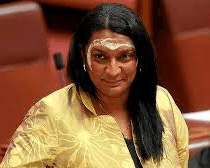
NACCHO members congratulate the first Aboriginal woman elected to Federal Parliament Senator Nova Peris on her maiden speech

NOVA

NOTHING IS IMPOSSIBLE TO THOSE WHO SEE THE INVISIBLE.

“To Aboriginal and Torres Strait Islander peoples this has always been part of our story of struggle, injustice and heartache. But we are here today – I am here today – because of this history. Aboriginal Australians are symbolic of triumph over adversity. We represent knowledge and wisdom held in land and country.”

Senator Nova Peris Canberra 13 Nov 2013

The chair of NACCHO Justinm Mohamed on behalf of the 150 Aboriginal Community Controlled Health Services members would like to congratulate Senator Nova Peris the first elected Aboriginal woman to the Federal Parliament.

Here is Nova’s maiden speech

Thank you Mr. President

I acknowledge the traditional owners, the Ngambri and Ngunnawal people on whose country we meet today — I pay my respects to my elders, past and present and to our future leaders.

I am Nova Maree Peris.

I was born in Darwin in the Northern Territory and I retain my strong cultural and spiritual ties to my country, to the Mother Earth.

I am a member of the oldest continuous surviving culture on earth.

I am proud that this hill we meet on here today is culturally significant to the Ngambri people as representing the womb of the ‘Woman’ on this Country.

It is very significant to me being the first Aboriginal woman elected to the Federal Parliament of Australia.

Through my mother, I am a descendant of the Gija people of the East Kimberley and the Yawuru people of the West Kimberley I am also Iwatja from Western Arnhem Land through my father.

Through my life I have come across many people from all walks of life who have inspired me.

Some through their wisdom; and others through their courage and their ability to overcome adversity.

But no one has inspired me more so than my grandmother. Nora Peris was a proud Giga woman – She was torn from her mother’s arms and lived on the Mission of Moola Bulla in the east Kimberley.

Moola Bulla is a long, sad and painful story” she used to say. This was home to her for 12 years. A river separated her and her traditional Aboriginal mother who was still living on country.

She always said they were so close — yet so far apart. My Nanna’s clothes were made from stitched together hessian bags. When the Second World War hit, the kids were released from the mission and for two years she walked and lived off the harsh Eastern Kimberly land.

These conditions and her will to survive shaped her; and it was there where she met my grandfather Johnny Peris. Johnny Peris was a Yawuru Man, a Beagle Bay mission survivor who was also a proud stockman. They met and had 10 children. Four of their children were taken away and sent to Garden Point Mission on the Tiwi Islands in the Northern Territory.

One of the four children who was taken and is here today is my mother, Joan Peris. She lived on the mission for eight years, she worked every day and never received a cent in pay. Mum became like a sister to many of the other children that were forcibly taken to the Garden Point mission.

Over the years, people have said to me that it’s incredible what I have achieved in sport. I have competed at some of the biggest sporting events on the planet.

Accolades, achievements and celebrations have been a part of my life. But in my heart, I know that part of my life is virtually meaningless compared to the ability to survive shown by my grandparents and my mother.

I cannot even imagine or comprehend how it would have felt to live life during those days.

These stories are part of the truth of Australia’s history.

It is what it is. The past is the past and no matter how hard we try we cannot change that history.

But let’s start to undo the wrongs with what is right and just. I urge all my Parliamentary colleagues to become champions for the recognition of Australia’s first nations people in our constitution.

To Aboriginal and Torres Strait Islander peoples this has always been part of our story of struggle, injustice and heartache. But we are here today – I am here today – because of this history. Aboriginal Australians are symbolic of triumph over adversity. We represent knowledge and wisdom held in land and country.

Because in our hearts we know that we do not own Mother Earth, the Earth owns us.

As a child growing up, I dreamt big.

Most people would have looked at an Aboriginal girl from the Territory, where the statistics of alcohol abuse, youth suicide, domestic violence, imprisonment rates and sub-standard education point to every reason why you should not succeed.

But I was determined to be successful.

And yes I am a product of that history, and I continue to live in a society whereby the odds are stacked against Aboriginal people.

I have always been inspired by those around me and my sister Venessa Peris has undertaken an incredible journey of her own.

She has lived an amazing and accomplished life serving Australia. She was a Corporal and served 10 years in the Australian Army. And last month she just completed 10 years with United Nations Peace Keeping Operations.

Venessa served seven years in the Ivory Coast and survived a West African Civil war and at one stage was involved in evacuating more than 4000 people.

She is currently carrying out her duties and resides in Monrovia, Liberia.

I say this to all of my Indigenous brothers and sisters, and to all people – within every one of us, lies the ability to reach deep inside ourselves and draw upon our inherited strength that our ancestors have given us. There lies a spirit that needs to be awakened.

Whilst I am obviously very proud of my Aboriginal heritage I want to make it clear that I do not consider myself an expert when it comes to finding solutions for Aboriginal and Torres Strait Islander people’s particular predicaments.

For too long we’ve all heard too many people say they have the answers for Aboriginal Australians and claim the moral high ground.

If the answers were as easily provided, as the questions are posed – we simply would not have a problem. In fact the answers are difficult and complex; but they do not lie in absolute positions and simplified slogans. Just delivering another Government program will not end the appalling rates of youth suicide in our communities for example. These are uncomfortable issues but they must be confronted.

But I have always been someone who has tried to do things, not just talk about them. I build things up, I don’t tear things down and I have lived by the view that ‘As much is given, much is expected’.

I have always been humbled and honoured to serve. It’s partly why I established the Nova Peris Girls Academy. I wanted to try to make a real difference to young disadvantaged Indigenous women.

Of course I have now ceased active involvement in the Academy but I remain the organisation’s Patron.

Like many before me, for too long, I have watched Aboriginal Australians and our plight be used purely for political purposes.

I have seen some totally unscrupulous people try to use the misery of some our people’s circumstances to promote their own cause and agenda.

Should I see this happen – I will call it for what it is—it’s racism—and I know that’s confronting—but I will not stand by in silence.

How we change things – that remains the challenge—but I know from my heart that nothing can be achieved without total determination and a gut-busting effort.

I have been fortunate enough to achieve at the Olympic levels of sport in hockey and athletics. I have experienced the total joy of winning gold medals for my country.

And I have lived the exciting life of an elite athlete—fussed over and entertained—in more than 50 countries around the world.

But I would swap all of that in a heartbeat – I would forgo any number of gold medals – to see Aboriginal Australians be free, healthy and participating fully in all that our great country has to offer.

It is my dream to see kids from Santa Theresa, from Gunbalanya, from Kalkarindji and the Tiwi Islands all with the same opportunity as the kids from the Eastern Suburbs of Sydney.

That is one of the reasons I am a fierce advocate for Aboriginal people being taught to be able to read and write English. We cannot and should not be denied these basic tools.

Of course we should never be forced to renounce our culture—our beliefs sustain our spirits—they nourish us but at some levels they can restrain us too—that is the collision point that confronts Aboriginal people.

I make the simple point that in spite of difficulties like those I’ve described we are seeing some positive health benefits through the dedication of Aboriginal and non-Aboriginal health professionals.

We can make a difference; whatever our differences. The Northern Territory is currently the only jurisdiction in Australia that is on track to meet the Closing the Gap target on life expectancy.

This improvement comes from people who have sought evidence, and put that evidence into action. They have not acted on any fixed ideology, but out of dedication and commitment.

This evidence based method of approach is in my view, a real road sign for the future and points the way to dealing with so many other areas of Aboriginal life that have seemed so intractable for so long.

This is why I will be seeking to work not only with my colleagues in the Labor Party, in holding the Government to account, but also with the current Government, to ensure we build on successes in primary health care—and to extend those successes into other areas of our lives.

Mr President – Education remains the major foundation for self improvement. And although education is a basic fundamental right of every child in this country, irrespective of their race. The fact remains we must work hard to convince people of the value of education.

I acknowledge I am a Senator elected to represent all Territorians— and I fully intend to discharge this duty to the best of my ability and I will always put our concerns – the concerns of Territorians first and foremost.

I believe it is my duty and the duty of all members elected to the Parliament to answer questions and deal with issues honestly and openly.

One such matter that is a very contentious issue is the location of Australia’s proposed nuclear waste facility. Recently my Larrakia uncle Eric Fejo who is also here today spoke about the previous Government’s decision to locate the proposed nuclear waste facility on Muckaty Station in the Barkly region of the Northern Territory.

He reminded a public forum that during the Apology to the Stolen Generations it was stated that Governments were wrong to make laws and policies that inflict profound grief, suffering and loss on Aboriginal people.

That is what the Muckaty decision is currently doing. It is dividing a community of traditional owners. This policy is inflicting grief.

I strongly urge my fellow parliamentary colleagues to reconsider their support for the current location of this facility.

Of course Australia needs a nuclear waste management facility. But its location must be based on science not politics.

Mr President I do intend to finish my speech on a positive note.

The art of Aboriginal and Torres Strait Islander people is stunning. It is truly a gift to Australian culture. The outfit that I am wearing today is made in the Northern Territory – this beautiful gold silk fabric – featuring dancing brolgas was printed at Injalak Arts in Gunbalunya in Western Arnhem Land. It was made by my Dripstone High School friend Sarina Cowcher in Darwin. I also wore a Gracie Kumbi Merrepen printed design for my official swearing in yesterday.

I am a Territory Girl. I am immensely proud of who I am and where I hail from. It is majestic. The Northern Territory’s very talented musicians, our artists, our sports men and women. Our culture, our iconic and diverse landscape that boasts a number of world heritage listings.

There is certainly is no other place I would rather call home.

I want to thank the members of the Australian Labor Party and particularly those members of the Northern Territory Branch. In particular I thank Party President Matthew Gardiner and Party Secretary Kent Rowe.

I acknowledge all of my friends & family here today, my mother Joan Peris, my aunty Tanya, my bunyi Jimmy Cooper from Minjilang who walked me into the chamber.

Also here today are Aunty Eileen Hoosan and Aunty Pat Anderson. To my Children – Jessica, Destiny and Jack and grandson Issac – we may often find life difficult and challenging – but we always stick together, knowing wherever life’s journey leads us – we will all be true to ourselves.

To my husband Scott, I thank you for you unconditional love and support over the past years. As they say beyond each storm you will find the rainbow. Today is a rainbow. I thank you.

Viva la Vida.

I want to acknowledge Dr Ric Charlesworth, also a former member of Parliament, one of the greatest hockey players in the world, and now coach; he was one of my life mentors.

In the Hockeyroos team we had a mantra that took us to the gold medal.

This was loosely based on John F. Kennedy’s famous space program speech.

“We choose to go to the Olympics. We choose to go to the Olympics in this decade and do the other things, not because they are easy, but because they are hard, because that goal will serve to organise and measure the best of our energies and skills, because that challenge is one that we are willing to accept, one we are unwilling to postpone, and one which we intend to win.”

I also want to mention the legendary Muhammad Ali. I was lucky enough to spend a day with him, and after several hours I worked up the to courage to ask him: “What makes millions of people love and admire you so much?” He simply replied: “Never look down upon those who look up to you.”

These are the people who taught and continue to teach me the right values that have enabled me to achieve so much in life.

I also particularly thank former Prime Minister Julia Gillard from the bottom of my heart for her faith in me and for giving me the chance to become involved – my duty now is to work hard and make a real difference.

Mr President – when Dr Martin Luther King spoke of his dream in Washington it inspired millions across the world. I believe everybody has the capacity to dream – we all have the capacity to believe – but very few get the actual opportunity that I have before me now – I urge everybody – particularly young people – to pursue your dreams.

In this next stage of my life I hope to make all those who have had faith in me, every reason to continue to believe in the power of those dreams.

I would just like to close today with a story that has stayed in my heart for many years.

At the 2000 Sydney Olympics there were hundreds of very excited and enthusiastic volunteers. An elderly man was amongst them at the athletics track and he greeted me and wished me well each day that I ran.

One the evening of the semi-finals of the 4x400m he didn’t say anything, he just handed me a piece of paper and said: “Read this just before you enter the stadium”. I put it in my pocket and proceeded to the check-in and then walked with my team-mates, Tamsyn Lewis, Susan Andrews and Jana Pitman.

We were without Cathy Freeman that evening and we had to finish in the top two to reach the Olympic final. We all felt the weight of Australian expectation resting on our shoulders, our adrenaline was pumping and we did our best to stay cool. We walked into the stadium to be greeted by 110,000 screaming sporting enthusiasts.

I reached into my pocket and read the words on the paper.

“NOTHING IS IMPOSSIBLE TO THOSE WHO SEE THE INVISIBLE.”

I did not really know what it meant, and I didn’t have much time to reflect on it. But it seemed to inspire me, those words written by a kind elderly man. The four of us went out that evening and ran the race of our lives. I anchored the team and we broke a 23-year-old Australian record. And we made it into the Olympic final.

I returned to the warm up track where he greeted me with a big hug. And I asked him what does it mean? He simply replied: “It was my ticket to freedom, I thought about it every day that I was held captive” … It turned out he was a former prisoner of war!

Ma, Bor Bor

NACCHO political news: Tony Abbott PM says Australia can have an Aboriginal Prime Minister one day

44th Parliament

Prime Minister Tony Abbott address at the Welcome to Country Ceremony, Parliament House

And response from Opposition Leader Bill Shorten Welcome To Country – Response

SOURCE OF PICTURE NEWS LTD

Prime Minister Tony Abbott

This Parliament always has great work to do: to secure our borders, to balance our budget, to strengthen our economy, to the relief of families and for the protection of jobs.

But if we are to do great things, we must begin them well. We must begin them well.

We must acknowledge the extended family of the Australian nation.

We must acknowledge and celebrate the essential unity of the Australian people.

It’s Noel Pearson, a great indigenous leader and a prophet for our times, who has observed that Australia is the product of a British and an indigenous heritage. This Parliament is redolent of our British heritage. But only recently has this Parliament acknowledged our indigenous heritage.

The first Parliament to meet here in this city 86 years ago was opened by the Duke of York. There was one indigenous person present that day. Matilda has already recalled the presence on that day of a local man, Jimmy Clements. And that man on the side of the ceremony was every bit as much a symbol of unity as the representative of the Crown, because Jimmy Clements, although unacknowledged that day, carried with him an Australian flag.

Haven’t we changed over 86 years? Haven’t we come a long way? This city has come a long way. Our country has come a long way. And this Parliament has come a very long way indeed.

We have had indigenous members of this Parliament.

We have in Ken Wyatt, the first indigenous member of the House of Representatives.

In this term of Parliament we have in Nova Peris the first female indigenous member of this Parliament.

Two indigenous members of this Parliament, in this, the 44 h Parliament of our country.

May that number increase. May we one day, not too far off, have an indigenous Prime Minister

Who would have thought that the Northern Territory would have an indigenous Chief Minister?

But if we can have our first female Senator, indigenous Senator, our first indigenous Member of the House of Representatives, if we can have an indigenous Chief Minister of the Northern Territory, we certainly can have an indigenous Prime Minister of this country and we certainly can have in this Parliament, or the next, full recognition of indigenous people in the Constitution of our country.

There is much that I dispute with my predecessor as Prime Minister, Mr Kevin Rudd, but I honour him for the historic apology to indigenous people that took place at the opening of this Parliament in 2008 and I honour him for including this indigenous element in the rituals of our Parliament, which is so fittingly now a part of the opening of a new parliamentary term.

WELCOME TO COUNTRY – RESPONSE (FED)

Opposition Leader Bill Shorten Welcome To Country – Response

Can I thank Matilda for the Welcome to Country and also to everyone here for the sharing the traditional music and dancing of this land with us.

I’d like to begin by acknowledging the traditional owners of the land we are meeting on today, and the long and continuing relationship between Indigenous peoples and their Country.

I would like to pay my respects to Elders both past and present – especially those Elders here with us today.

Can I also acknowledge the Prime Minister, the Leader of the Senate, many of my colleagues from the House and Senators who are joining us on this occasion.
And to welcome everyone else who is here with us today – I know some of you have travelled a long way to join us.

We meet today with hope for the future.

We have that hope because of what we’ve achieved in this place in recent years.

It is here that we stood together and committed to close the gap between Indigenous and non-Indigenous Australians – and the gap is closing.

It is here that we committed to formally recognise our first peoples in our founding document – the Constitution – a cause we continue into this Parliament.

It is here that a Prime Minister and a nation said sorry – and started a new relationship with Aboriginal people – one based on respect and reconciliation.

I know that there is much still to do – and it’s with this new spirit of reconciliation that we stand together today and reaffirm our commitment to do more.

Because this work doesn’t end with each Parliament. It transcends parliaments and it transcends politics.

I stand proud to serve in the Parliament of a country where the wonderful, important gesture such as we have seen today is common practice at events from the beginning of a new parliament, or at ANZAC Day services, or at school assemblies.

Together, I am confident we can make sure that the 44th Parliament of Australia can both honour this past, and push forward to ensure that the future will be a bright one for all Australians – Indigenous and non-Indigenous Australians alike.

Once again Matilda, thank you for the Welcome to Country.

NACCHO Aboriginal health news alert: Aboriginal population will soar to more than one million in the next 20 years.Download the report here

SNAICC

Dr Biddle said the indigenous population was likely to become “more urban and older”. He warned that “it won’t come without costs, as certain determinants of indigenous wellbeing, like cultural participation, language usage and acquisition and maintenance of country, will be more difficult to maintain.”

THE number of Aborigines and Torres Strait Islanders will soar to more than one million in the next 20 years, as the indigenous population rapidly ages and becomes more urbanised.

Report edited from the AUSTRALIAN PATRICIA KARVELAS Follow @PatKarvelas

A groundbreaking report,  released this month, predicts that the fastest indigenous population growth will be in Brisbane, Rockhampton, Cairns, southwestern Western Australia, South Headland, Townsville and Mackay.

DOWNLOAD THE REPORT HERE

The report forecasts that the indigenous population will grow from about 670,000 in 2011 to about 1.06 million by 2031, an increase of about 59 per cent, compared with an increase of about 20 per cent for the non-indigenous population.

NACCHO0024-1280x1024

FOR MORE INFORMATION ABOUT THE NACCHO  HEALTHY FUTURES PLAN 2030

From making up about 3 per cent of the total population in 2011, indigenous people will comprise 3.9 per cent by 2031.

The paper, by the Australian National University’s Nicholas Biddle, finds that even excluding changes in whether people identify as indigenous, the regions in Queensland and Western Australia are projected to grow by at least 3 per cent a year.

Four regions — Apatula, Tennant Creek, Katherine and northwestern NSW — are projected to grow by less than 1 per cent per year over the period.

The indigenous population is projected to become much more urban over the next 20 years. In 2011, the indigenous population of Brisbane was estimated to be 65,000. This is slightly less than the roughly 69,000 indigenous people estimated to live in the whole of the Northern Territory.

By 2031, the Brisbane region is projected to have an indigenous population of a little more than 132,000 people, about 50 per cent more than the Northern Territory, with a little less than 89,000.

Although the total indigenous population is projected to grow by 59 per cent between 2011 and 2031, the population up until age 24 is only projected to grow by 47 per cent. This is still faster than the equivalent projection for the non-indigenous population in that age group, but is much slower than the indigenous population aged 65 and older, which is projected to grow by 200 per cent.

The 65-and-older cohort is forecast to comprise 6.4 per cent of the indigenous population in 2031, compared with about 3.4 per cent at the 2011 census.

This could have profound financial implications, as low rates of employment are likely to mean that indigenous retirees have far less in savings than their non-indigenous counterparts. It is also likely to have implications for health and disability policy.

Dr Biddle said there were two main reasons for the relatively rapid projected growth, including migration from non-urban to urban Australia, and high rates of intermarriage between indigenous and non-indigenous Australians. “As the children of these partnerships tend to be identified as indigenous, there is therefore an additional contribution to growth.”

He said that even in the regions with the slowest growth, the indigenous population was likely to grow faster than the non-indigenous population.

The report, funded by the federal government, warns that a rapidly growing indigenous population could put budget pressures on programs. “For programs that are funded on a fixed-dollar basis per person, a large growth in the eligible indigenous population could mean that the cost of the program would need to be either increased or spread across a greater number of people,” it says.

Dr Biddle said the indigenous population was likely to become “more urban and older”. He warned that “it won’t come without costs, as certain determinants of indigenous wellbeing, like cultural participation, language usage and acquisition and maintenance of country, will be more difficult to maintain.”

NACCHO Aboriginal Employment and Training news: Opportunity to report to the PM Tony Abbott on Aboriginal health employment and training needs

2013_CCHEP launch

Jobs are the key to improving opportunities for all Australians.

It would be a shame to miss this great opportunity to put the focus on Aboriginal community controlled health and away from the mining sector.

Here is your opportunity to tell the Prime Minister of Australia, the Hon Tony Abbott MP your needs in the Aboriginal Community Controlled Health Sector.Picture above Congress Alice Springs

STAKEHOLDERS MEETING DATES BELOW

Or written submissions close 31 December  2013

DETAILS HERE

The Commonwealth Government believes more needs to be done to boost Indigenous employment and support Indigenous Australians to get ahead.

All Australians yearn to see practical and genuine improvement in the lives of Indigenous people.

Too often, employment and training programmes provide ‘training for training’s sake’ without the practical skills that people need to fill the jobs that exist.

To address this, the Prime Minister of Australia, the Hon Tony Abbott MP, has asked Mr Andrew Forrest to lead a Review of Indigenous Training and Employment Programmes.

This Review will report to the Prime Minister in April 2014, providing practical recommendations to ensure Indigenous training and employment services are targeted and administered to connect unemployed Indigenous people with real and sustainable jobs.

It will consider ways to dramatically improve how services can better respond to employers who want to provide sustainable employment and end the cycle of Indigenous disadvantage. Innovative approaches that secure real jobs will be central to the Review, including practical life training and mentoring.

The Parliamentary Secretary to the Prime Minster, the Hon Alan Tudge MP, will guide and shape the Review process with Mr Forrest.

Date for consultations

Perth Friday 15 November 2013 …9.45am – 11.15am Perth Convention Centre 21 Mounts Bay Rd, Perth

Adelaide Tuesday 19 November 2013…9.45am – 11.15am Adelaide Convention Centre North Terrace, Adelaide

 Alice Springs Tuesday 19 November 2013…3.45pm – 5.15pm Alice Springs Convention Centre 93 Barrett Dr, Alice Springs

Kununurra Wednesday 20 November 2013…9.45am – 11.15am Ord River Sports Club Chestnut Dr, Kununurra

 Darwin Wednesday 20 November 2013…5.30pm – 7.00pm Darwin Convention Centre Stokes Hill Rd, Darwin

Brisbane Thursday 21 November 2013…9.45am – 11.15am Brisbane City Hall 64 Adelaide St, Brisbane

 Sydney Thursday 21 November 2013…5.15pm – 6.45pm Masonic Conference Centre 66 Goulburn St, Sydney

Melbourne Friday 22 November 2013…9.45am – 11.15am Melbourne Town Hall Cnr Swanston and Collins Street, Melbourne

There is so much goodwill from employers.

The challenge, though, is to convert good intentions into practical change for the better.

As Chair of the Review, Mr Forrest is looking for breakthrough ideas to, once and for all, end the disparity in employment for Indigenous Australians. Your input is vital. In order to realise real change, new and sustainable solutions are needed.

To have your say, you may wish to participate in a meeting with Mr Forrest and the Review team, or lodge a concise written submission.

Further information is provided at How to get involved. This website will be updated regularly to include details of meetings and how to participate.

Are you interested in working in Aboriginal health at a national level?

NACCHO0024-1280x1024

Are you interested in working in Aboriginal health?

NACCHO is the national authority in comprehensive Aboriginal primary health care currently has a wide range of job opportunities in the pipeline.

Current NACCHO job opportunities