NACCHO Aboriginal Health and #Smoking : @TheMJA #npc Mass-reach #anti-smoking campaigns must return

Disadvantaged groups are and should be a key focus of action to reduce smoking further. This has long been recognised, including in the report of the National Preventative Health Taskforce, which specifically called for action in relation to Aboriginal and Torres Strait Islander people and other highly disadvantaged groups, such as people with mental health problems,”

The evidence tells us that we need a mix of approaches. We need whole-of-community approaches, with measures such as tax increases and strong mass media campaigns, which benefit disadvantaged groups disproportionately. We also need specific targeted approaches, as this article notes: the Talking About the Smokes project and the Tackling Indigenous Smoking program have played valuable role in complementing mainstream activity.”

 Professor Mike Daube, professor of health policy at Curtin University, welcomed calls for further action on smoking prevalence in disadvantaged groups, and said that a mix of approaches was needed. Professor Daube told MJA InSight.

Read over 100 NACCHO Smoking articles published in past 5 years

NACCHO Aboriginal Health and Smoking : Download Tackling Indigenous Smoking Program prelim. evaluation report

TARGETED tobacco control strategies are urgently needed to tackle the “remarkably high” smoking rates in some high-risk groups, according to Australian authors, but leading public health experts say reinstatement of mass-reach campaigns should be a priority.

Writing in the MJA, Professor Billie Bonevski, a health behaviour scientist and researcher at the University of Newcastle, and co-authors said that the overall smoking prevalence in Australia was now 14%, but among population subgroups, such as those with severe mental illness and those who had been recently incarcerated, the rates were upwards of 67%.

Tobacco use among Aboriginal and Torres Strait Islander people also remained high, with the prevalence among Indigenous people aged 15 years and older being about 39% in 2014–15.

Listen to Podcast HERE

The authors said that a truly comprehensive approach to tobacco control should include targeted campaigns in high smoking prevalence populations.

“If we are truly concerned about this issue, we must focus more attention on the groups that are being left behind,” they wrote.

Novel, targeted interventions and increased delivery of evidence-based interventions was needed, the authors said, noting that tobacco harm reduction strategies, such as vaporised nicotine, should also be further investigated.

In an MJA InSight podcast, lead author Professor Bonevski said that smoking was still “almost … socially acceptable” in some subgroups, such as those from low socio-economic populations.

“People who have lower incomes end up smoking from a younger age and, by the time they reach adulthood, they are more heavily nicotine dependent and … it becomes much harder to quit,” she said. “This is a vicious cycle in terms of socio-economic status contributing to high smoking rates, and then high smoking rates contributing to poor health, and then poor health keeping you in that low socio-economic status group, and so on.”

Professor Simon Chapman, Emeritus Professor in the University of Sydney’s School of Public Health, said that targeting high smoking prevalence subgroups sounded sensible “until we unpack what targeting involves”.

“The world-acclaimed, highly successful Australian national Quit campaign has been scandalously mothballed since 2013. So, talk of fracturing what is now a zero-budgeted, non-operational population-wide campaign into multiple targeted campaigns is currently a ‘brave’ call,” he said.

Professor Chapman said that Australia’s main goal should be to restore our “family silver”: properly funded, mass reach campaigns that reach all subgroups.

He pointed to research, published in 2014, that found that the decline in smoking prevalence in Australia – from 23.6% in 2001 to 17.3% in 2011 – was largely due (76%) to stronger smoke-free laws, tobacco price increases and greater exposure to mass media campaigns.

Professor Chapman said that higher smoking rates among disadvantaged groups were more likely to be explained by higher uptake, than by failure to quit.

He noted that 22.7% of the most disadvantaged people were ex-smokers, versus 26.9% of the least disadvantaged. “But only 53.5% of the least disadvantaged people have never smoked, compared with 62.9% of the most advantaged,” he said.

Professor Chapman said that labour-intensive interventions were inefficient in preventing uptake among young people.

“It remains the case that most kids who don’t start smoking and most smokers who quit do not attribute their status to a discrete intervention,” he said.

Professor Mike Daube, professor of health policy at Curtin University, welcomed calls for further action on smoking prevalence in disadvantaged groups, and said that a mix of approaches was needed.

See opening statement


Professor Daube said that strong action at the public policy and health system levels was crucial.

“At the policy level, this should include immediate resumption by the federal government of national mass media campaigns, which have, incomprehensibly, been absent over the past 4 years; and action to combat the tobacco industry’s cynical strategies to counter the impacts of tax increases and plain packaging,” he said.

“We also need more than lip service within health systems about the physical health of people with mental health problems, not least through support and assistance in quitting smoking. There are some who try, but they are the exception.”

Professor Daube said that the suggestion that vaporised nicotine may play a role in reducing smoking was “very speculative”, and still “some way ahead of the evidence”.

“[We] should await any determination by the [Therapeutic Goods Administration] as to their safety and efficacy,” he said.

Earlier in 2017, the TGA decided to uphold the ban on vaporised nicotine in e-cigarettes in Australia

Aboriginal Health conferences and events #SaveAdate #HearingAwarenessWeek #NACCHOAgm2017 #OchreDay2017 @NATSIHWA

21 August Hearing Awareness week

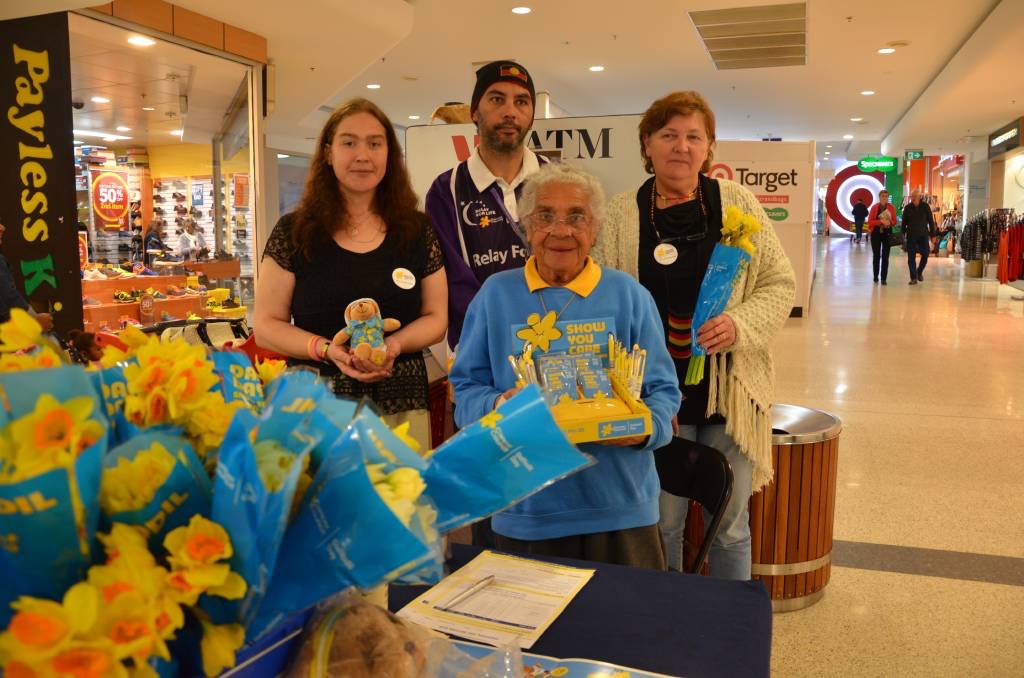
25 August : Daffodil Days Information for Aboriginal and Torres Strait Islanders

3 September  : Clintons Walk for Justice arrives in Canberra

6 September Brisbane One Day NATSIHWA Workshop QLD Forum

4 -10 September National Stroke Week, the Stroke Foundation’s annual awareness campaign is taking place

12 – 14 September SNAICC National Conference

13 September : Webinar Reducing the mental health impact of Indigenous incarceration on people, communities and services

20-23 September : AIDA Conference 2017

29 Sept : Closing the Prison Gap Focus on the Children Tweed Heads NSW

4- 5 October Aboriginal Male Health Ochre Day Darwin NT

9- 10 October  : Indigenous Affairs and Public Administration Conference : Can’t we do better?

10 October  : CATSINAM Professional Development Conference Gold Coast

18 -20 October  : 35th Annual CRANAplus Conference Broome

20 October : ‘Most influential’ health leaders to appear in key forum at major rural medicine conference

18- 20 October First 1000 Days Summit Abstracts close August 11

26-27 October  :Diabetes and cardiovascular research, stroke and maternal and child health issues.

31 October2 Nov  :NACCHO AGM Members Meeting Canberra ABSTRACTS close 21st August 2017

15 November  One Day NATSIHWA Workshop SA Forum

14- 15 November  : 6th Annual NHMRC Symposium on Research Translation.

15 -18 November  :National Conference on Incontinence Scholarship Opportunity close 1 September

27-30 November  :Indigenous Allied Health Australia : IAHA Conference Perth

14 December Shepparton  One Day NATSIHWA Workshop VIC Forum

11-12 April 2018  :6th Rural and Remote Health Scientific Symposium  Canberra call for extracts

If you have a Conference, Workshop Funding opportunity or event and wish to share and promote contact

Colin Cowell NACCHO Media Mobile 0401 331 251

Send to NACCHO Social  Media

mailto:nacchonews@naccho.org.au


NACCHO CONFERENCE WEBSITE


21 August Hearing Awareness Week

Hearing awareness week is a good time to reflect on the impact of poor hearing. Unfortunately we get so involved in social outcomes; we are often bombarded with information and misinformation.

I admit I am so intense with ears, to the point were I can have a conversation and lose my friend from talking too much “medicine”. I thought it might be nice to go back to basics to help the understanding for the community.”

Dr Kelvin Kong, an ear, nose and throat specialist gives us the score on Otitis Media and the importance on ear health for Hearing Awareness Week writing for  IndigenousX   in 2016

25 August  :Daffodil Days Information for Aboriginal and Torres Strait Islanders

 Cancer Council NSW and Menzies School of Health Research have developed fact sheets about cancer for Aboriginal and Torres Strait Islander people. These resources were also developed in conjunction with a Clinical Advisory Group and an Indigenous Consultation Group. They include information on cancer types, treatment and common cancer terms. Picture above :Dubbo Aboriginal support group

Cancer terms

What is cancer?

Provides information on cancer facts, cancer growth, differences between tumours and who you can speak to after a diagnosis.

Understanding cancer talk

This fact sheet offers a glossary of key terms doctors may use about cancer, treatment and the roles of people who work with cancer.


Cancer types

The following booklets will help explain to you the cancer type, how it will be diagnosed, the treatment you may have and its effects on your body.


Cancer treatment

Surgery

Explains what surgery is, the different types, why it is used in cancer treatment and short and long term effects.

Radiotherapy

This fact sheet explains radiotherapy as a cancer treatment, why it is needed, how it is given and how it will affect your body.

Chemotherapy

Provides information on chemotherapy as a cancer treatment, explains how it works and the effects treatment may have on you.


Cancer support

What men should know about cancer

This fact sheet has information on common cancers that affect men including symptoms to look for.

Help getting to treatment

Gives tips for getting to and from your cancer treatment with your own care or with community transport.

Help with money

This fact sheets provides tips for help with money issues including hardship programs, concessions and loans.

How can I help?

This fact sheet gives tips on how to support family or friends with cancer including practical help and emotional support.

For more information

View more Cancer Booklets including information on treatment making decision and links to professional and community support.

For support and information on cancer and cancer-related issues, call Cancer Council 13 11 20. This is a confidential service.

How you can help

You can support Cancer Council by:

  • volunteering your time
  • participating in an event or
  • making a donation to help fund our cancer research, education and support services

3 September  : Clintons Walk for Justice arrives in Canberra

We all have come a long way and now it time we finish this off and do why we went on this journey in the first place.

The walk well live on and the name the spirit walker well live on when I go and pass on. A man who walk across a country bring hope and change and all the way to capital city to tell men in suit to change they way because he believe and he believe in a dream could made a difference.

Clintons Facebook Page

6 September Brisbane One Day Workshop QLD Forum

National Aboriginal and Torres Strait Islander Health Workers Association (NATSIHWA) 

Join the National Aboriginal and Torres Strait Islander Health Workers Association (NATSIHWA) for a one day CPD networking workshop focussed on current workforce development opportunities.

Upskill and strengthen your skill level in a specialised area and find out what is happening through program development, education and funding opportunities.

Hear from organisations such as: PHN Primary Heath Network, CranaPlus, Autism QLD, Rheumatic Heart, PEPA Program of Experience in the Palliative Approach, Diabetes Australia, IBA Indigenous Business Australia, HESTA Superannuation, 1800 RESPECT, Hearing Australia and more to be annuonced in the coming months (tailored for your specific region).

Register Here

4 -10 September National Stroke Week, the Stroke Foundation’s annual awareness campaign is taking place

National Stroke Week, the Stroke Foundation’s annual awareness campaign is taking place 4 to 10 September 2017.

Australians are being asked to join the FAST response team by knowing the signs of stroke. Paramedics, nurses and doctors can only treat stroke if Australians recognise the signs of stroke and call 000 immediately.

Could your community recognise the signs of stroke F.A.S.T?

Face – Check their face. Has their mouth drooped?
Arms – Can they lift both arms?
Speech – Is their speech slurred? Do they understand you?
Time – Time is critical. If you see any of these symptoms Act FAST and call 000.

Sharing the FAST message with those around you could save their life.

REGISTER online to get your FREE Stroke Week kit

Once you register you will be sent a FREE Stroke Week kit including posters, campaign booklet and resources to support your activity.

Click here to register now.

What does an awareness activity involve?

  • Set up a public awareness display in your local shopping centre.
  • Host a public morning/afternoon tea.
  • Organise a healthy event i.e. social walk around the park or a healthy bake sale.
  • You can also add a health check to your activity. We provide the tools to make this simple.

Visit www.strokefoundation.org.au/strokeweek for more details.

Join the FAST response team for National Stroke Week.

12 – 14 September SNAICC National Conference

Includes 2 pre-conference masterclasses, 3 plenaries, 56 concurrent sessions, and a social/cultural program.

Register now!

13 September : Webinar Reducing the mental health impact of Indigenous incarceration on people, communities and services

Developed in consultation with NACCHO and produced by the Mental Health Professionals’ Network a federally funded initiative

Join our interdisciplinary panel as we explore a collaborative approach to reducing the mental health impact of Indigenous incarceration on people, communities and services.

The webinar format will include a facilitated question and answer session between panel members exploring key issues and impacts of incarceration on individuals, families and communities.

The panel will discuss strategies to enhance cultural awareness and develop responsive services for Indigenous communities affected by incarceration. Strategies to increase self-esteem and enhance emotional, physical and spiritual wellbeing of individuals will also be explored.

When: Wednesday 13th September, 2017

Time: 4.30pm – 5.45pm (AEST)

Where: Online – via your computer, tablet or mobile

Cost: Free

Panel:

  • Dr Mark Wenitong (Medical Advisor based in QLD)
  • Dr Marshall Watson (Psychiatrist based in SA)
  • Dr Jeffrey Nelson (Clinical Psychologist based in QLD)
  • Julie Tongs (OAM) (CEO Winnunga Nimmityjah Aboriginal Health Service – Narrabundah ACT)

Facilitator:

  • Dr Mary Emeleus (General Practitioner and Psychotherapist based in QLD)

Read more about our panel.

Learning Outcomes:

Through an exploration of incarceration, the webinar will provide participants with the opportunity to:

  • Describe key issues and impacts of incarceration on individuals, families and communities
  • Develop strategies to enhance culturally aware and responsive services for Indigenous people and communities affected by incarceration
  • Identify strategies to increase self-esteem and enhance emotional, physical and spiritual wellbeing

Before the webinar:

Register HERE


20-23 September AIDA Conference 2017

The AIDA Conference in 2017 will celebrate 20 years since the inception of AIDA. Through the theme Family. Unity. Success. 20 years strong we will reflect on the successes that have been achieved over the last 20 years by being a family and being united. We will also look to the future for AIDA and consider how being a united family will help us achieve all the work that still needs to be done in growing our Indigenous medical students, doctors, medical academics and specialists and achieving better health outcomes for Aboriginal and Torres Strait Islander people.

This conference will be an opportunity to bring together our members, guests, speakers and partners from across the sector to share in the reflection on the past and considerations for the future. The conference will also provide a platform to share our individual stories, experiences and achievements in a culturally safe environment.

Conference website

29 Sept : Closing the Prison Gap Focus on the Children Tweed Heads NSW

  • Emeritus Professor Judy Atkinson and Margaret Hayes will “Focus on the Children”, describing their work with young people excluded from mainstream schools due to their behaviour.
  • Leanne Phillips and Cathy Stillwell will talk about “Healing the Womyn Healing the Child”
  • Jyi Lawnton and Casey Bird will describe “Indigenous Policy and the Scientific Gaze”
  • Chris Lee and Associate Professor Helen Farley discuss “Making the Connection”, the use of technology to address the issues of literacy and numeracy in juvenile justice settings
  • Dr Anthea Krieg will talk about her work in Ceduna, South Australia, coordinating services to prevent incarceration of First Nations children.

More info bookings Website

30 Sept : The 2017 Human Rights Photography competition 

The 2017 Human Rights Photography competition is now open to children and adults around the country, with a $600 camera prize up for grabs for the most outstanding image!

For almost a decade, the Australian Human Rights Commission has been holding photo competitions every couple of years. Our last competition attracted a record 450 entries.

Photography is a powerful medium with a long history in the promotion and advancement of human rights around the world. Photos foster empathy for the suffering and experience of others, community engagement and positive social change. No one can forget the impact of photos such as Nick Ut’s famous photo The Terror of War of child Kim Phuc after a napalm attack during the Vietnam War.

Our focus for this year’s competition will be the experiences of people at home. The theme for the 2017 competition is Home, inspired by Eleanor Roosevelt’s famous quote “Where, after all, do universal human rights begin? In small places, close to home…

The shortlisted and winning photos to be displayed at the 2017 Human Rights Awards on 8 December in Sydney.

So, what are you waiting for?

About the competition

  • Enter at https://photocompetition.humanrights.gov.au/
  • There will be two categories for entries: Under 18 and 18 & over.
  • Overall winners will receive their prizes at the 2017 Human Rights Awards on December 8 in Sydney. A selection of photos from the Competition will also be on display.
  • Main prizes worth $600.
  • The competition will close on 30 September 2017.

If you have a query about the competition, please email photocomp@humanrights.gov.au

Photo Credit: Nimboi’s Bat by Sean Spencer, from the 2011 competition.

4- 5 October Aboriginal Male Health Ochre Day Darwin NT  

2017 Ochre Day Registration

Where: Darwin
When: 4th & 5th October 2017

This year NACCHO is pleased to announce the annual NACCHO Ochre Day will be held in Darwin during October 2017.

Beginning in 2013, Ochre Day is an important NACCHO Aboriginal male health initiative. Aboriginal males have arguably the worst health outcomes of any population group in Australia.

NACCHO has long recognised the importance of addressing Aboriginal male health as part of Close the Gap by 2030.

All information provided in registering for the NACCHO Ochre Day remains entirely confidential and will only be used to assist with planning i.e. catering etc.

  • There is no registration cost to attend the NACCHO Ochre Day (Day One or Two)
  • All Delegates will be provided breakfast & lunch on Day One and morning & afternoon tea as well as lunch on Day Two.
  • All Delegates are responsible for paying for and organising your own travel and accommodation.

For further information please contact Kyrn Stevens:
Phone: 08 8942 5400
Email: naccho.ochre@ddhs.org.au

Each Delegate is required to complete a separate applicatiom

REGISTER HERE 

9- 10 October Indigenous Affairs and Public Administration Conference : Can’t we do better?


This year marks 50 years since the 1967 referendum resulted in the Commonwealth gaining national responsibilities for the administration of Indigenous affairs. This is a shared responsibility with state and territory administrations.

Website

ANZSOG and the Department of the Prime Minister and Cabinet are providing travel support and waiving conference fees for Aboriginal and Torres Strait Islander community leaders and public servants attending the conference from remote locations.

To enquire about your eligibility, please contact conference2017@anzsog.edu.au

In partnership, the Department of the Prime Minister and Cabinet (DPMC), the University of Sydney, and the Australia and New Zealand School of Government (ANZSOG) are holding an international conference that questions the impact of the past 50 years of public administration and raise issues for the next 50 years in this important nation building area.

DPMC is seeking to build and foster a public canon of knowledge to open the history of Indigenous policy and administrative practice to greater scrutiny and discussion.

The Indigenous Affairs and Public Administration Conference will be attended by Aboriginal and Torres Strait Islander representatives, other Indigenous peoples, public servants from state and federal governments, and the academic community.

 The conference will feature a range of guest presenters, including Australia’s Chris Sarra, Andrea Mason and Martin Nakata, New Zealand’s Arapata Hakiwai and Geraint Martin, as well as other international speakers.

The deliberations and discussions of the conference will feed into a final report that will be used to guide Federal government policy formation at a series of roundtables in late 2017 and early 2018.

REGISTER

2017 Indigenous Affairs and Public Administration Conference

October 9-10
The Refectory, University of Sydney

October 9, 6:00pm – 9:30pm: Pre-conference dinner
October 10, 8:30am – 5:00pm: Conference

Cost:

Early bird tickets (until September 1): $150
Regular tickets: $250
Full time PhD student concession tickets: $25

Register Here

10 October CATSINAM Professional Development Conference Gold Coast

catsinam

Contact info for CATSINAM

18 -20 October 35th Annual CRANAplus Conference Broome

We are pleased to announce the 35th Annual CRANAplus Conference will be held at Cable Beach Club Resort and Spa in Broome, Western Australia, from 18 to 20 October 2017.

THE FUTURE OF REMOTE HEALTH AND THE INFLUENCE OF TECHNOLOGY

Since the organisation’s inception in 1982 this event has served to create an opportunity for likeminded remote and isolated health individuals who can network, connect and share.

It serves as both a professional and social resource for the Remote and Isolated Health Workforce of Australia.

We aim to offer an environment that will foster new ideas, promote collegiate relationships, provide opportunities for professional development and celebrate remote health practice.

Conference Website

18- 20 October First 1000 Days Summit


The First 1000 Days Australia Summit is a three-day event that will bring together Aboriginal and Torres Strait Islander Elders, researchers, community members, front- line workers and policy makers involved in areas relevant to the work of First 1000 Days Australia. Lectures, panel discussions and workshops will address topics such as caring and parenting, infant and child development, family strengthening, implementation and translation, as well as a number of other areas.

The theme for the Summit is ‘Celebrating our leadership, strengthening our families’. We invite interested presenters to submit abstracts for oral presentations, workshops and posters that align with the aims, principles and research areas of First 1000 Days Australia, and of First 1,000 Days international.

20 October : ‘Most influential’ health leaders to appear in key forum at major rural medicine conference 


‘Most influential’ health leaders to appear in key forum at major rural medicine conference

RMA Presidents’ Breakfast
Friday 20 October 2017
Pullman Albert Park, Melbourne


www.ruralmedicineaustralia.com.au

Australia’s most influential health leaders will discuss critical health policy issues in a key Presidents’ Breakfast forum at the Rural Medicine Australia 2017 conference, to be held in Melbourne in October.Dr Ewen McPhee, President of the Rural Doctors Association of Australia (RDAA), will host the forum and will be joined on the panel by Associate Professor Ruth Stewart, President of the Australian College of Rural and Remote Medicine (ACRRM); Dr Bastian Seidel, President of the Royal Australian College of General Practitioners (RACGP); and Dr Tony Bartone, Vice President of the Australian Medical Association (AMA).

26-27 October Diabetes and cardiovascular research, stroke and maternal and child health issues.

‘Translation at the Centre’ An educational symposium

Alice Springs Convention Centre, Alice Springs

This year the Symposium will look at research translation as well as the latest on diabetes and cardiovascular research, stroke and maternal and child health issues.  The event will be run over a day and a half.
The Educational Symposium will feature a combination of relevant plenary presentations from renowned scientists and clinicians plus practical workshops.

Registration is free but essential.

Please contact the symposium coordinator on 1300 728 900 (Monday-Friday, 9am-5pm) or via email at events@baker.edu.au  

31 October2 Nov NACCHO AGM Members Meeting Canberra

We welcome you to attend the 2017 NACCHO Annual Members’ Conference.

On the new NACCHO Conference Website  you find links to

1.Registrations now open

2. Booking Your Accommodation

3. Book Your Flights

4. Expressions of Interest Speakers, case studies and table top presentations Close

5. Social Program

6.Conferences Partnership Sponsorship Opportunities

7.NACCHO Conference HELP Contacts

The NACCHO Members’ Conference and AGM provides a forum for the Aboriginal community controlled health services workforce, bureaucrats, educators, suppliers and consumers to:

  • Present on innovative local economic development solutions to issues that can be applied to address similar issues nationally and across disciplines
  • Have input and influence from the ‘grassroots’ into national and state health policy and service delivery
  • Demonstrate leadership in workforce and service delivery innovation
  • Promote continuing education and professional development activities essential to the Aboriginal community controlled health services in urban, rural and remote Australia
  • Promote Aboriginal health research by professionals who practice in these areas and the presentation of research findings
  • Develop supportive networks
  • Promote good health and well-being through the delivery of health services to and by Indigenous and non-Indigenous people throughout Australia.

Where :Hyatt Hotel Canberra

Dates : Members’ Conference: 31 October – 1 November 2017
Annual General Meeting: 2 November 2017

CLICK HERE

15 November  One Day NATSIHWA Workshop SA Forum

National Aboriginal and Torres Strait Islander Health Workers Association (NATSIHWA) 

Join the National Aboriginal and Torres Strait Islander Health Workers Association (NATSIHWA) for a one day CPD networking workshop focussed on current workforce development opportunities.

Upskill and strengthen your skill level in a specialised area and find out what is happening through program development, education and funding opportunities.

Hear from organisations such as: PHN Primary Heath Network, CranaPlus, Autism QLD, Rheumatic Heart, PEPA Program of Experience in the Palliative Approach, Diabetes Australia, IBA Indigenous Business Australia, HESTA Superannuation, 1800 RESPECT, Hearing Australia and more to be annuonced in the coming months (tailored for your specific region).

Register HERE

14-15 November : 6th Annual NHMRC Symposium on Research Translation.

The National Health and Medical Research Council (NHMRC) and the Lowitja Institute, Australia’s national institute for Aboriginal and Torres Strait Islander health research, are proud to be co-hosting the 6th Annual NHMRC Symposium on Research Translation.

This partnership indicates an alignment of priorities and a strong commitment from our two institutions to deliver a measurable, positive impact on the health and wellbeing of Australia’s First Peoples.

Under the theme “The Butterfly Effect: Translating Knowledge into Action for Positive Change”, the Symposium will be an opportunity to bring relevant expertise to the business of Aboriginal and Torres Strait Islander health research translation and put forward Indigenous perspectives that inform the most effective policies and programs. It will also be a forum to share knowledge of what successful research looks like at community level and what the key elements of success are.

We look forward to the participation of delegates with community, research and policy expertise, including outstanding keynote speakers Dr Carrie Bourassa (Canada) and Sir Mason Durie (New Zealand). We are confident that through our joint commitment to Aboriginal and Torres Strait Islander health research, the Symposium will make a significant contribution to the health of Aboriginal and Torres Strait Islander communities, families and individuals. This commitment also signals the importance of working together as equal partners, Indigenous and non-Indigenous.

More info HERE

15 -18 November  :National Conference on Incontinence Scholarship Opportunity close 1 September

The Continence Foundation of Australia is offering 10 scholarships to support health professionals to attend the 26th National Conference on Incontinence. The conference will be held in Sydney on 15-18 November 2017.  The conference program and registration brochure can be found here.
This scholarship program is open to registered nurses and physiotherapists with an interest in continence care working in rural and remote areas of Australia. The scholarship includes full conference registration, including clinical workshops and social events, flights and accommodation. The top applicant also has the opportunity to participate in a placement at a Sydney continence clinic. Previous unsuccessful applicants are encouraged to apply.
Applications close Friday 1 September.
Applications are being taken online. Click here to find out more and to apply.  

27-30 November Indigenous Allied Health Australia : IAHA Conference Perth

iaha

Abstracts for the IAHA 2017 National Conference are now open!

We are calling for abstracts for concurrent oral presentations and workshops under the following streams:
– Care
– Cultures
– Connection

For abstract more information visit the IAHA Conference website at: https://iahaconference.com.au/call-for-abstracts/

14 December Shepparton  One Day NATSIHWA Workshop VIC Forum

National Aboriginal and Torres Strait Islander Health Workers Association (NATSIHWA) 

Join the National Aboriginal and Torres Strait Islander Health Workers Association (NATSIHWA) for a one day CPD networking workshop focussed on current workforce development opportunities.

Upskill and strengthen your skill level in a specialised area and find out what is happening through program development, education and funding opportunities.

Hear from organisations such as: PHN Primary Heath Network, CranaPlus, Autism QLD, Rheumatic Heart, PEPA Program of Experience in the Palliative Approach, Diabetes Australia, IBA Indigenous Business Australia, HESTA Superannuation, 1800 RESPECT, Hearing Australia and more to be annuonced in the coming months (tailored for your specific region).

Register HERE

11-12 April 2018 6th Rural and Remote Health Scientific Symposium  Canberra call for extracts

About the Symposium

Drawing upon a tradition which commenced with the first rural and remote health scientific conference ‘Infront Outback’ held in Toowoomba in 1992, the 6th Rural and Remote Health Scientific Symposium will be held in Canberra, 11-12 April 2018.

The Symposium will celebrate 20 years since the establishment of the first university department of rural health in 1997 and will highlight the research and knowledge that followed this innovation.

Outback Infront will celebrate the leadership that has emerged from the rural and remote health research community, while at the same time, support early career academics and the next generation of rural health researchers.

The Symposium will focus on rural and remote health research that informs strategic health policy and health service challenges in rural and remote Australia.

The Symposium will provide an opportunity to share and develop research that seeks to understand and deliver innovative change through building evidence that has the potential to transform health outcomes and service delivery.

Who should attend

The Symposium program will be designed to engage academics, policy makers, expert researchers in rural and remote health and clinician-researchers, as well as emerging and early career researchers.

It will also be relevant to policy makers, university departments of rural health, rural clinical schools, research collaborations and bodies, rural workforce organisations and health services delivery networks and providers.

Program

As well as key presentations from respected researchers in rural and remote health the Symposium will also feature Rogano presentations (scholarly debate on a current research project that answer “how to” questions and encourage scholarly thinking and debate) and a return of the popular Lightning Talk presentations to support early career academics and the next generation of rural health researchers.

Abstracts are now being sought for general presentations, Lightning talks and Rogano presentations


Aboriginal #Health #Research debate : Controlled experiments won’t tell us which #Indigenous health programs are working

 ” For example, it is known anecdotally in Alice Springs that some Aboriginal Australians who could benefit from kidney dialysis treatment prefer, instead, to go back to their community to be on country.

While this can be detrimental to their physical health, it has important cultural significance for them.

The RCT approach in this situation would undoubtedly demonstrate the health benefits of kidney dialysis. But understanding this problem in the context of real lives requires different methodologies.

Unless we design research programs to consider why people would rather stay on country than receive effective health treatments, Aboriginal health may not improve.

From the Conversation August 2017

Picture above Some Aboriginal Australians who could benefit from kidney dialysis treatment prefer to go back to their community to be on country instead. WESTERN DESERT/AAP

Read over 40 NACCHO Research posts published over the past 5 years

Described as “one of the simplest, most powerful and revolutionary tools of research”, the randomised controlled trial (RCT) has yielded a great deal of important information in the health sciences. It is usually held up as the “gold standard” for gathering medical evidence.

The RCT can tell us which procedure or treatment is more effective under tightly controlled situations. This evidence is useful and important, but we also need to know things like what people want from health services, which treatments are preferred, and why some people stick to treatment regimes and some people don’t.

These issues are particularly relevant to remote Australia and Aboriginal and Torres Strait Islander health, where high levels of illness and early death persist, and where what applies to the tightly controlled conditions of a laboratory rarely translates.


Read more: Why are Aboriginal children still dying from rheumatic heart disease?


The government is rolling out its A$40 million plan to evaluate Indigenous health programs. The Evidence and Evaluation Framework aims to strengthen reporting, monitoring and evaluation for programs and services provided to Indigenous Australians.

As Indigenous Affairs Minister Nigel Scullion said last year:

When you don’t know anything about any of the programs, then you’re just relying on gut feelings, and that’s not good enough.

So, the framework will provide information about where government money is being spent, what works and why.

However, from a Western biomedical perspective, the randomised controlled trial is afforded an elevated position in establishing what works and why. While some recommend using RCTs to evaluate Indigenous programs, it is critical to keep in mind why this form of evidence-gathering is not always appropriate in this context.

Randomised controlled trials aren’t real life

In health and medical research, the RCT involves randomly assigning people to different groups and giving the groups different treatments. The random allocation to groups precludes there being systematic differences between participants at the start of the study.

At the end of the study, any differences between the groups can be attributed to the treatment and not some other factor. RCTs, therefore, are an elegant and efficient way of ruling out competing explanations for an observed effect.

However, research participants and scenarios in randomised controlled trials are often unlike the patients and settings to which the evidence will ultimately be applied. For example, RCTs have demonstrated that psychological treatments delivered through the internet can be effective for a wide range of disorders. But in real-world settings, adherence rates to internet treatments are very low, so the RCT result has little practical meaning.

The issue of which particular outcome should take priority can also be difficult to resolve through the RCT approach to research. Most RCTs prioritise the clinical perspective, such as a measurable change in a particular health outcome. However, there can be a mismatch between what doctors view as success and what patients and their loved ones perceive as a positive outcome following drug or other forms of treatment.

For example, it is known anecdotally in Alice Springs that some Aboriginal Australians who could benefit from kidney dialysis treatment prefer, instead, to go back to their community to be on country. While this can be detrimental to their physical health, it has important cultural significance for them.

The RCT approach in this situation would undoubtedly demonstrate the health benefits of kidney dialysis. But understanding this problem in the context of real lives requires different methodologies. Unless we design research programs to consider why people would rather stay on country than receive effective health treatments, Aboriginal health may not improve.

How best to gather evidence

Valuable work can be conducted by health professionals and service providers collecting data during their regular daily activities. The model of the “scientist-practitioner” often observed in clinical psychology could be applied to great effect in remote Australia.

This model promotes a seamless transition between science and practice in which the individual is both researcher and clinician. Scientist-practitioners adopt a critical stance to their clinical practice and routinely demonstrate, through evaluation, the value of the service they are providing.

Such a model was used in a GP practice in rural Scotland. Here, they found one simple change in how appointments were scheduled almost doubled the number of patients (in a six-month period) able to access a psychology service within a reasonable time after referral from their GP.

Rather than clinicians advising patients when to attend the next appointment, systems were organised so patients booked appointments in the same way they would to see a GP. The changes were quantified by clinician-researchers who collected these data in the course of their routine clinical practice.

After this change, patients were able to access the service within two weeks of being referred, rather than waiting for seven months as had been the case. Access to services is typically problematic in rural areas, so discovering a cost-effective means of improving access is an important outcome.

The results were so substantial and sudden that they were unequivocal. A large expensive RCT wasn’t necessary to demonstrate this simple change had made important improvements.


Read more: Aboriginal – Māori: how Indigenous health suffers on both sides of the ditch


This sort of approach could easily be applied in remote Australian settings. An RCT is not the only way, nor even the best way in all situations, to eliminate alternative reasons for the treatment outcomes obtained. Many important questions are ignored or refashioned inappropriately when only one methodology predominates.

Especially in the area of Indigenous health, the health and medical community must be guided by what patients want, not just by what health professionals know how to do.

Aboriginal Male Health #OchreDay2017 : @First1000DaysOz Defining #IndigenousDads , men and impact on family wellbeing. “

‘Monocultures of the mind’ approaches to the issues impacting on our families have also seen the erasure of the role and contribution of our men to strong, healthy and empowered households.

In the protection of our children, our men – their identity, their contribution to healthy, happy households has been made invisible. Our men and their contribution to families are impacted on by western ideals implicit in the economic concepts of development, improvement and engagement. 

This strategy has been pervasive; ever since the 2007 Northern Territory Intervention the inflammatory message that Aboriginal and Torres Strait Islander men are not capable caregivers is not, nor should it be, acceptable.

Because of it, our society has lost so much. The roles and responsibilities of men as fathers have become absent in the policy and program resource chain, and they are not often valued or seen as contributors to our children’s health and wellbeing.

What our men lose is an appreciation of their capacity for nurturance and their role as key contributors to the health and wealth of our households.

When I first looked in early childhood policy documents I could not see our men represented in policy as anything other than perpetrators of violence, overrepresented in the criminal justice system and in the suicide statistics and as ‘having high levels of disease’, particularly in the sexual and reproductive health literature. This representation of our men shakes the very foundations of our families and communities. “

Kerry Arabena Professor Indigenous Health University of Melbourne  Leading

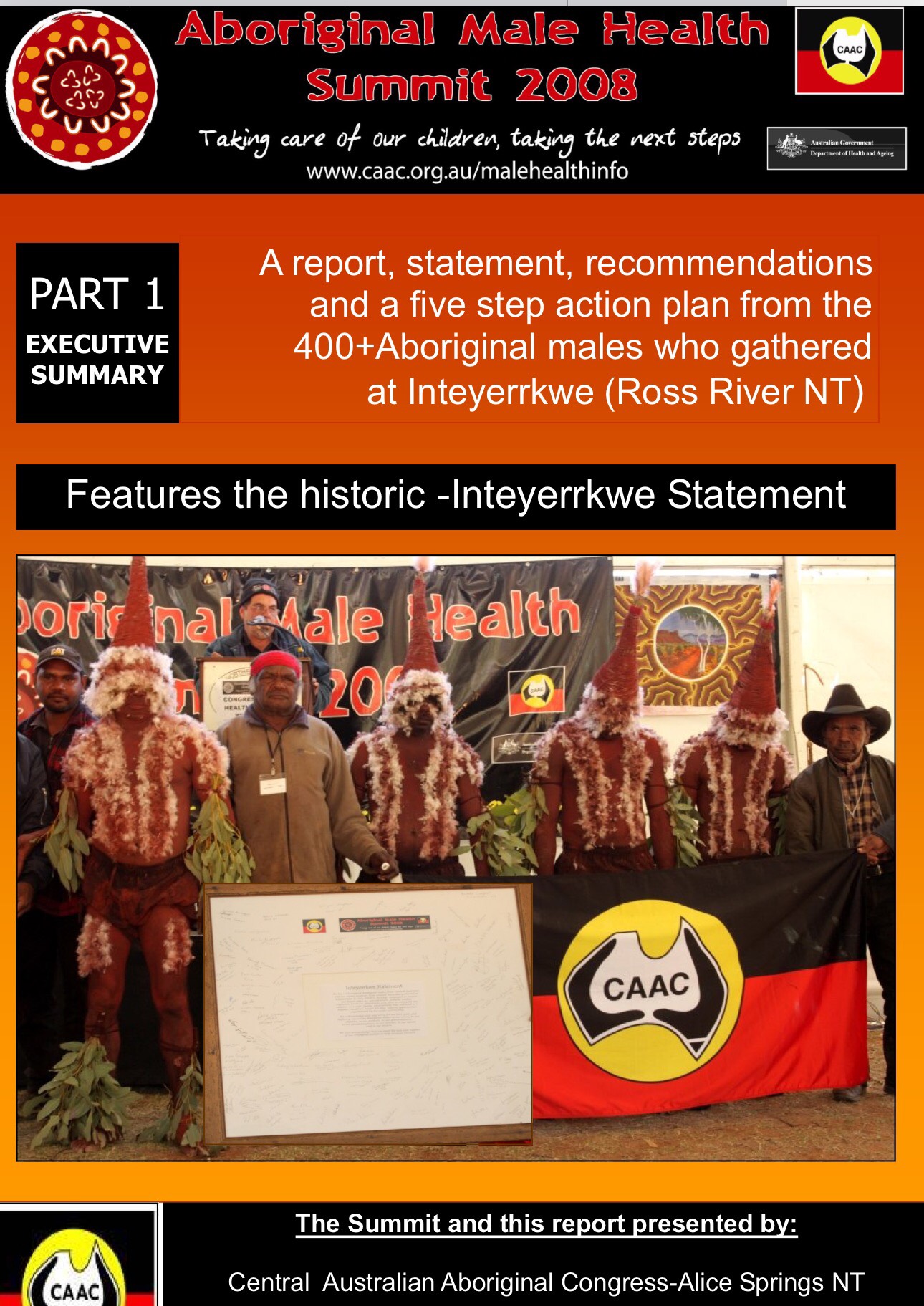
Congress Alice Springs Inteyerrkwe Statement 2008

We the Aboriginal males from Central Australia and our visitor brothers from around Australia gathered at Inteyerrkwe in July 2008 to develop strategies to ensure our future roles as grandfathers, fathers, uncles, nephews, brothers, grandsons, and sons in caring for our children in a safe family environment that will lead to a happier, longer life that reflects opportunities experienced by the wider community.

We acknowledge and say sorry for the hurt, pain and suffering caused by Aboriginal males to our wives, to our children, to our mothers, to our grandmothers, to our granddaughters, to our aunties, to our nieces and to our sisters.

We also acknowledge that we need the love and support of our Aboriginal women to help us move forward “

John Liddle Congress ACCHO Alice Springs , on behalf of 400 Aboriginal Males at Ross River in response to NT 2007 Intervention see below for details

 ” This year NACCHO is pleased to announce the annual NACCHO Ochre Day will be held in Darwin 4-5 October 2017.

Beginning in 2013, Ochre Day is an important NACCHO Aboriginal male health initiative. Aboriginal males have arguably the worst health outcomes of any population group in Australia. NACCHO has long recognised the importance of addressing Aboriginal male health as part of Close the Gap by 2030.”

For more information and to register for Ochre Day

 Reprinted with permission and support from HERE

As current Program Chair and former CEO of the Lowitja Institute, I ( Kerry Arabena ) took great pleasure in celebrating the recent 20-year anniversary of both the Institute and its associated Cooperative Research Centres.

To mark the event, the Lowitja Institute commissioned a brief history, Changing the Narrative in Aboriginal and Torres Strait Islander Health Research, which it launched at Parliament House on 9 August.

The publication details the evolution of collaborative and culturally appropriate ways of conducting health research that has a clear and positive impact for our communities. And although 20 years seems like a long time, it isn’t really. It is just over six policy cycles. We still have much to do.

This same week, the United Nations Special Rapporteur on Extreme Poverty and Human Rights has criticised the Turnbull government’s characterisation of welfare recipients, particularly those who use alcohol and drugs, observing that Australia’s ‘mid twentieth century language’ about welfare ran counter to the tendency internationally to use the more modern language of ‘social protection’.

Also this week, Senator Patrick Dodson responded to an article in which graphic footage of violence in some Western Australian communities was released to the media. Although the footage was shocking, Dodson stressed that regional WA towns are not ‘war zones’, and that their residents should be treated with respect.

He also responded to the overuse of simplistic language in which community members, particularly Aboriginal men, are vilified as the sole culprits for these appalling abuses. He went on to state that what is truly required are community people knowing about, then using circuit breakers that respond to, the multitude of issues contributing to the deep trauma and anxiety caused by alcohol and drug misuse, domestic violence and sexual abuse.

That is why I am proud of the efforts of the Lowtija Institute to address these and other issues relating to how we can all value and honour the roles of our young men, the genesis of work on reclaiming ideals of maleness derived from deep and enduring cultural values and relationships, as advocated for by men recorded in Dr. Brian McCoys’s work ‘Holding Men’.

Advocating for an approach in which men and women work together at a community level, as well as at local and regional levels, to help all members of communities find their feet is critical to redefining our strength and positivity.

Controlling and managing our affairs through principles of kinship, reciprocity, working together and respect is something that sits well with the Lowitja Institute – above all other research funders. In the First 1000 Days Australia movement, calls for men and women to work together to strengthen families for now and for the future has both an evidence base and a social function. Although both men and women experience trauma, they respond differently, as they do to the experience of anxiety.

Children have attachment to their birth parents, no matter what their experience of being with those parents is like, and we need, in turn, to respond appropriately to this.

Aboriginal and Torres Strait Islander men and women across the country are calling for families to have the type of relationships between and with each other, and with their children, that breaks cycles of trauma, heals our families and sets us up for a brighter, happier, healthier future

Part of that future, in my view, needs to be premised on a ‘theory of masculinity’ developed by and for Aboriginal and Torres Strait Islander men and supported by Aboriginal and Torres Strait Islander women.

Dr Vandana Shiva, an Indian scholar, environmental activist and anti-globalisation author is someone I have long admired, and her influence in my development of the key concepts inherent in the First 1000 Days Australia movement is evident.

I am a Social Worker with a PhD in Environmental Science and President of the International Ecology and Health Association after all! Her Essays on Monocultures of the Mind was particularly powerful, showing how local knowledge is displaced and eradicated as part of the ongoing colonial project through its interactions with dominant Western knowledge.

This erasure takes place at many levels, through many steps. First, local knowledge is made to disappear by simply not seeing it, by negating its very existence. ‘Monocultures of the mind’ generate models of production that destroy diversity and legitimise that destruction as progress, growth and improvement.

From the perspective of ‘monocultures of the mind’, productivity and yields appear to increase when diversity is erased and replaced with uniformity; and in the case of our early childhood services, I would suggest the roles and contribution of men to families have been negated; and the roles and resourcing of universal early childhood services elevated, through people and systems invested in attitudes founded in monoculture thinking and action.

Western systems of knowledge have generally been viewed as universal.

However, dominant systems are also local systems, with their social basis in a particular culture (non-Indigenous), class (middle) and gender (male). It is not universal in an epistemological sense, merely the globalised version of a very local and parochial tradition emerging from a dominating and colonising culture.

What I learned from Dr Shiva and others is that, from a perspective of diversity, monocultures are impoverished systems both qualitatively and quantitatively. They are also highly unstable and non-sustainable systems. Monocultures spread not because they produce more, but because they control more. Thus, the expansion of monocultures has more to do with politics and power than with enriching and enhancing systems premised on diversity and locality.

What we need to do is reclaim men’s capacity for nurturance and bring their role and contributions into early childhood in ways that are in line with the First 1000 Days Australia Council Charter of Rights, and specific to families, communities, nations and geographic regions.

Applied to the First 1000 Days Australia movement, which we are building to respect the diversity and legitimacy of local knowledge about culture, caring and parenting.  This approach has seen us:

  • Take an ecological approach to how we do our work, understanding that we are born into ecosystems not societies. This is important positioning, as the world is gripped by the sixth largest mass extinction and, over the next 50 years, our children will have to respond to a series of global megatrends including planetary pushback. Positioned at the commencement of the 21st century, we need to be forward looking.
  • Undertake to support strategies for local and regional programs that are both founded on a celebration of local knowledges and proudly acknowledge people’s capacities for contribution OUTSIDE of the universal service system. These strategies include Welcome Babies to Country programs, building of a ‘culture as therapy’ workforce, and supporting local entrepreneurial activity to escape being trapped in welfarised ‘service delivery systems’ that permeate Indigenous Affairs.
  • Build on and support the role of both our men and women in our First 1000 Days Australia work. Indigenous Dads have so much to contribute to our families, as can be seen by the many dads who are celebrated in the #IndigenousDads movement, which has reclaimed the inspirational role that so many men provide for their partners, their children and other children in their lives more generally.

‘Monocultures of the mind’ approaches to the issues impacting on our families have also seen the erasure of the role and contribution of our men to strong, healthy and empowered households.

In the protection of our children, our men – their identity, their contribution to healthy, happy households has been made invisible. Our men and their contribution to families are impacted on by western ideals implicit in the economic concepts of development, improvement and engagement.

This strategy has been pervasive; ever since the 2007 Northern Territory Intervention the inflammatory message that Aboriginal and Torres Strait Islander men are not capable caregivers is not, nor should it be, acceptable.

Historic background added by NACCHO

Men need to be part of the solution says NACCHO at national Aboriginal health meeting

National Aboriginal Community Controlled Health Organisation.
Media Release  2008

The annual general meeting in Broome this week of the national peak body for Aboriginal health, NACCHO, has endorsed the “Inteyerrkwe Statement” from the July Aboriginal Male Health Summit in Central Australia acknowledging and apologising for the suffering some Aboriginal men have caused in their communities.

The meeting called on all Aboriginal men to think about the statement and to commit to its principals of caring for children in a safe family environment and recognising the need for the love and support of Aboriginal women to help men move forward

See Congress Alice Springs Aboriginal Male Health submission

Download 1. Congress Aboriginal Male Health 2008

Aboriginal Male Health‐ Brothers Supporting Brothers‐ a central Australian Aboriginal perspective.

Download Report 2. Congress Final report Male Health summit Part 1

Because of it, our society has lost so much. The roles and responsibilities of men as fathers have become absent in the policy and program resource chain, and they are not often valued or seen as contributors to our children’s health and wellbeing.

What our men lose is an appreciation of their capacity for nurturance and their role as key contributors to the health and wealth of our households.

When I first looked in early childhood policy documents I could not see our men represented in policy as anything other than perpetrators of violence, overrepresented in the criminal justice system and in the suicide statistics and as ‘having high levels of disease’, particularly in the sexual and reproductive health literature.

This representation of our men shakes the very foundations of our families and communities. And their absence in early childhood policy and programs falsifies the gender roles and responsibilies in our communities and accomplishes the colonial mission that was started more than 200 years ago – through modern knowledge systems premised on monocultures and monopolies.

In part to disrupt these knowledge systems, and to empower men as nurturers, First 1000 Days Australia advocates changing the names of ‘child and maternal health services’ to move beyond privileging the biological role that women play in the carrying of their children and recognising the social circumstance into which children are born. First 1000 Days Australia advocates for child and family services, with an emphasis on men’s capacity for care.

We are interested in SMS4Dads as a program, for example, to assist men prepare for the birth of their baby by attending men’s antenatal classes and having other men to talk to about the transition to fatherhood.

We want to provide space for men to support each other in their fatherhood journey, and as carers of children.

We appreciate the roles of uncles, brothers and cousins in the care of children.

We want to hear from men about how best to support them respond to the needs and aspirations of their partners and children in powerful and tender ways.

We need a gender equity approach to raising our children, and to recognise there are single fathers out there who are doing it tough, and who need supports from services and other families to know they are doing ok.

We also recognise the value of those men who support anti-violence campaigns, who work in our early childhood centres, who mentor and help our young men prior to becoming dads and who stick with them through those important early years.

This work, while valuing our men, has not yet developed a theoretical underpinning but it is high on our agenda.

First 1000 days Australia also wants to disrupt the ‘monocultures of the mind’s’ pervasive attitude that needs to erase the role and contribution of our men, and to replace our values with those that extend structures perpetuating the colonial project.

We need to examine the ways in which colonial practices have diminished our beliefs about gender, race and privilege and to address the impact of these, particularly in constructing only two distinct genders – men and women. Perhaps there can be something learned from other Indigenous authors who are reclaiming Indigenous masculinity.

I don’t often say this out loud, but, having been a long time single parent, I have often described myself as both ‘mother and father for my children’.

Perhaps, if I were to decolonise my mind, I would have said something more nuanced like. ‘I am a woman who has also had to call on my masculine self to raise my children’.

We are people, with male and female hormones, who can embody both masculine and feminine expressions of self in our one body. In this way, I can release myself from colonial constructs of separateness, power, privilege and embodiment.

What will assist the work of First 1000 Days Australia is for men to address the lack of critical attentiveness to Indigenous masculinities in Australia, through our own knowledge systems and under the leadership of Indigenous academics.

We would be so proud to take carriage of these findings into our activities and support our way forward – as families and as communities – together.

And it is starting – through the Lowitja Institute. Through the Lowitja Institute we can explore the full range of options available to us, and set an agenda to suit ourselves both now and into the future.

I cannot imagine another research institute being able to create then hold the space for the discussions that need to be had, to bring this research agenda to life.

It is an exciting time for the Program Committee, whose members are working with others in designing research questions that will make a difference, and change the narrative about what it means to be an Aboriginal and Torres Strait Islander man caring for our children.

Over the next year or so, the Lowitja Institute will support a program of research related to valuing our men, which is being led by a group of men and supported by women, to start to lay the way forward for all of us.

Nothing defines a society so much as how they care for children. It is our job, our responsibility to care for our children; particularly in calls across the country for Treaty.

We need to start to define how we are going to raise Treaty Kids, living Treaty Lives, in Treaty Families, with Treaty fathers caring for Treaty mothers if we are going to make Treaty real.

We look forward to seeing our people take the lead in these important conversations and that our combined efforts bring about positive generational change for our children.

We celebrate the Lowitja Institute, and for its past 20 years of changing the narrative in Indigenous health research. May we be resourced to do this for the next 20 years – and beyond.

Aboriginal Primary Health Care Certificate 3 and 4 :@NSWTAFE ” Google School ” delivers to 38 Indigenous #NSW #QLD student graduates

Part of my job is to run clinics in the community, so having my Certificate IV qualification will allow me to check blood sugar, take blood samples and measure body mass index,”

Stephen Taylor from Nowra is studying this Certificate IV course to upskill in his job as an Aboriginal Community Support Worker and Chronic Care Coordinator, which involves monitoring the health of his clients thus minimising hospital visits. He believes these skills will increase his value to his community and to his employer

TAFE NSW Aboriginal Pathways students from across NSW and Queensland benefited from contemporary online learning during their recent studies in primary health care in Port Macquarie.

Originally published HERE

The students are studying the Certificate III or Certificate IV in Aboriginal and/or Torres Strait Islander Primary Health Care and are developing valuable skills like assessing clients’ physical wellbeing, administering medications, providing nutritional guidance, and addressing social determinants of health.

According to Sharon Taylor, Key Account Manager for Aboriginal Pathways TAFE NSW, this is not only the first time Certificate III and IV Practice qualifications in Aboriginal and/or Torres Strait Islander Primary Health Care have been held in Port Macquarie, but also the first time the qualifications have been delivered using the flexible technology of Google Classroom.

“Although they were all first time users, students and staff all spoke enthusiastically of this type of learning, highlighting as outstanding benefits the automatic saving function, online networking and collaborative features,” said Ms Taylor.

Both qualifications have a focus on culturally appropriate application, and workers in this industry are crucial to improving health outcomes for Aboriginal and Torres Strait Islander people.

Amarlee Kelly, one of the 38 students in the two classes, is an Aboriginal woman from Tweed Heads, in Bundjalung country on the north coast of NSW. For Ms Kelly, leaving family and country to study in Port Macquarie took her out of her comfort zone.

“I was very nervous and uncomfortable about leaving my husband,” said Ms Kelly.

“We have been married for 24 years, and we rarely do things without each other. [But] when Uncle Bill performed his amazing Welcome to Country, I was really able to get a feel for Birpai country, and after that I felt much more comfortable and was able to settle down and get to work.”

Ms Taylor added that with Australian Health Practitioner Regulation Agency (AHPRA) accreditation, TAFENSW Aboriginal Pathways are able to offer the Certificate IV in Aboriginal and/or Torres Strait Islander Practice qualification, which enables their graduates to become AHPRA- registered practitioners.


Aboriginal Health : Our ACCHO Members #Deadly good news stories #NACCHOagm2017 #NSW #TAS #QLD #VIC #WA #NT #SA

1.1 National : 2017 NACCHO Members’ Conference abstracts / Expressions of Interest close 21 August

1.2 National : 2017 NACCHO Aboriginal Male Health Ochre Day registrations

2.WA : Derbarl Yerrigan Health Service (DYHS) officially launches the ‘Pink Box’

3. 1 NSW : Armajun Aboriginal Medical serice  very active campaign in testing the ear health of preschool and school-age Aboriginal children

3.2 NSW : Governor of NSW visits Katungul Aboriginal Corporation Community and Medical Services

4. NT : Miwatj Health had a HUGE presence at the 2017 Garma Festival

5.VIC : KIRRAE Health Services at Framlingham Aboriginal Reserve funded to fight ice

6.1 QLD : Gidgee Healing Aboriginal Community Controlled Health Service Mt Isa supports another cataract blitz

6.2 QLD : Jobs and health benefits in $120M boost for Indigenous infrastructure

7.TAS : Tasmanian Aboriginal Health Workers out to break HEP.C stigma

8. Deadly Choices QLD trains up the Nganampa health team

9. View hundreds of ACCHO Deadly Good News Stories over past 5 years

How to submit a NACCHO Affiliate  or Members Good News Story ? 

 Email to Colin Cowell NACCHO Media    

Mobile 0401 331 251

Wednesday by 4.30 pm for publication each Thursday

1. National : 2017 NACCHO Members’ Conference abstracts / Expressions of Interest close 21 August

NACCHO is now calling for Expressions of Interest (EOI) from Member Services for speakers, case studies and table top presentations for the 2017 NACCHO Members’ Conference. This is an opportunity to show case grass roots best practice at the Aboriginal Community Controlled service delivery level.

In doing so honouring the theme of this year’s NACCHO Members’ Conference ‘Our Health Counts: Yesterday, Today and Tomorrow’.

NACCHO Conference Website

1.2 National : 2017 NACCHO National Aboriginal Male Health Ochre Day registrations Darwin NT

Register HERE

2.WA : Derbarl Yerrigan Health Service (DYHS) officially launches the ‘Pink Box’

Derbarl Yerrigan Health Service (DYHS) have officially launched the ‘Pink Box’, a free vending machine that allows a discrete way for women to obtain sanitary products.

In partnership with Share the Dignity charity, the suppliers of the Pink Box, the launch took place at DYHS head office in East Perth.

Mrs Gail Yarran delivered the Welcome to Country followed by Jenny Bedford, DYHS’s new CEO who officially opened the launch. The audience listened to speeches from Maternal & Child Health worker, Jillian Taylor and the Founder of Share the Dignity charity, Rochelle Courtenay before the official ribbon cutting ceremony.

Also see : Indigenous girls missing school during their periods: the state of hygiene in remote Australia

3. 1 NSW : Armajun Aboriginal Medical serice  very active campaign in testing the ear health of preschool and school-age Aboriginal children

This time last year, Harrison Faley was struggling to make sense of daycare.

Stuck hearing as if he were underwater, his parents thought he was simply a typical, inattentive two-year-old. But in reality, otitis media, a very common middle ear disease for young children, was blocking his conductive hearing.

Report from HERE

“We were alerted by his daycare that his speech was lagging a bit and he was getting constant ear infections,” mother Harnah Faley recalled.

“The specialist asked us to wait until he had all his teeth, and when that happened we had him tested again, and he was down to 10 per cent function.”

Within two months, Harrison had grommets (tiny tubes) inserted to allow air to reach his middle ear.

“The improvement was pretty much instant,” Mrs Faley said, adding that along with his hearing, Harrison’s speech and development progressed significantly.

“If you ask him, he got the potatoes out of his ears,” she said.

Harrison was just one of 51 children to have a free ear check up at the Inverell Shire Public Library on Tuesday, August 1 as part of the first local otitis media awareness day.

Two audiometry nurses were present to do the screening, one from Armajun Aboriginal Health Service.

Of those screened, 25 per cent had middle ear fluid and a further 22 per cent had a Eustachian Tube Dysfunction, which can lead to otitis media.

Only half the children screened on the day had a ‘normal’ reading for ear health.

Although Aboriginal children are ten times more likely to have otitis media and 70 percent more likely to have recurring otitis media; there was a higher percentage of ‘normal’ readings in Inverell’s Aboriginal children (13 per cent of those screened).

Organisers believe this was due to Armajun’s very active campaign in testing the ear health of preschool and school-age Aboriginal children in this area.

Hearing Support Teachers from the NSW Department of Education talked on factors that contribute to otitis media and how parents can help reduce the risks.

The morning period was very busy, with one local preschool bringing twenty seven students aged 3-5 for screening. The rest of the children were brought in by their parents or grandparents throughout the day.

Library staff were proactive and kept the children entertained with craft activities as they waited. Volunteers from the Inverell branch of Quota International also helped make the day a success.

With so many children having indications of either otitis media or Eustachian Tube Dysfunction, conductive hearing loss teacher Beverly Walls said it was a timely reminder to parents to be vigilant when their children complain of ear ache or have difficulty understanding instructions.

3.2 NSW : Governor of NSW visits Katungul Aboriginal Corporation Community and Medical Services

Another great afternoon at our Batemans Bay clinic with community and His excellency David Hurley, Governor of NSW and wife. Pictured above with CEO Robert Skeen .Many thanks to Aunty Muriel Slockee for her Welcome to Country and the deadly Koori Choir from the Batemans Bay Primary School. Another thank you to Marty Thomas who enchanted all on the Didgeridoo.

4. NT : Miwatj Health had a HUGE presence at the 2017 Garma Festival

Did you pay us a visit at Garma 2017!?

Miwatj Health had a HUGE presence at the 2017 Garma Festival. From Clinicians, to our Raypirri Rom team, we were everywhere!

Our clinic was a great success, with 26 staff assisting over the four days, including 3 Aboriginal Health Practitioners and an admin staff member from Galiwin’ku (Elcho Island). Thank you to everyone to dedicated their time (and long weekend) to help provide a much needed service for the festival.

Miwatj Health would also like to thank Captain Starlight for coming all the way from Darwin to entertain the children; the clinic would not have been the same without you.

Our #YakaNgarali Team also went out to Garma to educate community members on the harmful affects of smoking. They tested approximately 40 people using the Smokerlyzer (check out our videos to see how the Smokerlyzer works), while also quizzing participants of the festival to gain a greater understanding of their knowledge around smoking facts.


Overall, we had a super successful weekend and cannot wait for Garma 2018!

5.VIC : KIRRAE Health Services at Framlingham Aboriginal Reserve funded to fight ice

KIRRAE Health Services is one of just 13 Victorian community groups to receive state government funding to help in the fight against ice.

The health service based at the Framlingham Aboriginal Reserve will receive $10,000 for an early intervention and prevention program targeting males aged eight to 17.

The state government funding is aimed at tackling ice through “a range of localised activities, including workshops, forums, social media, music events and education programs aimed at sporting communities”.

Kirrae Health Services will use the funding through its Koko Blokes program. “Koko” is a Kirrae Whurrong word meaning “younger brother”.

The program deals with positive role-modelling and issues around drug and alcohol use, domestic violence and respect.

6.1 QLD : Gidgee Healing Aboriginal Community Controlled Health Service Mt Isa supports another cataract blitz

Seventeen patients were in Mount Isa this month for the north-west Queensland city’s latest “cataract blitz”.

Not –for-profit organisation Check UP funded the North west Hospital and Health Service (NWHHS) to provide the eye surgery, targeted at Indigenous people form remote communities.

It follows a cataract surgery “blitz” last October. Patients travelled from Doomadgee, Mornington Island, Normanton, Cloncurry and Camooweal this month. Their pre-surgery clinics were conducted by telehealth, a first for cataract surgery, according to outreach coordinator Amy Davy.

“Providing Telehealth as an option for our patients from outlying communities reduces the number of trips or length of stay during their surgical procedures, so we’re pleased with the success of this, and will be utilising telehealth in similar situations,” she said.

Ms Davy praised the work Aboriginal Community Controlled Health Service Gidgee healing’s Blake Fagan, who provided transport for the patients, and NWHHS Indigenous liaison officer Melissa Nathan, who assisted the patients through their eye surgery.

Visiting ophthalmologist Andrew Foster conducted 19 operations in 2 days, completing a cataract surgery every half hour.

“This blitz” is a very good system for getting patients treated,” he said.

“Doing it in a group like this is very effective as they support each other, and know each other. It works very well, with no “fail to attends”.

Dr Foster is based on the Sunshine Coast and flies into Mount Isa every month to do eye surgery.

6.2 QLD : Jobs and health benefits in $120M boost for Indigenous infrastructure

Indigenous communities across Queensland are set to benefit from critical infrastructure upgrades, with a $120 million boost over four years to improve water, wastewater and solid waste infrastructure.

Visiting Mornington Island, Aurukun and Pormpuraaw this week, Minister for Local Government and Aboriginal and Torres Strait Islander Partnerships Mark Furner said the Indigenous Councils Critical Infrastructure Program funding was vital for the health of communities.

“I’m extremely proud to announce the Palaszczuk Government’s commitment to strengthen indigenous communities has been backed with our $120 million investment,” Mr Furner said.

“The program is about ensuring Aboriginal and Torres Strait Islander people living in remote communities have infrastructure to improve living conditions and provide a sustainable future.

“This funding will be tailored to each community, supporting the infrastructure they need now and into the future, helping to close the gap on disadvantage.

“One of the great things about this program is that the councils actually develop the skills locally to manage the infrastructure and projects moving forward.”

Minister Furner said for councils in remote locations, access, distance and logistics meant the cost of the projects could be up to seven times higher than mainland and metropolitan areas.

“The level of funding provided for the Indigenous Councils Critical Infrastructure Program is crucial to meet the additional challenges many of these communities face.

“Communities will be pleased to know that the first stage of project approvals are already underway and some of the most vital infrastructure projects will commence shortly.”

On-site condition assessments have been conducted to help prioritise projects that are necessary to the health and safety of communities and designed to meet the specific needs of each location.

7.TAS : Tasmanian Aboriginal Health Workers out to break HEP.C stigma

By Jillian Mundy

Don’t be shamed to be screened or treated for hepatitis C. It is now curable in as little as eight weeks with the latest medicine, which is really available in Australia. That’s the message Aboriginal health worker Aaron Everett and land manager Jarrod Edwards want to spread. The two Tasmanian Aboriginal men, spoke at the second World Indigenous Peoples, Conference on Viral Hepatitis in Alaska thi month, want to break the stigma around viral hepatitis.

Mr Edwards is keen to share the journey of his own diagnosis treatment and recovery from hep-C. “I want to encourage other Aboriginal people to get screened and if they test positive have the treatment, “he told the Koori Mail.

“The advances in the treatment have come a long way and the side –effects I got don’t exist now”.

Mr Edwards encouraged people to also talk about hep-C to break the stigma. He said he was shocked when an Aboriginal health check in 2006 returned positive for the illness.

“I was an intravenous drug user at the time, but I was always really clean and careful with injecting equipment. I really don’t know how I got it. The diagnosis hit me for a six,” he said.

At first he did not seek treatment attributing the reluctance to his lifestyle.

“It was a stigma thing. I felt dirty,“ he said. “It was a long journey though. It took me five years.

“It was the holistic, community approach of the Aboriginal health service that gave me the ability to begin my healing journey, which included working on country”.

Mr Edwards said treatment at the time took 12 months and included weekly injections, daily pills, anti-depressants and regular visits to a psychiatrist.

There were also side-effects such as hair loss, fatigue to the point of passing out and very fragile and dry skin.

Mr Edwards has no doubt that without treatment he would be dead. “My liver would have packed it in,“ he said.

Mr Edwards is now cured and, coupled with his lifestyle changes, is proud to be a father and productive member of his community.

He also attributes his healing to the support of his partner, Aboriginal health practitioner Candy Bartlett.

“I wanted to have a long-term relationship, a family, a home of our own and be able to come back and on country”, he said.

DON’T HESITATE

These days Mr Edwards urges people not hesitate in seeking treatment.

“Don’t be ashamed of it. It doesn’t matter how you got it; just go and treat it,” he says.

Mr Everett, one of the clinical team working with patients during screening and treatment for hepatitis C at the Aboriginal health service in Hobart, said people are often shamed about the virus.

“it’s not a highly spoken about virus, because of the stigma on how it might have been contracted, often through sharing injecting equipment,” he said.

Mr Everett wants people to be open about being screened and treated, to help break the stigma surrounding viral hepatitis and in turn help eliminate it.

“Come in and be checked. Don’t be ashamed. It is not a death sentence,“ he said. “But it’s a different story if left untreated, especially when combined with an unhealthy lifestyle or other health issues it can be an extra burden, yet can be totally cured.”.

New direct-acting antiviral medicines which were added to the Pharmaceutical Benefits Scheme (PBS) last year have revolutionised hep-C treatment by increasing the cure rate to close to 100% and reducing treatment duration and side-effects.

Viral Hepatitis is usually transmitted through the re-use of contaminated injecting equipment. It can be spread through unscreened blood transfusions and inadequate sterilisation of medical equipment (highly unlikely in Australia these days), It can also be transmitted sexually, from mother to child and through contaminated sharp grooming equipment.

People with hepatitis can be unaware, and unknowingly pass on the virus.

The conference Mr Edwards and Mr Everett are attending aims to ensure Indigenous communities around the world are given the same access to prevention, testing and treatment as other people.

The World Hepatitis Alliance aims to eliminate viral hepatitis by 2030

8. Deadly Choices QLD trains up the Nganampa health team

Just like the Nganampa Health Service staff, you can eat healthy and be the best version of yourself.

Some great photos from when Deadly Choices were up in Umuwa to share their experiences, wisdom and host training for the Nganampa team

Please share


Aboriginal Health this weeks TOP 35 #jobalerts @MiwatjHealth @NATSIHWA @CATSINaM

This weeks #Jobalerts

Please note  : Before completing a job application please check with the ACCHO or stakeholder that job is still available

1-5 : Ceduna Koonibba Aboriginal Health Service Aboriginal Corporation (CKAHSAC)

6.Aboriginal Coordinator -Aboriginal Quitline Program

7.Aboriginal Health Worker/Practitioner , Maternal and Child health( Strong Mums Solid Kids program)

8-9 : Nunkuwarrin Yunti’s Link-Up SA \ Program caseworker /counsellor

10.Aboriginal Health Worker – Drug & Alcohol – Durri AMS close 21 August

11. Aboriginal Health Worker : Wathaurong Aboriginal Health Service Closes 20 August

12.ACADEMIC SPECIALIST – INDIGENOUS EYE HEALTH POLICY AND PRACTICE (RE-ADVERTISED)

13. Policy Adviser (Indigenous Health) Australian Medical Association

14. Aboriginal Health Worker / Practitioner Carnarvon Medical Services Aboriginal Corporation (CMSAC)

15.General Practitioner | Remote Aboriginal Health Service NT

16 – 35 Employment at Miwatj Health NT Nurses Health Workers etc


  Register or more INFO

How to submit a Indigenous Health #jobalert ? 

NACCHO Affiliate , Member , Government Department or stakeholders

If you have a job vacancy in Indigenous Health 

Email to Colin Cowell NACCHO Media

Tuesday by 4.30 pm for publication each Wednesday

1-5 : Ceduna Koonibba Aboriginal Health Service Aboriginal Corporation (CKAHSAC)


As a Community Controlled Aboriginal Health Service, Ceduna Koonibba Aboriginal Health Service Aboriginal Corporation (CKAHSAC) provides a range of culturally safe and high quality services specifically designed to improve the wellness and health of Aboriginal and Torres Strait Islander people.

CKAHSAC is an equal opportunity employer and is committed to ensuring there is no discrimination in the workplace. For further information please visit our website www.ckahsac.org.au

These position will be based with Ceduna Koonibba Aboriginal Health Service Aboriginal Corporation. The successful applicant will be required to undertake duties specified in the Job and Person Specification.

All enquiries and requests for Job Descriptions must be directed to Lee-Ann Miller, Human Resources Coordinator via

Email: Lee-Ann.Miller@ckahsac.org.au  or telephone 8626 2500

How to Apply:

Applications in writing should address the selection criteria contained in the Job Description and include a cover letter outlining your suitability to the position.

Applications should be addressed to: Lee-Ann Miller, Human Resources Coordinator, CKAHSAC, PO Box 314, CEDUNA SA 5690.

CLOSING DATE: 5.00PM ON WEDNESDAY 6th SEPTEMBER 2017

Please note: Late applications will not be considered.

  1. ABORIGINAL HEALTH PRACTITIONER/WORKER – several positions available
  • Aboriginal Health Practitioner/Worker – Connected Beginnings (0 – 4 Years
  • – 12 months with possibility of extension – Subject to funding
  • Aboriginal Health Practitioner/Worker – New Directions (5 – 14 Years)
  • – 12 month employment contract – Subject to funding
  • Fixed Term Contract , subject to funding
  • AHW 4 – salary range $67,635.00 to $70,762.00 per annum
  • Essential – Certificate IV in Aboriginal and/or Torres Strait Islander Primary Health Care qualifications
  • Full Time 1.0 FTEThe position of Aboriginal and/or Torres Strait Islander Health Practitioner/Worker is to provide flexible, holistic and culturally sensitive health services to clients and community, and to improve health outcomes and better access to health services.

2.Aboriginal Torres Strait Islander Health Practitioner – sexual health

3.ABORIGINAL TORRES Strait Islander Health Practitioner/WORKER – Outreach – Female

4.ABORIGINAL TORRES STRAIT ISLANDER HEALTH PRACTITIONER/WORKER – clinic – MALE

  • Full Time , Up to 12 month contract SUJECT TO FUNDING
  • AHW 4 – salary range $67,635.00 to $70,762.00 per annum
  • Essential – ABORIGINAL AND/OR TORRES STRAIT ISLANDER HEALTH PRACTITIONER Certificate 4 – Sexual Health
  • Essential – ABORIGINAL AND/OR TORRES STRAIT ISLANDER
  • HEALTH PRACTITIONER Certificate and/or 4 Certificate IV in Aboriginal and/or Torres Strait Islander Primary Health Care – Outreach – Female and Clinic Male
  • Several position available

The position of Aboriginal and/or Torres Strait Islander Health Practitioner – Sexual Health is to provide flexible, holistic and culturally sensitive health services to clients and community, and to improve health outcomes and better access to health services.

The position of Aboriginal  and/or Torres Strait Islander Health Practitioner/Worker – Outreach – Female and Clinic – Male is to provide flexible, holistic and culturally sensitive health services to clients and community, and to improve  health outcomes and better access to health services.

5.Registered Nurse – Mother’s and Babies Coordinator

Up to 12 month employment contract with a possible extension

RN 2 , Level 1 (Depending on qualifications)

Essential – Register Nurse with a current practicing certificate and a current Immunisationprovider

Full Time 1.0 FTE

The position of Registered Nurse – Mother’s and Babies Coordinator is to provide flexible, holistic and culturally sensitive health services to clients and community, and to improve health  outcomes and better access to maternal women & child health services.

6.Aboriginal Coordinator -Aboriginal Quitline Program


We’re passionate about nurturing careers.

We support new innovation and thinking, and openly collaborate and share new ideas. We’re healthy and active in our lives and wellbeing is encouraged at every level.  Our people play an important role in the future of health and healthcare and we believe that working together, we’re stronger.

About Us

Medibank is a leading private health insurer with 40 years of experience delivering better health to Australians. We look after the health cover needs of millions of customers and deliver a wide range of programs to support health and wellbeing in the community.

The Opportunity

Medibank is delivering the best possible smoking cessation outcomes for Aboriginal clients in NSW and ACT on behalf of Quitline, the Cancer Institute of NSW and Healthdirect Australia.

The Aboriginal Quitline Program provides both inbound and outbound calls to Aboriginal clients who are considering smoking cessation. We have a dedicated team of counsellors who provide specific interventions such as delivering one off counselling, focusing on quit planning, supporting with quitting (including managing withdrawal symptoms), providing strategies for relapse prevention and providing outbound milestone checks.

Joining our Relationship Management team, the Aboriginal Coordinator will provide team leadership and program direction in relation to Quitline, specifically focused on the delivery of the program to Aboriginal and Torres Strait Islander Clients. This is a 12 month maternity leave contract and will be critical in promoting the service & liaising with Aboriginal Health workers & key Aboriginal Health & Community Controlled Services to ensure strong partnerships. The role will have a distinct community focus and will be key in the promotion of the program amongst Aboriginal and Torres Strait Islander communities. This is a satisfyingly broad role with a range of responsibilities including:

  • Develop and implement Aboriginal Health Community Engagement Strategies for the NSW and ACT Aboriginal Quitline program
  • Foster relationships within Aboriginal and Torres Strait Islander communities to promote awareness of services by travelling to identified communities;
  • Represent NSW Quitline at Aboriginal Health community events, organising and hosting promotional stalls as required;
  • Lead Aboriginal Advisory Groups with participation from key influencers in Aboriginal health groups to inform service design and the delivery of service improvement initiatives;
  • Lead engagement efforts to increase the variety of services delivered to Aboriginal and Torres Strait Islander communities;
  • Support the development and delivery of cultural education and training across the business and contribute to the Aboriginal Employment Strategy.

About You

You have exceptional communication and stakeholder engagement skills which enable you to build strong and lasting relationships across a range of internal and external stakeholders/clients and community groups. Critical thinking, decision making and problem solving skills are your strong suit as is your ability to lead and motivate others to achieve shared goals and objectives. You will also have the following skills and experience:

  • Strong community engagement experience with Aboriginal communities, ideally in health, welfare or similar;
  • Strong delivery focus; project management skills will be highly regarded;

This position will only be open to Aboriginal and/or Torres Strait Islander applicants – Medibank considers this to be a genuine occupational requirement under the relevant anti-discrimination legislation.

What We Offer

In return for your hard work we offer a range of great benefits. Furthermore, we take the health and wellbeing of our employees seriously, offering flexible working conditions and encouraging well-being at all levels of life.

Medibank is an equal opportunity employer committed to providing a working environment that embraces and values diversity and inclusion. If you have any support or access requirements, we encourage you to advise us at the time of application to assist you through the recruitment process.

A Career at Medibank adds up to more. More achievement. More progress. More passion and more innovation for health.

For a career option that will suit you better, click to apply.


7.Aboriginal Health Worker/Practitioner , Maternal and Child health( Strong Mums Solid Kids program)
                       
 
Opportunity to Improve Child and Maternal Health Outcomes.
·         Join a well-respected Aboriginal Community Controlled Health Organisation in South Australia!
·         A Full-time and A part-time position available!
·         $59,045 – $66,566 (pro-rata for part time) depending on qualifications and experience PLUS super, salary sacrifice options and more!
About the Organisation
Nunkuwarrin Yunti is the foremost Aboriginal Community Controlled Health Organisation in Adelaide, South Australia, providing a range of health care and community support services to Aboriginal and Torres Strait Islander people.

Nunkuwarrin Yunti aims to promote and deliver improvement in the health and well-being of all Aboriginal and Torres Strait Islander people in the greater metropolitan area of Adelaide and advance their social, cultural and economic status. The organisation places a strong focus on a client centred approach to the delivery of services and a collaborative working culture to achieve the best possible outcome for clients.  The Women, Children and Family Health Service aims to support safe nurturing environments for pregnant women, infants and children, increase uptake and utilisation of services with an emphasis for clients to encourage continued engagement with services.

About the Opportunity
Nunkuwarrin Yunti now has two opportunities for Aboriginal Health Workers /Practitioners (Maternal and Child Health) to join their multidisciplinary team based in Adelaide, on a full-time and part-time (0.5FTE) basis.
Reporting to the Maternal Child Health Coordinator, you’ll be responsible for communicating information about maternal, infant and child health messages, facilitating internal and external referral and ongoing engagement with a range of social and specialist services and supporting the engagement of individuals and families in opportunities to access information and resources.
Some of your key responsibilities will include (but will not be limited to):
·         Providing up to date information and education to individuals, groups and the wider Aboriginal community;
·         Providing client care in line with agreed best practice guidelines and service protocols;
·         Linking families to child care and early learning environment programs;
·         Attending multi-disciplinary meetings;
·         Contributing to case review and case conferences;
·         Contributing to the development and review of care plans; and
·         Developing and maintaining effective internal and external networks in a professional manner.
To be successful in this role, you will hold a Certificate IV in Aboriginal Primary Health Care (Practice), have previous demonstrated vocation experience in maternal, infant and/or child health and an understanding of best practice approaches to comprehensive primary health care.
You will also need to have a sound knowledge of the issues effective Aboriginal and Torres Strait Islander families and an ability to participate in the development and coordination of care plans.
Candidates will need to have experience in the use of computer software, especially Patient Information Recall Systems and other databases.
A current Medicare Provider Number, or eligibility to obtain one are essential to this role.
While not essential, candidates with professional registration with AHPRA, a Certificate IV in Aboriginal Primary Health Care (Aboriginal Maternal and Infant Care) and qualifications and/or training with immunisation will be highly regarded.
To download the full-time position description, please click here.
To download the part-time position description, please click here.
Further information from
Clare levy, Coordinator SMSK
Nunkuwarrin Yunti of South Australia Inc
182-190 Wakefield Street, ADELAIDE SA 5000
T: 08 8406 1600 | F: 08 8232 0949

8-9 : Nunkuwarrin Yunti’s Link-Up SA Program caseworker /counsellor

Two New Vacancies are available within the Link Up Program.

Both positions are 12 month Contract position that may be extended subject to funding.

Link Up Caseworker:   (Click for more information)

Link Up Counsellor: (Click for more information)

Nunkuwarrin Yunti’s Link-Up SA Program is funded by the Department of Prime Minister and Cabinet (Federal), and also receives reunion funding from the Department of Premier & Cabinet, Aboriginal Affairs & Reconciliation (State).

Link Up provides family tracing, reunion and counselling services to Aboriginal and Torres Strait Islander people and their families who have been separated under the past policies and practices of the Australian Government. Assistance is also provided to people over the age of 18 years who have been adopted, fostered or raised in institutions.

For more information about Link Up (Click here)

Please feel free to communicate this opportunity through your networks.

10.Aboriginal Health Worker – Drug & Alcohol – Durri AMS close 21 August

For over 30 years, Durri Aboriginal Corporation Medical Service has provided essential and culturally appropriate medical, preventive, allied and oral health services to Aboriginal communities.  Located in the Macleay and Nambucca valleys on the Mid North Coast of NSW.  Durri is committed to making health care and education accessible to improve the health status and wellbeing of our community.

An exciting opportunity has arisen for a Aboriginal Health Worker with an interest in the area of Drug & Alcohol to join the passionate team at our Nambucca Heads clinic site.

This challenging role would suit an experienced and motivated Aboriginal Health Worker with a desire to achieve positive outcomes in indigenous health.  You will work with a dedicated team of healthcare professionals.

The successful candidate will enjoy beautiful beaches, World Heritage Rainforest, and relaxed lifestyle of the mid north coast whilst making a real difference in the community.

Benefits include 9.5% super, attractive salary sacrifice, training and access to an employee assistance program.

To apply to to our website:  www.durri.org.au, download a copy of the Application Pack and submit this along with your resume not exceeding 4 pages, and your submission for each of the selection criteria to: hr@durri.org.au, or mail to:

Application

Chief Operations Officer

Durri Aboriginal Corporation Medical Services

PO Box 136

Kempsey  NSW 2440

Applications close: 21 August 2017 at 5.00 pm 

Applicants must have a current Police and Working with Children Check Clearance and Confirmation of Aboriginality.

Pursuant to Section 14 of the Anti-Discrimination Act 1977 (NSW) Australian Aboriginality is a genuine occupational qualification for this position.

Applications that do not attach a completed selection criteria submission will not be considered. 

Contact: Paula 02 65602360

11. Aboriginal Health Worker : Wathaurong Aboriginal Health Service Closes 20 August

The Wathaurong Aboriginal Health Service is a fast growing and innovative health service that aims to provide the local Aboriginal community with culturally appropriate, high quality care. The following position is now available:-

Aboriginal Health Worker
Part Time 22.8 hours per week (Ongoing)

The successful applicant will be part of a service aimed at providing intensive case work and direct support to Aboriginal people.  You will facilitate clinical assessments, work in partnership with the clinical practice, and provide cultural expertise to ensure the provision of holistic and culturally appropriate health care. You will also assist Aboriginal people to access appropriate primary care services, and liaise with internal and external practitioners to assist in the delivery of culturally appropriate services. You will work in North Geelong and also in Colac.   Qualifications as an Aboriginal Health Worker are desirable or a willingness to undertake study to achieve the qualification.

This is an identified position, open to Aboriginal and Torres Strait Islander applicants only.

If you have extensive experience in related areas of work and a solid understanding of the issues confronting Aboriginal communities then we want to hear from you.

A Position Description is available from www.wathaurong.org.au

A police check, Working with Children Card and a driving license are required for all positions.

Applications to be sent to Human Resources preferably via email jobs@wathaurong.org.au or post to Wathaurong Aboriginal Cooperative, PO Box 402, North Geelong 3215.  Applications that fail to answer the key selection criteria will not be considered.

Closing date for these positions is 20 August 2017

Wathaurong is a Child Safe organisation

Wathaurong is a smoke free workplace

12.ACADEMIC SPECIALIST – INDIGENOUS EYE HEALTH POLICY AND PRACTICE (RE-ADVERTISED)

Melbourne School of Population and Global Health
Faculty of Medicine, Dentistry and Health Sciences

Salary: Level B $98,775 – $117,290 p.a. plus 9.5% superannuation or Level C $120,993 – $139,510 p.a. plus 9.5%superannuation

Indigenous Eye Health in the Melbourne School of Population and Global Health at the University of Melbourne has developed and is supporting implementation of the Roadmap to Close the Gap for Vision. The work is of national and international significance and is demonstrating effective translational research through the systematic implementation of evidenced-based, sustainable public health reform in Indigenous eye health.

You will support the regional implementation of The Roadmap to Close the Gap for Vision from a health system perspective and contribute to and lead improvements in Indigenous eye health across Australia. As part of a small, strategic and responsive team, you will collaborate with stakeholders within regions, jurisdictions and nationally to implement the Roadmap recommendations and provide technical advice and support. You will contribute to Roadmap advocacy and support submission of national and international peer reviewed publications and be actively involved in conference and meeting presentations.

To be successful in the position, you must have:
-Leadership experience or demonstrated potential for leadership and engagement in research or health systems
-Demonstrated understanding and knowledge of key issues related to Indigenous health
-Demonstrated experience working, communicating and engaging effectively with Indigenous communities
-Demonstrated capacity to maintain and contribute to industry partnerships and collaborations with a broad range of stakeholders.

This could be the next great step in your career. In addition, you will have access to many benefits enjoyed by our staff. To learn more about the benefits and working at the University, see http://about.unimelb.edu.au/careers/working/benefits and http://joining.unimelb.edu.au

This is a re-advertised position. Previous applicants need not re-apply.

Close date: 3 Sep 2017

Position Description and Selection Criteria

Download File 0043281_REVISED_Level B or C_July 2017.pdf

For information to assist you with compiling short statements to answer the selection criteria, please go to http://about.unimelb.edu.au/careers/search/info/selection-criteria

13. Policy Adviser (Indigenous Health) Australian Medical Association

Aboriginal and Torres Strait Islander people are strongly encouraged to apply for this exciting role.

The AMA

The Australian Medical Association (AMA) is the most influential membership organisation representing registered medical practitioners and medical students of Australia.

The AMA exists to promote and protect the professional interests of doctors and the health care needs of patients and communities.

The Federal Secretariat of the AMA contributes to the achievement of this Mission through reinforcing the AMA’s peak status in the development and implementation of health policy and identifying and acting upon the main issues affecting members.

The Federal Secretariat also delivers relevant member services and works with members directly to grow and value membership of the AMA.

Public Health

The AMA’s Public Health team is responsible for the AMA’s work on population and community health issues, including prevention, substance abuse, child and youth health and Indigenous health. The Secretariat assists in developing the AMA’s policies and political advocacy on Public Health issues of national importance.

The Role 

The Policy Adviser (maternity leave cover, part-time) will provide high level policy and strategic advice to the AMA President on Indigenous health issues. The Policy Adviser will write policy responses and take a lead in the development of AMA policy on all Indigenous health issues.

The Policy Adviser will develop policy positions for consideration by the Task Force on Indigenous Health and resolutions informed by research and input from within the AMA and when required from other medical organisations and health stakeholders.

The Policy Adviser will take a lead in the development of strategies to advocate AMA policies and prepare written material to support AMA campaigns and advocacy on Indigenous health.

The Policy Adviser will manage the AMA Indigenous Medical Scholarship and coordinate support for scholarship recipients, and will also coordinate the production of the AMA’s annual Report Card on Indigenous Health,

The Policy Adviser will provide secretariat support for the AMA Taskforce on Indigenous Health, represent the AMA at meetings and on external committees such as the Close the Gap Campaign Steering Committee.

Selection Criteria

  • demonstrated experience in working with Aboriginal and Torres Strait Islander people and the ability to communicate in a culturally sensitive manner
  • knowledge of Aboriginal and Torres Strait Islander health issues
  • experience working as a Policy Adviser or similar type of role on Indigenous health issues;
  • established networks in the Indigenous health sector;
  • relevant qualifications or a combination of qualifications and experience relevant to the role;
  • demonstrated ability to contribute to policy development;
  • an ability to identify relevant issues and to collate and present information to substantiate policy advice;
  • demonstrated ability to work independently, using initiative to solve problems and produce high quality accurate work with a minimum of supervision and under tight deadlines;
  • excellent communication skills both written and verbal;
  • the ability to liaise effectively and build collaborative working relationships with stakeholders;
  • demonstrated ability to work effectively as part of a small team, including the ability to supervise staff;
  • experience in using modern computer software and office systems to analyse data, produce documents dealing with complex issues, and maintain accurate records;
  • an enthusiastic and flexible approach.

To apply for this role please submit a cover letter and an up to date resume via SEEK. For further information or for a confidential discussion in respect of this role please contact Alyce on 02 6270 5482. Remuneration for this role will be determined after assessment of relevant skills, experience and qualifications.

Closing Date for Applications – Tuesday 22 August 2017 – Aboriginal and Torres Strait Islander people are strongly encouraged to apply.

APPLY HERE


14. Aboriginal Health Worker / Practitioner Carnarvon Medical Services Aboriginal Corporation (CMSAC)

About the Organisation

Carnarvon Medical Services Aboriginal Corporation (CMSAC) is an Aboriginal Community Controlled Health Service established in 1986. CMSAC aims to provide primary, secondary and specialist health care services to Carnarvon and the surrounding region.

To find out more, visit http://www.cmsac.com.au/about-us/

About the Opportunity

Exciting opportunities exist for 2 Full-Time, experienced and passionate Aboriginal Health Workers / Practitioners to join the CMSAC team.

Reporting directly to the Senior Registered Nurse, the Aboriginal Health Worker will be responsible for providing supportive, effective and efficient Primary Health Care services to clients in the clinic and within the community.

As an Aboriginal Health Worker / Practitioner, your responsibilities will include (but not limited to):

  • Work with members of the clinical team to deliver Primary Health services to clients
  • In collaboration with the multidisciplinary team, conduct health checks on clients
  • Using the Therapeutic Guidelines, perform consultations with clinic clients, including listening to their story, providing a basic physical examination and consulting with more experienced clinical staff as necessary, and to advise on the treatment and management of a client’s health problems
  • Assist the Senior Registered Nurse and Program Nurses to address areas of improvement
  • Provide education to clients and families on health care and health promotion
  • Demonstrate leadership in maintaining infection control principles
  • Have an understanding of CMSAC reporting requirements

About You

The successful applicant will have a demonstrated ability to communicate effectively and sensitively with Aboriginal and Torres Strait Islander peoples. You will have a sound understanding of the unique issues impacting the health of Aboriginal peoples whilst have experience in the provision of health promotion programs.

In addition to the above, the successful applicant will possess:

  • Certificate IV Aboriginal and/or Torres Strait Islander Primary Health Care Practice
  • Current Apply First Aid certificate, or willingness to obtain
  • Current, unencumbered C-Class Manual Drivers Licence
  • Working with Children Check and a National Police Clearance, or willingness to obtain
  • The ability to pass a pre-employment drug and alcohol test

About the Benefits

CMSAC is dedicated to recognising and rewarding dedication. As such, you will enjoy an attractive remuneration package including salary sacrificing options!

In addition:

  • CMSAC will negotiate relocation assistance with the right candidate
  • You’ll enjoy a fantastic work/life balance, with Monday – Friday hours, 8:30am – 5.00pm and 5 weeks annual leave!

Applications close Monday 21 August at 5pm.

APPLY FOR THIS JOB

15.General Practitioner | Remote Aboriginal Health Service NT

The Role
Cornerstone Medical are seeking Vocationally Registered Doctor for an exciting permanent position within an Aboriginal Medical Service in the NT. You be will be responsible for providing holistic primary health care services alongside an experienced team of Registered Nurses and visiting specialists.The Centre
You will work alongside an experienced team of 1 additional GP, 14 nurses, allied health workers, and an experienced support team. The hours of work are 5pmwith no on call or after hours. There is a pharmacy onsite, numerous health programs and visiting specialists weekly.The location
You will be located on the beautiful and untouched coastline of NT; right on the coast. This is an is an indigenous community in one of the largest most remote towns of Australia’s Northern Territory. The renowned fishing town is the major service centre for the population of 2,300 as well as more than 30 outstations or homelands, with a school, health clinic, multiple food outlets, two supermarkets, service station, arts centre, créche and a tarmac airport with daily commercial flights to Darwin.The Criteria 
To be eligible for this position you must meet the following criteria:

  • MBBS
  • Vocational AHPRA registration
  • Interest in indigenous health, Chronic Disease and remote GP work

The Package
On appointment for this position, you will be offered:

  • OTE $240-350,000 per annum including
  • Free Accommodation and full relocation assistance
  • Quarterly return flights to Darwin with accommodation
  • Yearly retention allowance lump sum $35,000
  • Salary sacrificing up to $30,000
  • Professional development allowance and Attraction allowance
  • 4 return trips to Darwin per annum incl accommodation
  • House, vehicle, laptop and phone
  • Indemnity insurance reimbursed
This really is a fantastic opportunity to expand your career in Indigenous Health as a part of a supportive and community focused organisation.  For more information on this or other exciting opportunities please phone Aoife (Eva) McAuliffe today on 07 3171 2929 or email aoife@cmr.com.au
Aoife (Eva) McAuliffe
07 3171 2929

16.Employment at Miwatj Health NT

Miwatj Health offers a wide range of employment opportunities for health and other professionals, in a unique primary healthcare environment.

We offer satisfying career paths for doctors, nurses, Aboriginal Health Practitioners, allied health staff, public/population health practitioners, health informatics specialists, administrative, financial and management personnel.

If you are suitably qualified and are looking for a rewarding and challenging experience in one of the most diverse, beautiful and interesting regions of Australia, we invite you to apply for any of the current vacancies listed below.

All applications for current vacancies must include:

  • a current Resumé,
  • names and contact details of at least two referees, at least one of whom must be a employment referee.

We encourage applications from Aboriginal and Torres Strait Islander people, particularly those with links to and knowledge of local communities in the region.

Separately from the list of current vacancies, you may also submit a general expression of interest, with a current Resume, and we shall retain it on file for future reference if an appropriate vacancy arises.

Miwatj strongly prefers that all applications and expressions of interest submit your application via our recruitment platform by clicking the link below.

You may contact HR via recruitment@miwatj.com.au. However, if that is not possible, EOI or resume may be mailed or faxed, to arrive by the closing date, to:
Miwatj Health – Human Resources Department
PO Box 519
Nhulunbuy NT 0881
Fax number (08) 8987 1670

See Website for all details and APPLY

https://miwatj.applynow.net.au/


Aboriginal Health and the @AusLawReform inquiry into the incarceration rate of Aboriginal peoples


” The Terms of Reference for this Inquiry ask the ALRC to consider laws and legal frameworks that contribute to the incarceration rate of Aboriginal and Torres Strait Islander peoples and inform decisions to hold or keep Aboriginal and Torres Strait Islander people in custody.

ALRC Home page

Download this 236 page discussion paper

discussion_paper_84_compressed_no_cover

Full Terms of reference part B below

The ALRC was asked to consider a number of factors that decision makers take into account when deciding on a criminal justice response, including community safety, the availability of alternatives to incarceration, the degree of discretion available, and incarceration as a deterrent and as a punishment

The Terms of Reference also direct the ALRC to consider laws that may contribute to the rate of Aboriginal and Torres Strait Islander peoples offending and the rate of incarceration of Aboriginal and Torres Strait Islander women.

Submissions close on 4 September 2017.

Make a submission

Part A Proposals and Questions

1. Structure of the Discussion Paper

1.40     The Discussion Paper is structured in parts. Following the introduction, Part 2 addresses criminal justice pathways. The ALRC has identified three key areas that influence incarceration rates: bail laws and processes, and remand; sentencing laws and legal frameworks including mandatory sentencing, short sentences and Gladue-style reports; and transition pathways from prison, parole and throughcare. These were the focus of stakeholder comments and observations in preliminary consultations.

1.41     Part 3 considers non-violent offending and alcohol regulation. It provides an overview of the detrimental effects of fine debt on Aboriginal and Torres Strait Islander peoples, including the likelihood of imprisonment in some jurisdictions. Fine debt can be tied to driver licence offending, and the ALRC asks how best to minimise licence suspension caused by fine default. Part 3 also looks at ways laws and legal frameworks can operate to decrease alcohol supply so as to minimise alcohol-related offending in Aboriginal and Torres Strait Islander communities.

1.42     Part 4 discusses the incarceration of Aboriginal and Torres Strait Islander women. It contextualises Aboriginal and Torres Strait Islander female offending within experiences of trauma, including isolation; family and sexual violence; and child removal. It outlines how proposals in other chapters may address the incarceration rates of Aboriginal and Torres Strait Islander women, and asks what more can be done.

1.43     Part 5 considers access to justice, and examines ways that state and territory governments and criminal justice systems can better engage with Aboriginal and Torres Strait Islander peoples to prevent offending and to provide better criminal justice responses when offending occurs. The ALRC places collaboration with Aboriginal and Torres Strait Islander organisations at the centre of proposals made in this Part, and suggests accountability measures for state and territory government justice agencies and police. The remoteness of communities, the availability of and access to legal assistance and Aboriginal and Torres Strait Islander interpreters are also discussed. Alternative approaches to crime prevention and criminal justice responses, such as those operating under the banner of ‘justice reinvestment’, are also canvassed.

2. Bail and the Remand Population

Proposal 2–1        The Bail Act 1977 (Vic) has a standalone provision that requires bail authorities to consider any ‘issues that arise due to the person’s Aboriginality’, including cultural background, ties to family and place, and cultural obligations. This consideration is in addition to any other requirements of the Bail Act.

Other state and territory bail legislation should adopt similar provisions.

As with all other bail considerations, the requirement to consider issues that arise due to the person’s Aboriginality would not supersede considerations of community safety.

Proposal 2–2        State and territory governments should work with peak Aboriginal and Torres Strait Islander organisations to identify service gaps and develop the infrastructure required to provide culturally appropriate bail support and diversion options where needed.

3. Sentencing and Aboriginality

Question 3–1        Noting the decision in Bugmy v The Queen [2013] HCA 38, should state and territory governments legislate to expressly require courts to consider the unique systemic and background factors affecting Aboriginal and Torres Strait Islander peoples when sentencing Aboriginal and Torres Strait Islander offenders?

If so, should this be done as a sentencing principle, a sentencing factor, or in some other way?

Question 3–2        Where not currently legislated, should state and territory governments provide for reparation or restoration as a sentencing principle? In what ways, if any, would this make the criminal justice system more responsive to Aboriginal and Torres Strait Islander offenders?

Question 3–3        Do courts sentencing Aboriginal and Torres Strait Islander offenders have sufficient information available about the offender’s background, including cultural and historical factors that relate to the offender and their community?

Question 3–4        In what ways might specialist sentencing reports assist in providing relevant information to the court that would otherwise be unlikely to be submitted?

Question 3–5        How could the preparation of these reports be facilitated? For example, who should prepare them, and how should they be funded?

4. Sentencing Options

Question 4–1        Noting the incarceration rates of Aboriginal and Torres Strait Islander people:

(a)     should Commonwealth, state and territory governments review provisions that impose mandatory or presumptive sentences; and

(b)     which provisions should be prioritised for review?

Question 4–2        Should short sentences of imprisonment be abolished as a sentencing option? Are there any unintended consequences that could result?

Question 4–3        If short sentences of imprisonment were to be abolished, what should be the threshold (eg, three months; six months)?

Question 4–4        Should there be any pre-conditions for such amendments, for example: that non-custodial alternatives to prison be uniformly available throughout states and territories, including in regional and remote areas?

Proposal 4–1        State and territory governments should work with peak Aboriginal and Torres Strait Islander organisations to ensure that community-based sentences are more readily available, particularly in regional and remote areas.

Question 4–5        Beyond increasing availability of existing community-based sentencing options, is legislative reform required to allow judicial officers greater flexibility to tailor sentences?

5. Prison Programs, Parole and Unsupervised Release

Proposal 5–1        Prison programs should be developed and made available to accused people held on remand and people serving short sentences.

Question 5–1        What are the best practice elements of programs that could respond to Aboriginal and Torres Strait Islander peoples held on remand or serving short sentences of imprisonment?

Proposal 5–2        There are few prison programs for female prisoners and these may not address the needs of Aboriginal and Torres Strait Islander female prisoners. State and territory corrective services should develop culturally appropriate programs that are readily available to Aboriginal and Torres Strait Islander female prisoners.

Question 5–2        What are the best practice elements of programs for Aboriginal and Torres Strait Islander female prisoners to address offending behaviour?

Proposal 5–3        A statutory regime of automatic court ordered parole should apply in all states and territories.

Question 5–3        A statutory regime of automatic court ordered parole applies in NSW, Queensland and SA. What are the best practice elements of such schemes?

Proposal 5–4        Parole revocation schemes should be amended to abolish requirements for the time spent on parole to be served again in prison if parole is revoked.

6. Fines and Driver Licences

Proposal 6–1        Fine default should not result in the imprisonment of the defaulter. State and territory governments should abolish provisions in fine enforcement statutes that provide for imprisonment in lieu of unpaid fines.

Question 6–1        Should lower level penalties be introduced, such as suspended infringement notices or written cautions?

Question 6–2        Should monetary penalties received under infringement notices be reduced or limited to a certain amount? If so, how?

Question 6–3        Should the number of infringement notices able to be issued in one transaction be limited?

Question 6–4        Should offensive language remain a criminal offence? If so, in what circumstances?

Question 6–5        Should offensive language provisions be removed from criminal infringement notice schemes, meaning that they must instead be dealt with by the court?

Question 6–6        Should state and territory governments provide alternative penalties to court ordered fines? This could include, for example, suspended fines, day fines, and/or work and development orders.

Proposal 6–2        Work and Development Orders were introduced in NSW in 2009. They enable a person who cannot pay fines due to hardship, illness, addiction, or homelessness to discharge their debt through:

  • work;
  • program attendance;
  • medical treatment;
  • counselling; or
  • education, including driving lessons.

State and territory governments should introduce work and development orders based on this model.

Question 6–7        Should fine default statutory regimes be amended to remove the enforcement measure of driver licence suspension?

Question 6–8        What mechanisms could be introduced to enable people reliant upon driver licences to be protected from suspension caused by fine default? For example, should:

(a)     recovery agencies be given discretion to skip the licence suspension step where the person in default is vulnerable, as in NSW; or

(b)     courts be given discretion regarding the disqualification, and disqualification period, of driver licences where a person was initially suspended due to fine default?

Question 6–9        Is there a need for regional driver permit schemes? If so, how should they operate?

Question 6–10      How could the delivery of driver licence programs to regional and remote Aboriginal and Torres Strait Islander communities be improved?

7. Justice Procedure Offences—Breach of Community-based Sentences

Proposal 7–1        To reduce breaches of community-based sentences by Aboriginal and Torres Strait Islander peoples, state and territory governments should engage with peak Aboriginal and Torres Strait Islander organisations to identify gaps and build the infrastructure required for culturally appropriate community-based sentencing options and support services.

8. Alcohol

Question 8–1        Noting the link between alcohol abuse and offending, how might state and territory governments facilitate Aboriginal and Torres Strait Islander communities, that wish to do so, to:

(a)     develop and implement local liquor accords with liquor retailers and other stakeholders that specifically seek to minimise harm to Aboriginal and Torres Strait Islander communities, for example through such things as minimum pricing, trading hours and range restriction;

(b)     develop plans to prevent the sale of full strength alcohol within their communities, such as the plan implemented within the Fitzroy Crossing community?

Question 8–2        In what ways do banned drinkers registers or alcohol mandatory treatment programs affect alcohol-related offending within Aboriginal and Torres Strait Islander communities? What negative impacts, if any, flow from such programs?

9. Female Offenders

Question 9–1        What reforms to laws and legal frameworks are required to strengthen diversionary options and improve criminal justice processes for Aboriginal and Torres Strait Islander female defendants and offenders?

10. Aboriginal Justice Agreements

Proposal 10–1       Where not currently operating, state and territory governments should work with peak Aboriginal and Torres Strait Islander organisations to renew or develop Aboriginal Justice Agreements.

Question 10–1      Should the Commonwealth Government develop justice targets as part of the review of the Closing the Gap policy? If so, what should these targets encompass?

11. Access to Justice Issues

Proposal 11–1       Where needed, state and territory governments should work with peak Aboriginal and Torres Strait Islander organisations to establish interpreter services within the criminal justice system.

Question 11–1      What reforms to laws and legal frameworks are required to strengthen diversionary options and specialist sentencing courts for Aboriginal and Torres Strait Islander peoples?

Proposal 11–2       Where not already in place, state and territory governments should provide for limiting terms through special hearing processes in place of indefinite detention when a person is found unfit to stand trial.

Question 11–2      In what ways can availability and access to Aboriginal and Torres Strait Islander legal services be increased?

Proposal 11–3       State and territory governments should introduce a statutory custody notification service that places a duty on police to contact the Aboriginal Legal Service, or equivalent service, immediately on detaining an Aboriginal and Torres Strait Islander person.

12. Police Accountability

Question 12–1      How can police work better with Aboriginal and Torres Strait Islander communities to reduce family violence?

Question 12–2      How can police officers entering into a particular Aboriginal or Torres Strait Islander community gain a full understanding of, and be better equipped to respond to, the needs of that community?

Question 12–3      Is there value in police publicly reporting annually on their engagement strategies, programs and outcomes with Aboriginal and Torres Strait Islander communities that are designed to prevent offending behaviours?

Question 12–4      Should police that are undertaking programs aimed at reducing offending behaviours in Aboriginal and Torres Strait Islander communities be required to: document programs; undertake systems and outcomes evaluations; and put succession planning in place to ensure continuity of the programs?

Question 12–5      Should police be encouraged to enter into Reconciliation Action Plans with Reconciliation Australia, where they have not already done so?

Question 12–6      Should police be required to resource and support Aboriginal and Torres Strait Islander employment strategies, where not already in place?

13. Justice Reinvestment

Question 13–1      What laws or legal frameworks, if any, are required to facilitate justice reinvestment initiatives for Aboriginal and Torres Strait Islander peoples?

Part B The Term of reference

ALRC inquiry into the incarceration rate of Aboriginal and Torres Strait Islander peoples

I, Senator the Hon George Brandis QC, Attorney-General of Australia, refer to the Australian Law Reform Commission, an inquiry into the over-representation of Aboriginal and Torres Strait Islander peoples in our prisons.

It is acknowledged that while laws and legal frameworks are an important factor contributing to over‑representation, there are many other social, economic, and historic factors that also contribute. It is also acknowledged that while the rate of imprisonment of Aboriginal and Torres Strait Islander peoples, and their contact with the criminal justice system – both as offenders and as victims – significantly exceeds that of non‑Indigenous Australians, the majority of Aboriginal and Torres Strait Islander people never commit criminal offences.

Scope of the reference

  1. In developing its law reform recommendations, the Australian Law Reform Commission (ALRC) should have regard to:
    1. Laws and legal frameworks including legal institutions and law enforcement (police, courts, legal assistance services and prisons), that contribute to the incarceration rate of Aboriginal and Torres Strait Islander peoples and inform decisions to hold or keep Aboriginal and Torres Strait Islander peoples in custody, specifically in relation to:
      1. the nature of offences resulting in incarceration,
      2. cautioning,
      3. protective custody,
      4. arrest,
      5. remand and bail,
      6. diversion,
      7. sentencing, including mandatory sentencing, and
      8. parole, parole conditions and community reintegration.
    2. Factors that decision-makers take into account when considering (1)(a)(i-viii), including:
      1. community safety,
      2. availability of alternatives to incarceration,
      3. the degree of discretion available to decision-makers,
      4. incarceration as a last resort, and
      5. incarceration as a deterrent and as a punishment.
    3. Laws that may contribute to the rate of Aboriginal and Torres Strait Islander peoples offending and including, for example, laws that regulate the availability of alcohol, driving offences and unpaid fines.
    4. Aboriginal and Torres Strait Islander women and their rate of incarceration.
    5. Differences in the application of laws across states and territories.
    6. Other access to justice issues including the remoteness of communities, the availability of and access to legal assistance and Aboriginal and Torres Strait Islander language and sign interpreters.
  2.  In conducting its Inquiry, the ALRC should have regard to existing data and research[1] in relation to:
    1. best practice laws, legal frameworks that reduce the rate of Aboriginal and Torres Strait Islander incarceration,
    2. pathways of Aboriginal and Torres Strait Islander peoples through the criminal justice system, including most frequent offences, relative rates of bail and diversion and progression from juvenile to adult offending,
    3. alternatives to custody in reducing Aboriginal and Torres Strait Islander incarceration and/or offending, including rehabilitation, therapeutic alternatives and culturally appropriate community led solutions,
    4. the impacts of incarceration on Aboriginal and Torres Strait Islander peoples, including in relation to employment, housing, health, education and families, and
    5. the broader contextual factors contributing to Aboriginal and Torres Strait Islander incarceration including:
      1. the characteristics of the Aboriginal and Torres Strait Islander prison population,
      2. the relationships between Aboriginal and Torres Strait Islander offending and incarceration and inter‑generational trauma, loss of culture, poverty, discrimination, alcohol and drug use, experience of violence, including family violence, child abuse and neglect, contact with child protection and welfare systems, educational access and performance, cognitive and psychological factors, housing circumstances and employment, and
      3. the availability and effectiveness of culturally appropriate programs that intend to reduce Aboriginal; and Torres Strait Islander offending and incarceration.
  3. In undertaking this Inquiry, the ALRC should identify and consider other reports, inquiries and action plans including but not limited to:
    1. the Royal Commission into Aboriginal Deaths in Custody,
    2. the Royal Commission into the Protection and Detention of Children in the Northern Territory (due to report 1 August 2017),
    3. Senate Standing Committee on Finance and Public Administration’s Inquiry into Aboriginal and Torres Strait Islander Experience of Law Enforcement and Justice Services,
    4. Senate Standing Committee on Community Affairs’ inquiry into Indefinite Detention of People with Cognitive and Psychiatric impairment in Australia,
    5. Senate Standing Committee on Indigenous Affairs inquiry into Harmful Use of Alcohol in Aboriginal and Torres Strait Islander Communities,
    6. reports of the Aboriginal and Torres Strait Islander Social Justice Commissioner,
    7. the ALRC’s inquiries into Family violence and Family violence and Commonwealth laws, and​
    8. the National Plan to Reduce Violence against Women and their Children 2010-2022.

The ALRC should also consider the gaps in available data on Aboriginal and Torres Strait Islander incarceration and consider recommendations that might improve data collection.

  1. In conducting its inquiry the ALRC should also have regard to relevant international human rights standards and instruments.

Consultation

  1. In undertaking this inquiry, the ALRC should identify and consult with relevant stakeholders including Aboriginal and Torres Strait Islander peoples and their organisations, state and territory governments, relevant policy and research organisations, law enforcement agencies, legal assistance service providers and the broader legal profession, community service providers and the Australian Human Rights Commission.

Timeframe

  1. The ALRC should provide its report to the Attorney-General by 22 December 2017.


NACCHO Aboriginal Health conferences and events #SaveAdate #NACCHOAgm2017 #OchreDay2017

3 September  : Clintons Walk for Justice arrives in Canberra

4 -10 September National Stroke Week, the Stroke Foundation’s annual awareness campaign is taking place

12 – 14 September SNAICC National Conference

13 September : Webinar Reducing the mental health impact of Indigenous incarceration on people, communities and services

20-23 September : AIDA Conference 2017

29 Sept : Closing the Prison Gap Focus on the Children Tweed Heads NSW

4- 5 October Aboriginal Male Health Ochre Day Darwin NT  

10 October  : CATSINAM Professional Development Conference Gold Coast

18 -20 October  : 35th Annual CRANAplus Conference Broome

20 October : ‘Most influential’ health leaders to appear in key forum at major rural medicine conference

18- 20 October First 1000 Days Summit Abstracts close August 11

26-27 October  :Diabetes and cardiovascular research, stroke and maternal and child health issues.

31 October2 Nov  :NACCHO AGM Members Meeting Canberra ABSTRACTS close 21st August 2017

14- 15 November  : 6th Annual NHMRC Symposium on Research Translation.

15 -18 November  :National Conference on Incontinence Scholarship Opportunity close 1 September

27-30 November  :Indigenous Allied Health Australia : IAHA Conference Perth

11-12 April 2018  :6th Rural and Remote Health Scientific Symposium  Canberra call for extracts

If you have a Conference, Workshop Funding opportunity or event and wish to share and promote contact

Colin Cowell NACCHO Media Mobile 0401 331 251

Send to NACCHO Social  Media

mailto:nacchonews@naccho.org.au

Noting Abstracts close 21st August 2017

NACCHO CONFERENCE WEBSITE


2017 Ochre Day Registration

Where: Darwin
When: 4th & 5th October 2017

This year NACCHO is pleased to announce the annual NACCHO Ochre Day will be held in Darwin during October 2017.

Beginning in 2013, Ochre Day is an important NACCHO Aboriginal male health initiative. Aboriginal males have arguably the worst health outcomes of any population group in Australia. NACCHO has long recognised the importance of addressing Aboriginal male health as part of Close the Gap by 2030.

All information provided in registering for the NACCHO Ochre Day remains entirely confidential and will only be used to assist with planning i.e. catering etc.

  • There is no registration cost to attend the NACCHO Ochre Day (Day One or Two)
  • All Delegates will be provided breakfast & lunch on Day One and morning & afternoon tea as well as lunch on Day Two.
  • All Delegates are responsible for paying for and organising your own travel and accommodation.

For further information please contact Kyrn Stevens:
Phone: 08 8942 5400
Email: naccho.ochre@ddhs.org.au

 Each Delegate is required to complete a separate applicatiom

REGISTER HERE 

3 September  : Clintons Walk for Justice arrives in Canberra

We all have come a long way and now it time we finish this off and do why we went on this journey in the first place.

I’m almost there at end of a amazing journey. It has been a great honour to walk in the foot step of my ancients and I walk with prouded for my people and walk on song line that my ancients made for us to follow and understand why they was created in the first place for my people.

I do not know what going to happen when I reach Canberra, but I do know in my heart an mind I must try because it need to be done to change this country and this world we live in. But I hope it well be something that this country will never forget and it well help change this country way to do better to build a better country and a better world we live in.

All that matter now is to speak the truth from the heart to make this men in suit and everyone else who live here to change they way and do better than they know them self now.

I hope in year to come people well talk about the walk for justice that a man who was just young walk across a land thought different country for his people and for everyone else. Walk all the way to the capital city call Canberra to speak the truth and send a message he collected from his people and from every one else on this journey that made him did it in the first place.

The walk well live on and the name the spirit walker well live on when I go and pass on. A man who walk across a country bring hope and change and all the way to capital city to tell men in suit to change they way because he believe and he believe in a dream could made a difference.

Clintons Facebook Page

4 -10 September National Stroke Week, the Stroke Foundation’s annual awareness campaign is taking place

National Stroke Week, the Stroke Foundation’s annual awareness campaign is taking place 4 to 10 September 2017.

Australians are being asked to join the FAST response team by knowing the signs of stroke. Paramedics, nurses and doctors can only treat stroke if Australians recognise the signs of stroke and call 000 immediately.

Could your community recognise the signs of stroke F.A.S.T?

Face – Check their face. Has their mouth drooped?
Arms – Can they lift both arms?
Speech – Is their speech slurred? Do they understand you?
Time – Time is critical. If you see any of these symptoms Act FAST and call 000.

Sharing the FAST message with those around you could save their life.

REGISTER online to get your FREE Stroke Week kit

Once you register you will be sent a FREE Stroke Week kit including posters, campaign booklet and resources to support your activity.

Click here to register now.

What does an awareness activity involve?

  • Set up a public awareness display in your local shopping centre.
  • Host a public morning/afternoon tea.
  • Organise a healthy event i.e. social walk around the park or a healthy bake sale.
  • You can also add a health check to your activity. We provide the tools to make this simple.

Visit www.strokefoundation.org.au/strokeweek for more details.

Join the FAST response team for National Stroke Week.

12 – 14 September SNAICC National Conference

Includes 2 pre-conference masterclasses, 3 plenaries, 56 concurrent sessions, and a social/cultural program.

Register now!

13 September : Webinar Reducing the mental health impact of Indigenous incarceration on people, communities and services

Developed in consultation with NACCHO and produced by the Mental Health Professionals’ Network a federally funded initiative

Join our interdisciplinary panel as we explore a collaborative approach to reducing the mental health impact of Indigenous incarceration on people, communities and services.

The webinar format will include a facilitated question and answer session between panel members exploring key issues and impacts of incarceration on individuals, families and communities.

The panel will discuss strategies to enhance cultural awareness and develop responsive services for Indigenous communities affected by incarceration. Strategies to increase self-esteem and enhance emotional, physical and spiritual wellbeing of individuals will also be explored.

When: Wednesday 13th September, 2017

Time: 4.30pm – 5.45pm (AEST)

Where: Online – via your computer, tablet or mobile

Cost: Free

Panel:

  • Dr Mark Wenitong (Medical Advisor based in QLD)
  • Dr Marshall Watson (Psychiatrist based in SA)
  • Dr Jeffrey Nelson (Clinical Psychologist based in QLD)
  • Julie Tongs (OAM) (CEO Winnunga Nimmityjah Aboriginal Health Service – Narrabundah ACT)

Facilitator:

  • Dr Mary Emeleus (General Practitioner and Psychotherapist based in QLD)

Read more about our panel.

Learning Outcomes:

Through an exploration of incarceration, the webinar will provide participants with the opportunity to:

  • Describe key issues and impacts of incarceration on individuals, families and communities
  • Develop strategies to enhance culturally aware and responsive services for Indigenous people and communities affected by incarceration
  • Identify strategies to increase self-esteem and enhance emotional, physical and spiritual wellbeing

Before the webinar:

Register HERE


20-23 September AIDA Conference 2017

The AIDA Conference in 2017 will celebrate 20 years since the inception of AIDA. Through the theme Family. Unity. Success. 20 years strong we will reflect on the successes that have been achieved over the last 20 years by being a family and being united. We will also look to the future for AIDA and consider how being a united family will help us achieve all the work that still needs to be done in growing our Indigenous medical students, doctors, medical academics and specialists and achieving better health outcomes for Aboriginal and Torres Strait Islander people.

This conference will be an opportunity to bring together our members, guests, speakers and partners from across the sector to share in the reflection on the past and considerations for the future. The conference will also provide a platform to share our individual stories, experiences and achievements in a culturally safe environment.

Conference website

29 Sept : Closing the Prison Gap Focus on the Children Tweed Heads NSW

  • Emeritus Professor Judy Atkinson and Margaret Hayes will “Focus on the Children”, describing their work with young people excluded from mainstream schools due to their behaviour.
  • Leanne Phillips and Cathy Stillwell will talk about “Healing the Womyn Healing the Child”
  • Jyi Lawnton and Casey Bird will describe “Indigenous Policy and the Scientific Gaze”
  • Chris Lee and Associate Professor Helen Farley discuss “Making the Connection”, the use of technology to address the issues of literacy and numeracy in juvenile justice settings
  • Dr Anthea Krieg will talk about her work in Ceduna, South Australia, coordinating services to prevent incarceration of First Nations children.

More info bookings Website

30 Sept : The 2017 Human Rights Photography competition  Closes

The 2017 Human Rights Photography competition is now open to children and adults around the country, with a $600 camera prize up for grabs for the most outstanding image!

For almost a decade, the Australian Human Rights Commission has been holding photo competitions every couple of years. Our last competition attracted a record 450 entries.

Photography is a powerful medium with a long history in the promotion and advancement of human rights around the world. Photos foster empathy for the suffering and experience of others, community engagement and positive social change. No one can forget the impact of photos such as Nick Ut’s famous photo The Terror of War of child Kim Phuc after a napalm attack during the Vietnam War.

Our focus for this year’s competition will be the experiences of people at home. The theme for the 2017 competition is Home, inspired by Eleanor Roosevelt’s famous quote “Where, after all, do universal human rights begin? In small places, close to home…

The shortlisted and winning photos to be displayed at the 2017 Human Rights Awards on 8 December in Sydney.

So, what are you waiting for?

About the competition

  • Enter at https://photocompetition.humanrights.gov.au/
  • There will be two categories for entries: Under 18 and 18 & over.
  • Overall winners will receive their prizes at the 2017 Human Rights Awards on December 8 in Sydney. A selection of photos from the Competition will also be on display.
  • Main prizes worth $600.
  • The competition will close on 30 September 2017.

If you have a query about the competition, please email photocomp@humanrights.gov.au

Photo Credit: Nimboi’s Bat by Sean Spencer, from the 2011 competition.

4- 5 October Aboriginal Male Health Ochre Day Darwin NT  

2017 Ochre Day Registration

Where: Darwin
When: 4th & 5th October 2017

This year NACCHO is pleased to announce the annual NACCHO Ochre Day will be held in Darwin during October 2017.

Beginning in 2013, Ochre Day is an important NACCHO Aboriginal male health initiative. Aboriginal males have arguably the worst health outcomes of any population group in Australia.

NACCHO has long recognised the importance of addressing Aboriginal male health as part of Close the Gap by 2030.

All information provided in registering for the NACCHO Ochre Day remains entirely confidential and will only be used to assist with planning i.e. catering etc.

  • There is no registration cost to attend the NACCHO Ochre Day (Day One or Two)
  • All Delegates will be provided breakfast & lunch on Day One and morning & afternoon tea as well as lunch on Day Two.
  • All Delegates are responsible for paying for and organising your own travel and accommodation.

For further information please contact Kyrn Stevens:
Phone: 08 8942 5400
Email: naccho.ochre@ddhs.org.au

Each Delegate is required to complete a separate applicatiom

REGISTER HERE 

10 October CATSINAM Professional Development Conference Gold Coast

catsinam

Contact info for CATSINAM

18 -20 October 35th Annual CRANAplus Conference Broome

We are pleased to announce the 35th Annual CRANAplus Conference will be held at Cable Beach Club Resort and Spa in Broome, Western Australia, from 18 to 20 October 2017.

THE FUTURE OF REMOTE HEALTH AND THE INFLUENCE OF TECHNOLOGY

Since the organisation’s inception in 1982 this event has served to create an opportunity for likeminded remote and isolated health individuals who can network, connect and share.

It serves as both a professional and social resource for the Remote and Isolated Health Workforce of Australia.

We aim to offer an environment that will foster new ideas, promote collegiate relationships, provide opportunities for professional development and celebrate remote health practice.

Conference Website

18- 20 October First 1000 Days Summit


The First 1000 Days Australia Summit is a three-day event that will bring together Aboriginal and Torres Strait Islander Elders, researchers, community members, front- line workers and policy makers involved in areas relevant to the work of First 1000 Days Australia. Lectures, panel discussions and workshops will address topics such as caring and parenting, infant and child development, family strengthening, implementation and translation, as well as a number of other areas.

The theme for the Summit is ‘Celebrating our leadership, strengthening our families’. We invite interested presenters to submit abstracts for oral presentations, workshops and posters that align with the aims, principles and research areas of First 1000 Days Australia, and of First 1,000 Days international.

20 October : ‘Most influential’ health leaders to appear in key forum at major rural medicine conference 


‘Most influential’ health leaders to appear in key forum at major rural medicine conference

RMA Presidents’ Breakfast
Friday 20 October 2017
Pullman Albert Park, Melbourne


www.ruralmedicineaustralia.com.au

Australia’s most influential health leaders will discuss critical health policy issues in a key Presidents’ Breakfast forum at the Rural Medicine Australia 2017 conference, to be held in Melbourne in October.Dr Ewen McPhee, President of the Rural Doctors Association of Australia (RDAA), will host the forum and will be joined on the panel by Associate Professor Ruth Stewart, President of the Australian College of Rural and Remote Medicine (ACRRM); Dr Bastian Seidel, President of the Royal Australian College of General Practitioners (RACGP); and Dr Tony Bartone, Vice President of the Australian Medical Association (AMA).

26-27 October Diabetes and cardiovascular research, stroke and maternal and child health issues.

‘Translation at the Centre’ An educational symposium

Alice Springs Convention Centre, Alice Springs

This year the Symposium will look at research translation as well as the latest on diabetes and cardiovascular research, stroke and maternal and child health issues.  The event will be run over a day and a half.
The Educational Symposium will feature a combination of relevant plenary presentations from renowned scientists and clinicians plus practical workshops.

Registration is free but essential.

Please contact the symposium coordinator on 1300 728 900 (Monday-Friday, 9am-5pm) or via email at events@baker.edu.au  

31 October2 Nov NACCHO AGM Members Meeting Canberra

We welcome you to attend the 2017 NACCHO Annual Members’ Conference.

On the new NACCHO Conference Website  you find links to

1.Registrations now open

2. Booking Your Accommodation

3. Book Your Flights

4. Expressions of Interest Speakers, case studies and table top presentations Close

5. Social Program

6.Conferences Partnership Sponsorship Opportunities

7.NACCHO Conference HELP Contacts

The NACCHO Members’ Conference and AGM provides a forum for the Aboriginal community controlled health services workforce, bureaucrats, educators, suppliers and consumers to:

  • Present on innovative local economic development solutions to issues that can be applied to address similar issues nationally and across disciplines
  • Have input and influence from the ‘grassroots’ into national and state health policy and service delivery
  • Demonstrate leadership in workforce and service delivery innovation
  • Promote continuing education and professional development activities essential to the Aboriginal community controlled health services in urban, rural and remote Australia
  • Promote Aboriginal health research by professionals who practice in these areas and the presentation of research findings
  • Develop supportive networks
  • Promote good health and well-being through the delivery of health services to and by Indigenous and non-Indigenous people throughout Australia.

Where :Hyatt Hotel Canberra

Dates : Members’ Conference: 31 October – 1 November 2017
Annual General Meeting: 2 November 2017

CLICK HERE

14-15 November : 6th Annual NHMRC Symposium on Research Translation.

The National Health and Medical Research Council (NHMRC) and the Lowitja Institute, Australia’s national institute for Aboriginal and Torres Strait Islander health research, are proud to be co-hosting the 6th Annual NHMRC Symposium on Research Translation.

This partnership indicates an alignment of priorities and a strong commitment from our two institutions to deliver a measurable, positive impact on the health and wellbeing of Australia’s First Peoples.

Under the theme “The Butterfly Effect: Translating Knowledge into Action for Positive Change”, the Symposium will be an opportunity to bring relevant expertise to the business of Aboriginal and Torres Strait Islander health research translation and put forward Indigenous perspectives that inform the most effective policies and programs. It will also be a forum to share knowledge of what successful research looks like at community level and what the key elements of success are.

We look forward to the participation of delegates with community, research and policy expertise, including outstanding keynote speakers Dr Carrie Bourassa (Canada) and Sir Mason Durie (New Zealand). We are confident that through our joint commitment to Aboriginal and Torres Strait Islander health research, the Symposium will make a significant contribution to the health of Aboriginal and Torres Strait Islander communities, families and individuals. This commitment also signals the importance of working together as equal partners, Indigenous and non-Indigenous.

More info HERE

15 -18 November  :National Conference on Incontinence Scholarship Opportunity close 1 September

The Continence Foundation of Australia is offering 10 scholarships to support health professionals to attend the 26th National Conference on Incontinence. The conference will be held in Sydney on 15-18 November 2017.  The conference program and registration brochure can be found here.
This scholarship program is open to registered nurses and physiotherapists with an interest in continence care working in rural and remote areas of Australia. The scholarship includes full conference registration, including clinical workshops and social events, flights and accommodation. The top applicant also has the opportunity to participate in a placement at a Sydney continence clinic. Previous unsuccessful applicants are encouraged to apply.
Applications close Friday 1 September.
Applications are being taken online. Click here to find out more and to apply.  

27-30 November Indigenous Allied Health Australia : IAHA Conference Perth

iaha

Abstracts for the IAHA 2017 National Conference are now open!

We are calling for abstracts for concurrent oral presentations and workshops under the following streams:
– Care
– Cultures
– Connection

For abstract more information visit the IAHA Conference website at: https://iahaconference.com.au/call-for-abstracts/

11-12 April 2018 6th Rural and Remote Health Scientific Symposium  Canberra call for extracts

About the Symposium

Drawing upon a tradition which commenced with the first rural and remote health scientific conference ‘Infront Outback’ held in Toowoomba in 1992, the 6th Rural and Remote Health Scientific Symposium will be held in Canberra, 11-12 April 2018.

The Symposium will celebrate 20 years since the establishment of the first university department of rural health in 1997 and will highlight the research and knowledge that followed this innovation.

Outback Infront will celebrate the leadership that has emerged from the rural and remote health research community, while at the same time, support early career academics and the next generation of rural health researchers.

The Symposium will focus on rural and remote health research that informs strategic health policy and health service challenges in rural and remote Australia.

The Symposium will provide an opportunity to share and develop research that seeks to understand and deliver innovative change through building evidence that has the potential to transform health outcomes and service delivery.

Who should attend

The Symposium program will be designed to engage academics, policy makers, expert researchers in rural and remote health and clinician-researchers, as well as emerging and early career researchers.

It will also be relevant to policy makers, university departments of rural health, rural clinical schools, research collaborations and bodies, rural workforce organisations and health services delivery networks and providers.

Program

As well as key presentations from respected researchers in rural and remote health the Symposium will also feature Rogano presentations (scholarly debate on a current research project that answer “how to” questions and encourage scholarly thinking and debate) and a return of the popular Lightning Talk presentations to support early career academics and the next generation of rural health researchers.

Abstracts are now being sought for general presentations, Lightning talks and Rogano presentations

Aboriginal #Nutrition Health and #Sugar : @healthgovau Health Star Rating System review closes 17 August

 ” The Health Star Rating System has been marred by anomalies. Milo powder (44% sugar) increased its basic 1.5 Stars to 4.5 by assuming it will be added to skim milk. About one in every seven products bearing health stars goes against the Department of Health’s own recommendations.

Those of us working in public health question why obvious junk foods get any stars at all.”

See Sugar, sugar everywhere MJA insight article in full Part 3 below

  ” In 2012-13, Aboriginal and Torres Strait Islander people 2 years and over consumed an average of 75 grams of free sugars per day (equivalent to 18 teaspoons of white sugar)1. Added sugars made up the majority of free sugar intakes with an average of 68 grams (or 16 teaspoons) consumed and an additional 7 grams of free sugars came from honey and fruit juice. “

ABS Report abs-indigenous-consumption-of-added-sugars 

See Part 1 below for Aboriginal sugar facts

The Health Star Rating (HSR) Advisory Committee (HSRAC), responsible for overseeing the implementation, monitoring and evaluation of the HSR system is undertaking a five year review of the HSR system.

The five year review of the system is well underway, with a public submission process opening on 8 June 2017 on the Australian Department of Health’s online Consultation Hub.

Since the consultation period has been opened there has been strong interest in the system from stakeholders representing a diverse range of views.

To ensure that as much evidence as possible is captured, along with stakeholders’ views on the system, a further two week extension to the consultation period has been agreed and it will now close on 17 August 2017

See full survey details Part 2 Below

Part 1 Aboriginal sugar facts

ABS Report

abs-indigenous-consumption-of-added-sugars

Aboriginal and Torres Strait Islander people consume around 14 per cent of their total energy intake as free sugars, according to data from the Australian Bureau of Statistics (ABS).

The World Health Organization (WHO) recommends that free sugars contribute less than 10 per cent of total energy intake.

Director of Health, Louise Gates, said the new ABS report showed Aboriginal and Torres Strait Islander people are consuming an average of 18 teaspoons (or 75 grams) of free sugars per day (almost two cans of soft drink), four teaspoons more than non-Indigenous people (14 teaspoons or 60 grams).

OTHER KEY FINDINGS

    • Aboriginal and Torres Strait Islander people derived an average of 14% of their daily energy from free sugars, exceeding the WHO recommendation that children and adults should limit their intake of free sugars to less than 10% of dietary energy.
    • Free sugars made the greatest contribution to energy intakes among older children and young adults. For example, teenage boys aged 14-18 years derived 18 per cent of their dietary energy from free sugars as they consumed the equivalent of 25 teaspoons (106 grams) of free sugars per day. This amount is equivalent to more than two and a half cans of soft drink. Women aged 19-30 years consumed 21 teaspoons (87 grams) of free sugars, which contributed 17 per cent to their total energy intake.
    • The majority (87%) of free sugars were consumed from energy dense, nutrient-poor ‘discretionary’ foods and beverages. Two thirds (67%) of all free sugars consumed by Aboriginal and Torres Strait Islander people came from beverages, led by soft drinks, sports and energy drinks (28%), followed by fruit and vegetable juices and drinks (12%), cordials (9.5%), and sugars added to beverages such as tea and coffee (9.4%), alcoholic beverages (4.9%) and milk beverages (3.4%).
    • Intakes were higher for Aboriginal and Torres Strait Islander people living in non-remote areas where the average consumption was 78 grams (18.5 teaspoons), around 3 teaspoons (12 grams) higher than people living in remote areas (65 grams or 15.5 teaspoons).
    • Aboriginal and Torres Strait Islander people consumed 15 grams (almost 4 teaspoons) more free sugars on average than non-Indigenous people. Beverages were the most common source of free sugars for both populations, however Aboriginal and Torres Strait Islander people derived a higher proportion of free sugars from beverages than non-Indigenous people (67% compared with 51%).

Part 2 @healthgovau Health Star Rating System review closes 17 August

Introduction

The Health Star Rating (HSR) Advisory Committee (HSRAC), responsible for overseeing the implementation, monitoring and evaluation of the HSR system, is undertaking a five year review of the HSR system. The HSR system is a front-of-pack labelling (FoPL) scheme intended to assist consumers in making healthier diet choices. The findings of the review will be provided to the Australia and New Zealand Ministerial Forum on Food Regulation (Forum) in mid‑2019.

In parallel with this consultation on the HSR system five year review, the HSRAC is conducting a dedicated investigation of issues and concerns raised about the form of the food (‘as prepared’) rules in the Guide for Industry to the HSR Calculator. These enable additional nutrients to be taken into account when calculating star ratings based on foods prepared according to on-label directions. A specific consultation process seeking input into this investigation opened on 19 May 2017 and will close at 11.59 pm 30 June 2017. The form of the food (‘as prepared’) consultation can be viewed on the Australian Department of Health’s Consultation Hub.

The HSR system

The HSR system is a public health and consumer choice intervention designed to encourage people to make healthier dietary choices. The HSR system is a voluntary FoPL scheme that rates the overall nutritional profile of packaged food and assigns it a rating from ½ a star to 5 stars. It is not a system that defines what a ‘healthy’ or ‘unhealthy’ food is, but rather provides a quick, standardised way to compare similar packaged foods at retail level. The more stars, the healthier the choice. The HSR system is not a complete solution to assist consumers with choosing foods in line with dietary guidelines, but should be viewed as a way to assist consumers to make healthier packaged food choices.  Other sources of information, such as the Australian Dietary Guidelines and the New Zealand Eating and Activity Guidelines, also assist consumers in their overall food purchasing decisions.

The HSR system aims to:

1. Enable direct comparison between individual foods that, within the overall diet, may contribute to the risk factors of various diet related chronic diseases;

2. Be readily understandable and meaningful across socio-economic groups, culturally and linguistically diverse groups and low literacy/low numeracy groups; and

3. Increase awareness of foods that, within the overall diet, may contribute positively or negatively to the risk factors of diet related chronic diseases.

The HSR system consists of the graphics, including the words ‘Health Star Rating’, the rules identified in the HSR system Style Guide, the algorithm and methodology for calculating the HSR identified in the Guide for Industry to the HSR Calculator, and the education and marketing associated with the HSR implementation.

The HSR system is a joint Australian, state and territory and New Zealand government initiative developed in collaboration with industry, public health and consumer groups. The system is funded by the Australian government, the New Zealand government and all Australian jurisdictions during the initial five year implementation period.

From June 2014, food manufacturers started to apply HSRs to the front of food product packaging. Further information on the HSR system is available on the HSR website. The New Zealand Ministry for Primary Industries (MPI) website also provides information on the HSR system in New Zealand.

Purpose and scope of the review
The five year review of the HSR system will consider if, and how well, the objectives of the HSR system have been met, and identify options for improvements to and ongoing implementation of the system (Terms of reference for the five year review).

With a focus on processed packaged foods, the objective of the HSR system is:

To provide convenient, relevant and readily understood nutrition information and /or guidance on food packs to assist consumers to make informed food purchases and healthier eating choices.

The HSRAC has agreed that the areas of communication, system enhancements, and monitoring and governance will be considered when identifying whether the objectives of the HSR system have been achieved.

Although HSRAC will need to be a part of the review process, a degree of independence is required and independent management and oversight of the review is an important factor to ensure credible and unbiased reporting. An independent consultant will be engaged to undertake the review. Specific detail about the scope of the review will be outlined in the statement of requirement for the independent consultant. A timeline for the five year review of the HSR system has been drafted and will be updated throughout the review.

Next steps in the review process

As part of the five year review, HSRAC is seeking evidence based submissions on the consultation questions provided in this discussion paper.

This consultation is open to the public, state and territory governments, relevant government agencies, industry and public health and consumer groups.

Making a submission

The HSRAC is seeking submissions on the merits of the HSR system, particularly in response to the consultation questions below. The aim of the questions is to assist respondents in providing relevant commentary. However, submissions are not limited to answering the questions provided.  Please provide evidence or examples to support comments. Some areas of this review are technical in nature therefore comments on technical issues should be based on scientific evidence and/or supported by research where appropriate. Where possible, please provide citations to published studies or other sources.

While the HSRAC will consider all submissions and proposals put forward, those that are not well supported by evidence are unlikely to be addressed as part of the five year review.

Enquiries specifically relating to this submission process can be made via email to: frontofpack@health.gov.au. Please DO NOT provide submissions by email.

After the consultation period closes the HSRAC will consider the submissions received and will prepare a summary table of the issues raised which will be published on the HSR website. All information within the summary table will be de-identifiable and will not contain any confidential material.

HSRAC will treat information of a confidential nature as such. Please ensure that material supplied in confidence is clearly marked ‘IN CONFIDENCE’ and is provided in a separate attachment to non-confidential material. Information provided in the submissions will only be used for the purpose of the five year review of the HSR system and will not be used for any other purpose without explicit permission.

Please see the Terms of Use and Privacy pages at the bottom of this page for further information on maintaining the security of your data.

For further information about the HSR system, including its resources and governance structure, please refer to the Australian HSR website and the New Zealand MPI website.

Part 3 Sugar Sugar MJA Insights

Originally published Here

IT’S hard to escape sugar, not only in what we eat and drink, but also in the daily news and views that seep into so many corners of our lives.

There’s nothing new about concern over sugar. I can trace my own fights with the sugar industry back to the 1960s, and since their inception in 1981, the Australian Dietary Guidelines have advised limiting sugary foods and drinks. The current emphasis in many articles in newspapers, magazines, popular books and online blogs, however, go further and recommend eliminating every grain of the stuff from the daily diet.

Taking an academic approach to the topic, the George Institute for Global Health has published data based on the analysis of 34 135 packaged foods currently listed in their Australian FoodSwitch database. They found added sugar in 87% of discretionary food products (known as junk foods in common parlance) and also in 52% of packaged foods that can be described as basic or core foods.

The George Institute’s analysis is particularly pertinent to the Department of Health’s Health Star Rating System, and found that some of the anomalies in the scheme could be eliminated by penalising foods for their content of added sugars rather than using total sugars in the product, as is currently the case.

The definition of “added sugars” used in Australia also needs attention, a topic that has been stressed in the World Health Organization’s guidelines. I will return to this later.

In Australia, the nutrition information panel on the label of packaged foods must include the total sugars present. This includes sugars that have been added (known as extrinsic sugars) as well as any sugars present naturally in ingredients such as milk, fruit or vegetables (intrinsic sugars).

There is no medical evidence to suggest that intrinsic sugars are a problem – at least not if they occur in “intact” ingredients. If you consume fruit, for example, the natural dietary fibre and the bulk of the fruit will limit the amount of the fruit’s intrinsic sugars you consume. However, if the sugar is extracted from the structure of the fruit, it becomes easy to consume much larger quantities. Few people could munch their way through five apples, but if you extract their juice, the drink would let you take in all the sugar and kilojoules of five apples in less than a minute.

The Australian Dietary Guidelines do not include advice to restrict fruit itself because there is high level evidence of its health value. The guidelines do, however, recommend that dried fruit and fruit juice be restricted – the equivalent of four dried apricot halves or 125 mL juice consumed only occasionally.

Contrary to the belief of some bloggers, Australia’s dietary guidelines have never suggested replacing fat with sugar. That was a tactic of some food companies who marketed many “low” or “reduced” fat foods where the fat was replaced with sugars or some kind of refined starch.

The wording of Australia’s guideline on sugar has changed. The initial advice to “avoid too much sugar” led to the sugar industry’s multimillion dollar campaign “Sugar, a natural part of life”. This included distributing “educational” material to the general public, politicians, doctors, dentists, pharmacists and other health professionals discussing the importance of a “balanced diet”.

In spite of fierce lobbying by the sugar industry, the next revision of the guidelines retained a sugar guideline, although it was watered down to “eat only moderate amounts of sugars”. Some school canteen operators reported that they had been confronted by sweet-talking sellers of junk foods omitting the word “only” from this guideline.

The evidence for sugar’s adverse effects on dental health have long been known, but the evidence against sugar and its potential role in obesity and, consequently, in type 2 diabetes and other health problems has grown stronger. The most recent revision of the National Health and Medical Research Council’s Dietary Guidelines, therefore, emphasises the need to “limit” added sugars and lists the foods that need particular attention.

Sugary drinks have been specifically targeted because the evidence against them is strong and extends beyond epidemiological studies. Double-blind trials now clearly link sugary drinks with weight gain, the only exceptions being a few trials funded by the food industry.

Added sugar is not the only topic for public health concern, and hence the government’s Health Star Rating System was set up to introduce a simple front-of-pack labelling scheme to assist Australians reduce their intake of saturated fat, salt and sugars from packaged foods.

A specially commissioned independent report (Evaluation of scientific evidence relating to Front of Pack Labelling by Dr Jimmy Chun Yu Louie and Professor Linda Tapsell of the School of Health Sciences, University of Wollongong) found that added sugars were the real problem, but the food industry argued that the scheme should include total sugars because this was already a mandatory inclusion on food labels and routine chemical analysis couldn’t determine the source of sugars.

This was a strange argument since food manufacturers know exactly how much sugar they add to any product, just as they know how many “offset” points the Health Star Rating System allows for the inclusion of fruit, vegetable, nuts or legumes. The content of these ingredients is only disclosed on the food label if used in the product’s name.

The Health Star Rating System has been marred by anomalies. Milo powder (44% sugar) increased its basic 1.5 Stars to 4.5 by assuming it will be added to skim milk. About one in every seven products bearing health stars goes against the Department of Health’s own recommendations.

Those of us working in public health question why obvious junk foods get any stars at all.

How can caramel topping or various types of confectionery, such as strawberry flavoured liquorice, each get 2.5 stars? Why do some chocolates sport 3.5 stars, while worthy products such as Greek yoghurt without any added sugars get 1.5 and a breakfast cereal with 27% sugar gets four stars?

The fact that over a third of Australian’s energy intake comes from discretionary products (40% for children) is the elephant in the room for excess weight. We need to reduce consumption of these products and allotting them health stars is not helping.

It’s clearly time to follow our dietary guidelines and limit both discretionary products and added sugar. Of the nutrients used in the current algorithm for health stars, the George Institute’s analysis shows that counting added rather than total sugars has the greatest individual capacity to discriminate between core and discretionary foods.

However, in moving to mandate added sugars on food labels and using added sugars in health stars, it’s vital to define these sugars. The World Health Organization has done so: “Free sugars refer to monosaccharides (such as glucose, fructose) and disaccharides (such as sucrose or table sugar) added to foods and drinks by the manufacturer, cook or consumer, and sugars naturally present in honey, syrups, fruit juices and fruit juice concentrates”.

Regular sugar in Australia could be described as cane juice concentrate. It has no nutrients other than its carbohydrate. Fruit juice concentrates are also just sugars with no nutrients other than carbohydrates. At present the Health Star Rating System allows products using apple or pear juice concentrate to be counted as “fruit” and used to offset the total sugars. This is nonsense, and gives rise to confectionery, toppings and some breakfast cereals scoring stars they do not deserve.

Other ways to boost health stars also need attention. Food technologists boast they can manipulate foods to gain extra stars (Health Star Rating Stakeholders workshop, Sydney, 4 August 2016). For example, adding wheat, milk, soy or other protein powder, concentrated fruit purees or a laboratory-based source of fibre such as inulin will all give extra “offset” points to reduce adverse points from saturated fat, sugar or salt. Indeed, some food technologists have even suggested they could revert to using the especially nasty trans (but technically unsaturated) fatty acid from partially hydrogenated vegetable oils to replace naturally occurring saturated fat.

My alternative is to go for fresh foods and minimise packaged foods. If the stars look too good to be true, check the ingredient list. But remember that Choice found sugar may go by more than 40 different names. Buyer beware!