NACCHO Press Release #WCPH2017 : NACCHO welcomes funding of $35.2 million for 36 #ACCHO Tackling Indigenous Smoking Programs


 “ NACCHO welcomes the government’s commitment to provide $35.2 million for aboriginal controlled community health bodies to lead the fight against smoking in urban remote and regional communities.

 There is still a long way to go in reducing smoking rates among Aboriginal and Torres Strait Islander people but we are making some progress through innovative, effective, evidence led programs by our members with the support of research organisations

NACCHO Chair Matthew Cooke said Minister Ken Wyatt had recognised the work that NACCHO’s member organisations do to improve health outcomes for Aboriginal and Torres Strait Islander people.

In this NACCHO News Alert you will find

1.NACCHO Press Release

2.Kimberley AMS Tackling Indigenous Smoking  Program (Photo above)

3.Tackling Indigenous Smoking Programme components

4. TIS Resources and information Centre

5.Check-out monitoring and evaluation videos for Tackling Indigenous Smoking programs

6. Examples of our ACCHO / TIS programs that work

7.Links to Grant Recipient websites

Read  NACCHO Aboriginal Health Smoking 100 + Research / Articles Here

The peak body for Aboriginal medical services today welcomed the government’s commitment to provide $35.2 million for aboriginal controlled community health bodies to lead the fight against smoking in urban remote and regional communities.

National Aboriginal Community Controlled Health Care Organisation Chair Matthew Cooke said the funding would go to front line services to prevent people taking up smoking and encourage smokers to quit.

Mr Cooke said 36 Aboriginal medical services would receive the funding to continue leading programs targeting smoking in their local communities.

See all ACCHO / TIS website links below or View here

“Smoking is responsible for 23 per cent of the health gap between Aboriginal and Torres Strait Islander people and other Australians – and is an overwhelming contributor to higher rates of cancer, strokes and heart disease in our communities,” Mr Cooke said,

“Evidence by researchers in Darwin shows that there are historical reasons why smoking rates are higher among Aboriginal and Torres Strait Islander people.

“That’s why it is so critical that any programs tackling smoking are designed, led and implemented on the ground by Aboriginal and Torres Strait Islander people so they are meaningful for our people and they are effective.”

About 40% Aboriginal and Torres Strait Islander people aged 15 and over smoke daily. Aboriginal people living in remote communities smoke at three times the rate of other Australians.

The latest Closing the Gap report shows that while targets to halving the smoking rates by next year are not on track, there has been a 9 per cent reduction in smoking rates among Aboriginal people since 2002.

2.Photo Above : Deadly Dan and local health representatives are urging Kimberley smokers to kick the habit.

A team of Kimberley smoke-busters has been established to help Aboriginal people kick the habit.

The Kimberley Aboriginal Medical Services’ Tackling Indigenous Smoking program was launched in Broome in 2016 to coincide with World No Tobacco Day.

The 13-person team, embedded in Aboriginal Medical Services in Broome, Derby, Halls Creek and Fitzroy Crossing, will provide support to Aboriginal people to become smoke-free through individual and family-based case management, education programs and other training initiatives.

The program has been funded by the Federal Department of Health and will run until June 2018.

To celebrate the launch of the Kimberley TIS program, KAMS and community health partners hosted a barbecue event at Broome Regional Aboriginal Medical Services.

Read full article HERE

Tackling Indigenous Smoking Programme components
For Aboriginal and Torres Strait Islander people, tobacco smoking is the most preventable cause of ill health and early death, and responsible for around one in five deaths. More national statistics.

The Australian Government has delivered a targeted program to reduce Indigenous smoking rates (Tackling Indigenous Smoking) with regional grants since 2010.

It has also supported the important complementary role of primary health care services in the delivery of brief interventions, and developed nationwide media campaigns targeting Aboriginal and Torres Strait Islanders as part of the National Tobacco Campaign, including Break the Chain television, radio, digital and print advertising, the More Targeted Approach, Quit for You, Quit for Two targeting pregnant women and Don’t Make Smokes Your Story.

The Australian Government is committed to ensuring that all actions taken to address high rates of smoking are based on available evidence and delivered in the most appropriate, effective and efficient way. To support this, a review of Tackling Indigenous Smoking was commissioned by the Department of Health. The review was undertaken by the University of Canberra in 2014 and included stakeholder input in various forms.

Informed by the review, the revised TIS programme with a budget of $116.8 million over 3 years ($35.3 million in 2015-16; $37.5 million in 2016-17 and $44 million in 2017-18) was announced by the Government, on 29 May 2015.

See current

Programme components

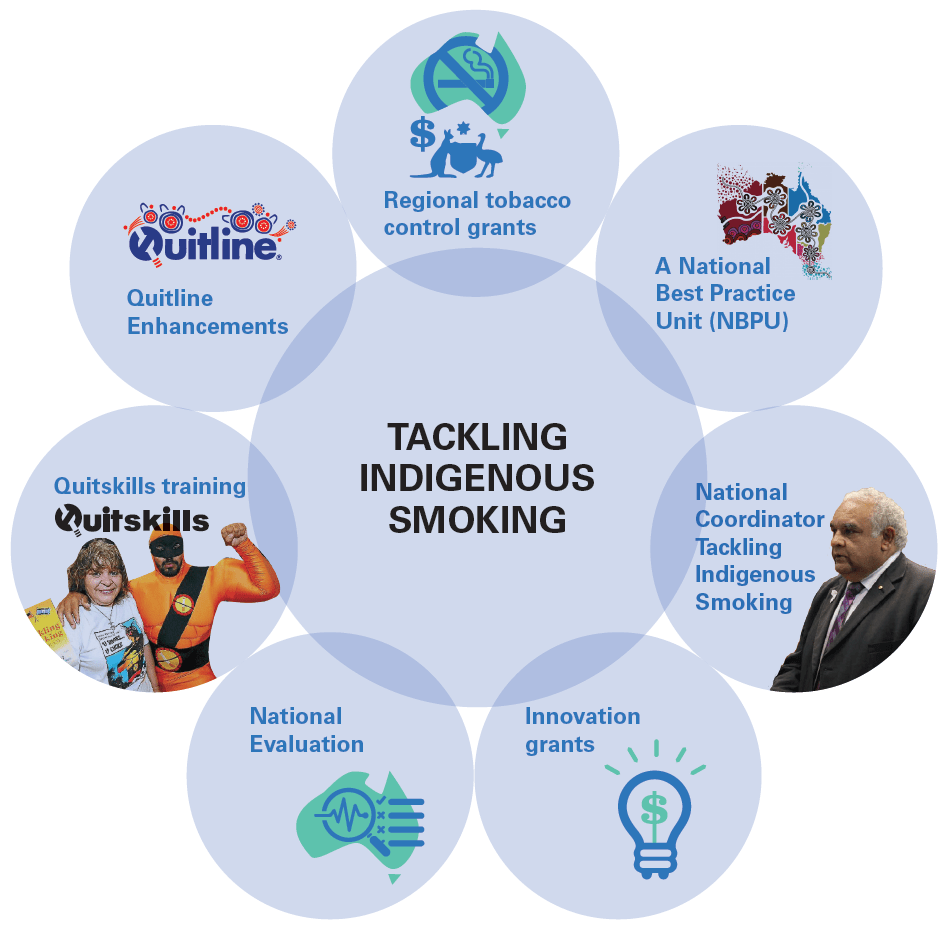
The programme consists of the following components:

    • Regional tobacco control grants to support multi-level approaches to tobacco control that are locally designed and delivered to prevent the uptake of smoking and support smoking cessation among Indigenous Australians, Funding for the new grants commenced from 1 January 2016;
    • A National Best Practice Unit (NBPU) to support regional tobacco control grant recipients through evidence-based resource sharing, information dissemination, advice and mentoring, workforce development, and monitoring and evaluation, with support and leadership provided by the National Coordinator – Tackling Indigenous Smoking, Professor Tom Calma AO. The NBPU was sourced through an open tender process with a consortium led by Ninti One and including the University of Canberra, University of Sydney and Edith Cowan University is operating the NBPU;
    • Enhancements to existing Quitline services and provision of frontline community and health worker brief intervention training;
    • Program Evaluation and Monitoring which includes the design of an evaluation and monitoring framework to be used for the development of local and national performance indicators for grant reporting and to guide overall programme evaluation. The Cultural and Indigenous Research Centre (CIRCA) has been contracted to develop the Programme Evaluation and Monitoring Framework and undertake the evaluation of the TIS program as a whole; and
    • Innovation grants in remote and very remote areas which have high smoking rates and within specific groups such as pregnant women and young people susceptible to taking up smoking, for commencement in mid-2016.

In addition to the Tackling Indigenous Smoking program, the Australian Government provided $10 million for an Indigenous specific campaign for the National Tobacco Campaign 2016, which commenced on 1 May 2016 across various media.

The campaign, “Don’t Make Smokes Your Story” aims to increase sustained efforts to quit smoking and to reduce smoking uptake, targeting Aboriginal and Torres Strait Islander people, by highlighting the risks associated with smoking and avenues of support within a cultural context.

Website

4. Resources and TIS portal information Centre

The TIS Programme aims to improve the health of Aboriginal and Torres Strait Islander people by reducing the prevalence of tobacco use. The Programme has a number of parts:

  • Regional Grants to organisations
  • A National Best Practice Unit (NBPU)
  • Enhancements to Quitline services
  • Quitskills training
  • Innovation Grants
  • A National Coordinator for Tackling Indigenous Smoking
  • An evaluation of the overall Programme

Website Portal Here

5.Check-out monitoring and evaluation videos for Tackling Indigenous Smoking programs

View Vidoes Here

6. Examples of our ACCHO / TIS programs that work

Check thru to the NACCHO site page to view videos


NSW Wellington Aboriginal Corporation Health Service

NSW Galambila / Durri / Werin Coffs Harbour Kempsey and Port Macquarie

Do you love your sport? Don’t let smoking impact your ability to breathe free and easily. Chuck those smokes away; get outside and play #deadlynready #ToMakeOurMobSmokeFree

Drop into your local AMS for support on your quit journey today #readymob if you would like Ready Mob to attend your school or community group please see our page for more details http://smokefreecommunity.com.au/ Galambila Aboriginal Health Service

NT Danila Dilba

 Check out the Facebook Page


NT Katherine West Health Board

Indigenous Hip Hop Projects was proud to partner with Katherine West Health Board and Bulla Camp to create this follow up deadly Music Video/ Health Resource.

The key message was focused on the tobacco and smoking issues in the community particularly with people smoking in cars and in the house

South Australia Nunkuwarrin Yunti of South Australia

Allan Sumner is a talented South Australian artist. He is a descendant of three Aboriginal peoples being the Ngarrindjeri people from the lower river and lakes of the Murray River along the Coorong, the Adelaide plains Kaurna people and the Yankunytjatjara people from central Australia.

The Nunkuwarrin Yunti Tackling Tobacco Team contracted Ochre Dawn who approached Allan to create an artwork to illustrate the story that Nunkuwarrin Yunti and the community share in tackling tobacco.

Drawing upon his own experience, 20 years of working in health, tobacco control and on personal health battles “It came to me very easy, to create the artwork” said Allan.

“The Tackling Tobacco Teams new artwork is a contemporary view which has traditional elements present, in particular the symbol in reference to the pregnant mothers and children are popular across many cultural groups. Some of the other symbols, you wouldn’t necessarily see in Aboriginal artwork but they do have meaning.

These new symbols will be used into the future. I think that’s how Aboriginal artwork is bold, it was never ever the same before, the fact is, it’s always taken someone to sit down and recreate something to give it meaning to say this is what I want it to represent, and that’s exactly what I’m doing. My artwork in years to come, my children’s children are going to say ‘that symbol means this’. Aboriginal culture is living and always transforming, it’s never set, it changes over a long period of time, and I’m just a part of creating that culture.”

“Quitting smoking isn’t easy and it’s a narrow path. In the Tackling Tobacco Team artwork, I came up with the idea to illustrate that narrow path. There’s always barriers to why people can’t give up the smokes, so I thought it’s like a river, to get across the river there is narrow paths, then there’s stepping stones in the river, you have to find those stepping stones of support to get across to the fresh air on the other side”.

Further “I wanted the artwork to be vibrant and eye catching so that people stop and take a look. I wanted to really portray the messages well, therefore I put a lot of thought into the descriptions of the symbols used, so that when people look at the artwork they understand the full meaning and story behind it”. Allan explained that the artwork being contemporary in nature containing new stories, cultural symbols and significant meaning, will continue to be linked to Aboriginal history, it will in time become a very valuable story to the viewers.

Tackling Tobacco Team & Robert de Castella, Adrian Dodson-Shaw and Elsie Seriat from Indigenous Marathon Foundation.Thanks for dropping in

QLD The Institute for Urban Indigenous Health Deadly Choices

Murri Places, Smoke-free Spaces is an initiative by The Institute for Urban Indigenous Health aimed at reducing the prevalence of tobacco smoking, particularly within health services and other Aboriginal and Torres Strait Islander workplaces.

Follow on Facebook

It includes smoke-free policies, smoking cessation and nicotine dependence education and support programs for staff and their families. It also encourages creating and identifying smoke-free spaces – including workplaces, houses and cars to increase health and wellbeing in the community.

Going smoke-free is a Deadly Choice – why?

  • Tobacco smoking is the largest single preventable cause of death and disease in Australia
  • There are approx. 19,000 smoking related deaths each year
  • 47% of Indigenous people smoke compared to 17% of the Australian population
  • Smokes cost about $20 per pack, so if you smoke 1 pack of cigarettes a day you’ll spend $7280 per year!

Join the Smoke-Free Team today and get your limited edition jersey

If you have been thinking about giving up the smokes, now is a great time to get support from your local Aboriginal Medical Service.

How to get your limited edition Smoke-Free Team jersey:

  1. Tell your AMS you are interested in joining the Smoke-Free Team and giving up the smokes
  2. Attend four (4) Quit appointments
  3. Take home your limited edition Deadly Choices Smoke-Free Team jersey

Not a smoker? You can still get your jersy by referring a friend or family member. Once they have completed their four (4) Quit appointments, you’ll both get a jersey!

Are you interested in finding out more?

Contact your nearest Aboriginal Medical Service and ask about Quit Smoking programs, Nicotine Replacement Therapy and other supports they can offer.

programs 01

Download Smoking During Pregnancy Fact Sheet
Download Tips For Quitting Fact Sheet
Download Tobacco fact sheet

Make a Deadly Choice today.

Contact your nearest clinic for assistance and NRT if appropriate

QLD Apunipima Cape York Health Council.

Check out our TIS stall in Hopevale today! Kurtis & Dean have set up opposite the school to promote the key messages of our program 🙂

Have a yarn with them if you would like to be involved in your local social marketing campaign.

#DontMakeSmokesOurStory #CloseTheGap
National Best Practice Unit Tackling Indigenous Smoking — at Hopevale,Queensland

What’s Your Story, Cape York?’ Facebook page is administrated by the Tackling Indigenous Smoking (TIS) Team at Apunipima Cape York Health Council.

‘Don’t Make Smokes Your Story’ is a national campaign on that shares the real, difficult stories of Aboriginal and Torres Strait Islander people who have smoked tobacco. The campaign was initiated by the Australian Government as part of their plan to close the gap in Aboriginal and Torres Strait Islander smoking rates.

QLD Carbal Medical Service

Check out the website

WA   Wirraka Maya Health Service Aboriginal Corporation

Victorian Aboriginal Health Service (VAHS)

The Tackling tobacco team is a part of the Healthy lifestyles team at the Victorian Aboriginal Health Service (VAHS) and provides smoking cessation throughout the Aboriginal community in Victoria.

The team’s focus is to cut the smoking rates in the community and close the gap between Aboriginal and non-Aboriginal Australians.

Activities include:

  • client support and education
  • pilot hypnotherapy program for community to quit smoking
  • health promotion/smoking cessation education at community events
  • presentations to young people and other organisations
  • referrals to Quit

The team partners with the Aboriginal Quit line counsellors wherever possible

Website Page

Tasmania Aboriginal Centre


Website


ACT Winnunga

Winnunga’s Tobacco/Healthy Lifestyle Workers offer health information sessions and stalls at events, schools and workplaces as well as referrals into our No More Boondah (link to be inserted here soon) quit smoking program. Onsite at Winnunga we offer access to a range of programs including healthy cooking and sporting/exercise groups.

Winnunga has a smoke free policy which states that smoking is prohibited on all grounds surrounding Winnunga’s main building, car park and art room.

If you would like to enquire about our team attending your event, workplace or school please call us on 02 6284 6222 and ask for Chanel Webb, Tobacco Action Worker or Ian Bateman, Healthy Lifestyle Worker.

If you would like information about Winnunga’s ‘No More Boondah’ quit smoking program click here  or call Perri Chapman, Tobacco Action Worker, on 02 6284 6222.

Be sure to visit our face book page ‘tackling Indigenous smoking & promoting healthy lifestyles’ for the latest updates on smoking and living healthy!

WEBPAGE

6.Links to Grant Recipient websites

NACCHO Aboriginal Health Workforce : @KenWyattMP meets medical colleges to boost Aboriginal health care

” Providing health care that was culturally appropriate for Indigenous people was crucial.

Ultimately, what I want to see is that Aboriginal people, if they come into a hospital, they take the full patient journey,

The procedures and treatment regimes are the same as any other Australian receives so that we push out life and we move to closing the gap.

Increasing the number of Aboriginal and Torres Strait Islander people working in health care will also be discussed.

If we don’t get our initial training and ongoing education right, we will never deliver a culturally safe health system,

The colleges are critical partners in getting this right with ideas on training and recruitment and retention initiatives.”

Indigenous Health Minister Ken Wyatt

Photo above : Danielle Dries  pictured above with the minister in an inspiring final-year Aboriginal medical student from the Australian National University was the recipient of the MDA National and Rural Doctors Association of Australia (RDAA) Rural Health Bursary for 2016. Read full Story here

NACCHO Background Info

Read NACCHO Articles Cultural Safety

Aboriginal Health ” managing two worlds ” : How Katherine Hospital, once Australia’s worst for Indigenous health, became one of the best

Senior representatives from Australia’s medical colleges are converging on Canberra today for a roundtable aimed at improving treatment for Aboriginal and Torres Strait Islander people.

As reported by ABC NEWS this morning

Indigenous Health Minister Ken Wyatt will host the 12 colleges at Parliament House in a bid to boost outcomes and access to health care over the next decade.

The powerful groups include the Royal Australasian College of Surgeons, the Australian College of Rural and Remote Medicine and the Royal Australian College of General Practitioners.

“[They’re] important for me to partner with if I’m going to close the gap,” Mr Wyatt told the ABC.

“I believe that they can make an incredible difference, it’s just we’ve never asked them to in this sense.”

Prime Minister Malcolm Turnbull’s Closing the Gap report to Parliament last month showed six of the seven targets were off track, including life expectancy and child mortality.

Mr Wyatt earlier this year became Australia’s first-ever Indigenous federal government minister.


Aboriginal #Earlychildhood #Obesity Study : We need to reduce the prevalence of overweight/obesity in the first 3 years of life

“People who are obese in childhood are at increased risk of being obese in adulthood, which can increase the risk of cardiovascular disease, some types of cancer, diabetes, and arthritis,”

Research found reducing consumption of sugary drinks and junk food from an early age could benefit the health of Indigenous children, but that this is just one part of the solution to improving weight status.

“We know that Indigenous families across Australia – in remote, regional, and urban settings – face barriers to accessing healthy foods. Therefore, efforts to reduce junk food consumption need to occur alongside efforts to increase the affordability, availability, and acceptability of healthy foods,”

 Ms Thurber, PhD Scholar, from the National Centre for Epidemiology and Population Health at ANU.

A major study into the health of Aboriginal and Torres Strait Islander children has found programs and policies to promote healthy weight should target children as young as three.

Lead researcher Katie Thurber from The Australian National University (ANU) said the majority of Indigenous children in the national study had a health body Mass Index (BMI), but around 40 per cent were classified as overweight or obese by the time they reached nine years of age.

Download the Report Here Thurber BMI Trajectories LSIC

Latest national figures show obesity rates are 60 per cent higher for Aboriginal and Torres Strait Islander peoples compared to non-Indigenous Australians.

In 2013, around 30 per cent of Indigenous children were classified as overweight or obese, and two thirds of Indigenous people over 15 years old were classified as overweight or obese.

Key messages

•  The majority of Aboriginal and Torres Strait Islander children nationally have a healthy Body Mass Index
•  However, more than one in ten Aboriginal and Torres Strait Islander children in Footprints in Time were already overweight or obese at 3 years of age, and there was a rapid onset of overweight/obesity between age 3 and 9 years
•  We need programs and policies to reduce the prevalence of overweight/obesity in the first 3 years of life, and to slow the onset of overweight/obesity from age 3-9 years
•  Reducing children’s consumption of sugar-sweetened beverages and high-fat foods is one part of the solution to improving weight status at the population level
•  To enable healthy diets, we need to (1) create healthier environments and (2) improve the social determinants of health (such as financial security, housing, and community wellbeing). Creating healthy environments is complex, and will require both increasing the affordability, availability, and acceptability of healthy foods and decreasing the affordability, availability, and acceptability of unhealthy foods
•  Programs and policy to promote healthy weight need to be developed in partnership with Aboriginal and Torres Strait Islander communities
•  Despite higher levels of disadvantage, most Aboriginal and Torres Strait Islander children maintain a healthy weight; we need programs and policies that cultivate environments and circumstances that will enable all Aboriginal and Torres Strait Islander children to have a healthy start to life
 

Ms Thurber said improving weight status would have a major benefit in closing the gap in health between Indigenous and non-Indigenous Australians.

“Obesity is a leading contributor to the gap in health,” Ms Thurber said.

“We want to work with Aboriginal and Torres Strait Islander families and communities, as well as policy makers and service providers, to think about what will work best to promote healthy weight in those early childhood years.

“We want to start early, and identify the best ways for families and communities to support healthy diets, so that all Aboriginal and Torres Strait Islander children can have a healthy start to life.”

The research used data from Footprints in Time, a national longitudinal study that has followed more than 1,000 Indigenous children since 2008. It is funded and managed by the Department of Social Services.

Professor Mick Dodson, Chair of the Steering Committee for the Footprints in Time Study and Director of the ANU National Centre for Indigenous Studies, said Aboriginal and Torres Strait Islander children deserve the best possible start in life.

“This study shows just how important it is to support them, their families and their communities to provide a healthy diet and opportunities for physical activity,” Professor Dodson said.

Ms Thurber said using the Footprints in Time study, researchers for the first time were able to look at how weight status changes over time for Aboriginal and Torres Strait Islander children, enabling them to identify pathways that help children maintain a healthy weight.

The research has been published in Obesity.

NACCHO Aboriginal Health and #Smoking : @KenWyattMP announces $35.2 million funding #ACCHO Anti-smoking programs

These health services are all delivering frontline services to prevent young Indigenous people taking up smoking and to encourage existing smokers to quit.

Reducing smoking rates is central to the Government’s efforts to close the gap in life expectancy, but requires a consistent, long-term commitment”

Minister for Indigenous Health, Ken Wyatt

Over 100 NACCHO Articles about smoking

REDUCING INDIGENOUS SMOKING TO CLOSE THE GAP

The Australian Government will provide $35.2 million next financial year to continue anti-smoking programs targeted to Aboriginal and Torres Strait Islander people in regional and remote areas.

Minister for Indigenous Health, Ken Wyatt, said the Government had approved the continuation of funding to 36 Aboriginal Community ControlledHealth Services and one private health service.

“These health services are all delivering frontline services to prevent young Indigenous people taking up smoking and to encourage existing smokers to quit,”  .

“Reducing smoking rates is central to the Government’s efforts to close the gap in life expectancy, but requires a consistent, long-term commitment.

“Smoking causes the greatest burden of disease, disability, injury and earlydeath among Indigenous people and accounts for 23 per cent of the health gap between Indigenous and non-Indigenous Australians.”

Under the Council of Australian Governments (COAG) National Healthcare Agreement, all governments have committed to halving the 2008 adult daily smoking rate among Indigenous Australians, of 44.8 per cent, by 2018.

“The rate of smoking among Aboriginal and Torres Strait Islander people is still far higher than among other Australians and is damaging their health in many ways,” Minister Wyatt said.

It’s unlikely now that we will meet the COAG target, but we are making progress.

“It’s important that anti-smoking programs are meaningful for Indigenous people and changes made in recent years have ensured that only programs which are evidence based and effective are receiving grants.”

Continued funding for the 37 health services follows a preliminary evaluation of the Tackling Indigenous Smoking program which found that it was operating effectively and using proven approaches to changing smoking behaviour.

NACCHO Aboriginal Health : Our #ACCHO Members Good News Stories from #NT #WA #VIC #SA #NSW #QLD @KenWyattMP

1. NSW Jullums , Bullinah and Bulgarr Ngaru ACCHO/AMS

2. NSW Wellington Aboriginal Corporation AMS

3. South Australia Nunyara Aboriginal Health Service 

4.Western Australia : Aboriginal Health Council of WA.

5.Victorian Aboriginal Health Service (VAHS)

6. NT 6. NT Katherine West Health Board

7. QLD Deadly Choices and  Gurriny Yealamucka Health Service

 For NACCHO the acceptance that our Aboriginal controlled health services deliver the best model of integrated primary health care in Australia is a clear demonstration that every Aboriginal and Torres Strait Islander person should have ready access to these services, no matter where they live.

 Lets celebrate and share our ACCHO’s success

How to submit a NACCHO Affiliate

or Members Good News Story ? 

 Email to Colin Cowell NACCHO Media     Mobile 0401 331 251

Wednesday by 4.30 pm for publication each Thursday


1.Jullums (Lismore), Bullinah (Ballina), Bulgarr Ngaru Medical Aboriginal Corporation (Casino, Maclean and Grafton) Clinic’s

The idea of these workshops is to raise awareness around the different signs and symptoms of heart disease, and also around prevention and management of the disease.

“This is a new, collaborative approach to addressing this issue, but we’re also working together with existing avenues such as healthy lifestyle and exercise programs to assist participants to make the most of what they’ll be learning.”

Aboriginal Chronic Care Officer with NNSWLHD, Anthony Franks

A series of workshops is being held in Northern NSW to raise awareness of the risk factors for heart disease and engage with Aboriginal and Torres Strait Islander women on ways to reduce their chances of becoming one of the statistics.

Download dates and venues Northern NSW Workshops dates and Venues

ABORIGINAL and Torres Strait Islander women are at least three times more likely to be hospitalised due to heart disease than their caucasian counterparts.

Heart disease is the leading single cause of death among Aboriginal and Torres Strait Islander Australians.

The program consists of three one-day workshops, with the first being held in March at various sites across the North Coast.

The participants will attend each of the three workshop days in March, May and July, with the aim of continuing the education and providing feedback and follow up at the later meetings.

The workshops are a collaboration between the Northern NSW Local Health District (NNSW LHD), local Aboriginal Medical Services (AMS), North Coast Primary Health Network (NCPHN), Solid Mob, and the NSW and Queensland Government health coaching services, Get Healthy and On Track. They are funded by the National Heart Foundation.

Workshops are being held in Grafton, Muli, Casino, Ballina, Maclean, Goonellabah and Tweed Heads.

2. Wellington Aboriginal Corporation Health Service 

Health expo to change bad habits in men

The Wellington Aboriginal Corporation Health Service hosted the QuiBFit Aboriginal Men’s Health Expo in Dubbo.

About 120 men participated from across the region which includes Orange, Coonabarabran, Walgett, Wellington, Dubbo, Parks and Goodooga.

A major focus was tackling Indigenous smoking and mental health and wellbeing.

Wellington Aboriginal Corporation Health Service chief executive Darren Ah See said a lot of th e focus in the Indigenous health sector is on “mums and bubs”.

“It’s good to have an event like this for men because they are the reluctant ones about getting their health checks”, he said.

“We want to try to change that norm and get men to take responsibility not only around their health and wellbeing but to be the leaders of their communities and families.

“It’s all about social and health wellbeing but it is also about mentorship and trying to encourage families and individuals to head in the right direction”.

The expo culminated with a corroboree, with more than 300 people attending.

Western NSW Local Health District Aboriginal health and wellbeing director Brendon Cutmore said it was extremely important to focus on preventive health at the expo.

“It is really our opportunity as Aboriginal men to take control of our lives, whether that be through eliminating some of the negative habits people have, things such as smoking, drugs and alcohol, “he said.

“Coming to these types of event sand having discussions around how to make your life healthier, how to be a leader in the community and how to be a leader in your family and how your actions reflect on the people around you – that’s a big take home message.

 3.Nunyara Aboriginal Health Service Whyalla SA

 “ I encouraged Aboriginal and Torres Strait Islander women to attend the gathering in Whyalla to benefit from the stories and experiences of their peers.

It is important that these gatherings to take place in regional areas so Aboriginal and Torres Strait Islander women living outside of Adelaide have the chance to network and share community news.

Previous gatherings have been very successful and attracted many participants from across the state.

These events are also an opportunity for the State Government to strengthen ties with local service providers and gain insight into matters affecting the community.

Status of Women Minister Zoe Bettison

Co-facilitator’s Kimberley from OfW and Zena Wingfield for the in Whyalla today

The first State Aboriginal Women’s Gathering for 2017 was held in Whyalla this week

The gathering took place on Tuesday 28 March at Nunyara Aboriginal Health Service, Whyalla Stuart.

The gatherings gave Aboriginal and Torres Strait Islander women an opportunity to discuss a range of issues and share news from their communities.

Guest speakers presented information on topics including health, women’s legal services, sports and recreation, mental health and wellbeing, and caring support.

Status of Women Minister Zoe Bettison said the gatherings give women the opportunity to learn from each other, share experiences and discuss issues, in a safe and supportive environment.

The Office for Women has partnered with Whyalla’s Nunyara Aboriginal Health Service to convene this event.

Background

In 2016, five separate State Aboriginal Women’s Gatherings were held across the state to make it easier for women in regional areas to participate.

Whyalla was identified as a significant location for the first gathering of 2017 as a way to provide support and information to Aboriginal women in the region.

Gatherings have also been planned for 2017 in the Far West Coast and the South East.

For more information about the State Aboriginal Women’s Gatherings visit www.officeforwomen.sa.gov.au

4. Aboriginal Health Council of WA.

“ The prevalence of ear disease and hearing loss in Aboriginal kids has a major effect on their speech and educational development, social interactions, employment and future wellbeing,

While many children are vulnerable to chronic ear disease, in WA it represents a significant burden for Aboriginal children who can experience their first onset within weeks following birth.

Aboriginal children can also have more frequent and longer lasting episodes compared to non-Aboriginal children.”

AHCWA Chairperson Michelle Nelson-Cox said poor ear health was a significant problem among Aboriginal people, particularly children.

Training program to improve ear health among Aboriginal people

A training program to assist Aboriginal Health Workers to provide ear health care to their communities is being delivered around the state by the Aboriginal Health Council of WA.

The two week ear health training program was delivered in four different locations last year, and 23 Aboriginal Health Workers (AHWs) have graduated from the course so far.

The program is scheduled to be delivered in at least four more locations this year including Perth, Broome and Kalgoorlie. More trainings will be scheduled for the second half of the year.

The program teaches AHWs how to manage ear infections, carry out screening, identify risk factors and plan ear health promotion and strategies.

AHCWA Chairperson Michelle Nelson-Cox said poor ear health was a significant problem among Aboriginal people, particularly children.

“The prevalence of ear disease and hearing loss in Aboriginal kids has a major effect on their speech and educational development, social interactions, employment and future wellbeing,” she said.

“While many children are vulnerable to chronic ear disease, in WA it represents a significant burden for Aboriginal children who can experience their first onset within weeks following birth.

“Aboriginal children can also have more frequent and longer lasting episodes compared to non-Aboriginal children.”

Ms Nelson-Cox said people in regional areas were more susceptible to ongoing ear problems.

“Children living in remote communities have some of the highest rates of chronic ear disease in the world,” she said.

“We want to spread the message in regional communities that early detection and treatment of ear diseases in children is vital to ensure optimum development of speech, language, and to minimise the long term effects on educational performance.”

AHCWA has also launched a giant inflatable ear to be used as an interactive teaching tool among Aboriginal communities.

Koobarniny, which means ‘big’ in the Noongar language, is believed to be the first of its type in Australia.

Koobarniny is currently being used at different events around the metropolitan area, but it’s hoped it will travel to regional areas in the future.

 5. Victorian Aboriginal Health Service (VAHS)
 
 7. QLD Deadly Choices and  Gurriny Yealamucka Health Service

It’s been a great couple of days in the North with today’s visit by Steve Renouf, Lote Tiquiri & Brisbane Broncos James Roberts at the DC Yarrabah Gurriny Yealamucka Health Service Aboriginal Corporation

Please share this post


Aboriginal Health ” managing two worlds ” : How Katherine Hospital, once Australia’s worst for Indigenous health, became one of the best


” Katherine Hospital in the Northern Territory has gone from one of the worst facilities in the country when it comes to Indigenous health care to one of the best.

Their secret: engaging with Indigenous patients and supporting doctors.”

Dr Quilty his high level of specialist training has meant that patients who would have had to be evacuated to Royal Darwin Hospital can now receive treatment in Katherine. Full Story below

Photo above : Gaye is a 50 year-old cancer patient from Mataranka in the NT. Supplied: Simon Quilty

NACCHO support INFO

Aboriginal Patient Journey Mapping Tools Project:

Communicating complexity

The Managing Two Worlds Together project aims to add to existing knowledge of what works well and what needs improvement in the system of care for Aboriginal patients from rural and remote areas of South Australia (and parts of the Northern Territory). It explores their complex patient journey.

The relationship between patients and health care providers is the foundation of care and requires communication across cultures, geography and life experiences. As a staff member in one rural Aboriginal Community Controlled Health Service put it: ‘It’s like managing two worlds together, it doesn’t always work’.

Download Stage 3 Study Managing Two World Study Report

NACCHO Aboriginal Health News Alert :

Do we need to close the gap on Aboriginal hospital experiences ?

How Katherine Hospital, once Australia’s worst for Indigenous health, became one of the best

As published ABC NEWS  By Hagar Cohen for Background Briefing

When physician Simon Quilty arrived at the hospital, it was going through a major crisis.

“What had happened in 2010 is that the hospital found itself in a situation where things were falling apart,” he says.

A number of doctors complained to the NT Medical Board about a lack of supervision and the impractical workload. The hospital was on the verge of shutting down.

More than one in four Indigenous patients left Katherine Hospital before completing treatment, often without informing staff, the worst rate in the nation. These “take own leave” cases are complex, but one factor is Indigenous patients’ perception of inadequate treatment.

It’s an issue plaguing the health system nationally: a 2014 Federal Health Department report found that racism contributes to the low rates of access to health services by Aboriginal people.

Similarly, the number of patients who “discharge against medical advice” is recorded and recognised by health departments as a key indicator for the quality of Aboriginal healthcare.

In the NT, 11 per cent of all Indigenous patients discharge themselves against medical advice.

“These people have very complex illnesses,” says Dr Quilty. “Many of them are highly likely, if not treated well, to resolve in significant injury or death. Hospitals in remote locations really need high expertise to deal with the very sick patients that turn up here.

“Thirteen and 15-year-olds are developing type 2 diabetes, they’ve got kidney impairment by the time they’re 22 and they’re on dialysis in their early 30s. It’s a bit terrifying really.”

Back from the brink

The NT Department of Health conducted an investigation into the staffing crisis at the Katherine Hospital. Its findings weren’t released publicly.

Background Briefing can reveal that the final report concluded that there were “significant deficiencies in nearly all the essential dimensions of safe clinical service provision”, adding that the “root cause is that the medical service model is unsustainable and becomes more unsustainable with each passing year”.

Six years ago, a new general manager and a group of new doctors arrived with an ambition to turn things around.

Katherine Hospital

They’ve brought highly trained specialist doctors who are invested in the community, interpreters are used regularly and families of Indigenous patients are consulted on complex treatment plans.

In the past, interpreters were available but rarely used. Families weren’t a part of the consultation process. Many of the doctors were junior, and staff turnover was high.

The new management has made huge inroads in the way the hospital cares for Aboriginal patients.

This year, only 4 per cent of the Indigenous patients “took own leave”, making Katherine one of the best performing hospitals in the nation when it comes to caring for Aboriginal patients.

Systematic use of interpreters

In 2006, when respected Indigenous lawman Peter Limbunya, from the remote community of Kalkarindji, stayed in the hospital for 10 days, he did not have access to an interpreter, despite not speaking English.

At the end of his treatment, Mr Limbunya, who was part of the legendary Wave Hill walk off in the 60s, was flown to a remote airstrip 5 kilometres away from his community.

His family wasn’t told he’d be back that day and nobody was there to meet him. He died of dehydration.

During the inquest into his death, the coroner found that interpreters were not in use at the hospital.

His cousin, lifetime activist and advocate for Aboriginal people Josie Crawshaw, remains outraged. She says her uncle would have known “absolutely nothing” about his treatment and what was going on.

But things have come along way since then. The hospital’s Aboriginal liaison officer, Theresa Haidle, says improving the way doctors communicate is the key to developing Indigenous patients’ trust in their treatment plans.

Regular use of interpreters has been an essential part of Ms Haidle’s work. She says they’ve been key in making sure patients understand their illnesses and treatment options.

“English isn’t their first language. It may not even be their second or third either. If there’s any doubt, we get interpreters in, or even on the phone.”

The systematic use of interpreters is a big change at Katherine Hospital.

Ms Haidle says the hospital has a lot further to go when it comes to providing a culturally safe environment, but overall, the relationship with the Aboriginal community is getting better all the time.

“It’s like a big learning process for everybody,” she says.

“We have to break it down as simple as we can,” she says. “There’s not an Aboriginal word that means cancer, so how do you explain those things?

“I remember one day a lady had this fungus, and there’s no words for those things on women’s bodies, or inside. So I heard the interpreter telling her: ‘You know, like mushrooms growing?’ They got her to stay and get it treated.”

Changing doctors’ attitudes

Pip Tallis, who is training to be a physician at Katherine Hospital, has worked in hospitals in Alice Springs and Darwin, where she says many of her Indigenous patients left before their treatment was complete.

“I found it really hard to understand why,” she says.

“It was frustrating as a doctor, and there was a lot of frustration among the staff and no-one really took the time to understand why people were taking their own leave, or really did anything to change it.

“I think, there was a bit of hands up in the air. ‘Whatever, what can we do about it? It’s their problem.'”

The NT town of Katherine, seen from the air

Dr Tallis says that her perspective has changed since coming to work at Katherine Hospital.

“I’ve spent six months working with the team here and observing how they engage with the patients, and I think that they do significant things to result in people not taking their own leave,” she says.

“Previously I was very inflexible. Now I spend a lot more time appreciating why people take their own leave.

“I’m also picking up the subtle signs on a patient who’s starting to not engage. I’ll sit down with them and explore their issues. And if they say they want to just go for a walk, you just say, ‘Would you like to take some medicine with you just in case you don’t come back?'”

Care plans to lower ‘take own leave’ rates

The introduction of weekly meetings to go over care plans for the Indigenous patients means everyone in the hospital can keep up with what’s happening with individual patients

These meetings are attended by social workers, doctors, nurses and admin staff.

At one such meeting, Dr Tallis mentions Jason, a 30-year-old patient from the remote community of Ngukurr, 330 kilometres south-east of Katherine.

Jason has tuberculosis, and has left the hospital during treatment once before. His family has convinced him to return. Dr Tallis explains at the meeting that Jason doesn’t like the hospital food, and that special food is being provided for him.

“We tried really hard to engage him,” she says. “We even got bacon and eggs for him in the mornings so he doesn’t complain about porridge, he’s got a DVD player, USB drive, he got pizza the other day. So we tried really hard to make it possible.”

But there’s still a cultural divide. At the end of the meeting, Jason explains to another doctor that he thinks “white fella” medicine is too slow.

“I want to go back to bush medicine,” he says. “It’s better and works fast because we learned it from old people.”

More support for staff

The hospital’s general manager, Angela Brannelly, says the 2010 investigation into the staffing crisis recommended major changes to the way the hospital operates, its level of staffing and supervision.

She says supporting the medical staff was one of her first priorities.

“We took it very seriously and made some really serious changes to the way that the medical team was supported here. It was around ensuring that someone’s got their back,” she says.

Dr Quilty, who joined the hospital in 2012, was the first physician to have ever been employed at the hospital. Last year he won the Royal Australian College of Physicians’ medal for clinical service in rural and remote areas.

A dark-skinned doll

His high level of specialist training has meant that patients who would have had to be evacuated to Royal Darwin Hospital can now receive treatment in Katherine. Since 2012, there has been a decrease of 43 per cent in the number of total aeromedical evacuations to Darwin.

Many Indigenous patients who live in remote communities don’t like going to Darwin to receive medical treatment because it’s far from family and the hospital is bigger and less personal.

Gaye, 50, a cancer patient who was transferred to Darwin for chemotherapy says she felt lonely in Darwin. “In Darwin I was always sad and crying a lot,” she says.

No-one in Darwin had realised that Gaye was deaf, which made communication with medical staff virtually impossible. In Katherine her deafness was recognised by the nurses and she was given a hearing aid, which she says made a huge difference to her mental health.

Katherine Hospital now employs two full-time physicians.

Still no Aboriginal doctors

Katherine Hospital employs 24 doctors but none of them are Indigenous.

Ms Brannelly admits the hospital hasn’t done enough to attract Aboriginal doctors.

“That’s good advice for us, and it’s probably where we need to go in that space around seeking out Aboriginal medical officers to come and work for us,” she says.

“I think we have some work to do there, absolutely.”

NACCHO TOP10 #JobAlerts This week in Aboriginal Health : @Walgett_AMS #Mawarnkarra #Durri #Nganampa Health @Apunipima @UrapuntjaAMS

Help Close the Gap and create healthy futures for our mob

This weeks featured jobs on our NACCHO Job Alert

1.Non-Member Board Director — Specialist in Primary Health Care

2.Aboriginal Health Worker, Mental Health – Walgett AMS

3. Aboriginal Health Worker – Drug & Alcohol – Walgett AMS

4.Remote Area Nurses & Nurse-Midwives Nganampa Health Council SA

5. Aboriginal Health Worker – Full Time :Durri ACMS NSW

6. Teacher Aboriginal Health (Practitioner) Port Macquarie NSW

7. Indigenous Health Promotion Officer Mawarnkarra Health Service WA

8. Apunipima Cape York Health Council : Chief Executive Officer Closing 31 March

9. Alcohol and Other Drug (AOD) Worker : Illawarra Aboriginal Medical Service

10.Urapuntja Health Service :  3 positions currently available : No closing date

HESTA scholarship granted to 10 rural health students to inspire their future leadership

Two Indigenous students among 10 Rural Health Club members to win @HESTASuper scholarship to National Rural Health Conference SEE FULL STORY

How to submit a Indigenous Health #jobalert ? 

NACCHO Affiliate , Member , Government Department or stakeholder

If you have a job vacancy in Indigenous Health 

 Email to Colin Cowell NACCHO Media

Tuesday by 4.30 pm for publication each Wednesday

1.Non-Member Board Director — Specialist in Primary Health Care

For 40 years, Central Australian Aboriginal Congress has been a voice for Aboriginal people in Central Australia. Today, the organisation provides comprehensive primary health care to Aboriginal people living in Alice Springs and five remote communities in Central Australia.

As a Non-Member Board Director — Specialist in Primary Health Care, you will have the following attributes:

• Ability to identify key issues in relation to primary health care and have oversight of appropriate policies to define the parameters within which the organisation will operate.

• Knowledge, experience and networks in public health including health policy, community health and wellbeing, health needs analysis, health planning, resource allocation, analysis of population health trends, critical appraisal of published evidence and service delivery.

• Knowledge, experience and understanding of primary health care, for example nursing, allied health, medical practice and specialties and community health service provision.

• An understanding of clinical governance, knowledge and experience in clinical leadership, safety and quality standards of service delivery in primary health care, and associated performance measurement and reporting.

• Knowledge and experience in the strategic use and governance of information management and information technology, particularly in the context of health, tele-health, the collection of health data and electronic health records, and including personal information in privacy and security risk management.

• Ability to commit to the responsibilities including the time required by this role and an ability to contribute to continuing to build the capacity and governance of the organisation.

The responsibilities and duty of care for Non-Member Directors is equal to that of Member Directors. As a Non-Member Director, it is not a requirement that you reside in Central Australia.

Aboriginal and non-Aboriginal people are encouraged to apply

Download the FACT  and Contact

5.2 2017_Executive_ CAACAC Non-Member Directors Fact Sheet_Primary Health Care

For further information on these positions, please contact Donna Ah Chee, CEO Ph: 08 8951 4401

To submit your application, please ph: 08 8951 4401 or

email: directorate.execsec@caac.org.au

2.Aboriginal Health Worker, Mental Health – Walgett AMS

Walgett is a nestled in north-central New South Wales. With a population of 2,300, Walgett is a regional hub for the wool, wheat and cotton industries. It is also the gateway to the New South Wales opal fields. Walgett Shire offers a friendly relaxed lifestyle and there are many sporting and recreational pursuits available.
The Walgett Aboriginal Medical Service (WAMS) will work with the Aboriginal Communities of the Walgett Shire area to provide a quality culturally appropriate health service.
The organisation has grown from strength to strength and we have shown all members of the community we are here to help in any way we can.
This position is a permanent full time position and reports through to the Chronic Disease Manager. Duties will include, but not limited to:
 Maintain Confidentiality and Privacy at all times;
 Develop, coordinate and implement community development activities;
 Develop and facilitate cross-cultural awareness training;
 Coordinate referrals to specialist and other agencies services e.g. psychiatrists, psychologists etc.
 Working with WAMS team to research, develop and implement, monitor and evaluate the Aboriginal Mental Health program.

QUALIFICATIONS AND EXPERIENCE REQUIRED TO CARRY OUT THIS ROLE:

Essential:
– Aboriginality: a genuine requirement of this position, as per section 14 of the Anti-Discrimination Act 1977;
– Certificate four in Aboriginal Mental Health and/or relevant qualification;
– Experience working with rural and remote communities;
– Knowledge of current Aboriginal health issues;
– Experience researching, designing and implementing primary health care strategies and an Aboriginal Health program
– Demonstrated knowledge of Aboriginal Mental Health issues significant to Aboriginal people;

– Ability to liaise with both Aboriginal and non-Aboriginal organisations and individuals;
– Ability to organise, co-ordinate and facilitate workshops and conferences;
– Sound knowledge of the application of community protocols and the Aboriginal Health Information Guidelines; and
– Current NSW driver’s license.
Desirable:
– Knowledge of Walgett and surrounding communities’ services by WAMS;
– Experience working in mental health and/or related fields;
– First Aid certificates; and
– Ability to create and maintain a client data base, analyse client data and adapt program according to client and community needs.
If you’re looking for a change of pace and the opportunity to gain a unique rural experience, then this is the role for you. Applicants must send through a copy of their resume along with a cover letter outlining their experience. Additional training may be provided to the right candidate.

APPLY HERE

3. Aboriginal Health Worker – Drug & Alcohol – Walgett AMS

Walgett is a nestled in north-central New South Wales. With a population of 2,300, Walgett is a regional hub for the wool, wheat and cotton industries. It is also the gateway to the New South Wales opal fields.  Walgett Shire offers a friendly relaxed lifestyle and there are many sporting and recreational pursuits available.

The Walgett Aboriginal Medical Service (WAMS) will work with the Aboriginal Communities of the Walgett Shire area to provide a quality culturally appropriate health service.

The organisation has grown from strength to strength and we have shown all members of the community we are here to help in any way we can.

This position is a permanent full time position and reports through to the Chronic Disease Manager.  Duties will include, but not limited to:

  • Maintain Confidentiality and Privacy at all times;
  • Increase community awareness of the effects of the abuse of alcohol and other addictive substances;
  • Increase community awareness of all diseases caused by alcohol and other drug substances;
  • Plan, implement and evaluate culturally appropriate programs;
  • Work with judicial and police system to give support to clients requiring counselling and rehabilitation as directed by these agencies;
  • Assist with transportation to outsourced facilities; and
  • Work and assist Doctors and fellow team members at WAMS.

QUALIFICATIONS AND EXPERIENCE REQUIRED TO CARRY OUT THIS ROLE:

Essential:

  • Aboriginality: a genuine requirement of this position, as per section 14 of the Anti-Discrimination Act 1977;
  • Certificate three (3) in Aboriginal Mental Health and/or relevant qualification;
  • Certificate four (4) in Drug and Alcohol;
  • Experience working with rural and remote communities;
  • Knowledge of current Aboriginal health issues;
  • Experience researching, designing and implementing primary health care strategies and an Aboriginal Health program
  • Demonstrated knowledge of Aboriginal Mental Health issues significant to Aboriginal people;
  • Ability to liaise with both Aboriginal and non-Aboriginal organisations and individuals;
  • Ability to organise, co-ordinate and facilitate workshops and conferences;
  • Sound knowledge of the application of community protocols and the Aboriginal Health Information Guidelines;
  • Current NSW driver’s license;
  • Clean NCC; and
  • Clean WWCC.

Desirable:

  • Knowledge of Walgett and surrounding communities’ services by WAMS;
  • Experience working in mental health and/or related fields;
  • First Aid certificates; and
  • Ability to create and maintain a client data base, analyse client data and adapt program according to client and community needs.

The successful candidate will need to provide to us, prior to the commencement of work:

  • Clean WCC (Working with Children Check)
  • Clean NCC (National Crime Check)
  • Undergo a Pre-Employment Medical Clearance.

If you’re looking for a change of pace and the opportunity to gain a unique rural experience, then this is the role for you.  Applicants must send through a copy of their resume along with a cover letter outlining their experience.  Additional training may be provided to the right candidate.

APPLY HERE

4.Remote Area Nurses & Nurse-Midwives Nganampa Health Council SA

Remote Area Nurses & Nurse-Midwives

Exciting and varied opportunities for Registered Nurses and Nurse – Midwives to join a highly recognised Aboriginal Health Service. If you have recent Medical/ A&E and Clinical experience, are passionate about making a difference and looking to be remunerated for your efforts – then read on..

Your new company

Nganampa Health Council is an Aboriginal owned and controlled health organisation operating on the Anangu Pitjantjatjara Yankunytjatjara (APY) Lands in the far north-western region of South Australia. The APY Lands cover roughly 103,000 square km, with a population of approx. 3,000 Anangu people. The region is freehold land controlled by the Anangu people.

Across this area, Nganampa Health operates seven clinics, an aged care facility and assorted health related programs including aged care, sexual health, environmental health, health worker training, dental, women’s health, male health, children’s health and mental health.

Nganampa Health Council is widely recognised as being an exemplar Aboriginal health service in the country. Their successes include significantly reducing the rates of sexually transmitted infections, increasing birth weights through their antenatal program, consistently keeping childhood immunisation rates at 100% and providing high quality residential and respite aged care at their Tjilpiku Pampaku Ngura aged care facility.

Further information can be found at www.nganampahealth.com.au

Your new career

Nganampa Health Council has opportunities for full-time clinic-based Registered Nurses and Registered Midwives to join their clinical teams, based in remote South Australia.

In these highly varied roles, you will be responsible for delivering primary health care according to the CARPA Standard Treatment Manual, and assisting in the early detection and management of chronic illness as part of a multi-disciplinary team. 

Working under the direction of the Medical Director and Clinical Service Manager, some of your areas of responsibility will include:

  • Working collaboratively with Medical Officers, Anangu Health Workers and other health staff to provide primary health care;
  • Treating acute illness and chronic medical conditions, and managing computerised recalls and patient follow-up care;
  • Child health monitoring and immunisations;
  • Patient health education;
  • Assessment and referral of social welfare issues;
  • Public health screening for STI, HIV/AIDS, Hepatitis A, B & C;
  • Public health surveying and programs;
  • Antenatal and post natal care;
  • General education support for Anangu Health Workers; and
  • Day-to-day administration of the clinics.

On offer is an extremely attractive salary package circa $204,581 – $238,133, commensurate with remote area experience, (this includes estimated non-cash benefits of $37,615 – $47,141).

Successful candidates will also be supplied with rent-free modern accommodation, including all rent, electricity, gas and basic essentials! Benefits include:

  • District allowance;
  • Work allowance;
  • Superannuation;
  • Annual retention bonus;
  • Leave loading;
  • Annual airfare;
  • 12 days study leave;
  • Recreation leave allowance;
  • 12 weeks annual leave; and
  • Assistance with relocation costs (negotiable)

About you

Candidates need to be adaptable and flexible individuals who can display the initiative, discretion and cultural sensitivity needed to support and drive the organisation’s objectives and values. Your ability to communicate and participate effectively within a cross-cultural, multi-disciplinary health team will be a must.

Individuals who are open to change, accepting of Aboriginal people, comfortable living in a remote environment and who are willing to learn the ways of the people will be well suited to these roles. The ability to work under Aboriginal management and control will also be highly regarded, as will a demonstrated understanding of issues affecting Aboriginal health, the principles of Primary Health Care and relevant legislation. No two days will be the same and as a result, highly resourceful candidates will thrive!

To be considered, you will:

  • Be a Registered Nurse or an RN / Registered Midwife, and be registered with the Australian Health Practitioners Regulation Agency (AHPRA);
  • Have a minimum of three years post graduation/ post bridging course, along with recent acute Medical / A&E experience;
  • Have demonstrable experience working in a clinical environment and hospital-based general nursing experience in the past 5 years (both of which are essential);
  • Ideally hold post basic nursing qualifications in Emergency Care, Critical Care and or rural and remote area Nursing (not essential);
  • Be able to demonstrate a sound professional clinical background and an ability to manage their own tasks; and
  • Have a good degree of computer literacy — health records and organisational documentation is computerised

Midwives must have done some acute general work within the past 5 years.

These positions are based in busy community clinics that are open from 9am to 5:30pm Monday to Friday. Nurses do provide an after hours on-call service, and you will require advanced nursing clinical skills including excellent clinical assessment skills and confidence in managing diversity in presentations — trauma, acute and chronic medical conditions — across all age groups.

The successful candidates must also be willing to undergo a Police Check and a Working With Children Check. A manual driver’s licence is essential and it would be advantageous to have experience with 4WD vehicles, although a 2 day 4WD training course is provided in your orientation week.

If you have a diverse background in clinical experience, including in clinical acute medicine, A&E, paediatrics and/or Aboriginal health care – then we want to hear from you!

Aboriginal and Torres Strait Islander people are strongly encouraged to apply.

To receive regular updates from Nganampa Health including future job opportunities, follow Nganampa Health Council on Facebook:

http://www.facebook.com/pages/Nganampa-Health-Council/306940186003663

Apply Now

5. Aboriginal Health Worker – Full Time :Durri ACMS NSW

Position designated under Section 14 of the Anti-Discrimination Act 1997 NSW

For over 30 years, Durri Aboriginal Corporation Medical Service has provided essential and culturally appropriate medical, preventive, allied and oral health services to Aboriginal communities.  Located in Kempsey and surrounds and the Nambucca Valley on the Mid North Coast of NSW. Durri is committed to making health care and education accessible to improve the health status and wellbeing of our communities.

An exciting opportunity has arisen for a Health Professional to join the dedicated and passionate team at our Nambucca Heads outreach clinic.

This challenging role would suit an experienced and motivated Aboriginal Health Worker/Practitioner, AHPRA registered or willingness to obtain required credentials with a desire to achieve positive outcomes in Indigenous Health.   You will work with a dedicated team of GPs, Nurses, Allied Health practitioners and healthcare workers in the delivery of a wide range of health services.

The successful candidate will enjoy access to beautiful beaches, World Heritage Rainforest and relaxed lifestyle of the Mid North Coast whilst making a real difference in the community.

Above award pay rates and a Monday to Friday work week, make this an attractive and rewarding opportunity.  Benefits include 9.5% superannuation, attractive salary sacrifice, training and access to an employee assistance program.

To apply go to our website: http://www.durri.org.au and download a copy of the Application Pack.  Email this with your resume not exceeding 4 pages, and your submission addressing each of the selection criteria to hr@durri.org.au, or mail to:

Application

Chief Operations Officer

Durri Aboriginal Corporation Medical Services

PO Box 136

KEMPSEY  NSW  2440

Applications close: 05.04.2017 at 5.00 pm

Applications that do not attach a completed selection criteria submission will not be considered

6. Teacher Aboriginal Health (Practitioner) Port Macquarie NSW

North Coast TAFE is seeking a Teacher of Aboriginal Health (Practitioner) with current industry experience and knowledge to be based in Port Macquarie.
This position is an Aboriginal identified position in accordance with Part 9A of the Anti-Discrimination Act 1977. Aboriginal applicants must demonstrate Aboriginality.
If you are interested in sharing your talents by teaching, and if helping people, building relationships and making a difference is important to you, then this is for you!

You will love this position if you:


  • Like to share your passion and expertise in Aboriginal Health
  • Are a respected industry professional with strong, established, local industry networks in the Hastings and Manning Valley
  • Have the ability to work closely with organisations to assist with their learning needs in conjunction with head teachers and teachers
  • Have experience coaching, mentoring and training existing staff, or trainees in the workplace
  • Are committed to building links within Aboriginal Health

Summary and purpose of position:
The role of the TAFE teacher as a professional educator is to help, construct, guide and enhance the educative process. The teacher delivers educational programs and facilitates learning, enabling students to achieve their desired outcomes.
The role of the teacher involves a broad range of activities which directly and indirectly support learning through the delivery of educational programs and include:


  • Providing appropriate variety and flexibility in educational practice
  • Contributing to decision making that affects the learning environment
  • Liaising with local industry, other educational providers and the community to ensure that education and training are relevant and responsive to needs
  • Participating cooperatively in the development and implementation of agreed quality improvement processes by reflecting on experience, their own performance and an evaluation of processes and program outcomes.

If you have…


  • Demonstrated high level written and oral communication skills and proven ability to communicate effectively
  • Capability to facilitate learning in an adult environment and hold the TAE40110 Certificate IV in Training and Assessment (TAE)
  • Commitment to quality customer service
  • Strengths in problem solving and change management

… We would love to hear from you!

North Coast TAFE is an award winning provider of quality vocational education and training (VET) and one of the largest regional training providers in Australia.
This is a unique opportunity to join our innovative team and dynamic organisation while also enjoying the spectacular lifestyle of North Coast NSW.

Location: Port Macquarie

Status: Full Time for 2 years
Closing date: Monday 3 April 2017, 11:59 pm


Learn more: Information regarding the position is available by clicking the following link: Information Package

Important Information:
•Applicants are required to apply on-line
•Applicants are required to address the selection criteria
For any additional information regarding this position please contact Heidi Groves, Talent Resourcing Officer on 02 6588 8053

If you experience difficulties whilst submitting your application online at JobsNSW please contact the Support Team on 1800 562 679.

NOTE: It is an offence for a person convicted of a serious sex offence to apply for this position. Relevant screening checks will be conducted.
This is a child-related position. Applicants must have a valid and current Working with Children Check (WWCC) Clearance as a condition of employment. To apply for a WWCC Clearance, please visit the Children Guardian’s website at http://www.kids.nsw.gov.au/

APPLY HERE

7. Indigenous Health Promotion Officer Mawarnkarra Health Service WA

We are seeking an Indigenous Health Promotions Officer to enhance the holistic primary health care services provided to the Aboriginal people of the West Pilbara, by undertaking activities aimed to develop & implement a coordinated team-based approach to Aboriginal & Torres Strait Islander health, as well as facilitate working relationships and communication exchange between mainstream organisations, Aboriginal Medical Services, and their peak bodies.

The successful applicant must be willing to travel on a regular basis therefore will need to hold a “C” class driver’s license. The skills required include the ability to complete reporting duties into various computer programs, taking initiative and working within a team environment. Excellent communication, interpersonal skills and organisational skills is also mandatory. Aboriginal and Torres Strait Islander people are strongly encouraged to apply.


Interested applicants are encouraged to request a copy of the Position Description and Selection Criteria from our Human Resources team on (08)9182 0801 or via emailmailto:hrofficer@mhs.org.au

8. Apunipima Cape York Health Council : Chief Executive Officer

Apunipima Cape York Health Council is committed to the delivery of comprehensive primary health care services to ensure positive health outcomes for the people of Cape York. By tailoring its focus to each individual community, this organisation provides holistic health services, supporting individuals and families across the region. As part of their commitment to the region, the Board of Directors is seeking to appoint a new CEO to lead the organisation with a focus on continued and sustainable growth.

Based in Cairns and managing a diverse team of over 160 staff delivering services to 11 remote Cape York Communities, this role will focus on harnessing the organisation’s 23 years of experience in advocacy and service delivery as well as seeking new opportunities to support the existing client base.

The CEO will be particularly focused on developing the organisation’s capability and driving outcomes to achieve a more innovative primary health care health service. Key to the role are strong people leadership, commercial decision making in a not for profit environment, and the ability to build and maintain high level relationships to maximise the benefit to the Aboriginal and Torres Strait Islander community as well as the individuals utilising its services.

Apunipima Cape York Health Council is looking for an Executive with a proven commercial success, strong stakeholder engagement and outstanding leadership skills. The successful applicant will be required to demonstrate a commitment to ensuring improved outcomes for the people of Cape York as well as experience in the management of health services or related industries.

Confidential enquiries can be directed to Ryan Webster on 07 3003 7731.

To apply or request an information pack please email executiveqld@chandlermacleod.com

Applications close on Friday 31st March 2017.

Reference Number: 183587A_148904451643755
Contact Details: Ryan Webster

9. Alcohol and Other Drug (AOD) Worker : Illawarra Aboriginal Medical Service

The Illawarra Aboriginal Medical Service provides health and community services to the local Indigenous community.

The AOD Worker will work in a highly skilled team to deliver quality care to drug and alcohol clients.

Essential criteria:

  • Minimum of Certificate IV in Alcohol and Other Drugs
  • Minimum 2 years’ experience working in the Community Services field specific to Alcohol and Other Drugs
  • Demonstrated knowledge of case management
  • Demonstrated knowledge of treatment models
  • Proven ability in delivering presentations and facilitating group work
  • Proven ability in counselling single clients, couples and families, inclusive of youth
  • Demonstrated ability to use computer programs such as Microsoft Office, as well as the ability to gain necessary skills to utilise position specific programs
  • Current Drivers Licence
  • Working with Children Check

Desirable:

  • Knowledge of local AOD issues in Indigenous people

Aboriginal and Torres Strait Islander people are encouraged to apply.

To apply for this position, please forward your Cover Letter, Selection Criteria Statement and Resume to klawlor@illawarraams.com.au.

Applications will close at 5pm on Friday 31 March 2017
A criminal record check will be carried out on successful applicant.
Applications that do not address the Selection Criteria will not be considered.
Previous applicants need not apply.

10.Urapuntja Health Service :  3 positions currently available

The Urapuntja Community is situated on the Sandover Highway some 280 km north east of Alice Springs. Urapuntja Community comprises 16 Outstation communities spread out over some 3230 square km of desert. There are some 900 people who are mainly Anmatyerre and Alyawarra speaking people. Distances to the outstations vary from 5 to 100 kms from the clinic.

Note to above :

Urapuntja Health Service Aboriginal Corporation is celebrating 40 years of service. To mark the occasion we are planning events on the 28th of July 2017. We are also on the hunt for photo’s and stories documenting our history and would greatly appreciate you forwarding this to anyone you may know that has contributed to the success of our service.
For further information and to register interest please contact 40years@urapuntja.org.au

Urapuntja Health Service developed from many years of negotiations by Aboriginal people to have their own health service.

Urapuntja is a community controlled health service with a Board of Directors which is elected from and by the community at the Annual General Meeting held each year. The Directors meets regularly to discuss issues and make decisions relevant to the Organisation.

POSITIONS AVAILABLE

Remote Area Midwife
Location Amengernternenh Community, Utopia, NT
12 month limited term contract full time (38 hours p.w.)
Download Job and Person Specification

General Practitioner
Location Amengernternenh Community, Utopia, NT
12 month limited term contract full time (38 hours p.w.)
Download Job and Person Specification

Remote Area Nurse
Location Amengernternenh Community, Utopia, NT
12 month limited term contract full time (38 hours p.w.)
Download Job and Person Specification

NACCHO Aboriginal Health ” Opt out ” My Health Records News : Why aren’t more people using the My Health Record?


 ” With a My Health Record, both a patient and their healthcare professional can gain immediate access to important health information on-line.

This can improve co-ordinated care outcomes, reduce duplication and provide vital information in emergency situations.

“It also enables us, as a consumer, to become more active in managing your health and provide links between the multiple services many of us may need through our lives.”

                          MY HEALTH RECORD WEBSITE

 HISTORY OF E-Health/My Health Record from NACCHO

” COAG Health ministers decided on Friday 24 March that the My Health Rec­ord system would be opt-out, making electronic medical records compulsory for all Australians unless they said otherwise, despite trials of that model having yet to report.

Those trials concluded this year, with only 1.9 per cent of individuals deciding to opt-out — so proving the success of this approach “

Update March 24 2017

 ” The opt-out approach, which was first proposed in a 2013 Department of Health review, has been trialled in both the Nepean Blue Mountains and Northern Queensland since June last year.

Around 1 million new My Health Records were automatically created for all people living in the areas, unless they responded in the negative.

Nationally the number of people signed up to My Health Record is 4.6m, according to figures shared today by the Australian Digital Health Agency (ADHA).”

 ” The Australian Medical Association has called on the government to tackle barriers to the use of ehealth and telemedicine in rural and regional Australia.

In a position paper released earlier this year the AMA argued that “the utilisation of telehealth and telemedicine in rural and remote Australia remains patchy and is not used to full potential, because of no, or inadequate internet access”.

Internet connections in rural areas are often expensive, slow and have relatively small download allowances.”

Download the AMA Position paper

Better access to high speed broadband PS_Final_0

Read moreEhealth: AMA call for bush broadband boost

The AMA Position Statement on Shared Electronic Medical Records 2016 can be found here

Why aren’t more people using the My Health Record?

Published in The Conversation 24 March


The My Health Record is an online summary of personal health information that patients can share with health providers. As many as one in five Australians have a My Health Record.

But recent statistics show the My Health Record is only being used by a small percentage of consumers, and even then not to its fullest uses. So how can we get a greater return on the estimated A$1.2 billion taxpayer dollars invested in the system?

1. More health professionals need to add information

To date, approved health-care providers in the system have uploaded only about 1.7 million clinical documents, for the 4.6 million Australians who have a My Health Record. Just over one third of these clinical documents are Shared Health Summaries – listing health conditions, allergies, medications, and immunisations.

Information about health-care recipients is also added to the My Health Record from other sources – including Medicare and the Pharmaceutical Benefits Scheme, along with pharmacy medications information and hospital discharge summaries. Some health-care providers might be willing to share clinical documents, but hold concerns about privacy and may be unsure how sharing the information will improve patient care.

The shared health information in the My Health Record could help many patients recall vital health information. It could be particularly useful for those who struggle with medication management, have multiple health conditions, enter hospital frequently, or have multiple health providers.

The main purpose of the My Health Record is to improve the quality, safety and efficiency of patient care. Reducing medical errors related to the poor exchange of health information between patients and their health providers, or across multiple health providers, is a high priority.

We need more health information added into the system before it’s going to be useful for more people in supporting their health-care decisions. Patients prompting their GP or practice nurse to upload a Shared Health Summary at each visit could increase use of the system, which is designed to improve patient control over their health information.

2. We need to add more information ourselves

Many consumers with a My Health Record have only had one since June 2016 through a trial of “opt-out” sites. Lacking experience or guidance in using the My Health Record, they will not know what they can upload or why, or how to use the technology.

Currently, there are only about 80,000 “Consumer Entered Health Summaries” in the My Health Record. These summaries contain emergency contact details and very brief information on allergies and medications. There are also about 35,000 “Consumer Entered Health Notes” – similar to a health journal or diary.

Fewer than 900 people have uploaded a copy of their Advance Care Directive – a critically important document outlining a person’s wishes for future medical treatment – into the My Health Record. As it is the only national online repository for Advance Care Directives that can be accessed anywhere, more legal information websites need to prompt people to store their Advance Care Directive in the My Health Record.

Not knowing how to use computers, navigate the My Health Record, or save and upload documents will prevent many people from taking advantage of the system.

3. More people need to know how to use it

Currently, the My Health Record places high demands on reading and e-health literacy, making it difficult for many people to use. This could be a barrier for a large number of people.

People with low health literacy, people who lack engagement with digital health, people who lack access to a computer and the internet, and people with limited English literacy could struggle with these online records.

Information about the My Health Record needs to be inclusive, easier to read, and translated into many languages – and use pictures and videos – to enable everyone to use the system.

4. The people who need it most need support to use it

As many as one in five Australians have a disability. Anyone with a condition that affects their ability to explain their health history to others might need help to use the My Health Record. This includes people with dementia, stroke, traumatic brain injury, intellectual or developmental disability, autism spectrum disorder, motor neurone disease, Parkinson’s disease, and people with a wide range of social, physical, cognitive, or sensory impairments affecting communication.

People with communication difficulties have three times the risk of preventable harmful adverse events in hospital, relating to their problems communicating their needs to health providers. The My Health Record might be particularly helpful for this group, who are at risk of exclusion because of their communication impairments and low levels of digital inclusion.

While the My Health Record is set up for use by all Australians, people with communication difficulties and their families may need additional information, funding, and other supports to enable their participation. They might also need help to identify who would be their Nominated or Authorised Representative in the system.

Future enhancements of the My Health Record need to take into account the views and experiences of people with multiple health conditions who are engaging with the My Health Record. Gathering their stories of experience could lead to a greater understanding of the types of support needed for more people to use and benefit from this important e-health initiative.

NACCHO Aboriginal Health #PalliativeCare : Supporting Indigenous people to talk about their end-of-life care


The end of someone’s life is a very special time in Aboriginal and Torres Strait Islander culture. To ensure people have the care they want, in the place they want, it is important to be able to plan and discuss their wishes,

For example, returning to country at the end of life and having a traditional burial are often important for many Aboriginal and Torres Strait Islander people.

Being able to discuss these wishes with family and their health care team means they are more likely to have the best death possible.”

CATSINaM CEO Janine Mohamed ( Pictured above with the on Ken Wyatt ) says these resources will help health care workers open conversations around end-of-life care in a culturally safe way.

See Ministers Press Release below

New resources launched today by the Hon Ken Wyatt, Minister for Indigenous Health, will help Aboriginal and Torres Strait Islander people discuss their end-of-life care wishes with their families and health care teams.

The Aboriginal and Torres Strait Islander Dying to Talk resources were developed in partnership by Palliative Care Australia (PCA) and the Congress of Aboriginal and Torres Strait Islander Nurses and Midwives (CATSINaM).

PCA CEO Liz Callaghan says the resources were developed after consultations with Indigenous health organisations that identified the need for a specific resource for Aboriginal and Torres Strait Islander people.

“The Aboriginal and Torres Strait Islander specific resources have been developed to support advance care planning and end-of-life discussions,” Ms Callaghan said.

“Focus groups were held with Aboriginal and Torres Strait Islander people to understand what barriers they had in discussing their end-of-life care wishes and planning for death. Those focus groups informed the design and content of the Discussion Starter and the Dying to Talk Cards to ensure they were culturally safe and useful.

“I also thank the Australian Indigenous Doctors’ Association and Indigenous Allied Health Australia for their input on this project.”

The resources can be accessed at http://dyingtotalk.org.au/and printed resources can be provided by request pcainc@palliativecare.org.au.

Palliative Care Australia is funded by the Australian Government.

New resources to help Indigenous Australians broach end of life discussions

A discussion starter about end of life care, specifically developed for Aboriginal and Torres Strait Islander people, was launched at Parliament House by the Minister for Aged Care and Minister for Indigenous Health, Ken Wyatt.

Page last updated: 28 March 2017 8.15 pm

PDF printable version of New resources to help Indigenous Australians broach end of life discussions – PDF 311 KB

A discussion starter about end of life care, specifically developed for Aboriginal and Torres Strait Islander people, was launched today at Parliament House by the Minister for Aged Care and Minister for Indigenous Health, Ken Wyatt.

Launching the Dying toTalk resources, Minister Wyatt said that starting a discussion about dying is never easy and can be hard when we want to talk to our families and friends about dying but they don’t want to listen.

“Sometimes, we put these discussions off because its confronting and we don’t want to face our own mortality,” he said.

“No matter what the reasons, I am very grateful to live in a country that has such a strong palliative care system in place and palliative care health professionals who help us tackle these discussions.

“I hope that today, with the launch of these new resources, we edge a little closer to making these conversations less difficult and more open.”

The Dying toTalk resources include a culturally appropriate step-by-step guide to make those difficult discussions about death that bit easier and a set of cards that can be used as a tool to start the conversations.

“Throughout the pages of the discussion paper and on the cards it asks us to consider a number of critical questions,” Minister Wyatt said.

“It’s structured. It’s succinct. It’s clear. It helps start the discussion about what would happen if you or a loved one were sick.”

“When you are sick, what would happen to your family? What would happen to your belongings? What sort of health care do you want? How important is it to visit country? How important is it to be on country when you die?

“These are all questions that need to be asked, and answered when we are still able to make our wishes known to the people we care about.”

The Australian Government provided $95,000 to Palliative Care Australia to develop the Dying toTalk resources which has been co-designed with the support of the Congress of Aboriginal and Torres Strait Islander Nurses and Midwives, Indigenous Allied Health Australia and the Australian Indigenous Doctors’ Association.

“The resources will be distributed across Australia to Aboriginal Medical Services and Aboriginal Health Services which will in turn help Aboriginal and Torres Strait Islander people start a discussion about dying in a way that is helpful, constructive and compassionate,” Minister Wyatt said.

“It will help Aboriginal and Torres Strait Islander people have the most difficult of discussions, with respect and dignity.”

The resources can be accessed at the Dying toTalk website.


Aboriginal Health Events / Workshops #SaveADate @First1000DaysOz #NACCHOAGM17 and Members Meeting

#Cyclone Debbie : Our thoughts and prayers today are with our 10 FNQ ACCHO health clinics , staff and community members

Stay safe Matthew Cooke Chair  and  Pat Turner CEO NACCHO

Full detail and contact information for all the 20 events below

Workshop of the week

April – November Introduction to First 1000 Days Australia

This two-day short course presents the overall objectives of First 1000 Days Australia, which aims to provide a coordinated, comprehensive intervention addressing the needs of Aboriginal and Torres Strait Islander children from pre-conception to two years of age, thereby laying the foundation for their future health and wellbeing.

Through a mix of presentations, group work and case studies, the course will explore how the First 1000 Days Australia Model can be established and implemented across different Aboriginal and Torres Strait Islander communities Australia-wide in partnership with the University of Melbourne and Aboriginal Community Controlled Health Organisations.

For more information download our brochure (below) from the previous short course (update pending),

email iheu-admin@unimelb.edu.au or call Dr Rebecca Ritte on +61 3 9035 7505.

To register for the April 2017 Short Course in Melbourne follow the link here.

Upcoming Courses:

Date

Location

Registration opens

REGISTER
21–22 February 2017

Caboolture, Qld

01/02/2017

 Sold out
3–4 April 2017

Melbourne, Vic

02/03/2017

Register here
14–15 August 2017

Melbourne, Vic

05/04/2017

Register your interest here
6–7 November 2017

Townsville, Qld

16/08/2017

Register your interest here

Sponsored Attendance

First 1000 Days Australia offers up to five sponsored positions for community members and/or representatives from community organisations to cover registration to our Short Courses.

To secure a place, we are asking applicants to complete a brief Expression of Interest form explaining why you think this course will benefit you.

Please contact us if you would like to apply.

Applications close one week prior to the commencement of the course.

Funding $ and surveys OPEN

March : NACCHO #IPAG Aboriginal Health Consultation  Mylife #MyLead Consultation opens for #NATSIHP : Closes 30 April

March : Applications for Innovative (Disability) Workforce Fund CLOSES 27 March

March : NSW Funding for NAIDIC week opens

March – May   : NEW : Get NDIS Ready with a Roadshow NSW Launched

save-a-date

Events Workshops

29 March: RHD Australia Education Workshop Adelaide SA

3-7 Apr 2017  15TH WORLD CONGRESS ON PUBLIC HEALTH

4-7 Apr 2017, The Future of Indigenous Health Education: Leadership, Collaboration, Curriculum

26- 29 April The 14 th National Rural Health Conference Cairns

29 April:14th World Rural Health Conference Cairns

10 May: National Indigenous Human Rights Awards

23-25 May Conference Aboriginal People with Disability

26 May :National Sorry day 2017

6 June : Stomp out the Gap : Cathy Freeman Foundation

1-2 July Aboriginal Health Conference  Perth

2-9 July NAIDOC WEEK

7 July Awabakal 40th Anniversary Dinner

8-9 August 2nd World Indigenous Peoples Conference on Viral Hepatitis Alaska in August 2017

10 October CATSINAM Professional Development Conference Gold Coast

30 October2 Nov NACCHO AGM Members Meeting Canberra Details to be released soon

27-30 November Indigenous Allied Health Australia : IAHA Conference Perth

If you have a Conference, Workshop Funding opportunity or event and wish to share and promote contact

Colin Cowell NACCHO Media Mobile 0401 331 251

Send to NACCHO Media mailto:nacchonews@naccho.org.au

save-a-date


March : NACCHO #IPAG Aboriginal Health Consultation  Mylife #MyLead Consultation opens for #NATSIHP : Closes 30 April

My Life, My Lead is a new online public consultation portal to highlight the issues that support or impede Aboriginal and Torres Strait Islander people to have good health.

The Minister for Indigenous Health, Ken Wyatt AM, MP, said that the launch of the new portal will give more Aboriginal and Torres Strait Islander people an opportunity to lead the discussion about the life they live now, and the life they want in the future for themselves, their families and their communities.

The Australian Government is committed to working with Aboriginal and Torres Strait Islander leaders and communities, and other stakeholders to improve progress against the goals to improve health outcomes for Indigenous Australians, and is  welcoming participation in the IPAG Consultation 2017 from a broad range of stakeholders.

You can have your say by taking part in the online submission to the IPAG consultation 2017.

The online submission will be open from Wednesday 8 March 2017 and will close 11.59 pm Sunday 30 April 2017.

March Applications for Innovative (Disability) Workforce Fund open

nds-innovative-fund-applications-open

Applications for Innovative (Disability) Workforce Fund will be open 6 March to 27 March 2017. Click here to download the promotional flyer from National Disability Services (NDS).

The Innovative Workforce Fund (the Fund) is an initiative of the Australian Government Department of Social Services to:

  • support projects that explore more efficient and effective ways to engage, develop and utilise the disability workforce;
  • build a strong evidence base that supports innovative approaches for participants of the National Disability Insurance Scheme (NDIS).

The Fund has been established from an allocation of the Sector Development Fund and will be administered by National Disability Services (NDS).

Applications will open on 6 March 2017, and will be accepted from organisations and individuals throughout Australia.

Applications for three project types will be sought, including showcase projects funded up to $200,000.

Applications will not open until 9am on Monday 6 March 2017. At this time, you will be able to apply and access funding guidelines at www.workforce.nds.org.au/innovation.

For more information, contact Leila Wright, Project Manager, Innovative Workforce Fund, National Disability Services, leila.wright@nds.org.au.

 March : NSW Funding for NAIDIC week opens

The NSW Government is urging grassroots organisations to hold local events during NAIDOC Week 2017 by providing a total of $200,000 in grants to help celebrate the history, culture and accomplishments of Aboriginal people.

The national theme this year is ‘Our Languages Matter’, highlighting the importance of growing and sharing Aboriginal languages. NSW is linguistically diverse with over 35 Aboriginal languages – all currently critically endangered

Grant applications totalling $200,000, are open from today, Monday 6 March through to Thursday 27 April. Not-for-profit community groups are encouraged to apply via www.aboriginalaffairs.nsw.gov.au.

NAIDOC, which stands for National Aborigines and Islanders Day Observance Committee, is held nationally each year in the first full week of July. This year NAIDOC will run from 2 – 9 July.

March ACEM Foundation Conference Grant (the Grant) Open Close 9 April

The purpose of the ACEM Foundation Conference Grant (the Grant) is to support Aboriginal, Torres Strait Islander and Māori medical practitioners, medical students and other health professionals in attending the Australasian College for Emergency Medicine (ACEM/the College) Winter Symposium or the ACEM Annual Scientific Meeting (ASM).

The ACEM Foundation acknowledges that increasing the Aboriginal, Torres Strait Islander and Māori health workforce is an essential step in reducing the current health disparities experienced by Indigenous people. By supporting attendance at the ASM or Winter Symposium, the Grant aims to provide the recipient with an opportunity for professional development and:

More INFO HERE

March – May   : Get NDIS Ready with a Roadshow NSW Launched

ndis

The Every Australian Counts team will be hitting the road from March – May presenting NDIS information forums in the NSW regional areas where the NDIS will be rolling out from July.

We’ll be covering topics including:

  • What the NDIS is, why we need it and what it means for you
  • The changes that the NDIS brings and how they will benefit you
  • How to access the NDIS and get the most out of it

These free forums are designed for people with disability, their families and carers, people working in the disability sector and anyone else interested in all things NDIS.

Please register for tickets and notify the team about any access requirements you need assistance with. All the venues are wheelchair accessible and Auslan interpreters can be available if required. Please specify any special requests at the time of booking.

Find the team in the following locations: 


Click on a link above to register online now! 

Every Australian Counts is the campaign that brought about the introduction of the National Disability Insurance Scheme.

Now it is a reality, the team are focused on engaging and educating the disability sector and wider Australian community about the benefits of the NDIS and the options and possibilities that it brings.

 7 April National Aboriginal and Torres Strait Islander Health Workers 


Join the National Aboriginal and Torres Strait Islander Health Workers Association (NATSIHWA) for a one day CPD networking workshop focussed on current workforce development opportunities.

Register

7 April Perth   Register Free Entry  Here

11 April Broome  Register Free Entry Here

28 June Cairns Register Free Entry Here

Upskill and strengthen your skill level in a specialised area and find out what is happening through program development, education and funding opportunities.

Hear from organisations such as: PHN Primary Heath Network, CranaPlus, Autism QLD, Rheumatic Heart, PEPA Program of Experience in the Palliative Approach, Aboriginal Learning Circle, Diabetes Australia, IBA Indigenous Business Australia, HESTA Superannuation, 1800 RESPECT, Hearing Australia and more to be annuonced in the coming months (tailored for your specific region).

Current topics on the agenda:

Who is NATSIHWA? – an update on what is happening on a national level.

NATSIHWA Membership Benefits – Why join? Access to online members portal, web resources, weekly eNewsletter and social media.

Scope of Practice – An update on the development of the national framework for the scope of practice for ATSIHW’s and ATSIHP’s.

AHPRA – Who is AHPRA and what do they do? Why register with AHPRA? CPD requirements of ongoing registration.

Modern Award – An update on the progress of the modern award process with Fair Work Australia.

Workforce Development – Career development, training opportunities, CPD Points, GNARTN Tool, Scholarships.


29 March: RHDAustralia Education Workshop Adelaide SA

edit

Download the PDF brochure sa-workshop-flyer

More information and registrations HERE

3-7 Apr 2017  15TH WORLD CONGRESS ON PUBLIC HEALTH

www.wcph2017.com/   Registrations Close 31 March


It is our very great pleasure to invite you to Melbourne, Australia the host destination for the 2017 World Congress on Public Health.
We are planning a Festival of Public Health during the Congress to engage researchers, practitioners, academics, administrators, policy makers, industry representatives, students and stakeholders involved in public health from all over the globe.
It is our desire that they will share and enhance knowledge transfer about the latest advancements in public health, its challenges and opportunities, collaborations and advancements.

4-7 Apr 2017, The Future of Indigenous Health Education: Leadership,
Collaboration, Curriculum
Twitter hashtag

The conference will encourage strengths based presentations relating to Indigenous health teaching and learning, curriculum development and research; community engagement; and the recruitment and graduation of Indigenous students in the health professions.

LIME Connection provides an opportunity for:
– Collaboration, information sharing and networking across nations;
– Professional development and capacity-building;
– Linking with community, colleges and those from all health disciplines;
– Discussion and critique of current practices; and
– Exploration of emerging tools and techniques to drive improvement in Indigenous health education.

26- 29 April The 14 th National Rural Health Conference Cairns c42bfukvcaam3h9

INFO Register

29 April : 14th World Rural Health Conference Cairns

acrrm

The conference program features streams based on themes most relevant to all rural and remote health practitioners. These include Social and environmental determinants of health; Leadership, Education and Workforce; Social Accountability and Social Capital, and Rural Clinical Practices: people and services.

Download the program here : rural-health-conference-program-no-spreads

The program includes plenary/keynote sessions, concurrent sessions and poster presentations. The program will also include clinical sessions to provide skill development and ongoing professional development opportunities :

Information Registrations HERE

10 May: National Indigenous Human Rights Awards

nihra-2017-save-the-date-invitation_version-2

” The National Indigenous Human Rights Awards recognises Aboriginal and Torres Strait Islander persons who have made significant contribution to the advancement of human rights and social justice for their people.”

To nominate someone for one of the three awards, please go to https://shaoquett.wufoo.com/forms/z4qw7zc1i3yvw6/
 
For further information, please also check out the Awards Guide at https://www.scribd.com/document/336434563/2017-National-Indigenous-Human-Rights-Awards-Guide

 23-25 May Conference Aboriginal People with Disability

Save the date: Conference for #Aboriginal People with #disability May 23, 24, 25 in #WaggaWagga

On 23, 24 and 25 May 2017 FPDN is hosting a conference for Aboriginal and Torres Strait Islander people with disability. Community members and service providers are also welcome. Sponsorship is available for First Peoples with disability.

Website

The agenda will be published in April 2017.

Download the PDF Save the Date – Living Our Way Conference

26 May :National Sorry day 2017
bridge-walk
The first National Sorry Day was held on 26 May 1998 – one year after the tabling of the report Bringing them Home, May 1997. The report was the result of an inquiry by the Human Rights and Equal Opportunity Commission into the removal of Aboriginal and Torres Strait Islander children from their families.
 6 June : Stomp out the Gap : Cathy Freeman Foundation

More info Here

 1-2 July Aboriginal Health Conference  Perth .

We would like to invite NACCHO and any partnering organisations to submit an Abstract on these projects for consideration in our Aboriginal Health Conference taking place at the Parmelia Hilton Perth on the 1-2 July 2017.

Abstract submissions are now being invited that address Aboriginal health and well-being.

Underpinned by a strong conference theme; Champions | Connection | Culture, it will provide an inspirational platform for those with evidence based approaches, improved health outcomes and successful projects in

  • Aboriginal Health;
  • Community Engagement;
  • Education;
  • Workforce Development.

If you are currently engaged in work, research or other collaborations relating to Aboriginal health you are encouraged to submit an abstract of 300 words. Abstracts will be reviewed by our Education Steering Committee. Abstracts that fulfil the requirements as outlined in the Submissions Guidelines will be considered. Due consideration will be given to originality and quality.  Receipt of abstracts will be acknowledged within one week of them being received and successful applicants will be notified by 23 May 2017. Successful abstracts will be published in the Conference Program handbook.

Attached for your reference is the Abstract Submission Form and the Abstract Submission Guidelines.

Download Here abstract-submission-form_2017-v1

Closing date for abstract submission is Monday 10 April 2017.

Should you have any further questions or queries, please don’t hesitate to contact me.

Should you have any further questions or queries, please don’t hesitate to contact the Events team.
events@ruralhealthwest.com.au | T: 6389 4500 | F: 6389 4501
 
2-9 July NAIDOC WEEK
17_naidoc_logo_stacked-01

The importance, resilience and richness of Aboriginal and Torres Strait Islander languages will be the focus of national celebrations marking NAIDOC Week 2017.

The 2017 theme – Our Languages Matter – aims to emphasise and celebrate the unique and essential role that Indigenous languages play in cultural identity, linking people to their land and water and in the transmission of Aboriginal and Torres Strait Islander history, spirituality and rites, through story and song.

More info about events

7 July Awabakal 40th Anniversary Dinner

40 years respecting the past, leading the future – the legacy lives on

Since 1977, Awabakal has been providing primary health care, aged care, children and family services to Indigenous people living throughout the Newcastle, Lake Macquarie, Port Stephens and Hunter Valley regions. Our legacy lives on through the services we provide.

More info

8-9 August 2nd World Indigenous Peoples Conference on Viral Hepatitis Alaska USA

2nd World Indigenous Peoples Conference on Viral Hepatitis in Anchorage Alaska in August 2017 after the 1st which was held in Alice Springs in 2014.

Download Brochure Save the date – World Indigenous Hepatitis Conference Final
Further details are available at https://www.wipcvh2017.org/

10 October CATSINAM Professional Development Conference Gold Coast

catsinam

Contact info for CATSINAM

30 October2 Nov NACCHO AGM Members Meeting Canberra

Details to be released

27-30 November Indigenous Allied Health Australia : IAHA Conference Perth

iaha

save-a-date