NACCHO Press Release : Aboriginal Health and #ClosetheGap Report : #NationalClosetheGap Day : A Time to Reflect and Recommit how our mob can enjoy the same access to health, education and employment outcomes as non-Indigenous Australians.

“ We were really pleased when the Council of Australian Governments agreed to a formal partnership with Aboriginal and Torres Strait Islander peak bodies on closing the gap.

It was encouraging to hear the Prime Minister acknowledge that until Aboriginal and Torres Strait Islander people are brought to the table as equal partners, the gap will not be closed and that this principle would be part of Closing the Gap efforts going forward,”

NACCHO CEO, Pat Turner see Press Release Part 1

Download NACCHO Press Release

NACCHO CTG Day Media Release Final

Releasing the report, the Aboriginal and Torres Strait Islander commissioner June Oscar AO said Indigenous people had “the right to self-determination and full participation in decision-making about matters that affect us”.

“We need to invest in and support on the ground voices and solutions,” she said.

The programs have reduced the rate of incarceration, addressed health problems like anaemia and low birth weight babies and helped families find secure housing

From The Sydney Morning Herald March 21 :

Our choice, our voice: to close gap, Indigenous leaders say what works

“The Aboriginal and Torres Strait Islander Social Justice Commissioner June Oscar AO and the Co-Chair of the National Congress of Australia’s First Peoples Rod Little, will today release the 2019 Close the Gap report – “Our Choices, Our Voices”.

The report, prepared by the Lowitja Institute, is being released at a community event at Tharawal Aboriginal Corporation – Aboriginal Medical Service South Western Sydney, as part of National Close the Gap day events around the country.

The report highlights the incredible work being carried out by Aboriginal Community Controlled Organisations (ACCOs) to improve the health and well-being of Aboriginal and Torres Strait Islander peoples.”

From the CTG Press Release see Part 2 Below

Download a copy of the 2019 Close the Gap report Our Choices, Our Voices visit

ctg2019_final2_web

https://antar.org.au/campaigns/national-close-gap-day

As Australia marks National Close the Gap (CTG) Day, it is an opportunity for the nation to reflect on the progress and challenges in the life outcomes facing Aboriginal and Torres Strait Islander Communities.

For ten years Closing the Gap has put an important spotlight on the vast health, economic and life disparities between First Nations peoples and the Australian population at large.

Historically, the challenge of Closing the Gap has always centred around the lack of Aboriginal and Torres Strait Islander voices and input in the larger framework, policies and targets.

The top-down approach of Closing the Gap was never going to yield the outcomes we all hoped to see.

“Aboriginal Community Controlled Health Organisations were established on principles that address structural power imbalances. Our services are fundamental to closing the gap. But we have long recognised that closing the gap on Aboriginal and Torres Strait Islander health and disadvantage will never be achieved until:

  • Our primary health care services are adequately resourced, and their infrastructure hardware is fit for purpose;
  • Our people are living in safe, secure and health housing;
  • Culturally safe and trusted early intervention services are available to our vulnerable children and their families to address the unacceptably high rates of Aboriginal and Torres Strait Islander children and youth in out of home care and detention facilities;
  • Services to promote our psychological, social and emotional wellbeing need to be fully funded within our comprehensive primary health care service model; and
  • Our connection to our land, languages and lore need to be respected, maintained and promoted, given we are the oldest living culture in the world over the past 65,000 years.

National Close the Gap Day is an opportunity for us all to reflect on the status of Aboriginal and Torres Strait Islander peoples in our country and consider how we can work together to ensure our First Nations people enjoy the same access to health, education and employment outcomes as non-Indigenous Australians.

Part 2 CTG Press Release

The Aboriginal and Torres Strait Islander Social Justice Commissioner June Oscar AO and the Co-Chair of the National Congress of Australia’s First Peoples Rod Little, will today release the 2019 Close the Gap report – “Our Choices, Our Voices”.

The report, prepared by the Lowitja Institute, is being released at a community event at Tharawal Aboriginal Corporation – Aboriginal Medical Service South Western Sydney, as part of National Close the Gap day events around the country.

“The report highlights the incredible work being carried out by Aboriginal Community Controlled Organisations (ACCOs) to improve the health and well-being of Aboriginal and Torres Strait Islander peoples.

“The stories in the report clearly demonstrate that when Aboriginal and Torres Strait Islander people are involved in the design and delivery of the services they need, we are far more likely to achieve success,” the Co-Chairs said.

The report comes one month after the Commonwealth Government’s Closing the Gap report was tabled in Federal parliament, showing a lack of progress on most targets.

In his address, the Prime Minister restated the government’s commitment to work collaboratively in a formal partnership with Aboriginal and Torres Strait Islander people.

Commissioner Oscar said the report highlights the need to have genuine and meaningful engagement with Aboriginal and Torres Strait Islander peoples in the decision-making process.

“We have a right to self-determination and full participation in decision-making about matters that affect us. We need to invest in and support on the ground voices and solutions. An investment in our community-controlled organisations is an investment in success,” Commissioner Oscar said.

Rod Little said he hopes that National Close the Gap Day will encourage further commitment to address the challenge of health inequality.

“Health outcomes and life expectancy in Aboriginal communities are affected by many different factors, such as housing, educational opportunity, access to community-controlled primary health services, a culturally safe workforce, racism, and trauma and healing.

“I want Aboriginal and Torres Strait Islander peoples to have the same opportunity to live full and healthy lives, like all other Australians,” Rod Little said.

Among the case studies included in the report;

The Birthing on Country Project provides Aboriginal and Torres Strait Islander women access to culturally and clinically safe, inclusive care that incorporates cultural birthing traditions within mainstream maternity services. It is currently piloting two programs;

* South East Queensland in collaboration with Indigenous Urban Health Institute and Aboriginal and Torres Strait Islander Community Health Services Brisbane and

* Nowra, New South Wales, alongside Waminda South Coast Women’s Health and Welfare Aboriginal Corporation

Northern Territory Aboriginal Health Academy is taking a new approach to education and training. This is a community-led learning model focussed on re-shaping and re-designing the way training is delivered to Aboriginal and Torres Strait Islander high school students.

IndigiLez Leadership and Support Group offers support for Aboriginal and Torres Strait Islander lesbian, gay, bisexual, transgender, intersex and queer (LGBTIQ) women.

Yawuru Home Ownership Program was established in 2015 after the Yawuru people in highlighted housing as a key priority.

The Co-Chairs said the over-riding principle throughout the stories is that the success of these initiatives is based on community governance and leadership, which is imperative to the success and longevity of the programs.

“These stories illustrate that ‘our choice and our voice’ is vital if we are to make gains and start to close the gap.

“We are optimistic that by supporting Aboriginal and Torres Strait Islander led initiatives and a commitment to working in genuine partnership, that we can close the gap,” they said.

Further information on National Close the Gap Day visit the ANTaR website; https://antar.org.au/campaigns/national-close-gap-day

NACCHO #ClosetheGap in Aboriginal Dental /Oral Health @AIHW Report #WOHD19 #rethinksugarydrink : It’s #WorldOralHealthDay @Live_Lighter Sugary drinks are the leading cause of tooth decay : We’re urging our mob to use this info as motivation to cut back on sugary drinks

” Indigenous Australians are more likely than other Australians to have multiple caries and untreated dental disease, and less likely to have received preventive dental care (AHMAC 2017). The oral health status of Indigenous Australians, like all Australians, is influenced by many factors (see What contributes to poor oral health?) and a tendency towards unfavourable dental visiting patterns, broadly associated with accessibility, cost and a lack of cultural awareness by some service providers (COAG 2015; NACDH 2012).” 

See Part 1 below AIHW Report

See full AIHW Web Report HERE 

Read over 35 NACCHO Aboriginal Oral Dental Health articles HERE 

” With new figures revealing almost half of Australian children aged 5-10 experience tooth decay in their baby teeth [1], the Rethink Sugary Drink alliance is urging Aussies to give their teeth a break from sugary drinks and make the switch to water in a bid to protect their oral health.

The Australian Institute of Health and Welfare figures released today also reveal this trend continues into adulthood with Australians aged 15 and over having an average of nearly 13 decayed, missing or filled teeth.

Sugary drinks, such as soft drinks, sports drinks and energy drinks, are a major contributor of added sugar in Australian children’s diets and the leading cause of tooth decay.’ ,

From Re Think Sugary Drinks Website See in Full Part 2 Below

Part 1 AIHW Report Oral health and dental care in Australia

Good oral health is fundamental to overall health and wellbeing (COAG 2015). Without it, a person’s general quality of life and the ability to eat, speak and socialise is compromised, resulting in pain, discomfort and embarrassment.

Oral health refers to the condition of a person’s teeth and gums, as well as the health of the muscles and bones in their mouth (AHMAC 2017). Poor oral health—mainly tooth decay, gum disease and tooth loss—affects many Australian children and adults, and contributed 4.4% of all the burden that non-fatal burden diseases placed on the community in 2011. Oral health generally deteriorates over a person’s lifetime

What contributes to poor oral health?

Many factors contribute to poor oral health (NACDH 2012), including:

  • consumption of sugar, tobacco and alcohol
  • a lack of good oral hygiene and regular dental check-ups
  • a lack of fluoridation in some water supplies
  • access and availability of services, including:
    • affordability of private dental care
    • long waiting periods for public dental care.

What is the impact of poor oral health?

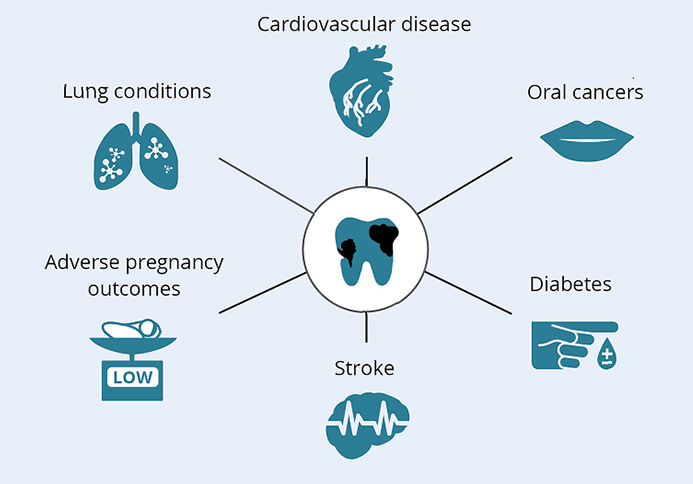
The most common oral diseases affect the teeth (tooth decay, called ‘caries’) and gums (periodontal disease). Oral disease can destroy the tissues in the mouth, leading to lasting physical and psychological disability (NACDH 2012). Tooth loss can reduce the functionality of the mouth, making chewing and swallowing more challenging, which in turn can compromise nutrition. Poor nutrition can impair general health and exacerbate existing health conditions (NACDH 2012). Poor oral health is also associated with a number of chronic diseases, including stroke and cardiovascular disease (DHSV 2011) (Figure 1).

Figure 1 demonstrates the links between poor oral health and chronic diseases such as cardiovascular disease, lung conditions, oral cancers, adverse pregnancy outcomes, stroke and diabetes.

Poor oral health can also affect a person’s wellbeing. Dental disease can impair a person’s appearance and speech, eroding their self-esteem, which in turn can lead to restricted participation at school, the workplace, home and other social settings (NACDH 2012).

Some groups are at greater risk of poor oral health

The National Oral Health Plan identifies four priority population groups that have poorer oral health than the general population and also experience barriers to accessing oral health care—either in the private or public sector. State and territory governments are the current providers of most public dental services, and access is largely targeted towards people on low incomes or holders of concession cards. Eligibility requirements can vary between states and territories (AIHW 2018).

The four priority population groups identified in the plan are:

People who are socially disadvantaged or on low incomes: This group has historically been identified as those on a low income and/or receiving some form of government income assistance, but now extends to include people experiencing other forms of disadvantage including refugees, homeless people, some people from culturally and linguistically diverse backgrounds, and people in institutions or correctional facilities (COAG 2015). Poorer oral health results from infrequent dental care. Barriers include cost, appropriateness of service delivery and lower levels of health literacy, including oral health (COAG 2015).

Aboriginal and Torres Strait Islander AustraliansIndigenous Australians are more likely than other Australians to have multiple caries and untreated dental disease, and less likely to have received preventive dental care (AHMAC 2017). The oral health status of Indigenous Australians, like all Australians, is influenced by many factors (see What contributes to poor oral health?) and a tendency towards unfavourable dental visiting patterns, broadly associated with accessibility, cost and a lack of cultural awareness by some service providers (COAG 2015; NACDH 2012).

People living in regional and remote areasOverall, this group has poorer oral health than those in Major cities (COAG 2015), and oral health status generally declines as remoteness increases. Rural Australians have access to fewer dental practitioners than their city counterparts, which, coupled with longer travel times and limited transport options to services, affects the oral health care that they can receive (COAG 2015; Bishop & Laverty 2015). People living in Remote and Very remote areas are also more likely to smoke and drink at risky levels. They have reduced access to fluoridated drinking water and face increased costs of healthy food choices and oral hygiene products. These risk factors contribute to this population’s overall poorer oral health (COAG 2015).

People with additional and/or specialised health care needsThis group includes people living with mental illness, people with physical, intellectual and developmental disabilities, people with complex medical needs and frail older people. These people can be vulnerable to oral disease; for example, some medications for chronic diseases can cause a dry mouth, which increases the risk of tooth decay (Queensland Health 2008). A number of factors make accessing dental care more difficult for this group, including:

  • a shortage of dental health professionals with skills in special-needs dentistry
  • difficulties in physically accessing appropriate dental treatment facilities
  • the cost of treatment. People with additional and/or specialised health care needs often have their earning capacity eroded by ill health (COAG 2015).

Why does oral health vary across Australia?

People in some states and territories have generally poorer oral health than others. For example, the National Child Oral Health Study found that the prevalence of caries in the deciduous teeth of children was significantly higher in Northern Territory and Queensland than in all other states and territories (Do & Spencer 2016). Oral health status is influenced by a complex interaction of factors, as outlined above. These factors should be considered when looking at results by state and territory. For example:

  • all people living in the Northern Territory were located in Outer regionalRemote or Very remote areas, whereas the majority of the Victorian population were located in Major cities in 2016 (ABS 2018a)
  • the Northern Territory has Australia’s highest proportion of Aboriginal and Torres Strait Islander people (26% of its population) which is much higher than the next highest state, Tasmania (4.6% of its population) (ABS 2017)
  • Tasmania has the highest proportion of people living in the lowest socioeconomic areas (37%) (refer to Technical notes for explanation of SEIFA) (ABS 2018b).

The variations observed in oral health status between state and territory populations may also be partly explained by differences in individual state and territory oral health care funding, service models and eligibility requirements, which can result in varied patterns of dental visiting among residents (AIHW 2018). Oral health campaigns and policies can also make an impact. For example, water fluoridation coverage in Queensland has reduced since the Queensland Government transferred the decision whether to fluoridate water supplies from state to local governments in 2008, despite evidence that access to fluoridated drinking water has been shown to reduce tooth decay (Queensland Health 2015; NHMRC 2017).

Part 2 Australians’ love affair with sugary drinks rots the smiles of children as young as five

Leading health bodies call for people to rethink sugary drink this World Oral Health Day.

With new figures revealing almost half of Australian children aged 5-10 experience tooth decay in their baby teeth [1], the Rethink Sugary Drink alliance is urging Aussies to give their teeth a break from sugary drinks and make the switch to water in a bid to protect their oral health.

The Australian Institute of Health and Welfare figures released today also reveal this trend continues into adulthood with Australians aged 15 and over having an average of nearly 13 decayed, missing or filled teeth.

Sugary drinks, such as soft drinks, sports drinks and energy drinks, are a major contributor of added sugar in Australian children’s diets and the leading cause of tooth decay.

On World Oral Health Day today, Craig Sinclair, Head of Prevention at Cancer Council Victoria, a partner of Rethink Sugary Drink, is urging Australians to see this information as motivation to cut back on sugary drinks.

While regular sugary drink consumption leaves a lasting effect on Australians’ oral health, Mr Sinclair said the risks extend beyond just teeth.

“These super sugary drinks don’t stop at ruining Aussie smiles. In the long run they can lead to unhealthy weight gain, increasing the risk of serious health problems such as type 2 diabetes, heart and kidney disease, stroke and 13 types of cancer.”

“It’s sadly no surprise that tooth decay is hitting Australian kids hard, given the overwhelming availability of sugary drinks. Not only are there significantly more sugary drink choices available today, they are everywhere our kids look. Ironically they’re even in venues designed to help our kids be healthy, such as sports centres, sporting clubs, as well as places they visit regularly like train stations, festivals and events,” Mr Sinclair said.

“Big beverage brands don’t just stop there – they also sweet talk our kids into guzzling high-sugar drinks through social media, and outdoor and online advertising. We need government to invest in public education campaigns to cut through the marketing spin and expose the health impacts of sugary drinks.”

A/Prof Matthew Hopcraft, Chief Executive Officer of the Australian Dental Association Victorian Branch, a Rethink Sugary Drink partner, has seen the devastating impact sugary drinks has on children’s teeth and wants Australians to consider the consequences of drinking too many.

“I’ve seen firsthand the devastating impact tooth decay has on the health, nutrition, social and emotional wellbeing of these kids and their families. There are extreme cases where dentists are extracting all 20 baby teeth from kids as young as 3 – it’s not pretty.” A/Prof Hopcraft said.

“Some people may not realise every time they take a sip from a sugary drink they expose their teeth to an acid attack, dissolving the outer surface of our tooth enamel. This regular loss of enamel can lead to cavities and exposure of the inner layers of the tooth that may leave them feeling very sensitive and painful.

“Healthy teeth are an integral part of good oral health, enabling us to eat, speak and socialise without pain, discomfort or embarrassment. It’s disheartening to know 27% of Aussie kids feel uncomfortable about the appearance of their teeth. No kid should look back on their childhood and remember the distress and pain that came as a result of drinking too many sugary drinks.”

A/Prof Hopcraft said World Oral Health Day serves the perfect chance for Australians to rethink their choice of drink.

“We know less than 10 per cent of Australian adults have managed to avoid tooth decay. There is no reason why we can’t turn these numbers around. If Australians can simply cut back on sugary drinks or remove them entirely from their diet, their teeth will be much stronger and healthier for it,” A/Prof Hopcraft said

“We recommend taking a look at how much sugar is in these drinks – people may be shocked to know some have as many as 16 teaspoons of sugar. Water is always the best choice and your teeth will thank you in the long run.”

In support of World Oral Health Day the Rethink Sugary Drink alliance are calling for the following actions in addition to the restriction of unhealthy drink marketing to address the issue of sugary drink overconsumption:

A public education campaign supported by Australian governments to highlight the health impacts of regular sugary


[1] AIHW (Australian Institute of Health and Welfare) 2019. Oral health and dental care in Australia, 2014-15 and 2016-17


About Rethink Sugary Drink: Rethink Sugary Drink is a partnership between the Apunipima Cape York Health Council, Australian Dental Association, Australian Dental and Oral Health Therapists’ Association, Cancer Council Australia, Dental Health Services Victoria, Dental Hygienists Association of Australia, Diabetes Australia, Healthier Workplace WA, Kidney Health Australia, LiveLighter, The Mai Wiru Sugar Challenge Foundation, Nutrition Australia, Obesity Policy Coalition, Royal Australasian College of Dental Surgeons, Stroke Foundation, Parents’ Voice, the Victorian Aboriginal Community Controlled Health Organisation (VACCHO) and the YMCA to raise awareness of the amount of sugar in sugar-sweetened beverages and encourage Australians to reduce their consumption.

Visit  http://www.rethinksugarydrink.org.auu for more information.

NACCHO Aboriginal Health #Jobalerts to #CloseTheGap : #OurHealthOurChoiceOurVoice This week features # Bega ACCHO #FNQLD Mamu ACCHO CEO #NSW @ahmrc ACCHO CEO #Katungul ACCHO #WA @TheAHCWA #NT #Anyinginyi #Sunrise ACCHO @DanilaDilba @CAACongress @MiwatjHealth

Before completing a job application please check with the ACCHO that the job is still open

1. ACCHO Employment NEWS

Scholarship program triples completion rates for Aboriginal TAFE students :Teaching model yields 96 percent completion rate

1.1 Job/s of the week 

2.Queensland

    2.1 Apunipima ACCHO Cape York

    2.2 IUIH ACCHO Deadly Choices Brisbane and throughout Queensland

    2.3 ATSICHS ACCHO Brisbane

    2.4 Wuchopperen Health Service ACCHO CAIRNS

3.NT Jobs Alice Spring ,Darwin East Arnhem Land and Katherine

   3.1 Congress ACCHO Alice Spring

   3.2 Miwatj Health ACCHO Arnhem Land

   3.3 Wurli ACCHO Katherine

   3.4 Sunrise ACCHO Katherine

4. South Australia

4.1 Nunkuwarrin Yunti of South Australia Inc

5. Western Australia

  5.1 Derbarl Yerrigan Health Services Inc

  5.2 Kimberley Aboriginal Medical Services (KAMS)

6.Victoria

6.1 Victorian Aboriginal Health Service (VAHS)

6.2 Mallee District Aboriginal Services Mildura Swan Hill Etc 

6.3 : Rumbalara Aboriginal Co-Operative 

7.New South Wales

7.1 AHMRC Sydney and Rural 

7.2 Greater Western Aboriginal Health Service 

7.3 Katungul ACCHO 

8. Tasmanian Aboriginal Centre ACCHO 

9.Canberra ACT Winnunga ACCHO

10. Other : Stakeholders Indigenous Health 

Health roles at Children Ground Alice Springs:

  1. Social and Emotional Well-being Counsellor role
  2. Head of Health and Health Promotion role
  3. First Nations Health Promotion roles

Over 302 ACCHO clinics See all websites by state territory 

NACCHO Affiliate , Member , Government Department or stakeholders

If you have a job vacancy in Indigenous Health 

Email to Colin Cowell NACCHO Media

Tuesday by 4.30 pm for publication each Wednesday

1. NACCHO Employment News : 

Scholarship program triples completion rates for Aboriginal TAFE students :Teaching model yields 96 percent completion rate
A unique teaching approach has more than tripled Aboriginal students’ completion rates at TAFE, new research from the University of Sydney has found.
Photo Above :Rachel Williams is a clinician at the Armajun Aboriginal Medical Service in Inverell.

The research, published in the Australian Health Review, analysed a customised model of learning support developed by the University’s Poche Centre for Indigenous Health.

Under the model, 380 qualifications have been awarded to Aboriginal students in oral health, allied health, counselling and heath assistance through TAFE. The training model has yielded a 96 per cent completion rate, the paper’s lead researcher and Poche Centre research director Dr Kylie Gwynne found.

Dr Gwynne’s paper scrutinised the first cohort of students who enrolled under the Poche Centre’s training model. Her analysis proves the effectiveness of seven key factors which improve outcomes for Aboriginal students.

The enabling factors discussed in Dr Gwynne’s paper were varied and include:

  • Ensuring enrolling students were motivated and had strong community support
  • Ensuring Aboriginal support staff were involved in all aspects of the program
  • Ensuring training took into account students’ financial needs, academic requirements and family commitments
  • Fostering connections and relationships between students

“Vocational training is an important pathway into the health professions for Aboriginal people but completion rates for Aboriginal students are typically poor,” said Dr Gwynne.

“It is possible to improve completion rates if vocational training is designed to meet the cultural and familial needs of Aboriginal students.

“We’ve called this initiative Project5000, as we ultimately want 5000 Aboriginal people to be qualified and in local secure jobs. We are eager to offer the program to more communities and more scholars.

“Preliminary economic analysis undertaken by the Australian Social Investment Trust estimates a cost-benefit of more than $27,000 for every job secured. This is largely attributed to a decrease in welfare and increase in tax, ” she concluded.

About Project5000

  • Project5000 expands on the Poche Centre’s current program found to have delivered oral health care to Aboriginal communities in NSW at half the cost and twice the effectiveness of the NSW government’s model at the same time.
  • The model uses a localised approach, delivering services almost entirely in local communities with local community partnerships and accountability, employing both dentist and oral health therapists with new graduate clinicians.
  • It involves training and qualifying local Aboriginal people to enable them to deliver services to their own communities.
  • Project5000 is expected to include industries such as aged care, disability services, community health and hospitality – and could extend to construction and other industries depending on where local skills shortages are identified with local communities.
  • Over four years the project intends to work with 20 communities, over 1,300 participants, working in 1,000 jobs at a cost of $2.5m per year.
  • The Poche Centre will work with local industries to identify skills gaps, negotiate qualification type and level and agree paid work experience arrangements that are directly linked to the qualification being undertaken.

1.1 Jobs of the week 

Queensland Aboriginal and Islander Health Council : Health Policy Manager

An exciting opportunity for a high calibre professional, to provide high quality policy advice in the Aboriginal and Islander Community Controlled Health Sector.

* Salary: $102,000 + superannuation

* Attractive health promotion charity salary packaging

* South Brisbane Location

* This is an Indigenous – identified position. Applicants must be an Aboriginal or Torres Strait Islander person (pursuant to Section 25 of the Queensland Anti-discrimination act 1991).

QAIHC is a non-partisan peak organisation representing Aboriginal and Torres Strait Islander Community Controlled Health Organisations (ATSICCHOs) across Queensland.

Role Overview

The Manager, Health Policy, will provide leadership to a small team responsible for providing high quality policy advice on complex and high-profile policy areas in the Aboriginal and Islander Community Controlled Health Sector in Queensland. You will lead a team that advocates for QAIHC Members, supporting their needs and interests.

Pre-requisite skills & experience

* Experience managing small teams;

* Understanding of public policy development including Government budgetary cycles and decision-making processes;

* Experience in advocating for change in a public policy environment (health policy advocacy is highly desirable);

* Exceptional relationship skills and an ability to engage with a broad range of stakeholders;

* Advanced communication, collaboration and interpersonal skills;

* Highly developed influential writing skills;

* Understanding of the ATSICCHS and the issues facing them;

* Demonstrated experience of working with Aboriginal and Torres Strait Islander communities and their leaders, respecting traditional culture, values and ways of doing business;

* Relevant tertiary qualifications and demonstrated experience in a similar role;

To apply, obtain an application pack or any query, please email – applications@qaihc.com.au.

Please apply only via this method.

Applications are required by midnight on Sunday 31st March 2019

Bega Garnbirringu Health Services (Bega) Manager Primary Health.

Bega is an Aboriginal Community Controlled Health Organisation based in Kalgoorlie. We are committed to providing culturally appropriate and sustainable holistic health care services to Aboriginal and Torres Strait Islander people across the Goldfields region. Bega is renowned as an employer of choice due to our positive work environment and very attractive terms and conditions. These include a 35-hour week, salary sacrifice options and ongoing professional development opportunities.

The Manager Primary Health is a key leadership role reporting to the Chief Operations Officer (COO) and is supported by the Assistant Manager Primary Health. The core function is to provide clinical governance oversight and expertise to ensure clinical services are conducted in accordance with best practice, including all relevant clinical and regulatory legislations. An integral component of this function is to ensure contractual reporting obligations of funding bodies are met in a timely manner while ensuring staff compliance with organisational and operational Policies across all levels of clinical programs. It is expected that you will be an exemplary leader who provides guidance, mentoring and coaching to all clinical staff in the pursuit of maintaining a workplace cultural that is free from unhealthy behaviours.

To be considered for this role, you will hold tertiary qualifications in health care and business management with at least five (5) years senior management experience in an Aboriginal Primary Health or similar setting. Your experience will also include development, implementation, change management and evaluation of complex service delivery systems or an equivalent combination of education, training and experience to fulfil this requirement. A deep and empathetic understanding of issues affecting Aboriginal people and a genuine passion for Aboriginal health is vital to your success in this role.

A highly attractive remuneration package, commensurate with experience and seniority of the role, will be offered to the successful candidate.

If you believe you are up for the challenge and possess the appropriate skill set, please submit a covering letter addressing the essential selection criteria and tell us why you are the best candidate for this exciting position.

A detailed position description is available on our website www.bega.org.au or can be requested via email recruitment@bega.org.au or by calling the Human Resource Officer on 08 9022 5500.

AHMRC Business Development Manager (Registered Training Organisation)

About the Organisation

The Aboriginal Health and Medical Research Council of New South Wales (AH&MRC) is the peak body for Aboriginal health in NSW and is comprised of 46 Aboriginal Community Controlled Health Organisations throughout the state.

The AH&MRC provides vital health and health related services in association with its member organisations and these combined services include:

  • Health service delivery
  • Supporting Aboriginal community health initiatives
  • Development and delivery of Aboriginal Health education
  • Research in Aboriginal Health
  • Collecting, evaluating and disseminating Aboriginal health data
  • Policy development and evaluation
  • Project and program planning, implementation and evaluation
  • Ethical evaluation of Aboriginal Health research and data
  • Advocacy and networking

The AH&MRC’s vision is that Aboriginal Community Controlled Health Services (ACCHSs) are sustainable and are driving holistic and culturally strong approaches to redressing health inequities for Aboriginal peoples in NSW.

About the Opportunity

AH&MRC now has an exciting opportunity for a Business Development Manager to join their team, working to develop business opportunities within the Education and Training Unit (RTO) of AHMRC . This is a full-time role based in Little Bay, in Sydney’s inner suburbs.

Reporting to the Deputy Chief Executive, this role will see you primarily responsible for identifying and developing strategic business opportunities and maintaining relationships that will grow AH&MRC’s footprint and generate revenue.

What does this look like day-to-day?:

  • Seeking new business opportunities and partnerships through various channels;
  • Collaborating with internal project teams and external stakeholders to drive sales;
  • Providing excellent customer service to new and existing customer to maintain growth; and
  • Actively managing relationships through regular client visits, consultation and communication.

To be considered for this position you will have demonstrated business development experience within the NFP, primary health or ACCHO sectors. Any experience working within an RTO or in a training function will be highly regarded.

For more information regarding our ideal candidate, please click ‘apply now’.

About the Benefits

AH&MRC is offering the successful candidate an attractive remuneration package circa $85,000-$95,000 plus super, negotiable with skills and experience as well as inclusion in a performance-based incentive structure.

As a community health organisation, AH&MRC can also offer you $16,000 of your income salary packaged per annum. This figure is FBT exempt and no tax is payable on this amount, considerably increasing your take-home pay.

You will enjoy working within a friendly and collaborative team environment in a vibrant and central part of Sydney, with easy access to public transport, cafes, shops and a great selection of on-street parking.

This is a rare chance to join and help shape the services of a growing and innovative organisation committed to driving positive change. Don’t miss out- APPLY NOW!

Chief Executive Officer (CEO) Mamu ACCHO FNQ

Mamu Health Service Limited is an Aboriginal Community Controlled Health Organisation with clinics in Innisfail, Tully, Babinda, and Ravenshoe.

We are currently recruiting for the position of Chief Executive Officer (CEO) to drive our organisation to achieve this vision through our strategic directives.

The Chief Executive Officer (CEO) will be accountable to the Mamu Health Service Limited Board of Directors for the leadership, efficient and effective management of the organisation according to strategic directives. The CEO will also be responsible for ensuring the legislative and funding requirements are met including appropriate financial, human resources, infrastructure, continuous quality and service delivery programs are in place to deliver high quality Comprehensive Primary Health Care.

This is a full time position located in the town of Innisfail. The successful applicant will be required to live within the Innisfail community in order to work and collaborate with the Board of Directors, as well as develop a strong network of relationships throughout the health industry and communities.

All applicants must be willing to undertake an AFP Criminal History Check, and must hold a current Blue Card with Commission for Children and Young People and Child Guardian.

To apply for this vacancy, a full application package can be obtained from our website on http://www.mamuhsl.org.au

Please submit your resume and written responses addressing the selection criteria to:

The Chairperson at ceorecruitment@mamuhsl.org.au

Applications close 5.00pm Monday 25th March 2019

Under section 25 of the Anti-Discrimination Act 1991, there is a genuine occupational requirement for the incumbent to be of Ab

Chief Executive Officer : Bourke Aboriginal Health Service

About the business

The Bourke Aboriginal Community Health Service is an Aboriginal Community Controlled organisation established in November 1986 and incorporated on 19th day of October 1987 as a public company limited by guarantee.

The service is Aboriginal community controlled overseen by a body of Nine Directors who meet on a monthly basis.

Bourke Aboriginal Health Service has been in operation since 1986 delivering a highly professional Health Service to the Aboriginal community of Bourke and district, with a focus on Primary Health Care, Chronic Disease and specialist services.

About the role

This role will be responsible and accountable to the Bourke Aboriginal Health Service (BAHS) Board for the leadership, and efficient and effective management of the organisation in accordance with strategic directives, policies and procedures, as well as legislative and funding requirements.

Skills and experience

  • Pursuant to Section 14 of the Anti Discrimination Act 1977 (NSW) the person must be of Aboriginal descent. Confirmation of Aboriginality from a recognised organisation must be provided in the application
  • Relevant tertiary qualifications in management, health management, business or similar discipline with a minimum of five years senior management experience
  • Proven ability to provide advice, making sound recommendations and implementing Board directions on complex issues, developing and implementing strategic, project and business plans
  • Proven high level of experience in a senior management role demonstrating excellent strategic thinking, planning and decision making skills
  • High level experience in managing the financial affairs of an organisation, including budgeting, financial management and reporting, and ensuring compliance with legal and funding obligations
  • Proven ability to take a lead role in communicating in high level meetings, committees and forums within Aboriginal communities, government departments and other agencies
  • Exemplary personal and professional ethics and conduct
  • Ability to promote a work environment that empowers, motivates and develops the diverse talents of all employees as well as implementing strategies that maximize staff performance
  • Current Class C Drivers Licence

How to apply

Applications must be received by BAHS by the closing of business 05 April 2019. Late applications will not be considered.

Contact person for enquiries re the position: Robert Knight, Chair Person (Board)

Applications to be sent to:

Post to (mark envelope Private and Confidential):-

Mr. Robert Knight Chair Person Bourke Aboriginal Health Service

P O Box 362

BOURKE NSW 2840

Personal Delivery (mark envelope Private and Confidential):-

Ms. Melanie Driscoll Human Resource Officer Bourke Aboriginal Health Service

61 Oxley Street

BOURKE NSW 2840

Email:

Application for position: melanied@bahs.com.au – Human Resource Officer

Enquiries re position: Zacmo@bahs.com.au – Corporate Services Manager

Katungul Aboriginal Corporation Regional Health and Community Services
Providing culturally appropriate health care to Indigenous and Torres Strait Islander communities on the Far South Coast of NSW.
We believe that our community deserve medical, dental and other health services that are culturally appropriate.
Interested in working for Katungul Aboriginal Corporation Regional Health and Community Services?
Social and Emotional Wellbeing Mentor, Batemans Bay

Social and Community Services Worker, Bega

Aboriginal Health Worker Clinical, Bega

Registered Nurse, Bega

Speech Pathologist – Part Time, Bega

Download position descriptions HERE 

Health Services Section Manager  : Anyinginyi Health Aboriginal Corporation (AHAC)

Anyinginyi Health Aboriginal Corporation (AHAC) is a multi-disciplinary organisation which provides primary health care services to the Aboriginal people of Tennant Creek and the surrounding Barkly region.

Anyinginyi consists of five different sections (Health Centre, Corporate Services, Public Health Unit, Sports and Recreation, and Piliyintinji-Ki Stronger Families) which allows them to have an holistic approach to health ensuring that clients’ physical and emotional health and wellbeing is given the utmost priority.

About the Opportunity

Anyinginyi Health Aboriginal Corporation has an exciting opportunity for a full time Health Services Section Manager to join their team based in Tennant Creek, on a 2 year contract basis.

As a member of the Anyinginyi Executive Leadership Team and reporting to the General Manager, this position will see you managing the staff and resources of the Anyinginyi Health Services (Health Centre, RRHS and allied health), to ensure a high standard of care is provided in a culturally responsive manner. You will work closely with fellow Section Managers in multi-servicing needs for Anyinginyi clients.

More specifically, some of your duties will include but not be limited to:

  • Ensuring strategic links are established and maintained with funding bodies and other service providers working in the areas associated with Primary Health Care, especially the internal liaison and service coordination between Anyinginyi Sections;
  • Preparing and managing budgets and monitoring Funding Agreement compliance, including reporting requirements;
  • Communicating Board and senior management decisions to staff and provide Board and senior management with regular status reports on the program, as directed by the General Manager;
  • Effectively manage the staff and resources of Health Services Section including attraction and retention of employees.

To be considered for this position, you will have considerable, Executive-Level experience delivering primary health care services, within the not-for-profit sector and/or within Aboriginal community-controlled organisations.

To view the full position description, please click ‘apply now’.

About the Benefits

This is a highly varied and interesting role where you will truly make a difference in the lives of Aboriginal people and experience real job satisfaction every day – don’t miss out!

In return for your hard work and dedication, you will be rewarded with attractive remuneration circa $129,684-$145,827 + super, negotiable with skills and experience. In addition, you will have access to a range of great benefits including:

  • Salary packaging up to $15,899.94;
  • Subsidised furnished accommodation is available for candidates coming from outside of the Barkly region;
  • 6 weeks annual leave giving you plenty of time to explore the beautiful Barkly region;
  • Vehicle provided for full work and private use (up to 2500km per year);
  • One paid ADO monthly;
  • Free general medical;
  • Free general dentistry (excluding laboratory work);
  • Free gym membership; and
  • Free personal medical prescriptions (conditions apply).

You will be joining a friendly and professional team, where you will also receive personal and professional development opportunities.

This opportunity won’t last long – if you think you have what it takes – apply now!

Please note: When responding to the application questions, please refer to the selection criteria on page 2 of the attached position description.

APPLY HERE and MORE INFO

AHCWA Western Australia

If you are passionate about improving the health and wellbeing of Aboriginal and Torres Strait Islander people across Western Australia then the below opportunities may interest you.

VIEW all opportunities HERE 

CATSINaM Nursing and Midwife jobs in all States and Territories

The Congress of Aboriginal and Torres Strait Islander Nurses and Midwives (CATSINaM) is the sole representative body for Aboriginal and Torres Strait Islander nurses and midwives in Australia.

CATSINaM’s primary function is to implement strategies to increase the recruitment and retention of Aboriginal and Torres Strait Islander peoples into nursing and midwifery professions.

Search Here by State and Territory 

Sunrise ACCHO Katherine : Intensive Family Support Service Manager

Job No: 108693 – https://applynow.net.au/jobs/108693

Applications close : Check with ACCHO

Location: Katherine

* Leadership opportunity for a Social Worker or Psychologist – join this established Community Controlled Health Organisation!

* Truly rewarding position focusing on community development & empowerment!

* Highly attractive base salary circa $102,921 – $115,267 + super, salary sacrificing options, generous leave & more!

About the Organisation

Sunrise Health Service Aboriginal Corporation is a Community Controlled Health Organisation.

The Sunrise approach involves community people taking part in controlling their own health. Everything from financial management and governance, staff selection and service delivery priorities are directed by the organisation’s Aboriginal Board and Community Health Committees.

Sunrise Health Service Aboriginal Corporation works in partnership with Northern Territory PHN (NT PHN), who provide support services to health professionals and organisation across the Northern Territory. NT PHN offers support and assistance to eligible nurses and allied health professionals who are relocating to the NT for the purposes of employment.

About the Opportunity

Sunrise Health Service Aboriginal Corporation has a rewarding opportunity for an Intensive Family Support Service Manager to join their dedicated team. This position is based in Katherine, however a large amount of time will be spent within the Ngukurr community, where accommodation will be provided for any overnight stays.

The primary purpose of this role is to provide Intensive Family Support Service (IFSS) assessment service interventions and counselling-related services. This includes home-based and community-based intensive services targeted to reduce child neglect, with a focus on improving parental skills and how to provide better care for children.

You will step into this position with the aim to build on and improve the existing program, rather than creating a new program from scratch. Your ultimate goal will be to develop key strategies in order to evolve the program to a point where the delivery of the service provision is transferred wholly to a local and sustainable community level service delivery model.

Some of your key responsibilities will include (but will not be limited to):

* Managing the IFSS Program including budgets, reporting and data analysis;

* Accepting referrals and undertaking assessments, developing plans and delivering services/activities for clients who have been referred to the program;

* Ensuring effective health promotion delivery and improved program outcomes;

* Providing advice to support, manage, direct and up-skill IFSS staff;

* Liaising regularly with senior elders for strategic or program issues; and

* Acting as an effective conduit between the Federal Department of Social Services (DSS), NT DCF, the Primary Health Care Manager, the Ngukurr Community and its service provider agencies. To view a full position description, please go to https://applynow.net.au/jobs/108693

About You

To be considered for this role, you must have a background and qualification in Social Work, Mental Health Social Work or Psychology, while a background in Child Protection or working with disadvantaged groups will be highly regarded.

Previous experience working with children and their families is essential, as is experience working within Aboriginal communities.

Sunrise is seeking an individual who can display the initiative, discretion and cultural sensitivity needed to support and drive this important program. You will be comfortable living in a remote environment and working under Aboriginal management and control. The ability to build capacity of both staff and the community will be critical to your success in this role.

In addition, as you’ll be providing in depth support and clinical guidance to your reports in adverse and high pressure situations, strong leadership skills and demonstrated clinical experience at a supervisory level is required.

About the Benefits

This is an incredible opportunity to work closely with, and build the capacity of, a remote Aboriginal community in order to improve their health and wellbeing.

Your dedication will be rewarded with a highly attractive base salary circa $102,921 – $115,267 (based on skills and experience) plus super.

You will also have access to a wide range of benefits including:

* 6 weeks leave per year;

* Up to 10 days study leave;

* Access to company vehicle for work-related travel;

* Laptop and Phone;

* Accommodation for any overnight stays while working in the communities;

* Salary packaging options up to $15,899 per year.

Working at Sunrise Health Service and living in the Katherine region has lifestyle benefits that are unique to the Northern Territory. With the Katherine Gorge on your doorstep and an incredible outdoor lifestyle on offer, combined with some of the best fishing in the world, the Northern Territory is the place to be to make the most of life’s adventures.

Don’t miss out on these unique opportunities in which you can truly make a difference – Apply Now! For more information, and to apply, please go to https://applynow.net.au/jobs/108693

Winnunga Nimmityjah Aboriginal Health : Child and Adolescent Psychologist


Winnunga Nimmityjah Aboriginal Health & Community Services is a community controlled health service providing holistic health care to the Aboriginal and Torres Strait Islander communities of the ACT and surrounding areas. The Service manages approximately 30 programs through various funding agreements and employs more than 70 staff offering salary sacrifice pursuant to tax department regulations and organisational policy.

Child and Adolescent Psychologist

The role of the Child and Adolescent Psychologist is to enhance the clinical services offered at Winnunga AHCS through working in collaboration with the multidisciplinary team in the delivery of psychology services to young clients and their families. This includes work on an individual basis to provide high level clinical consultations and therapeutic support to children, adolescents and their families to address mental health and wellbeing needs.

We are seeking an experienced Child and Adolescent Psychologist to work within our Clinical and Social Health Teams. The successful applicant will have registration as a psychologist with AHPRA, eligible for a Medicare provider number have sound clinical assessment and treatment skills and competency in evidence-based psychological treatments. Experience in trauma informed practice and experience working with and understanding and commitment to the philosophy and practice of an Aboriginal Community Controlled Health Service and the ability to work sensitively and effectively with Aboriginal and Torres Strait Islander people.

Previous experience working in mental health and a demonstrated ability to work in a multidisciplinary team is desirable.

A current driver’s licence is essential.

A copy of the position descriptions and selection criterias may be obtained by calling Roseanne Longford on 02 62846259 or email to Roseanne.Longford@winnunga.org.au Applications should be addressed and mailed to Julie Tongs, CEO, Winnunga Nimmityjah Aboriginal Health Service 63 Boolimba Cres Narrabundah ACT 2604 or by email to Roseanne.Longford@winnunga.org.au

APPLICATIONS CLOSE 29th March 2019

WORKING WITH VULNERALBLE PEOPLE CHECK (WWVPC)

All people employed at Winnunga are required to provide their WWVPC registration, or to carry out a WWVPC pursuant to the Working With Vulnerable People (Background Checking) Act 2011 (ACT).


2.1 JOBS AT Apunipima ACCHO Cairns and Cape York

The links to  job vacancies are on website


www.apunipima.org.au/work-for-us


As part of our commitment to providing the Aboriginal and Torres Strait Islander community of Brisbane with a comprehensive range of primary health care, youth, child safety, mental health, dental and aged care services, we employ approximately 150 people across our locations at Woolloongabba, Woodridge, Northgate, Acacia Ridge, Browns Plains, Eagleby and East Brisbane.

The roles at ATSICHS are diverse and include, but are not limited to the following:

  • Aboriginal Health Workers
  • Registered Nurses
  • Transport Drivers
  • Medical Receptionists
  • Administrative and Management roles
  • Medical professionals
  • Dentists and Dental Assistants
  • Allied Health Staff
  • Support Workers

Current vacancies

2.4 Wuchopperen Health Service ACCHO CAIRNS 

Wuchopperen Health Service Limited has been providing primary health care services to Aboriginal and Torres Strait Islander people for over 35 years. Our workforce has a range of professional, clinical, allied health, social emotional wellbeing and administration positions.

  • We have two sites in Cairns and a growing number of supplementary services and partnerships.
  • We have a diverse workforce of over 200 employees
  • 70 percent of our team identify as Aboriginal and/or Torres Strait Islander people

Our team is dedicated to the Wuchopperen vision: Improving the Quality of Life for Aboriginal and Torres Strait Islander Peoples. If you would like to make a difference, and improve the health outcomes of Aboriginal and Torres Strait Islander people, please apply today.

Expressions of Interest

We invite Expressions of Interest from:

  • Aboriginal Health Workers
  • Clinical Psychologists
  • Dietitians
  • Diabetes Educators
  • Exercise Physiologists
  • Medical Officers (FAACGP / FACCRM)
  • Registered Nurses
  • Midwives
  • Optometrists
  • Podiatrists
  • Speech Pathologists

In accordance with Wuchopperen’s privacy processes, we will keep your EOI on file for three months.

 Current Vacancies

NT Jobs Alice Spring ,Darwin East Arnhem Land and Katherine

3.1 JOBS at Congress Alice Springs including

More info and apply HERE

3.2 There are 30 JOBS at Miwatj Health Arnhem Land


More info and apply HERE

3.3  JOBS at Wurli Katherine

More info and apply HERE

3.4 Sunrise ACCHO Katherine

Sunrise Job site

4. South Australia

   4.1 Nunkuwarrin Yunti of South Australia Inc

Nunkuwarrin Yunti places a strong focus on a client centred approach to the delivery of services and a collaborative working culture to achieve the best possible outcomes for our clients. View our current vacancies here.

NUNKU SA JOB WEBSITE 

5. Western Australia

5.1 Derbarl Yerrigan Health Services Inc

Derbarl Yerrigan Health Services Inc. is passionate about creating a strong and dedicated Aboriginal and Torres Straits Islander workforce. We are committed to providing mentorship and training to our team members to enhance their skills for them to be able to create career pathways and opportunities in life.

On occasions we may have vacancies for the positions listed below:

  • Medical Receptionists – casual pool
  • Transport Drivers – casual pool
  • General Hands – casual pool, rotating shifts
  • Aboriginal Health Workers (Cert IV in Primary Health) –casual pool

*These positions are based in one or all of our sites – East Perth, Midland, Maddington, Mirrabooka or Bayswater.

To apply for a position with us, you will need to provide the following documents:

  • Detailed CV
  • WA National Police Clearance – no older than 6 months
  • WA Driver’s License – full license
  • Contact details of 2 work related referees
  • Copies of all relevant certificates and qualifications

We may also accept Expression of Interests for other medical related positions which form part of our services. However please note, due to the volume on interests we may not be able to respond to all applications and apologise for that in advance.

All complete applications must be submitted to our HR department or emailed to HR

Also in accordance with updated privacy legislation acts, please download, complete and return this Permission to Retain Resume form

Attn: Human Resources
Derbarl Yerrigan Health Services Inc.
156 Wittenoom Street
East Perth WA 6004

+61 (8) 9421 3888


DYHS JOB WEBSITE

 5.2 Kimberley Aboriginal Medical Services (KAMS)

Kimberley Aboriginal Medical Services (KAMS)

https://kamsc-iframe.applynow.net.au/

KAMS JOB WEBSITE

6.Victoria

6.1 Victorian Aboriginal Health Service (VAHS)


Thank you for your interest in working at the Victorian Aboriginal Health Service (VAHS)

If you would like to lodge an expression of interest or to apply for any of our jobs advertised at VAHS we have two types of applications for you to consider.

Expression of interest

Submit an expression of interest for a position that may become available to: employment@vahs.org.au

This should include a covering letter outlining your job interest(s), an up to date resume and two current employment referees

Your details will remain on file for a period of 12 months. Resumes on file are referred to from time to time as positions arise with VAHS and you may be contacted if another job matches your skills, experience and/or qualifications. Expressions of interest are destroyed in a confidential manner after 12 months.

Applying for a Current Vacancy

Unless the advertisement specifies otherwise, please follow the directions below when applying

Your application/cover letter should include:

  • Current name, address and contact details
  • A brief discussion on why you feel you would be the appropriate candidate for the position
  • Response to the key selection criteria should be included – discussing how you meet these

Your Resume should include:

  • Current name, address and contact details
  • Summary of your career showing how you have progressed to where you are today. Most recent employment should be first. For each job that you have been employed in state the Job Title, the Employer, dates of employment, your duties and responsibilities and a brief summary of your achievements in the role
  • Education, include TAFE or University studies completed and the dates. Give details of any subjects studies that you believe give you skills relevant to the position applied for
  • References, where possible, please include 2 employment-related references and one personal character reference. Employment references must not be from colleagues, but from supervisors or managers that had direct responsibility of your position.

Ensure that any referees on your resume are aware of this and permission should be granted.

How to apply:

Send your application, response to the key selection criteria and your resume to:

employment@vahs.org.au

All applications must be received by the due date unless the previous extension is granted.

When applying for vacant positions at VAHS, it is important to know the successful applicants are chosen on merit and suitability for the role.

VAHS is an Equal Opportunity Employer and are committed to ensuring that staff selection procedures are fair to all applicants regardless of their sex, race, marital status, sexual orientation, religious political affiliations, disability, or any other matter covered by the Equal Opportunity Act

You will be assessed based on a variety of criteria:

  • Your application, which includes your application letter which address the key selection criteria and your resume
  • Verification of education and qualifications
  • An interview (if you are shortlisted for an interview)
  • Discussions with your referees (if you are shortlisted for an interview)
  • You must have the right to live and work in Australia
  • Employment is conditional upon the receipt of:
    • A current Working with Children Check
    • A current National Police Check
    • Any licenses, certificates and insurances

6.2 Mallee District Aboriginal Services Mildura Swan Hill Etc 

MDAS Jobs website 

6.3 : Rumbalara Aboriginal Co-Operative 2 POSITIONS VACANT

.

http://www.rumbalara.org.au/vacancies


7.1 AHMRC Sydney and Rural 


Check website for current Opportunities

7.2 Greater Western Aboriginal Health Service 

Greater Western Aboriginal Health Service (GWAHS) is an entity of Wellington Aboriginal Corporation Health Service. GWAHS provides a culturally appropriate comprehensive primary health care service for the local Aboriginal communities of western Sydney and the Nepean Blue Mountains. GWAHS provides multidisciplinary services from sites located in Mt Druitt and Penrith.

The clinical service model includes general practitioners (GPs), Aboriginal Health Workers and Practitioners, nursing staff, reception and transport staff. The service also offers a number of wraparound services and programs focused on child and maternal health, social and emotional wellbeing, Drug and Alcohol Support, chronic disease, as well as population health activities.

GWAHS is committed to ensuring that patients have access to and receive high quality, culturally appropriate care and services that meet the needs of local Aboriginal communities.

WEBSITE

7.3 Katungul ACCHO

Download position descriptions HERE 

8. Tasmania


TAC JOBS AND TRAINING WEBSITE

9.Canberra ACT Winnunga ACCHO


Winnunga ACCHO Job opportunites 

10. Other : Stakeholders Indigenous Health 

Health roles Children Ground Alice Springs:

  1. Social and Emotional Well-being Counsellor role
  2. Head of Health and Health Promotion role
  3. First Nations Health Promotion roles

See all 3 PDF Downloads Below 

Head of Health/Health Promotion Exciting Opportunity with a Unique Organisation Children’s Ground is working to create a different future for First Nations children, families and communities. We are looking for an inspirational, dynamic and innovative individual to join our team in Central Australia as Head of Health/Health Promotion.

The position will lead a multi-disciplinary team focused on improving the health and wellbeing outcomes for the community. The Health team works with local First Nations people, supporting individuals and families in the development and implementation of health plans. The successful applicant will have significant expertise in health promotion and senior organisational health roles.

Children’s Ground encourages Aboriginal and Torres Strait Islander applicants to apply.
You will have the benefit of working within an intergenerational approach that supports and values an Aboriginal world view whereby language and culture is at the forefront of learning.

The salary for this position will be based on qualifications and experience and is expected to be between $88k – $96k (FTE) per annum plus superannuation, annual leave, and the opportunity to salary package up to $15,900 of salary. Six weeks annual leave (4 weeks annual leave with leave loading plus 2 weeks bonus leave over the Christmas period). Relocation assistance may be provided.

To submit your application, please email your CV and a cover letter (no more than 2 pages) addressing the Selection Criteria outlined in the position description to

cgadmin@childrensground.org.au

Please include the title of the role in the subject line of your email.
Applications must

Aboriginal Health Promotion CA PD Jan2019

Head of Health & Health Promotion PD 190312

Social Emotional Wellbeing PD Nov 2018 FINAL

Download the 4 Page PDF Here

dq-website-ad_atsi-health-practitioner_300119

Research Assistant, Injury Team and Aboriginal and Torres Strait Islander Health Program

  • Full time (1.0 FTE), fixed term for 2 years
  • Respected global research organisation
  • Make an impact on global health outcomes

‘The George’ is 600+ people globally focused on improving the health of millions of people. A medical research institute affiliated with leading universities and with projects in approximately 50 countries, we are challenging the status quo in healthcare to find the best ways to prevent and treat chronic disease and injury, and to influence policy and practice worldwide.

This role will provide research assistance to the Injury Division and the Aboriginal and Torres Strait Islander Health Program. The role will also be supported by and work with the Research Support and Administration team in collaboration with the Academic Project Operations team who provide overall administrative and research services support.

The Injury Team seeks to identify and test cost-effective programs to reduce the global burden of injury, influence policy and scale up proven programs for sustainable change. Our research cuts across the causes of unintentional injury that contribute most to the global burden – road injury, falls, burns and drowning. Our global research extends from Australia across Asia and Africa, with major collaborations ongoing in India, China, Vietnam and Bangladesh.

Improving the health of Aboriginal and Torres Strait Islander populations is a major priority for the George Institute. The Aboriginal and Torres Strait Islander Health Program is a cross cutting program. We work in partnership with Aboriginal communities, research organisations and other key stakeholders in Aboriginal and Torres Strait Islander health to conduct high quality research that delivers meaningful impact. The underlying principles of our program ensure genuine engagement with Aboriginal and Torres Strait Islander peoples and communities with research broadly spanning across social determinants of health, healthcare delivery and key conditions and injuries. We ensure strong Aboriginal and Torres Strait Islander leadership of projects and focus on building the capacity of researchers to enable collaborative approaches to conducting high quality, ethically sound research.

The Role

The Research Assistant will provide research support across the Injury Team and the Aboriginal and Torres Strait Islander Health Program. A Research Assistant is required to support the research and communications activities as well as being responsible for the associated general administrative responsibilities. The candidate will have the opportunity for on the job research and administration skills development and there is potential for the right candidate to progress to a Masters or PhD related to this work.

Key responsibilities of the role will include:

  • Assisting with the preparation of presentations, reports, grant applications, ethics applications and publications
  • Maintaining, updating and tracking CVs, publications and other academic contributions on program and portfolio management system and work with external research management systems
  • Liaising with and building effective working relationships with staff and external stakeholders including with Aboriginal and Torres Strait Islander communities and organisations
  • Contributing to and assisting with communications and translation of research including relevant media, submissions and website management
  • Working closely with other administrators across organisation providing weekly reception relief, as required
  • Assisting with the wider research and administration teamwork across the organisation to ensure smooth and effective workflow processes, task delegation, and ongoing achievement of identified tasks.
  • Preparing, providing support and attending various meetings, as required
  • Undertaking designated administrative duties, including travel arrangements, financial payments, budget monitoring and expense reimbursements
  • Managing incoming enquiries, emails and requests for information and responding when appropriate

Our ideal candidate will possess:

Essential

  • Relevant qualifications and/or experience in a similar business administration and/or research role
  • Strong analytical skills and ability to synthesise complex information
  • Demonstrated understanding of Aboriginal and Torres Strait Islander culture
  • Awareness of issues affecting the health and well-being of Aboriginal and Torres Strait Islander Peoples and ability to work in a culturally safe manner
  • Proficient in the use of the Microsoft Office suite, including Word, Excel, Outlook and SharePoint
  • Demonstrated ability to work with business sensitive information and maintain confidentiality
  • Demonstrated ability to work effectively in different interpersonal environments i.e. autonomously, in small teams and with a wide range of varying stakeholders
  • Ability to be flexible and adaptable in the face of changing organisational priorities
  • Ability to evaluate and recommend changes to existing processes and procedures for greater effect
  • Strong general administration skills and experience, including taking minutes, organising meetings, organising travel etc.
  • Ability to work with databases with a high level of attention to detail
  • Methodical with good attention to detail and strong focus on quality of work
  • Strong writing and communication skills
  • Ability to produce social media and web content
  • Excellent time management and organisation skills
  • Demonstrated interpersonal skills with the proven ability to work across several teams and managing own workload

Desirable

  • Experience working with Aboriginal and Torres Strait Islander peoples and communities
  • Previous research experience in injury prevention or Aboriginal and Torres Strait Islander health
  • Experience working in the fast-paced Australian medical or scientific research environment.
  • Relevant health related degree

Application close date: 05 April 2019

We are reviewing applications as soon as we receive them, so apply now!

This is a great opportunity for you to work on an exciting new project and make an impact on global health outcomes.

We offer a flexible and inclusive work culture with excellent staff benefits including, salary packaging arrangements and sound learning opportunities.

The George Institute is an equal employment opportunity employer committed to equity, diversity and social inclusion. Applications are encouraged from people with a disability; women; Aboriginal and Torres Strait Islander people; people who identify as LGBTIQ; mature-aged adults and those from culturally and linguistically diverse backgrounds.

Why work at the George?

We are committed to attracting, developing, rewarding and retaining the best people in their fields to conduct and support our innovative and highest quality research programs

More Info apply HERE 

NACCHO Aboriginal Health and #SuicidePrevention News Alerts : #Closethegap : #NACCHO and @TheRACP Peak Health bodies call for Prime Minister and state and territory leaders to declare Aboriginal youth #suicide crisis an urgent national health priority

The recent Aboriginal youth suicides represent a national emergency that demands immediate attention.

Aboriginal community controlled health services need to be properly resourced to ensure our children are having regular health checks and to develop community led solutions.’

NACCHO CEO, Ms Patricia Turner : See NACCHO RACP press release : see Part 1 below

See all 130 + NACCHO Aboriginal Health and Suicide Prevention articles published over last 7 years 

“Funded programs are not required to demonstrate a measurable reduction in suicide and mental health risk factors, which is staggering,

We just aren’t demanding that basic level of accountability

The first priority must be analyses of suicide mortality data to identify the causal pathways,  

Suicide risk is the most complex thing to assess and monitor … communities are crying out for specialist assistance and just not getting it. “Children as young as 10 are dying by suicide … this is no longer an Aboriginal issue, it’s a national one,

Indigenous psychologist Adjunct Professor Tracy Westerman said Australia had failed to collect crucial evidence to determine what intervention strategies work. See Part 2 below 

 ” Community driven action plans to prevent suicide are extending across the Kimberley, with four more communities implementing plans to save lives and improve health and well-being.

As part of the Kimberley Aboriginal Suicide Prevention Trial, Kununurra, Balgo, Wyndham and Halls Creek now have local plans, joining Broome, Derby and Bidyadanga.

Each community receives up to $130,000 to help roll out its action plan which reflects and responds to local issues

See Minister Ken Wyatt Press Release and Communique Part 3 and 4 Below

Part 1 RACP and NACCHO Press Release

JOINT STATEMENT

HEALTH BODIES DECLARE ABORIGINAL YOUTH SUICIDE AN URGENT NATIONAL PRIORITY

  • Health bodies call for Prime Minister and state and territory leaders to declare urgent national health priority
  • Immediate investment in Aboriginal-led mental health and wellbeing services needed to stop child deaths
  • Long-term solution of Aboriginal and Torres Strait Islander self-determination requires commitment to Uluru Statement from the Heart

The Royal Australasian College of Physicians (RACP), the Royal Australian and New Zealand College of Psychiatrists (RANZCP) and the National Aboriginal Community Controlled Health Organisation (NACCHO) are calling on the Prime Minister to make tackling Aboriginal and Torres Strait Islander youth suicides a national health priority.

Suicide was once unknown to Aboriginal and Torres Strait Islander peoples but now every community has been affected by suicide.

In response to the recent Aboriginal youth suicides and the release of the WA Coroner’s report on the inquest into the deaths of thirteen children and young persons in the Kimberley Region, we are calling on the Prime Minister and state and territory leaders to put the issue at the top of the COAG agenda and to implement a coordinated crisis response to urgently scale up Aboriginal led mental health services before more young lives are tragically lost.

An urgent boost to Aboriginal community controlled health services is required to build on the existing range of initiatives that are being rolled out. We also call on the Government to expand upon evidence-based resilience and cultural connection programs to be adapted and attuned to local needs.

We are calling on the Federal Government to:

  • Provide secure and long-term funding to Aboriginal community controlled health services to expand their mental health, social and emotional wellbeing, suicide prevention, and alcohol and other drugs services, using best-practice traumainformed approaches
  • Increase funding for ACCHSs to employ staff to deliver mental health and social and emotional wellbeing services, including psychologists, psychiatrists, speech pathologists, mental health workers and other professionals and workers;
  • Increase the delivery of training to Aboriginal health practitioners to establish and/or consolidate skills development in mental health care and support, including suicide prevention
  • Commit to developing a comprehensive strategy to build resilience and facilitate healing from intergenerational trauma, designed and delivered in collaboration with Aboriginal and Torres Strait Islander communities

RACP spokesperson Dr Mick Creati, said: “The unspeakable child suicide tragedy that has been unfolding requires a national response and the attention of the Prime Minister. Unless we see urgent boost to investment in Aboriginal-led mental health services then the deaths will continue.”

RANZCP President Dr Kym Jenkins, said: ‘We must address the factors underlying suicidality in Aboriginal and Torres Strait Islander communities, including intergenerational trauma, disadvantage and distress. For this, we urgently need an increased capacity of mental health and wellbeing services to help people and communities recover from trauma and build resilience for the future.’

Part 2 Leaders urged to declare Aboriginal child suicides a ‘national crisis’

 Kate Aubusson From the Brisbane Times 20 March 

Prime Minister Scott Morrison must declare Indigenous child suicides a national emergency and overhaul current strategies, peak medical and health bodies have demanded.

The call comes in the wake of harrowing Aboriginal and Torres Strait Islander child suicide rates, and the WA coroner’s inquest into the deaths of 13 young people, five aged between 10 and 13 years in the Kimberley region.

A joint statement from the Royal Australasian College of Physicians (RACP), the Royal Australian and New Zealand College of Psychiatrists (RANZCP) and the National Aboriginal Community Controlled Health Organisation (NACCHO) has urged Mr Morrison and all state and territory leaders to make Indigenous youth suicides an “urgent national health priority”.

The organisations called on the leaders to launch a “coordinated crisis response” and invest in Aboriginal-led strategies “before more young lives are tragically lost”.

In January, five Aboriginal girls aged between 12 and 15 years took their own lives.

The latest ABS data shows Indigenous children aged 10 to 14 die of suicide at 8.4 times the rate of non-Indigenous children. One in four aged under 18 who suicided were Aboriginal.

None of the 13 children who died by suicide had a mental health assessment, according to the coroner’s report.

The international journal The Lancet Child and Adolescent Health recently called Australia’s Indigenous youth suicide rate an “unmitigated crisis”.

NACCHO CEO Pat Turner said the recent Aboriginal youth suicides was “a national emergency that demands immediate attention”.

The joint statement called for Indigenous community-led solutions, long-term funding boosts to Aboriginal Community Controlled Health Services (ACCHS) for best-practice and trauma-informed mental health, suicide prevention, and drug and alcohol programs.

The organisations also pushed for more ACCHS funding to employ more psychologists, psychiatrists, speech pathologists and mental health workers, increase training for Aboriginal health practitioners to develop a comprehensive strategy focused on resilience and intergenerational trauma healing.

In September the Morrison government announced $36 million in national suicide prevention projects.

Paediatrician with Victorian Aboriginal Health Service Dr Mick Creati said Indigenous suicides could not be prevented by a “white bread psychiatry model”.

Aboriginal suicides were often radically different from those among the general population, research shows. They were more likely to be impulsive, potentially triggered by some kind of interpersonal conflict.

The crisis demanded a “different, culturally appropriate model”, Dr Creati said.

“We don’t know exactly what the right model is yet … but Aboriginal people need to be included [in their development] to make sure they are appropriate for Aboriginal populations.”

But Indigenous psychologist Adjunct Professor Tracy Westerman said Australia had failed to collect crucial evidence to determine what intervention strategies work.

“Funded programs are not required to demonstrate a measurable reduction in suicide and mental health risk factors, which is staggering,” Professor Westerman said.

“We just aren’t demanding that basic level of accountability”.

The first priority must be analyses of suicide mortality data to identify the causal pathways,  Professor Westerman said.

“Suicide risk is the most complex thing to assess and monitor … communities are crying out for specialist assistance and just not getting it. “Children as young as 10 are dying by suicide … this is no longer an Aboriginal issue, it’s a national one,” she said.

Part 3 The eighth meeting of the Kimberley Suicide Prevention Trial Working Group was held on 14 March in Broome communique

The Working Group discussed the findings of WA Coroner’s Report into suicide deaths in the Kimberley and continued its consideration of resources and strategies to support activity as part of the suicide Prevention trial.

The meeting today was chaired by the Hon Ken Wyatt, Minister for Indigenous Health (Commonwealth) and attended by the Hon Roger Cook, Deputy Premier and Minister for Health (WA State Government), Senator the Hon Patrick Dodson (Commonwealth) and Member for the Kimberley, the Hon Josie Farrer MLC (WA State Government). Apologies were received from the Hon Ben Wyatt, Minister for Indigenous Affairs (WA State Government).

The meeting was also attended by over 40 representatives from communities, organisations and government agencies.

Key messages from today’s discussion included:

  • A shared commitment to work together at all levels of government to develop place-based, and Aboriginal-led and designed responses.
  • A commitment to ongoing collaboration.
  • Acknowledgement of the good work achieved thus far – but noting more needs to be done.
  • The role of the community liaison officers on the ground across Kimberley communities was highlighted as an example of good progress – connecting services and projects with what people want.
  • The need to continue mapping services was agreed.
  • The need for holistic approaches was highlighted.
  • Community organisations are keen to work with the State and Commonwealth Governments on solutions that address the recommendations in relation to the report of the WA Coronial Inquest and all other referenced reports.

Part 4 Minister Wyatt Press release

Community driven action plans to prevent suicide are extending across the Kimberley, with four more communities implementing plans to save lives and improve health and well-being.

As part of the Kimberley Aboriginal Suicide Prevention Trial, Kununurra, Balgo, Wyndham and Halls Creek now have local plans, joining Broome, Derby and Bidyadanga.

Each community receives up to $130,000 to help roll out its action plan which reflects and responds to local issues.

However, the four new plans have a common thread – they are centred on people working and walking together on country, with a series of camps involving high-risk groups.

The camps are planned to provide a range of supports around suicide including healing and sharing and respecting cultural knowledge and traditions. They will also support close engagement with Elders.

A strong cultural framework underpins all the Trial’s activities and all the projects identified by the communities fit within the systems-based approach, guided by the Aboriginal and Torres Strait Islander Suicide Prevention Evaluation Project (ATSISPEP).

Nine communities are involved in the Kimberley Aboriginal Suicide Prevention Trial, with Community Liaison Officers playing a critical role.

The outcomes will contribute to a national evaluation which aims to find the most effective approaches to suicide prevention for at-risk populations and share this knowledge across Australia.

The Morrison Government is supporting the Kimberley Aboriginal Suicide Prevention Trial with $4 million over four years, from 2016-2020.

It is one of 12 Suicide Prevention Trials being conducted across the nation, with total funding of $48 million.

NACCHO Aboriginal Health #Saveadate Events and Conferences : This week features #ClosetheGap Day March 21 How to get involved in #NationalCloseTheGapDay #NCTGD#OurHealthOurChoiceOurVoice

This weeks featured NACCHO SAVE A DATE events

21 March National Close the Gap Day

Download the 2019 Health Awareness Days Calendar 

21 March Indigenous Ear Health Workshop Brisbane

22 March : The experts priorities for the 2019 Federal Election 

24 -27 March National Rural Health Alliance Conference

20 -24 May 2019 World Indigenous Housing Conference. Gold Coast

18 -20 June Lowitja Health Conference Darwin

2019 Dr Tracey Westerman’s Workshops 

7 -14 July 2019 National NAIDOC Grant funding round opens

23 -25 September IAHA Conference Darwin

24 -26 September 2019 CATSINaM National Professional Development Conference

16 October Melbourne Uni: Aboriginal and Torres Strait Islander Health and Wellbeing Conference

5-8 November The Lime Network Conference New Zealand 

Featured Save date

21 March National Close the Gap Day

For the last 10 years many thousands of Australians from every corner of the country, in schools, businesses and community groups, have shown their support for Close the Gap by marking National Close the Gap Day each March.

See RACGP CTG Video here 

This National Close the Gap Day, we have an opportunity to send our governments a clear message that Australians value health equality as a fundamental right for all.

On National Close the Gap Day we encourage you to host an activity in your workplace, home, community or school.

Our aim is to bring people together to share information, and most importantly, to take meaningful action in support of achieving Indigenous health equality by 2030.

How to get involved in National Close the Gap Day

  • Register your activity. You can download some online resources to support your event
  • Invite your friends, workmates and family to join you
  • Take action by signing the Close the Gap pledge and asking your friends and colleagues to do the same
  • Call, tweet or write to your local Member of Parliament and tell them that you want them to Close the Gap
  • Listen to and share the stories of Aboriginal and Torres Strait Islander people on Facebook – visit our Close the Gap Facebook page.
  • Share your photos and stories on social media. Use the hashtag #ClosetheGap
  • Donate to help our work on Close the Gap

With events ranging from workplace morning teas, sports days, school events and public events in hospitals and offices around the country — tens of thousands of people take part each year to make a difference.

Too many health gaps exist between Indigenous and non-Indigenous Australians.

We must work to create equal access to healthcare for Aboriginal and Torres Strait Islander peoples.

Make a difference at: https://antar.org.au/campaigns/national-close-gap-day

#ClosetheGap #NationalCloseTheGapDay #NCTGD

#OurHealthOurChoiceOurVoice

Your actions can create lasting change. Be part of the generation that closes the gap.

National Close the Gap Day is a time for all Australians to come together and commit to achieving health equality for Aboriginal and Torres Strait Islander people.

The Close the Gap Campaign will partner with Tharawal Aboriginal Aboriginal Medical Services, South Western Sydney, to host an exciting community event and launch our Annual Report.

Register for event HERE 

Visit the website of our friends at ANTaR for more information and to register your support. https://antar.org.au/campaigns/national-close-gap-day

EVENT REGISTER

21 March Indigenous Ear Health Workshop Brisbane 

The Australian Society of Otolaryngology Head and Neck Surgery is hosting a workshop on Indigenous Ear Health in Brisbane on Thursday, 21 March 2019.

This meeting is the 7th to be organised by ASOHNS and is designed to facilitate discussion about the crucial health issue and impact of ear disease amongst Indigenous people.

The meeting is aimed at bringing together all stakeholders involved in managing Indigenous health and specifically ear disease, such as:  ENT surgeons, GPs, Paediatricians, Nurses, Audiologists, Speech Therapists, Allied Health Workers and other health administrators (both State and Federal).

Download Program and Contact 

Indigenous Ear Health 2019 Program

22 March : The experts priorities for the 2019 Federal Election 

Listen to 3 of Australia’s leading health advocates outline their top priorities for change

– Book Here

24 -27 March National Rural Health Alliance Conference

Interested in the health and wellbeing of rural or remote Australia?

This is the conference for you.

In March 2019 the rural health sector will gather in Hobart for the 15th National Rural Conference.  Every two years we meet to learn, listen and share ideas about how to improve health outcomes in rural and remote Australia.

Proudly managed by the National Rural Health Alliance, the Conference has a well-earned reputation as Australia’s premier rural health event.  Not just for health professionals, the Conference recognises the critical roles that education, regional development and infrastructure play in determining health outcomes, and we welcome people working across a wide variety of industries.

Join us as we celebrate our 15th Conference and help achieve equitable health for the 7 million Australians living in rural and remote areas.

Hobart and its surrounds was home to the Muwinina people who the Alliance acknowledges as the traditional and original owners of this land.  We pay respect to those that have passed before us and acknowledge today’s Tasmanian Aboriginal community as the custodians of the land on which we will meet.

More info 

28 March

28 March Close : DSS are drafting the Terms of Reference for the Royal Commission into Violence, Abuse, Neglect & Exploitation of People with Disability. @FPDNAus

https://engage.dss.gov.au/royal-commission-into-violence-abuse-neglect-and-exploitation-of-people-with-disability/

They have set up an on-line survey that is only open for the next 10 days. closes 28 March

https://www.surveymonkey.com/r/LSXH77X8

20 -24 May 2019 World Indigenous Housing Conference. Gold Coast

Thank you for your interest in the 2019 World Indigenous Housing Conference.

The 2019 World Indigenous Housing Conference will bring together Indigenous leaders, government, industry and academia representing Housing, health, and education from around the world including:

  • National and International Indigenous Organisation leadership
  • Senior housing, health, and education government officials Industry CEOs, executives and senior managers from public and private sectors
  • Housing, Healthcare, and Education professionals and regulators
  • Consumer associations
  • Academics in Housing, Healthcare, and Education.

The 2019 World Indigenous Housing Conference #2019WIHC is the principal conference to provide a platform for leaders in housing, health, education and related services from around the world to come together. Up to 2000 delegates will share experiences, explore opportunities and innovative solutions, work to improve access to adequate housing and related services for the world’s Indigenous people.

Event Information:

Key event details as follows:
Venue: Gold Coast Convention and Exhibition Centre
Address: 2684-2690 Gold Coast Hwy, Broadbeach QLD 4218
Dates: Monday 20th – Thursday 23rd May, 2019 (24th May)

Registration Costs

  • EARLY BIRD – FULL CONFERENCE & TRADE EXHIBITION REGISTRATION: $1950 AUD plus booking fees
  • After 1 February FULL CONFERENCE & TRADE EXHIBITION REGISTRATION $2245 AUD plus booking fees

PLEASE NOTE: The Trade Exhibition is open Tuesday 21st May – Thursday 23rd May 2019

Please visit www.2019wihc.com for further information on transport and accommodation options, conference, exhibition and speaker updates.

Methods of Payment:

2019WIHC online registrations accept all major credit cards, by Invoice and direct debit.
PLEASE NOTE: Invoices must be paid in full and monies received by COB Monday 20 May 2019.

Please note: The 2019 WIHC organisers reserve the right of admission. Speakers, programs and topics are subject to change. Please visit http://www.2019wihc.comfor up to date information.

Conference Cancellation Policy

If a registrant is unable to attend 2019 WIHC for any reason they may substitute, by arrangement with the registrar, someone else to attend in their place and must attend any session that has been previously selected by the original registrant.

Where the registrant is unable to attend and is not in a position to transfer his/her place to another person, or to another event, then the following refund arrangements apply:

    • Registrations cancelled less than 60 days, but more than 30 days before the event are eligible for a 50% refund of the registration fees paid.
    • Registrations cancelled less than 30 days before the event are no longer eligible for a refund.

Refunds will be made in the following ways:

  1. For payments received by credit or debit cards, the same credit/debit card will be refunded.
  2. For all other payments, a bank transfer will be made to the payee’s nominated account.

Important: For payments received from outside Australia by bank transfer, the refund will be made by bank transfer and all bank charges will be for the registrant’s account. The Cancellation Policy as stated on this page is valid from 1 October 2018.

Terms & Conditions

please visit www.2019wihc.com

Privacy Policy

please visit www.2019wihc.com


18 -20 June Lowitja Health Conference Darwin


At the Lowitja Institute International Indigenous Health and Wellbeing Conference 2019 delegates from around the world will discuss the role of First Nations in leading change and will showcase Indigenous solutions.

The conference program will highlight ways of thinking, speaking and being for the benefit of Indigenous peoples everywhere.

Join Indigenous leaders, researchers, health professionals, decision makers, community representatives, and our non-Indigenous colleagues in this important conversation.

More Info 

2019 Dr Tracey Westerman’s Workshops 

More info and dates

7 -14 July 2019 National NAIDOC Grant funding round opens 

The opening of the 2019 National NAIDOC Grant funding round has been moved forward! The National NAIDOC Grants will now officially open on Thursday 24 January 2019.

Head to www.naidoc.org.au to join the National NAIDOC Mailing List and keep up with all things grants or check out the below links for more information now!

https://www.finance.gov.au/resource-management/grants/grantconnect/

https://www.pmc.gov.au/indigenous-affairs/grants-and-funding/naidoc-week-funding

23 -25 September IAHA Conference Darwin


24 -26 September 2019 CATSINaM National Professional Development Conference


The 2019 CATSINaM National Professional Development Conference will be held in Sydney, 24th – 26th September 2019. Make sure you save the dates in your calendar.

Further information to follow soon.

Date: Tuesday the 24th to Thursday the 26th September 2019

Location: Sydney, Australia

Organiser: Chloe Peters

Phone: 02 6262 5761

Email: admin@catsinam.org.au

16 October Melbourne Uni: Aboriginal and Torres Strait Islander Health and Wellbeing Conference

The University of Melbourne, Department of Rural Health are pleased to advise that abstract
submissions are now being invited that address Aboriginal and Torres Strait Islander health and
wellbeing.

The Aboriginal & Torres Strait Islander Health Conference is an opportunity for sharing information and connecting people that are committed to reforming the practice and research of Aboriginal & Torres Strait Islander health and celebrates Aboriginal knowledge systems and strength-based approaches to improving the health outcomes of Aboriginal communities.

This is an opportunity to present evidence-based approaches, Aboriginal methods and models of
practice, Aboriginal perspectives and contribution to health or community led solutions, underpinned by cultural theories to Aboriginal and Torres Strait Islander health and wellbeing.
In 2018 the Aboriginal & Torres Strait Islander Health Conference attracted over 180 delegates from across the community and state.

We welcome submissions from collaborators whose expertise and interests are embedded in Aboriginal health and wellbeing, and particularly presented or co-presented by Aboriginal and Torres Strait Islander people and community members.

If you are interested in presenting, please complete the speaker registration link

closing date for abstract submission is Friday 3 rd May 2019.
As per speaker registration link request please email your professional photo for our program or any conference enquiries to E. aboriginal-health@unimelb.edu.au.

Kind regards
Leah Lindrea-Morrison
Aboriginal Partnerships and Community Engagement Officer
Department of Rural Health, University of Melbourne T. 03 5823 4554 E. leah.lindrea@unimelb.edu.au

5-8 November The Lime Network Conference New Zealand 

This years  whakatauki (theme for the conference) was developed by the Scientific Committee, along with Māori elder, Te Marino Lenihan & Tania Huria from .

To read about the conference & theme, check out the  website. 

NACCHO Aboriginal Eye Health and #Housing @2019wihc #CloseTheGap : Co Host John Paterson CEO @AMSANTaus opening speech @IEHU_UniMelb #ClosingtheGap in Vision 2020 #CTGV19 Conference Plus #AliceSprings Declaration @OptometryAus @RANZCOeyedoctor @Vision2020Aus

Regarding the environmental improvements, we know that the NT Aboriginal population has the worst housing in Australia.  

Around 60% of Aboriginal people live in over-crowded housing and one third live in poorly maintained houses. 

This directly impacts on the ability of our people to maintain healthy living practices such as ensuing their kids have clean faces and clean clothes. 

We cannot keep on relying on antibiotics to get rid of trachoma – to be sustainable, there must be major improvements in environmental health and housing.

Improving housing will also lead to improvements in other infectious diseases that are way too common in our people in the NT

John Paterson CEO of the Aboriginal Medical Services Alliance of the NT or AMSANT. See full Speech Part 1 Below

Alice Springs Declaration

At the 2019 Close the Gap in vision 2020 conference, held in Alice springs, delegates heard that improvements in environmental health and housing are essential to eliminate trachoma and to reduce rates of other childhood infections that can lead to serious conditions such as rheumatic heart disease, blindness and deafness.

The conference heard about good progress in reducing trachoma rates but also that there had been some stalling in remote Central Australian communities where trachoma remains endemic and will not be eliminated unless housing is addressed.

Over half of Aboriginal people in the NT live in overcrowded housing and nearly one third live in poorly maintained housing. This is by far the worst result of any jurisdiction in Australia.

The Conference noted that there is currently a political impasse between the Commonwealth and Northern Territory governments which is preventing the completion of an agreement to enable desperately needed Commonwealth investment in Aboriginal housing to be made available.

The Conference was also concerned at the very slow pace of implementation of the Northern Territory government funded housing program, where only 62 million of 220 million has been spent in the first two years.

The delegates demand that both levels of government urgently work to fix this impasse to ensure that Aboriginal housing investment can be made available to address the critical housing needs in the NT and contribute to improving the health and wellbeing of Aboriginal Territorians.

This declaration was unanimously endorsed

Download PDF Copy

CTG19 ALICE SPRINGS DECLARATION

” Supporting and improving the local primary health care service capacity to confidently perform eye assessments should reduce the dependency on visiting eye specialists.

Going forward I see the promotion of these items as a highly effective way of investing in people and communities to have the capacity to manage and improve their own health outcomes.

Building local workforces must be key and I know that’s easier said than done.

The Roadmap to Close the Gap for Vision is a standout example of a program that has been successful in its impact towards closing the First Nations health gap.

Remarkable results have been achieved in just under a decade and the Roadmap recommendations are well on the way to being fully implemented.

Progress in Indigenous eye health has long been a challenge, making the success of this collaborative work even more remarkable.

The Hon Warren Snowdon Opposition Spokesperson Indigenous Health Keynote Address #CTG19 see full speech part 2 Below

Good morning everyone. My name is John Paterson and I am the CEO of the Aboriginal Medical Services Alliance of the NT or AMSANT. As many of you will know, AMSANT is the peak body for Aboriginal community controlled health services in the Northern Territory.

I’d like to begin by acknowledging the traditional owners, the Arrernte past, present and future, of the land on which we’re meeting: Mbantua – also known as Alice Springs.

To everyone here today, welcome to this important conference that is for the first time being held outside of Melbourne.

It will provide us with a great opportunity to share challenges, learnings and new ideas in a key regional centre for Aboriginal Australians who live in remote and very remote settings.  Aboriginal culture is strong and proud here, as it is across the NT.

Welcome to the many attendees from the NT and right across Australia. Thank you for the work you do in eye health and your interest in improving Aboriginal health outcomes.

I would like to begin by talking a little about the history of our sector in the NT.

It is a story of self-determination.

And it is a story about the passion and dedication in developing essential primary health care services to our people from the ground up.

It is a story about always being a strong advocate for our people.

Our sector provides comprehensive primary health care from Darwin to the most remote areas of the NT.

Central Australian Aboriginal Congress is 45 years old and is the second oldest ACCHS after Redfern. It is also the largest ACCHS in the NT and one of the largest in Australia.

Keynote from Donna Ah Chee CEO Congress calling on the sector to see Aboriginal and Torres Strait Islander eye health in the context of the bigger picture of Indigenous health.

Miwatj is the largest remote ACCHS in Australia and Utopia is the oldest ACCHS based in a very remote region, having also recently turned 40.

We have in total 26 members – 13 of which provide comprehensive primary health care across the NT.

We work in partnership with the Northern Territory Government, who also provide Aboriginal PHC services to the NT. However, ACCHSs are the larger of the two providers and our sector is expanding in line with the Commonwealth and NT Government commitment to transition PHC services to community control.

The theme of this conference – “Strengthen and sustain” – resonates with the foundational principles of our sector including the need to build capacity and self-determination.

The ACCHS sector aims to provide comprehensive primary health care with our larger services providing a broad and expanding range of services that go beyond providing physical health care. Comprehensive primary health care includes Social and Emotional Wellbeing, social support, youth work, health promotion and prevention, with some now extending into aged care and even disability care.

The broad range of services considered to be part of primary health care is in line with the Alma Ata Declaration of 1978, where primary health care leaders from around the world – including leaders from the Aboriginal community controlled sector – set out a vision of primary health care that is now reflected in how our sector operates.

The declaration emphasised the need for communities to have a say and be involved in the running of primary health care, hence the fundamental importance we attach to our sector being community controlled.

Another principle of the Declaration is that comprehensive primary health care should work with government policy makers and other sectors such as employment and housing, to address the conditions that lead to poor health. Our sector strives to do this at every level, from the community to national levels, and even on the international stage.

In the NT, one of the main ways we are achieving this is by working with other Aboriginal peak bodies in an Alliance called the Aboriginal Peak Organisation NT, or APONT. APONT includes AMSANT, along with the Central and Northern Land Councils, who assist traditional owners and native title holders in the management and development of their land, including through Aboriginal ranger groups and increasingly, community development projects.

The Alma Ata declaration also emphasised the need to aim for equity of outcomes in health care provision – noting that across the world including in rich countries such as Australia, there is an unacceptable health gap between the well off and those living in poverty. As you all know, on our own country, this health gap is even larger between Aboriginal Australians and the rest of Australia. Equity is a foundational principle of our sector.

The first national Aboriginal Health Strategy, in 1989, reflected these principles and others including the need to take a holistic view of health care, including the physical, social, spiritual and emotional health of people.

This strategy recognised the inter-relationship between good health and the social determinants of health and the need to partner with sectors outside health. The strategy also emphasised capacity-building of community-controlled organisations and the community itself to support local and regional solutions to improving health.

This was a fine strategy, however, an implementation plan was not properly developed and the strategy was not properly funded. This has been a recurring story in Aboriginal health over the years.

The most recent national Aboriginal health plan is also based on self-determination, including the need for community control and the critical importance of the social and cultural determinants of health.

As I hope most of you know, there are a national set of Close the Gap targets that are soon due to expire, that guide our efforts to improve Aboriginal health.  Sadly only 3 of the 8 target are currently on track – and the health gap is one of those that is not on track.

In fact, despite marked improvement in life expectancy in the NT over the last thirty years, life expectancy in the NT now seems to be stalling which is due to the failure to address social determinants, and the ever-growing chronic disease epidemic in our people.

I believe we would have seen much more progress towards closing the gap if the vision first set out in 1989 in the National Aboriginal Health Strategy had been implemented by both the Federal and State governments, including the critical need to commit to self-determination.

While that precious opportunity has foundered for the last three decades, I believe we are once again at a critical juncture and seeing a shift towards governments working in equal partnership with our people. This trend must continue if we are to see sustainable improvement.

At a national level, I am very heartened to see that the process to refresh the Closing the Gap targets is now developing into an equal partnership between Aboriginal leaders across Australia and Commonwealth, State and Territory governments through the Council of Australian Governments or COAG process.

We now, for the very first time, have a large group of Aboriginal peak bodies working closely with government to set the forward agenda for tackling the health gap. Our national peak organisation, NACCHO, led by an inspiring Aboriginal Alice Springs leader – Pat Turner – is at the vanguard of this work.

Read all 50 plus NACCHO Aboriginal Eye Health Articles Here

I represent APONT on this national coalition, ensuring that our leadership in the Northern Territory continues to influence the national agenda. We will be working hard to ensure that the targets reflect the critical issues affecting the health of our people – across the social determinants, and including issues such as housing,  the skyrocketing imprisonment rates and tragically high rates of children in the child protection system.

How does all of this high-level government policy relate to eye care?

We know that our Aboriginal community controlled health services in the NT are under resourced.

Six years ago, a study was done in a small ACCHS in the NT – one of our better funded services. The study looked at how much it cost to carry out all the chronic disease care recommended by the CARPA manual – which is the guideline that all our services use.

It found that the service was under funded to the tune of $1700 per person per year. This funding gap may have increased since then.  The AMA has recently reiterated that there is a large funding gap in Aboriginal primary health care.

We cannot build specialist services, including specialist eye services, on a foundation of an under-resourced primary health care sector.  Our sector must be properly funded.

Trachoma is often described as a disease of poverty, which is one of the reasons why its continued existence in Australia, and almost exclusively in Aboriginal communities, is a national disgrace.

The World Health Organisation has developed the SAFE strategy for eliminating trachoma.

I am sure most of you know that the S stands for surgery, A for antibiotics, F for facial cleanliness and E for Environmental Improvements.

Regarding the environmental improvements, we know that the NT Aboriginal population has the worst housing in Australia.

Around 60% of Aboriginal people live in over-crowded housing and one third live in poorly maintained houses.

This directly impacts on the ability of our people to maintain healthy living practices such as ensuing their kids have clean faces and clean clothes.

We cannot keep on relying on antibiotics to get rid of trachoma – to be sustainable, there must be major improvements in environmental health and housing.

Improving housing will also lead to improvements in other infectious diseases that are way too common in our people in the NT, including skin sores and sore throats – which can both precipitate RHD; and with skin sores also being linked to high rates of renal disease.

A recent data linkage study found that over-crowded housing was by far the biggest reason for children missing school – accounting for over 30 days of missed school a year on average.

We know that poor school attendance is very closely linked to poor school results.  Our children need decent living conditions if they are to thrive both physically but also socially and at school.

What is AMSANT doing about the shocking state of housing in the NT?

AMSANT has worked as part of the APONT alliance in supporting the formation of an Aboriginal Housing committee, AHNT, and is supporting AHNT to become the recognised Aboriginal housing peak body for the NT. Along with AHNT, we are working closely with NT Department of Housing to develop a community led housing strategy, to return Aboriginal housing to community control.

More info Register 

This is a long journey – but it is already bearing some fruit.

However, currently, as many of you will be aware from recent media reports – the NT and Commonwealth are at a stand-off about desperately needed Commonwealth funding for remote Aboriginal housing.

We must have cooperation between the two levels of government to address our housing crisis. We are tired of the excuses and political stand offs, while our communities suffer.

If they would for one moment stop and listen to us, come and talk with us, they would hear our message loud and clear – we want a seat at the decision-making table.

It the Prime Minister and the State and Territory Premiers and Chief Ministers can agree on an equal partnership with Aboriginal peak bodies on Closing the Gap, then the Commonwealth and NT governments can do the same for Aboriginal housing. We say – make it happen!

And now to eyes.


Eye health matters. In Australia, people with even mild vision loss have a risk of dying that is 2.6 times higher than those with good vision.

Vision loss causes 11% of the Indigenous health gap, meaning it accounts for 11% of years of life lost to disability for Indigenous people. It is the third leading cause of the gap behind cardiovascular disease and diabetes.

The 2008 National Indigenous Eye Health Strategy demonstrated the huge gap between the eye health of Indigenous and other Australians:

  • Indigenous adults were 6 times more likely to become blind as non-Indigenous, despite 94% of this vision loss being preventable or treatable;
  • Australia was the only developed country in the world to have endemic trachoma in some regions;
  • And yet studies showed that Indigenous children have better eyesight than others.

However, as you know, a lot is happening in the eye space and primary health care is a critical part of that work.

The work done to close the gap for vision has been very successful. The progress made on the Roadmap to Close the Gap for Vision, which comprises action against over 40 recommendations, is substantial and impressive, particularly given the number of stakeholders in many sectors who have contributed to its achievements.

One of the achievements in the NT has been the formation and ongoing success of regional eye health coordination groups, which are collaborations and partnerships involving all the key eye health stakeholders including primary health care, and are an important component of the Roadmap to Close the Gap for Vision.

The Central Australian and Barkly collaboration has been working effectively for 10 years now, and has been joined in recent years by a Top End collaboration.

AMSANT is involved in both groups and has been funded by the Fred Hollows Foundation to become more involved, including through a position supporting the Central Australian committee.

However, I hope that you have got the message that everyone in health care – including those in eye health care – need to think more broadly about health and not just focus on their part of the gap.

The Aboriginal vision of health is holistic and specialist services need to be built on a strong primary health care foundation.

The international health research has shown that health systems built on a strong primary health care foundation are more equitable affordable and sustainable.

I believe that the eye care gap will not sustainably close – along with the rest of the health gap – if we do not have political commitment to self-determination, and an equitable approach to funding Aboriginal primary health care, based on need.

And we also  need a commitment to fixing the social determinants of health, equitably, based on need and Aboriginal-led.

We must avoid the situation where specialist areas advocate separately to government for their bit of Aboriginal health funding without seeing the bigger picture and the lack of resources on the ground in primary health care.

We need to work together in true partnership if we are to close the gap and that means we MUST be at the decision-making table, not an afterthought.

So thank you for all the work that you do in eye health care- we do appreciate it.

And I hope that you enjoy the two days and go back to your work refreshed, invigorated and inspired.

Thank you.

Part 2 : ADDRESS TO THE CLOSE THE GAP FOR VISION BY 2020

From the outset I want to stress that Federal Labor is acutely aware that Australia remains the only developed country with endemic trachoma, which is only found in our Aboriginal and Torres Strait Islander communities.

Further, while we acknowledge the scourge of Trachoma, cataract is the leading cause of blindness for Aboriginal and Torres Strait Islander adults and is 12 times more common than for non-Indigenous Australians. We have seen inroads in the rates of trachoma, many thanks to people in this room.

Trachoma has dropped from 21 per cent in outback children in 2008 to 3.8 per cent in 2018 and is on track to be eliminated by the end of 2020. This is a marvellous achievement and I again want to thank the tireless effort, tenacity and dedication of those in this room over the last decade in ensuring this has remained a front and centre issue for consecutive governments across partisan lines.

Today I want to discuss three things:

  • Where to now and looking beyond 2020
  • How we can build on the success of the Roadmap in other spaces and;
  • What to expect from a Shorten Labor Government

As the incidence of Trachoma lessens and is likely to be completely eliminated come 2020/21, we will face different vision-loss challenges. Blindness and impaired vision among Aboriginal people was six times the national rate in 2008, and it is now down to three times the national rate. However, Aboriginal and Torres Strait Islander Australians are still most likely to experience permanent vision impairment, with most cases of avoidable blindness resulting from uncorrected refractive error, diabetic retinopathy and cataracts.

One in 10 Aboriginal and Torres Strait Islander adults is at risk of Diabetic Retinopathy, which we all know can lead to irreversible vision loss. Aboriginal and Torres Strait Islander people wait on average 63% longer for cataract surgery than non-Indigenous Australians. Almost two-thirds of vision impairment among Aboriginal and Torres Strait Islander people is due to uncorrected refractive error- often treatable with a pair of glasses.

And I want to note here, that I welcomed Minister Wyatt’s announcement in August last year to commit $2 million to provide Aboriginal and Torres Strait Islander people with easier access to affordable prescription glasses. This was a positive first step.

The case for well-informed advocacy around uncorrected refractive error, diabetic retinopathy and cataracts in the First Nation population must be a priority for this sector come 2020 and beyond. As we edge towards the complete elimination of Trachoma the traction from governments’ and the funding which comes attached I anticipate will lessen. This will be no surprise to people in this room.

Security of funding will decline without ongoing strategic advocacy from the sector. There will need to a be a sustained and coordinated approach as there has been with the Roadmap to ensure this doesn’t curtail the inroads that are being made in other areas of vision loss. For example; Aboriginal and Torres Strait Islander Australians with diabetes have significantly fewer recommended eye checks than the non-indigenous Australian population and this incidence is particularly escalated in remote and regional areas [35% comparted with 64% respectively].

The total indirect cost of blindness as a result of diabetic retinopathy and diabetic macular oedema, the most frequent manifestations of diabetic retinopathy, is estimated to be more than $28,000 per person. Early investment into coordinated primary healthcare presents a powerful fiscal argument for governments at all levels.

These are the sorts of messages I encourage the sector to advocate for, we are in fiscally uncertain times so governments are constantly looking for costefficient measures.  The fact the up to 98 per cent of diabetes-related blindness can be prevented through annual eye exams and timely treatment in the early stages of disease, is compelling.

Investing in professional development and training to enhance existing clinicians’ skills to perform eye-health assessments can produce significant savings for both the patient and the tax payer. I am a proponent of the MBS 715 item [Aboriginal Health Check] and the annual MBS 12325 item [Diabetic Retinopathy Screening] to be employed in all instances, as both schedule items promote early screening and diagnosis, preventing future complications and the costs associated with vison impairment.

The establishment of diabetic eye screening rates as a key performance indicator for Primary Health Networks is a sensible way to drive MBS revenue and improve eye health outcomes. Further, employing MBS item service delivery models, is a sustainable model of care which does not rely on ongoing or recurrent government funding. Increased information-sharing around the schedule benefits can produce significant preventative health gains to the target communities as well as provide large fiscal returns to service practices.  It’s a no brainer.

Further, supporting and improving the local primary health care service capacity to confidently perform eye assessments should reduce the dependency on visiting eye specialists. Going forward I see the promotion of these items as a highly effective way of investing in people and communities to have the capacity to manage and improve their own health outcomes.

Building local workforces must be key and I know that’s easier said than done.

The Roadmap to Close the Gap for Vision is a standout example of a program that has been successful in its impact towards closing the First Nations health gap. Remarkable results have been achieved in just under a decade and the Roadmap recommendations are well on the way to being fully implemented. Progress in Indigenous eye health has long been a challenge, making the success of this collaborative work even more remarkable. This work has undergone rigorous scientific process and has a strong evidence base.

Importantly it has been strongly supported by local communities and organisations, including leading peak bodies and philanthropic organisations.

This disciplined coordination is what I think other sectors can really look towards and aspire to. And I must say this discipline is attributed in major part to the work of Professor Taylor. Stopping trachoma and other infections through the promotion of good hygiene practices and the emphasis on health hardware are pathways to negate further chronic health conditions.

Including: Ear infections and otitis media

  • Respiratory infection
  • Tooth and gum disease
  • Skin infections
  • Kidney disease

And I think most markedly

  • Rheumatic Heart Disease

The Roadmap has been able to achieve comprehensive culturally safe coordination in navigating all levels of care which is critical when managing health conditions, such as avoidable blindness.  Skilled workforce shortage complications in regional areas can ultimately be ameliorated by investing in people and communities to have the capacity to manage and improve their own health outcomes.

I know Diabetic retinopathy cameras and trained operators are being placed in more than 150 Aboriginal health clinics across Australia and this ideally must be the model we aspire for in other complex health areas. This model has been promoted and driven throughout the Roadmap.

To reiterate my major point, Labor is committed to Closing the Gap in eye health. The Roadmap was established under Labor and has since made significant improvements to the eye health of First Australians, as I’ve acknowledged. A Shorten Labor Government is committed to fully implementing the Roadmap to Close the Gap for vision.

A Shorten Labor government appreciates there is still work to be done to close the gap to meet the 2020 deadline. As an outcome of the Roadmap there are many regions of Australia where successful eye care programs have been developed providing high quality eye care for First Australians.

We acknowledge these successes and aim to build on and enhance these existing services. Now is the time to consolidate this good work and finally end avoidable blindness to ensure we meet our World Health Organisation obligations and successfully eliminate Trachoma. As Professor Taylor says, “we can’t afford to take our foot off the accelerator.” Equitable access to specialist and general eye health care services is critical to reducing high rates of preventable blindness among Aboriginal and Torres Strait Islander people.

We’ve seen too many cases of good work in Aboriginal affairs left unevaluated and subsequently dismantled, especially under the Abbott/Turnbull/ Morrison government. The Tackling Indigenous Smoking program is a case in point which we’ve witnessed under this Government.

Guiding all the decisions under a Shorten Labor Government will be evidence- based policy.  The Federal Labor team will certainly have more to say on this and you can expect further announcements in the coming months in the lead up to the election. But I can say that any further investments will be to meet the 2020 Roadmap.

Under a Shorten Labor government we will be prioritising:

  • The national implementation of regional coordinators
  • Population based funding of outreach services
  • Case management and local coordination
  • Prompt housing repair and maintenance to ensure First Australians have access to safe and functioning bathrooms

We’re at the pointy end of finalising our election commitments but I do want to use this opportunity to encourage the experts before me to bring forward any policy proposals you have. If anyone wishes to share any policy ideas, as some have already, by all means I am open to hearing them and sharing them with my Federal Labor team. And for anyone in this room who isn’t aware I have an open-door policy, so please don’t hesitate to get in touch in near future.

I think that’s enough from me.

Thank you for your time this morning.

NACCHO Members #Aboriginal Health Deadly Good News Stories : #National @IndigMaraProjct @Mayi_Kuwayu #NT Katherine West #Wurli-Wurlinjang #Sunrise ACCHO’s @HOTNORTH #QLD @Apunipima @Wuchopperen #TAS #VIC #NSWVotes2019 Both major party policies #WA @TheAHCWA #ACT

1.1 National : Indigenous Marathon Project a community focussed health initiative that uses the simple act of running as a vehicle to promote the benefits of healthy and active lifestyles. #RunSweatInspire

1.2  Mayi Kuwayu TV ads going live today March 14 in a number of ACCHO health clinics around Australia

2.1 QLD : Wuchopperen ACCHO Cairns celebrated 10 years of Mums and Bubs program

2.2 QLD : Apunipima ACCHO team continues to roll out Mental Health First Aid training and Midwife workshop on Cape York

3. NT : Katherine West, Wurli-Wurlinjang and Sunrise Health Services ACCHO’s meet with 100 health professionals to enhance communication between hospitals, primary health and public health services

4.1 NSW : NSW Labor Leader, Michael Daley and Shadow Minister for Aboriginal Affairs, David Harris, have today announced Labor’s policies to better support Aboriginal communities across NSW. Press Release

4.2 NSW : ACCHO’s in Northern NSW partner with TAFE NSW to support and service qualifications that upskill the Aboriginal and Torres Strait Islander health care workforce

5. Tas : Tasmanian Aboriginal Centre ACCHO opens new tulaminakali Health clinic in Devenport 

6. ACT : Beds at the troubled Ngunnawal Bush Healing Farm are likely to lay empty for longer after the government back tracked on plans to look for a provider for a residential program by early this year.

7. WA : AHCWA  headed to Bunbury last week to deliver the Certificate II in Family Wellbeing to a group of 10 students. 

8. VIC : MDAS ACCHO : Mallee Mums find support and strength in each other

How to submit in 2019 a NACCHO Affiliate  or Members Good News Story ?

Email to Colin Cowell NACCHO Media 

Mobile 0401 331 251 

Wednesday by 4.30 pm for publication Thursday /Friday

1.1 National : Indigenous Marathon Project a community focussed health initiative that uses the simple act of running as a vehicle to promote the benefits of healthy and active lifestyles. #RunSweatInspire

“ Running a marathon is one of life’s ultimate challenges. To run a marathon from some of Australia’s most remote and harshest places is truly an amazing accomplishment.

When our runners cross the finish line of the world’s biggest marathon, in the world’s biggest city, after overcoming unimaginable challenges, they know they can achieve anything.

The lessons learnt and the pride felt are taken home and used to educate and inspire others about the importance of personal pride, healthy lifestyles, good nutrition and regular physical activity,”

Rob De Castella Indigenous Marathon Project

Picture Above EMOTIONAL: Jessica Bartholomew, Cyrus Morseu and Debra Hegarty after the New York Marathon 2018

The Indigenous Marathon Project (IMP) was founded in 2010 by former World Champion marathon runner Rob de Castella. IMP is not a sports program, but a community focussed health initiative that uses the simple act of running as a vehicle to promote the benefits of healthy and active lifestyles.

IMP annually selects, educates, trains and takes a group of inspirational young Indigenous men and women aged 18-30 to compete in the world’s biggest marathon – the New York Marathon.

Through this, IMP promotes the importance of healthy and active lifestyles throughout Indigenous communities, and creates Indigenous role models.

 ” Mr Fielding was running to raise money for The Purple House, an organisation that provides dialysis to some of Australia’s most remote communities.

Aside from the more than $40,000 raised so far, he wants to promote a healthy lifestyle to other Indigenous Australians.”

From ABC TV COVERAGE

From NACCHO May 2018

Starting at 4am in the APY Lands town of Indulkana, Zibeon Fielding has just finished a 62-kilometre ultramarathon.

The feat, which is about the same as running one and a half full marathons, comes just five weeks after Mr Fielding completed the Boston Marathon.

Port Macquarie March 2018

Port Macquarie last weekend welcomed three former Olympians Australian Olympians Nova Peris, Rob de Castella, Steve Moneghetti to support a new program for improving the lives of Aboriginal and Torres Strait Islander communities.

“It’s so good to see because everyone knows there is an abundance of talent in communities but minimal opportunities.

Running can change people’s lives and the IMP graduates have themselves become inspirations.

It’s a beautiful thing to see with Port Macquarie getting behind it.”

Olympian Nova Peris pictured below with Charlie Maher said the Bush to Beach Project was awesome : 

WATCH VIDEO \

Additional Text and Photo Port Macquarie News

“The project enables participants to visit the partner community in recognition of their commitment, Providing the opportunity to learn and share culture, experiences and stories with one and another while working towards creating change.

This is the first year of the program and we are proud to have the young Ntaria participants visiting Port Macquarie in March for the 2019 Port Macquarie Running Festival.

“In order to make sure the program is sustainable and can make lasting change for many years ahead we are holding a fundraiser in conjunction with the Port Macquarie Running Festival. ”

Charlie Maher Ambassador

NACCHO’s Social Media editor Colin Cowell promoted the project nationally and attended the lunch on Saturday, March 9 fundraising to support the Bush to Beach Project.

The founder of Bush to Beach Charlie Maher said around $6000 was raised from the event.

Mr Maher was emotional in his speech at the fundraiser saying he was blown away by the support.

He said it had been a “real experience” having kids from his hometown of Hermannsburg visit.

Mr Maher said friendships were formed between the participants of the program from Port Macquarie and Hermannsburg.

“Our kids realised how much they had,” he said.

“We are trying to teach them to always be grateful, humble and appreciate what you have.”

The is the first of two visits of by the Northern Territory participants to Port Macquarie.

They will return in September.

The Port Macquarie participants of Bush to Beach will visit Hemmannsburg next month (April).

1.2  Mayi Kuwayu TV ads going live today March 14 in a number of ACCHO health clinics around Australia

Mayi Kuwayu is a major new study that will provide a far greater understanding of the value of culture for Aboriginal and Torres Strait Islander people.

The Mayi Kuwayu Study looks at how Aboriginal and Torres Strait Islander wellbeing is linked to things like connection to country, cultural practices, spirituality and language use.

Our research team will follow a large number of Aboriginal and Torres Strait Islander people and ask about their culture and wellbeing. As a longitudinal study, we will survey people and then ask them to take the same survey every few years, so that we can understand what influences changes over time.

This is the first time a national study of this type has been done and will provide an evidence base to allow for the creation of better policies and programs.

This study has been created by and for Aboriginal and Torres Strait Islander people. It is an Aboriginal and Torres Strait Islander controlled research resource.

The Mayi Kuwayu team are experienced at working closely with communities across Australia, and the study has majority Aboriginal staffing and study governance (decision making) structure.

The Mayi Kuwayu launch video can be viewed at https://vimeo.com/297654156

In exactly one month, MK Study leader Ray Lovett will be running the Boston Marathon as part of his ongoing commitment to The Indigenous Marathon Foundation, a charity led by world champion and former Olympian Rob de Castella which uses running to promote health and resilience and celebrate achievement in young Aboriginal and Torres Strait Islander men and women.

We’ll keep you posted on what you can do to be part of Ray’s marathon effort! #ourculturescount #RunSweatInspire

By sharing your story, you can help create a better understanding of how culture affects health and wellbeing over time.

TAKE THE SURVEY 

2.1 QLD : Wuchopperen ACCHO Cairns celebrated 10 years of Mums and Bubs program

The Australian Nurse-Family Partnership Program, First Time Mums, has been running for ten years this year at Wuchopperen Health Service Limited (Wuchopperen).

The First Time Mums Program is a client-centred, home visiting program providing care and support to mums pregnant with their first Aboriginal or Torres Strait Islander baby until bub turns two.

The Program aims to assist first time pregnant mums and their families to develop knowledge and skills to improve the long-term health, social and economic future of Aboriginal and Torres Strait Islander families.

The dedicated team of Nurse Home Visitors and Aboriginal and Torres Strait Islander Family Partnership Workers have completed over 5,000 home visits to clients in the past ten years, providing a culturally safe service to Aboriginal and Torres Strait Islander families. The Family Partnership Workers help to promote trust and respect between the clients and their families, the broader Aboriginal and Torres Strait Islander community and local health providers.

Nurse Supervisor of the First Time Mums Program at Wuchopperen, Helen Moss, says the program has made a huge difference to the lives of over 350 families since its inception in Cairns.

“Over the past ten years we have seen the program grow dramatically and help hundreds of mums and bubs, with fantastic results. While the clinical results speak for themselves, the relationships we see our team form with the clients, the mums with their babies, and the mums with each other is the most incredible part of the program.

It is such a rewarding program to be a part of, the whole team really get to know the mums and bubs on a very personal level and seeing the mothers creative positive change for themselves and their families is deeply heart-warming. Ultimately we feel their success is our success!” says Helen.

The First Time Mums program has shown the importance of ongoing support and community in the direct health outcomes of mothers and their babies.

“100% of the babies who have come through the program were fully immunised by the time they turned two, which has had a significant impact on the long-term health of the babies, and 97% of our babies were within a healthy birth weight range. This is a huge achievement and sets up a really solid base for the rest of the child’s life,” says Helen.

Birth weight is a crucial aspect of new born health, with data from Queensland Health showing in 2015‐2016, Aboriginal and Torres Strait Islander babies were 1.8 times as likely to be low birth weight compared with non‐Indigenous babies.

2.2 QLD : Apunipima ACCHO team continues to roll out Mental Health First Aid training and Midwife workshop on Cape York

Apunipima’s Social Emotional Wellbeing Community Implementation Manager, Bernard David, was in Hope Vale last week.

Bernard was delivering Mental Health First Aid Training to staff from Apunipima and Hope Vale Council.

Mental Health First Aid Training is a three day training course that teaches you how to help someone who is developing a mental health problem or experiencing a mental health crisis.

The training helps participants to identify, understand, and respond to signs of addictions and mental illnesses.

Earlier this month a group of expectant mums in Aurukun got together to celebrate their pregnancies.

The group were invited by Apunipima’s Midwife in conjunction with the PHaMs team to share their pregnancy stories, complications and individual family challenges. It also gave the women an opportunity to discuss ways they could support each other at this exciting time.

The women hope to have another yarning session closer to the time for the women to fly out of community to deliver their babies in Cairns.

This will give them a chance to discuss ways to manage the challenges associated with being away from home for extended periods of time, their options for support services in Cairns, labour, birth and early breastfeeding and parenting.

3. NT : Katherine West, Wurli-Wurlinjang and Sunrise Health Services ACCHO’s meet with 100 health professionals to enhance communication between hospitals, primary health and public health services


 “We need to be mindful of how we approach research in Aboriginal communities. Research must be done in partnership and not done to Aboriginal people

Sinon Cooney from Katherine West Health Board says of research

Health experts gathered in Katherine this week 14-15 March for Hot North, a four-year National Health and Medical Research Council funded research program led by Menzies School of Health Research.

The event will bring more than 100 health professionals together from local health services, such as Katherine Hospital, Katherine West, Wurli-Wurlinjang and Sunrise Health Services to enhance communication between hospitals, primary health and public health services and to share the latest research and findings on regionally specific health concerns

This time last year a group of health experts gathered in Katherine and called for more emergency housing to help fix chronic health problems here.

A year later, the same problems remain.

Those same health experts will gather in Katherine on Thursday and Friday this week for Hot North, a four-year National Health and Medical Research Council funded research program led by Menzies School of Health Research.

This time workshop will hear about regionally important health concerns such as antimicrobial resistance, disability and ageing, diabetes in pregnancy and youth, rheumatic heart disease, and new initiatives in skin health.

The event will bring more than 100 health professionals together from local health services, such as Katherine Hospital, Katherine West, Wurli-Wurlinjang and Sunrise Health Services to enhance communication between hospitals, primary health and public health services and to share the latest research and findings on regionally specific health concerns.

Hot North director, Professor Bart Currie said a major focus of the workshops is to give researchers, clinicians and other health professionals an opportunity to network, collaborate and share research.

“It gives researchers and Katherine health professionals the opportunity to strengthen relationships and facilitate learning experiences that develop and transform health practices across northern Australia.

“By developing a community of medical researchers and clinicians, HOT NORTH is connecting a wide range of experts to address the current and future challenges facing the tropical north”, said HOT NORTH Director, Professor Bart Currie.

With 65 activities funded to date, HOT NORTH-supported research and translation is investigating a wide range of health issues facing the Indigenous people living in northern Australia.

As one of the top Aboriginal health providers in the country, Katherine Hospital plays an important role in helping to close the gap between Indigenous and non-Indigenous health outcomes.

Katherine Hospital’s head physician Dr Simon Quilty said, “The Katherine region is huge, and the challenges in providing health care in this remote and tropical region, that’s bigger than Victoria and Tasmania combined, are immense.

“Not only do we have the logistic issues of servicing over 13,000 people who live in remote communities, but these people come from over 20 different tribal nations with different beliefs and expectations of health.

“HOT NORTH provides a fantastic forum for health care professionals from across the north of Australia to mix with academics engaged in remote, tropical and Indigenous health to come up with ideas of how to do things better.”

Katherine Hospital and the health clinics servicing Katherine have made significant progress over the past number of years.

It now ranks as one the top hospitals in Australia for its relationship with its Indigenous patients.

“It’s the transfer of research and practical experience into better service delivery that will help us close the gap across the north and protect the north from tropical and emerging diseases,” added Professor Currie.

Based at Menzies, HOT NORTH utilises a strong collaborative approach between researchers and community, drawing on the expertise of research professionals from eight of Australia’s leading research organisations:

  • Menzies School of Health Research
  • James Cook University
  • Telethon Kids Institute
  • Marie Bashir Institute & The University of Sydney
  • Doherty Institute & The University of Melbourne
  • South Australian Health and Medical Research Institute
  • QIMR Berghofer Medical Research Institute
  • Burnet Institute

4.1 NSW : Ten Aboriginal communities across NSW will receive significant infrastructure and service upgrades, thanks to a $55 million investment by the NSW Liberals & Nationals Government. 


Minister for Planning and Housing Anthony Roberts and Minister for Aboriginal Affairs Sarah Mitchell today announced the funding, which is part of the new Roads to Home program, aimed at improving the quality of life and economic opportunities in discrete Aboriginal communities.

Pictured with Roy Ah See Chair NSW ALC yesterday at Bowraville launch 

“This is about connecting with some of our isolated communities in NSW and providing them with the facilities and services that they deserve,” Mr Roberts said.

“Some of these communities are facing challenges such as emergency vehicles having difficulty locating patients due to lack of street signs, waste not being collected due to unpassable roads, and school buses being unable to reach children because of road and drainage issues.”

The investment will deliver essential road upgrades to improve the connectivity of these communities, including road surfacing, stormwater and drainage, kerbs and footpaths, street and public space lighting, and power and telecommunication upgrades.

The Government will also update land tenure rules in these communities, which have been a primary barrier to home ownership and land development.

Ms Mitchell said the upgrades will have more than just a physical effect on the local communities.

“As a Government, it is crucial we do what we can to ensure these communities have access to the same standards and ongoing maintenance as their neighbours,” Ms Mitchell said.

“These upgrades will make it easier for people to get to and from work and school, improve road safety, and allow communities to grow and start new businesses and ensure these communities have access to the same standards and ongoing maintenance as their neighbours.”

NSW Aboriginal Land Council (NSWALC) Chairman Roy Ah See welcomed today’s announcement.

“This announcement will change the lives of First Australians in discrete communities for the better. This has been a priority for NSWALC, and I appreciate that the Liberals & Nationals Government has listened to and acted on our concerns,” Mr Ah See said.

“This announcement will help build up Aboriginal communities, unlock opportunities and provide the ability for many to move toward home ownership and greater economic independence. This is another example of what can be achieved when government works with Aboriginal people for Aboriginal people.”

The first 10 communities to benefit from the NSW Government’s initial $55 million investment are:

  • Bellwood Reserve, Nambucca (Nambucca Shire LGA)
  • Bowraville, Nambucca (Nambucca Shire LGA)
  • Cabarita, Forster (Mid-Coast LGA)
  • Gingie Mission, Walgett (Walgett Shire LGA)
  • Gulargambone Top, Weilan (Coonamble LGA)
  • La Perouse Mission, La Perouse (Randwick LGA)
  • Namoi Reserve, Walgett (Walgett Shire LGA)
  • Narwan Village, Armidale (Armidale Dumaresq LGA)
  • Three Ways, Griffith (Griffith LGA)
  • Wallaga Lake Koori Village, Merrimans (Eurobodalla LGA)

Work will start in these communities this year.

4.1 NSW : NSW Labor Leader, Michael Daley and Shadow Minister for Aboriginal Affairs, David Harris, have today announced Labor’s policies to better support Aboriginal communities across NSW. Press Release


This builds on Labor’s previous significant announcements including a pathway to negotiate a Treaty or Treaties with the First Peoples of the State.

Mr Daley said: “Labor has always acknowledged the unique cultural heritage of the First Peoples as a priority.

“The Liberals and Nationals have spent eight years paying lip service to policies in Aboriginal Affairs but they haven’t made any substantive policy or legislative changes.”

Mr Harris said: “It’s important that a NSW Labor Government continues to build on the existing relationship with the NSW Aboriginal community to achieve lasting generational change.”

Under further measures announced today, Labor will:

  • Appoint an Aboriginal Affairs Advocate for Children and Young People – The Advocate will be a voice for Aboriginal children in government policy and legislation and will work side by side with the Advocate for Children and Young People. Labor will work with Aboriginal communities to develop the role, determine its focus and make sure that it is Aboriginal-led to empower Aboriginal communities.
  • Allocate $5 million over four years to reinstate traditional burning practices – Expanding traditional burning practices will open up country for the local Aboriginal community and restore the traditional forest structure. These programs will create employment and training opportunities for Aboriginal communities.
  • Adopt the principles of Justice Reinvestment – A strategy that aims to reduce incarceration rates and improve social outcomes by directing resources into communities with high rates of imprisonment. Labor will deliver $4.5 million over four years to fund three pilot programs, which will be delivered through NGOs, and deliver a coordinating authority.
  • Make a formal apology to victims of state-sanctioned massacres in NSW – Recent research identified at least 68 massacres in NSW between 1788 and 1872, resulting in the deaths of approximately 1,653 Aboriginal people.
  • Move the Department of Aboriginal Affairs to Premier and Cabinet – This demonstrates NSW Labor’s commitment to a future Treaty Process which will need cross portfolio co-ordination at the highest level.
  • Fund the NSW Aboriginal Education Consultative Group (AECG) – The AECG is a not for profit Aboriginal organisation that provides advice on all matters relevant to education and training. Labor will deliver $4 million of additional money over four years which will enable the organisation to increase its participation in developing and supporting Aboriginal education across NSW.
  • Secure the future of the Girls Academy – Provide $3.9 million in funding over four years to secure the future of the Girls Academy, a program focused on increasing school attendance and retention rates. Currently, the Clontarf Foundation, an organisation which provides education and life skills programs to Aboriginal boys and young men, is receiving government funding. The Liberals and Nationals have failed to provide funding for a similar program for girls and women.

Labor also recommitted to:

  • Returning Me-Mel (Goat Island) to its traditional owners as a priority – Me-Mel has enormous significance to Indigenous communities and was home to the Wangal people when Captain Arthur Phillip and the First Fleet arrived in Sydney Cove in 1788. The Liberals and Nationals promised to return Me-Mel in October 2016, but the transfer has still not taken place.
  • Establishing Walama Court – A court for indigenous offenders in the District Court jurisdiction, at a time when Aboriginal incarceration rates are worse in NSW than either at the time of the Royal Commission into Aboriginal Deaths in Custody or in 2011.
  • Delivering dedicated Aboriginal Cultural and Heritage Act – NSW is the only state in Australia without standalone legislation to protect Aboriginal cultural heritage.
  • Establishing a Myall Creek massacre education and cultural centre – Providing up to $3 million to help establish an education and cultural centre at the historic Myall Creek massacre site in northern NSW, supporting one of the state’s most well-known reconciliation projects.
  • Flying the Aboriginal Flag on the Harbour Bridge – For 40 years, the Aboriginal flag has flown as a proud symbol for Indigenous Australians. A Daley Labor Government will fly the Aboriginal flag with the flags of Australia and New South Wales on the Harbour Bridge.
  • Funding up to six scholarships for Indigenous medical doctors – The scholarship will be delivered through the highly successful Shalom Gamarada Indigenous Residential Scholarship Program. This program is sponsored by Sydney’s Jewish community and Shalom College at the UNSW. It has been successful in its goal to close the gap between Indigenous and non-Indigenous Australians through higher education and by increasing the number of Indigenous professionals, especially in the critical area of Indigenous health.

4.2 NSW : ACCHO’s in Northern NSW partner with TAFE NSW to support and service qualifications that upskill the Aboriginal and Torres Strait Islander health care workforce

THE first Indigenous cohort of health practitioners is set to graduate from TAFE.

Sixteen health care practitioners travelled from across the north coast to TAFE NSW Port Macquarie to celebrate the milestone and the finalisation of their Certificate IV in Aboriginal and Torres Strait Islander Health Care Practice.

Originally Published HERE

Once they complete the remaining 300 workplace clinical hours of the 18-month course, they will be the first-ever student cohort in the NSW North Coast to graduate with the nationally-recognised qualification.

The students – all of whom already work as Aboriginal and Torres Strait Islander (ATSI) health practitioners and identify as Aboriginal and Torres Strait Islander – completed their sixth and final block of the course’s theory component last week. The big milestone was celebrated with a dinner at The Mercure restaurant.

TAFE NSW manager service delivery Aboriginal health, Daniel Morrison, said everyone was delighted to finish the face-to-face training blocks, each of which they travelled to TAFE NSW Port Macquarie to undertake.

“I am really proud of my students for achieving such a momentous milestone. I know they will be valuable community members with the skills and knowledge they’ve gained over the past 12 months,” he said.

“The TAFE NSW Certificate IV in Aboriginal and Torres Strait

Islander Health Care Practice empowers practitioners to offer streamlined care to patients, upskilling them to provide professional practice work in a clinical setting. The overarching goal is to improve health outcomes for our communities and families.”

TAFE NSW partners with the Aboriginal Medical Service and several Local Area Health Districts to support and service qualifications that upskill the Aboriginal and Torres Strait Islander health care workforce.

5. Tas : Tasmanian Aboriginal Centre ACCHO opens new tulaminakali Health clinic in Devenport 

6. ACT : Beds at the troubled Ngunnawal Bush Healing Farm are likely to lay empty for longer after the government back tracked on plans to look for a provider for a residential program by early this year.

The $12 million custom-built facility in Canberra’s Tidbinbilla Valley – opened in late 2017 – was originally designed as an eight-bed residential facility for Indigenous people.

The government controversially abandoned the Indigenous community’s proposal for a residential drug and alcohol centre after it was revealed the area was not zoned for clinical services.

However it maintained plans for a residential program on the site to facilitate a “reconnection with the land and culture”.

But more than a year after it opened, clients are still bussed to and from daily activities at the farm. Just 34 participants have taken part since it opened.

A briefing for estimates hearings prepared by ACT Health in October revealed the government planned to put a tender out for a residential program at the farm by early 2019. But the government has since confirmed those plans are on hold.

It will not decide the future of the farm until the delayed “healing framework” – which was due for completion in January 2019 – is completed and a wide ranging review is handed down in October.

The government says there are separate plans to open a residential drug and alcohol facility for the Indigenous community.

“ACT Health will consider all findings and recommendations of the review as it rolls out to determine the most appropriate next steps for the [bush healing farm],” an ACT Health spokeswoman said.

She said the work was being done in close collaboration with members of the Aboriginal and Torres Strait Islander community, the Aboriginal and Torres Strait Islander Elected Body, United Ngunnawal Elders Council as well as other stakeholders.

The government has denied the purpose of the farm was ever to include clinical services, but stakeholders have disputed that.

Winnunga Aboriginal Health Service and Gugan Gulwan Youth Aboriginal Corporation walked away from the program in 2017 after it emerged no clinical services would actually be offered on-site.

The spokeswoman said, “The primary purpose of the [bush healing farm] is to provide an additional service to support a person’s reconnection with the land and culture and empower them to make new and more positive choices.

“The current operational model of the [bush healing farm] was not intended as a clinical model of alcohol and other drug withdrawal.

“However, the government recognises the need for Aboriginal specific services for withdrawal and rehabilitation and is at the same time progressing this work.”

The spokeswoman said that at the time of writing the estimates brief, the government anticipated the healing framework would be finalised by early 2019.

When that did not happen, the plans to put out a tender were scrapped.

“In addition, ACT Health initiated the review of the [bush healing farm] in September 2018, which will review the services, program design and delivery and governance of the facility,” she said.

“The review will build upon success and learnings to date and talk to the Aboriginal and Torres Strait Islander community about the best way forward for this service.

“The review is well underway and key stakeholders are contributing their views and aspirations for the [bush healing farm], which will inform next steps.

“During this review, further assessment will take place to determine the best way forward to provide a residential program, and the government will consider any changes as recommended by the review throughout the year.”

7. WA : AHCWA  headed to Bunbury last week to deliver the Certificate II in Family Wellbeing to a group of 10 students. 


Well done to everyone on the successful completion of their training

8. VIC : MDAS ACCHO : Mallee Mums find support and strength in each other


A new mum’s group at Mallee District Aboriginal Services is working with new and first-time parents to access better services – and build their mutual support networks at the same time.

The group was set up in response to suggestions from new mums last year, and organiser Maternal and Child Health Koori Maternity Services Assistant Nikita Morganson says it’s gone from strength-to-strength.

“It’s been fantastic for the mums involved to find a place and a network where they feel safe and supported,” Nikita said.

“This is a safe place where they have found they can come and yarn and be open with each other.
“We have special guests come to have conversations with the mums regarding anything to do with babies.

“We had the librarian come along to discuss the benefits of reading to baby, we also had the chemist come in to discuss myths and facts about products for babies and breastfeeding mums.”

Nikita said the group mixed formal and cultural activities, participating in sessions such as parents’ First Aid and other events within the community, with the support of one another.

“We’re also planning for Aunty Marilyne Nicholls to come along and do some cultural yarning with the mums and we’re hoping that might bring in some new faces as well,” she said.

Nikita said the mothers involved with the group were finding more confidence by supporting each other, even outside the group activities, bringing closeness and strength.

The new mums’ group is open to mums with new babies (whether first-time or not) and meets on Fridays (during school terms).

More information about what is available from the program contact Nikita Morganson at MDAS on (03) 5032 8600.

NACCHO Aboriginal Health #Jobalerts as at 13 March 2019 : This week features @ChildrensGround #FNQLD Mamu ACCHO CEO #NSW Bourke ACCHO CEO #Katungul ACCHO #WA @TheAHCWA #NT #Anyinginyi #Sunrise ACCHO @DanilaDilba @CAACongress @MiwatjHealth

Before completing a job application please check with the ACCHO that the job is still open

1. ACCHO Employment NEWS

1.1 Job/s of the week 

2.Queensland

    2.1 Apunipima ACCHO Cape York

    2.2 IUIH ACCHO Deadly Choices Brisbane and throughout Queensland

    2.3 ATSICHS ACCHO Brisbane

    2.4 Wuchopperen Health Service ACCHO CAIRNS

3.NT Jobs Alice Spring ,Darwin East Arnhem Land and Katherine

   3.1 Congress ACCHO Alice Spring

   3.2 Miwatj Health ACCHO Arnhem Land

   3.3 Wurli ACCHO Katherine

   3.4 Sunrise ACCHO Katherine

4. South Australia

4.1 Nunkuwarrin Yunti of South Australia Inc

5. Western Australia

  5.1 Derbarl Yerrigan Health Services Inc

  5.2 Kimberley Aboriginal Medical Services (KAMS)

6.Victoria

6.1 Victorian Aboriginal Health Service (VAHS)

6.2 Mallee District Aboriginal Services Mildura Swan Hill Etc 

6.3 : Rumbalara Aboriginal Co-Operative 

7.New South Wales

7.1 AHMRC Sydney and Rural 

7.2 Greater Western Aboriginal Health Service 

7.3 Katungul ACCHO 

8. Tasmanian Aboriginal Centre ACCHO 

9.Canberra ACT Winnunga ACCHO

10. Other : Stakeholders Indigenous Health 

Health roles at Children Ground Alice Springs:

  1. Social and Emotional Well-being Counsellor role
  2. Head of Health and Health Promotion role
  3. First Nations Health Promotion roles

Over 302 ACCHO clinics See all websites by state territory 

NACCHO Affiliate , Member , Government Department or stakeholders

If you have a job vacancy in Indigenous Health 

Email to Colin Cowell NACCHO Media

Tuesday by 4.30 pm for publication each Wednesday

1. NACCHO Employment News: 

Overseas trained doctors seeking visas to work as General Practitioners (GPs) will be required to obtain a Health Workforce Certificate from a Rural Workforce Agency from 11 March 2019.

Under this new requirement, overseas trained doctors will be directed away from well-serviced metropolitan areas to areas of workforce need, especially regional, rural and remote communities.

This initiative will reduce the numbers of overseas trained doctors entering the primary health care system by around 200 each year for the next four years under the skilled migration program.

The number of GPs in Australia has increased three times more than population growth over the past decade, due to a surge in locally trained medical graduates and a continued high intake of overseas trained doctors.

Minister for Regional Services, Senator Bridget McKenzie, said the Visas for GPs initiative would allow the Government to better manage the growth and distribution of the national medical workforce.

“The Visas for GPs initiative won’t reduce the number of GPs currently providing services but will reduce the rise in doctors in city areas and improve numbers in rural areas where they are needed.” Minister McKenzie said.

“The new requirements will ensure the right balance of specialist GPs is available to the Australian community, while also providing opportunities for Australian trained doctors.

“The Liberal Nationals government is absolutely committed to improving access to high-quality health services for those Australians living in regional areas.”

The Visas for GPs initiative was announced in the 2018-19 Budget as part of the Government’s $550 million Stronger Rural Health Strategy—an historic 10-year plan to meet current and future health workforce challenges across regional, rural and remote Australia.

The Department of Health is working closely with the Department of Home Affairs to implement the visa requirement.

Further information about the Health Workforce Certificate application process is available on

DoctorConnect:

http://www.doctorconnect.gov.au/internet/otd/publishing.nsf/Content/visas_for_GPs

1.1 Jobs of the week 

Chief Executive Officer (CEO) Mamu ACCHO FNQ

Mamu Health Service Limited is an Aboriginal Community Controlled Health Organisation with clinics in Innisfail, Tully, Babinda, and Ravenshoe.

We are currently recruiting for the position of Chief Executive Officer (CEO) to drive our organisation to achieve this vision through our strategic directives.

The Chief Executive Officer (CEO) will be accountable to the Mamu Health Service Limited Board of Directors for the leadership, efficient and effective management of the organisation according to strategic directives. The CEO will also be responsible for ensuring the legislative and funding requirements are met including appropriate financial, human resources, infrastructure, continuous quality and service delivery programs are in place to deliver high quality Comprehensive Primary Health Care.

This is a full time position located in the town of Innisfail. The successful applicant will be required to live within the Innisfail community in order to work and collaborate with the Board of Directors, as well as develop a strong network of relationships throughout the health industry and communities.

All applicants must be willing to undertake an AFP Criminal History Check, and must hold a current Blue Card with Commission for Children and Young People and Child Guardian.

To apply for this vacancy, a full application package can be obtained from our website on http://www.mamuhsl.org.au

Please submit your resume and written responses addressing the selection criteria to:

The Chairperson at ceorecruitment@mamuhsl.org.au

Applications close 5.00pm Monday 25th March 2019

Under section 25 of the Anti-Discrimination Act 1991, there is a genuine occupational requirement for the incumbent to be of Ab

Chief Executive Officer : Bourke Aboriginal Health Service

About the business

The Bourke Aboriginal Community Health Service is an Aboriginal Community Controlled organisation established in November 1986 and incorporated on 19th day of October 1987 as a public company limited by guarantee.

The service is Aboriginal community controlled overseen by a body of Nine Directors who meet on a monthly basis.

Bourke Aboriginal Health Service has been in operation since 1986 delivering a highly professional Health Service to the Aboriginal community of Bourke and district, with a focus on Primary Health Care, Chronic Disease and specialist services.

About the role

This role will be responsible and accountable to the Bourke Aboriginal Health Service (BAHS) Board for the leadership, and efficient and effective management of the organisation in accordance with strategic directives, policies and procedures, as well as legislative and funding requirements.

Skills and experience

  • Pursuant to Section 14 of the Anti Discrimination Act 1977 (NSW) the person must be of Aboriginal descent. Confirmation of Aboriginality from a recognised organisation must be provided in the application
  • Relevant tertiary qualifications in management, health management, business or similar discipline with a minimum of five years senior management experience
  • Proven ability to provide advice, making sound recommendations and implementing Board directions on complex issues, developing and implementing strategic, project and business plans
  • Proven high level of experience in a senior management role demonstrating excellent strategic thinking, planning and decision making skills
  • High level experience in managing the financial affairs of an organisation, including budgeting, financial management and reporting, and ensuring compliance with legal and funding obligations
  • Proven ability to take a lead role in communicating in high level meetings, committees and forums within Aboriginal communities, government departments and other agencies
  • Exemplary personal and professional ethics and conduct
  • Ability to promote a work environment that empowers, motivates and develops the diverse talents of all employees as well as implementing strategies that maximize staff performance
  • Current Class C Drivers Licence

How to apply

Applications must be received by BAHS by the closing of business 05 April 2019. Late applications will not be considered.

Contact person for enquiries re the position: Robert Knight, Chair Person (Board)

Applications to be sent to:

Post to (mark envelope Private and Confidential):-

Mr. Robert Knight Chair Person Bourke Aboriginal Health Service

P O Box 362

BOURKE NSW 2840

Personal Delivery (mark envelope Private and Confidential):-

Ms. Melanie Driscoll Human Resource Officer Bourke Aboriginal Health Service

61 Oxley Street

BOURKE NSW 2840

Email:

Application for position: melanied@bahs.com.au – Human Resource Officer

Enquiries re position: Zacmo@bahs.com.au – Corporate Services Manager

Katungul Aboriginal Corporation Regional Health and Community Services
Providing culturally appropriate health care to Indigenous and Torres Strait Islander communities on the Far South Coast of NSW.
We believe that our community deserve medical, dental and other health services that are culturally appropriate.
Interested in working for Katungul Aboriginal Corporation Regional Health and Community Services?
Social and Emotional Wellbeing Mentor, Batemans Bay

Social and Community Services Worker, Bega

Aboriginal Health Worker Clinical, Bega

Registered Nurse, Bega

Speech Pathologist – Part Time, Bega

Download position descriptions HERE 

Health Services Section Manager  : Anyinginyi Health Aboriginal Corporation (AHAC)

Anyinginyi Health Aboriginal Corporation (AHAC) is a multi-disciplinary organisation which provides primary health care services to the Aboriginal people of Tennant Creek and the surrounding Barkly region.

Anyinginyi consists of five different sections (Health Centre, Corporate Services, Public Health Unit, Sports and Recreation, and Piliyintinji-Ki Stronger Families) which allows them to have an holistic approach to health ensuring that clients’ physical and emotional health and wellbeing is given the utmost priority.

About the Opportunity

Anyinginyi Health Aboriginal Corporation has an exciting opportunity for a full time Health Services Section Manager to join their team based in Tennant Creek, on a 2 year contract basis.

As a member of the Anyinginyi Executive Leadership Team and reporting to the General Manager, this position will see you managing the staff and resources of the Anyinginyi Health Services (Health Centre, RRHS and allied health), to ensure a high standard of care is provided in a culturally responsive manner. You will work closely with fellow Section Managers in multi-servicing needs for Anyinginyi clients.

More specifically, some of your duties will include but not be limited to:

  • Ensuring strategic links are established and maintained with funding bodies and other service providers working in the areas associated with Primary Health Care, especially the internal liaison and service coordination between Anyinginyi Sections;
  • Preparing and managing budgets and monitoring Funding Agreement compliance, including reporting requirements;
  • Communicating Board and senior management decisions to staff and provide Board and senior management with regular status reports on the program, as directed by the General Manager;
  • Effectively manage the staff and resources of Health Services Section including attraction and retention of employees.

To be considered for this position, you will have considerable, Executive-Level experience delivering primary health care services, within the not-for-profit sector and/or within Aboriginal community-controlled organisations.

To view the full position description, please click ‘apply now’.

About the Benefits

This is a highly varied and interesting role where you will truly make a difference in the lives of Aboriginal people and experience real job satisfaction every day – don’t miss out!

In return for your hard work and dedication, you will be rewarded with attractive remuneration circa $129,684-$145,827 + super, negotiable with skills and experience. In addition, you will have access to a range of great benefits including:

  • Salary packaging up to $15,899.94;
  • Subsidised furnished accommodation is available for candidates coming from outside of the Barkly region;
  • 6 weeks annual leave giving you plenty of time to explore the beautiful Barkly region;
  • Vehicle provided for full work and private use (up to 2500km per year);
  • One paid ADO monthly;
  • Free general medical;
  • Free general dentistry (excluding laboratory work);
  • Free gym membership; and
  • Free personal medical prescriptions (conditions apply).

You will be joining a friendly and professional team, where you will also receive personal and professional development opportunities.

This opportunity won’t last long – if you think you have what it takes – apply now!

Please note: When responding to the application questions, please refer to the selection criteria on page 2 of the attached position description.

APPLY HERE and MORE INFO

AHCWA Western Australia

If you are passionate about improving the health and wellbeing of Aboriginal and Torres Strait Islander people across Western Australia then the below opportunities may interest you.

VIEW all opportunities HERE 

CATSINaM Nursing and Midwife jobs in all States and Territories

The Congress of Aboriginal and Torres Strait Islander Nurses and Midwives (CATSINaM) is the sole representative body for Aboriginal and Torres Strait Islander nurses and midwives in Australia.

CATSINaM’s primary function is to implement strategies to increase the recruitment and retention of Aboriginal and Torres Strait Islander peoples into nursing and midwifery professions.

Search Here by State and Territory 

Sunrise ACCHO Katherine : Intensive Family Support Service Manager

Job No: 108693 – https://applynow.net.au/jobs/108693

Applications close : Check with ACCHO

Location: Katherine

* Leadership opportunity for a Social Worker or Psychologist – join this established Community Controlled Health Organisation!

* Truly rewarding position focusing on community development & empowerment!

* Highly attractive base salary circa $102,921 – $115,267 + super, salary sacrificing options, generous leave & more!

About the Organisation

Sunrise Health Service Aboriginal Corporation is a Community Controlled Health Organisation.

The Sunrise approach involves community people taking part in controlling their own health. Everything from financial management and governance, staff selection and service delivery priorities are directed by the organisation’s Aboriginal Board and Community Health Committees.

Sunrise Health Service Aboriginal Corporation works in partnership with Northern Territory PHN (NT PHN), who provide support services to health professionals and organisation across the Northern Territory. NT PHN offers support and assistance to eligible nurses and allied health professionals who are relocating to the NT for the purposes of employment.

About the Opportunity

Sunrise Health Service Aboriginal Corporation has a rewarding opportunity for an Intensive Family Support Service Manager to join their dedicated team. This position is based in Katherine, however a large amount of time will be spent within the Ngukurr community, where accommodation will be provided for any overnight stays.

The primary purpose of this role is to provide Intensive Family Support Service (IFSS) assessment service interventions and counselling-related services. This includes home-based and community-based intensive services targeted to reduce child neglect, with a focus on improving parental skills and how to provide better care for children.

You will step into this position with the aim to build on and improve the existing program, rather than creating a new program from scratch. Your ultimate goal will be to develop key strategies in order to evolve the program to a point where the delivery of the service provision is transferred wholly to a local and sustainable community level service delivery model.

Some of your key responsibilities will include (but will not be limited to):

* Managing the IFSS Program including budgets, reporting and data analysis;

* Accepting referrals and undertaking assessments, developing plans and delivering services/activities for clients who have been referred to the program;

* Ensuring effective health promotion delivery and improved program outcomes;

* Providing advice to support, manage, direct and up-skill IFSS staff;

* Liaising regularly with senior elders for strategic or program issues; and

* Acting as an effective conduit between the Federal Department of Social Services (DSS), NT DCF, the Primary Health Care Manager, the Ngukurr Community and its service provider agencies. To view a full position description, please go to https://applynow.net.au/jobs/108693

About You

To be considered for this role, you must have a background and qualification in Social Work, Mental Health Social Work or Psychology, while a background in Child Protection or working with disadvantaged groups will be highly regarded.

Previous experience working with children and their families is essential, as is experience working within Aboriginal communities.

Sunrise is seeking an individual who can display the initiative, discretion and cultural sensitivity needed to support and drive this important program. You will be comfortable living in a remote environment and working under Aboriginal management and control. The ability to build capacity of both staff and the community will be critical to your success in this role.

In addition, as you’ll be providing in depth support and clinical guidance to your reports in adverse and high pressure situations, strong leadership skills and demonstrated clinical experience at a supervisory level is required.

About the Benefits

This is an incredible opportunity to work closely with, and build the capacity of, a remote Aboriginal community in order to improve their health and wellbeing.

Your dedication will be rewarded with a highly attractive base salary circa $102,921 – $115,267 (based on skills and experience) plus super.

You will also have access to a wide range of benefits including:

* 6 weeks leave per year;

* Up to 10 days study leave;

* Access to company vehicle for work-related travel;

* Laptop and Phone;

* Accommodation for any overnight stays while working in the communities;

* Salary packaging options up to $15,899 per year.

Working at Sunrise Health Service and living in the Katherine region has lifestyle benefits that are unique to the Northern Territory. With the Katherine Gorge on your doorstep and an incredible outdoor lifestyle on offer, combined with some of the best fishing in the world, the Northern Territory is the place to be to make the most of life’s adventures.

Don’t miss out on these unique opportunities in which you can truly make a difference – Apply Now! For more information, and to apply, please go to https://applynow.net.au/jobs/108693

Winnunga Nimmityjah Aboriginal Health : Child and Adolescent Psychologist


Winnunga Nimmityjah Aboriginal Health & Community Services is a community controlled health service providing holistic health care to the Aboriginal and Torres Strait Islander communities of the ACT and surrounding areas. The Service manages approximately 30 programs through various funding agreements and employs more than 70 staff offering salary sacrifice pursuant to tax department regulations and organisational policy.

Child and Adolescent Psychologist

The role of the Child and Adolescent Psychologist is to enhance the clinical services offered at Winnunga AHCS through working in collaboration with the multidisciplinary team in the delivery of psychology services to young clients and their families. This includes work on an individual basis to provide high level clinical consultations and therapeutic support to children, adolescents and their families to address mental health and wellbeing needs.

We are seeking an experienced Child and Adolescent Psychologist to work within our Clinical and Social Health Teams. The successful applicant will have registration as a psychologist with AHPRA, eligible for a Medicare provider number have sound clinical assessment and treatment skills and competency in evidence-based psychological treatments. Experience in trauma informed practice and experience working with and understanding and commitment to the philosophy and practice of an Aboriginal Community Controlled Health Service and the ability to work sensitively and effectively with Aboriginal and Torres Strait Islander people.

Previous experience working in mental health and a demonstrated ability to work in a multidisciplinary team is desirable.

A current driver’s licence is essential.

A copy of the position descriptions and selection criterias may be obtained by calling Roseanne Longford on 02 62846259 or email to Roseanne.Longford@winnunga.org.au Applications should be addressed and mailed to Julie Tongs, CEO, Winnunga Nimmityjah Aboriginal Health Service 63 Boolimba Cres Narrabundah ACT 2604 or by email to Roseanne.Longford@winnunga.org.au

APPLICATIONS CLOSE 29th March 2019

WORKING WITH VULNERALBLE PEOPLE CHECK (WWVPC)

All people employed at Winnunga are required to provide their WWVPC registration, or to carry out a WWVPC pursuant to the Working With Vulnerable People (Background Checking) Act 2011 (ACT).


2.1 JOBS AT Apunipima ACCHO Cairns and Cape York

The links to  job vacancies are on website


www.apunipima.org.au/work-for-us


As part of our commitment to providing the Aboriginal and Torres Strait Islander community of Brisbane with a comprehensive range of primary health care, youth, child safety, mental health, dental and aged care services, we employ approximately 150 people across our locations at Woolloongabba, Woodridge, Northgate, Acacia Ridge, Browns Plains, Eagleby and East Brisbane.

The roles at ATSICHS are diverse and include, but are not limited to the following:

  • Aboriginal Health Workers
  • Registered Nurses
  • Transport Drivers
  • Medical Receptionists
  • Administrative and Management roles
  • Medical professionals
  • Dentists and Dental Assistants
  • Allied Health Staff
  • Support Workers

Current vacancies

2.4 Wuchopperen Health Service ACCHO CAIRNS 

Wuchopperen Health Service Limited has been providing primary health care services to Aboriginal and Torres Strait Islander people for over 35 years. Our workforce has a range of professional, clinical, allied health, social emotional wellbeing and administration positions.

  • We have two sites in Cairns and a growing number of supplementary services and partnerships.
  • We have a diverse workforce of over 200 employees
  • 70 percent of our team identify as Aboriginal and/or Torres Strait Islander people

Our team is dedicated to the Wuchopperen vision: Improving the Quality of Life for Aboriginal and Torres Strait Islander Peoples. If you would like to make a difference, and improve the health outcomes of Aboriginal and Torres Strait Islander people, please apply today.

Expressions of Interest

We invite Expressions of Interest from:

  • Aboriginal Health Workers
  • Clinical Psychologists
  • Dietitians
  • Diabetes Educators
  • Exercise Physiologists
  • Medical Officers (FAACGP / FACCRM)
  • Registered Nurses
  • Midwives
  • Optometrists
  • Podiatrists
  • Speech Pathologists

In accordance with Wuchopperen’s privacy processes, we will keep your EOI on file for three months.

 Current Vacancies

NT Jobs Alice Spring ,Darwin East Arnhem Land and Katherine

3.1 JOBS at Congress Alice Springs including

More info and apply HERE

3.2 There are 30 JOBS at Miwatj Health Arnhem Land


More info and apply HERE

3.3  JOBS at Wurli Katherine

More info and apply HERE

3.4 Sunrise ACCHO Katherine

Sunrise Job site

4. South Australia

   4.1 Nunkuwarrin Yunti of South Australia Inc

Nunkuwarrin Yunti places a strong focus on a client centred approach to the delivery of services and a collaborative working culture to achieve the best possible outcomes for our clients. View our current vacancies here.

NUNKU SA JOB WEBSITE 

5. Western Australia

5.1 Derbarl Yerrigan Health Services Inc

Derbarl Yerrigan Health Services Inc. is passionate about creating a strong and dedicated Aboriginal and Torres Straits Islander workforce. We are committed to providing mentorship and training to our team members to enhance their skills for them to be able to create career pathways and opportunities in life.

On occasions we may have vacancies for the positions listed below:

  • Medical Receptionists – casual pool
  • Transport Drivers – casual pool
  • General Hands – casual pool, rotating shifts
  • Aboriginal Health Workers (Cert IV in Primary Health) –casual pool

*These positions are based in one or all of our sites – East Perth, Midland, Maddington, Mirrabooka or Bayswater.

To apply for a position with us, you will need to provide the following documents:

  • Detailed CV
  • WA National Police Clearance – no older than 6 months
  • WA Driver’s License – full license
  • Contact details of 2 work related referees
  • Copies of all relevant certificates and qualifications

We may also accept Expression of Interests for other medical related positions which form part of our services. However please note, due to the volume on interests we may not be able to respond to all applications and apologise for that in advance.

All complete applications must be submitted to our HR department or emailed to HR

Also in accordance with updated privacy legislation acts, please download, complete and return this Permission to Retain Resume form

Attn: Human Resources
Derbarl Yerrigan Health Services Inc.
156 Wittenoom Street
East Perth WA 6004

+61 (8) 9421 3888


DYHS JOB WEBSITE

 5.2 Kimberley Aboriginal Medical Services (KAMS)

Kimberley Aboriginal Medical Services (KAMS)

https://kamsc-iframe.applynow.net.au/

KAMS JOB WEBSITE

6.Victoria

6.1 Victorian Aboriginal Health Service (VAHS)


Thank you for your interest in working at the Victorian Aboriginal Health Service (VAHS)

If you would like to lodge an expression of interest or to apply for any of our jobs advertised at VAHS we have two types of applications for you to consider.

Expression of interest

Submit an expression of interest for a position that may become available to: employment@vahs.org.au

This should include a covering letter outlining your job interest(s), an up to date resume and two current employment referees

Your details will remain on file for a period of 12 months. Resumes on file are referred to from time to time as positions arise with VAHS and you may be contacted if another job matches your skills, experience and/or qualifications. Expressions of interest are destroyed in a confidential manner after 12 months.

Applying for a Current Vacancy

Unless the advertisement specifies otherwise, please follow the directions below when applying

Your application/cover letter should include:

  • Current name, address and contact details
  • A brief discussion on why you feel you would be the appropriate candidate for the position
  • Response to the key selection criteria should be included – discussing how you meet these

Your Resume should include:

  • Current name, address and contact details
  • Summary of your career showing how you have progressed to where you are today. Most recent employment should be first. For each job that you have been employed in state the Job Title, the Employer, dates of employment, your duties and responsibilities and a brief summary of your achievements in the role
  • Education, include TAFE or University studies completed and the dates. Give details of any subjects studies that you believe give you skills relevant to the position applied for
  • References, where possible, please include 2 employment-related references and one personal character reference. Employment references must not be from colleagues, but from supervisors or managers that had direct responsibility of your position.

Ensure that any referees on your resume are aware of this and permission should be granted.

How to apply:

Send your application, response to the key selection criteria and your resume to:

employment@vahs.org.au

All applications must be received by the due date unless the previous extension is granted.

When applying for vacant positions at VAHS, it is important to know the successful applicants are chosen on merit and suitability for the role.

VAHS is an Equal Opportunity Employer and are committed to ensuring that staff selection procedures are fair to all applicants regardless of their sex, race, marital status, sexual orientation, religious political affiliations, disability, or any other matter covered by the Equal Opportunity Act

You will be assessed based on a variety of criteria:

  • Your application, which includes your application letter which address the key selection criteria and your resume
  • Verification of education and qualifications
  • An interview (if you are shortlisted for an interview)
  • Discussions with your referees (if you are shortlisted for an interview)
  • You must have the right to live and work in Australia
  • Employment is conditional upon the receipt of:
    • A current Working with Children Check
    • A current National Police Check
    • Any licenses, certificates and insurances

6.2 Mallee District Aboriginal Services Mildura Swan Hill Etc 

MDAS Jobs website 

6.3 : Rumbalara Aboriginal Co-Operative 2 POSITIONS VACANT

.

http://www.rumbalara.org.au/vacancies


7.1 AHMRC Sydney and Rural 


Check website for current Opportunities

7.2 Greater Western Aboriginal Health Service 

Greater Western Aboriginal Health Service (GWAHS) is an entity of Wellington Aboriginal Corporation Health Service. GWAHS provides a culturally appropriate comprehensive primary health care service for the local Aboriginal communities of western Sydney and the Nepean Blue Mountains. GWAHS provides multidisciplinary services from sites located in Mt Druitt and Penrith.

The clinical service model includes general practitioners (GPs), Aboriginal Health Workers and Practitioners, nursing staff, reception and transport staff. The service also offers a number of wraparound services and programs focused on child and maternal health, social and emotional wellbeing, Drug and Alcohol Support, chronic disease, as well as population health activities.

GWAHS is committed to ensuring that patients have access to and receive high quality, culturally appropriate care and services that meet the needs of local Aboriginal communities.

WEBSITE

7.3 Katungul ACCHO

Download position descriptions HERE 

8. Tasmania


TAC JOBS AND TRAINING WEBSITE

9.Canberra ACT Winnunga ACCHO


Winnunga ACCHO Job opportunites 

10. Other : Stakeholders Indigenous Health 

Health roles Children Ground Alice Springs:

  1. Social and Emotional Well-being Counsellor role
  2. Head of Health and Health Promotion role
  3. First Nations Health Promotion roles

See all 3 PDF Downloads Below 

Head of Health/Health Promotion Exciting Opportunity with a Unique Organisation Children’s Ground is working to create a different future for First Nations children, families and communities. We are looking for an inspirational, dynamic and innovative individual to join our team in Central Australia as Head of Health/Health Promotion.

The position will lead a multi-disciplinary team focused on improving the health and wellbeing outcomes for the community. The Health team works with local First Nations people, supporting individuals and families in the development and implementation of health plans. The successful applicant will have significant expertise in health promotion and senior organisational health roles.

Children’s Ground encourages Aboriginal and Torres Strait Islander applicants to apply.
You will have the benefit of working within an intergenerational approach that supports and values an Aboriginal world view whereby language and culture is at the forefront of learning.

The salary for this position will be based on qualifications and experience and is expected to be between $88k – $96k (FTE) per annum plus superannuation, annual leave, and the opportunity to salary package up to $15,900 of salary. Six weeks annual leave (4 weeks annual leave with leave loading plus 2 weeks bonus leave over the Christmas period). Relocation assistance may be provided.

To submit your application, please email your CV and a cover letter (no more than 2 pages) addressing the Selection Criteria outlined in the position description to

cgadmin@childrensground.org.au

Please include the title of the role in the subject line of your email.
Applications must

Aboriginal Health Promotion CA PD Jan2019

Head of Health & Health Promotion PD 190312

Social Emotional Wellbeing PD Nov 2018 FINAL

Download the 4 Page PDF Here

dq-website-ad_atsi-health-practitioner_300119

Research Assistant, Injury Team and Aboriginal and Torres Strait Islander Health Program

  • Full time (1.0 FTE), fixed term for 2 years
  • Respected global research organisation
  • Make an impact on global health outcomes

‘The George’ is 600+ people globally focused on improving the health of millions of people. A medical research institute affiliated with leading universities and with projects in approximately 50 countries, we are challenging the status quo in healthcare to find the best ways to prevent and treat chronic disease and injury, and to influence policy and practice worldwide.

This role will provide research assistance to the Injury Division and the Aboriginal and Torres Strait Islander Health Program. The role will also be supported by and work with the Research Support and Administration team in collaboration with the Academic Project Operations team who provide overall administrative and research services support.

The Injury Team seeks to identify and test cost-effective programs to reduce the global burden of injury, influence policy and scale up proven programs for sustainable change. Our research cuts across the causes of unintentional injury that contribute most to the global burden – road injury, falls, burns and drowning. Our global research extends from Australia across Asia and Africa, with major collaborations ongoing in India, China, Vietnam and Bangladesh.

Improving the health of Aboriginal and Torres Strait Islander populations is a major priority for the George Institute. The Aboriginal and Torres Strait Islander Health Program is a cross cutting program. We work in partnership with Aboriginal communities, research organisations and other key stakeholders in Aboriginal and Torres Strait Islander health to conduct high quality research that delivers meaningful impact. The underlying principles of our program ensure genuine engagement with Aboriginal and Torres Strait Islander peoples and communities with research broadly spanning across social determinants of health, healthcare delivery and key conditions and injuries. We ensure strong Aboriginal and Torres Strait Islander leadership of projects and focus on building the capacity of researchers to enable collaborative approaches to conducting high quality, ethically sound research.

The Role

The Research Assistant will provide research support across the Injury Team and the Aboriginal and Torres Strait Islander Health Program. A Research Assistant is required to support the research and communications activities as well as being responsible for the associated general administrative responsibilities. The candidate will have the opportunity for on the job research and administration skills development and there is potential for the right candidate to progress to a Masters or PhD related to this work.

Key responsibilities of the role will include:

  • Assisting with the preparation of presentations, reports, grant applications, ethics applications and publications
  • Maintaining, updating and tracking CVs, publications and other academic contributions on program and portfolio management system and work with external research management systems
  • Liaising with and building effective working relationships with staff and external stakeholders including with Aboriginal and Torres Strait Islander communities and organisations
  • Contributing to and assisting with communications and translation of research including relevant media, submissions and website management
  • Working closely with other administrators across organisation providing weekly reception relief, as required
  • Assisting with the wider research and administration teamwork across the organisation to ensure smooth and effective workflow processes, task delegation, and ongoing achievement of identified tasks.
  • Preparing, providing support and attending various meetings, as required
  • Undertaking designated administrative duties, including travel arrangements, financial payments, budget monitoring and expense reimbursements
  • Managing incoming enquiries, emails and requests for information and responding when appropriate

Our ideal candidate will possess:

Essential

  • Relevant qualifications and/or experience in a similar business administration and/or research role
  • Strong analytical skills and ability to synthesise complex information
  • Demonstrated understanding of Aboriginal and Torres Strait Islander culture
  • Awareness of issues affecting the health and well-being of Aboriginal and Torres Strait Islander Peoples and ability to work in a culturally safe manner
  • Proficient in the use of the Microsoft Office suite, including Word, Excel, Outlook and SharePoint
  • Demonstrated ability to work with business sensitive information and maintain confidentiality
  • Demonstrated ability to work effectively in different interpersonal environments i.e. autonomously, in small teams and with a wide range of varying stakeholders
  • Ability to be flexible and adaptable in the face of changing organisational priorities
  • Ability to evaluate and recommend changes to existing processes and procedures for greater effect
  • Strong general administration skills and experience, including taking minutes, organising meetings, organising travel etc.
  • Ability to work with databases with a high level of attention to detail
  • Methodical with good attention to detail and strong focus on quality of work
  • Strong writing and communication skills
  • Ability to produce social media and web content
  • Excellent time management and organisation skills
  • Demonstrated interpersonal skills with the proven ability to work across several teams and managing own workload

Desirable

  • Experience working with Aboriginal and Torres Strait Islander peoples and communities
  • Previous research experience in injury prevention or Aboriginal and Torres Strait Islander health
  • Experience working in the fast-paced Australian medical or scientific research environment.
  • Relevant health related degree

Application close date: 05 April 2019

We are reviewing applications as soon as we receive them, so apply now!

This is a great opportunity for you to work on an exciting new project and make an impact on global health outcomes.

We offer a flexible and inclusive work culture with excellent staff benefits including, salary packaging arrangements and sound learning opportunities.

The George Institute is an equal employment opportunity employer committed to equity, diversity and social inclusion. Applications are encouraged from people with a disability; women; Aboriginal and Torres Strait Islander people; people who identify as LGBTIQ; mature-aged adults and those from culturally and linguistically diverse backgrounds.

Why work at the George?

We are committed to attracting, developing, rewarding and retaining the best people in their fields to conduct and support our innovative and highest quality research programs

More Info apply HERE 

NACCHO #Saveadate Aboriginal #SocialDeterminants #Health and #Housing : @2019wihc Registrations for The World Indigenous Housing Conference #2019WIHC on the #GoldCoast 20-24 May are now open #Itsabasichumanright

” The 2019 World Indigenous Housing Conference on the Gold Coast will bring together over 2,000 Indigenous leaders, government, industry and academia representing Housing, health, and education from around the world including:

  • National and International Indigenous Organisation leadership
  • Senior housing, health, and education government officials Industry CEOs, executives and senior managers from public and private sectors
  • Housing, Healthcare, and Education professionals and regulators
  • Consumer associations
  • Academics in Housing, Healthcare, and Education.

The 2019 World Indigenous Housing Conference is pleased to announce the following invited speakers who bring their expertise and knowledge to share with attendees at 2019WIHC.

Our local and international speakers will bring to life the focus areas of this three-day conference on the Gold Coast.

Their keynote presentations will be complemented by concurrent sessions, panel discussions, plenary sessions and networking opportunities.

See details of all speakers HERE

Download the WIHC Conference Brochure and share

2019WIHC_Overview_Feb2019

 ” Thousands of Aboriginal Territorians are being left in limbo as a remote housing squabble between the Commonwealth and NT Governments reaches an “outrageous, crazy” fever pitch.

Key points:

  • The NT Government has handed over the maintenance and management of 44 remote Aboriginal communities’ housing to the Commonwealth
  • Chief Minister Michael Gunner’s move has been slammed by Indigenous Affairs Minister Nigel Scullion as unconstitutional
  • CEO of AMSANT John Paterson said Indigenous Territorians were being treated like political footballs

Territory Chief Minister Michael Gunner on Monday relinquished the remote housing leases of 44 remote communities back to the Federal Government — the latest move in an heated public spat over a $550 million housing agreement.

Mr Gunner’s decision will mean the NT Labor Government’s hallmark $1.1 billion housing policy will cease to be rolled out across those 44 communities in Central Australia, the West Daly, Tiwi Islands and Arnhem Land.

Treated like a political football’: John Patterson AMSANT 

Indigenous leaders have voiced their anger at how the negotiations have been handled.

John Paterson, chief executive officer of the Aboriginal Medical Services Alliance Northern Territory, said his board was “absolutely furious that we can’t get two governments to sort out … an essential service such as housing for Indigenous Territorians”.

“We have Indigenous Territorians that are suffering from rheumatic heart disease, from other serious chronic illnesses, living in substandard housing throughout the NT, who had all these promises from both levels of government and here we have a big spit-fight between the two governments and using the Aboriginal housing as a political football,” Mr Paterson said.

“This is absolutely disgraceful and a lack of leadership from everyone.”

Mr Paterson said he would be taking further action with the Federal Government if no resolution was sorted out promptly.

“If we can’t get a resolution or find a solution to this fairly quickly, then we’ll be writing to the Prime Minister to seek his intervention as he’s done with the Close the Gap process and demonstrate and provide the appropriate leadership to have this resolved,” he said.

Read todays NT media coverage here

 “ Australian State and Territory Health Ministers discussed the conditions that make up the health gap for Aboriginal and Torres Strait Islander people and are associated with a range of social and environmental determinants.

Communicable diseases in particular share the same environmental risk factors of poor cleanliness and hygiene, the impacts of which are exacerbated by overcrowded living conditions.

Acute rheumatic fever (ARF) and rheumatic heart disease (RHD) are two examples of diseases resulting from overcrowding and poverty in remote Aboriginal and Torres Strait Islander communities. ” 

March 8 Communique :  Diseases of housing overcrowding and poverty in remote Aboriginal and Torres Strait Islander communities

As you may be aware the National Congress and the National Aboriginal Torres Strait Islander Housing Authority (NATSIHA) are hosting the 2019 World Indigenous Housing Conference.

NATSIHA a peak body for Aboriginal and Torres Strait Islander Housing has been formed as a response to the Redfern Statement.

They have the United Nations Special Rapporteur for Indigenous Peoples and the UN Special Rapporteur for Adequate Housing attending along with Community representatives from Australia, NZ , USA, Canada , Fiji , Samoa , Tonga just to name a few.

There are Ministerial Delegations from a number of Countries and DFAT will be hosting a side event. This will not be a talk fest as a report will be taken to the UN Permeant Forum next year by the UN Special Rapporteur Indigenous Peoples.

The 2019 World Indigenous Housing Conference #2019WIHC is the principal conference to provide a platform for leaders in housing, health, education and related services from around the world to come together.

Up to 2000 delegates will share experiences, explore opportunities and innovative solutions, work to improve access to adequate housing and related services for the world’s Indigenous people.

Event Information:

Key event details as follows:

Venue: Gold Coast Convention and Exhibition Centre
Address: 2684-2690 Gold Coast Hwy, Broadbeach QLD 4218
Dates: Monday 20th – Thursday 23rd May, 2019 (24th May)

Registration Costs

  • After 1 February FULL CONFERENCE & TRADE EXHIBITION REGISTRATION $2245 AUD plus booking fees

PLEASE NOTE: The Trade Exhibition is open Tuesday 21st May – Thursday 23rd May 2019

Please visit www.2019wihc.com for further information on transport and accommodation options, conference, exhibition and speaker updates.

Methods of Payment:

2019WIHC online registrations accept all major credit cards, by Invoice and direct debit.
PLEASE NOTE: Invoices must be paid in full and monies received by COB Monday 20 May 2019.

Please note: The 2019 WIHC organisers reserve the right of admission. Speakers, programs and topics are subject to change.

Please visit http://www.2019wihc.com for up to date information.

Conference Cancellation Policy

If a registrant is unable to attend 2019 WIHC for any reason they may substitute, by arrangement with the registrar, someone else to attend in their place and must attend any session that has been previously selected by the original registrant.

Where the registrant is unable to attend and is not in a position to transfer his/her place to another person, or to another event, then the following refund arrangements apply:

    • Registrations cancelled less than 60 days, but more than 30 days before the event are eligible for a 50% refund of the registration fees paid.
    • Registrations cancelled less than 30 days before the event are no longer eligible for a refund.

Refunds will be made in the following ways:

  1. For payments received by credit or debit cards, the same credit/debit card will be refunded.
  2. For all other payments, a bank transfer will be made to the payee’s nominated account.

Important: For payments received from outside Australia by bank transfer, the refund will be made by bank transfer and all bank charges will be for the registrant’s account. The Cancellation Policy as stated on this page is valid from 1 October 2018.

Terms & Conditions

please visit www.2019wihc.com

Privacy Policy

please visit www.2019wihc.com


NACCHO Aboriginal Children’s Health : #SaltAwarenessWeek #UnpackTheSalt #EatLessSalt @georgeinstitute Report : Which fast #junkfood giants packs the most amount of salt in your kids’ meal?

New research has revealed the hidden toll that fast food kids’ meals can have on young children’s health. Some meals aimed at kids contain more than an entire day’s maximum recommended salt intake.

Most disturbing, the salt content of fast foods like chicken nuggets in Australia can be more than twice as salty as similar meals in the UK.

A new report from The George Institute for Global Health, VicHealth and the Heart Foundation analysed the salt content in kids’ meals from four major fast food outlets (Hungry Jack’s, KFC, McDonald’s and Subway) as part of a global push to reduce the salt content in children’s food during World Salt Awareness Week.

Originally Published HERE 

The report found high levels and a huge variation in the salt content of children’s meals across the four chains. A kids’ chicken nuggets meal from Hungry Jack’s contained more than an entire day’s worth of salt for a 4-8 year old child, a McDonald’s Cheeseburger Happy Meal with fries contained almost two thirds of a day’s worth of salt, and a KFC Kids Meal Snack Popcorn contained almost half a days’ worth of salt.

Subway Kids’ Paks were the least salty meal options, providing mini subs and purees rather than burgers with chips. All of their meals were found to be in the top five lowest salt kids’ meal options and contained one gram of salt or less per meal.

Meals with fries were among the saltiest options. McDonalds was the only chain that provided apple slices, yoghurt and cherry tomatoes as an option, instead of fries.

Heart Foundation dietitian Sian Armstrong said while none of the popular meals are healthy options, it was concerning to see some kids’ meals containing more than an entire day’s worth of salt.

“An alarming 80 per cent of Aussie kids are eating too much salt with most of it coming from processed food and fast food takeaways,” Ms Armstrong said.

“Consuming excess salt can lead to high blood pressure, a major risk for heart attack, stroke and kidney disease. Studies suggest that children with elevated blood pressure may go onto suffer it as adults.

“Most parents know that fast food isn’t a healthy option for their kids, however they may not realise that a single kids’ meal could blow out an entire day’s salt intake.

“This research shows fast food doesn’t have to be this salty. There is no reason why chicken nuggets at KFC and Hungry Jack’s should be almost twice as salty as the chicken nuggets from McDonald’s. The same goes for fries. Fast food outlets can and must reduce the salt content of their meals.”

Read over 100 NACCHO Aboriginal Health and Nutrition articles HERE 

Key findings:

  • The average salt content of children’s meals across the four outlets was 1.57g of salt or 45% of a child’s recommended daily salt intake.
  • The highest salt children’s meal was the Hungry Jack’s 6 Chicken Nugget Kids’ pack (includes a dipping sauce and small chips), which contained 3.78g salt or 108% of a 4-8-year-old child’s recommended daily salt intake.
  • The lowest salt children’s meal was the Subway Kids’ Pak Veggie Delite Mini Sub, (includes a mini-sub and SPC puree snack), which contained 0.44g salt or 13% of a 4-8-year-old child’s daily recommended salt intake.
  • McDonald’s is the only fast-food outlet offering fresh fruit (apple slices) and vegetables (grape tomatoes) with the Kids Meal packs.
  • Within the retailers, there was a range in salt levels for children’s meals. For example, a McDonald’s Happy Meal containing 3 chicken nuggets, apple slices and water contains 16% of a 4-8-year-old child’s salt intake, whereas the saltier option of a cheeseburger, fries and water contains 66% of a 4-8-year-old child’s salt intake.
  • There are huge variations in the same product at the different outlets; a 6 pack of chicken nuggets from KFC and Hungry Jack’s contained twice as much salt as 6 pack of chicken nuggets from McDonald’s
  • The UK set salt targets for takeaway kids’ meals of less than 1.8 grams of salt per meal. Thirty per cent of the meals analysed in this report exceeded this target. All Subway products met this target.

The George Institute’s Public Health Nutritionist and the report’s lead author Clare Farrand said it was clear there needed to be more regulation on fast food outlets to make their products healthier.

“It is unacceptable that some children’s meals in Australia are significantly saltier than similar meals purchased in the UK,” Ms Farrand said.

“Hungry Jack’s 6 pack nugget meal was 1.5 times saltier in Australia than in the UK and McDonald’s 6 pack nugget meal was a whopping 1.7 times saltier.”

“The fact that some companies produce the same foods with a lot less salt in the UK demonstrates that they can, and should for all countries.”

“We know that some companies are doing better than others – all of the Subway kids’ meals meet the UK targets – but clearly more needs to be done to reduce the salt content across the board.”

VicHealth dietitian Jenny Reimers said when it comes to kids’ meals it was time for fast food outlets to make the default choice the healthier option.

“Kids aren’t born craving salty food – we develop this taste preference based on exposure so it’s really important parents limit the amount of salty food their kids eat,” Ms Reimers said.

“Fast food really should be occasional treats, yet the average family has takeaway almost once a week. If you’re going to have takeaway foods, try less salty options with fresh fruit and vegetables included.

“While it’s encouraging that some fast food outlets are including fresh fruit and vegies as options in their kids’ meals this should be the default and it should be offered at all restaurants.”

Tips for consumers:

  • Limit fast food – these discretionary foods should only be eaten in small amounts as a treat every now and again
  • If you are eating fast food, try to choose options with fruit and vegetables as these are likely to be lower in salt
  • Parents looking to lower their family’s salt intake can sign up to the Unpack Your Lunch 10-Day Salt Challengewhere they will receive tips to reduce salt, blogs and low salt recipes.

About the Victorian Salt Reduction Partnership

The Victorian Salt Reduction Partnership was established in 2014 in response to alarming high levels of salt consumption by the Victorian public.

The partnership comprises of peak public health organisations: VicHealth, Heart Foundation, The George Institute for Global Health, Deakin University Institute for Physical Activity and Nutrition (IPAN), National Stroke Foundation, Kidney Health Australia, The Victorian Department for Health and Human Services, Baker Heart and Diabetes Institute, Food Innovation Australia Ltd, CSIRO and the High Blood Pressure Research Council.

Australia is committed to meeting the World Health Organization’s target of 30 percent reduction in average population salt intake by 2025. To achieve this, the partnership has developed a comprehensive set of actions aimed at gaining consensus and commitment for salt reduction action from governments, public and industry in Victoria.