NACCHO at the National Press Club – Get your tickets now!

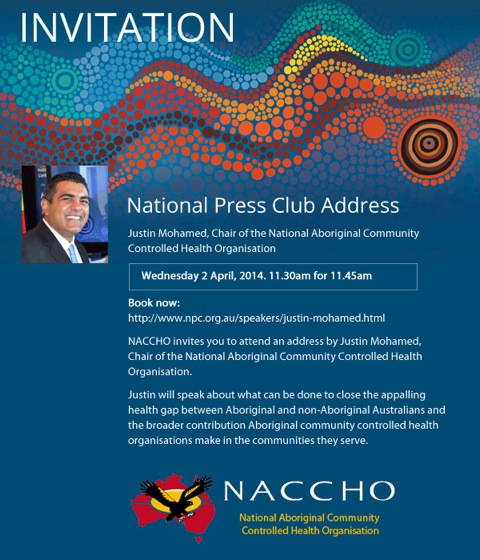
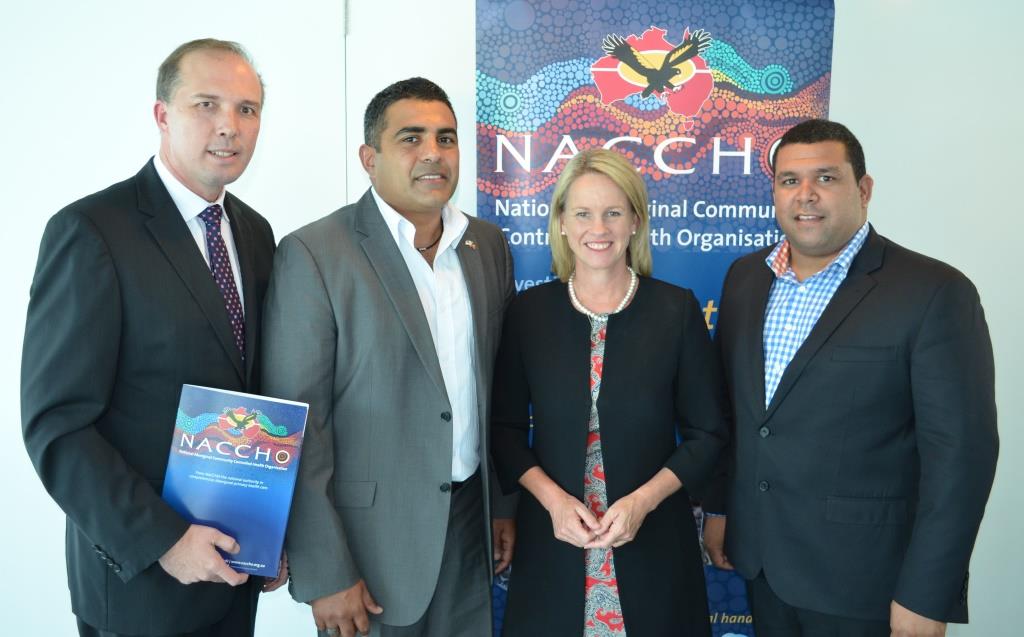
NACCHO Chair Justin Mohamed will be giving an address at the National Press Club in Canberra on Wednesday 2nd April.

Justin will be launching a report on the economic benefits of the Aboriginal Community Controlled Health sector and talking about how to close the health gap between Aboriginal and non-Aboriginal Australians.

Tickets are selling fast so get in quick if you want to secure
an individual ticket or a table.

Book now!!

naccho_invite

NACCHO Aboriginal health and racism: All Australians have the right to be protected against racial discrimination and vilification

Tom

Statement from the Co-Chairs of Reconciliation Australia, Dr Tom Calma AO and Melinda Cilento

Today NACCHO joins our fellow Australians from the Greek, Jewish, Chinese, Arab, Armenian and Korean communities in expressing our strong view that all Australians have the right to be protected against racial discrimination and vilification. For this reason NACCHO and Reconciliation Australia are opposed to any changes to the RDA which weaken protections against racial discrimination.

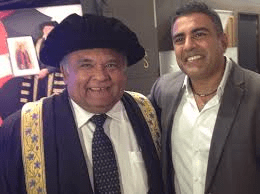
Picture above Dr Tom Calma with NACCHO Chair

Reconciliation Australia condemns all forms of racism. Racism is harmful. It destroys the confidence, self-esteem and health of individuals, undermines efforts to create fair and inclusive communities, breaks down relationships and erodes trust.

What are the impacts of racism on Aboriginal health ?

Racism perpetuates inequalities and can directly or indirectly exclude people from accessing services and opportunities. Racism remains a major barrier to achieving our vision for a just, equitable and reconciled Australia. It remains a barrier to governments seeking to close the gap on health outcomes, and to improve economic participation through employment and education. The fact is that many Aboriginal and Torres Strait Islander people continue to experience racism on a far too regular basis.

The Racial Discrimination Act 1975 (RDA) currently ensures all Australians are protected from discrimination on the grounds of race, colour, descent or ethnic origin.

Any changes to the RDA that weaken protections from racial vilification would pave the way to a less reconciled, just and equitable Australia. We therefore strongly oppose the current proposed changes to the RDA which repeal Section 18C.

Medical research clearly links experiences of racism with reduced health outcomes. Against this background, how are the proposed amendments to the RDA consistent with the Government’s expressed intentions to close the health inequity gap?

Now is not the time to reduce protections from racist abuse nor to signal that such views are less odious in modern Australia.

Like other Australians we strongly value the concept of freedom of speech, but that freedom must always be balanced against the rights of others. The use of defamation laws by politicians from both sides of politics is well known and exemplifies the balance between free speech and the need for citizens to be protected from scurrilous and false verbal attacks.

We note that Section 18D of the current Racial Discrimination Act contains exemptions for “anything said or done reasonably and in good faith” and, in the case of publishing, anything that constitutes “a fair and accurate report of any event or matter of public interest”.

We note that in the key case against which the alleged free speech restrictions of the RDA are being measured – the Andrew Bolt case – the judge, J Bromberg, found that Mr Bolt contravened section 18C because the articles were not written in good faith and contained factual errors, and therefore not made exempt by Section 18D of the RDA.

In his judgment J Bromberg found the Section 18D exemptions did not apply because of “….the manner in which the articles were written, including that they contained errors of fact, distortions of the truth and inflammatory and provocative language”.

Section 18D does provide free speech protection for comments that may be considered offensive to many Australians as long as these comments are delivered in a reasonable and honest way.

In a 2000 complaint under the RDA, Walsh v Hanson, politician Pauline Hanson’s published comments that Aboriginal people received preferential treatment from Governments were found not to have contravened the RDA Section 18D.

In the conciliation before the Human Rights and Equal Opportunity Commission, Commissioner Nader found that Ms Hanson would be exempt because the views expressed were genuinely held and formed part of a genuine political debate. The Commissioner found Hanson’s statements were put forward reasonably and in good faith, and there was a public interest at play – namely, political debate concerning the fairness of distribution of social welfare payments in the Australian community.

In recent years we have seen a generally calm and reasoned debate about the terrible impact of racism and its place in Australia’s history and the relationships between First Peoples and other Australians.

Australia’s sporting codes have shown great leadership in banning racism from the sporting field and working hard to better educate sports fan and the general public about the detestable nature of racism and bigotry.

The work of the AFL, the NRL, the A-League, Cricket Australia and other Australian institutions has had a marked impact on reducing racism in the community.

Our own Reconciliation Action Plan program has likewise shown to be increasing awareness of and reducing racism and ignorance in Australia.

We believe that Australia has made marked progress in the journey of reconciliation and is making inroads into reducing the legacy of historical discriminatory policies that have so devastatingly led to the levels of Aboriginal and Torres Strait Islander disadvantage.

We are deeply concerned that any reduced protection against racism and bigotry may have a seriously detrimental impact on this progress.

NACCHO at National Press Club April 2 : Investing in Aboriginal community controlled health makes economic $ense

NACCHO0032 Press Club Brochure Concept2__190314_Page_1

On 2 April the NACCHO chair Justin Mohamed will be appearing at the National Press Club in Canberra

Watch live on ABC-TV at 12.30 pm (see below)

healthy-futures-great

New Microsoft Word Document (5)


“Investing in Aboriginal Community Control makes economic $ense”

The good news is that ACCHS deliver the goods – not only health gains, but also substantial economic gains.

 In all the rhetoric about Closing the Gap, what is missing from the picture is this —  the ACCHS network of clinics, community health centres and health-based co-operatives throughout Australia generates substantial  economic value for Aboriginal people and their  communities. ACCHS are a large-scale employer of Aboriginal people. This provides  real income and economic independence for many people. They contribute enormously to raising the education and skill levels of the Aboriginal workforce.

Investing in ACCHS is a good business proposition. It provides value for money and is highly cost-effective for four main reasons:

ACCHS deliver primary health care that delivers results

 Like your local GP does but more effectively for Aboriginal people because  the ACCHS model combines the best of clinical know-how with culturally enriched local knowledge and wisdom. It takes care of the whole person, not separate body parts. People work as part of a team that includes Aboriginal Health Workers, allied health,  and social and emotional wellbeing counsellors   in the front line. GPs as well, although not always. It runs health promotion and health screening to identify and treat health problems before they get serious. It organises access to medical specialists and hospitals if necessary. The ACCHS model considers individuals and families as part of a community and it responds effectively to community-based needs and issues.

This model of health care works for Aboriginal people. Evidence-based inquiries and reports show that ACCHS outperform mainstream services in terms of treatment and prevention. They reduce the need for highly expensive hospital-based services. And they  save lives.

ACCHS employment boosts Aboriginal education and training levels

 ACCHS employ people with high skill levels. Most have tertiary level qualifications and several have multiple qualifications. This increases the  education and skill base of the Aboriginal workforce.  Organisational  pathways in ACCHS are based on continuing and further education.  The message is that ACCHS have education benefits. A single investment by government in ACCHS  deals effectively with the  two main problems in Aboriginal communities – high unemployment and low levels of education.

BOOKINGS

NACCHO Aboriginal health: Dr Charles Perkins 1993 speech “Aboriginal people and a healthy economy”

Image (19)

Importantly Aboriginal people should be aware of this false economy which forms the basis of Aboriginal affairs in this country.

The economic lifeline is maintained only at the discretion of politicians and a fickle public.

We must therefore develop and consolidate a viable economy for our various communities and organisations that will sustain us into the future.

We must create short and long-term economic strategies now and thus create a more independent and secure base for ourselves and our children. The reality is that Aboriginal people under utilise, to put it kindly, their current economic and personnel resources. The potential for economic viability for our people is available now if only we could awake to the opportunity and not be blinded largely by employment survival economics

Unless the approaches to Aboriginal health are broadened to include greater attention to the health problems of adults, and are matched by broad ranging strategies aimed at redressing Aboriginal social and economic disadvantages, it is likely that overall mortality will remain high.

Dr Charles Perkins opening the Australia’s First National /International Indigenous and Economic Conference (NIBEC 1993) Alice Springs.  1993 International Year of the World’s Indigenous Peoples and Paul Keating was Prime Minister

NACCHO editor note from Colin Cowell pictured above with Charles Perkins :

June 3 1992 at the Koori Mail first anniversary conference also the day of the Mabo Decision

In 1993 I project managed for Charlie’s Arrernte mob in Alice Springs Australia’s First National /International Indigenous and Economic Conference and part of my role was assisting Charlie to communicate his vision about Aboriginal people and a healthy economic future.

“Creating an economic template for our  healthy futures.” Dr Charles Perkins

As Australia enters the decade of the 90’s we find ourselves as a nation struggling to maintain our equilibrium in a rapidly changing world.

There is no doubt Australia has lost its relatively high standard of living and has become increasingly debt burdened, both to overseas creditors and within Australia itself.

It is also clear that other countries, particularly many of our Asian neighbours, have a booming and immensely competitive industrial and commercial society. From a layman’s point of view something is drastically wrong with current economic policy and planning that has allowed this nation to become extremely vulnerable in an increasingly complex, competitive and fast changing world.

It is clear the time has come, in consideration of our high unemployment, high overseas debt, falling living standards, rising prices and decreasing productivity, for the Australian people to decide that in the future we must elect politicians of competence, vision and integrity.

Surely the greatest public health pollution that exists in Australia today can be seen in the conduct of a number of our politicians – past and present of all parties. They take up needed space. This is the pollution that is the most insidious and ultimately fatal to any society of people.

The many poor quality politicians operating in many of our parliaments is a disgrace. The irony is that we, the Aboriginal people, voted for them.

Aboriginal people like everyone else in Australia have felt the negative outcomes of the economic scandals that have affected and still affects most states in the Commonwealth in recent years. Subsequently such economic activity must have reverberations throughout the world, not only with our trading partners and our competitors, but also with the nations at large. It must be difficult for them and as it is with us to understand the often unsavoury activities of some our banks, previously of high reputation, and our many once high flying extravagant entrepreneurs. Surely our international reputation has been damaged for generations to come. Sad to say they are all whites. In this context is Mabo such a calamity as some suggest.

What bewilders me, as an Aboriginal, is how people who have power, education, authority and collective responsibility, could do this to our young and dynamic nation.

They are destroying our future – for both blacks and whites.

In all of this economic turmoil it remains patently clear that the Aboriginal people of this country are seeking remedies for the solution of our problems from governments, politicians and bureaucrats who cannot even manage their own responsibilities, even with the best of facilities, education, financial and personnel services.

From an Aboriginal view point, our mistake over the years has been to look towards the white people in positions of influence, to solve our problems. This has been our fundamental error. Recent history tells us what we should have known over 200 years ago. It is amazing to me, that we, the Aboriginal people, have not yet absorbed this fundamental fact. The point is that white people in responsible positions are no better than us, in fact worse, considering educational background, at managing or solving difficult individual or community problems.

In regard to Aboriginal groups in Australia it is clear that since the early 1980’s Aboriginal organisations have become preoccupied with following agendas established by others.

For example, the economic agenda has been established by the federal and state governments, while the political agenda has been set by the media and other sectional interests. In the case of the bureaucracy, it is obvious that where once Aboriginal groups were able to display a self-interest separate from the mainstream Australian society : today their social consciousness has been totally absorbed by the government, and as such, by government processes.

In that sense, it seems that we Aboriginal people have lost both our identity and our purpose and have contributed to our own alienation and dependency.

This is due, in part, to the pursuit of survival economic goals. In addition, the blame is partly contained within the role monopolised by government (consciously or otherwise) which determines the political processes which purge the political and democratic aggression from those organisations and individuals through which it most achieves its goals.

Likewise, the silence from many Aboriginal organisations and individuals, most able to protest on a broad range of issues, shows clearly their dependency on government monies for their survival. The later effect of such a coercive process is that, Aboriginal affairs policies, are not properly debated, and, as such impossible to articulate. We are a captive peoples as never before in our history. A clear expression in the negative of this point is the lack of a national representative independent organisation for our people.

Considering the previous scenario let me now suggest some strategies for consideration which may assist to create a template for our future the healthy Australia.

The key elements are all interconnected in a total mosaic of Aboriginal affairs underpinned on the one hand with our culture and on the other with Aboriginal affairs economics.

1.The first is the Aboriginal economy specifically and what we can do to remove the concept and perception of “welfare” from Aboriginal affairs.

Obviously in the general welfare services area this is not entirely possible – nor should it be.

In almost all areas of Aboriginal activity we are funded by the government, or quasi-government bodies. We have scarcely moved away from the annual dependent and humiliating welfare budget process. Our economy is in reality a false economy. This arrangement can be terminated or drastically reduced at any time by any government. We must therefore consider several options.

Importantly Aboriginal people should be aware of this false economy which forms the basis of Aboriginal affairs in this country. The economic lifeline is maintained only at the discretion of politicians and a fickle public. We must therefore develop and consolidate a viable economy for our various communities and organisations that will sustain us into the future.

We must create short and long term economic strategies now and thus create a more independent and secure base for ourselves and our children. The reality is that Aboriginal people under utilise, to put it kindly, their current economic and personnel resources. The potential for economic viability for our people is available now if only we could awake to the opportunity and not be blinded largely by employment survival economics.

My main point on this principle is that Aboriginal people must now begin to re-create the economic base that will provide the springboard for our very survival. We have no real asset ownership or financial control in the investment context. Assets now held by governments, State of Federal and government bodies such as the land councils in the NT, ATSIC, CDC and others – this means land, buildings, businesses, cash and pastoral properties must be transferred to local Aboriginal ownership freehold. This is real empowerment and real self determination for both communities and individuals.

An essential element in all of this financial rearrangement is the psychology and public perception, not forgetting the practice, of removing Aboriginal affairs funding out of the context of “welfare”. The annual appropriation of over one billion dollars through the federal government should be placed under the direct control of Aboriginal people but obviously this body, (eg ATSIC), would have no connection whatsoever with the government. Such an arrangement can be concluded between Aboriginal people and the Australian Government, in the context of a Treaty, that will provide for a “sunset Clause”, and of course democratic elections and appropriate accountability for funds expenditure.

A further point revolves around the need for a national program that allows for the employment for all Aborigines of working age, providing they are physically capable. Aboriginal people should be given the opportunity to undergo relevant and proper training, where required, to allow them to obtain such reasonable employment that may exist. Most Australians would be surprised to realise that Aboriginal people numbering some eighteen thousand in over 136 communities actually work for the dole. Aboriginal people are not lazy, have never resisted work opportunities and have always been fully cognisant of the benefits proper employment brings to health, happiness and general well-being of their own family and their community. It is clear such an initiative would reduce alcoholism and it detrimental effects drastically. This is preventative health – not curative. There is a positive correlation as we all know between jobs and dignity, self respect and confidence.

2.My second major suggestion toward our survival as Aborigines, is cultural renaissance.

To survive as a nation within Australia we must re-establish our Aboriginal Cultural base throughout Australia. Aboriginal culture is the raison d’etre for our existence.

It was our anchor in the past. It should be our anchor in the future. It provides the purpose and the passion. It should be our uniting force. We need our culture, to bring us together (is) once again as a people. Today we are divided and disorganised.

There has never been so much bitterness between Aboriginal people as there is today. We fight like hungry black dogs over a diminishing budgetary bone thrown to us by our white and black manipulators. To this end, of establishing our cultural base nationally, I would suggest traditional and urban Aboriginal people should engage in organised cultural/social exchange programs. This means Aboriginal people from the cities and towns should spend time living out bush with traditional groups to learn their law, dance, customs and songs.

The reverse, should of course apply. We can thus build up our cultural base nationally to give us confidence and greater credibility. For example, we should begin to learn our own, or other Aboriginal languages, and further ensure such languages are taught as an accredited course in schools and tertiary institutions.

In addition, Aboriginal dance and music should be part of the general education curriculum throughout the nation in primary and secondary schools.

3.Thirdly, We must “free up”, for want of a better word, our numerous Aboriginal organisations.

There are nearly 2000 operating in Australia today in a variety of areas. We should realise, as indicated previously, that many Aboriginal organisations have become so institutionalised they are just part of the oppressing system, and as such, resistant to change. They have become in fact, an end in themselves, and not as originally intended, a means to another end, this being the well-being and economic independence of Aboriginal people. To put it bluntly, some of the organisations live for themselves alone. They have not evolved with time. They no longer serve the basic needs of the Aboriginal people to the degree that warrants their existence.

Reference made to Multi-Culturalism in Australia is Institutionalised and Resistant to change.

Clearly Aboriginal organisations in the 1960’s / 1970’s and early 1980’s were established to help Aboriginal people overcome disadvantages in identified areas of concern.

It should be said that many have basically performed creditably over the years and served the Aboriginal people and Australia well. However, the last ten years have seen a withering away of effort and commitment. Many, including some leaders, have lost their commitment, purpose and the “fire” in their organisational belly. They have become areas of employment per se, and ultimately conservative and somewhat reactive – once again survival economics.

What we desperately need is for the passion and commitment for the course of our people in the 60’s, 70’s and early 80’s to be re-ignited. Clearly not all Aboriginal organisations or individuals are at fault, or sections of the media, unions and governments. However, there is no doubt the scenario condemns us all.

We must go back to the basics and the grass roots, we must build up at the local level and then move to the state and then national. Perhaps a revamped, reorganised, streamlined ATSIC may be our salvation. Once again the quality of people is the key element.

4.The future is ours to create. Today is our tomorrow

Fourthly as we are all aware this is The International Year of the World’s Indigenous Peoples which was launched in December 1992 in New York at the United Nations. It is a significant beginning to this decade of the 90o. the time is right, the scene is set, our people are ready and willing – this is or could be the decade for the renaissance of the Indigenous people in this country we now call Australia. History is  a guide but still a memory.

The future is ours to create. Today is our tomorrow. All societies have it seem to have one or two opportunities to fulfil their dreams and ours has arrived. We are on the threshold of our great national dream. The just, the good, the compassionate, the prosperous society.

The catalyst to move our people collectively towards this greater future has been granted to us the High Court in the recent Mabo decision. It could not come at a more opportune time, It is our once in a lifetime chance to recreate the society that we all desire.

As the Prime Minister stated in Sydney in December 1992, “We need these practical building blocks of change.

The Mabo judgement should be seen as one of these. By doing away with the bizarre conceit that this continent had no owners prior to settlement of Europeans. Mabo establishes a fundamental truth and lays the basis for justice … Mabo is an historic decision – we can make it an historic turning point, the basis of a new relationship between Indigenous and non-Aboriginal Australians. The message should be that there is nothing to fear or to lose in the recognition of historical truth, of the extension of social justice, or the deepening of Australian social democracy to include Indigenous Australians”.

Within this context the federal government must pursue, as they promised some years ago, the concept of a treaty.

This government must keep its promise to enter into a Treaty with the Indigenous people, particularly in this U.N. Year of the Indigenous People. This would demonstrate to the world that Australians – both Aboriginal and non-Aboriginal, can exist in cultural harmony and celebrate our common humanity.

History must not be a cross we should carry as a nation, into the future. Our children must inherit a society better than the one we inherited. A treaty is not so much a matter of dollars and cents, it is more spiritual and symbolic. It can be a catalyst which binds us together as a nation, respecting our past but building for the future. Australians must never forget that Australia was Aboriginal land and still is Aboriginal land. A Treaty is the appropriate mechanism for such negotiations. Naturally, such a Treaty can be one of the basic principles for discussions and conclusion with the framework of the recent and further Mabo High Court decision.

As is public knowledge, on 3 June 1992, the High Court made the great leap forward in recognising that Australia and the Torres Strait Islands were not empty “terra Nullius” before the British invasion of 1788, but were peopled by hundreds of Aboriginal nations, each with a distinct, rich and complex culture. The Mabo decision thus take recognition of Aboriginal and Torres Strait Islander culture at its starting point, and establishes that Aboriginal and TSI peoples have rights which have their source in traditional customary law rather than the British common law imposed on us in 1788. In this respect, the decision is empowering, as Aboriginal people are not starting with nothing and waiting for rights to be handed out piecemeal at the political him of the government of the day.

The Mabo decision represents an opportunity for some measure of justice to be gained for Aboriginal Peoples who are the most dispossessed of Indigenous peoples of all former British colonies, who are the most jailed race in the world and who have suffered and continue to suffer cultural genocide. However, Mabo is very limited in its “context”, it only addresses the narrow concept of native title and thus is defined in traditional areas.

It is also important to recognise the limitations of the case. Firstly, Aboriginal and TSI Sovereignty is a demand by Aboriginal people that the courts and Parliament of Australia recognise and acknowledge that the “acquisition” of sovereignty by the British in 1788 was illegal under English law at the time and also international law.

And that the acquiring of the land was by dispossession, genocide, ethnocide and it was consequently unlawful, illegal and immoral. Plus the demand that the government of Australia as the inheritors of the British Crown, compensate Aboriginal people for the loss and the damage done to our land and our culture. It is not a demand upon Australian individuals to surrender their land but rather a demand for recognition and compensation by the community as a whole. Sovereignity was not argued by the plaintiffs in Mabo, and therefore Commonwealth and State governments, according to the decision, have ultimate power to extinguish native title at will, subject to the Racial Discrimination Act 1975 (Cth).

Given these limitations, the hysteria and scare mongering currently seen in the media is put into perspective. Australians will not lose their homes and backyards. One of the most basic principles of Mabo is that once a State Government grants freehold title to a third party (ie. A person or company) , and native title to that area is automatically extinguished. In lay language, once any person buys a bit of land, native title is completely wiped out.

You can see that far from Australia being on the brink of a black coup d’etat, native title is actually quite limited and vulnerable.

The question then arises, where do we go from here ?. The notion of native title coinciding with other interests in land points us toward the answer.

Mabo is about working together, about balance and recognition of Aboriginal and TSI culture as a source of strength and wisdom from which all Australians can learn.

Mabo is also about self-determination – giving Aboriginal and TSI peoples the space and resources to enjoy our culture, work out our own solutions and control our own lives. The imposition of successive waves of government policy has not solved anything for us, but only created more problems.

Some of the most difficult aspects of post-Mabo relations will stem from competing land use in the form of resource development and native title. I do not believe that Aboriginal And TSI peoples are anti-development, if it is done in a way which respects them.

The history of conflict between mining companies and Aboriginal people has largely resulted form the formers deceit, lack of proper consultation and negociation, marginalisation of Aboriginal people from benefits flowing from projects undertaken on their land and disrespect for the wishes of Aboriginal people, for example; in relation to the protection of sacred sites.

Today, Aboriginal people must be equal partners at the negotiating table, we must have our say and governments and resource developers must listen and work out with us proper solutions to these vexed problems in a faire, reasoned and balanced way. I believe that Mabo gives Australia the opportunity to mature as a nation. Just as there is no economy without environment, development must include justice and human rights.

I am not supposing a utopian dream where in all parties are completely happy and negotiate the perfect solution, but a way ahead toward fair and just solutions which all parties can live with and which do not sacrifice the interest of one over the other.

Most important of all, in the Federal Constitution, it is necessary that there be a recognition of Sovereignty as by that recognition and resulting compensation so that Aboriginal people can regain our dignity and be treated as equal partners in any future development of our land.

5.Fifthly a major element which would allow us to move away from the dependency situation, is free education for all Aboriginal people at all levels.

This would give us the basis for true self-determination.

This free education would be from pre-school, though to the tertiary level. As I have previously indicated, in other places, the current education and training policies of the federal government are not effective. The costs are too high and the results very poor. We must have flowing through the universities and the schools, educated and competent Aboriginal people, young and old. Men and women who can lead us.

We need articulate, intelligent community based leaders. This is not entirely the case at the moment.

At least 3000 Aboriginal graduates per year will dramatically change the face of Aboriginal affairs within five years. It will cost more in the short term but less in the long term. The cost benefit to the Australian economy over ten years will be enormous.

Education at an appropriate level, and nature, can provide our people with the confidence, the competence and ability to compete with white Australians on an equal basis. We can eyeball other Australians with dignity and respect. We can create our own options in whatever sphere of activity we so wish.

6.My sixth point is that there is an urgent need to establish an effective, independent, non-government sponsored national Aboriginal and Torres Strait Island organisation.

This organisation should be funded by the Aboriginal people, and others, through voluntary subscription with a charter to express strongly the political, social and cultural opinions of Aboriginal people, free of any government or other sectional influence. This is no adverse reflection on ATSIC-ATSIC is government – this is not. The both bodies can complement each other. At present there is no national organisation since the demise of FCAATSI in the 1970’s. It should, obviously, be democratically elected and thus accountable to the Aboriginal people. It has been clear for some time that Aboriginal people in Australia have no focal point of reference for independent opinion on our issues. Our opinions are largely reflected to the nation by our need for economic survival in the workplace as funded by government or by churches, sectional interests, unions, media or a nervous general public. There is no doubt we need a national independent body as never before in our history.

However, critical to the establishment of this independent political voice for Aboriginal people must come the realisation that we now in Australia operate within the framework of a dynamic multicultural society. We, Aboriginal people must now cultivate vigorously the understanding and support of the many ethnic groups in this country. We cannot stand alone. Their support is vital and a natural development.

7.My seventh point is Health, Sport and Recreation.

Despite the world wide recession the majority of Australian people live in relative affluence. This can not be said of the Aborigines living in Australia whose life expectancy still remains comparable with that of countries like India, Papua New Guinea and Ghana.

It is this indicator more than any other that clearly summarises the extent of Aboriginal health disadvantages.

Finally unless the approaches to Aboriginal health are broadened to include greater attention to the health problems of adults, and are matched by broad ranging strategies aimed at redressing Aboriginal social and economic disadvantages, it is likely that overall mortality will remain high.

NACCHO Close the Gap Day : Warren Mundine: “The Future of Aboriginal Health” Address To Lowitja Institute

Lowitja

“Decades of Indigenous controlled health service delivery have seen the Aboriginal community controlled health sector become a leading provider of primary health care services and a significant employer of Aboriginal and Torres Strait Islander peoples.

This sector has mature organisations with a depth of expertise and capabilities, particularly in remote and regional areas, surpassing the level of mainstream health services in some areas.

I see no reason why organisations in these positions should not be able to leverage their capabilities and positioning to provide health services more broadly, thereby expanding their ability to generate extra income and funding. Opening the door to entrepreneurship, independence and self-sufficiency could present great opportunities.”

Opening Address by Nyunggai Warren Mundine:

“The Future of Aboriginal & Torres Strait Islander Health”

Pictured above with  Lowitja O’Donoghue

Thank you Aunty Di Kerr for the Welcome to Country on behalf of the Wurundjeri Nation.

I too would like to acknowledge and pay respect to the traditional owners of the land on which we meet and also to acknowledge and pay respect to my own Bundjalung, Gumbaynggirr, Yuin and Irish ancestors.

I wish also to thank you the Lowitja Institute for inviting me to give the Keynote Address at this Congress and to Lowitja O’Donoghue for her introduction.

And thank you Deborah Cheetham and the Indigenous Dance Troupe, Koori Youth Will Shake Spear, for your terrific performances.

I also acknowledge the Deputy Chair of the Prime Minister’s Indigenous Advisory Council, Professor Ngiare Brown.

I am honoured to be here today addressing you.

The Future of Aboriginal & Torres Strait Islander Health? The short answer is the Prime Minister’s Indigenous Advisory Council sees a healthy and prosperous future for Aboriginal & Torres Strait Islander health. I see great leadership, innovation and vision when I look at the community controlled Aboriginal & Torres Strait Islander Medical Services and their national advocacy organisation, the National Aboriginal Community Controlled Health Organisation, and the Australian Indigenous Doctors’ Association.

As people would appreciate, after reviewing the recent “Closing the Gap” report there is much more work to be done.

To get an understanding of the Council and the work of the Council I’ll give a brief outline.

The Prime Minister’s Indigenous Advisory Council was created to provide advice to the Federal Government on Aboriginal & Torres Strait Islander Affairs, with a focus on practical changes to improve the lives of Aboriginal and Torres Strait Islander people.

The Council provides ongoing advice to the Government on emerging policy and implementation issues related to Aboriginal & Torres Strait Islander Affairs covering, but not limited to:

  • improving school attendance and educational attainment
  • creating lasting employment opportunities in the real economy
  • reviewing land ownership and other drivers of economic development
  • preserving Aboriginal and Torres Strait Islander cultures
  • building reconciliation and creating a new partnership between black and white Australians
  • empowering Aboriginal and Torres Strait Islander communities, including through more flexible and outcome-focussed programme design and delivery
  • building the capacity of communities, service providers and governments
  • promoting better evaluation to inform government decision-making
  • supporting greater shared responsibility and reducing dependence on government within Aboriginal and Torres Strait Islander communities
  • achieving constitutional recognition of Aboriginal and Torres Strait Islander people.

The Council also has another role of being the Deregulation Committee for Prime Minister and Cabinet as part of the review by Parliamentary Secretary to the Prime Minister, Josh Frydenberg into deregulation including cutting red tape and addressing the overburden of compliance costs.

The Council is supported by a Secretariat based within Prime Minister and Cabinet.

The Chair meets at least monthly with the PM, currently I have weekly conversations with the Prime Minister, the Minister for Indigenous Affairs and other Ministers. The Council meets 4 to 6 times a year. Our 3rd meeting is being held in Sydney on the 2nd April.

As you can see, the Council has a broad Terms of Reference and is an independent body that gives advice. That means we give advice whether the Government agrees or not. A good example of this is the Anti-Discrimination Act Section 18C debate. Council members didn’t agree with the policy taken to the last election by the Coalition and we gave advice to the Prime Minister of our views not to repeal Section 18C. The Government and the general public are very aware of the Council’s view on this matter.

The Council is the Prime Minister’s advisory group not an elected representative body. It is an advisory group like the Commission of Audit, the Gonski Education Review, the Henry Tax Review, the Banking Inquiry Review and many such other bodies. So, when people say we are not an elected body, we don’t represent Aboriginal and Torres Strait Islander people – I say “correct”. We are a group of people who bring a range of expertise, skills and experiences together to advise the Prime Minister and Government. Council meetings are full of robust and frank discussion and new ways of thinking and that is reflected in the advice we give to the Prime Minister.

The Prime Minister wants the Council to focus primarily on the three areas of Jobs, Education and One rule for all. The third area is essentially around upholding community standards and the rule of law in all communities. My term for this is “social stability”.

Broadly, the Council operates within a reform agenda based with an economic and commerce focus. We want to see a focus on outcomes and on the experience of the people who receiving or relying on services; we look for innovative and entrepreneurial approaches; we want service delivery that is integrated and eliminates duplication; we expect service deliverers – including States and Territories – to be accountable and we will hold them to their accountabilities; we want to see less red tape more Bang for the Buck and efficiencies in cost and delivery; we also want to see investment in Indigenous communities. Above all, we want to see simple and practical approaches that really deliver.

That is the lens through which all or our deliberations and recommendations are made and it is the lens through which I will talk about the future of Indigenous Health this morning.

*              *              *

In preparing this speech I received a detailed briefing with pages and pages of statistics on Indigenous health and health risk factors. And these were just a sample. I am all too familiar with the data which paints a dire picture of Indigenous health and wellbeing in Australia.

Of course, for Aboriginal and Torres Strait Islander people it’s not just about statistics; it’s about our family, friends and communities; it’s about our parents and our children and our own selves. It’s my sister who died at aged 50 from heart disease. It’s the man who was stabbed in front of me enraged with alcohol and drugs Musgrave Park when I was a youth. It’s the regular emails I receive letting me know about “sorry business”. It’s the fact that almost every Indigenous person I know over the age of 40 has Type 2 diabetes. It’s my own brush with death in 2012 from cardio-vascular disease.

Indigenous people live these statistics every day and we experience the real impact – not just on individuals and their specific health problems – but also on our communities and families who are being hollowed out by things like low life expectancy, chronic and communicable diseases, and mental health problems, alcohol related disease and assaults, Foetal Alcohol Spectrum Disorder, suicide and child mortality. These problems have an ongoing social, cultural and psychological impact on communities and families.

When it comes to Indigenous health policy and health services, the greatest challenge is bureaucracy, waste and red tape.

Health is one of the most governed of all the public services. Constitutionally, health services are provided by the States. However, the Federal government has considerable influence and control because it provides substantial funding.

Indigenous health policy and the delivery of health services to Indigenous people involves multiple administrators and decision makers at multiple levels. There are at least two portfolios – health and Indigenous affairs – in the Commonwealth and in each State and often other relevant portfolios such as community services and human services. Each portfolio has a Minister and a department and often Assistant Ministers or Parliamentary Secretaries as well.  All of this is before you get to the front line health services, such as State operated hospitals and other medical services and specialised Indigenous health services such as Aboriginal community controlled health services, each of which has their own administrative staff and obligations.

The previous Federal government also had a Minister for Indigenous Health. Prime Minister Abbott chose not to continue with this portfolio and these responsibilities have been rolled into the Department of Health and the Department of the Prime Minister and Cabinet which is responsible for Indigenous affairs.

Some people criticised this, arguing that not having a dedicated Indigenous health portfolio would set back Indigenous health policy and delivery. I disagree. One of the reasons we are spending billions on Indigenous people and not achieving material improvements in closing the gap is because the funding is poorly targeted and wasted on red tape and bureaucracy. The most recent Productivity Commission indicates that the majority of funding allotted specifically to Indigenous Australians is spent on bureaucrats, advisers, contractors and the like, many of whom are non-Indigenous. Shortly after the last election Minister Scullion and I did a preliminary review of the spending figures and we estimated that at least a third of Government funding for Indigenous programs doesn’t even make it past the front doors of office buildings in Canberra and other cities.

Every additional Minister and department or other entity involved in Indigenous health results in additional reporting, handoffs and intra-government dealings. The different groups have to consult and report to each other and handle demarcation issues and duplication. Inevitably this means funding must be being consumed by bureaucratic process.

I recently saw a rerun of an episode of Yes Minister called “The Economy Drive”. In it, Sir Humphrey, Permanent Secretary of the fictional Department of Administrative Affairs, must deal with Minister Hackett wanting to eliminate waste and improve efficiency. Explaining to the more junior public servant, Bernard Woolley, why this is a bad thing, Sir Humphrey explains:

“There has to be some way to measure success in the Civil Service. British Leyland can measure success by the size of their profits, or rather they measure their failure by the size of their losses. We don’t make profits or losses so we have to measure our success by the size of our staff and our budget. By definition, Bernard, a big department is more successful than a small one.”

Even though it is fiction and satire, the scary thing about Yes Minister is that people who have worked in Government very much relate to it.

Whenever funding cuts to Indigenous services or programs are made, the vocal protest and criticism simply assumes that defunding will undoubtedly lead to bad outcomes for Indigenous people. In doing so they are measuring success by the size of budgets and staffing. But if funding to date has not had a material positive impact on Closing the Gap statistics, we can’t simply assume that a funding cut will have an adverse impact. It depends whether what is being cut is actually contributing to improvements or if it is wasted spend. Knee-jerk reactions of outrage without regard to the actual outcomes (if any) the defunded services have achieved, ultimately weaken the voice of criticism.

To me it is a very simple proposition. The success of government service delivery in Indigenous health should be measured by the outcomes achieved.

It’s not about the volume of services or who provides them or how much the Government is spending or how many people are involved or how much activity occurring on a day to day basis. It’s not about the size of the department or how many departments there are or whether we have a dedicated Minister for Indigenous Health. It’s about the outcomes and results achieved for Indigenous people.

We need to get bang for our buck. I do not want to see a single cent of funding wasted on administration, bureaucracy, reporting or other red tape that isn’t contributing to outcomes. Every cent wasted is a cent denied to Indigenous people and not being used to close the gap.

In this country we pride ourselves on our universal health system – a system where everyone gets access to top rate medical treatment in public hospitals with delivery prioritised based on health needs, not on ability to pay or other factors. No one wants to see a two-tiered health system, one for Indigenous people and one for non-Indigenous people. Our health system should deliver the world class medical services to everyone and Indigenous people should benefit from that as much as everyone else. The purpose of special Indigenous health services and policy is to close the health gaps between Indigenous and non-Indigenous people.

In the current Federal ministerial structure we have one Health Minister who is responsible for the funding and funding arrangements for health for everyone.

The job of the Department of Prime Minister & Cabinet (which houses the Indigenous Affairs portfolio) is to focus on what is needed in addition to the mainstream health system to close the gap between Indigenous and non-Indigenous health. This may involve funding additional health services or bodies. It also involves looking at the totality of different services and resources that are targeted towards, or that impact, Indigenous health – including housing, sanitation – and holding States, Territories and other bodies to account to deliver real outcomes.

Groups like the National Aboriginal Community Controlled Health Organisation are critical to delivering health services that cater to the additional needs of Indigenous people and communities to close the gap and recognise the importance of having Indigenous involvement in health policy and service delivery. The Indigenous Advisory Council’s Deputy Chair, Professor Ngiare Brown, who is a doctor, is an Executive Research Manager at NACCHO.

Decades of Indigenous controlled health service delivery have seen the Aboriginal community controlled health sector become a leading provider of primary health care services and a significant employer of Aboriginal and Torres Strait Islander peoples. This sector has mature organisations with a depth of expertise and capabilities, particularly in remote and regional areas, surpassing the level of mainstream health services in some areas. I see no reason why organisations in these positions should not be able to leverage their capabilities and positioning to provide health services more broadly, thereby expanding their ability to generate extra income and funding. Opening the door to entrepreneurship, independence and self-sufficiency could present great opportunities.

*              *              *

At one level, it is very easy to become overwhelmed by Indigenous health statistics, not only the data itself but also the immensely complex interconnectedness of health problems, health risk factors and social issues.

At another level, Indigenous health problems are not complex to understand at all. If you step back from the tangled web of data and statistics, what you are really looking at is poverty.

Across the world, the conditions under which people are born, grow up, live, work and age shape their health.  As the World Health Organisation points out: ‘the poorest of the poor have the worst health’. Most Indigenous people of my generation, and many of those in the generations after that, grew up in poverty or not far above it. Poverty is both a cause and a consequence of poor health.

It is estimated that socioeconomic disadvantage – in things like education, employment and income – account for one-third to one-half of the health gap between Indigenous and non-Indigenous Australians.

If we only achieved two things – eliminating poverty and eliminating smoking – we would close the gap in Indigenous health for good.

It is very important to remember this as we talk about Indigenous health service provision and health policy. Both are vitally important. But even the best policy and the best service provision will not close the gap if Indigenous people continue to live in poverty, or indeed if we make choices, like the choice to smoke, which damage our health.

The solution to poverty is not a mystery. Poverty is solved by economic development and commerce. Between 1990 and 2010 the number of people living in extreme poverty globally halved. That’s one billion people lifted out of poverty in just 2 decades. Two-thirds of poverty reduction comes from economic growth. The most astonishing example is China. Since it began economic reform 30 years ago its extreme-poverty rate fell from 84% to 10%.

For economic development we need our people to be educated and get into jobs and we need social stability in our communities or people will never invest in them.

So – the reason why I talk so much about economic and commercial development, about getting kids to school, about getting Indigenous people into real jobs and about safe communities, is because these are the key to eliminating poverty and therefore they are key to closing the gap in health. And therefore they are priority areas for the Prime Minister’s Indigenous Advisory Council and for the future of Indigenous Health.

Nyunggai Warren Mundine is Executive Chairman of the Australian Indigenous Chamber of Commerce

You can hear more about Aboriginal health and Close the Gap at the NACCHO SUMMIT

summit-2014-banner

The importance of our NACCHO member Aboriginal community controlled health services (ACCHS) is not fully recognised by governments.

The economic benefits of ACCHS has not been recognised at all.

We provide employment, income and a range of broader community benefits that mainstream health services and mainstream labour markets do not. ACCHS need more financial support from government, to provide not only quality health and wellbeing services to communities, but jobs, income and broader community economic benefits.

A good way of demonstrating how economically valuable ACCHS are is to showcase our success at a national summit.

REGISTRATIONS NOW OPEN

SUMMIT WEBSITE FOR MORE INFO

abstract-blocks

NACCHO Close the Gap day :The Portrayal of Aboriginal Health in Selected Australian Media

sovereign

One of the factors impacting on the relationship of Indigenous Australians with mainstream society is the way in which the media portray Indigenous people and issues. There is growing research that suggests negative media portrayals in relation to Indigenous Australians perpetuates racist stereotypes among the wider population and that this type of racism has a major impact on the health of Indigenous Australians

Portrayal of Indigenous Health in Selected Australian Media Melissa J. Stoneham Curtin University

Aboriginal and Torres Strait Islanders (herein referred to as Indigenous Australian) comprise three percent of the Australian population (Australian Government, 2013). Distributed across the continent, Indigenous Australians are one of the most linguistically and culturally diverse populations in the world. It is commonly acknowledged that health outcomes for this group are lower than those of non-Indigenous Australians.

DOWNLOAD THE REPORT HERE  : The Portrayal of Indigenous Health in Selected Australian Media Melissa J. Stoneham Curtin University

NACCHO Aboriginal health and racism: Marcia Langton the nature of my Q and A apology to Andrew Bolt

Photograph above Australia Day Canberra 2012 Colin Cowell

Although progress has been made in closing the gap, Indigenous Australians continue to experience a lower life expectancy with the current gap between Indigenous and non-Indigenous estimated at 11.5 years for males and 9.7 years for females (Australian Bureau of Statistics, 2010). Traditionally, the responsibility for tackling ill health has fallen to the health sector. While delivering health to those in need is one of the social determinants of health, the high burden of illness in many cases is due to the poor environmental conditions in which people are born, grow, live, work, and age.

These unequal conditions are, in turn, a product of bad politics, poor social policies and programs, and unfair economic arrangements (World Health Organisation, 2008).

According to Calma (2013), the poor health of Indigenous Australians is a result of a failure to realise the right to health for Indigenous Australians. Indigenous Australians have not had the same opportunities to be as healthy as other Australians or been able to take effective action to remedy long-standing and substantial health inequalities due to the relationship with mainstream society and services.

Making sense of the cultural health status of Australian Indigenous peoples requires an understanding of the relationship between the colonisation process, trauma, and its impact on health. The trauma, grief, pain, and anger that have resulted from the assimilation, segregation, and protectionist policies of the past are still present in the lives of Australian Indigenous people (Hearn & Wise, 2004).

A parallel consideration is the definition that Australian Indigenous peoples have of health. The Social and Emotional Wellbeing Framework, developed by the Australian Government, acknowledges that wellbeing is part of a holistic understanding of life, integrating the life-death-life cycle. It recognises this whole-of-life view of health is essential to achieve positive life outcomes for Australian Indigenous peoples (Department of Health and Ageing, 2004).

Although not recognised as a specific wellbeing factor within the above document, land has a powerful and persuasive underlying influence on Australian Indigenous wellbeing (Garnett & Sithole, 2007). The dispossession of Australian Indigenous people from their land and the subsequent loss of social, cultural, and financial capital has had a devastating effect on the health of Indigenous people worldwide (Hearn & Wise, 2004).

One of the factors impacting on the relationship of Indigenous Australians with mainstream society is the way in which the media portray Indigenous people and issues. There is growing research that suggests negative media portrayals in relation to Indigenous Australians perpetuates racist stereotypes among the wider population and that this type of racism has a major impact on the health of Indigenous Australians (Coffin, 2007; Larson, Gillies, Howard & Coffin, 2007; Sweet, 2009).

Similarly, in New Zealand, a number of mass media studies identified that Mãori health is often framed in the deficit model (Robson & Reid, 2001); the media are routinely reporting that the Mãori peoples are over-represented in national disease statistics (Rankine et al., 2008) and are persistently constructed as sicker and poorer than members of the dominant cultural group (Moewaka Barnes et al., 2005). Nairn, Pega, McCreanor, Rankine, and Barnes (2006) also looked at media representation of Māori peoples in New Zealand and highlighted a number of examples where the media perpetuated racist discourse by using language that framed stories in a particular way (e.g. Stoneham: Portrayal of Indigenous Health Published by Scholarship@Western, 2014 needy, passive objects of settler help), using only selective facts while leaving out crucial information, and excluding or conforming Mãori stories to fit a certain ideology.

This study aimed to examine the media portrayal of Indigenous Australians’ public health issues in selected media over a 12-month period. The objective was to determine the extent to which the portrayal was negative, positive, or neutral.

You can hear more about Aboriginal health and Close the Gap at the NACCHO SUMMIT

summit-2014-banner

The importance of our NACCHO member Aboriginal community controlled health services (ACCHS) is not fully recognised by governments.

The economic benefits of ACCHS has not been recognised at all.

We provide employment, income and a range of broader community benefits that mainstream health services and mainstream labour markets do not. ACCHS need more financial support from government, to provide not only quality health and wellbeing services to communities, but jobs, income and broader community economic benefits.

A good way of demonstrating how economically valuable ACCHS are is to showcase our success at a national summit.

REGISTRATIONS NOW OPEN

SUMMIT WEBSITE FOR MORE INFO

abstract-blocks

NACCHO job opportunity: National Communications and Media Advisor

Media

Are you an experienced Communications and Media professional?

Do you want to use your skills towards shaping a better future for Aboriginal Australians?

If you are committed to contributing to change, please read on…

Slide4

About NACCHO

The National Aboriginal Community Controlled Health Organisation (NACCHO) is a living embodiment of the aspirations of Aboriginal communities and their struggle for self-determination.  Founded at a meeting in Albury in 1974, NACCHO is the national authority on Comprehensive Aboriginal Primary Health Care representing over 150 Aboriginal Community Controlled Health Organisations (ACCHOs) across the country on Aboriginal health and well-being.

Based in Canberra, NACCHO is governed by a board of community-elected Aboriginal leaders from every state and Territory across Australia.  Through employment, engagement, empowerment and social action, ACCHOS have become strategic sites for Aboriginal community development, by empowering Aboriginal people through self-determination.  They are a proven mechanism for Aboriginal people to take responsibility over their own health matters.

ACCHOs ranged from large multi-functional services employing several medical practitioners and providing a wide range of services to small services that rely on Aboriginal Health Workers and/or nurses to provide the build of primary care service, often with a preventative focus on health education.  The services form a network, but each is autonomous and independent, both of one another and of government.

NACCHO is committed to Investing in Healthy Futures for Generational Change

About the role

The Communications and Media Advisor is a multifaceted position encompassing the strategic implementation of NACCHO’s National Communication Strategy, from stakeholder engagement, media relations, social media and website management, through to project management and media monitoring.

The position reports directly to the Chief Executive Officer and Chair, providing high level strategic and political advice, as well as providing recommendations to enable the strategic direction of the organisation.

The role of Communications and Media Advisor has day-to-day responsibility for the following:

  • Public Relations, Media and Monitoring
  • Website Management
  • Marketing and Social Media Management
  • Stakeholder Engagement
  • Brand Development
  • Events Management
  • Strategic Direction

About you

We are looking for a highly motivated and experienced Communications and Media Advisor to be part of the NACCHO team as we work towards developing our brand and promoting Aboriginal Community Controlled Health.

The successful applicant will be able to demonstrate knowledge and experience in the following:

  • Website Management (WordPress)
  • Customer Relationship Management databases
  • Microsoft Office Suite (Word, Excel, Outlook)
  • iPhone and Android apps
  • Events Management systems

A tertiary qualification in media, communications, journalism or a related field would be highly regarded.

This is a full-time ongoing opportunity.  To submit an application to work within the NACCHO team, apply by filling out the form below.  Please ensure you have your resume available, as you will be required to attach your resume to the application.  The selection criteria below must be filled out in order to proceed with the application.

APPLY HERE

Applications close COB Friday 4th April 2014.

For further information on this exciting opportunity, contact

Josh Quarmby on 02 6246 9345, or email Mailto:josh@naccho.org.au

NACCHO is committed to increasing the workforce participation of Aboriginal and Torres Strait Islander people.  Aboriginal and Torres Strait Islander people are strongly encouraged to apply.

CJC

After 43 years ,286 jobs in 17 countries the current National Communications and Media Advisor Colin Cowell  is retiring

I would like to thank the 10,000 plus followers (this alert, Twitter and Facebook ) and 15,000 monthly readers of this NACCHO Communique that  I created  over  two years ago.

Thank you for your support and positive feedback

Colin Cowell

NACCHO Aboriginal health and racism: Marcia Langton the nature of my Q and A apology to Andrew Bolt

869920-e452df9e-a9a7-11e3-9dd3-54db44ed2f71

I believe that his obsessive writing about the colour of the skin of particular Aboriginal people is malicious and cowardly

Among the many race-obsessed expressions in his offensive, and now, unlawful, columns was the accusation that the defendants, all ”fair-skinned” Aboriginal people, claimed to be Aboriginal to receive certain benefits.

As every person who has been raised by an Aboriginal parent knows, we must be ”twice as good as the white man” to finish school and get a job and suffer endless racist slurs while doing so from idiots who say things like, ”You don’t look Aboriginal. Why don’t you identify as white?”

What are our children and grandchildren to say to these fools? Deny their mothers, fathers, siblings, grandparents, and other family members because one of Bolt’s ilk is offended by their Aboriginal identity?

Marcia Langton responding to her comments on Q and A

Prof Marcia Langton, B.A. (Hons) ANU, PhD Macq. U., A.M., F.A.S.S.A.

Chair of Australian Indigenous Studies :

The University of Melbourne

I apologised for causing offence to him, because he stated that I should apologise to him because I had ‘hurt his feelings’ and offended him. I did not apologise for my beliefs or my intention of trying to explain my beliefs.

It was not my intention to cause offence to Andrew Bolt. Andrew Bolt as a newspaper column, a television program and a blog site, and ought to be capable of a robust debate, that is a dialogue rather than a monologue.

The debate concerns the fate of Section 18C of the Racial Discrimination Act 1975 and whether this section should be removed. I say it should not be removed and he has demanded of the government that it be wholly removed. If the Parliament removes this section, he, and others who hold his views, will be free to continue to attack Aboriginal people on the grounds of the colour of their skin.

I believe that his obsessive writing about the colour of the skin of particular Aboriginal people is malicious and cowardly.

WHAT ARE THE IMPACTS OF RACISM ON ABORIGINAL HEALTH

The question should also be asked as to whether, by publishing photographs and personal details about these people, he is drawing attention to them for the benefit of his followers, who regularly demonstrate in the social media their extremist racist views.

He is putting the  lives and physical well being in danger from the mentally unwell among his fans? Note that so many of the reports about the Aboriginal people he attacks come from this readership and that Bolt acknowledges them by their first names.

This is a very dangerous practice and I reiterate that my concern is for the safety and wellbeing of the Aboriginal people he attacks.

Some are my friends and colleagues, and many I have never met. They not deserve the horrendous treatment that he metes out to them in his column and blog. I am astonished that the media and the Australian public allow this to continue.

He believes that he is not racist, and I believe that he is sincere in this belief. Nevertheless, I am particularly concerned about the harm that his attacks do to these young people, the impact on their self esteem, and the harm to other young Aboriginal people. I am concerned because of the very high rates of suicide among our youth and I believe that this kind of abuse contributes indirectly to this outcome.

See, for instance, attached report: Yin Paradies, Ricci Harris & Ian Anderson 2008, The Impact of Racism on Indigenous Health in Australia and Aotearoa:

Towards a Research Agenda PDF [2.9 MB] Discussion Paper No. 4, CRCAH, Darwin –

See more at: http://www.lowitja.org.au/racism-and-health#sthash.ePEHMyFC.dpuf)

He refuses to allow me to explain this argument to him. I have tried twice, once at a lunch with him, Jon Faine and Lyndon Ormond-Parker in Melbourne (organised by Jon Faine; date, Tuesday 26 June) and also on 2GB on The Steve Price Show.

On the ABC’s Q&A, I was drawing attention to the fact that his practice, often, is to publicly name a young fair-skinned Aboriginal person, such as Dr Misty Jenkins, and draw attention to their ‘light skin’ or appearance, and then draw an inference that the fact that this person identifies as Aboriginal is somehow fraudulent, or that this person has somehow gained an unfair advantage (such as entry to university) by identifying

The inference is that someone who doesn’t fit a ‘racial’ stereotype and who identifies as Aboriginal is necessarily fraudulent. At no time has he provided evidence to support these implied accusations, and the reader is left with the impression that every ‘fair-skinned’ person is fraudulently claiming benefits that the ‘taxpayer’ must pay for.

Bolt argues that there is only one ‘race’ and yet it is only ‘fair-skinned’ Aboriginal people who are subjected to his taunts, and not, for instance, Dutch Australians or Italian Australians, who might benefit from say the fact of the existence of SBS.

Why are there no objections to other Australians identifying with their cultural or national background?

Has Bolt ever objected to someone claiming to be Dutch Australian or Italian Australian or Irish Australian? Not as far as I know, and thus I conclude that his singling out of ‘fair skinned’ Aboriginal people goes to the issue of ‘race’ and could be construed as racist.

Another relevant argument is my belief that he conflates two problems, and that there are very serious consequences of this conflation.

His assumption, I believe, is that the insistence by the majority of Aboriginal people on our right to identify as such and to maintain our cultural heritage is merely a ruse to obtain welfare and other benefits from the ‘taxpayer.’

The issue of identification as Aboriginal must be separated from the question of what welfare and other benefits ought to flow to people who identify as Aboriginal. There are thousands Aboriginal people who do not qualify for any of the special Aboriginal benefits (such as Abstudy which is means tested, like most government social security and related payments) and yet proudly identify as Aboriginal. There is no financial benefit in doing so, and often there are disadvantages, such as racism in the workplace and various forms of racial discrimination, all of which Aboriginal people, whatever their skin colour, are prepared to endure in order to maintain their identity.

I have spoken and written about this in my speech to the Melbourne Writers Festival.

In this speech, I argued that the two fundamental issues need to be separated, and that all assistance should be on the basis of need not ‘race.’

(This is a complicated issue, and while I don’t agree with everything in this report, it is helpful in separating these issues; Dr John Gardiner-Garden, Current Issues Brief no. 10 2002-03, Defining Aboriginality in Australia, Social Policy Group, 3 February 2003, Canberra: Parliament of Australia, Parliamentary Library):

http://www.aph

I believe that Bolt believes something similar to me (which as I say I have tried unsuccessfully to explain to him) but instead of separating the issues, he continues to imply that any Aboriginal person who does fit a ‘racial’ stereotype and who claims to be Aboriginal, does so for the imagined financial and other benefits that are he says are accorded to them.

Further, rather than saying that any benefits ought to be on the basis of need, his repeated (and I believe, obsessive) published comments and articles on this matter present a series of imputations that as a whole can be interpreted as a complete rejection of the right of people descended from an Aboriginal person to identify as Aboriginal.

Here’s yet another example of this in his column of August 21, 2009, entitled, ‘The new tribe of white blacks’, in which he names and publishes photographs of two of my colleagues, Mark McMillan and Dani Mellor:

http://blogs.news.com.au/heraldsun/andrewbolt/index.php/heraldsun/comments/column_the_new_tribe_of_white_blacks/P40/

There are many other such articles, including these, provided by David Barrow who has corresponded with the Australian Press Council on these matters:

(1) the article titled: “No comment” dated 24 October 2011 attributed to Andrew Bolt which I complained placed a gratuitous emphasis on the race and colour of Dr Leila Usher (a person of fairer rather than darker skin).

(2) the article titled: “No comment” dated 14 October 2011 attributed to Andrew Bolt which I complained placed a gratuitous emphasis on the race and colour of Tamika Chesser (a person of fairer rather than darker skin).

Mr Bolt makes the following statement in the article: No comment:

Tamika Chesser, 21, a former contestant of the reality television show Beauty and the Geek, was to have faced Southport Magistrates Court this morning to dispute allegations she struck a police officer after being arrested for public drunkenness back in April….

However, Chesser later made contact with lawyers from the Aboriginal and Torres Strait Islander Legal Service and the case went ahead in her absence this morning.

She was fined $800 for charges of assaulting police, obstructing police and public drunkenness .No conviction was recorded.

(No comments for legal reasons. Thanks to reader Jono.)

Race and colour of Dan Christian (a person of fairer rather than darker skin).

Mr Bolt makes the following statement in the article:

I cannot comment for legal reasons: DAN Christian believes he can make a difference as a frontline all-rounder and Aboriginal cricketing trailblazer for Australia. Christian, 28, is as enthusiastic about his Wiradjuri heritage as his inclusion in the second Test squad to face New Zealand in Hobart… Christian, from the NSW Riverina, led an national indigenous side on a tour to England in 2009.

“You are either Aboriginal or you are not. That is how we are brought up,” said Christian…

(Thanks to reader Ashley. No comments for legal reasons, thanks to the Racial Discrimination Act.)

(4) the article titled: “No comment” dated 27 October 2011 attributed to Andrew Bolt which I complained placed a gratuitous emphasis on the race and colour of Professor John Maynard (a person of fairer rather than darker skin).

Mr Bolt makes the following statement in the article:

A recent Federal Court ruling makes me unable to discuss issues of racial identification which are suggested by Professor Maynard’s home page: John Maynard is of the Worimi people of Port Stephens, New South Wales.

He completed a Diploma of Aboriginal Studies from the University of Newcastle in 1995 and a Bachelor of Arts from the University of South Australia in 1999. He was awarded a PhD examining the rise of early Aboriginal political activism from the University of Newcastle in 2003. Prior to his appointment as Chair of Aboriginal Studies/Head of Wollotuka School of Aboriginal Studies at the University of Newcastle Professor Maynard was Australian Research Council post-doctoral fellow and is Deputy Chairperson of Council with the Australian Institute of Aboriginal and Torres Strait Islander Studies (AIATSIS) in Canberra.

Professor Bunyip discusses Professor Maynard’s latest book: At Newcastle University, Professor John Maynard has just published a book, The Aboriginal Soccer Tribe, which insists Aborigines played a game called Woggabaliri, which the Silly’s Craig Foster reports is “the earliest knownform of ball sport played by indigenous Australians and, according to the Australian Sports Commission, the game most closely resembled association football.”

Recent other examples of my inability under the law to say what I believe are here and here. I was also unable to comment on another professor’s position or on the significance of a video referred to here.

(No comments for legal reasons.)

http://www.andrewboltparty.com/Portals/0/APC_Barrow_Letter%282013_12_16%29.pdf

As David Barrow points out,

In all instances, Andrew Bolt’s articles appear to make a superficial negative imputation between the fairer rather than darker skin complexion of the people pictured and their identification as an Aboriginal.

Further, the imputations in the Andrew Bolt articles appear to be that the people pictured are wrongly identifying as an Aboriginal when their fairer rather than darker skin complexion should disqualify them from genuinely identifying as an Aboriginal.

http://www.andrewboltparty.com/Portals/0/APC_Barrow_Letter%282013_12_16%29.pdf

Race theories underlying Andrew Bolt’s assumptions

I believe that underlying Andrew Bolt’s assumptions are various beliefs about ‘race’ t. I have published about this problem of the underlying ‘race’ theories that impact on the representation of Aboriginal people over a 20-30 year period.

It is my very strong belief that Andrew Bolt has a responsibility to the public to inform himself about these matters. It is also my belief that his obvious failure, or perhaps, wilful refusal, to acknowledge these matters, especially the issue of identity, of which as Justice Merkel as cited in the above found, that some degree of Aboriginal descent is a necessary, but not of itself a sufficient, condition of eligibility) and stressed the role of social processes in establishing individual identity. According to his judgement, Aboriginal descent did not need to be proved ‘according to any strict legal standard’, it being: a technical rather than a real criterion for identity, which after all in this day and age, is accepted as a social, rather than a genetic, construct.

Much of my answer to this question (which would be very long if fully explained) is set out in this opinion piece published in The Age on October 2, 2011 in response to the findings of Justice Mordecai Bromberg in the ‘Bolt case’ (Eatock v Bolt (2011) FCA 1103, (28 September 2011) (2011 No. 2) FCA 1180, (19 October 2011):

http://www.theage.com.au/federal-politics/political-opinion/the-gripes-of-wrath-20111001-1l2z5.html

In this article, I write, for instance:

Bolt and his defenders are crying about an imagined right to unrestricted free speech. But speech is already restricted, for instance, by defamation laws that protect people’s reputations and by the Trade Practices Act, which outlaws false claims about products. it seems to me Bolt is saying that only people of the ”races” he approves of are entitled to such protections. In my view, his claim to the right of unlimited free speech only works if the presumption is that ”white people” like him are not members of a race, but normal.

In his way of thinking (and this is a common belief in Australia) only undesirable ”others” are members of a race, and hence, being a member of a race as he believes such to be constituted is inherently a bad thing.

It was ideas about racial purity, racial hygiene, the master race, the inferior races, a perverted idea about the survival of the fittest and other such nonsense that led to the incarceration of Aboriginal people in reserves in the 19th century to prevent ”mixing” of the ”races” and later, the segregation laws that specified where and how ”half-castes” and other ”castes” could live…

For those people who persisted in identifying as Aboriginal, however ”fair skinned” they were, to use the words of Mordecai Bromberg, life was miserable. This remains the case today, a fact of life for most Aboriginal people, and one that Andrew Bolt has perverted into a mythology based in lies and resentment.

Among the many race-obsessed expressions in his offensive, and now, unlawful, columns was the accusation that the defendants, all ”fair-skinned” Aboriginal people, claimed to be Aboriginal to receive certain benefits. As every person who has been raised by an Aboriginal parent knows, we must be ”twice as good as the white man” to finish school and get a job and suffer endless racist slurs while doing so from idiots who say things like, ”You don’t look Aboriginal. Why don’t you identify as white?”

What are our children and grandchildren to say to these fools? Deny their mothers, fathers, siblings, grandparents, and other family members because one of Bolt’s ilk is offended by their Aboriginal identity?

This must be what Bolt wants. Just like the old Protection Board of the 19th century, he must believe that he can intimidate and terrify Aboriginal people into sneaking away and pretending to be ”white”, to deny their Aboriginal parentage and upbringing and the values and world view learnt in an Aboriginal family.

There were many Aboriginal people who were so intimidated and did sneak away and pretend to be ”white”. It was called ”passing”, a play on words, connoting both ”passing away”, as in dying, and ”passing himself off as white”.

Not quite despised but regarded as gutless, they were the ones who sneaked back to take advantage of the miserable ”benefits” that came with policy reform in the 1970s. Then, we called them ”very late identifiers”.

Of course, they only identified on paper when they filled in a form. They did not identify as Aboriginal in the community. And the reason why is obvious except to Bolt and his kind. What Bolt refuses to acknowledge, or is deliberately misleading about, is the fact that identifying as Aboriginal is almost certainly likely to lead to being run out of school by racists, unemployment and jail. Look at the statistics. That’s what the Close the Gap campaign is aimed at: reducing the Third World rates across almost every socio-economic indicator.

What is particularly insulting about Bolt’s diatribes against the particular individuals who litigated in this case is that each one of them has identified as Aboriginal, aimed high, and beaten the odds. They have achieved great things in their fields; each one has worked inordinately hard and striven for excellence. And each one has been recognised in his or her field for that excellence.

That is also Bolt’s gripe. His columns twisted their achievement into something sinister and underhanded. I can almost hear him muttering, ”How dare these racial hybrids disprove the theory!”

We don’t have to agree with every one of them; we don’t have to like each one of them, but none of them deserve the ugly scorn of Bolt’s columns in the Herald Sun.

Fortunately for young Aboriginal people, and especially our ”fair-skinned” brothers and sisters, Justice Mordecai Bromberg has found so at law.

On October 3, Andrew Brock’s article was published in The Age, stating my point very succinctly:

After more than 100 years of disadvantaging Aboriginal people with ”mixed blood”, conservative commentators like Andrew Bolt now claim there is too much support for mixed-blood Aboriginal people, and only ”real draw-in-the-dirt Aboriginal” people should be eligible for support. It is an old debate, and should be expressed with compassion for the past rather than vitriol.

Every system attracts rorts, and Aboriginal people dislike those who rort the system by falsely claiming to be Aboriginal. But Bolt’s arguments echo early colonial attitudes that presumed the end of the Aboriginal race in Victoria and complete assimilation to be the only solution for half-castes. After the judgment, Bolt wrote about the right to ”pressure people to give up some racial identity”.

Historian Chris Healy, author of Forgetting Aborigines, argues that if people want to forget Victoria was colonised and indigenous people were dispossessed, then a good way to do that is to deny Aboriginality and argue that we are all the same. Another way is to perpetuate a history that allows white people to define who is Aboriginal.

The history of Aboriginal Victorians since colonisation is a tragic, dynamic and inspiring story and one that Victorians might study before deciding who is and isn’t Aboriginal, based on the colour of their skin.

http://www.theage.com.au/federal-politics/society-and-culture/bolt-echoes-a-shameful-past-thats-more-than-skin-deep-20111002-1l3q0.html

Read more

There is a body of case law on determining Aboriginality, about which Gardiner-Garden writes the following:

The 1980s and the Rise of the Three-part Definition

In the 1980s a new definition was proposed in the Constitutional Section of the Department of Aboriginal Affairs’ Report on a Review of the Administration of the Working Definition of Aboriginal and Torres Strait Islanders (Canberra, 1981). The section offered the following definition:

An Aboriginal or Torres Strait Islander is a person of Aboriginal or Torres Strait Islander descent who identifies as an Aboriginal or Torres Strait Islander and is accepted as such by the community in which he (she) lives.

A definition similar to this had already started to be used by the some parts of the Commonwealth in 1978 and the Report of the Aboriginal Affairs Study Group of Tasmania, (1978, p. 16) found that this definition: provides three criteria which are necessary and sufficient for the identification of an individual as Aboriginal and is sufficient for such identification in Tasmania.

The 1981 Report gave the new definition added impetus and soon this three-part definition (descent, self-identification and community recognition) was adopted by all Federal Government departments as their ‘working definition’ for determining eligibility to some services and benefits. The definition also found its way into State legislation (e.g. in the NSW Aboriginal Land Rights Act 1983 where ‘Aboriginal means a person who: (a) is a member of the Aboriginal race of Australia, (b) identifies as an Aboriginal, and (c) is accepted by the Aboriginal community as an Aboriginal’) and was accepted by the High Court as giving meaning to the expression ‘Aboriginal race’ within s. 51 (xxvi) of the Constitution.

It was also used by the Federal Court when, in a first instance decision, it found that the Royal Commission into Aboriginal Deaths in Custody had no jurisdiction to inquire into the death of Darren Wouters as the community did not identify him as Aboriginal nor did he identify himself as Aboriginal. Similarly, several justices in The Commonwealth of Australia v Tasmania, (1983) 158 CLR 1, observed that there are several components to ‘racial’ identity and that descent was only one such component. Justice Brennan concluded that while proof of descent or lack of descent could confirm or contradict an assertion or claim of membership of a race, descent alone does not ordinarily exhaust the characteristics of a racial group’, while Justice Deane argued that by ‘Australian Aboriginal’ would be meant ‘a person of Aboriginal descent, albeit mixed, who identifies himself as such and who is recognised by the Aboriginal community as an Aboriginal’.

The three-part definition was soon facing bigger problems that that posed by competition from either the blood-quotum definitions or the tautological race definition. In the 1990s the three-part definition continued to be used administratively and continued to be used by the courts to give meaning to the legislative expression ‘person of the Aboriginal race’ e.g. Justice Brennan’s 1992 Mabo (No. 2) judgement:

Membership of the indigenous people depends on biological descent from the indigenous people and on mutual recognition of a particular person’s membership by that person and by the elders or other persons enjoying traditional authority among those people.

It was soon apparent, however, that the three-part definition was itself open to different interpretation. When it came to the test, which of the three criteria was the most important? Which criteria, if satisfied, could carry an identification in the event that meeting the others proved problematic?

The 1990s and Problems for the Three-part Definition.

The three-part definition was soon facing bigger problems that that posed by competition from either the blood-quotum definitions or the tautological race definition. In the 1990s the three-part definition continued to be used administratively and continued to be used by the courts to give meaning to the legislative expression ‘person of the Aboriginal race’ e.g. Justice Brennan’s 1992 Mabo (No. 2) judgement:

Membership of the indigenous people depends on biological descent from the indigenous people and on mutual recognition of a particular person’s membership by that person and by the elders or other persons enjoying traditional authority among those people…

In the course of the 1990s there were cases when people identifying strongly as Aboriginal would claim that the sources were simply not available to prove their Aboriginal descent but that this should not mean their Aboriginality could not be recognised. On the other hand there were people who argued that Aboriginality should only be recognised with evidence of descent.

The debate became particularly divisive in Tasmania. In that state many people without ‘known’ Aboriginal family names, found themselves relying on self or community identification at a time when the Tasmanian Aboriginal Centre (TAC), the main operator of Aboriginal services in Tasmania, was putting more emphasis on evidence of descent and reassessing eligibility for services based on more stringent requirements than those that had been imposed for the issue of earlier certificates of Aboriginality. The TAC started to refuse to allow certain children to continue to attend the Aboriginal Community School in Hobart or access after-school services and extra tuition and started to deny other indigenous-identifying individuals access to legal services.

This prompted the Tasmanian office of ATSIC to commission Koori Consultants to prepare a report into how the three criteria in the widely-used Commonwealth definition could be applied in Tasmania. The findings of the Final Report of the Community Consultation on Aboriginality in Tasmania, February 1996, tended to support the TAC approach.

The report found that an individual seeking to identify as an Aboriginal ought to be able to satisfy all three criteria – and that when it came to proving Aboriginal descent, authentic documentary evidence should be provided to show a direct line of ancestry through a known family name, to traditional Aboriginal society at the time of colonisation. The report suggested setting up an independent unit to research and verify genealogical material submitted in the support of claims.

Other inputs in the 1990s into the debate over whether the emphasis should be self/community-identification or descent, included judgement in three Federal Court cases.

The first case was the appeal against the Trial Judge’s decision in the 1989 Wouters Case. The initial finding had been that the Royal Commission into Aboriginal Deaths in Custody had no jurisdiction to inquire into the death of Darren Wouters as the community did not identify him as Aboriginal and he did not himself identify as such. In Attorney-General (Cwlth) v State of Queensland, July 1990, the Full Federal Court reversed this decision and found that the Royal Commission’s letters patent were framed in such a way as to make Aboriginal descent a sufficient criterion.

Indeed, it was effectively found that the category of ‘Aboriginal’ could expand or contract according to the context and purpose and the Royal Commission was intended tohave such a broad ranging inquiry that its subjects could even include people whose identity was in some part in question. Justice French supported the three-part Commonwealth definition as used by Justice Deane in the Tasmanian Dam case but found that ‘the context of those observations [by Justice Deane in that case] and the purposes they serve do not translate to this case’.

The second case was Gibbs v Capewell, (1995) 54 FCR 503. An order was sought under the Aboriginal and Torres Strait Islander Commission Act 1989 (ATSIC Act) in relation to the validity of an election held under that act. The first respondent, Mr Capewell, had his election to the Roma Regional Council of ATSIC challenged on the grounds that he was not an ‘Aboriginal person’ as required under the act and that votes were cast by people not entitled to do so because they also were not Aboriginal persons as required under the act. In his findings Justice Drummond agreed with the findings of Justice French in the above discussed Wouters case – that the three-part definition is of use but that the emphasis to be placed on the different criteria in this definition will vary according to context.

He argued that some degree of Aboriginal descent was essential, but that the extent to which the other criteria need to be deployed might depend on the degree of descent. In the absence of other factors a small degree of Aboriginal descent was not sufficient whereas a substantial degree of Aboriginal descent may by itself be sufficient to establish Aboriginality for legal purpose. In general Justice Drummond believed:

The less the degree of Aboriginal descent, the more important cultural circumstances become in determining whether a person is ‘Aboriginal’.

A person with a small degree of descent who genuinely identifies as an Aboriginal and who has Aboriginal communal recognition as such would I think be described in current ordinary usage as an ‘Aboriginal person’ and would be so regarded for the purposes of the Act. But where a person has only a small degree of Aboriginal descent, either genuine self-identification as Aboriginal alone or Aboriginal communal recognition as such by itself may suffice, according to the circumstances.

The third case was Shaw v Wolf (1998). Justice Merkel agreed with the conclusions of Justice Drummond in Gibbs v Capewell (e.g. that some degree of Aboriginal descent is a necessary, but not of itself a sufficient, condition of eligibility) and stressed the role of social processes in establishing individual identity. According to the judgement, Aboriginal descent did not need to be proved ‘according to any strict legal standard’, it being: a technical rather than a real criterion for identity, which after all in this day and age, is accepted as a social, rather than a genetic, construct.

Indeed: The development of identity as an Aboriginal person cannot be attributed to any one determinative factor. It is the interplay of social responses and interactions, on different levels and from different sources, both positive and negative, which create self-perception and identity.

Marcia Langton

Prof Marcia Langton, B.A. (Hons) ANU, PhD Macq. U., A.M., F.A.S.S.A.

Chair of Australian Indigenous Studies

Centre for Health Equity

The Melbourne School of Population and Global Health,

The University of Melbourne

You can hear more about Aboriginal health and Close the Gap at the NACCHO SUMMIT

summit-2014-banner

The importance of our NACCHO member Aboriginal community controlled health services (ACCHS) is not fully recognised by governments.

The economic benefits of ACCHS has not been recognised at all.

We provide employment, income and a range of broader community benefits that mainstream health services and mainstream labour markets do not. ACCHS need more financial support from government, to provide not only quality health and wellbeing services to communities, but jobs, income and broader community economic benefits.

A good way of demonstrating how economically valuable ACCHS are is to showcase our success at a national summit.

SUMMIT WEBSITE FOR MORE INFO

abstract-blocks

NACCHO Aboriginal health and education : Rise of Aboriginal PhDs heralds a change in culture

SG_729_edu2-620x349

“Increased funding for indigenous health research by  the National Health and Medical Research Council  has helped attract  post-graduate students in the health sector. (NHMRC funding for indigenous  health research increased from $9.4 million in 2003 to $45 million in 2013.)

”We have Aboriginal nurses as well as doctors who have undertaken PhDs,”

Professor Ian Anderson, assistant vice-chancellor for Indigenous higher  education policy at Melbourne University

Indigenous Australians are enhancing their culture through  increased academic achievements.

Andrew Bock Sydney Morning Herald:

Please note the spelling of indigenous is not NACCHO policy

Just 55 Aboriginal and Torres Strait Islander students were awarded PhDs in  Australia from1990 to 2000, but 219 students earned PhDs in the 11 years to  2011, a fourfold increase.

The number of Aboriginal and Torres Strait Islander students completing  doctoral degrees has quadrupled in the past two decades and a new generation is  preparing to influence the institutions of knowledge in Australia.

Dr Sana Mary Nakata, 30, whose father, Martin Nakata, was the first Torres  Strait Islander to complete a PhD, finished her doctorate in 2012 and is now  teaching political theory at Melbourne University. Her goals in doing a PhD were  twofold: ”To establish myself as one of this country’s first indigenous  political theorists – first as a political theorist and an indigenous political  theorist second,” Dr Nakata says.

”Indigenous people can make great contributions off the sporting field. I  would like the intellectual potential and contributions of Aboriginal and Torres  Strait Islander people recognised.”

Promising: Professor Ian Anderson says the higher intake is significant.
Promising: Professor Ian Anderson says the higher intake is significant.  Photo: Michael Clayton-Jones

Genevieve Grieves, 37, is the daughter of Dr Vicki Grieves, the first  Warraimay person to gain a PhD; in February she started a PhD at Melbourne  University to explore the representation of Aboriginal people in south-east  Australia and to help ”get projects going between universities, government  departments and museums that better present Aboriginal culture and give  Aboriginal people better access to their own culture”.

Ms Grieves says she is fortunate to have the precedent set by her mother, and  she in turn is helping others consider higher education. ”I’m normalising it  for younger people in the community around me.”

Just 55 Aboriginal and Torres Strait Islander students were awarded PhDs in  Australia from 1990 to 2000, but 219 students earned PhDs in the 11 years to  2011, a fourfold increase, according to the Department of Education. A  remarkable 143 PhDs were awarded in the five years to 2012, according to the  last available data. Moreover, 324 indigenous students were enrolled in PhDs in  Australia in 2012.

Academic legacy: Professor Martin Nakata.

Professor Ian Anderson, assistant vice-chancellor for indigenous higher  education policy at Melbourne University, says the increase ”represents a  maturation of the education agenda and is significant in terms of a growing  intergenerational achievement. It will enable Aboriginal people to have input  into the knowledge economy, inspire policy and influence political  decision-making, leadership and institutional reform.”

According to the last census data, 362 indigenous Australians had PhDs in  2011, including honorary or overseas doctorates; 28 doctorates were awarded in  2012 in Australia and data for 2013 is still to be added, so it’s likely the  number of Aboriginal and Torres Strait Islander people with PhDs in Australia  has topped 400.

Although these numbers are still a long way from a benchmark parity rate of  2.2 per cent with the non-indigenous population recommended by a 2012 review of  indigenous higher education, the growth is having a multiplier effect.

Doctore Sana Mary Nakata.
Doctor Sana Mary Nakata. Photo: Jeffrey Glorfeld

In 2007, Misty Jenkins, from Ballarat and Gunditjmara descent, became the  first indigenous person to study at Oxford and then Cambridge University, after  completing a PhD in immunology at Melbourne University. Although her research on  cancer cell death at the Peter MacCallum Cancer Centre is not specifically  indigenous, she sits on several boards devoted to indigenous higher education  and research. She also helped expand indigenous postgraduate programs at  Cambridge and Oxford, where Paul Gray, in experimental psychology, and Christian  Thompson, in fine arts, are this year completing PhDs.

Aboriginal and Torres Strait Islander people did not enter tertiary education  until the 1950s. Dr Margo Weir, 74, finished a diploma in physical education in  1959 at Melbourne University and completed a PhD in curriculum design and  evaluation in 2000. ”It’s the PhDs in institutions that influence the knowledge  parameters of those disciplines,” she says. ”If you are an Aboriginal PhD, you  are importing Aboriginal culture and knowledge into that framework.”

Professor Steven Larkin, pro vice-chancellor for indigenous leadership at  Charles Darwin University, says PhD graduates can change the way those who  follow conduct research,  adding that Aboriginal PhD students need supervisors  who understand ”conflicts of knowledge culture”.

Another change wrought by having more Aboriginal and Torres Strait Islander  academics  could be enhanced debate across communities. ”At the moment there  are one or two voices that dominate, Professor Larkin says. ”We might have  those views challenged, and I think that’s a good thing. Out of difference comes  creativity and innovation.”

If Aboriginal PhD graduates are to influence indigenous politics, doctorates  may need to generate ”different analyses and contribute new knowledge”, Dr  Sana Nakata says, to which Professor Larkin adds: ”Our understanding of  disadvantage, for example, may need to change to generate new ways to tackle  it.”

Dr Grieves, a research fellow at the University of Sydney, says indigenous  knowledge is being recognised in universities around the world but she is  philosophical about its political impact in Australia. ”Our PhD system is not a  system that produces academic activists like those in other parts of the  world,” she says. ”The education system here is really about individual career  plans. I don’t hold out a lot of hope that 400 Aboriginal people with PhDs are  going to change things for Aboriginal people.

Dr Grieves believes people who have been activists should be running research  programs, ”but they’re not”.

”Those people – Gary Foley, Jim Everett and Paul Coe, for example – have  been our great thinkers and researchers,” she says. Gary Foley was awarded a  PhD for research on the history of Aboriginal organisations last year.

She also points to concerns that people with PhDs ”are not being employed in  top positions at universities in favour of Aboriginal bureaucrats”.

The growth in doctoral numbers can be attributed to several factors,  including better supervision, more scholarship programs, and the establishment  of centres such as Murrup Barak at the University of Melbourne and Nura Gili at  UNSW.

Dr Bill Jonas, a Worimi man and the first indigenous person to receive a PhD,  in 1980, cites the importance of indigenous research centres established at five  universities in the mid-1990s and, before that, programs designed to help  Aboriginal people with lower entry scores get into academic programs.

Professor Anderson says increased funding for indigenous health research by  the National Health and Medical Research Council  has helped attract  post-graduate students in the health sector. (NHMRC funding for indigenous  health research increased from $9.4 million in 2003 to $45 million in 2013.)

”We have Aboriginal nurses as well as doctors who have undertaken PhDs,” he  says.

According to census data, Aboriginal PhD students are more likely to study  society and culture, education and the arts,  and are under-represented in the  fields of health, science and engineering.

But these trends may already be changing, according to Professor Martin  Nakata, who chairs Australian Indigenous Education and is director of Nura Gili  at the University of NSW. More than 40 per cent of the 340 undergraduate  students at UNSW last year were studying law, maths or science, and more than 60  were studying medicine, he says.

These doctorates have been achieved by the ”individual effort and sheer  commitment of student and supervisor”, Professor Nakata says. ”If anything,  this achievement has been due to their effort. I know what it’s like to work in  knowledge convergences, and it’s tough.”

Dr Grieves adds: ”We come from one of the longest surviving cultures in the  world, which is, and has always been, a highly intellectual culture.”

You can hear more about Aboriginal health and Close the Gap at the NACCHO SUMMIT

summit-2014-banner

The importance of our NACCHO member Aboriginal community controlled health services (ACCHS) is not fully recognised by governments.

The economic benefits of ACCHS has not been recognised at all.

We provide employment, income and a range of broader community benefits that mainstream health services and mainstream labour markets do not. ACCHS need more financial support from government, to provide not only quality health and wellbeing services to communities, but jobs, income and broader community economic benefits.

A good way of demonstrating how economically valuable ACCHS are is to showcase our success at a national summit.

SUMMIT WEBSITE FOR MORE INFO

abstract-blocks

NACCHO Close the Gap Day : Will Government funding of $800 M be enough to Close the Aboriginal health Gap ?

Peter

Updated at 7.00 Pm 18 March 2014 the above heading should read

Will Government funding of $1.3 billion  be enough to Close the Aboriginal health Gap ?

See Official Press Release below after the SBS interview

The government is responding to the call to Close the Gap with around $800 million in grant funding to organisations for Indigenous specific primary health and allied health care, the majority of which are Aboriginal and Torres Strait Islander Community Controlled Health Organisations (ACCHOs).

ACCHOs deliver culturally appropriate and sustainable primary health care services to Aboriginal and Torres Strait Islander communities.

Many communities have different cultures and histories so different needs may need to be addressed by locally developed, specific strategies,” .

Says Assistant Minister for Health Senator Fiona Nash  talking with SBS this week (refer official press release below for funding details)

This is Justin Mohamed statement about the need to Close the Gap

Unless the critical social issues of housing, education and self-determination that contributed to Aboriginal and Torres Strait Islander health inequality were adequately addressed, along with health funding, then it could take many generations to Close the Gap.

“In many rural, remote and urban areas we have many generations of a family living under one roof with high unemployment ,low income, no food in the fridge and the kids unable to attend school or do their homework because of the overcrowded living conditions.

The Aboriginal community controlled health services operate on multiple levels, and contribute significantly not just to cutting edge primary health care services, but to addressing some of the key social determinants as well, such as meaningful, employment, training, and leadership development.

The importance of our NACCHO member Aboriginal community controlled health services (ACCHS) to Close the Gap is not fully recognised by governments.

The economic benefits of ACCHS has not been recognised at all.

We provide employment, income and a range of broader community benefits that mainstream health services and mainstream labour markets do not. ACCHS need more financial support from government, to provide not only quality health and wellbeing services to communities, but jobs, income and broader community economic benefits

Justin Mohamed NACCHO chair will be speaking at the National Press Club 2 April

“Investing in Aboriginal Community Controlled Health makes economic sense

PRESS CLUB BOOKINGS

For a country rich in resources and opportunity, the Indigenous people of Australia do not share the same fortune when it comes to health.

Aboriginal and Torres Strait Islanders can expect to live 10-17 years less than non-Indigenous Australians. The babies of Aboriginal mothers are twice as likely to die as other Australian babies, and in general Indigenous Australians experience higher rates of preventable illness such as heart disease and diabetes.

These are startling statistics from a country that enjoys the privilege of having one of the highest life expectancies in the world. For a country rich in resources and opportunity, the Indigenous people of Australia do not share the same fortune when it comes to health.

The reasons for the gap in Indigenous health are complex. Decades of discrimination, inaccessible health services, a misrepresentation of Indigenous Australians working in the health industry and failure to address root causes such as substandard education, housing and infrastructure all contribute.

ctg

Oxfam’s National Close the Gap day is March 20, a day designed to create awareness, spark conversation and remind politicians on the inequality of health care that exists in our own country.

Close the GAP WEBSITE for events

Last year 145,000 people registered to support the campaign by holding a small event, like a morning tea, to discuss Indigenous health with family, friends and colleagues.

Oxfam Australia’s Indigenous Rights Policy Advisor Andrew Meehan says support of the campaign has helped put Indigenous health back on the agenda with government officials. “Registered events this year have now hit a record of 1060, showing an undeniable groundswell of support from everyday Australians expecting governments to keep their promise to invest in Indigenous health. It’s clear Australians care about this issue and expect our leaders to act,” Meehan said.

In 2008 The Council of Australian Government set a series of goals to decrease the general gap between Indigenous and non-Indigenous Australians. Earlier this year the progress of these goals were reviewed. In the areas of health, the goal of closing the life expectancy gap by 2031 has seen little improvement. Only the Northern Territory looks set to achieve this goal. More optimistic though is the goal of halving the gap in Indigenous mortality rates in children under five. If the current rate of improvement continues this goal is set to be achieved by 2018.

A number of aid organisations and humanitarian groups are working tirelessly to do their bit to close the gap, One Disease at a Time is a not for profit organisation with the vision to systematically target and eliminate one disease at a time. Currently in its sights is scabies, a highly contagious skin disease which affects seven out of ten children Indigenous children before their first birthday. Left untreated, scabies can lead to chronic disease and even death.

It can be disfiguring, children are forced to miss school and employment and personal relationships can be impacted. “Recognising the importance in giving kids the best start in life, one of our core program goals is to reduce scabies rates in children under five years old. Among children living in households with crusted scabies, we have seen an 88 per cent reduction in their time spent in hospital for scabies,” says founder of One Disease at a Time Dr Sam Prince.

One Disease at a Time work closely within communities to achieve their goals, something Meehan says is a critical element in closing the gap. “We’re pushing the government to invest in community controlled health. These are the people better placed to identify the services that are actually required. Focusing on this area is also an investment in jobs, giving these people an opportunity into a health career path,” he says.

20140212000889072764-original

The PM Tony Abbott recently released at the Closing the Gap Report in Canberra with Tom Calma and Justin Mohamed above

DOWNLOAD PM 2014  REPORT

DOWNLOAD THE CLOSE THE GAP CAMPAIGN REPORT

Assistant Minister for Health Senator Fiona Nash says the government is responding to the call with around $800 million in grant funding to organisations for Indigenous specific primary health and allied health care, the majority of which are Aboriginal and Torres Strait Islander Community Controlled Health Organisations (ACCHOs). “ACCHOs deliver culturally appropriate and sustainable primary health care services to Aboriginal and Torres Strait Islander communities.  Many communities have different cultures and histories so different needs may need to be addressed by locally developed, specific strategies,” she says.

Further to this, a $1.3 billion dollar investment in 2013-14 has been pledged for health projects including child and maternal health and the management of chronic diseases with specific focus on reducing the factors that create risk for disease including smoking and diet.

Dr Prince believes the secret to success in closing the gap is sharing stories of hope. “These will serve to ignite change in Indigenous communities, amongst the next generation of medical practitioners, and Australians as a whole.”

OFFICIAL PRESS RELEASE From Senator Nash’s Office

What current government initiatives are in place to tackle the gap in Indigenous health care?

As most parents will know, healthy children are happier and more responsive, both at home and at school.
We are committed to getting kids into school, adults into work and ensuring the ordinary rule of law applies in communities.
This is important and cannot be achieved without a continued focus on good health.
In order to contribute to closing the gap in health outcomes the Government is providing around $1.3b in 2013-14 for Aboriginal and Torres Strait Islander healthactivities including:
·   child and maternal health services to give children a great start to their life, education and employment opportunities;
·   effective approaches to preventing and managing chronic disease especially in relation to reducing the factors that create risk for disease including smoking, healthy food and lifestyle;
·    ensuring a well-functioning and culturally appropriate health system and specific strategies and approaches to combat areas of concern such as trachoma, STIs, eye health and ear health.
The Government will provide around $800m in grant funding to organisations for Indigenous specific primary health and allied health care, the majority of which are Aboriginal and Torres Strait Islander Community Controlled Health Organisations (ACCHOs).
ACCHOs deliver culturally appropriate and sustainable primary health care services to Aboriginal and Torres Strait Islander communities.  Many communities have different cultures and histories so different needs may need to be addressed by locally developed, specific strategies.
The Government is working with Aboriginal and Torres Strait Islander people and organisations, and with state and territory governments, to implement programmes to reduce the disparities in life expectancy and health outcomes between Aboriginal and Torres Strait Islanders and non-Indigenous Australians.
We are seeking change – improved access and outcomes across the breadth and depth of the health sector.

ON CLOSE THE GAP DAY March 20 show your support

by changing your Facebook or Twitter profile to CLOSE THE GAP

CTG

You can hear more about Aboriginal health and Close the Gap at the NACCHO SUMMIT

summit-2014-banner

The importance of our NACCHO member Aboriginal community controlled health services (ACCHS) is not fully recognised by governments.

The economic benefits of ACCHS has not been recognised at all.

We provide employment, income and a range of broader community benefits that mainstream health services and mainstream labour markets do not. ACCHS need more financial support from government, to provide not only quality health and wellbeing services to communities, but jobs, income and broader community economic benefits.

A good way of demonstrating how economically valuable ACCHS are is to showcase our success at a national summit.

SUMMIT WEBSITE FOR MORE INFO