NACCHO Aboriginal #ChooseHealth wishes you a very Healthy Xmas and #sugarfree 2018 New Year #SugaryDrinksProperNoGood

 ”  This campaign is straightforward – sugary drinks are no good for our health.It’s calling on people to drink water instead of sugary drinks.’

Aboriginal and Torres Strait Islander people in Cape York and throughout all our communities experience a disproportionate burden of chronic disease compared to other Australians.’

‘Regular consumption of sugary drinks is associated with increased energy intake and in turn, weight gain and obesity. It is well established that obesity is a leading risk factor for diabetes, kidney disease, heart disease and some cancers. Consumption of sugary drinks is also associated with poor dental health.

Water is the best drink for everyone – it doesn’t have any sugar and keeps our bodies healthy.’

Apunipima Public Health Advisor Dr Mark Wenitong

WATCH Apunipima Video HERE

“We tell ‘em kids drink more water; stop the sugar. It’s good for all us mob”

Read over 30 NACCHO articles Health and Nutrition HERE

https://nacchocommunique.com/category/nutrition-healthy-foods/

 ” Let’s be honest, most countries and communities (and especially Aboriginal and Torres Strait Islanders ) now face serious health challenges from obesity.

Even more concerning, so do our kids.

While no single mission will be the panacea to a complex problem, using 2017 to set a new healthy goal of giving sugar the kick would be a great start.

Understand sugar, be aware of it, minimise it and see it for what it is – a special treat for a rare occasion.

This New Year’s, make breaking up with sugar your planned resolution.

“Hey sugar – it’s not me, it’s you…”

Alessandro R Demaio  Global Health Doctor; Co-Founded NCDFREE & festival21; Assoc. Researcher, University of Copenhagen and NACCHO supporter ( First Published 2016 see in full below )


We recommend the Government establish obesity prevention as a national priority, with a national taskforce, sustained funding and evaluation of key measures including:

  • Laws to stop exposure of children to unhealthy food and drink marketing on free to air television until 9.30 pm
  • Mandatory healthy food star rating from July 2019 along with stronger food reformulation targets
  • A national activity strategy to promote walking, cycling and public transport use
  • A 20 per cent health levy on sugary drinks

Australia enjoys enviable health outcomes but that is unlikely to last if we continue to experience among the world’s highest levels of obesity.

 CEO of the Consumers Health Forum, Leanne Wells

NACCHO Aboriginal #HealthStarRating and #Nutrition @KenWyattMP Free healthy choices food app will dial up good tucker

” Weight gain spikes sharply during the Christmas and New Year holiday period with more than half of the weight we gain during our lifetime explained just by the period between mid-November and mid-January.

Public Health Advocacy Institute of WA

 ” Labels that warn people about the risks of drinking soft drinks and other sugar-sweetened beverages can lower obesity and overweight prevalence, suggests a new Johns Hopkins Bloomberg School of Public Health study.

The study used computer modelling to simulate daily activities like food and beverage shopping of the populations of three U.S. cities – Baltimore, San Francisco and Philadelphia.

It found that warning labels in locations that sell sugary drinks, including grocery and corner stores, reduced both obesity and overweight prevalence in the three cities, declines that the authors say were attributable to the reduced caloric intake.

The virtual warning labels contained messaging noting how added sugar contributes to tooth decay, obesity and diabetes.

The findings, which were published online December 14 in the American Journal of Preventive Medicine, demonstrates how warning labels can result in modest but statistically significant reductions in sugary drink consumption and obesity and overweight prevalence.”

Diabetes Queensland : Warning labels can help reduce sugary drinks consumption and obesity, new study suggests


Global recognition is building for the very real health concerns posed by large and increasing quantities of hidden sugar in our diets. This near-ubiquitous additive found in products from pasta sauces to mayonnaise has been in the headlines and in our discussions.

The seemingly innocuous sweet treat raises eyebrows from community groups to policy makers – and change is in the air.

Let’s review some of the sugar-coated headers from 2016 :

  • The global obesity epidemic continued to build while more than two-in-three Australian adults faced overweight or obesity – and almost one in four of our children.
  • Science around sugary drinks further solidified, with consumption now linked to obesity, childhood obesity, heart disease, diabetes (type-2), dental caries and even lower fertility.
  • Australians were estimated to consume a staggering 76 litres of sugary drinks each since January alone, and new reports highlighted that as much as 15% of the crippling health costs associated with obesity could result from sugary drinks consumption.
  • Meanwhile around the planet, more countries took sound policy measures to reduce sugar consumption in their citizens. France, Belgium, Hungary, Finland, Chile, the UK, Ireland, South Africa and many parts of the United States implemented, continued or planned the implementation of pricing policies for sugary drinks.

In short, the over-consumption of sugar is now well recognised as a public health challenge everywhere.

With all this in mind and a New Year ahead, it’s time to put big words into local action. With resolutions brewing, here are seven helpful tips to breaking up with sugar in 2017.

1. Understand sugar

When it comes to sugar, things can get pretty confusing. Below, I shed some light on the common misunderstandings, but let’s recheck sugar itself – in simplest terms.

Sugar is a type of refined carbohydrate and a source of calories in our diet. Our body uses sugar and other sources of calories as energy, and any sugar that is not used is eventually stored as fat in our liver or on our bellies.

“Free sugars” are those added to products or concentrated in the products – either by us or by the manufacturer. They don’t include sugars in whole fruits and vegetables, but more on that later. For a range of health reasons, the World Health Organization recommends we get just 5% of our daily calories from free sugars. For a fully grown man or woman, this equates to a recommended limit to sugar consumption of roughly 25 grams – or 6 teaspoons. For women, it’s a little less again.

Consume more than this, and our risk of health problems rises.

2. Quit soft drinks

With 16 teaspoons of sugar in a single bottle serving – that’s more than 64 grams – there’s nothing “soft” about soft drinks. Including all carbonated drinks, flavoured milks and energy drinks with any added sugars, as well as fruit drinks and juices, sugary drinks are a great place to focus your efforts for a healthier 2018. Sugary drinks provide no nutritional value to our diets and yet are a major source of calories.

sugartax

What’s more concerning, evidence suggests that when we drink calories in the form of sugary drinks, our brains don’t recognise these calories in the same way as with foods. They don’t make us feel “full” and could even make us hungrier – so we end up eating (and drinking) more. In this way, liquid calories can be seen as even more troubling than other forms of junk foods. Combine this with studies that suggest the pleasure (and sugar spike) provided by sugary drinks may make them hard to give up – and it’s not difficult to see why many of us are drinking higher amounts, more often and in larger servings. This also makes cutting down harder.

The outcome is that anything up to one-seventh of the entire public cost of obesity in Australia could now result from sugary drinks. In other words, cut out the sugary drinks and you’ll be doing your own health a favour – and the health of our federal and state budgets.

3. Eat fruit, not juice

When it’s wrapped in a peel or a skin, fruit sugars are not a challenge to our health. In fact, the sugars in fruit are nature’s way of encouraging us to eat the fruit to begin with. Fruits like oranges, apples and pears contain important fibres. The “roughage” in our foods, this fibre is healthy in many ways but there are three in particular I will focus on. First, it slows our eating down; it is easy to drink a glass of juice squeezed from 7 apples, but much harder to eat those seven pieces whole. Second, it makes us feel full or satiated. And third, it slows the release of the sugars contained in fruit into our blood streams, thus allowing our bodies to react and use the energy appropriately, reducing our chances of weight gain and possibly even diabetes.

Juice, on the other hand, involves the removal of most of those fibres and even the loss of some of the important vitamins. What we don’t lose though, is the 21 grams or more than five teaspoons of sugar in each glass.

In short, eat fruit as a snack with confidence. But enjoy whole fruit, not juice.

4. Sugar by any other name

High-fructose corn syrup, invert sugar, malt sugar and molasses – they all mean one thing: sugar.

As the public awakens to the health challenges posed by sugar, the industry turns to new ways to confuse consumers and make ‘breaking up’ more difficult. One such way is to use the many alternative names for sugar – instead of the ‘s’ word itself. Be on the lookout for:

Evaporated cane juice, golden syrup, malt syrup, sucrose, fruit juice concentrate, dextrose and more…

5. Eat whole foods where possible

Tomato sauce, mayonnaise, salad dressings, gravies, taco sauces, savoury biscuits and breakfast cereals – these are just some of the many foods now often packed with hidden, added sugars.

A study found that 74% of packaged foods in an average American supermarket contain added sugars – and there is little evidence to suggest Australia would be dramatically different. Added to food to make it more enjoyable, and moreish, the next tip when avoiding such a ubiquitous additive is to eat whole foods.

It’s hard to hide sugar in plain flour, or a tomato, or frozen peas. Buying and cooking with mostly whole foods – not products – is a great way to ensure you and your family are not consuming added sugars unaware.

6. See beyond (un)healthy claims

Words like “wholesome”, “natural” and “healthy” are clad on many of our favourite ingredients. Sadly, they don’t mean much.

Even products that are full of sugar, like breakfast cereals and energy bars, often carry claims that aim to confuse and seduce us into purchase. Be wary – and be sure to turn the package over and read the ingredients and nutrition labelling where possible (and if time permits).

7. Be okay with sometimes

The final but crucial message in all of this is that eating or drinking sugar is not a sin. Sugar is still a part of our lives and something to enjoy in moderation. The occasional piece of cake, or late night chocolate – despite the popular narrative painted by industry to undermine efforts for true pricing on sugar – these occasional sweet treats are not the driving challenge for obesity. The problem is that sugary drinks, and sugar in our foods, have become every day occurrences.

With this in mind, let’s not demonise sugar but instead let’s see it for what it is. Enjoy some juice or bubbles from time to time but make water the default on an everyday basis. With the average can of cola containing 39 grams or 9 teaspoons of sugar, be OK with sometimes.

Bitter truth

Let’s be honest, We now face serious health challenges from obesity.

Even more concerning, so do our kids.

Learn more about our ACCHO making Deadly Choices


NACCHO Aboriginal Health and homelessness : New @AIHW Reports : Will 64,644 #Indigenous people be homeless in their own country this Xmas ?

To be homeless in your own country is a tragedy for First Nations Peoples, and the failure lies at the door of the Turnbull Government.

 Unless the problem of homelessness and housing is addressed, the many other social predicaments affecting Indigenous people will also not be addressed,

 It is now time for the Turnbull government to show some respect and get serious about addressing homelessness in Australia, and especially in Aboriginal and Torres Strait Islander communities.”

Senator Patrick Dodson Press Release see Below

 ” Other than the efforts of coalface organisations such as the Ngalla Maya Aboriginal Corporation, the First Nations Homelessness Project there has been little done for Aboriginal and/or Torres Strait Islander people who are homeless. 1 in 4 of Australia’s homeless are Aboriginal and/or Torres Strait Islanders.”

Ngalla Maya is a registered charity and if people would like to donate this Xmas they can through: Ngalla Maya

Gerry Georgatos :University researcher and academic and an Australian human rights campaigner, who has campaigned for prison reform, as well as championing the rights of Indigenous Australians and the homeless.EMAIL

SEE Previous Gerry Stories Like : Family evicted the day before Christmas

Related articles:

What sort of Australia is this? Seven homeless children in an asbestos slum

Six homeless children fighting for a better tomorrow

Homeless family living in a tent near Perth

Homeless Perth family in tent offered interim housing

Family evicted the day before Christmas

Thousands of children evicted – nowhere to go

Senator Patrick Dodson Press Release

The Australian Institute of Health and Welfare Report on Specialist Homelessness Services 2016-17 found that Aboriginal and Torres Strait Islander people ‘continue to be over-represented in both the national homeless population and as users of specialist homelessness services’.

See Full AIHW report HERE

The report also found that while Aboriginal and Torres Strait Islander people make up only 3.3% of the Australian population, they constitute 25% of the clients accessing specialist homelessness services in 2016–17, which is an estimated 64,644 clients.

The key findings of the report were:

  • Indigenous client numbers increased by 5% since 2015–16 to around 64,644 in 2016–17, and grew at a faster rate than the general SHS population (3% increase).
  • There were more returning Indigenous clients (58%) than new Indigenous clients in 2016–17, meaning over half the Indigenous clients in 2016–17 had received assistance at some time in the previous 5 years.
  • The length of Indigenous client support continues to increase, up from 44 to 46 days in 2016–17, and remains notably longer than that of non-Indigenous clients (39 days in 2016–17).
  • The proportion of Indigenous clients receiving accommodation servicesdecreased to 42%, down from 44% in 2015–16; however, the median length of accommodation increased slightly (20 nights, up from 19 nights) but remains significantly shorter than non–Indigenous clients (41 nights).
  • An estimated 3,000 (or 6%) more Indigenous clients ended support in public or community housing and fewer Indigenous clients were in short-term or emergency accommodation following assistance from SHS agencies in 2016–17.

Characteristics of Indigenous clients 2016–17

Of the 64,644 Indigenous clients who received services in 2016–17:

  • Around 1 in 4 (23%, or 14,500) were children aged under 10, compared with 14% (or nearly 28,000) of non-Indigenous children under 10.
  • Just over half (53%) were aged under 25, compared with 40% of non-Indigenous clients.
  • There were twice as many Indigenous female clients aged over 18 (42%, or over 27,000) than male Indigenous clients (21%). By comparison, 46% of non-Indigenous clients aged over 18 were female and 29% were male.
  • Just over 1 in 4 (26%) sought assistance because of a housing crisis and a further 1 in 4 (23%) because of domestic and family violence. Non-Indigenous clients also reported these two main reasons most commonly (domestic and family violence 26%; housing crisis 23%).
  • Over one-third (35%) were living as single parents with a child or children when they approached an agency for support, similar to non-Indigenous clients (34%).

Clients may also be facing additional challenges when they present to an agency for assistance.

Figure INDIGENOUS.2 outlines the multiple vulnerabilities reported by Indigenous and non–Indigenous clients (aged 10 and over) of homelessness services.

Specifically, domestic and family violence, mental health issues and problematic drug and/or alcohol use identified within these populations.

Over half (54%) of Indigenous clients reported one or more of these vulnerabilities, fewer than non–Indigenous clients (61%). One in 3 (35%) Indigenous clients reported domestic and family violence and of these clients the greatest overlap in vulnerabilities was with mental health:

  • Eight per cent reported both domestic and family violence and mental health issues, while a further 1 in 20 (4%) reported all three vulnerabilities (domestic and family violence, mental health issues and problematic drug and/or alcohol use), similar to non–Indigenous clients (3%).

Alarmingly, the AIHW also found that the gap between Indigenous and non–Indigenous rates of service use has continued to widen.

The report found that in 2016–17 Indigenous people were 9.2 times more likely to use specialist homelessness services than non-Indigenous people, up from 8.2 times in 2012–13.

The use of homelessness service use by Indigenous clients living in remote or very remote areas has increased by the greatest margin over time; from 499 Indigenous clients per 10,000 population in 2012–13 to 721 in 2016–17.

This is in contrast to non- Indigenous clients in the same areas where the rate decreased from 53 clients per 10,000 to 41 clients over the same time period.

The Turnbull government has yet to release its Discussion Paper on the ‘refresh’ of the Close the Gap targets.

The IAHW Report on Homelessness Services makes it clear that the current Close the Gap targets are doing little to address the unmet need for

Aboriginal and Torres Strait Islander people who are dealing with homelessness or the threat of homelessness daily.


It is now time for the Turnbull government to show some respect and get serious about addressing homelessness in Australia, and especially in Aboriginal and Torres Strait Islander co

Aboriginal Health News : Our final 2017 #NACCHO Members #Deadly good news stories #NT #NSW #QLD #WA #SA #VIC #ACT #TAS @IndigenousWFPHA

1.International : Our Indigenous public health takes a leap forward on the international stage

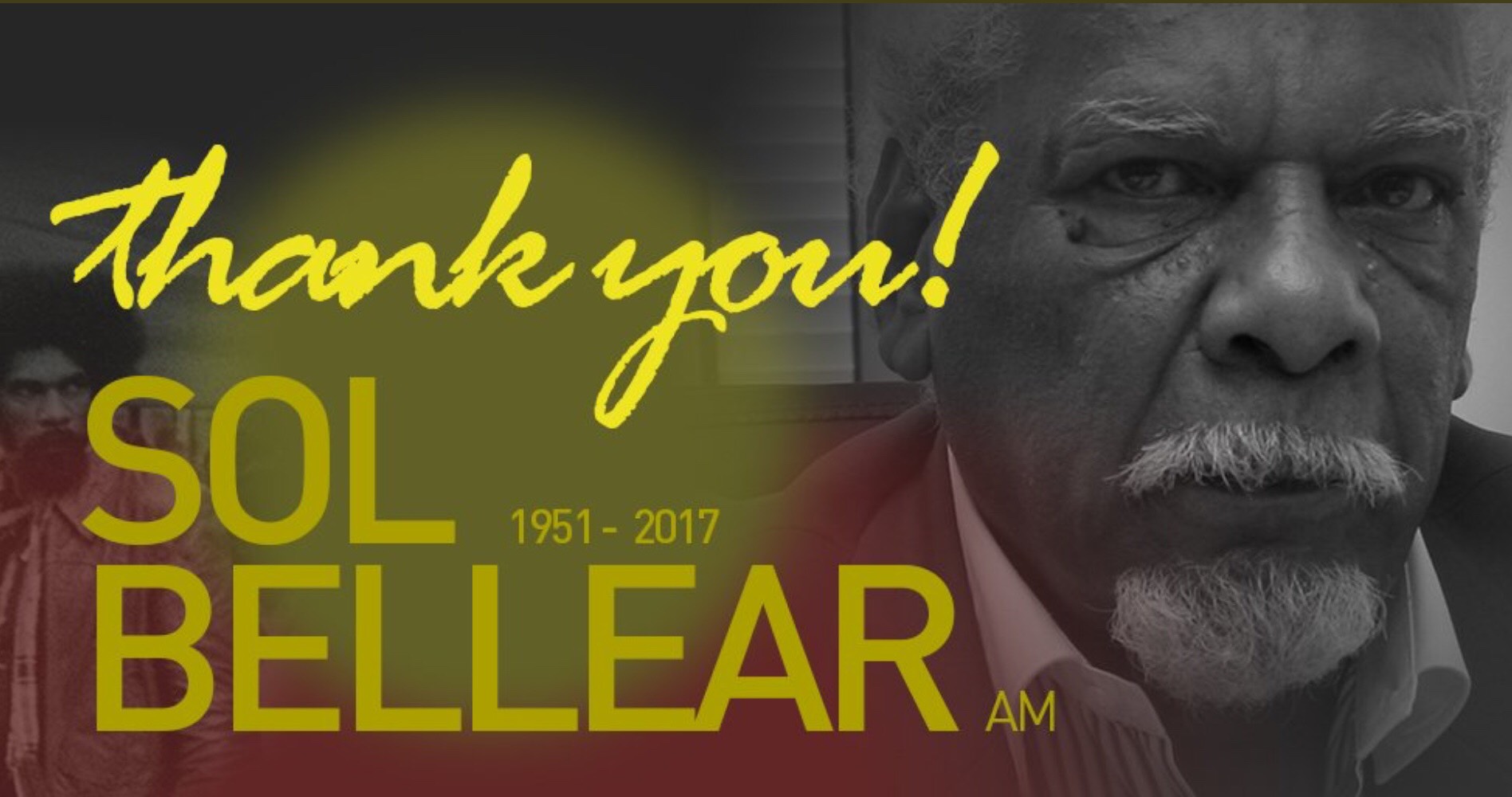
2. National : NACCHO Sol Bellear AM tribute and Bellear family thank you 

3.1 NSW : Katungul ACCHO Our thanks to CEO Robert Skeen providing this years ”  Secret Santa “

3.2 NSW : Wellington ACCHO to feature in ‘Break it Down’ Mental Health Series

3.3 NSW : Tharawal ACCHO Dr Josie Guyer is the inaugural winner of the RACGP Aboriginal and Torres Strait Islander Health Growing Strong Award

4. Nganampa Health Council operates a Smoking Cessation and Healthy Lifestyles program encouraging Anangu to lead healthy lifestyles

5.VIC : @VACCHO_CEO Jill Gallagher AO named Treaty Advancement Commissioner

6.AHCWA :Western Australia joins the nationally delivered National Disability Insurance Scheme NDIS

7. NT : AMSANT : Racism likely at play in low Indigenous kidney transplants

8.QLD ATSICHS Brisbane Reports record Health Checks

9.Tasmania : Ida West Aboriginal Health Scholarship closes 21 December

10.ACT : Winnunga News : Download November 2017 Edition

 View hundreds of ACCHO Deadly Good News Stories over past 5 years

How to submit a NACCHO Affiliate  or Members Good News Story ?

Our First News Post in 2018 will be January 18 

 Email to Colin Cowell NACCHO Media    

Mobile 0401 331 251

Wednesday by 4.30 pm for publication each Thursday


1.International : Our Indigenous public health takes a leap forward on the international stage

The World Federation of Public Health Associations (WFPHA) is pleased to announce the formation of its first Indigenous Working Group.

Watch Video Here

In April 2017, at the 15th World Congress on Public Health, over 40 Indigenous delegates at the Yarning Circle supported the formation of an Indigenous Working Group. This working group was ratified by the Governing Council of the WFPHA on the 15th of November 2017.

It is estimated that there are 370 million Indigenous People across 70 countries around the world. Many Indigenous Peoples are a minority in their own country, experience poorer health, have lower life expectancy and are among the most disadvantaged people in their population.

Michael Moore, President of the WFPHA, said “The formation of this group demonstrates the WFPHA commitment to working with Indigenous peoples from around the world to improve their health and wellbeing.”

The group will be co-chaired by Adrian Te Patu from New Zealand who is also a member of the Governing Council, and Carmen Parter from Australia who is the Aboriginal and Torres Strait Islander Vice President for the Public Health Association of Australia. Emma Rawson from New Zealand and Summer May Finlay from Australia are co-vice chairs.

“The Indigenous Working Group aims to assist in reducing the health disparity and inequities experienced by Indigenous people globally,” said Mr Te Patu.

Mr Te Patu recognizes the “differences among Indigenous peoples but also our similarities which are the strengths of this group.”

The Working Group is underpinned by the United Nations Declaration on the Rights of Indigenous People. Self-determination is a key component of the Declaration; therefore the Indigenous Working Group will be led by Indigenous peoples.

“It is important to recognize that this group embodies Indigenous self-determination and will be led by Indigenous peoples,” said Mr. Moore.

“To address public health concerns among Indigenous peoples culturally appropriate solutions are required. The Governing Council understands that Indigenous Nations know what is required and have the skills and capacity to address the issues they face,” said Mr Moore.

Carmen Parter, Co-Chair said “This is an opportunity for Indigenous peoples to come together to support each other and seek out research collaborations that develop the evidence base that informs global Indigenous public health policies.”

The Working Group’s objectives are: to bring together Indigenous peoples from around the world to share and learn from each other, engage in collective advocacy, partner with existing international groups working in Indigenous affairs, and source any funding or in-kind support to support the work of the Indigenous Working Group.

Indigenous members of WFPHA are invited to join the Working Group, with non-Indigenous people invited to join as associate members.

The Working Group hopes to hold its first face to face meeting in May 2018 at the WFPHA General Assembly in Geneva.

More information about the Working Group can be found on the WFPHA website: http://www.wfpha.org/about-wfpha/working-groups/indigenous-working-group.

Please follow the Working Group on Twitter @IndigenousWFPHA

2. National : NACCHO Sol Bellear AM tribute and Bellear family thank you 

#SolsLastMarch #StateFuneral for Sol Bellear AM ” Remembered as a giant of a man “ 

3.1 NSW : Katungul ACCHO Our thanks to CEO Robert Skeen providing this years ”  Secret Santa ”

3.2 NSW : Wellington ACCHO to feature in ‘Break it Down’ Mental Health Series

 ” Wellington’s Indigenous community left a film crew inspired as they took part in a workshop aimed at creating conversation about mental health for Indigenous people. 

Charity organisation, Desert Pea Media (DPM), spent two weeks in Wellington recently working on a media project with around 20 local students, councilors, community members and organisations.”

Originally published here

‘Break it Down’ – a story-telling project funded by NSW Primary Health Network – involves six communities around Western NSW. Participants assist crew in writing and recording a song, before shooting a music video and creating a series of short films with a focus on community members.

The material will be compiled into a mental health awareness campaign using a ‘90s hip hop approach. It will be worked into the curriculum, across social media and other broadcast opportunities.

Creative director, Toby Finlayson, said the content produced in Wellington was nothing short of amazing.

“Both the high schools have been involved which isn’t a common thing, but a really fantastic example of the community coming together to do something positive,” he said.

Toby said the stories shared by William Hill, Kristy White and Mary Henderson were particularly inspiring.

“One of the films we created was with William Hill who tells his story about his reconnection with culture and country, and how that helped him grow as a person,” he said.

“Mary grew up in Wellington on Nanima Reserve and shared her story of what life was like during the mission days, how things are different and the shameful treatment of Indigenous people in NSW, and especially Wellington in the past.

“It is very important for young people to understand the context of their community and history of their older community members still here in Wellington.”

Toby said participants were very responsive to discussing mental health in what was a challenging but creative process.

“It’s not easy talking about this stuff, and not a lot of people want to talk about it, so young people who live and breath the trauma and grief associated with life in Indigenous communities I think were really brave and inspirational to see them taking leadership and responsibility for change,” he said. “We were really inspired by the Wellington Indigenous community.”

3.3 NSW : Tharawal ACCHO Dr Josie Guyer is the inaugural winner of the RACGP Aboriginal and Torres Strait Islander Health Growing Strong Award.

‘As the Aboriginal parent that I have, Mum has always inspired me, She’s had quite a tough life; things haven’t been easy for her but she’s always very encouraging. Seeing how proud my mum is of me for winning this award, it just makes me feel like everything is worth it.

’Aboriginal people seem to have a different level of connection when you tell them that you’re Aboriginal as well,’ And I certainly have a different level of empathy and understanding, coming from an Aboriginal family with similar health problems that I see my patients having.”

‘That’s really rewarding and I think allows me to be a better doctor.’

When discussing the kind of emotions stirred by winning the Growing Strong Award, Dr Guyer is definite in her response.

Originally published HERE

RACGP President Dr Bastian Siedel presented Dr Guyer with the Growing Strong Award at GP17 in October.

The Growing Strong Award was established in 2017 to support Aboriginal and Torres Strait Islander general practice registrars.

Winning this award is a particularly significant feat for someone who is relatively new to the world of general practice. Dr Guyer worked as a nurse for the best part of 20 years before deciding she wanted a new challenge.

Now in her second year as a general practice registrar, Dr Guyer works with Aboriginal and Torres Strait Islander patients at the Tharawal Aboriginal Corporation in Airds, on the outskirts of Sydney, where she strives to contribute to closing the healthcare gap.

Dr Guyer feels that developing a close connection with her patients is one of the most important steps to improve health outcomes.

‘Aboriginal people seem to have a different level of connection when you tell them that you’re Aboriginal as well,’ she said.

‘That’s really rewarding and I think allows me to be a better doctor.’

Dr Guyer has found that connecting on this level also helps to educate her patients on preventive health measures.

‘It does take a lot of perseverance, but I think [educating patients about] preventive health is really important and empowers them to make changes to their lifestyle,’ she said.

‘I talk to kids and parents about valuing education, because I really think that’s the only way we can make changes.’

Dr Guyer cites the people with whom she has worked during her own education as invaluable throughout her journey as a general practice registrar.

‘I’ve met doctors who have been fantastic mentors. Especially because they are quite open and honest about sharing their journey with us as registrars, and often medicine is not an easy road,’ she said.

‘It’s really good to know that sometimes it’s tough and that’s okay, you just keep persevering. That has been really encouraging.’

Dr Guyer’s determination is supported through her passion for general practice.

‘I love the diversity in general practice, and the challenges that come with chronic and complex care,’ she said. ‘Also dealing with the social determinants of health, because they obviously play a big part in the general wellbeing of people.’

Dr Guyer is grateful for having had the opportunity to attend GP17 in Sydney in October, where she was inspired by the people she met and heard speak during presentations. She was humbled to be the first recipient of the Growing Strong Award, which was presented to her by RACGP President Dr Bastian Siedel.

Dr Guyer hopes this type of honour will instil ambition in future Aboriginal and Torres Strait Islander general practice registrars.

‘Aboriginal [and Torres Strait Islander] people can become doctors, because I’ve done it,’ she said. ‘That’s a really powerful story to tell people

4. Nganampa Health Council operates a Smoking Cessation and Healthy Lifestyles program encouraging Anangu to lead healthy lifestyles.

The Tjitkita Nyuntu Ngayuku Malpa Wiya – Smoking Cessation program have created this incredible painting to be used for health promotion and as a resource on the APY Lands.

The painting tells the story of smoking and its effect on children.

We are committed to reducing smoking rates and making all houses and cars smoke free to protect children from the health effects of smoking.

It is possible for Anangu to give up smoking and if you would like help, talk to our clinic staff. #NHCPeople

5.VIC : @VACCHO_CEO Jill Gallagher AO named Treaty Advancement Commissioner


Aboriginal Health, Healing , Self Determination Reconciliation and a #Treaty

6.AHCWA :Western Australia joins the nationally delivered National Disability Insurance Scheme NDIS

The State Government has confirmed that Western Australia will be joining the nationally delivered National Disability Insurance Scheme.

This will see the end of the WA NDIS trial.

All current participants in the WA NDIS trial will transfer to the nationally delivered Scheme from April 2018 until 31 December 2018.

For more information, please visit

7. NT : AMSANT : Racism likely at play in low Indigenous kidney transplants

Low kidney transplant rates for Indigenous Australians are “shocking”, “unacceptable”, and are likely to be driven by racism, the Australian Medical Association (AMA) has said.

Aboriginal and Torres Strait Islander dialysis patients are less likely than other Australians to receive a transplant — remote patients have a tenth of the chance, and urban patients a third of a chance, research suggests.

“I’m shocked by those figures. A ten-fold gap is entirely unacceptable,” AMA president Dr Michael Gannon said.

“The topic of racism in our health system is an uncomfortable one for doctors, nurses, but it has to be one of the possible reasons for this kind of disparity.

“If there’s reasons why Aboriginal and Torres Strait Islanders are not being transplant-listed, they need to be investigated, but the problems need to be fixed.”

Indigenous Health Minister Ken Wyatt said he was disheartened by the disparities, and will urge the Australian Organ and Tissue Donation and Transplantation Board to look into the issue.

“I’d describe it as extremely disappointing,” Mr Wyatt said.

“It’s something I want to focus on for the next 12 months of starting to heighten the awareness — we have to have more Aboriginal and Torres Strait Islander people accessing organs.”

A patient must undergo a “work-up” of health tests to be accepted on to the active waiting list for a new kidney, and each state and territory operates a separate wait list.

Read full article here

8.QLD ATSICHS Brisbane Reports record Health Checks

Our community accessed our primary health more than ever in 2017. This year you mob had 4857 health checks which is a 36% increase and we saw 2863 new patients. A healthy choice is a deadly choice!

Each year we prepare a series of publications highlighting our achievements.

We are proud to present Our Community, Our Work, Our Stories, our 2016-17 Annual Report

We believe it provides valuable insights into the key issues affecting our community in Brisbane and Logan and how we are working towards reinstating the wellbeing of our people – person by person, family by family, generation by generation.

Take a look at what we have achieved over the past 12 months.

http://e.issuu.com/embed.html#27714854/55404302

Download our 2016-17 Annual Report

Download our 2016-17 Financial Statements

To get a hard copy of our annual report or financial statements email marketing@atsichsbrisbane.org.au

9.Tasmania : Ida West Aboriginal Health Scholarship closes 21 December

10..ACT : Winnunga News : Download November 2017 Edition

DOWNLOAD PDF HERE

Winnunga AHCS Newsletter November 2017

Thank you for your support of our NACCHO Good News Stories in 2017


NACCHO Aboriginal Health and Prison System: New Ground breaking partnership for ACT Government and Winnunga having an ACCHO deliver health and wellbeing services to prison inmates

“ACT Corrective Services recognises that increasing Aboriginal led services within the Alexander Maconochie Centre (AMC) a minimum to maximum security prison is essential to maintaining cultural connection for Aboriginal detainees and improving overall wellbeing and safety.”

Speaking at the National Aboriginal Community Controlled Health Organisation (NACCHO) board meeting ACT Minister for Justice Shane Rattenbury announced that Winnunga Aboriginal Health and Community Services (AHCS) will move soon into full service delivery at the AMC

Photo above Minister with some of the new NACCHO Board December 2017 : Pic Oliver Tye

Julie Tongs pictured above with Shane Rattenbury and NACCHO CEO John Singer  

‘Importantly, Winnunga will continue to be a separate independent entity, but will work in partnership with the ACT Government to complement the services already provided by ACT Corrective Services and ACT Health to deliver better outcomes for Indigenous detainees.

It is ground breaking to have an Aboriginal community controlled and managed organisation delivering health and wellbeing services within its own model of care to inmates in prison in this capacity’ Ms Tongs said.

‘Winnunga delivering health and wellbeing services in the AMC and changing the way the system operates is the legacy of Steven Freeman, a young Aboriginal man who tragically died whilst in custody in the AMC in 2016

It is also ground breaking for our sector, so it needs to be given the recognition it deserves’

Julie Tongs, CEO of Winnunga Nimmityjah Aboriginal Health and Community Services (Winnunga AHCS) welcomed the announcement by Minister Shane Rattenbury

Winnunga has commenced enhanced support at the AMC focused on female detainees, and will move to full delivery of standalone health, social and emotional wellbeing services in the AMC in 2018.

The Independent Inquiry into the Treatment in Custody of Steven Freeman highlighted the need for improvements in a range of areas including cultural proficiency to more effectively manage the welfare of Aboriginal and Torres Strait Islander detainees.

The ACT Government is working to develop a safer environment for all detainees, especially Aboriginal and Torres Strait Islander detainees.

Minister Rattenbury welcomed the involvement of Winnunga AHCS in the delivery of health services within its culturally appropriate model of care in the AMC.

To achieve this ACT Corrective Services and Justice Health have been working closely with Winnunga AHCS to enhance their presence in the AMC. Winnunga AHCS has begun delivering social and emotional wellbeing services to female detainees who choose to access Winnunga AHCS in the AMC.

Over time, all detainees will have the option to access Winnunga AHCS services.

Winnunga AHCS will over time deliver services to all inmates in the AMC who choose to access this option, however the services will be implemented through a staged process initially focussed on female detainees. This will help inform system changes as we operationalise the model of care within the AMC.

‘In 2018, we will expand our role to deliver GP and social and emotional wellbeing services to all detainees who choose to access Winnunga AHCS in the AMC, Monday to Friday, between the hours of 9am to 5pm’, Ms Tongs noted.

‘Winnunga does not want to be divisive in the AMC, we will be inclusive.

Obviously, there will be some issues particularly around – strong identity and connection to land, language and culture, and how the impact of colonisation and stolen Generations affects unresolved trauma, grief and loss that will be specific to Aboriginal people, however we will work with all inmates’, said Ms Tongs.

Ms Tongs stated, ‘The priority for us is to ensure in time all Aboriginal people are provided with an Aboriginal health check and care plan…the goal is for Winnunga to provide all services we do outside in the community, to prisoners also on the inside and this is a very good starting point’.

NACCHO tribute and Bellear family thank you : #SolsLastMarch #StateFuneral for Sol Bellear AM ” Remembered as a giant of a man “


” Sol was giant of a man who made a giant contribution to self-determination for our people right throughout the land , one who would now take his honoured place amongst his very honoured ancestors.

News of his sudden death last week had sent shockwaves through Aboriginal Australia”.

Pat Turner, Chief Executive of NACCHO : National Aboriginal Community Controlled Health Organisation speaking at the State Funeral about her long term friendship and respect for Sol Bellear.  Pictures above Michelle Lovegrove

See full NACCHO Tribute to Sol Bellear AM Press Release

NACCHO tribute to Sol Bellear AM Aboriginal activist

NACCHO was also represented by Current Chair John Singer and Past Chairs Pat Anderson , Matthew Cooke and Justin Mohamed.

 ” We will always be grateful for the many expressions of kindness, love and support we have received following the loss of our father and brother, Sol Bellear, who passed away peacefully at home on Wednesday night, 29 November.

We have been overwhelmed by the numbers of people who have reached out to us in this very difficult time. Sol touched many lives in the movement for Aboriginal rights, the game of rugby league and the community of Redfern that he loved.  Now the people whose lives he touched are comforting us with their memories of him.”

Statement from the family of  Solomon David “Sol” Bellear AM

Sol stood for many things including self-determination, proper treaties with our people, Aboriginal control of our people’s health and legal services, Land Rights and a better understanding of our history.

Although, Sol achieved many great victories, much of this work remained unfinished at the end of his life. We ask all those who loved Sol to please continue his work so that the vision he had for his country and people might one day be fulfilled.

One of Sol’s last wishes was for the Sydney City Council to erect a plaque at Redfern Park to help people remember and reflect on the Redfern Speech delivered on that site by former Prime Minister, Paul Keating.

We will always treasure the time we had with him. He was the most loving and committed Father, Brother, Poppy and Uncle any family could hope for.=

We would like to particularly thank the NSW Premier and the staff from her Department, the NSW Aboriginal Land Council, Joshua Roxburgh and our brother, Shane Phillips for their generous assistance in organising Sol’s funeral.

 Sol Bellear remembered as giant at state funeral

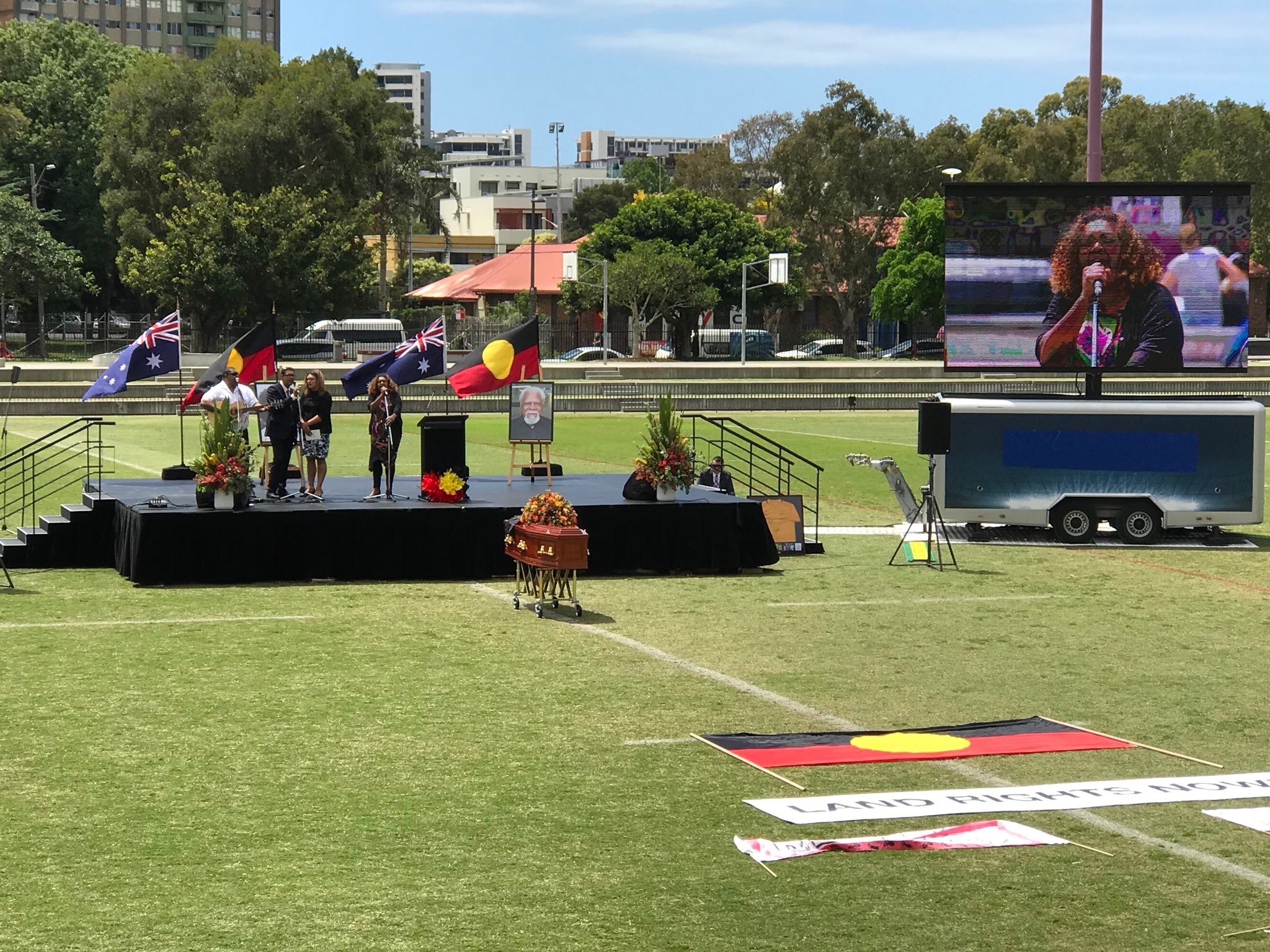
Aboriginal land rights and health activist Sol Bellear has been remembered as a giant of indigenous advancement at a state funeral on Saturday at Redfern Oval in Sydney, the spiritual home of his beloved South Sydney Rabbitohs.

From the Australian

It was a mark of the man, mourners heard, that after being dropped as a player from the Rabbitohs squad after raising a black-power salute on scoring a try at the ground, he was within a year serving on the rugby league team’s board.

“He carried a great personal weight on his shoulders because he was a strong man,” fellow activist Paul Coe, one of the leaders with whom Bellear founded the Aboriginal tent embassy at the then parliament house in 1972, said.

“He would stand his ground no matter what or no matter who was opposing him.”

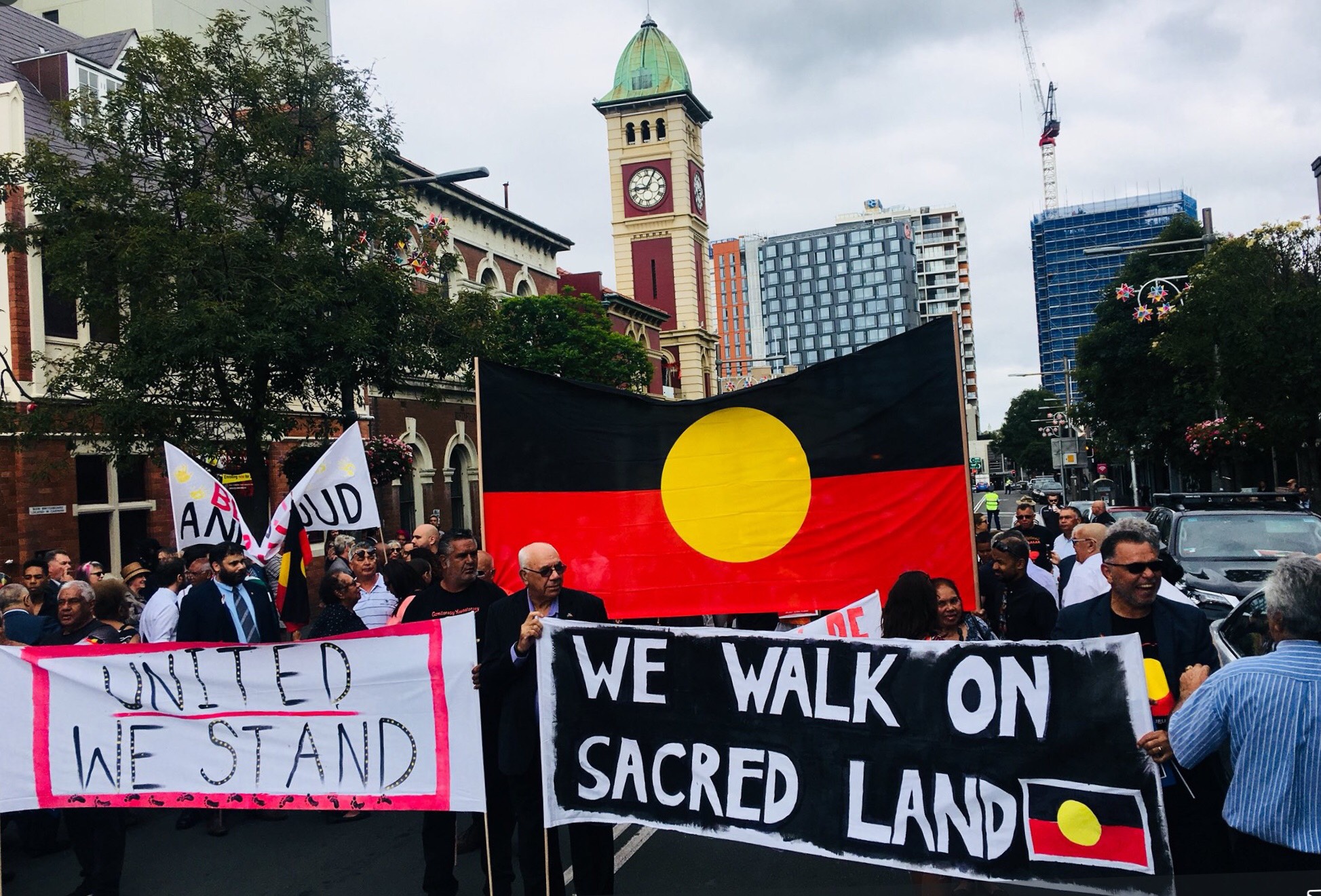
Bellear was joined in one final march to the football ground from the nearby Aboriginal Medical Service in Redfern, an institution which mourners including NSW Governor David Hurley and wife Linda heard was one of his great legacies.

Sols Last March with 3,000 family and friends

The march ended at the park where, exactly 25 years ago tomorrow, Bellear led Paul Keating to the stage to deliver the then prime minister’s famous oration admitting white Australia’s culpability in the poor state of indigenous affairs.(see Picture in Part 1 above )

“He stood proud and he stood tall but he was not egotistical,” Mr Coe said.

“I’ve seen him give money out of his own pocket to people on the streets. This is the kind of man that he was — a kind of man you could admire but not completely understand.

“In those days as young students, trying to work out who and what we were, it was very hard to make ends meet. But he would always give of himself, both time and energy.”

A Bundjalung man from Mullumbimby in northern NSW, Solomon David Bellear, who was 66, leaves partner Naomi and children Tamara and Joseph. He was made a member of the Order of Australia in 1999 for services to the Aboriginal community, in particular in the field of health. His brother Bob, who died a decade ago, was the first Aboriginal judge.

In a letter from grand-daughter Rose read out at the service, Bellear was bid a “merry Christmas in the dreamtime” and the hope he had travelled there safely with his totem, the carpet snake.

Bellear’s achievements were legion. He was the founding chair of the Aboriginal Legal Service, a founding member of the Aboriginal Housing Company, an Aboriginal delegate to the UN General Assembly, player and director at the Rabbitohs, a foundation player with the Redfern All Blacks in the NSW Aboriginal Rugby League Knockout, a manager with the indigenous dreamtime and All Stars rugby league teams, and deputy chair of the former Aboriginal and Torres Strait Islander Commission.

undefined

Sol Bellear, whose funeral was held on Saturday. Picture: Dan Himbrechts

Ken Wyatt, federal Minister for Indigenous Health and Aged Care, said on Friday Bellear had “played a key role in establishing medical, housing, land rights and legal services for Aboriginal people and remains a towering figure on the journey towards justice for our people”.

He was remembered as being crucial to the consensus position developed at the Indigenous constitutional convention held in Central Australia in May this year, when disparate ambitions for reform were distilled into the Uluru Statement from the Heart.

Singer Emma Donovan opened the funeral with the touchstone Land Rights Song, whose memorable lines “they keep on saying everything’s fine, still they can’t see us cry all the time” seemed particularly apt.

Bellear’s casket was borne from the park by a cortege including members of his beloved Redfern All Blacks, whose members linked arms to sing their team song for him one last time. His casket was draped with a Rabbitohs scarf, the hearse with an Aboriginal flag.

As it set off one final, slow, lap of the oval, fists were raised in a black-power salute

NACCHO Aboriginal Health and #Smoking Research Report : ‘Deadly progress’: substantial drop in Indigenous smoking from 2004-2015

“The research is a positive news story in Indigenous health, and more should be done to understand what is working to reduce Indigenous smoking” 

Professor Tom Calma, lead advocate for Indigenous tobacco control and Chancellor of the University of Canberra

Read Paper HERE

Read over 118 NACCHO Aboriginal Health and Smoking published over the past 5 years

A paper led by ANU researcher Associate Professor Ray Lovett published in the journal Public Health Research & Practice today found a substantial drop in smoking among Aboriginal and Torres Strait Islander people over the last ten years.

The research highlights the positive downward trends in daily smoking prevalence for young Indigenous people and Indigenous people living in urban areas.

The majority of Aboriginal and Torres Strait Islander adults (around six in ten) do not smoke daily.

According to the study, the proportion of Indigenous people smoking daily dropped by 9%, from 50% in 2004 to 41% in 2014.

Lovett explains, ‘As a result, there are 35,000 fewer daily smokers today than there would have been if things had stayed the same since 2004. This will lead to thousands of lives saved’.

‘The way we communicate statistics matters. In our work we focus on the progress made within the Aboriginal and Torres Strait Islander population, and we find that substantial progress has been achieved.

In contrast, when reports focus on the gap in smoking prevalence compared to the total Australian population, this can have negative consequences and can actually contribute to widening the gap’, said Lovett.

The team used data from national surveys conducted by the Australian Bureau of Statistics to assess trends in Indigenous smoking over time.

Dr Lovett and his research team are now working with two Aboriginal organisations, Central Australian Aboriginal Congress and Institute for Urban Indigenous Health, to better understand how their work contributes to the decline in smoking rates.

The full article can be found here: http://www.phrp.com.au/?p=37127

Discussion

The prevalence of daily smoking among Aboriginal and Torres Strait Islander adults in Australia has decreased by 8.6 percentage points (95% CI 5.5, 11.8), from 50.0% in 2004–05 to 41.4% in 2014–15.

This corresponds to an estimated 35 000 fewer Aboriginal and Torres Strait Islander adult daily smokers in 2014–15, compared with if the smoking prevalence had remained stable since 2004–05. Our findings indicate that thousands of premature deaths in Aboriginal and Torres Strait Islander people have been prevented by the reduction in daily smoking prevalence over the past decade.

Accurately determining the number of deaths averted requires additional data, such as cause-specific mortality. Declines in daily smoking among Aboriginal and Torres Strait Islander people were observed among both males and females, and were most evident among those aged 18–44 years, and those living in urban/regional areas.

The absolute decrease in smoking prevalence observed in the Aboriginal and Torres Strait Islander population is comparable with the decrease of 6.8 percentage points (95% CI 5.6, 7.9) in the total Australian population over the same period, although the base smoking prevalence was substantially lower in the total Australian population (21.3% in 2004–05). These results demonstrate that considerable progress has been made in the Aboriginal and Torres Strait Islander population in the past decade, matching in absolute terms the extent of progress made in the total Australian population.

Given the similar absolute decrease in smoking prevalence in the Aboriginal and Torres Strait Islander and total Australian population, the gap in smoking prevalence has remained relatively stable. This may appear inconsistent with the Australian Institute for Health and Welfare’s midterm report for the National Tobacco Strategy 2012–20185, which reported that the gap in smoking between Aboriginal and Torres Strait Islander people and non-Indigenous Australians had increased between 2008 and 2015.

The discrepancy arises from different methods used to report trends in smoking inequalities.9-11 Our analysis emphasises change in the absolute prevalence of smoking within the population (50.0% – 41.4% = 8.6% absolute prevalence decrease), whereas the midpoint report emphasises smoking prevalence in the Aboriginal and Torres Strait Islander population relative to the non-Indigenous population.5

In relative terms, the ratio of Aboriginal and Torres Strait Islander to total Australian smoking prevalence increased from 2.4 (50.0%:21.3%) in 2004–05 to 2.9 (41.4%:14.5%) in 2014–15. This demonstrates that reporting change in absolute versus relative terms can lead to fundamentally different conclusions, which could affect support for programs and policies.9-12

Focusing on relative differences in isolation can obscure progress at the population level; that is, the absolute number of Aboriginal and Torres Strait Islander adults quitting or not taking up smoking.

Further, research from other populations demonstrates that communicating information about health inequity using a progress frame (as used in this paper) rather than a disparity frame (i.e. focusing on the persisting gap) is associated with more positive emotional responses and increased interest in engaging in health-promoting behaviours.14 Therefore, we consider it ethical to report absolute progress in smoking prevalence.

The ambitious target to halve Aboriginal and Torres Strait Islander adult daily smoking prevalence to 23.9% by 20186 will not be achieved if current trends continue. However, this target would be reached within the next two decades if smoking prevalence continues to decrease at the current rate. If the success in smoking reduction observed within the younger age groups and those living in urban/regional areas is echoed in older age groups and in remote areas, this target may be reached earlier.

We observed significant reductions (about 10%) in daily smoking prevalence among the youngest age groups (18–24, 25–34 and 35–44 years). Data from the 2004–05 NATSIHS indicates that two-thirds of current and past Aboriginal and Torres Strait Islander smokers had begun smoking by age 1817; therefore, our findings of reduced smoking prevalence among younger adults is promising.

The Aboriginal and Torres Strait Islander population has a younger age profile than the total population, and therefore the potential population-level benefit of reducing smoking among younger adults is important.18

We observed reductions in daily smoking prevalence among male and female Aboriginal and Torres Strait Islander adults living in urban/regional areas. Given that the majority of Aboriginal and Torres Strait Islander people live in urban/regional settings, this is another encouraging finding at the population level.

We did not detect a significant change between 2004–05 and 2014–15 in daily smoking prevalence among Aboriginal and Torres Strait Islander adults living in remote areas. The observed stability of smoking prevalence in remote areas from 2004 to 2015 is consistent with trends from 1994 to 2004.7 Despite being the largest available datasets, the number of survey participants in remote areas was relatively small, and is likely to be insufficient to detect changes in prevalence.

Given the enduring high smoking prevalence among older age groups and in remote settings, improved intensive effort will be required to change the normalisation of tobacco use and correct potential misperceptions of tobacco use, particularly as older people may have had longer and more intense exposure to tobacco marketing.19

This includes continued and concerted effort from targeted Aboriginal and Torres Strait Islander tobacco control programs, in addition to national strategies.4,20

The prevalence of smoking is reduced by increased numbers of people quitting and not taking up smoking. Since 2008, there has been a concerted effort in public health strategies, policies and programs to reduce tobacco smoking in Aboriginal and Torres Strait Islander people.

Australia’s approach to tobacco control is comprehensive, and it is difficult to attribute changes to one program; however, continuing support for both whole-of-population and targeted strategies is required.

For example, recent evidence indicates that the introduction of graphic warning labels on cigarette packages led to increased understanding of and concern about the harms associated with smoking among Aboriginal and Torres Strait Islander people19,21, and research has demonstrated that smokers’ knowledge of the effects of second-hand smoke is associated with desire and attempts to quit.22 Our findings may indicate that programs and policies have been particularly effective at reducing smoking among young people and those living in urban/regional areas. It is more difficult to assess the potential effectiveness of programs and policies in remote settings; finer regional estimates are required to assess policy and program impacts in this setting.23

Strengths and weaknesses

This paper analyses multiple cross-sectional data, which are the most comprehensive data available on Aboriginal and Torres Strait Islander smoking status. Limitations of our approach include that comparability between survey estimates may be affected by differences in scope, sample design, coverage, and potential changes in the age structure of the population over time. The use of weighting generates estimates that are representative of the in-scope population, which were similarly defined across the four surveys. However, we note that the 2004–05 and 2008 surveys represent a somewhat smaller percentage (82–90%) of the Aboriginal and Torres Strait Islander population compared with the other surveys (95%); this may result from issues related to survey scope.17

We have restricted our analysis to current daily smoking – rather than including weekly or less frequent smoking – to enable consistent measurement across surveys, and to enable direct comparison with national tobacco targets.5,6 It is important to note that our analysis focused on cigarette smoking. Recent ABS surveys provide data on the use of other tobacco products (e.g. chewing tobacco); data on e-cigarette use are not yet available.

Although we include a comparison with daily smoking prevalence in the total Australian population as a benchmark, this article focuses on variation in daily current smoking trends within the Aboriginal and Torres Strait Islander population. We have presented comparable estimates for the total Australian population, rather than the non-Indigenous Australian population, because of the data that were available, and we may therefore underestimate the gap in prevalence between the Aboriginal and Torres Strait Islander and non-Indigenous populations. However, this underestimation is likely to be very small; for example, in 2014, the difference between daily adult smoking prevalence in the non-Indigenous population (14.2%; 95% CI 13.4, 15.0)3 versus the total Australian population (14.5%; 95% CI 13.6, 15.4) was marginal.

Conclusions

Applying a progress frame rather than a disparity frame and reporting absolute changes in smoking prevalence provides clear evidence of the substantial and significant declines in daily smoking prevalence among Aboriginal and Torres Strait Islander adults, which will result in considerable health gain. Particular success has occurred among younger adults and those living in urban/regional areas.

Despite this progress, the smoking prevalence in the Aboriginal and Torres Strait Islander population remains high, with an estimated 165 000 current adult daily smokers. It will be critical to learn from the success among younger adults and those in urban areas to effect change among older age groups and those in remote areas. Continuation and enhancement of a suite of tobacco control efforts are required.


Aboriginal Health News : Our #NACCHO Members #Deadly good news stories #NT #NSW #QLD #WA #SA #VIC #ACT #TAS

1.National: Download the Indigenous health check (MBS 715) data tool

2.NSW: Last march and State Funeral : Sol Bellear AM

3.1 VIC : Lakes Entrance Aboriginal Health Association  wins Victorian Health Award

3.2 VIC : Expanding Brabuwoolong Medical Centre East Gippsland Services for a Healthier Future

4.1 SA : Nganampa Health Council  Port Adelaide Football Club stars Chad Wingard and Paddy Ryder visit the APY Lands 

4.2 SA : AHCSA and Umoona Tjutagku Health Service in Coober Pedy to deliver a Meningococcal Vaccination Program

5.WA : The 2018 WA Australian of the Year, Aboriginal psychologist Tracy Westerman

6.Tas: Aboriginal warrior and diplomat Mannalargenna still showing the way forward, elder says

7.ACT : Winnunga News : Download November 2017 Edition

8. QLD : Goolburri Aboriginal Health Advancement Co Ltd Senior Indigenous Games Australian Championship 2017

9 . NT : Miwatj Health Aboriginal Corporation NDIS Mental Health Team in Sydney presenting

 View hundreds of ACCHO Deadly Good News Stories over past 5 years

How to submit a NACCHO Affiliate  or Members Good News Story ? 

 Email to Colin Cowell NACCHO Media    

Mobile 0401 331 251

Wednesday by 4.30 pm for publication each Thursday

1.National: Download the Indigenous health check (MBS 715) data tool

All Indigenous people are eligible for an annual Indigenous-specific health check: item 715 on the Medicare Benefits Schedule (MBS).

This tool shows numbers and usage rates of the checks at national, state and territory and Primary Health Network levels.

Charts can be customised to show different time periods and, where possible, disaggregation by age and sex.

Download data tool etc. :

FROM HERE

2.NSW: Last march and State Funeral : Sol Bellear AM

Read NACCHO Tribute to Sol Bellear HERE

Health, justice and land rights Legend Sol Bellear AM will lead his last march at a State Funeral to be held in Redfern on Saturday.

Sol’s family, friends and supporters are invited to gather at Redfern Aboriginal Medical Service on Redfern Street from 10am for a last march to the State Funeral service at Redfern Oval starting at 11am.

WHEN: Saturday 9 December 2017

WHERE:

  • March from 10am outside Aboriginal Medical Service, Redfern Street
  • Service from 11am at Redfern Oval

For any enquiries please email media@alc.org.au or call 02 9689 4444.

3.1 VIC : Lakes Entrance Aboriginal Health Association  wins Victorian Health Award

Last night and the Lakes Entrance Aboriginal Health Association took home a award for implementing a shared-care model between Aboriginal Community Controlled Organisations and the Aboriginal Quitline!

Congratulations to Lakes Entrance Aboriginal Health Association & Quit Victoria for taking home the award for Preventing Tobacco Use Pictured here with Health Minister Jill Hennesy

3.2 VIC : Expanding Brabuwoolong Medical Centre East Gippsland Services for a Healthier Future

A $5.14 million Turnbull Government investment in Bairnsdale’s new Brabuwoolong Medical Centre has secured a major step forward for Aboriginal and Torres Strait Islander health services in East Gippsland.

Welcoming the Centre’s official opening today, Minister for Indigenous Health, Ken Wyatt AM, said local services and solutions for local issues were fundamental to improving the health of Aboriginal and Torres Strait Island people.

“This comprehensive facility provides a one-stop shop for better health,” MinistPDF printable version of Expanding East Gippsland Services for a Healthier Futurer Wyatt said.

“This is about grassroots community support to ensure local indigenous men, women and children have the care they need, close to where they live, work and go to school.

“Experience shows that culturally comfortable and trusted health services empower people to take control of their own wellbeing and achieve their full potential.”

Member for Gippsland, Darren Chester, said it was a proud day for Koori people across the region.

“This is a welcoming place that will help health professionals work together with local families for better health,” Minister Chester said.

“With five GP consulting rooms, triage, procedure and meeting rooms and a major dental centre, Brabuwoolong has been designed with the future in mind.

“Koori maternity services are also a priority, along with outreach and chronic disease services. The current staff of 28, plus visiting specialists, are providing a whole new level of local health care.”

The new Brabuwoolong centre is operated by the Gippsland and East Gippsland Aboriginal Co-op Ltd (GEGAC) and is named after one of the five East Gippsland Koori clans. The overall cost of the centre was $5.26 million, including $120,000 raised by GEGAC.

The capital works program for the new facilities was provided in addition to Turnbull Government funding to GEGAC of more than $1.9 million this financial year, for health and aged care services.

“Working together with local communities in East Gippsland – and right across Australia – is the best way to help ensure we get the results we all want see to close the gap in indigenous health,” Minister Wyatt said.

4.1 SA : Nganampa Health Council  Port Adelaide Football Club stars Chad Wingard and Paddy Ryder visit the APY Lands 

Watch Video Here

“What you see is what you get. You see the people with smiling faces and understand there are two different worlds.” Earlier in October, Port Adelaide Football Club stars Chad Wingard and Paddy Ryder visited the APY Lands conducting healthy lifestyle workshops for school children. NHC is proud to be involved in this program, giving children on the APY Lands such a unique opportunity! #NHCPeople

4.2 SA : AHCSA and Umoona Tjutagku Health Service in Coober Pedy to deliver a Meningococcal Vaccination Program

AHCSA is teaming up with Umoona Tjutagku Health Service in Coober Pedy to deliver a Meningococcal Vaccination Program next week on the 12th, 13th & 14th December. Do you live in Coober Pedy or have family there?

If so, please share this information. #ourhealthourchoiceourway

5.WA : The 2018 WA Australian of the Year, Aboriginal psychologist Tracy Westerman.

Working with communities that have high rates of suicide, Tracy Westerman knows hopelessness and marginalisation can be deadly.

The Aboriginal psychologist, who delivers suicide prevention programs in remote areas, was this week crowned WA’s Australian of the Year.

She wants Aboriginal teenagers struggling to find hope for the future to know such an honour is not out of reach.

Having grown up in the inland Pilbara town of Tom Price, Dr Westerman did her high school exams via long-distance education.

When she was 15, she read a book about psychology and decided it was her calling.

She won a place at the University of WA and moved to Perth, where she suffered the “biggest culture shock ever” and struggled to catch a bus, cross Stirling Highway and reconcile mainstream psychology with Aboriginal culture.

“As a Pilbara woman, and as someone who had no expectations around me of being successful other than from my family, I find there’s this thing called the tyranny of low expectation,” Dr Westerman said.

“I want an Aboriginal kid to pick up the newspaper and go ‘far out, she did it’.

“Don’t ever let anyone tell you you can’t do something. Never let go of your dreams.”

Dr Westerman, a Njamal woman, founded Indigenous Psychological Services in 1998 to address the high rates of mental illness among Aboriginal people.

She loves going to work with her people every day, but laments the extent of racism and marginalisation they face and how it contributes to so much stress and mental ill-health.

She wants policymakers to talk more about the Aboriginal communities that don’t have suicides and learn from them.

“To me, that’s the story,” Dr Westerman said. “What is it about those communities that protects them from what troubles other communities that are caught in crisis or a chronic status of suicide and distress?”

Dr Westerman said many Australians had very little experience with Aboriginal people and did not realise they had an unconscious bias, so she gently tried to “make the unconscious conscious” and help them look at their reaction to Aboriginal people in an objective way.

“It’s very common that people go, ‘Oh my God, I just had no idea’.”

6.Tas: Aboriginal warrior and diplomat Mannalargenna still showing the way forward, elder says

Photo: Younger members of the community learnt traditional ochre painting to mark Mannalargenna Day. (ABC News: Tim Morgan)

One of Tasmania’s most revered Indigenous leaders, who died exiled from his homeland, is being held up as an example of reconciliation 182 years after his death. From the ABC

Mannalargenna died on December 4, 1835, at Wybalenna on Flinders Island, after being exiled from his homeland of Tebrikunna, now known as Cape Portland, on the state’s north-east coast.

The Aboriginal community has marked the anniversary of his the death with a gathering at Little Musselroe Bay.

Highly regarded by his people, the Pairrebeenne clan, Mannalargenna initially led guerrilla-style attacks against British settlers before shifting to the role of negotiator.

Along with other diplomats, he played a key role in convincing his people to agree to leave their country for Swan Island in 1830, with the promise that one day they would return.

As elder Aunty Patsy Cameron remembered, it was a promise that was never fulfilled for her ancestor

“At that time when you think about our history there are only about 400 Aboriginal people still free in the bush,” she said

“I think he was such a wise man and he could see that the only way forward was to go to the islands for a short while thinking he was going to be able to come back.

“Mannalargenna is the example of reconciliation and the way that we all move forward together.”

Hundreds of people braved wet weather to attend the third annual commemoration to share in a day of cultural food, activities and music.

They travelled from all corners of the state including Hobart and Stanley, while others made the trip from interstate.

Mandy Quadrio came from Queensland for the occasion and said there was “a strong spiritual connection” in being on the land of her ancestors.

“In contemporary times it gives us a sense of belonging,” she said.

The meaning of the day was not lost on the younger generation either.

Emily Wood was one of five girls from Flinders Island who performed a cultural dance which told the story of the muttonbird, a traditional source of food which is still harvested by the community.

“To all come together it’s nice. It means a lot because you can relate to other people and you meet new people,” she said.

Friend Lillie Scown agreed.

“It’s fun just coming here and seeing everybody dress up and just having fun,” she said.

“It’s a day to remember and celebrate.”

7.ACT : Winnunga News : Download November 2017 Edition

DOWNLOAD PDF HERE

Winnunga AHCS Newsletter November 2017

8. QLD : Goolburri Aboriginal Health Advancement Co Ltd Senior Indigenous Games Australian Championship 2017


9 . NT : Miwatj Health Aboriginal Corporation NDIS Mental Health Team in Sydney presenting

Our NDIS Mental Health Team led an incredible presentation in Sydney recently.

The information delivered and the quality of our presenters shone through amongst the audience, prompting rave reviews from the Community Mental Health Australia hosts and national attendees.

The NDIA Directors were extremely keen on discussing and supporting our NDIS Mental Health Model and processes and we look forward to these relationships developing further in the future.

Congratulations to the NDIS Manager Tim Keane & Acting Mental Health Manager Johnny Wurarr Dhurrkay!


#NACCHOagm2017 Aboriginal Health Conference : Media Alert : Hear our national #ACCHO ” Voices ” in Canberra this week

  ” Aboriginal Community Controlled Health Organisation leaders and health experts from across Australia will come together in Canberra this week to examine key policy issues and projects that are making a difference in closing the gap in Indigenous health.

The theme of the conference is Our Health Counts: Yesterday, Today, Tomorrow.

NACCHO would like to acknowledge that we will be gathering on the traditional Ngunnawal and Ngambri lands and acknowledge owner’s past, present and future “

Download the full conference program here https://www.nacchoconference.com.au/program/

 The NACCHO Members’ Conference and AGM will provide a forum for our Aboriginal community controlled health (ACCHO ) services workforce, bureaucrats, educators, suppliers and consumers to:

  • Present on innovative local economic development solutions to issues that can be applied to address similar issues nationally and across disciplines
  • Have input and influence from the ‘grassroots’ into national and state health policy and service delivery
  • Demonstrate leadership in workforce and service delivery innovation
  • Promote continuing education and professional development activities essential to the Aboriginal community controlled health services in urban, rural and remote Australia
  • Promote Aboriginal health research by professionals who practice in these areas and the presentation of research findings
  • Develop supportive networks
  • Promote good health and well-being through the delivery of health services to and by Indigenous and non-Indigenous people throughout Australia.

Social Media

Follow on Twitter: #NACCHOagm2017 @NACCHOAustralia

Facebook : A limited number of sessions and interviews will be broadcast via our FACEBOOK Page @NacchoAboriginalHealth

National Media Contact: Jenny Stokes 0478 504 280

NACCHO Social Media: Colin Cowell 0401 331 251

NACCHO Contact at Conference: Oliver Tye 0450 956 942

Download the full conference program here https://www.nacchoconference.com.au/program/

The conference will also:

  • Launch a new Memorandum of Understanding between NACCHO and the Pharmacy Guild of Australia to improve access to medicine for Aboriginal and Torres Strait Islander people
  • Reveal what the 2016 Census statistics tell us about Aboriginal and Torres Strait Islander health
  • Launch the Mayi Kuwayu Study – an Aboriginal led longitudinal survey of more than 400,000 Aboriginal and Torres Strait Islander adults to provide the first large scale evidence of relationship between cultural engagement and health
  • Highlight PWC’s landmark report into Aboriginal and Torres Strait Island incarceration rates.

The conference will be opened by the Secretary of the Department of Health, Glenys Beauchamp and Professor Brendan Murphy will later address delegates about an Enhanced Multijurisdictional Response to Sexually Transmitted Infections and Blood Borne Viruses in Indigenous Communities.

Background : We honour on our conference poster  the first Aboriginal ” Voices to go to Canberra”

 ” Jimmy Clements and another Wiradjuri man, John Noble were one of the earliest practitioners of what the politics of visibility, of being present where you are not meant to be and where your presence creates discomfort.

Regardless of whether they were as unaware or indifferent to the meaning of the event, as is often suggested, their presence was a powerful act, contesting claims of the erasure of Indigenous people from the land and place.”

For its poignancy and historical significance, is the image of Jimmy Clements, an old Wiradjuri man, sitting in the dust with his dogs and holding an Australian ensign, at the 1927 opening of Parliament House in Canberra.

A few days later the Canberra Times – again with an emphasis on Indigenous connection to country – reported:

“Where his dusky forebears have gathered in native ceremonial for centuries past, a lone representative of a fast diminishing race saluted visiting royalty. Despite the grotesque garb and untamed mane, the Aborigine comported himself not without dignity. With his three faithful dogs, he made an immediate target for a battery of cameras.”

Jimmy Clements (c. 1847 – 28 August 1927) was an Aboriginal elder from the Wiradjuri tribe , and was present at the opening of the Provisional Parliament House in Canberra on 9 May 1927.

He was also known as “King Billy”[1] and also by Nangar or Yangar.[2]

Clements and another Wiradjuri man, John Noble, had walked for nearly a week over the mountains from Brungle Mission near Gundagai, New South Wales.[3]

The two men were the only indigenous people to attend the first opening of parliament.

Clements was initially told to move on by police at the ceremony due to his attire but due to popular support from other members of the crowd he was among prominent citizens who were presented to the Duke and Duchess of York (later King George VI and Elizabeth the Queen Mother).[1]

The National Archives of Australia describes it as “possibly the first recorded instance of Aboriginal protest at Parliament House in Canberra”.

It was the precursor to so much activism – from the 1938 Day of Mourning, the fight for recognition and much else in 1967, and the ongoing battle for land rights that manifested with the enduring tent embassy, just across the road, on Australia Day 1972.

The sign out front reads: Sovereignty never ceded.

Monash University’s Maryrose Casey wrote of Clements and Noble in the International Journal of Critical Indigenous Studies: “Regardless of whether they were as unaware or indifferent to the meaning of the event, as is often suggested, their presence was a powerful act, contesting claims of the erasure of Indigenous people from the land and place.

Clements died on 28 August 1927, aged 80, in Queanbeyan, New South Wales near Canberra

See Guardian Article

Aboriginal Health News : Our #NACCHO Members #Deadly good news stories #TAS #NT #NSW #QLD #WA #SA #VIC #TAS

1.1 #NACCHOagm2017 and Members’ Conference Program launched

2.NSW : Award winning Katungul Aboriginal Corporation  in new partnership with Deadly Choices
3. WA : AHCWA Gap between Indigenous and non-indigenous longevity surges in WA

4.SA: National Disability Insurance Scheme Aboriginal community consultation

5.QLD : Apunipima’s ACCHO Napranum Centre Working to National Standards

6. VIC : VACCHO : Korin Korin Balit-Djak: Aboriginal health, wellbeing and safety strategic plan 2017–2027 

7. NT: AMSANT APO NT :  Failure guaranteed if you don’t involve us, say Aboriginal organisations

8.ACT : Winnunga ACCHO Newsletter September 2017

9. Tas: Tasmanian Aboriginal Centre : Hobart seeks OZ Day move

 View hundreds of ACCHO Deadly Good News Stories over past 5 years

How to submit a NACCHO Affiliate  or Members Good News Story ? 

 Email to Colin Cowell NACCHO Media    

Mobile 0401 331 251

Wednesday by 4.30 pm for publication each Thursday

1.1 #NACCHOagm2017 and Members’ Conference Program launched

 Download the 48 Page Conference Program

NACCHO 2017 Conference Program

You can follow on Twitter , Instagram and Facebook using HASH Tag #NACCHOagm2017

The NACCHO Members’ Conference and AGM will provided a forum for the Aboriginal community controlled health services workforce, bureaucrats, educators, suppliers and consumers to:

  • Present on innovative local economic development solutions to issues that can be applied to address similar issues nationally and across disciplines
  • Have input and influence from the ‘grassroots’ into national and state health policy and service delivery
  • Demonstrate leadership in workforce and service delivery innovation
  • Promote continuing education and professional development activities essential to the Aboriginal community controlled health services in urban, rural and remote Australia
  • Promote Aboriginal health research by professionals who practice in these areas and the presentation of research findings
  • Develop supportive networks
  • Promote good health and well-being through the delivery of health services to and by Indigenous and non-Indigenous people throughout Australia.

Conference Website

2.NSW : Award winning Katungul Aboriginal Corporation  in new partnership with Deadly Choices
It’s important to all our staff, because even though we work for the organisation, we are still community members and part of the wider family,

 All our staff have a strong investment in not only seeing Katungul succeed, but because of our long community and family history, we also have those ties with the community, so it’s not only about what’s happening now but also building a strong base for future generations.

Those historical family and cultural ties reflects our ‘Koori health in Koori hands’ philosophy.”

Katungul chief executive officer Rob Skeen said the awards had definitely been a huge boost for staff, particularly receiving the peer-to-peer recognition of both the people’s choice and NAIDOC awards

Since taking over as CEO last year, Mr Skeen has seen the number of employees grow from 30 to 56 and the health service was getting recognition for its accomplishments from a range of other services and government entities.

Katungul has won the Excellence in Business Award in the Far South Coast Regional Business Awards. This follows their recent win in the Eurobodalla Business Awards.

The Excellence in Business award recognises a business employing more than 20 people that has attained significant growth and is able to demonstrate the specific strategies and processes implemented to achieve sustainable growth over the previous 24 months.

Katungul Aboriginal Corporation provides culturally appropriate health care to Aboriginal and Torres Strait Islander communities on the Far South Coast of NSW. Staff are committed to providing high quality treatment and services in a culturally appropriate way.

Facilities include general practice and medical and dental clinics. Allied health programs are in place for eye health, otitis media and maternity care. There are many outreach programs available to serve the wider community.

At Katungul, they strive to work in partnership with local health services to ensure all specific medical, dental, social and emotional wellbeing needs are satisfied to a high standard.

Katungul serves communities from Eden to Batemans Bay.

Katungul will now be a finalist  in the NSW State Business Awards to be decided in Sydney in late November.

This is a significant achievement and reflects the hard work put in by all staff and the Board over the last few years.

Katungul and Deadly Choices will launch their partnership with a community day on Saturday 4 November
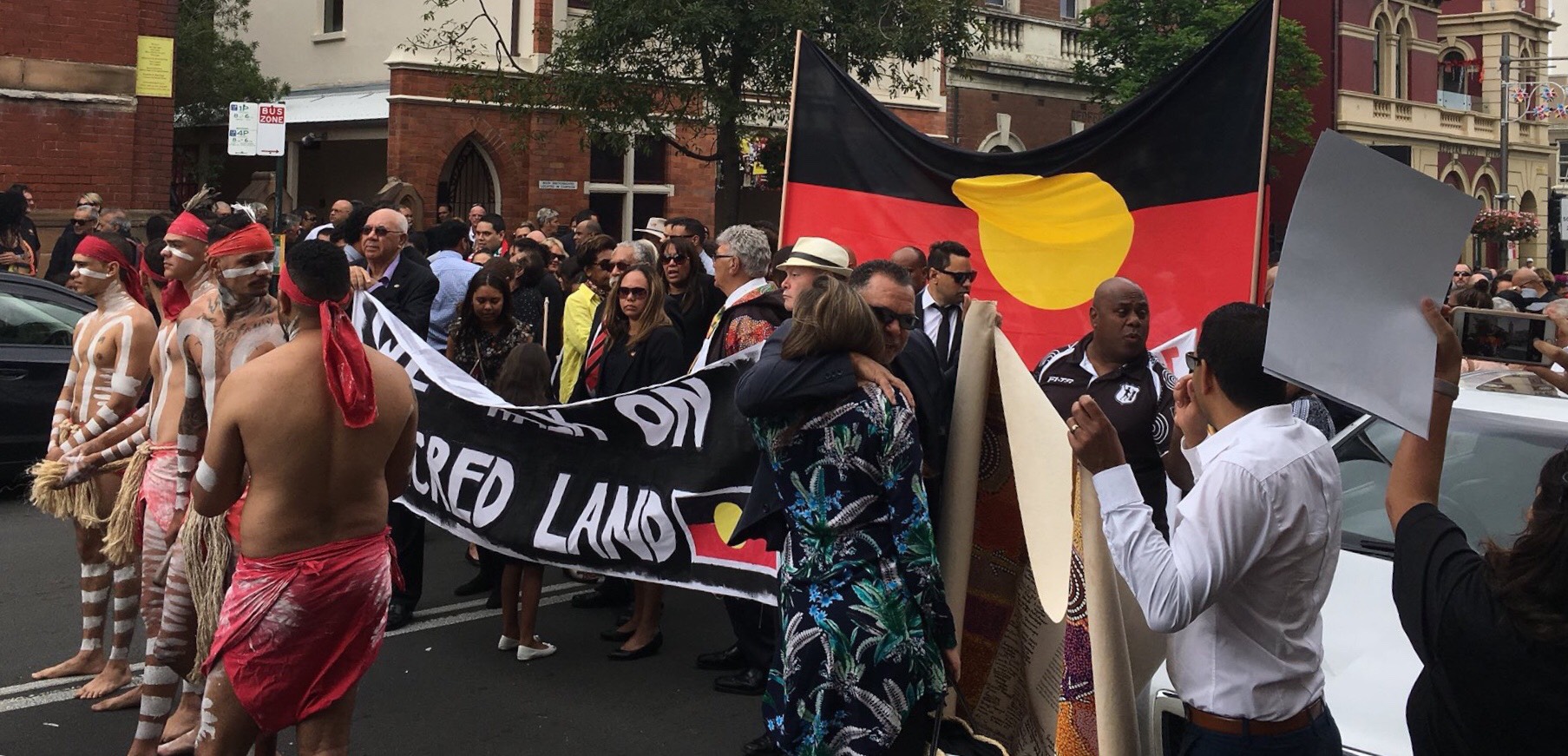
3. WA : AHCWA Gap between Indigenous and non-indigenous longevity surges in WA

The disparity between the life expectancy of Aboriginal and non-Aboriginal West Australians has surged, bucking a national trend that shows a closing of the gap, a new report has found.
The Australian Institute of Health and Welfare report, released this week, shows the life expectancy gap between indigenous and non-indigenous West Australians increased from 14.7 years to 15.1 years in men and 12.9 years to 13.5 years in women in a comparison of data between 2005-2007 and 2010-2012.
Nationally, the gap decreased from 11.4 years to 10.6 years for men and remained stable at 9.6 years to 9.5 years for women during the same period.

The figures come despite the Aboriginal and Torres Strait Islander Health Performance Framework 2017: Western Australia report showing small increases in the life expectancy of indigenous males in WA from 64.5 to 65 years and indigenous females from 70 to 70.2 years between 2005–2007 and 2010–2012.

Aboriginal Health Council of WA chairperson Michelle Nelson-Cox said despite the improvements to indigenous longevity and several other health outcomes, there was still a long way to go and health education remained a key focus.

“Positively, this report identifies several areas of improvement in Aboriginal health, including a 48% drop in deaths from circulatory diseases and five-fold increase in the rate of indigenous health checks being claimed,” Ms Nelson-Cox said.

The report showed a substantial increase in the rate of indigenous-specific health checks being claimed, rising from 42 per 1000 in 2006-07 to 254 per 1000 in 2014-15, she said.

“This is a significant move that shows health education campaigns and our commitment to making health checks more available to Aboriginal communities are having an impact,” she said.

“But we remain deeply concerned at several findings, including that the rate of indigenous women smoking during pregnancy is five times higher than non-indigenous women and the disparity in notifications for sexually transmitted infections for indigenous Australians.

“In addition, the death rates for chronic diseases are much higher for indigenous Australians than non-indigenous Australians.

“To that end, this report highlights the need for greater investment in evidence based, culturally safe, high quality responsive and accessibly primary health care for Aboriginal people in WA.

“AHCWA urgently calls on the government to provide further support to Aboriginal Community Controlled Health Services (ACCHSs) who continue to be the strongest, most effective means to addressing the gap in health outcomes.

“Without this investment, achieving our Closing the Gap targets will remain out of reach.”

Ms Nelson-Cox said while it was recognised that governments invested significant funding in Aboriginal health, Aboriginal community and community-controlled organisations were the most effective agencies.

There also needed to be greater transparency and accountability of other stakeholders in the sector, she said.

AHCWA is the peak body for Aboriginal health in WA, with 22 Aboriginal Community Controlled Health Services (ACCHS) currently engaged as members.

4.SA: National Disability Insurance Scheme Aboriginal community consultation

Read over 25 NACCHO Disability NDIS articles HERE

 5.QLD : Apunipima’s ACCHO Napranum Centre Working to National Standards
 

Charkil-Om Primary Health Care Centre received AGPAL accreditation for the first time in September, just after celebrating its first birthday in August.

AGPAL (Australian General Practice Accreditation Limited) accreditation is independent recognition that a practice meets the requirements of governing industry standards which are set by the Royal Australian College of General Practitioners.

Apunipima’s Quality and Risk Manager Roberta Newton said accreditation acknowledged the high standard of care being provided to the community by the Charkil-Om team.

‘So stringent are the AGPAL standards that many mainstream clinics need more than one go to achieve accreditation,’ she said.

‘To achieve it first time is a real coup, not only for the staff but also for our community.’

While AGPAL accreditation is not mandatory, all Apunipima primary health care centres are either accredited or working towards accreditation.

‘We wanted the community to know that their health and wellbeing is our priority,’ Roberta said.

‘By choosing to attend an accredited practice, our patients know they will get quality and safe care that meets the national standards.’

The Centre offers a full range of culturally appropriate comprehensive primary health care services including doctors, nurse and maternal and child health worker supported by a range of visiting services, and is fast becoming a real hub for the community.

Charkil-Om Primary Health Care Centre manager Kelvin Coleman said the AGPAL team were impressed with both the Centre and its operation.

‘The AGPAL accreditors were particularly impressed that we were able to source full time permanent doctors and committed staff to deliver such comprehensive services in a remote area,’ he said.

“All of our staff played a valuable role in working together meet the AGPAL standards. Receiving AGPAL accreditation is an acknowledgement of the dedication, care and commitment of our staff.’

‘I am incredibly proud of what our team have achieved, not only for ourselves, but most importantly for our community.’

6. VACCHO : Korin Korin Balit-Djak: Aboriginal health, wellbeing and safety strategic plan 2017–2027 

Key messages

  • Korin Korin Balit-Djak means ‘Growing very strong’ in the Woi wurrung language. It provides an overarching framework for action to improve the health, wellbeing and safety of Aboriginal Victorians now and over the next 10 years.
  • The purpose of Korin Korin Balit-Djak is to realise the Victorian Government’s vision for ‘Self-determining, healthy and safe Aboriginal people and communities’ in Victoria.

VIEW WEBSITE HERE

Korin Korin Balit-Djak emerges at a significant time for both Aboriginal communities in Victoria and the government. It follows the government’s commitment to self-determination for Aboriginal Victorians.

The Department of Health and Human Services commissioned work that has informed both Korin Korin Balit-Djak and the discussion about Aboriginal self-determination across all areas of the Victorian Government and community. This research and discussion has underpinned a new policy platform for Aboriginal health, wellbeing and safety.

Korin Korin Balit-Djak is informed by an extensive consultation process with Aboriginal communities across Victoria, as well as a strong evidence base, including Koolin Balit evaluation findings (Victorian Government 2012). The plan details how the department will work with Aboriginal communities, community organisations, other government departments and mainstream service providers – now and into the future – to improve the health, wellbeing and safety of Aboriginal people in Victoria.

Korin Korin Balit-Djak covers five domains:

  • Aboriginal community leadership
  • prioritising Aboriginal culture and community
  • system reform across the health and human services sector
  • safe, secure, strong families and individuals
  • physically, socially and emotionally healthy Aboriginal communities.

Korin Korin Balit-Djak will be reviewed and updated every three years.

Korin Korin Balit-Djak is guided by the government’s vision to achieve optimum health, wellbeing and safety for all Victorians so they can live the life they value. It aligns with the department’s strategic directions and aspires to address, and ultimately eliminate, systemic racism within the Victorian health and human service sectors.

Digital story: Dixon Patten

Victorian Aboriginal artist Dixon Patten was commissioned by the department to produce the artwork titled Korin Korin Balit-Djak. In this video, he explains how his artwork depicts the way the department will work with Aboriginal communities to ensure the physical, social and emotional wellbeing of Aboriginal people.

7. NT: AMSANT APO NT :  Failure guaranteed if you don’t involve us, say Aboriginal organisations

“We have been calling on the Minister for Indigenous Affairs to clarify and formalise the Community Development Program reform process since last December. Every request is met with silence,

The Prime Minister and Minister for Indigenous Affairs never tire of talking about how they want to do things with us, not to us. That they want new ways of working with Aboriginal people. Yet here is a program that affects the lives of 29,000 Indigenous people and has caused immense harm, and we still can’t get confirmation of a process that includes us,”

John Paterson CEO AMSANT spokesperson from APO NT

The Australian Government must step out from behind closed doors and involve Indigenous people in a transparent process for reforming the discriminatory remote ‘work for the dole’ scheme, the Aboriginal Peak Organisations NT (APO NT)1 urged today.

The Government committed to reviewing the program, called the ‘Community Development Program’ (CDP) and consulting with remote communities in May 2017.

Australia’s election to the world’s leading human rights body, the UN Human Rights Council, this week relied on a pledge to support the Declaration on the Rights of Indigenous Peoples ‘in both word and deed’. The Declaration requires the Government to work in partnership with Aboriginal people and respect the right to self-determination.

“The Australian Government said to the world that it would tackle Indigenous disadvantage in partnership with our people. Meanwhile the Government’s racially discriminatory program results in Aboriginal people receiving more penalties than other Australians, and hurts our communities,” said Mr Paterson.

“If the Government is serious about the promises it made to get elected to the Council, the Minister for Indigenous Affairs will immediately announce an independent and transparent reform process involving a partnership with Aboriginal people,” added Mr Paterson.

APO NT launched a positive alternative to CDP in Canberra last month (APO NT alternative to CDP). Our model would create 10,500 part time jobs to be filled by people in remote communities who currently get less than the minimum wage to do work they should be employed and paid properly to do. Our model would create new jobs and enterprises, strengthen communities and get rid of pointless administration. It has incentives to encourage people into work, training and other activities, rather than punishing people who are already struggling.

David Ross from APO NT, said, “Thirty-three organisations from around Australia have endorsed our new model. We have done the work, we want to talk, and we want a program that will actually deliver positive outcomes on the ground.”

“The Australian Government appears to be unable to put the rhetoric of collaboration into practice. What do all these commitments mean if they don’t deliver a seat at the table on this fundamental issue? Let’s not repeat the mistakes of the past and impose a top-down program from Canberra that is guaranteed to fail in remote Australia,” Mr Ross concluded.

KEY FACTS ABOUT THE COMMUNITY DEVELOPMENT SCHEME

The CDP is the main program of job related assistance for unemployed people in remote areas of Australia. It is the equivalent of job active (formerly JSA) and Disability Employment Services in the rest of the country.

The CDP has around 35,000 participants, around 83% of whom are identified as Indigenous.

People with full time work capacity who are 18-49 years old must Work for the Dole, 25 hours per week, 5 days per week, at least 46 weeks per year (1150 hours per year). Under job active Work for the Dole only starts after 12 months, and then for 390-650 hours per year.

Despite having a caseload less than a 20th the size of job active, more penalties are applied to CDP participants than to jobactive participants.

In the 21 months from the start of CDP on 1 July 2015 to the end of March 2017, 299,055 financial penalties were applied to CDP participants. Over the same period, 237,333 financial penalties were applied to jobactive participants.

8.ACT : Winnunga ACCHO Newsletter September 2017

Download a PDF copy HERE

Winnunga AHCS Newsletter September 2017

9. Tas: Tasmanian Aboriginal Centre : Hobart seeks OZ Day move


Welcome your comments about all these ACCHO stories


NACCHO Aboriginal Health Evaluation Alert : Minister @KenWyattMP engages consultants to evaluates the #IAHP Indigenous Australians’ Health Program

Independent consultants have been engaged to conduct evaluations of the Australian Government’s Indigenous Australians’ Health Program (IAHP).

Our focus is on closing the gap and, while we are making gains, we need to accelerate progress and in some cases, just doing more of the same is not going to achieve that,

We need to know what is working well so we can best target our investment in, and support of, health programs.

The consultants will work closely with Aboriginal and Torres Strait Islander communities and key consumer, primary health care and government organisations, The subsequent implementation of the agreed evaluation design will be a separate, four-year project.”

The Minister for Indigenous Health, Ken Wyatt AM, said the two projects were part of a wide ranging approach to monitor and examine the IAHP.See NACCHO background below Part 2 and 3

1.A longer term evaluation of comprehensive primary health care will be co-designed with stakeholders over 9 months, by consultants Allen and Clarke.

2.In addition, a health economics analysis will be undertaken by Deakin University.

This project will consider the IAHP’s return on investment and the relative costs of providing comprehensive primary health care to Aboriginal and Torres Strait Islander people through Indigenous specific and non-Indigenous health care services.

“Improved health results, social returns and broader economic benefits will be assessed,” said Minister Wyatt.

“This economic evaluation will inform future IAHP investments, to improve efficiency and drive better health outcomes.

“Both studies will be supported by an Evaluation Advisory Group comprised of key stakeholders and health experts, to ensure a wide range of perspectives are taken into account.

“This work aligns with the Turnbull Government’s commitment to a more strategic, long-term approach to Indigenous health and Indigenous affairs as a whole.”

Part 2 NACCHO Background : IAHP Indigenous Australians’ Health Programme

The Indigenous Health Division is responsible for the Indigenous Australians’ Health Programme, which commenced on 1 July 2014.

This Programme consolidated four Indigenous health funding streams: primary health care base funding; child and maternal health activities; Stronger Futures in the Northern Territory (Health); and the Aboriginal and Torres Strait Islander Chronic Disease Fund.

The following themes comprise the Programme:

  • Primary Health Care Services;
  • Improving Access to Primary Health Care for Aboriginal and Torres Strait Islander People;
  • Targeted Health Activities;
  • Capital Works; and
  • Governance and System Effectiveness.

The Guidelines for the Programme provide an overview of the arrangements for the administration of, and activities that may be funded under, the Programme.

PDF version: Indigenous Australians’ Health Programme Guideline – PDF 501 KB

Part 3 NACCHO background history February 2016

NACCHO $ Aboriginal Health Funding alert :Federal Goverment’s Indigenous Australians’ Health Programme

1.Indigenous Australians’ Health Programme – Tackling Indigenous Smoking Innovation Grants

The Australian Government has made available $6.3 million over three financial years from June 2016 to June 2018 for innovation grants. These projects will offer innovative and intense activities for Aboriginal and Torres Strait Islander people to reduce smoking prevalence in remote areas, for pregnant women and for young people vulnerable to entrenched cultural norms of smoking.

It is expected that successful grant recipients will work in collaborative partnerships of research organisations and service providers to seek solutions to reduce rates of smoking that have been resistant to reduction. This arrangement will improve the evidence on how to reduce smoking rates in areas or groups of high need and interventions will be evaluated in context to add to existing understanding of what works and what does not work in what circumstances.

This will be a competitive, open process for which various health service providers and research organisations may apply

2.Indigenous Australians’ Health Programme – Service Maintenance Programme

The Indigenous Australians’ Health Programme’s Service Maintenance Programme (SMP) is providing Commonwealth funded Aboriginal Community Controlled Health Services (ACCHSs) a total of up to $2 million (GST exclusive) in grant funding in 2015-16. SMP grants will provide for the priority repair and upgrade of clinics and staff housing facilities run by organisations which aim to improve access to services and improve health outcomes for Indigenous Australians.

3.Indigenous Australians’ Health Programme – Primary Health Care Activity

The Department of Health has released two Invitations to Apply for the continuation of Primary Health Care and New Directions: Mothers and Babies Services under the Indigenous Australians’ Health Programme (IAHP) in selected communities and regions across Australia for two years from 2016-17. IAHP Primary Health Care Activity aims to improve access for Aboriginal and Torres Strait Islander people to effective and high quality health care services essential to improving health and life expectancy, and reducing child mortality. New Directions: Mothers and Babies Services Activity aims to improve the health of Indigenous Australians by improving access to antenatal care and maternal and child health services by Indigenous children, their mothers and families.

4.Indigenous Australians’ Health Programme – New Directions: Mothers and Babies Services Activity

The Department of Health has released two Invitations to Apply for the continuation of Primary Health Care and New Directions: Mothers and Babies Services under the Indigenous Australians’ Health Programme (IAHP) in selected communities and regions across Australia for two years from 2016-17. IAHP Primary Health Care Activity aims to improve access for Aboriginal and Torres Strait Islander people to effective and high quality health care services essential to improving health and life expectancy, and reducing child mortality. New Directions: Mothers and Babies Services Activity aims to improve the health of Indigenous Australians by improving access to antenatal care and maternal and child health services by Indigenous children, their mothers and families