NACCHO Sector News: 30 April 2025

The NACCHO Sector News is a platform we use to showcase the important work being done in Aboriginal and Torres Strait Islander health, focusing on the work of NACCHO, NACCHO members and NACCHO affiliates.

We also share a curated selection of news stories that are of likely interest to the Aboriginal and Torres Strait Islander health sector, broadly.

Wahluu Health officially launches the Aboriginal Health Service (AHS) ‘Wundirra’

“WE’RE only starting off, but the dream here is big.”

For decades, the dream of the Indigenous community in Bathurst has been the development of an Aboriginal Health Service (AHS).

Now, with the official launch of Wahluu Health, Wundirra, the community is one step closer to realising this dream, and joining the likes of other cities in the Central West, including Orange and Dubbo.

Read the full article here

Shona Kennedy, Wundirra health manager (centre) with local children at the Wahluu Health Launch of Wundirra. Picture by Alise McIntosh

Shona Kennedy, Wundirra health manager (centre) with local children at the Wahluu Health Launch of Wundirra. Picture by Alise McIntosh

Tharawal – Vaccination Uptake Support Program

Families flocked to Tharawal Aboriginal Medical Service (AMS) in Airds on Wednesday, 23 April, where furry friends and flu fighters turned out for a successful flu vaccination clinic.

Over 200 locals rolled up their sleeves for their annual flu vaccination, with South Western Sydney Local Health District (SWSLHD) and Tharawal AMS staff working together to deliver the flu shots.

A pizza truck, petting zoo and raffles helped take the sting out of the vaccination for children – and their parents – with one grateful mum posting on Facebook: “Thank you for today, the boys really enjoyed the petting zoo and pizza. Made the whole flu shot experience much more enjoyable”.

The clinic was also an opportunity for some Tharawal AMS patients to keep their shingles, pneumonia and COVID-19 vaccines up-to-date. It was one of several SWSLHD flu vaccination clinics being held across the region this month.”

If you’d like to know more about getting vaccinated this winter, visit their website: Your 2025 guide to winter vaccines: Flu, COVID-19 and RSV | South Western Sydney PHN

Children in a petting zoo

Children at the petting zoo, during a vaccination program in Tharawal

“Anything with mob is where my passion lies” – graduate paying it forward in her community

GO Foundation alumni Makayla Rodrigues wants others to know trusting your gut and backing yourself is the greatest form of self-investment.

The Gomeroi and Worimi woman recently completed her Social Work Bachelor’s degree and is working as a First Nations Community Development Worker at community counselling and support service Interrelate.

At the back end of high school, her scholarship with the GO Foundation helped with the transition into university life and studies – with the added complexities of COVID lockdowns.

“I got early entry into the University of Wollongong with no idea of what I needed for uni,” Ms Rodrigues told National Indigenous Times, with GO’s financial support allowing for her to buy her first laptop and set up for studying at home.

“It definitely made a massive difference for me.”

Founded in 2009 by AFL greats Michael O’Loughlin and Adam Goodes, GO Foundation has awarded scholarships to close to 2000 students since 2014 across their footprint in Sydney, Adelaide and Canberra. 664 students, according to last year’s impact report, were supported in 2024.

Read the full article here

Makayla Rodrigues

Makayla Rodrigues – Image: GO Foundation.

Matty Mills: Championing mental health in First Nations and queer communities

Content warning: this article contains reference to suicide. Please refer to the services at the bottom of this article for support.

Returning for his second year, TV presenter and proud Kamilaroi man Matty Mills brings a deeply personal connection to The Push-Up Challenge, a cause close to his heart as he has been directly impacted by suicide and, as a queer First Nations man, understands the confronting intersection of suicide statistics within his community.

Highlighting the harrowing reality that suicide is the leading cause of death for young First Nations men under 25, Matty sees the challenge as an opportunity to do his part and use his platform for good, aligning with his belief in movement as medicine, having long found strength and mental well-being through physical activity as an outlet for past trauma and a way to maintain his best self.

Read the full article here

If this article brought up anything for you or someone you love, please reach out to, call or visit the resources listed below for support.

Matty Mills

Image: Matty Mills

New journals to support Indigenous mums through pregnancy and motherhood

After more than a decade in women’s health, proud Gamilaroi woman Darinka Ondrovic has launched a new range of antenatal journals to support First Nations women during pregnancy.

Ms Ondrovic, who was born and raised on Wiradjuri Country in Dubbo, NSW, said the journals offer a space for cultural connection, emotional reflection, and strength.

Each page includes culturally safe guidance, wellbeing prompts, and artwork reflecting the experiences of Aboriginal and Torres Strait Islander women.

Ms Ondrovic said the journals were developed to support women during an important time in their lives.

“Our women deserve to feel seen, heard, and supported during such a sacred time,” she said.

“These journals are created to walk beside them, honouring culture and tradition while supporting health and wellbeing.”

Read the full article here

Gamilaroi woman Darinka Ondrovic has launched antenatal journals to support Indigenous mums.

Gamilaroi woman Darinka Ondrovic has launched antenatal journals to support Indigenous mums.

Sector Jobs – you can see sector job listings on the NACCHO website here.

Advertising Jobs – to advertise a job vacancy click here to go to the NACCHO website current job listings webpage. Scroll down to the bottom of the page to find a Post A Job form. You can complete this form with your job vacancy details – it will then be approved for posting and go live on the NACCHO website.

NACCHO Governance Program Workshop

Specialised governance workshops for Aboriginal Community Controlled Health Organisations will be delivered in multiple locations during 2024 to 2025.

See all dates and details here

NACCHO Sector News: 29 April 2025

The NACCHO Sector News is a platform we use to showcase the important work being done in Aboriginal and Torres Strait Islander health, focusing on the work of NACCHO, NACCHO members and NACCHO affiliates.

We also share a curated selection of news stories that are of likely interest to the Aboriginal and Torres Strait Islander health sector, broadly.

National Yarning Circle starts in Adelaide with a focus on Aboriginal and Torres Strait Islander-led aged care

The National Aboriginal Community Controlled Health Organisation (NACCHO) has today opened the second Elder Care Support National Yarning Circle in Adelaide, bringing together frontline workers, health leaders, and policymakers to lead a culturally grounded and community-driven reform of aged care for Aboriginal and Torres Strait Islander peoples.

Hosted on Kaurna Country, this year’s Yarning Circle builds on the success of the inaugural 2024 event, celebrating the growing national Elder Care Support workforce and their critical role in reimagining care for older First Nations peoples.

NACCHO’s Executive Director Monica Barolits-McCabe stated, “Our elders carry our culture, wisdom, and stories. Caring for them is a sacred responsibility, not simply a service. Through the Elder Care Support Program, we are transforming aged care by placing culture, connection to Country, and community at its heart. This Yarning Circle is an opportunity to celebrate our progress, share stories of resilience, and collectively build the next chapter in Aboriginal-led aged care.”

With an ageing Aboriginal and Torres Strait Islander population and growing health inequities, delegates will focus on strengthening and expanding place-based solutions that prioritise connection to Country, cultural safety, and wraparound support.

Read the full article on the NACCHO website

Elder Care Support National Yarning Circle 2025

Elder Care Support National Yarning Circle 2025

Elder Care Journal launches

The Kambu Health Members Elders Group have launched the Elder Care Journal, a culturally safe resource designed to empower Aboriginal and Torres Strait Islander Elders to guide their own health journey.

Launched at Brothers Leagues Club, Ipswich last Thursday, it features vibrant artwork and supports Elders to keep track of their health information, including appointments and blood sugar and blood pressure record keeping.

Read the full article on the Ipswich West Moreton Today website

Local Elders came together for the cake cutting.

Local Elders came together for the cake cutting

Funding sees Goanna Academy expand mental health education programs

Greg Inglis’ Goanna Academy will see an expansion of its preventive mental health education programs for at-risk people, as well as the piloting of a new mental health training program.

On Monday, Labor announced $6.4 million over three years if they are elected to support the Indigenous-owned, headspace-endorsed mental health education provider, which aims to end the stigma surrounding – and improve everyone’s ability to talk and discuss – mental health.

The Goanna Academy’s programs look to build wellbeing and resilience for some of the most at-risk groups in the country, including regional men, youth, and First Nations communities, with the funding set to expand their work out of New South Wales and Queensland.

Read the full article on the National Indigenous Times

Greg Inglis' Goanna Academy has helped hundreds of First Nations children since it was founded (Image: Goanna Academy)

Greg Inglis’ Goanna Academy has helped hundreds of First Nations children since it was founded (Image: Goanna Academy)

Albert Bevan, a First Nations social and emotional wellbeing officer

Discover what a career in primary health care has to offer. As a First Nations social and emotional wellbeing officer, you will help provide a safe environment for your community. Make a difference for your Mob and join the team.

Watch the video on the Department of Health and Aged care website

Albert Bevan, a First Nations social and emotional wellbeing officer

Albert Bevan, a First Nations social and emotional wellbeing officer

Dr Nathan Luies, a First Nations sport and exercise physician

Discover what a career in primary health care has to offer. As a sport and exercise physician, you will help to improve the wellbeing and health of First Nations people. Make a difference for your Mob and join the team.

Watch the video on the Department of Health and Aged care website

Dr Nathan Luies, a First Nations sport and exercise physician

Dr Nathan Luies, a First Nations sport and exercise physician


Sector Jobs – you can see sector job listings on the NACCHO website here.

Advertising Jobs – to advertise a job vacancy click here to go to the NACCHO website current job listings webpage. Scroll down to the bottom of the page to find a Post A Job form. You can complete this form with your job vacancy details – it will then be approved for posting and go live on the NACCHO website.

NACCHO Governance Program Workshop

Specialised governance workshops for Aboriginal Community Controlled Health Organisations will be delivered in multiple locations during 2024 to 2025.

See all dates and details here

NACCHO Aboriginal and Torres Strait Islander Health Workforce : Donnella Mills @NACCHOChair Keynote Address at #CATSINaM19 Building a workforce and embedding #CulturalSafety : Connecting care through culture

” I’m keen to hear your ideas on how we can cooperate across the sector to develop a better workforce with cultural safety embedded throughout the hundreds of clinics and hospitals across the country.

I was impressed by the theme you chose for your conference: ‘connecting care through culture’. That simple phrase captures so much of what we do in our sector each and every day.

Cultural safety, I believe, is what makes us unique and what represents our greatest strength.

In the Aboriginal community-controlled health organisations – the ACCHOs – you have this reinforced through the operating model.

Community control’ is not just a term – it is a 48-year-old model – forged at Redern in 1971 – and now exercised in 144 local Aboriginal and Torres Strait Islander communities across the country.” 

Donnella Mills Acting Chair, NACCHO Keynote address at the CATSINaM National Professional Development Conference Sydney 26 September 

I would like to acknowledge that this conference is being held on Aboriginal land. I recognise the strength, resilience and capacity of the Gadigal people of the Eora Nation who are the traditional custodians of this place we now call Sydney. I pay my respects to their elders.

For those of you who don’t know me, I am a Torres Strait Islander woman with ancestral and family links to Masig and Nagir. I am the Acting Chair of NACCHO, which stands for the National Aboriginal Community Controlled Health Organisation.

I thank the CATSINaM Board for inviting me to deliver this address. It is a privilege to be talking with you today and a special pleasure to be among so many hard-working and dedicated healthcare professionals.

Without you, the Health gap would be so much wider than it is now. Without you, there would be little cultural safety in our hospitals and medical services. I have seen how important your work is on the ground at Wuchopperen and in the other services I have visited. You are the backbone of Aboriginal health.

I plan to speak for about 25 minutes. That will leave us about 20 minutes for yarning at the end. I’m keen to hear your ideas on how we can cooperate across the sector to develop a better workforce with cultural safety embedded throughout the hundreds of clinics and hospitals across the country.

Community control

Our people trust us with their health. We build ongoing relationships to give continuity of care so that chronic conditions are managed and preventative health care is effectively targeted.

Studies have shown that Aboriginal controlled health services are 23% better at attracting and retaining Aboriginal clients than mainstream providers.

Through local engagement and a proven service delivery model, our clients ‘stick’. The cultural safety in which we provide our services is a key factor of our success. In this way, ACCHOs are already ‘leading the way’.

We also build partnerships that make things work. Leadership is not all about the strength to stand up on your own, it is about being smart enough to stand shoulder-to-shoulder with one another. It is about galvanising support on the ground. It is about forging alliances in the sector and building strategic partnerships at the national level.

Employment

Another strength – one that we tend to overlook – is the sheer size of our sector. Let’s have a look at the ACCHO part of it alone. It is not widely known, but the 144 ACCHOs, collectively, are the single largest employer of Aboriginal and Torres Strait Islander people in Australia. That means that one in every 44 Indigenous jobs in Australia is at one of our health services.

If we add the Aboriginal health workers in the mainstream and the rest of the sector, these numbers become all the more impressive.

Our sector is doing more to close the employment gap than any of the employment measures dreamed up by Government agencies.

If the Government really wants to get people off welfare, don’t punish vulnerable people with cashless welfare cards, robo-debts or by sending them off to meaningless Work for the Dole activities.

Work with our sector and grow the Aboriginal workforce together. We have real jobs located in real communities. That is where the investment needs to go.

We should remind our politicians of this when they visit us.

They may see a small clinic somewhere with a few staff, but if they understood that we are part of a huge national network of Aboriginal professionals, they might take more notice of us and realise what we have to offer.

Comprehensive primary health care

Another challenge for us is continuing the development of a comprehensive primary health care model. I think we have been hearing this since the release of the National Aboriginal Health Strategy way back in 1989.

Twenty-one years later, a study concluded that ACCHOs are one of a very few settings where ‘comprehensive primary health care’ is delivered. If we keep offering a comprehensive approach for primary health care across the nation, our people will be much less likely to fall between the cracks.

We can do this through colocation of services or forming partnerships at the local level. This can include clinical care, immunisation and environmental health programs, on-site pharmaceutical dispensing and partnerships with family violence, child protection counselling and legal services.

We can also develop links with sports programs, homelessness services, dental services, aged care and disability support. None of these elements can fully succeed when they stand alone. The voluminous literature on the social determinants of health tell us that. But more importantly, it is what we all know from our own personal experiences.

You don’t need an academic to tell you that comprehensive primary health care is the best approach. We all know this intuitively and from our experiences on the ground.

I am not saying that we should all diversify or ‘dilute’ what we are doing. What I am saying is that while we focus on our core activities, we should also be taking every opportunity we can to link up with other Aboriginal and Torres Strait Islander services and programs in complementary areas.

From my own experience ….

When you think about it, it should not be hard to promote ourselves; to sell ourselves to a new Government. After all, we provide value for money. ACCHOs result in greater health benefits per dollar spent; measured at a value of $1.19 for every $1 spent.

Studies have also shown that the lifetime health impact of interventions delivered by ACCHOs is 50% greater than if these same interventions were delivered by mainstream health services. This is primarily due to improved Aboriginal access and outcomes.

I don’t need to tell you that we also have some pretty significant challenges ahead of us. And I’d like to address these now, one by one.

Remuneration

If we are serious about workforce development, then we cannot ignore the issue of wages. Correct me if I am wrong, but from what I have heard, remuneration is a big issue for nurses and midwives. The ALP, as part of its election platform in May of this year had much to say about improving wages and conditions in the childcare sector, and justifiably so. Childcare is another industry in which women dominate, but are underpaid.

We need the Commonwealth and State Governments to take a similar approach to nurses and midwives. As you all know, women make up almost 90% of all employed nurses and midwives. Representative bodies like NACCHO and CATSINaM need to work together to drive this message home to Governments across the country. Remuneration is an important aspect in attracting and retaining staff.

Vocational development

I think we need to keep improving the career development opportunities and skills acquisition not just for nurses and midwives, but for all Aboriginal health workers. Currently, there is an imbalance in the medical services in which we see more Aboriginal people on the lower levels and amongst the non-clinical staff.

The graph in my presentation shows the situation for ACCHOs. We need more Aboriginal non-clinical staff but we need even more Aboriginal clinical staff.

Recruitment

I see that CATSINaM has a proud record in increasing its membership in recent years. I think you had a record number in your 2018 Annual Report – 1,366 members – representing a jump of 35%. Clearly, you are doing something right to have recruited so many new members.

You must have won the trust of your members to have such a healthy and expanding membership base. With almost half of the Aboriginal and Torres Strait Islander nurses and midwifes in Australia as your members, CATSINaM is the key organisation in addressing many of the workforce development issues in our sector.

Certainly, much more needs to be done to develop career pathways to secure more Aboriginal and Torres Strait Islander nurses and midwifes as well as more doctors and allied health professionals.

Across Australia in 2015 the AIHW reported that there were only about 180 medical practitioners, 750 allied health professionals, and 3,200 nurses (including 230 midwives) who identified as Aboriginal or Torres Strait Islander people. For nurses, this represents just over 1% of all employed nurses and midwives Australia-wide.

The Northern Territory (2.4%) and Tasmania (2.2%) had the highest proportion of Aboriginal nurses and midwives, while Victoria had the lowest (0.5%). Compare these figures to our proportion of working-age Australians – close to 3.%. We should have 3% of all nurses and midwives, not 1%.

As I have already said, our sector is the largest employer of Aboriginal and Torres Strait Islander people across the country.

Now, if the ACCHOs as a group employ about 6,000 staff, of which 56 per cent are Aboriginal or Torres Strait Islanders, then we still have another 2,500 jobs in our own sector which could be filled by Aboriginal and Torres Strait Islander people.

We have a significant opportunity here. Think of what we could do for our people if we filled such a large number of jobs.

Retention

A big challenge that we confront every day – particularly in the bush – is retention. Stress and burnout is a real problem as Fran Baum’s research has shown. Turnover of staff is high and vacancies remain unfilled for longer than we would like.

With so many vacancies, particularly in remote clinics, a concerted effort could also have a significant positive impact on the size and health of our workforce. It is troubling to hear of the high reported vacancy rate of 6% (i.e. about 380 vacancies at any point in time).

Nevertheless, ACCHOs are doing pretty well in comparison with mainstream and non-Aboriginal organisations. The proportion of health vacancies was 6% compared with 9% for other organisations. My guess is that it is cultural safety that explains the advantage here.

So, if we have a good model and we have sector already working hard for Aboriginal health, then how are we going?

Life expectancy target not met

If we look at just one of the ‘Closing the Gap’ targets – life expectancy – you can see how stark the differences are. According to ABS data, which probably overestimate Aboriginal life expectancy, non-Aboriginal Australians can expect to live to about the age of 82. Aboriginal and Torres Strait Islander people are lucky to make it to 72. T

hat’s a ten-year difference. We would be better off living in other countries where the life expectancy is higher. Countries – believe it or not – like Bangladesh or Azerbaijan. Life expectancy is longer in some Third World countries than it is for our people.

Funding for Aboriginal health has fallen

Despite all the words we have heard from Commonwealth and State Governments over the years about ‘Closing the Gap’, instead of increasing expenditure, Governments have actually decreased expenditure on Aboriginal health over the past decade.

Governments need to spend two to three times more on Aboriginal health if we are to have a level of funding commensurate with the actual cost of the burden of disease. This is a huge sum – about $1.4 billion per year – on one estimate.

In real terms health expenditure (excluding hospital expenditure) for Aboriginal people fell 2% from $3,840 per person in 2008 to $3,780 per person in 2016. Over the same period, expenditure on non-Aboriginal people rose by 10%. How can you expect to close the gap when you are reducing funding for our people and increasing it for the non-Aboriginal population?

If we act as one, we can turn things around.

Look at the way that the Aboriginal peaks, like NACCHO and CATSINaM, stood together to force the nine Australian governments to restart the Closing the Gap process. Before we came together and complained to them, the consultation process was expensive lip service.

Before we stood together with one voice, our separate voices were ignored. Now they are listening. Now things are back on track.

Funds are tighter than ever to procure, but, over the years, we have built a world class model of health care and there is too much at stake for us now to start drifting backwards now.

The timing is critical, especially now that we have a re-elected Government and the new arrangements in the administration of Aboriginal programs. It is great to see Ken Wyatt as the first Aboriginal Cabinet member as the Minister for Indigenous Australians.

But we need to engage as closely as we can with him and with Minister Hunt. We also need to keep the dialogue open with Senator Dodson, Senator McCarthy and the Member for Barton in NSW, Linda Burney.

There are also plenty of good Aboriginal leaders in the State and Territory Governments and I urge you to keep talking to them. It is important to have our voice heard.

Especially when we face a mainstream system that continues to overlook us; especially when we have a mainstream system that continues to patronise us. If we don’t act now and keep the pressure up, we will lose some of our recent hard-won gains.

The future

Despite the appalling funding neglect for programs and the low wages paid to our health workers, you have shone in adversity. You are resilient. You survive despite whatever circumstances you find yourselves in.

It’s self-determination and the need to control our own health programs that led to the ACCHO model of care in the first place. It is a lesson for our sector.

If the system was working now, we would have zero preventable hospital admissions. The evidence is not just here, it is overseas as well.

In Canada it has been shown that First Nations communities that transitioned from government-control to community-control of health services experienced a 30% reduction in hospitalisation rates compared with communities where government control was maintained.

In a perfect world our model of primary care through community control would also be complete. We would have full coverage across the land.

We would also have an Aboriginal NDIS workforce in fully-funded models for disability services rolled out, Australia-wide.

And of course, all this hinges on a more accountable public health system and an uncapped needs-based funding model. Who knows, if we had all these things, we may even seriously imagine a future in which we have actually closed the health gap.

With Aboriginal health in Aboriginal hands I know that we can get there eventually.

NACCHO and CATSINaM can continue to work together and to set the way forward for Aboriginal health.

But we can also show the non-Aboriginal population what is possible. It is this future that I imagine for my daughter and my own family.

I am sure that it is a vision that we all share.

Leading the way for all of Australia through cultural safety and respect.

Have your say about what is needed to make real change in the lives of Aboriginal and Torres Strait Islander people #HaveYourSay about #closingthegap

There is a discussion booklet that has background information on Closing the Gap and sets out what will be talked about in the survey.

The survey will take a little bit of time to complete. It would be great if you can answer all the questions, but you can also just focus on the issues that you care about most.

To help you prepare your answers, you can look at a full copy here

The survey is open to everyone and can be accessed here:

https://www.naccho.org.au/programmes/coalition-of-peaks/have-your-say/


NACCHO Aboriginal Health #ClosingTheGap #NAIDOC2019 : @AIHW Key results report 2017-18 Aboriginal and Torres Strait Islander health organisations:

Findings from this report:

  • Just under half (45%) of organisations provide services in Remote or Very remote areas

  • In 2017–18, around 483,000 clients received 3.6 million episodes of care

  • Nearly 8,000 full-time equivalent staff are employed in these organisations and 4,695 (59%) are health staff

  • Organisations reported 445 vacant positions in June 2018 with health vacancies representing 366 (82%) of these
  • In 2017–18, nearly 200 organisations provided a range of primary health services to around 483,000 clients, 81% of whom were Indigenous.
  • Around 3.6 million episodes of care were provided, nearly 3.1 million of these (85%) by Aboriginal Community Controlled Health Services.

See AIHW detailed Interactive site locations map HERE

In 2017–18, Indigenous primary health services were delivered from 383 sites (Table 3). Most sites provided clinical services such as the diagnosis and treatment of chronic illnesses (88%), mental health and counselling services (88%), maternal and child health care (86%), and antenatal care (78%). Around two-thirds provided tobacco programs (69%) and substance-use and drug and alcohol programs (66%).

Most organisations provided access to a doctor (86%) and just over half (54%) delivered a wide range of services, including all of the following during usual opening hours: the diagnosis and treatment of illness and disease; antenatal care; maternal and child health care; social and emotional wellbeing/counselling services; substance use programs; and on‑site or off-site access to specialist, allied health and dental care services.

Most organisations (95%) also provided group activities as part of their health promotion and prevention work. For example, in 2017–18, these organisations provided around:

  • 8,400 physical activity/healthy weight sessions
  • 3,700 living skills sessions
  • 4,600 chronic disease client support sessions
  • 4,100 tobacco-use treatment and prevention sessions.

In addition to the services they provide, organisations were asked to report on service gaps and challenges they faced and could list up to 5 of each from predefined lists. In 2017–18, around two-thirds of organisations (68%) reported mental health/social and emotional health and wellbeing services as a gap faced by the community they served.

This was followed by youth services (54%). Over two-thirds of organisations (71%) reported the recruitment, training and support of Aboriginal and Torres Strait Islander staff as a challenge in delivering quality health services.

Read full report and all data HERE

This is the tenth national report on organisations funded by the Australian Government to provide health services to Aboriginal and Torres Strait Islander people.

Indigenous primary health services

Primary health services play a critical role in helping to improve health outcomes for Aboriginal and Torres Strait Islander people. Indigenous Australians may access mainstream or Indigenous primary health services funded by the Australian and state and territory governments.

Information on organisations funded by the Australian Government under its Indigenous Australians’ health programme (IAHP) is available through two data collections: the Online Services Report (OSR) and the national Key Performance Indicators (nKPIs). Most of the organisations funded under the IAHP contribute to both collections (Table 1).

The OSR collects information on the services organisations provide, client numbers, client contacts, episodes of care and staffing levels. Contextual information about each organisation is also collected. The nKPIs collect information on a set of process of care and health outcome indicators for Indigenous Australians.

There are 24 indicators that focus on maternal and child health, preventative health and chronic disease management. Information from the nKPI and OSR collections help monitor progress against the Council of Australian Governments (COAG) Closing the Gap targets, and supports the national health goals set out in the Implementation Plan for the National Aboriginal and Torres Strait Islander Health Plan 2013–2023.

Detailed information on the policy context and background to these collections are available in previous national reports, including the Aboriginal and Torres Strait Islander health organisations: Online Services Report—key results 2016–17 and National Key Performance Indicators for Aboriginal and Torres Strait Islander primary health care: results for 2017.

At a glance

This tenth national OSR report presents information on organisations funded by the Australian Government to provide primary health services to Aboriginal and Torres Strait Islander people. It includes a profile of these organisations and information on the services they provide, client numbers, client contacts, episodes of care and staffing levels. Interactive data visualisations using OSR data for 5 reporting periods, from 2013–14 to 2017–18, are presented for the first time.

Key messages

  1. A wide range of primary health services are provided to Aboriginal and Torres Strait Islander people. In 2017–18:
  • 198 organisations provided primary health services to around 483,000 clients, most of whom were Aboriginal and Torres Strait Islander (81%).
  • These organisations provided around 3.6 million episodes of care, with nearly 3.1 million (85%) delivered by Aboriginal Community Controlled Health Services (ACCHSs).
  • More than two-thirds of organisations (71%) were ACCHSs. The rest included government-run organisations and other non-government-run organisations.
  • Nearly half of organisations (45%) provided services in Remoteand Very remote
  • Services were delivered from 383 sites across Australia. Most sites provided the diagnosis and treatment of chronic illnesses (88%), social and emotional wellbeing services (88%), maternal and child health care (86%), and antenatal care (78%). Around two-thirds provided tobacco programs (69%) and substance-use and drug and alcohol programs (66%).

See this AIHW detailed Interactive site locations map HERE

  1. Organisations made on average nearly 13 contacts per client

In 2017–18, organisations providing Indigenous primary health services made around 6.1 million client contacts, an average of nearly 13 contacts per client (Table 2). Over half of all client contacts (58%) were made by nurses and midwives (1.8 million contacts) and doctors (1.7 million contacts). Contacts by nurses and midwives represented half (49%) of all client contacts in Very remote areas compared with 29% overall.

  1. Organisations employed nearly 8,000 full-time equivalent (FTE) staff

At 30 June 2018, organisations providing Indigenous primary health services employed nearly 8,000 FTE staff and over half of these (54%) were Aboriginal or Torres Strait Islander. These organisations were assisted by around 270 visiting staff not paid for by the organisations themselves, making a total workforce of around 8,200 FTE staff.

Nurses and midwives were the most common type of health worker (14% of employed staff), followed by Aboriginal and Torres Strait Islander health workers and practitioners (13%) and doctors (7%). Nurses and midwives represented a higher proportion of employed staff in Very remote areas (22%).

  1. Social and emotional health and wellbeing services are the most commonly reported service gap

Organisations can report up to 5 service gaps faced by the community they serve from a predefined list of gaps. Since this question was introduced in 2012–13, the most commonly reported gap has been for mental health and social and emotional health and wellbeing services. In 2017–18, this was reported as a gap by 68% of organisations.


Aboriginal Community Controlled and Health Sector : 30 plus #JobAlerts Includes @ahmrc #Nursing @Nganampa_Health @IUIH_ @CAACongress This week #TopJobs #CEO Jobs in #SA and #WA

This weeks #Jobalerts

Please note  : Before completing a job application please check with the ACCHO that the job is still open

This weeks top job

Chief Executive Officer

Location: Carnarvon, WA
Employment Type: Full time/ Permanent
Remuneration: Salary and employment conditions will be commensurate with qualifications and experience and will be negotiated with the successful applicant

About the Organisation

Carnarvon Medical Services Aboriginal Corporation (CMSAC) is an Aboriginal Community Controlled Health Service established in 1986. CMSAC aims to provide primary, secondary and specialist health care services to Carnarvon and the surrounding region.

About the Opportunity

CMSAC has a highly rewarding opportunity for a Chief Executive Officer to lead its professional, multi-disciplinary team, based in Carnarvon, WA.

This pivotal leadership position will work directly with the Board of Directors and is responsible for the day to day management and delivery of high quality, comprehensive and culturally appropriate primary healthcare services to the local Aboriginal community.

Key areas of responsibility will include (but will not be limited to):

  • Leading, directing and managing the operations of the organisation;
  • Implementing and achieving the strategic objectives and responsibilities of the organisation set by the Board of Directors;
  • Developing and fostering a high performing work environment
  • Driving and implementing cultural workplace changes;
  • Diversifying and growing revenue streams to increase service delivery;
  • Strengthening the organisation’s stakeholder relations, community engagement and patient satisfaction; and
  • Building and sustaining strong financial performance.

To view the full position description and selection criteria, please click here.

To view and download the application pack, please click here.

About YouOur successful candidate will have sound experience in a senior leadership position, along with tertiary qualifications in business and/or health.

As an inspiring and collaborative leader with a strong understanding of healthcare trends for Aboriginal and Torres Strait Islander peoples, you will work strategically to enable transformative change by strengthening the organisation and creating a sustainable future for improved health outcomes for our local Aboriginal communities.

Although not essential, experience working in an Aboriginal Community Controlled Health Service will be highly regarded.

Please Note: The successful candidate will be required to undertake a National Police Check prior to employment.

About the BenefitsFor your hard work and dedication, you will enjoy a highly attractive remuneration package plus salary sacrifice benefits. (Salary and employment conditions will be commensurate with qualifications and experience and will be negotiated with the successful applicant).

In addition, you will have access to a number of fantastic benefits including:

  • Fully furnished accommodation (exc utilities)
  • A fully maintained company vehicle for business and reasonable personal use
  • Mobile phone allowance (up to $1200 p/a)
  • 6 weeks annual leave
  • Support to further invest in your career through additional training
  • Study leave options
  • Annual leave loading
  • Employee assistance program
  • Work/life balance, with Monday – Friday hours, 8:30am – 5pm

A relocation allowance can be negotiated with the right candidate!

Closing date: Wednesday 14 February 2018 at 5pm.

APPLY HERE


How to submit a Indigenous Health #jobalert ? 

NACCHO Affiliate , Member , Government Department or stakeholders

If you have a job vacancy in Indigenous Health 

Email to Colin Cowell NACCHO Media

Tuesday by 4.30 pm for publication each Wednesday


Job Ref : N2018 -1

ACCHO Member : Congress Alice Springs

Position: Childcare Educational Leader

Location : Alice Springs

Closing Date : 9 February

More Info apply :

Job Ref : N2018 -3

ACCHO Member : Congress Alice Springs

Position: Continuous Quality Improvement Facilitator

Location : Alice Springs

Closing Date : 5th February

More Info apply :

Job Ref : N2018 -6

ACCHO Member : Congress Alice Spring

Position : Dentist

Location : Alice Springs

Closing Date : 30 january

More Info apply :

Job Ref : N2018 -7

ACCHO Member : Nunyara Aboriginal Health Service

Position: GP. General Practitioner

Location : Wyalla SA

Closing Date : 31 January

More Info apply :

Job Ref : N2018 -8

ACCHO Member :

Position: Remote Chronic Disease Nurse

Location : Tjunjuntjara via Kalgoorlie WA

Closing Date : 9 February

More Info apply :

Job Ref : N2018 -9

ACCHO Member : Nganampa Health Service

Position: Remote Area Nurses and Midwives

Location : Far NW region of SA

Closing Date : 2 February

More Info apply :

Job Ref : N2018 -10

ACCHO Member : Ngaanyatjarra Health Service

Position: Alcohol & Other Drugs Counsellor

Location : Remote WA

Closing Date : 29 January

More Info apply :

Job Ref : 2018-16

ACCHO Member : Institute for Indigenous Urban Health

Position: Early Years Education Coordinator

Location : Brisbane

Closing Date : 2 February

More Info apply :

Job Ref : N2018-17

ACCHO Member : Institute for Indigenous Urban Health

Position: Clinical Optometrist

Location : Brisbane

Closing Date : 31st January

More Info apply :

Job Ref : N2018-22

ACCHO Member : Institute for Indigenous Urban Health

Position: Trainer – Aged Care and Disability

Location : Brisbane

Closing Date : 2nd February

More Info apply :

Job Ref : N2018-26

ACCHO Member : Wellington ACCHO

Position: Aboriginal Health Worker (Counsellor) – SEWB

Location : wellington NSW

Closing Date : 31ST January

More Info apply :

Job Ref : N2018-27

ACCHO Member : Wellington ACCHO

Position: Drug & Alcohol Worker- SEWB

Location : Wellington NSW

Closing Date : 31ST January

More Info apply :

Job Ref : N2018 – 32

ACCHO Member : AHMRC – NSW

Position: Policy Management Systems Officer

Location : Surry Hills – NSW

Closing Date : 19 February

More Info apply :

Job Ref : N2018 – 33

ACCHO Member : AHMRC – NSW

Position: Training and Workforce Development Coordinator

Location : Little Bay – NSW

Closing Date : 19 February

More Info apply :

Job Ref : N2018 – 34

ACCHO Member : AHMRC – NSW

Position: Finance Officer

Location : Little Bay – NSW

Closing Date : 19 February

More Info apply :

Job Ref : N2018 – 35

ACCHO Member : AHMRC – NSW

Position: Executive Support Officer

Location : Surry Hills – NSW

Closing Date : 19 February

More Info apply :

Job Ref : N2018 – 36

ACCHO Member : Stakeholder PHN Murray

Position: Aboriginal Access Advisor Intern

Location : Bendigo

Closing Date : 18 February

More Info apply :

Job Ref : N2018 – 37

ACCHO Member : Stakeholder PHN Murray

Position: Aboriginal Access Advisor Intern

Location : Mildura – VIC

Closing Date : 18 February

More Info apply :

Job Ref : N2018 – 38

ACCHO Member : Stakeholder PHN Murray

Position: Aboriginal Access Advisor Intern

Location : Shepparton – VIC

Closing Date : 18 February

More Info apply :

Job Ref : N2018 – 39

ACCHO Member : AHCWA

Position: Human resources Advisor

Location : Perth WA

Closing Date : 6 February

More Info apply :

Job Ref : N2018 40

ACCHO Member : Bulgarr Ngaru Medical AC

Position: Practise Nurse RN

Location : Tweed Heads – NSW

Closing Date : 14 February

More Info apply :

Job Ref : N2018 – 41

ACCHO Member : ATSICHS

Position: Care Coordinator – Registered Nurse

Location : Brisbane – QLD

Closing Date : 9 February

More Info apply :

Job Ref : N2018 – 42

ACCHO Member : Carnavon Medical Services

Position: Chief Executive Officer

Location : Carnavon – WA

Closing Date : 14 February

More Info apply :


Job Ref : N2018 – 43

ACCHO Member : Pangula Mannamurra AC

Position: Chief Executive Officer

Location : Mt Gambier – SA

Closing Date : 16 February

More Info apply :

Job Ref : N2018 -44

ACCHO Member : South West AMS

Position: Human Resources Officer

Location : Bunbury WA

Closing Date : 1 February

More Info apply :


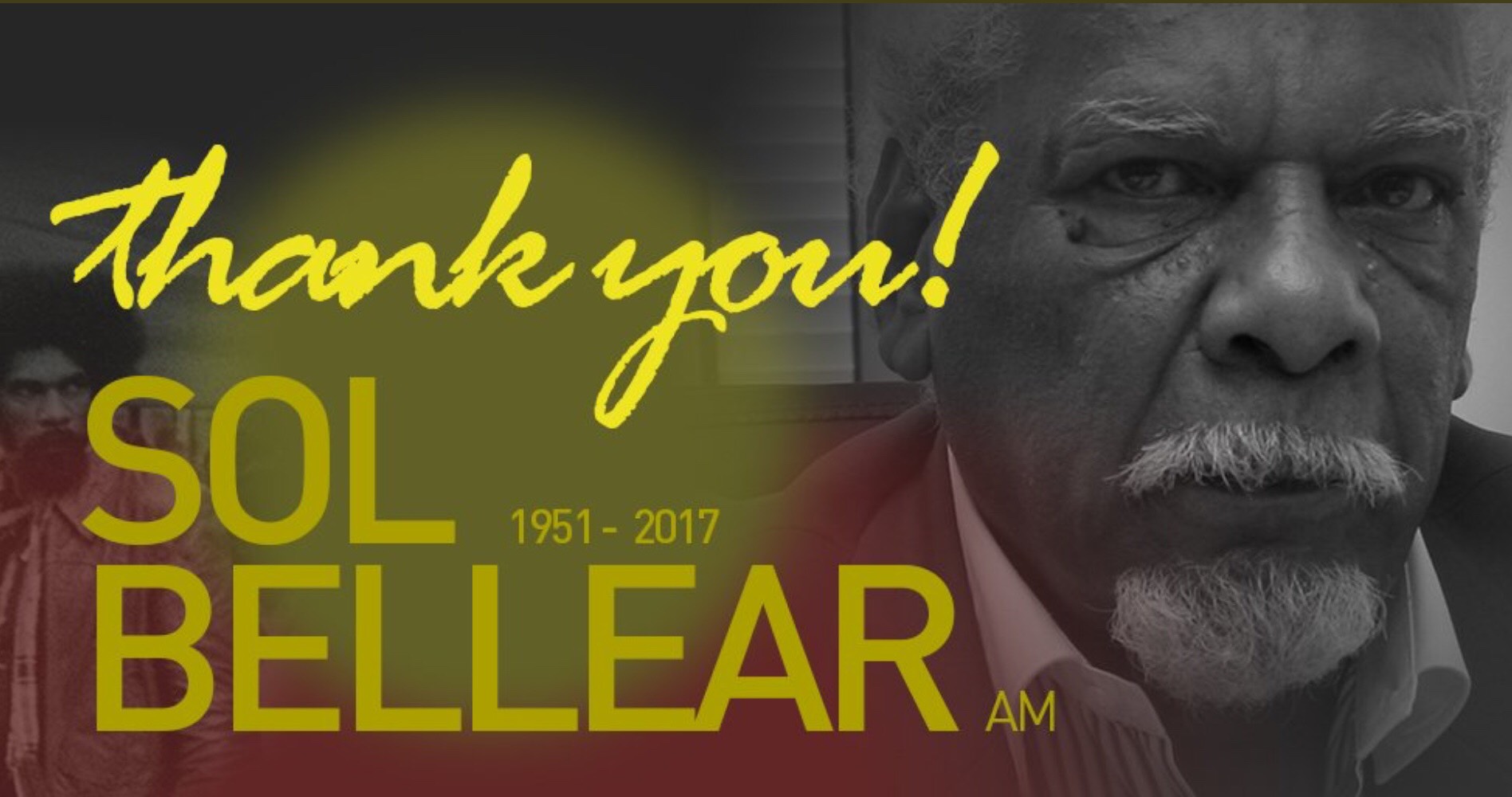
NACCHO tribute and Bellear family thank you : #SolsLastMarch #StateFuneral for Sol Bellear AM ” Remembered as a giant of a man “


” Sol was giant of a man who made a giant contribution to self-determination for our people right throughout the land , one who would now take his honoured place amongst his very honoured ancestors.

News of his sudden death last week had sent shockwaves through Aboriginal Australia”.

Pat Turner, Chief Executive of NACCHO : National Aboriginal Community Controlled Health Organisation speaking at the State Funeral about her long term friendship and respect for Sol Bellear.  Pictures above Michelle Lovegrove

See full NACCHO Tribute to Sol Bellear AM Press Release

NACCHO tribute to Sol Bellear AM Aboriginal activist

NACCHO was also represented by Current Chair John Singer and Past Chairs Pat Anderson , Matthew Cooke and Justin Mohamed.

 ” We will always be grateful for the many expressions of kindness, love and support we have received following the loss of our father and brother, Sol Bellear, who passed away peacefully at home on Wednesday night, 29 November.

We have been overwhelmed by the numbers of people who have reached out to us in this very difficult time. Sol touched many lives in the movement for Aboriginal rights, the game of rugby league and the community of Redfern that he loved.  Now the people whose lives he touched are comforting us with their memories of him.”

Statement from the family of  Solomon David “Sol” Bellear AM

Sol stood for many things including self-determination, proper treaties with our people, Aboriginal control of our people’s health and legal services, Land Rights and a better understanding of our history.

Although, Sol achieved many great victories, much of this work remained unfinished at the end of his life. We ask all those who loved Sol to please continue his work so that the vision he had for his country and people might one day be fulfilled.

One of Sol’s last wishes was for the Sydney City Council to erect a plaque at Redfern Park to help people remember and reflect on the Redfern Speech delivered on that site by former Prime Minister, Paul Keating.

We will always treasure the time we had with him. He was the most loving and committed Father, Brother, Poppy and Uncle any family could hope for.=

We would like to particularly thank the NSW Premier and the staff from her Department, the NSW Aboriginal Land Council, Joshua Roxburgh and our brother, Shane Phillips for their generous assistance in organising Sol’s funeral.

 Sol Bellear remembered as giant at state funeral

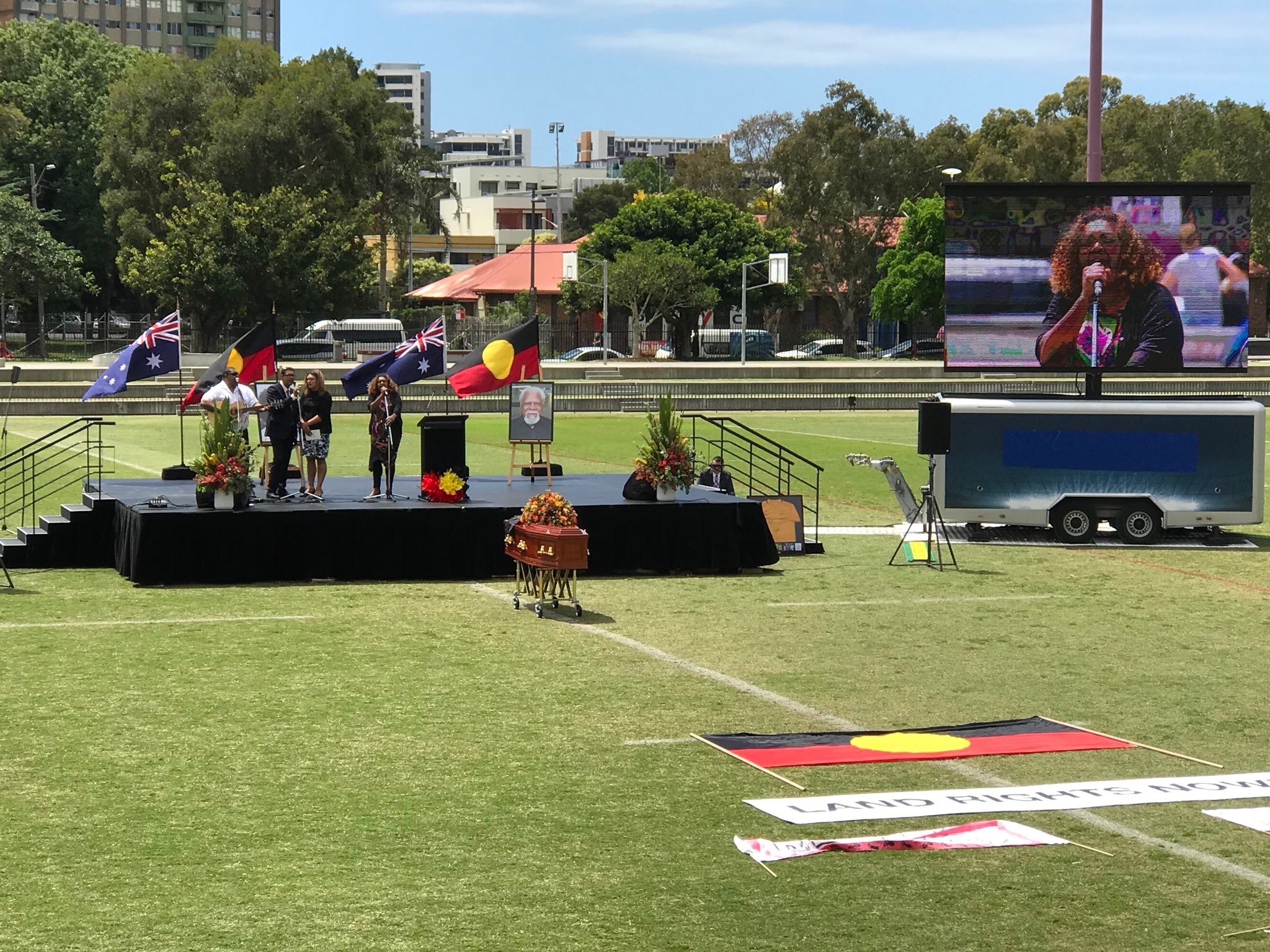
Aboriginal land rights and health activist Sol Bellear has been remembered as a giant of indigenous advancement at a state funeral on Saturday at Redfern Oval in Sydney, the spiritual home of his beloved South Sydney Rabbitohs.

From the Australian

It was a mark of the man, mourners heard, that after being dropped as a player from the Rabbitohs squad after raising a black-power salute on scoring a try at the ground, he was within a year serving on the rugby league team’s board.

“He carried a great personal weight on his shoulders because he was a strong man,” fellow activist Paul Coe, one of the leaders with whom Bellear founded the Aboriginal tent embassy at the then parliament house in 1972, said.

“He would stand his ground no matter what or no matter who was opposing him.”

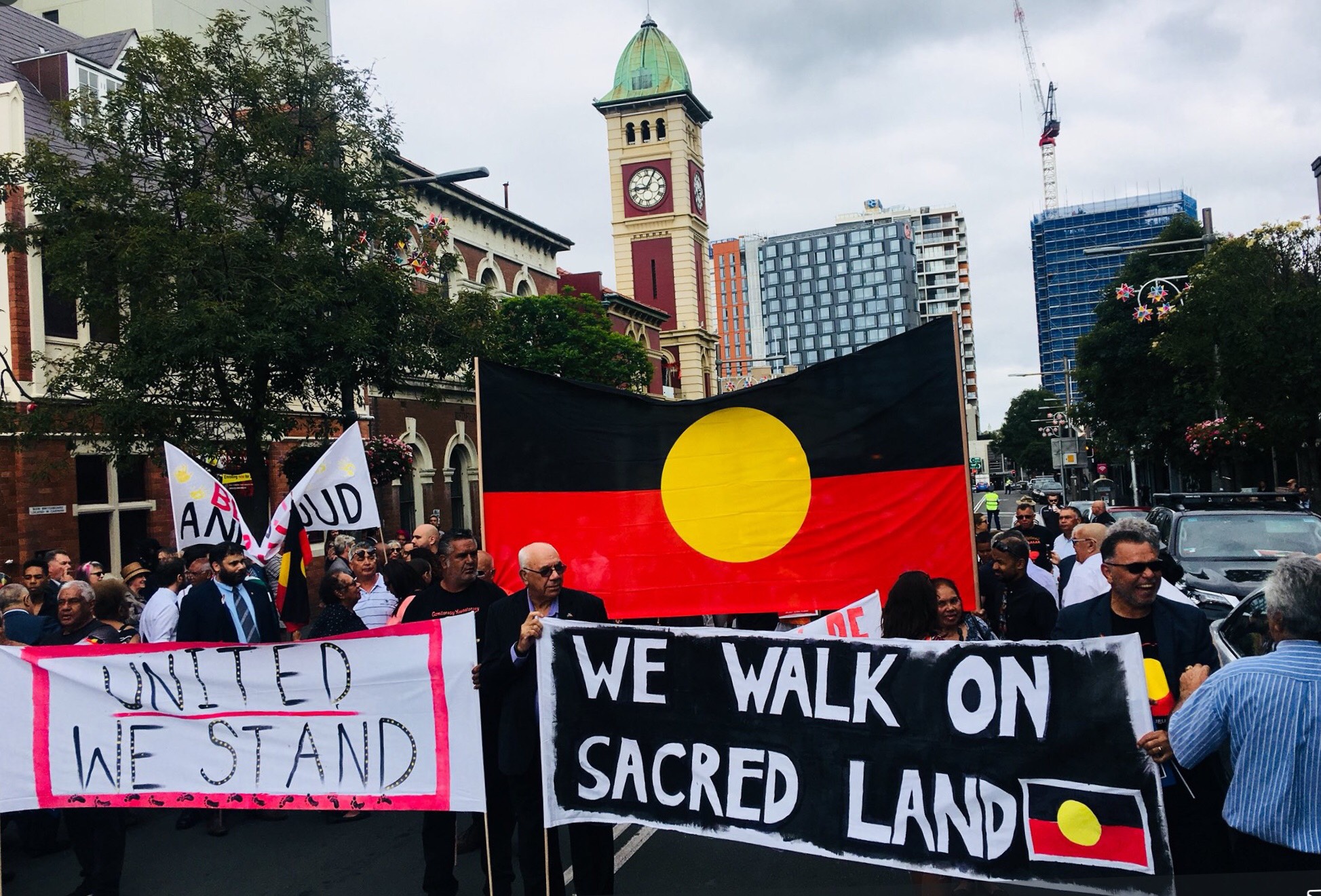
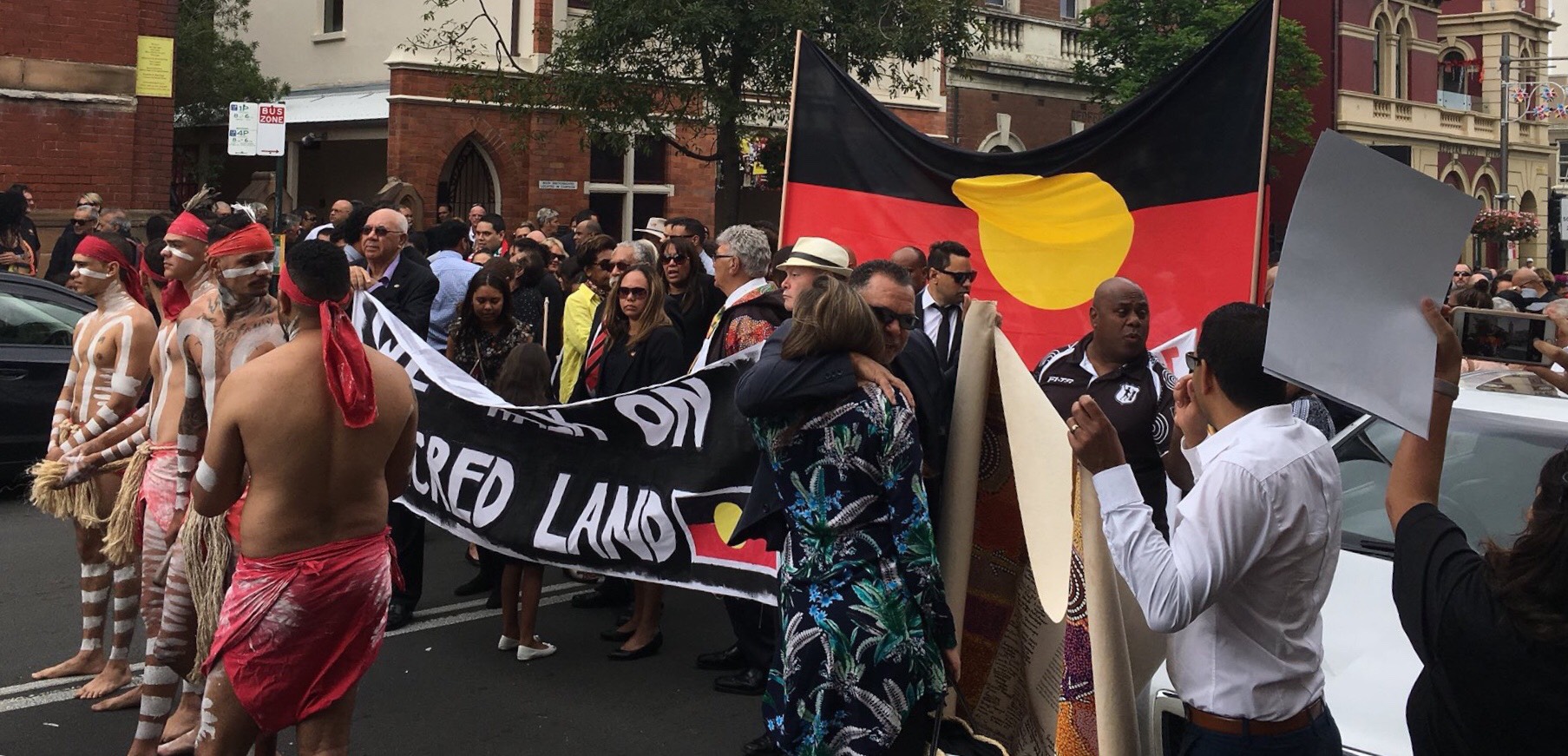
Bellear was joined in one final march to the football ground from the nearby Aboriginal Medical Service in Redfern, an institution which mourners including NSW Governor David Hurley and wife Linda heard was one of his great legacies.

Sols Last March with 3,000 family and friends

The march ended at the park where, exactly 25 years ago tomorrow, Bellear led Paul Keating to the stage to deliver the then prime minister’s famous oration admitting white Australia’s culpability in the poor state of indigenous affairs.(see Picture in Part 1 above )

“He stood proud and he stood tall but he was not egotistical,” Mr Coe said.

“I’ve seen him give money out of his own pocket to people on the streets. This is the kind of man that he was — a kind of man you could admire but not completely understand.

“In those days as young students, trying to work out who and what we were, it was very hard to make ends meet. But he would always give of himself, both time and energy.”

A Bundjalung man from Mullumbimby in northern NSW, Solomon David Bellear, who was 66, leaves partner Naomi and children Tamara and Joseph. He was made a member of the Order of Australia in 1999 for services to the Aboriginal community, in particular in the field of health. His brother Bob, who died a decade ago, was the first Aboriginal judge.

In a letter from grand-daughter Rose read out at the service, Bellear was bid a “merry Christmas in the dreamtime” and the hope he had travelled there safely with his totem, the carpet snake.

Bellear’s achievements were legion. He was the founding chair of the Aboriginal Legal Service, a founding member of the Aboriginal Housing Company, an Aboriginal delegate to the UN General Assembly, player and director at the Rabbitohs, a foundation player with the Redfern All Blacks in the NSW Aboriginal Rugby League Knockout, a manager with the indigenous dreamtime and All Stars rugby league teams, and deputy chair of the former Aboriginal and Torres Strait Islander Commission.

undefined

Sol Bellear, whose funeral was held on Saturday. Picture: Dan Himbrechts

Ken Wyatt, federal Minister for Indigenous Health and Aged Care, said on Friday Bellear had “played a key role in establishing medical, housing, land rights and legal services for Aboriginal people and remains a towering figure on the journey towards justice for our people”.

He was remembered as being crucial to the consensus position developed at the Indigenous constitutional convention held in Central Australia in May this year, when disparate ambitions for reform were distilled into the Uluru Statement from the Heart.

Singer Emma Donovan opened the funeral with the touchstone Land Rights Song, whose memorable lines “they keep on saying everything’s fine, still they can’t see us cry all the time” seemed particularly apt.

Bellear’s casket was borne from the park by a cortege including members of his beloved Redfern All Blacks, whose members linked arms to sing their team song for him one last time. His casket was draped with a Rabbitohs scarf, the hearse with an Aboriginal flag.

As it set off one final, slow, lap of the oval, fists were raised in a black-power salute

Aboriginal Community Controlled Health #JobAlerts #Doctors #RMA17 #OTCC2017 This weeks @DanilaDilba @CAACongress @ahmrc @IUIH_

This weeks #Jobalerts

Please note  : Before completing a job application please check with the ACCHO or stakeholder that job is still available

1-8 Danila Dilba ACCHO Darwin 8 Positions

9. Senior Rural Medical Practitioner – Port Augusta

10.Nhulundu Health Service : General Practitioner : Gladstone QLD

11. TRACHOMA ENVIRONMENTAL IMPROVEMENTS MANAGER

12. Katungul Aboriginal Corporation Community NSW  : Medical Practitioner 

13. Miwatj Health NT Tackling Indigenous Smoking Community Worker

14-18 Congress ACCHO Alice Springs

19-20. AHMRC full-time Vacancies

 21 – 22 JOBS AT IUIH Brisbane

23. Poche Centre for Indigenous Health : Research Associate, Breathe Easy Walk Easy Lungs for Life

VIEW Hundreds of past Jobs on the NACCHO Jobalerts


How to submit a Indigenous Health #jobalert ? 

NACCHO Affiliate , Member , Government Department or stakeholders

If you have a job vacancy in Indigenous Health 

Email to Colin Cowell NACCHO Media

Tuesday by 4.30 pm for publication each Wednesday

1-8 Danila Dilba ACCHO Darwin 8 Positions

1 Aboriginal Health Practitioner (AHP) / Registered Nurse
2 Transport Officer
3 Team Leader, Deadly Choices
4 Manager – Marketing and Communications
5 Team Leader, Mobile Unit
6 Community Support Worker (AOD)
7 Indigenous Outreach Worker (Palmerston)
8 Clinical Psychologist

WEBSITE

9. Senior Rural Medical Practitioner – Port Augusta


Established in the early 1970’s, Pika Wiya Health Service Aboriginal Corporation provides culturally appropriate, comprehensive primary health care services, social support and training to all Aboriginal and Torres Strait Islander people.

The organisation operates from its premises in Port Augusta and also has clinics at Davenport, Copley and Nepabunna communities. Pika Wiya Health Service Aboriginal Corporation also provides services to the communities of Quorn, Hawker, Marree, Lyndhurst and Beltana.

About the Opportunity

Pika Wiya Aboriginal Health Service Aboriginal Corporation (Pika Wiya) now has a full-time opportunity for a Senior Rural Medical Practitioner to join their team in Port Augusta, SA.

Reporting to the Medical Director, you will be responsible for the provision of high-level primary health care, ensuring continuity care for individuals, and for prevention programs for the population.

This will be done primarily through the Port Augusta clinic (bulk-billing clinic) – servicing a combination of booked and walk in clients – and also by visiting a remote clinic once a month.

To be successful in this position, you will hold an AHPRA recognised medical degree including general or specialist registration and a Medicare Australia Provider Number.

You will also have demonstrated experience working in a medical practice and have the ability to provide high-quality clinical skills in a rural general practice. Additionally, you must have a good knowledge of the Australian health system and the Medicare billing system.

It is crucial to this role that you have a good understanding of Aboriginal community and health and be willing to involve yourself in the community.

About the Benefits

In return for your hard work and dedication, you will be rewarded with an attractive base salary of $225,000 plus super.

You will also be eligible generous salary packaging, up to$16,000 through Maxxia, to increase your take home pay!

Pika Wiya is also willing to negotiate relocation assistance and accommodation subsidies for the right candidate.

Make a real difference to the health and well-being of a vibrant community – Apply Now!

10.Nhulundu Health Service : General Practitioner : Gladstone QLD

 General Practitioner

(Full time positions based in Gladstone)

Nhulundu Wooribah Indigenous Health Organisation Inc. (“Nhulundu”) is an Aboriginal Community Controlled Health Service delivering an integrated, comprehensive primary health care service to the whole Gladstone community.

Services include; bulk billing GP services, chronic disease management program, diabetes education, health promotion programs, mums and bubs clinic, aged care and community support service functions.

The position is responsible for providing best practice comprehensive primary health care. Leadership in the safety and quality of clinical services delivered by the health team. Optimising uptake and income generation across the service through MBS billings

This is an exciting opportunity to join an enthusiastic and committed team and make a direct impact on improved health outcomes in the community.

  • Competitive Salary Package – including salary sacrifice
  • Well Balanced working environment – Hours = Monday – Friday 8.30 – 5.00pm

Key Requirements include

  • Qualified Medical Practitioner, holding unconditional current registration with the Medical Board of Australia
  • Eligible for unrestricted Medicare Provider Number
  • Vocational Registration preferred
  • Knowledge, understanding and sensitivity towards the social, economic and cultural factors affecting Aboriginal and Torres Strait Islander people’s health; An ability to communicate and empathise with Aboriginal and Torres Strait Islander people

You will be supported by a team of dedicated clinic staff including Registered Nurses Aboriginal Health Workers, the Tackling Indigenous Smoking team, Dietician/Diabetes Educator, Medical Receptionist, Practice Manager and visiting Specialists and Allied Health providers

Enquiries and Applications (Resume) can be addressed to:

Karen Clifford – Business Service Manager:

By Email: jobs@nhulundu.com.au

By Phone: 0428 228 851


11. TRACHOMA ENVIRONMENTAL IMPROVEMENTS MANAGER

Job no: 0044056
Work type: Fixed Term
Location: Parkville

Indigenous Health Equity Unit
Centre for Health Equity, Melbourne School of Population & Global Health
Faculty of Medicine, Dentistry and Health Sciences

Salary: $99,199 – $107,370 p.a. plus 9.5% superannuation

The Trachoma Environmental Improvements Manager (TEIM) plays an important role to drive activities and provide focus on the “Environmental” element of the World Health Organisation SAFE strategy to eliminate trachoma. The position will: advocate for safe and functional washing facilities (bathrooms) and work to enhance coordination, collaboration and cooperation between key players at the State and Territory, regional and local levels in health including environmental health, housing, infrastructure and education in targeted regions and remote communities in the tri-state border region of NT, SA, and WA.

The Trachoma Environmental Improvements Manager will be based in Alice Springs and work closely with the Indigenous Eye Health (IEH) Trachoma Coordinator who is also based in Alice Springs.

The position requires travel by vehicle or plane to remote areas of NT, South Australia and Western Australia. Travel to Melbourne and other Australian destinations will also be required from time to time.

IEH strongly encourages applications from Indigenous Australians.

Close date: 22 Oct 2017

Position Description and Selection Criteria

Download File 0044056.pdf

For information to assist you with compiling short statements to answer the selection criteria, please go to http://about.unimelb.edu.au/careers/search/info/selection-criteria

 12. Katungul Aboriginal Corporation Community NSW  : Medical Practitioner 


Katungul ACCMS is an Aboriginal Community controlled corporation providing community and health services to Aboriginal Australians located in the South Coast of NSW. Katungul has recently been recognised for its excellence in business in the Eurobodalla and Far South Coast NSW Business Awards.
The role will involve working with a multi disciplinary team of health workers and other staff to provide culturally attuned, integrated health and community services on the Far South Coast of New South Wales.
Applicants will ideally be fully accredited as General Practitioners with experience working in an Aboriginal Medical service. However other General Practitioners  who do not meet this criteria will be considered.
Remuneration and terms of employment will be negotiated with the successful candidate(s).
Enquries should be directed to Chris Heazlewood, Human Resources Manager on 02 44762155 or by email chrish@katungul.org.au

 Download Position description  

MEDICAL PRACTITIONER October 2017

13. Miwatj Health NT Tackling Indigenous Smoking Community Worker

Job No: MHAC19
Location: Ramingining
Employment Status: Part Time
No. of Vacancies: 2
Closing Date: 30 Dec 2020

Miwatj Health Aboriginal Corporation is the regional Aboriginal Community Controlled Health Service in East Arnhem Land, providing comprehensive primary health care services for over 6,000 Indigenous residents of North East Arnhem and public health services for close to 10,000 people across the region.

Tackling Indigenous Smoking Community Worker .5

Are you reliable, self-motivated and hardworking? Do you want to make a difference to Indigenous health? You will work with individuals, clients, families and communities to help quit tobacco use. You will deliver and promote healthier life choices and encourage smoke free behaviour. You will report to the Coordinator TIS on progress and issues. You will need to maintain confidential client information, have the ability to speak and understand Yolngu Matha and have a good understanding of Yolngu kinship and traditional systems.

You must have a current NT Class C Drivers License and a current Ochre Card (or the ability to obtain one).

Click here for Job Description

Aboriginal and Torres Strait Islanders are encouraged to apply.

14-18 Congress ACCHO Alice Springs

Thank you for your interest in working with Congress!

CONGRESS HR Website

We have two types of applications for you to consider:

General Application

  • Submit an expression of interest for a position that may become available.
  • This should include a covering letter outlining your job interest(s), an up-to-date resume and three current employment referees.

Applying for a Current Vacancy

  • Applying for a specific advertised vacancy.
  • Before applying for any position general or current please read the section ‘Job App FAQ‘.

TRANSPORT OFFICER

Hourly Rate: $22.78 + 25% casual loading

Location: Alice Springs | Job ID: 3696530| Closing Date: 01 Dec 2017

GENERAL PRACTITIONER – ALICE SPRINGS

Central Australian Aboriginal Congress (Congress) has over 40 years’ experience providing comprehe …

Location: Alice Springs | Job ID: 3677297| Closing Date: 30 Dec 2017

EXPRESSIONS OF INTEREST – EARLY CHILDHOOD EDUCATORS

Multiple Positions Available

Location: Alice Springs | Job ID: 3683459

EXPRESSIONS OF INTEREST- CLIENT SERVICE ROLES

Client Service Officer     …

Location: Alice Springs | Job ID: 3672944| Closing Date: 31 Dec 2017

EXPRESSIONS OF INTEREST- CLINICAL ROLES

Location: Alice Springs | Job ID: 3672893 | Closing Date: 31 Dec 2017

19-20 . AHMRC full-time Vacancies


To receive a copy of the Recruitment Information Package for more information and the selection criteria, please contact HR via email or telephone. The selection criteria must be addressed for your application to be considered.

19.Research, Training and Workforce Development Manager

Located at Little Bay at the Aboriginal Health College.

For a position description please email hr@ahmrc.org.au

Applications close: Monday, 23 October 2017.

20.Government Policy and Partnership Manager

Located at our main office in Surry Hills

This is an Identified Position.

For a position description please email hr@ahmrc.org.au

Applications close: Monday, 23 October 2017.

For a confidential conversation please contact Human Resources on (02) 9212 4777 or email gagic@ahmrc.org.au

Pursuant to Section 14(d) of the Anti-Discrimination Act 1977 (NSW), Australian Aboriginality is a genuine occupational qualification for this position and is identified as an essential pre-requisite for appointment to the role of Chief Executive Officer, under AH&MRC Constitutional Rules.

Aboriginal and/or Torres Strait Islander people are strongly encouraged to apply.

21 – 22 JOBS AT IUIH Brisbane


IUIH and its members are constantly looking for healthcare workers, GP’s, allied health professionals, medical and health related students to fill short or long term vacancies within their growing operations.Current job opportunities are listed below:


Website HERE

23. Research Associate, Breathe Easy Walk Easy Lungs for Life

Faculty of Health Sciences

Physiotherapy and Poche Centre for Indigenous Health

The Poche Centre for Indigenous Health, is situated on the Camperdown campus of the University of Sydney

The primary aim of the Poche Centre is to contribute to the reduction of disparities in Indigenous Health and social justice outcomes through collaboration with health research organisations including Aboriginal and Torres Strait Islander controlled organisations, other community organisation and government.
A PhD scholarship is available for an Aboriginal and/or Torres Strait Islander identified person through a NHMRC funded project: Implementing evidence into practice to improve chronic lung disease management in Indigenous Australians: the Breathe Easy, Walk Easy – Lungs for Life (BE WELL) project.


While the project title suggests that the PhD topic could be in lung health, there are opportunities for the PhD student to choose a PhD topic within his/her interest, for example, health service delivery, education of Aboriginal Health Workers, models of best practice etc.
The PhD student will be able to work with a very supportive group and could be located either in the Poche Centre for Indigenous Health on the Camperdown Campus or in the Faculty of Health Sciences on the Cumberland Campus of the University of Sydney. In both these locations other Aboriginal and Torres Strait Islander people are enrolled in PhD programs and would provide a collaborative and engaging environment.

The PhD scholarship is for a part-time PhD at $27,000 per year (tax free) for 3.5 years or a part-time PhD combined with the part-time Project Manager role, which attracts a substantial full-time salary and a 5 year appointment.

All applications must be submitted via the University of Sydney careers website.  Visit sydney.edu.au/recruitment and search by the reference number 1695/0917 to apply.

Closing: 11:30pm 19 October 2017

The University of Sydney has established the Merit Appointment Scheme to increase the number of Aboriginal and Torres Strait Islander staff employed across the institution. Under this scheme an applicant’s Aboriginality is an essential selection criterion and is authorised under the provisions of the Anti-Discrimination Act 1977.


NACCHO Aboriginal Healthy Futures #closethegap #socialdeterminants @pmc_gov_au Debate : Where to from here?


” Federal Indigenous affairs bureaucrats have released a draft of their new evaluation framework, eight months after the Commonwealth committed $40 million over four years to evaluate policies in the portfolio and put a highly regarded university professor in the driving seat.

The draft sets out processes to look more objectively at national policies to support Aboriginal and Torres Strait Islander communities and contribute to Closing the Gap, which have been led by the Department of the Prime Minister and Cabinet for the past few years.”This is intended to align with the role of the Productivity Commission in overseeing the development and implementation of a whole of government evaluation strategy of policies and programs that effect Indigenous Australians,”

PM&C sets high standards for Indigenous affairs evaluation see PART 1 Below

 ”  It’s been widely known for fifty years that the health of Aboriginal people lags far behind that of other Australians. Despite that and the expenditure of billions of taxpayers’ dollars, serious gaps persist between Indigenous versus non-Indigenous health and wellbeing.

There is compelling evidence that social factors are potent determinants of the health of populations. In the simplest of terms these are (a) social disadvantage, and (b) the relationship of Indigenous Australians to mainstream society. Associated with these are basic issues already mentioned; these include education, housing standards, employment and socio-economic status. These must be addressed if health disadvantages are to be overcome. Until this happens the poor health outcomes of Indigenous Australians will persist.

It’s easy to identify medical problems, perhaps because they can be classified and measured. It is tempting then to decide that these problems are ‘medical’ and, therefore, should respond to ‘medical’ interventions or approaches in isolation. This is dangerously misleading.

It’s time for clinicians to realise and publicly acknowledge that most of the important issues which determine the health status of Indigenous people have ‘non-medical’ roots and need vigorous ‘non-medical’ approaches in order to be corrected.

 MICHAEL GRACEY. Aboriginal health: An embarrassing decades-long saga See Part 2 Below

Part 1

Around the same time as the new evaluation funding was announced, Malcolm Turnbull sought out indigenous health expert Ian Anderson to take over as deputy secretary leading the PM&C indigenous affairs group, which is also the only group within the central department overseen by an associate secretary, Andrew Tongue.

FROM The Mandarin

Anderson’s first major task was a review of the Closing the Gap target framework, which focuses attention on particular indicators of disadvantage. A few months into the job he set out some of his thoughts in a public speech at a special event marking 50 years since the referendum that effectively created this area of federal policy.

The framework notes good evaluation is “planned from the start, and provides feedback along the way” (referencing the audit office’s 2014 better practice guide to public sector governance).

“Good evaluation is systematic, defensible, credible and unbiased. It is respectful of diverse voices and world-views.

“Evaluation is distinct from but related to monitoring and performance reviews. Evaluation may use data gathered in monitoring as one source of evidence, while information obtained through monitoring and performance reviews may help inform evaluation priorities.”

The credibility of future evaluations depends on demonstrating their independence. To this end, the framework says a new external advisory committee, membership so far unknown, will “support transparency and ensure the conduct and prioritisation of evaluations is independent and impartial” by overseeing how the new framework is applied, checking the annual evaluation plan and with “ongoing advice, quality assurance and review”.

A “commitment to transparency” is also included. The committee will publish “all high priority evaluations” and reviews of them. Others will be randomly reviewed and summarised in an annual report.

“At the three year mark an independent meta-review of IAG evaluations will be undertaken to assess the extent to which the Framework has achieved its aims for greater capability, integration and use of robust evaluation evidence against the standards described under each of the best practice principles.”

All the actual evaluation reports will be published as well, at least in summary form, including “where ethical confidentiality concerns or commercial in confidence requirements” apply. Indigenous communities that have participated in evaluations will get to see the results too and additional “knowledge translation” efforts are proposed:

“Evaluation findings will be of interest to communities and service providers implementing programs as well as government decision-makers. Evaluation activities under the Framework will be designed to support service providers in gaining feedback about innovative approaches to program implementation and practical strategies for achieving positive outcomes across a range of community settings.”

The draft framework says it aims to:

  • generate high quality evidence that is used to inform decision making,
  • strengthen Indigenous leadership in evaluation,
  • build capability by fostering a collaborative culture of evaluative thinking and continuous learning across the IAG and more broadly across communities and organisations, and
  • place collaboration and ethical ways of doing high quality evaluation at the forefront of evaluation practice in order to inform decision making.

Higher quality evaluation that is “ethical, inclusive and focused on improving outcomes” is more likely to have impact, the draft points out. “It aims to pursue consistent standards of evaluation of Indigenous Advancement Strategy (IAS) programs but not impose a ‘one-size-fits-all’ model of evaluation.”

The guide calls for best-practice evaluation to be “integrated into the cycles of policy and community decision-making” in a way that is “collaborative, timely and culturally inclusive.”

“Our approach to evaluation, as outlined in this Framework, reflects a strong commitment to working with Indigenous Australians.

“Our collaborative efforts centre on recognising the strengths of Aboriginal and Torres Strait Islander peoples, communities and cultures.

“Fostering leadership and bringing the diverse perspectives of Indigenous Australians into evaluation processes helps ensure the relevance, credibility and usefulness of evaluation findings. In evaluation, this means we value the involvement of Indigenous Australian evaluators in conducting all forms of evaluation, particularly using participatory methods that grow our mutual understanding.”

Indigenous Advancement Strategy evaluations will look at how well programs meet three criteria:

Do they build on strengths to make a positive contribution to the lives of current and future generations of Indigenous Australians?

Are they designed and delivered in collaboration with Indigenous Australians, ensuring diverse voices are heard and respected?

Do they demonstrate cultural respect towards Indigenous Australians?

Four elements of good evaluation

The draft framework lists four elements of good evaluations — they are robust, relevant, credible and appropriate, which is to say they are “fit for purpose” and done in a timely fashion — and explains in detail how each of these ideals is to be achieved in Indigenous affairs through higher standards.

“Evaluation needs to be integrated into the feedback cycles of policy, program design and evidence-informed decision-making,” explains a chapter on relevance. “Evaluation feedback cycles can provide insights to service providers and communities to enhance the evidence available to support positive change. This can occur at many points in the cycle.”

While not being too prescriptive, the framework aims to set a high standard for the evidence that is used to judge the impact of programs.

“A range of evaluation methodologies can be used to undertake impact evaluation. Evaluations under the Framework will range in scope, scale, and in the kinds of questions they ask. Measuring long-term impact is challenging but important. We need to identify markers of progress that are linked by evidence to the desired outcomes.

“The transferability of evaluation findings are critical to ensure relevant and useful knowledge is generated under the Framework. High quality impact evaluations use appropriate methods and draw upon a range of data sources both qualitative and quantitative.

“Evaluation design should utilise methodologies that produce rigorous evidence and make full use of participatory methods. Use of participatory approaches to evaluation is one example of demonstrating the core values of the Framework in practice.”

Perhaps the moves to take a more academic approach at the federal level will allow for more open discussion of what works, in a portfolio where this year the minister has seen fit to publicly attack researchers in the field, and blast the independent audit office for doing its job instead of helping him attack the opposition.

Part 2 :  Aboriginal health: An embarrassing decades-long saga

It’s been widely known for fifty years that the health of Aboriginal people lags far behind that of other Australians. Despite that and the expenditure of billions of taxpayers’ dollars, serious gaps persist between Indigenous versus non-Indigenous health and wellbeing.

Recognition of an Aboriginal Health Problem

When these inequities were recognised in the 1960s the very high rates of Aboriginal childhood malnutrition and infections and high death rates of infants and young children brought home the unpalatable fact that Australia had a so-called ‘Third World’ health problem. This is a feature of poverty-stricken nations. This was clearly unacceptable in our otherwise affluent and healthy country. There was a public outcry which stirred the federal government into attempts to remedy this embarrassing state of affairs.

In 1979 the Commonwealth Parliamentary Committee on Aboriginal Affairs found that . . .

‘the appalling state of Aboriginal health’ . . . ‘can be largely attributed to the unsatisfactory environmental conditions in which Aboriginals live, to their low socio-economic status in the Australian community, and to the failure of health authorities to give sufficient attention to the special needs of Aboriginals and to take proper account of their social and cultural beliefs and practices’ . . .

The Committee criticised governments for their lack of recognition of these factors and commented on the need for Aboriginal people to be much more closely involved in all stages of planning and delivering their own health care. Notwithstanding some improvements in Indigenous health which occurred over the almost forty years that followed, many of that Committee’s findings and criticisms are still valid.

Efforts to Improve Indigenous Health

In 1981 a $50 million Aboriginal Health Improvement Program was launched with the aim of upgrading environmental health standards, such as better housing and community and family hygiene conditions. Government funds were allocated and State and Territory health departments implemented strategies and programs and deployed clinical and allied staff in order to achieve better Indigenous health.

An important objective was to provide more accessible services for Indigenous people. Some positive health gains followed; for example, better pregnancy outcomes, fewer maternal deaths, fewer infant and young child infections, suppression of vaccine-preventable illnesses through immunisation, and lower infant death rates.

This should have helped Indigenous youngsters to negotiate the rough ride through early life that would otherwise have been their lot. However, health and disease statistics for Indigenous Australians generally stayed well behind those of other citizens in the years that followed.

Strategies to ‘Close the Gap’

The persisting poor standards of Indigenous health prompted the Federal Government in 2008 to ‘Close the Gap’ for Indigenous Australians in a range of health outcomes and other facets of life and wellbeing so that they and other Australians would have ‘equal life chances’. The then Prime Minister Rudd anticipated within a decade halving the widening gap in literacy, numeracy and employment opportunities for Indigenous people. The Statement of Intent also anticipated better opportunities for Indigenous children so that within a decade . . . “the appalling gap in infant mortality rates between Indigenous and non-Indigenous children would be halved and, within a generation, the equally appalling 17-year life gap between Indigenous and non-Indigenous when it comes to overall life expectancy” . . .  would be gone.

These aspirations seemed commendable and were well received by the public. However, their feasibility was questioned soon after they were announced. The target of closing the gap in life expectancy was said to be “probably unattainable” and the capacity to extinguish the risk of chronic diseases (like heart disease, diabetes and kidney disease) and related deaths was considered publicly by a renowned medical expert to be “implausible” in the 22-year timetable set out by the government. This is pertinent because those chronic diseases are the main contributor to the discrepancy in Indigenous versus non-Indigenous deaths. Those reservations were well founded.

Obstructions to Closing the Gap

Indigenous Australians now have very high rates of chronic diseases, as already mentioned. These are aggravated by smoking- and drug-related disorders. These conditions are long-term and have permanent complications, such as visual loss or blindness, or severe limitations on mobility. These cannot be reversed and, therefore, restrict prospects for longevity. In many Aboriginal communities a third or half of adults 35 years or over have one or more of these problems. Nationally, these diseases and accidental or intentional injuries, including suicide and homicide, are several times more prevalent in Indigenous Australians than in the total Australian population.

This well-documented and widespread heavy burden of illnesses, disabilities and related excess premature deaths among Indigenous Australians makes it virtually impossible to remove, within a generation, the inequalities between this pattern and the better outcomes which prevail in the rest of the population. This is made more difficult because some of these problems are trans-generational and can have their origins during intra-uterine development.

There are practical impediments in bringing better health to the Indigenous population. Inadequate access and maldistribution of facilities, personnel and services can be serious drawbacks, particularly in rural and remote areas. Of course, improving access to services does not necessarily lead to their appropriate utilisation.

And compliance with treatments and follow-up supervision and medications can be problematic. Similarly, altering health knowledge and modifying risky personal lifestyles are difficult among many people whether they are Indigenous or not. There have also been serious problems with management and governance of clinical services for Indigenous people whether they are Indigenous-specific or mainstream services.

This has tended to weaken their impact on health service delivery and waste limited financial and other resources. Collectively, all of these factors have diluted the much-needed positive outcomes of efforts to close the gaps in Aboriginal health standards and statistics.

Indigenous Health: the current situation

Some indicators of the current situation are revealing: death rates of Indigenous children under five years are more than double the national rates; their low birth weight rate is about double the overall national rate; hospitalisation rates are almost three times the national rates; hospital admission rates for potentially preventable conditions are almost four times higher; deaths from complications of diabetes at 35 to 55 years are approximately twenty times higher; and dementia rates are about five time higher than in non-Indigenous Australians and the  condition starts earlier in life. The Australian Institute of Health and Welfare estimated that among Indigenous Australians born from 2010 to 2012 life expectancy would be about nine to ten years shorter than for other Australians. These indicators of health status, illness patterns and life expectancy are disgraceful and require urgent attention.

Where to from here?

 The targets set to be met by the Close the Gap Strategy are reported publicly each year. Regrettably, the goals are falling short in many of the government’s nominated areas. These include several of the health-related areas which have been mentioned.
Tellingly, the targets are not being met in many other facets of Indigenous life which have significant impacts on physical, emotional and mental health and wellbeing.

These include, for example, early childhood schooling rates, closing the gaps in literacy and numeracy for older Indigenous schoolchildren, achieving equity in employment rates and the economic benefits which should follow, having Indigenous people housed in adequate and hygienic living conditions, and being more engaged with the wider Australian community in various day-to-day activities. These failures have been publicly acknowledged by successive Prime Ministers including Abbott and Turnbull.
In the health arena itself there is a need for closer cooperation and collaboration between the three main sectors which provide curative and health promotion activities for Indigenous people. These sectors are: (a) mainstream services provided by governments; (b) Indigenous-specific services from Aboriginal or Indigenous Health or Medical Services; and (c) privately funded clinical and allied services. There is often overlapping of these sectors and, sometimes, issues of territoriality which detract from their effectiveness and, potentially, add to the financial costs involved.
As mentioned by that Parliamentary Committee as far back as 1979, there is a pressing need for more Indigenous involvement and responsibility for decision-making and delivery of their own health services. Although this is improving slowly, there is a long way to go before those people who need the services have the power to help control their own future health. This is particularly so in remote areas where local communities and their committees are often sidelined from this important function.

Social Dimensions which affect Health

There is compelling evidence that social factors are potent determinants of the health of populations.

In the simplest of terms these are (a) social disadvantage, and (b) the relationship of Indigenous Australians to mainstream society. Associated with these are basic issues already mentioned; these include education, housing standards, employment and socio-economic status.

These must be addressed if health disadvantages are to be overcome. Until this happens the poor health outcomes of Indigenous Australians will persist.

It’s easy to identify medical problems, perhaps because they can be classified and measured. It is tempting then to decide that these problems are ‘medical’ and, therefore, should respond to ‘medical’ interventions or approaches in isolation. This is dangerously misleading. It’s time for clinicians to realise and publicly acknowledge that most of the important issues which determine the health status of Indigenous people have ‘non-medical’ roots and need vigorous ‘non-medical’ approaches in order to be corrected. This means, of course, that non-medical sectors of governments must accept more responsibility and become more actively involved in issues which ultimately determine the health of populations which they are expected to serve. This will require a major shift in thinking within Federal and State governments and bureaucracies and wider acceptance among the Australian community.

The challenges are daunting but the need is urgent. Surely it is within our collective capabilities to turn around this sad and long-standing saga into a success story.

Michael Gracey AO is a paediatrician who has worked with Indigenous children, their families and communities for more than forty years. He was Australia’s first Professor of Aboriginal Health and for many years was Principal Medical Adviser on Aboriginal Health to the Western Australian Department of Health. He is a former President of the International Paediatric Association.

Aboriginal Community Controlled Health #NACCHOagm2017 21 days to go This weeks #jobalerts Inc @CAACongress @ahmrc @IUIH_

This weeks #Jobalerts

Please note  : Before completing a job application please check with the ACCHO or stakeholder that job is still available

1.Nhulundu Health Service : General Practitioner : Gladstone QLD

2.RVTS AMS Doctor Training stream opportunities Closes 15 October

3. TRACHOMA ENVIRONMENTAL IMPROVEMENTS MANAGER

 4. Katungul Aboriginal Corporation Community NSW  : Medical Practitioner 

5. Miwatj Health NT Tackling Indigenous Smoking Community Worker

6.Sunrise Health Service Aboriginal Corp : Katherine NT HR Manager

7-12 Congress ACCHO Alice Springs

13-14. AHMRC full-time Vacancies

15-25 Durri Aboriginal Corporation Medical Service (Durri ACMS)

26-31 : Wurli-Wurlinjang Health NT 6 positions

26.Wurli-Wurlinjang Family Partnership Program (WWFPP) – Various Positions

27.Program Coordinator _ Strong Indigenous Families (FDV)

28.Strong Indigenous Families. Positions include: Counsellors/ Therapists, Case Managers & Community Engagement Support Officers (FDV)

29 .Mental Health Professionals

30.Registered Aboriginal Health Practitioner

31.General Practitioner

 32 – 42 JOBS AT IUIH Brisbane
43. AMSANT Darwin Financial Accountant
44-52 Danila Dilba Darwin 8 Great Job Opportunities

VIEW Hundreds of past Jobs on the NACCHO Jobalerts


Register or more INFO

How to submit a Indigenous Health #jobalert ? 

NACCHO Affiliate , Member , Government Department or stakeholders

If you have a job vacancy in Indigenous Health 

Email to Colin Cowell NACCHO Media

Tuesday by 4.30 pm for publication each Wednesday

1.Nhulundu Health Service : General Practitioner : Gladstone QLD

 General Practitioner

(Full time positions based in Gladstone)

Nhulundu Wooribah Indigenous Health Organisation Inc. (“Nhulundu”) is an Aboriginal Community Controlled Health Service delivering an integrated, comprehensive primary health care service to the whole Gladstone community.

Services include; bulk billing GP services, chronic disease management program, diabetes education, health promotion programs, mums and bubs clinic, aged care and community support service functions.

The position is responsible for providing best practice comprehensive primary health care. Leadership in the safety and quality of clinical services delivered by the health team. Optimising uptake and income generation across the service through MBS billings

This is an exciting opportunity to join an enthusiastic and committed team and make a direct impact on improved health outcomes in the community.

  • Competitive Salary Package – including salary sacrifice
  • Well Balanced working environment – Hours = Monday – Friday 8.30 – 5.00pm


Key Requirements include


  • Qualified Medical Practitioner, holding unconditional current registration with the Medical Board of Australia
  • Eligible for unrestricted Medicare Provider Number
  • Vocational Registration preferred
  • Knowledge, understanding and sensitivity towards the social, economic and cultural factors affecting Aboriginal and Torres Strait Islander people’s health; An ability to communicate and empathise with Aboriginal and Torres Strait Islander people


You will be supported by a team of dedicated clinic staff including Registered Nurses Aboriginal Health Workers, the Tackling Indigenous Smoking team, Dietician/Diabetes Educator, Medical Receptionist, Practice Manager and visiting Specialists and Allied Health providers

Enquiries and Applications (Resume) can be addressed to:

Karen Clifford – Business Service Manager:

By Email: jobs@nhulundu.com.au

By Phone: 0428 228 851

2.RVTS AMS Doctor Training stream opportunities Closes 15 October

Round 2 – 2018 applications close October 15

The RVTS AMS stream was established in 2014 and is designed to meet the specific needs of Doctors working with Aboriginal and Torres Strait Islander communities.

AMS stream applicants are accepted from Doctors working in rural, regional and (even) urban Aboriginal Community Controlled Health Services locations, with 10 AMS training positions available in 2018.  Applications for 2018 close on 15 October and so interested doctors have less than a week to finalise their applications.

Why train with RVTS?

  • Stay in your Aboriginal Medical Service for the duration of your training
  • A great combination of remote and face to face training and supervision
  • Personalised supervision and comprehensive support
  • High fellowship achievement rate (94%) for FACRRM or FRACGP or both!
  • RVTS registrars eligible for the A1 Medicare schedule
  • RVTS training is fully funded by the Australian Government

Interested Doctors are encouraged to check their eligibility and apply at www.rvts.org.au before 15 October 2017.

3. TRACHOMA ENVIRONMENTAL IMPROVEMENTS MANAGER

Job no: 0044056
Work type: Fixed Term
Location: Parkville

Indigenous Health Equity Unit
Centre for Health Equity, Melbourne School of Population & Global Health
Faculty of Medicine, Dentistry and Health Sciences

Salary: $99,199 – $107,370 p.a. plus 9.5% superannuation

The Trachoma Environmental Improvements Manager (TEIM) plays an important role to drive activities and provide focus on the “Environmental” element of the World Health Organisation SAFE strategy to eliminate trachoma. The position will: advocate for safe and functional washing facilities (bathrooms) and work to enhance coordination, collaboration and cooperation between key players at the State and Territory, regional and local levels in health including environmental health, housing, infrastructure and education in targeted regions and remote communities in the tri-state border region of NT, SA, and WA.

The Trachoma Environmental Improvements Manager will be based in Alice Springs and work closely with the Indigenous Eye Health (IEH) Trachoma Coordinator who is also based in Alice Springs.

The position requires travel by vehicle or plane to remote areas of NT, South Australia and Western Australia. Travel to Melbourne and other Australian destinations will also be required from time to time.

IEH strongly encourages applications from Indigenous Australians.

Close date: 22 Oct 2017

Position Description and Selection Criteria

Download File 0044056.pdf

For information to assist you with compiling short statements to answer the selection criteria, please go to http://about.unimelb.edu.au/careers/search/info/selection-criteria

 4. Katungul Aboriginal Corporation Community NSW  : Medical Practitioner 


Katungul ACCMS is an Aboriginal Community controlled corporation providing community and health services to Aboriginal Australians located in the South Coast of NSW. Katungul has recently been recognised for its excellence in business in the Eurobodalla and Far South Coast NSW Business Awards.
The role will involve working with a multi disciplinary team of health workers and other staff to provide culturally attuned, integrated health and community services on the Far South Coast of New South Wales.
 
Applicants will ideally be fully accredited as General Practitioners with experience working in an Aboriginal Medical service. However other General Practitioners  who do not meet this criteria will be considered.
 
Remuneration and terms of employment will be negotiated with the successful candidate(s).
Enquries should be directed to Chris Heazlewood, Human Resources Manager on 02 44762155 or by email chrish@katungul.org.au

 Download Position description  

MEDICAL PRACTITIONER October 2017

5. Miwatj Health NT Tackling Indigenous Smoking Community Worker

Job No: MHAC19
Location: Ramingining
Employment Status: Part Time
No. of Vacancies: 2
Closing Date: 30 Dec 2020

Miwatj Health Aboriginal Corporation is the regional Aboriginal Community Controlled Health Service in East Arnhem Land, providing comprehensive primary health care services for over 6,000 Indigenous residents of North East Arnhem and public health services for close to 10,000 people across the region.

Tackling Indigenous Smoking Community Worker .5

Are you reliable, self-motivated and hardworking? Do you want to make a difference to Indigenous health? You will work with individuals, clients, families and communities to help quit tobacco use. You will deliver and promote healthier life choices and encourage smoke free behaviour. You will report to the Coordinator TIS on progress and issues. You will need to maintain confidential client information, have the ability to speak and understand Yolngu Matha and have a good understanding of Yolngu kinship and traditional systems.

You must have a current NT Class C Drivers License and a current Ochre Card (or the ability to obtain one).

Click here for Job Description

Aboriginal and Torres Strait Islanders are encouraged to apply.

6.Sunrise Health Service Aboriginal Corp : Katherine NT HR Manager

Location: Katherine, NT

Reference: 89158

Link to job ad/ to apply: http://applynow.net.au/jobs/89158

Use your Human Resources management experience to enhance remote community health & wellbeing! Great work/life balance & benefits!

About the Organisation


Sunrise Health Service Aboriginal Corporation’s (Sunrise) (ICN 4170) is an Aboriginal Community Controlled Organisation (an ACCHO). An ACCHO is a primary health care service initiated and operated by the local Aboriginal community to deliver holistic, comprehensive, and culturally appropriate health care to the community which controls it, through a locally elected Board of Management. Sunrise’s focus is to improve the health and wellbeing of the people in the Arnhem Land region east of Katherine in the Northern Territory. Sunrise operates nine clinics located across Arnhem Land.

Sunrise works closely with various organisations in the Northern Territory, including the Northern Territory Primary Health Network (NT PHN). NT PHN provides support services to health professionals and organisations across the Northern Territory including support and assistance to health professionals relocating to the NT.

Sunrise has achieved ISO 9001 certification, and accreditation by Australian General Practice Accreditation Limited.

About the Opportunity

Sunrise Health Service Aboriginal Corporation (ICN 4170) now has a full-time opportunity for an experienced HR Manager to join their dedicated, multidisciplinary team.

This is an influential ‘hands-on’ role that offers you the opportunity to advance your career as part of a respected organisation.

The position offers an attractive remuneration package $115,858 – $129,430 (negotiable with skills and experience), plus statutory superannuation. In addition, you will receive a range of benefits including:

  • 6 weeks leave per year
  • 2 weeks study leave
  • Salary sacrificing options

Additionally, working at Sunrise Health Service and living in the Katherine region has lifestyle benefits that are unique to the Northern Territory. With Australia’s most stunning landscapes on your doorstep and an incredible outdoor lifestyle on offer, the Northern Territory is the place to be to make the most of life’s adventures.

Interviews will be taking place immediately – Apply Now!

For more information and to apply, please visit http://applynow.net.au/jobs/89158

7-12 Congress ACCHO Alice Springs

Thank you for your interest in working with Congress!

CONGRESS HR Website

We have two types of applications for you to consider:

General Application

  • Submit an expression of interest for a position that may become available.
  • This should include a covering letter outlining your job interest(s), an up-to-date resume and three current employment referees.

Applying for a Current Vacancy

  • Applying for a specific advertised vacancy.
  • Before applying for any position general or current please read the section ‘Job App FAQ‘.

 CLINICAL PSYCHOLOGIST / PSYCHOLOGIST

Base Salary: $96,213- $119,223 (p.a)     …

Location: Alice Springs | Job ID: 3755948| Closing Date: 15 Oct 2017

TRANSPORT OFFICER

Hourly Rate: $22.78 + 25% casual loading

Location: Alice Springs | Job ID: 3696530| Closing Date: 01 Dec 2017

GENERAL PRACTITIONER – ALICE SPRINGS

Central Australian Aboriginal Congress (Congress) has over 40 years’ experience providing comprehe …

Location: Alice Springs | Job ID: 3677297| Closing Date: 30 Dec 2017

EXPRESSIONS OF INTEREST – EARLY CHILDHOOD EDUCATORS

Multiple Positions Available

Location: Alice Springs | Job ID: 3683459

EXPRESSIONS OF INTEREST- CLIENT SERVICE ROLES

Client Service Officer     …

Location: Alice Springs | Job ID: 3672944| Closing Date: 31 Dec 2017

EXPRESSIONS OF INTEREST- CLINICAL ROLES

Location: Alice Springs | Job ID: 3672893 | Closing Date: 31 Dec 2017

13-14. AHMRC full-time Vacancies


To receive a copy of the Recruitment Information Package for more information and the selection criteria, please contact HR via email or telephone. The selection criteria must be addressed for your application to be considered.

13.Research, Training and Workforce Development Manager

Located at Little Bay at the Aboriginal Health College.

For a position description please email hr@ahmrc.org.au

Applications close: Monday, 23 October 2017.

14.Government Policy and Partnership Manager

Located at our main office in Surry Hills

This is an Identified Position.

For a position description please email hr@ahmrc.org.au

Applications close: Monday, 23 October 2017.

For a confidential conversation please contact Human Resources on (02) 9212 4777 or email gagic@ahmrc.org.au

Pursuant to Section 14(d) of the Anti-Discrimination Act 1977 (NSW), Australian Aboriginality is a genuine occupational qualification for this position and is identified as an essential pre-requisite for appointment to the role of Chief Executive Officer, under AH&MRC Constitutional Rules.

Aboriginal and/or Torres Strait Islander people are strongly encouraged to apply.

All applicants must address the selection criteria to be considered for the above positions

15-25 : Durri Aboriginal Corporation Medical Service (Durri ACMS)

The Durri Aboriginal Corporation Medical Service (Durri ACMS) was established in 1976. The name Durri means “to grow in good health” and was bestowed upon the organisation by members of the local Aboriginal community.

Located in Kempsey, approximately half way between the cities of Brisbane and Sydney. Durri is on the traditional land of the Dunghutti peo

Durri’s vision is to achieve and maintain better health and wellbeing outcomes for our Aboriginal people and communities.

Durri aims to be an employer of choice in Aboriginal health, supporting a skilled and flexible workforce.

Durri is a great place to work – a family friendly and culturally sensitive work environment that values people.

If you have a passion for indigenous health and are committed to closing the gap, then why not join us?

Website LINK

 Application package Child & Family Nurse – Nambucca Application package Child & Family Nurse – Nambucca.pdf
Size : 180.534 Kb
Type : pdf
Application package AHW - Bowraville.pdf Application package AHW – Bowraville.pdf
Size : 180.922 Kb
Type : pdf

Added Oct 4

Application Package AHW – Drug Alcohol – Kempsey

26-31  : Wurli-Wurlinjang Health NT 6 positions

If you are considering applying for a position with us, we encourage you in the first instance to review the position profile of the vacancy you are interested in. This will assist you in understanding the role you are interested in and will provide details in relation to the position responsibilities and other criteria applicants should consider addressing in their application.

All applications must contain the following as a minimum:

  • completed employment application form
  • current resume or curriculum vitae (CV)
  • a cover letter which provides a clear and concise overview of your ability to meet the requirements of the role.
  • a minimum of two referees (names, positions and telephone contact number) preferably one current and one past supervisor

Note: Applications who are successful must have the ability to satisfactorily complete a Criminal History Check and obtain a Working with Children Card.

Applications may be forwarded using our online Employment Application Form OR by emailing the Human Resources team at hr@nullwurli.org.au

View all details of these Wurli current vacancies HERE

26.Wurli-Wurlinjang Family Partnership Program (WWFPP) – Various Positions

27.Program Coordinator _ Strong Indigenous Families (FDV)

28.Strong Indigenous Families. Positions include: Counsellors/ Therapists, Case Managers & Community Engagement Support Officers (FDV)

29.Mental Health Professionals

30.Registered Aboriginal Health Practitioner

31.General Practitioner


32 – 42 JOBS AT IUIH Brisbane


IUIH and its members are constantly looking for healthcare workers, GP’s, allied health professionals, medical and health related students to fill short or long term vacancies within their growing operations.Current job opportunities are listed below:


Website HERE

43. AMSANT Darwin Financial Accountant


About the Position
AMSANT is seeking a competent and motivated Accountant for our finance team with good interpersonal and organisational skills and a passion for contributing to improvements in Aboriginal health in the NT. The successful candidate will preferably hold a degree in Accounting with a minimum of two years’ experience. Duties will consist of processing the AMSANT fortnightly payroll for 45 staff, processing monthly and annual accruals, reconciling and lodgement of ATO requirements, maintaining asset register, managing AMSANT funding compliance register and other finance duties and ad hoc reporting. Experience with Payroll and MYOB is highly desirable.

Contract Type & Salary
This is a full time role with salary between $80,559 and $85,465 based on the successful applicant’s experience and qualifications. Generous salary packaging is also available.

Location
Darwin

How to apply
Please download the Job Description and Selection Criteria above.
Your application should address the selection criteria and include a CV, cover letter and two referee’s details. Email applications to hr@amsant.org.au

Application closing date
15th October 2017

For further information about the role
Contact Paul Stephson or Human Resources on 08 8944 6666/ hr@amsant.org.au

We strongly encourage applications from Aboriginal and Torres Strait Islander peoples for all positions that become available at AMSANT.

 Website

44-52 Danila Dilba Darwin 8 Great Job Opportunities

Some great career opportunties with us! Go to the vacancies section of our website for details www.daniladilba.org.au

NACCHO Aboriginal Health Pharmacy NEWS Download : With recent reforms ACCHO Pharmacists are playing a key role in closing the gap

‘There are a lot of different activities happening from ACCHO to ACCHO. The approach needs to be flexible and responsive to communities’ needs, as well as integrated into the holistic care models ACCHOs use, but the detail on what has the biggest health impact is unknown.

Current ACCHO pharmacist have shown an opportunity to bring players together and make medicines a team sport – this includes the pharmacist working the allied health, GPs, nurses, Aboriginal Health Workers (AWH) and a range of local community pharmacies, hospitals, PHNs and more to get the best results for their clients and community as a whole.’

Director of Medicines Policy and Program for the National Aboriginal Community Controlled Health Organisation (NACCHO) Mike Stephens Pictured centre below

Pharmacists working in Aboriginal health Services (AHS), with the support of recent government reforms, are playing a key role in closing the gap and helping Aboriginal and Torres Strait islander patients navigate Australia’s complex health system.

This year marks the 50th anniversary of the 1967 Referendum, when the overwhelming majority of Australians voted to include Indigenous Australians in the Census and allow the Commonwealth to make laws for them.

Next year marks the tenth anniversary of the Closing the Gap program, established by the Council of Australian Governments (COAG) in 2008 with the aim of eliminating the gap in health, education and employment disadvantages between Indigenous and non-Indigenous Australians.

In acknowledging of these important milestones, this year’s annual Closing the gap Prime Minister’s Report said : ‘While we celebrate the successes we cannot shy away from the stark reality that we are not seeing sufficient national progress on the Closing the Gap targets/ While many successes are being achieved locally, as a nation, we are only on track to meet one of the seven Closing the Gap targets this year.’

Download the 7 Page report HERE

Closing the Gap Pharmacists and Aboriginal Health

The health-related targets of halving the gap in child mortality and closing the gap in life expectancy are not on track.

Some of the targets will expire in 2018, so governments have’ agreed to work together with Indigenous leaders and communities, establishing opportunities for collaboration and partnerships.”

According to PSA CEO Dr Lance Emerson, ‘Aboriginal Australians are four times more likely to be hospitalised for chronic conditions compared with non-Indigenous Australians- and the life expectancy of Aboriginal people in this country is 10 years lower than non-Aboriginal people- and in fact below that of many developing countries such as Bangladesh’.

‘This reality is disgraceful in a rich country such as Australia, ‘Dr Emerson said. ‘Health professionals need to be doing all they can to work toward deeper understanding and meeting the needs of Aboriginal people, to support reconciliation and self-determination- and Aboriginal peoples ‘community control of services provided for Aboriginal people’.

The Government has implemented several programs to provide timely and affordable access to PBS medicines and Quality Use of Medicines (QUM) (listed opposite). However, the review of Pharmacy Remuneration and Regulation Interim Report noted in June that ’although they are related, these programs operate independently with differing eligibility criteria applied for each. This raises difficulties for both consumers in terms of access and for pharmacists and other health professionals with respect to administration.

‘In considering how pharmacy options may contribute to improved health outcomes for Aboriginal and Torres Strait Islander people, the Panel has questioned whether currently arrangements are sufficient and how might they be improved.

Integrating pharmacists

The Federal Government has committed to implementing reforms and investigating new funding models to help pharmacists continue to improve health outcomes of Indigenous patients.

NACCHO Aboriginal Health and #PSA17SYD Minister Hunt announces Aboriginal Health Services will be able to employ a pharmacist if a link with a community pharmacy is not available

NACCHO Aboriginal Health and #PSA17Syd Part 2 of 2 Health Minister asks pharmacists to help Close the Gap

In his opening speech at PSA17 in Sydney in July, Federal Health Minister Greg Hunt announced a trial, funded through the Pharmacy Trial Program (PTP), to support AHSs to integrate pharmacists into their services.

The trial has strong stakeholder support amid growing evidence that pharmacists employed by Aboriginal Community Controlled Health Organisations (ACCHOs) can help increase patients’ life expectancy and health outcomes.

As a country, we will not have fully succeeded unless and until Indigenous health outcomes are the same as non-Indigenous health outcomes, ‘Mr Hunt said. ‘That’s our very simple shared goal.

‘We will work immediately to have Indigenous specific medication reviews available and we will fund and support that as part of tranche 1 to make sure they are culturally specific.

‘We want in these Aboriginal Health Services to ensure there’s a pharmacy presence. The first line there is to see if we can have a direct link and an offer to community pharmacists to participate, but where that’s not possible, the breakthrough agreement… is that the Aboriginal Health Services will be able to directly employ a pharmacist.’

This announcement follows the Review’s Interim Report recommendation to trial the ability for AHS’s to employ pharmacists and operate a pharmacy because ‘the current inability of an AHS to operate a community pharmacy poses a significant risk to patient health in some rural and remote areas.

The Panel presented the option that: ‘All levels of government should ensure that any existing rules that prevent an AHS from owning and operating a community pharmacy located at the AHS are removed.’ The Panel suggested that as a transition step, these changes should first be trialled in the Northern Territory.

PSA National President Dr Shane Jackson said having a culturally responsive pharmacist integrated within an AHS builds better relationships between patients and staff, leading to improved results in chronic disease management and QUM.

‘Integrating a non-dispensing pharmacist in an AHS has the potential to improve medication adherence, reduce chronic disease, reduce medication misadventure and decrease preventable medication related hospital admissions to deliver significant savings to the health system’, Dr Jackson said.

Director of Medicines Policy and Program for the National Aboriginal Community Controlled Health Organisation (NACCHO) Mike Stephens welcomes the announcement of the trial.

‘We know from recent studies, including systematic reviews, that pharmacists delivering services within a practice setting can have a significant impact on health outcomes,’ Mr Stephens said. ‘While there is some level of role translatability between ACCHO and non-ACCHO sectors, we really dont’ know where the “sweet spots” are in terms of health outcomes, community demand and value for money when embedding pharmacists in ACCHOs.

‘There are a lot of different activities happening from ACCHO to ACCHO. The approach needs to be flexible and responsive to communities’ needs, as well as integrated into the holistic care models ACCHOs use, but the detail on what has the biggest health impact is unknown.

‘Current ACCHO pharmacist have shown an opportunity to bring players together and make medicines a team sport – this includes the pharmacist working the allied health, GPs, nurses, Aboriginal Health Workers (AWH) and a range of local community pharmacies, hospitals, PHNs and more to get the best results for their clients and community as a whole.’

Mr Stephens said some ACCHOs are also hiring intern pharmacist and pharmacy technicians, allowing pharmacists to focus more on clinical, education and practice-based activities that work well in a general practice setting.

These pioneers are also promoting the newer roles of pharmacists. I see a lot of pharmacists focusing on systems based activities like clinical governance, DUEs and audits, as well as working across teams in and outside of the organisation, such as improving transitional care with local hospitals.’

Mr Stephens said there had been ‘a lot of interest’ in the trial from NACCHO’s Members Services.

‘Research has shown that access and acceptability of pharmacy services could be improved.

Feedback from ACCHOs indicates the benefits of embedding pharmacists can be diverse, but may include improvements in clinical governance and prescribing practices, internal and external workflow, MMR uptake and relationships with community pharmacies’.

Sharing ideas

In recognition of the growing number of pharmacists working in ACCHOs, PSA and NACCHO launched the ACCHO Special Interest Group (SIG) at PSA17.

Dr Jackson said pharmacists working in ACCHOs had specific needs and skills and developing a SIG to support them will help drive the growth of this career path.

‘In many cases, pharmacists working in these positions are providing innovative and diverse services that have the potential to be informative and relevant to the evolution of pharmacy services and inter-professional care,’ Dr Jackson said.

The ACCHO SIG will allow PSA and NACCHO to foster collaboration, inform relevant policy and consult with ACCHO pharmacists about their needs. The ACCHO SIG will also support pharmacist participating in the Aboriginal health organisations trial.

Mr Stephens, who convened the ACCHO SIG, said the key aim was to share resources and ideas and give each other support in a relatively niche area.

‘I have learnt a lot from each of the participants and their input has definitely shaped my clinical practice and policy output. I hope the SIG can evolve organically as needs and issues develop.’

Mr Stephens said optimising medicines use for Aboriginal and Torres Strait Islander people has been an ongoing challenge.

‘Despite some great programs, policy and resources, Aboriginal PBS utilisation is still only about two thirds of non-Indigenous Australians’use. Most pharmacists would have heard of Closing the Gap prescriptions but how is that delivering outcomes ? How could it be improved ? We have responded to this question and more in a recent submission to the Review of Indigenous Pharmacy Programs. There is a real sense of goodwill from many industry players in this area at the moment.’

Mr Stephens said that, in addition to the SIG, a more informal network has been set up for any pharmacist or other health professional with an interest or expertise in Aboriginal and Torres Strait Islander medicine issues. NACCHO shares a monthly medicines bulletin with the network, including practical resources and links.

Mr Stephens describes his previous workplace, Danila Dilba Aboriginal Health Service in Darwin, as a dynamic multidisciplinary environment.

‘It opened my eyes to the details of how a large holistic health service works, and how general practice and other primary care services fit into that. I did everything from HMRs to pharmacy accounts, board briefings to Drug Use Evaluations (DUE) and clinical governance, GP education and much more. The team vibe was great and I had a lot of fun with colleagues from different disciplines and backgrounds.

‘The challenge was the complexity and nuances of community relationships and systems, and learning where your skills will work best. Engagement is critical and I saw some programs struggle because clients and employees were not driving the change.’ Mr Stephens is a strong believer in lifelong learning and found PSA’s Guide to providing pharmacy services to Aboriginal and Torres Strait Islander people invaluable.

‘It has a lot of detail but is applicable for pretty much all pharmacists across Australia, and it has some great case studies. It was developed by a range of organisations and people with lots of experience.

‘There’s never been time to upskill and get involved, with PSA’s support modules for Aboriginal Health Services Pharmacists, the ACCHO SIG and the network. NACCHO can also provide support for pharmacists looking to get involved.’

PSA provides CPD, training, practice support tools and recommended external resources to support AHS pharmacists. This includes an essential guide as well as guidance on networking and advancing within this career pathway.

Building rapport

Vanessa Bickerton MPS, a hospital pharmacist from Perth, previously worked at Wirraka Maya Health Service in South Hedland in the Pilbara region, 1600 kilometres north of Perth. She said it was a challenging but uniquely satisfying role.

‘Though it took some time to establish relationships and build rapport with patients, the pharmacy service was integral to the organisations,’ Ms Bickerton said.

As part of diverse team of doctors, nurses, AHWs, pharmacists and other allied health professionals worked closely with patients in communities that sometimes had limited access to medical care.

‘This included supply to even more remote nursing stations, such as Marble Bar, Nullagine and Yandeyarra- where due to geographical challenges the Royal Flying Doctor Service only visits once or twice a week,’ Ms Bickerton said.