NACCHO Aboriginal Health and #ElderCare : @KenWyattMP launches @genrontologyau #ATSIAAG Report : Assuring equity of access and quality outcomes for older Aboriginal peoples: What needs to be done

“This report details valuable recommendations to improve aged care access for our First Peoples and I commend the Australian Association of Gerontology and its special Aboriginal and Torres Strait Islander Ageing Advisory Group.

It highlights the importance of respect for culture, to instill confidence in older First Nations people, and I look forward to its findings helping guide the development of effective pathways to quality aged care.”

The report was launched by Minister for Aged Care and Indigenous Health Ken Wyatt at Parliament House on Wednesday.

A new report is calling for an expansion of specialist targeted services for older Aboriginal and Torres Strait Islander people and more work to embed cultural safety in mainstream care to improve the aged care system for Indigenous Australians.

Photo above : From left: Graham Aitken, Ken Wyatt, Ros Malay and James Beckford Saunders at the launch of a report focused on improving aged care access and quality for Aboriginal and Torres Strait Islander people

Download here

ASSURING EQUITY OF ACCESS FOR OLDER Aboriginal people

Elder Facts

In the 2016 Census, 649,171 people identified as Aboriginal and/or Torres Strait Islander, representing 2.8% of the population – up from 2.5% in the 2011 Census, and 2.3% in 2006.

Although the Aboriginal and Torres Strait Islander population has a much younger age profile and structure than the non-Indigenous population, the median age of Aboriginal and Torres Strait Islander people is gradually rising.

The proportion of Aboriginal and Torres Strait Islander people aged 65 years and over is only 4.8%, much smaller than for non-Indigenous people at 16%.

However, the number of Aboriginal and Torres Strait Islander people aged 55 years and over is increasing, and is projected to more than double from 59,400 in 2011 to up to 130,800 in 2026.

Aboriginal and Torres Strait Islander Elders need access to culturally appropriate services, and they generally want to be cared for in their communities where they are close to family, and where they can die on their land.

Aboriginal and Torres Strait Islander people face ongoing challenges finding services that are appropriate to their needs and circumstances, and often have problems accessing services where they exist.

Press Release

The Australian Association of Gerontology report also recommends strategies to improve the ability of the aged care workforce to provide more appropriate care, an expansion of advocacy services and a more appropriate needs assessment process.

The report was developed by the AAG’s Aboriginal and Torres Strait Islander Ageing Advisory Group (ATSIAAG) with findings from its national workshop in Perth in November 2017 that explored barriers to equity in access and outcomes in aged care for Aboriginal and Torres Strait Islander peoples.

A lack of service connectivity, the challenges vulnerable groups experience with consumer directed care and My Aged Care, high costs and gaps in policy, education and advocacy are among roadblocks to access and equity outlined in the report.

The report was launched by Minister for Aged Care and Indigenous Health Ken Wyatt at Parliament House on Wednesday.

“This report details valuable recommendations to improve aged care access for our First Peoples and I commend the Australian Association of Gerontology and its special Aboriginal and Torres Strait Islander Ageing Advisory Group,” Minister Wyatt said.

“It highlights the importance of respect for culture, to instil confidence in older First Nations people, and I look forward to its findings helping guide the development of effective pathways to quality aged care.”

ATSIAAG co-chair Graham Aitken said he was delighted Minister Wyatt gave the report the prominence it deserved.

“We are looking forward to seeing a response from government to the suggestions put forward in the report,” he said.


Fellow ATSIAAG co-chair Ros Malay said the report was timely given the work underway to develop an action plan for Aboriginal and Torres Strait Islander people under the Aged Care Diversity Framework, which was launched in December.

“The report has some great ideas that could be picked up in the action plan,” Ms Malay said.

The report was launched during a ATSIAAG roundtable of key stakeholders from government agencies, academia, aged care, and Aboriginal and Torres Strait Islander organisations who discussed how better data would drive improved aged care for older Aboriginal and Torres Strait Islander people.

A greater uptake of evidence from research and data to ensure greater understanding of the aged care service and support needs of older Aboriginal and Torres Strait Islander people and how they can best be met is another strategy proposed in the report.

Mr Wyatt said understanding how better data could build a better aged care system for the nation’s First Peoples was a priority for the Turnbull Government.

“Following last year’s Australian National Audit Office report into Indigenous aged care, we have taken steps to improve data,” he said.

AAG CEO James Beckford Saunders said a report from this week’s roundtable would be published within the next few months.

Access the report, Assuring equity of access and quality outcomes for older Aboriginal and Torres Strait Islander peoples: What needs to be done, here

NACCHO Aboriginal Health Status : New publication brings you up to date about the health of Aboriginal and Torres Strait Islander people


” The most recent indicators of the health of Aboriginal and Torres Strait Islander people are documented in the Australian Indigenous HealthInfoNet’s authoritative annual publication, the Overview of Aboriginal and Torres Strait Islander health status 2017.

 In an increasingly data rich world the Overview ‘cuts through’ the enormous amount of information to provide a succinct, brief and evidence based review of key issues that will assist in everyday practice and policy. It summarises the current status of Aboriginal and Torres Strait islander people and communities on a number of health indicators.”

HealthInfoNet Director, Professor Neil Drew

Download Healthinfo 2017 Report

The Overview, strives to provide a balance of reporting the emerging positive health outcomes within the context of persisting health inequalities.

The Overview draws on the most up-to-date, authoritative sources and undertakes some special analyses. It is freely available on the HealthInfoNet web resource, along with downloadable PowerPoint presentations of key facts, tables, and figures.

HealthInfoNet Director, Professor Neil Drew says ‘The Overview is our flagship knowledge exchange resource. This means that health workers and others working in the sector receive an update that is accessible and timely. Our expert authors summarise over 350 publications and data sources in a single brief publication to deliver significant time savings for the extremely busy health workforce who want

Publication details

The Overview of Aboriginal and Torres Strait Islander health status (Overview) aims to provide a comprehensive summary of the most recent indicators of the health and current health status of Australia’s Aboriginal and Torres Strait Islander people.

The initial sections of the Overview provide information about the context of Aboriginal and Torres Strait Islander health, population, and various measures of population health status.

The remaining sections are about selected health conditions and risk and protective factors that contribute to the overall health of Aboriginal and Torres Strait Islander people. These sections comprise an introduction and evidence of the extent of the condition or risk/protective factor.

The annual Overview is a resource relevant for workers, students and others who need to access up-to-date information about Aboriginal and Torres Strait Islander health.

Accompanying the Overview is a set of PowerPoint slides designed to help lecturers and others provide up-to-date information.

NACCHO Aboriginal Health #AFL @AlcoholDrugFdn #NRW2018 #WorldNoTobaccoDay : Senator Bridget McKenzie Minister for Sport and Rural Health supports Redtails Pinktails #SayNoMore Drugs, #Smoking and #FamilyViolence #SayYesTo #Education #Employment #Family #Community


 ” Over the weekend Senator Bridget McKenzie had a chat pregame to local Central Australia Redtails before they took on Darwin’s TopEnd Storm curtain raiser to AFL Sir Doug Nicholls Indigenous round , a 6 hour broadcast on Channel 7 nationally : The Redtails and PinkTails Right Tracks Program is funded by the Local Drug Action Teams Program ”

See Part 1 Below

Part 2 Say No more to Family Violence all players link up

Part 3 #WorldNoTobaccoDay May 31 launched in the Alice

 ” Tobacco smoking is the largest preventable cause of death and disease in Australia and the Coalition Government is further committing to reduce the burden on communities.

In the lead up World No Tobacco Day on 31 May, today I am pleased to launch the next phase of the Coalition Government’s highly successful campaign Don’t Make Smokes Your Story,”

Watch video launch in the

The Minister for Rural Health, Senator Bridget McKenzie was also is in Alice Springs to launch the next phase of the National Tobacco Campaign and said that smoking related illness devastates individuals, families and the wider community : see Part 3 below

PART 1

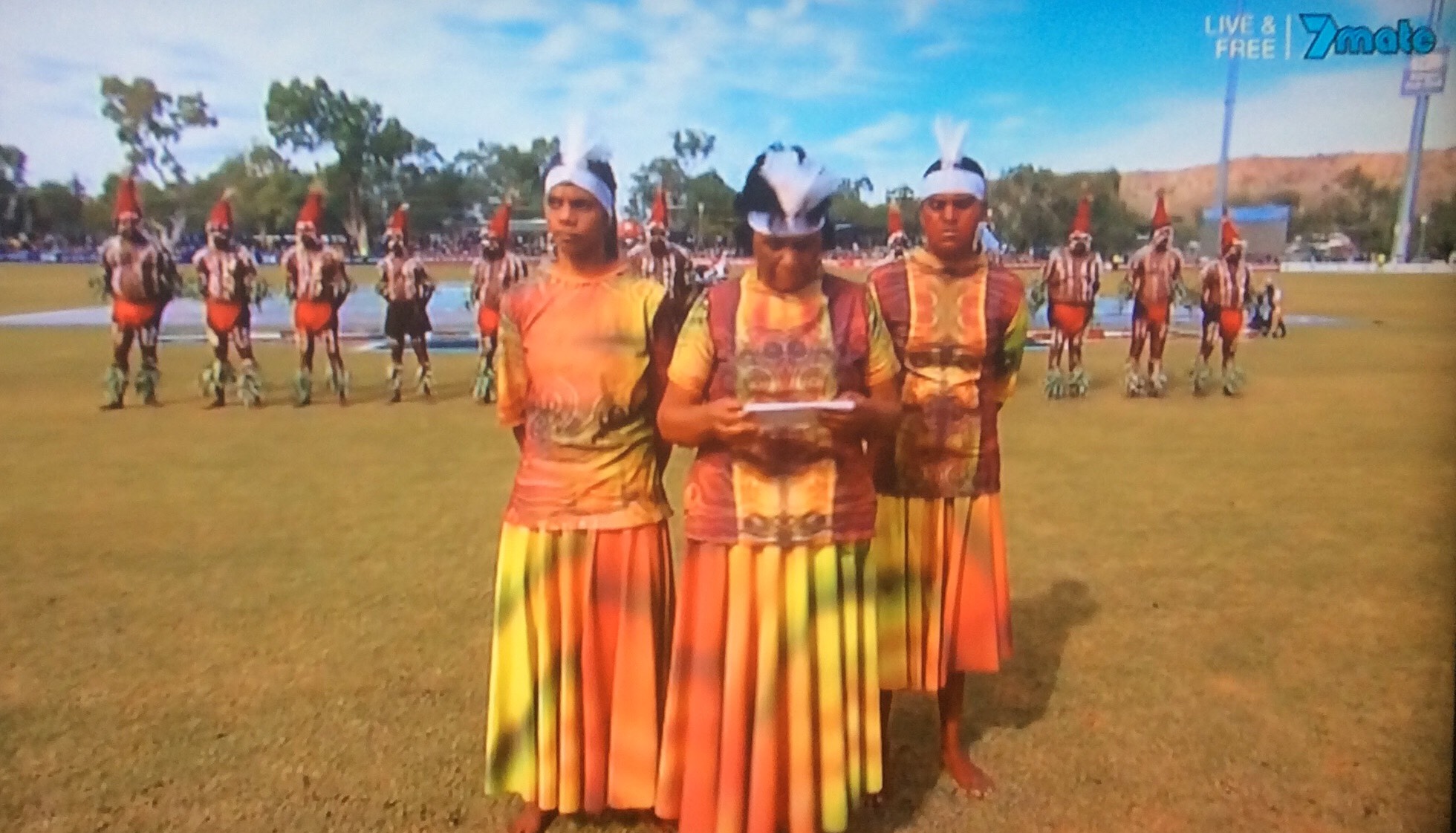
Arrernte Males AFL Opening Ceremony

Arrernte women AFL Opening Ceremony

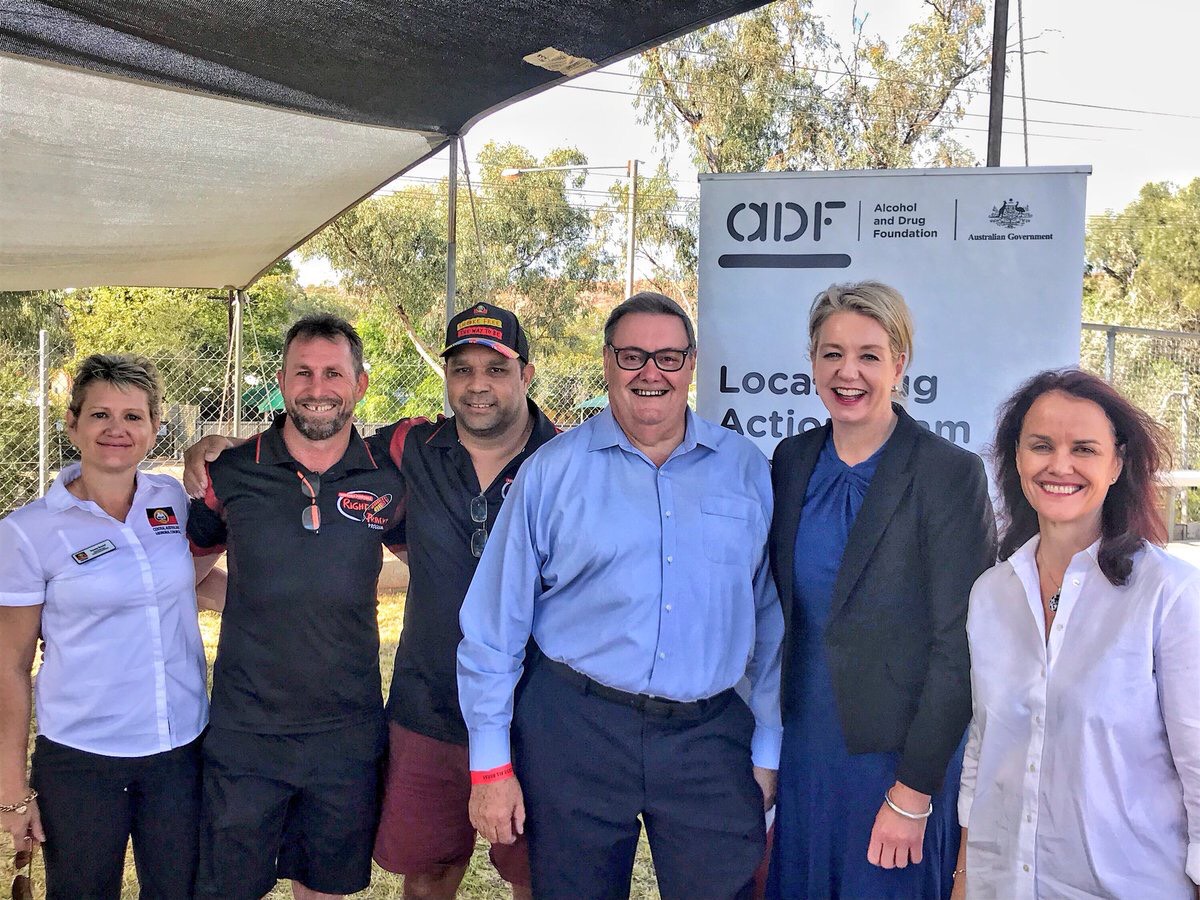
Part 1 The Australian Government and the ADF are excited to welcome an additional 92 Local Drug Action Teams, in to the LDAT program

The Senator with Alcohol and Drug Foundation CEO Dr Erin Lalor and  General Manager of Congress’ Alice Springs Health Services, Tracey Brand in Alice Springs talking about the inspirational Central Australian Local Drug Action Team at Congress and announcing 92 Local Drug Action Teams across Australia building partnerships to prevent and minimise harm of ice alcohol & illicit drugs use by our youth with local action plans

WATCH VIDEO of Launch

The Local Drug Action Team Program supports community organisations to work in partnership to develop and deliver programs that prevent or minimise harm from alcohol and other drugs (AOD).

Local Drug Action Teams work together, and with the community, to identify the issue they want to tackle, and to develop and implement a plan for action.

The Alcohol and Drug Foundation provides practical resources to assist Local Drug Action Teams to deliver evidence-informed projects and activities. The community grants component of the Local Drug Action Team Program may provide funding to support this work.

Each team will receive an initial $10,000 to develop and finalise a Community Action Plan and then to implement approved projects in your community. Grant funding of up to a maximum of $30k in the first year and up to a maximum of $40k in subsequent years is also available to help deliver approved projects in Community Action Plans. LDAT funding is intended to complement existing funding and in kind support from local partners.

LDATs typically apply for grants of between $10k and $15k to support their projects


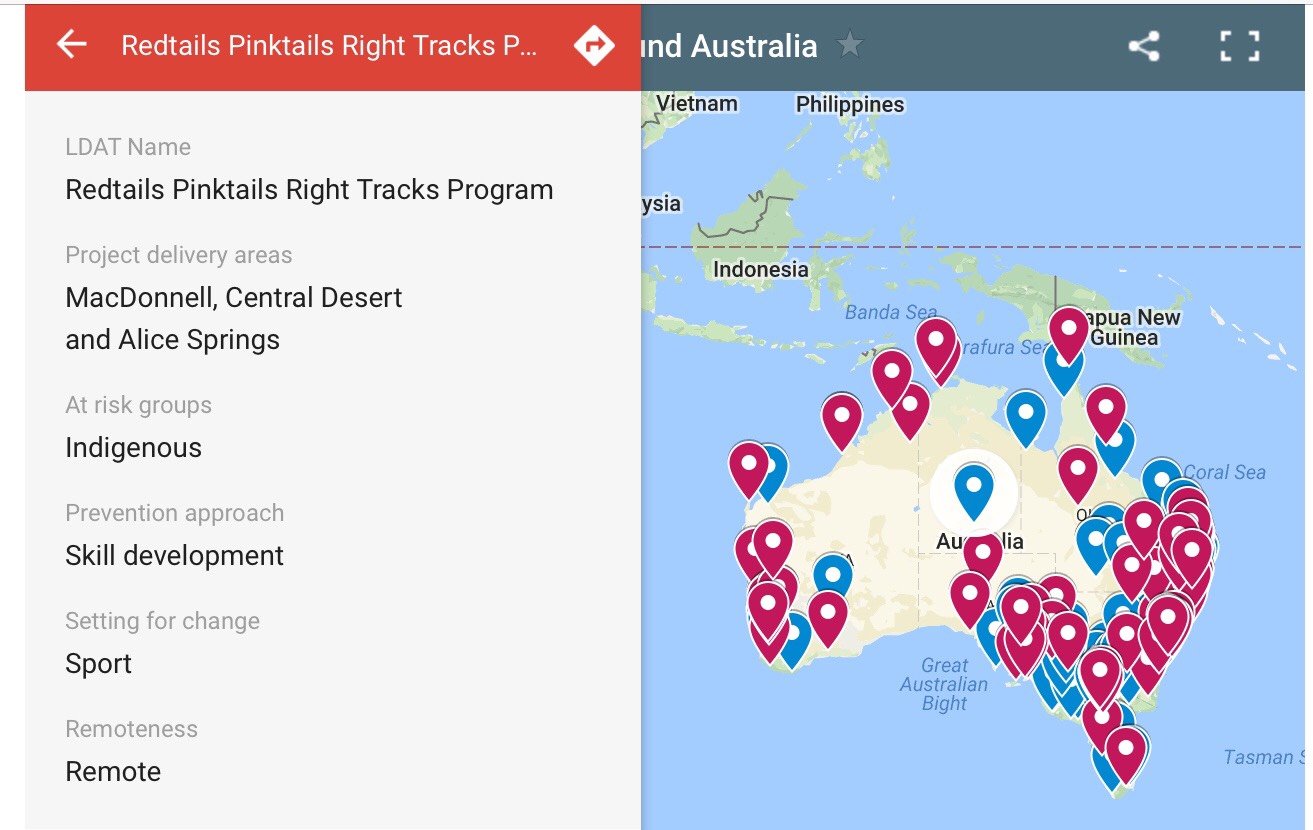
See ADF website for Interactive locations of all sites

The power of community action

Community-based action is powerful in preventing and minimising harm from alcohol and other drugs.

Alcohol and other drugs harms are mediated by a number of factors – those that protect against risk, and those that increase risk. For example, factors that protect against alcohol and other drug harms include social connection, education, safe and secure housing, and a sense of belonging to a community. Factors that increase risks of alcohol and other drug harms include high availability of drugs, low levels of social cohesion, unstable housing, and socioeconomic disadvantage. Most of these factors are found at the community level, and must be targeted at this level for change.

Alcohol and other drugs are a community issue, not just an individual issue.

Community action to prevent alcohol and other drug harms is effective because:

  • the solutions and barriers (protective/risk factors) for addressing alcohol and other drugs harm are community-based
  • it creates change that is responsive to local needs
  • it increases community ownership and leads to more sustainable change

Part 2 Say No more to Family Violence all players link up

Such a powerful message told here in Alice Springs today as the Redtails Football Club, Top End Storm football club, link arms with the Melbourne Football Club, Adelaide Football Club for the NO MORE Campaign AU before the AFL Indigenous Round started.

WEBSITE Link up and say ‘No More’


 Watch Channel 7 Coverage of this special statement from all players

Part 3 #WorldNoTobaccoDay May 31 launched in the Alice

Tobacco smoking is the largest preventable cause of death and disease in Australia and the Coalition Government is further committing to reduce the burden on communities.

In the lead up World No Tobacco Day on 31 May, today I am pleased to launch the next phase of the Coalition Government’s highly successful campaign Don’t Make Smokes Your Story,”

Watch the ABC TV Interview HERE

Watch video of launch in the Alice

Successful Tobacco Campaign Continues

Tobacco smoking is the largest preventable cause of death and disease in Australia and the Coalition Government is further committing to reduce the burden on communities.

The Minister for Rural Health, Senator Bridget McKenzie was in Alice Springs to launch the next phase of the National Tobacco Campaign and said that smoking related illness devastates individuals, families and the wider community.

“In the lead up World No Tobacco Day on 31 May, today I am pleased to launch the next phase of the Coalition Government’s highly successful campaign Don’t Make Smokes Your Story,” Minister McKenzie said.

“The latest phase of Don’t Make Smokes Your Story continues to focus on Indigenous Australians aged 18–40 years who smoke and those who have recently quit. The campaign also concentrates on pregnant women and their partners with Quit for You, Quit for Two.

“An evaluation of the first two phases of the campaign revealed they had successfully helped to reduce smoking rates.

“More than half of the Aboriginal and Torres Strait Islander participants who saw the campaign took some action towards quitting smoking — and 8 per cent actually quit.

“These are very promising stats, however, we must continue to support and encourage those Australians who want to quit, but need help.”

The launch of the next phase of the campaign aligns with World No Tobacco Day and this year’s theme is Tobacco and heart disease.

“Cardiovascular disease is one of the leading causes of death in Australia, killing one person every 12 minutes,” Minister McKenzie said.

“There is a clear link between tobacco and heart and other cardiovascular diseases, including stroke — a staggering 45,392 deaths in Australia can be attributed to cardiovascular disease in 20151.

“Latest estimates show that tobacco use and exposure to second-hand tobacco smoke not only costs the lives of loved ones, but it costs the Australian community $31.5 billion in social — including health — and economic costs.”

“The Coalition Government, along with all states and territories, has made significant efforts to reduce tobacco consumption across the board.

“For example, we know that tobacco is the leading cause of preventable disease for Aboriginal and Torres Strait Islander people accounting for more than 12 per cent of the overall burden of illness.

“The Coalition Government has recently invested $183.7 million continuing to boost the Tackling Indigenous Smoking program to cut smoking and save lives.

“This comprehensive program has helped to cut the rates of Aboriginal and Torres Strait Islander people smoking and we want to build on this success.

“The Government’s investment in this program highlights our long-term commitment to Closing the Gap in health inequality.”

The ABS report Aboriginal and Torres Strait Islander People: Smoking Trends, Australia, 1994 to 2014-15, reported a decrease in current (daily and non-daily) smoking rate in those aged 18 years and older from 55 per cent in 1994 to 45 per cent in 2014-15, which shows Indigenous tobacco control is working.

For help to quit smoking, phone the Quitline on 13 7848, visit the Department of Health’s Quitnow website or download the free My Quitbuddy app.

Your doctor or healthcare provider can also help with information and support you may need to quit.


NACCHO Coverage #Budget2018 No 5/5 : Senator Nigel Scullion’s #Indigenous #budget2018 under fire from opposition forces for not #ClosingTheGap

 ” Malcolm Turnbull is more interested in giving a $80-billion-dollar tax cut to big business than he is to improving the lives of First Nations People.

This budget is an indictment on the Turnbull Government that pretends it wants to do things with First Nations peoples.

The Turnbull Government has shown no vision, no plan, no insight and no desire to close the gap and provide a pathway out of poverty for First Nations people.

The 2018 Budget contains a litany of decisions which demonstrate neglect of First Nations people, including housing , The Closing the Gap Strategy , Community Development Program and over-incarceration of First Nations Peoples

Leader of the Opposition, Bill Shorten, Shadow Assistant Minister for Indigenous Affairs, Patrick Dodson, and Shadow Assistant Minister for Indigenous Health, Warren Snowdon

See Attached Press Release or Read Part 1 Below

Labor Response Indigenous Budget 2018

 ” There is very little money going into the Closing the Gap service areas, in fact there is no new money that has been allocated there.

So, the priorities for Closing the Gap which are linked to the reduction in housing funding is a serious worry for many of our people.

And not just Indigenous Peoples, but service providers and public sector health providers.

The whole approach of this Government is neglectful of First Nations People in the remote areas.

ABC Interview with Senator Patrick Dodson SUBJECTS: Budget, Remote Housing, CDP, Closing the Gap, Captain Cook monuments

See Attached Press Release or Read Part 2 Below

ABC interview

“We are pleased that there will be subsidies for 6000 jobs and an improved assessment process to ensure vulnerable people are not forced to participate beyond their capabilities.

However, the Government has engaged in a cherry-picking exercise rather than wholeheartedly adopting the positive Aboriginal community-driven model developed by APO NT, which will limit the benefits possible on the ground,”

John Paterson, spokesperson for APO NT, said that for three years Aboriginal and Torres Strait Islander organisations have been dealing with the devastation wrought by the Government’s program

See Attached Press Release or Read Part 3 Below

APONT_HRLC

 ” Yet again, our people have been let down with this year’s Federal Budget. The investment in our communities is more eroded, our quality of life more diminished, our voices and needs more blatantly ignored.

While the Budget seeks to commemorate colonisation, it fails to address its ongoing consequences and the oppression that our people continue to experience. The most alarming aspects of the Budget further stack the system against our people and punish people living in poverty.

As a co-chair of NATSILS, I have been actively involved in trying to engage with governments to provide insight and solutions into justice and social issues we face, and the need for greater  investment. It is disheartening that they are not listening, and actively doing damage to our communities.

Closing the Gap is not mentioned, despite a year-long refresh agenda. There is some welcome investment in Indigenous health organisations and aged care for Aboriginal and Torres Strait Islander people.

On the other hand, the Budget is strangely silent on justice, family violence, Closing the Gap and child protection. All of these areas have been identified as ‘a national crisis’ and are all interlinked.”

Cheryl Axleby co-chair of NATSILS writing for IndigenousX Budget ignores solutions and damages our communities see part 4

Post 1 of our NACCHO Posts on #Budget2018 NACCHO

Post 2 will be the NACCHO Chair Press Release

Post 3 will be Health Peak bodies Press Release summary

Post 4 will be Government Press Releases

Post 5 Opposition responses to Budget 2018 Here

ALL NACCHO BUDGET COVERAGE HERE

The Government has shown no respect, no vision, no plan, no insight and no desire to improve the lives of First Nations people.

This budget clearly demonstrates why First Nations people need a Voice to the Parliament.

Senator Malarndirri McCarthy – Northern Territory Linda Burney Warren Snowdon MP

View Interview with above Labor Team

Part 1 Press Release from Leader of the Opposition, Bill Shorten, Shadow Assistant Minister for Indigenous Affairs, Patrick Dodson, and Shadow Assistant Minister for Indigenous Health, Warren Snowdon

HOUSING

  •  Slashing 1.5 billion dollars to remote housing over the next four years.
  •  Western Australia, South Australia and Queensland will no longer receive any funding for remote housing. These savage cuts to housing will have a devastating effect in remote communities, where overcrowding and homelessness are rife.
  •  Housing is key determinant to close the gap and underpins the health and well-being of First Nations Peoples. Without safe and secure housing, the gap will never be closed.

Read Housing article Here

CLOSING THE GAP STRATEGY

  •  No new funding has been allocated to the Closing the Gap strategy, despite the Government announcing a 10 year refresh process in February this year.
  •  The fact that the Government has failed to allocate adequate funding to the Closing the Gap Refresh is insulting to First Nations peoples and their peak organisations who have been trying to cooperate with the Government on new Closing the Gap targets.
  •  The closing the gap strategy has been left to languish under this Government, while the gap widens.
  •  Further, the government has yet again failed to fund the Implementation Plan for the National Aboriginal and Torres Strait Islander Health Plan 2013-2023.

COMMUNITY DEVELOPMENT PROGRAM

  •  Failing to address the strategic, integrated and practical reform needed to the CDP program.
  •  The Minister for Indigenous Affairs Nigel Scullion announced 6,000 new wage-based subsides, but this leaves some 30,000 First Nations peoples subject to the current punitive, discriminatory CDP scheme, which is driving up poverty in remote areas.

INCARCERATION

  •  Failing to address the shameful over-incarceration of First Nations Peoples.
  •  The Government has not provided funding to implement the recommendations from the Northern Territory Royal Commission, or the Australian Law Reform Commissions ‘Pathways to Justice’ report.
  •  Both the Northern Territory Royal Commission and the ALRC Inquiry into the incarceration rates of Aboriginal and Torres Strait Islander People were called for by the Turnbull Government, to effectively wash their hands of its findings and provide no fiscal outlays for the recommendations exhibits a shameful lack of leadership.
  •  This is a human rights abrogation and shows a callous disregard for equal justice for First Nations people.
  •  Labor has long called for national justice targets, to reduce incarceration rates and improve community safety.

FIRST NATIONS CHILDREN

  •  First Nations children, our future Australians, are left behind in this budget.
  •  In 2017, more than 17,000 Aboriginal and Torres Strait Islander children were living in out-of-home care, compared with about 9,000 a decade ago.
  •  To respond to the shocking number of Aboriginal kids growing up away from country and culture, a Labor Government will convene a national summit on First Nations Children in our first 100 days.

This budget is an indictment on the Turnbull Government that pretends it wants to do things with First Nations peoples.

The Turnbull Government has shown no vision, no plan, no insight and no desire to close the gap and provide a pathway out of poverty for First Nations people.

Part 2 ABC Interview SUBJECTS: Budget, Remote Housing, CDP, Closing the Gap, Captain Cook monuments.

MOLLY HUNT: Senator, what’s your reaction to last night’s budget?

SENATOR DODSON: Well, from the First Nations perspective it’s pretty poor.

It’s unimaginative and disastrous. Remote housing to the State (of WA) is not being supported by the Federal Government’s budget which means over the next couple of years there will be at least 1.5 billion dollars slashed to remote housing.

The Western Australian portion of that is annually is around $100 million dollars. This means serious impacts for people in the regions in relation to housing.

We have no money allocated for roads in this budget. The Territory is getting an upgrade to the Buntine Highway; most of the roads money for WA is going into the metropolitan areas.

There is very little money going into the Closing the Gap service areas, in fact there is no new money that has been allocated there.

So, the priorities for Closing the Gap which are linked to the reduction in housing funding is a serious worry for many of our people.

And not just Indigenous Peoples, but service providers and public sector health providers.

The whole approach of this Government is neglectful of First Nations People in the remote areas.

There are some positives in the procurement area in other states but that doesn’t help in many of these places.

There’s some money allocated into Indigenous Protected Areas, $15 million dollars, but what take of that comes into the Kimberley is unclear at this point, but hopefully some of it comes there.

There is also some money in age care which we hope will help in some of those cases where carers have to look after their families at home.

Again the detail around that in relation to the Northern part of the State is not clear.

There’s a bit of a tantalising flirt with the CDP, with a promise of 6000 new wage type subsidies for a scheme that has absolutely failed First Nations peoples.

There are 30,000 current CDP participants and there is no clarity about what their destinies are going to be.

Overall, it’s a bit like being a kid who’s in a foster home watching all the other kids get a present off the Christmas tree and being left to pick up the glittering wrappers and hopefully play with the busted toys once they have been discarded.

So the budget is very disappointing. A very sad neglect of First Nations peoples and an indictment on the Turnbull Government that pretends it wants to do things with First Nations peoples.

And it’s a neglect of the bush as well. There is no clarity around the mobile black spot concerns that many of our people in remote areas have got or any improvement of communication systems to the remote areas.

The whole question of how that could assist families, pastoral properties and others – there is no clarity around that at all and that is a major concern.

We know there is some funding for the Cape Leveque Road which is a good thing, but that’s not out of this budget, that has come with the state’s contributions as well.

So overall, a very sad return for First Nations. It looks like the cuts to the IAS overall is going to mean a lot of hardship to service providers.

The clarity around that we are yet to distil but there will be cuts like there are to all departments, I think of about $32 million dollars to the IAS… but there is no reform, no insight and no real plan to move things to a better place for Indigenous peoples.

MOLLY HUNT: You’re with ABC Kimberley, I’m talking to WA Senator Patrick Dodson, my name is Molly Hunt. Senator, we have about three minutes until the seven o’clock news, I just want to know, is the Government making any substantiative changes to the ongoing trial of the cashless welfare card in this year’s extension?

SENATOR DODSON: The Government wants to roll it out in Kalgoorlie. Labor is obviously not happy about that. There is not sufficient evidence to say its working either in Kununurra or Ceduna.

The need for wrap around services obviously have to be improved. The Government wanted to introduce drug testing, we’ve opposed that, but it will more than likely come up in the Senate during these sittings with Kalgoorlie.

But it has no other mandate from the Parliament to go further than Kalgoorlie until there is some clear and unequivocal evidence that this particular draconian measure actually works.

MOLLY HUNT: And just lastly Senator, overall impression of last night’s budget?

SENATOR DODSON: Well as I said I’m like the kid at the Christmas tree watching all the other kids jumping with joy and celebrating and waiting for their wrappers to be dropped to the floor so we can pick them up.

MOLLY HUNT: Senator, do you support the money for the Captain Cook anniversary?

SENATOR DODSON: Well no, not really. I think we have got to find ways to deal with our history and we have heard from the Uluru Statement from the Heart for the need for a truth telling commission, for a Makarrata Commission, so we can come to a greater consensus around the settlement narrative, the occupation narrative and the so called discovery narrative of this nation.

I think we have to get beyond these colonial and draconian measures that keep continuing to divide us.

Part 3 The Aboriginal Peak Organisations NT (APO NT) and the Human Rights Law Centre Discriminatory remote work scheme improved but onerous work hours and harsh penalties will drive poverty

The need for fair pay for work in Aboriginal and Torres Strait Islander communities has finally been acknowledged by the Federal Government but Budget measures outlined for its remote work for the dole scheme fall well-short of realising this in practice.

The Aboriginal Peak Organisations NT (APO NT) and the Human Rights Law Centre cautiously welcomed some changes to the Community Development Program (CDP), but expressed deep concern about the Government’s piecemeal approach and its decision to continue with onerous obligations while introducing a harsher penalty system in remote communities.

John Paterson, spokesperson for APO NT, said that for three years Aboriginal and Torres Strait Islander organisations have been dealing with the devastation wrought by the Government’s program.

“The hard work of APO NT and other Aboriginal organisations and CDP providers has started to pay-off, with the Minister for Indigenous Affairs recognising that paid work with proper entitlements is the key to lifting families out of poverty, stimulating social enterprise and creating meaningful employment opportunities,” said Mr Paterson.

Mr Paterson welcomed the announcement of 6000 subsidised jobs with proper work entitlements and improvements to the way that people’s work capacity is assessed but said the Government should be adopting the Aboriginal-led model already developed by APO NT.

“We are pleased that there will be subsidies for 6000 jobs and an improved assessment process to ensure vulnerable people are not forced to participate beyond their capabilities.

However, the Government has engaged in a cherry-picking exercise rather than wholeheartedly adopting the positive Aboriginal community-driven model developed by APO NT, which will limit the benefits possible on the ground,” said Mr Paterson.

The Budget measures include a reduction in work requirements from 25 to 20 hours, but people in remote communities, 83 per cent of whom are Aboriginal and Torres Strait Islander, will still have to work around 270 hours more each year than people in urban areas.

Adrianne Walters, senior lawyer at the Human Rights Law Centre, said that it was mind-boggling that after three years, a racist and inflexible work hours requirement will continue to be imposed on remote communities, albeit in slightly modified form.

“Equal pay for equal work is a core tenet of Australian society. The Federal Government must eliminate the blatantly discriminatory requirement which sees people in remote Aboriginal and Torres Strait Islander communities forced to work more hours for the same basic Centrelink payment as people in cities,” said Ms Walters.

Both organisations have also warned that the new compliance measures announced in the Budget will undermine the potential for positive outcomes.

“The inclusion of more onerous compliance measures is likely to drive up poverty and disengagement.

The Government’s own data indicates that people subject to the remote CDP scheme are already at least 20 times more likely to be financially penalised,” said Mr Paterson.

“Unfair financial penalties have already seen parents struggling to put food on the table for their kids.

The Government appears satisfied to dump a new harsh one-size-fits-all penalty system on remote communities, but still discriminate against them in terms of work hours,” said Ms Walters.

Further information

The Aboriginal Peak Organisations NT has worked with other Aboriginal and Torres Strait Islander organisations to develop an alternative model for fair work and strong resilient communities. The model focuses on waged work, fair participation obligations, access to support services and

Aboriginal-led institutional arrangements.

Key aspects of the alternative model that are missing from Minister Scullion’s CDP reforms include:

  •  Flexibility and community governance structures so that jobs and community projects meet the needs of communities and remote employers.
  •  An approach to participation obligations that allows local organisations to tailor arrangements to their own communities, with a focus on support and incentives, rather than heavy-handed compliance and financial penalties.
  •  Work activity obligations that are no greater than those that apply to people in the urban Jobactive program.
  •  1500 paid jobs with training for people under 25, giving disengaged young people a reason to re-engage and a pathway to future employment.
  •  An Aboriginal and Torres Strait Islander led agency to manage the scheme instead of the current non-Indigenous led Canberra-based model.
  •  A reduction in pointless and excessive administration requirements, which is a hallmark of the current program and consumes valuable funding.

Part 4 Cheryl Axleby writing for IndigenousX Budget ignores solutions and damages our communities

Originally published on Indigenous X

Yet again, our people have been let down with this year’s Federal Budget. The investment in our communities is more eroded, our quality of life more diminished, our voices and needs more blatantly ignored.

While the Budget seeks to commemorate colonisation, it fails to address its ongoing consequences and the oppression that our people continue to experience. The most alarming aspects of the Budget further stack the system against our people and punish people living in poverty.

As a co-chair of NATSILS, I have been actively involved in trying to engage with governments to provide insight and solutions into justice and social issues we face, and the need for greater  investment. It is disheartening that they are not listening, and actively doing damage to our communities.

Housing

One role of the Government is to recognise that poverty, racial and structural disadvantage exists and to do something about it, including making the right investments to drive change.

More pressure has been placed on rural and remote communities to increase employment where there are no opportunities, and at the same time, the National Partnership agreements on remote housing for WA, Qld and SA have not been funded.

Yet we know that many people accessing Aboriginal and Torres Strait Islander Legal Services need help with housing and tenancy. These measures are set to create more legal need and greater barriers to accessing justice which directly impacts upon people’s physical, emotional and social wellbeing.

Welfare & CDP

Stringent measures deducting welfare payments from people with unpaid fines and outstanding warrants have been introduced. These measures come in the face of increasing rates of over-representation, and a demonstrated connection between poverty and imprisonment for Aboriginal and Torres Strait Islander people.

Across Australia, governments should be abolishing imprisonment for unpaid fines, not deducting welfare payments from people who are already oppressed by the system. This will likely have a huge impact on Aboriginal and Torres Strait Islander communities. We cannot afford to lose more lives to unpaid fines.

The concerning welfare measures include extending a punitive demerit point system to Community Development Program (CDP) participants. This cuts and suspends welfare payments for weeks at a time, risking further deep financial disadvantage for our most vulnerable people.

The over-penalising of CDP participants is causing high levels of financial hardship and shows that the program is deeply flawed. Since the introduction of the CDP, 300,000 financial penalties were applied, despite having only around 33,000 participants.

Despite the clear failures of the CDP, only minor improvements were introduced, including a new wage subsidy scheme and slight reduction in the hours participants need to work for their benefits. But for a wage subsidy scheme to have any impact, there must be jobs available in the first place. The loss of people’s income is causing deep distress and harming health. The CDEP programs previously supported within our communities, in my view, more adequately met the needs of our people and contributed to building community capacity.

Closing the Gap

Closing the Gap is not mentioned, despite a year-long refresh agenda. There is some welcome investment in Indigenous health organisations and aged care for Aboriginal and Torres Strait Islander people.

On the other hand, the Budget is strangely silent on justice, family violence, Closing the Gap and child protection. All of these areas have been identified as ‘a national crisis’ and are all interlinked.

Yet the Government has neglected the needs of our people who are victims and survivors of family violence. And while the NDIS is fully funded, there is no funding to ensure Aboriginal and Torres Strait Islander people with disability will have equal access to culturally-safe support services under the NDIS.

Justice

When it comes to justice, the Australian Government has ignored the findings from their own Law Reform Commission ‘Pathways to Justice’ and Northern Territory Royal Commission inquiries. The recommendations, including introducing national justice targets, support for justice reinvestment and Aboriginal and Torres Strait Islander Legal Services to deliver essential legal help, did not form part of the Budget. Instead, they have introduced oppressive, punitive measures which will disproportionately affect Aboriginal and Torres Strait Islander people’s quality of life.

We all know the statistics. Aboriginal and Torres Strait Islander people are 13 times more likely to be imprisoned than non-Indigenous people. This is worse, and increasing, for Aboriginal and Torres Strait Islander women, who are imprisoned at 21 times the rate of non-Indigenous women. Aboriginal and Torres Strait Islander children, who are 6% of the Australian youth population, make up 55% of children and young people in prison are 25 times more likely to be imprisoned.

How can it be, that these shameful statistics, continue to be ignored by our Commonwealth, state and territory governments.

The escalation of increasing rates of overrepresentation demonstrates current government policy and programs are not meeting the needs of our people. And we know that the Government could save $19 billion annually by 2040 if the gap between Indigenous and non-Indigenous rates of incarceration were closed.

The welcome investment in Indigenous health will not outweigh the government’s changes to housing and welfare, which will further entrench disadvantage. This will lead to more unmet legal need for Aboriginal and Torres Strait Islander Legal services, already at crisis level. This need must be comprehensively mapped to determine the gaps in providing essential legal help.

Part 5 Government’s Indigenous budget strategy blasted for failures and hundreds of millions to non-Indigenous organisations


NACCHO #HealthBudget18 Coverage 3/5 Read and Download the Top 10 Peak Health Organisation Press Release responses to #Budget2018NACCHO

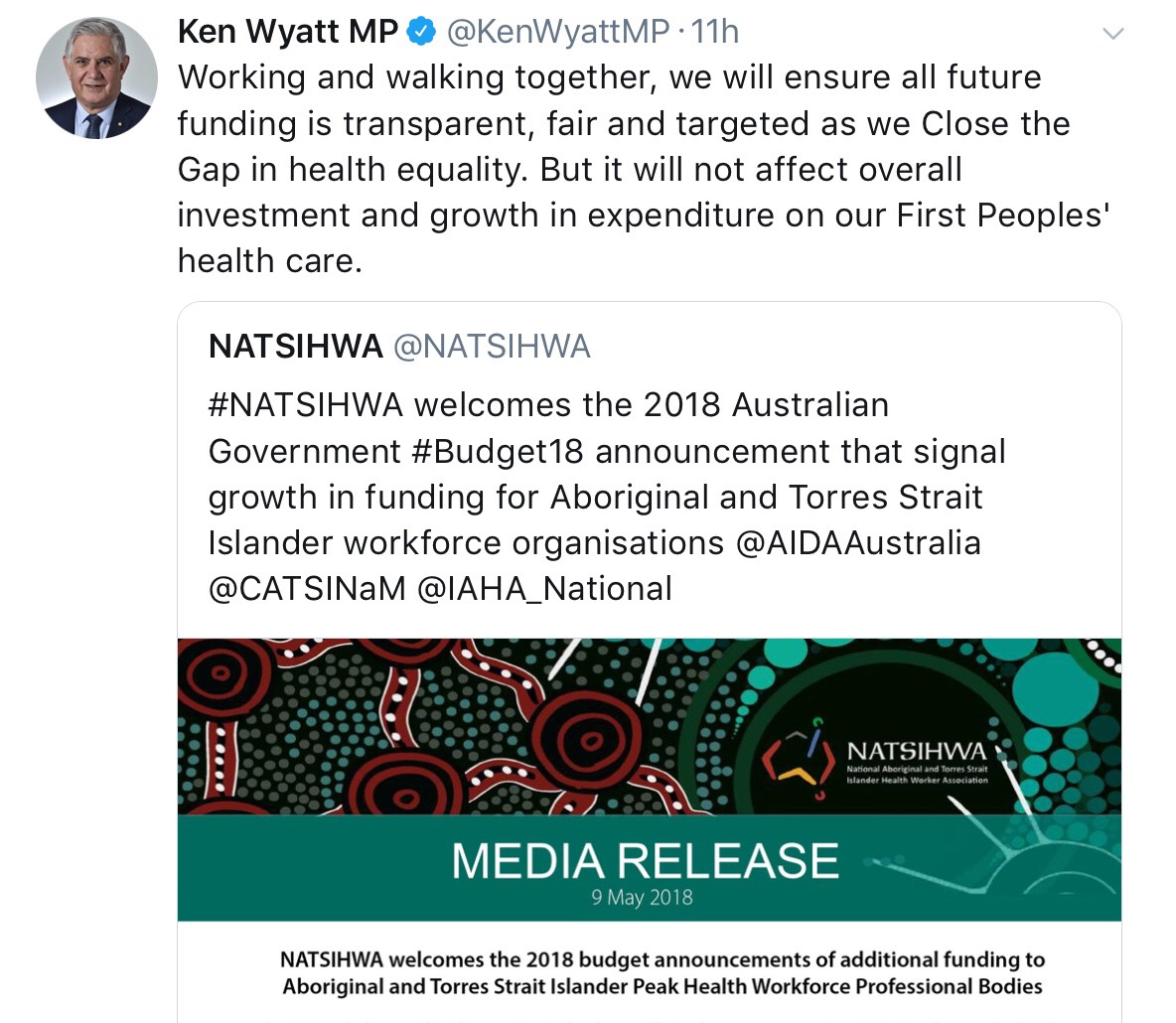
1.NATSIHWA welcomes the 2018 budget announcements of additional funding to Aboriginal and Torres Strait Islander Peak Health Workforce Professional Bodies

2. IAHA : Allied health undervalued in 2018 Federal Budget

3.AIDA funded to continue our work in improving health outcomes for Indigenous Australians

4.1 AMA : SAFE AND STEADY HEALTH BUDGET, BUT BIGGER REFORMS ARE STILL TO COME

5.NRHA :RURAL HEALTH BUDGET $$ WELCOME – BUT NOT ENOUGH

6.AHHA : Health data boost right step on the road to reform

7. PHAA : Budget 2018 – prevention focus goes missing

8.RACGP : Signs Federal Government beginning to recognise vital role of specialist GPs in Australia’s healthcare system

9.CHF Health budget includes welcome consumer focus

10. Vision 2020 Australia welcomes the Australian Government’s investment to target major causes of vision loss in Aboriginal and Torres Strait Islander communities.

Post 1 of our NACCHO Posts on #Budget2018 NACCHO

Post 2 will be the NACCHO Chair Press Release

Post 3 will be Health Peak bodies Press Release summary

Post 4 will be Government Press Releases

Post 5 Opposition responses to Budget 2018 (Monday )

ALL NACCHO BUDGET COVERAGE HERE

1.NATSIHWA welcomes the 2018 budget announcements of additional funding to Aboriginal and Torres Strait Islander Peak Health Workforce Professional Bodies

“Today’s budget announcement presents an important opportunity for NATSIHWA. It will enable us to progress key strategic priorities, including the development of a National Mentor program to support Aboriginal and/or Torres Strait Islander Health Workers and Health Practitioners. This is a very exciting time for our members”

Mr Karl Briscoe, NATSIHWA CEO.

Download full Press Release

1.NATSIHWA BUDGET Media Release 2018

The National Aboriginal and Torres Strait Islander Health Workers Association (NATSIHWA) welcomes the 2018 Australian Government budget announcement that signal growth in funding for Aboriginal and Torres Strait Islander workforce organisations.

These organisations (NATSIHWA, CATSINaM, IAHA and AIDA) work togetherto support the Aboriginal and Torres Strait Islander health workforces and improve health outcomes for Aboriginal and Torres Strait Islander people.

“We thank the Australian government for the continued support of NATSIHWA. This funding will not only enhance the sustainability of our profession, but will also lead to opportunities that promote the recognition and professionalism of Aboriginal and/or Torres Strait Islander Health Workers and Health Practitioners” said Ms Josslyn Tully, NATSIHWA Chairperson.

In particular, the budget announcement support the progression of NATSIHWA’s strategic plan 2017-2020. Key strategic priorities for NATISHWA over the next 12 months, include the:

  • Development of a National Mentoring Program for Aboriginal and/or Torres Strait Islander Health Workers and Health Practitioners;
  • Implementation of the National Professional Development Symposium which will bring together over 100 Aboriginal and/or Torres Strait Islander Health Workers and Health Practitioners in Alice Springs in October 2018;
  • Continuation of Regional forums to support professional development and networking of Aboriginal and/or Torres Strait Islander Health Workers and Health Practitioners in regions across Australia;
  • Development of further educational resources to support individuals and services in defending Aboriginal and/or Torres Strait Islander Health Workers and Health Practitioners’ Scope of Practice; and,
  • Enhanced influence of national policy and program that improve Aboriginal and Torres Strait Islander health and health workforce outcomes that support a culturally safe work environment.

“NATSIHWA looks forward to progressing these initiatives with our membership, which includes over 750 full members who are qualified Aboriginal and/or Torres Strait Islander Health Workers and Health Practitioners across Australia”, said Ms Josslyn Tully

2. IAHA : Allied health undervalued in 2018 Federal Budget

Improving Aboriginal and Torres Strait Islander health and wellbeing must remain a national priority. Action is needed to improve outcomes for Aboriginal and Torres Strait Islander people.

Download full Press Release

2. Media-Release_allied-health-undervalued-in-2018-Federal-Budget

Those actions must involve: a coherent strategy to tackle the causes of disadvantage and enable our people to achieve their potential; governments showing the stamina to address issues that come from generations of trauma and disadvantage; and commitment to work with, hear and respect Aboriginal and Torres Strait Islander people and the knowledge they bring to issues that shape their lives.

IAHA now has a commitment of funding for a further four years. We also have a commitment of $1.55M per year in additional funding to share with our fellow Aboriginal and Torres Strait Islander health workforce peak organisations: AIDA, CATSINAM and NATSIHWA. We have proven our approaches deliver results and build the Aboriginal and Torres Strait Islander health workforce.

IAHA has a significant advocacy role and interest in several other initiatives announced in the 2018-19 Budget, including measures responding to urgent needs across Australian communities, including:

  • $105M over four years to improve access to aged care for Aboriginal and Torres Strait Islander people
  • $30M over four years for ear health assessment in pre-schools
  • $34.3M over four years for eye health and
  • Extra commitment to suicide prevention, additional mental health care.

IAHA CEO Donna Murray said “For initiatives to deliver for Aboriginal and Torres Strait Islander people, community must be involved in how those measures are developed and implemented. This applies to new measures and to addressing existing acute allied health shortages in health, disability, aged care and other social services.”

A culturally safe and responsive skilled workforce, is critical in working with Aboriginal and Torres Strait Islander people and communities. To ensure the workforce has the skills needed to deliver results, strategies and solutions need to be developed and delivered in partnership with IAHA, our members and communities.

“IAHAs success thus far in developing and implementing innovative allied health career pathway programs and supports, providing leadership opportunities and development, mentoring, in partnering and in promoting person-centred, multidisciplinary care needs to be leveraged further. We, therefore, welcome a stronger partnership with Government to enable this success to continue and grow”, said Ms Murray.

IAHA chairperson, Nicole Turner, commented “By leading and facilitating inter-professional approaches that fit with Aboriginal and Torres Strait Islander notions of health and wellbeing, we’ve supported and enabled rapid growth in the Aboriginal and Torres Strait Islander health workforce. But we still represent less than 1 percent of the allied health workforce. Our workforce must continue to grow. Continued funding for IAHA is a vital step in the right direction.”

IAHA welcomes the $550M allocated to the Stronger Rural Health Strategy and the aim of ensuring the right health professionals are available when and where they are needed. However, IAHA remains concerned and disappointed that acute shortages in rural and remote allied health services have been largely ignored, and particularly that there appears to be almost no gain for Aboriginal and Torres Strait Islander communities who have little or no access to allied health services at present.

CEO, Donna Murray, added “IAHA will continue to advocate for the National Aboriginal and Torres Strait Islander Health Plan and Implementation Plan to be fully funded. IAHA will continue to seek opportunities to work constructively with Government to achieve this result.”

3.AIDA funded to continue our work in improving health outcomes for Indigenous Australians

This week the Australian Government announced the 2018/2019 Budget to the Australian public. The Australian Indigenous Doctors’ Association (AIDA) welcomes the news of increased government investment into Aboriginal and Torres Strait Islander peak workforce organisations of $33.4 million over four years from 2018-2019.

Download full Press Release

3.AIDA-budget-response_MEDIA-RELEASE-9-May-2018

We take this as a tangible measure of the genuine commitment of the Turnbull Government to work with us to build the Aboriginal and Torres Strait Islander health workforce.

As the only professional association for both Aboriginal and Torres Strait Islander doctors and medical students, AIDA is committed to improving the health of our people and enriching the health profession by growing the numbers of Indigenous doctors.

This renewed funding certainty will allow AIDA, through our strong relationships with key stakeholders, to keep supporting efforts to increase the cultural safety of mainstream medical education and health care systems.

This continued financial support from the government means job security for our employees, increased resourcing for emerging issues and the ability to continue to implement our long-term strategic agenda.

This includes:

  •  Development of our 2018 policy priorities
  •  Further investment in Indigenous-led health research
  • The delivery of a cultural safety program for doctors, by Indigenous doctor
  • Ongoing support to our student and doctor member base

Doing things with, not to Aboriginal and Torres Strait Islander Peoples

AIDA encourages the Turnbull Government to maintain its stated commitment to work in a consultative and collaborative way with Aboriginal and Torres Strait Islander Peoples.

We remain concerned that there is no commitment in the 2018/19 Budget to adequately resource the Implementation Plan for the National Aboriginal and Torres Strait Islander Health Plan 2013-2023.

AIDA maintains that this is the roadmap for the government to work with us to genuinely redress health disparity and deliver culturally appropriate and needs-based health care to Aboriginal and Torres Strait Islander Peoples.

We encourage the government to commit to implementing the social determinants of health framework into future Indigenous health policy development.

AIDA also remains concerned about the lack of targeted funding commitment around Closing the Gap.

We maintain that measureable targets, accountability mechanisms and appropriately funded policy design and program delivery are essential to closing the gap on Indigenous disadvantage.

With this renewed funding certainty, AIDA will continue working towards our vision for an Australian health care system that is free of racism, and one that affords Aboriginal and Torres Strait Islander Peoples the health care they have a right to expect and receive.

4.1 AMA : SAFE AND STEADY HEALTH BUDGET, BUT BIGGER REFORMS ARE STILL TO COME

VIEW NACCHO TV HERE

The Government has tonight delivered a safe and steady Health Budget, which outlines a broad range of initiatives across the health portfolio – but some of the bigger reforms and the biggest challenges are yet to come.

AMA President, Dr Michael Gannon, said the Government has provided some necessary funding to aged care, mental health, rural health, the PBS, and medical research, with many decisions directly responding to AMA policy.

Download full Press Release

4.1 Safe and Steady Health Budget, But Bigger Reforms Are Still to Come

4.2 AMSA Rural

AMSA Rural enthusiastically supports the changes to rural bonding and the opportunities presented by the Junior Doctor Training Program and the National Rural Generalist Pathway.

While the MDMS network may represent an expensive mis-step in addressing rural health workforce shortages, with funds better spent on rural Specialty Training Places, the announcement of better targeting, monitoring and planning for future rural workforce needs is encouraging.

Overall, AMSA Rural welcomes the government’s renewed focus on health equity for rural and regional communities, and looks forward to hearing more details of the Stronger Rural Health Strategy.

Download full Press Release

4.2 AMSA RH MR-  RURAL HEALTH IN FOCUS

5.NRHA :RURAL HEALTH BUDGET $$ WELCOME – BUT NOT ENOUGH

New funding to attract more doctors to country areas has been welcomed by the National Rural Health Alliance, Australia’s peak body for rural and remote health.

“We are pleased tonight’s Federal Budget allocates $550 million over 10 years to help fill the health workforce gaps that exist in so many parts of country Australia,” said Alliance CEO Mark Diamond.

The government says it will deliver 3,000 new specialist GPs, and 3,000 additional nurses over ten years mainly through providing end to end training in country areas.

“It’s not only doctors and nurses that are missing outside major cities. Equally there are not enough allied health professionals. Some areas have no psychologists, no physiotherapists, no occupational therapists,” Mr Diamond said.

A new Workforce Incentive Program will provide some funds to general practices to employ more nurses, doctors and, for the first time, allied health workers.

Download full Press Release

5. National Rural Health Alliance

6.AHHA Health data boost right step on the road to reform

‘The lack of any concrete action on preventive health is concerning—it has been allowed to slip down health budget priorities, despite its proven benefits in preventing big health bills later. This particularly applies to dental health, which once again has been overlooked.

‘In terms of Closing the Gap in Aboriginal and Torres Strait Islander health, we note some modest investments, including the commitment of $5 million per year for the next 3 years to address trachoma in Aboriginal communities’, Ms Verhoeven said.

‘It is disappointing that the government didn’t take the opportunity to address one of our pre-Budget recommendations to make the administrative changes to ensure patients discharged from hospital have access to Closing the Gap prescriptions.

This would have been a practical and relatively inexpensive measure to improve health outcomes for Aboriginal and Torres Strait Islander peoples.’

7.1 PHAA : Budget 2018 – prevention focus goes missing

Tonight’s national Budget continues to fund the health care systems, but is woefully short on preventative health measures to keep Australians from becoming sick in the first place, according to Public Health Association Australia (PHAA) Chief Executive Michael Moore AM.

“Despite repeated advice – and repeated commitments in principle – the Government is still not developing a preventative health focus for our health system,” said Mr Moore.

“It’s true there are a few modest measures tonight – including additional vaccinations funded, very welcome measures to promote mental wellbeing, and the Good Sports Program to reduce alcohol consumption in sporting contexts.”

“But Australia’s people will continue to experience avoidable chronic disease in the years ahead. People who should be destined to live healthy lives will not because of the preventable diseases they will suffer. While we need to look after the aged populations and those requiring medical treatment, we need to focus even more heavily on the younger generation we are failing,” Mr Moore said.

“The inevitable cost to Budgets far into the future will be greater than the investments that might have been funded.”

“What is also noticeable is that there are no preventive measures in this budget which impact negatively on industry.”

“Just last week we saw Australia’s first ever dedicated conference of preventative health professionals, with 300 expert Australians gathering in Sydney to debate the way forward to a more preventive approach to health and wellbeing.

“Yet tonight, preventive health has again been relegated to a low priority.”

“Future Health Ministers and Treasurers will rue the mistakes of this generation, including tonight’s Budget, in failing to invest in preventive health.”

Mr Moore also acknowledged Minister for Aged Care and Indigenous Health Ken Wyatt for securing a number of important initiatives in Indigenous health, Australia’s most agonizing continuing health crisis.

The Public Health Association welcomed a number of specific initiatives in tonight’s Budget:

  • Improving physical activity with a $50.4m investment to get people moving and expanding other physical activity.
  • Funding to expanding four forms of vaccinations, including Pertussis, and a targeted program to address low vaccination rate areas.
  • A National Injury Prevention Strategy for children and older people, including a program to prevent water and snow sport injuries
  • Additional funding for suicide prevention

Download 2 full Press Release

7.1 PHAA Prevention

7. 2 PHAA

NACCHO would also wish Michael a healthy future

8.RACGP Signs Federal Government beginning to recognise vital role of specialist GPs in Australia’s healthcare system


The Federal Government’s commitment to fund training for general practice is a sign political leaders are finally beginning to understand the vital role of specialist GPs in Australia’s healthcare system.

Royal Australian College of General Practitioners (RACGP) President Dr Bastian Seidel commended the government for investing to fund a world class, contemporary postgraduate training program for medical graduates through Australian medical colleges and in particular through the RACGP.

“We are cautiously optimistic that the penny has finally dropped,” Dr Seidel said.

“A commitment to unconditionally fund postgraduate GP training will ensure that all Australians have access to a doctor with specialist qualifications in general practice, and this has not always been the case.

Additionally, the commitment to support 3,000 international medical graduates (IMGs) to attain Fellowship as a specialist general practitioner is welcomed.

“Far too often, doctors without any postgraduate qualifications were placed in so called ‘areas of need’ and ‘district workforce shortages’.

“They were asked to work there with little or no professional support or continuous professional training.

“The funding made available in this year’s Federal Budget will finally start to rectify this shortcoming.”

Dr Seidel said while Australian GPs would be pleased with the Federal Government’s commitment to improving general practice training, there were still significant issues that needed to be addressed before the next Federal election. The indexation of general practice consultation item numbers, whilst welcome, does not go far enough.

Dr Seidel said he would like to see the Federal Government show its commitment to general practice by increasing the Medicare rebate for GP attendances by 18.5% to bring specialist GPs into line with other medical specialist attendance items.

“We must see coherent and cohesive funding for general practice that reflects the expertise of all specialist GPs.

“Appropriate investment in general practice has been proven, repeatedly, to be the most cost-effective way to deliver effective healthcare to the Australian population, particularly as the numbers of patients with chronic conditions continue to increase.

“Patients want to spend more time with their GP, and the evidence shows that time with your GP is good for patients,” Dr Seidel said.

“The Federal Government can really make a difference to the quality of care GPs are able to provide Australians by increasing this rebate before the Federal election and as a matter of urgency


9.CHF Health budget includes welcome consumer focus

The #digitalhealth slides from @CHFofAustralia #HealthBudget18 response. Note : Funding for things where digital health is a big part. Especially interesting is the work happening with Healthy Active Beginnings.Thx @deanhewson ‬

All 23 slides here:

Record funding for hospitals from 2020 and a $5 billion rise for aged care are contained in a Federal Budget which also provides for more consumer-focused approaches to care and research.

Download full Press Release

9. CHF Federal Health Budget

10. Vision 2020 Australia welcomes the Australian Government’s investment to target major causes of vision loss in Aboriginal and Torres Strait Islander communities.

Vision 2020 Australia welcomes the Australian Government’s investment to target major causes of vision loss in Aboriginal and Torres Strait Islander communities.

Download full press release

10. Vision Australia welcomes Eye Health Funding

The Government’s 2018-19 budget allocated $34.3 million to the eye health issues that disproportionately impact on Aboriginal and Torres Strait Islander people.

Vision 2020 Australia CEO Carla Northam said “Our members consistently tell us that the three major causes of vision loss for Aboriginal and Torres Strait Islander people are eye problems associated with diabetic retinopathy, uncorrected refractive error and the length of time people wait for cataract surgery.

“With the right amount of funding, we can address these debilitating eye conditions.”

Dr Dawn Casey, Acting CEO of the National Aboriginal Community Controlled Health Organisation (NACCHO) welcomed the focus on providing eye health checks, especially for Aboriginal and Torres Strait Islander people who have diabetes. “We need to do all we can to make sure all Aboriginal people with diabetes have an annual eye test. At the moment, only around half are getting their eyes checked every year.”

Professor Hugh Taylor from Indigenous Eye Health, the University of Melbourne identified access to cataract surgery as needing serious attention. He said “Vision loss from cataract is twice as common in Indigenous Australians and they have to wait almost twice as long for surgery.”

Professor Taylor added “Eye care services at the local and regional levels must be planned and resourced to meet population-based needs.”

While the details on how the Government will spend the $34.3 million are unclear, Vision 2020 Australia believes that activity must focus on cutting cataract surgery wait times, making sure everyone with diabetes has an annual eye test and getting glasses to people who need them. Through these measures the Government will meet its commitment to address the major causes of vision loss in Aboriginal and Torres Strait Islander communities.


NACCHO Aboriginal Health and Teenage #Pregnancy #maternalMHmatters : Download @AIHW Report : Indigenous teenage mothers almost twice as likely to smoke during pregnancy as non-Indigenous mothers. @sistaquit #Prevention2018


” Indigenous teenage mothers are over-represented One in 4 (24%) teenage mothers identified as Aboriginal and/or Torres Strait Islander in 2015.

This means that Indigenous women were over-represented amongst teenage mothers, given Indigenous women aged 15–19 account for only 5.3% of the overall population of Australian females of the same age.

The proportion of Indigenous mothers in Australia is higher in Remote and Very remote areas, and teenage Indigenous mothers also follow this pattern

Compared to non-Indigenous teenage mothers, Indigenous teenage mothers were 1.5 times as likely to smoke in the first 20 weeks of pregnancy (43% compared with 28%) “

Read Part 2 Below or Download :

NACCHO Download aihw-per-93.pdf

Babies of teenage mothers are more likely to be premature and experience health issues in the first month than babies born to women just a few years older, a new report has revealed.

Teenage mums are also more likely to live in Australia’s lowest socio-economic areas (42 per cent) compared to mums aged 20-24 years (34 per cent), according to the report by the Australian Institute of Health and Welfare (AIHW).

The report, published today , showed the numbers of teenage mothers had dropped from 11800 in 2005 to 8200 in 2015, with nearly three-quarters of teenage mothers aged 18 or 19.

Compared to babies born to mothers aged 20-24 years, more babies born to teenage mothers were premature, had a low birth weight and needed admission to special care nursery.

Despite the negative outcomes for babies, the report showed positive trends for teenage mothers including more spontaneous labours, lower caesarean section rates and less diabetes for teenage mothers.

“The difference between teenage mothers and those in the slightly older age group is due in part to a large number of teenage mothers living in low socio-economic areas,” says AIHW report author Dr Fadwa Al-Yaman.

Dr Al-Yaman said the differences could also be due to the higher smoking rates in pregnancy, with a quarter of teenage mothers smoking after 20 weeks of pregnancy compared to 1 in six of those aged 20 to 24.

A quarter of teenage mothers identified as Aboriginal or Torres Strait Islander, with Indigenous teenage mothers almost twice as likely to smoke during pregnancy as non-Indigenous mothers.

Dr Al-Yaman said risk factors were highly interlinked, with issues such a smoking, low levels of education and employment being concentrated in remote areas.

The teenage birth rate in metro areas is less than half that of regional areas, she said.

“There is a strong link between socio-economic disadvantage and living in remote areas,” she told AAP.

“You need to have access to transport, access to health services and if you have to pay for your transport, sometimes over an hour’s worth, it’s going to take more of your welfare money.”

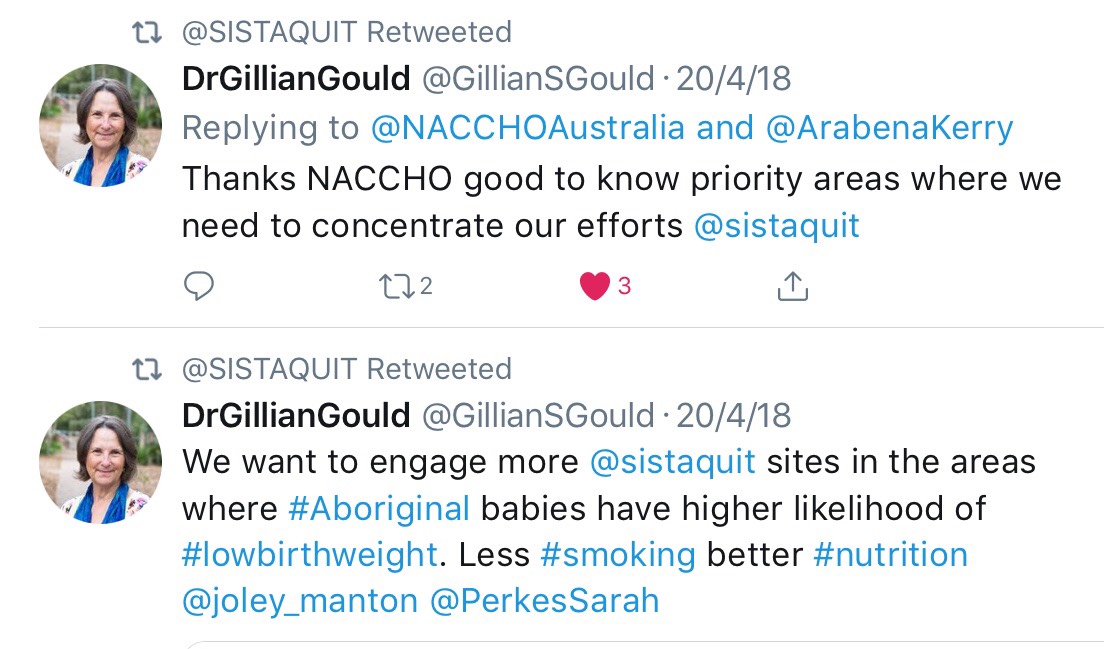
SISTAQUIT Trial Recruiting Services Now

The SISTAQUIT™ trial aims to improve health providers’ skills and when offering smoking cessation care to pregnant Aboriginal and Torres Strait Islander women.

Pregnancy is an important window of opportunity for GPs and health providers to help smokers quit, however they often lack the confidence and skills to address their patients’ smoking.

This intervention provides webinar-based training in evidence based and culturally competent smoking cessation care for providers working within Aboriginal Medical and Health Services.

The SISTAQUIT™ Team are currently recruiting Aboriginal Medical Services (AMS) and GP practices in NSW, WA, QLD, SA and NT for this study.

To find out more about your service being involved in the SISTAQUIT™ trial please contact Dr Gillian Gould or Joley Manton at the University of Newcastle.

Website

Download the trial brochure here

Download an information sheet here

Part 2 Indigenous Mothers

Indigenous teenage mothers are over-represented One in 4 (24%) teenage mothers identified as Aboriginal and/or Torres Strait Islander in 2015.

This means that Indigenous women were over-represented amongst teenage mothers, given Indigenous women aged 15–19 account for only 5.3% of the overall population of Australian females of the same age.

Indigenous mothers are younger than average

The average age of Indigenous teenage mothers (17.8 years) was lower than for non- Indigenous mothers (18.1 years). Indigenous teenage mothers were 4.5 times as likely to be aged under 15 (1.8%; 35) as non-Indigenous teenage mothers (0.4%; 27) and less likely to be aged 19 (37.4%; 744 compared with 49.1%; 3,048).

More likely to live in remote areas

The proportion of Indigenous mothers in Australia is higher in Remote and Very remote areas, and teenage Indigenous mothers also follow this pattern.

In 2015, the Indigenous population rate for 15–19 year old mothers living in Remote and Very remote areas was 84.9 per 1,000 females, which was 5.5 times the non-Indigenous rate (15.2 per 1,000).

The population rate for 15–19 year old Indigenous mothers was also higher for women living in Major cities at 40.7 per 1,000 for Indigenous women compared with 7.1 per 1,000 for non-Indigenous women.

Fewer and later antenatal visits

Indigenous teenage mothers generally attended fewer antenatal visits than non-Indigenous teenage mothers, with higher proportions of 1 visit (1.5% compared with 0.9%) and 2–4 visits (9.5% compared with 6.1%) and lower proportions of 5 or more visits (86% compared with 91%).

They were 1.1 times as likely to attend their first antenatal visit at 20 weeks gestation or more (25% compared with 23%).

More likely to smoke

Compared to non-Indigenous teenage mothers, Indigenous teenage mothers were:

• 1.5 times as likely to smoke in the first 20 weeks of pregnancy (43% compared with 28%)

• 1.7 times as likely to smoke after 20 weeks (36% compared with 21%).

Higher rates of diabetes

Indigenous teenage mothers were 1.2 times as likely as non-Indigenous teenage mothers to have diabetes (6.0% compared with 4.9%) and gestational diabetes (5.1% compared with 4.2%).

Onset of labour, method of birth and perineal status

In 2015, Indigenous teenage mothers were more likely than their non-Indigenous counterparts to have spontaneous labour (66% compared with 62%), and less likely to have induced labour (28% compared with 32%), but equally likely to have no labour (both 6.1%).

Compared to non-Indigenous teenage mothers, Indigenous teenage mothers were slightly more likely to:

• have a caesarean section (19% compared with 18%)

• have an intact perineum (27% compared with 26%).


NACCHO Aboriginal Health and #Sugartax : @4Corners #Tippingthescales: #4corners Sugar, politics and what’s making us fat #rethinksugarydrinks @janemartinopc @OPCAustralia

On Monday night Four Corners investigates the power of Big Sugar and its influence on public policy.

“How did the entire world get this fat, this fast? Did everyone just become a bunch of gluttons and sloths?”  Doctor

The figures are startling. Today, 60% of Australian adults are classified as overweight or obese. By 2025 that figure is expected to rise to 80%.

“It’s the stuff of despair. Personally, when I see some of these young people, it’s almost hard to imagine that we’ve got to this point.”  Surgeon

Many point the finger at sugar – which we’re consuming in enormous amounts – and the food and drink industry that makes and sells the products fuelled by it.

Tipping the scales, reported by Michael Brissenden and presented by Sarah Ferguson, goes to air on Monday 30th of April at 8.30pm. It is replayed on Tuesday 1st of May at 1.00pm and Wednesday 2nd at 11.20pm.

It can also be seen on ABC NEWS channel on Saturday at 8.10pm AEST, ABC iview and at abc.net.au/4corners.

See Preview Video here

 ” In 2012-13, Aboriginal and Torres Strait Islander people 2 years and over consumed an average of 75 grams of free sugars per day (equivalent to 18 teaspoons of white sugar)1. Added sugars made up the majority of free sugar intakes with an average of 68 grams (or 16 teaspoons) consumed and an additional 7 grams of free sugars came from honey and fruit juice. “

NACCHO post – ABS Report abs-indigenous-consumption-of-added-sugars 

Amata was an alcohol-free community, but some years earlier its population of just under 400 people had been consuming 40,000 litres of soft drink annually.

The thing that I say in community meetings all the time is that, the reason we’re doing this is so that the young children now do not end up going down the same track of diabetes, kidney failure, dialysis machines and early death, which is the track that many, many people out here are on now,”

NACCHO Post : Mai Wiru, meaning good health, and managed by long-time community consultant John Tregenza.

See Previous NACCHO Post Aboriginal Health and Sugar TV Doco: APY community and the Mai Wiru Sugar Challenge Foundation

4 Corners Press Release

“This isn’t about, as the food industry put it, people making their own choices and therefore determining what their weight will be. It is not as simple as that, and the science is very clear.” Surgeon

Despite doctors’ calls for urgent action, there’s been fierce resistance by the industry to measures aimed at changing what we eat and drink, like the proposed introduction of a sugar tax.

“We know about the health impact, but there’s something that’s restricting us, and it’s industry.”  Public health advocate

On Monday night Four Corners investigates the power of Big Sugar and its influence on public policy.

“The reality is that industry is, by and large, making most of the policy. Public health is brought in, so that we can have the least worse solution.”  Public health advocate

From its role in shutting down debate about a possible sugar tax to its involvement in the controversial health star rating system, the industry has been remarkably successful in getting its way.

“We are encouraged by the government here in Australia, and indeed the opposition here in Australia, who continue to look to the evidence base and continue to reject this type of tax as some sort of silver bullet or whatnot to solve what is a really complex problem, and that is our nation’s collective expanding waistline.” Industry spokesperson

We reveal the tactics employed by the industry and the access it enjoys at a time when health professionals say we are in a national obesity crisis.

“We cannot leave it up to the food industry to solve this. They have an imperative to make a profit for their shareholders. They don’t have an imperative to create a healthy, active Australia.”  Health advocate

NACCHO post – Sixty-three per cent of Australian adults and 27 per cent of our children are overweight or obese.

 “This is not surprising when you look at our environment – our kids are bombarded with advertising for junk food, high-sugar drinks are cheaper than water, and sugar and saturated fat are hiding in so-called ‘healthy’ foods. Making a healthy choice has never been more difficult.

The annual cost of overweight and obesity in Australia in 2011-12 was estimated to be $8.6 billion in direct and indirect costs such as GP services, hospital care, absenteeism and government subsidies.1 “

 OPC Executive Manager Jane Martin 

BACKGROUND

 ” This campaign is straightforward – sugary drinks are no good for our health. It’s calling on people to drink water instead of sugary drinks.’

Aboriginal and Torres Strait Islander people in Cape York experience a disproportionate burden of chronic disease compared to other Australians.’

‘Regular consumption of sugary drinks is associated with increased energy intake and in turn, weight gain and obesity. It is well established that obesity is a leading risk factor for diabetes, kidney disease, heart disease and some cancers. Consumption of sugary drinks is also associated with poor dental health.

Water is the best drink for everyone – it doesn’t have any sugar and keeps our bodies healthy.’

Apunipima Public Health Advisor Dr Mark Wenitong

Read over 48 NACCHO articles Health and Nutrition HERE

https://nacchocommunique.com/category/nutrition-healthy-foods/

Read over 24 NACCHO articles Sugar Tax HERE  

https://nacchocommunique.com/category/sugar-

NACCHO Aboriginal Health @VACCHO_org @Apunipima join major 2018 health groups campaign @Live Lighter #RethinkSugaryDrink launching ad showing heavy health cost of cheap $1 frozen drinks

NACCHO Aboriginal Health #Junkfood #Sugarydrinks #Sugartax @AMAPresident says Advertising and marketing of #junkfood and #sugarydrinks to children should be banned

NACCHO Aboriginal Health : Download @KenWyattMP speech to @CISOZ : The question of leadership and responsibility in Aboriginal health – addressing the Centre for Independent Studies

 ” Last year, we led a massive group listening program – the My Life My Lead consultations involved 600 people at 13 forums across Australia, plus more than 100 written submissions were received.

Seven priority areas were identified, and are informing the current Closing the Gap refresh agenda.

The priorities we heard from First Australians are:

  • Putting culture at the centre of change
  • Success and wellbeing for health through employment
  • Foundations for a healthy life
  • Environmental health
  • Healthy living and strong communities
  • Health service access, and
  • Health and opportunity through education

We need to be fully committed to sitting down and listening; hearing what’s being said, and continuing to invest in programs that do their work from the ground up.

Policies and services that reflect local voices and wisdom are more closely owned by the people they serve.”

Minister Ken Wyatt MP speaking at Centre for Independent Studies in Sydney yesterday

Download full address or read below

FINAL Wyatt CIS speech 10 April 2018

Family the key to Indigenous health, says Ken Wyatt

Executive summary from the The Australian Stephen Fitzpatrick 

Good parenting rather than increased funding for programs and services is key to improving Indigenous health, the federal minister responsible for the sector has ­declared.

Warning that “doing more of the same is an option we can no longer afford”,

Aboriginal Liberal MP Ken Wyatt said the successes and the failures in indigenous health demonstrated that “responsible parents and families provide the most consistent and enduring interventions”.

“Funding for health programs and services, from public or private sources, will only ever be part of the currency of change,” Mr Wyatt said at a speech to the Centre for Independent Studies in Sydney. “By far the greatest value will come from every mother, father, uncle, aunt and elder every day, taking responsibility for and contributing to better health.”

Calling for a declaration of “non-negotiable standards to be met from the bottom up”, Mr Wyatt said these standards must “reflect the pride of the oldest continuous culture on the planet” but should also extend “far beyond families, to health and community groups and organisations too”.

He said there had for too long been a “piecemeal approach” to indigenous health, with “inadequate accountability” for repeated programs and yet “every time there’s been a new issue or challenge, ­people say we need more money”.

Efforts to close the gap between indigenous and non-indigenous health outcomes would not succeed “until we eliminate the mindset that Aboriginal Australians could be, and even should be on occasions, dealt with differently”.

The current syphilis epidemic in northern Australian indigenous communities, which has prompted the Turnbull government to commit $8.8 million in an attempt to turn its tide seven years after it began, was a case in point.

“If this outbreak had occurred on Sydney’s north shore, in ­Cottesloe in Perth or Toorak in Melbourne — in any city or major town, in fact — there would have been a rapid response years ­earlier,” Mr Wyatt said.

However, he cautioned that there must also be a greater focus on strategies that clearly work, calling for governments and NGOs to “hear the voices of families, of mothers, fathers and community elders, not just the voices of those who are the strongest ­advocates for the establishment of organisations or services”.

He cited the work of Fitzroy Crossing women including Aboriginal and Torres Strait Islander Social Justice Commissioner June Oscar in curbing the spectre of ­fetal alcohol spectrum disorder, saying it had “turned the town around and you now see strong families there, bound by the glue of love and caring”.

He had ordered his department to overhaul a Medicare provision designed for indigenous Australians that provides physical, psychological and social wellbeing assessments as well as preventive healthcare, education and other options to improve health.

He said only 217,000 people ­accessed this provision last year but he wanted this number to rise because “what I want to see is all First Nations people accessing all relevant (Medicare) items in the same way other Australians do”.

He praised the growing number of indigenous health professionals at all levels, “as doctors and nurses, in allied health, administration and management (and) in policy planning and research”.

Mr Wyatt said this was likely to be the best hope for the future, with more than 40 per cent of the 720,000-strong indigenous population aged under 24, so that many of this group were “set to make a big impact across many fields that may help to close the gap”.

Full Speech Minister Ken Wyatt


Download FINAL Wyatt CIS speech 10 April 2018

Thank you Tom, [Switzer, Executive Director, Centre for Independent Studies] for your introduction.

In West Australian Noongar language, I say kaya wangju – hello and welcome.

At the same time, I acknowledge the traditional owners of the land on which we meet, the Gadigal people of the Eora Nation, and pay my respects to Elders past and present.

Today, I want to pose the question: “What is the currency of positive change for the health of First Nations people?”

Is it government or private investment; is it determination; is it personal motivation?

To begin, I’d like those of us who can remember, to think back to 1972.

Australia’s Helen Reddy was topping the international charts and we were getting out of Vietnam.

The Tent Embassy went up at Parliament House in Canberra on Australia Day that year, a symbolic foreign mission erected in the fight for land rights, after years of dashed hopes – an embassy that continues today in the fight for equality.

1972 was a potentially life-changing year for thousands of Aboriginal and Torres Strait Islander Australians.

Prime Minister Gough Whitlam established the Commonwealth Department of Aboriginal Affairs, ushering in an era of bold new promise, building on changes implemented by previous governments following the 1967 referendum.

Looking back – in so many different ways since then – we have come so far.

Yet, since 1972, we have not seen the broad, wholesale change that we would expect, especially given the significant funding and vast amount of good intentions that have been invested in Aboriginal affairs.

Yes, for the first time in several years, we are on track to reach three of the seven Closing the Gap targets – but what lies behind the statistics that still highlight health inequities today?

What have we got right – and wrong – since 1972?

As I travel our nation, I see and hear more and more inspiring stories of First People’s achievement and the journey to equality, from almost every corner of the country.

Perhaps I’m a bit old-fashioned, but I like to call these “jewels in the crown” – because they shine so brightly, and they exemplify the things that work.

One of these is a university college for Aboriginal students I recently launched in Perth.

Now doubling in size six years after it began, it boasts a 90 per cent retention rate, with almost 80 percent of students passing all their exams.

Head to remote communities in the Kimberley and the Pilbara and you’ll find the EON program, literally teaching children how to grow vegetables and good health.

This is especially close to my heart, because I approved the initial, modest, funding to help start the project 10 years ago.

Since then, EON’s employed scores of local Aboriginal people, worked with students and families to create dozens of school vegetable gardens and has run countless cooking classes, including bush tucker, too.

The compelling taste and health benefits of home grown food are one thing; but it’s the ownership, the healthy habits, the skills learned, and the pride that are also helping change young lives.

The EON program’s now in high demand, extending further south in WA and into the Northern Territory this year.

In the Western Desert, the Pintupi Luritja people saw the tragedy of kidney failure and decided it wasn’t going to be a one-way ticket off their beloved country, to being hooked up to dialysis in Alice Springs.

They took control, famously painted and sold precious artworks – and raised a million dollars to start realising their dream.

Eighteen years on, the Purple House project has treatment centres across their vast lands, a mobile dialysis truck and, just as important, a growing primary and preventive health care network.

Not surprisingly, the wraparound approach – from the ground and the street up – most often shows the common denominator of success.

This local impetus is being strongly supported, and replicated with careful community consultation, through significant Turnbull Government programs.

Better Start to Life and its care and family partnerships begin a child’s health journey before conception. We have funded 124 sites nationwide, and counting.

The results are showing fewer low birth weight babies, higher rates of breastfeeding and, in our Australian Nurse Family Partnership Program sites, 100 per cent immunisation rates, the highest in the nation.

At the same time, from Alice Springs to Port Augusta and from Doomadgee to Canberra, the Connected Beginnings program links parents, health care and education, so children are ready to start school, learn and grow into healthy teenagers and adults.

As Nelson Mandela rightly said: “There can be no keener revelation of a society’s soul than the way in which it treats its children.”

But sometimes, I go into communities and I meet with organisations that tell me they are meeting their health targets — the key performance indicators.

I then get permission from Elders to walk around and chat with locals.

On one particular occasion, in the Kimberley, I met a significant Aboriginal artist.

We were walking along and a friend was talking with this painter and I noticed that her eyes looked opaque, so I asked her: How much can you see?

She said: “I can’t see very much at all, I’m hoping for my cataract surgery.”

At that time, it had been a two-year wait – yet the health organisation’s KPIs were being met. How could this be?

In a country as rich and advanced as Australia, how can this happen?

This is not an isolated incident.

Improving overall Aboriginal and Torres Strait Islander health is, first and foremost, critical for the well-being and dignity of hundreds of thousands of First Australians.

But it is also fundamental to our nation’s commitment to equality, and our global health status.

The health of First Nations Australians is everyone’s business.

We must continually celebrate with Aboriginal communities and families the many milestones in health, education, careers and cultural achievement.

At the same time, it is crucial we look carefully at where poorer aspects of health and wellbeing remain.

In these cases, doing more of the same is an option we can no longer afford – the high cost in lives and lost futures is incalculable, and budgets are also under intense pressure.

First Nations knowledge is embedded in the memories of the living – knowledge that is imparted through teaching, storytelling, music, art and dance.

They are our living libraries and losing each individual means a precious book of knowledge is lost forever.

It is imperative that we enable people to be healthy and live longer.

For far too long in Aboriginal health there was a piecemeal approach; series upon series of programs, often with inadequate accountability.

Every time there’s been a new issue or challenge, people say we need more money.

Currently, there are two evaluations underway to identify opportunities to improve; access to quality and effective primary health care services; assess health gains; and identify the social returns and the broader economic benefits of the Indigenous Australians’ Health Program.

While Government investment in the program will continue to grow over the forward estimates, it is imperative – especially for those in greatest need – that we maximise the health value in every dollar.

To illustrate this point I want to look at the current challenges of Sexually Transmitted Infections and Blood Borne Viruses.

Recently, I was asked to approve significant special funding for a targeted program to tackle the increasing prevalence of STIs, particularly the alarming rise of syphilis in northern areas.

When I asked ‘What are the States and Territories doing about this?’ I was disturbed to find too little had been invested and too little done when the first warning signs appeared, almost seven years ago – certainly not to the extent I would have expected from the responsible jurisdictions.

There was still an overwhelming reliance on Commonwealth leadership and funding in order to address the spread of STIs across the Top End.

I committed $8.8 million dollars, to provide a surge approach that is currently ramping up, aiming to turn the tide of infection.

I also make the point that these First Nations people now struggling under the burden of this deadly disease are, first and foremost, citizens of Australia.

If this outbreak had occurred on Sydney’s North Shore, in Cottesloe in Perth, or Toorak in Melbourne – in any city or major town, in fact – there would have been a rapid response years earlier.

I believe there will not be complete success, in terms of Closing the Gap, until we eliminate the mindset that Aboriginal Australians could be, and even should be on occasions, dealt with differently.

Ensuring awareness and respect for First Nations people and culture throughout our health system may be critical to equality of access – but above all, there is a fundamental human right we must accord every one of our citizens, and that is the right to good health.

Picture this scenario.

A doctor based in Kintore – around 2,000 kilometres South-West of Darwin visited the community of Kiwirrkurra located in Western Australia’s sandhill country — the Gibson Desert.

This doctor reports meeting a group of nine nomadic Aboriginal people, and he says:

“…They were the most healthy people I have ever seen…They were literally glowing with health – not an ounce of superfluous fat. They were extremely fit…”

The year was 1984.

Today, we hear a different narrative too often: There is an alarming rise in obesity and diabetes, suicide levels are high, there is alcohol and drug misuse and the impacts of poverty leave many people with a sense of powerlessness.

Too often, First Nations people’s achievements are overshadowed by health and welfare stories of deep, and understandable, concern.

We’re seeing laudable improvements because of interventions, but they’re not always consistent enough, and they’re often not equivalent to results achieved by other sectors within multicultural Australia.

I’m strongly focussed on where we need to improve; on why – even after accounting for the social and environmental impacts on health – we’re still seeing better outcomes for non-Aboriginal people.

For almost 20 years now, the Medicare Benefits Schedule (MBS) has included Item number 715 – a health assessment especially designed to ensure Aboriginal and Torres Strait Islander people receive primary care matched to their needs.

A 715 looks at a patient’s health — physical, psychological and their social wellbeing.

It also assesses what preventative health care, education and other assistance should be offered to improve health and wellbeing.

It’s holistic. Not body part, by body part. The whole body.

Australia’s Aboriginal and Torres Strait Islander population is around 720,000.

Yet only 217,000 people in 2016-17 have been assessed under MBS Item 715.

At the same time, I see organisations such as the Institute for Urban Indigenous Health, that according to their 2016-17 Annual Report have over 33,000 active patients, of which approximately 60 per cent have had their 715 health check.

In 2016-17, the organisations Members’ Network of 19 Aboriginal Community Controlled Health Care Clinics generated more than $14.3 million in Medicare income, with all funds re-invested in the delivery of comprehensive health care for Aboriginal and Torres Strait Islander people in South East Queensland.

What I see here are significantly better results, through completion of a “cycle of care”, comprising the range of chronic disease and other MBS items.

The Institute has grown its clinics from 5 to 19 in the past nine years, with their 20th soon to open in the Moreton Bay region.

I’m excited by this work – the innovation and capacity to change, and the resolve not to accept the status quo of poorer health outcomes.

I look at some of the health disparities and think, why aren’t we as a nation case managing, fundamentally, 720,000 people in a way that would make a difference to so many chronic conditions?

I have asked my department for an overhaul of 715s – what I want to see is all First Nations people accessing all relevant MBS items in the same way that other Australians do.

A key Government focus is on the health of our children, from conception right through to their late teens, so they can grow into strong and healthy men and women who can be the best mentors for their own children.

With more than 1700 First Australians receiving kidney dialysis, and rheumatic heart disease affecting another 6,000 mainly younger people, this year I’ve also prioritised renal health and RHD, along with eye and ear health.

From four national roundtables, we’re now charting Australia’s first roadmaps to coordinate efforts to combat these debilitating and deadly conditions.

It’s absolutely intolerable that RHD among our First Nations people is happening at more than 50 times the rate of other groups in Australian society.

In parts of the Northern Territory, those horrific rates of RHD are doubled again.

And Aboriginal and Torres Strait Islander people under the age of 55 are starting dialysis at twice the rate of non-Aboriginal Australians, with many showing danger signs in their teens.

The unfinished business of today is disappointing because we should be celebrating more successes.

And are community-controlled health organisations and other community groups established to service great need, sitting down enough and asking families and individuals what they know, what they want and what they think would work best?

They must ask: Where is the continuity of service for anyone who requires an intervention to prolong their life or to circumvent an illness?

Minor ailments like skin sores or strep throats, if treated consistently and effectively, won’t develop into early onset renal failure or rheumatic heart disease.

In the same way, neither will ear infections become impaired hearing, that can stunt a child’s learning capacity and their chances of a good job, or any job at all.

There is a need for a holistic approach to the health of each individual.

Some of the benefits flowing from Australia’s recent mining boom have been great employment opportunities, close to country, for thousands of First Nations people.

But the job hopes of many were hampered by deafness contracted in childhood, much to the frustration of mining companies committed to hiring keen local staff.

Hearing and communication are fundamental to fulfilling our life’s potential.

They’re also two of the most valuable commodities for sustainable change in Aboriginal and Torres Strait Islander health.

Governments and non-government organisations across the board must listen to and hear the voices of families, of mothers, fathers and community Elders.

Not just the voices of those who are the strongest advocates for the establishment of organisations or services that, theoretically, should make a difference on the ground.

I say this with no political overtones – the Prime Minister and the Turnbull Government are committed to doing things with Aboriginal and Torres Strait Islander people, not to them.

Last year, we led a massive group listening program – the My Life My Lead consultations involved 600 people at 13 forums across Australia, plus more than 100 written submissions were received.

SEE NACCHO report

Seven priority areas were identified, and are informing the current Closing the Gap refresh agenda.

The priorities we heard from First Australians are:

Putting culture at the centre of change

Success and wellbeing for health through employment

Foundations for a healthy life

Environmental health

Healthy living and strong communities

Health service access, and

Health and opportunity through education

We need to be fully committed to sitting down and listening; hearing what’s being said, and continuing to invest in programs that do their work from the ground up.

Policies and services that reflect local voices and wisdom are more closely owned by the people they serve.

People are empowered, because they’ve been heard, and take responsibility because they’re respected and proud.

Around the nation there are many things that are working and I have seen programs and services where Aboriginal organisations, Aboriginal people and non-Aboriginal people are highly successful in the most difficult of circumstances.

I see June Oscar and her community’s work in Fitzroy Crossing, which has changed the whole dynamic of buying alcohol and curbed the local tragedy of Foetal Alcohol Spectrum Disorder.

Together, they have turned the town around and you now see strong families there, bound by the glue of love and caring.

Alcohol and the bad behaviour of a few no longer defines Fitzroy Crossing, the strength and the story of the community does.

When I think about the successes, as well as the failures, I know that responsible parents and families provide the most consistent and enduring interventions.

Funding for health programs and services, from public or private sources, will only ever be part of the currency of change.

By far the greatest value will come from every mother, father, uncle, aunt and Elder every day, taking responsibility for and contributing to better health.

For over 65,000 years, First Nations people survived and thrived without a plethora of organisations – individual families and communities pulled together, to ensure the health and wellbeing of all.

Working and walking together with local communities, we collectively need to declare non-negotiable standards to be met, from the bottom up.

Standards that also reflect the pride of the oldest continuous culture on the planet.

This individual responsibility extends far beyond families, to health and community groups and organisations, too.

Everyone working to close the gap in health equality must look at themselves and say: Together, we have outcomes to achieve – what difference are we really making today and how can we do better?

We must constantly walk around the communities we serve and look for patterns of disparity.

If that’s what we’re seeing, the question should be: Are we fighting our own people? Are we listening enough?

Fortunately for the future, increasing numbers of young First Nations people are hearing the call to lead the next wave of change.

With more than 40 per cent of our Aboriginal and Torres Strait Islander population aged under 24, large groups – like the undergraduates I met recently at the university college – are set to make a big impact across many fields that may help close the gap.

Through concerted programs around the country, there’s also a growing number of First Nations health professionals at all levels – as doctors and nurses; in allied health, administration and management; in policy, planning and research.

My message to them and to all Aboriginal and Torres Strait Islander people, in communities across this nation, is that we are proud descendants of those who came here at least 65,000 years ago.

We have proven incredibly resilient, and we’ll continue that tradition of resilience, and respect for our country and for all Australians.

But the strength of our cultural identity will always remain the basis for our health – and what we strive for and live for.

Thank you.


NACCHO Aboriginal Women’s Health #SocialDeterminants #RedfernStatement : The impact of political determinants of health must be recognised for Aboriginal and Torres Strait Islander women


 ” Western culture remains the dominant culture in Australian society.

Its worldview has shaped Australian society and is constantly in conflict with the cultural identity and knowledge of Aboriginal and Torres Strait Islanders, including that of women.

Recently, Australian Indigenous leaders have set out a blueprint for action in the Redfern Statement. 

This blueprint acknowledges that Aboriginal people have provided viable, holistic solutions.

Without a change in leadership attitudes, governance and administration, Aboriginal and Torres Strait Islander women will continue to be disadvantaged, and their health will continue to suffer.

It is high time that Australian policymaking recognized the above issues and acted with integrity on the deficits because we will not have equality until Australia recognizes the impact of the political determinants of health as identified throughout this paper.

Australia will never be a whole, functioning society until institutionalised oppression ceases. ” 

Originally published here Power and Persuasion

Read over 340 Aboriginal Women’s Health articles published by NACCHO over past 6 years

Read over 100 Aboriginal Health and Social Determinants published by NACCHO over past 6 years

The role of government policy is to support its citizenry to thrive. By this measure, Australian policy is failing Aboriginal and Torres Strait Islander communities, and women are bearing the brunt of failed policy through seriously compromised health and wellbeing. “

In this analysis, Vanessa Lee from the University of Sydney applies a lens of political determinants of health to illuminate policy failure for Indigenous women and their communities, and calls for the government to be held accountable to the outcomes of generations of harmful policy.

 This piece is drawn from an article that ran in the Journal of Public Health Policy in 2017.

Paternalism is compromising the health of Indigenous women

When it comes to Australian policy, Aboriginal and Torres Strait Islander women are not being supported. Rather, a long history of paternalistic government decisions created barriers towards Indigenous women achieving equivalent health and wellbeing measures when compared to non-Indigenous women.

The manifestation of colonisation has included a displacement of Aboriginal and Torres Strait Islander people, a history of segregation and apartheid, and a breakdown of culture and cultural values through the impact of missionaries and government legislation, Acts and policies.

These political determinants of health breech human rights conventions, lack an evidence base, and are profoundly damaging across generations. Better policy could be and should be implemented but there appears to be a lack of political will.

Aboriginal and Torres Strait Islander women experience poorer health and reduced social and emotional wellbeing when compared to non-Indigenous women, and this is due to generational life circumstances. Aboriginal and Torres Strait Islander women take a holistic world view that intrinsically connects family and culture with everything else that they connect with.

What this means is that Indigenous women have a cultural and family relationship with their social and economic world.

The breakdown in life circumstances are evident today across employment and education where 39 per cent of the Indigenous females were employed compared to 55 per cent of the non-Indigenous females; and 4.6 per cent overall of the Indigenous compared to 20 per cent of the non-Indigenous people have completed a bachelor degree or higher degree.[1]

Educational attainment and employment are intrinsically linked to economic opportunity, with higher levels of education reducing societal disadvantage. Failure to address these fundamental social determinants in early life contributes to life-long disadvantage.

When the British colonized Australia, they did so under a paternalistic ideology that remains evident today as Australian federal, state, territory and local governments continue to implement paternalistic policies. Paternalistic policies are those that restrict choices to individuals, ostensibly in their ‘best interest’ and without their consent.

The justification of such policies is often to change individuals’ damaging behaviours; for example gambling, smoking, consumption of drugs and alcohol, or the reliance on welfare payments. Given the etymology of the word ‘paternalism’, it is little wonder that Aboriginal and Torres Strait Islander women have been the victims of extraordinarily high levels of sexism, domestic violence, marginalization, work-place lateral violence and racism.

Especially since the policies were developed and implemented from colonisation, with little or no evidence to support the need to change behaviours of the First Nations women of Australia.  The response to the impact of these paternalistic policies has resulted in an increase in prevalence in pain and trauma based behaviours such as substance abuse.

Social determining factors

Social determinants of health are about “the cause of the cause.” Poorer health outcomes are not narrowed to individual lifestyle choice or risky behaviour. Understanding the social determinants of health requires looking at the relationship between cause, social factors and health outcomes. Social factors are those societal factors that influence health throughout life and include housing, education, access to healthcare and family support.

The diagram below highlights an example of the circular relationship between the causes of the social factors and the social factors themselves across a person’s life stages. The unborn Aboriginal and/or Torres Strait Islander child of parents with high drug and/or alcohol intake, low income and low education will be born into an environment influenced at the macrosocial level by history, culture, discrimination and the political economy.

This first stage of inequality can manifest in increasing risky behaviours such as smoking, drinking, unhealthy eating, and lack of exercise or imprisonment. These behaviours have been associated with intellectual impairment that continues through all life stages.[ii] Quite often the continuous exposure to drugs and alcohol from adults becomes part of the child’s assumption of the normality of risk-taking behaviour and the cycle continues.

Tragically, at times the child born into this situation may commit suicide. Indigenous young people are as much as five times more likely to commit suicide as their non-Indigenous peers. Or the child may end up in prison, and although Indigenous women make up 2% of the adult female population 2% of the adult female populationin Australia they make up 27 to 34% of the female prison population across jurisdictions (see also here). T

he imprisonment of women causes an upheaval in their lives and that of their families and for Indigenous women it also creates a breakdown in their world view and to all that is connected to their world view.

Diagram 1: Relationship between ‘the cause’ and life stages

Relationship between causes, social factors and life stages

Social and economic circumstances have a profound impact on individual experiences of inequity, yet within a neoliberal framework the individual is blamed for making poor choices. The government’s failure to acknowledge or address the causes which shape the social factors that in turn underpin individual lifestyle “choices” reveals a disinterest in addressing the socio-structural causes of illness and health.

When governments invest long-term resources and time into understanding the socio-structural causes of illness and health, they will recognize that Aboriginal and Torres Strait Islander women are constantly subjected to unnecessary inequalities that mitigate against making positive lifestyle choices for future generations.

Structured inequities within society are based on unequal distribution of power, wealth, income and status. A woman’s ability to move up and down the class system is directly impacted by socioeconomic position or status – including education, employment and income.

This truth epitomizes the gross inequalities that continue to exist in Australian society. Inequities in health are heightened because social class not only includes education, employment and income but also differential access to power. Social class structures are characterized by factors including race, sex/gender, ethnicity, Indigeneity and religion. Fundamentally, it is structural issues of class and political disadvantage that place Aboriginal and Torres Strait Islander women close to the bottom of the socioeconomic ladder.

Political determinants

From colonization of Australia until the present day, the policy decisions for Aboriginal and Torres Strait Islander people made by National, State and Territory governments, churches and other institutions have had dire effects on Indigenous peoples’ health and well-beingInequitable policies contributed to inequalities in health resulting from unequal distribution of power and resources between Indigenous and non-Indigenous people.

The impact of policies which fail to take a holistic view on Indigenous population health reflects a political failure of the system with regard to the basic human rights of Aboriginal and Torres Strait Islander people and their good health and well-being.

Denial of a human right directly violates a person’s right to self-determination. These rights should be protected by a covenant to which Australia is a signatory—The International Covenant on Civil and Political Rights (1966) (The Covenant). It states that “all peoples have the right of self-determination. By virtue of that right they freely determine their political status and freely pursue their economic, social and cultural development” (Article 1 Section 1).

The level of Australia’s commitment to this covenant became questionable with the implementation of The Northern Territory National Emergency Response (the Intervention) in 2007. This was a federal government action that ignored one of its own government-funded reports highlighting the critical importance of working with Aboriginal and Torres Strait Islander people in the design and implementation of initiatives for their communities. In less than six months, following the politically motivated “Intervention” that was introduced just prior to an election, the Australian parliament introduced a complex legislative package consisting of five Bills, all 450 pages long and passed in parliament on the same day.

The bills were primarily associated with welfare reform. In 2008, a national emergency response by the Australian government took effect and was administered across all of the Northern Territory using the political rationale ‘to protect Aboriginal children’. This appeared to be an excuse to further erode Indigenous self-determination rather than to address the safety of children; as one critic pointed out, “we have witnessed the abandonment of consultation with Indigenous people, diminishing use of available statistical and research evidence and increased marginalization of the experts – especially if their views diverge from national leadership.” (p. 7)

The impact on health outcomes

Welfare data published in 2016 show that Indigenous children in the Northern Territory were being removed from families at 9.8 times more often than that of non-Indigenous children based on ‘reforms’ in the five new ‘welfare reform’ Bills.

The Northern Territory Indigenous death rates are still 2.3 times higher than those of non-Indigenous people, and Indigenous people experience assault victimization at six times the rate of non-Indigenous people (see here).

The 2014/2015 Social Survey found that fewer than half of Aboriginal and Torres Strait Islander people aged 15 years and over were employed, and males were more than twice as likely as females to be working full time.

The deplorable outcomes of these politically motivated policies are most clearly illustrated by the understanding that Aboriginal and Torres Strait Islander women between the ages of 20 and 24 years are four times more likely to commit suicide than are the other woman and between 70-60% of Indigenous women in prisons are due to them being victims of domestic violence.

Holding government accountable to policy outcomes

These outcomes demonstrate the political failure of Australian governments at national, state, territory and local levels to work with the Aboriginal and Torres Strait Islander people, and the lack of integrity surrounding equitable policy administration, leadership and governance.

Many policies developed for Aboriginal and Torres Strait Islanders over a long period of time have contributed to the shameful inequity in Australian society between Indigenous and non-Indigenous people. This level of inequity is even more dramatic with regard to Indigenous women.

The Covenant is neither the first Human Rights Charter that Australia has signed nor the first it has violated to the disadvantage of Aboriginal and Torres Strait Islander women, their health and well-being (and of the entire Indigenous population). Australia played a key role as one of eight nations involved in developing the United Nations’ Universal Declaration of Human Rights, when Australian Dr HV Evatt was the President of the United Nations General Assembly.

Until a referendum allowed Aboriginal and Torres Strait Islander people to become citizens, there was scant regard to Article 2: “Everyone is entitled to all the rights and freedoms set forth in this Declaration, without distinction of any kind, such as race, colour, sex, language, religion, political or other opinion, national or social origin, property, birth or other status”. The Australian government is disregarding its own stated ideals when it disregards the rights of Indigenous Australians.

The gap in health outcomes between Aboriginal and Torres Strait Islanders and other Australians is becoming more apparent, leading to calls for a new and more effective response. The effects of discriminative policies are now being exposed more often – thus, they become more visible. Non-Indigenous services account for 80 per cent of Indigenous expenditure, and there is a lack of transparency and clarity evaluating how these organizations address policies developed by government for Aboriginal and Torres Strait Islander people.

Fifty per cent of the Indigenous Australian population is under the age of 22and their health, as that of their elders, remains dire. Without understanding their cultural ways of doing and knowing and without working with Aboriginal and Torres Strait Islander women in making policy decisions, there will be no progress in achieving health equality for this population group.

Major changes needed

Western culture remains the dominant culture in Australian society. Its worldview has shaped Australian society and is constantly in conflict with the cultural identity and knowledge of Aboriginal and Torres Strait Islanders, including that of women. Recently,

Australian Indigenous leaders have set out a blueprint for action in the Redfern Statement.

This blueprint acknowledges that Aboriginal people have provided viable, holistic solutions. Without a change in leadership attitudes, governance and administration, Aboriginal and Torres Strait Islander women will continue to be disadvantaged, and their health will continue to suffer.

It is high time that Australian policymaking recognized the above issues and acted with integrity on the deficits because we will not have equality until Australia recognizes the impact of the political determinants of health as identified throughout this paper. Australia will never be a whole, functioning society until institutionalised oppression ceases.

References

[1] Burns, J., MacRae, A., Thomson, N., Anomie., Catto, M., Gray, C., Levitan, L., McLoughlin, N., Potter, C., Ride, K., Stumpers, S., Trzesinski, A. and Urquhart, B. (2013) Summary of Indigenous women’s health. http://www.healthinfonet.ecu.edu.au/population-groups/women/reviews/our-review.

[ii] Carson, B., Dunbar, T., Chenhall, R. and Bailie, R. (Eds.). (2007). Social determinants of indigenous health. Sydney, Australia: Allen & Unwin.

NACCHO #ClosingTheGap Aboriginal Health : @congressmob and #RedfernStatement Alliance leaders express dismay over last minute changes to high-level #Aboriginal peak body meeting for @pmc_gov_au #CTGRefresh consultations

 ” National Congress and Redfern Statement Alliance leaders meeting in Canberra yesterday  have expressed dismay over last minute changes to a high-level Aboriginal peak body meeting for the Closing the Gap Refresh consultations.

Co-Chair Rod Little expressed his frustration, saying ‘it is critical that the government respects the need for Aboriginal peak bodies to share their expert views without having to accommodate other powerful voices such as NGOs.”

Download full Press Release : National Congress – Closing the Gap Refresh Rejigged – Final pdf Media Release Final 4th April 2018 (1)

The Closing the Gap Refresh agenda stated: ‘Australian governments acknowledge they need to work differently with Aboriginal and Torres Strait Islander Peoples.

Our Redfern Statement called for the government to ‘commit to better engagement with Aboriginal and Torres Strait Islander peoples through their representative national peaks.’ More specifically, the recommendation focused on ‘convening regular high level ministerial and departmental meetings and forums with the National Congress and the relevant peak organisations and forums.’

Read 15+ NACCHO articles about the Redfern Statement

National Congress has only recently learnt that no longer will Aboriginal peak bodies be given the much-anticipated exclusive opportunity to voice their views on the Refresh project.

Now we understand that the government organisers have opened the doors to a range of non-indigenous NGOs to participate on the same day.

Whilst these organisations have valuable contributions to make, this may not be the appropriate forum.

The consultation process is already compressed enough without our organisations having to abbreviate our important contributions.”

What is potentially being overlooked by consultation organisers is how having NGOs present might impact on critical evaluations of the influence of NGOs themselves on Aboriginal and Torres Strait Islander affairs.

It should not be taken for granted that NGOs and Aboriginal peak bodies see eye to eye on a range of issues, and the sensitive issue of setting targets for Closing the Gap may well be such an issue.

National Congress reminds the government that the Redfern Statement Alliance is an excellent framework with which to engage Aboriginal peak bodies.

No member of this alliance wants to see its perspectives on Closing the Gap Refresh watered down or diminished by competing organisations.

Our peak organisations are calling for the full attention of the government and an exclusive opportunity to have our voices heard.

The government is not meeting its own expectations and working ‘differently’ by having powerful NGO representatives share this key consultation.

We would like this to be addressed as a matter of urgency.

Background to #CTGRefresh

Another step in this process is to consider how governments can improve program implementation. Six implementation principles have been developed to guide the new Closing the Gap agenda.

The principles are:

  • Funding prioritised to meet targets
  • Evidence-based programs and policies
  • Genuine collaboration between governments and communities
  • Programs and services tailored for communities
  • Shared decision-making
  • Clear roles, responsibilities and accountability

How you can get involved ?

We want your views on the future of Closing the Gap. What is important, what worked and how can we do better?

“We have to be there to be part of the conversation, so let’s get with it.” – Chris Sarra, Co-Chair Indigenous Advisory Council, and Founder and Chair, Stronger, Smarter Institute

We’re interested in getting your thoughts on a few questions below. You don’t need to answer every question.

Alternatively, you may prefer to upload a submission.

Once you’ve completed your response, click ‘Next’ and we will ask you a few questions about yourself.

Read the discussion paper for more information on the Closing the Gap Refresh.

Submissions close 5pm AEDT 30 April  2018.