NACCHO Aboriginal Health and @sistaquit Smoking : Smoking rates among pregnant Indigenous women tackled in major research project

 ” In 2014 it was reported 45 per cent of surveyed Indigenous mothers smoked during pregnancy, compared to 13 per cent of non-Indigenous pregnant women.

Those figures have spurred University of Newcastle associate professor Gillian Gould to study what can be done to help reduce rates of Indigenous women smoking while pregnant.

It’s not only that they may be born with low birth rate, or have risks of premature birth, but it can set them up for things like obesity, diabetes, a higher risk of heart disease, and lots of respiratory illnesses.”

Smoking rates among pregnant Indigenous women tackled in major research project 

See full ABC report here or Part 2 below

Part 1 Project update 26 September

Currently we have received EOIs from about 20 ACCHS in 5 states that we are targeting for the SISTAQUIT study. These states are NSW, QLD, SA, WA and NT.

These sites will now undergo a two-way discussion for mutual interest, and to find out what protocols we need to go through to get their communities signed up.

We are aiming for 30 services to be signed up to SISTAQUIT by end of the year.

We will have a trade table at the NACCHO AGM, so interested CEOs and managers of ACCHS can get more information,  meet with Joley Manton face-to-face, and sign up their interest or consent.

Our pilot study “ICAN QUIT in Pregnancy” has been successful wrapped up, and we are applying our learnings to go forward to this larger SISTAQUIT trial.

We would like to thank pilot ACCHS services in NSW, SA and QLD for their tremendous support in making this happen.

What does the SISTAQUIT™ in Pregnancy study aim to do?

Our study aims to improve the provision of timely, evidence-based smoking cessation support to pregnant women attending Aboriginal Medical Services (AMS), by training health providers such as GPs, Aboriginal Health Workers and midwives in culturally appropriate smoking cessation care.

The SISTAQUIT intervention (culturally appropriate smoking cessation training for health providers) has been developed over a decade. We most recently explored the feasibility and acceptability of the SISTAQUIT intervention through the ICAN QUIT in Pregnancy pilot study with six Aboriginal Community Controlled Health services.

We aim to increase the proportion of health providers offering assistance in quitting to pregnant smokers and to improve the quit rates of pregnant smokers, measured by carbon monoxide testing during pregnancy and after birth. We also aim to improve birth weights and respiratory outcomes of the babies in the first six months of life.

We are currently seeking EOIs from AMS interested in participating in the trial. Funding is available to cover AMS trial participation costs, and pregnant mothers will be offered a voucher for their time for each study visit.

Contact Details

School of Medicine and Public Health, University of Newcastle:

Assoc. Prof. Gillian Gould: gillian.gould@newcastle.edu.au

Ms Joley Manton: sistaquit@newcastle.edu.au;  Phone: (02) 4033 5720

Website: www.newcastle.edu.au/SISTAQUIT

Part 2


SISTAQUIT project aiming to help 450 Indigenous women quit smoking.

 “We want to show that SISTAQUIT works, and that women are able to quit with our approach.

We wanted to be able to reach out eventually to any service in Australia through the internet, so we decided to do that through interactive webinars.

We know now that quite a few chronic diseases are set up by babies being exposed to smoking when they’re in the womb,”

Associate Professor Gould said

It is hoped a large-scale research project will help provide clearer solutions for tackling smoking rates among pregnant Indigenous women across the country.

In 2014 it was reported 45 per cent of surveyed Indigenous mothers smoked during pregnancy, compared to 13 per cent of non-Indigenous pregnant women.

Those figures have spurred University of Newcastle associate professor Gillian Gould to study what can be done to help reduce rates of Indigenous women smoking while pregnant.

It’s not only that they may be born with low birth rate, or have risks of premature birth, but it can set them up for things like obesity, diabetes, a higher risk of heart disease, and lots of respiratory illnesses.

“From that point of view, it is important.

“We know that one of the problems is that women are not given enough help to quit smoking.”

Associate Professor Gould has been working on the multi-phase research project for a number of years.

In the first phase of the study, the research team worked with Indigenous communities in the NSW Hunter Valley to develop a suite of resources to train health providers in supporting women while they quit smoking.

Many of those resources have been digitally focused.

Phase two involved a pilot project using those resources, and was implemented in NSW, South Australia and Queensland.

“We had trained all of the health providers at those services,” Associate Professor Gould said

Project aiming to give health workers effective tools

With the pilot study finished, the research is now expanding into 30 Aboriginal medical centres around the country, with the SISTAQUIT project aiming to help 450 Indigenous women quit smoking.

“We will link up with the services, and we’re conducting three one-hour webinars, which will be live and interactive,” Associate Professor Gould said.

“We [also] have this booklet that women receive, and within that booklet are embedded different videos.

“The women can use an app on their phone, and when they scan the little screenshot of the video that’s in the booklet, they can hear [information] from Aboriginal and Torres Strait Islander health professionals which is going to help them quit smoking.

“We’re mainly aiming it at the health professionals — GPs, midwives, Aboriginal health workers — to give them training, and then they have these resources that are going to, in consultation with women, help them quit.

“By doing it this way and being able to do it in enough women, we will get the answer — ‘is this approach the best approach?’ — and therefore, can the Government then scale-up our approach to make those webinars and resources available across the whole of Australia?”

Cultural sensitivities are observed in the training materials, and Associate Professor Gould said that helped build trust.

“We’re talking to women, giving them accurate, factual messages, but in a way that’s delivered by people they would trust,” she said.

“We’ve developed the whole approach with Aboriginal medical services, and we’ve had Aboriginal investigators on our team guiding us and working very closely with us

“By doing it this way and being able to do it in enough women, we will get the answer — ‘is this approach the best approach?’ — and therefore, can the Government then scale-up our approach to make those webinars and resources available across the whole of Australia?”

Cultural sensitivities are observed in the training materials, and Associate Professor Gould said that helped build trust.

“We’re talking to women, giving them accurate, factual messages, but in a way that’s delivered by people they would trust,” she said.

“We’ve developed the whole approach with Aboriginal medical services, and we’ve had Aboriginal investigators on our team guiding us and working very closely with us

Hopes smoking rates will drop

The study is set to last until 2021, and Associate Professor Gould was optimistic the approach would help reduce rates of smoking.

“This is the real world; it’s a real-world study, so this is what life is like,” she said.

“In our pilot study so far, we’ve had four women quit out of 22, which means we’ve already got a quit rate of almost 25 per cent. The usual quit rate is about 3 per cent. So, we think we’re doing pretty good.

“We’re aiming in the bigger trial to improve the quit rate from the baseline of 3 per cent up to 11 per cent, but already in our pilot we’ve exceeded our aim.

“You never know if this is going to work or not, and that’s why [we’re] doing the study


Aboriginal Health and #UN Capacity building Program : Applications Close October 1 : For an opportunity to focus on the rights of Indigenous peoples

 
” The Sustainable Development Goals ( SDGs ) is an opportunity to focus on the rights of Indigenous peoples and ensure they have the capability to participate in decision making; implement and advocate policies on inequality. “

More information and the application form are available to be downloaded from http://www.dtp.unsw.edu.au/rights-indigenous-peoples-and-agenda-2030


To mark the 10th Anniversary of the United Nations Declaration on the Rights of Indigenous Peoples (UNDRIP), the Diplomacy Training Program, in partnership with National Congress of Australia’s First Peoples and the Indigenous Law Centre (UNSW) is holding a capacity building program on the United Nations Declaration on the Rights of Indigenous Peoples (UNDRIP) and the 2030 Agenda – Sustainable Development Goals (SDGs).
Download the PDF brochure here
 
This special program will build the capacity of advocates from Aboriginal and Torres Strait Islander communities and organisations to use UNDRIP as they engage with governments and the private sector in incorporating SDGs in their planning.

• Increase awareness and understanding of the UNDRIP and SDGs and their relevance to Australia

• Build knowledge and skills to promote the application and implementation of UNDRIP, including the right to Free, Prior and Informed Consent;

• Catalyze engagement and coordination to ensure that SDG planning, resourcing and monitoring prioritise the perspectives of Aboriginal and Torres Strait Islander Peoples;

Contribute to inclusion of Indigenous Peoples and Indigenous Peoples’ rights in Australia’s reporting to the UN High Level Political Forum (HLPF) and national SDG review processes.

The SDGs is an opportunity to focus on the rights of Indigenous peoples and ensure they have the capability to participate in decision making; implement and advocate policies on inequality.
 
This capacity building program will be held at University of New South Wales in Sydney on October 23-25 2017.

More information and the application form are available to be downloaded from http://www.dtp.unsw.edu.au/rights-indigenous-peoples-and-agenda-2030

Applications close Sunday 01 October 2017.


With best wishes,

NACCHO Aboriginal Health Training News: Congress #ACCHO Alice Springs wins major Training Large Employer of the Year Award

“Receiving this award is great recognition of what can be achieved through the combination of a Workforce Engagement and Development Plan, a dedicated Leadership team and an Aboriginal Staff Advisory Committee.

With a workforce of 399 staff and over 50% Aboriginal employment, training is critical to achieving Congress’ strategic objectives through building a skilled workforce that has appropriate clinical and non-clinical skills to deliver culturally‑safe and responsive health care to Aboriginal people .

Accredited and non-accredited training remains a commitment across our entire workforce, establishing an Aboriginal workforce is critical to closing the gap in health outcomes for Aboriginal people and Congress strategic plan. “

Chief Executive Officer, Donna Ah Chee. ( See NACCHO TV Interview HERE )

Photo above  : Tracey Donnellan Brand : General Manager Health Services Division CACC accepting the award in Darwin

Congress is thrilled to be named 2017 Large Employer of the Year at the NT Training Awards.

The Large Employer of the Year Award recognises organisations with a workforce of  200+ employees that has achieved excellence in the provision of nationally recognised training to its employees.

Congress has a proud 43 year history of providing comprehensive Aboriginal community controlled health care to over 15,000 Aboriginal people in Alice Springs and across six remote Aboriginal communities in Central Australia.

For more info about CAAC download cphc-congress-final-report

The Congress Workforce Engagement and Development Plan was precipitated by the Congress Board of Directors establishing a benchmark of 60% Aboriginal employment.  The Plan builds on a number of innovative strategies to support Aboriginal people to gain employment and qualifications and to build on our existing workforce including:

  • A cadetship program that supports Aboriginal people to attain undergraduate tertiary qualifications in a health, early childhood or commerce field.
  • A traineeship program employing trainees across a number of health, early childhood and administrative positions, providing on the job and accredited Certificate IV training and career in Congress.
  • An Aboriginal Health Practitioner (AHP) focused traineeship program with 13 AHP trainees progressing towards Certificate IV in Aboriginal Primary Health Care with a pathway to an AHP career in Congress.
  • A Diploma of Leadership and Management program focused on supporting Aboriginal staff into management positions.
  • Provision of nationally accredited mentoring set skill set for Managers and mentors.
  • 63 staff currently actively engaged in training from Certificate III to post graduate qualifications, with the predominate focus on investing in our Aboriginal workforce.
  • Strategic focus on Professional Development, training and study across our entire workforce with generous paid leave available to staff.

Accredited and non-accredited training remains a commitment across our entire workforce, establishing an Aboriginal workforce is critical to closing the gap in health outcomes for Aboriginal people and Congress strategic plan” said Chief Executive Officer, Donna Ah Chee.

Congress acknowledges our training partners, Central Australian Remote Health Development Service and Batchelor Institute.

Congress delivers comprehensive health care across 13 Health Services in Alice Springs and six remote Aboriginal communities in Central Australia

Part 2 Congress Education & Training Service

What do we do?

Our Education and Training Service provides a range of education and training opportunities to Aboriginal people interested in pursuing a rewarding and meaningful career in Aboriginal health.

  • Traineeships
  • Cadetships
  • HLT40213 Certificate IV in Aboriginal and/or Torres Strait Islander Primary Health Care Practice

Traineeships

Congress traineeships are offered to Aboriginal school leavers seeking work experience and/or Aboriginal people looking to return to work and or a career change, who are interested in building career in the field of Aboriginal health or related administrative and corporate service.

Congress traineeships provide full-time employment for 12-18 months (role dependant) leading to a nationally accredited qualification (Certificate III or IV) on completion.

Cadetships

Congress offers cadetships to Aboriginal people who are undertaking full-time study at university in a health, social services or business administrative field and who are seeking on the job training in their field.

Cadetships are offered on a fixed-term basis for the duration of the university course length.

Cadetships include:

  • full-time study on campus;
  • 12 weeks full-time per year paid Congress placement;
  • mentoring and coaching with Congress professional;
  • allowance for text books/equipment;
  • weekly allowance paid for study periods; and
  • allowance for accommodation and travel costs.

Course fees and HELP fees are the responsibility of the cadet.

AHPs

Congress works in partnership with Batchelor Institute of Indigenous Tertiary Education (BIITE) to provide accredited training to Congress students and trainees, specifically the HLT40213 Certificate IV in Aboriginal and/or Torres Strait Islander Primary Health Care Practice course.

The training component is delivered by BITE through its workshop program based at the Desert Peoples Centre (DPC) in Alice Springs.

Congress supports this training through students undertaking clinical practice within their own services. Congress will also accept other BIITE students on clinical placement and will share with BIITE resources to provide access to the Communicare system.

For more information regarding the HLT40213 Certificate IV visit the BIITE website here.

How to apply:

For more information on available positions, eligibility and how to apply visit the Jobs page or email vacancy@caac.org.au.

Opening hours

Mon – Fri  8.30am – 5pm

Contact Details

Human Resources
(08) 8959 4771

Traineeships and Cadetships – Training & Development Coordinator
(08) 8959 4771

NACCHO Aboriginal Health and #Ice : Counselling , treatment and information : Helping our mob take their lives back from drugs


” The AIHW reported that ‘Aboriginal and Torres Strait Islander people were 1.5 times more likely to have recently used meth/amphetamine than non-Indigenous people.

According to a 2012–13 National Australian Aboriginal and Torres Strait Islander Health Survey, 2.7 per cent of Indigenous Australians living in non-remote areas reported the use of speed or amphetamine in the past year.

The committee heard that Australia’s Indigenous communities are at a higher risk of developing problematic crystal methamphetamine use.

Indigenous communities share the same vulnerabilities as other people found in regional and remote communities however, these vulnerabilities are more complex due to other factors such as the ‘disparity in the general health of Aboriginal Australians compared to non-Indigenous Australians’93 and the imprisonment rates of Indigenous people being ’14 times higher than the rate of non-Indigenous population’.

Extract from Parliamentary Joint Committee on Law Enforcement Inquiry into crystal methamphetamine (ice) First Report September 2017 Download 162 page report Ice

Read over 60 NACCHO Ice related articles published over the past 5 years

Download PDF Copy  NACCHO-ICE-V2-FINAL

 ‘ The Turnbull Government is teaming up with key community groups across the country to tackle the scourge of ice at a grass-roots level, with the next 40 Local Drug Action Teams rolling out.”

 Grass roots response to win ice war ( See part 2 below )

The Turnbull Government is today launching the next phase of our National Drugs Campaign to help tackle the use of illicit drugs, particularly ice, among young Australians.

The new television and online campaign illustrates the range of risks associated with drug use and provides information on the range of resources, support and treatment options available.

View here

The $10 million campaign has resources for parents, including the Positive Choices Online Portal, to help them learn about drugs and be able to have important conversations with their kids.

We’re also promoting the new National Alcohol and Other Drug Hotline – 1800 250 015 – which links to existing state and territory alcohol and other drug telephone services that offer free and confidential support, information, counselling and referral.

I’d encourage anyone wanting information to visit the new website at www.drughelp.gov.au.

We’re launching the campaign at St Vincent’s Hospital in Melbourne – where doctors and surgeons are all too familiar with the dangers of drugs. They’ve treated people suffering from drug-induced psychosis and teenagers who have taken MDMA and gone into cardiac arrest.

It takes courage for someone to admit they may have a problem with drugs, and it’s the first step to overcoming it.

The Turnbull Government is offering more help than ever before and has committed more than $685 million over four years to reduce the impact that drug and alcohol misuse has on individuals, families and communities.

This includes the unprecedented $298 million investment over four years through the National Ice Action Strategy.
Drug use in Australia is high and continues to rise. In fact, Australia has one of the highest rates of methamphetamine use in the world.

So we need to increase our efforts against illicit drugs at every level – individuals, families, communities and governments.

And as we approach schoolies season at the end of the year, it’s important that young people and their parents are armed with the facts about drugs. That’s why the new campaign also has a focus on party drugs such as MDMA, “caps”, ecstasy and pills.

The 2016 National Drug Strategy Household Survey found that around 3.1 million Australians (more than 15.6 per cent) had used an illicit drug at least once in the past year. This was slightly higher than in 2013 and reflects a steady increase from 13.4 per cent in 2007.

Methamphetamine or ‘ice’ is a particular problem. Recent data from police, health and emergency services suggests the number of ice users in Australia is now well above 200,000 – with more than 60,000 of these people using it weekly or more often.

And in 2016, around 1.8 million people reported being victims of a drug-related incident.

These are truly shocking statistics and highlight the need to take action.

A 2016 report into the social costs of methamphetamine conducted by the National Drug Research Institute (NDRI) found that the social cost of methamphetamine in Australia was over $5 billion in the year studied (2013-14).

The primary contributors to this cost were: crime, including police and court costs ($3.2 billion); workplace absenteeism ($290 million); child maltreatment ($260 million); and health ($200 million).

For more information about the campaign visit www.drughelp.gov.au

Resources Factsheets and booklets

Here you can find a range of evidence-based information and resources. They will help you to stay informed, communicate effectively and implement strategies to protect yourself or someone you care about from alcohol and drug related harm.

Download from Here

Example of resources How to start the conversation about Drug use

 Part 2 Grass roots response to win ice war

The Turnbull Government is teaming up with key community groups across the country to tackle the scourge of ice at a grass-roots level, with the next 40 Local Drug Action Teams rolling out.

This means there are now 80 teams across the country delivering a targeted local response to help tackle drug use and addiction.

More than 300 partnerships have now been formed between local councils, service providers, schools, police, sporting groups and non-government organisations to bring these teams together to prevent and reduce the harms of drugs.

Each team will receive an initial $10,000 to develop locally-focused drug and alcohol prevention activities, with support from the Alcohol and Drug Foundation.

The Turnbull Government is providing $19.2 million for the program which will establish 220 Local Drug Action Teams over the next three years.

The teams will deliver community-led education and mentoring programs, early intervention and prevention programs, and support for vulnerable people to minimise their risk of alcohol and other drug related harms.

This initiative is part of the Government’s $298 million investment over four years to combat illicit drug and alcohol use through the National Ice Action Strategy.

Australians are proportionally using more methamphetamine, including ice, than almost any other country. Conservative estimates suggest there are more than 200,000 ice users in Australia.

We know a community response to an issue like drug and alcohol misuse is one of the best ways to effectively prevent and reduce the harms caused by drugs.

We must also continue to stop these drugs entering Australia and we have already made significant investments in policing our borders and our streets to combat the supply of ice.

The AFP has seized over 12 tonnes of methamphetamine since January 2013. This included a 903kg haul of ice which was discovered in April this year – Australian largest methamphetamine seizure.

The first 40 Local Drug Action Teams rolled out in April this year and delivered local drug and alcohol forums for parents and students, mentoring and professional training for at-risk young people, school based reduction programs, and promoted the role of local sporting clubs.

Interested community groups can apply for the next application round, which opens in late 2017.

Information can be found on the Alcohol and Drug Foundation website.


NACCHO Aboriginal Health #AIDAconf2017 @AMApresident speech #Indigenous health – Turning words into action

 ” At every opportunity, the AMA highlights the issues of housing, clean water, transport, food security, access to allied medical services, and other social determinants that contribute to chronic disease and act as barriers to treatment and prevention.

The AMA has said time and again that it is simply unacceptable that Australia cannot manage the health care of the first peoples, who make up just three per cent of our population.

When it comes to Indigenous health, the Federal Government needs to broaden its thinking.”

Dr Michael Gannon AMA President speaking at Australian Indigenous Doctors #AIDAconf207 21 September

Please note we hope to publish todays #AIDAconf2017 speech from Minister Indigenous Health Ken Wyatt on  Monday

I acknowledge the Wonnarua People – the traditional owners and custodians of the land, and pay respects to their elders, past and present.

My thanks to the Australian Indigenous Doctors’ Association for the invitation to speak here today. It is a great privilege.

Congratulations on your 20th Anniversary. You have come a long way.

Aboriginal and Torres Strait Islander people face adversity in many aspects of their lives.

There is arguably no greater indicator of disadvantage than the appalling state of Indigenous health.

Aboriginal and Torres Strait Islander people are needlessly sicker, and are dying much younger than their non-Indigenous peers.

What is even more disturbing is that many of these health problems and deaths stem from preventable causes.

The battle to gain meaningful and lasting improvements has been long and hard, and it continues.

I sit on the Western Australian State Perinatal and Infant Mortality Committee. Aboriginality is a depressingly regular theme in these Stillbirths and Neonatal Deaths.

I am proud to be President of an organisation that has for decades highlighted the deficiencies in Indigenous health services and advocated for improvements.

While there has been some success in reducing childhood mortality and smoking rates, the high levels of chronic disease among Indigenous people continue to be of considerable concern.

For the AMA, Aboriginal and Torres Strait Islander health is a key priority. It is core business.

It is a responsibility of the entire medical profession to ensure that Aboriginal and Torres Strait Islander people have the best possible health.

It is the responsibility of doctors to ensure that patients – all patients – are able to live their lives to the fullest.

Many of you will know that the AMA has a Taskforce on Indigenous Health, which I Chair.

The Taskforce develops and recommends Indigenous health policy and strategies for the AMA to champion with governments and other agencies.

Along with AMA leadership, the Taskforce has representatives from AIDA, NACCHO, the Royal Australian College of General Practitioners, and the Australian Medical Students’ Association.

The Taskforce has been working since 2000. The Taskforce helps the AMA develop its annual Report Card on Indigenous Health.

Download here

2016-ama-report-card-on-indigenous-health

These Report Cards comment on topical issues in Aboriginal and Torres Strait Islander health, and recommend solutions that we urge governments to embrace.

The consistent message in all of these Report Cards is that the health of Aboriginal and Torres Strait Islander people will not improve until the factors that contribute to poor health, the social determinants of health, are addressed.

This year, the AMA’s Report Card on Indigenous Health – to be released in November – will focus on ear health and hearing loss.

Aboriginal and Torres Strait Islander people in Australia suffer from some of the highest levels of ear disease in the world, and experience hearing problems at up to ten times the rate of non-Indigenous people across nearly all age groups.

Hearing loss has health and social implications, particularly in relation to educational difficulties, low self-esteem, and contact with the criminal justice system.

To address ear health issues among Aboriginal and Torres Strait Islander people, it will be necessary to continue raising awareness, improving strategies for prevention, providing funds for further research, and improving access to services.

The AMA hopes the Report Card will be a catalyst for government action to improve ear health among Aboriginal and Torres Strait Islander people.

All our governments must address the broader social determinants of health, which contribute to the development of ear disease.

At every opportunity, the AMA highlights the issues of housing, clean water, transport, food security, access to allied medical services, and other social determinants that contribute to chronic disease and act as barriers to treatment and prevention.

The AMA has said time and again that it is simply unacceptable that Australia cannot manage the health care of the first peoples, who make up just three per cent of our population.

When it comes to Indigenous health, the Federal Government needs to broaden its thinking.

For too long now, people working in Indigenous health have called for action to address the social issues that affect the health of Aboriginal and Torres Strait Islander people.

Education, housing, employment, sanitation, clean water, and transport – these all affect health too.

This is clearly recognised in the Government’s own National Aboriginal and Torres Strait Health Plan 2013-2023, yet we continue to see insufficient action on addressing social determinants.

One message is clear – the evidence of what needs to be done is with us.

There is a huge volume of research, frameworks, strategies, action plans and the like sitting with governments – and yet we are not seeing these being properly resourced and funded. We do not need more paper documents. We need action.

The AMA recognises that Indigenous doctors are critical to improving health outcomes for their Aboriginal and Torres Strait Islander patients.

Aboriginal and Torres Strait Islander doctors have a unique ability to align their clinical and cultural expertise to improve access to services, and provide culturally appropriate care for Indigenous patients.

But there are too few Aboriginal and Torres Strait Islander doctors and medical students in Australia.

My father grew up in Dowerin in rural WA. He had long lost the title of its best ever footballer before Lance ‘Buddy’ Franklin was born.

I grew up in Perth and went to primary school with Aboriginal kids. The same was true at high school.

Later in my University training and as a Doctor-in-training, I had regular exposure to a high proportion of Aboriginal patients at Royal Perth Hospital and King Edward Memorial Hospital.

But at University, I had little contact with Indigenous people.

In 2017, there are just 281 medical practitioners employed in Australia who identify as Aboriginal and/or Torres Strait Islander – representing only 0.3 per cent of the workforce.

In 2016, around 286 Indigenous students were known to be studying medicine. It is, as you in this room know, slowly changing.

The Indigenous medical workforce must grow significantly to achieve overall improvements in Indigenous health.

To help boost the number of Indigenous medical students, and ultimately doctors, the AMA has offered a scholarship to an Indigenous medical student each year since 1994.

Over the years, our Scholarship has helped support more than 20 Indigenous men and women to complete their medical degrees.

Our most recent Scholarship recipient, James Chapman, understands the importance of family, culture, and education.

At a young age, James saw both of his parents endure health problems, and unfortunately lost his father to acute myeloid leukaemia after a short battle with the disease.

While he did not realise it at the time, James has said his father was a victim of the gap that exists between Indigenous and non-Indigenous Australians.

His father’s death made him realise his potential to contribute to his fellow Indigenous populations by providing access to health services.

James now has a purpose to study medicine so that he can practise in rural and remote Australia, offering Indigenous people access to equal health care, and addressing a major socio-economic inequality in Australia.

He realises that closing the gap between Indigenous and non-Indigenous people isn’t a one-man job.

But he takes comfort in knowing that he can contribute and make a difference to his fellow Indigenous people’s lives – prolonging and preserving a culture that holds a very important place for himself and many others.

The AMA worked hard to achieve Deductible Gift Recipient (DGR) status for our scholarship, and we are actively seeking donations, hoping to award a second annual scholarship for the first time this year.

Increasing the number of Indigenous doctors is a goal, not just for the AMA, but for all of those involved in closing the gap and improving the health and wellbeing of Australia’s first peoples.

The AMA will continue advocating for an increase in the number of Indigenous doctors in Australia.

The AMA has been a persistent, sustained, and powerful voice on Indigenous health for decades.

During that time, much has changed for the better, particularly as a result of the Close the Gap campaign. Recent cuts to funding are a huge concern.

Despite good intention and considerable investment by successive governments, the disparity in health outcomes remains.

Each year, the Prime Minister delivers a report on Closing the Gap, which in recent years has been profoundly disappointing.

The Closing the Gap reports sadly are not delivering on positive outcomes to improve Indigenous health.

Nor do they deliver one extra doctor when and where they are needed most.

They certainly provide no new funding.

Achieving health equality for Aboriginal and Torres Strait Islander Australians is an incredibly difficult task.

There have been some gains, but we need to do more – much more.

We must ensure that our governments do not fatigue in this task. They have the support of the broader Australian community.

It will take time, but most of all it will take ongoing commitment.

Governments at all levels must make meaningful investment in Indigenous health, and work with Indigenous communities to develop solutions that address their unique health needs.

Local Indigenous communities and local Indigenous people have the knowledge and expertise. They know what works. Without using this experience, the gap will remain wide and intractable.

The AMA has repeatedly said that it is not credible that Australia, one of the world’s wealthiest countries, cannot address the health and social justice issues that affect three per cent of its citizens.

We will continue to work with governments to take action to improve health and life outcomes for Aboriginal and Torres Strait Islander people.

NACCHO Aboriginal Health and #Racism : #UN #HRC36 told Australia must abandon racially discriminatory remote work for the dole program

Thank you Mr President,

Australia is denying access to basic rights to equality, income and work for people in remote Aboriginal and Torres Strait Islander communities, through a racially discriminatory social security policy.

Australia should work with Aboriginal organisations and leaders to replace this discriminatory Program with an Aboriginal-led model that treats people with respect, protects their human rights and provides opportunities for economic and community development “

36th Session of the UN Human Rights Council 20 September see in full part 2 below

The program discriminates on the basis of race, with around 83 per cent of people in the program being Aboriginal and Torres Strait Islander. This is a racially discriminatory program that was imposed on remote communities by the Government and it’s having devastating consequences in those communities,”

John Paterson, a CEO of the Aboriginal Peak Organisations NT, told the Council that the Government’s program requires people looking for work in remote communities to work up to 760 hours more per year for the same basic payment as people in non-Indigenous majority urban areas.

Picture above Remote work-for-the-dole scheme ‘devastating Indigenous communities’

The Australian Government is denying access to basic rights to equality, work and income for people in remote Aboriginal and Torres Strait Islander communities, through its racially discriminatory remote work for the dole program.

In a joint statement to the UN Human Rights Council overnight, the Aboriginal Peak Organisations NT and Human Rights Law Centre urged the Council to abandon its racially discriminatory ‘Community Development Program’ and replace it with an Aboriginal-led model.

Adrianne Walters, a Director of Legal Advocacy at the Human Rights Law Centre, said that the program is also denying basic work rights to many people in remote communities.

“Some people are required to do work that they should be employed to do. Instead, they receive a basic social security payment that is nearly half of the minimum wage in Australia. People should be paid an award wage and afforded workplace rights and protections to do that work.” said Ms Walters.

The statement to the Council calls for the Federal Government to work with Aboriginal and Torres Strait Islander people on a model that treats people with respect, protects their human rights and provides opportunities for economic and community development.

“Aboriginal and Torres Strait Islander people in remote communities want to take up the reins and drive job creation and community development. Communities need a program that sees people employed on decent pay and conditions, to work on projects the community needs. It’s time for Government to work with us,” said Mr Paterson.

The Aboriginal Peak Organisations NT has developed an alternative model for fair work and strong communities, called the Remote Development and Employment Scheme, which was launched in Canberra two weeks ago with broad community support.

“The new Scheme will see new opportunities for jobs and community development and get rid of pointless administration. Critically, the Scheme provides incentives to encourage people into work, training and other activities, rather than punishing people already struggling to make ends meet,” said Mr Paterson.

The Human Rights Law Centre has endorsed the Aboriginal Peak Organisations NT’s proposed model.

“Aboriginal organisations have brought a detailed policy solution to the Government’s front door. The Scheme would create jobs and strengthen communities, rather than strangling opportunities as the Government’s program is doing,” said Ms Walters.

Part 2 36th Session of the UN Human Rights Council

Items 3 and 5

Human Rights Law Centre statement, in association with Aboriginal Peak Organisations Northern Territory, Australia

Thank you Mr President,

Australia is denying access to basic rights to equality, income and work for people in remote Aboriginal and Torres Strait Islander communities, through a racially discriminatory social security policy.

The Council has received the report of the Special Rapporteur on Indigenous peoples’ rights following her mission to Australia in 2017. This statement addresses one area of concern in the Special Rapporteur’s report.

The Australian Government’s remote ‘Community Development Program’ requires people looking for work in remote communities to work up to 760 more hours per year for the same basic social security payment as people in non-Indigenous majority urban areas.

The program discriminates on the basis of race, with around 83 per cent of people covered by the program being Indigenous.

High rates of financial penalty are leaving families without money for the basic necessities for survival.

In addition, the program denies basic work rights. People are required to do work activities that they should be employed, paid an award wage and afforded workplace rights to do. Instead, they receive a basic social security payment that is nearly half of the minimum wage in Australia.

The program undermines self-determination and was imposed on Aboriginal communities with very little consultation.

Australia should work with Aboriginal organisations and leaders to replace this discriminatory Program with an Aboriginal-led model that treats people with respect, protects their human rights and provides opportunities for economic and community development.

Mr President,

Australia is a candidate for a seat on the Human Rights Council for 2018. We call on the Council and its members to urge Australia to respect rights to self-determination and non-discrimination, and to abandon its racially discriminatory remote social security program and replace it with an Aboriginal-led model.

Part 3 Fair work and strong communities

Aboriginal Peak Organisations NT Proposal for a Remote Development and Employment Scheme

NACCHO is one of the many organisations that has endorsed this scheme

See full Story here

Download the brochure and full list of organisations endorsing

RDES-Summary_online

All Australians expect to be treated with respect and to receive a fair wage for work. But the Australian Government is denying these basic rights to people in remote communities through its remote work for the Dole program – the “Community Development Programme”.

Around 84 per cent of those subject to this program are Aboriginal and Torres Strait Islander people.

Most people in remote communities have to do more work than people in non-remote non Indigenous majority areas for the same basic social security payment.

In some cases, up to 760 hours more per year.

There is less flexibility and people are paid far below the national minimum wage.

Aboriginal and Torres Strait Islander people are also being penalised more because of the onerous compliance conditions.

In many cases, people are receiving a basic social security payment for work they should be employed to do.

The Government’s program is strangling genuine job opportunities in remote communities.

The Government’s remote Work for the Dole program is racially discriminatory and must be abandoned. Better outcomes will be achieved if Aboriginal and Torres Strait Islander people are given the opportunity to determine their own priorities and gain greater control over their own lives.

Aboriginal Health #AIDAConf2017 : Our ACCHO Members #Deadly good news stories #NT #NSW #TAS #QLD #WA #SA #VIC

1.1 : NACCHO CEO attends AMA’s Indigenous Health Taskforce 

1.2 : National : 2017 NACCHO Members’ Conference and AGM Registrations

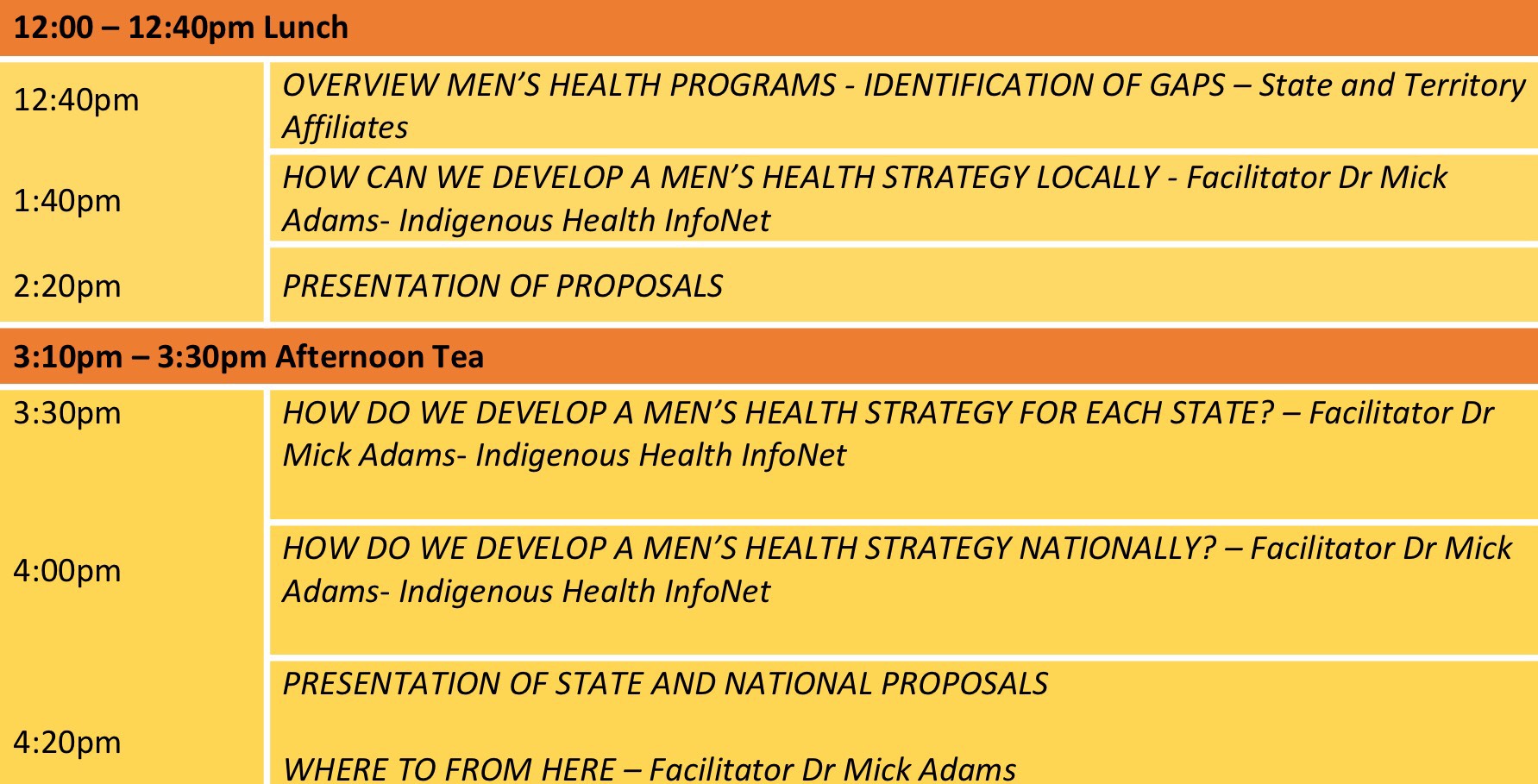
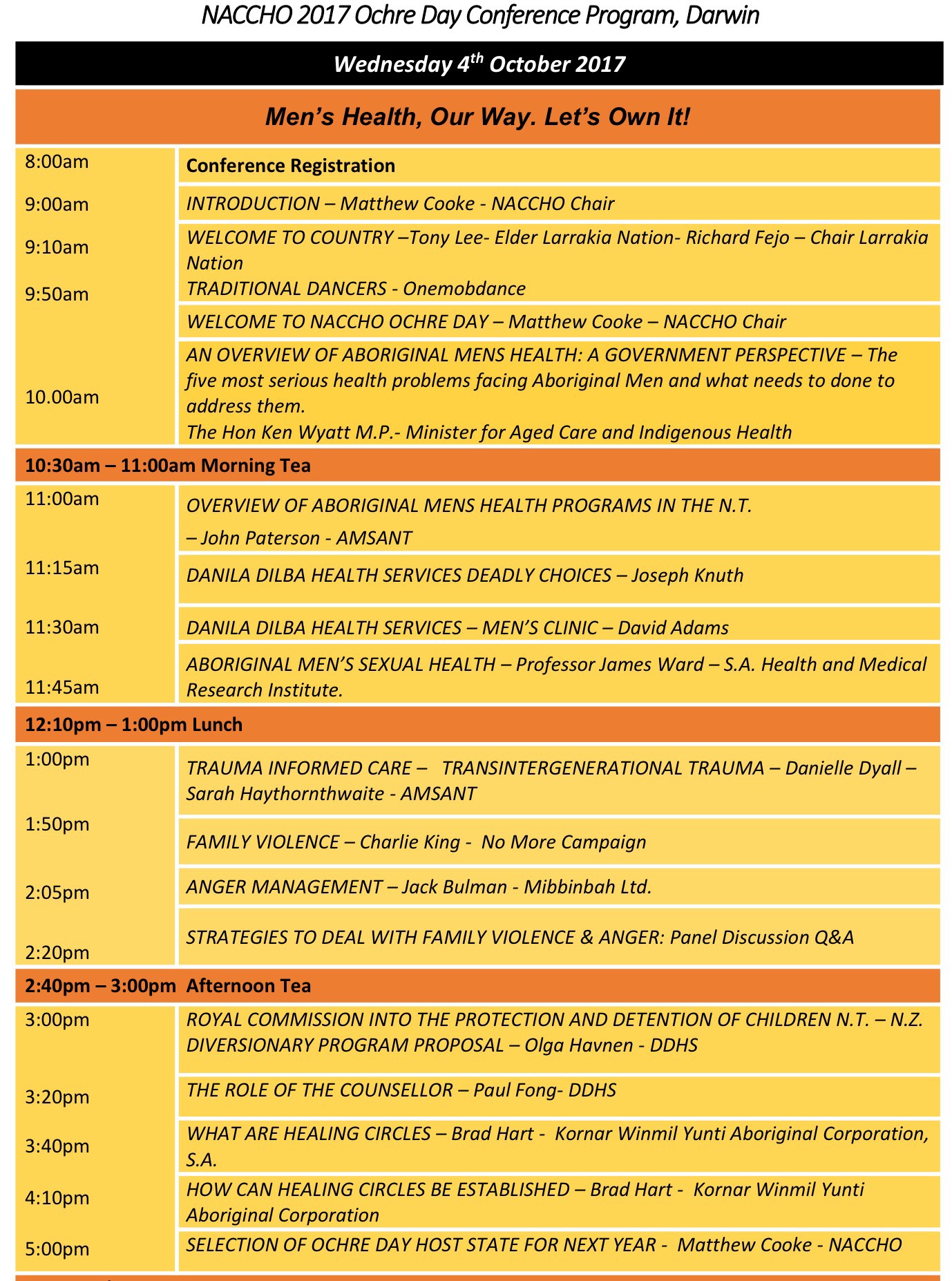
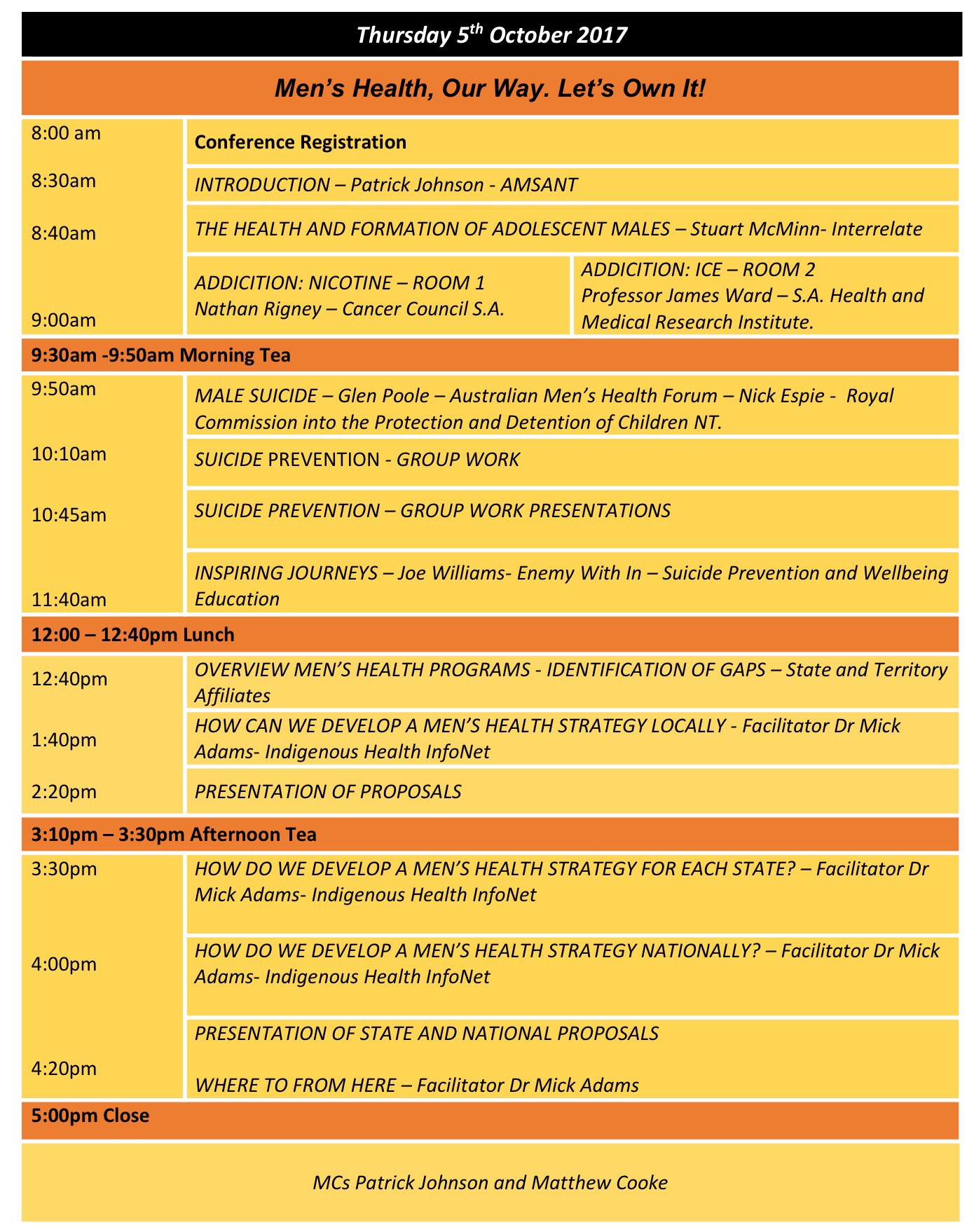
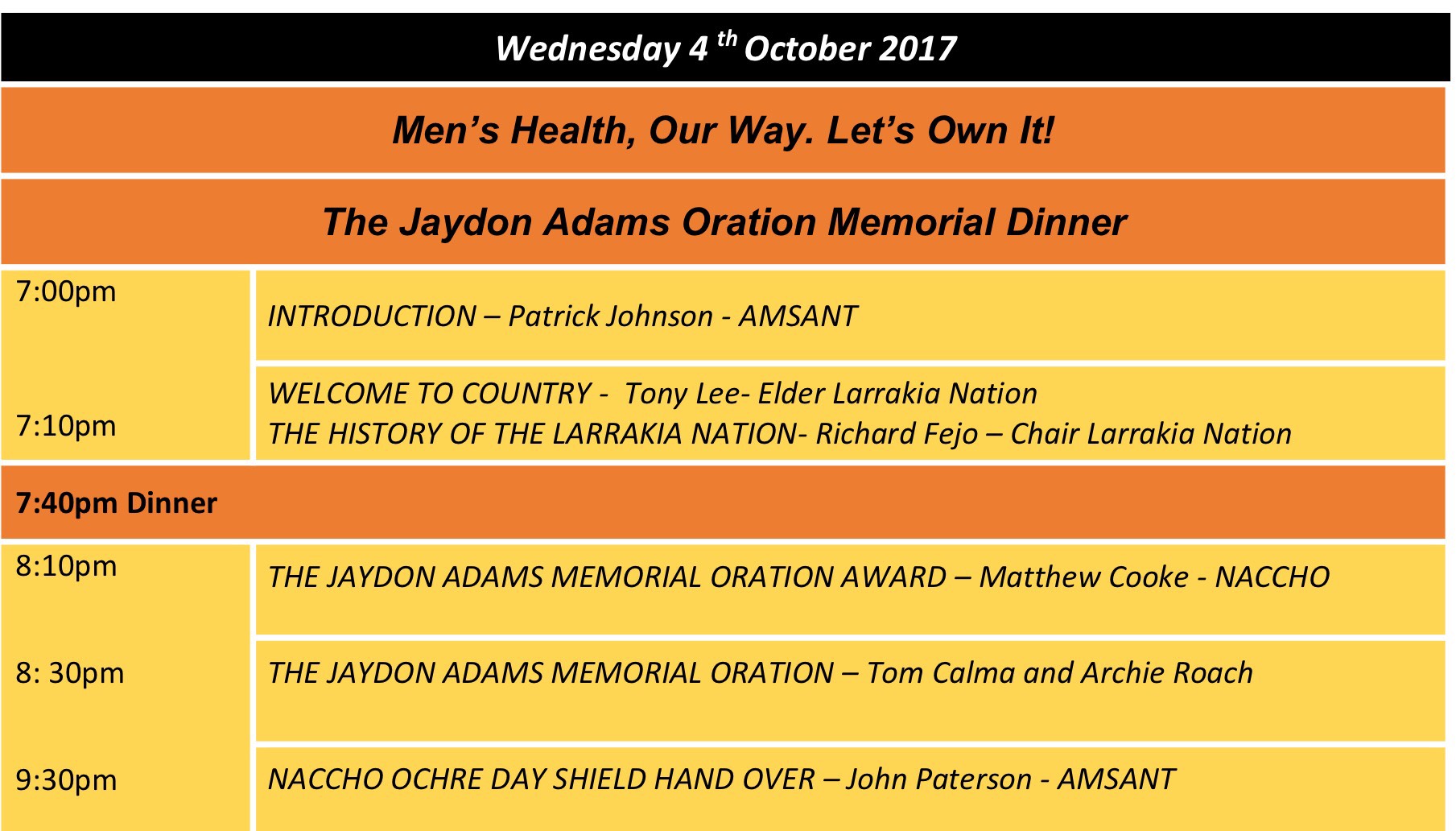
1.3 National : 2017 NACCHO National Aboriginal Male Health Ochre Day registrations Darwin NT

2 .1 NSW: Awabakal ACCHO Leading Indigenous doctors visit to inspire the students to pursue their dreams

2. 2 NSW Awabakal is Tackling Indigenous Smoking

3. VIC : VACCHO supports a YES vote for Equality

4. WA: AHCWA : Football benefits Indigenous communities long after the siren

5. QLD : Deadly Choices 2017 STATE QUEENSLAND MURRI CARNIVAL IN REDCLIFFE has kicked off

6. NT : $6 Million Health Centre for Umbakumba,Groote Eylandt

7. TAS : FIAAI ‘No Smokes No Limits’ Public Health Campaign Launched

8.SA : Aboriginal Health Council of SA  and South Australian Aboriginal Chronic Disease Consortium

9. View hundreds of ACCHO Deadly Good News Stories over past 5 years

How to submit a NACCHO Affiliate  or Members Good News Story ? 

 Email to Colin Cowell NACCHO Media    

Mobile 0401 331 251

Wednesday by 4.30 pm for publication each Thursday

1.1 NACCHO CEO attends AMA’s Indigenous Health Taskforce 

NACCHO CEO Pat Turner and Minister for Indigenous Health, Ken Wyatt, attended the AMA’s Indigenous Health Taskforce meeting last weekend to discuss the Government’s Aboriginal and Torres Strait Islander health priorities and actions.

The Taskforce identifies, develops, and recommends Indigenous health policy and strategies for the AMA, and includes Federal Councillors, AMA members, and Indigenous health organisations.

Issues discussed included the growing incidence of type 2 diabetes among young Indigenous people, renal disease, preventable hospital admissions and deaths, mortality rates, and the use of the Medicare Benefits Scheme (MBS) and the Pharmaceutical Benefits Scheme (PBS) by Aboriginal and Torres Strait Islander patients.

The Taskforce also discussed racism within the health system in Australia, and recognised the need for more programs and strategies to eradicate racism from the entire health workforce

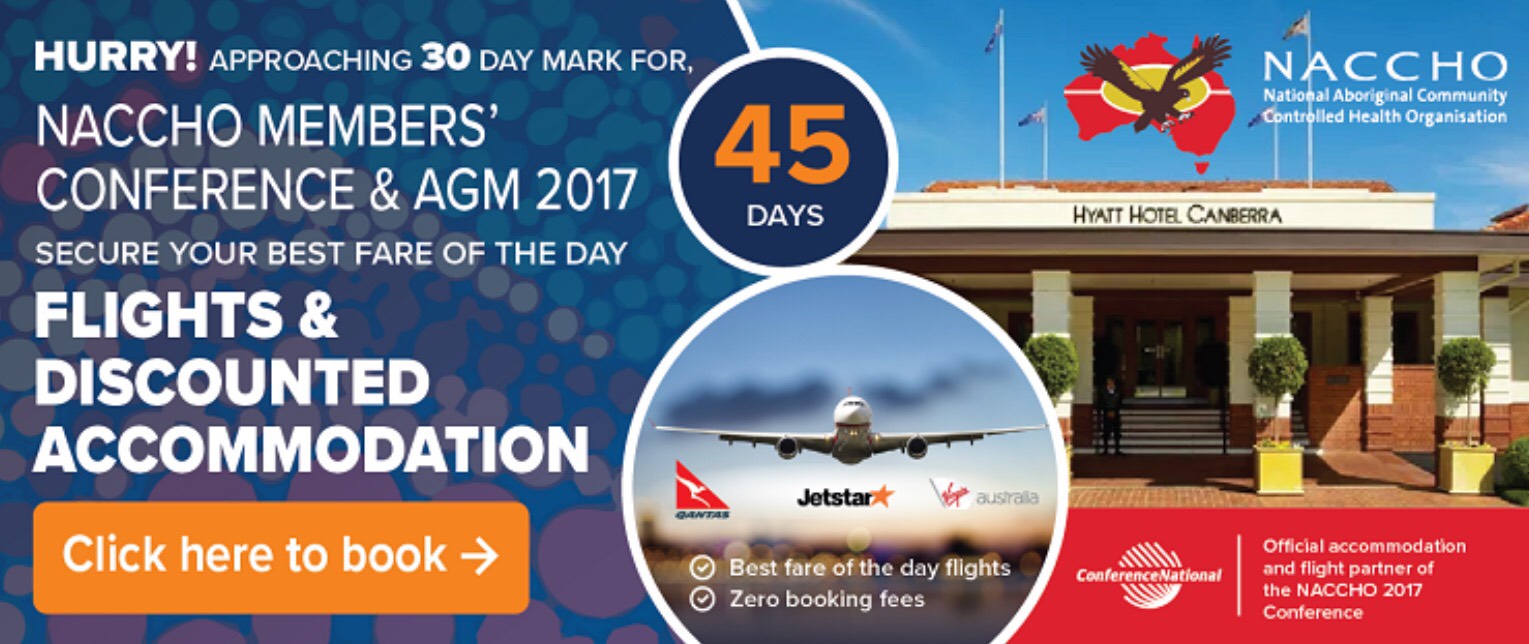
1.2 National : 2017 NACCHO Members’ Conference and AGM Registrations : Only 45 days to go

 Last Monday 18 September there was only 45 days to go and we are nearly booked out

This is an opportunity to show case grass roots best practice at the Aboriginal Community Controlled service delivery level.

In doing so honouring the theme of this year’s NACCHO Members’ Conference ‘Our Health Counts: Yesterday, Today and Tomorrow’.

NACCHO Conference Website

1.3 National : 2017 NACCHO National Aboriginal Male Health Ochre Day registrations Darwin NT

Register HERE

Download the 2 day Ochre Day Program

final 2017-Ochre-Day-Program

2 .1 NSW: Awabakal ACCHO Leading Indigenous doctors visit to inspire the students to pursue their dreams

A group of leading Indigenous doctors visited Maitland High School on Tuesday to inspire the students to pursue their dreams.

Eight doctors from the Australian Indigenous Doctors’ Association told the students their experiences and ran medical workshops, including plastering and handwashing with the use of a UV light to detect germs.

The program was part of AIDA’s visit to the Hunter, which included a stop in at Awabakal in Newcastle.

Maitland High was chosen due to its high Aboriginal population (12 per cent).

AIDA president Kali Hayward said they wanted to show the students the opportunities available and leave a lasting impression. “You can’t underestimate the value of a role model,” she said

2. 2 NSW Awabakal is Tackling Indigenous Smoking

Awabakal is facing the issue of increased smoking rates in the community head on with the launch of their I’m Quitting campaign which took place in September  at Awabakal Medical Service.

The campaign is part of the national Tackling Indigenous Smoking program and aims to reduce smoking rates among Aboriginal and Torres Strait Islander people, with Awabakal highlighting the problem on a local level.

 The launch event saw 25 ‘quit kits’ issued to existing smokers who are looking to cut down or completely quit the habit. The kits include a branded shirt to raise awareness, a 30 day progress chart with health information on the first month of quitting, pledge magnets to remind people why they were quitting, Nicotine Replacement Therapy voucher and more.

When discussing the campaign, Chief Executive Officer Raylene Gordon said that smoking rates within the Aboriginal community were continuing to increase and Awabakal was committed to supporting the community in their efforts to quit.

“The I’m Quitting campaign has been introduced to help support members of our community who are wanting to reduce or completely stop smoking all together and it is a program of which I am incredibly proud,” said Raylene.

“Smoking is a real issue for the Aboriginal community it is the most preventable cause of early death, with smoking accounting for one in every five deaths.

“This is an unacceptable figure. The I’m Quitting campaign is designed to assist community members on their quitting journey by providing useful information and quit tips, along with supporting them through our Medical Service to ensure they stay on track,” said Raylene.

Awabakal Project Officer and I’m Quitting participant, Ray Kelly, said he has decided to quit smoking for not only his own health but also for his daughters.

“I have been smoking for about 15 years and I can feel the damage it has caused. I’m mainly quitting for my three daughters, I need to be there for them as they grow and I need to be a healthy role model,” said Ray.

“My goal is to quit completely and while I have attempted to do so in the past, I’m really focussed on making this time stick.

“Even in the last week or so since cutting back I have noticed a difference, I feel healthier while I train and my tastebuds have changed,” concluded Ray.

Awabakal are encouraging anyone that is thinking of quitting smoking to contact Awabakal Medical Service on 02 4907 8555.

3. VIC : VACCHO supports a YES vote for Equality

VACCHO supports the right of every Australian to get married regardless of their gender or sexuality.

We oppose this non-binding postal survey that asks ‘anyone’ to determine the human rights of our LGBTI families and friends, however believe the most powerful act to effect positive change, is to vote yes.

VACCHO will be unequivocally supporting the Equality Campaign, and encouraging our Member organisations to vote yes, as well as ours and the wider community to do the same.

Aboriginal and/or Torres Strait Islander people who identify as LGBTI often experience multiple levels of marginalisation and discrimination. VACCHO is significantly concerned about the implications this campaign will have on the social and emotional wellbeing of the Aboriginal and/or Torres Strait Islander LGBTI community, their families and mainstream brothers and sisters. Already we have witnessed deplorable content generated from the No Campaign.

We know LGBTI people suffer uniquely high rates of suicidality, same-sex attracted people are up to 14 times more likely to attempt suicide. This statistic will be compounded in our LGBTI community, especially for our young brotherboys and sistergirls.

It saddens us that in 2017 the Federal Government can stand silent and allow this level of vilification and discrimination to occur.

Discriminatory legislation is an impediment to the LGBTI Aboriginal and/or Torres Strait Islander community achieving the highest attainable standard of health, instead this process is widening the health inequalities of First Australians.

We hope that the Parliament will respect the outcome of the Equality campaign, work swiftly to deliver marriage equality, and heal the harm.

4. WA: AHCWA : Football benefits Indigenous communities long after the siren

Football has the ability to build a strong heart and mind, and it is making our kids more disciplined and coordinated with their body skills as well as their mentality.

Indigenous sporting personalities needed to be particularly mindful that they were role models for their communities.

They have kids that look up to them and their competitiveness in the sporting industry, and [players need to recognise their] connection to culture and must not forget that they come from a grass roots level “

Michelle Nelson-Cox is speaking about the positive impact footy has on Indigenous communities in Western Australia

Ms Nelson-Cox, a Whadjuk Noongar woman, is the chairperson of the Aboriginal Health Council of WA.

Originally Published HERE

“[Football] is very important to have around, not only for aspiring young kids who fantasise about being an elite sportsperson, but also because of our elite sportspeople who are creating a positive profile [in the community],” she said

A recent report by the Bankwest Curtin Economics Centre – After the Siren: The community benefits of Indigenous participation in Australian Rules Football – has highlighted the physical health, mental well being and community connectedness benefits that flow from playing football.

AFL is the second-most popular team sport among Aboriginal and Torres Strait Islanders, with almost 45,000 Indigenous players, and in WA, one in four Indigenous men play the sport.

Indigenous boys living in remote areas and playing football had 20 percent lower rates of truancy from school than those that did not play, according to the report.

In the past year adult Indigenous players reported higher life satisfaction than those who did not participate, and they were twice as likely to rate their health as excellent.

Fifty-six percent of Aboriginal and Torres Strait Islander children who played football were assessed as being in excellent health, compared to 48 percent of children that had not engaged with the sport

Report co-author and Senior Research Fellow, Dr Sean Gorman from Curtin University’s School of Media, Culture and Creative Arts, said the report also found that AFL is an inclusive sport that offers wide accessibility irrespective of socio-economic background.

“Whether it is urban or regional areas, the role of football plays is massive, not just in terms of getting communities engaged, it is massive in terms of the way it presents a positive aspect to people’s lives that are, if we look at social and economic indicators, not great,” he said.

“Football is a really important social mechanism for Aboriginal people to engage their agency, but also to participate in something that all Australians love.”

Dr Gorman also highlighted the important role elite-level Indigenous players held in the community.

“They are seen as significant contributors to the way Aboriginal people feel great pride and great resonance that enables them to see something other than the horrible statistics that we see time and time again,” he said.

“The role they play is completely vital to the way Aboriginal people can feel proud and safe and valued, whether that is in urban, regional or remote Australia.”

Ms Nelson-Cox said Indigenous sporting personalities needed to be particularly mindful that they were role models for their communities.

“They have kids that look up to them and their competitiveness in the sporting industry, and [players need to recognise their] connection to culture and must not forget that they come from a grass roots level,” she said.

Dr Gorman said that for many professional Indigenous players, there was a deeper narrative associated with their participation in AFL.

“When you talk to Aboriginals about why they play they say ‘I am not playing for myself, I am representing my family and my community’,” he said.

“It becomes a deeper narrative, a stronger narrative, which as a broader community we need to appreciate and understand.

“This is where the report becomes so salient because it is how we connect all these disparate narratives up, and we can start to appreciate on a greater level the contribution these men and women have made over time.”

One such role model is the Fremantle Dockers’ woman’s team Vice Captain and Noongar woman Kirby Bentley, who spoke at the launch of the After the Siren report on Thursday.

“I am still one of the most elite Indigenous female footballers in the country and for me that is not so much about saying how good I think I am. It’s more about what I can do with the position I am in,” she said.

The number of women’s football teams has doubled since AFL Women’s League was introduced this year, according to the report.

AFL is also making its mark on remote communities in the far-north of WA.

“It is an integral part of the Western Desert communities,” Michael McMonigal said.

McMonigal is the program manager of Ngurra Kujungka [Inc], an non-for-profit organisation leading the development of the Western Desert’s first community driven, regional sport and recreation program.

“It has a very positive influence on the community, in terms of their overall physical, mental and emotional wellbeing,” he said.

“We are hoping to develop programs and pathways for these young footballers to follow in the future.”

In 2003, Newcrest Mining Ltd began sponsoring the annual Western Desert League, a football competition created to benefit and engage the Martu people, the traditional owners of a large part of central WA.


5. QLD : Deadly Choices 2017 STATE QUEENSLAND MURRI CARNIVAL IN REDCLIFFE has kicked off

Arthur Beetson Foundation has announced that 2017 Deadly Choices Arthur Beetson Foundation Murri Rugby League Carnival will take place at Dolphin Oval Redcliffe from 20th to 23rd September.

The Carnival involves teams from across Queensland and is a real show piece of Indigenous Rugby League Talent.

Three Competitions take place over four days include Under 15’s Boys, Open Women’s and Open Men’s. Some exciting additional events and activities will be announced very soon.

The Carnival is much more than Rugby League as it also has a major focus on Health and Education. All players have to complete a “Health Check” as a requirement to participate and all Under 15’s Boy participants must have attended school 90% of time

.
Peter Betros Chairman of QRL stated the “ this Carnival highlights the great reach the game of Rugby League has across Queensland and the Arthur Beetson Foundation should be congratulated in providing this opportunity for so many to get involved”

Brad Beetson, son of the late Arthur Beetson and Board Member of the Arthur Beetson Foundation stated “ Dad through his life had a passion on improving the lives of young indigenous it’s great that the foundation can continue this by using his other great passion of Rugby League the vehicle to do so”.

Murri Rugby League is an annual four day rugby league carnival for Aboriginal and Torres Strait Islander Queensland rugby league teams. Queensland Rugby League (QRL) has awarded the Arthur Beetson Foundation with the tender for the next three years. The Foundation has employed MRL (Qld Pty Ltd) to event manage the Murri Rugby League carnival.

Giving Back

A significant portion of Arthur Beetson Foundation generated revenue will be invested back into Indigenous Rugby League programs and structures endorsed by the QRL to establish sports focused sustainable community activities.

Murri Rugby League aims to:

  • Raise the representation of Indigenous players from the current 11% in the National Rugby League to 15%, an overall 4% growth in participation over a 3-5 year time frame.
  • Provide structure in a drug and alcohol free environment for players to have the opportunity to develop a direction into representation at a national level.
  • Work with the network of Indigenous communities in Queensland to promote and develop the carnival as a state event.
  • Develop a sponsorship alliance which will support the participation of all Communities and contribute to the staging of the carnival as an annual event.

About The Murri Rugby League Carnival

The Murri Carnival is a very important date on the Indigenous calendar and is much more than a rugby league event. The Carnival has certain basic rules. An adult person cannot play in the Carnival unless they:
. undergo a health check; and
. enrol to vote or, if enrolled, make sure that their enrolment details are current.

An under 15 player cannot play in the Carnival unless they;
. undergo a health check; and
. have a 90% school attendance record.

Each year a number of people are identified as possible suffers of diabetes a disease that shortens the life span of too many Indigenous Australians.

In 2014 the under 15 side travelled to New Zealand and a Men’s team travelled to Fiji to play and take part in a cultural exchange. The QRL Indigenous under 15 team also played the curtain raiser to the NRL Indigenous All Star Game at Suncorp Stadium last February 2015 against a New South Wales Koori team

6. NT : $6 Million Health Centre for Umbakumba,Groote Eylandt 

The community of Umbakumba on the Territory’s Groote Eylandt is celebrating the opening of a new $6 million health centre.

The Member for Arnhem Selena Uibo said the jointly funded facility was sorely needed in the remote island community, 600 kilometres southeast of Darwin.

The community is located approximately 50 km east of Angurugu situated inside Little Lagoon, Point Langton on the northeast coast of Groote Eylandt. Umbakumba is approximately 50 km east of Angurugu on Groote Eylandt, which is 650 km east of Darwin and 50 km off the Arnhem Land coast in the Gulf of Carpentaria. Apart from the fortnightly freight barge service from Darwin, Umbakumba is generally accessed by air.

Groote Eylandt airport, located 1 km from Angurugu, is the main air access point for the island. Owned and maintained by Gemco, the airstrip is sealed and there are flights to and from Nhulunbuy/Darwin most days.

Travel time to Nhulunbuy: 30-50 minutes, to Darwin: 1.5-2 hours. A 50 km dirt road links Angurugu to Umbakumba. Charter flights can also be arranged direct to Umbakumba which has a dirt airstrip that can accommodate twin engine light aircraft.

There is a reasonable dirt road from the airport to Umbakumba. However, a 4-wheel drive is essential and given the number of rivers and streams, travel throughout the island during the wet season can be difficult.

“Groote Eylandt residents want and deserve to access high quality health services,” Ms Uibo said.

“We know that improving the health of Groote Eylandt people, boosts the community and makes the Territory a healthier and stronger place.”

The $6 million build has been funded through a tripartite Regional Partnership Agreement including:

$3 million from Groote Eylandt Bickerton Island Enterprises

$2 million from the Northern Territory Government

$1 million from the Australian Government

Ms Uibo said it was a great example of local decision making with the Groote Eylandt Bickerton Island Enterprises group working with the Territory and Federal Governments to improve health.

“The original clinic was so run down that the costs of repairs was prohibitive,” Ms Uibo said.

“Local contractor GCC was awarded the contract to build a new facility in January last year and after significant challenges including weather and distance they have delivered a state of the art facility for community.

The new Yinumarra health Centre facilities include:

  • new emergency services with an ambulance bay and a single bed emergency rooms
  • five consulting rooms including men’s, women’s and children’s consulting areas
  • dental room
  • drug storage room
  • multi-purpose room
  • enhanced security and privacy for staff and clients
  • reception and internal and external waiting area

The centre is one of three to be opened, with Ngukurr Health Centre opened last week and Numbulwar Health Centre opening tomorrow

7. TAS : FIAAI ‘No Smokes No Limits’ Public Health Campaign Launched

Flinders Island Aboriginal Association’s Tackling Smoking Program has recently launched their latest ‘No Smokes No Limits’ public health campaign with billboards being revealed across Tasmania. These billboards feature motocross imagery and Aboriginal ambassadors Jay and Josh Woolley from WSM Freestyle.

As part of this campaign, smokers are encouraged to contact their local health service, general practice or the Quitline for assistance in giving up the habit. This campaign seeks to denormalise smoking, and is in stark contrast to some of the messaging typically associated with extreme sports that are often sponsored by energy drinks or other consumables associated with poor health outcomes.

FIAAI CEO Maxine Roughley said “This program especially targets young people who are our future and we are proud to be supporting such an important health issue.”

FIAAI will be looking to expand this campaign to buses and other mediums in the future, with billboards currently being found in several parts of the state including Hobart, Launceston, East Devonport, Burnie and others. FIAAI will also be presenting at the upcoming Oceania Tobacco Control Conference (October 17-19) regarding this campaign.

The FIAAI Tackling Smoking Team can be contacted on 6334 5721 for more information.


8.SA : Aboriginal Health Council of SA  and South Australian Aboriginal Chronic Disease Consortium
The South Australian Aboriginal Chronic Disease Consortium (the Consortium) was launched on 18 May 2017, as a collaborative partnership formed between the South Australian Aboriginal Health Partnership (comprising of SA Health, Aboriginal Health Council of SA and Department of Health – Commonwealth) and the South Australian Academic Health Science and Translation Centre.

The Translation Centre represents a partnership between SA Health, South Australian Health and Medical Research Institute (SAHMRI), University of Adelaide, Flinders University, University of South Australia, Aboriginal Health Council of South Australia, Health Consumers Alliance of South Australia, Adelaide Primary Health Network, Country SA Primary Health Network and Cancer Council SA. The Translation Centre has 9 priority areas of which one is Aboriginal Health.

Consortium Vision

The Consortium’s vision is to reduce the impact of chronic disease experienced by Aboriginal and Torres Strait Islander people living in South Australia through the successful implementation of the priorities identified within 3 plans: The South Australian Aboriginal Cancer Control Plan 2016-2021, the South Australian Aboriginal Heart and Stroke Plan 2017-2021 and the South Australian Aboriginal Diabetes Strategy 2017-2021.

How will the Consortium Work

The responsibility to oversee the implementation activity of the SA Aboriginal Chronic Disease Consortium rests within its governance structures. The Consortium has 5 active working groups including an Executive Group, an Aboriginal Community Reference Group and three condition-specific leadership groups representing Diabetes, Cancer and Heart and Stroke. We refer to the people and organisations on these groups as our members.

Who is working in the Consortium Coordinating Centre?

The team comprises of two full time staff. Wendy Keech is the Senior Research Translation Manager and Executive Officer. Wendy is supported by Douglas VJ Clinch, in a Project Officer role overseeing and supporting the various governance groups of the Consortium. Strategic policy and cultural advice and support is being provided by Kim Morey and Neville Fazulla both on a part-time basis to the team, and have particular focus on supporting the community reference group. Andrea McKivett, has been providing her clinical, technical and cultural support to the team since the inception of the Consortium, with Katharine McBride recently joining the team to provide technical support one day a week. The team come from various backgrounds and disciplines required to support the work of the Consortium, and all are passionate people with a strong commitment to making a difference to the health and wellbeing of Aboriginal people in South Australia.

If you would like any further information please don’t hesitate to contact Wendy Keech, on (08) 81284228, email: wendy.keech@sahmri.com or Doug VJ Clinch, on (08) 81284893 or email: douglas.clinch@sahmri.com.

Aboriginal Community Controlled Health TOP #jobalerts Inc CEO @ahmrc @IUIH_ @CAACongress @Walgett_AMS @MiwatjHealth

 
 This weeks #Jobalerts

Please note  : Before completing a job application please check with the ACCHO or stakeholder that job is still available

1. Miwatj Health NT Senior Social and Emotional Well Being Therapeutic Clinician

2. Wuchopperen Health Service Cairns  : CHIEF EXECUTIVE OFFICER

3. Congress Alice Springs Chief Operating Officer at the Central Australia Academic Health Science Centre (CAAHSC)

4. Congress Alice Springs : WOMENS HEALTH NURSE

5-10 : Wurli-Wurlinjang Health NT 6 positions

5.Wurli-Wurlinjang Family Partnership Program (WWFPP) – Various Positions

6.Program Coordinator _ Strong Indigenous Families (FDV)

7.Strong Indigenous Families. Positions include: Counsellors/ Therapists, Case Managers & Community Engagement Support Officers (FDV)

8 .Mental Health Professionals

9.Registered Aboriginal Health Practitioner

10.General Practitioner

11. National Health and Medical Research Council 2017 – 2018 Indigenous Internship program

 12 – 20 JOBS AT IUIH Brisbane

21 .Aboriginal Health and Medical Research Council of NSW  CEO

22. GP Vacancies: Full time and Part time Bulgarr Ngaru Medical Aboriginal Corporation Grafton and Casino

 23 . Office Practice Manager : Port Augusta, SA Pika Wiya Health Service

24. Senior Rural Medical Practitioner : Port Augusta, SA: Pika Wiya Health Service

25. Walgett ACCHO HUMAN RESOURCE MANAGER

VIEW Hundreds of Jobs on the NACCHO Jobalerts


  Register or more INFO

How to submit a Indigenous Health #jobalert ? 

NACCHO Affiliate , Member , Government Department or stakeholders

If you have a job vacancy in Indigenous Health 

Email to Colin Cowell NACCHO Media

Tuesday by 4.30 pm for publication each Wednesday

1. Miwatj Health NT Senior Social and Emotional Well Being Therapeutic Clinician 

Miwatj Health Aboriginal Corporation is the regional Aboriginal Community Controlled Health Service in East Arnhem Land, providing comprehensive primary health care services for over 6,000 Indigenous residents of North East Arnhem and public health services for close to 10,000 people across the region.

Miwatj Health aims to improve access to integrated, culturally responsive and safe mental health and drug and alcohol services that holistically meet the social and emotional well being and mental health needs of the population in the East Arnhem region.  We  are seeking enthusiastic, dedicated and an appropriately qualified senior therapeutic clinician to fill a role within our organisation.

Our Values

  • Compassion care and respect for our clients and staff and pride in the results of our work.
  • Cultural integrity and safety, while recognising cultural and individual differences.
  • Driven by evidence-based practice.
  • Accountability and transparency.
  • Continual capacity building of our organisation and community.

In this role you will be responsible for working collaboratively with members of the Social and Emotional Well Being (SEWB) team, and the Manager, Mental Health to contribute to the development and delivery of the Miwatj SEWB model.

Key Responsibilities include;

  • Demonstrated experience in working in Aboriginal Community Controlled Health Organisations or environments and fully embrace the concept of Aboriginal Community Control
  • Experience in delivering (culturally adapted) Focused Psychological Strategies to Aboriginal and Torres Strait Islander people
  • Deliver culturally adapted evidence based therapeutic interventions that value and build upon traditional indigenous knowledge
  • Contribute to a coordinated approach for the prevention, assessment, early intervention, referral and shared care arrangements for common mental and behavioral disorders, including alcohol and drug use disorders
  • Develop and articulate a Miwatj SEWB Model that includes the promotion of strong SEWB, screening, self-referral and early intervention for common mental health disorders (including alcohol and drug use disorders) as part of comprehensive primary health care. This includes the development of mental health care plans, clinical pathways, case management, and clear referral pathways and processes
  • Develop clinical governance structures and processes to support the delivery of culturally-adapted evidence-based therapeutic interventions to address common mental health disorders, including alcohol and drug use disorders, as part of comprehensive primary health care
  • Ensure Therapeutic Work complements and works in an integrated way with the existing medical and social/cultural support streams of care
  • Effectively manage a team of two clinicians to deliver, articulate and promote the SEWB Miwatj Model

To apply for this role you must be either a registered Clinical Psychologist, Registered Psychologist, Mental Health experienced Social Worker, or Mental Health experienced Occupational Therapist and be eligible to work in Australia.

For further details please refer to the Job Description.

This is a full time position with benefits and an attractive salary commensurate with experience. The position is Darwin based and will involve regular travel throughout the Miwatj region (locally based and subsidised accommodation may be negotiated).

Applications close 11 October 2017.

Aboriginal and Torres Strait Islanders are encouraged to apply.

2. Wuchopperen Health Service Cairns  : CHIEF EXECUTIVE OFFICER

Focus on Aboriginal and Torres Strait Islander Health

• Primary and Allied Health Care – Established Services

• Aboriginal Community Controlled Organisation

• Cairns and Outreach Locations

Wuchopperen Health Service Limited is a community controlled organisation delivering holistic primary and allied health care for Aboriginal and Torres Strait Islander people in Cairns and surrounding districts. Wuchopperen Health Service’s vision of improving quality of life for Aboriginal and Torres Strait Islander Peoples underlines our commitment to providing high quality, safe and coordinated care for our people.

Wuchopperen is seeking a motivated and appropriately experienced CEO to deliver inspirational leadership and continue to drive our strategic aims to fully develop our organisations potential, enhance our capability and continue to expand the key role we already play within our community, now and into the future.

Reporting directly to the Board of Directors, the successful applicant will oversee an established organisational structure comprising of Clinic, Allied Health, Community and Mental Health Services, a Child and Family Centre along with Corporate Support.

The CEO will provide clear direction in the effective coordination of our various health services and programs, and funding related activity. In addition, the CEO will be responsible for facilitating corporate governance responsibilities and working closely with and alongside the Board, and providing oversight of Wuchopperen’s ongoing strict adherence to relevant Accreditation and Funding compliance standards.

This role presents an outstanding opportunity for a suitably inspired and credentialed Indigenous professional, to oversee the ongoing success and continual improvement of our organisation in accepting responsibility for the following key areas: Board Governance, Compliance and Coordination

• Leadership and Management of the Executive Team

• Strategic Management and Planning within a Competitive Health Market

• Budget, Finance, Risk Assessment and Funding

• Representation and Advocacy of Wuchopperen

• Local, Regional and National Stakeholder Engagement

• Business Development and Revenue Enhancement

Please submit your application, including a cover letter and resume, to Jenny Hall at jenny@mjsp.com.au.


3. Congress Alice Springs Chief Operating Officer at the Central Australia Academic Health Science Centre (CAAHSC)

  • Base salary: $158,554 – $183,085 (p.a)
  • Total effective package: $188, 192 – $220,310 (p.a)
  • Full-Time Maximum Term 3 year contract

The Central Australia Academic Health Science Centre (CAAHSC) is a partnership of 12 organisations from across the Territory including the Central Australian Aboriginal Congress (Congress), to establish a health research centre. The CAAHSC is a construct around innovation in regional health that brings together Aboriginal health services, the Alice Springs hospital and leading research and education institutions under a virtual centre of excellence. The centre has a focus on Aboriginal health, remote health and primary health care in a regional context, with another key focus to translate research into outcomes on the ground. The CAAHSC is an exciting collaborative, and it will be at the forefront of some incredible research and Congress is the leading partner.

The Centre is one of only two consortia nationally to be recognised as a Centre for Innovation in Regional Health (CIRH) by Australia’s peak funding body for medical research, the National Health and Medical Research Council (NHMRC).

The Centre is seeking a Chief Operating Officer who is interested in making a genuine contribution to improving health outcomes for Aboriginal people.

The Chief Operating Officer provides direct strategic and governance support to the Executive Committee of the Central Australia Academic Health Science Centre (CAAHSC) and manages the day to day operations of the CAAHSC.

Alice Springs offers a unique lifestyle in a friendly and relaxed atmosphere in the heart of Australia. It is within easy reach of Uluru (Ayers Rock) and Watarrka (Kings Canyon) and a host of other world heritage sites.

As well as a wonderful lifestyle and rewarding work, Congress offers the following:

  • Competitive salaries
  • Six (6) weeks annual leave
  • 9.5% superannuation
  • Generous salary packaging
  • A strong commitment to Professional Development
  • Family friendly conditions
  • Relocation assistance (where applicable)
  • District allowance

For more information on the position please contact Chief Medical Officer – Public Health, Dr John Boffa (08) 8951 4401 or 0418 812 141 or email john.boffa@caac.org.au.

Application close: MONDAY 2 OCTOBER 2017.

*Total effective package includes: base salary, district allowance, superannuation, leave loading, and estimated tax saving from salary packaging options.

Contact Human Resources on (08) 8959 4774 or vacancy@caac.org.au for more information

To apply for this job go to: http://www.caac.org.au/hr& enter ref code: 3748736.

4. Congress Alice Springs : WOMENS HEALTH NURSE

Full-time, Fixed Term 2 Year Contract based in SANTA TERESA

  • Base Salary: $98,982 – $106,314 (p.a)
  • Total Effective Package: $121,757 – $129,934 (p.a)*
  • Female Identified Position

Central Australian Aboriginal Congress (Congress) has over 40 years’ experience providing comprehensive primary health care for Aboriginal people living in Central Australia. Congress is seeking a Women’s Health Nurse who is interested in making a genuine contribution to improving health outcomes for Aboriginal people.

The Women’s Health Nurse works within a multi discipline team to provide culturally appropriate women’s health services and health promotions to Aboriginal women and children 0 – 8 weeks of age living in Santa Teresa.

This position participates in the after hour on call roster for medical emergencies. All after hour call outs are accompanied.

Central Australia offers a unique lifestyle in a friendly and relaxed atmosphere in the heart of Australia. It is within easy reach of Uluru (Ayers Rock) and Watarrka (Kings Canyon) and a host of other world heritage sites.

As well as a wonderful lifestyle and rewarding work, Congress offers the following:

  • Competitive salaries
  • Six (6) weeks annual leave
  • 9.5% superannuation
  • Generous salary packaging
  • A strong commitment to Professional Development
  • Family friendly conditions
  • Relocation assistance (where applicable)
  • District allowance and Remote Benefits

For more information on the position contact Clinic Manager Jason King on (08) 8956 0911 and Jason.King@caac.org.au

Applications close: SUNDAY 1 OCTOBER 2017

*Total effective package includes: base salary, district allowance, superannuation, leave loading, and estimated tax saving from salary packaging options.

Contact Human Resources on (08) 8959 4774 or mailto:vacancy@caac.org.aufor more information. Only shortlisted applicants will be contacted.

For more information about jobs at Congress visit www.caac.org.au

To apply for this job go to: http://www.caac.org.au/hr & enter ref code: 3736373.


Identified Position is under Section 9A of the NSW Anti-Discrimination Act 1977. Job Applications close 20 September 2017

  • 5-10 : Wurli-Wurlinjang Health NT 6 positions

If you are considering applying for a position with us, we encourage you in the first instance to review the position profile of the vacancy you are interested in. This will assist you in understanding the role you are interested in and will provide details in relation to the position responsibilities and other criteria applicants should consider addressing in their application.

All applications must contain the following as a minimum:

  • completed employment application form
  • current resume or curriculum vitae (CV)
  • a cover letter which provides a clear and concise overview of your ability to meet the requirements of the role.
  • a minimum of two referees (names, positions and telephone contact number) preferably one current and one past supervisor

Note: Applications who are successful must have the ability to satisfactorily complete a Criminal History Check and obtain a Working with Children Card.

Applications may be forwarded using our online Employment Application Form OR by emailing the Human Resources team at hr@nullwurli.org.au

View all details of these Wurli current vacancies HERE

5.Wurli-Wurlinjang Family Partnership Program (WWFPP) – Various Positions

6.Program Coordinator _ Strong Indigenous Families (FDV)

7.Strong Indigenous Families. Positions include: Counsellors/ Therapists, Case Managers & Community Engagement Support Officers (FDV)

8.Mental Health Professionals

9.Registered Aboriginal Health Practitioner

11.General Practitioner


11. National Health and Medical Research Council 2017 – 2018 Indigenous Internship program


National Health and Medical Research Council (NHMRC) is pleased to invite eligible applicants to apply to the Indigenous Internship program.
The Indigenous Internship program provides a wide range of opportunities for Aboriginal and Torres Strait Islander students to gain insight into the work of the NHMRC, as well as to enhance their educational experience through practical work experience.
An internship with the NHMRC provides:
·         exposure to government processes and requirements in relation to funding health and medical research
·         experience in developing guidelines, identifying and promoting resolution of ethical issues
·         exposure to mechanisms and challenges of disseminating and increasing uptake of knowledge
·         better understanding of the rationale for, and demands of, public administration and accountability
A limited number of paid placements for internships are available in our Canberra and Melbourne offices.
 
Eligibility
To be eligible you must be:  enrolled in an Undergraduate or Postgraduate degree in a health or medical research related field; able to work independently and as part of a team; and can provide evidence to confirm that you are of Aboriginal and/or Torres Strait Islander descent.
 
Applications for the 2017-18 Indigenous Internship Program close on Friday 29 September 2017.
To find out more please see our Indigenous Internship Information, which details eligibility and selection, as well as the terms and conditions of the program.
If you have any questions, please contact the Indigenous Employment Coordinator TJ Oberleuter on 02 6217 9530.

12 – 22 JOBS AT IUIH Brisbane

IUIH and its members are constantly looking for healthcare workers, GP’s, allied health professionals, medical and health related students to fill short or long term vacancies within their growing operations.Current job opportunities are listed below:

Website HERE

+ Team Leader – Home Support (Hervey Bay) Full Time On going + Manager, Family Wellbeing Services + Business Intelligence Analyst / Developer + Regional Optometrist + Registered Nurse – Full Time Ongoing + Exercise Physiologist, Full Time On going Based at Windsor + Exercise Physiologist – Hervey Bay / Cherbourg – Full time, Fixed Term + Indigenous Outreach Worker (CTG) Bundaberg Full Time Fixed Term

21 .Aboriginal Health and Medical Research Council of NSW  CEO

Aboriginal Health and Medical Research Council of NSW is currently seeking a motivated and highly experienced CEO to lead AH&MRC to a new level of sustainable growth and success.

Working directly with the Board of directors, AH&MRC’s personnel and funding bodies, this role will suit a candidate who has experience working within the Aboriginal Community Controlled Health Services (ACCHS), has a strong commitment to serving the interests of indigenous people and is a motivational leader with a focus on strategic planning.

The purpose of the AH&MRC is to lead the Aboriginal Health Agenda in NSW for improved policies, programs, service and practices.  Ensure that Aboriginal knowledge informs decision-making processes and support, strengthen Aboriginal Community Controlled Health Services to build sustainability within the Health Sector.

This is an Identified Position. 

Essential Criteria:

  1. Demonstrated experience working in a CEO capacity including the functions of a Company Secretary or as an Executive/Senior Manager in Aboriginal health sector or public health of no less than 5 years.
  2. This vacancy is an identified Aboriginal or Torres Strait Islander recruitment under Part 22, section 22.9 of the AH&MRC Constitution. Applicants for this role must satisfy the Aboriginality criteria. Aboriginality is defined by decent through parentage, identification as being Aboriginal and being accepted in the community as such. In your response to this criteria, you will need to provide information on how you satisfy the Aboriginality criteria.
  3. Demonstrated track record of successful leadership and experience working with board of directors identifying areas of risk and opportunities for growth.
  4. Demonstrated experience of the Aboriginal Community Controlled Health sector as well as health issues, including social determinants affecting Aboriginal peoples’ health status in contemporary Australian society.
  5. A decisive leader, capable of making efficient and effective decisions to positively affect organisational success and highly committed to promoting the welfare of the workplace from a financial, cultural and competitive market policy environment.
  6. Demonstrated experience in networking/liaising with the Aboriginal community, ACCHSs, government departments and non-Government organisations.
  7. Excellent written communication skills that demonstrate your ability to prepare and present reports, briefs and general routine correspondence.
  8. A policy response exercise.

How to Apply:

To receive a copy of the Recruitment Information Package for more information and the selection criteria, please contact HR via email or telephone.

Please send your completed application as per instructions in the Recruitment Information Kit to the HR Department either via post or email.

The selection criteria must be addressed for your application to be considered. 

For a confidential conversation please contact Human Resources (Gordana Agic) on (02) 9212 4777 or mailto:gagic@ahmrc.org.au

22. GP Vacancies: Full time and Part time Bulgarr Ngaru Medical Aboriginal Corporation Grafton and Casino

Are you a General Practitioner who has thought about being part of the effort to close the gap in Indigenous health outcomes??

Bulgarr Ngaru Medical Aboriginal Corporation (BNMAC) is a Community Controlled Aboriginal Health Service situated in Grafton and Casino, providing a full range of general practice services and Primary Health Care to the Community members of the Clarence and Richmond Valley’s.

BNMAC is recruiting General Practitioners to be based in Casino, NSW. Full time (35 hours per week) and part time options available with no on-call requirements.

The salary package may be negotiated as either wages or a combination of wages and percentage of receipted income. Staff members of BNMAC are eligible to access salary sacrifice.

The General Practitioner is required to provide culturally appropriate comprehensive primary health care services to clients of BNMAC.

Minimum Credentialing criteria for GP’s:

  1. Bachelor of Medicine or an Australian/Overseas equivalent recognised by the Australian Medical Council
  2. Current unrestricted registration as a General Practitioner with the Australian Health Practitioner Regulation Agency (AHPRA).
  3. Hold relevant professional indemnity insurance
  4. Evidence of Fellowship of Royal Australian College of General Practitioners (RACGP) or Australian College of Rural and Remote Medicine (ACRRM) or vocational registration.
  5. Evidence of completion of previous triennium requirements and active participation in continuous education recognised by the RACGP Quality Assurance and Continuous Professional Development (QA & CDP) or ACRRM Professional Development Program (PDP).
  6. Details of all past and continuing health care related employment and particularly that in General Practice.

Appointment is subject to a current Drivers Licence and a NSW Working with Children’s Check clearance. Further information on the Working with Children Check is available at http://www.kidsguardian.nsw.gov.au/Working-with-children/working-with-children-check

Clinical:

  1. Provide holistic approaches to health that include case conferencing and care planning for patients with chronic diseases.
  2. Be responsible to the Chief Executive Officer for provision of General Practitioner services to Bulgarr Ngaru Medical Aboriginal Corporation clients.
  3. Attend outreach visits when required under the instruction of the Executive Officer and in conjunction with a local Aboriginal Health Worker.
  4. Work collaboratively and co-operatively with a range of other health providers within the organisation and the Aboriginal community.
  5. In collaboration with other staff members, develop and undertake programs and tasks appropriate to family medicine, preventive medicine and primary care in the community and health education, incorporating the following:
  • Health assessments of children and adults
  • Chronic disease care plans
  • Women and men’s issues
  • Otitis Media and seasonal infections in both children and adults
  • Ante natal and post natal care
  • Diabetes management and other vascular health issues, perform ECGs
  • Treatment of minor lacerations
  • Geriatric and mental health
  • Arranging specialist services for clients as required and ensuring that these services are recorded.
  • Examining, diagnosing and developing treatment plans for patients
  • Treating the medical needs of both emergency and general patients to an optimum level without discrimination or bias
  • Understanding the practice principles of Infection Control
  • Ensuring, promoting and motivating patients in the general area of health, and contributing to community health.
  • Providing clinical leadership for staff in relation to meeting the health needs of the local Aboriginal community.
  • Medical consultations with clients of BNMAC are to be undertaken with due consideration of cultural respect and sensitivity.
  • Participation in Healthy for Life Program activities, Nutrition Program and other programs run by BNMAC staff.

Additional duties required:

  • Provision of in-service education to staff members as required
  • Participation in general staff and clinical staff meetings
  • Participation in accreditation and quality assurance activities undertaken by BNMAC.
  • Participate in Asbestos health screening activities
  • Abide by BNMAC policies and procedures
  • Work within the applicable NSW Work Health and Safety Guidelines
  • Advise the Chief Executive Officer of any local health needs and special programs to address these.
  • Establish liaison with local health agencies and personnel; attend meetings relevant to health needs of the Aboriginal Community as directed.
  • Utilise the client management software system and other associated systems to identify care needs, initiate recalls and care plans and ensure that client records are maintained accurately and meet all legal obligations.
  • Experience or interest in Indigenous Primary Health would be beneficial.
  • Provide clear advice to administration about Medicare items for claiming.

For further information please contact:

Mr Scott Monaghan 02 6644 3500

Please send applications attention Scott Monaghan at info@bnmac.com.au

23 . Office Practice Manager : Port Augusta, SA Pika Wiya Health Service

Link to apply: http://applynow.net.au/jobs/92120

About the Organisation

Established in the early 1970’s, Pika Wiya Health Service Aboriginal Corporation provides culturally appropriate, comprehensive primary health care services, social support and training to all Aboriginal and Torres Strait Islander people.

The organisation operates from its premises in Port Augusta and also has clinics at Davenport, Copley and Nepabunna communities. Pika Wiya Health Service Aboriginal Corporation also provides services to the communities of Quorn, Hawker, Marree, Lyndhurst and Beltana.

About the Opportunity

Pika Wiya Aboriginal Health Service Aboriginal Corporation (Pika Wiya) now has a full-time opportunity for an experienced Office Practice Manager to join their team in Port Augusta, SA.

In this role, you will be primarily responsible for the provision of specialised clerical, patient transport, and administrative services within the clinical/administrative team.

You will also work closely with the clinic supervisor, medical practitioners, and other organisations to ensure accurate medical claiming and billing and to organise placements.

To be successful in this role, you must have demonstrated experience in a similar position, training in Communicare, and a tertiary qualification in Business Administration or equivalent.

You will be an effective leader with the ability to nurture a team environment and conduct day-to-day business within the practice using tact, diplomacy, and empathy for others. As such, you will display exceptional interpersonal and communication skills and have the ability to work under pressure.

It is crucial to this role that you have previously worked in an Aboriginal organisation or community or have an understanding of appropriate cultural practices.

About the Benefits

In return for your hard work and dedication, you will be rewarded with a competitive salary circa $68,129 – $71,278 (commensurate with skills and experience) plus super and generous salary sacrificing benefits.

You will also receive access to a mobile phone and study leave options!

 24. Senior Rural Medical Practitioner : Port Augusta, SA: Pika Wiya Health Service

Link to apply: http://applynow.net.au/jobs/89148

About the Organisation

Established in the early 1970’s, Pika Wiya Health Service Aboriginal Corporation provides culturally appropriate, comprehensive primary health care services, social support and training to all Aboriginal and Torres Strait Islander people.

The organisation operates from its premises in Port Augusta and also has clinics at Davenport, Copley and Nepabunna communities. Pika Wiya Health Service Aboriginal Corporation also provides services to the communities of Quorn, Hawker, Marree, Lyndhurst and Beltana.

About the Opportunity

Pika Wiya Aboriginal Health Service Aboriginal Corporation (Pika Wiya) now has a full-time opportunity for a Senior Rural Medical Practitioner to join their team in Port Augusta, SA.

Reporting to the Medical Director, you will be responsible for the provision of high-level primary health care, ensuring continuity care for individuals, and for prevention programs for the population.

This will be done primarily through the Port Augusta clinic (bulk-billing clinic) – servicing a combination of booked and walk in clients – and also by visiting a remote clinic once a month.

To be successful in this position, you will hold an AHPRA recognised medical degree including general or specialist registration and a Medicare Australia Provider Number.

You will also have demonstrated experience working in a medical practice and have the ability to provide high-quality clinical skills in a rural general practice. Additionally, you must have a good knowledge of the Australian health system and the Medicare billing system.

It is crucial to this role that you have a good understanding of Aboriginal community and health and be willing to involve yourself in the community.

About the Benefits

In return for your hard work and dedication, you will be rewarded with an attractive base salary of $225,000 plus super.

You will also be eligible generous salary packaging, up to$16,000 through Maxxia, to increase your take home pay!

Pika Wiya is also willing to negotiate relocation assistance and accommodation subsidies for the right candidate.

Make a real difference to the health and well-being of a vibrant community – Apply Now! 

25. Walgett ACCHO HUMAN RESOURCE MANAGER

  • SENIOR LEADERSHIP / HR MANAGER OPPORTUNITY 
  • WALGETT & BREWARRINA District & COMMUNITY, Nthn-NSW 
  • ESTABLISHED, SUCCESSFUL & HIGHLY RESPECTED ACCHS TEAM

Download this Job info

OUR ORGANISATION

The WALGETT Aboriginal Medical Service (‘WAMS’) and the BREWARRINA Aboriginal Health Service Limited (‘BAHSL’) are highly respected and established Aboriginal Community Controlled Health Organisations, fully committed to providing accessible, practical, culturally appropriate and confidential Health services in Walgett, Brewarrina and surrounding communities.THE OPPORTUNITY

We are looking for a motivated, experienced and suitably qualified individual to join our senior management team, and fulfil the key role of HUMAN RESOURCE MANAGER.

Reporting directly to the Chief Executive Officer, the HR Manager oversees and facilitates all Human Resource and Employee Relations activities of the organisation, including  providing timely, practical advice and ongoing strategic support on all employee initiatives, programs and/or workplace issues.

As a key member of the Senior Management Team, the HR Manager is responsible for ensuring HR practices align with strategic business plans for the organisation. This opportunity represents a rewarding and fulfilling opportunity to join our established team, already highly regarded for making a real difference in our local communities. Highly competitive remuneration (including salary packaging), plus local Accommodation options are also available.

CONTACT / INFO / APPLY

Jon Mathias (MJSP)

Email jon@mjsp.com.au

Phone # 07 3839 1233


NACCHO Aboriginal Health and #Obesity : Download #TippingtheScales Report Leading health orgs set out 8 urgent actions for Federal Government

“Sixty-three per cent of Australian adults and 27 per cent of our children are overweight or obese.

This is not surprising when you look at our environment – our kids are bombarded with advertising for junk food, high-sugar drinks are cheaper than water, and sugar and saturated fat are hiding in so-called ‘healthy’ foods. Making a healthy choice has never been more difficult.

The annual cost of overweight and obesity in Australia in 2011-12 was estimated to be $8.6 billion in direct and indirect costs such as GP services, hospital care, absenteeism and government subsidies.1 “

 OPC Executive Manager Jane Martin 

Download the report HERE  tipping-the-scales

Read over 30 + NACCHO Obesity articles published last 5 years

Read over 30+ NACCHO Nutrition and Healthy foods published last 5 years

Thirty-four leading community, public health, medical and academic groups have today united for the first time to call for urgent Federal Government action to address Australia’s serious obesity problem.

In the ground-breaking new action plan, Tipping the Scales, the agencies identify eight clear, practical, evidence-based actions the Australian Federal Government must take to reduce the enormous strain excess weight and poor diets are having on the nation’s physical and economic health.

Led by the Obesity Policy Coalition (OPC) and Deakin University’s Global Obesity Centre (GLOBE), Tipping the Scales draws on national and international recommendations to highlight where action is required. Areas include:

  1. Time-based restrictions on TV junk food advertising to kids
  2. Set clear food reformulation targets
  3. Make the Health Star Rating mandatory by July 2019
  4. Develop a national active transport strategy
  5. Fund weight-related public education campaigns
  6. Introduce a 20% health levy on sugary drinks
  7. Establish a national obesity taskforce
  8. Develop and monitor national diet, physical activity and weight guidelines.

OPC Executive Manager Jane Martin said the eight definitive policy actions in Tipping the Scales addressed the elements of Australia’s environment which set individuals and families up for unhealthy lifestyles, rather than just focusing on treating the poor health outcomes associated with obesity.

Watch video HERE : How does junk food marketing influence kids

“Sixty-three per cent of Australian adults and 27 per cent of our children are overweight or obese. This is not surprising when you look at our environment – our kids are bombarded with advertising for junk food, high-sugar drinks are cheaper than water, and sugar and saturated fat are hiding in so-called ‘healthy’ foods. Making a healthy choice has never been more difficult,” Ms Martin said.

“The annual cost of overweight and obesity in Australia in 2011-12 was estimated to be $8.6 billion in direct and indirect costs such as GP services, hospital care, absenteeism and government subsidies.1 But Australia still has no strategy to tackle our obesity problem. It just doesn’t make sense.

“Without action, the costs of obesity and poor diet to society will only continue to spiral upwards. The policies we have set out to tackle obesity therefore aim to not only reduce morbidity and mortality, but also improve wellbeing, bring vital benefits to the economy and set Australians up for a healthier future.”

Professor of Epidemiology and Equity in Public Health at Deakin University, Anna Peeters, said the 34 groups behind the report were refusing to let governments simply sit back and watch as growing numbers of Australians developed life-threatening weight and diet-related health problems.

“For too long we have been sitting and waiting for obesity to somehow fix itself. In the obesogenic environment in which we live, this is not going to happen. In fact, if current trends continue, there will be approximately 1.75 million deaths in people over the age of 20 years caused by diseases linked to overweight and obesity, such as type 2 diabetes, cancer heart disease, between 2011-20501,” Professor Peeters said.

“Obesity poses such an immense threat to Australia’s physical and economic health that it needs its own, standalone prevention strategy if progress is to be made. There are policies which have been proven to work in other parts of the world and have the potential to work here, but they need to be implemented as part of a comprehensive approach by governments. And they need to be implemented now.

“More than thirty leading organisations have agreed on eight priorities needed to tackle obesity in Australia. We would like to work with the Federal Government to tackle this urgent issue and integrate these actions as part of a long-term coordinated approach.”

In addition to the costs to society, the burden of obesity is felt acutely by individuals and their families.

As a Professor of Women’s Health at Monash University and a physician, Professor Helena Teede sees mothers struggle daily with trying to achieve and sustain healthy lifestyles for themselves and their families, while having to deal with the adverse impact of unhealthy weight, especially during pregnancy.

“As a mother’s weight before pregnancy increases, so does the substantive health risk to both the mother and baby. Excess weight gain during pregnancy further adds to these risks and is a key driver of infertility, long-term obesity, heart disease and type 2 diabetes, while for the child, their risk of becoming overweight or obese and developing chronic diseases in later life greatly increases,” Professor Teede said.

“The women I see are generally desperate for help to improve their lifestyle and that of their families. They want to set themselves and their families up for healthy, long lives.

“Currently, there is a lot of blame placed on individuals with unhealthy diets and lifestyles seen as being due to individual and family discipline. Women from all backgrounds and walks of life struggle with little or no support to achieve this. It is vital that we as a community progress beyond placing all responsibility on the individual and work towards creating a policy context and a society that supports healthy choices and tips the scales towards obesity prevention to give Australian families a healthy start to life.”

The calls to action outlined in Tipping the Scales are endorsed by the following organisations: Australian Chronic Disease Prevention Alliance (which includes the Heart Foundation, Cancer Council Australia, Kidney Health Australia, Diabetes Australia and the Stroke Foundation), Australian Health Policy Collaboration (AHPC), Australian Medical Students’ Association (AMSA), Australian & New Zealand Obesity Society (ANZOS), Australasian Society of Lifestyle Medicine, Baker Heart & Diabetes Institute, CHOICE, Consumers Health Forum of Australia, Deakin University’s Global Obesity Centre (GLOBE), Institute For Physical Activity and Nutrition (IPAN), Monash Centre for Health, Research and Implementation (MCHRI), LiveLighter, Menzies School of Health Research, The University of Melbourne’s Melbourne School of Population & Global Health, Melbourne Children’s (which includes The Royal Children’s Hospital Melbourne, Murdoch Children’s Research Institute and the University of Melbourne), the National Rural Health Alliance Inc, Nutrition Australia, Obesity Australia, Obesity Policy Coalition, Obesity Surgery Society of Australia & New Zealand, Parents’ Voice, Public Health Association of Australia and Sugar By Half.

Download the Tipping the Scales action plan and snapshot at opc.org.au/tippingthescales


1. Obesity Australia. Obesity: Its impact on Australia and a case for action. No time to Weight 2. Sydney, 2015.

Aboriginal Male Healthy Futures 2013-2030 Register Now #OchreDay2017 Darwin 4-5 Oct: How can we increase positive outcomes for our mob ?


” NACCHO has long recognised the importance of an Aboriginal male health policy and program to close the gap by 2030 on the alarming Aboriginal male mortality rates across Australia.

Aboriginal males have arguably the worst health outcomes of any population group in Australia.

To address the real social and emotional needs of males in our communities, NACCHO in 2013 proposed a positive approach to Aboriginal male health and wellbeing.”

At the National Male Health #OCHRE DAY in Darwin October 4-5 Dr Mick Adams will be facilitating discussions around strategies to increase positive Aboriginal Male Health outcomes locally , state/Territory and nationally : see below for full program or

Download the  2 Day Program HERE :

final 2017-Ochre-Day-Program

For more information call 08 8942 5400 or naccho.ochre@ddhs.org.au

The Ochre Day program has now been finalised and registrations are filling fast – register now for Ochre Day 2017

REGISTER HERE

Other Speakers and presenters will include :

  1. Tony Lee – Elder Larrakia Nation
  2. Richard Fejo – Chair Larrakia
  3. Matthew Cooke – NACCHO Chair . Welcome to NACCHO Ochre Day
  4. The Hon Ken Wyatt M.P. Minister for Aged Care and Indigenous Health. An overview of Aboriginal Mens Health : a Government perspective
  5. John Paterson – Amsant – Overview of Aboriginal Mens Health Programs in the N.T.
  6. Joseph Knuth – Danila Dilba Health Services Deadly Choices
  7. David Adams- Danila Dilba Health Services – Mens Clinic
  8. Professor James Ward- S.A. Health and Medical Research Institute
  9. Danielle Dyall – Trauma Informed Care – Transintergenerational Trauma
  10. Sarah Haythronthwaite – AMSANT
  11. Charlie King – No more Campaign – Family Violence
  12. Jack Bulman – No more campaign – Family Violence
  13. Olga Havnen – DDHS – Royal Commission into the Protection and Detention of Children N.T. N.Z- Diversionary Program Proposal
  14. Paul Fong – DDHS- The Role of the Counsellor
  15. Brad Hart- Kornar Winmil Yunti Aboriginal Corporation S.A.- What are Healing Circles
  16. Brad Hart – Kornar Winmil Yunti Aboriginal Corporation
  17. Stuart Mc Minn- Interrelate- The Health and Formation of Adolescent Males
  18. Nathan Rigney- Cancer Council S.A. –
  19. Professor James Ward – S.A Health and Medical research Institute
  20. Glen Poole- Australian Men’s Health Forum –
  21. Nick Espie- Royal Commission into the Protection and Detention of Children N.T.
  22. Joe Williams – Enemy With In – Suicide Prevention and Wellbeing Education

 Background to NACCHO Aboriginal Male Health 10 point Blueprint 2013-2030

NACCHO, its affiliates and members are committed to building upon past innovations and we require targeted actions and investments to implement a wide range of Aboriginal male health and wellbeing programs and strategies.

At the 2013 NACCHO OCHRE DAY in Canberra the delegates called on State, Territory and Federal governments to commit to a specific, substantial and sustainable funding allocation for the NACCHO Aboriginal Male Health 10 point Blueprint 2013-2030

This blueprint as set below highlighted how the Aboriginal Community Controlled Health Services sector could continue to improve our rates of access to health and wellbeing services by Aboriginal males through working closely within our communities, strengthening cultural safety and further building upon our current Aboriginal male health workforce and leadership.

We celebrate Aboriginal masculinities, and uphold our traditional values of respect for our laws, respect for elders, culture and traditions, responsibility as leaders and men, teachers of young males, holders of lore, providers, warriors and protectors of our families, women, old people, and children

The NACCHO 10-Point Blue print Plan is based on a robust body of work that includes the Close the Gap Statement of Intent and the Close the Gap targets, the National Framework for the Improvement of Aboriginal and Torres Strait Islander Male Health (2002), NACCHO’s position paper on Aboriginal male health (2010)  the 2013 National Aboriginal and Torres Strait Islander Health Plan (NATSIHP), and the NACCHO Healthy futures 10 point plan  2013-2030

These solutions have been developed in response to the deep-rooted social, political and economic conditions that effect Aboriginal males and the need to be addressed alongside the delivery of essential health care.

Our plan is based on evidence, targeted to need and capable of addressing the existing inequalities in Aboriginal male health services, with the aim of achieving equality of health status and life expectancy between Aboriginal males and non-Aboriginal males by 2030.

This blueprint celebrated our success so far and proposes the strategies that governments, NACCHO affiliates and member services must in partnership commit to and invest in to ensure major health gains are maintained into the future

NACCHO, our affiliates and members remain focused on creating a healthy future for generational change and the NACCHO Aboriginal Male Health 10 point Blueprint 2013-2030 will enable comprehensive and long-term action to achieve real outcomes.

To close the gap in life expectancy between Aboriginal males and non-Aboriginal within a generation we need achieve these 10 key goals

1. To call on government at all levels to invest a specific, substantial and sustainable funding allocation for the, NACCHO Aboriginal Male Health 10 point Blueprint plan 2013-2030 a comprehensive, long-term Aboriginal male Health plan of action that is based on evidence, targeted to need, and capable of addressing the existing inequities in Aboriginal male health

2. To assist delivering community-controlled ,comprehensive primary male health care, services that are culturally appropriate accessible, affordable, good quality, innovative to bridge the gap in health standards and to respect and promote the rights of Aboriginal males, in urban, rural and remote areas in order to achieve lasting improvements in Aboriginal male health and well-being

3. To ensure Aboriginal males have equal access to health services that are equal in standard to those enjoyed by other Australians, and ensure primary health care services and health infrastructure for Aboriginal males are capable of bridging the gap in health standards by 2030.

4. To prioritise specific funding to address mental health, social and emotional well-being and suicide prevention for Aboriginal males.

5. To ensure that we address Social determinants relating to identity culture, language and land, as well as violence, alcohol, employment and education.

6.To improve access to and the responsiveness of mainstream health services and programs to Aboriginal and Torres Strait Islander people’s health  services are provided commensurate Accessibility within the Primary Health Care Centre may mean restructuring clinics to accommodate male specific areas, or off-site areas, and may include specific access (back door entrance) to improve attendance and cultural gender issues

 7.To provide an adequate workforce to meet Aboriginal male health needs by increasing the recruitment, retention, effectiveness and training of male health practitioners working within Aboriginal settings and by building the capacity of the Aboriginal and Torres Strait Islander health workforce.

8 To identified and prioritised (as appropriate) in all health strategies developed for Aboriginal Community Controlled Health Services (ACCHSs) including that all relevant programs being progressed in these services will be expected to ensure Aboriginal male health is considered in the planning phase or as the program progresses. Specialised Aboriginal male health programs and targeted interventions should be developed to address male health intervention points across the life cycle continuum.

9. To build on the evidence base of what works in Aboriginal health, supporting it with research and data on relevant local and international experience and to ensure that the quality of data quality in all jurisdictions meets AIHW standards.

10. To measure, monitor, and report on our joint efforts in accordance with benchmarks and targets – to ensure that we are progressively reaching our shared aims.

NOTE 2013 : 1.Throughout this document the word Male is used instead of Men. At the inaugural Aboriginal and Torres Strait Islander Male Health Gathering-Alice Springs 1999, all delegates present agreed that the word Male would be used instead of the word Men. With the intention being to encompass the Male existence from it’s beginnings in the womb until death.

2.Throughout this document the word Aboriginal is used instead of Aboriginal and Torres Strait Islander. This is in line with the National Aboriginal Community Controlled Health Organisation (NACCHO) being representative of Aboriginal People. This does not intend to exclude nor be disrespectful to our Brothers from the Torres Strait Islands.

OCHRE DAY Program