” A Health Care Home is an existing Aboriginal Community Controlled Health Service (ACCHS) — or Aboriginal clinic or health service — that cares for people with long-term conditions such as diabetes, arthritis, heart and lung conditions.
Mainstream general practices can also be Health Care Homes.
Under a two-year trial beginning in late 2017, up to 200 practices around Australia, including ACCHS, will become Health Care Homes.”
” Up to 65,000 Australians will soon be receiving improved care for their ongoing chronic conditions, with the expansion of the Turnbull Government’s trial of Health Care Homes.
An additional 168 general practices and Aboriginal Community Controlled Health Services (ACCHS) will offer Health Care Home services from today, building on the 22 clinics already in the trial.
Additional practices are expected to sign on in the coming weeks.
Patients with two or more chronic conditions – such as diabetes, arthritis and heart and lung conditions – are eligible to enrol at a Health Care Home to receive integrated, team-based care.”
In an important reform for primary care in Australia, close to 200 Health Care Homes around Australia are now enrolling patients.
These practices and Aboriginal Community Controlled Health Services (ACCHS) will provide better coordinated and more flexible care for up to 65,000 Australians who are living with chronic and complex health conditions.
The stage one trial of Health Care Homes will run until November 2019.
What is a Health Care Home?
A Health Care Home is an existing Aboriginal Community Controlled Health Service (ACCHS) — or Aboriginal clinic or health service — that cares for people with long-term conditions such as diabetes, arthritis, heart and lung conditions.
Mainstream general practices can also be Health Care Homes.
Under a two-year trial beginning in late 2017, up to 200 practices around Australia, including ACCHS, will become Health Care Homes.
Health Care Homes is an Australian Government-funded program. It’s about giving people with long-term conditions the best possible care for their health needs.
Here are some of the good things about Health Care Homes:
My own care plan — my doctor talked to me about my health needs. Then we came up with a plan which suits me and my health.
My own care team — my care team at my clinic are there for me if I want to have a yarn or if I have any health worries.
Connecting my care — I still see my doctor and Aboriginal health worker. When I need to, I go to the physio or my heart or kidney doctor. But my care team makes sure that all the care I receive is connected.
Care that’s right for you
If you have long-term health conditions, there are a lot of things to keep an eye on symptoms, your medicines, visits to the clinic and to other doctors, like your heart or kidney doctor.
Wouldn’t it be good if there was one team looking after all this for you?
That’s what Health Care Homes is all about. If you become a Health Care Homes’ patient, you will have your own care team.
Your care plan
The care team will talk to you about a care plan. This plan contains all the care you receive from your usual doctor, Aboriginal health worker and others. It includes health goals — like eating healthy food, quitting smoking or keeping an eye on your diabetes.
With this plan, all the people who look after you can see the same information about your health anytime they need to.
So can you and your family members or carers.
That way, when you see your heart doctor or kidney doctor you won’t have to explain about any new medicines or anything that’s changed since your last visit. Your doctor can see it all on your care plan.
What if I like everything just the way it is?
You can keep going to your clinic and still see the doctors and Aboriginal health workers who know you.
You don’t have to change anything that you like about your care.
But if you become a Health Care Homes’ patient, your care will be better organised. And if something changes in the future, you and your care team can change your care or medicines in a way that works for you.
For more information:
Talk to your Aboriginal health worker or clinic about Health Care Homes.
health.gov.au/healthcarehomes-consumer
Coordinated care for people with chronic conditions
One in four Australians have at least two chronic health conditions1. For these people, our health system can seem hard to navigate and disjointed. Different health professionals and services work in isolation from each other; care is often un-coordinated; and patients can find it difficult to get to different services and appointments.
A Health Care Home is a general practice or Aboriginal Community Controlled Health Service (ACCHS) that coordinates care for patients with chronic and complex conditions.
People with chronic and complex conditions, who could benefit from Health Care Homes’ flexible, coordinated care can enrol as Health Care Homes patients.
What are the benefits for patients?
My care team — you have a committed care team, led by your usual doctor.
My shared care plan — with the support of your care team, you will develop a shared care plan. This plan helps you have a greater say in your care; and makes it easier for all the people who look after you, both inside and outside the Health Care Home, to coordinate your care.
Better access and flexibility — with a care team behind you, you have better access to care. Health Care Homes can also be more responsive and flexible. If you want to talk to someone in your care team, you won’t always need an appointment with your GP. You might call or message the practice team. Or they might call you to see how you’re going.
Better coordinated — your care team will do more to coordinate all your care from your usual doctor, specialists and other health professionals.
would benefit from the Health Care Home model of care
and are assessed as eligible by a participating Health Care Home
then you could enrol as a patient.
If you would like to become a Health Care Home patient, ask your GP if their practice is a Health Care Homes.
More about Health Care Homes
What will it cost me if I become a Health Care Homes’ patient?
Ask your doctor or practice receptionist about this. Some people don’t have any out-of-pocket expenses when they go to see their doctor; while others are asked to pay a contribution. This will be the same under Health Care Homes.
What if I don’t want to change my care? I like everything just the way it is.
Joining Health Care Homes is voluntary. You don’t have to become a Health Care Home patient.
If you do sign up for Health Care Homes, you can keep seeing the doctors you know and trust.
The benefit of Health Care Homes is that it makes it easier for all the people who look after you — from your doctor to your specialist doctors and others — to share information about your health and to coordinate care based on your needs.
My doctor and my usual clinic already coordinate my care. Why should I sign up for Health Care Homes?
Doctors and practices already work hard to coordinate care for their patients.
The Health Care Homes’ trial gives practices the opportunity to improve the services they provide and the flexibility of these services.
For example, Health Care Homes’ patients can see their practice nurse, without needing to see their GP for every visit.
Health Care Homes will also give patients better access to appointments with either their GP or another member of their care team.
No two patients are the same. Health Care Homes helps doctors and clinics tailor care to each patient.
The government pays Health Care Homes in a different way, to reflect the responsive, flexible way in which they look after their patients.
I already have a GP management plan, a team care management plan or mental health treatment plan. What will happen to these if I join Health Care Homes?
These plans will form the basis of your new shared care plan. For example, if you have a GP management plan, you will continue to be eligible for up to five allied health services each calendar year.
With Health Care Homes, can I see my doctor whenever I want to?
Some Health Care Homes will keep their appointment schedules free at certain times, so that Health Care Homes’ patients can drop in, or get an appointment that day.
But every Health Care Home will be different. Ask your doctor or practice receptionist how this will work in your practice.
If after-hours access is important to you, ask about this too.
Another advantage of Health Care Homes is that patients may not always have to physically come in to the practice to receive care. Instead, patients may be able to Skype, call or email the practice.
If I am enrolled in a Health Care Home can I see another doctor?
When you are at home, you should always try to go to your Health Care Home. If you are travelling, however, you can see another doctor.
What if I get really sick? Or go to hospital?
If you get really sick, your care team will continue to care for you. They may also work with you to adjust your care plan as needed.
If you go to hospital, the care team will follow up with the hospital.
How does Health Care Homes fit in with state-funded isolated travel and accommodation allowance payments?
Being a Health Care Homes’ patient will not affect your eligibility for any state-based isolated travel and accommodation allowance payments.
Can I stop being a Health Care Homes’ patient?
Yes, you can withdraw from your Health Care Home. However, it is a good idea to first talk to your care team if you are unhappy about any aspect of your care. They might be able to help.
If you withdraw from Health Care Homes, you will not be eligible to reapply during the stage one trial, which runs from October 2017 to December 2019.
I am Aboriginal/Torres Strait Islander. Will my care change under Health Care Homes?
If your local ACCHS or the practice you usually visit becomes a Health Care Home you can ask your doctor or practice receptionist for more information about Health Care Homes.
If you enrol as a Health Care Home patient then your care team at the practice will coordinate your care, from visits to the GP, through to specialist visits, scripts, blood pressure checks, physiotherapy, podiatry and other health services.
Each Health Care Home will also work with the integrated team care (ITC) program arrangements for chronic care; and will coordinate other health services provided by state, territory and local governments or by community groups.
“The Australian Institute of Health and Welfare has released a new report : Trends in Indigenous mortality and life expectancy 2001-2015
This report examines Indigenous mortality and life expectancy during the period 2001 to 2015, based on evidence from the Enhanced Mortality Database.
The study observed increases in life expectancy during the study period for both Indigenous males and females across most jurisdictions. Life expectancy however increased faster among non-Indigenous than among Indigenous males and females.
As a result, there was little change in the life expectancy gap
Are we Closing the Gap ? ”.
Download the AIHW report HERE and Summary Part 2 below
Healthy Communities: Life Expectancy and Potentially Avoidable Deaths in 2013–2015
This report provides updated information for life expectancy and potentially avoidable deaths in 2013–2015 across Australia, by Primary Health Network and smaller local areas.
Life expectancy at birth indicates the average number of years that a new born baby could expect to live, assuming that the current age-specific death rates are experienced throughout his/her life. It is a broad measure of population health.
Potentially avoidable deaths are deaths below the age of 75 from specific conditions that are potentially preventable through primary or hospital care. These conditions are classified using nationally agreed definitions. Rates of potentially avoidable deaths per head of population can be a useful indicator of how well health systems are performing.
Across PHN areas, the lowest average life expectancy for males and females was for those living in the Northern Territory–75.7 years and 78.5 years, respectively.”
Report 1 Trends in Indigenous mortality and life expectancy 2001-2015
In 2008, the Council of Australian Governments (COAG) committed to six ‘Closing the Gap in Indigenous disadvantage’ targets (COAG 2008).
These were revised to seven targets with the addition of a school attendance target in 2014 and a further revision to the early childhood education target in 2015 (Commonwealth of Australia 2015, 2016).
Two key health targets within the COAG ‘Closing the Gap’ are:
closing the life expectancy gap within a generation (by 2031)
halving the gap in death rates for Indigenous children under 5 within a decade (by 2018).
Assessing progress against these two ‘Closing the Gap’ targets requires robust measures of mortality and life expectancy, in particular, the levels, patterns and trends of mortality to assess whether efforts are on track to meet the targets.
Official mortality and life expectancy estimates are produced by the ABS on a regular basis.
ABS estimates of life expectancy for Indigenous Australians are based on linking Census data with mortality records for the 13 months following the Census, and are produced at the national level as well as for four individual jurisdictions (New South Wales, Queensland, Western Australia and the Northern Territory).
In Australia, all deaths are likely to be registered, however not all Indigenous deaths are recorded as Indigenous during the registration process. Information on a deceased person’s Indigenous status is provided to jurisdictional registrars of births, deaths and marriages from a variety of sources, including the family and friends of the deceased person, the funeral director, the doctor certifying the death, the coroner or a health worker.
There is no consistency in how Indigenous status is reported by these sources.
The quality of Indigenous identification in death data therefore reflects the quality of the information provided by these various sources. The quality of Indigenous identification on death records often varies between jurisdictions, and can affect not only the reliable estimation of the true levels, patterns and trends in Indigenous mortality and life expectancy, but also the reliable estimation of the gap in mortality and life expectancy between Indigenous and non-Indigenous Australians.
Robust estimates of Indigenous mortality and life expectancy cannot therefore be reliably estimated without adjustments to Indigenous status information on the death data.
This means that the effectiveness of ‘Closing the Gap’ initiatives to improve Indigenous mortality and life expectancy cannot be reliably determined while there are inconsistencies in Indigenous identification in death data across jurisdictions.
To find solutions to meet these challenges, AIHW developed the EMD project which was later endorsed and supported by the COAG to add to similar efforts being made by Australian, state and territory statistical agencies and departments, and the research community.
The difference in life expectancy between two populations is the result of differences between the two populations in their age-specific death rates. Understanding the factors that contribute to Indigenous life expectancy is important in understanding the life expectancy gap.
These components include the levels, patterns and trends in Indigenous death rates, including the distribution of Indigenous deaths by age and sex.
Equally important is knowledge of the levels, trends and components of non-Indigenous life expectancy, including the levels, age-sex patterns and trends in non-Indigenous mortality, and how these components are changing in relation to Indigenous mortality.
The focus of this report is therefore not only on the levels, patterns, trends and the gap in mortality and life expectancy between Indigenous and non-Indigenous Australians, but also on the various contributors to the life expectancy gap.
1.2 Objectives
The aims of the EMD project are:
to enhance the quality of Indigenous status information on death data by linking registered death data with comparative data sets that contain information on deaths and Indigenous identification, comparing Indigenous status information across the linked data sets, and using the result of the comparison to develop algorithms for enhancing Indigenous status on death data
to use the enhanced death data to develop life tables for jurisdictions with small Indigenous populations for which official life expectancy estimates are currently unavailable
to explore the mortality patterns underlying the trends and the gap in life expectancy between Indigenous and non-Indigenous Australians, to assist with monitoring the ‘Closing the Gap’ key health targets.
2.5 Conclusion
Enhancement of Indigenous identification in the Enhanced Mortality Database has enabled the estimation of alternative mortality measures for the six jurisdictions considered, as well as for Australia as a whole.
A number of mortality measures and indicators—namely, the median age at death, age-specific death rates, the cumulative proportions of deaths occurring by specified ages, and age-standardised death rates—have all shown that mortality has declined, if only slightly, in most age groups for both Indigenous males and females across the six jurisdictions considered.
The analysis also provides information on which areas of mortality must be further monitored and targeted. For instance, on average, death occurs much earlier for Indigenous males and females than non-Indigenous males and females. Some of the key findings from the study include the following:
Mortality appeared to have declined during the reference period for both Indigenousmales and females: the median age at death for both Indigenous males and femalesincreased during the period 2001–2005 to 2011–2015, while the age-standardised deathrates declined for both Indigenous males and females (tables 2.2 and 2.3).
In terms of absolute decline in mortality, non-Indigenous males experienced a muchbigger absolute decline in mortality than Indigenous males, while Indigenous femalesexperienced a much bigger absolute decline in mortality than non-Indigenous females:
–consequently, the rate difference between Indigenous and non-Indigenous malesincreased during the period 2001–2005 to 2011–2015 while the rate differencebetween Indigenous and Indigenous females decreased (Table 2.4).
In terms of relative decline in mortality, non-Indigenous females experienced a slightlyhigher percentage decline in mortality (13.5%) than that experienced by Indigenousfemales (12.9%). Non-Indigenous males, however, experienced both a bigger absolutedecline in mortality as well as a bigger percentage mortality decline (17.7%) compared toIndigenous males (4.3%):
–as a result, the rate ratio between Indigenous and non-Indigenous males increasedduring the period 2001–2005 to 2011–2015 while the rate ratio between Indigenousand Indigenous females remained stable (Table 2.4).
The age-standardised death rate declined marginally (4.3%) for Indigenous males, from13.8 per 1,000 population in 2001–2005 to 13.2 in 2011–2015 and more substantially forIndigenous females (12.1%) from 11.6 in 2001–2005 to 10.2 in 2011–2015.
On the other hand, the age-standardised death rate declined by 17.7 per cent fornon-Indigenous males, from 7.9 per 1,000 population in 2001–2005 to 6.5 in 2011–2015,and by 13.5 per cent for Indigenous females, from 5.2 in 2001–2005 to 4.5 in2011–2015.
The age-standardised death rate also declined for Indigenous males and females in alljurisdictions, except in Queensland and South Australia where the age-standardiseddeath rate increased for Indigenous males, and Victoria, where the age-standardiseddeath rate increased for Indigenous females.
The biggest gap in mortality between Indigenous males and females on the one hand,and non-Indigenous males and females on the other, occurred at two points along theage spectrum: at infancy and from about age 45 onwards.
Trends in Indigenous mortality and life expectancy 2001–2015
Life expectancy
Life expectancy is a statistical measure of how long a person can expect to live, depending on the age they have already reached. It is the number of years of life remaining to a person at a particular age if current death rates do not change. Life expectancy can be determined for any age.
Thus, life expectancy at age 20 or 65 refers to the probable years of life remaining for a group of people at age 20 or 65 if they experienced the prevailing mortality rates for the rest of their lives. The most commonly used estimate of life expectancy is life expectancy at birth. Life expectancy at birth reflects the mortality pattern that prevails across all age groups (Shryock & Siegel 1976).
Estimates of life expectancy are obtained from a life table. The life table is a summary measure of the age-specific death rates in a population. Because mortality differs between the two sexes, the life table is usually calculated for males and females separately. The quality of life table estimates is directly affected by the quality of the input death and population data.
The death data used to prepare the life tables in this report come from the Enhanced Mortality Database, created by linking the MED to comparative data sets that contain information on death and Indigenous status (see Appendix C on the methodology for enhancing the Indigenous status of death records).
New information on lifetime risky alcohol consumption, high blood pressure and insufficient physical activity are presented in the Fact Sheets below.
This update is accompanied by an interactive web tool that shows how your local area compares with the national average and allows comparison between each area.
These fact sheets display variation in health risk factors across Primary Health Network (PHN) areas.
In 2014–15:
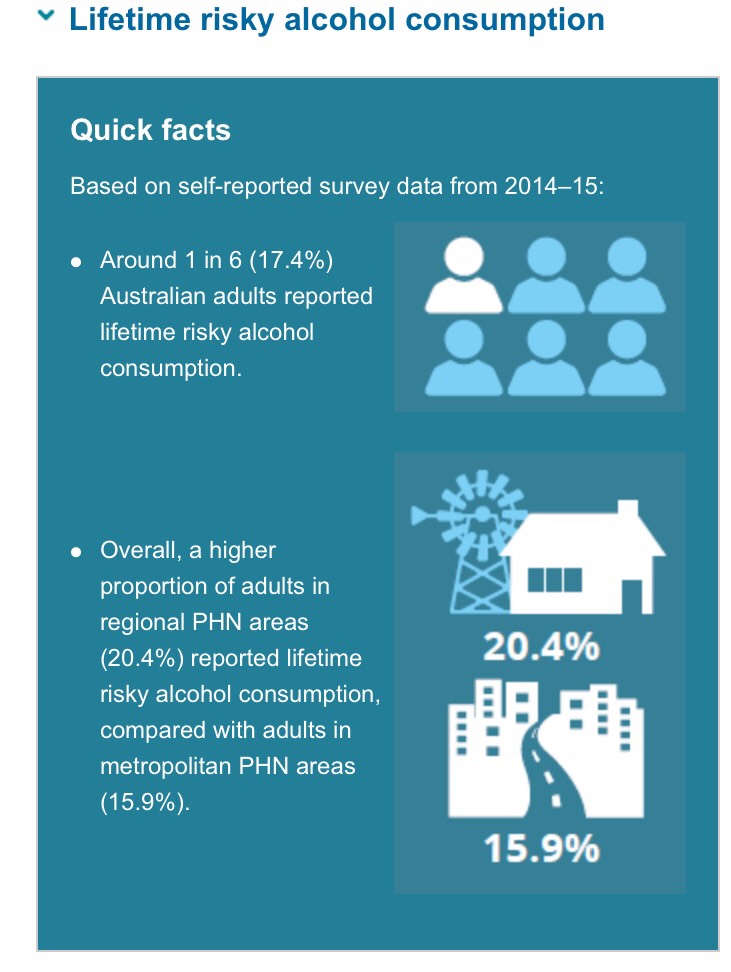
Around 1 in 6 Australian adults (17%) reported lifetime risky alcohol consumption
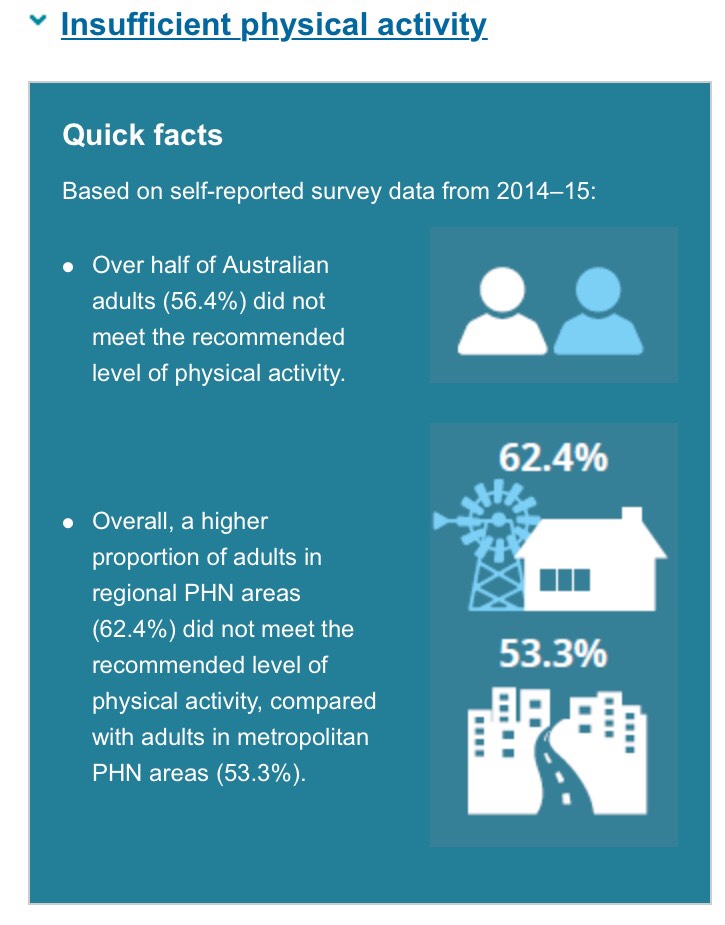
Over half of Australian adults (56%) reported insufficient physical activity participation
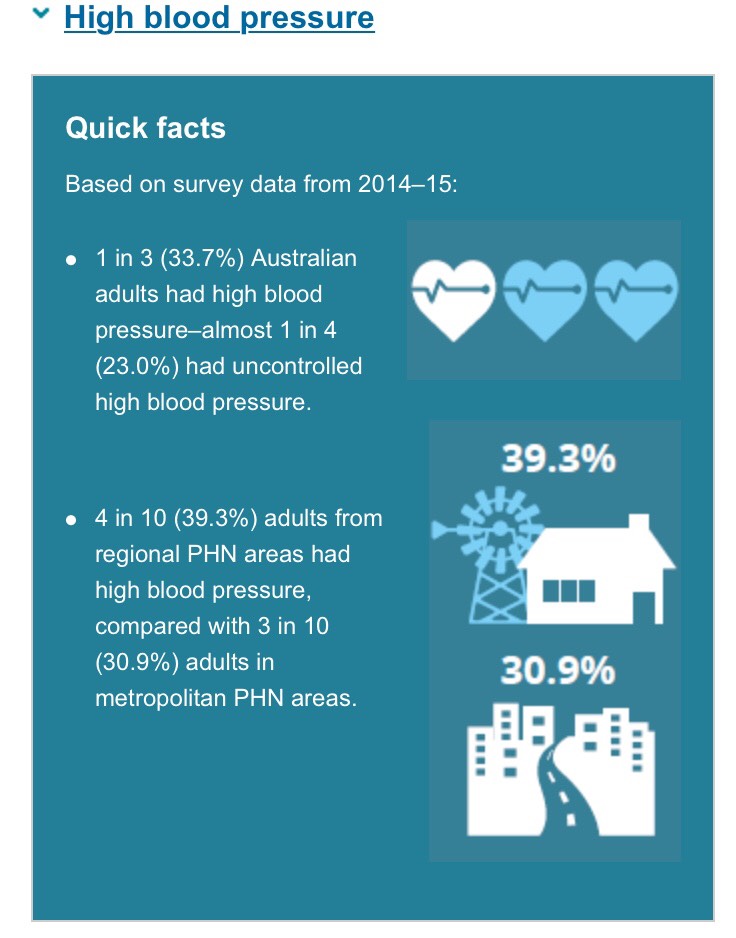
Almost 1 in 3 Australian adults (34%) had high blood pressure.
1.A lifetime risky alcohol consumption
This fact sheet covers local-level results for the proportion of Australian adults (aged 18 years and over) who reported consuming more than 2 standard drinks of alcohol per day on average—thereby increasing their lifetime risk of harm from alcohol consumption. Results are presented by Primary Health Network (PHN) areas.
Please note, the results presented are crude rates, which reflect the actual level of lifetime risky alcohol consumption in the community. However, caution is needed when making comparisons across PHNs as the rates presented do not account for differences in the age of the populations.
What is lifetime risky alcohol consumption?
Alcohol consumption refers to the consumption of drinks containing ethanol, commonly referred to as alcohol. The quantity, frequency or regularity with which alcohol is drunk provides a measure of the level of alcohol consumption.
Lifetime risky alcohol consumptionrefers to Australian adults consuming more than 2 standard drinks per day on average. That is, alcohol consumption exceeding the National Health and Medical Research Council’s (NHMRC) Australian Guidelines to Reduce Health Risks from Drinking Alcohol (see Box 1 for more information).
Based on survey data from 2014–15, 17.4% of Australian adults reported lifetime risky alcohol consumption.
This fact sheet covers local-level results for the proportion of Australian adults (18 years and over) who reported insufficient levels of physical activity. Results are presented by Primary Health Network (PHN) areas.
Please note, the results presented are crude rates, which reflect the actual level of insufficient physical activity in the community. However, caution is needed when making comparisons across PHNs as the rates presented do not account for differences in the age of the populations.
What is insufficient physical activity?
Physical activity is the expenditure of energy generated by moving muscles in the body. Most physical activity occurs during leisure time, or through active transport and incidental activity such as housework or gardening.
Insufficient physical activityrefers to physical activity levels that do not meet the Department of Health’s Australia’s Physical Activity & Sedentary Behaviour Guidelines (see Box 1 for more information).
This includes adults (18–64 years) who did not complete more than 150 minutes of physical activity, on at least 5 sessions over a week, and older Australians (65+ years) who did not complete 30 minutes of activity on at least 5 days.
Based on self-reported survey data from 2014–15, 56.4% of Australian adults had insufficient levels of physical activity
This fact sheet covers local-level results for the proportion of Australian adults (aged 18 years and over) who had high blood pressure and uncontrolled high blood pressure. Results are presented by Primary Health Network (PHN) areas.
Please note, the results presented are crude rates, which reflect the actual level of high blood pressure in the community. However, caution is needed when making comparisons across PHNs as the rates presented do not account for differences in the age of the populations.
What is high blood pressure?
High blood pressure, also known as hypertension, is defined in this fact sheet by the World Health Organization definition (see Box 1 for more information).
Uncontrolled high blood pressure as defined here refers to all people with measured high blood pressure, regardless of whether they are taking medication. It is presented for context in this fact sheet.
High blood pressure is an important and treatable cause of disease and death. It is a major risk factor for chronic diseases including stroke, coronary heart disease, heart failure and chronic kidney disease.
The modifiable risk factors for high blood pressure include poor diet (particularly high salt intake), obesity, excessive alcohol consumption and insufficient physical activity. Lifestyle changes and medication can help to control high blood pressure.
Based on survey data from 2014–15, 33.7% of Australian adults had high blood pressure. There were 23.0% of Australian adults who had uncontrolled high blood pressure.
” With diagnoses and rates of HIV in Aboriginal communities at an all-time high since 1992, this year’s Aboriginal and Torres Strait Islander HIV Awareness Week (ATSIHAW) is more important than ever. Now in its fourth year, the role of ATSIHAW is to engage Aboriginal and Torres Strait Islander communities across Australia in HIV prevention.
ATISHAW is an opportunity to promote action, awareness and advocacy at all levels of government and community, to provide much needed resources to address the rising rates of HIV,
Action is required in policy, programming, clinical service delivery; awareness is required across communities and in clinical settings; and advocacy is required at all levels of health service delivery and governments.”
Associate Professor James Ward
“ The theme of this year’s National Aboriginal and Torres Strait Islander HIV Awareness Week is ‘U and Me Can Stop HIV’ and we know that education and awareness are vitally important in our battle against HIV and STIs,”
We have had a variety of media resources available but until now, only a small number have been culturally appropriate for Indigenous people.
With messages like ‘Looking after our mob starts with looking after ourselves’, these new videos are more likely to cut through, especially to younger Aboriginal people, who aremost vulnerable to these infections.”.
Minister for Indigenous Health, Ken Wyatt AM, this week officially released the videos, and an accompanying range of social and print media resources, at the launch of the National Aboriginal and Torres Strait Islander HIV Awareness Week.
Three animated education and awareness videos focus on HIV, STIs and PrEP (a daily medication that can prevent HIV), which aim to enhance awareness of HIV prevention. These are housed on the website www.atsihiv.org.au,
ATSIHAW 2017 runs from Monday, 27 November to Sunday, 3 December. The Federal Minister for Indigenous Health, the Hon Ken Wyatt AM, MP, officially launched ATSIHAW on Wednesday, 29 November at a breakfast hosted by Senator Dean Smith, Chair of the Parliamentary Friends of HIV/AIDS, Blood Borne Viruses and Sexually Transmitted Diseases.
Other dignitaries in attendance included : Senator Richard Di Natale, Leader of the Australian Greens; Professor Sharon Lewin, Chair of the Ministerial Advisory Committee on Blood Borne Viruses and Sexually Transmissible Infections; Dr Dawn Casey, Deputy Chief Executive Officer of the National Aboriginal Community Controlled Health Organisation (NACCHO);
Ms Michelle Tobin, Chair of the Positive Aboriginal & Torres Strait Islander Network (PATSIN) – a group representing Aboriginal and Torres Strait Islander people living with HIV); as well as other members of the Australian Parliament.
Concerning statistics
Recently released national data shows the rate of HIV diagnoses among Aboriginal and Torres Strait Islander people is now more than double the rate for the non-Indigenous Australian-born population. This rate has increased by 33 per cent during the last five years, while the rate in the non-Indigenous Australian-born population has decreased by 22 per cent in the same period – creating a new gap in health between the two populations.
Associate Professor James Ward, Head Infectious Diseases Research Aboriginal Health at the South Australian Health and Medical Research Institute (SAHMRI), and ATSIHAW committee member, said that this is absolutely unacceptable.
Over the last five years, significant differences have appeared in the HIV epidemic between the Aboriginal and Torres Strait Islander population and the non-Indigenous Australian-born population. Although men who have sex with men make up the majority of cases in both groups (51 per cent vs 74 per cent), a greater proportion of Indigenous cases are because of injecting drug use (14 per cent vs three per cent) or through heterosexual sex (20 per cent vs. 14 per cent).
Ms Michelle Tobin said that more work is required to ensure there are strategies for all of these groups of people in Aboriginal and Torres Strait Islander communities rolled out, and that these have impact.
The other unique issue occurring in Australia is the continuing increase in HIV rates among Aboriginal and Torres Strait Islander people each year, despite the major advances in HIV testing, diagnostics and treatment. Innovative HIV test-and-treat strategies and large-scale pre-exposure HIV prophylaxis trials (PrEP) trials have successfully engaged the gay community and are resulting in reductions across jurisdictions, but but to date, have had little impact in Aboriginal communities.
“We need to make sure that these strategies have impact on all of the Australian population – not just some”, Associate Professor Ward added.
“Aboriginal and Torres Strait Islander communities are generally not benefiting from these advances.”
Community support; an important part of ATSIHAW
The overarching theme of ATSIHAW is ‘U AND ME CAN STOP HIV’. This highlights the strengths of Aboriginal and Torres Strait Islander communities, and the role we can all play in preventing new HIV cases and improving the outcomes for people living with HIV.
This year, ATSIHAW is holding over 55 community events across Australia at Aboriginal Community Controlled Health Services and other community services. The number of ATSIHAW events and strong social media engagement, demonstrates the growing sense of community responsibility for spreading awareness of the importance of HIV prevention.
Alice Springs this week
High-profile ambassadors for ATSIHAW have also been recruited, including Steven Oliver from ABC’s Black Comedy. Steven said that he’s involved in ATSIHAW because he wants to help fight and break down the stigma associated with HIV and those living with it.
Professor Kerry Arabena and Dr Pat Anderson AM are also Ambassadors for ATSIHAW, alongside 30 other community members who are all concerned about HIV in the communities.
New HIV resources for Aboriginal and Torres Strait Islander communities
A new set of resources will be launched by the Honourable Ken Wyatt AM, MP, Minister for Indigenous Health, including three animated education and awareness videos focusing on HIV, STIs and PrEP (a daily medication that can prevent HIV), which aim to enhance awareness of HIV prevention. These are housed on the website www.atsihiv.org.au, als
New animated videos voiced by young Aboriginal and Torres Strait Islander people are the latest weapons in the fight again HIV and sexually transmitted infections in Indigenous communities.
Part 2 Minister’s Press release
Minister for Indigenous Health, Ken Wyatt AM, this week officially released the videos, and an accompanying range of social and print media resources, at the launch of the National Aboriginal and Torres Strait Islander HIV Awareness Week.
The videos have been developed specifically to counter the shame and stigma that can be associated with HIV.
“World Aids Day is on 1 December and it is important we take this opportunity to talk about the rates of HIV diagnosis in our Indigenous communities,” Minister Wyatt said.
“In the past 30, years Australia has made progress in reducing the rates of STIs, however, despite advances in testing and treatment we continue to see Indigenous STI and HIV diagnoses on the rise.”
In 2016, it was estimated that the HIV notification rate for Indigenous people was more than double the rate among non-Indigenous people, with a greater proportion of newly diagnosed HIV infection attributed to heterosexual contact and injecting drug use.
“Working together with Indigenous communities, the States, Territories and local health services, to counter these infections is a key Turnbull Government priority,” said Minister Wyatt.
“This includes $8 million to support a range of programs focussed on delivering culturally appropriate sexual health services, plus a further $8.8 million over three years to target priority areas including testing, education and awareness.
“We are also developing a long-term response to STIs and blood borne viruses in our Indigenous communities, with a proposed strategic approach and action plan due to be received by the Government in December.
“The ‘U and Me Can Stop HIV’ theme of this year’s National Aboriginal and Torres Strait Islander HIV Awareness Week is a timely reminder of the need to work together to improve sexual health.”
ATSIHAW is administered by SAHMRI, with funding provided by the Commonwealth Department of Health
” The Family Matters Report clearly shows we have a system that invests in failure and not success. Only one in every five dollars spent on child protection is invested in family supports. Supportive and preventative services – designed to build the capacity of families to care for children and allow children to thrive – are crucial to addressing the over-representation of Aboriginal and Torres Strait Islander children in out-of-home care.”
Natalie Lewis : Family Matters Report 2017: Without urgent action the number of Aboriginal and Torres Strait Islander children removed from family will triple in the next 20 years
The rate at which Aboriginal and Torres Strait Islander children are removed from their families is an escalating national crisis.
Without immediate action from all levels of government further generations of children will be lost to their families, cultures and communities, according to a new report from the Family Matters campaign.
The report – launched at Parliament House on 29 November – reveals a shocking trend in the removal of Aboriginal and Torres Strait Islander children, who are now nearly 10 times as likely to be removed from their family as non-Indigenous children – a disparity which continues to grow.
If we continue on this path, carved out by the flawed approaches of consecutive governments, the number of Aboriginal and Torres Strait Islander children in out-of-home care will more than triple in the next 20 years.
“Twenty years ago, the Bringing them Home report brought public and political awareness to the destructive impact of the Stolen Generations on communities, families and children – a historical pain that has caused trauma with lasting impacts. We cannot allow the history of trauma to devastate yet another generation of our children.
“In the 20 years since Bringing them Home, and nearly 10 years since the national apology, the numbers of Aboriginal children in out-of-home care have continued to escalate.”
– Natalie Lewis, Family Matters Co-Chair
The Family Matters Report shows that only 17 per cent of the child protection budget is spent on services aimed at preventing issues for families before they develop, while the bulk of spending is invested in reacting to problems when they arise.
The Family Matters Report provides a comprehensive analysis of child protections systems in every state and territory, judged against a series of building blocks to ensuring child safety and wellbeing.
The disproportionate representation of our children, and the failure to adequately provide for their wellbeing and ensure fulfilment of their rights, are characteristics common to all jurisdictions.
“Those of us working for our communities are striving to address these fundamental system failures, but what we really need is governments to resource our vision for a better future for our children. Aboriginal and Torres Strait Islander people have been forthcoming with solutions to these issues for many, many years. We need to work together now to prevent another generation of children growing up separated from their family, culture and connection to country.”
– Natalie Lewis
Data from the Family Matters Report 2017 shows:
Aboriginal and Torres Strait Islander children are 9.8 times more likely to be living in out-of-home care than non-Indigenous children.
Projected out-of-home care population growth suggests the number of Aboriginal and Torres Strait Islander children in care will more than triple by 2036.
From 2010 to 2018, the over-representation of Aboriginal and Torres Strait Islanders in child death statistics has grown from a rate ratio of 1.84 to 2.23.
Only 67 per cent of Aboriginal and Torres Strait Islander children in Australia are placed with family, kin, or other Aboriginal and Torres Strait Islander carers.
Only 2 per cent of Aboriginal and Torres Strait Islander children commenced an intensive family support service in 2015-16, a rate well below their rate of contact with child protection services.
Only 17 per cent of overall child protection funding is invested in support services for children and their families.
Aboriginal and Torres Strait Islander women are significantly less likely to access antenatal care during the first trimester of pregnancy.
” The Aboriginal and Torres Strait Islander population is reported to suffer the highest rates of otitis media in the world. This unacceptably high prevalance has been known for at least 60 years.
The 2017 Report Card on Indigenous Health identifies chronic otitis media as a ‘missing piece of the puzzel for Indigenous disadvantage’ and calls for an end to the preventable scourge on the health of Indigenous Australians.”
Download AMA Indigenous Health Report Card 2017: A National Strategic Approach to Ending Chronic Otitis Media and its Life Long Impacts in Indigenous Communities
“ This is a disease of poor people in poor countries as well as other indigenous minorities. These unacceptably high rates have been known for at least 60 years,
Chronic otitis media has lifelong impacts for health and wellbeing just like cardiovascular disease or diabetes – its effects are often ‘life sentences’ of disability and are linked to high rates of Indigenous incarceration.”
National Aboriginal Community Controlled Health Organisation (NACCHO) Chair, Mr. John Singer said Indigenous children experience some of the highest rates of chronic otitis media in the world.
NACCHO welcomes the 2017 AMA Report Card on Indigenous Health: A national strategic approach to ending chronic otitis media See Part 2 below
” Report Cards can be daunting, they can be challenging, and they can be inspiring – but above all, they are valuable.
They help provide foundations for informed decision making – something I thoroughly endorse.
And in the case of Indigenous health, they highlight issues that many of the more than 27,000 registered doctors, students and advocates who the AMA represents, deal with every day.
So I commend the AMA on its 2017 Report Card on Indigenous Health – the latest in a series of highly authoritative and respected reports on the crucial issue of Aboriginal Aboriginal and Torres Strait Islander health.’
The Hon Ken Wyatt launch speech see in full Part 5
Part 1 AMA Background
Otis media is a build up of fluid in the middle ear cavity, which can become infected. While the condition lasts, mild or moderate hearing loss is experienced.
Otitis media is very common in children and for most non-Indigenous children, is readily treated. But for many Indigenous people, otitis media is not adequately treated. It persists in chronic forms over months and years.
As this Report Card identifies, the peak prevalence for otitis media in some Indigenous communities is age five months to nine months; with up to one-third of six-month-old infants suffering significant hearing loss. The effects of long periods of mild or moderate hearing loss at critical developmental stages can be profound. During the first 12 or so months of life, a person’s brain starts to learn to make sense of the sounds it is hearing. This is called ‘auditory processing’. If hearing is lost during this critical period, and even if normal hearing returns later, life-long disabling auditory processing disorders can remain.
Chronic otitis media is a disease in communities with poorer social determinants of health. It is a disease of the developing world. It should not be an endemic ‘massive health problem’ in Australia – one of the healthiest and wealthiest countries in the world. However the chronic otitis media crisis is occurring in too many of our Indigenous communities.
This Report Card calls for a national, systematic approach to closing the gap in the rates of chronic otitis media between Indigenous and non-Indigenous infants and children in Australia, and a response to the lasting, disabling effects and social impacts of chronic otitis media in the Indigenous adult population.
Part 2 NACCHO welcomes the 2017 AMA Report Card on Indigenous Health: A national strategic approach to ending chronic otitis media
The peak body for Aboriginal controlled medical services today welcomed the release of the AMA’s 2017 Report Card on Indigenous Health and joined its call for a national, systematic approach to closing the gap in the rates of chronic otitis media between Indigenous and non-Indigenous children in Australia. This disease has long term disabling effects and social impacts in the Indigenous adult population.
National Aboriginal Community Controlled Health Organisation (NACCHO) Chair, Mr. John Singer said Indigenous children experience some of the highest rates of chronic otitis media in the world.
“This is a disease of poor people in poor countries as well as other indigenous minorities. These unacceptably high rates have been known for at least 60 years,” Mr. Singer said.
Chronic otitis media has lifelong impacts for health and wellbeing just like cardiovascular disease or diabetes – its effects are often ‘life sentences’ of disability and are linked to high rates of Indigenous incarceration.
NACCHO calls on Australian governments to adopt the recommendations of the Report including embedding chronic otitis media and hearing loss in the Closing the Gap Strategy. However in addition to these principles specialist ear disease and hearing services must be provided to all Aboriginal children if this disease is to be tackled.
Like many chronic diseases impacting on the gap in life expectancy, otitis media is linked to poorer social determinants. “If we are serious about improving health outcomes for Indigenous people, governments at all levels must do more to improve education, housing and employment outcomes.” Mr. Singer said.
Indigenous led solutions must be at the center of any approach. Aboriginal people are more likely to access the care and support they need from an Aboriginal controlled organisation. The community controlled sector has the experience, history and expertise in working with Aboriginal communities and are best placed to work with governments on the report recommendations. Our members should be the preferred model for investment in comprehensive primary health care services.
Our members across the country are keen to work with governments on a systematic approach to the prevention, detection, treatment and management of otitis media,” Mr. Singer said.
NACCHO, its Affiliates and members will continue to work with the AMA in the hope that the report will be a catalyst for coordinated, sustainable government action to improve ear health among Aboriginal and Torres Strait Islander people.
Part 3 INDIGENOUS EAR HEALTH – AMA CALLS FOR ACTION TO END A ‘LIFE SENTENCE’ OF HARM
AMA Indigenous Health Report Card 2017: A National Strategic Approach to Ending Chronic Otitis Media and its Life Long Impacts in Indigenous Communities
The AMA today issued a challenge to all Australian governments to work with health experts and Indigenous communities to put an end to the scourge of poor ear health – led by chronic otitis media – affecting Aboriginal and Torres Strait Islander Australians.
At the launch of the 2017 AMA Indigenous Health Report Card in Canberra today, AMA President, Dr Michael Gannon, said the focus on ear health was part of the AMA’s step by step strategy to create awareness in the community and among political leaders of the unique and tragic health problems that have been eradicated in many parts of the world, but which still afflict Indigenous Australians.
The Report Card – A National Strategic Approach to Ending Chronic Otitis Media and its Life Long Impacts in Indigenous Communities – was launched by the Minister for Indigenous Health, The Hon Ken Wyatt AM.
“It is a tragedy that, in 21st century Australia, poor ear health, especially chronic otitis media, is still condemning Indigenous people to a life sentence of hearing problems – even deafness,” Dr Gannon said.
“Chronic otitis media is a disease of poverty, linked to poorer social determinants of health including unhygienic, overcrowded conditions, and an absence of health services.
“It should not be occurring here in Australia, one of the world’s richest nations. It is preventable.
“Otitis media is caused when fluid builds up in the middle ear cavity and becomes infected.
“While the condition lasts, mild or moderate hearing loss is experienced. If left untreated, it can lead to permanent hearing loss.”
Dr Gannon said that, for most non-Indigenous Australian children, otitis media is readily treated.
“The condition in the non-Indigenous population passes within weeks, and without long-term effects.
“But for many Aboriginal and Torres Strait Islander children, otitis media is not adequately treated. It persists in chronic forms over months and years. At worst, it is there for life.”
Estimates show that an average Indigenous child will endure middle ear infections and associated hearing loss for at least 32 months, from age two to 20 years, compared with just three months for a non-Indigenous child.
Dr Gannon said the AMA wants a national, systematic approach to closing the gap in the rates of chronic otitis media between Indigenous and non-Indigenous infants and children in Australia.
“We urgently need a coordinated national response to the lasting, disabling effects and social impacts of chronic otitis media in the Indigenous adult population,” Dr Gannon said.
“We urge our political leaders at all levels of government to take note of this Report Card and be motivated to act to implement solutions.”
The AMA calls on Australian governments to act on three core recommendations:
Recommendation 1:
That a coordinated national strategic response to chronic otitis media be developed by a National Indigenous Hearing Health Taskforce under Indigenous leadership for the Council of Australian Governments (COAG). This should build on and incorporate existing national and State and Territory level responses and include:
a critical analysis of current approaches, and to identify the range of reasons that current chronic otitis media crisis persists;
the development of a COAG Closing the Gap target about new cases of chronic otitis media and hearing loss in Indigenous infants and children under 12 years of age;
a national otitis media surveillance program to monitor prevalence and support a targeted and cost-effective national response;
a significantly increased focus on prevention – both primordial prevention with a focus on the social determinants of the disease, and primary prevention including family and community health literacy about otitis media;
a central, adequately funded and supported role for primary health care and Aboriginal Community Controlled Health Services (ACCHS) in a systematic approach to the prevention, detection, treatment, and management of otitis media; and
access to ear, nose and throat (ENT) specialists, particularly within ACCHS and other Indigenous-specific primary health care services, based on need
Recommendation 2:
That the national approach proposed in Recommendation 1 include addressing the wider impacts of otitis media-related developmental impacts and hearing loss, including on a range of areas of Indigenous disadvantage such as through the funding of research as required. This includes:
a national approach to supporting Indigenous students with hearing loss that aims to remove disadvantage that they may face in educational settings;
a national approach to developing hearing loss-responsive communication strategies in all government and non-government agencies providing services to Indigenous people including – but not limited to – health, mental health, justice, and employment services; and
exploring the support role of the National Disability Insurance Scheme (NDIS) to Indigenous people with hearing loss
Recommendation 3:
That attention of governments be re-directed to the recommendations of the AMA’s 2015 Indigenous Health Report Card, which called for an integrated approach to reducing Indigenous imprisonment rates by addressing underlying causal health issues (including otitis media and related hearing loss and developmental impacts), with the expectation of appropriate action. The health issues to be addressed include mental health problems, cognitive disabilities, alcohol and drug problems, hearing loss, and developmental impacts associated with otitis media. 3
Part 4 : Background
Indigenous children experience some of the highest rates of chronic suppuratives otitis media (CSOM) in the world.
Chronic otitis media in infancy and childhood can affect Indigenous peoples’ adult health and wellbeing as much as cardiovascular disease or diabetes, and its effects are significant ‘life sentences’ of disability.
Chronic otitis media has life-long impacts that bring greater risk of a range of adult social problems, not the least of which is incarceration. The association of chronic otitis media-related hearing loss and the high rates of Indigenous imprisonment has been noted for over 25 years now – but with little action evident
I’d like to acknowledge the traditional custodians of the land on which we meet – the Ngunnawal and Ngambri people – and pay my respects to their Elders, past and present.
I thank AMA President Dr Michael Gannon and Associate Professor Kelvin Kong of the Royal Australasian College of Surgeons for their words, and acknowledge:
AMA Secretary-General Anne Trimmer
Representatives from the College,
the AMA’s Indigenous Health Taskforce,
the National Aboriginal Community Controlled Health Organisation (NACCHO), and Aboriginal medical centre
My Parliamentary colleagues, and distinguished guests.
Report Cards can be daunting, they can be challenging, and they can be inspiring – but above all, they are valuable.
They help provide foundations for informed decision making – something I thoroughly endorse.
And in the case of Indigenous health, they highlight issues that many of the more than 27,000 registered doctors, students and advocates who the AMA represents, deal with every day.
So I commend the AMA on its 2017 Report Card on Indigenous Health – the latest in a series of highly authoritative and respected reports on the crucial issue of Aboriginal Aboriginal and Torres Strait Islander health.
Over the past 15 years, this annual Report Card has highlighted priority issues such as low birth weight babies, institutionalised inequities and racism, government funding, medical workforce, rheumatic heart disease, and best practice in primary care.
I welcome this year’s Report Card, with its focus on ear health and hearing loss, which can have devastating impacts.
Compounding this is the fact that the most common ear afflictions are almost entirely preventable.
For all the wrong reasons, ear disease is highly prevalent in Indigenous children and repeated episodes can lead to hearing loss and deafness, if not treated early.
The impact of this can have lifelong effects on education, employment and wellbeing.
Nowhere have these consequences been more evident than in my home State of Western Australia, where significant numbers of hearing-impaired Aboriginal people have been unable to secure mining boom jobs, despite their best efforts and support from major companies.
While I agree with Dr Gannon that this Report Card can be ‘a catalyst for government action to improve ear health among Aboriginal and Torres Strait Islander people’, I would like to point out that the Turnbull Government has much work under way aimed at improving Indigenous ear health.
We are resolutely committed to turning this problem around.
The AMA’s Report Card calls for a national, systematic and strategic approach to address chronic otitis media and its impacts in Indigenous communities, and for this approach to be reflected in the Council of Australian Governments Closing the Gap targets.
I note the AMA recommends that any such national response be developed for COAG by a National Indigenous Hearing Health Taskforce, importantly under Indigenous leadership, and that it should build on and incorporate existing national, State and Territory-level responses.
In March, the COAG Health Council agreed to explore the feasibility of such a national approach to reducing the burden of middle ear disease.
The Queensland Department of Health has leadership of this proposal, and plans to take it to the Australian Health Ministers’ Advisory Council next week, when it is scheduled to consider the matter on 8 December.
Alongside this, the House of Representatives Standing Committee on Health, Aged Care and Sport Inquiry into Hearing Health and Wellbeing of Australia is calling for a national strategy to be developed and additional funding provided.
The recommendations of the committee’s report – titled ‘Still waiting to be heard’ – are currently being given detailed consideration by the Turnbull Government, as are the findings of the Department of Health’s independent examination of Commonwealth ear health initiatives.
The AHMAC work and the ‘Still waiting to be heard’ report will inform the way forward on Indigenous ear health.
It’s also pertinent to note a number of other initiatives that will contribute directly to improved ear health.
The Turnbull Government has committed to incorporating a social determinants and cultural determinants of health approach in the next iteration of the five-year Implementation Plan for the National Aboriginal and Torres Strait Islander Health Plan, due to be released in 2018.
As Dr Gannon has pointed out, ‘social determinants of health contribute to the development of ear disease …. and act as barriers to treatment and prevention.’
The release of the Cultural Respect Framework 2016–2026, which was endorsed by AHMAC early this year, will underpin the delivery of culturally competent health service delivery.
A culturally competent approach by health professionals is critical to the health and wellbeing of Aboriginal and Torres Strait Islander people who, like all Australians, have the right to safe, culturally comfortable care of the highest clinical standard.
Further, COAG is currently working to refresh the Closing the Gap targets, including the health targets.
Initiatives like these demonstrate the commitment of good minds and good people to tackling our nation’s most confronting health issue – Indigenous health.
That commitment is also reflected in Commonwealth funding. To improve ear health, a total of $76.4 million, from 2012–13 to 2021–22, is being provided through the Indigenous Australians’ Health Programme, and the National Partnership on Northern Territory Remote Aboriginal Investment.
This funding is increasing access to clinical services, including surgery. It is providing equipment, training health professionals and raising awareness of otitis media symptoms and the need for early treatment.
In the past year, this has resulted in around 47,000 patient contacts in more than 300 locations across Australia.
More than 200 surgeries were provided, and over 1000 health professionals received training in 80 locations.
More than 1000 pieces of diagnostic equipment were available across 170 sites; and clinical guidelines were made available nationally.
As well, under the Australian Hearing Specialist Program for Indigenous Australians, the Australian Government provides hearing services in more than 200 Aboriginal and Torres Strait Islander communities across Australia each year to help overcome distance, culture and language barriers.
Successful initiatives, such as Children’s Health Queensland’s Deadly Ears program, are making a difference. Deadly Ears has helped almost halve the rate of Chronic Otitis Media, working at 11 outreach services in rural and remote areas.
So, clearly, there is a large body of work underway at local, State and national levels – but just as clearly, we must continue our focus, build our partnerships and broaden our approach.
While primary care is fundamental to ear health solutions, we must work together with Aboriginal communities to advance other areas of life which impact on health and wellbeing.
The Turnbull Government understands this, and this is the basis for our whole-of-government policies, including housing, education, employment and health service delivery.
We are focussed on what works, so efficient and successful models of care can be shared and replicated.
We are concentrating on grassroots empowerment, to support local responsibility, and in turn, to grow personal commitment.
Finding ear health solutions is a shared responsibility – for all governments, the medical profession, health workers, and parents and their children.
Reducing ear problems is one of my top Indigenous health priorities, and I’m confident we can start to make real gains in this critical area.
While there is undoubtedly a way to go, evidence-based Report Cards like this will help ensure we are on the right track.
The Turnbull Government is listening.
I commend the AMA for its work, and look forward to continuing our shared dedication to better hearing for Indigenous people.
” Remote Aboriginal Australians with kidney disease have demanded equitable access to life-saving treatment closer to home to prevent the removal of people from their traditional homelands.
In a new Menzies School of Health Research report, patients and carers from across northern and central Australia called on state, territory and federal government health ministers to overhaul the system to provide more holistic care.”
Report lead author Dr Jaquelyne Hughes says the current model meets medical needs, but missed the mark in helping indigenous people feel connected to their country, families and culture.
“We heard, overwhelmingly, of how people felt lonely, distressed and isolated following relocation to access treatment,” Dr Hughes said.
Some patients reported homelessness and desperation because of this disconnect, describing having to stay in the long grass when Darwin hostels are booked out.
A Torres Strait Islander said many sick people are forced to travel up to 1000 kilometres to Cairns and Townsville to receive dialysis.
“And they cry, their tears are running, because they want to go back home, they miss their families, they miss the lifestyle of the islands, because they are islanders,” the patient said.
Many noted the disease can fracture communities as elders become ill and are relocated together with their relatives, who miss out on cultural obligations and suffer disruptions to education and employment.
“We want them (the elders) to stay in communities. They are the old people; they have to hold country and family together for us,” one patient said.
“Families living in Darwin (for dialysis) are missing out on ceremonies, funerals and other important stuff,” another person said.
Dr Hughes said the only type of care available to most indigenous renal failure sufferers was designed by and for people in cities at the expense of those in the bush.
MENZIES Press Release
Indigenous people with kidney disease living in remote and rural Australia as well as their support networks have made a resounding call for equitable health care closer to home in a report released today by Menzies School of Health Research (Menzies).
In the ‘Indigenous Patient Voices: Gathering Perspectives, Finding Solutions for Chronic and End-Stage Kidney Disease’ 2017 symposium report, renal patients and carers from across northern and central Australia highlighted the need for more holistic care and services to be made available closer to home.
Report lead author Dr Jaquelyne Hughes said current health care systems met medical care needs, but missed the mark in helping Indigenous people feel connected to their country, communities and culture while they received treatment.
“We heard, overwhelmingly, of how people felt lonely, distressed and isolated following relocation to access treatment,” Dr Hughes said.
“Some patients reported homelessness and desperation because of this disconnect. They are not rejecting the desire to live well; they are rejecting the only model of care available to them.
“The care available to kidney patients was designed by and for people who live close to cities. This automatically excludes people who live further away and in the bush.”
The report follows the Indigenous Patient Voices Symposium held during September in Darwin in conjunction with the 53rd Annual Scientific Meeting of the Australia and New Zealand Society of Nephrology (ANZSN).
Dr Hughes is one of many health practitioners urging the Australian state, territory and federal government health ministers to respond to this call to action.
“Consumer engagement is a national priority of Australian health services, and the symposium showed many Aboriginal and Torres Strait Islander people are willing to provide feedback to support the necessary health care transformation,” she said.
“We’ve highlighted the patient-reported barriers to accessing quality services for chronic and end-stage kidney disease, how and where services are delivered, how information is communicated and developing pathways and career opportunities for Indigenous Australians within the renal health care workforce.”
“Caring for Indigenous Australians: Aboriginal and Torres Strait Islander People is an important program which will help address the fundamental need for culturally appropriate care for Aboriginal people, some who may need to use aged care services at an earlier stage of their lives
Programs like this are a vital part of ensuring the care of senior Indigenous people is as culturally continuous as possible”
Minister for Aged Care and Indigenous Health Ken Wyatt has welcomed the new course, which coincides with his announcement of a new North West Ageing and Aged Care Strategy which aims to create age-friendly communities across the Pilbara and the Kimberley, while encouraging more seniors support services and greater local employment in aged care.
Photos above Ken Wyatt meeting with the elders from the Yindjibarndi Aboriginal Corporation in Roebourne WA\.
The launch of Caring for Indigenous Australians: Aboriginal and Torres Strait Islander People will be streamed live via the Aged Care Channel at 10.45am AEDT on 22 November with Aboriginal Elder Mr Elliot taking part in answering live questions from members.
Developed by the Aged Care Channel (ACC) in partnership with the Department of Health, the Caring for Indigenous Australians: Aboriginal and Torres Strait Islander People course aims to help inform aged care facilities across Australia of the cultural considerations of caring for Indigenous Australians.
ACC Group Manager Content and Production, Steve Iliffe says the program took six months to put together with the help of research, lots of resources, government input and guidance of Indigenous people as well as visits to different aged care facilities in Pilbara and northern Adelaide.
“We thought it was an important program to do because Indigenous Australians do have a series of complex needs different to the rest of the population due to their history and access to health in areas,” he explains.
“They have a connection to the land, a connection to their family and want to still have access to bush tucker and do things that they traditionally do.
“We went out to a number of different aged care facilities to talk to the people there about what they do to provide tailored care.”
ACC Learning and Development Manager Nicola Burton says providing culturally-appropriate care is a crucial part of the person-centred approach.
“The goal of this program is to recognise how to respond to the cultural needs of Indigenous Australians receiving care,” she says.
“There are significant regional differences between Aboriginal and Torres Strait Islander groups, each with complex and diverse ways of life.
“Language, music and art vary in each area, but a connection with culture, community and the land seems to be common to all Aboriginal and Torres Strait Islander people.”
While working of the course and program, the ACC team spoke to and sought the advice of subject matter expert Ngarrindjeri elder and Chair of the Aboriginal and Torres Strait Islander Ageing Advisory Group Mark Elliott.
“It was important for us to work with an indigenous leader – he guided us through the process and the research,” Mr Iliffe says.
“With this new course, we hope that we can increase understanding between cultures because at the end of the day, it’s about creating a home for people in aged care and providing them with a life they are still living.”
The new Strategy announced by the Minister includes short, medium and long-term goals, from the engagement and inclusion of seniors in local communities, through to tailored home and residential care support.
“[Caring for Indigenous Australians: Aboriginal and Torres Strait Islander People]is an important program which will help address the fundamental need for culturally appropriate care for Aboriginal people, some who may need to use aged care services at an earlier stage of their lives,” Minister Wyatt says.
“Programs like this are a vital part of ensuring the care of senior Indigenous people is as culturally continuous as possible.
“It will contribute to this goal by helping staff understand the impact of historical events and past government policies, along with broadening their appreciation of Indigenous culture and the health challenges faced by some people.
“Giving staff these insights can contribute to better care, and I encourage everyone involved in indigenous aged care to take the course.”
He adds that the aim of the North West Ageing and Aged Care Strategy is to foster quality and culturally relevant residential aged care facilities that allow people to stay connected to community and age safely with dignity.
“Hopefully the new course will contribute to achieving this outcome,” he says.
“The program showcases the Pilbara’s Yaandina residential aged care facility, whose staff are experienced in providing residents with culturally sensitive care.”
Mr Iliffe says the result of the research and creation of the program is close to the hearts of all involved.
“The people involved had the most amazing time and it is something they will cherish forever,” he says.
“These experiences help us more closer to closing the gap.”
The launch of Caring for Indigenous Australians: Aboriginal and Torres Strait Islander People will be streamed live via the Aged Care Channel at 10.45am AEDT on 22 November with Aboriginal Elder Mr Elliot taking part in answering live questions from members.
3.QLD : Johnathan Thurston 2018 Queensland Australian of the Year
4. 1 WA : Kalgoorlie Tackling Indigenous Smoking (TIS) team – Make a Change” hip hop project
4.2 WA : SWAMS celebrates two decades of Aboriginal health care
5. 1 NSW : Wellington Aboriginal Corporation Health Service (WACHS) clocks up 25 years
5.2 NSW : Katungul Aboriginal Corporation has joined forces with the Institute for Urban Indigenous Health Brisbane (IUHI) to deliver the Deadly Choices program on the Far South Coast.
6. Vic : VAHS Healthy Lifestyle Ambassadors win title
7.NT Miwatj Health Service : Christina’s Story on Quit Smoking Tobacco
8 SA : Artists painting their Indigenous songlines to stay healthy and strong
Wednesday by 4.30 pm for publication each Thursday
1.1 National: NACCHO members elect new Chair and Deputy
National Aboriginal Community Controlled Health Organisation (NACCHO) members have elected John Singer as their new Chairperson and Donella Mills as Deputy Chairperson at the last week NACCHO Annual General Meeting in Canberra
1.3 Heart Foundation survey Aboriginal and Torres Strait Islander heart health resources
The Heart Foundation is committed to improving the heart health of Aboriginal and Torres Strait Islander peoples.
In this survey, we are seeking your feedback on how we can improve the use and effectiveness of our Aboriginal and Torres Strait Islander heart health resources, for both health professionals and Aboriginal and Torres Strait Islander people and communities.
“Winnunga is excited to be part of the Deadly Choices Deadly Roos campaign. The more organisations like ours can work together, the closer we can move towards Closing the Gap and improving the health outcomes in our communities”,
Winnunga Nimmityjah CEO Julie Tongs OAM.
“We know from our Deadly Choices campaign that people respond to health promotion messages from celebrities and sporting legends.
Partnerships like this one with the Deadly Roos and Winnunga Nimmityjah are a powerful vehicle for positive change in the lifestyle of Aboriginal and Torres Strait Islander peoples.”
Institute for Urban Indigenous Health CEO, Adrian Carson, echoed Ms Tongs’ sentiment.
Pictured above Julie Tongs with the Deadly Choices team and Team NACCHO Oliver Tye and Kayla Ross
Prevention being better than cure is the message of the day at Winnunga Nimmityjah Aboriginal Health and Community Services today, as the Narrabundah clinic welcomed Australian rugby league legends in Canberra for their 2017 Rugby League World Cup game against France.
Australian Kangaroos squad members Cooper Cronk and Dane Gagai, and Coach Mal Menginga, joined former Kangaroo Steve Renouf to spread the word about the importance of getting regular health checks. The clinic visit is one of a series of events throughout Australia during the 2017 World Cup.
In September, Federal Minister for Indigenous Health, Ken Wyatt AM announced that legendary Kangaroos coach Mal Meninga and other Indigenous and non-Indigenous players would become ambassadors for the Institute for Urban Indigenous Health’s Deadly Choices program, to extend its message across Australia.
Deadly Choices is a community-based healthy lifestyle campaign launched in 2013. There is particular focus on young people, as well as the importance of exercise, education, school attendance, quitting smoking, and regular preventive health checks.
Through media campaigns, sports carnivals and community events Deadly Choices has prompted:
almost 19,000 annual health check-ups in South East Queensland;
1,155 smoke-free household pledges; and
more than 3,300 smoker interventions.
Community members who get their 715 Health Check at a participating Aboriginal Medical Service – such as Winnunga Nimmityjah – during the World Cup can score a special edition Deadly Kangaroos World Cup jersey.
3.QLD : Johnathan Thurston 2018 Queensland Australian of the Year
HE IS a legend on the field, a hero in the community — and now Johnathan Thurston is on his way to becoming Australian of the Year.
The NRL star was last night recognised for his tireless commitment to helping others, taking out the 2018 Queensland Australian of the Year award at a ceremony in Brisbane.
His stellar career as a rugby league player is matched by his community endeavours, which includes championing the Achieving Results through Indigenous Education academy and serving as an ambassador for an anti-ice campaign ran by the Apunipima Cape York Health Council.
4. 1 WA : Kalgoorlie Tackling Indigenous Smoking (TIS) team – Make a Change” hip hop project
The Tackling Indigenous Smoking (TIS) team at Bega Garnbirringu Health Service created a music video to educate and empower young people in the Goldfields region to not take up smoking. The hip hop music video was created during a week-long workshop in June 2017.
The Bega Garnbirringu TIS team also created TV ads, radio ads and other informational materials by using the video as a main theme.
The Bega Garnbirringu TIS team engaged and educated the hip hop participants on smoking cessation through regular visits. Participants included East Kalgoorlie Primary School and Kalgoorlie-Boulder Community High School students (Clontarf and Kalgoorlie Girls Academy).
Participants were also informed about smoking issues and how to change the culture of smoking. Participants were provided with information about second-hand smoke and prevention strategies. The education sessions assisted participants to create a hip hop song. The participants were given the opportunity to write poetry/raps which included local heritage and culture in their health messages, vocal coaching and learnt how to create a video clip.
In less than four months, the hip hop video received more than 5,700 views on Bega Garnbirringu YouTube channel. Community Members liked the video sharing on Facebook and other social media platforms. Community Members recognised participants in the video, and complimented them on their enthusiasm, participation and efforts.
The participants were interviewed informally during and after the workshop. It was reported that they loved and enjoyed the workshop. Participants were aware of smoking harms and recognise support services of Bega Garnbirringu TIS team that delivers education to the local community on a regular basis. Participants noted that they will never smoke, and ask family and friends to not smoke or to quit smoking.
The Hip Hop video can be found here. The TV advertisement can be found here. The GWN7 promotional segment can be found here.
4.2 WA : SWAMS celebrates two decades of Aboriginal health care
The South West Aboriginal Medical Service (SWAMS) is celebrating its milestone 20th birthday with a week-long festival of events being held across the South West from 16-22 December 2017.
SWAMS, an Aboriginal Community Controlled organisation, plays a pivotal role in improving the quality of life for Aboriginal people in the South West, through the delivery of culturally focused primary health care.
“Twenty years ago, no such service existed. Aboriginal people were dying from preventable disease, diabetes was rife, and a lack of cultural awareness in tertiary medicine made it difficult for Aboriginal people to get the specialist care needed,” SWAMS CEO Lesley Nelson said.
“All that has changed now. We are a thriving organisation with highly trained staff working across six clinics to improve the quality and quantity of life for thousands of Aboriginal people under our care,” Ms Nelson said.
“This isn’t just a celebration for SWAMS. This is a celebration for an entire community and for those community members who had a vision for better Aboriginal health care back in 1997.”
“We still have a long way to go, but I think it’s safe to say that they would be proud of the organisation SWAMS has become and the difference we make to the community.”
The celebrations will take place in Bunbury, Busselton, Manjimup, Collie and Harvey and will include a series of free family picnics in each town, featuring a BBQ lunch, birthday cake and entertainment.
The highlight of the festival programme is a ticketed 20th Anniversary Gala Evening at the Bunbury Regional Entertainment Centre, with live entertainment by The Merindas and comedian Kevin Kropinyeri.
Gala tickets can be purchased from http://www.trybooking.com/329821 or from the SWAMS administration building located at 3/30 Wellington Street, Bunbury (cash only).
SWAMS 20th Anniversary Festival events:
Please refer to the attached schedule.
For more information on the SWAMS 20th Anniversary Festival, contact the office on (08) 9791 1166 or email info@swams.com.au.
5. 1 NSW : Wellington Aboriginal Corporation Health Service (WACHS) clocks up 25 years
“From little things big things grow.”
That is what founding member of the Wellington Aboriginal Corporation Health Service (WACHS), Aunty Joyce Williams, said to herself 25 years ago when the service was launched.
It has certainly been the case for the organisation which flourished over the last two decades to now service locations across the state.
The milestone was celebrated with the help of community members, ambassadors and services at Pioneer Park on Friday – a sight to behold for Aunty Joyce who reminisced on the service’s early days.
“From little things big things grow – I always said that and I believe it,” she said.
“It’s still happening, it’s still growing.
“Look at all the students here – in years to come these children will remember this day.”
Aunty Joyce gave credit to CEO Darren Ah-See who she said has done a wonderful job in the organisation’s progression.
WACHS chairperson, Marsha Hill, agreed the milestone was a big day for the indigenous community of Wellington.
The Move it Mob Style crew kept school students entertained.
“It is a massive milestone acknowledging the Elders who set up the service,” she said
“It took a lot of time, effort and dedication for a mob of people in a time that it wasn’t a positive experience for Aboriginal people.”
She said the service initially started with one drug and alcohol worker, and has since grown to employ close to 100 staff members across NSW.
“It has allowed opportunities for staff to train and earn professional qualifications so the best quality service can be delivered to the community,” Marsha said.
She added the service has expanded across the state to include Moree, Dubbo, Mt Druitt, and soon to be Penrith and the Blue Mountains.
“It’s a really good service to work for and an absolute pleasure to see our community healthy and have access to the best and quality health care,” Marsha said.
Friday’s celebrations were attended to by local schools and services, QuitBFit ambassadors, and special guests including Move it Mob Style, NRL and former NRL players Timana Tahu, Nathan Merritt, Ash Taylor, Will Smith Braidon Burns, and Tyrone Roberts.
5.2 NSW : Katungul Aboriginal Corporation has joined forces with the Institute for Urban Indigenous Health Brisbane (IUHI) to deliver the Deadly Choices program on the Far South Coast.
Steve Renouf (left), Aidan Sezer (centre), and Jack Wighton (right) were on hand to help promote Katungul’s partnership with Deadly Choices.
Rugby league legend Steve Renouf announced the partnership at a community event in Narooma on Saturday, November 4.
Current Canberra Raiders players Jack Wighton and Aidan Sezer also attended the event at NATA Oval.
The partnership expands the delivery of Deadly Choices across Australia, representing an ongoing commitment by community controlled health organisations to Close the Gap in Indigenous life expectancy.
Deadly Choices is a community-based healthy lifestyle campaign launched in 2013. It has a particular focus on young people, as well as the importance of exercise, education, school attendance, quitting smoking, and regular preventive health checks.
Renouf said the partnership with Katungul was an important part of Deadly Choices’ aim to spread its Indigenous health message across Australia.
“The big thing for Deadly Choices is we get Aboriginal and Torres Strait Islander people who historically weren’t getting their health check to get them,” he said.
“We’ve launched a partnership with the Kangaroos and the Rugby League World Cup. We were in Canberra on Friday night, and we launched a week ago in Melbourne with the Victorian Aboriginal Health Service down there.”
Robert Skeen, CEO of Katungul, said the partnership was an achievement born from months of planning.
“We are really excited to partner with Deadly Choices to further expand the program and the benefits it provides to community,” he said.
“We’re empowering our community to make Deadly Choices, by getting their health checked and spreading the message that prevention is better than cure.”
Wighton and Sezer, both of an Indigenous background, helped promote the new partnership, with Wighton stressing the importance of such events.
“I love coming out to these things,” he said. “Helping our people is a big thing, and these events are giving a rise to people getting healthy.”
Sezer also sees the importance in community events, and thinks the pathway to health is often a mindset.
“You can see from the turnout how much the Indigenous community appreciates the fact that Deadly Choices have provided this day for them to enjoy,” he said.
“I think it (staying healthy) is more about people keeping a good mind-frame, and taking days like this as a blessing to come down and enjoy it.”
In September, Federal Minister for Indigenous Health Ken Wyatt AM announced that legendary Kangaroos coach Mal Meninga and other Indigenous and non-Indigenous players would become ambassadors for the Deadly Choices program.
Community members who get their 715 Health Check at a participating Aboriginal Medical Service – such as Katungul – during the World Cup can score a special edition Deadly Kangaroos World Cup jersey.
6. Vic : VAHS Healthy Lifestyle Ambassadors win title
Congratulations to NJS Storm for winning the grand final at the A.C.T Aboriginal and Torres Strait Islander Netball Tournament! What an honour to be able to take home the trophy in memory of Neil Smith! Good job to the girls who played all 8 games undefeated. We are proud to have you as healthy lifestyle ambassadors! Enjoy the victory!
7.NT Miwatj Health Service : Christina’s Story on Quit Smoking Tobacco
Check out the incredible Christina from Galiwin’ku, Elcho Island, NT, Australia her sharing story on why she decided to quit smoking tobacco.
Ft. our legendary #YakaNgarali workers, Glen Gurruwiwi and Oscar Datjarranga.
We could not be more proud of the strength and determination Christina has shown in her quitting journey. If you want to #StartTheJourney like Christina, contact Glen or Oscar today!
8 SA : Artists painting their Indigenous songlines to stay healthy and strong
Dorothy Ward taps her head and her heart as she explains the process of painting her songlines.
“My family had the knowledge, the knowledge with culture, of every dreamtime rock hole … they bring the story into the painting,” she says.
“They start doing their own dreaming, from their grandmother or grandfather. They bring that story up to the canvas, they make it known, they do it with their mind and heart and it strengthens them and they be, you know, they strong.”
She is sitting with other artists from the Warakurna arts centre in remote Western Australia. Warakurna represents artists from the Ngaanyatjarra lands, communities whose country is on the Western Australian side of the Gibson desert, 330km east of Uluru.
They are waiting for the three-day art fair to begin. Twenty-four stallholders, representing Indigenous arts centres from around Australia, have brought their best work to Adelaide to sell in the Tandanya National Aboriginal Cultural Institute. The art fair is part of the Tarnanthi festival of contemporary Aboriginal and Torres Strait Islander art, a citywide festival that runs until 22 October.
In the Ngaanyatjarra lands, as in many remote communities, art is one of the main sources of income.
“Art provides another income stream,” Warakurna arts centre’s manager, Jane Menzies, tells Guardian Australia. “One can’t live off the Centrelink dole payments. It’s woeful, unsustainable out there … the cost of living is so high.”Welfare payments range between $540 a fortnight for the unemployment benefit and $890 for the aged care pension. Once the bills are taken out, it’s barely enough to cover the cost of petrol.
“A lot of our artists are travelling for funerals, and funerals are not just 10km up the road, it’s 800km up the road,” Menzies says. “The elders are doing this sometimes three times a month. The cost of doing this is much higher than the money that they receive from the government.”
Art is also a way of building resilience in communities straddling the divide between Indigenous cultural traditions and the western expectations of state and federal governments.
“It empowers people to share their knowledge, to collaborate and paint that knowledge and ensure that it has a place that’s ongoing: a legacy, which clearly has huge benefits for mental health and wellness,” Menzies says.
The role of art as cultural maintenance is particularly important when people become too old or unwell to travel on country themselves.
Once a week, a busload of artists from Warakurna travel 100km down the Great Central Road to Kungkarrangkalpa aged care facility in Wanarn to paint and hear the stories of old people who can no longer return home.
“It gives the old people an opportunity to paint their Tjukurrpa [a Ngaanyatjarra word meaning culture or dreaming] with artists and to see their family,” Menzies says.
When they age they go there and they paint, paint, paint
Dorothy Ward
Ward, who takes part in the visits every Friday, says it helps to keep both older and younger people “healthy and strong”.
“They keep the knowledge into their system, whole body, to work through it,” she says. “When they age they go there and they paint, paint, paint.”
Across the border in the Anangu Pitjantjatjara Yankunytjatjara lands in South Australia, art is playing a more direct role in improving the health of people in remote communities. They are holding an auction to raise money to pay for nurses to run a dialysis centre at Pukatja, a remote community formerly known as Ernabella. Pukatja is about 1,300km north of Adelaide and 420km south of Alice Springs.
Since the Northern Territory closed its borders to out-of-state dialysis patients in 2009, dialysis patients in Pukatja and other APY communities have had to travel more than 1,000km south to Port Augusta
or to Adelaide, to receive treatment.
Purple House, a community-controlled health organisation based in Alice Springs that has helped six remote communities in the territory and three in WA open local dialysis centres, has secured a federal funding grant to build a four-chair dialysis centre and nurses’ accommodation in Pukatja.
But the funding does not cover operational costs. Purple House has already raised $180,000 and hoped to raise the final $150,000 needed to cover the first 12 months at an auction on the last day of the art fair on Sunday.
Leading artists from the APY lands’ prolific arts centres, including Jimmy Pompey, Robert Fielding Punnagka and Nura Rupert, donated works to the auction. A number of the artists also have pieces showing in the Tarnanthi exhibition at the Art Gallery of SA, which will run until January.
The largest piece at the auction, a women’s collaborative work from Tjala Arts, was expected to sell for $30,000 alone.
It sold for $69,000 and has been donated to the SA Museum to form part of an installation with dialysis machines about the impact of kidney failure in remote communities.
In total, the auction raised $169,300, enough to open the doors of the new dialysis centre.
Addressing the crowd following the auction, one Pukatja/Ernabella elder, who had been living in Adelaide to receive dialysis, said she was going to roll up her swag and “hit the road to Ernabella!”.
Others who might otherwise have put off treatment to avoid leaving their home will also be able to receive treatment locally, Purple House chief executive Sarah Brown says.
“There are a number of senior artists who have got family on dialysis and this will mean that they’ll be able to get home from Adelaide, Port Augusta and Alice Springs back to the APY lands, and there’s a lot of people who know that they’re going to need dialysis soon who may actually otherwise choose not to start dialysis and pass away on country,” she says. “And if that happens, all their cultural knowledge and all their creative spirit will be lost to the whole of Australia.”
Diabetes is the second leading cause of death for Aboriginal and Torres Strait Islander peoples, behind heart disease. According to Australian Bureau of Statistics figures, rates of death from diabetes in 2016 were 4.9 times higher for Indigenous Australians than non-Indigenous Australians.
Indigenous people are five times more likely to be hospitalised from chronic kidney disease, whether linked to diabetes or other causes, than non-Indigenous Australians. In remote communities in the central desert region, Brown says, rates of kidney disease can be between 15 and 30 times the national average.
Purple House opened its first remote dialysis centre at Kintore in the Pintupi homelands, 550km west of Alice Springs, in 2004.
Paniny Mick and Wawiriya Burton with the APY women’s painting. Photograph: Tjala Arts
“We started to get people home, very gently and quietly and carefully, and people’s health just improved enormously,” Brown says. “People who had been stuck in town painting for carpetbaggers, dodgy art dealers, were suddenly back out in their community able to support their family through painting for their art centre.”
The Kintore clinic and the central Purple House clinic in Alice Springs were kickstarted by funds raised at an art auction, just like the Pukatja centre. Subsequent centres have been built and run using mining royalties, government grants and philanthropic donations.
Brown hopes a new Medicare item number for remote community dialysis, proposed by the expert taskforce conducting a review of the Medicare Benefits Scheme, will provide ongoing funding.
“So then we know as long as people want to go home for dialysis and they’re well enough to go that we’ll have the money to be able to do it,” she says. “We’re really hoping that that’s going to start in the next year or so, and the donated money will run the service up until then. Anything left can go to making sure that this service is really robust and we’re working to help people get home safely.”
Guardian Australia travelled to Adelaide courtesy of the Art Gallery of South Australia.
“I’m hoping to show other Aboriginal and Torres Strait islanders that anything is possible when you put in the hard work
I joined a walking to running program and this is a great example of what you can achieve out of something as small as that.
Growing up I wasn’t a sport person but it’s not all about sport, it’s about a holistic view and making a change for the better, I want people to think ‘if Cara can do it than so can I’.”
Queanbeyan mother Cara Smith has just completed a remarkable journey at the New York marathon on Sunday (see her Story Part 2 below )
“The running the New York Marathon has given me a lot of discipline.
The main reason why I joined the squad was to be a positive role model for my family and for my community. People see me doing this and hopefully it gets them on the right; if you put in hard work you get rewarded for it.”
Speaking from Central Park New York Roy Tilmouth said the IMF running project had inspired him to be a positive role model for his community in Alice Springs.(see story Part 1 Below )
Update 9.00 am good news all 10 completed #NYM
Background news coveragePart 1 of 2
GROUP of indigenous Australians planning to participate in this weekend’s New York City marathon say the terror attack in Manhattan will not deter them from the race.Indigenous Marathon Foundation director Rob de Castella said the squad never considered pulling out.
“Absolutely not – I refuse to change my way of life and my aspirations and dreams based on what some radical, rat bag people do because once you start doing that, then terrorism wins,” he said.
The IMF project turns indigenous Australians from beginners to marathon runners within six months in an effort to promote healthy lifestyle choices, resilience and success.
“Most of them have done no running and they’ve gone from struggling to run three kilometers or five kilometers to six months later running 42 kilometers non-stop,” he said.
Participants also have to complete an education component, which this year featured an Aboriginal and Torres Strait Islander Mental Health and First Aid course.
De Castella said the runners, many from remote and regional areas, have experienced profound transformations as a result of the program.
“They realize that they’re so much stronger than what they were,” he said. “They want to make life better for their community because they are exposed to so much dysfunction and suicide, loss, suffering, abuse and alcoholism and they want it to stop.
“They realize that it has to start with them so this experience transforms them and makes them realize they are strong and that they have the capacity to drive change and address those issues they want stopped,” he said.
Twelve indigenous Australians will run in the world-famous New York City marathon, thanks to de Castella’s mentoring program. In the lead up to the marathon, the participants had to complete several challenges, including a 30-kilometere run in Alice Springs.
Speaking to News Corp Australia in Central Park before a practice run, Roy Tilmouth said the IMF running project had inspired him to be a positive role model for his community in Alice Springs.
“The running has given me a lot of discipline,” he said.
“The main reason why I joined the squad was to be a positive role model for my family and for my community. People see me doing this and hopefully it gets them on the right; if you put in hard work you get rewarded for it.”
Another mentee of De Castella, Layne Brown, said that his daughter had inspired him to prove something to himself.
“I’ve lost 20 kilos on this journey and I’m trying to live a better way than I have in the past,” he said.
“I stuffed a lot of things up and I want to be a better person and keep working towards that and running has been my vehicle for that over last six months”.
For Perth’s Luke Reidy, the running project offered an avenue to tackle his depression.
“I had a few deaths in the family and got depressed and I just want to highlight how physical exercise can also help with mental exercise,” he said.
Mr Reidy said he was humbled by the amount of people who had followed his progress and given their support throughout the process.
“The amount of people that watch your journey that you don’t know and they come up to you – it’s really humbling.”
Queanbeyan mother Cara Smith will complete a remarkable journey at the New York marathon on Sunday. Photo: Rohan Thomson
Smith has been part of a gruelling six-month training program under the tutelage of Australian marathon legend Rob de Castella as part of the Indigenous Marathon Foundation.
The 30-year-old was one of 12 people selected from more than 150 applicants after sharing her story with de Castella of wanting to fight a long family history of diabetes and obesity.
Smith has braved 4am training sessions in the the Canberra winter said she has herself through it to be part of something special and inspire her one-year-old son.
Smith said she was couldn’t wait to arrive in New York and soak up the atmosphere ahead of one of the biggest challenges of her life.
“I’ve been looking forward to this all year, I’m super excited and really nervous too so it’s a good mix but I just want to get started,” Smith said.
“I don’t know what to expect but I just want to soak up atmosphere and I can’t wait see my son’s face when I show him the New York marathon medal and talk to him about it one day.”
There will be unprecedented security at the event following the recent terrorist attack in New York which claimed six lives.
Smith prepared with five training camps which included a 30km effort in Alice Springs last month, the longest the group have run in preparation for the 42km epic.
“The final 12km will be pure willpower, I have a strong purpose and that is my son and setting up a healthy active lifestyle for him to aspire to,” Smith said.
“I want to set an example and I’ve done the training so I’m confident I’ll get there, I know it’s going to be tough but I’m really looking forward to the challenge.
“I want to see what the infamous wall throws at me, I’m really pumped for the final hurdle and I just hope the body and mind will hold up.”
De Castella said Smith’s sense of purpose is what will carry her the final 12km when her body is screaming to stop.
“In the marathon you always get to a point when you ask yourself ‘why am I doing this’ and it’s really important to have a really strong answer to that question,” de Castella said.
“The marathon doesn’t start until 30 km and that’s as far as they’ve ever run so they just have to get themselves to starting line and then it’s about hitting the wall and pushing through soreness and fatigue and blisters and exhaustion and pain.
“The only reason you keep going because is the reason of why you’re doing it and Cara’s reason is she wants to be a great model for her child and a leader for the community.
“These are everyday people, mums and dads and single parents, they’re not elite athletes, not high-flying academics and doctors and lawyers, they’re just everyday people that have basically had a gutful of all of the struggles and the problems in life and they just want to be part of a change going forward.”
Smith hopes her performance will inspire those in the indigenous community who are looking to make positive changes in their lives.
“I’m hoping to show other aboriginal and Torres Strait islanders that anything is possible when you put in the hard work,” Smith said.
“I joined a walking to running program and this is a great example of what you can achieve out of something as small as that.
“Growing up I wasn’t a sport person but it’s not all about sport, it’s about a holistic view and making a change for the better, I want people to think ‘if Cara can do it than so can I’.”