NACCHO preventative health : Health messages to remote Aboriginal communities where soft drinks cheaper than water .

John Paterson

“In many remote stores, it is still the case that water is more expensive than soft drink.

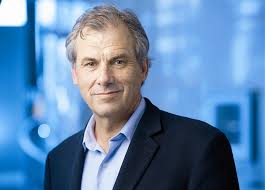
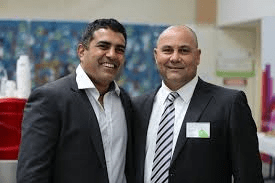
“In a lot of communities as soon as you walk in those community stores the first thing you see is a refrigerator full of Coke,” John Paterson (pictured above)  from AMSANT  the Aboriginal Medical Services Alliance NT .

VIEW ABC NEWS COVERAGE

Thirty short films, written by people living in the communities, will be launched over the next two months.

A Darwin-based record company is using its connections with Indigenous musicians to spread health messages in remote communities. Thirty short films, written by people living in the communities, will be launched over the next two months.

film

VIEW SUGARMAN the VIDEO HERE

Nigel Yunupingu stars in the film Sugar Man, which addresses excess sugar consumption in his community of Galiwin’ku on Elcho Island, off the coast of Arnhem Land. Skinnyfish Music co-founder Mark Grose says the films will be launched by the record label across the Northern Territory.

“I’ve got to say that all of the guys we’ve worked with are just natural actors, they just do such a great job,” he said. “Because it’s something that’s important to them.”

The films have been devised and written by people from Western Arnhem Land to Croker Island, with help from the record label and filmmaker Paul Williams. Mr Grose says every community has taken a different approach

. “So it’s really Aboriginal people speaking to Aboriginal people about a modern issue,” he said. “So I guess in a way, people aren’t being lectured to, they don’t have an expert or a doctor coming in saying this is what you have to do.” The overall message is “get active, eat bush tucker and live longer”.

Soft drinks cheaper than water

BdgP_x9CYAA3UBg

Photo above recent health promotion Burunga mob NT

Comedy, music and traditional knowledge are used to tackle serious health issues, including excess consumption of soft drinks. In August last year, remote retailer Outback Stores reported a drop in sugared soft drink sales for the first time.

But John Paterson from the Aboriginal Medical Services Alliance NT says, in many remote stores, it is still the case that water is more expensive than soft drink.

“In a lot of communities as soon as you walk in those community stores the first thing you see is a refrigerator full of Coke,” he said. Mr Paterson says fruit, vegetables and other healthy food options are also too expensive in remote community stores. “Unfortunately I think there’s a huge reliance on the fast-food takeaway products, which is obviously contributing to obesity, diabetes and a whole range of other chronic illnesses,” he said

. “This is why we want to encourage those shop owners, those chain stores that have a presence in Aboriginal communities, to seriously consider what they stock in their stores and really consider the long-term implications.” Mr Paterson says community awareness is part of the problem but a government subsidy for stores could also be a solution. “We need them to either carry out appropriate negotiations with government to get that subsidy if that’s what it requires to get the much healthier products into those community stores,” he said.

Some communities focusing on return to bush tucker

Mr Paterson says a return to using bush tucker in meals is also a positive step. “When I visited my grandmother in her home communities, where they predominantly lived off bush tucker foods … they were a lot healthier,” he said.

“I know there are some communities now that are really focusing on returning to the consumption of bush tucker and utilising more bush tucker in their meals.”

Rates of diabetes and rheumatic heart disease are much higher among Australia’s Indigenous population. The need for regular medical check-ups and anti-smoking messages are also featured in the films. Those involved in the project hope to get the films into all remote health centres and schools across the Northern Territory.

NACCHO preventative health news : Unhealthy big business spreading great harm worldwide-Prof Rob Moodie

Comic

“Surely we must find a balance between unrestrained commercialism and  maximising health and wellbeing. We need business  for our individual and  collective wellbeing.”

However, the benefits unhealthy businesses bring are  outweighed by the costs – in terms of premature death, chronic illness, limited  healthcare finances, overcrowding of hospitals and loss of productivity from  unhealthy employees.”

RM

Rob Moodie is professor of public health at the University of  Melbourne THE AGE 

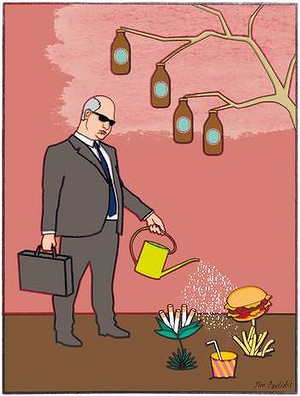
Illustration: Jim Pavlidis.

Two-thirds of Indonesian men smoke and more than half of Chinese men smoke.  Even more disturbing is that 40 per cent of 13-15-year-old Indonesian boys  smoke. How have these levels been reached while the world has known for more  than 50 years that tobacco is such a deadly habit?

In China, it is now estimated that 114 million people have diabetes.  South  Africa has one of the highest per capita alcohol consumption rates in the world,  with more than 30 per cent of the population struggling with an alcohol problem  or on the verge of having one.

Tobacco, alcohol, and diabetes related to overweight and obesity all have one  feature in common. They are each largely driven, and in the case of tobacco  completely caused, by powerful commercial interests in the form of transnational  corporations. It has been said that China’s booming economy has brought

Two-thirds of Indonesian men smoke and more than half of Chinese men smoke.  Even more disturbing is that 40 per cent of 13-15-year-old Indonesian boys  smoke. How have these levels been reached while the world has known for more  than 50 years that tobacco is such a deadly habit?

In China, it is now estimated that 114 million people have diabetes.  South  Africa has one of the highest per capita alcohol consumption rates in the world,  with more than 30 per cent of the population struggling with an alcohol problem  or on the verge of having one.

Tobacco, alcohol, and diabetes related to overweight and obesity all have one  feature in common. They are each largely driven, and in the case of tobacco  completely caused, by powerful commercial interests in the form of transnational  corporations. It has been said that China’s booming economy has brought with it  a medical problem that could bankrupt the health system.

We now face a major dilemma: unrestrained commercial development is pitted  against the health and wellbeing of populations. This dilemma is not new –  opponents of the abolition of slavery complained it would ruin the economy – but  it is manifesting in more obvious ways in the 21st century.

The tobacco, alcohol and ultra-processed (”junk”) food and drink industries  have been rapidly expanding in low and middle-income countries. In the past  decade, tobacco retail sales growth in these countries was 20 times that of the  developed world. For alcohol consumption it was three times; sugar-sweetened  beverages it was twice. But it isn’t only Indonesia, China and South Africa  where we find this dilemma; it is alive and well in Australia.

For years we have known that the tobacco industry promotes and funds biased  research findings, co-opts policy makers and health professionals, lobbies  politicians and officials to oppose public regulation, and influences voters to  oppose public health measures through expensive public relations campaigns. This  success has  been noticed and over the past decade alcohol and ultra-processed  food and drink companies have been emulating these very same tactics.

This is of little surprise given the flow of people, funds and activities  across the industries. For example Philip Morris owned both Kraft and Miller  Brewing; the board of SAB Miller (the second largest alcohol manufacturer)  includes at least five past or present tobacco company executives and board  members; and the Diageo executive director responsible for public affairs spent  17 years in a similar role at Philip Morris.

Economic development plays an important role in the health and wellbeing of  populations. Income, employment and education levels are all major determinants  of good health. Businesses create wealth, provide jobs and pay taxes (but as we  have seen, not all of them).  One of the best ways to protect and promote health  is to ensure people have safe, meaningful jobs. The more evenly wealth and  opportunity are distributed, the better the overall health and wellbeing of a  population.

But clearly not all businesses are good or healthy – yet we see some of them  expanding their markets and influence across the globe – seemingly with no  capacity to diminish or mitigate the harm they do. It is astonishing that an  industry such as tobacco, which is so harmful to human health, can wield so much  power.  In Indonesia, Philip Morris and its affiliate, Sampoerna, will invest  $US174 million to improve production capacities so, as Sampoerna’s president has  said, ”Indonesia would be the centre of the Marlboro brand production to cater  [for] demands in the Asia-Pacific region”.

Why do they need to expand their activities? Aren’t the existing 700 million  smokers in the  region enough? Especially when we know that more than half of  them will die prematurely, losing about 20 years of life   to  tobacco.

The major tobacco, food, and alcohol companies have assets that are greater  than many countries and can wield this power in  parliament, law courts and the  media, against the interests of the public’s health.

A new battlefront in this power play is the Trans Pacific Partnership   Agreement (TPP). This trade agreement among 12 countries (including Australia,  Japan and the US) represents about 40 per cent of the global economy.

The Australian government aims to ”pursue a TPP outcome that eliminates, or  at least substantially reduces, barriers to trade and investment” and that will  ”also deal with behind-the-border impediments to trade and investment”.

It is highly complex, has 29 chapters, is being negotiated in secret and is  provoking considerable criticism on the basis that it could greatly strengthen  the hand of some industries to sue national governments for their domestic  policies and also greatly weaken the capacity of governments to buy cheaper  generic drugs. The Nobel prize-winning humanitarian group Medicins sans  Frontieres says the TPP ”could restrict access to generic medicines, making  life-saving treatments unaffordable to millions”.

If our trade negotiators buckle under the pressure from other governments,  which are, in turn, highly influenced by transnational companies, then Australia  will have to confront some major problems. These include delayed availability of  cheaper generic drugs and increased cost of medicines; interference with our  Pharmaceutical Benefits Scheme; enshrining of rights to foreign corporations,  such as tobacco companies, to sue our government; interference with our capacity  to introduce health warnings on alcohol packaging, and the limiting of future  options for food labelling.

Surely we must find a balance between unrestrained commercialism and  maximising health and wellbeing. We need business  for our individual and  collective wellbeing. However, the benefits unhealthy businesses bring are  outweighed by the costs – in terms of premature death, chronic illness, limited  healthcare finances, overcrowding of hospitals and loss of productivity from  unhealthy employees.

This is why we have governments – to ensure a balance among the rights of  individuals, consumers, businesses and society as a whole. If, as Prime Minister  Abbott has said, Australia is open for business, then we need to make sure it’s  open for good business.  If we can’t control the vested interests of unhealthy  industries in trade agreements or in our domestic regulations, unhealthy  business will come back to bite us all.

Rob Moodie is professor of public health at the University of  Melbourne

Read more: http://www.theage.com.au/comment/unhealthy-big-business-spreading-great-harm-20140105-30bnk.html#ixzz2pkGpmrUG

NACCHO 2014 event alerts: Significant dates for Aboriginal cultural events in 2014

sovereign

Significant dates for cultural events in 2014

 There is planning underway for a number of significant cultural events for 2014, which encourage people to both participate and reflect on the importance of these events

Our thanks to Australian Indigenous HealthInfonet for creating this page

NACCHO will also be releasing shortly details of our major events planned for 2014

Photo above NACCHO vision

The list below contains dates and information for these events.

National Apology Day, 13 February 2014 This event marks the anniversary of the Apology to Australia’s Indigenous peoples in the House of Representatives on 13 February 2008 by former Prime Minister, Kevin Rudd, apologising for past laws, policies and practices that have impacted on Australia’s First Nations Peoples, particularly members of the Stolen Generations. The motion was supported by the Opposition and passed through both houses of Parliament, Brendan Nelson (former Leader of the Opposition) gave a formal response. Many members of the Stolen Generations were present in the Chamber to hear the Apology and thousands more filled the Great Hall of Parliament House and flowed out onto the lawns to watch it on big screens. The Apology was broadcast across Australia.

View information: National Sorry Day Committee

Harmony Day, 21 March 2014 Harmony Day is a day of cultural respect for everyone who calls Australia home – from the traditional owners of this land to those who have come from many countries around the world. By participating in Harmony Day activities, people can learn and understand how all Australians from diverse backgrounds equally belong to this nation and enrich it.

View information: Harmony Day

National Close the Gap Day, 20 March 2014 Every year people are encouraged to hold their own event on National Close the Gap Day to raise awareness about the 17-year life expectancy gap between Indigenous and non-Indigenous Australians. Since 2006, the Close the Gap campaign has achieved an enormous amount with community support. In 2013, there were over 900 National Close the Gap Day events around Australia.

View information: Oxfam

National Sorry Day, 26 May 2014 National Sorry Day is a significant day for Aboriginal and Torres Strait Islander peoples, and particularly for Stolen Generations survivors. The idea of holding a ‘Sorry Day’ was first mentioned as one of the 54 recommendations of the Bringing them home report, which was tabled in Parliament on 26 May 1997. This report was the result of a two year National Inquiry into the forcible removal of Indigenous children from their families, communities and cultural identity. On 26 May 1998 the first ‘Sorry Day’ was held in Sydney, it is now commemorated across Australia, with many thousands of people participating in memorials and commemorative events, in honour of the Stolen Generations.

View information: National Sorry Day Committee

National Reconciliation Week, 27 May – 3 June 2014 National Reconciliation Week is an ideal time for everyone to join the reconciliation conversation and reflect on shared histories, contributions and achievements. It is held annually from 27 May to 3 June and is a time to celebrate and build on the respectful relationships shared by Aboriginal and Torres Strait Islander people and other Australians. Preceded by National Sorry Day on 26 May, National Reconciliation Week is framed by two key events in Australia’s history, which provide strong symbols for reconciliation:

  • 27 May 1967 – the referendum that saw more than 90 per cent of Australians vote to give the Australian Government power to make laws for Indigenous people and recognise them in the census.
  • 3 June 1992 – the Australian High Court delivered the Mabo decision, which recognised that Indigenous people have a special relationship with the land. This paved the way for land rights known as native title. Mabo Day is held 3 June to celebrate the life of Eddie Koiki Mabo.

View information: National Reconciliation Week View information: Mabo Day

National NAIDOC Week, 6 – 13 July 2014 NAIDOC is a celebration of Aboriginal and Torres Strait Islander cultures and an opportunity to recognise the contributions of Indigenous Australians in various fields. Its origins can be traced to the emergence of Aboriginal groups in the 1920s which sought to increase awareness in the wider community of the status and treatment of Indigenous Australians. NAIDOC stands for National Aborigines and Islanders Day Observance Committee. Activities take place across the nation during NAIDOC Week in the first full week of July. All Australians are encouraged to participate.

View information: NAIDOC

National Aboriginal & Torres Strait Islander Children’s Day, 4 August 2014 National Aboriginal and Islander Children’s Day (NAICD) is a celebration of Indigenous children and is held on 4 August each year. NAICD was first observed by the Secretariat of National Aboriginal and Islander Child Care (SNAICC) in 1988. Each year SNAICC produces and sends out resources to help celebrations for NAICD.

View information: SNAICC (information for 2014 not available yet)

International Day of the World’s Indigenous People, 9 August 2014 The International Day of the World’s Indigenous People (9 August) was first proclaimed by the General Assembly in December 1994, to be celebrated every year during the first International Decade of the World’s Indigenous People (1995 – 2004). In 2004, the Assembly proclaimed a Second International Decade, from 2005 – 2014, with the theme of A decade for action and dignity.

View information: United Nations (information for 2014 not available yet)

NACCHO 2014 political news: Warren Mundine warns of budget pain for Aboriginal funding

WM

“We won’t solve Indigenous crime and justice problems with isolated decisions or with ideology. We need considered strategy based on facts and consistent, committed implementation. With governments working together and focused on outcomes and what works, we can deal with this problem and save governments a lot of money. That’s pragmatism.”

From “When ideology trumps pragmatism, everybody pays” Warren Mundine opinion piece (see full article below )

Welcome to NACCHO News Alerts for 2014 .

Warren Mundine warns of budget pain for Aboriginal funding

PATRICIA KARVELAS  The Australian 3 January 2014

WARREN Mundine has declared it unrealistic to expect indigenous affairs spending to be immune from budget cuts and that, despite his new role as head of Tony Abbott’s indigenous advisory council, he can’t cast a “force field” to exempt Aborigines from the broader budget agenda.

In an exclusive interview and writing in The Australian today, the indigenous leader said that, although he actively opposed the cuts to Aboriginal legal aid announced last month, his opposition was not ideological and he wanted spending to be subjected to an audit to examine if it was delivering the outcomes promised.

Mr Mundine also revealed he would spend this year pushing for state and territory governments to have “mandatory diversionary programs” to push juvenile offenders into jobs and education.

Indigenous academic and leader Marcia Langton, who is heading the Abbott government’s indigenous jobs review with Fortescue Metals Group chairman Andrew Forrest, said yesterday she backed auditing programs to ensure they made a real difference to the lives of indigenous people.

“I support social-investment approaches, especially for children and youth,” Professor Langton said.

“The legal aid approach by itself will do little to lower indigenous prison incarceration and juvenile detention rates. Early childhood health and education programs should be top priority.”

Mr Mundine said that, if a diversionary program succeeded and a young person went on to stable employment, “this means a lifetime of paying taxes rather than a life in and out of detention and welfare at taxpayers’ expense”.

“Yet governments shy away from effective diversionary programs because they fear being labelled weak on crime,” he said. “Another example of ideology trumping pragmatism.”

The government announced in its mid-year economic and fiscal update last month that $13.4 million would be taken out of indigenous legal aid over the next four years. The cut was reduced from $42m, after the government decided to spread the pain to non-indigenous legal aid in the wake of a strong campaign by indigenous activists and Mr Mundine. Labor has sought to personalise the cuts and claim that Mr Mundine, a former Labor Party president, was not a strong enough advocate for stopping the cuts.

Mr Mundine’s comments today are aimed at critics who he says are wrong if they expect he can insulate indigenous affairs from the budget razor gang.

Annual public spending on indigenous Australia jumped to $25.4 billion in 2012, according to the Productivity Commission. Mr Mundine said he believed that funding should be effective and not defended for the sake of it.

“Legal aid is vital, but it deals with the problem at the tail end,” he said. “We need to tackle this problem right at the beginning, with swift and early intervention for first offenders through diversionary programs, even if they are minor offences. We also need to look at how we make communities stable and safe so they don’t become breeding grounds for anti-social behaviour. Education and the jobs are the key.”

Mr Mundine said many young Aborigines’ problems started well before they engaged in criminal behaviour.

“When you meet kids who tell you the only time they’ve attended school is in detention and that they prefer detention to being at home, then that tells you their home and family environment is completely dysfunctional,” he said.

“If parents aren’t sending their kids to school or giving them a safe and stable home life, that sends off loud warning bells that we need to act.”

He said the federal government played a secondary role in the area, as crime and punishment were the responsibility of state and territory governments.

“I want to see state and territory governments introduce mandatory diversionary programs into jobs and education for juvenile offenders,” he said. “This is something we should look at for all juvenile offenders, not just indigenous people.”

Mr Mundine said he was not proposing “letting offenders off with warnings or community service”.

“We need to actively divert offenders on to a … path that requires them to work hard and take personal responsibility.”

He said a lot of the criticism of the decision to cut legal aid funding was based on the presumption that reducing funding would lead to increased indigenous incarceration. “That was the ideological principle through which the decision was judged.

“There was a lot of anger and indignation but not much discussion of the actual outcomes the defunded services have achieved and how those services correlate to incarceration rates. Some critics appeared more interested in opposing a budgetary decision of a government they don’t like based on political opinions.”

He said he objected to the cuts because he wanted his new council to review indigenous legal services as part of the broader review. “I engaged in a public battle with Treasury over the proposal,” he said.

“Ultimately, Treasury spared a substantial amount of legal services from defunding but identified others to make up the budget saving figure, including to some family violence programs.”

Professor Langton said the focus this year must be on what worked, not ideology. She said results from the National Assessment Program – Literacy and Numeracy (NAPLAN) showed education gaps.

“Place-based approaches that involve the community are needed,” she said. “The Family Responsibilities Commission in Cape York has demonstrated a highly effective approach that other communities are requesting. The truancy officers program instituted by (Indigenous Affairs) Minister (Nigel) Scullion will help with attendance rates but more is needed. The Cape York Agenda programs are working at Aurukun and it is important to note that success and replicate these successful measures in other low socioeconomic areas.”

Mr Mundine said there were thousands of initiatives across the country aimed at eliminating indigenous disadvantage. “Yet the gap between indigenous and non-indigenous people isn’t closing,” he said.

He said indigenous people had Mr Abbott’s ear and a seat at his table and warned it should not be wasted or scoffed at.

When ideology trumps pragmatism, everybody pays

Online copy The Australian

IN debates on social issues there are usually two sides: one based on ideology and the other on pragmatism.

Ideologues focus on principle and theory. Their ideas are based on their ideals. If something doesn’t work, they often blame poor application or resourcing.

Pragmatists accept reality and that compromise and setbacks are unavoidable. They care about results over theory. They support things that work. Too often, vocal activism on indigenous issues is dominated by ideologues.

Before the federal election, the Coalition announced spending cuts to indigenous legal services. I engaged in a public battle with Treasury over the proposal.

Ultimately, Treasury spared a substantial amount of legal services from defunding but identified others to make up the budget saving figure, including to some family violence programs.

I remain unhappy with the final decision. But, practically, once the line item had been included in pre-election figures it was going to be extremely difficult to get it reversed. The reality is that Australia’s budgetary position is unsustainable. Government is spending more than it raises in revenue, forecasts have been consistently wrong and there are structural budget deficiencies.

Initiatives for indigenous people aren’t immune from this problem. It’s unrealistic to expect me, or the Indigenous Advisory Council, to cast some sort of force-field over indigenous spending to exempt it from the broader budget agenda. Pragmatists understand that we must work within this reality. Ideologues don’t.

A lot of the criticism of the decision on legal aid funding was based on the presumption defunding undoubtedly will lead to increased indigenous incarceration. That was the ideological principle through which the decision was judged. There was a lot of anger and indignation but not much discussion of the actual outcomes the defunded services have achieved and how those services correlate to incarceration rates.

Some critics appeared more interested in opposing a budgetary decision of a government they didn’t like based on their political opinions.

Treasury wasn’t focused on the functions being cut or the outcomes they delivered; it was focused on the dollars.

But ideologues fell into the same trap; they, too, were focused on the dollars.

I objected to the decision because I want the IAC to review indigenous legal services as part of the broader review, identify what is delivering outcomes, develop a strategy on how services should be structured to address crime, incarceration rates and the needs of victims, and work with state and territory governments to implement.

A strategy that works will deliver savings far greater than hasty tactical cuts will ever deliver. We can deliver both outcomes and spending reductions. In fact, we must.

There are thousands of initiatives across the country aimed at eliminating indigenous disadvantage. Yet the gap between indigenous and non-indigenous people isn’t closing. If the present framework for addressing indigenous disadvantage were working, there would be less need for special services and therefore progressively less funding required to address the problems.

We also know there’s inefficiency in indigenous programs and that a lot of the money is spent on bureaucracy and administration. I meet indigenous people nearly every week who complain about it.

Removing inefficiency, duplication, bureaucracy and red tape will also mean lower spending.

That’s why money isn’t the main issue. The No 1 issue is the outcomes achieved for indigenous people; outcomes such as real jobs, school attendance and closing the gaps in health, education and incarceration.

Here’s an example. About 10 years ago, I sat on the NSW attorney-general’s juvenile crime prevention committee. Research presented to the committee pointed to a common conclusion – send a juvenile offender to detention and in most cases you have them for life; they’ll invariably be in and out of the system forever. However, put them into a diversionary program (where they instead go into a job or education that they must complete instead of jail) and in most cases you never see them again.

If a diversionary program succeeds and a young person goes on to stable employment, this means a lifetime of paying taxes rather than a life in and out of detention and welfare at taxpayer expense. Yet governments shy away from effective diversionary programs because they fear being labelled weak on crime. Another example of ideology trumping pragmatism.

There’s a mountain of research on indigenous incarceration, its causes and effects, and many ideas for solving the problem. Some have been tried and tested. Ironically, much of the work and expertise in this area that has informed me in recent months originates from National Aboriginal and Torres Strait Islander Legal Services – one of the bodies that Treasury is defunding.

We won’t solve indigenous crime and justice problems with isolated decisions or with ideology. We need considered strategy based on facts and consistent, committed implementation. With governments working together and focused on outcomes and what works, we can deal with this problem and save governments a lot of money. That’s pragmatism.

Nyunggai Warren Mundine is the chairman of the Prime Minister’s Indigenous Advisory Council and executive chairman of the Australian Indigenous Chamber of Commerce.

NACCHO political news :Aboriginal organisation to defy Tony Abbott funding cut

880739-120811-tony-abbott

The leaders of the national representative body for indigenous people have vowed to continue as a ”fearless” voice for Aboriginal and Torres Strait Islander peoples, despite the Abbott government indicating it is likely to cut its funding.

The National Congress of Australia’s First Peoples was set up in 2010 with an initial Commonwealth funding allocation of $29.2 million over five years. While it was envisaged that the organisation would become financially self-sufficient over time, it is yet to reach this stage.

From Dan Harrison SMH

In the May budget, the Gillard government provided a further $15 million in funding to flow over three years from July next year, but Indigenous Affairs Minister Nigel Scullion met the group’s co-chairs on Wednesday and told them it was unlikely they would receive the $15 provided for by Labor.

But in a statement issued late on Thursday, Congress co-chairs Kirstie Parker and Les Malezer promised the organisation would continue to fight.

”The National Congress of Australia’s First Peoples promised its members and supporters today that it will continue as a strong, fearless national representative body for Aboriginal and Torres Strait Islander Peoples,” the statement said.

”The new government has shown that they do not support real decision making for our families and communities through a national representative body chosen by our Peoples, for our Peoples.”

The statement said Congress would hold urgent meetings with members and would continue to build partnerships with other Australians to build a sustainable financial base for the organisation. It would also continue to increase its membership.

Labor’s spokesman on indigenous affairs, Shayne Neumann said the move brought into question Tony Abbott’s promise to be a Prime Minister for Indigenous Affairs.

Mr Neumann contrasted the treatment of Congress with the government’s decision to provide $1 million to set up an indigenous advisory council chaired by former ALP president Warren Mundine.

”What Tony Abbott is proposing to do is slash funding to a body of elected indigenous representatives while spending $1 million to establish a hand-picked Ministerial Advisory Committee in its place,” he said.

Mr Mundine said this was ”nonsense” as his committee was not intended to be a representative body, but was created to provide policy advice to government.

Stressing he was expressing a personal view, Mr Mundine said he had always thought the funding provided to Congress was excessive, and in a tight budgetary situation, the additional funding promised by Labor could be better spent on other priorities in the indigenous affairs portfolio.

Senator Scullion said no decision had been made about the organisation’s funding, and the decision about future funding would be made as part of the budget process, after the Commission of Audit reports.

”However, I did stress that it was highly unlikely that funding would be approved as the government moves funding to frontline services to focus on delivering real outcomes for first Australians,” Senator Scullion said.

”I felt it appropriate to advise Congress of this as early as possible so it could make plans for the future,” he said.

Senator Scullion said he had encouraged the organisation to use the $8.3 million remaining in its reserves to prepare for the future.

”There remains a role for Congress but it is important that it build membership from its current level of approximately 7500 and look to other sources of financial support in the future,” he said.

In April, Senator Scullion said he did not believe the organisation should receive Commonwealth funding because it made the peak body dependent.

Aboriginal and Torres Strait Islander Social Justice Commissioner Mick Gooda wrote recently that Congress should be given time to establish itself.

”Organisations evolve over time and I believe that Congress has the fundamentals for robust representation and good governance,” he wrote in his annual native title and social justice report.

In its submission to the Commission of Audit, Congress said while it had not yet achieved financial self-sustainability, it continued to ”work assiduously towards that goal”.

”Aboriginal and Torres Strait Islander Peoples take the view that government has certain obligations towards Aboriginal and Torres Strait Islander Peoples and this includes supporting a strong, sustainable, representative voice for our Peoples,” the submission by Congress said.

Read more: http://www.smh.com.au/federal-politics/political-news/indigenous-organisation-to-defy-tony-abbott-funding-cut-20131219-2znr4.html#ixzz2nxN9DQps

NACCHO political news: Aboriginal National Congress told funding will go next July

Nat Congress

THE peak Aboriginal body has been told it must prepare to lose its federal funding from next July and find another way to support itself.

From Patricia Karvelas From: The Australian

Labor had promised to keep the National Congress of Australia’s First Peoples funded with $15 million for another three years in this year’s May budget.

Since the election, the congress has hoped the Coalition would honour Labor’s pledge.

But Indigenous Affairs Minister Nigel Scullion said he had met the group’s co-chairs yesterday to warn them that was highly unlikely and they must look beyond the government for means of survival.

The edict came as Tony Abbott said last night that the referendum to acknowledge first Australians must surpass the apology and the 1967 referendum as a unifying moment for the nation.

In a speech to mark the 60th anniversary of law firm Arnold Block Leibler, the Prime Minister said “symbols” were important to reconciling with Aborigines.

He said too many had “felt like strangers” in the only land they had known. “The best thing we could do for Aboriginal Australia right now is push on as quickly as we can with constitutional recognition,” he said. “We have it in our hearts to do this.”

Senator Scullion told the congress’s co-chairs that while the final outcome would be determined by the Commission of Audit and be revealed at budget time, there was no appetite to keep them funded and they must use the next six months to plan for a future without federal funds.

“The circumstances are that the funding is unlikely, so I met with them and advised them that our priorities are frontline services and indicated that the principle reason that I don’t think they will keep getting funded was . . . we never committed to it during the election and our priorities are with our election commitments,” he said.

“I told them I wanted to tell them early to allow them to make financial plans. I told them I would lift restrictions on their current funds if I could.”

Senator Scullion said the co-chairs had asked whether the government would contract them for roles on a fee-for-service basis, and that he would consider it.

“I told them they had a role to represent the nation’s first people and they needed to grow their membership,” he said.

“I am very doubtful that a positive decision will be made on their funding and I think they need to start preparing for that.”

With its four-year federal funding deal to expire this year, the congress had written in a submission to the Abbott government that its Commission of Audit needed to recognise “the need for a sustainable independent national body” to ensure a voice for indigenous people.

NACCHO welcomes your comments

SEE BELOW

NACCHO Aboriginal health news : Honorary doctorate awarded to Aboriginal health pioneer and advocate Ms Pat Anderson

Dr Pat

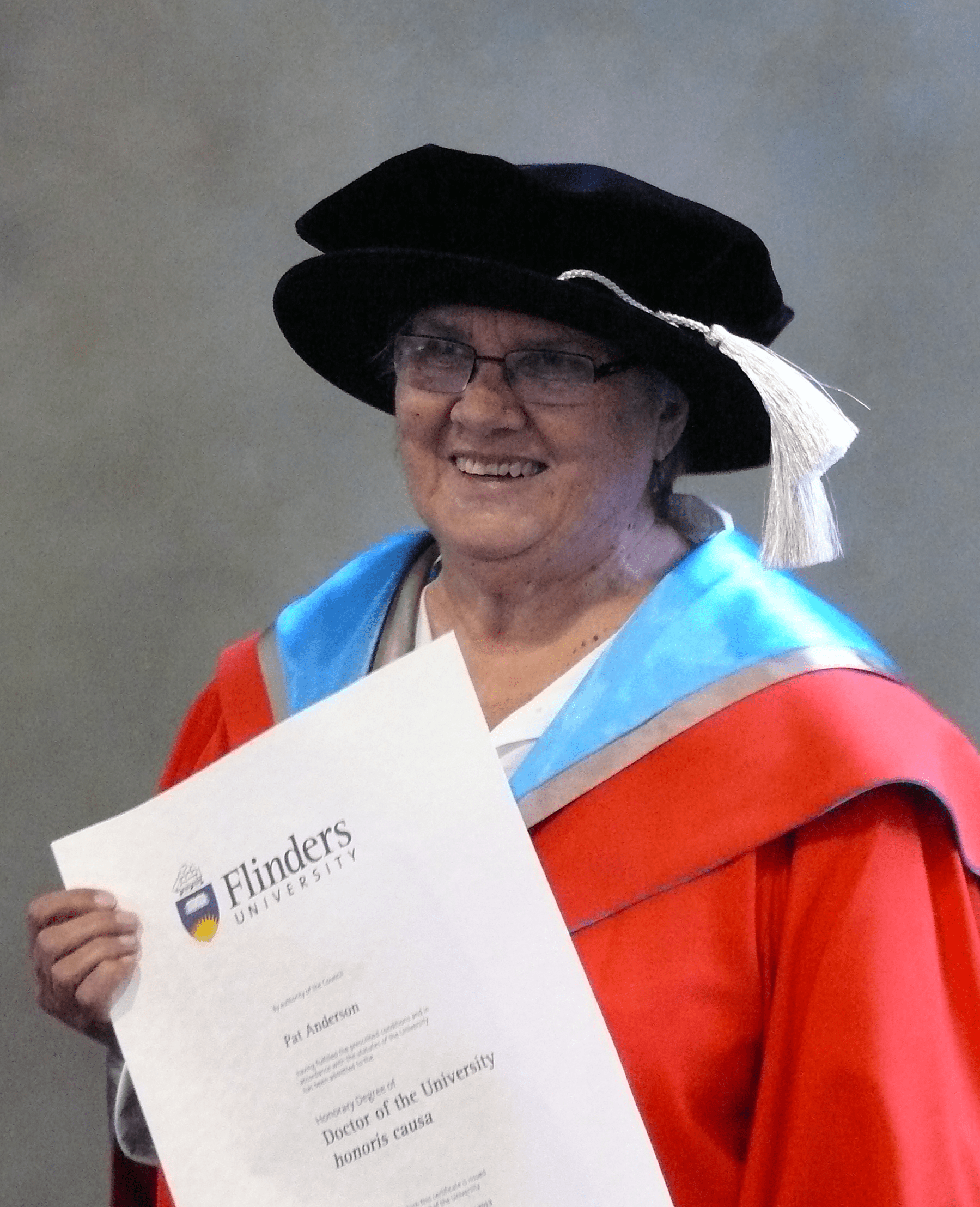
The chair of NACCHO Justin Mohamed on behalf of all NACCHO members, board and affiliates today congratulated Pat Anderson Aboriginal health pioneer and advocate being awarded an honorary doctorate.

Pictured above receiving a degree of Doctor of the University (DUniv) from Flinders University’s receiving the degree at the Adelaide Convention Centre (photo Mary Buckskin)

” Ms Pat Anderson is an Alyawarre woman from the Northern Territory with a national and international reputation as a powerful advocate for disadvantaged people, with a particular focus on the health of Australia’s First Peoples. Chair of the Lowitja Institute, she has extensive experience in all aspects of Aboriginal health, including community development, advocacy, policy formation and research ethics, and has had a close association with Flinders University for many years.” Mr Mohamed said.

READ HER RECENT ARTICLE :Racism a driver of Aboriginal ill health

After growing up on Parap Camp in Darwin, Ms Anderson travelled and worked overseas before working for the Woodward Royal Commission into Aboriginal Land Rights (1973-74) as a legal secretary.

She then became one of the first Aboriginal graduates of the University of Western Australia. After working in Tasmania, Western Australia and Victoria as an advocate for improved education for Aboriginal children, she returned to the Northern Territory in the early 1990s to become CEO of Danila Dilba Aboriginal Health Service.

This led to the start of her involvement with Flinders, supporting the placement of medical students based at the University’s Darwin Clinical School.

She played a key role in establishing the Aboriginal Medical Service Alliance of the Northern Territory (AMSANT), the representative body for the Aboriginal community-controlled health organisations.

After leading the founding of the Cooperative Research Centre (CRC) for Aboriginal and Tropical Health in 1997, she retained a leading role in the successive CRCs that came to constitute the core of the newly created Lowitja Institute, in which Flinders is a partner.

The Lowitja Institute, now recognised as Australia’s National Institute for Aboriginal and Torres Strait Islander Health Research, received an additional $25 million in research funding from the 2013 Federal Budget. Author of numerous essays, papers and articles, Ms Anderson was co-author with Mr Rex Wild QC of Little Children Are Sacred, a highly influential report on abuse of Aboriginal children in the NT.

NACCHO Aboriginal health : Mundine “Racial vilification legislation is not about freedom but about how we think about race “

Wm

In the coming months, Australia will have a polarising debate on the federal government’s decision to amend section 18C of the Racial Discrimination Act, one that will test the government’s working relationship with indigenous people and other minority groups.

Nyunggai Warren Mundine  Opinion article Sydney Morning Herald 18 December

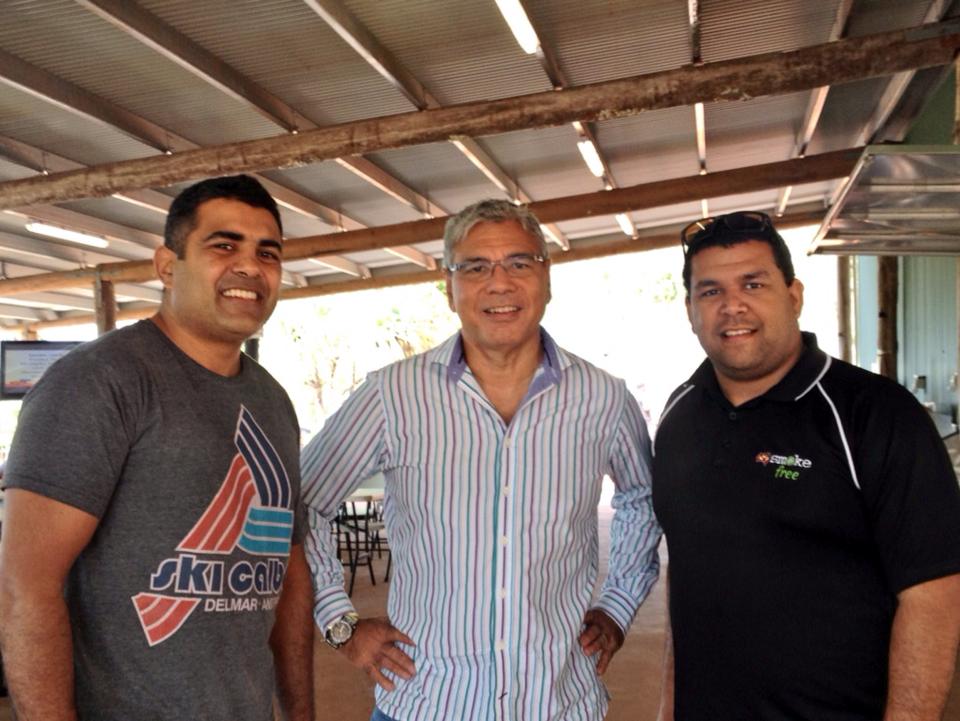
Pictured above  Justin Mohamed and Matthew Cooke with Warren Mundine (centre)  at the recent Garma Festival

The government believes the law goes too far in limiting free expression. Its decision was triggered by the censure of Andrew Bolt for articles suggesting ”fair-skinned” people of mixed indigenous and non-indigenous descent could not genuinely identify as indigenous, should not take part in indigenous arts and cultural awards and chose to identify as indigenous for personal gain. Bolt described these individuals as ”the white face of a new black race – the political Aborigine”.

All political traditions limit free speech; conservatives support censorship on moral and national security grounds, for example. The government’s job is to balance individual freedoms with legitimate restrictions to protect people from harm. Balance is achieved through consistent, principled reasoning, not reacting to single events. I’m concerned this is not happening here and I question whether the government would take similar action over other groups.

Take, for example, British National Party chairman Nick Griffin’s statements that black people cannot be British. Griffin believes British people of African or Asian descent are ”racial foreigners”; that British-born people of Pakistani descent are not British but remain of ”Pakistani stock”. Griffin has been convicted of inciting racial hatred. In 1998, the Howard government denied him entry to Australia.

Griffin imagines a continuing, authentic Briton and believes the absorption of non-white people into Britain and mixed marriages is leading to ”bloodless genocide” of the British race. This is obviously nonsense. Foreigners have been settling in the British Isles for thousands of years, through bloodless and bloody means alike.  British identity is defined by national laws and based on descent and citizenship, not genetic purity.

Indigenous people are also from tribal nations, with membership based on kinship and descent. Traditional laws are complex, highly developed and unique to each nation. Traditionally, these laws defined the nation’s members and regulated how people could interact. They also regulated how outsiders fit into the community.

I’m not part of a ”black race”. I’m from the Bundjalung nation and a descendant of the Bundjalung, Gumbaynggirr, Yuin and Irish peoples. My children and grandchildren are also Bundjalung, including those with ”fair skin”. For me, it’s just as offensive to say any of us aren’t Bundjalung as it is to say a black person cannot be British.

Bolt clearly does not see this parallel. He dismissed Mick Dodson’s call for a treaty because Dodson’s father is Irish. ”Sign a treaty with yourself, Mick,” he wrote. Yet I’m sure Bolt would not describe Britain as signing a treaty with itself when it agreed the Treaty of Versailles with Germany, even though Britain’s King George V was ethnically German and Danish. Likewise, a treaty in Australia would not be between black people and white people. It would be between the Commonwealth and indigenous tribal nations.

Bolt’s articles actually adopted the same logic as Griffin’s. The difference is Britain is a sovereign nation able to define its people through its laws. Indigenous nations were invaded and colonised and their traditional laws are not recognised. This difference is not relevant when it comes to defining racial vilification.

Jewish people are a nation of people originating from a common geography, genealogy, language and religion. They were also dispossessed of land and sovereignty and dispersed over thousands of years, yet they maintain their identity as a people and nation. Judaism is not just a religion; there are many secular Jews. Traditionally, Judaism is defined primarily by matrilineal descent: a person is Jewish if born to a Jewish mother. Israel’s law of return allows any Jewish person to migrate there.

Imagine if Bolt wrote that people with Jewish matrilineal lineage were not authentically Jewish and disputed their right to migrate to Israel because they did not resemble the Israelites Moses led out of the desert. Undoubtedly, he would warrant censure under section 18C. But I doubt this would prompt  a repeal of those laws.

It’s legitimate to question if people who are not disadvantaged are receiving benefits at the expense of those who are, but ”indigenous” is not synonymous with ”disadvantage”. Bundjalung law does not require that I have been discriminated against to be recognised.

Skin colour makes people a target of bigotry. However, bigotry is not always based on skin colour. I know ”fair-skinned” people who have hidden their indigenous ancestry to avoid discrimination. Indigenous people of mixed descent do not necessarily escape disadvantage or its consequences through their families. Some have suffered more.

Initiatives for indigenous arts, culture and language are not welfare. Their purpose should be to foster indigenous cultures and maintain them as they evolve. Skin colour and disadvantage are irrelevant for an award open to people of indigenous descent. Likewise, if the purpose is to break disadvantage, the question is whether the recipient meets the relevant disadvantage test. Being of indigenous descent is not, of itself, enough.

I doubt the government would repeal section 18C to protect the right to describe black Britons as ”the black face of a new white race” or to call people ”political Jews” because they do not have the same skin colour as Abraham. The problem is Attorney-General George Brandis does not regard Bolt’s articles as being in the same league.

This debate is not really about individual freedoms; it’s about perceptions of race and racism. The problem is not section 18C; it’s ignorance of the sophistication of indigenous laws and cultures.

I am pleased the Attorney-General has promised to consult before introducing legislation. I hope the federal government will listen and keep an open mind. Amending section 18C would send a dangerous signal. I believe it would be a mistake.

Nyunggai Warren Mundine is an aboriginal activist and former Federal President of the ALP.

NACCHO political health news : Abbott Government cuts to impact on Aboriginal health

Shane

Closing the gap requires a coordinated approach at the state and federal levels as the challenges faced by Aboriginal people are interconnected.You can’t improve overall health outcomes without also looking at the social determinants, things like housing, education and poverty. Similarly, you can’t improve health outcomes while the numbers of Aboriginal people in our jails continues to rise,”

Said NACCHO chair Justin Mohamed .(see press release below) pictured above with Shane Duffy NATSILS

Congress calls upon the Prime Minister to show leadership and understanding of the need for increased capacity in our organisations and communities.  He can demonstrate that by ensuring the National Aboriginal and Torres Strait Islander Legal Services is retained and strengthened,”

Said Co-Chair National Congress Les Malezer.(see press release below)

Overview

Yesterday the Federal Government delivered the Mid Year Economic and Fiscal Outlook 2013-2014.
Here are some things from the report as they relate to Aboriginal Affairs and Aboriginal Health and Health more broadly.
Ceased
-The Indigenous Carbon Farming Fund
-Remote Indigenous Energy Programme
-Aboriginal and Torres Strait Islander Health Programme ($1.0 m in 2013-2014)
-Office of the Coordinator-General for Remote Indigenous Services
-$27m from the Healthier Communities Priority Infrastructure Programme
-$5m Chronic Disease Prevention and Services Improvement Fund
-National Rural and Remote Health Infrastructure Programs – 22.3m
-Public Health Program – $6mil
Established
-$45 mil for Vocation Training and Employment Centres for 5000 Aboriginal job seekers under the Generation One model
-$5 for Empowered Communities based on Jawun Model.
-$1mil for Indigenous Advisory Council (Chaired by Warren Mundine)
-$40mil of redirected funding to re-open Indigenous Employment Programme in remote areas

NACCHO Press release

National Aboriginal Community Controlled Health Organisation (NACCHO) Chair, Justin Mohamed, said cutting legal services made no economic sense when you take into account the wider implications of incarceration on issues such as employment, education and health.

“The fact is people in our jail system often suffer from poor mental and physical health,” Mr Mohamed said.

“Incarceration also can have broader impacts on the health of those left behind – on the imprisoned person’s family and broader community.

“With rates of incarceration of Aboriginal people increasing, we should be doing everything we can to turn around the huge numbers of Aboriginal people in our prisons.

“NACCHO supports the good work of the National Aboriginal and Torres Strait Islander Legal Services and Aboriginal and Torres Strait Islander Legal Services – both who play an important role in keeping our people out of jail.

“They provide education and early intervention support and advice which can mean the difference between a life of incarceration and one that makes a contribution to the community.

“The Federal Government need to rethink their position and recognise how crucial a national voice on Aboriginal legal policy is in reducing the disproportionate numbers of Aboriginal people in the justice system.

“Aboriginal peak bodies understand better than anyone the issues their people face and the factors that contribute to them entering the justice system.

“Taking that voice from the mix to save a few dollars will just hamper future efforts to improve outcomes across a range of factors including health, education and employment.”

Mr Mohamed said closing the gap between Aboriginal and non-Aboriginal people needed an integrated approach.

“Aboriginal people make up more than thirty percent of the prison population, despite being only a fraction of the Australian population.

“Closing the gap requires a coordinated approach at the state and federal levels as the challenges faced by Aboriginal people are interconnected.

“You can’t improve overall health outcomes without also looking at the social determinants, things like housing, education and poverty. Similarly, you can’t improve health outcomes while the numbers of

Aboriginal people in our jails continues to rise,” Mr Mohamed said.

National Congress Condemns Cuts

 
The National Congress of Australia’s First Peoples (Congress) strongly opposes the decision by the Federal Government to cut funding to community controlled Aboriginal and Torres Strait Islander organisations.
The government’s ‘hit or miss’ funding cuts to our organisations, at the beginning of their term and before the completion of their highly-publicised inquiries, endangers the collaborative approach offered by the Prime Minister.
Today’s news that the national body for the Aboriginal and Torres Strait Islander Legal Services is to be defunded is a significant blow and does not reflect an effort to engage in partnership.
Having a national body for the legal services increases the skills, experience and effectiveness of all the Aboriginal and Torres Strait Islander Legal Services, and brings greater efficiency to the expenditure incurred by those legal services.
“Congress calls upon the Prime Minister to show leadership and understanding of the need for increased capacity in our organisations and communities.  He can demonstrate that by ensuring the National Aboriginal and Torres Strait Islander Legal Services is retained and strengthened,” said Co-Chair Les Malezer.
“Our Peoples must be self-determining and will not accept Governments making decisions on funding priorities without us.
“Removing our capacity for policy reform and advocacy to legal assistance programs delivered by Aboriginal, community and legal aid services will affect the most marginalised and vulnerable members of our community.
“Congress supports organisations controlled by Aboriginal and Torres Strait Islander communities to continue representing our interests and to provide expert advice on service delivery,” said Mr Malezer.
Congress recently made a strongly worded submission to the National Commission of Audit which reinforces our fundamental principles of self-determination and community decision making.
“Significant under investment by successive Governments makes our Peoples predicament comparable to some developing countries, “said Co-Chair Kirstie Parker.
“We cannot accept any reduction in Commonwealth spending on housing, remote infrastructure, legal services, community safety, native title, languages and culture, when investment and capacity building is what’s clearly required.
“We will continue to work with the Commission to engage with all of our members.
“Community input and ownership are highlighted as keys to achieve improvements by the Government’s own landmark reports – including the Department of Finance Strategic Review of Indigenous Expenditure (2011) and the Overcoming Indigenous Disadvantage: Key indicators 2011 report,” said Ms Parker.
Contact Congress : Liz Willis 0457 877 408  NACCHO Colin Cowell 0401 331 251


Government avoids scrutiny by cutting Coordinator-General for Remote Indigenous ServicesGeneral for Remote Indigenous Services.

“This cost cutting measure from the Government is deeply disappointing and will further undermine efforts to deliver on our Closing the Gap commitments,” Senator Rachel Siewert, Australian Greens spokesperson on Aboriginal and Torres Strait Islander Issues.
“The role of Coordinator General is to ‘monitor, assess, advise and drive progress relating to improvements in government service delivery in 29 remote Indigenous communities across Australia’.
Removing this role will directly affect the ability of the Government to monitor and report on the implementation of policies.
“This cut is a comparatively small amount of money that the Government admits will be used to either save money or fund other, unnamed policies.
It isn’t even being reinvested in other programs to help people in remote Australia.
“Decisions such as this make a mockery of Tony Abbott’s comments about being the Prime Minister for Indigenous Affairs, as once again his Government seeks to avoid scrutiny and accountability for its policies,” Senator Siewert concluded.

NACCHO News: THE Abbott government will strip funding from peak Aboriginal body

1226784448604

NATSILS chairman Shane Duffy said last night the cuts would deny essential legal services to even more Aboriginal people.

Source: News Limited

THE Abbott government will strip funding from the peak Aboriginal legal aid organisation and policy positions in its state affiliates, but has moderated the extent of cuts to at-the-coalface services following an outcry from the indigenous community.

The Coalition today will announce the defunding of the peak National Aboriginal and Torres Strait Islander Legal Services and all law reform and policy officer positions within each state and territory affiliate, saving $9 million over three years.

However, this represents a backdown after the Coalition went to the election promising cuts of $42m over three years to take effect from the 2014-15 financial year.

Our thanks to PATRICIA KARVELAS

FROM THE AUSTRALIAN

NATSILS chairman Shane Duffy said last night the cuts would deny essential legal services to even more indigenous people and further entrench them as “second-class citizens” in their own country.

Mr Duffy said that at a time when Aboriginal and Torres Strait Islander incarceration rates were at alarming highs and continuing to rise, the funding cuts were short-sighted.

“Without a national peak body and state-based law reform and policy officers, governments around Australia will have no access to informed, evidence-based frontline advice in regards to the effectiveness of the justice system,” Mr Duffy said.

“Justice-related costs are spiralling out of control around Australia, and removing the ability of frontline services to provide government agencies with accurate policy advice will only serve to make our system more ineffective, inefficient and increasingly costly.

“Cutting funding at the policy level in order to save money is simply a false economy.”

Mr Duffy said that the small saving of $3m a year was nothing compared to the impact such cuts would have on the ground.

“Without the advocacy work of a national peak body and state and territory-based law reform and policy officers, more people are going to end up in prison. It’s as simple as that,” he said.

“The funding cuts directly target our ability to work with governments to address the underlying causes of why Aboriginal and Torres Strait Islander peoples are so disproportionately represented in our justice system. There is no one else to fulfil this role if we are prohibited from doing so.”

Mr Duffy said that the funding cuts would also affect the level of prevention and early intervention services provided to Aboriginal and Torres Strait Islander peoples.

He said with the Prime Minister’s Indigenous Advisory Council, headed by Warren Mundine, reviewing all government expenditure, it was unclear why the legal aid cuts had already been decided on.

“The fact that the government has pre-empted this review calls into question the commitment Tony Abbott has for the council that he has specifically created to advise him on such issues. This isn’t what you would expect from a Prime Minister who has positioned himself as the Prime Minister for indigenous Australians,” he said.

Last night there was huge pressure on Mr Mundine, who has said he does not support the cuts, to intervene.