NACCHO Aboriginal Health and #Smoking Research Report : ‘Deadly progress’: substantial drop in Indigenous smoking from 2004-2015

“The research is a positive news story in Indigenous health, and more should be done to understand what is working to reduce Indigenous smoking” 

Professor Tom Calma, lead advocate for Indigenous tobacco control and Chancellor of the University of Canberra

Read Paper HERE

Read over 118 NACCHO Aboriginal Health and Smoking published over the past 5 years

A paper led by ANU researcher Associate Professor Ray Lovett published in the journal Public Health Research & Practice today found a substantial drop in smoking among Aboriginal and Torres Strait Islander people over the last ten years.

The research highlights the positive downward trends in daily smoking prevalence for young Indigenous people and Indigenous people living in urban areas.

The majority of Aboriginal and Torres Strait Islander adults (around six in ten) do not smoke daily.

According to the study, the proportion of Indigenous people smoking daily dropped by 9%, from 50% in 2004 to 41% in 2014.

Lovett explains, ‘As a result, there are 35,000 fewer daily smokers today than there would have been if things had stayed the same since 2004. This will lead to thousands of lives saved’.

‘The way we communicate statistics matters. In our work we focus on the progress made within the Aboriginal and Torres Strait Islander population, and we find that substantial progress has been achieved.

In contrast, when reports focus on the gap in smoking prevalence compared to the total Australian population, this can have negative consequences and can actually contribute to widening the gap’, said Lovett.

The team used data from national surveys conducted by the Australian Bureau of Statistics to assess trends in Indigenous smoking over time.

Dr Lovett and his research team are now working with two Aboriginal organisations, Central Australian Aboriginal Congress and Institute for Urban Indigenous Health, to better understand how their work contributes to the decline in smoking rates.

The full article can be found here: http://www.phrp.com.au/?p=37127

Discussion

The prevalence of daily smoking among Aboriginal and Torres Strait Islander adults in Australia has decreased by 8.6 percentage points (95% CI 5.5, 11.8), from 50.0% in 2004–05 to 41.4% in 2014–15.

This corresponds to an estimated 35 000 fewer Aboriginal and Torres Strait Islander adult daily smokers in 2014–15, compared with if the smoking prevalence had remained stable since 2004–05. Our findings indicate that thousands of premature deaths in Aboriginal and Torres Strait Islander people have been prevented by the reduction in daily smoking prevalence over the past decade.

Accurately determining the number of deaths averted requires additional data, such as cause-specific mortality. Declines in daily smoking among Aboriginal and Torres Strait Islander people were observed among both males and females, and were most evident among those aged 18–44 years, and those living in urban/regional areas.

The absolute decrease in smoking prevalence observed in the Aboriginal and Torres Strait Islander population is comparable with the decrease of 6.8 percentage points (95% CI 5.6, 7.9) in the total Australian population over the same period, although the base smoking prevalence was substantially lower in the total Australian population (21.3% in 2004–05). These results demonstrate that considerable progress has been made in the Aboriginal and Torres Strait Islander population in the past decade, matching in absolute terms the extent of progress made in the total Australian population.

Given the similar absolute decrease in smoking prevalence in the Aboriginal and Torres Strait Islander and total Australian population, the gap in smoking prevalence has remained relatively stable. This may appear inconsistent with the Australian Institute for Health and Welfare’s midterm report for the National Tobacco Strategy 2012–20185, which reported that the gap in smoking between Aboriginal and Torres Strait Islander people and non-Indigenous Australians had increased between 2008 and 2015.

The discrepancy arises from different methods used to report trends in smoking inequalities.9-11 Our analysis emphasises change in the absolute prevalence of smoking within the population (50.0% – 41.4% = 8.6% absolute prevalence decrease), whereas the midpoint report emphasises smoking prevalence in the Aboriginal and Torres Strait Islander population relative to the non-Indigenous population.5

In relative terms, the ratio of Aboriginal and Torres Strait Islander to total Australian smoking prevalence increased from 2.4 (50.0%:21.3%) in 2004–05 to 2.9 (41.4%:14.5%) in 2014–15. This demonstrates that reporting change in absolute versus relative terms can lead to fundamentally different conclusions, which could affect support for programs and policies.9-12

Focusing on relative differences in isolation can obscure progress at the population level; that is, the absolute number of Aboriginal and Torres Strait Islander adults quitting or not taking up smoking.

Further, research from other populations demonstrates that communicating information about health inequity using a progress frame (as used in this paper) rather than a disparity frame (i.e. focusing on the persisting gap) is associated with more positive emotional responses and increased interest in engaging in health-promoting behaviours.14 Therefore, we consider it ethical to report absolute progress in smoking prevalence.

The ambitious target to halve Aboriginal and Torres Strait Islander adult daily smoking prevalence to 23.9% by 20186 will not be achieved if current trends continue. However, this target would be reached within the next two decades if smoking prevalence continues to decrease at the current rate. If the success in smoking reduction observed within the younger age groups and those living in urban/regional areas is echoed in older age groups and in remote areas, this target may be reached earlier.

We observed significant reductions (about 10%) in daily smoking prevalence among the youngest age groups (18–24, 25–34 and 35–44 years). Data from the 2004–05 NATSIHS indicates that two-thirds of current and past Aboriginal and Torres Strait Islander smokers had begun smoking by age 1817; therefore, our findings of reduced smoking prevalence among younger adults is promising.

The Aboriginal and Torres Strait Islander population has a younger age profile than the total population, and therefore the potential population-level benefit of reducing smoking among younger adults is important.18

We observed reductions in daily smoking prevalence among male and female Aboriginal and Torres Strait Islander adults living in urban/regional areas. Given that the majority of Aboriginal and Torres Strait Islander people live in urban/regional settings, this is another encouraging finding at the population level.

We did not detect a significant change between 2004–05 and 2014–15 in daily smoking prevalence among Aboriginal and Torres Strait Islander adults living in remote areas. The observed stability of smoking prevalence in remote areas from 2004 to 2015 is consistent with trends from 1994 to 2004.7 Despite being the largest available datasets, the number of survey participants in remote areas was relatively small, and is likely to be insufficient to detect changes in prevalence.

Given the enduring high smoking prevalence among older age groups and in remote settings, improved intensive effort will be required to change the normalisation of tobacco use and correct potential misperceptions of tobacco use, particularly as older people may have had longer and more intense exposure to tobacco marketing.19

This includes continued and concerted effort from targeted Aboriginal and Torres Strait Islander tobacco control programs, in addition to national strategies.4,20

The prevalence of smoking is reduced by increased numbers of people quitting and not taking up smoking. Since 2008, there has been a concerted effort in public health strategies, policies and programs to reduce tobacco smoking in Aboriginal and Torres Strait Islander people.

Australia’s approach to tobacco control is comprehensive, and it is difficult to attribute changes to one program; however, continuing support for both whole-of-population and targeted strategies is required.

For example, recent evidence indicates that the introduction of graphic warning labels on cigarette packages led to increased understanding of and concern about the harms associated with smoking among Aboriginal and Torres Strait Islander people19,21, and research has demonstrated that smokers’ knowledge of the effects of second-hand smoke is associated with desire and attempts to quit.22 Our findings may indicate that programs and policies have been particularly effective at reducing smoking among young people and those living in urban/regional areas. It is more difficult to assess the potential effectiveness of programs and policies in remote settings; finer regional estimates are required to assess policy and program impacts in this setting.23

Strengths and weaknesses

This paper analyses multiple cross-sectional data, which are the most comprehensive data available on Aboriginal and Torres Strait Islander smoking status. Limitations of our approach include that comparability between survey estimates may be affected by differences in scope, sample design, coverage, and potential changes in the age structure of the population over time. The use of weighting generates estimates that are representative of the in-scope population, which were similarly defined across the four surveys. However, we note that the 2004–05 and 2008 surveys represent a somewhat smaller percentage (82–90%) of the Aboriginal and Torres Strait Islander population compared with the other surveys (95%); this may result from issues related to survey scope.17

We have restricted our analysis to current daily smoking – rather than including weekly or less frequent smoking – to enable consistent measurement across surveys, and to enable direct comparison with national tobacco targets.5,6 It is important to note that our analysis focused on cigarette smoking. Recent ABS surveys provide data on the use of other tobacco products (e.g. chewing tobacco); data on e-cigarette use are not yet available.

Although we include a comparison with daily smoking prevalence in the total Australian population as a benchmark, this article focuses on variation in daily current smoking trends within the Aboriginal and Torres Strait Islander population. We have presented comparable estimates for the total Australian population, rather than the non-Indigenous Australian population, because of the data that were available, and we may therefore underestimate the gap in prevalence between the Aboriginal and Torres Strait Islander and non-Indigenous populations. However, this underestimation is likely to be very small; for example, in 2014, the difference between daily adult smoking prevalence in the non-Indigenous population (14.2%; 95% CI 13.4, 15.0)3 versus the total Australian population (14.5%; 95% CI 13.6, 15.4) was marginal.

Conclusions

Applying a progress frame rather than a disparity frame and reporting absolute changes in smoking prevalence provides clear evidence of the substantial and significant declines in daily smoking prevalence among Aboriginal and Torres Strait Islander adults, which will result in considerable health gain. Particular success has occurred among younger adults and those living in urban/regional areas.

Despite this progress, the smoking prevalence in the Aboriginal and Torres Strait Islander population remains high, with an estimated 165 000 current adult daily smokers. It will be critical to learn from the success among younger adults and those in urban areas to effect change among older age groups and those in remote areas. Continuation and enhancement of a suite of tobacco control efforts are required.


Aboriginal Health News : Our #NACCHO Members #Deadly good news stories #NT #NSW #QLD #WA #SA #VIC #ACT #TAS

1.National: Download the Indigenous health check (MBS 715) data tool

2.NSW: Last march and State Funeral : Sol Bellear AM

3.1 VIC : Lakes Entrance Aboriginal Health Association  wins Victorian Health Award

3.2 VIC : Expanding Brabuwoolong Medical Centre East Gippsland Services for a Healthier Future

4.1 SA : Nganampa Health Council  Port Adelaide Football Club stars Chad Wingard and Paddy Ryder visit the APY Lands 

4.2 SA : AHCSA and Umoona Tjutagku Health Service in Coober Pedy to deliver a Meningococcal Vaccination Program

5.WA : The 2018 WA Australian of the Year, Aboriginal psychologist Tracy Westerman

6.Tas: Aboriginal warrior and diplomat Mannalargenna still showing the way forward, elder says

7.ACT : Winnunga News : Download November 2017 Edition

8. QLD : Goolburri Aboriginal Health Advancement Co Ltd Senior Indigenous Games Australian Championship 2017

9 . NT : Miwatj Health Aboriginal Corporation NDIS Mental Health Team in Sydney presenting

 View hundreds of ACCHO Deadly Good News Stories over past 5 years

How to submit a NACCHO Affiliate  or Members Good News Story ? 

 Email to Colin Cowell NACCHO Media    

Mobile 0401 331 251

Wednesday by 4.30 pm for publication each Thursday

1.National: Download the Indigenous health check (MBS 715) data tool

All Indigenous people are eligible for an annual Indigenous-specific health check: item 715 on the Medicare Benefits Schedule (MBS).

This tool shows numbers and usage rates of the checks at national, state and territory and Primary Health Network levels.

Charts can be customised to show different time periods and, where possible, disaggregation by age and sex.

Download data tool etc. :

FROM HERE

2.NSW: Last march and State Funeral : Sol Bellear AM

Read NACCHO Tribute to Sol Bellear HERE

Health, justice and land rights Legend Sol Bellear AM will lead his last march at a State Funeral to be held in Redfern on Saturday.

Sol’s family, friends and supporters are invited to gather at Redfern Aboriginal Medical Service on Redfern Street from 10am for a last march to the State Funeral service at Redfern Oval starting at 11am.

WHEN: Saturday 9 December 2017

WHERE:

  • March from 10am outside Aboriginal Medical Service, Redfern Street
  • Service from 11am at Redfern Oval

For any enquiries please email media@alc.org.au or call 02 9689 4444.

3.1 VIC : Lakes Entrance Aboriginal Health Association  wins Victorian Health Award

Last night and the Lakes Entrance Aboriginal Health Association took home a award for implementing a shared-care model between Aboriginal Community Controlled Organisations and the Aboriginal Quitline!

Congratulations to Lakes Entrance Aboriginal Health Association & Quit Victoria for taking home the award for Preventing Tobacco Use Pictured here with Health Minister Jill Hennesy

3.2 VIC : Expanding Brabuwoolong Medical Centre East Gippsland Services for a Healthier Future

A $5.14 million Turnbull Government investment in Bairnsdale’s new Brabuwoolong Medical Centre has secured a major step forward for Aboriginal and Torres Strait Islander health services in East Gippsland.

Welcoming the Centre’s official opening today, Minister for Indigenous Health, Ken Wyatt AM, said local services and solutions for local issues were fundamental to improving the health of Aboriginal and Torres Strait Island people.

“This comprehensive facility provides a one-stop shop for better health,” MinistPDF printable version of Expanding East Gippsland Services for a Healthier Futurer Wyatt said.

“This is about grassroots community support to ensure local indigenous men, women and children have the care they need, close to where they live, work and go to school.

“Experience shows that culturally comfortable and trusted health services empower people to take control of their own wellbeing and achieve their full potential.”

Member for Gippsland, Darren Chester, said it was a proud day for Koori people across the region.

“This is a welcoming place that will help health professionals work together with local families for better health,” Minister Chester said.

“With five GP consulting rooms, triage, procedure and meeting rooms and a major dental centre, Brabuwoolong has been designed with the future in mind.

“Koori maternity services are also a priority, along with outreach and chronic disease services. The current staff of 28, plus visiting specialists, are providing a whole new level of local health care.”

The new Brabuwoolong centre is operated by the Gippsland and East Gippsland Aboriginal Co-op Ltd (GEGAC) and is named after one of the five East Gippsland Koori clans. The overall cost of the centre was $5.26 million, including $120,000 raised by GEGAC.

The capital works program for the new facilities was provided in addition to Turnbull Government funding to GEGAC of more than $1.9 million this financial year, for health and aged care services.

“Working together with local communities in East Gippsland – and right across Australia – is the best way to help ensure we get the results we all want see to close the gap in indigenous health,” Minister Wyatt said.

4.1 SA : Nganampa Health Council  Port Adelaide Football Club stars Chad Wingard and Paddy Ryder visit the APY Lands 

Watch Video Here

“What you see is what you get. You see the people with smiling faces and understand there are two different worlds.” Earlier in October, Port Adelaide Football Club stars Chad Wingard and Paddy Ryder visited the APY Lands conducting healthy lifestyle workshops for school children. NHC is proud to be involved in this program, giving children on the APY Lands such a unique opportunity! #NHCPeople

4.2 SA : AHCSA and Umoona Tjutagku Health Service in Coober Pedy to deliver a Meningococcal Vaccination Program

AHCSA is teaming up with Umoona Tjutagku Health Service in Coober Pedy to deliver a Meningococcal Vaccination Program next week on the 12th, 13th & 14th December. Do you live in Coober Pedy or have family there?

If so, please share this information. #ourhealthourchoiceourway

5.WA : The 2018 WA Australian of the Year, Aboriginal psychologist Tracy Westerman.

Working with communities that have high rates of suicide, Tracy Westerman knows hopelessness and marginalisation can be deadly.

The Aboriginal psychologist, who delivers suicide prevention programs in remote areas, was this week crowned WA’s Australian of the Year.

She wants Aboriginal teenagers struggling to find hope for the future to know such an honour is not out of reach.

Having grown up in the inland Pilbara town of Tom Price, Dr Westerman did her high school exams via long-distance education.

When she was 15, she read a book about psychology and decided it was her calling.

She won a place at the University of WA and moved to Perth, where she suffered the “biggest culture shock ever” and struggled to catch a bus, cross Stirling Highway and reconcile mainstream psychology with Aboriginal culture.

“As a Pilbara woman, and as someone who had no expectations around me of being successful other than from my family, I find there’s this thing called the tyranny of low expectation,” Dr Westerman said.

“I want an Aboriginal kid to pick up the newspaper and go ‘far out, she did it’.

“Don’t ever let anyone tell you you can’t do something. Never let go of your dreams.”

Dr Westerman, a Njamal woman, founded Indigenous Psychological Services in 1998 to address the high rates of mental illness among Aboriginal people.

She loves going to work with her people every day, but laments the extent of racism and marginalisation they face and how it contributes to so much stress and mental ill-health.

She wants policymakers to talk more about the Aboriginal communities that don’t have suicides and learn from them.

“To me, that’s the story,” Dr Westerman said. “What is it about those communities that protects them from what troubles other communities that are caught in crisis or a chronic status of suicide and distress?”

Dr Westerman said many Australians had very little experience with Aboriginal people and did not realise they had an unconscious bias, so she gently tried to “make the unconscious conscious” and help them look at their reaction to Aboriginal people in an objective way.

“It’s very common that people go, ‘Oh my God, I just had no idea’.”

6.Tas: Aboriginal warrior and diplomat Mannalargenna still showing the way forward, elder says

Photo: Younger members of the community learnt traditional ochre painting to mark Mannalargenna Day. (ABC News: Tim Morgan)

One of Tasmania’s most revered Indigenous leaders, who died exiled from his homeland, is being held up as an example of reconciliation 182 years after his death. From the ABC

Mannalargenna died on December 4, 1835, at Wybalenna on Flinders Island, after being exiled from his homeland of Tebrikunna, now known as Cape Portland, on the state’s north-east coast.

The Aboriginal community has marked the anniversary of his the death with a gathering at Little Musselroe Bay.

Highly regarded by his people, the Pairrebeenne clan, Mannalargenna initially led guerrilla-style attacks against British settlers before shifting to the role of negotiator.

Along with other diplomats, he played a key role in convincing his people to agree to leave their country for Swan Island in 1830, with the promise that one day they would return.

As elder Aunty Patsy Cameron remembered, it was a promise that was never fulfilled for her ancestor

“At that time when you think about our history there are only about 400 Aboriginal people still free in the bush,” she said

“I think he was such a wise man and he could see that the only way forward was to go to the islands for a short while thinking he was going to be able to come back.

“Mannalargenna is the example of reconciliation and the way that we all move forward together.”

Hundreds of people braved wet weather to attend the third annual commemoration to share in a day of cultural food, activities and music.

They travelled from all corners of the state including Hobart and Stanley, while others made the trip from interstate.

Mandy Quadrio came from Queensland for the occasion and said there was “a strong spiritual connection” in being on the land of her ancestors.

“In contemporary times it gives us a sense of belonging,” she said.

The meaning of the day was not lost on the younger generation either.

Emily Wood was one of five girls from Flinders Island who performed a cultural dance which told the story of the muttonbird, a traditional source of food which is still harvested by the community.

“To all come together it’s nice. It means a lot because you can relate to other people and you meet new people,” she said.

Friend Lillie Scown agreed.

“It’s fun just coming here and seeing everybody dress up and just having fun,” she said.

“It’s a day to remember and celebrate.”

7.ACT : Winnunga News : Download November 2017 Edition

DOWNLOAD PDF HERE

Winnunga AHCS Newsletter November 2017

8. QLD : Goolburri Aboriginal Health Advancement Co Ltd Senior Indigenous Games Australian Championship 2017


9 . NT : Miwatj Health Aboriginal Corporation NDIS Mental Health Team in Sydney presenting

Our NDIS Mental Health Team led an incredible presentation in Sydney recently.

The information delivered and the quality of our presenters shone through amongst the audience, prompting rave reviews from the Community Mental Health Australia hosts and national attendees.

The NDIA Directors were extremely keen on discussing and supporting our NDIS Mental Health Model and processes and we look forward to these relationships developing further in the future.

Congratulations to the NDIS Manager Tim Keane & Acting Mental Health Manager Johnny Wurarr Dhurrkay!


NACCHO tribute to Sol Bellear AM Aboriginal activist : ” Last March for Sol ” and State Funeral details announced

” Sol Bellear leaves an important legacy that must be carried on by the board of NACCHO and all our members if Indigenous Australians are to ever enjoy health services and standards that other Australians take for granted.

Throughout his career he advocated a philosophy of community control, self-reliance and independence, attributes that would be vital for the survival of ACCHO’s over the decades

We would like to record our sincere gratitude and admiration for Sol’s service to our nation and communities, and tender our profound sympathy to his family and community in their bereavement.”

NACCHO Chair John Singer speaking on behalf of all the 143 Aboriginal Community Controlled Health Services throughout Australia said he was saddened to hear of the untimely passing of one of the nation’s leading spokespeople on Aboriginal health issues, Mr Sol Bellear AM. ( see our full Press Release below ) Or Download

NACCHO tribute to Sol Bellear AM Aboriginal activist

Last march Sol Bellear AM

Health, justice and land rights Legend Sol Bellear AM will lead his last march at a State Funeral to be held in Redfern on Saturday.

Sol’s family, friends and supporters are invited to gather at Redfern Aboriginal Medical Service on Redfern Street from 10am for a last march to the State Funeral service at Redfern Oval starting at 11am.

WHEN: Saturday 9 December 2017

WHERE:

  • March from 10am outside Aboriginal Medical Service, Redfern Street
  • Service from 11am at Redfern Oval

For any enquiries please email media@alc.org.au or call 02 9689 4444

“ So they took our children away. They forced us from our ancestral lands. They held our wages and savings in trust, and then found better ways to spend the money. We were forced into slavery, denied equal wages and prevented from ever building generational wealth.

That great lie still underpins thinking in Indigenous affairs policy today. So it’s time to do something different, and time to acknowledge that the case for self-determination for Aboriginal people in Australia isn’t just compelling – it’s overwhelming. “

Sol Bellear AM 1951 -2017 : When NACCHO TV recorded over 100 interviews throughout Australia in 2015 Sol was our first interview : VIEW HERE

NACCHO Press Release :

NACCHO tribute to Sol Bellear AM Aboriginal activist

 NACCHO Chair John Singer speaking on behalf of all the 143 Aboriginal Community Controlled Health Services throughout Australia said he was saddened to hear of the untimely passing of one of the nation’s leading spokespeople on Aboriginal health issues, Mr Sol Bellear AM

Sol was a respected elder, friend, lifetime Aboriginal activist, a co-founder and Chair of Aboriginal Medical Service Redfern and a recently appointed NACCHO board member.

Sol Bellear a Bundjalung man from Mullumbimby was also the first chair of the Aboriginal Legal Service when it was founded in the early 1970s.

In 1990 Sol became a member of the Aboriginal and Torres Strait Islander Commission (ATSIC), where he served as deputy chair before stepping down in 1994.

Throughout his career he advocated a philosophy of community control, self-reliance and independence, attributes that would be vital for the survival of ACCHO’s over the decades.

Mr. Singer said Sol Bellear was an inspiration to everyone involved with or interested in Aboriginal issues and specifically Indigenous health. He was admired and respected leader who served his community for nearly 50 years.

” Sol was a tireless worker for his people,” Mr Singer said.

“He travelled all over Australia and the world championing the cause of Indigenous Australians as we have had historically some of worst health outcomes in the western world.

“He was a fearless advocate not afraid to take on politicians and bureaucracies.

“And he certainly was a man of great compassion and commitment to improving the health of his Redfern Community and all Indigenous Australians.”

“Sol Bellear leaves an important legacy that must be carried on by the board of NACCHO and all our members if indigenous Australians are to ever enjoy health services and standards that other Australians take for granted,” Mr Singer concluded.

Aboriginal Health #Workforce : @KenWyattMP Congratulates 5000th placement under the successful Remote Area Health Corps program : Working together with communities

I congratulate RAHC on its outstanding record of providing high-calibre, clinically competent and culturally sensitive health workers for the Northern Territory.

Without this initiative, and dedicated professionals many people would have to go without, or delay health care attendance or have to travel long distances to access care.

While health is its highest priority, the program is also fostering lasting friendships and strengthening links between urban and remote Australia.”

At the RAHC 5000th placement event in Canberra , Minister for Indigenous Health, the Hon Ken Wyatt, said programs like RAHC were making a big difference to the lives of Aboriginal people.

 ” Several RAHC health professionals have enjoyed their placement in the picturesque community of Areyonga or Utju. Despite its relatively small population, there are some vital services in the area such as a community arts centre, swimming pool, outdoor basketball court, sports ovals, a community store and the Lutheran Church.

Utju Health Service is a remote clinic of Central Australia Aboriginal Congress (CAAC) that provides 24 hours, 7 days a week acute/emergency response through health staff on call and primary health care to the community.

To learn more about this community or any other communities in the Territory, click here

https://www.rahc.com.au/where-we-work.

A successful program to help overcome critical health workforce shortages in the Northern Territory has placed its 5000th health professional.

The Remote Area Health Corps (RAHC) has given thousands of Aboriginal and Torres Strait Islander people ready access to much-needed health care, from general practice to hearing services.

Presenting Victorian Audiologist Dr Vikki Tselepis with the 5000thplacement certificate, Minister for Indigenous Health, Ken Wyatt AM with Warren Snowdon MP NT , said the RAHC played a pivotal role in addressing the shortfall in heath service delivery in remote NT communities. Photo Oliver Tye NACCHO

“This highly successful initiative continues to grow, attracting, recruiting and supporting health professionals to undertake short-term placements,” Minister Wyatt said.

“I congratulate RAHC and Aspen Medical on this significant milestone and for their dedication to providing quality care.

“Without the RAHC, many Aboriginal and Torres Strait Islander people would have to go without, or delay health care services, or travel considerable distances to access care.

“Delivering affordable and sustainable universal healthcare for all Australians is a Turnbull Government priority, and we must work together to address the cultural and systemic barriers that exist.

“This means investing in a system that is equipped and able to provide culturally safe and respectful care for Aboriginal and Torres Strait Islander people.”

Since 2008, the RAHC program has expanded from 100 health professional placements annually to more than 660 in 2016–2017. Current Turnbull Government funding is $18 million (2015-16 to 2017-18).

Dr Tselepis says she has a profound respect for Aboriginal people and their culture and is inspired by her role in helping children grow up feeling strong and empowered.

“There is no doubt the program’s expansion has been helped by the 80 per cent repeat rate, with the majority of these mainly urban-based health workers regularly returning to undertake additional placements across the Territory,” said Minister Wyatt.

“For instance, Vikki has undertaken 17 RAHC placements, including the centres of Galiwinku, Gapuwiyak, Santa Teresa and Wadeye.

“While I am confident more local indigenous health professionals will be trained and live on country, it is vital that health staff like Vikki continue their work, making a huge practical contribution to the health and wellbeing of Aboriginal and Torres Strait Islander people.”

NACCHO Aboriginal Health and Update #HealthCareHomes : Download info for Aboriginal Community Controlled Health Services (ACCHS)

A Health Care Home is an existing Aboriginal Community Controlled Health Service (ACCHS) — or Aboriginal clinic or health service — that cares for people with long-term conditions such as diabetes, arthritis, heart and lung conditions.

Mainstream general practices can also be Health Care Homes.

Under a two-year trial beginning in late 2017, up to 200 practices around Australia, including ACCHS, will become Health Care Homes.”

Download the Health Care Homes brochure for Indigenous patients

 Read over 18 NACCHO Health Care Homes Articles

” Up to 65,000 Australians will soon be receiving improved care for their ongoing chronic conditions, with the expansion of the Turnbull Government’s trial of Health Care Homes.

An additional 168 general practices and Aboriginal Community Controlled Health Services (ACCHS) will offer Health Care Home services from today, building on the 22 clinics already in the trial.

Additional practices are expected to sign on in the coming weeks.

Patients with two or more chronic conditions – such as diabetes, arthritis and heart and lung conditions – are eligible to enrol at a Health Care Home to receive integrated, team-based care.”

The Hon Greg Hunt Minister for Health

Download Press Release

Hon Greg Hunt Press release Health Care Homes


Health Care Homes underway

In an important reform for primary care in Australia, close to 200 Health Care Homes around Australia are now enrolling patients.

These practices and Aboriginal Community Controlled Health Services (ACCHS) will provide better coordinated and more flexible care for up to 65,000 Australians who are living with chronic and complex health conditions.

The stage one trial of Health Care Homes will run until November 2019.

What is a Health Care Home?

A Health Care Home is an existing Aboriginal Community Controlled Health Service (ACCHS) — or Aboriginal clinic or health service — that cares for people with long-term conditions such as diabetes, arthritis, heart and lung conditions.

Mainstream general practices can also be Health Care Homes.

Under a two-year trial beginning in late 2017, up to 200 practices around Australia, including ACCHS, will become Health Care Homes.

Health Care Homes is an Australian Government-funded program. It’s about giving people with long-term conditions the best possible care for their health needs.

Here are some of the good things about Health Care Homes:

My own care plan — my doctor talked to me about my health needs. Then we came up with a plan which suits me and my health.

My own care team — my care team at my clinic are there for me if I want to have a yarn or if I have any health worries.

Connecting my care — I still see my doctor and Aboriginal health worker. When I need to, I go to the physio or my heart or kidney doctor. But my care team makes sure that all the care I receive is connected.

Care that’s right for you

If you have long-term health conditions, there are a lot of things to keep an eye on symptoms, your medicines, visits to the clinic and to other doctors, like your heart or kidney doctor.

Wouldn’t it be good if there was one team looking after all this for you?

That’s what Health Care Homes is all about. If you become a Health Care Homes’ patient, you will have your own care team.

Your care plan

The care team will talk to you about a care plan. This plan contains all the care you receive from your usual doctor, Aboriginal health worker and others. It includes health goals — like eating healthy food, quitting smoking or keeping an eye on your diabetes.

With this plan, all the people who look after you can see the same information about your health anytime they need to.

So can you and your family members or carers.

That way, when you see your heart doctor or kidney doctor you won’t have to explain about any new medicines or anything that’s changed since your last visit. Your doctor can see it all on your care plan.

What if I like everything just the way it is?

You can keep going to your clinic and still see the doctors and Aboriginal health workers who know you.

You don’t have to change anything that you like about your care.

But if you become a Health Care Homes’ patient, your care will be better organised. And if something changes in the future, you and your care team can change your care or medicines in a way that works for you.

For more information:

Talk to your Aboriginal health worker or clinic about Health Care Homes.

health.gov.au/healthcarehomes-consumer

Coordinated care for people with chronic conditions

Inforgraphic illustrating the 'Better Coordinated' Health Care Homes process

One in four Australians have at least two chronic health conditions1. For these people, our health system can seem hard to navigate and disjointed. Different health professionals and services work in isolation from each other; care is often un-coordinated; and patients can find it difficult to get to different services and appointments.

A Health Care Home is a general practice or Aboriginal Community Controlled Health Service (ACCHS) that coordinates care for patients with chronic and complex conditions.

People with chronic and complex conditions, who could benefit from Health Care Homes’ flexible, coordinated care can enrol as Health Care Homes patients.

What are the benefits for patients?

Inforgraphic illustrating 'Your Care Team' under the Health Care Homes trial

  • My care team — you have a committed care team, led by your usual doctor.
  • My shared care plan — with the support of your care team, you will develop a shared care plan. This plan helps you have a greater say in your care; and makes it easier for all the people who look after you, both inside and outside the Health Care Home, to coordinate your care.
  • Better access and flexibility — with a care team behind you, you have better access to care. Health Care Homes can also be more responsive and flexible. If you want to talk to someone in your care team, you won’t always need an appointment with your GP. You might call or message the practice team. Or they might call you to see how you’re going.
  • Better coordinated — your care team will do more to coordinate all your care from your usual doctor, specialists and other health professionals.

Inforgraphic illustrating 'Your Shared Care Plan' under the Health Care Homes program for easier coordination of your chronic conditions

Can I become a Health Care Home patient?

If you

  • have a Medicare card
  • have a My Health Record or are willing to get one
  • would benefit from the Health Care Home model of care
  • and are assessed as eligible by a participating Health Care Home

then you could enrol as a patient.

If you would like to become a Health Care Home patient, ask your GP if their practice is a Health Care Homes.

More about Health Care Homes

What will it cost me if I become a Health Care Homes’ patient?

Ask your doctor or practice receptionist about this. Some people don’t have any out-of-pocket expenses when they go to see their doctor; while others are asked to pay a contribution. This will be the same under Health Care Homes.

What if I don’t want to change my care? I like everything just the way it is.

Joining Health Care Homes is voluntary. You don’t have to become a Health Care Home patient.

If you do sign up for Health Care Homes, you can keep seeing the doctors you know and trust.

The benefit of Health Care Homes is that it makes it easier for all the people who look after you — from your doctor to your specialist doctors and others — to share information about your health and to coordinate care based on your needs.

My doctor and my usual clinic already coordinate my care. Why should I sign up for Health Care Homes?

Doctors and practices already work hard to coordinate care for their patients.

The Health Care Homes’ trial gives practices the opportunity to improve the services they provide and the flexibility of these services.

For example, Health Care Homes’ patients can see their practice nurse, without needing to see their GP for every visit.

Health Care Homes will also give patients better access to appointments with either their GP or another member of their care team.

No two patients are the same. Health Care Homes helps doctors and clinics tailor care to each patient.

The government pays Health Care Homes in a different way, to reflect the responsive, flexible way in which they look after their patients.

I already have a GP management plan, a team care management plan or mental health treatment plan. What will happen to these if I join Health Care Homes?

These plans will form the basis of your new shared care plan. For example, if you have a GP management plan, you will continue to be eligible for up to five allied health services each calendar year.

With Health Care Homes, can I see my doctor whenever I want to?

Some Health Care Homes will keep their appointment schedules free at certain times, so that Health Care Homes’ patients can drop in, or get an appointment that day.

But every Health Care Home will be different. Ask your doctor or practice receptionist how this will work in your practice.

If after-hours access is important to you, ask about this too.

Another advantage of Health Care Homes is that patients may not always have to physically come in to the practice to receive care. Instead, patients may be able to Skype, call or email the practice.

If I am enrolled in a Health Care Home can I see another doctor?

When you are at home, you should always try to go to your Health Care Home. If you are travelling, however, you can see another doctor.

What if I get really sick? Or go to hospital?

If you get really sick, your care team will continue to care for you. They may also work with you to adjust your care plan as needed.

If you go to hospital, the care team will follow up with the hospital.

How does Health Care Homes fit in with state-funded isolated travel and accommodation allowance payments?

Being a Health Care Homes’ patient will not affect your eligibility for any state-based isolated travel and accommodation allowance payments.

Can I stop being a Health Care Homes’ patient?

Yes, you can withdraw from your Health Care Home. However, it is a good idea to first talk to your care team if you are unhappy about any aspect of your care. They might be able to help.

If you withdraw from Health Care Homes, you will not be eligible to reapply during the stage one trial, which runs from October 2017 to December 2019.

I am Aboriginal/Torres Strait Islander. Will my care change under Health Care Homes?

If your local ACCHS or the practice you usually visit becomes a Health Care Home you can ask your doctor or practice receptionist for more information about Health Care Homes.

A brochure for Indigenous consumers is also available Fact sheets and brochures web page.

If you enrol as a Health Care Home patient then your care team at the practice will coordinate your care, from visits to the GP, through to specialist visits, scripts, blood pressure checks, physiotherapy, podiatry and other health services.

Aboriginal Community Controlled Health Services around Australia will also become Health Care Homes.

Each Health Care Home will also work with the integrated team care (ITC) program arrangements for chronic care; and will coordinate other health services provided by state, territory and local governments or by community groups.

More information for consumers is available on the fact sheets and brochures web page.

For health professionals’ information, go to Health Care Homes for health professionals.

NACCHO Aboriginal Health : @AIHW Reports 1.#Indigenous life expectancy 2001-2015 and 2.Life expectancy varies by where you live

“The Australian Institute of Health and Welfare has released a new report : Trends in Indigenous mortality and life expectancy 2001-2015

This report examines Indigenous mortality and life expectancy during the period 2001 to 2015, based on evidence from the Enhanced Mortality Database.

The study observed increases in life expectancy during the study period for both Indigenous males and females across most jurisdictions. Life expectancy however increased faster among non-Indigenous than among Indigenous males and females.

 As a result, there was little change in the life expectancy gap

Are we Closing the Gap ? ”.

Download the AIHW report HERE and Summary Part 2 below

aihw-ihw-174.pdf

Report 2 Life expectancy varies by where you live

Healthy Communities: Life Expectancy and Potentially Avoidable Deaths in 2013–2015

This report provides updated information for life expectancy and potentially avoidable deaths in 2013–2015 across Australia, by Primary Health Network and smaller local areas.

Life expectancy at birth indicates the average number of years that a new born baby could expect to live, assuming that the current age-specific death rates are experienced throughout his/her life. It is a broad measure of population health.

Potentially avoidable deaths are deaths below the age of 75 from specific conditions that are potentially preventable through primary or hospital care. These conditions are classified using nationally agreed definitions. Rates of potentially avoidable deaths per head of population can be a useful indicator of how well health systems are performing.

Across PHN areas, the lowest average life expectancy for males and females was for those living in the Northern Territory–75.7 years and 78.5 years, respectively.”

From My Healthy Communities Website

Download

AIHW_HC_Report_Avoidable_deaths_life_expectancy_November_2017

Report 1 Trends in Indigenous mortality and life expectancy 2001-2015

In 2008, the Council of Australian Governments (COAG) committed to six ‘Closing the Gap in Indigenous disadvantage’ targets (COAG 2008).

These were revised to seven targets with the addition of a school attendance target in 2014 and a further revision to the early childhood education target in 2015 (Commonwealth of Australia 2015, 2016).

Two key health targets within the COAG ‘Closing the Gap’ are:

  • closing the life expectancy gap within a generation (by 2031)
  • halving the gap in death rates for Indigenous children under 5 within a decade (by 2018).

Assessing progress against these two ‘Closing the Gap’ targets requires robust measures of mortality and life expectancy, in particular, the levels, patterns and trends of mortality to assess whether efforts are on track to meet the targets.

Official mortality and life expectancy estimates are produced by the ABS on a regular basis.

ABS estimates of life expectancy for Indigenous Australians are based on linking Census data with mortality records for the 13 months following the Census, and are produced at the national level as well as for four individual jurisdictions (New South Wales, Queensland, Western Australia and the Northern Territory).

In Australia, all deaths are likely to be registered, however not all Indigenous deaths are recorded as Indigenous during the registration process. Information on a deceased person’s Indigenous status is provided to jurisdictional registrars of births, deaths and marriages from a variety of sources, including the family and friends of the deceased person, the funeral director, the doctor certifying the death, the coroner or a health worker.

There is no consistency in how Indigenous status is reported by these sources.

The quality of Indigenous identification in death data therefore reflects the quality of the information provided by these various sources. The quality of Indigenous identification on death records often varies between jurisdictions, and can affect not only the reliable estimation of the true levels, patterns and trends in Indigenous mortality and life expectancy, but also the reliable estimation of the gap in mortality and life expectancy between Indigenous and non-Indigenous Australians.

Robust estimates of Indigenous mortality and life expectancy cannot therefore be reliably estimated without adjustments to Indigenous status information on the death data.

This means that the effectiveness of ‘Closing the Gap’ initiatives to improve Indigenous mortality and life expectancy cannot be reliably determined while there are inconsistencies in Indigenous identification in death data across jurisdictions.

To find solutions to meet these challenges, AIHW developed the EMD project which was later endorsed and supported by the COAG to add to similar efforts being made by Australian, state and territory statistical agencies and departments, and the research community.

The difference in life expectancy between two populations is the result of differences between the two populations in their age-specific death rates. Understanding the factors that contribute to Indigenous life expectancy is important in understanding the life expectancy gap.

These components include the levels, patterns and trends in Indigenous death rates, including the distribution of Indigenous deaths by age and sex.

Equally important is knowledge of the levels, trends and components of non-Indigenous life expectancy, including the levels, age-sex patterns and trends in non-Indigenous mortality, and how these components are changing in relation to Indigenous mortality.

The focus of this report is therefore not only on the levels, patterns, trends and the gap in mortality and life expectancy between Indigenous and non-Indigenous Australians, but also on the various contributors to the life expectancy gap.

1.2 Objectives

The aims of the EMD project are:

  1. to enhance the quality of Indigenous status information on death data by linking registered death data with comparative data sets that contain information on deaths and Indigenous identification, comparing Indigenous status information across the linked data sets, and using the result of the comparison to develop algorithms for enhancing Indigenous status on death data
  2. to use the enhanced death data to develop life tables for jurisdictions with small Indigenous populations for which official life expectancy estimates are currently unavailable
  3. to explore the mortality patterns underlying the trends and the gap in life expectancy between Indigenous and non-Indigenous Australians, to assist with monitoring the ‘Closing the Gap’ key health targets.

2.5 Conclusion

Enhancement of Indigenous identification in the Enhanced Mortality Database has enabled the estimation of alternative mortality measures for the six jurisdictions considered, as well as for Australia as a whole.

A number of mortality measures and indicators—namely, the median age at death, age-specific death rates, the cumulative proportions of deaths occurring by specified ages, and age-standardised death rates—have all shown that mortality has declined, if only slightly, in most age groups for both Indigenous males and females across the six jurisdictions considered.

The analysis also provides information on which areas of mortality must be further monitored and targeted. For instance, on average, death occurs much earlier for Indigenous males and females than non-Indigenous males and females. Some of the key findings from the study include the following:

  • Mortality appeared to have declined during the reference period for both Indigenousmales and females: the median age at death for both Indigenous males and femalesincreased during the period 2001–2005 to 2011–2015, while the age-standardised deathrates declined for both Indigenous males and females (tables 2.2 and 2.3).
  • In terms of absolute decline in mortality, non-Indigenous males experienced a muchbigger absolute decline in mortality than Indigenous males, while Indigenous femalesexperienced a much bigger absolute decline in mortality than non-Indigenous females:

–consequently, the rate difference between Indigenous and non-Indigenous malesincreased during the period 2001–2005 to 2011–2015 while the rate differencebetween Indigenous and Indigenous females decreased (Table 2.4).

  • In terms of relative decline in mortality, non-Indigenous females experienced a slightlyhigher percentage decline in mortality (13.5%) than that experienced by Indigenousfemales (12.9%). Non-Indigenous males, however, experienced both a bigger absolutedecline in mortality as well as a bigger percentage mortality decline (17.7%) compared toIndigenous males (4.3%):

–as a result, the rate ratio between Indigenous and non-Indigenous males increasedduring the period 2001–2005 to 2011–2015 while the rate ratio between Indigenousand Indigenous females remained stable (Table 2.4).

  • The age-standardised death rate declined marginally (4.3%) for Indigenous males, from13.8 per 1,000 population in 2001–2005 to 13.2 in 2011–2015 and more substantially forIndigenous females (12.1%) from 11.6 in 2001–2005 to 10.2 in 2011–2015.
  • On the other hand, the age-standardised death rate declined by 17.7 per cent fornon-Indigenous males, from 7.9 per 1,000 population in 2001–2005 to 6.5 in 2011–2015,and by 13.5 per cent for Indigenous females, from 5.2 in 2001–2005 to 4.5 in2011–2015.
  • The age-standardised death rate also declined for Indigenous males and females in alljurisdictions, except in Queensland and South Australia where the age-standardiseddeath rate increased for Indigenous males, and Victoria, where the age-standardiseddeath rate increased for Indigenous females.
  • The biggest gap in mortality between Indigenous males and females on the one hand,and non-Indigenous males and females on the other, occurred at two points along theage spectrum: at infancy and from about age 45 onwards.

Trends in Indigenous mortality and life expectancy 2001–2015

Life expectancy

Life expectancy is a statistical measure of how long a person can expect to live, depending on the age they have already reached. It is the number of years of life remaining to a person at a particular age if current death rates do not change. Life expectancy can be determined for any age.

Thus, life expectancy at age 20 or 65 refers to the probable years of life remaining for a group of people at age 20 or 65 if they experienced the prevailing mortality rates for the rest of their lives. The most commonly used estimate of life expectancy is life expectancy at birth. Life expectancy at birth reflects the mortality pattern that prevails across all age groups (Shryock & Siegel 1976).

Estimates of life expectancy are obtained from a life table. The life table is a summary measure of the age-specific death rates in a population. Because mortality differs between the two sexes, the life table is usually calculated for males and females separately. The quality of life table estimates is directly affected by the quality of the input death and population data.

The death data used to prepare the life tables in this report come from the Enhanced Mortality Database, created by linking the MED to comparative data sets that contain information on death and Indigenous status (see Appendix C on the methodology for enhancing the Indigenous status of death records).

Part 2


NACCHO Aboriginal Health : @AIHW My Healthy Communities health risk factors including #Alcohol #HighBloodPressure #physicalinactivity

 ” Health risk factors are attributes, characteristics or exposures that increase the likelihood of a person developing a disease or health disorder.

Examples of health risk factors include risky alcohol consumption, physical inactivity and high blood pressure.

High-quality information on health risk factors is important in providing an evidence base to inform health policy, program and service delivery.”

From My Healthy Communities

New information on lifetime risky alcohol consumption, high blood pressure and insufficient physical activity are presented in the Fact Sheets below.

This update is accompanied by an interactive web tool that shows how your local area compares with the national average and allows comparison between each area.

These fact sheets display variation in health risk factors across Primary Health Network (PHN) areas.

In 2014–15:

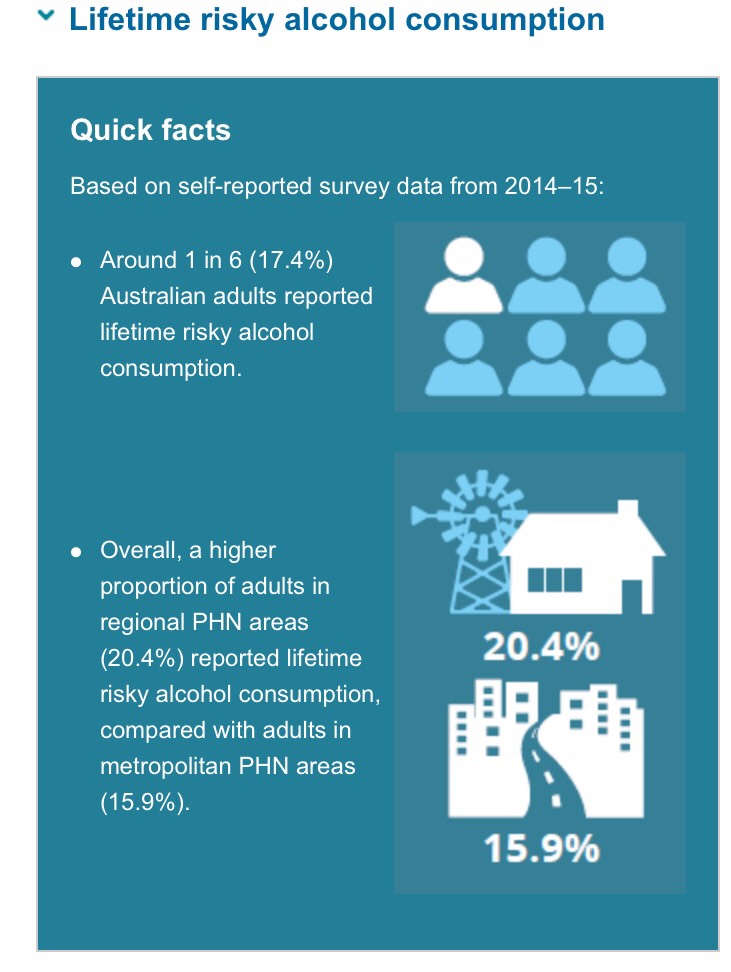
  • Around 1 in 6 Australian adults (17%) reported lifetime risky alcohol consumption
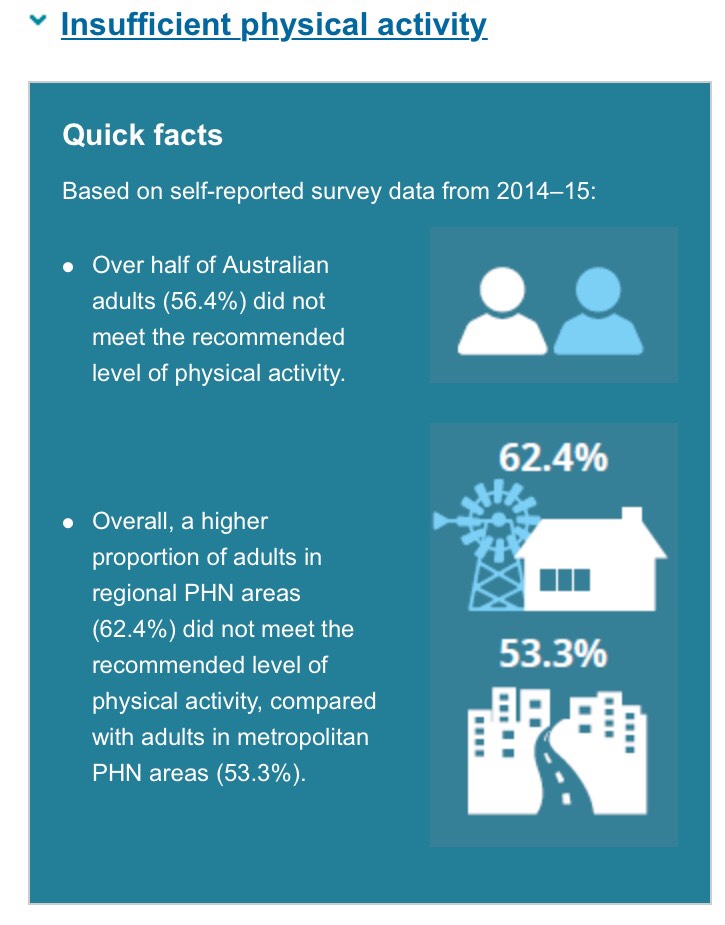
  • Over half of Australian adults (56%) reported insufficient physical activity participation
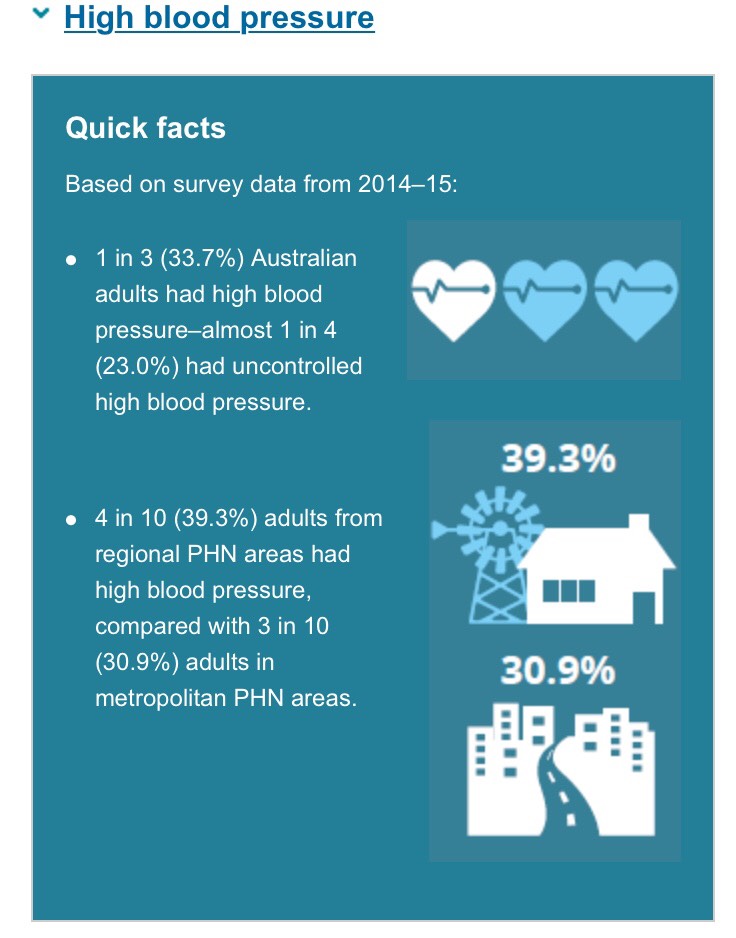
  • Almost 1 in 3 Australian adults (34%) had high blood pressure.

1.A lifetime risky alcohol consumption

This fact sheet covers local-level results for the proportion of Australian adults (aged 18 years and over) who reported consuming more than 2 standard drinks of alcohol per day on average—thereby increasing their lifetime risk of harm from alcohol consumption. Results are presented by Primary Health Network (PHN) areas.

Please note, the results presented are crude rates, which reflect the actual level of lifetime risky alcohol consumption in the community. However, caution is needed when making comparisons across PHNs as the rates presented do not account for differences in the age of the populations.

What is lifetime risky alcohol consumption?

Alcohol consumption refers to the consumption of drinks containing ethanol, commonly referred to as alcohol. The quantity, frequency or regularity with which alcohol is drunk provides a measure of the level of alcohol consumption.

Lifetime risky alcohol consumption refers to Australian adults consuming more than 2 standard drinks per day on average. That is, alcohol consumption exceeding the National Health and Medical Research Council’s (NHMRC) Australian Guidelines to Reduce Health Risks from Drinking Alcohol (see Box 1 for more information).

Based on survey data from 2014–15, 17.4% of Australian adults reported lifetime risky alcohol consumption.

Lifetime risky alcohol consumption Fact Sheet (PDF, 184 KB)

2.Insufficient physical activity 

This fact sheet covers local-level results for the proportion of Australian adults (18 years and over) who reported insufficient levels of physical activity. Results are presented by Primary Health Network (PHN) areas.

Please note, the results presented are crude rates, which reflect the actual level of insufficient physical activity in the community. However, caution is needed when making comparisons across PHNs as the rates presented do not account for differences in the age of the populations.

What is insufficient physical activity?

Physical activity is the expenditure of energy generated by moving muscles in the body. Most physical activity occurs during leisure time, or through active transport and incidental activity such as housework or gardening.

Insufficient physical activity refers to physical activity levels that do not meet the Department of Health’s Australia’s Physical Activity & Sedentary Behaviour Guidelines (see Box 1 for more information).

This includes adults (18–64 years) who did not complete more than 150 minutes of physical activity, on at least 5 sessions over a week, and older Australians (65+ years) who did not complete 30 minutes of activity on at least 5 days.

Based on self-reported survey data from 2014–15, 56.4% of Australian adults had insufficient levels of physical activity

Insufficient physical activity Fact Sheet (PDF, 186.1 KB)

3. High blood pressure

This fact sheet covers local-level results for the proportion of Australian adults (aged 18 years and over) who had high blood pressure and uncontrolled high blood pressure. Results are presented by Primary Health Network (PHN) areas.

Please note, the results presented are crude rates, which reflect the actual level of high blood pressure in the community. However, caution is needed when making comparisons across PHNs as the rates presented do not account for differences in the age of the populations.

What is high blood pressure?

High blood pressure, also known as hypertension, is defined in this fact sheet by the World Health Organization definition (see Box 1 for more information).

Uncontrolled high blood pressure as defined here refers to all people with measured high blood pressure, regardless of whether they are taking medication. It is presented for context in this fact sheet.

High blood pressure is an important and treatable cause of disease and death. It is a major risk factor for chronic diseases including stroke, coronary heart disease, heart failure and chronic kidney disease.

The modifiable risk factors for high blood pressure include poor diet (particularly high salt intake), obesity, excessive alcohol consumption and insufficient physical activity. Lifestyle changes and medication can help to control high blood pressure.

Based on survey data from 2014–15, 33.7% of Australian adults had high blood pressure. There were 23.0% of Australian adults who had uncontrolled high blood pressure.

Uncontrolled high blood pressure Fact Sheet (PDF, 209.2 KB

NACCHO Aboriginal #WomenVoices Health @June_Oscar @AusHumanRights launches Wiyi Yani Thangani : #HaveYourSay

This process will not shy away from the hard truths, but equally it will seek to highlight the enormous strength that exists amongst us,

From our remote communities to our urban centres, I hope to highlight the diversity that exists among us, as Aboriginal and Torres Strait Islander women and girls.

There are significant opportunities to grasp here, to ensure that our needs and aspirations and our voices are at the forefront of the government’s agenda – beyond the narrow frame of victimhood and dysfunction.

Together we will raise our voices as Aboriginal and Torres Strait Islander women and girls and together, we will deliver a message to government that demands to be heard,”

Wiyi Yani U Thangani means Women’s Voices in Commissioner Oscar’s Bunuba language.

The Aboriginal and Torres Strait Islander Social Justice Commissioner June Oscar AO on Friday launched the Wiyi Yani U Thangani (Women’s Voices) project.

Consultations will take place in major cities and regional and remote communities throughout 2018. A final report will be presented to the Government in mid-2019

Aboriginal and Torres Strait Islander women and girls : HAVE YOUR SAY ! see Part 2 and 3 below

The project will be led by the Australian Human Rights Commission in partnership with the Department of Prime Minister and Cabinet.

Commissioner Oscar was joined by the Federal Minister for Indigenous Affairs Nigel Scullion (see Part 3 below )

Aunty Norma Ingram, June Oscar , Pat Turner CEO of NACCHO , Jackie Huggins Congress for the launch of project Wiyi Yani U Thangani

With cultural performance

From the Redfern Dance Group

June Oscar with Dr Anita Heiss MC and Senator

The project will build on the legacy of the Women’s Business report of 1986, which was the first and last time national consultations were held with Aboriginal and Torres Strait Islander women.

“It is remarkable to me, that this report represents the first time that the views of Indigenous women were sought by government. Three decades later, Wiyi Yani U Thangani is a continuation of that journey,” Commissioner Oscar said.

The project will include a series of community visits and conversations with Indigenous women and girls around the country from early next year.

“The experiences of our women everywhere, but particularly in the justice space, and in the stories of people like the late Ms Dhu and Rosie Fulton and of our girls in care and juvenile detention are crying out for greater visibility, for greater coordinated effort and greater weight within the halls, laws and policy of government.

Part 2 The Project

The Aboriginal and Torres Strait Islander Social Justice Commissioner June Oscar AO is leading a national conversation with Aboriginal and Torres Strait Islander women and girls to hear their priorities, challenges and aspirations for themselves, their families and their future.\

Wiyi Yani U Thangani (Women’s Voices) will explore:

  • the needs, challenges and aspirations of Aboriginal and Torres Strait Islander women and girls today
  • the key achievements in relation to the rights of Aboriginal and Torres Strait Islander women and girls over the past 30 years
  • ways to enhance the lives of Aboriginal and Torres Strait Islander women and girls so that they can lead happy, healthy and fulfilling lives
  • ways to promote and protect culture.

Wiyi Yani U Thangani (Women’s Voices)  will run from late 2017 and throughout 2018 and will speak with Aboriginal and Torres Strait Islander women and girls from across the country either at a series of community meetings or via our online submission process.

Part 3 Join the Conversation

We want to hear:

  • what are your priorities and dreams?
  • what is needed for effective programs and services?
  • what do you need to feel safe, happy and empowered?
  • what are the key challenges and strengths for women and girls in your community?

We know that Aboriginal and Torres Strait Islander communities are unique and that there is much diversity amongst Aboriginal and Torres Strait Islander women and girls.

Wiyi Yani U Thangani will seek to engage with a broad range of people, especially those with unique aspirations and priorities, including Elders, linguistically diverse and LGBTI Aboriginal and Torres Strait Islander women and girls. Through our collective voice we have the power to influence our lives and our future.

YARN WITH US

The Aboriginal and Torres Strait Islander Social Justice Commissioner and her team will be traveling around Australia from February 2018 to speak with Aboriginal and Torres Strait Islander women and girls and those who support them.

We look forward to speaking with as many Aboriginal and Torres Strait Islander women and girls as possible in 2018.

Further updates about the Project can be found on this website or by following us on social media.

The Aboriginal and Torres Strait Islander Social Justice Commissioner invites all Aboriginal and Torres Strait Islander women and girls (12yrs+) and those who support them to join the Wiyi Yani U Thangani conversation. If we do not get a chance to speak to you directly, we still wish to encourage you to have your say or get in touch with us.

MAKE A SUBMISSION

The Aboriginal and Torres Strait Islander Social Justice Commissioner invites all Aboriginal and Torres Strait Islander women and girls (12yrs+) and those who support them to join the Wiyi Yani U Thangani conversation.

Please register your interest here to receive further information on how to Have your Say when  it becomes available. Details will be available soon.

Part 4 : Minister Scullion on Friday launched the Wiyi Yani U Thangani (Women’s Voices) Securing Our Rights, Securing Our Future project.

  • The project, led by first female Aboriginal and Torres Strait Islander Social Justice Commissioner June Oscar AO, will explore ways to support the empowerment of Aboriginal and Torres Strait Islander women and girls.
  • The Coalition Government is providing $1.25 million for this national project.

The voices of Aboriginal and Torres Strait Islander women and girls will be heard loud and clear with the launch of a major project exploring their security and success.

The Minister for Indigenous Affairs Nigel Scullion, together with the Aboriginal and Torres Strait Islander Social Justice Commissioner, Ms June Oscar AO, today launched the WiyiYani U Thangani (Women’s Voices) Securing Our Rights, Securing Our Future project.

The national project, which will canvas the views of Aboriginal and Torres Strait Islander women and girls across the nation to better understand the issues surrounding their personal, socioeconomic and cultural security, was a priority for Minister Scullion.

“As Minister for Indigenous Affairs I am absolutely determined to support the needs, aspirations and successes of Aboriginal and Torres Strait Islander women and girls.” Minister Scullion said.

“This project gives Aboriginal and Torres Strait Islander women and girls a platform to speak directly on the issues affecting them and what they need to achieve their full potential.

“Australia’s First Nation women provide courage and hope to their communities, and we need to ensure they have the right supports and pathways in place to guarantee their prosperity.

The Wiyi Yani U Thangani (Women’s Voices) Securing Our Rights, Securing Our Future project draws inspiration from the landmark 1986 Women’s Business report – a report on the progress of Aboriginal and Torres Islander women and girls,delivered by the Aboriginal Women’s Taskforce within the Department of Prime Minister and Cabinet.

“This is the first national consultation conducted by and for Aboriginal and Torres Strait Islander women and girls since the 1986 Women’s Business report – more than 31 years ago,” Minister Scullion said.

“The Women’s Business Report highlighted the strength and resilience of Indigenous women as change-makers within their community.

“We know this continues to be the case for many women across the country – these women are making a positive difference for their families and communities.

“I am especially grateful that this project is being conducted by Australia’s first female Aboriginal and Torres Strait Islander Social Justice Commissioner.

“June is both a leader and an inspiration to Aboriginal and Torres Strait Islander women and girls across Australia. She has driven change in her own community, and I am proud to be working alongside her.

Consultations will take place in major cities and regional and remote communities throughout 2018. A final report will be presented to the Government in mid-2019.

For more information about the project and how to make a submission, please visit https://www.humanrights.gov.au/


NACCHO Aboriginal #Sexualhealth #WorldAidsDay #UANDMECANSTOPHIV Community embraces Aboriginal and Torres Strait Islander 2017 #HIV Awareness Week

Ahiv

 ” With diagnoses and rates of HIV in Aboriginal communities at an all-time high since 1992, this year’s Aboriginal and Torres Strait Islander HIV Awareness Week (ATSIHAW) is more important than ever. Now in its fourth year, the role of ATSIHAW is to engage Aboriginal and Torres Strait Islander communities across Australia in HIV prevention.

ATISHAW is an opportunity to promote action, awareness and advocacy at all levels of government and community, to provide much needed resources to address the rising rates of HIV,

Action is required in policy, programming, clinical service delivery; awareness is required across communities and in clinical settings; and advocacy is required at all levels of health service delivery and governments.”

Associate Professor James  Ward

Ajw

The theme of this year’s National Aboriginal and Torres Strait Islander HIV Awareness Week is ‘U and Me Can Stop HIV’ and we know that education and awareness are vitally important in our battle against HIV and STIs,”

We have had a variety of media resources available but until now, only a small number have been culturally appropriate for Indigenous people.

With messages like ‘Looking after our mob starts with looking after ourselves’, these new videos are more likely to cut through, especially to younger Aboriginal people, who are most vulnerable to these infections.”.

Minister for Indigenous Health, Ken Wyatt AM, this week officially released the videos, and an accompanying range of social and print media resources, at the launch of the National Aboriginal and Torres Strait Islander HIV Awareness Week.

Three animated education and awareness videos focus on HIV, STIs and PrEP (a daily medication that can prevent HIV), which aim to enhance awareness of HIV prevention. These are housed on the website  www.atsihiv.org.au,

Watch 1 of 3 Videos HERE

ATSIHAW 2017 runs from Monday, 27 November to Sunday, 3 December. The Federal Minister for Indigenous Health, the Hon Ken Wyatt AM, MP, officially launched ATSIHAW on Wednesday, 29 November at a breakfast hosted by Senator Dean Smith, Chair of the Parliamentary Friends of HIV/AIDS, Blood Borne Viruses and Sexually Transmitted Diseases.

file-5

Other dignitaries in attendance included : Senator Richard Di Natale, Leader of the Australian Greens; Professor Sharon Lewin, Chair of the Ministerial Advisory Committee on Blood Borne Viruses and Sexually Transmissible Infections; Dr Dawn Casey, Deputy Chief Executive Officer of the National Aboriginal Community Controlled Health Organisation (NACCHO);

Ms Michelle Tobin, Chair of the Positive Aboriginal & Torres Strait Islander Network (PATSIN) – a group representing Aboriginal and Torres Strait Islander people living with HIV); as well as other members of the Australian Parliament.

Concerning statistics

Recently released national data shows the rate of HIV diagnoses among Aboriginal and Torres Strait Islander people is now more than double the rate for the non-Indigenous Australian-born population. This rate has increased by 33 per cent during the last five years, while the rate in the non-Indigenous Australian-born population has decreased by 22 per cent in the same period – creating a new gap in health between the two populations.

Associate Professor James Ward, Head Infectious Diseases Research Aboriginal Health at the South Australian Health and Medical Research Institute (SAHMRI), and ATSIHAW committee member, said that this is absolutely unacceptable.

Over the last five years, significant differences have appeared in the HIV epidemic between the Aboriginal and Torres Strait Islander population and the non-Indigenous Australian-born population. Although men who have sex with men make up the majority of cases in both groups (51 per cent vs 74 per cent), a greater proportion of Indigenous cases are because of injecting drug use (14 per cent vs three per cent) or through heterosexual sex (20 per cent vs. 14 per cent).

Ms Michelle Tobin said that more work is required to ensure there are strategies for all of these groups of people in Aboriginal and Torres Strait Islander communities rolled out, and that these have impact.

The other unique issue occurring in Australia is the continuing increase in HIV rates among Aboriginal and Torres Strait Islander people each year, despite the major advances in HIV testing, diagnostics and treatment. Innovative HIV test-and-treat strategies and large-scale pre-exposure HIV prophylaxis trials (PrEP) trials have successfully engaged the gay community and are resulting in reductions across jurisdictions, but but to date, have had little impact in Aboriginal communities.

“We need to make sure that these strategies have impact on all of the Australian population – not just some”, Associate Professor Ward added.

“Aboriginal and Torres Strait Islander communities are generally not benefiting from these advances.”

Community support; an important part of ATSIHAW

The overarching theme of ATSIHAW is ‘U AND ME CAN STOP HIV’. This highlights the strengths of Aboriginal and Torres Strait Islander communities, and the role we can all play in preventing new HIV cases and improving the outcomes for people living with HIV.

This year, ATSIHAW is holding over 55 community events across Australia at Aboriginal Community Controlled Health Services and other community services. The number of ATSIHAW events and strong social media engagement, demonstrates the growing sense of community responsibility for spreading awareness of the importance of HIV prevention.

Alice Springs this week

High-profile ambassadors for ATSIHAW have also been recruited, including Steven Oliver from ABC’s Black Comedy. Steven said that he’s involved in ATSIHAW because he wants to help fight and break down the stigma associated with HIV and those living with it.

Professor Kerry Arabena and Dr Pat Anderson AM are also Ambassadors for ATSIHAW, alongside 30 other community members who are all concerned about HIV in the communities.

New HIV resources for Aboriginal and Torres Strait Islander communities

A new set of resources will be launched by the Honourable Ken Wyatt AM, MP, Minister for Indigenous Health, including three animated education and awareness videos focusing on HIV, STIs and PrEP (a daily medication that can prevent HIV), which aim to enhance awareness of HIV prevention. These are housed on the website www.atsihiv.org.au, als

New animated videos voiced by young Aboriginal and Torres Strait Islander people are the latest weapons in the fight again HIV and sexually transmitted infections in Indigenous communities.

Part 2 Minister’s Press release

Minister for Indigenous Health, Ken Wyatt AM, this week  officially released the videos, and an accompanying range of social and print media resources, at the launch of the National Aboriginal and Torres Strait Islander HIV Awareness Week.

The videos have been developed specifically to counter the shame and stigma that can be associated with HIV.

“World Aids Day is on 1 December and it is important we take this opportunity to talk about the rates of HIV diagnosis in our Indigenous communities,” Minister Wyatt said.

“In the past 30, years Australia has made progress in reducing the rates of STIs, however, despite advances in testing and treatment we continue to see Indigenous STI and HIV diagnoses on the rise.”

In 2016, it was estimated that the HIV notification rate for Indigenous people was more than double the rate among non-Indigenous people, with a greater proportion of newly diagnosed HIV infection attributed to heterosexual contact and injecting drug use.

“Working together with Indigenous communities, the States, Territories and local health services, to counter these infections is a key Turnbull Government priority,” said Minister Wyatt.

“This includes $8 million to support a range of programs focussed on delivering culturally appropriate sexual health services, plus a further $8.8 million over three years to target priority areas including testing, education and awareness.

“We are also developing a long-term response to STIs and blood borne viruses in our Indigenous communities, with a proposed strategic approach and action plan due to be received by the Government in December.

“The ‘U and Me Can Stop HIV’ theme of this year’s National Aboriginal and Torres Strait Islander HIV Awareness Week is a timely reminder of the need to work together to improve sexual health.”

ATSIHAW is administered by SAHMRI, with funding provided by the Commonwealth Department of Health


Aboriginal Health News : Our #NACCHO Members #Deadly good news stories #NT #NSW #QLD #WA #SA #VIC


Nov 30

1.National Health Medical and Research Council (NHMRC) Road Map 3 public consultation will close on 10 December 2017

2.VIC : VAHS : The women in first Aboriginal woman MP Lidia Thorpe’s family have a history of blazing trails in health

3. SA : Nganampa Health Council : Anangu Study Scholarship Pirpantji Rive-Nelson – University of Queensland Student Doctor MD IV

4. NT  : Congress Alice Springs wins major National Indigenous Employment Award

5.1. NSW : Awabakal Early Learning awarded Excellent rating

5.2 : NSW : How Tharawal Aboriginal Corporation and South Western Sydney Local Health District work together to achieve better outcomes for mental health clients.

6.1 QLD : QAIHC Queensland awards for excellence in Indigenous health service delivery : QAIHC Member of the Year Award – Gurriny Yealamucka Health Service Aboriginal Corporation

6.2 QLD : QAIHC Conference focuses on providing quality health care to Indigenous communities

7.WA : AHCWA are pleased to announce the following Executive Board Members elected at a recent  AGM

 View hundreds of ACCHO Deadly Good News Stories over past 5 years

How to submit a NACCHO Affiliate  or Members Good News Story ? 

 Email to Colin Cowell NACCHO Media    

Mobile 0401 331 251

Wednesday by 4.30 pm for publication each Thursday

1.National Health Medical and Research Council (NHMRC) Road Map 3 public consultation will close on 10 December 2017

untitled

A reminder that the National Health Medical and Research Council (NHMRC) would like your feedback on the draft Road Map 3: A strategic framework for improving Aboriginal and Torres Strait Islander health through research (Road Map 3).

The draft Road Map 3 public consultation will close on 10 December 2017 and we invite you to make a submission through the website here:

www.nhmrc.gov.au/health-topics/indigenous-health/draft-road-map-3-public-consultation

Road Map 3 will guide and communicate NHMRC’s objectives and investment in Aboriginal and Torres Strait Islander health research for the next decade. Road Map 3 follows on from the release of Road Map 1 in 2002 and Road Map 2 in 2010.

Further information and background please contact Nous Group via email:

NHMRCroadmap3@nousgroup.com.au.

2.VIC : VAHS The women in Victoria’s first Aboriginal woman MP Lidia Thorpe’s family have a history of blazing trails.

50c1c2c06e18c9de7decb911c05df529

When Ms Thorpe gives her maiden speech in the Victorian Parliament today as the state’s first Aboriginal woman MP, her 84-year-old grandmother Alma Thorpe will be there to watch.

View Lidia’s powerful ” maiden ” speech HERE

In the ’70s Alma Thorpe was one of the founders of the Victorian Aboriginal Health Service. Her own mother set up a funeral fund for Aboriginal people in the ’60s to ensure proper burials.

Ms Thorpe said the strong women in her family had inspired her career in politics.

“All the women in my family have fought for Aboriginal people for a very long time,” she told NIT.

The new Member for the inner Melbourne electorate of Northcote said an Aboriginal woman in the Victorian parliament was “well overdue”.

She was sworn in earlier this week after storming to a historic win for the Greens in a November 18 by-election for the Legislative Assembly seat.

Ms Thorpe, a Gunnai-Gunditjmara woman from Victoria’s south-east and western districts, said even she was surprised by her overwhelming win.

“I was totally in shock,” she said.

“I thought it was going to be close — a close win or a close loss.

“I was not expecting the support we got. Everyone in Northcote is sick of the old parties and wanted to see change.”

Ms Thorpe said as an MP she would continue to care for country and would fight for a Great Forest National Park, which would cover big areas of the central Victorian highlands.

Overcrowded public transport systems were also a problem in Northcote.

She said she would also advocate for clan-based treaty in Victoria.

Ms Thorpe will take leave from her duties as chair of Victoria’s NAIDOC Week Committee.

Ms Thorpe has worked in Aboriginal health, education, employment and funeral services and run her own event management business since leaving school at the age of 14.

Wendy Caccetta NIT Report

https://nit.com.au/meet-victorias-first-female-aboriginal-mp/

3. SA : Nganampa Health Council : Anangu Study Scholarship Pirpantji Rive-Nelson – University of Queensland Student Doctor MD IV

PRN-300x261

For many residents of the APY Lands it can be difficult to undertake tertiary level education. In general, if students want to study they are relocated to a foreign environment far from their friends and family. Not to mention, it can be very expensive!

Nganampa Health Council introduced the Anangu Study Scholarship as a way to make tertiary education a bit easier for our people and ultimately to maximise the number of Anangu staff that we employ.

Pirpantji Rive-Nelson is currently in his final year of a Doctor of Medicine program with the University of Queensland, completing his clinical years in the Toowoomba Rural Clinical School.

“I chose this program at the University of Queensland because it is highly ranked on international and domestic scales. Additionally, I have previously studied in Brisbane for my Bachelor of Nursing undergraduate degree, so it made sense to return to Brisbane.

I applied for the NHC student scholarship during my Nursing undergraduate and have been provided financial support with my accommodation. Studying at University is an extremely difficult time with little income. Therefore, I have maximised the opportunity for support from our health care provider.

The benefit of receiving NHC student scholarship is that it has given me the basics of life in terms of stable accommodation. This support has been invaluable and enables to me to focus on completing my studies. I have been most grateful for the support NHC has provided me, and once I complete my studies and work in Alice Springs Hospital in 2019, I plan to fulfil my personal notion of return of service to our communities and people of the APY Lands. I sincerely hope other Anangu will pursue academia and health professions, so we can be a part of the provision of health care for our families and people.“

4. NT Congress Alice Springs wins major National Indigenous Employment Award

24068223_232615463806184_2510645117340814344_n

Central Australian Aboriginal Congress recognised as joint winner of the Stan Grant Indigenous Employment Award at the 2017 at the Australian HR Institute Awards.

Accepting the award in Melbourne on behalf of Congress is General Manager HR Kim Mannering and Aboriginal Staff Advisory Group Chair Andrew Lockyer.

Congratulations to board, leadership, staff and for your efforts to employ additional 67 Aboriginal people to roles across Congress compared to this time in 2014.

5.1. NSW : Awabakal Early Learning awarded Excellent rating

IMG_0346

On Thursday 7 December, Awabakal Ltd will be awarded an ‘Excellent’ rating – the highest rating possible – for their Wickham Preschool from the Australian Children’s Education and Care Quality Authority.

The presentation, which will take place at the Preschool in Wickham, will recognise Awabakal’s outstanding achievement as a leader in Early Learning and Education.

Awabakal is the first Early Childhood Service in the Newcastle and Hunter Region and the first Aboriginal service in New South Wales to achieve the ‘Excellent’ rating and is a particularly noteworthy merit.

This award places Wickham Preschool in the top 0.003 per cent of all Early Childhood Services in the country and is based on criteria including excellent educational care, leadership that contributes to the development of community and commitment to sustained excellent practice through continuous improvement and planning.

When discussing the rating announcement, Awabakal’s Early Learning and Education Principal, Renee Smith said this recognition was a huge achievement for the organisation.

“This is the biggest recognition in our field and to be the first Aboriginal Early Childhood Service in the state to be awarded this rating is an extraordinary achievement,” said Ms Smith.

“The staff at Awabakal are constantly searching for ways to continually deliver the best educational and social outcomes to our children and families, and we take pride in delivering the highest quality learning experiences so that we can create a community of leaders.

“I feel privileged to work for an organisation who is leading the way, providing innovative programs and showcasing excellence in service delivery and to have this recognised on a national platform is amazing,” concluded Ms Smith.

Awabakal Chief Executive Officer, Raylene Gordon, commented on the rating award saying the success of their Early Learning and Education department is reflective of the hard work and commitment the team have to the children in the community.

“Our preschool service is utilised by a number of families and children within our community and the staff who work at both Wickham and Glendale are dedicated to providing the best services to all.

“It is an honour to have the Wickham Preschool awarded an ‘Excellent’ rating and we look forward to achieving this across both sites in the near future. I would like to congratulate the entire Early Learning and Education team on this achievement,” concluded Ms Gordon.

5.2 : NSW : How Tharawal Aboriginal Corporation and South Western Sydney Local Health District work together to achieve better outcomes for mental health clients.

View Here

https://youtu.be/JmsbgmL2M-o?list=PLmdoKIibCmXbDqiQ_7O8ggmmBq9DWhQKo

6.1 QLD : QAIHC Queensland awards for excellence in Indigenous health service delivery : QAIHC Member of the Year Award – Gurriny Yealamucka Health Service Aboriginal Corporation

gurriny-health-transition-day

QAIHC Member of the Year Award – Gurriny Yealamucka Health Service Aboriginal Corporation

From Website

Quality of Service Gurriny Yealamucka Health Services Aboriginal Corporation values the responsibility of providing a quality health service to all residents of Yarrabah and will maintain a high standard of care across all levels of the organisation

Leadership Gurriny Yealamucka Health Services Aboriginal Corporation will endeavour to represent the Yarrabah community through strong leadership to ensure the delivery of health services are maintained and improved upon as determined by the needs of the clients.

Commitment Gurriny Yealamucka Health Services Aboriginal Corporation strives to provide 100% commitment to all levels of the organisation business and in its capacity to support the Yarrabah community.

Accountability Gurriny Yealamucka Health Services Aboriginal Corporation aims to be accountable to the appropriate stakeholders within the organisation, the Yarrabah community, non-Government and Government sector.

Teamwork Gurriny Yealamucka Health Services Aboriginal Corporation recognises and understands the value of teamwork and insists upon a team approach in service delivery and management to maximise outcome

The Queensland Aboriginal and Islander Health Council (QAIHC) honoured the state’s top achievers in the Aboriginal and Torres Strait Islander Community Controlled Health Sector (ATSICCHS) at the inaugural QAIHC Awards for Excellence ceremony, in Brisbane on Tuesday night (14 November 2017).

The QAIHC 2017 Awards for Excellence recognise and celebrate the outstanding achievements of individuals and organisations within the Sector.

QAIHC Chief Executive Officer, Mr Neil Willmett congratulated all the winners and finalists and encouraged them to continue their good work.

“The QAIHC Awards for Excellence are instrumental in acknowledging the significant contributions of our Aboriginal and Torres Strait Islander Community Controlled Health Services in improving health outcomes for our people,” he said.

“I congratulate all the nominees for the work you are undertaking to eliminate the disparities in health and wellbeing experienced by Aboriginal and Torres Strait Islander people in Queensland.

“Individually and collectively we continue our journey towards making a difference in the delivery of comprehensive primary health care,” Mr Willmett said.

The winners of the QAIHC 2017 Awards for Excellence are:

  • QAIHC Partnership Excellence Award – Cunnamulla Aboriginal Corporation for Health
  • QAIHC Innovation Excellence Award – Carbal Medical Services
  • QAIHC Patient Satisfaction & Service Excellence Award – The Dental Team, Wuchopperen Health Service
  • QAIHC Leader of the Year Award – Aunty Gail Wason, Mulungu Aboriginal Corporation
  • QAIHC Member of the Year Award – Gurriny Yealamucka Health Service Aboriginal Corporation

CheckUp, Health Workforce Queensland, General Practice Training Queensland, and General Medical Training James Cook University are proud partners of the QAIHC 2017 Awards for Excellence.

6.2 QLD : QAIHC Conference focuses on providing quality health care to Indigenous communities

The Queensland Aboriginal and Islander Health Council (QAIHC) held their annual State Member Conference in Brisbane on Tuesday 14 November 2017.

The theme for the conference, ‘Delivering quality health services to our communities,’ aligns with QAIHC’s aim of ensuring that Aboriginal and Torres Strait Islander people have the right access to equitable, culturally competent, and high-quality care.

With twenty-eight QIAHC Members servicing communities across Queensland, QAIHC is committed to supporting their Members to deliver optimal and culturally responsive primary healthcare services.

Mr Neil Willmett, Chief Executive Officer, QAIHC said the conference provided members with the opportunity to come together to discuss a range of policy, research, and legislative requirements relevant to the Aboriginal and Torres Strait Islander Community Controlled Health Sector.

“The conference covered a range of topics pertinent to the Sector including the Australian Government National Aboriginal and Torres Strait Islander Health Plan 2013-2023 and the proposed Commonwealth Funding Model,” he said.

“We were fortunate to have guest speakers from the Commonwealth and State health departments who were able to provide an update on the national agenda for Indigenous health and reinforce the commitment towards closing the gap in health outcomes between Indigenous and non-Indigenous Queenslanders.

“As an integral part of the Queensland Health Care system, the Aboriginal and Torres Strait Islander Community Controlled Health Sector plays a critical role in the delivery of quality comprehensive primary health care to our communities,” Mr Willmett said.

QAIHC is the peak organisation representing the Aboriginal and Torres Strait Islander Community Controlled Health Sector (ATSICCHS) in Queensland at both a state and national level. Membership is open to all Aboriginal and Torres Strait Islander Community Controlled Health Services in Queensland.


7.WA : AHCWA are pleased to announce the following Executive Board Members elected at a recent  AGM attended by delegates and observers from our Member Services. Congratulations to:

Chairperson: Vicki O’Donnell

Deputy Chairperson: Raymond Christophers

Secretary: Fabian Tucker

Treasurer: Susan Oakley