NACCHO Aboriginal Health #ACCHO Job Opportunities Inc #Nurses #Doctors etc #NT @MiwatjHealth @CAACongress #QLD @ATSICHSBris @IUIH_ @Apunipima @NATSIHWA #Aboriginal Health Workers @IAHA_National Allied Health @SNAICC @CATSINaM #Nursing

This weeks #Jobalerts

Please note  : Before completing a job application please check with the ACCHO that the job is still open

Job of the week 

Deputy Chief Executive Officer

About the Organisation

The name Derbarl Yerrigan is the Wadjuk Noongar name for the Swan River. Derbarl Yerrigan Health Service Aboriginal Corporation (DYHSAC) is an Aboriginal community controlled health organisation which was established in 1974 as the Perth Aboriginal Medical Service and later changed its name to DYHSAC in 1998.

We provide holistic and integrated primary health care services to Aboriginal people living in the Perth metropolitan region. DYHSAC employs 138 staff across its head office in East Perth and clinics in Maddington, Midland and Mirrabooka.

DYHSAC targets the social, emotional, cultural and physical wellbeing of Aboriginal people living on Noongar country. Our staff deliver comprehensive primary health care services at each DYHSAC clinic including:

  • Preventative care focussed on early detection and management of chronic illness across all ages;
  • Post-natal and antenatal care to women and families;
  • Early childhood, school age, and adolescent health programs;
  • Team-based management of chronic diseases with a focus on preventing disease progression and complications and maintaining quality of life;
  • Dental services to DYHSAC clients aged 13 years and above, including the development of full dental plans;
  • Access to a comprehensive suite of services provided by mental health and allied health care professionals and specialist services; and
  • Pharmacy and transport services to DYHSAC clients.

For more information, please visit the DYHSAC website, www.dyhs.org.au

About the Opportunity

The Derbarl Yerrigan Health Service Aboriginal Corporation is currently seeking to appoint a Deputy Chief Executive Officer (D/CEO).

This position provides an exciting and challenging opportunity for a suitably experienced professional, with the ability to oversee the day-to-day operations of a well-established Aboriginal community controlled health service currently operating through an extensive change management process.

The D/CEO will work directly with the CEO, Executive Management Team and Board of Directors, managing the day to day operations and delivery of primary healthcare services to the local Aboriginal communities across four sites in the Perth metro area (East Perth, Midland, Mirrabooka and Maddington).

Currently operating through a period of change, DYHSAC is seeking an individual with extensive executive management experience including a proven ability to achieve key strategic objectives in a dynamic and challenging environment.

As an inspiring and collaborative leader, the D/CEO will work strategically to enable transformative change by strengthening the organisation and creating a sustainable future for improved health outcomes for our local Aboriginal communities.

Primary responsibilities include but are not limited to:

  • Driving and implementing extensive cultural workplace changes
  • Achieving the strategic objectives and responsibilities of the organisation
  • Diversifying and growing revenue streams to increase service delivery
  • Strengthening the organisation’s stakeholder relations, community engagement and patient satisfaction
  • Building and sustaining strong financial performance
  • Developing and maintaining a collaborative and effective working relationship with the Board of Directors aspiring to a shared vision

To view the full position description and selection criteria, please visit www.ahcwa.org.au/employment

To view and download the application pack, please visit www.ahcwa.org.au/employment

How to submit a Indigenous Health #jobalert ? 

NACCHO Affiliate , Member , Government Department or stakeholders

If you have a job vacancy in Indigenous Health 

Email to Colin Cowell NACCHO Media

Tuesday by 4.30 pm for publication each Wednesday

There are 2 JOBS AT Apunipima Cairns and Cape York

The link to  job vacancies on website is

MAMU HEALTH SERVICE LIMITED

Mamu Health Service Limited is an Aboriginal community controlled health service providing comprehensive primary health care services to the Aboriginal and Torres Strait Islander communities in Ravenshoe and surrounding districts.  We are recruiting the following positions for our Ravenshoe Clinic:-

Aboriginal & or Torres Strait Islander Health Worker Practice Certificate III/IV Fixed Term. Applicant must have previous experience in similar role.

Traineeship – Aboriginal and/or Torres Strait Islander Primary Health Care (Practice) HLT30113 Certificate III – If you have a passion to work in the health industry we are offering a Traineeship in Certificate III ATSI Primary Health Care (Practice) fixed term (12- 14 months) (It is a genuine occupational requirement that the position be filled by an Aboriginal or Torres Strait Islander person as permitted by Section 25, 105 & 106 Queensland Anti-Discrimination (1991) Act.)

Registered Nurse – A Full time position is available. Applicants must have previous experience in working with the Aboriginal & Torres Strait Islander people. This is a Rural & Remote position which offers an attractive employment package including accommodation & fuel allowance.

All applicants must be willing to undertake an AFP Criminal History Check, and a Blue Card with Commission for Children and Young People and Child Guardian.

To apply for this vacancy, a full application package can be obtained from our website on http://www.mamuhsl.org.au, or please don’t hesitate to contact Julie Browne on 07 4061 9988 or jbrowne@mamuhsl.org.au to register your interest.

Please submit your resume and written responses addressing the Knowledge, Skills and Personal Attributes/Selection Criteria outlined in the Position Description to: The Chief Executive Officer Mamu Health Service Limited PO Box 1537 INNISFAIL Q 4860 Applications close at 5.00 pm on Friday 8th June 2018

Mamu Website

Ravenshoe Positions:

RAV-067 Trainee Health Worker_Position Description

RAV-066 ATSI Health Worker_3

RAV-060 Registered Nurse_Position Description3

Innisfail Positions:

IFL-267 Trainee Health Worker

IFL-264 ATSI Health Worker_2

IFL-263 ATSI Health Worker_2

IFL 269 Community Liason Officer_Female (002)

IFL-261 Sport Rec Officer_Position Description_110518 (003)

FOR ALL POSITIONS

APPLICATION CLOSING DATE: FRIDAY 8th JUNE 2018 5.00PM


There are 3 JOBS AT IUIH Brisbane

+ Traineeship Coordinator (Ongoing Full Time position based at Windsor) + Clinical Optometrist (Full Time or Part Time position based at Windsor) + Social Health Care Coordinator – MATSICHS (Ongoing Full Time position located at Morayfield)

 There are 14 JOBS at ATSICHS Brisbane

As part of our commitment to providing the Aboriginal and Torres Strait Islander community of Brisbane with a comprehensive range of primary health care, youth, child safety, mental health, dental and aged care services, we employ approximately 150 people across our locations at Woolloongabba, Woodridge, Northgate, Acacia Ridge, Browns Plains, Eagleby and East Brisbane.

The roles at ATSICHS are diverse and include, but are not limited to the following:

  • Aboriginal Health Workers
  • Registered Nurses
  • Transport Drivers
  • Medical Receptionists
  • Administrative and Management roles
  • Medical professionals
  • Dentists and Dental Assistants
  • Allied Health Staff
  • Support Workers

Current vacancies

Jobs of the week 28 positions in the NT Alice Spring ,Darwin East Arnhem Land and Katherine

There are 7 JOBS at Congress Alice Springs

More info and apply HERE

There are 21 JOBS at Miwatj Health Arnhem Land

More info and apply HERE

There are 5 JOBS at Wurli Katherine

More info and apply HERE

Maternal and Child Health Team Manager

About the Opportunity

Nunkuwarrin Yunti have a rewarding opportunity for a Registered Nurse (RN3) to join their vibrant team as a Maternal and Child Health Team Manager, based in Adelaide, on a full-time basis.

Leading the Strong Mums Solid Kids program the Maternal and Child Health Team Manager will focus on the line management, leadership and coordination activities of team of 6+ staff. With limited professional and management supervision, the Maternal and Child Health Team Manager will achieve continuity and quality of client care and be primarily accountable for the outcomes of practices in the practice setting.

What You Need to Succeed

Our ideal candidate will be registered with the Australian Health Practitioner Registration Authority (AHPRA) Nursing and Midwifery Board of Australia; and bring the following:

  • Knowledge and an understanding of Aboriginal and Torres Strait Islander societies and culture and the issues which may impact on maternal child and family wellbeing
  • Proven experience leading a multi-disciplinary team within a professional practice framework, and of a broad range of health professionals
  • Demonstrated experience coordinating and managing service level operations within a comprehensive primary health care context and effectively oversee clinical governance in the area of midwifery and/or child and family health
  • Ability to communicate sensitively and effectively with Aboriginal and Torres Strait Islander people and ensure culturally appropriate service delivery
  • Excellent time management skills and the ability to work under pressure in a complex, busy workplace
  • Previous experience working in an Aboriginal Community Controlled Health Service or community primary health care that demonstrate best practice outcomes for Aboriginal and Torres Strait Islander clients will be highly regarded but is not essential.

To view the full position description, please click here.

About the Organisation

Nunkuwarrin Yunti is the foremost Aboriginal Community Controlled Health Organisation in Adelaide, South Australia, providing a range of health care and community support services to Aboriginal and Torres Strait Islander people.

Nunkuwarrin Yunti aims to promote and deliver improvement in the health and well-being of all Aboriginal and Torres Strait Islander people in the greater metropolitan area of Adelaide and advance their social, cultural and economic status.

More info Apply HERE

We are currently hiring for 2 Senior Policy & Research Officers
The link to the role on Ethical Jobs is here:

ACCHO Member : Stakeholder PHN Murray

Position: Aboriginal Access Advisor Intern

Location : Bendigo

Closing Date : 24 June

More Info apply: http://www.murrayphn.org.au/aboriginal-internship

Job Ref : N2018 – 37

NACCHO Aboriginal Health and Palliative Care Week @Pall_Care_Aus @RuralDoctorsAus @KenWyattMP #NPCW18 NEWS ; 1. Updated culturally appropriate version of the Dying to Talk Discussion Starter. 2. My Health Record improving outcomes for people in palliative care

.

“Death is hard. It brings us grief. But I think the other side of grief is when we know that we’ve met the wishes of a loved one.

I’m impressed with the quality of thought underpinning the Dying to Talk resources, which would ease people gently into the discussions that we need to have . The resource is helpful, constructive and compassionate”.

Such was the wisdom offered by Minister for Indigenous Health, Ken Wyatt, when he launched in 2017 resources designed to help Aboriginal and Torres Strait Islander people discuss end-of-life care wishes with their families or health care teams. See Part 1 Below

Read all NACCHO Articles about Aboriginal Health and Palliative Care

Picture above : The Minister for Indigenous Health, Ken Wyatt with Palliative Care Australia CEO Liz Callaghan (left) and Congress of Aboriginal and Torres Strait Islander Nurses and Midwives CEO Janine Mohamed. Originally published 2017


 ” Australians are being encouraged to include My Health Record in the discussion of ‘What Matters Most?’ during National Palliative Care Week for 20 -26 May 2018

What matters most for a lot of people is being able to take control of their own health and their digital health information.

My Health Record is an online summary of your key health information, which is controlled by the individual, allowing health care providers involved in a person’s care to securely share health information. For people who require palliative care, this takes a lot of the pressure off. ”

See Part 2 Below

“Many rural and remote patients want to be able to spend the last months and weeks of their life in their own community, and ideally on their own farm or in their own home, rather than at a major hospital in a distant city” he said.

While improving access to palliative care remains a critical need in rural and remote communities, rural doctors and other rural health professionals do a great job in providing quality end-of-life care in a patient’s own community, wherever that is possible.

This whole team approach can include palliative care nurses, Aboriginal Health Workers, community nurses and others, with support from the Royal Flying Doctor Service.

Rural doctors are frequently on the front-line of palliative care provision in rural and remote communities”

Rural Doctors Assoc. of Aust. See Part 4 below

The resources include a set of cards, each printed with a statement, which healthcare workers can use to facilitate discussion with individuals or groups.

Also launched was a culturally appropriate version of the Dying to Talk Discussion Starter.

Among questions about family, possessions and health care, it asks about the importance of visiting country if you were sick and not going to get better, or being on country when you die.

Download Aboriginal-and-Torres-Strait-Islander-Discussion-Starter

Mr Wyatt congratulated the organisations that collaborated to develop the “invaluable” resources: Palliative Care Australia, the Congress of Aboriginal and Torres Strait Islander Nurses and Midwives, The Indigenous Allied Health Australia and the Australian Indigenous Doctors’ Association.

“Your step-by-step guide will make those difficult discussions about death a little bit easier. It is structured, it’s succinct and it’s clear.”

During the launch, Dr Wyatt reflected on what he had learned while working as an undertaker and talking with relatives of people who had died. Often they said they had never discussed death and so didn’t know what their loved one had wanted. They wished they had had this important discussion, or taken the time to listen when their loved one had asked to talk about death.

“It was a salient experience and taught me to live life fully on a day-by-day basis, but to also have a long term plan as to where I wanted to go to. And that is why talking about death is important. Because you can signal your intentions but at the same time prepare your family for the event whenever it does occur, because we are all mortal.”

PCA CEO Liz Callaghan said the original Dying to Talk Discussion Starter was launched in 2016. The new culturally appropriate resources were developed after consultations with Indigenous health organisations that identified the need for a specific resource for Aboriginal and Torres Strait Islander people.

“The Aboriginal and Torres Strait Islander specific resources have been developed to support advance care planning and end-of-life discussions,” Ms Callaghan said.

“Focus groups were held with Aboriginal and Torres Strait Islander people to understand what barriers they had in discussing their end-of-life care wishes and planning for death. Those focus groups informed the design and content of the Discussion Starter and the Dying to Talk Cards to ensure they were culturally safe and useful.”

Development of the new resources was funded by the Australian Government. They will be distributed across Australia, to Aboriginal Health Services and Aboriginal Medical Services.

The Discussion Starter can be downloaded from http://dyingtotalk.org.au/aboriginal-torres-strait-islander-discussion-starter/.

The resources feature artwork by Indigenous artist, Allan Sumner. The artwork conveys the journey of palliative care patients over the course of their lives, reflecting memories, loved ones, what is important, and what they have done and achieved.

 Part 2 My Health Record improving outcomes for people in palliative care

Australians are being encouraged to include My Health Record in the discussion of ‘What Matters Most?’ during National Palliative Care Week for 20 -26 May.

What matters most for a lot of people is being able to take control of their own health and their digital health information. My Health Record is an online summary of your key health information, which is controlled by the individual, allowing health care providers involved in a person’s care to securely share health information. For people who require palliative care, this takes a lot of the pressure off.

While most people think palliative care to be just for those in their last days of their illness, Palliative Care Australia CEO Liz Callaghan said that palliative care is not just care provided in the final stages of life, but helps those affected to live well with a terminal illness.

“People accessing palliative care services often have complex needs and their care team includes many health professionals including pharmacists, doctors, nurses, and allied health professionals. My Health Record makes it easier for those professionals to share information about medications, test results, and care plans.

“Australians can also share their advance care planning documents through their My Health record, ensuring all health professionals know what their wishes for their future care are,” Ms Callaghan said.

Agency Chief Clinical Information Officer and Executive General Manager Dr Monica Trujillo said palliative care is for people of any age who have been told that they have a serious illness that cannot be cured; it’s about assisting in managing symptoms and improving quality of life.

“For some people, palliative care may be beneficial from the time of diagnosis with a serious life-limiting illness. Palliative care can be given alongside treatments given by doctors and members of the treating team. Having a My Health Record means all medical practitioners and treating team can be kept up to date.

My Health Record can enable important health information including allergies, medical conditions, medicines, pathology and imaging reports to be accessed through one system. The benefits could include reduced hospital admissions, reduced duplication of tests, better coordination of care for people with chronic and complex conditions, and better informed treatment decisions,” Dr Trujillo said.

Carers Australia CEO Ara Cresswell said My Health Record can also assist with carers or loved ones who want to assist the patient going through palliative care.

“My Health Record can lessen the stress of having to remember details of the diagnoses and treatments of others, and help prevent adverse medication events. The ability to upload the patient’s end-of-life preferences can also lessen the distress of those forced into making very difficult decisions on behalf of a family member not able to communicate their own wishes.”

A My Health Record will be created for every Australian, unless they choose not to have one. The opt out period will run from 16 July to 15 October 2018. Records will then be created for interested Australians by the end of the year.

For further information visit http://www.myhealthrecord.gov.au or call 1800 723 471

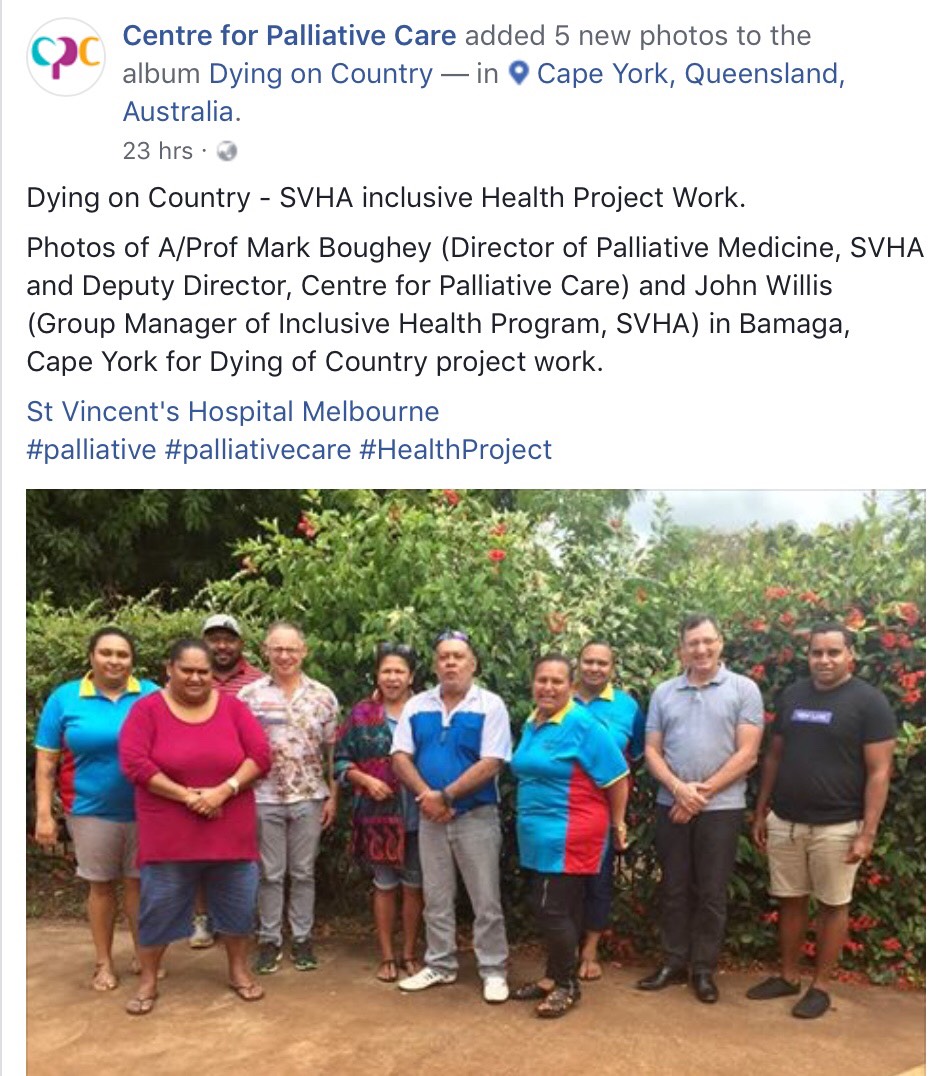
Part 3 Dying on Country

 Part 4 Rural Aussies urged to talk end-of-life care
with their doctor and families
National Palliative Care Week – 20-26 May 2018


While it may seem like a confronting conversation to have, the Rural Doctors Association of Australia (RDAA) is urging rural and remote Australians to take the time to discuss with their local doctor and family how they want to be looked after towards the end of their life.

Speaking during National Palliative Care Week 2018, RDAA President, Dr Adam Coltzau, said talking about end-of-life care now can help ensure patients are better able to have the palliative care journey they choose, rather than have it decided by others.

“Many rural and remote patients want to be able to spend the last months and weeks of their life in their own community, and ideally on their own farm or in their own home, rather than at a major hospital in a distant city” he said.

“While improving access to palliative care remains a critical need in rural and remote communities, rural doctors and other rural health professionals do a great job in providing quality end-of-life care in a patient’s own community, wherever that is possible.

“This whole team approach can include palliative care nurses, Aboriginal Health Workers, community nurses and others, with support from the Royal Flying Doctor Service.

“Rural doctors are frequently on the front-line of palliative care provision in rural and remote communities. They provide care for patients throughout the trajectory of their disease and then, as the doctor at the local hospital, aged care facility or hospice, they often also provide care right through to the end of life.

“A number of welcome new initiatives will make it even easier for rural patients to stay in their community towards the end of their life.

“The increased use of telehealth – where a rural patient and their GP can consult via videolink with relevant specialists, who may be in a distant city location – can greatly reduce the need for seriously ill rural patients to travel from their community for medical care.

“For patients with life-limiting conditions, often the last thing they want to be doing is commuting back and forth to a distant city for medical appointments, which can affect both their physical and mental well-being.

“The other important step forward is the development of the National Rural Generalist Pathway, which will deliver more of the next generation of rural doctors with advanced skills training in a wide range of areas including palliative care.

“Dealing with death and dying is difficult, but it is an important conversation to have with your family and your doctor if you are suffering from a life-limiting condition.

“Palliative care patients deserve to have a high level of care available to them within their local community, and planning for this can reduce stress on both the patient and their loved ones as their condition progresses.

“Talk to your doctor about the options available to you, and put a plan in place early to ensure your needs will be met.”

NACCHO Aboriginal Health This Weeks Events @KenWyattMP launches #IndigenousWFPHA #amanatcon #SorryDay2018 #NRW2018 #Saveadate #TopEndFASD18 #WorldNoTobaccoDay #IHMayDAY18 #BecauseOfHerWeCan #NACCHOagm2018 , @NATSIHWA , @AIDAAustralia , @CATSINaM @hosw2018

Download HERE

May 22 -23 Connect 18 NACCHO supports Indigenous Business
THINK: Knowledge Forum: 22nd May

Join Australia’s supplier diversity community at our full day Knowledge Forum as we share our stories and provide insights into how we can work together to achieve a more inclusive economy. From 8am to 6.30pm

ACT: Indigenous Business Tradeshow: 23rd May

Bring a stack of business cards to our Tradeshow and experience the vibrancy of the sector at the largest showcase of Indigenous businesses in the country. From 8.30am to 3.30pm

May 24 : Minister Ken Wyatt launches WFPHA Indigenous working Group in Geneva Switzerland
Follow on Twitter

The Indigenous Working Group aims to assist in reducing the health disparity and inequities experienced by Indigenous people globally. The group’s objectives are to:

  • bring together Indigenous peoples from around the world to share and learn from each other
  • engage in collective advocacy
  • partner with existing international groups working in Indigenous affairs
  • source any funding or in-kind support to support the work of the IWG and
  • seek out research opportunities that develop the evidence base that informs global Indigenous public health policies.

We are privileged to have an Indigenous man, Australian Minister of Indigenous Health, the Honourable Ken Wyatt, officially launch the group via a video.

Indigenous Working Group Launch and Workshop

Universal Health Coverage and Equality for all Indigenous people globablly: A Call for Action-Indigenous Voices Speak Out

This event will involve a range of Indigenous speakers from around the globe telling their stories about the health disparities and inequities experienced by Indigenous people in their country.  Participants will then engage in story-telling through yarning that aims to commence an Indigenous global agenda for change that strives for universal health coverage and equality.  The Indigenous Working Group (IWG) of the World Federation of Public Health Association will also be offically launched.

To download a copy of the flyer please click here.

May 25 AMA National Conference starts in Canberra
The 2018 AMA National Conference at QT Canberra, from 25-27 May, will feature an impressive line-up of influential political and health leaders, speakers and panellists, a new day-long policy discussion format, prestigious awards, and the election of a new AMA President.

In a new format, the Saturday of the Conference will be devoted to policy debates on key contemporary health issues by delegates from the floor of the Conference.

The Health Minister, Shadow Health Minister, and Greens Leader, are confirmed speakers at the AMA National Conference. It’s not to late to register to attend:

May 26 is National Sorry Day
National Sorry Day offers the Community the opportunity to acknowledge the impact of the policies spanning more than 150 years of forcible removal of Aboriginal and Torres Strait Islander children from their families.
The first National Sorry Day was held on 26 May  1998 following the 1997 Commission report ‘Bringing Them Home’ which recommended that a national day of observance be declared.
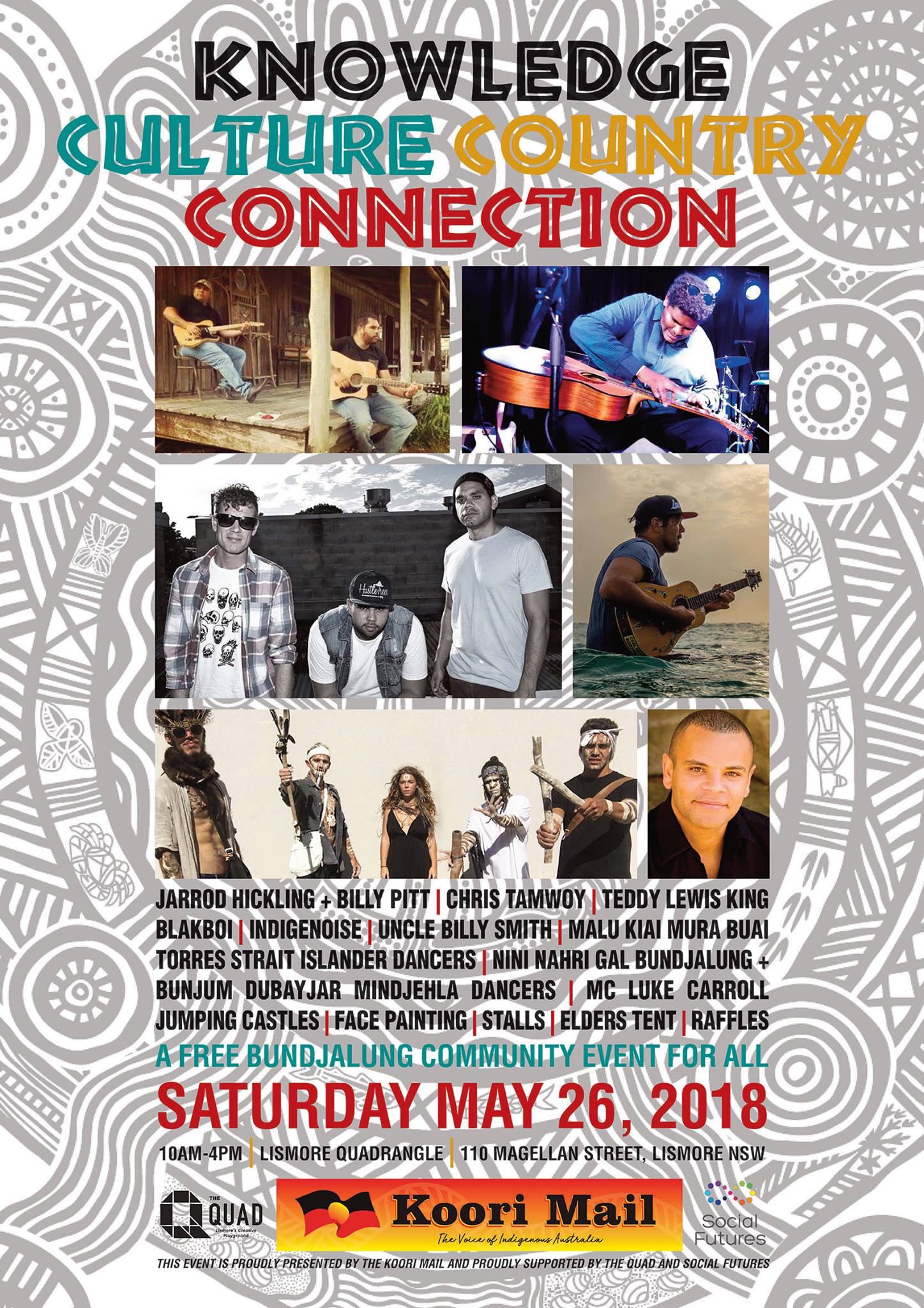
May 26 :  The event will celebrate 27 years since the first edition of the Koori Mail in 1991, and will also mark National Reconciliation week

THE Koori Mail, Australia’s only national Aboriginal and Torres Strait Islander newspaper, proudly based in Lismore on Bundjalung country, presents Knowledge, Culture, Country and Connection, a free community event on Saturday, May 26, in Lismore.

The event will celebrate 27 years since the first edition of the Koori Mail in 1991, and will also mark National Reconciliation week.

Local organisations and service providers, businesses and community groups will participate in the day, with the Koori Mail board of directors hoping the event will bring together communities across the Bundjalung nation to enjoy a showcase of music, dance, and much more.

Musicians and performers on the day include local Bundjalung acts Teddy Lewis King, Indigenoise, Uncle Billy Smith, Jarrod Hickling and Billy Pitt, and Blakboi.

Guitar sensation Chris Tamwoy will also perform on the day, which will be hosted by actor and entertainer Luke Carroll.

The event will be held at Lismore’s Quandrangle (Lismore Regional Gallery), from 10am to 4pm on Saturday, May 26.

Knowledge, Culture, Country and Connection is proudly 100% funded by the Koori Mail, the voice of Indigenous Australia.

*Please feel free to share.

 May 27  – 3 June National Reconciliation Week

National Reconciliation Week Ad Campaign Hits Screens

A new ad campaign that questions how much the average Australian knows about the country’s history will hit screens today in the lead up to National Reconciliation Week.

The 30-second and 60-second ads show a non-Indigenous man enjoying a game of football, before he starts to address the audience.

View HERE

“Oh g’day, I’m just your average Australian. I’m just doing average Australian things like watching Australian football with my Australian Shepherd,” he says.

The man says he knows quite a bit about our country – including that we have the “tastiest coat of arms in the world” – before he is interrupted by an Aboriginal woman.

“There’s also a bit that you don’t know. We’ve got the longest surviving culture on earth,” the woman says.

“Just your average artists,” an Aboriginal man chimes in.

“Warriors,” another Aboriginal woman says.

“Inventors,” a third Aboriginal woman offers.

The ad campaign highlights some of the lesser known aspects of Aboriginal and Torres Strait Islander histories, cultures and achievements, to prompt Australians to ask themselves: what are some of the things I don’t know about our shared history?

Australians will be asked to ponder that question during this year’s National Reconciliation Week (27 May – 3 June), which is themed Don’t Keep History a Mystery: Learn. Share. Grow.

Many Australians are unaware of, or reject, fundamental aspects of history, according to the Australian Reconciliation Barometer.

The biennial survey commissioned by Reconciliation Australia and conducted by Polity social research consultancy explores the perceptions of a representative sample of Australians in order to gauge progress towards reconciliation.

The most recent Barometer survey revealed that:

  •  Almost one in three Australians do not accept that government policy enabled Aboriginal and Torres Strait Islander children to be removed from their families without permission until the 1970s.
  •  More than one in three Australians do not accept that Aboriginal and Torres Strait Islander people were subject to mass killings, incarceration, forced removal from land and restricted movement, throughout the 1800s.

Reconciliation Australia CEO Karen Mundine said National Reconciliation Week would raise awareness of the fact that historical acceptance is key to reconciliation.

“It’s essential that we know each other, and that we share an understanding of the history that has shaped the relationship between wider Australia and Aboriginal and Torres Strait Islander peoples as it stands today,” she says.

“Only by acknowledging, accepting and addressing our shared history can we become a more just and equitable Australia.”

The National Reconciliation Week ads will be screened on SBS, NITV, Foxtel and ICTV, in cinemas nationally, on Qantas in-flight entertainment, and on big screens in Brisbane’s Queen St Mall and King St Mall, Melbourne’s Federation Square, and Sydney’s Pitt Street mall.

To find out how to get involved in National Reconciliation Week, visit reconciliation.org.au/national-reconciliation-week

May 28 Australia’s first Reconciliation Day public holiday

This year will proudly have Australia’s first Reconciliation Day public holiday on Monday 28th May. Reconciliation Day and is a time to learn more about Aboriginal and Torres Strait Islander cultures and histories, to share that knowledge and help us grow

Members of the Aboriginal and Torres Strait Islander community can access Transport Canberra’s Aboriginal and Torres Strait Islander Community Bus to attend the event. The bus will be departing from Bay 4 of the Queanbeyan bus interchange on Morisset Street from 9.30am on Monday 28 May, and will shuttle between the interchange and the event throughout the day. See below schedule for approximate timings – places are limited.

9.30am – Queanbeyan Bus Interchange, Bay 4
10am – Glebe Park

10.30am – Queanbeyan Bus Interchange, Bay 4

11am – Glebe Park

11.30am – Queanbeyan Bus Interchange, Bay 4

12pm – Glebe Park

12.30pm – Queanbeyan Bus Interchange, Bay 4

1pm – Glebe Park

2.15pm – Glebe Park to Queanbeyan Bus Interchange, Bay

May 30-31Top End Foetal Alcohol Syndrome Forum Darwin

APO NT is hosting a forum to raise awareness about FASD for Aboriginal communities in the Top End, share experiences and develop a top-end network

Follow on Twitter  #TopEndFASD18

Download the Full Program

NT TOP END FASD PROGRAM

May 31  Tom Calma World No Tobacco day

WorldNoTobaccoDay is coming up! But you don’t have to wait, start now: make every day a tobacco-free day

In the lead up to World No Tobacco Day, IAHA will host a live online webinar with Patron and National Coordinator Tackling Indigenous Smoking Professor Tom Calma to discuss the role of allied health in tackling Indigenous smoking.

To register follow this link –

31 May Reconciliation in the ACT : Are we there yet

DATE: Thursday 31 May 2018

TIME: 12.30pm – 1.30pm

VENUE: Function Room, Theo Notaras Multicultural Centre, 180 London Circuit, CANBERRA CITY

ABOUT: On 27 May 2018 the residents of Canberra will enjoy a public holiday, Reconciliation Day, to recognise and celebrate reconciliation in the ACT between Aboriginal and Torres Strait Islander people and non-Aboriginal people.

This seminar will explore the extent to which genuine and sustainable progress has been made in achieving reconciliation in the ACT. Discussion will centre on a range of data, summarised below, which reflects the extent to which Aboriginal people in Canberra continue to experience disadvantage and of the adequacy of the local response to these matters, including the degree of self-determination accorded the Aboriginal community.

  • Native title has been completely extinguished in the ACT;
  • Canberra’s Indigenous students fall two years behind their non-Indigenous peers in educational outcomes;
  • Canberra’s Indigenous people are 21 times more likely to be incarcerated compared to non-Indigenous people, and the ACT has the second highest rate of Indigenous incarceration in Australia;
  •  An Aboriginal child in Canberra is 12 times more likely than a non-Aboriginal child to be removed, under a care and protection order, from its parents and the ACT has the second highest rate of removal of Aboriginal children in Australia;
  •  7.6% of Canberra’s Aboriginal community report that they live in housing in which they do not have access to working sewerage facilities;
  • 46% of Indigenous males and 39% of indigenous females in the ACT over the age of 15 used an illicit drug or other substance in the last year; and
  • 35% of Aboriginal children in Canberra live in poverty;

This IGPA seminar is co-sponsored by Winnunga Nimmityjah AHCS and is jointly convened by Professorial Fellow Jon Stanhope AO and Adjunct Professor Dr Khalid Ahmed PSM.

Download the Brochure and Speaker Bio’s HERE

RECONCILIATION IN THE ACT ARE WE THERE YET (003)

May 31 : This year’s theme ‘Stepping Out into Our Future’

Aboriginal & Torres Strait Island peoples share their voice, aspirations, hopes, dreams, pathways, taking the steps further for our future.

June 11 .New : Finding Common Ground and a Way Forward for Indigenous Recognition 

Written submissions should be received by Monday 11 June

Above NACCHO Library image

A new committee met yesterday, to further consider matters regarding recognition of Australia’s indigenous people, and will be co-chaired by Senator Patrick Dodson, Senator for Western Australia, and Mr Julian Leeser MP , Member for Berowra.

The Joint Select Committee on Constitutional Recognition Relating to Aboriginal and Torres Strait Islander Peoples is expected to report by the end of November this year, with an interim report due in July.

The Committee is calling for submissions and is considering options for public meetings and hearings.

Co-Chairs Senator Dodson and Mr Leeser MP said: ‘As a committee, we are looking for common ground and ways forward on these critical matters for Australia’s future. We hope to hear from Australians about the next steps for recognition of First Nations peoples.

We plan to consult widely, starting with First Nations leadership. We understand that a great deal of work has already been done: the job of this committee is to build on that work and to now take the next steps.’

The Committee website has details of Committee membership, and will be the first point of information about the work of the Committee.

Written submissions should be received by Monday 11 June, to assist with planning meetings and hearings, but the Committee may accept submissions after this date.

For background:

Please contact the Committee secretariat on 02 6277 4129

or via email at jsccr@aph.gov.au

Interested members of the public may wish to track the committee via the website.

WEBSITE

Click on the blue ‘Track Committee’ button in the bottom right hand corner and register

October 30 2018 NACCHO Annual Members’ Conference and AGM SAVE A DATE

Follow our conference using HASH TAG #NACCHOagm2018

This is Brisbane Oct 30—Nov 2

The NACCHO Members’ Conference and AGM provides a forum for the Aboriginal community controlled health services workforce, bureaucrats, educators, suppliers and consumers to:

  • Present on innovative local economic development solutions to issues that can be applied to address similar issues nationally and across disciplines
  • Have input and influence from the ‘grassroots’ into national and state health policy and service delivery
  • Demonstrate leadership in workforce and service delivery innovation
  • Promote continuing education and professional development activities essential to the Aboriginal community controlled health services in urban, rural and remote Australia
  • Promote Aboriginal health research by professionals who practice in these areas and the presentation of research findings
  • Develop supportive networks
  • Promote good health and well-being through the delivery of health services to and by Indigenous and non-Indigenous people throughout Australia.

More Info soon

6. NACCHO Aboriginal Male Health Ochre Day

Hobart  Aug 27 –28

More Info soon

7. NATSIHWA National Professional Development Symposium 2018

We’re excited to release the dates for the 2018 National Professional Development Symposium to be held in Alice Springs on 2nd-4th October. More details are to be released in the coming weeks; a full sponsorship prospectus and registration logistics will be advertised asap via email and newsletter.

This years Symposium will be focussed on upskilling our Aboriginal and/or Torres Strait Islander Health Workers and Health Practitioners through a series of interactive workshops. Registrants will be able to participate in all workshops by rotating in groups over the 2 days. The aim of the symposium is to provide the registrants with new practical skills to take back to communities and open up a platform for Health Workers/Practitioners to network with other Individuals in the workforce from all over Australia.

We look forward to announcing more details soon!

8.AIDA Conference 2018 Vision into Action


Building on the foundations of our membership, history and diversity, AIDA is shaping a future where we continue to innovate, lead and stay strong in culture. It’s an exciting time of change and opportunity in Indigenous health.

The AIDA conference supports our members and the health sector by creating an inspiring networking space that engages sector experts, key decision makers, Indigenous medical students and doctors to join in an Indigenous health focused academic and scientific program.

AIDA recognises and respects that the pathway to achieving equitable and culturally-safe healthcare for Indigenous Australians is dynamic and complex. Through unity, leadership and collaboration, we create a future where our vision translates into measureable and significantly improved health outcomes for our communities. Now is the time to put that vision into action.

AIDA Awards
Nominate our members’ outstanding contributions towards improving the health and life outcomes of Aboriginal and Torres Strait Islander Peoples.

9.CATSINaM Professional Development Conference

Venue: Hilton Adelaide 

Location:  233 Victoria Square, Adelaide, SA 

Timing: 8:30am – 5:30pm

We invite you to be part of the CATSINaM Professional Development Conference held in Adelaide, Australia from the 17th to the 19th of September 2018.
The Conference purpose is to share information while working towards an integrated approach to improving the outcomes for Aboriginal and Torres Strait Islander Australians. The Conference also provides an opportunity to highlight the very real difference being made in Aboriginal and Torres Strait Islander health by our Members.
To this end, we are offering a mixed mode experience with plenary speaker sessions, panels, and presentations as well as professional development workshops.

More info

The CATSINaM Gala Dinner and Awards evening,  held on the 18th of September, purpose is to honour the contributions of distinguished Members to the field.

10.Healing Our Spirit Worldwide

Global gathering of Indigenous people to be held in Sydney
University of Sydney, The Healing Foundation to co-host Healing Our Spirit Worldwide
Gawuwi gamarda Healing Our Spirit Worldwidegu Ngalya nangari nura Cadigalmirung.
Calling our friends to come, to be at Healing Our Spirit Worldwide. We meet on the country of the Cadigal.
In November 2018, up to 2,000 Indigenous people from around the world will gather in Sydney to take part in Healing Our Spirit Worldwide: The Eighth Gathering.
A global movement, Healing Our Spirit Worldwidebegan in Canada in the 1980s to address the devastation of substance abuse and dependence among Indigenous people around the world. Since 1992 it has held a gathering approximately every four years, in a different part of the world, focusing on a diverse range of topics relevant to Indigenous lives including health, politics, social inclusion, stolen generations, education, governance and resilience.
The International Indigenous Council the governing body of Healing Our Spirit Worldwide has invited the University of Sydney and The Healing Foundation to co-host the Eighth Gathering with them in Sydney this year. The second gathering was also held in Sydney, in 1994.
 Please also feel free to tag us in any relevant cross posting: @HOSW8 @hosw2018 #HOSW8 #HealingOurWay #TheUniversityofSydney

NACCHO Aboriginal Health and #NDIS News : 1. Aboriginal people with disabilities and their families need our support and 2. the Ombudsman releases report into the National Disability Insurance Agency’s handling of reviews

 ” In 2014 the Australian government commenced rolling out the NDIS. But Aboriginal participation in the new scheme remains unacceptably low.

This means that despite increases in the funding available, there is a real danger that without culturally appropriate services, supports and pathways the Aboriginal community will not get access to all of the opportunities that the NDIS represents.

Daily our mob lives with the impacts of disability more than any other section of the Australian population: almost half of our Indigenous population aged 15 years and over live with disability or a restrictive long-term health condition and experience disability at more than twice the rate of the general Australian population which increases further with the inclusion of psychosocial disability (mental health).

We need solutions to ensure that all Aboriginal people and their families have access to quality disability services that respect their culture and meet their needs.”

Joseph Archibald is a Gamilario man living on Birpai country mid-north NSW coast. He is manager of Windaan Aboriginal Services. Joseph has worked in the disability sector across areas including sector capacity building for Aboriginal engagement and Aboriginal employment and workforce strategy with industry peak National Disability Services (NDS) and NDIS service development with Galambila Aboriginal Health Service

Read over 20 recent NACCHO Aboriginal Health and NDIS articles HERE

Commonwealth Ombudsman Michael Manthorpe today released a report into the National Disability Insurance Agency’s (NDIA) handling of reviews of decisions under the National Disability Insurance Scheme Act 2013 highlighting complaints and stakeholder feedback including significant backlogs, delays in decision making and poor communication practices.”

In releasing the report, Mr Manthorpe acknowledged the considerable pressure the NDIA has been under to meet bilateral targets since the national rollout of the NDIS, which began in July 2016.

Download a copy of report Here

Report-on-NDIA-administration-of-reviews-under-the-Act_1

However, the Ombudsman stressed this must not be used as a reason to deprioritise or delay other work, including reviews.

“It is clear from this report there are a number of areas in which the NDIA can, and should improve its administration of participant-initiated reviews. Without significant efforts to improve the timeliness of its approach and its communication with participants, there remains a risk that participants’ rights to review will be challenged and the review process will continue to be unwieldy, unapproachable and the driver of complaint volumes” Mr Manthorpe said.

Since mid-2016, complaints to the Commonwealth Ombudsman about the NDIA’s review process have represented around 32 per cent of all NDIA complaints.

The report makes 20 recommendations aimed at improving the NDIA’s administration of reviews, all of which were accepted by the NDIA. The Ombudsman’s Office will continue to monitor the implementation of the recommendations in the report, which is available at:

Media Part 2

People with disabilities are facing delays of up to nine months when they attempt to have their bungled National Disability Insurance Scheme (NDIS) plans fixed, an investigation has found.

From the ABC Report

Key points:

  • NDIS participants seek reviews when their plan does not fit with their needs, for example if they receive funding for fewer hours of care than needed
  • Ombudsman’s report found up to 8,000 people are still waiting for an outcome on their reviews
  • Agency accepted finding that it was not prioritising urgent cases, where people could be at risk of harm or homelessness

People seek reviews for many reasons, including when their plan includes wrong or inadequate equipment and support, for example if they receive funding for fewer hours of care than needed.

“[Delays] pose a particular risk to those who may be at risk of losing services or experiencing deterioration in their capacity if their plan is not adjusted quickly,” the report said.

The Ombudsman said it received 400 complaints about the National Disability Insurance Agency’s (NDIA) review processes over the 18 months to January.Reports to the watchdog included:

“In one case, a participant did not know why her plan was changed because the NDIA had not told her it had accepted (and given effect to) her request for a plan review,” the report said.

“Some participants have told us they have been waiting for up to eight or nine months for a decision on their review request, without any update on its progress or explanation of the time taken.”

The Ombudsman described the review processes as “unwieldy”, “unapproachable”, and lacking “fairness and transparency”.

The Commonwealth Ombudsman’s report into the NDIS’s plan review system has revealed up to 8,000 people are stuck waiting for an outcome.

  • The agency not prioritising urgent cases where, for example, people could be at risk of harm or homelessness
  • NDIA staff and contractors discouraging people from seeking a review
  • The NDIA not acknowledging requests for review or responding to enquiries

The NDIA has accepted the Ombudsman’s 20 recommendations.

“The NDIA has established a dedicated team to manage outstanding reviews.

Social Services Minister Dan Tehan reinforced the message that the NDIA was dealing with the issues outlined in the report.

“Obviously when you undertake a reform of this scale there will always be issues that we need to work through … we’re doing everything we can to speed up the process.

“”These problems need to be fixed, and fixed right now,” Ms Macklin said.

“Get peoples’ plans right the first time so we just don’t need all these reviews done, and people waiting for much-needed support.”

Federal Labor’s social services spokeswoman Jenny Macklin said it was “an absolutely damning report”.

“This was something that was identified some months ago and special teams have been put in place to address this issue,” he said.

“The NDIS is a world-first reform, the size and scale of which means the scheme will not be without challenges.”

“[The agency] has started determining the most practical way to implement responses,” a spokesman said in a statement.

More than 140,000 Australians are now covered by the NDIS — a number expected to reach 475,000 by early next decade.

Example of AWABAKAL ACCHO NDIS Promotion

You are invited to our FREE information sessions to learn more about the National Disability Insurance Scheme (NDIS).

AWABAKAL NDIS GATHERING
14 June 2018
• 10am to 12pm at Wickham Office
• 2pm – 4pm at Cardiff Office

We will explain:
• What is the National Disability Insurance Scheme?
• Accessing the National Disability Insurance Scheme.
• What is funded by the National Disability Insurance Scheme?
• What supports are available if I am not eligible for the National Disability Insurance Scheme?
• Your Consumer Rights when accessing Service Providers
• What is a service agreement?

Yarn to people who have been National Disability Insurance Scheme participants for several years about exercising their rights as consumers.

LOCATION: 10am to 12pm 64 Hannell st Wickham
2pm to 4pm 15 Kelton St Cardiff

For further information contact Suzy Trindall – CDAH
M: 0428 840 953 E: suzy@cdah.org.au

Part 3 Aboriginal people with disabilities and their families need our support

FROM INDIGENOUSX / THE Guardian

Before I worked in the sector, I didn’t know much about disabilities and felt it had little to no relevance to my personal life. How wrong I was. I have been a carer for immediate and extended family and have grown up around family members with disability, but as in many of our Indigenous communities across the country, care and acceptance were our cultural norm and labels were not required.

Pictured above : Editor of NACCHO Communique and Stroke Foundation Consumer Council Co chair & Board Member 2017 Colin Cowell (left ) with fellow stroke survivor Tania Lewis at an NDIS workshop in Coffs Harbour conducted by Joe Archibald (right )

Read Tania’s story HERE

The question of how much of a difference access to quality formal disability supports could have made to the lives of my family members with disability, as well as our lives as carers, is more relevant now then ever.

We need solutions to ensure that all Aboriginal people and their families have access to quality disability services that respect their culture and meet their needs.

The National Disability Insurance Scheme (NDIS) boasts some pretty impressive statistics, including the largest social reform since Medicare, increased funding in the sector from about $8bn per year to $22bn in 2019-20, and providing supports to about 475,000 people.

In 2014 the Australian government commenced rolling out the NDIS. But Aboriginal participation in the new scheme remains unacceptably low. This means that despite increases in the funding available, there is a real danger that without culturally appropriate services, supports and pathways the Aboriginal community will not get access to all of the opportunities that the NDIS represents.

Daily our mob lives with the impacts of disability more than any other section of the Australian population: almost half of our Indigenous population aged 15 years and over live with disability or a restrictive long-term health condition and experience disability at more than twice the rate of the general Australian population which increases further with the inclusion  of psychosocial disability (mental health).

Research and statistics demonstrate the overwhelmingly adverse intersectional impact of being Aboriginal and Torres Strait Islander and having disability across a range of wellbeing and social indicators including health, educational attainment, employment participation, personal safety and exposure to the out of home care and criminal justice systems. Indigenous youth in juvenile detention are recorded as having very high rates of significant intellectual disabilities or mental health conditions.

Aboriginal people living with disability, their carers and families need our support.

Every day Indigenous families enter the NDIS system and service marketplace, many with little support and knowledge of what to do and where to go. This will continue as the NDIS evolves and adapts its generic approach, after having already acknowledged more culturally appropriate strategies and pathways are needed to create equity.

There are cohorts of participants for which supply shortages are high-risk due to the increased cost of service provision and limited availability of workforce, including those who: are in outer regional, remote or very remote areas; have complex needs; are from culturally and linguistically diverse backgrounds; are Aboriginal and Torres Strait Islander Australians; or have acute care needs such as in crisis situations.”

For those who have knowledge of the NDIS space you don’t have to look hard to identify the significant risks in becoming a participant or service provider within an evolving scheme. Acknowledging NDIS is a tough market and costs are yet to reflect the “high risk” and specialist service delivery required to achieve effective outcomes, so it is essential to identify what you do well.

We need culturally appropriate services with sustainable models that can compete in the NDIS open market and be around for our communities for the long term.

Seek to collaborate with existing culturally appropriate services.

Our mob still requires a lot of advocacy in the disability space, and services cannot meaningfully address the needs of Aboriginal communities alone. Adopting models that work closely with Aboriginal families and local partner organisations is important, such as our partnership with Galambila Aboriginal Health Services. It complements existing strengths and services pathways to provide comprehensive care coordination across disability, primary health and allied health services. We know that isolating disabilities from our other services does not work in achieving the positive engagement and outcomes for overall health and wellbeing of our communities.

Historically culture and community supports have been excluded from formal disability service provision, but the right supports and services can empower our families to maintain community and culture in services as much as possible.

At Windaan we have made a commitment to weather the storm of NDIS service delivery and seek out partners where our values and vision align. This allows our Indigenous communities to receive services they’re entitled to and deserve.

  • Guardian Australia is proud to partner with IndigenousX to showcase the diversity of Indigenous peoples and opinions from around the country.

Aboriginal Health and Pharmacy Press Release : NACCHO @jcu @PSA_National embark on a pioneering project to embed 22 pharmacists in Aboriginal community-controlled health services in QLD, VIC and the NT .

“There is a higher burden of chronic disease in the Aboriginal community, and these patients are likely to be prescribed multiple medicines, which also place them at greater risk of drug-related complications, Yet they have limited access to appropriate pharmacist advice across Australia, particularly in remote areas.

 There are many, many reasons behind why Aboriginal patients are more likely to have adherence problems than other Australians, There are socio-economic reasons, such as the cost of medicines and access to transport to fill prescriptions.

 There are patient reasons; a person may have a poor memory – and the more medicines they have to take, the more difficult it is to remember them all. Some patients are very fearful of medications. They’re worried that it might make them feel worse.

 There are also prescriber reasons; the medicine may not be right for the patient, or the patient may not have been prescribed necessary life-saving medicines.”

The inability of many Aboriginal and Torres Strait Islander people with chronic diseases to access quality pharmacist support may be placing lives at risk, according to a James Cook University medical researcher.

Associate Professor, General Practice and Rural Medicine, Sophia Couzos, said Aboriginal and Torres Strait Islander patients often struggled to follow medication regimes – including treatment for life-threatening conditions like diabetes and cardio-vascular disease.

Download the Press Release HERE

JCU Media – Pharmacy

 Read all previous NACCHO articles Aboriginal Health and Pharmacy HERE

JCU has joined forces with the Pharmaceutical Society of Australia (PSA) and the National Aboriginal Community Controlled Health Organisation (NACCHO) to embark on a pioneering project to embed 22 pharmacists in Aboriginal community-controlled health services in Queensland, Victoria and the Northern Territory.

The Integrating Pharmacists within Aboriginal Community Controlled Health Services to improve Chronic Disease Management (IPAC) project will see culturally-trained pharmacists working with both clinical staff and patients to address issues which lead to poor medication use, including under-utilisation and over-utilisation of drugs. These issues range from socio-economic obstacles through to fear.

The IPAC project pharmacists, located within the primary healthcare teams of Aboriginal health services, will be ideally placed to assist patients and prescribers.

“The IPAC pharmacists will be providing advice in a culturally safe environment for the patient, where they can feel at ease,” Dr Couzos pointed out.

NACCHO Director, Medicines Policy and Programs, Mike Stephens,pictured above )  said the pharmacists would also educate staff and liaise with external stakeholders, including hospitals, to develop strategic plans for more effective medicine use.

“There’s good evidence that pharmacists in health services improve patient health,” he said.

The United Kingdom is investing heavily in programs that place pharmacists in primary healthcare teams, according to Dr Couzos. But the practice only occurs on an ad hoc basis in Australia. Despite this, there was no shortage of pharmacists keen to play frontline roles within Aboriginal health services, she maintained.

“There are many pharmacists who have already had some experience working with Aboriginal community controlled health services, who have excellent relationships with them, and who have wanted to be part of the primary healthcare team,” she said.

PSA Manager, Health Sector Engagement, Shelley Crowther, said the peak national body for pharmacists had been advocating for a number of years that pharmacists play an active role in improving medication management for Aboriginal and Torres Strait Islander people.

“There is a lot of evidence to support that medication misadventure results in cost to the health system,” she said. “The Australian Commission on Safety and Quality in Healthcare estimates medication-related admissions to hospitals Australia-wide cost $1.2 billion annually.

“In terms of Aboriginal and Torres Strait Islander health, obviously the discrepancies in health outcomes for them give even greater weight to the importance of trying to reduce medication misadventure and improve medication management to try to achieve better health outcomes.”

The first IPAC pharmacists will begin work in June this year. JCU will evaluate the project, which is scheduled to run until early 2020. Among other elements, the evaluation will measure healthcare improvements in chronic disease sufferers who have been supported by a practice pharmacist.

“If the quality of care improves, that will lead to health dollar savings down the track because we know that access to quality primary health care can prevent unnecessary hospitalisations,” Dr Couzos said. “This project will give impetus to the Australian Government to explore how healthcare workforce innovation can enhance access to quality healthcare for Aboriginal people.”


NACCHO Aboriginal Health and #WorldHypertensionDay @strokefdn High #bloodpressure – known to doctors as ‘hypertension’ – is a silent killer of our mob with 47% having high #stroke risk


 ” But high blood pressure – known to doctors as ‘hypertension’ – is a silent killer of our mob because there are no obvious signs or symptoms, and many people don’t realise they have it. “

A staggering 82 percent of those, found to have high blood pressure, were not aware prior to taking the health check and were referred to their doctor for a further assessment.

Aboriginal and Torres Strait Islander are between two and three times as likely to have a stroke than non-Indigenous Australians which is why increasing stroke awareness is crucial.

Too many Australians couldn’t spot a stroke if it was happening right in front of them.

We know that in Aboriginal and Torres Strait Islander communities this awareness is even lower.

We want all Australians, regardless of where they live or what community they’re from, to learn the signs of stroke.”

Stroke Foundation and Apunipima ACCHO Cape York Project

 ” Naomi and Rukmani’s stroke rap runs through vital stroke awareness messages, such as lifestyle advice, learning the signs of stroke, and crucially the need to seek medical advice when stroke strikes.

Music is a powerful tool for change and we hope that people will listen to the song and remember the FAST message – it could save their life,”

Stroke Foundation Queensland Executive Officer Libby Dunstan 

Naomi Wenitong  pictured with her father Dr Mark Wenitong Public Health Officer at  Apunipima Cape York Health Council  in Cairns:

Share the stroke rap with your family and friends on social media

Listen to the new rap song HERE

                                       or Hear

Research has shown the number of strokes would be practically cut in half (48 percent) if high blood pressure alone was eliminated

NACCHO has published over 90 articles Aboriginal health stroke prevention and recovery READ HERE

“It can happen to anyone — stroke doesn’t discriminate against colour, it doesn’t discriminate against age “

Photo above Seith Fourmile, Indigenous stroke survivor campaigns for culture to aid in stroke recovery

” Cardiovascular disease is the leading cause of death for Aboriginal and Torres Strait Islander people, who experience and die from cardiovascular disease at much higher rates than other Australians.

What you don’t know can hurt you. Heart disease and strokes are the biggest killers of Australians, and the biggest risk factor for both of them is high blood pressure.

But high blood pressure – known to doctors as ‘hypertension’ – is a silent killer because there are no obvious signs or symptoms, and many people don’t realise they have it. “

John Kelly CEO-National, Heart Foundation

Aboriginal and Torres Strait Islander people, when compared with other Australians, are:

  • 1.3 times as likely to have cardiovascular disease
  • three times more likely to have a major coronary event, such as a heart attack
  • more than twice as likely to die in hospital from coronary heart disease
  • 19 times as likely to die from acute rheumatic fever and chronic rheumatic heart Disease
  • more likely to smoke, have high blood pressure, be obese, have diabetes and have end-stage renal disease.

It was World Hypertension Day yesterday  and the Stroke Foundation is determined to slash stroke numbers in Australia – with your help.

Today kicks off Australia’s Biggest Blood Pressure Check for 2018 and communities are being urged to take five minutes out of their day for a potentially life-saving blood pressure check.

More than 4.1 Million Australians are living with hypertension or high blood pressure, putting themselves at serious and unnecessary risk of stroke.

Research has shown the number of strokes would be practically cut in half (48 percent) if high blood pressure alone was eliminated.

The major concern with high blood pressure is many people don’t realise they have it. It has no immediate symptoms, but over time, it damages blood vessels and increases the risk of stroke and heart disease.

How you can help?

  • Encourage your family and friends to take advantage of a free check.
  • Help spread the word via social media:  Research has shown the number of strokes would be practically cut in half if high blood pressure alone was eliminated.
  • Get your free health check today! https://bit.ly/2ps1UOn #WorldHypertensionDay

  • I am urging you – no matter what age you are – to have a blood pressure check regularly with your ACCHO GP (General Practitioner), pharmacist or via a digital health check machine.
  • Stroke strikes in an instant, attacking the brain. It kills more women than breast cancer and more men than prostate cancer and leaves thousands with an ongoing disability, but stroke is largely preventable by managing blood pressure and living a healthy lifestyle.
  • Stroke Foundation and SiSU Wellness conducted more than 520,000 digital health checks throughout 2017, finding 16 percent of participants had high blood pressure putting them at risk of stroke

Given there will be 56,000 strokes in Australia this year alone, if we can reduce high blood pressure we will have a direct and lasting impact on the rate of stroke in this country.Yours sincerely,

Sharon McGowan
Chief Executive Officer
Stroke Foundation

NACCHO Aboriginal Children’s Health News Alert : John Paterson CEO of @AMSANTaus demands #NT Government ‘Reform system’ to stop Indigenous child abuse

The current system is clearly not working and the fragmentation and duplication of family support services is part of the problem, and these are largely delivered by non-Aboriginal organisations, which impairs their ability to work with the most vulnerable Aboriginal families,

The “most urgent system reform” was the establishment of a tripartite forum between the commonwealth and territory governments and the community sector, as recommended in the royal commission into child detention in the NT,

This would enable Aboriginal leaders to “plan in partnership with governments to do what is needed to fix the child protection and out-of-home care systems” and lead to the development of “a more structured intensive family support service system throughout the NT”.

John Paterson, chief executive of the Aboriginal Medical Services Alliance of the Northern Territory, yesterday criticised the “many system failures” that led to the attack, which included the fact the child had not been removed despite the family involved having been the subject of 52 notifications to Territory Families since 2002

As published in the Australian

Aboriginal medical providers in the Northern Territory have lashed departmental failings that saw a Tennant Creek toddler sexually abused, saying problems would continue unless family support services were delivered in conjunction with Indigenous-led organisations

Mr Paterson said this approach would require increased funding from both levels of government for prevention services and programs, to counter the fact that the NT government had “directed more than 80 per cent of new funding to the crisis end of the system”.

He said the “wholesale removal of children from vulnerable families is not the answer” but warned the system needed to shift “from statutory responses to better preventative services and programs”.

“We know that children in out-of-home care are more likely not to complete their education, to be unemployed and for women, more likely to have their children removed,” Mr Paterson said. “The issues are long term and systemic, which require long-term predictable funding from both levels of government as well as a commitment to the tripartite forum.”

The Australian can reveal that neither the NT government nor the territory’s Children’s Commissioner has sent Indigenous Affairs Minister Nigel Scullion the full copy of a report into the matter, which, when delivered to Chief Minister Michael Gunner last week, was heavily redacted to cover up the department’s failings.

This is despite Senator Scullion describing it as “look(ing) like arse-covering of the highest order” and saying he had “asked the NT government for a copy of the full report, without redactions, to see what Michael Gunner is hiding”.

Senator Scullion did not respond to questions yesterday.

The inquiry’s redacted section includes the fact that older siblings of the toddler had also been subjected to attacks and that one of them had been taken away by a known sex offender after being left at home alone.

The toddler and another child have been removed from their parents’ care by authorities and a 24-year-old NT man charged with sexual assault, after the toddler underwent surgery for genital injuries, required a blood transfusion and tested positive for gonorrhoea.

NACCHO Aboriginal Health #ACCHO Deadly Good News stories : Features #NSW #QLD @QAIHC_QLD #VIC @VAHS1972 @DeadlyChoices #WA @TheAHCWA #NT #ACT

1.1 National : Funding opportunity for ACCHO’s : Indigenous Australians’ Health Programme (IAHP) $35 Million Available

2.1 NSW : For NSW ACCHO members Indigenous bubs need to be counted for a passport to life

2.2 NSW : Wellington Aboriginal Corporation Health Service (WACHS) Taylor and co arrive to help raise Organ Tissue Donation awareness in Indigenous communities

3.ACT New $12 Million facility for Winnunga ACCHO as they celebrate 30 years

4. 1 QLD : GALANGOOR Duwalami Aboriginal and Torres Strait Islander Health Service TEN YEARS MAKES YOU MORE STRONG

4.2 QLD : QAIHC helps Palm Island lay health foundation plan for next 10 years

5. WA :  AHCWA staff are currently in the Kimberley’s completing the Gibb River Challenge to raise money for the RFDS.

6. TAS: Tasmanian Aboriginal Centre Remembering Kikatapula

7. SA: Please help Zibeon get people back home for treatment and give generously to help open the doors to the first remote dialysis clinic on the APY lands.

8.1 VIC : VAHS Deadly Choices Education session Friday 18 May

9. NT Congress Alice Spring new Tackling Smoking Ads

 View hundreds of ACCHO Deadly Good News Stories over past 6 years

How to submit a NACCHO Affiliate  or Members Good News Story ?

 Email to Colin Cowell NACCHO Media    

Mobile 0401 331 251

Wednesday by 4.30 pm for publication each Thursday /Friday

1.1 National : Funding opportunity for ACCHO’s : Indigenous Australians’ Health Programme (IAHP) $35 Million Available

The objective of the IAHP is to provide Aboriginal and Torres Strait Islander people with access to effective high quality health care services in urban, regional, rural and remote locations across Australia.  This includes through Aboriginal Community Controlled Health Services, wherever possible and appropriate, as well as mainstream services delivering comprehensive, culturally appropriate primary health care.

WEBSITE

The expected outcomes of the IAHP include improvements in:

  • The health of Aboriginal and Torres Strait Islander people;
  • Access to high quality, comprehensive and culturally appropriate primary health care; and
  • System level support to the Aboriginal and Torres Strait Islander primary health care sector to increase the effectiveness and efficiency of services.

Implementation of the IAHP aligns with the Aboriginal and Torres Strait islander Health Plan 2013-2023: Implementation Plan which focusses on systematic service improvement and addressing geographic disparities through more effective and innovative regional arrangements.  The Implementation Plan can be found on the department’s Implementation Plan for the National Aboriginal and Torres Strait Islander Health Plan 2013-2023 website.


About the Major Capital Works Program Grant Opportunity

This Grant Opportunity is for Expression of Interest applications as Stage One in a two-stage application process for funding under the IAHP Major Capital Works Program.  The objective of this Grant Opportunity is to improve access for Aboriginal and Torres Strait Islander peoples to safe and effective essential health services through the provision of culturally appropriate, fit for purpose health infrastructure across Australia.  Further information on the type of activities and projects eligible to be funded under this Grant Opportunity are included in the IAHP Major Capital Works Program Stage One EOI Guidelines.

Eligibility:

Organisations will be eligible to apply if they satisfy all of the eligibility criteria outlined in the IAHP Major Capital Works Program Stage One EOI Guidelines and the IAHP Major Capital Works Program Stage One EOI Application Form, which includes that the organisation must currently receive primary health care funding to deliver clinical services under the IAHP.

Total Amount Available (AUD):

$35,000,000.00

Instructions for Lodgement:

All applications must be submitted on the IAHP Major Capital Works Program EOI Stage One Application Form, following the instructions and eligibility requirements included in the Application Form and Grant Opportunity Guidelines, and emailed to Grant.ATM@health.gov.au by the stated closing date and time.

Before completing the application form, please read the documents attached to this Grant Opportunity Package which include the Grant Opportunity Guidelines, the IAHP Guidelines, the application form, and the department’s funding agreement standard terms and conditions.

2.1 NSW : For NSW ACCHO members Indigenous bubs need to be counted for a passport to life

The NSW Registry of Births Deaths & Marriages has found that up to 10 percent of Indigenous babies are going unregistered in some parts of NSW.

Speaking at the South Sydney Rabbitohs’ Indigenous Round, NSW Registrar of Births Deaths & Marriages Amanda Ianna launched a new campaign to encourage Aboriginal mums to register their bubs, as well as a new range of commemorative birth certificates.

“The number of Indigenous people still not registering births is far too high,” Ms Ianna said.

“It causes problems for children when they need a birth certificate to enrol in school or organised sport or, when they’re older, get a driver’s licence or tax file number.

“A birth certificate is a passport to many things in life that we often take for granted.

“Some mums are under the misconception they have to pay to register their baby or they assume the hospital does it for you. That’s not the case.”

The ‘Our Kids Count’ campaign encourages Aboriginal mums to register their bubs and includes this video: http://www.bdm.nsw.gov.au/Aboriginal

Ms Ianna also unveiled a new range of commemorative birth certificates, including three new skin tone variations on the best-selling ‘baby handprint’ design.

“For parents, the commemorative certificates allow them to honour their cultural heritage while celebrating one of the most significant events of their lives,” she said.

“They are designed for people of all backgrounds, including Indigenous communities, recently arrived migrants and multicultural families who now call NSW home.”

In addition to the handprints, there is also a Ken Done original, May Gibbs’ favourite characters Snugglepot and Cuddlepie and two Bananas in Pyjamas designs.

Who can I ask for help?

Our team are here to help, so you can phone 13 77 88 to yarn.

Speak to your local Aboriginal Medical Service, Local Aboriginal Land Council, Cultural Centre, Aboriginal Health Practitioner or community centre. Staff in hospitals and medical practices or your local Aboriginal Liasion Officer can give you information.

For more information on the certificates visit:

http://www.bdm.nsw.gov.au or call 13 77 88

2.2 NSW : Wellington Aboriginal Corporation Health Service (WACHS) Taylor and co arrive to help raise Organ Tissue Donation awareness in Indigenous communities

Having all played on the weekend, Ash Taylor, Braidon Burns, Tyrell Fuimaono and Will Smith jump on a bus … where are they going?

The quartet of NRL guns head to Kennard Park, Wellington, naturally.

While most top flight rugby league players stay at home or enjoy some much deserved family time after game day, Taylor gave that up to lead a small convoy to the bush to help promote a worthy cause.

Originally published HERE

The foursome was spreading the organ tissue donation message, a day put on by Donate Life, in conjunction with the Wellington Aboriginal Corporation Health Service (WACHS) and Organ Tissue Donation Services (OTDS) to raise awareness within Aboriginal communities in the Central West.

For the Gold Coast Titans halfback, one touted as a future State of Origin No.7 for the Maroons, coming out to an area he’s previously supported was a no-brainier.

The fact there was a bit of footy on at the same time was just the icing on the cake.

“I’ve been here a few times. I watched a game here last year too,” Taylor said before kick-off of the first grade game between the Cowboys and Westside on Sunday.

Taylor hails from Toowoomba while Burns is originally from Coonamble.

“It’s always a good game here,” Taylor continued.

“I love coming out and watching country footy, it reminds me of home. I’m really excited to watch it.”

3.ACT New $12 Million facility for Winnunga ACCHO as they celebrate 30 years

The Winnunga Aboriginal Health Service, which celebrated 30 years of excellence last weekend, will soon be able to continue to do its important work in a brand new facility with support from the ACT Government.

Minister for Health and Wellbeing Meegan Fitzharris and Minister for Aboriginal and Torres Strait Islander Affairs Rachel Stephen-Smith will join Winnunga Nimmityjah Health and Community Services and the ACT Aboriginal and Torres Strait Islander Elected Body on Saturday to reaffirm the ACT Government’s commitment to the service, which delivers on an election promise for a new Winnunga Nimmityjah facility.

“Winnunga Nimmityjah plays such an important role in our community and delivers quality health services to Aboriginal and Torres Strait Islander people in our region every day,” Minister Fitzharris said.

“The ACT Government’s support of Winnunga Nimmityjah is long standing and I hope our partnership will grow so we can continue to focus our efforts on closing the gap in health outcomes for Aboriginal and Torres Strait Islander people.

“I’m very pleased to announce that the $12 million funded in last year’s Budget will be provided to Winnunga Nimmityjah as grants to build a modern new facility that Winnunga Nimmityjah will own. The ACT Government will support Winnunga Nimmityjah throughout the delivery of the project.

“The ACT Government has committed to work closely with Winnunga on the new facility, and planning and preliminary work has already commenced,” said Minister Fitzharris.

Minister Stephen-Smith said each year more than 4,000 people used Winnunga’s wide range of services.

“Winnunga Nimmityjah means strong health in the Wiradjuri language, and Canberra is lucky to have had such a strong and supportive health service for local Aboriginal and Torres Strait Islanders for the last 30 years

4. 1 QLD : GALANGOOR Duwalami Aboriginal and Torres Strait Islander Health Service TEN YEARS MAKES YOU MORE STRONG

GALANGOOR Duwalami Aboriginal and Torres Strait Islander Health Service in Hervey Bay, Queensland, has celebrated 10 years of business

Director Graham Douglas said the service has been working to close the Health gap in the local community but there’s still plenty more to be done.

“We’re going really well, the Wakka Wakka man told the Koori Mail. “We get specialists in once a month as well as the general clinic services, which are always busy. We moved to a new clinic in 2017 and we had to have two buildings next to each other to meet the demand.”

Mr Douglas said marking 10 years was an important milestone for the service.

“We’ve had our ups and downs, “he said. “Back in 2008 we only had three staff and they all did two jobs each. We are growing now. We’ve been working hard and we haven’t stopped looking out for the community. We are doing really well. We’re thinking smart’.

Mr Douglas said now with more staff, the aim of the service remains the same- it’s always for the community.

“We’ve got a few success stories, he said.

“It’s about seeing smiles on people’s faces when they get stronger and healthier.”

4.2 QLD : QAIHC helps Palm Island lay health foundation plan for next 10 years

Guests included Townsville Hospital and Health Service boards Chair Tony Mooney, Northern Queensland Primary Health Network Director Suzanne Andrews and QAIHC – Queensland Aboriginal and Islander health Council Board Chair Kieran Chilcott, who signed a statement of intent recommitting to Closing the Gap on Palm Island.

A plan that will lay the foundation for a healthier Palm Island for the next 10 years was launched in the north Queensland Aboriginal shire last month.

The Palm Island health Action Plan 2018 to 28 was launched at the local PCYC before a large audience that included Elders community members and invited guests.

Photo Suzanne Andrews and story originally published in Koori Mail

Palm Island Major Alf Lacey said it was significant for the community.

“It means a lot to our community when decision makers respect us and involve us in the planning and delivery of things that affect us deeply, he said. “Our community is a unique community and therefore our desire to Close the Gap needs a unique solution. This plan strikes that balance. It is important to celebrate success; however, we need to remain focused on the long journey ahead in meeting the objectives of this plan”.

Ethel Wharton, who was the matron at Palm hospital from 1967 for about 20 years and was presented with a photo and a card acknowledging her service .

State Townsville MP Scott Stewart said the Palm Island Health Action Plan would provide a clear road map for the future delivery of health care.

“This is a document developed by Palm Islanders for Palm Islanders, he said. ”The community has told us how they want to be cared for and what they need to live strong, long and healthy lives. Today we launch the plan in partnership with community and commit to making their vision a reality.”

Mr Mooney said the Health Service and Council had embraced the opportunity to grow the influence Palm Islanders had over their own health.

“There is evidence that shows when people have greater engagement with their health they have better health outcomes,”he said. “Good primary health is essential to warding off chronic illness, being healthy and living longer. Our excellent staff at Palm’s Joyce Palmer Health Service will always be there when people get sick but this new centre is all about helping Palm Islanders stay well.” Mr Stewart said key components of the plan were already being implemented with the $16.5 million Palm Island Primary Care Centre under construction.

The project is being funded through 8.5 million for the State Government’s Significant Regional Infrastructure Project program, $4.7 million from the Making Tracks Indigenous Health Investment Strategy and $3.3 million from the Townsville Hospital and Health Service.

“We are already seeing the first green shoots of what this plan will deliver for Palm Islanders,” Mr Stewart said.

“This centre will expand and improve Palm Islanders access to primary health services and provide a hub for social and emotional wellbeing and dental maternal and child health services. A transition will begin to slowly transfer delivery of these services to the community.”

In coordination with the launch a Palm Island Primary Health Fair was held at the PCYC.

The event included sporting clinics by the Townsville Fire and former North Queensland Cowboys star Ray Thompson, a healthy lunch catered locally, interactive primary health stalls and local entertainment.

5. WA :  AHCWA staff are currently in the Kimberley’s completing the Gibb River Challenge to raise money for the RFDS.

The 12 staff members left Derby on Sunday, travelling on the Gibb River Rd, reaching Ellenbrae station last night. Next stop is Home Valley Station where they’ll be able to have a hot shower and a much-needed rest.

The Gibb River Challenge is a socially competitive 660km team relay event raising community awareness and money for charity. The event runs over one week from Derby to El Questro.

6. TAS: Tasmanian Aboriginal Centre Remembering Kikatapula

This week marks the death of Kikatapula, also known in life as ‘Black Tom’ or Tom Birch.

From the east coast, he saw the first ships arriving in lutruwita; was stolen from his family and brought up around Richmond; rejoined his tribe; was arrested for murder but released; spoke several Aboriginal languages.

was a major figure in the wars of resistance; later joined Robinson’s expeditions as a guide; contracted dysentery at Wybalenna and died during this week in 1832 at pataway, the area around today’s town of Burnie.

waranta tangara Kikatapula, mangina rrala;
lungkana rruthina pataway-ta. Krakani nayri, ngini.
We mourn Kikatapula, brave warrior; killed at pataway.
Rest peacefully, beloved ancestor.

7. SA: Please help Zibeon get people back home for treatment and give generously to help open the doors to the first remote dialysis clinic on the APY lands.

Zibeon Fielding is a 24 year old man from Mimili Community and an Aboriginal Health Worker at ‘Local’ in the far-north-west region of South Australia on the Anangu Pitjantjatjara Yankingtjara Lands(APY). Zibeon is determined, passionate and wants to help his people live long, healthy and happy lives.

In 2016, Zibeon was selected into the Indigenous Marathon Project (IMP), a foundation established by World Champion Robert De Castella. A testament to his determined spirit, Zibeon tried out for the squad for four consecutive years before being accepted into the program. Zibeon has now trained under the IMP, completed a New York City Marathon and is now taking on his biggest challenge yet.

Please help Zibeon get people back home for treatment and give generously to help open the doors to the first remote dialysis clinic on the APY lands.

THE CHALLENGE

Zibeon’s challenge….and dream, is to run an Ultra Marathon – 62km from his community of Mimili, to neighbouring Indulkana. It’s a long, long way…the length of ONE AND A HALF MARATHONS through harsh desert country and further than he has ever run before.

As part of his training Zibeon is now set to run another ‘WORLD’S BIG SIX MARATHON’ in Boston (USA), April 16th 2018. (Proudly sponsored by Epic Good Foundation http://epicgood.com.au/)

With the support of the South Australian Film Corporation, Zibeon is filming his journey towards the run and will share the mental and physical obstacles he endures. He will reveal what’s required to push the boundaries of ones physical capacity and provide an educational journey that allows the audience to share his pain, moments of doubt and absolutely dogged perseverance.

Zibeon will start his run on 20th of May.

THE GOAL

The ultimate goal is to raise $50,000 for The Purple House – Western Desert Dialysis. The money will be used to help get the doors open at the first remote dialysis unit on the APY lands – Pukatja / Ernabella SA.

Opening in 2018, the new dialysis unit will provide much needed ‘on country’ dialysis for Anangu people. Indigenous people from remote Australia are being diagnosed with kidney failure at unprecedented rates and without ‘on country’ treatment options, dialysis patients are forced to relocate Alice Springs or Adelaide…many miles from home.

With every step he takes…millions over the 5 months training and 5+ hour final ultra marathon, Zibeon is striving to bring about positive change to all those he cares about and even to those he doesn’t know yet. Zibeon hopes to reconnect old people with their homes and inspiring young people to do right by themselves.

With your help, Zibeon will get the doors open at the new Pukatja Dialysis Unit and start to bring people home to country and their families.

WHAT CAN YOU DO TO HELP?

Please click the ‘DONATE’ button and give generously, SHARE on social media and follow Zibeon on his epic journey

DONATE HERE $20 $50 $100 Etc

8.1 VIC : VAHS Deadly Choices Education session Friday 18 May


9. NT Congress Alice Spring new Tackling Smoking Ads

NACCHO Aboriginal Health supports @fam_matters_au campaign #WeBelieveFamilyMatters @IndigenousX Every child has the right to be safe : Plus @SNAICC Submission: #ClosingtheGap ‘Refresh’ Process


”  I am a proud advocate for change – because things need to change. Change can be uncomfortable and it can cause anxiety.

 But I see a near future where change can bring positive outcomes to our nation. I play a small role at SNAICC – National Voice for our Children, the national advocacy body fighting for the rights of Aboriginal and Torres Strait Islander children.

I say only small because there are plenty of stronger and louder voices in the national conversation speaking up about the changes that need to happen for our people. So I will only speak for myself and the changes that I dream of.”

Maylene Slater-Burns is Kamilaroi/Wiradjuri/Djungan/Gangalidda woman. Seeker of some real change : Continued Part 2 below

Or Read in full HERE

Hosting this week IndigenousX : Guardian Australia is proud to partner with IndigenousX to showcase the diversity of Indigenous peoples and opinions from around the country

Read over 300 Aboriginal Children’s Health articles published by NACCHO over past 6 years

 Part 1 SNAICC Submission: Closing the Gap ‘Refresh’ Process – April 2018 ( added by NACCHO )

SNAICC put it simply in its recent submission to the Closing the Gap “refresh”:

“We have a shared responsibility to ensure the right of every Aboriginal and Torres Strait Islander child to be safe and thrive in family, community and culture.”

It has been 10 years since COAG’s Closing the Gap strategy began.

In that time, only three of the seven national targets are reported as being on track and four are due to expire in 2018. COAG is currently undertaking the Closing the Gap ‘refresh’ process.

This process is a unique opportunity to influence the next phase of the CTG agenda, which will form the framework over the next 10 years for all Australian governments to advance outcomes for Aboriginal and Torres Strait Islander people. It will also provide the framework for how government funding is prioritised to meet the targets.


SNAICC’s Key Calls

We have a shared responsibility to ensure the right of every Aboriginal and Torres Strait Islander child to be safe and thrive in family, community and culture. To achieve this:

  • an additional Closing the Gap target should be included to eliminate the overrepresentation of our children in out-of-home care by 2040, with sub-targets that address the underlying causes of child protection intervention; and
  • the current Closing the Gap target on early childhood education should be  strengthened to encompass early childhood development and  expanded to close the gap in outcomes for all Aboriginal and Torres Strait Islander children from birth to 4 years by 2030

Download the SNAICC Submission HERE

SNAICC_Brief-CTG_Refresh-Apr._2018

Part 2 Every child has the right to be safe. Will you speak up with me?

Upon the delivery of the federal budget last week, it is clear that change for our people is not a priority for the federal government – but the government of the day has never scared me into thinking change is impossible. I, in tune with how I was raised by my family in Naarm, believe that real change happens from within community, by community and for community.

My mum, Sharon Slater, and my dad, Mel Burns, have lived and worked in the Melbourne Aboriginal community for decades. As I grew up, it was a normal part of life to be at work with them. My parents were foster carers, youth workers, basketball coaches, community drivers, fundraisers, and health workers – and completed their own admin at the end of the day. I am proud to follow in their footsteps. All I’ve ever known is my community from within.

SNAICC has been part of my life since early childhood, as Mum worked in administration and bookkeeping. Family was always centre at SNAICC – the best memory I have is my twin Marjorie and I mucking around with the photocopier.

In the late 1980s, following the first child survival seminar held in Naarm, community leaders called for the establishment of a national peak body to represent Aboriginal child care agencies, which led to the creation of SNAICC. Despite the ongoing harsh climate of constant political change that impacts a great number of our Aboriginal community-controlled organisations, SNAICC continues to be the voice of its members and the voice for our children.

For me, SNAICC’s work answers a natural calling in this journey to realise the changes that our children, families and communities deserve.

Today, Aboriginal and Torres Strait Islander children are over-represented in the child protection system at a rate of more than 10 times that of other children. We are losing our children and we must speak up right now, because enough is enough.

The Family Matters campaign is the coming together of organisations and individuals across the nation to reduce the over-representation of our children removed from family.

Family Matters is an approach that trusts Aboriginal people to deal with Aboriginal business, one that includes genuine collaboration and partnership, empowers communities and involves long-term, all-of-government support across the country.

It all comes down to trusting in the legacy of my role models, family members and past leaders who have paved the way before us. Our community knows what works best for our community, and the best way forward when it comes to reunifying the 17,664 Aboriginal and Torres Strait Islander children living away from home with their community, heritage and culture.

Community is bringing the Family Matters campaign to the doorstep of Australia.

SNAICC put it simply in its recent submission to the Closing the Gap “refresh”: “We have a shared responsibility to ensure the right of every Aboriginal and Torres Strait Islander child to be safe and thrive in family, community and culture.”

Now is the time for healing and restoration through connecting with other dreamers and change-makers to move forward together. Will you walk with me? Will you speak up with me? Our children are trusting us with their futures. Our work starts now.

NACCHO Aboriginal Health #ACCHO Job Opportunities Inc #Nurses #Doctors etc #NT @MiwatjHealth @CAACongress #QLD @ATSICHSBris @IUIH_ @Apunipima @NATSIHWA #Aboriginal Health Workers @IAHA_National Allied Health @CATSINaM #Nursing

This weeks #Jobalerts

Please note  : Before completing a job application please check with the ACCHO that the job is still open

Job of the week 

Tackling Indigenous Smoking Project Officer

About the Organisation

With an administrative hub based in Newman, in the Pilbara region of Western Australia, The Puntukurnu Aboriginal Medical Service (PAMS) provides holistic primary health care to the individuals and families within the remote communities of Jigalong, Parnngurr, Punmu and Kunawarritji.

PAMS has over 700 registered clients, with most being Martu. Services offered include health education and promotion programs and initiatives, as well as the monitoring and management of ongoing health issues such as diabetes, hypertension, ante-natal & post-natal care and child health.

About the Programme

The Tackling Indigenous Health (TIS) Programme contributes to closing the gap in Indigenous Health outcomes by reducing tobacco smoking, the most significant risk factor for chronic disease among Aboriginal and Torres Strait Islander people.

The aim is to implement, monitor and evaluate strategies to reduce the level of smoking, provide culturally appropriate health information related to the risks associated with smoking including passive smoking in local Aboriginal communities.

About the Opportunity

As the Tackling Indigenous Smoking (TIS) Project Officer, you will manage the coordination, planning, development , implementation and evaluation of the TIS Programme in collaboration with Wirraka Maya Health Service Aboriginal

Before applying, please visit http://www.ahcwa.org.au/employment to view the full position description and selection criteria.

Aboriginal and Torres Strait Islander people are encouraged to apply.

Applications close 5pm, Wednesday 23 May 2018

For more information please contact Sarah Calder on 08 6145 1049

More INFO APPLY HERE

More Info apply :

How to submit a Indigenous Health #jobalert ? 

NACCHO Affiliate , Member , Government Department or stakeholders

If you have a job vacancy in Indigenous Health 

Email to Colin Cowell NACCHO Media

Tuesday by 4.30 pm for publication each Wednesday

There are 4 JOBS AT Apunipima Cairns and Cape York

The link to  job vacancies on website is

Mamu Website

Ravenshoe Positions:

RAV-067 Trainee Health Worker_Position Description

RAV-067 MHSL Application Information Package_ May 2018

RAV-066 ATSI Health Worker_3

RAV-066 MHSL APPLICATION INFORMATION PACKAGE _ATSI Health Worker

RAV-060 Registered Nurse_Position Description3

RAV-060 MHSL APPLICATION INFORMATION PACKAGE_May 2018

Innisfail Postions:

IFL-267 Trainee Health Worker

IFL-267 MHSL Application Information Package_ May 2018

IFL-264 ATSI Health Worker_2

IFL-264 MHSL APPLICATION INFORMATION PACKAGE _ATSI Health Worker

IFL-263 ATSI Health Worker_2

IFL-263 MHSL APPLICATION INFORMATION PACKAGE _ATSI Health Worker_May 2018 (003)

IFL 269 Community Liason Officer_Female (002)

IFL 269 MHSL Application Information Package_ May 2018

IFL-261 Sport Rec Officer_Position Description_110518 (003)

IFL-261 MHSL Application Information Package_ Sport and Recreation Officer_270416


FOR ALL POSITIONS

APPLICATION CLOSING DATE: FRIDAY 8th JUNE 2018 5.00PM


There are 3 JOBS AT IUIH Brisbane

 + Podiatrist (Ongoing Full Time Position based at Windsor) + Care Coordinator Registered Nurse (Ongoing Part Time based at Brisbane North) + Traineeship Coordinator (Ongoing Full Time position based at Windsor)

 There are 11 JOBS at ATSICHS Brisbane

As part of our commitment to providing the Aboriginal and Torres Strait Islander community of Brisbane with a comprehensive range of primary health care, youth, child safety, mental health, dental and aged care services, we employ approximately 150 people across our locations at Woolloongabba, Woodridge, Northgate, Acacia Ridge, Browns Plains, Eagleby and East Brisbane.

The roles at ATSICHS are diverse and include, but are not limited to the following:

  • Aboriginal Health Workers
  • Registered Nurses
  • Transport Drivers
  • Medical Receptionists
  • Administrative and Management roles
  • Medical professionals
  • Dentists and Dental Assistants
  • Allied Health Staff
  • Support Workers

Current vacancies

Jobs of the week 28 positions in the NT Alice Spring ,Darwin East Arnhem Land and Katherine

There are 7 JOBS at Congress Alice Springs

More info and apply HERE

There are 21 JOBS at Miwatj Health Arnhem Land

More info and apply HERE

There are 5 JOBS at Wurli Katherine

More info and apply HERE

Maternal and Child Health Team Manager

About the Opportunity

Nunkuwarrin Yunti have a rewarding opportunity for a Registered Nurse (RN3) to join their vibrant team as a Maternal and Child Health Team Manager, based in Adelaide, on a full-time basis.

Leading the Strong Mums Solid Kids program the Maternal and Child Health Team Manager will focus on the line management, leadership and coordination activities of team of 6+ staff. With limited professional and management supervision, the Maternal and Child Health Team Manager will achieve continuity and quality of client care and be primarily accountable for the outcomes of practices in the practice setting.

What You Need to Succeed

Our ideal candidate will be registered with the Australian Health Practitioner Registration Authority (AHPRA) Nursing and Midwifery Board of Australia; and bring the following:

  • Knowledge and an understanding of Aboriginal and Torres Strait Islander societies and culture and the issues which may impact on maternal child and family wellbeing
  • Proven experience leading a multi-disciplinary team within a professional practice framework, and of a broad range of health professionals
  • Demonstrated experience coordinating and managing service level operations within a comprehensive primary health care context and effectively oversee clinical governance in the area of midwifery and/or child and family health
  • Ability to communicate sensitively and effectively with Aboriginal and Torres Strait Islander people and ensure culturally appropriate service delivery
  • Excellent time management skills and the ability to work under pressure in a complex, busy workplace
  • Previous experience working in an Aboriginal Community Controlled Health Service or community primary health care that demonstrate best practice outcomes for Aboriginal and Torres Strait Islander clients will be highly regarded but is not essential.

To view the full position description, please click here.

About the Organisation

Nunkuwarrin Yunti is the foremost Aboriginal Community Controlled Health Organisation in Adelaide, South Australia, providing a range of health care and community support services to Aboriginal and Torres Strait Islander people.

Nunkuwarrin Yunti aims to promote and deliver improvement in the health and well-being of all Aboriginal and Torres Strait Islander people in the greater metropolitan area of Adelaide and advance their social, cultural and economic status.

More info Apply HERE