NACCHO Aboriginal Health #ACCHO #Becauseofherwecan #NAIDOCWEEK Job Opportunities Inc @VACCHO_org #NT Deputy CEO @DanilaDilba @MiwatjHealth @CAACongress #QLD @ATSICHSBris @DeadlyChoices @IUIH_ @Apunipima #VIC MDAS Mildura @NATSIHWA #Aboriginal Health Workers @IAHA_National Allied Health @CATSINaM #Nursing

This weeks #ACCHO #Jobalerts

Please note  : Before completing a job application please check with the ACCHO that the job is still open

This weeks #ACCHO #Jobalerts

Please note  : Before completing a job application please check with the ACCHO that the job is still open

Job of the Week-  Permanent General Practitioner – Gladstone

Description:

Gladstone on the Central Queensland Coast.

Gladstone sits at the start of the Great Barrier Reef, and our beautiful Harbour is surrounded by a multitude of easily accessible islands, for camping, fishing or resort style. Gladstone incorporates the seaside towns of Boyne Island and Tannum Sands, as well as Calliope. Gladstone is easy driving distance to Rockhampton, one hour to the north, or southeast to historic Bundaberg, Agnes Waters and the town of 1770 is a two hour drive away.

The position is within a group Practice for a full time General Practitioner at the local Aboriginal and Islander Community Controlled Health Service. The practice is in the central business district of the town, in a new, purpose built facility. It is a bulk billing practice with online claiming. The role is fully supported by a an experienced, multidisciplinary health team consisting of a Clinical Practice Manager, Registered Nurses, Aboriginal Health Workers and Medical Receptionists.

The Practice is further supported by visiting allied health professionals – podiatry, exercise physiology, diabetic educator and visiting specialists in mental health, endocrinology, paediatrics and cardiology. The health service provides comprehensive primary health care services, with targeted programs for Aboriginal and Torres Strait Islander health, preventative health, chronic disease management, maternal and child health, tobacco cessation, aged care and healthy lifestyles. There is a desire to open for a half day Saturday.

There are no scheduled out of hour’s requirements. Attendance at community events may be required on an occasional weekend. This position is 40 hours per week, Monday to Friday. No on call requirements.

Attractive salaried remuneration package with salary sacrifice, four weeks annual leave and one weeks professional development paid leave per year. Accommodation paid for 6 – 12 months in a fully furnished house/apartment – negotiable on longevity of placement.

There is a large range of both public and private schools for primary and secondary schooling, a campus of Central Qld University/CQ Tafe offering a wide variety of higher education as well as a dedicated Technical College at Gladstone State High School.

The area offers plenty of sporting and recreational activities and opportunities, and has a dedicated entertainment and restaurant precinct. With parks, playgrounds, sporting venues, islands, beaches and beautiful weather, this town offers you everything.

Requirements of the position:

  • Current and unconditional registration with AHPRA
  • Fellowship with RACGP or ACRRM
  • Ability to pass a federal police check

If you are an enthusiastic General Practitioner who would like to make a real difference in people’s lives, would like to be part of an experienced, supportive team of health care providers, this Medical Health Service is for you.

Job ID 1777

Following successful placement eligible candidates may be entitled to receive support and financial assistance through Health Workforce Queensland’s comprehensive workforce attraction and retention incentives.

Contact: 07 3105 7800

APPLY HERE

QAIHC Sexual Health Coordinator

QAIHC is a non-partisan peak organisation representing 28 Aboriginal and Islander Community Controlled Health Organisations (AICCHOs) across Queensland at both state and national level. Our members deliver comprehensive and culturally appropriate, world class primary health care services to their communities.

Role Overview

  • Based in the QAIHC Cairns office
  • Salary $82,500 + superannuation + attractive health promotion charity salary packaging
  • Temporary role contracted till 31st December 2019

The Sexual Health Coordinator Role is a project-based role that is being funded by Queensland Health under their Making Tracks Indigenous Investment Strategy. As part of this project, the Sexual Health Coordinator would assist with the coordination of sexual health service delivery across AICCHO’s within North Queensland and provide support and resources in developing and delivering their Sexual Health programs at the local level.

The Sexual Health Coordinator will be a central role in a project designed to:

  • Implement a coordinated response to ensure the reduction of STIs among Aboriginal and Torres Strait Islander people in North Queensland.
  • Improve the knowledge and awareness of STIs and protective behaviours among Aboriginal and Torres Strait Islander people in North Queensland particularly those under 30 years of age, through the delivery of evidence based, culturally appropriate sexual health promotion.
  • Improve access to and delivery of culturally secure STI services, including best practice STI testing and management.
  • Improve the knowledge and skills of the workforce to provide culturally secure services and appropriate models of care for delivery of STI services to Aboriginal and Torres Strait Islander people.
  • Establish data collection and surveillance systems to enable the effective review of progress and improvement towards achieving the goals of the action plan.

Pre-requisite skills & experience

    • High level knowledge of sexual health issues, treatment and prevention
    • Qualifications in health promotion, public health, social science (with a health promotion major), health education or related field or relevant experience.
    • Ability to build relationships and engage with a broad range of stakeholders.
    • High level communication, collaboration and interpersonal skills.
    • Understanding of the Aboriginal and Torres Strait Islander Community Controlled Health Organisations and the issues facing them.
    • Ability to work with Aboriginal and Torres Strait Islander communities and their leaders, respecting traditional culture, values and ways of doing business.
    • A current drivers licence
  • Aboriginal and Torres Strait Islander people are strongly encouraged to apply for this position

To apply, obtain an application pack or any query, please email – applications@qaihc.com.au.

Please apply only via this method.

Applications are required by midnight on Sunday 29th July 2018

Clinical Trainer – Aboriginal Health Primary Healthcare Practice

VICTORIAN ABORIGINAL COMMUNITY CONTROLLED HEALTH ORGANISATION

VACCHO is Victoria’s peak representative Aboriginal health body and champions community control and health equality for Aboriginal communities. We are a centre of expertise, policy advice, training, innovation and leadership in Aboriginal health. VACCHO advocates for the health equality and optimum health of all Aboriginal people in Victoria.

Our Education and Training Unit (ETU) is a Registered Training Organisation (RTO) and VACCHO strives to operate as a dynamic and responsive provider of vocational education and training to the Aboriginal Community Controlled Health sector.

We are looking for someone to deliver training and assess competency against the Aboriginal Health Care qualifications from AQF level II to Diploma. This is a fantastic opportunity for someone passionate about health to educate the next generations of practitioners and assist in improving community health, well-being and contributing to promoting healthier lifestyles.

Aboriginal and/or Torres Strait Islander people are strongly encouraged to apply, but also suitable for someone with relevant experience working in community.

You will need:

  • Certificate IV in Training and Assessment (although we can assist in obtaining this for the right candidate)
  • Qualifications in health or primary health care related fields to a minimum of ACF level V
  • Clinical experience or practice in Aboriginal health or non-Aboriginal health, acute, primary or community health settings
  • Current registration with Australian Health Practitioner Regulation Agency (AHPRA).

If this sounds like the job you are looking for then you can download the Position Description and application form from our website http://www.vaccho.org.au/jobs.

To apply please email a copy of your resume and application form to employment@vaccho.org.au

For queries about the position please contact Helen Grose on 9411 9411. Applications close on Tuesday 24 July.

DYHSAC is currently seeking suitably experienced Governance Support Officer

About the Organisation

The name Derbarl Yerrigan is the Wadjuk Noongar name for the Swan River. Derbarl Yerrigan Health Service Aboriginal Corporation (DYHSAC) has a proud history of providing Aboriginal health services within the Perth metropolitan area and in 1974 was the first Aboriginal Community Controlled Health Service to be established in Australia. DYHSAC has now grown to have four successful, busy clinics across the Perth metro area, delivering comprehensive healthcare and specialised programs along with an accommodation centre for clients requiring medical treatment away from home or Country. Our mission is to provide high quality, holistic and culturally secure health services for Aboriginal and Torres Strait Islander people and communities in the Perth metropolitan region.

About the Opportunity

DYHSAC is currently seeking suitably experienced Governance Support Officer to join our team on a 12 months Fixed term Full time contract . Reporting to the Chief Executive Officer, the Governance Support Officer is responsible for providing administrative support to the CEO, Board Secretariat and Executive Officer as a crucial part of the Office of the CEO.

Please note: Aboriginal and/or Torres Strait Islander people are highly encouraged to apply for this position.

Primary responsibilities include but are not limited to:

  • Provide administrative support to the Board Secretariat in the conduct of DYHSAC Board and Sub-committee meetings and assist with the implementation and follow up of Board and Sub-Committee resolutions, recommendations and actions.
  • Accurately maintain governance and Board information including Board decision and information papers, registers, policies, procedures and associated documents including those required under the Corporations (Aboriginal and Torres Strait Islander) Act 2006 (CATSI Act).
  • Contribute to the successful operation of the Office of the CEO through the provision of high quality support services.
  • Attend and take minutes of other internal meetings.


About the Successful Person

You will have:

  • Demonstrated understanding of the unique issues affecting and impacting on the health and wellbeing of Aboriginal people.
  • Highly developed communication skills, including an ability to communicate effectively and sensitively with Aboriginal people.
  • Demonstrated ability to manage and maintain strict confidentiality at all times.
  • High level verbal and written communication skills with strong attention to detail.
  • Demonstrated ability to use computers and related software packages, specifically MS Word, Outlook, Excel and Power Point.
  • Ability to take minutes in a formal meeting environment.
  • Ability to work with minimum supervision to meet deadlines and daily work commitments.
  • Ability to undertake basic research and prepare draft correspondence, reports and written documentation.
  • It is an essential requirement for this position to undertake a National Police Check.

About the Benefits

  • Competitive salary + superannuation + salary sacrificing.

All applications are to be submitted via the below link only. Email and hard copy applications will not be accepted.

Closing date: Friday 20 July 2018

ONLY short-listed applicants will be contacted. Interviews may commence prior to the advertisement closing.

Please note that the Derbarl Yerrigan Health Service Aboriginal Corporation is an equal opportunity institution, providing educational and employment opportunities without regard to race, colour, gender, age, or disability.

Community Support Officer MAMU HEALTH SERVICE LIMITED

Mamu Health Service Limited is an Aboriginal community controlled health service providing comprehensive primary health care services to the Aboriginal and Torres Strait Islander communities in Innisfail and surrounding districts. We are recruiting the following position:-


Community Support Services Manager – Providing leadership within the Community Support Services programs and working collaboratively with Senior Management Team. Minimum qualification – Diploma level or higher and previous Management in Counselling/Drug and Alcohol

All applicants must be willing to undertake an AFP Criminal History Check, and a Blue Card with Commission for Children and Young People and Child Guardian.

To apply for this vacancy, a full application package can be obtained from our website on www.mamuhsl.org.au, or please don’t hesitate to contact Julie Browne on 07 4061 9988 or jbrowne@mamuhsl.org.au to register your interest.

Please submit your resume and written responses addressing the Knowledge, Skills and Personal Attributes outlined in the Position Description to:

The Chief Executive Officer

Mamu Health Service Limited

PO Box 1537

INNISFAIL Q 4860

Applications close at 5.00 pm on Friday 20th July 2018

It is a genuine occupational requirement that that the position be filled by an Aboriginal or Torres Strait Islander person as permitted by Section 25, 105 & 106 Queensland Anti-Discrimination (1991) Act.

Deputy CEO Danila Dilba ACCHO Darwin Closing 15 June

About the Organisation

Danila Dilba Health Service is an Aboriginal community-controlled organisation providing culturally-appropriate, comprehensive primary health care and community services to Biluru (Aboriginal and Torres Strait Islander) people in the Yilli Rreung (greater Darwin) region of the Northern Territory.

The mission of DDHS is to improve the physical, mental, spiritual, cultural and social wellbeing of its clients through innovative comprehensive primary health care programs that are based on the principles of equity, access, empowerment, community self-determination and inter-sectoral collaboration.

About the Opportunity

Danila Dilba now has an exciting leadership opportunity for a full-time Deputy CEO to join their team in Darwin.

Working closely with the CEO, this role will see you responsible for providing strong internal leadership and day to day management to Corporate Services, enabling the organisation to achieve its strategic and operational goals. You will also ensure the effective communication of the organisation’s vision and strategies.

Some key duties will include (but will not be limited to):

  • Leading an advocacy agenda to influence decision makers on policy issues related to Aboriginal health and wellbeing;
  • Assisting the Board and CEO in implementing the strategic and business plans including engagement of stakeholders and delivering organisational objectives;
  • Providing line management to the HR, Finance, Audit and Compliance, Facilities Management, and ICT functions of the business;
  • Leading growth and sustainability through development and implementation of a Business Development Strategy targeting emerging opportunities, innovations and potential income streams;
  • Developing and strengthening strategic stakeholder relationships and partnerships; and
  • Taking responsibility for service quality and continuous improvement.

This is an identified Aboriginal position; exemption is claimed under Section 8 (1) of the Racial Discrimination Act 1975.

About the Benefits

This is a fantastic opportunity to take on a new leadership challenge within a fast-paced and expanding organisation!

Danila Dilba Health Service offers a stable, safe and supportive work environment with plenty of challenges and variety as you interact with people from a wide range of cultural and social backgrounds.

Danila Dilba Health Service is an organisation that truly values its team, and is committed to improving employee knowledge, skills and experience. Staff development programs are both encouraged and provided by the organisation.

You will receive a competitive remuneration (negotiable with experience and qualifications)PLUS super, phone, laptop, salary sacrificing options and a range of benefits including:

  • 6 weeks annual leave per year (with the opportunity to cash-out up to two weeks annual leave in any financial year);
  • Relocation assistance (negotiable) when relocating to Darwin;
  • Fully maintained vehicle for private use;
  • Up to 2 weeks paid study leave per annum;
  • Professional development and training provided; and
  • Entertainment benefits (up to $2,550).

Most importantly, you’ll be joining a team of passionate and dedicated individuals who contribute to the positive impact made on the local community. Here you will be able to voice your thoughts and opinions, as the organisation embraces opportunity and encourages its people to initiate action and follow through on the outcome.

How to Apply

Take on a new challenge in your executive career, with a progressive Aboriginal community-controlled organisation – Apply Now!


Mallee District Aboriginal Services Victoria

MDAS has opportunities for highly-motivated and organised individuals looking to work as part of a professional team committed to improving Aboriginal health and wellbeing.

Aboriginal and Torres Strait Islander People are strongly encouraged to apply for all positions.

MDAS is committed to protecting children and young people from harm.  We require all applicants who are to work with children and young people to undergo an extensive screening process prior to appointment, a process that includes, but is not limited to, comprehensive reference checks, an identity check, a ‘working with children’ check and/or a ‘national criminal history record’ check.

MDAS is proud to be a LGBTI-friendly workplace.

This page is updated weekly.

This page is updated weekly.


How to submit a Indigenous Health #jobalert ? 

NACCHO Affiliate , Member , Government Department or stakeholders

If you have a job vacancy in Indigenous Health 

Email to Colin Cowell NACCHO Media

Tuesday by 4.30 pm for publication each Wednesday

There are 3 JOBS AT Apunipima Cairns and Cape York

The links to  job vacancies are on website


As part of our commitment to providing the Aboriginal and Torres Strait Islander community of Brisbane with a comprehensive range of primary health care, youth, child safety, mental health, dental and aged care services, we employ approximately 150 people across our locations at Woolloongabba, Woodridge, Northgate, Acacia Ridge, Browns Plains, Eagleby and East Brisbane.

The roles at ATSICHS are diverse and include, but are not limited to the following:

  • Aboriginal Health Workers
  • Registered Nurses
  • Transport Drivers
  • Medical Receptionists
  • Administrative and Management roles
  • Medical professionals
  • Dentists and Dental Assistants
  • Allied Health Staff
  • Support Workers

Current vacancies

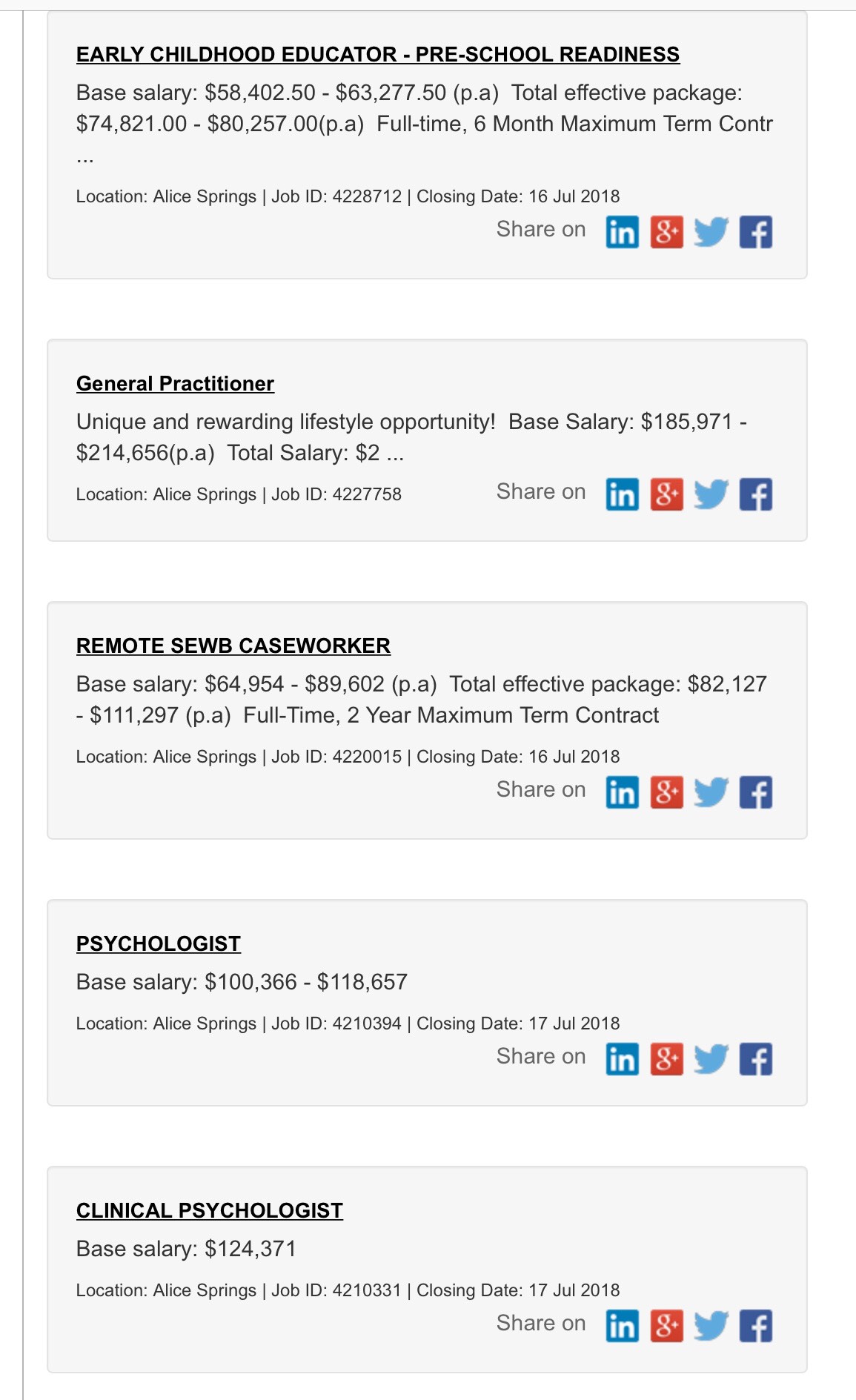
NT Jobs of the week 40 positions in the NT Alice Spring ,Darwin East Arnhem Land and Katherine

There are 13 JOBS at Congress Alice Springs including


More info and apply HERE

More info apply HERE

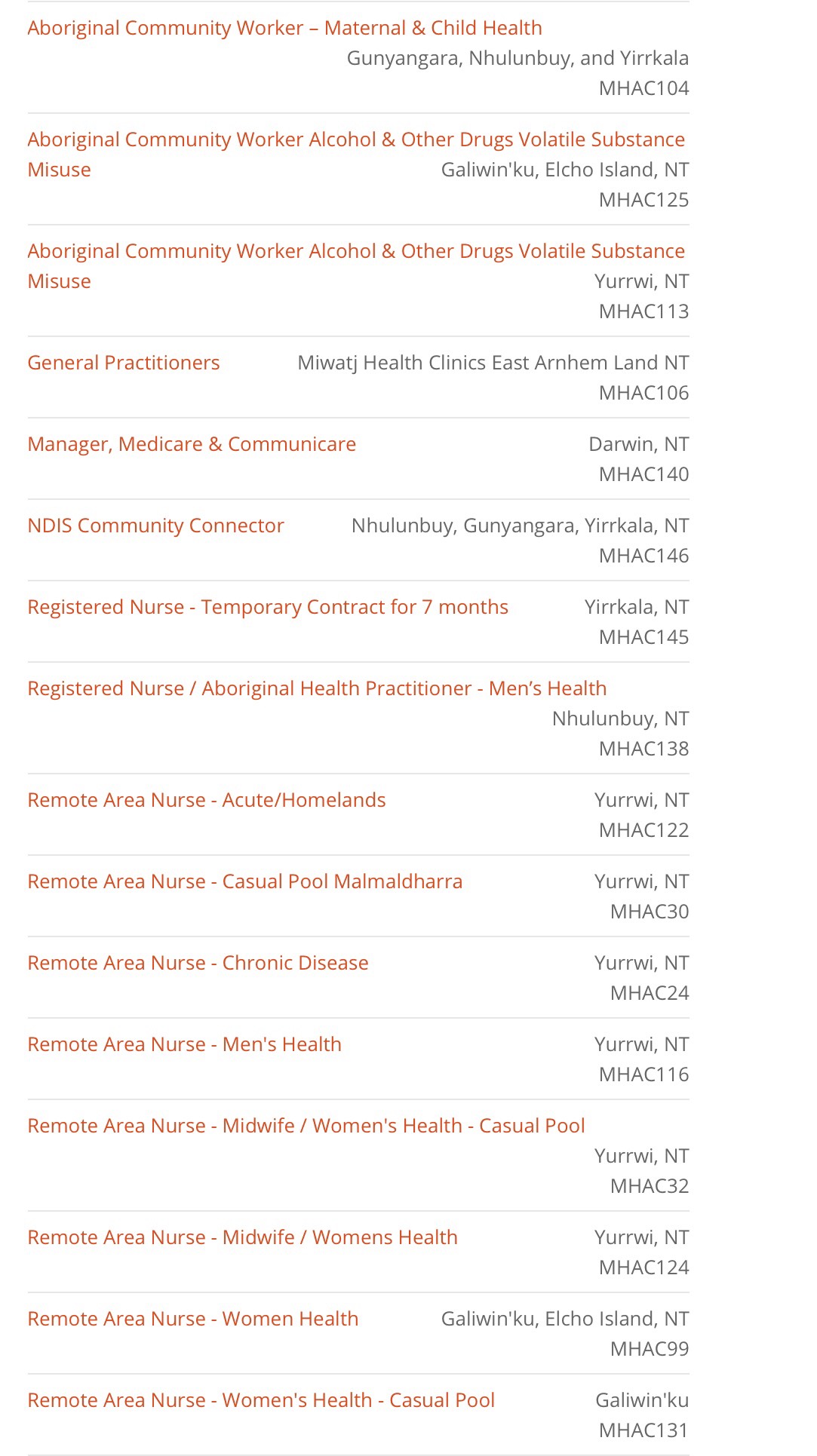
There are 17 JOBS at Miwatj Health Arnhem Land


More info and apply HERE

There are 2 JOBS at Wurli Katherine

More info and apply HERE


Aboriginal Health #Socialdeterminants and #Remote Housing Debate : @NACCHOChair urges Federal Government to maintain funding $ for remote Indigenous housing

“ NACCHO is extremely disappointed that the Commonwealth Government has recently walked away from all States’ Remote Housing funding agreements and only maintained smaller scale arrangements in the Northern Territory.

States have been offered short-term agreements and committed fewer funds.

Simply put, decent housing and reducing homelessness is critical to improving health outcomes for Aboriginal people’

We know it’s a significant concern for State Governments too

Mr John Singer Chairperson of NACCHO See full Press Release Part 1

It is morally reprehensible that the Federal Government can walk away from ongoing funding for remote communities after being involved in this space for 50 years.

If the PM does not step in to resolve this issue – as requested in a formal letter sent to him by WA Premier Mark McGowan on May 11 – he will be showing his true stripes as the so-called PM for Closing the Gap.

We want to Close the Gap – not slam the door.”

WA Housing Minister Peter Tinley : Read full Press Release Below Part 2 Remote communities’ campaign calls on Commonwealth for a fair go

“The people living in WA’s 165 remote communities are amongst the most vulnerable in Australia. There are significant challenges in servicing their communities to a suitable standard.

For the Federal Government to suggest that this is solely a State responsibility is a nonsense.

I would urge all Australians – including all members of the Liberal and National State Opposition whose silence on this issue to date has been noted – to get on board with this campaign.”

I’ve spent a lot of my life having to deal with the slings and arrows of being an Aboriginal person. Nigel Scullion is just the latest in that , he’s clearly unsuitable to try to resolve this issue and I am surprised and disappointed that he would resort to such rhetoric.”

WA Aboriginal Affairs Minister Ben Wyatt in The Guardian

WA minister says Scullion ‘unsuitable’ to resolve remote Indigenous housing dispute

and Press Release Part 2

“Without a decent place to live, the task of closing the gap in health or education becomes only more difficult,”

Shadow Assistant Minister for Indigenous Affairs, Senator Patrick Dodson said housing underpins all of the Close the Gap targets. See Part 3

Download NACCHO Press Release

NACCHO URGES FEDERAL GOVERNMENT TO MAINTAIN HOUSING Agreements

The National Aboriginal Community Controlled Health Organisation (NACCHO) is extremely concerned that the Federal Government has cut funding for the National Partnership Agreement on Remote Indigenous Housing.

Housing conditions in remote communities remain substandard, overcrowded and there are high rates of homelessness in remote communities. All of these contribute to poor health outcomes and prevalence of third world diseases like trachoma and rheumatic heart disease.

The WA State Government’s ‘Don’t Walk Away’ campaign, calls on the Federal Government not to abandon remote communities in Western Australia. For more information, visit http://www.dontwalkaway.wa.gov.au

NACCHO requests that the National Partnership Agreement on Remote Indigenous Housing funding is maintained to support efforts in Closing the Gap policies of the Federal government and Agreements with all States signed as a matter of urgency.

Part 2 Remote communities’ campaign calls on Commonwealth for a fair go

The WA McGowan Government started a campaign to pressure the Federal Government to not abandon 165 remote communities in Western Australia.

The ‘Don’t Walk Away’ campaign featured online and print media advertising, and promote a website with a call to action for people concerned about the plight of the almost 12,000 people living in remote communities across WA.

June 30 marked the end of a 10-year, $1.2 billion funding agreement between the Federal Government and the WA Government to support remote communities through the provision of housing.

The WA Government contributes about $90 million annually to maintain these communities through the provision of essential services such as power, water and waste management, infrastructure and regular maintenance activity.

The Federal Government’s own independent Remote Housing Review has identified that about 1,300 new homes will need to be built in WA in the coming decade to address issues of overcrowding in remote communities and to cater for population growth.

But despite months of haggling, the Federal Government has indicated it intends to wash its hands of further involvement in the provision of housing for remote services after making a payment of about $60 million over the next three years.

This will leave an approximate $400 million gap in the State’s finances over the forward estimates.

The State Government today issued a national call to action for all caring Australians to lobby Prime Minister Malcolm Turnbull – the so-called PM for Closing the Gap – to solve the current impasse and prevent indigenous Australians living in remote communities from further disadvantage.

For more information, visit http://www.dontwalkaway.wa.gov.au

Part 3 Labor Press Release TURNBULL WALKS AWAY FROM REMOTE INDIGENOUS HOUSING

Malcolm Turnbull has turned his back on remote Indigenous communities in Western Australia, South Australia and Queensland, with funding for remote housing in those states ceasing yesterday.

This is despite Senator Nigel Scullion’s repeated claims to contrary over the past six months.

This year’s Budget confirmed there would be no additional funding for these states in the National Partnership Agreement on Remote Indigenous Housing. Only the NT will continue to receive Commonwealth support to tackle overcrowding.

Shadow Homelessness Minister Doug Cameron said the Turnbull Government is walking away from remote communities. “This cut shows an appalling lack of leadership and a complete misunderstanding of the Close the Gap framework,” Senator Cameron said.

“Overcrowding is a root cause of Indigenous disadvantage because it leads to a range of other social and health problems in remote communities. Prior to the Budget, Senator Scullion’ described claims he was cutting the agreement as ‘fiction’ and ‘nonsense’.

In December 2017, Senator Scullion told the Guardian Australia that “commonwealth officials are in discussion with their state counterparts regarding future funding arrangements. This will include further Commonwealth funding.”

Shadow Assistant Minister for Indigenous Affairs, Senator Patrick Dodson, said housing underpins all of the Close the Gap targets. “Without a decent place to live, the task of closing the gap in health or education becomes only more difficult,” Senator Dodson said.

According to a 2017 review of the program, by 2018 the strategy will have delivered 4,000 new houses and 7,500 refurbishments The NPA is estimated to have led to a significant decrease in the proportion of overcrowded houses in remote and very remote areas.

It has also been a driver of job creation and Indigenous business’s in many remote communities.

With Malcolm Turnbull’s refresh of the Close the Gap strategy now underway, it is critical that the Turnbull Government does not walk away from any of the current targets.

Instead of walking away from programs that work – the Turnbull Government should be working with Indigenous communities to ensure services are delivered as efficiently and effectively as possible.


NACCHO Aboriginal Health #Saveadate Features #NAIDOCWeek #BecauseofHerWeCan Mum Shirl and NACCHO Women Leadership Tributes : Wiyi Yani U Thangani (Women’s Voices) #NACCHOagm2018 Registrations and Expression of Interest to present NOW OPEN

NAIDOC WEEK 2018 Tribute

NAIDOC Week celebrations will kicked off yesterday highlighting the histories, rich cultures, and outstanding achievements of Aboriginal and Torres Strait Islander peoples.

The 2018 theme #Becauseofherwecan highlighted the past and present contributions of Aboriginal and Torres Strait Islander women.

NAIDOC Week is an opportunity to celebrate the achievements of Aboriginal and Torres Strait Islander women – who are strong role models and leaders in their homes, communities and society more broadly

We can all play a part in improving outcomes for women and this year’s theme provides an opportunity to press even harder for progress in our ACCHO’s

These woman in our Part 1 and 2 tribute today represent the 45 years of ACCHO’s advocating for culturally respectful, needs based approach to improving the health and wellbeing outcomes of our people in the past and now into our healthy futures.

Part 1 Coleen Shirley Perry Smith AM MBE (22 November 1921 – 28 April 1998), better known as Mum Shirl, was a prominent Wiradjuri woman, social worker and humanitarian activist committed to justice and welfare of Aboriginal Australians. She was a founding member of the Aboriginal Legal Service, the Aboriginal Medical Service, the Aboriginal Tent Embassy, the Aboriginal Children’s Service and the Aboriginal Housing Company in Redfern, a suburb of Sydney. During her lifetime she was recognised as an Australian National Living Treasure

Mum Shirl was born as Coleen Shirley Smith in the Erambie Mission, near Cowra in 1921 to Joseph and Isabell Smith. She did not attend a regular school because of her epilepsy and was taught by her grandfather and learned 16 different Aboriginal Languages. She began to visit Aboriginal people in jail after one of her brothers was incarcerated and she discovered that her visits were beneficial to other prisoners as well.

Her community activism also saw her accompanying indigenous people who were unfamiliar with the legal system to court when they had been charged with a crime. Her nickname came from her habit of replying, “I’m his mum” whenever officials queried her relationship with the prisoners – the name by which she became widely known.[1]

Because of her work visiting Aboriginal prisoners, Mum Shirl is the only woman in Australia to have been given unrestricted access to prisons in New South Wales. “She’d be at one end of the state one day, and seen at the other end of the state the next day. The department wasn’t getting her from A to B. She used to rely on family and friends to get her around,” said Ron Woodham from NSW Corrective Services.[2] Later the Department of Corrective Services revoked her pass, making her prisoner support work near impossible.[3]

Smith’s welfare work, however, was not confined only to prisons and the legal system. She also spent considerable time and money finding homes for children whose parents could not look after them, and helping displaced children to find their own parents again. The children with nowhere to go often ended up living with her. By the early 1990s she had raised over 60 children. Likewise, many people with no family or friends in Sydney arrived at Mum Shirl’s Redfern house seeking shelter.

In 1970, Smith, along with Ken Brindle, and Chicka and Elsa Dixon, were the guiding force behind a group of young Aboriginal men and women who were involved in the campaign for land rights by the Gurindji people. This same group, with Fred Hollows and others helped to establish Aboriginal Medical Service in July 1971. They also helped establish the Aboriginal Legal Service in 1971, the Aboriginal Black Theatre, the Aboriginal Tent Embassy, the Aboriginal Children’s Service, the Aboriginal Housing Company and the Detoxification Centre at Wiseman’s Ferry.[4]

Part 2

NACCHO Aboriginal Women’s Health Leadership #IWD2018 We honour all the woman working in our #ACCHO’s over 45 years in #NT #NSW #QLD #WA #SA #VIC #ACT #TAS

  1. NSW : Dr Naomi Mayers one of the founders of Aboriginal Medical Service in Redfern ,AHMRC and NACCHO
  2. VIC: Jill Gallagher AO VACCHO CEO 2001-2018
  3. QLD : Pamela Mam establishment of the Aboriginal and Islander Community Health Service and Jimbelunga Nursing centre
  4. SA : Mary Buckskin (1955 – 2015 ) CEO of AHCSA for 8 years
  5. NT : Donna Ah Chee CEO Congress Alice Springs , NACCHO Board Member, Chair AMSANT former CEO NACCHO
  6. WA : Vicki O’Donnell. Chair AHCWA : CEO – Kimberley Aboriginal Medical Services.
  7. ACT : Julie Tongs OAM CEO Winnunga Nimmityjah Aboriginal Health Service, NACCHO Board Member,
  8. TAS. Heather Sculthorpe CEO Tasmanian Aboriginal Centre

10.Read over 336 NACCHO Aboriginal Women’s Health articles published in past 6 years

NAIDOC Week will be held from 8 – 15 July, guided by the theme ‘Because of her, we can!’ in recognition of the role of Aboriginal and Torres Strait Islander women

NAIDOC Week celebrations will kick off today, highlighting the histories, rich cultures, and outstanding achievements of Aboriginal and Torres Strait Islander peoples.

Minister for Indigenous Affairs, Nigel Scullion said that the 2018 theme highlighted the past and present contributions of Aboriginal and Torres Strait Islander women.

“NAIDOC Week is an opportunity to celebrate the achievements of Aboriginal and Torres Strait Islander women – who are strong role models and leaders in their homes, communities and society more broadly,” said Minister Scullion.

“The Turnbull Government proudly supports NAIDOC Week each year, and I am pleased to announce that a record number of organisations have received funding to celebrate 2018 NAIDOC Week.

This year, 528 organisations received grants through the Turnbull Government’s 2018 NAIDOC Week grants round.

The 2018 NAIDOC Week grants will support a variety of events in all states and territories, including a NAIDOC Touch Football Cup, historical recordings, art workshops, and cultural showcases and a Koori Cook Off.

“These grants support communities across the country to hold their own events, spreading understanding and pride of Aboriginal and Torres Strait Islander cultures – the oldest continuing culture in the world.

Many of the 2018 NAIDOC Week grant recipients will hold events in honour of the theme, including the Celebrating Tiwi Women Awards, the Djab Wurrung Women Elders event in Budja Budja, Victoria and a women’s story telling film and portrait exhibition project in Ballarat.

The week will culminate in the National NAIDOC Awards Ceremony, held in Sydney on 13 July to recognise the outstanding contributions of Aboriginal and Torres Strait Islander peoples in their communities and beyond.

The Turnbull Government is also supporting Aboriginal and Torres Strait Islander women every other week of the year through culturally appropriate, place-based and Indigenous-led services delivered mostly through Indigenous owned and controlled organisations as part of the $5 billion Indigenous Advancement Strategy (IAS).

Through the IAS we are investing $41 million in women and girls specific education programmes, more than $140 million in domestic violence prevention and support measures, in addition to the $100 million Third Action Plan, as well as a range of health and cultural initiatives for Aboriginal and Torres Strait Islander women.

The Turnbull Government is proud to be partnering with the Aboriginal and Torres Strait Islander Social Justice Commissioner, Ms June Oscar AO, who in February this year commenced a landmark national consultation process with Aboriginal and Torres Strait Islander women and girls.

The Wiyi Yani U Thangani (Women’s Voices) project commissioned by Minister Scullion is a national conversation with Aboriginal and Torres Strait Islander women and girls’ to understand their priorities, challenges and aspirations.

Findings will inform key policies and programs such as the Closing the Gap refresh, future investment under the Indigenous Advancement Strategy and development of the Fourth Action Plan of the National Plan to Reduce Violence Against Women and Their Children. Consultations are continuing through to November 2018.

The Aboriginal and Torres Strait Islander Social Justice Commissioner, June Oscar AO, warmly invites Aboriginal and Torres Strait Islander women and girls to come together as part of the Wiyi Yani U Thangani (Women’s Voices) project.

Aboriginal and Torres Strait Islander women and girls have many strengths and play a central role in bringing about positive social change for our families and communities.

Dr Jackie Huggins will be hosting these engagements on behalf of the Commissioner. Dr Huggins and the team will be speaking with Aboriginal and Torres Strait Islander women (18+) and girls (aged 12-17) through a series of community gatherings across the country, to hear directly about their needs, aspirations and ideas for change.

Please see details and registration options below.

EVENT DETAILS: Northern Territory – Borroloola, Katherine, Tiwi Islands and Darwin

Please join us for one of the following sessions and register by clicking on the relevant link. You can also email us at wiyiyaniuthangani@humanrights.gov.au or phone us on (02) 9284 9600.


Borroloola – Monday 23rd July 2018

  • Who: Aboriginal and Torres Strait Islander Women and Girls
  • Time: 9:30am – 1:30pm
  • Location: Mabunji Aboriginal Resource Centre, 2087 Robinson Road, Borroloola, NT 0854

Please click here to register for this event.


Borroloola – Tuesday 24th July 2018
  • Who: Aboriginal and Torres Strait Islander Women and Girls
  • Time: 9:30am – 1:30pm
  • Location: Mabunji Aboriginal Resource Centre, 2087 Robinson Road, Borroloola, NT 0854

Please click here to register for this event.


Katherine – Thursday 26th July 2018

  • Who: Aboriginal and Torres Strait Islander Women and Girls
  • Time: 9.30am – 1:30pm​
  • Location: Flinders University, O’Keefe House, Katherine Hospital, Giles Street, Katherine, NT 0850

Please click here to register for this event.


Wurrumiyanga (Bathurst Island) – Monday 30th July 2018

  • Who: Aboriginal and Torres Strait Islander Women and Girls
  • Time: 10.30am – 2.30pm
  • Location: Tiwi Enterprises – Mantiyupwi Motel – Meeting Room, Lot 969 Wurrumiyanga, NT 0822

Please click here to register for this event.


Pirlangimpi (Melville Island) – Wednesday 1st August 2018
  • Who: Aboriginal and Torres Strait Islander Women and Girls
  • Time: 9:30am – 1:30pm
  • Location: TBC

Please click here to register for this event.


Darwin – Thursday 2nd August 2018

  • Who: Aboriginal and Torres Strait Islander Women and Girls
  • Time: 9:30am- 1.30pm
  • Location: Michael Long Learning & Leadership Centre – Conference Room, 70 Abala Rd Marrara, Darwin, NT 0812

Please click here to register for this event.


Palmerston – Friday 3rd August 2018

  • Who: Aboriginal and Torres Strait Islander Women and Girls
  • Time: 9:30am – 1:30pm
  • Location: Palmerston Recreation Centre – Community Room, 11 The Boulevard, Palmerston, NT 0831

Please click here to register for this event.


Refreshments: Refreshments will be provided. Please register to ensure there is sufficient catering and please call or email to let us know any dietary requirements you may have.

Accessibility: The venue is accessible for people using wheelchairs. If you have any access or support requirements, such as an interpreter, please call or email us.

More information: Please see the website for further information about Wiyi Yani U Thangani (Women’s Voices), including a list of our planned gatherings.

If you are unable to attend this gathering, we would still like to hear from you through our submission process. For more details visit the submission page.

We hope you can take part in this important national conversation dedicated to Aboriginal and Torres Strait Islander women and girls.

Please share this invitation with others who may be interested in attending.

Should you have any questions please email wiyiyaniuthangani@humanrights.gov.au or phone (02) 9284 9600.

To find out more about NAIDOC Week and events in your community, visit naidoc.org.au.


NACCHO AGM 2018 Brisbane Oct 30—Nov 2 Registrations and Expressions of Interest now open

Follow our conference using HASH TAG #NACCHOagm2018

Brisbane Oct 30—Nov 2

Register HERE

Conference Website Link:          

Accommodation Link:                   

Book your early bird conference registrations before 30 June and save money per delegate.

The NACCHO Members’ Conference and AGM provides a forum for the Aboriginal community controlled health services workforce, bureaucrats, educators, suppliers and consumers to:

  • Present on innovative local economic development solutions to issues that can be applied to address similar issues nationally and across disciplines
  • Have input and influence from the ‘grassroots’ into national and state health policy and service delivery
  • Demonstrate leadership in workforce and service delivery innovation
  • Promote continuing education and professional development activities essential to the Aboriginal community controlled health services in urban, rural and remote Australia
  • Promote Aboriginal health research by professionals who practice in these areas and the presentation of research findings
  • Develop supportive networks
  • Promote good health and well-being through the delivery of health services to and by Indigenous and non-Indigenous people throughout Australia.

Expressions of Interest to present

NACCHO is now calling for EOI’s from Affiliates , Member Services and stakeholders for Case Studies and Presentations for the 2018 NACCHO Members’ Conference. This is an opportunity to show case grass roots best practice at the Aboriginal Community Controlled service delivery level.

Download the Application

NACCHO Members Expressions of Interest to present to the Brisbane Conference 2018 on Day 1

In doing so honouring the theme of this year’s NACCHO Members Conference; ‘Investing in What Works – Aboriginal Community Controlled Health’. We are seeking EOIs for the following Conference Sessions.

Day 1 Wednesday 31 October 2018

Concurrent Session 1 (1.15 – 2.00pm) – topics can include Case Studies but are not limited to:

  • Workforce Innovation
  • Best Practice Primary Health Care for Clients with Chronic Disease
  • Challenges and Opportunities
  • Sustainable Growth
  • Harnessing Resources (Medicare, government and other)
  • Engagement/Health Promotion
  • Models of Primary Health Care and
  • Clinical and Service Delivery.

EOI’s will focus on the title of this session within the context of Urban, Regional, Rural or Remote.  Each presentation will be 10-15 minutes in either the Plenary or Breakout rooms.

OR

Table Top Presentations (2.00-3.00pm)

Presenters will speak from the lectern and provide a brief presentation on a key project or program currently being delivered by their service.

Presentation will be 10 minutes in duration-with 5 minutes to present and
5 minutes for discussion and questions from delegates.

Conference Website Link


Dr Tracy Westerman’s 2018 Training Workshops
For more details and July dates


July 11-12 National NAIDOC Aboriginal and Torres Strait Islander Woman’s Conference in Sydney.

When the National NAIDOC Committee announced the 2018 Theme: Because of Her, We Can in November 2017 there was a huge round of applause around Australia particularly from Aboriginal and Torres Strait Islander Women.

Amongst those women were Christine Ross, Sharon Kinchela and Chris Figg who all agreed we needed to celebrate this fabulous theme.

So, with great excitement Ngiyani Pty Ltd announced they would host a National NAIDOC Aboriginal and Torres Strait Islander Women’s Conference to be held on 11 – 12 July 2018 at UNSW Kensington Campus Sydney. They are utlising the services of Christine Ross Consultancy as the Project Manager.

For all event enquires please call 1300 807 374 or email christine.ross@live.com.au


4 August National Children’s Day

National Aboriginal and Torres Strait Islander Children’s Day (Children’s Day) is a time for Aboriginal and Torres Strait Islander families to celebrate the strengths and culture of their children. The day is an opportunity for all Australians to show their support for Aboriginal children, as well as learn about the crucial impact that community, culture and family play in the life of every Aboriginal and Torres Strait Islander child.

Children’s Day is held on 4 August each year and is coordinated by SNAICC – National Voice for our Children. Children’s Day was first observed in 1988, with 2017 being the 29th celebration. Each year SNAICC produces and distributes resources to help organisations, services, schools, and communities celebrate.

The theme for Children’s Day 2018 is SNAICC – Celebrating Our Children for 30 Years.

Our children are the youngest people from the longest living culture in the world, with rich traditions, lore and customs that have been passed down from generation to generation. Our children are growing up strong with connection to family, community and country. Our children are the centre of our families and the heart of our communities. They are our future and the carriers of our story.

This year, we invite communities to take a walk down memory lane, as we revisit some of the highlights of the last 30 years. We look back on the empowering protest movements instigated by community that had led to the establishment of the first Children’s Day on 4 August 1988. We look back at all of the amazing moments we’ve shared with our children over the years, and how we’re watching them grow into leaders.

We look back to see what we’ve achieved, and decide where we want to go from here to create a better future for our children. If you have celebrated Children’s Day at any time during the past 30 years, we would love to hear from you.

Website

Download HERE

The recent week-long #MensHealthWeek focus offered a “timely reminder” to all men to consider their health and wellbeing and the impact that their ill health or even the early loss of their lives could have on the people who love them. The statistics speak for themselves – we need to look after ourselves better .

That is why I am encouraging all men to take their health seriously, this week and every week of the year, and I have made men’s health a particular priority for Indigenous health.”

Federal Minister for Indigenous Health and Aged Care Ken Wyatt who will be a keynote speaker at NACCHO Ochre Day in August

To celebrate #MensHealthWeek NACCHO has launches its National #OchreDay2018 Mens Health Summit program and registrations

The NACCHO Ochre Day Health Summit in August provides a national forum for all Aboriginal and Torres Strait Islander male delegates, organisations and communities to learn from Aboriginal male health leaders, discuss their health concerns, exchange share ideas and examine ways of improving their own men’s health and that of their communities

More Details HERE

All too often Aboriginal male health is approached negatively, with programmes only aimed at males as perpetrators. Examples include alcohol, tobacco and other drug services, domestic violence, prison release, and child sexual abuse programs. These programmes are vital, but are essentially aimed at the effects of males behaving badly to others, not for promoting the value of males themselves as an essential and positive part of family and community life.

To address the real social and emotional needs of males in our communities, NACCHO proposes a positive approach to male health and wellbeing that celebrates Aboriginal masculinities, and uphold our traditional values of respect for our laws, respect for Elders, culture and traditions, responsibility as leaders and men, teachers of young males, holders of lore, providers, warriors and protectors of our families, women, old people, and children.

More Details HERE

NACCHO’s approach is to support Aboriginal males to live longer, healthier lives as males for themselves. The flow-on effects will hopefully address the key effects of poor male behaviour by expecting and encouraging Aboriginal males to be what they are meant to be.

In many communities, males have established and are maintaining men’s groups, and attempting to be actively involved in developing their own solutions to the well documented men’s health and wellbeing problems, though almost all are unfunded and lack administrative and financial support.

To assist NACCHO to strategically develop this area as part of an overarching gender/culture based approach to service provision, NACCHO decided it needed to raise awareness, gain support for and communicate to the wider Australian public issues that have an impact on the social, emotional health and wellbeing of Aboriginal Males.

It was subsequently decided that NACCHO should stage a public event that would aim to achieve this and that this event be called “NACCHO Ochre Day”.

The two day conference is free: To register


October 30 2018 NACCHO Annual Members’ Conference and AGM SAVE A DATE

Follow our conference using HASH TAG #NACCHOagm2018

This is Brisbane Oct 30—Nov 2

The NACCHO Members’ Conference and AGM provides a forum for the Aboriginal community controlled health services workforce, bureaucrats, educators, suppliers and consumers to:

  • Present on innovative local economic development solutions to issues that can be applied to address similar issues nationally and across disciplines
  • Have input and influence from the ‘grassroots’ into national and state health policy and service delivery
  • Demonstrate leadership in workforce and service delivery innovation
  • Promote continuing education and professional development activities essential to the Aboriginal community controlled health services in urban, rural and remote Australia
  • Promote Aboriginal health research by professionals who practice in these areas and the presentation of research findings
  • Develop supportive networks
  • Promote good health and well-being through the delivery of health services to and by Indigenous and non-Indigenous people throughout Australia.

More Info soon

6. NACCHO Aboriginal Male Health Ochre Day 27-28 August

More info

7. NATSIHWA National Professional Development Symposium 2018

We’re excited to release the dates for the 2018 National Professional Development Symposium to be held in Alice Springs on 2nd-4th October. More details are to be released in the coming weeks; a full sponsorship prospectus and registration logistics will be advertised asap via email and newsletter.

This years Symposium will be focussed on upskilling our Aboriginal and/or Torres Strait Islander Health Workers and Health Practitioners through a series of interactive workshops. Registrants will be able to participate in all workshops by rotating in groups over the 2 days. The aim of the symposium is to provide the registrants with new practical skills to take back to communities and open up a platform for Health Workers/Practitioners to network with other Individuals in the workforce from all over Australia.

We look forward to announcing more details soon!

8.AIDA Conference 2018 Vision into Action


Building on the foundations of our membership, history and diversity, AIDA is shaping a future where we continue to innovate, lead and stay strong in culture. It’s an exciting time of change and opportunity in Indigenous health.

The AIDA conference supports our members and the health sector by creating an inspiring networking space that engages sector experts, key decision makers, Indigenous medical students and doctors to join in an Indigenous health focused academic and scientific program.

AIDA recognises and respects that the pathway to achieving equitable and culturally-safe healthcare for Indigenous Australians is dynamic and complex. Through unity, leadership and collaboration, we create a future where our vision translates into measureable and significantly improved health outcomes for our communities. Now is the time to put that vision into action.

AIDA Awards
Nominate our members’ outstanding contributions towards improving the health and life outcomes of Aboriginal and Torres Strait Islander Peoples.

9.CATSINaM Professional Development Conference

Venue: Hilton Adelaide 

Location:  233 Victoria Square, Adelaide, SA 

Timing: 8:30am – 5:30pm

We invite you to be part of the CATSINaM Professional Development Conference held in Adelaide, Australia from the 17th to the 19th of September 2018.
The Conference purpose is to share information while working towards an integrated approach to improving the outcomes for Aboriginal and Torres Strait Islander Australians. The Conference also provides an opportunity to highlight the very real difference being made in Aboriginal and Torres Strait Islander health by our Members.
To this end, we are offering a mixed mode experience with plenary speaker sessions, panels, and presentations as well as professional development workshops.

More info

The CATSINaM Gala Dinner and Awards evening,  held on the 18th of September, purpose is to honour the contributions of distinguished Members to the field.

10.Healing Our Spirit Worldwide

Global gathering of Indigenous people to be held in Sydney
University of Sydney, The Healing Foundation to co-host Healing Our Spirit Worldwide
Gawuwi gamarda Healing Our Spirit Worldwidegu Ngalya nangari nura Cadigalmirung.
Calling our friends to come, to be at Healing Our Spirit Worldwide. We meet on the country of the Cadigal.
In November 2018, up to 2,000 Indigenous people from around the world will gather in Sydney to take part in Healing Our Spirit Worldwide: The Eighth Gathering.
A global movement, Healing Our Spirit Worldwidebegan in Canada in the 1980s to address the devastation of substance abuse and dependence among Indigenous people around the world. Since 1992 it has held a gathering approximately every four years, in a different part of the world, focusing on a diverse range of topics relevant to Indigenous lives including health, politics, social inclusion, stolen generations, education, governance and resilience.
The International Indigenous Council the governing body of Healing Our Spirit Worldwide has invited the University of Sydney and The Healing Foundation to co-host the Eighth Gathering with them in Sydney this year. The second gathering was also held in Sydney, in 1994.
 Please also feel free to tag us in any relevant cross posting: @HOSW8 @hosw2018 #HOSW8 #HealingOurWay #TheUniversityofSydney

NACCHO Aboriginal Health and #DiabetesWeek #NDW2018 With Key Messages from @DiabetesAus @RuralDoctorsAus It’s About Time’ aims to raise awareness about the importance of early detection and early treatment for all types of diabetes

 ” Too many Australians especially Aboriginal and Torres Strait Islanders are being diagnosed with diabetes too late. This is true for both type 1 diabetes and type 2 diabetes. The delay in diagnosis is putting many people at risk of major life-threatening health problems.

Early diagnosis, treatment, ongoing support and management can reduce the risk of diabetes-related complications.

Diabetes:

  • is the leading cause of blindness in adults
  • is a leading cause of kidney failure
  • is the leading cause of preventable limb amputations
  • increases the risk of heart attacks and stroke by up to four times

It’s About Time we detected all types of diabetes earlier and save lives

See the itsabouttime.org.au for more info

 ” Aboriginal and Torres Strait Islander people are almost four times more likely than non-Indigenous Australians to have diabetes or pre-diabetes. Improving the lives of people affected by all types of diabetes and those at risk among Aboriginal and Torres Strait Islander communities is a priority for Diabetes Australia.

You can reduce the risk of developing type 2 diabetes by eating a more healthy diet and being physically active which will help maintain a healthy weight to keep your sugar (glucose) levels normal and your body strong.

If you have any worries about diabetes, check the symptoms below and find out more from your Aboriginal Health Worker, Health Clinic/Community Centre, Aboriginal Medical Service or doctor.”

Read over 140 NACCHO Aboriginal Health and Diabetes articles published over past 6 years

Part 1

More info HERE

Or watch NDSS Video HERE

 ” This National Diabetes Week, the Rural Doctors Association of Australia (RDAA) is urging rural and remote Australians to be alert for the early signs of diabetes, and to see their doctor as soon as possible if they are showing any symptoms.

RDAA is also urging those living in the bush to undertake preventative health checks to try to minimise the modifiable risk factors for developing Type 2 diabetes, like being physically inactive, smoking, having a poor diet, and being overweight or obese ”

RDAA President, Dr Adam Coltzau see Part 2 Below

 ” Digital technology is changing the way people living in regional and remote communities access information, and now there’s a new app to help people with diabetes.

Taken directly from a program used in 70 touchscreen kiosks throughout Australia, the Diabetes Story is a health information module developed specifically for Aboriginal and Torres Strait Islander people.

You can download the app at www.diabetesstory.info

See Part 3 Below

Part 2 Rural Doctors Press Release

“The theme of National Diabetes Week this year, It’s About Time, reflects the fact that too many Australians are being diagnosed with diabetes too late” RDAA President, Dr Adam Coltzau, said.

“In the case of Type 1 diabetes, late diagnosis can be life-threatening.

“And with any type of diabetes, early diagnosis, treatment and ongoing management can reduce the risk of diabetes-related complications.

“There are various types of diabetes, including:

Type 1 diabetes (an auto-immune disease which is not linked to modifiable lifestyle factors, cannot be prevented or currently cured, and is more commonly diagnosed in childhood)

Type 2 diabetes (which is associated with modifiable lifestyle risk factors and usually develops in adults over the age of 45 years, but is increasingly occurring in younger age groups including children)

“Symptoms for both these types can include excessive thirst, passing more urine, feeling tired and lethargic, and always feeling hungry — though many people with Type 2 diabetes often display no symptoms at diagnosis.

“Gestational diabetes is another form of diabetes, which typically affects between 12% and 14% of pregnant women and usually occurs around the 24th to 28th week of pregnancy.

“People who develop Type 1 diabetes will typically need to go onto insulin therapy for life (or until a cure is found), delivered either by multiple daily injections or via an insulin pump attached to their body.

“While Type 1 diabetes cannot be prevented, Type 2 diabetes can be delayed or prevented in up to 58 per cent of cases.

“Preventative health care starts with visiting your doctor for check ups and identification of early signs of Type 2 diabetes or pre-diabetes.

“Maintaining a healthy weight, being physically active and following a healthy eating plan, as well as managing blood pressure, cholesterol levels and not smoking, all help to prevent Type 2 diabetes from developing.

“Should Type 2 diabetes develop, early detection and management through lifestyle modifications is key to minimising its impact, as well as ensuring the early detection and treatment of any complications.

“If you have immediate concerns that you may have diabetes, make an appointment with your local GP, community nurse or diabetes educator to get it checked out sooner rather than later.”

Part 3 There’s a new app to help people with diabetes

Digital technology is changing the way people living in regional and remote communities access information, and now there’s a new app to help people with diabetes.

Taken directly from a program used in 70 touchscreen kiosks throughout Australia, the Diabetes Story is a health information module developed specifically for Aboriginal and Torres Strait Islander people.

You can download the app at www.diabetesstory.info

It uses digital technology to explain a complex issue in a direct, interesting way that encourages people “to take charge of their diabetes”.  It is an interactive self-management module that delivers culturally appropriate health and wellbeing diabetes information.

Consumers can use it on their mobile phones while health workers and educators will be able to use it on tablets to conduct mediated diabetes education sessions, and to provide further support for self-management.

The six domains are:

  1. a)  What is diabetes
  2. b)  Managing diabetes
  3. c)  Fighting diabetes
  4. d)  Diabetes in Pregnancy
  5. e)  Personal Stories
  6. f)   Where to get help

The App also has an audio function.

The Diabetes Story, both the module and App, has been a collaborative partnership with Aboriginal and Torres Strait Islander health organisations such as the Victorian Aboriginal community Controlled Health Organisation (VACCHO), the Victorian Aboriginal Health Service (VAHS), Aboriginal Community Controlled Health Services in North Queensland, as well as Diabetes Victoria, Diabetes Qld and Diabetes Australia.

The Diabetes Story project is funded under the National Diabetes Services Scheme (NDSS), an initiative of the Australian Government administered with the help of Diabetes Australia.


NACCHO Aboriginal Heart Health : Download @AIHW Report on #cardiac care for Indigenous people. Mortality falling but still “much higher” than non-Indigenous pop. Investment needed to #ClosetheGap #ACCHOs @Aus_Lighthouse @END_RHD @HeartAust

 ” Heart-related conditions, such as coronary heart disease, heart failure, and rheumatic heart disease (RHD), contribute substantially to poor health and reduced life expectancy among Aboriginal and Torres Strait Islander people.

Cardiac conditions are more common among Indigenous than non-Indigenous Australians, and there are many interconnected reasons for this, including higher rates of risk factors for cardiac conditions (such as smoking, low levels of physical activity, overweight or obesity, diabetes, and high blood pressure), and poorer access to preventative health services “

AIHW Report Released July 6

aihw-Cardiac Report

Read Previous NACCHO Aboriginal Heart Health : @HeartAust #NickysMessage “Heart disease is the number one killer of Aboriginal and Torres Strait Islander peoples. “

Read also over 50 Aboriginal Health and Heart Articles published over 6 Years

Better Cardiac Care project and selected extracts

The Better Cardiac Care for Aboriginal and Torres Strait Islander People project is an initiative that was developed at the Better Cardiac Care for Aboriginal and Torres Strait Islander People Forum, held in March 2014 (BCCF 2014).

Representatives from various Indigenous and other organisations, as well as Australian Government and jurisdictional health departments attended the forum.

The project aims to reduce mortality and morbidity from cardiac conditions among Indigenous Australians, by increasing access to services, better managing risk factors and treatment, and improving coordination of care.

The forum established 5 priority areas of interventions that health services should undertake to improve cardiac care for Indigenous Australians, which:

  • are aligned with national and international best-practice guidelines for cardiac care and chronic disease
  • were informed by the Essential Service Standards for Equitable National Cardiovascular Care
  • focus on providing sustainable models of care built around partnerships between all health service providers.

SEE AIHW WEBSITE

The 5 priority areas are:

  • primary preventive care—early cardiovascular risk assessment and management
  • clinical suspicion of disease—timely diagnosis of heart disease and heart failure
  • acute episode—guideline-based therapy for acute coronary syndrome
  • ongoing care—optimisation of health status and provision of ongoing preventive care
  • rheumatic heart disease—strengthening the diagnosis, notification, and follow-up of RHD.

A set of 21 Better Cardiac Care measures (Table 1.1) were also developed to track the implementation and monitoring of the priority areas and associated actions

2 Results

Priority area 1: Early cardiovascular risk assessment and management

Priority area 1 of the Better Cardiac Care project is early cardiovascular risk assessment and management. This is based on the premise that all Aboriginal and Torres Strait Islander people with no known cardiac disease should receive:

  • an annual cardiovascular risk assessment
  • appropriate management and follow-up for identified cardiac disease risk factors
  • lifestyle modification advice appropriate to their cardiovascular risk level, as per current guidelines (NACCHO & RACGP 2012).

Primary prevention in the form of early and consistent risk factor identification and management will improve long-term outcomes for Indigenous Australians, reduce the population burden of chronic cardiac disease, and improve the appropriate delivery of care by the health-care system (BCCF 2014).

Three measures were agreed upon within this priority area, and updated data are available for measure 1.1 on health assessments.

The data for measure 1.2 are expected to become available for the next report, which will be provided based on the AIHW data collection on the national key performance indicators for Aboriginal and Torres Strait Islander primary health care.

Measure 1.1: Annual health assessments

This measure reports on the number and proportion of Indigenous Australians who had a Medicare Benefits Schedule (MBS) health assessment in the previous 12 months (Table B.2 in Appendix B contains the list of relevant MBS item numbers included in the measure).

Why is it important?

Health assessments aim to increase preventative health opportunities, detect chronic disease risk factors, manage existing chronic disease, and reduce inequities in access to primary care for Indigenous Australians. Early detection and management of risk factors for cardiac disease (such as smoking, physical inactivity, high blood pressure) can reduce the incidence of cardiac disease and lessen its severity.

All Indigenous Australians are eligible for an annual health assessment, which is listed as item 715 on the MBS.This comprehensive health asessement covers a wide variety of risk factors related to cardiac disease and other chronic diseases, including medical history, nutrition, physical activity, smoking and alcohol intake, living conditions, and body mass index, although it is not a specific cardiovascular risk assessment. People within specified target groups may also be eligible for other types of MBS health assessments (Department of Health 2014), which are referred to as ‘general’ health assessments in this report.

Results

Overall:

  • In 2015–16, more than one-quarter of Indigenous Australians (27%, or an estimated 199,400 people) received a health assessment—about 26% received an MBS item 715 health assessment, and about 1% received a general health assessment (Figure 1.1a).

Time trend:

  • Between 2004–05 and 2015–16, the age-standardised proportion of Indigenous Australians who had an MBS health assessment rose from 2% to 27% for females, and from 2% to 24% for males (Figure 1.1b).
  • From 2014–15 to 2015–16, the overall proportion rose by 3 percentage points.
  • A marked increase occurred from 2010–11, coinciding with the introduction of the Australian Government’s Indigenous Chronic Disease Package.

Sex and age:

In 2015–16:

  • more Indigenous females than males had an MBS health assessment (Figure 1.1b)
  • about one-quarter (25%) of Indigenous children aged under 15 had an MBS health assessment. Among Indigenous Australians aged 15 and over, the proportion rose from 21% among those aged 15–24 to 38% among those aged 65 and over (Figure 1.1c).

State/territory and remoteness area:

In 2015–16, the proportion of Indigenous Australians who had an MBS health assessment was:

  • highest in Queensland (33%), and lowest in Tasmania (9%) (Figure 1.1d)
  • highest in Inner/Outer regional areas combined (29%), and lowest in Major cities (21%)

Priority area 2: Timely diagnosis of heart disease and heart failure

Priority area 2 of the Better Cardiac Care project is timely diagnosis of heart disease and heart failure.

This is based on the premise that all Aboriginal and Torres Strait Islander people suspected of having heart disease or heart failure should receive appropriate initial diagnostic services (such as stress testing or coronary angiography for ischaemic heart disease, or echocardiography for heart failure and rheumatic heart disease) as close to the patient’s home as possible, within acceptable timeframes according to the level of risk and the patient’s condition (BCCF 2014).

Of the 3 measures recommended for this priority area, data are available for:

  • measure 2.1 for Medicare-listed diagnostic items
  • measure 2.3 for cardiologist review of suspected/confirmed cardiac disease

Measure 2.1: Cardiac-related diagnosis

This measure reports on the number and proportion of Indigenous Australians who had 1 or more relevant cardiac-related MBS diagnostic item claims in the previous 12 months, compared with non-Indigenous Australians (Table B.2 in Appendix B contains the list of relevant MBS item numbers included in the measure).The current report includes additional MBS items within measure 2.1, compared with the second national report (AIHW 2016); as such the results are not comparable. Additional MBS items were used to more accurately capture the status of cardiac-related diagnoses, and were obtained from the Cardiac Services Clinical Committee of the Medical Benefit Schedule Review Taskforce (Department of Health 2017).

Why is it important?

People suspected of having cardiac disease should receive appropriate and timely diagnostic services. Categories of diagnostic tests captured by this measure include:

  • diagnostic procedures and investigations—19 items that include various kinds of electrocardiography, and pacemaker and defibrillator testing
  • diagnostic imaging services—25 items that include various kinds of echocardiography, computed tomography scans and angiography (Department of Health 2018).

Results

Overall:

In 2015–16:

  • 64,909 MBS claims for cardiac-related diagnostic items were made for Indigenous patients (age-standardised proportion of 13.2%), compared with 3,178,327 claims for non-Indigenous patients (proportion of 12.1%).
  • 45,932 claims for diagnostic procedures and investigations (age-standardised proportion of 9.3%), and 18,977 claims for diagnostic imaging services (age-standardised proportion of 3.9%) were made for Indigenous patients—both proportions were slightly higher than for non-Indigenous Australians (Figure 2.1a).

Time trend:

  • Between 2004–05 and 2015–16, the age-standardised proportion of Indigenous Australians who had cardiac-related diagnostic items MBS claims rose from 6.8% to 10.4%, with a similar pattern for non-Indigenous Australians (rising from 6.9% to 9.1%) (Figure 2.1b).

Sex and age:

In 2015–16, the proportion of Indigenous Australians who had MBS claims for cardiac-related diagnostic items:

  • rose with increasing age, with the lowest proportion among those aged under 25. It was slightly higher than that of non-Indigenous Australians in all age groups, except for those aged 65 and over, where proportions were higher among non-Indigenous Australians (Figure 2.1c)
  • was lower overall than that of non-Indigenous Australians, for men and women, with Indigenous women having slightly higher proportions than Indigenous men (Figure 2.1d).

Better Cardiac Care measures for Aboriginal and Torres Strait Islander people 2017 11

State/territory and remoteness area:

In 2015–16, the proportions of MBS claims for cardiac-related diagnostic items:

  • ranged from 3% to 13% across states and territories, and from 7% to 8% across remoteness areas among Indigenous Australians (figures 2.1e and 2.1f)
  • were lower among Indigenous Australians living in Major cities and Inner/Outer regional areas combined than their non-Indigenous counterparts (Figure 2.1f).

Priority area 4: Optimisation of health status and provision of ongoing preventive care

Priority area 4 is optimisation of health status and provision of ongoing preventive care. This is based on the premise that all Aboriginal and Torres Strait Islander people with cardiac conditions should receive ongoing multidisciplinary primary health care and specialist physician follow-up as required, to prevent further illness, and to optimise health status (BCCF 2014).

Of the 4 measures recommended for this priority area, MBS data are available for:

  • measure 4.2 for follow-up after receiving a cardiovascular therapeutic procedure
  • measure 4.3 for specialist physician review after a cardiovascular therapeutic procedure

Priority area 5: Strengthening the diagnosis, notification and follow-up of rheumatic heart disease

Priority area 5 of the Better Cardiac Care project is strengthening the diagnosis, notification and follow-up of rheumatic heart disease (RHD) (BCCF 2014). This is based on the premise that:

  • all Aboriginal and Torres Strait Islander people suspected to have acute rheumatic fever (ARF) or RHD should receive an echocardiogram as early as possible
  • new cases should be automatically reported to a central register to help track patients, and ensure ongoing care.

There is no diagnostic pathology test for ARF; instead, its diagnosis is based on a clinical decision (RHD Australia et al. 2012). The clinical manifestation of ARF is non-specific and can be atypical, with delays in both presentation and referral of patients. As a result, ARF can often go undetected in the acute stage, leading to ongoing complications and lifelong morbidity.

Of the 4 measures recommended for this priority area, data are available from RHD registers in Queensland, Western Australia, South Australia, and the Northern Territory for:

  • measure 5.1 for the annual incidence of ARF and RHD
  • measure 5.2 for recurrent ARF
  • measure 5.3 for treatment with benzathine penicillin G doses
  • measure 5.4 for echocardiograms among patients with severe or moderate RHD.

NACCHO Aboriginal Children’s Health : Read @keenan_mundine’s powerful speech to @UNHumanRights Council calling for Australian Governments to end injustice of Indigenous kids in prison #RaisetheAge Plus #IndigenousX 8 things the government can do right now to end this injustice “

“I have spent more than half of my life behind bars, and I want to make sure this will not be the same future for my children.

Right now, children as young as ten are still being locked away in prisons across Australia.

This year alone, around 600 children under the age of 14 were taken from their families and imprisoned. This injustice must end.

”In joining this Council, the Australian Government promised to uphold human rights and champion Indigenous peoples’ rights. For as long as Indigenous children are 25 times more likely to be sent to prison than non-Indigenous children, these will be hollow promises “

Indigenous advocate, Keenan Mundine, a former youth prisoner and principal consultant of Inside Out Aboriginal Justice Consultancy, has travelled to Geneva to address the UN Human Rights Council about the Turnbull Government’s failure to stop ten year old children being sent to prison.

 ” The justice system is stacked against Aboriginal and Torres Strait Islander kids at every stage, from police through to the courts. It is undeniable that racism is a factor, whether it’s institutional or direct.

It is also clear that invasion and past policies of dispossession of land, stolen children and discrimination has led to this shocking statistic, with a direct link proven between contact with the justice system and the entrenched poverty, homelessness, child removal, lack of education, family violence, substance abuse, disability, mental and other health issues.

But there are solutions. Here are 8 things the government can do right now to end this injustice “

Cheryl Axleby Chair of NATSILS From Indigenous X

Two years after the ABC’s Four Corners program exposed horrific abuse of children in the Don Dale prison, pressure is mounting on Australian state and territory governments to raise the age of criminal responsibility from 10 to 14 years.

Mr Mundine told the Council – the world’s peak human rights body of which Australia is now a member – that the Turnbull Government must stop ignoring human rights abuses at home.

“I have travelled from across the world to address this Council because I want my sons to grow up in a country that treats them fairly. This one simple change to our laws, will make a very big difference. Indigenous children in Australia deserve what I was denied – equality and freedom,” said Mr Mundine.

The Turnbull Government called for the Northern Territory Royal Commission into the horrors of Don Dale in 2016, but has failed to deliver a key recommendation for reform – raising the age at which children can be charged, hauled before the courts and sent to prison.

Australia has one of the lowest ages of criminal responsibility in the democratic world. The average age in Europe is 14 years.

The National Aboriginal and Torres Strait Islander Legal Services, the Human Rights Law Centre, Amnesty International and other medical, Indigenous and human rights organisations have been pushing all Australian governments to commit to raising the age of criminal responsibility.

Cheryl Axleby, Co-Chair of the National Aboriginal and Torres Strait Islander Legal Services, said in addition to raising the age to 14 years, more support was needed for Indigenous-led programs.

“Australian youth prisons are institutional racism in action. Criminalising the behaviour of young, vulnerable children – who are mostly Aboriginal or Torres Strait Islander – creates further disadvantage and traps children in the criminal justice system. It’s time to raise the age to 14 and fund wrap-around Indigenous-led supports that keep kids strong in culture and community,” said Ms Axleby.

When seeking election to the Human Rights Council, the Turnbull Government pledged to put Indigenous rights front and centre and progress the realisation of human rights through the implementation of UN recommendations and resolutions.

In the last five years, the UN has demanded Australia uphold children’s rights and raise the age of criminal responsibility on numerous occasions.

Ruth Barson, a Director of Legal Advocacy at the Human Rights Law Centre, said children should be in classrooms not courtrooms.

“No child should be strip searched, hand cuffed, or locked in a prison cell. The Turnbull Government cannot defend human rights on the world stage, while allowing primary school aged children to be sent to prisons at home. Raising the age is a simple reform that would make a world of difference. What we need is for our governments to show some leadership,” said Ms Barson.

Across Australia, Aboriginal and Torres Strait Islander children make up over 50% of the children locked away in youth prisons. Western Australia, the Northern Territory and South Australia have the highest Aboriginal and Torres Strait Islander youth imprisonment rates in the country.

Belinda Lowe, Indigenous Rights Campaigner at Amnesty International, said the criminal justice system is failing kids and it’s failing communities.

“Children thrive best with their families and in their communities. Let’s instead focus on prevention not detention. Let’s raise the age that kids can be put behind bars, and provide early support to children and their families who are facing difficulties in their lives, so children don’t offend in the first place,” said Ms Lowe.

This session of the Human Rights Council session will run until 6 July.

The Human Rights Law Centre will attend every day of the Council session and provide regular updates on the Australian Government’s actions.

Read: Keenan Mundine’s statement

Watch: Keenan Mundine’s statement

Plus Indigenous X post

Cheryl Axleby Chair of NATSILS From Indigenous X

Every single child in prison in the Northern Territory is Indigenous.

This is systemic racism in action.

This damning fact is causing outrage across Australia, two years after we saw the torture and abuse coming out of Don Dale Youth Detention Centre in the nightmarish Four Corners Report. A Royal Commission followed, with hundreds of recommendations to end the over-representation of Aboriginal and Torres Strait Islander kids in prison, yet here we are.

But the Northern Territory is not alone; Aboriginal and Torres Strait Islander kids are over-imprisoned in every state and territory in Australia, and are locked up at a rate 25 times higher than that of other youth.

We know the reasons why, and it’s not because there are no “bad” non-Indigenous children in the Northern Territory.

The justice system is stacked against Aboriginal and Torres Strait Islander kids at every stage, from police through to the courts. It is undeniable that racism is a factor, whether it’s institutional or direct.

It is also clear that invasion and past policies of dispossession of land, stolen children and discrimination has led to this shocking statistic, with a direct link proven between contact with the justice system and the entrenched poverty, homelessness, child removal, lack of education, family violence, substance abuse, disability, mental and other health issues.

But there are solutions. Here are 8 things the government can do right now to end this injustice:

1. Support children, families and communities to stay strong and together

No child belongs in prison.

Prison doesn’t “work” – many kids come out damaged and more likely to go back in. Children need love and support and the care of their communities, so they can be brought up strong in their identity and connection with country.

There is a large cross-over between experiencing child removal, disability, family violence, mental health issues, and the justice system. But families need culturally appropriate wrap-around supports in place to stay strong and together. Policies need to change to stop forced child removals, reduce family violence and help heal the ongoing trauma of the Stolen Generations.

2. Raise the Age of Criminal Responsibility

Australia is far behind the rest of the world in locking up very young children – the global median age of criminal responsibility is 14, but the Australia-wide age is 10.

Science shows these young children are not yet able to understand the long-term consequences of their actions, or to control their impulses. It is often the most vulnerable and disadvantaged children who come to the attention of the justice system at a young age.

Once in the system, younger children are more likely to be return to prison. Aboriginal and Torres Strait Islander kids are hugely over-represented in this age bracket, so raising the age will help to end their over-representation in the system.

The NT Royal Commission recommended for government to raise the age. The UN has repeatedly criticised Australia for locking up kids as young as 10, which is below minimum international standards and recommended age, and a breach of their rights under the Convention on the Rights of the Child. It’s time for all Australian governments to #RaisetheAge to 14.

3. Get children who are not sentenced out of prison

Most kids in prison are not sentenced and may not even have had their trial yet. This goes against international standards and can be incredibly damaging for kids, leading to further contact with the justice system.

This can be due to police and courts not granting children bail, as well as delays in court processes and legal representation. Compliance with and over-policing of bail conditions is a huge issue for Aboriginal children, or not having a “suitable” address to be bailed to, or a guardian available to come to court.

This can be fixed by having better family supports in place so bail isn’t denied due to welfare reasons, amending unfair bail legislation, increased funding and access to Aboriginal and Torres Strait Islander Legal Services, bail support programs, having custody notification services in place and investing in community alternatives to prison.

4. Adequately fund Aboriginal and Torres Strait Islander community-controlled legal and other support services

Aboriginal and Torres Strait Islander Legal Services and Family Violence Legal Prevention Services are the preferred and often only option for legal representation for Aboriginal and Torres Strait Islander people.

These services are community-controlled and culturally safe, and understand the systemic issues that stack the system against Indigenous people. However, these are desperately under-resourced to meet legal need, and despite the reversal of further fundings cuts in 2017, budget papers show that Aboriginal and Torres Strait Islander Legal Services will face a further $5m cut from 2020.

It’s not just legal services that struggle for funding, but most Aboriginal Community-Controlled Organisations across health, disability, education, housing and youth justice diversion.

In the Northern Territory, Bushmob had to end its bush camp program – where the government could have been sending kids to learn life skills and reconnect with culture, rather than to prison.

Another example is Balit Ngulu – the only Aboriginal youth specific legal service in Australia – is facing closure this year due to lack of funding. Our communities have the answers but they need Government support.

5. End abusive practices in prisons

Whether it’s Don Dale, Cleveland, Banksia Hill, Bimberi, Parkville, Cobham – children in prisons around Australia are subject to solitary confinement, strip searches, assaults, spit hoods, hog-tying, sedating, deprivation of food, hygiene, exercise and education. These abuses are an indictment on Australia and they are continuing to happen right around the country. This year it was revealed that one young man in Banksia Hill spent over a year in isolation.

Independent oversight is needed so these human rights abuses end and perpetrators are held accountable.

6. Set targets to end the overrepresentation of Aboriginal and Torres Strait Islander children in prison

Decades have gone by without any progress on the rates of overrepresentation of Aboriginal and Torres Strait Islander kids in prison.

The Federal Government must set national justice targets on ending rates of imprisonment and violence as part of the Closing the Gap framework so it can measure, track, report and be held accountable for achieving national progress on ending the overrepresentation of Aboriginal and Torres Strait Islander children in prison.

There is currently a refresh of the targets – now is the time to add them in.

7. Improve collection and use of data

It is amazing how much we simply do not know about children being deprived of their liberty, because governments are either not tracking or refuse to be transparent about youth justice data.

Data is necessary to inform smart and effective policy choices, and to fully understand the over-representation of Aboriginal and Torres Strait Islander kids by different age groups, genders, disability, socio-economic groups, LGBTIQ+ identity and geographic locations.

8. Work through COAG to reform State and Territory laws that breach children’s rights

The Australian Government must accept that this is a national shame which demands national leadership.

The solutions are in the recommendations of the avalanche of commissions and inquiries stemming back to the Royal Commission into Aboriginal Deaths in Custody over 27 years ago.

Most recently, solutions were set out in the Northern Territory Royal Commission Report and the Australian Law Reform Commission’s ‘Pathways to Justice’ Report – neither of which have received an adequate national response.

The Australian Government can set minimum youth justice standards to make sure that all laws are compliant with human rights and do not disproportionately affect Indigenous kids.

NATSILS, as part of Change The Record Coalition, called for these changes last year in response to the NT Royal Commission as part of a National Plan of Action. The Australian Government must hear our voices and adopt our recommendations so that our children are no longer abused in prison, and instead are supported to thrive in their communities.

NACCHO Aboriginal Childrens Health and Protection : Put services in hands of Indigenous @AMSANTaus #ACCHO groups like @CAACongress and Anyinginyi #TennantCreek says Federal #Indigenous Affairs Minister Nigel Scullion

“Aboriginal health services were out­performing the mainstream system not because there was “anything wrong” with the latter, but because Indigenous organisations were more engaged with people on the ground.

They are completely irrigated with people with cultural competence it’s working, and wherever we invest in services and deal with a large Indigenous demographic, we need to invest in Indigenous organisations,

If I’m in Alice Springs and a log falls on my head, take me to Congress (Central Australian Aboriginal Congress), and if I’m in Tennant Creek to Anyinginyi (Anyinginyi Health), because they are better, more sophisticated, larger, deeper-capacity health systems, Why wouldn’t we be moving, instead of having two health systems, to having a single one?”

Federal Indigenous Affairs Minister Nigel Scullion has called on state and territory governments to hand ­Aboriginal organisations control of services in areas where most ­Indigenous people live.

Adapted from The Australian

Doing so would also benefit non-indigenous Australians through improved service delivery, he said, arguing that in the Northern Territory, Aboriginal-run health services outperform the public health system.

Senator Scullion visited the troubled outback NT town of Tennant Creek yesterday with Social Services Minister Dan Tehan. They met local service providers, including representatives of Aboriginal groups, the police and the education system.

Senator Scullion said there was “no enterprise” that Aboriginal ­organisations could not undertake, and claims to the contrary were tantamount to racism.

Mr Tehan said the message he and Senator Scullion had heard “loud and clear” was that better service co-ordination was the key to resolving the town’s problems.

“The royal commission (into the protection and detention of children in the NT) made it very clear that this isn’t a financial resourcing issue; this is about better co-ordination of services,” he said.

Tennant Creek has been in upheaval since the rape of a toddler in February brought longstanding problems into the spotlight. It later emerged that a series of blunders had prevented child protection services from removing the girl when she was at risk.

NT Minister for Territory Families Dale Wakefield said her department had since reviewed more than 150 cases involving multiple child protection notifications and uncovered further failings, but no children had been taken into protective custody as a direct result. It emerged recently that 15 Tennant Creek children had been put into care ­between February and June.

“We have now put in place a system where we will be reviewing 50 cases each month,” Ms Wakefield said. “I’m confident that there’s more oversight and more resources in Tennant Creek.”

Territory Families received 1515 child protection notifications from Tennant Creek in the nine months to the end of March and completed 578 investigations. Of those, there were 181 occasions where harm was substantiated, a 10 per cent increase on the previous year.

Acting Assistant Police Commissioner Michael White said stricter alcohol restrictions had helped cut domestic violence by about 20 per cent. He said there was no evidence to support claims the worst offenders had merely moved elsewhere.


NACCHO Aboriginal Health : @theMJA Publishes special @naidocweek #IndigenousHealth #CloseTheGap #Ulurustatement #FirstNations open access edition

 ” While Closing the Gap has become an iconic representation of Indigenous advocacy, it remains essential to maintain focus on the individual components of disease processes, epidemiology, intervention delivery, and cultural mechanisms that influence the achievement of significant change.

The MJA will ensure it strengthens its role in delivering the relevant data to clinicians, policy developers, and the Australian community.

Indigenous health: One gap is closed See Part 1 Below

“DESPITE a slight narrowing over the past decade, the life expectancy gap between Aboriginal and Torres Strait Islander Australians and the general population remains significant.

On average, the lives of Aboriginal and Torres Strait Islander people are around a decade shorter than those of non-Aboriginal Australians – a shocking statistic for a high income country.

This gap has been attributed to many factors, most of which relate to high levels of socio-economic disadvantage.

Now, new research points to multimorbidity as a significant driver of higher mortality rates in Aboriginal and Torres Strait Islander populations.”

See Part 2 Below Multimorbidity as a significant driver of higher mortality rates

  ” Aboriginal people are under stress and we need to take some of that away by recognising their existence and their self-determination. The Uluru Statement is a good place to start.”

He says that he’s no hand wringer and he’s optimistic that the cultural change can happen.

The government won’t take constitutional recognition to a referendum yet because it doesn’t think the public has come around to it. But I think the public is ahead of the government here, just as it was for same-sex marriage. There’s an enormous willingness in the public to embrace First Nations people. I think there’s a huge capacity for change.”

The Uluru Statement is a good place to start SEE Part 3 Below

Read full edition Here

Part 1 Indigenous health: one gap is closed

The 2017 MJA Indigenous health issue explored the social determinants of health that are essential to closing the gap between health outcomes for Indigenous and non-Indigenous Australians, specifically targeting cultural awareness and communication.1

The issue also placed recent gains in the life expectancy of Indigenous Australians in perspective,2 and recognised achievements by an often silent yet dedicated clinical community.

The Journal has continued to develop these themes. In this year’s Indigenous health issue, four research papers and the accompanying editorials underline the progress we are making as a journal and as a medical community in bringing about meaningful change.

In this respect, the report by Hendry and colleagues,3 documenting the effective closure of the gap in vaccination rates, is particularly heartening. Vaccination is recognised by the World Health Organization as one of the most cost-effective interventions in public health.4 Hendry and her co-authors describe a program in which Aboriginal Immunisation Healthcare Workers identify and follow up Indigenous children due or overdue for vaccinations, a program that has achieved equality of full vaccination coverage for Indigenous and non-Indigenous children in New South Wales at 9, 15 and 51 months of age.

This remarkable outcome is especially significant given the high background susceptibility of Indigenous children to vaccine-preventable diseases. While it is not clear whether the improvement in vaccination rates is attributable to the dedicated program structure or to the deployment of culturally aware health workers, it is certain that partnerships between modern clinical methods and traditional cultural awareness will continue to be the model of choice for improving Indigenous health.

Also noteworthy is the authors’ combination of high quality research with statistically sound methodology in a culturally appropriate setting, a mix essential to the Journal, as detailed in the 2017 Indigenous health issue.1,5 Banks and colleagues6 applied similarly robust and culturally appropriate methodology to draw attention to the substantial undertreatment with lipid-lowering therapies of Aboriginal and Torres Strait Islander people at high risk of cardiovascular disease.

They found that 4.7% of Indigenous people aged 25–34 years are at high primary risk, but this age group is not assessed for cardiovascular disease risk under current national guidelines. The accompanying editorial7 summarises a suite of targeted interventions that build on these and other findings published in the Journal.8 While these approaches are no doubt important, adapting the successful approach of Hendry and colleagues’ to vaccination,3 to provide a similarly structured intervention for lipid-lowering therapy, could be a game-changing strategy for closing the gap in cardiovascular disease.

The MJA recognises the power of big data and data linkage studies. Randall and colleagues9 analysed linked hospital and mortality data to explore in depth multimorbidity in Indigenous patients in NSW.

The necessary policy and clinical responses are placed in perspective by Broe and Radford10 in their editorial. They note the especially higher level of comorbidities among Aboriginals in mid-life age groups than in non-Aboriginals of the same age, and that this difference is correlated with the age-group peak in the mortality gap between Indigenous and non-Indigenous Australians, highlighted in this Journal last year.2 While the wealth of information made available by big data-based research can sometimes be overwhelming, the MJA prioritises analyses that can change practice..

Finally, Gunasekera and colleagues11 report the high degree of agreement between diagnoses by audiologists and otolaryngologists of otitis media in Aboriginal children, suggesting that audiologists could triage cases in areas where specialist services are limited.

The false negative rate was low — in 3.0% of children, audiologists did not diagnose otitis media subsequently detected on image review by an experienced otolaryngologist — and the most serious form, tympanic membrane perforation, was never missed. These findings may open pathways for children in high risk settings — where otitis media is common (prevalence of 29% in this study) but otolaryngologists are few — to more efficiently receive specialist care.

The articles in this issue show that progress in medical and research methodology can be meaningfully combined with cultural sensitivity. The Journal welcomes submissions that further develop these approaches. More broadly, the MJA will continue to highlight emerging issues of significance to Indigenous health, and is leading a global collaboration with major overseas medical journals to publish a joint issue on the health of indigenous peoples around the world in 2019.

While Closing the Gap has become an iconic representation of Indigenous advocacy, it remains essential to maintain focus on the individual components of disease processes, epidemiology, intervention delivery, and cultural mechanisms that influence the achievement of significant change. The MJA will ensure it strengthens its role in delivering the relevant data to clinicians, policy developers, and the Australian community.

Part 2

Published in the MJA, the study linked hospital and mortality data for around five and half million New South Wales residents, from 2003 to 2013.

The authors from the University of New South Wales, led by Dr Deborah Randall, found a much higher prevalence of multimorbidity (defined as two or more medical conditions) among people with an Aboriginal and Torres Strait Islander background than among the non-Indigenous population.

After adjusting for age, sex and socio-economic status, the rate of multimorbidity in Aboriginal and Torres Strait Islander people was more than 2.5 times that of the non-Aboriginal population.

The relatively higher rates were found across all age groups, and peaked at around the age of 40 years. In younger Aboriginal and Torres Strait Islander people, this was largely driven by mental health issues, while in those aged over 60 years, it was mostly due to physical conditions.

A secondary endpoint for the study was one-year all-cause mortality after 2013. The rate for this was also around 2.5 times greater for Aboriginal and Torres Strait Islander people, and was significantly associated with multimorbidity.

According to Professor Tony Broe, Conjoint Professor of Geriatric Medicine at the University of NSW and co-author of an editorial on the study, the research has two major implications, one for Aboriginal and Torres Strait Islander people and the other for chronic disease control in general.

“First, there’s the much higher rate of multimorbidity in Aboriginal people, which is no mystery, but what the study authors have done is to show the data and put a figure on the issue. That’s important.”

Professor Broe, whose recent research work has focused on Aboriginal health and ageing, says that the second lesson from the study is that Australia is not managing multimorbidity and chronic disease very well, whether it’s in Aboriginal and Torres Strait Islander people or across the general population.

“The current approach to chronic disease is that we treat by specific disease and specialty. So, the respiratory physician will deal with lung disease and the cardiologist will deal with heart disease et cetera. That’s the wrong approach. What those of us involved in Aboriginal health have done is to say, well, these diseases all have the same risk factors. So, we decided to look at hypertension, smoking, mental health disorders and other risk factors as a group of things to tackle.”

Professor Broe says that in order to reduce multimorbidity prevalence, there needs to be a switch of focus away from episodic medical care towards preventive medicine.

“You come in with pneumonia and they give you a treatment, but what we want to do is to prevent you coming in with pneumonia in the first place. We need more focus on preventive medicine and we should be getting the GPs to do it, not the specialists. The specialists can help out with chronic disease programs, but it should be GPs who are running them.”

But Professor Broe says that the preventive approach won’t be enough on its own to improve the health and mortality rates of Aboriginal and Torres Strait Islander people. A large part of the solution is non-medical, he says, and requires a major cultural change.

“A lot of the comorbidities of younger Aboriginal people relate to mental health issues, driven by stress and trauma. In fact, a study we’ve just published shows that even the high rates of late-life dementia in Aboriginal people are associated with childhood stress and adversity. Aboriginal people are under stress and we need to take some of that away by recognising their existence and their self-determination.

Perspectives

PODCASTS

James S Ward, Karen Hawke and Rebecca J Guy

Med J Aust 2018; 209 (1): 56 Free

John A Stevens, Garry Egger and Bob Morgan

Med J Aust 2018; 209 (1): 68 Free

Multimorbidity in Aboriginal and non-Aboriginal people

GA (Tony) Broe and Kylie Radford

Med J Aust 2018; 209 (1): 16-17 Free

Part 3 THE Medical Journal of Australia and MJA InSight endorse the Uluru Statement from the Heart.

The Statement, a consensus from the First Nations National Constitutional Convention held in May 2017, calls for “establishment of a First Nations Voice enshrined in the Constitution” and seeks “a Makarrata Commission to supervise a process of agreement-making between governments and First Nations and truth-telling about our history”.

It affirms the connection of Aboriginal and Torres Strait Islander peoples with the land, and highlights the social difficulties and ongoing suffering faced by Aboriginal and Torres Strait Islander peoples. The MJA accepts the invitation of the Aboriginal and Torres Strait Islander peoples to join with them “in a movement of the Australian people for a better future”.

The MJA has been at the forefront of striving for health equity and equality for all Australians, including our First Nations peoples. We know the legacy of the MJA over 104 years is but a tiny fraction of the history of our nation, although our contribution in this short time has helped to spotlight our First Nations peoples’ health, including, all too often, the astounding and continuing inequities.

We recognise there is an ongoing health crisis that is clearly felt in the hearts of the First Nations peoples.

The 2018 Indigenous issue of the Journal, like those before it, continues to expand knowledge of Indigenous health determinants and issues and, even more crucially, begins presenting practical solutions to improve First Nations peoples’ health by harnessing modern medical understanding integrated with uncompromising cultural awareness. The task is far from complete. The Journal commits not only to support the Uluru Statement but to continue to prioritise publications that will integrate the statement into a health care and societal movement.

Health is integral to the spirit of all cultures; it is underpinned by social determinants obligating recognition, understanding and complete cultural awareness as identified in the Uluru Statement. If health equity and equality are to be achieved for all Australians, and if Australians all agree this is a fundamental human right and that it is un-Australian to think otherwise, then we must join hands and move forward to create a better future for us all.

Laureate Professor Nick Talley, AC, is editor-in-chief of the Medical Journal of Australia.

NACCHO Aboriginal #Telehealth News Alert : 1.@RuralDoctorsAus and @ACRRM call for a strong commitment to boost access to telehealth services for patients in the bush. 2. #TeleOutreach improving hearing outcomes for children in remote communities

Telehealth is already proving its worth in making healthcare more accessible to rural and remote patients, through enabling them to undertake follow-up consults with distant specialists via videoconferencing (accompanied by their local GP) or to undertake mental health consults with psychologists.

 This has been a great start, and we commend the current and previous governments for investing in this important area.

 But it is now time to take telehealth to the next level.

 We are calling on the Federal Government to now fund telehealth consultations for rural and remote patients with their local GPs, and for Federal Labor to commit to doing the same if they are elected.

Boosting access to consults with local rural GPs via telehealth for those living in the bush would be a tremendous step forward in making it easier for more rural and remote patients to improve their health outcomes.”

RDAA President, Dr Adam Coltzau see full Press Release Part 1 Below

Download Submission Here

RDAA ACRRM telehealth submission

Watch NACCHO TV example here

 ” Our new tele-follow up prog for children with hearing aids in remote communities includes a family-nominated Hearing Helper role. We support them to support family & they help us connect via video. Wondering if this is novel?”

Australian Hearing has launched a trial of a teleOutreach service that provides a follow-up appointment with hearing impaired Aboriginal and Torres Strait Islander children in remote locations via video-chat ”

Sam Harkus See Part 2 Below

As the major political parties develop their election platforms in the lead-up to the next federal election, the Rural Doctors Association of Australia (RDAA) and the Australian College of Rural and Remote Medicine (ACRRM) are calling for a strong commitment to boost access to telehealth services for patients in the bush.

RDAA and ACRRM have lodged a submission with the major parties that proposes increasing access to telehealth consults with rural GPs as part of a cycle of care arrangement for rural and remote patients.

The patient would first see their regular rural or remote GP face-to-face and then be able to access and MBS rebate for a fixed number of follow-up consultations by telehealth — not just for specific conditions, but also for routine general practice health care checks.

The submission has been supported by the Royal Australian College of General Practitioners (RACGP).

ACRRM President, Associate Professor Ruth Stewart, said: “The tyranny of distance discourages many rural patients from seeing their doctor.

“For many rural patients who live on properties far from town, or who live many hours’ drive away from their nearest GP, a trip to the doctor even for a short consultation can entail a full day away from the farm, work or home.

“Sometimes this can be a big contributor in rural and remote patients not visiting their doctor, even when they have an underlying health condition and should be seeing the doctor regularly for checkups.

“Increasing access to telehealth consults with their regular GP for these patients will make it much easier for them to get their health checked regularly.

“The initial rollout of telehealth in the specialist care and mental healthcare space has shown that it can be very successful in making healthcare more accessible in the bush, provided it is used to support, rather than replace, face-to-face services.

“It would be great to see telehealth now expanded to increase the ability of rural and remote patients to consult their local rural GP for a wide range of conditions, including  follow-up checks and ongoing care for chronic conditions.”

Part 2

For the past three decades Australian Hearing has been dedicated to improving access to hearing services for Aboriginal and Torres Strait Islander children. Now Australian Hearing has launched a trial of a teleOutreach service to further our support. This service provides a follow-up appointment with hearing impaired Aboriginal and Torres Strait Islander children in remote locations via video-chat.

The service, called TeleFUP, is led by Australian Hearing’s dedicated team of outreach audiologists and delivers support to children in remote communities after they are fitted with their first hearing aid.

The six-month trial will focus on providing follow up support to children and some adults within two to three weeks of receiving their hearing aid. These children and their families currently wait on average three months for a face-to-face follow-up. A small teleOutreach team of Sydney and Melbourne-based audiologists will connect with remote community clients across the Northern Territory, Queensland, South Australia and Western Australia.

A strength of the TeleFUP program will be community Hearing Helpers. These are people who live and work in the community, who already play a role in the child’s life. Australian Hearing will also support the Helpers remotely so they can provide assistance to families.

“For over 30 years, the aim of Australian Hearing’s outreach program has been to improve access to hearing services for Aboriginal and Torres Strait Islander people through building strong community connections. The program has reached a new landmark with the launch of the TeleFUP trial,” says Samantha Harkus, Principal Audiologist Aboriginal and Torres Strait Islander Services, Australian Hearing.

“The first few weeks with a hearing aid are critical. It’s a time when extra support is needed.  However, in remote communities there is usually less assistance available for families. Through TeleFUP, Australian Hearing can provide better support from a distance and help to strengthen community support. This will make it easier for children to make great use of their hearing aids so they can hear easily,” says Samantha.

TeleFUP is Australian Hearing’s second teleOutreach program, now joining TeleFIT which started in 2016. TeleFIT is a video-fitting clinic aimed at children under five years in remote communities.

As an Australian Hearing initiative implemented in partnership with Queensland’s Aboriginal Hearing Health program Deadly Ears, TeleFIT has significantly reduced waiting time and tripled the number of children receiving hearing aids before they start school.


NACCHO partners with @Mayi_Kuwayu and key Indigenous peak bodies to survey 200,000 Aboriginal and Torres Strait Islander people in national Wellbeing study

“The Aboriginal-led and governed study will be larger than any previous study of Aboriginal and Torres Strait Islander adults.

It aims to provide information for communities, services and policy makers to improve Aboriginal and Torres Strait Islander health and wellbeing.”

Dr Mark Wenitong, study co-investigator from the Apunipima Cape York Health Council.

In an Australian first, the Australian National University will partner with key Aboriginal and Torres Strait Islander peak bodies to conduct a national study of Aboriginal and Torres Strait Islander wellbeing.

The study name, ‘Mayi Kuwayu’ means ‘to follow Aboriginal people over time’ in Ngiyampaa language, the family language of the study’s director, Associate Professor Ray Lovett from the National Centre for Epidemiology and Population Health at ANU.

Download Mayi Kuwayu Study_Protocol

“The survey includes questions that people have told us matter to them as Aboriginal and Torres Strait Islander people.

Those things include connection to country, cultural beliefs and knowledge, language, family, kinship and community, cultural expression and continuity and self-determination and leadership, along with health”, Associate Professor Ray Lovett said.


The study will be rolled out in the second half of 2018 and will provide much needed evidence on Aboriginal and Torres Strait Islander culture and its impact on health and wellbeing.

The team has developed the survey questions with Aboriginal and Torres Strait Islander people from across the country over the last three years.

An Aboriginal and Torres Strait Islander governance committee will oversee the study, and ensure that it adheres to principles of Indigenous data sovereignty and governance.

All Aboriginal and or Torres Strait Islander people aged 16 years or older can be part of the study.


Potential participants can contact the team at mkstudy@anu.edu.au, at the study website www.mkstudy.com.au, or by free call on 1800 531 600.

The study received funding from the Lowitja Institute and the National Health and Medical Research Council.

A protocol paper describing the study has recently been published in the journal BMJ Open: https://bmjopen.bmj.com/content/8/6/e023861.share.

Our study partners include: