NACCHO Aboriginal Health #ACCHO Job Opportunities #Doctors wanted #Rural and Remote Plus #NT@AMSANTaus @MiwatjHealth @CAACongress #NSW @ahmrc #QLD @ATSICHSBris @DeadlyChoices @IUIH_ @Apunipima #VIC @VACCHO_org #MDAS Mildura @NATSIHWA #Aboriginal Health Workers @IAHA_National Allied Health @CATSINaM #Nursing

This weeks #ACCHO #Jobalerts

Please note  : Before completing a job application please check with the ACCHO that the job is still open

1.Jobs of the week General Practitioner Alice Springs

Unique and rewarding lifestyle opportunity!

Base Salary: $185,971 – $214,656(p.a)

Total Salary: $223,529 – $255,518(p.a)

Full-time and part-time positions available.

Central Australian Aboriginal Congress (Congress) has over 40 years’ experience providing comprehensive primary health care for Aboriginal people living in Central Australia. Congress is seeking General Practitioners who are interested in making a genuine contribution to improving health outcomes for Aboriginal people.

Alice Springs offers a unique lifestyle in a friendly and relaxed atmosphere in the heart of Australia. It is within easy reach of Uluru (Ayers Rock) and Watarrka (Kings Canyon) and a host of other world heritage sites.

As well as a wonderful lifestyle and rewarding work, Congress offers the following rewards:

  • Paid annual leave 6 weeks plus 1 week paid professional development leave
  • Flexible working conditions
  • Medicare incentive scheme
  • NFP salary sacrifice up to $30,000 pa
  • General Practice Rural Incentives Program (as at 1 November 2016). Congress operates in MM6 and MM7 regions, providing access to annual additional MBS payments of up to $35K in urban and $60K in rural locations
  • Access to Congress provided medical services for self and immediate family at no cost.

General Practitioner – Main Clinic

As General Practitioner you will be responsible for performing comprehensive primary health care clinical consultation across all sections of Congress’ Health Services Division, including the areas of male health, women’s health, adolescent health, child health, drug and alcohol, aged care, and for the teaching and supervision of GP registrars and medical students.

General Practitioner – Male Health

This is a male identified position. Our Ingkintja Male Health Service and Men’s Shed is a male-only centre providing care for Aboriginal men. With a particular focus on wellbeing. Ingkintja offers a holistic service including male health checks and a drop-in centre for meetings, activities and general self care.

Remote General Practitioner – Santa Teresa, Mutitjulu, Ntaria and Utju

The Remote General Practitioner works with a team of dedicated Nurses, Aboriginal Health Practitioners, allied health professionals and visiting medical specialists and providing health care to the Aboriginal people of Central Australia at a number of locations.

The ideal candidate will have vocational registration and recent experience in providing a broad range of clinical interventions including but not limited to, acute care, adult health checks, chronic disease management plans and brief interventions. Training for emergency care will be provided if required.

For more information regarding the above positions contact Medical Director, Sam Heard on (08) 8958 4572 or 0438 556 050 or sam.heard@caac.org.au

For more information on the application process, please contact Human Resources at vacancy@caac.org.au or phone (08) 8951 0937.

2. Job of the Week – Medical Officers Apunipima Cape York Health Council

3 x part-time permanent positions (0.75 FTE), servicing the communities of Cape York

With over 230 team members, Apunipima Cape York Health Council is one of Australia’s leading Aboriginal Community Controlled health services, delivering a broad spectrum of comprehensive primary health care services to 11 communities of Cape York.

We are currently offering a unique and exciting opportunity to contribute to positive health outcomes for the people of Cape York as a key member of a multidisciplinary team, providing a diverse range of clinic and community based services. Aurukun is a traditional Cape York community, with strong cultural roots, and these roles will be actively engaging within the community through both formal and informal channels, in addition to the core role as lead clinician.

An attractive salary package is available for this position, including options for generous salary sacrifice, a great team environment, supportive networks and diverse duties. It is envisaged that these roles will operate on an overlapping rotating roster, of three weeks in community and one week off.

How do I apply?

To apply for this position please visit our web site http://www.apunipima.org.au/work-for-us Please note: applicants will be required to address selection criteria as part of the application process for this position.

For enquiries regarding the recruitment process contact the HR team by email: hr@apunipima.org.au or ph: 07 4037 7269.

To discuss this role please contact Louise Craig – Senior Medical Officer by e-mail: louise.craig@apunipima.org.au or by phone: (07) 4037 7202.

Applications for this position will close on Sunday 29 July 2018

Apunipima Cape York Health Council is an equal opportunity employer

www.apunipima.org.au

3. Permanent General Practitioner – Gladstone

Description:

Gladstone on the Central Queensland Coast.

Gladstone sits at the start of the Great Barrier Reef, and our beautiful Harbour is surrounded by a multitude of easily accessible islands, for camping, fishing or resort style. Gladstone incorporates the seaside towns of Boyne Island and Tannum Sands, as well as Calliope. Gladstone is easy driving distance to Rockhampton, one hour to the north, or southeast to historic Bundaberg, Agnes Waters and the town of 1770 is a two hour drive away.

The position is within a group Practice for a full time General Practitioner at the local Aboriginal and Islander Community Controlled Health Service. The practice is in the central business district of the town, in a new, purpose built facility. It is a bulk billing practice with online claiming. The role is fully supported by a an experienced, multidisciplinary health team consisting of a Clinical Practice Manager, Registered Nurses, Aboriginal Health Workers and Medical Receptionists.

The Practice is further supported by visiting allied health professionals – podiatry, exercise physiology, diabetic educator and visiting specialists in mental health, endocrinology, paediatrics and cardiology. The health service provides comprehensive primary health care services, with targeted programs for Aboriginal and Torres Strait Islander health, preventative health, chronic disease management, maternal and child health, tobacco cessation, aged care and healthy lifestyles. There is a desire to open for a half day Saturday.

There are no scheduled out of hour’s requirements. Attendance at community events may be required on an occasional weekend. This position is 40 hours per week, Monday to Friday. No on call requirements.

Attractive salaried remuneration package with salary sacrifice, four weeks annual leave and one weeks professional development paid leave per year. Accommodation paid for 6 – 12 months in a fully furnished house/apartment – negotiable on longevity of placement.

There is a large range of both public and private schools for primary and secondary schooling, a campus of Central Qld University/CQ Tafe offering a wide variety of higher education as well as a dedicated Technical College at Gladstone State High School.

The area offers plenty of sporting and recreational activities and opportunities, and has a dedicated entertainment and restaurant precinct. With parks, playgrounds, sporting venues, islands, beaches and beautiful weather, this town offers you everything.

Requirements of the position:

  • Current and unconditional registration with AHPRA
  • Fellowship with RACGP or ACRRM
  • Ability to pass a federal police check

If you are an enthusiastic General Practitioner who would like to make a real difference in people’s lives, would like to be part of an experienced, supportive team of health care providers, this Medical Health Service is for you.

Job ID 1777

Following successful placement eligible candidates may be entitled to receive support and financial assistance through Health Workforce Queensland’s comprehensive workforce attraction and retention incentives.

Contact: 07 3105 7800

APPLY HERE

4. Jobs of the week Public AMSANT Clinical Health Project Officer – Darwin / Alice Springs

AMSANT’s Public Health Unit team is seeking a clinician with expertise relevant to Aboriginal primary health care to work on improving eye health care within ACCHSs as well as other clinical/public health priorities.

This role will require a registered clinician with an interest in improving health systems and patient pathways and an understanding of clinical data and CQI approaches.

The successful applicant will be joining an experienced and dynamic team and organisation that is supporting a growing community controlled sector in the NT.

Contract Type

6 months full time with a very strong possibility of extension.

Salary

An appropriate salary will be negotiated based on the successful applicant’s experience and qualifications. Generous salary packaging is also available.

Location 

Darwin or Alice Springs

More INFO APPLY HERE

5. Jobs of the week : AHMRC NSW

– Executive Support Officer
– Training Workforce Development Coordinator – Identified Position
– Senior Project Officer
– Practice Improvement Officer – Identified Position

– Strategy Relationship Coordinator
– PR and Multimedia Assistant
– Research, Training and Workforce Development Manager

More INFO APPLY 

Job opportunities at NATSIHWA 

For more INFO and APPLY

QAIHC Sexual Health Coordinator

QAIHC is a non-partisan peak organisation representing 28 Aboriginal and Islander Community Controlled Health Organisations (AICCHOs) across Queensland at both state and national level. Our members deliver comprehensive and culturally appropriate, world class primary health care services to their communities.

Role Overview

  • Based in the QAIHC Cairns office
  • Salary $82,500 + superannuation + attractive health promotion charity salary packaging
  • Temporary role contracted till 31st December 2019

The Sexual Health Coordinator Role is a project-based role that is being funded by Queensland Health under their Making Tracks Indigenous Investment Strategy. As part of this project, the Sexual Health Coordinator would assist with the coordination of sexual health service delivery across AICCHO’s within North Queensland and provide support and resources in developing and delivering their Sexual Health programs at the local level.

The Sexual Health Coordinator will be a central role in a project designed to:

  • Implement a coordinated response to ensure the reduction of STIs among Aboriginal and Torres Strait Islander people in North Queensland.
  • Improve the knowledge and awareness of STIs and protective behaviours among Aboriginal and Torres Strait Islander people in North Queensland particularly those under 30 years of age, through the delivery of evidence based, culturally appropriate sexual health promotion.
  • Improve access to and delivery of culturally secure STI services, including best practice STI testing and management.
  • Improve the knowledge and skills of the workforce to provide culturally secure services and appropriate models of care for delivery of STI services to Aboriginal and Torres Strait Islander people.
  • Establish data collection and surveillance systems to enable the effective review of progress and improvement towards achieving the goals of the action plan.

Pre-requisite skills & experience

    • High level knowledge of sexual health issues, treatment and prevention
    • Qualifications in health promotion, public health, social science (with a health promotion major), health education or related field or relevant experience.
    • Ability to build relationships and engage with a broad range of stakeholders.
    • High level communication, collaboration and interpersonal skills.
    • Understanding of the Aboriginal and Torres Strait Islander Community Controlled Health Organisations and the issues facing them.
    • Ability to work with Aboriginal and Torres Strait Islander communities and their leaders, respecting traditional culture, values and ways of doing business.
    • A current drivers licence
  • Aboriginal and Torres Strait Islander people are strongly encouraged to apply for this position

To apply, obtain an application pack or any query, please email – applications@qaihc.com.au.

Please apply only via this method.

Applications are required by midnight on Sunday 29th July 2018

Clinical Trainer – Aboriginal Health Primary Healthcare Practice

VICTORIAN ABORIGINAL COMMUNITY CONTROLLED HEALTH ORGANISATION

VACCHO is Victoria’s peak representative Aboriginal health body and champions community control and health equality for Aboriginal communities. We are a centre of expertise, policy advice, training, innovation and leadership in Aboriginal health. VACCHO advocates for the health equality and optimum health of all Aboriginal people in Victoria.

Our Education and Training Unit (ETU) is a Registered Training Organisation (RTO) and VACCHO strives to operate as a dynamic and responsive provider of vocational education and training to the Aboriginal Community Controlled Health sector.

We are looking for someone to deliver training and assess competency against the Aboriginal Health Care qualifications from AQF level II to Diploma. This is a fantastic opportunity for someone passionate about health to educate the next generations of practitioners and assist in improving community health, well-being and contributing to promoting healthier lifestyles.

Aboriginal and/or Torres Strait Islander people are strongly encouraged to apply, but also suitable for someone with relevant experience working in community.

You will need:

  • Certificate IV in Training and Assessment (although we can assist in obtaining this for the right candidate)
  • Qualifications in health or primary health care related fields to a minimum of ACF level V
  • Clinical experience or practice in Aboriginal health or non-Aboriginal health, acute, primary or community health settings
  • Current registration with Australian Health Practitioner Regulation Agency (AHPRA).

If this sounds like the job you are looking for then you can download the Position Description and application form from our website http://www.vaccho.org.au/jobs.

To apply please email a copy of your resume and application form to employment@vaccho.org.au

For queries about the position please contact Helen Grose on 9411 9411. Applications close on Tuesday 24 July.

DYHSAC is currently seeking suitably experienced Governance Support Officer

About the Organisation

The name Derbarl Yerrigan is the Wadjuk Noongar name for the Swan River. Derbarl Yerrigan Health Service Aboriginal Corporation (DYHSAC) has a proud history of providing Aboriginal health services within the Perth metropolitan area and in 1974 was the first Aboriginal Community Controlled Health Service to be established in Australia. DYHSAC has now grown to have four successful, busy clinics across the Perth metro area, delivering comprehensive healthcare and specialised programs along with an accommodation centre for clients requiring medical treatment away from home or Country. Our mission is to provide high quality, holistic and culturally secure health services for Aboriginal and Torres Strait Islander people and communities in the Perth metropolitan region.

About the Opportunity

DYHSAC is currently seeking suitably experienced Governance Support Officer to join our team on a 12 months Fixed term Full time contract . Reporting to the Chief Executive Officer, the Governance Support Officer is responsible for providing administrative support to the CEO, Board Secretariat and Executive Officer as a crucial part of the Office of the CEO.

Please note: Aboriginal and/or Torres Strait Islander people are highly encouraged to apply for this position.

Primary responsibilities include but are not limited to:

  • Provide administrative support to the Board Secretariat in the conduct of DYHSAC Board and Sub-committee meetings and assist with the implementation and follow up of Board and Sub-Committee resolutions, recommendations and actions.
  • Accurately maintain governance and Board information including Board decision and information papers, registers, policies, procedures and associated documents including those required under the Corporations (Aboriginal and Torres Strait Islander) Act 2006 (CATSI Act).
  • Contribute to the successful operation of the Office of the CEO through the provision of high quality support services.
  • Attend and take minutes of other internal meetings.


About the Successful Person

You will have:

  • Demonstrated understanding of the unique issues affecting and impacting on the health and wellbeing of Aboriginal people.
  • Highly developed communication skills, including an ability to communicate effectively and sensitively with Aboriginal people.
  • Demonstrated ability to manage and maintain strict confidentiality at all times.
  • High level verbal and written communication skills with strong attention to detail.
  • Demonstrated ability to use computers and related software packages, specifically MS Word, Outlook, Excel and Power Point.
  • Ability to take minutes in a formal meeting environment.
  • Ability to work with minimum supervision to meet deadlines and daily work commitments.
  • Ability to undertake basic research and prepare draft correspondence, reports and written documentation.
  • It is an essential requirement for this position to undertake a National Police Check.

About the Benefits

  • Competitive salary + superannuation + salary sacrificing.

All applications are to be submitted via the below link only. Email and hard copy applications will not be accepted.

Closing date: Friday 20 July 2018

ONLY short-listed applicants will be contacted. Interviews may commence prior to the advertisement closing.

Please note that the Derbarl Yerrigan Health Service Aboriginal Corporation is an equal opportunity institution, providing educational and employment opportunities without regard to race, colour, gender, age, or disability.

Community Support Officer MAMU HEALTH SERVICE LIMITED

Mamu Health Service Limited is an Aboriginal community controlled health service providing comprehensive primary health care services to the Aboriginal and Torres Strait Islander communities in Innisfail and surrounding districts. We are recruiting the following position:-


Community Support Services Manager – Providing leadership within the Community Support Services programs and working collaboratively with Senior Management Team. Minimum qualification – Diploma level or higher and previous Management in Counselling/Drug and Alcohol

All applicants must be willing to undertake an AFP Criminal History Check, and a Blue Card with Commission for Children and Young People and Child Guardian.

To apply for this vacancy, a full application package can be obtained from our website on www.mamuhsl.org.au, or please don’t hesitate to contact Julie Browne on 07 4061 9988 or jbrowne@mamuhsl.org.au to register your interest.

Please submit your resume and written responses addressing the Knowledge, Skills and Personal Attributes outlined in the Position Description to:

The Chief Executive Officer

Mamu Health Service Limited

PO Box 1537

INNISFAIL Q 4860

Applications close at 5.00 pm on Friday 20th July 2018

It is a genuine occupational requirement that that the position be filled by an Aboriginal or Torres Strait Islander person as permitted by Section 25, 105 & 106 Queensland Anti-Discrimination (1991) Act.


Mallee District Aboriginal Services Victoria

MDAS has opportunities for highly-motivated and organised individuals looking to work as part of a professional team committed to improving Aboriginal health and wellbeing.

Aboriginal and Torres Strait Islander People are strongly encouraged to apply for all positions.

MDAS is committed to protecting children and young people from harm.  We require all applicants who are to work with children and young people to undergo an extensive screening process prior to appointment, a process that includes, but is not limited to, comprehensive reference checks, an identity check, a ‘working with children’ check and/or a ‘national criminal history record’ check.

MDAS is proud to be a LGBTI-friendly workplace.

This page is updated weekly.

This page is updated weekly.


How to submit a Indigenous Health #jobalert ? 

NACCHO Affiliate , Member , Government Department or stakeholders

If you have a job vacancy in Indigenous Health 

Email to Colin Cowell NACCHO Media

Tuesday by 4.30 pm for publication each Wednesday

There are 3 JOBS AT Apunipima Cairns and Cape York

The links to  job vacancies are on website


As part of our commitment to providing the Aboriginal and Torres Strait Islander community of Brisbane with a comprehensive range of primary health care, youth, child safety, mental health, dental and aged care services, we employ approximately 150 people across our locations at Woolloongabba, Woodridge, Northgate, Acacia Ridge, Browns Plains, Eagleby and East Brisbane.

The roles at ATSICHS are diverse and include, but are not limited to the following:

  • Aboriginal Health Workers
  • Registered Nurses
  • Transport Drivers
  • Medical Receptionists
  • Administrative and Management roles
  • Medical professionals
  • Dentists and Dental Assistants
  • Allied Health Staff
  • Support Workers

Current vacancies

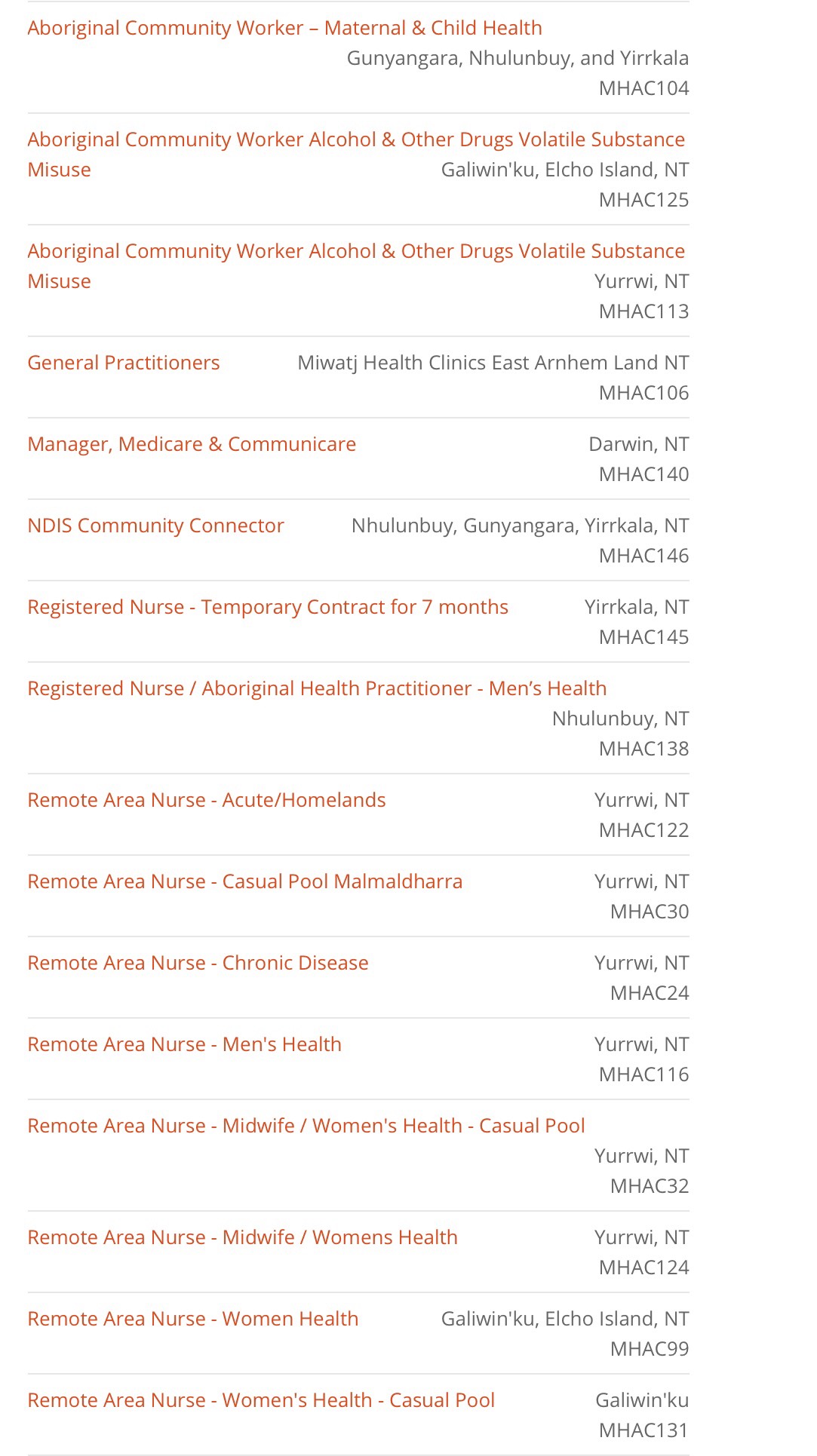
NT Jobs of the week 40 positions in the NT Alice Spring ,Darwin East Arnhem Land and Katherine

There are 13 JOBS at Congress Alice Springs including


More info and apply HERE


There are 17 JOBS at Miwatj Health Arnhem Land


More info and apply HERE

There are 2 JOBS at Wurli Katherine

More info and apply HERE


NACCHO Aboriginal Health Pharmacy News : #ACCHO Pharmacy skills will help #closethegap in #heart disease

ACCHOs have a strong history in doing this effectively and appropriately for their communities,

Specifically, ACCHO-embedded non-dispensing pharmacists and community pharmacies have a role in identifying risk factors and encouraging heart health checks within the ACCHO communities.’

Deputy NACCHO CEO Dr Dawn Casey

With new research showing current cardiovascular disease screening guidelines are missing younger at-risk Aboriginal people, a leading Aboriginal health specialist has highlighted the role pharmacists can play in preventative cardiac care.

The statement Dr Dawn Casey comes following research finding up to half of older Australian Aboriginal and Torres Strait Islander people are at high risk of cardiovascular disease (CVD), and that significant numbers of those in their 20s were also at risk.¹

Continued below

Read over 50 NACCHO Aboriginal Heart Health articles published over past 6 years

Read 8 NACCHO Aboriginal Health and Pharmacy articles

Featured article 

 Read above report HERE : NACCHO Aboriginal Heart Health

From Australian Pharmacist 

Australian National University researchers found 1.1% of Aboriginal and Torres Strait Islander 18-24 year olds and 4.7% of 25-34 year olds were at high absolute primary risk of CVD. This is around the same as the proportion of non-Indigenous Australians aged 45-54 who are at high risk.¹

The study of 2820 people from a 2012-13 health survey² revealed many Aboriginal and Torres Strait Islander people are not aware of their risk and most not receiving currently recommended therapy to lower their cholesterol, and are hospitalised for coronary heart disease at a rate up to eight times higher than that of other Australians.¹

Australia’s national guidelines recommend all Aboriginal and Torres Strait Islander peoples aged 35-74 have a heart check. But this new research found the high-risk category starts much earlier than this, and indicates the affected group needs to start receiving CVD checks earlier in life, the study authors said.

Dr Casey echoed the positive results of the study, allowing the entire ACCHS sector to better deliver preventative and holistic care.

‘ACCHOs have a strong history in doing this effectively and appropriately for their communities,’ she told Australian Pharmacist.

‘Specifically, ACCHO-embedded non-dispensing pharmacists and community pharmacies have a role in identifying risk factors and encouraging heart health checks within the ACCHO communities.’

‘Embedded ACCHO pharmacists can use their skills and knowledge work with a range of clinicians in the ACCHO to conduct holistic risk screening and overall management strategy.

NACCHO is currently actively advocating for enhanced integration of pharmacists into ACCHOs models of care.’

NACCHO and PSA are currently working as part of a broader team on two projects to enhance the broader roles that pharmacists’ skills and training can deliver – Integrating Pharmacists within Aboriginal Community Controlled Health Services to improve Chronic Disease Management (IPAC) and Indigenous Medication Review Service (IMeRSe).

‘Pharmacists have a broad range of clinical skills and are often very suitable additions to multidisciplinary clinical teams, especially where chronic disease is prevalent and many medicines required,’ Dr Casey said.

‘Community pharmacists may identify risks within normal client care, for example through a pharmacy-based MedsCheck or an HMR. Where team-based care is working effectively, pharmacies and ACCHOs will liaise and work together to ensure care is optimised across these settings.

‘Pharmacists’ understanding of medicines also involves understanding how medical conditions and risk factors for these conditions apply. Unfortunately there is still sometimes a misconception across Australia that pharmacists really just supply medicines and manage retail businesses. Enhancing professional and clinical services is a key trend across the whole pharmacy sector and NACCHO is an active participant in these developments.’

PSA and NACCHO have collaboratively produced guidelines to support pharmacists caring for Aboriginal and Torres Strait Islander people available at:

Click to access guide-to-providing-pharmacy-services-to-aboriginal-and-torres-strait-islander-people-2014.pdf

References

1 Calabria B, Korda RJ, Lovett RW, Fernando P, Martin T, Malamoo L, Welsh J, Banks, E. Absolute cardiovascular disease risk and lipid-lowering therapy among Aboriginal and Torres Strait Islander Australians. Med J Aust 2018; 209 (1): 35-41. DOI: 10.5694/mja17.00897

NACCHO Aboriginal Health and #MyHealthRecords : Australia’s peak GP, pharmacy, and healthcare bodies support My Health Record and the Government’s decision to move the system to an opt out model

“The My Health Record will allow a range of benefits – from a full medication summary, to a record of diagnostic reports, through to the ability for patients to enter their own notes.

Ultimately it’s a tool that will help patients better track their own health and medical history,” 

Australian Medical Association (AMA) President, Dr Tony Bartone believes the opt out model is the fastest and most effective way to realise the benefits of My Health Record. See sector support Part 2

VIEW Rob and Sandra’s My Health Record Story VIDEO HERE 

 “At Galambila we aim to provide a culturally appropriate service to our local Aboriginal community. We have a range of clinics and services aiming to close the gap and keep our community healthy and living longer.

Galambila has six GPs and allied health services such as podiatry and been active in setting up My Health Records for patients and in uploading patient summaries.” 

My role is to provide linkages with community pharmacy, as well as actively enhancing our quality use of medication at a clinic level. I play an important role in the care of our clients as they transition through care settings by ensuring correct and appropriate medication usage.

It is an innovative role that adds value to the primary health care outcomes of our clients.”

Pharmacist, Chris Braithwaite Galambila ACCHO Coffs Harbour

See full ACCHO story Part 4 below

NACCHO Aboriginal Health and #MyHealthRecord : Puntukurnu Aboriginal Medical Service (PAMS) remote clinics to access My Health Record

Part 1 :From Monday 16 July all Australians will be able to decide if they want a My Health Record – an online summary of their key health information where they can safely store, access and share their important health information.

More than 5.9 million Australians already have a My Health Record and 12,860 healthcare professional organisations are connected, including general practices, hospitals, pharmacies, diagnostic imaging and pathology practices. The My Health Record is already making healthcare management for individuals and healthcare providers easier and safer, and could save lives in an emergency situation.

Australians can manage privacy and control access to their My Health Record including what information gets uploaded and who has access such as family members, carers and healthcare providers. This empowers them to share and control their health information with doctors, hospitals and other healthcare providers from anywhere, at any time.

By the end of 2018, a My Health Record will be created for every Australian, unless they choose not to have one. If people choose not to have a My Health Record, they will be able to opt out of having one created for them during a three-month period, starting on Monday 16 July and ending on October 15 2018.

Professor Meredith Makeham, family General Practitioner and Chief Medical Adviser to the Australian Digital Health Agency said, “My Health Record empowers Australians by giving them secure access to their own healthcare information and supports them in managing their health conditions.”

“People can choose which healthcare information they’d like to store in their My Health Record and who they’d like to share it with.”

“My Health Record aims to deliver better healthcare outcomes and safer care for people. It will reduce harm caused by medication errors because people and their healthcare providers will have access to important information about medicines and allergies. This could save your life in an emergency.”

“My Health Record will help people with chronic and complex health conditions have better coordinated care. It will enable all of their clinicians to see the same healthcare information. This should also reduce avoidable hospital admissions and the unnecessary duplication of pathology and imaging investigations.”

“My Health Record has the potential to have a significant and long-lasting positive impact on healthcare services for every Australian, and we encourage all Australians to find out about the benefits of the My Health Record,” said Mr Tim Kelsey, Chief Executive of the Australian Digital Health Agency.

“My Health Record is a key priority in the Government’s National Digital Health Strategy, and a great example of the collaboration underway as government, healthcare providers, industry bodies, and Australians all work together to deliver it.”


Part 2: Australia’s peak GP, pharmacy, and healthcare bodies support My Health Record and the Government’s decision to move the system to an opt out model

Consumers Health Forum (CHF) CEO, Ms Leanne Wells said the opt out period is an important time for Australians to learn more about My Health Record. “My Health Record gives Australians the opportunity to be active partners in their own care, with many potential benefits for those that decide to have one. The opt out period is a great opportunity for individuals to learn more about My Health Record so they can understand the impact it could have on their treatments. We are looking forward to seeing more records be created by the end of the year, so more Australians have access to the benefits the platform enables,” said Ms Wells.

Download full press release

My Health Record CHF opens new era

Royal Australian College of General Practitioners (RACGP) Chair of the RACGP Expert Committee – eHealth and Practice Services Dr Nathan Pinskier said My Health Record is one of the best examples of how technology can make a positive difference to society.

“Many Australians are already making use of digital services across a range of industries. My Health Record provides the opportunity for Australians to access their health information in a secure environment. The RACGP are working with GPs to obtain awareness on how to best use My Health Record to provide patients timely access to additional information and support better health outcomes,” said Dr Pinskier.

Pharmaceutical Society of Australia National President, Dr Shane Jackson is also looking forward to seeing more Australians take ownership of their healthcare. “In collaboration with the Agency we are helping our 30,000 pharmacists guide patients through this important healthcare decision. The information in the My Health Record System will allow pharmacists to deliver more effective and efficient care, and it is great that all Australians will have the option to benefit from this,” said Dr Jackson.

Pharmacy Guild of Australia National President, Mr George Tambassis said increased use of the system will result in sustainable healthcare delivery. “The Guild is committed to ensuring all pharmacy dispensing and medicine related services are fully integrated into My Health Record. By doing so we will help advance the efficiency, quality, and delivery of healthcare,” said Mr Tambassis.

Australian Healthcare and Hospital Association (AHHA) CEO, Ms Alison Verhoeven applauded the Agency’s decision to expand the My Health Record platform while respecting a patient’s right to privacy. “Health care is a sensitive topic, and so it is only right Australians are given the right to decide how it is disclosed and who to. Patients are at the centre of My Health Record – realising the health benefits it enables and controlling those who have access to it. It’s a critical and exciting development in the progression of healthcare services in Australia,” said Ms Verhoeven.

Part 3

More information on My Health Record can be found at

www.myhealthrecord.gov.au.

People who do not want a My Health Record can opt out by visiting the My Health Record website or by calling 1800 723 471 for phone-based assistance.

Additional support is available to Aboriginal and Torres Strait Islanders, people from non-English speaking backgrounds, people with limited digital literacy, and those living in rural and remote regions.

Part 4

Pharmacist, Chris Braithwaite has worked in a variety of Aboriginal and Torres Strait Islander health locations since graduating in 2012, including at Katherine in the Northern Territory, Mount Isa and Cape York in Queensland. He has been working at Galambila Aboriginal Health Service at Coffs Harbour in northern NSW – in Gumbaynggirr country – since October 2016 .

I was attracted by the opportunity take on the emerging role as a practice pharmacist working closely with GPs, Aboriginal Health Workers, nurses and other allied health professionals. Working with Aboriginal people is a unique and rewarding use of my skills.

My Health Record is particularly exciting for pharmacists as we have, for too long operated in an information poor silo and this will be a step in the right direction to close the loop and increase our capacity to deliver targeted care.

For patients, it will provide a platform for empowerment regarding their health and an accessible record for those Australian’s who find health literacy a challenge. This is really a priceless advance for the health system.

I have always been attracted by the concept behind My Health Record, but what’s really convincing are the case studies and examples I have heard where pharmacists and other health professionals have delivered more effective and efficient care. When these stories come to light, you can always recall a situation where having access to My Health Record would have made an enormous impact on the way you delivered care.

To me, this was especially relevant in Cape York, where the Aboriginal and Torres Strait Islander community is particularly transient. My Health Record will be invaluable in these situations.

Galambila

At Galambila we aim to provide a culturally appropriate service to our local Aboriginal community. We have a range of clinics and services aiming to close the gap and keep our community healthy and living longer.

Galambila has six GPs and allied health services such as podiatry and been active in setting up My Health Records for patients and in uploading patient summaries.

My role is to provide linkages with community pharmacy, as well as actively enhancing our quality use of medication at a clinic level. I play an important role in the care of our clients as they transition through care settings by ensuring correct and appropriate medication usage.

It is an innovative role that adds value to the primary health care outcomes of our clients.

In my work at Galambila I find the dispensing record and medicines view particularly useful. When performing a Home Medicines Review (HMR), this helps me assess dispensing intervals and gives an indication of medication adherence.

A phone call to the community pharmacist is still useful and important for their insights given the regularity of contact with patients. However this saves a major aspect of the conversation as well as unnecessary paperwork.

I also find discharge summaries particularly useful in ensuring the patient’s transition back into community is smooth. This is especially pertinent when they are discharged from a non local hospital and it isn’t sent directly to us.

A simple, but powerful example was when an unknown patient presented to see the GP. The patient did not have strong recollection about their previous treatment. They were asking for prescriptions but couldn’t remember what it was they took, nor could they name a recent community pharmacy (only the town). We were unable to get in contact with their previous GP.

In the past, it would have taken me 30 minutes to obtain the information I need. However, they had an active My Health Record and I was able to quickly access this with the GP and we were able to provide the care the patient needed immediately.

I believe the potential for My Health Record is incredible, especially for patient safety in terms of medication management. As time goes on and the conformity with clinical software increases, having someone’s renal function at your fingertips when dispensing medicines such as rivaroxaban, for example will revolutionise the dispensing process in the community.

In the future I imagine it will be part of my daily practice and widely accepted by the public and health professionals as an incredibly useful tool for more effective and efficient care.

NACCHO Aboriginal Health Weekly Save a date : Conferenceand Events : Donna Ah Chee CEO @CAACongress to be keynote speaker @RuralDoctorsAu @ACRRMRural #Rural Medicine Australia conference Darwin #RMA18

Featured conference in NACCHO Save a dates this week

25-27 October 2018, Darwin Rural Medicine Australia conference

Donna Ah Chee, a highly respected advocate in the Aboriginal health sector, will be a keynote speaker at this year’s Rural Medicine Australia 2018 (RMA18) conference.

RMA18 is the premier annual event for rural and remote doctors, and is hosted by the Rural Doctors Association of Australia (RDAA) and Australian College of Rural and Remote Medicine (ACRRM).

Donna is a Bundgalung woman from the far north coast of New South Wales, and has lived in Alice Springs for 30 years, where she is a leader in the delivery of Aboriginal health services.

RDAA President, Dr Adam Coltzau, said: “We are very excited to have Donna — who is such an influential member of the Aboriginal health community — speaking at RMA18.

“Donna is CEO of the Central Australian Aboriginal Congress, an Aboriginal community-controlled primary health care service employing over 400 staff to deliver integrated services to Alice Springs and six remote communities.

“She is also a strong advocate at the state and national levels in the field of Aboriginal health, holding Chair, Board and Expert Member positions on numerous organisations, groups and committees concerned with Aboriginal healthcare, health research, literacy, and alcohol and other drug issues.

“We are really privileged to be able to hear her perspectives on Aboriginal health at RMA18.”

ACRRM President, Associate Professor Ruth Stewart, said: “We have so much to learn from the Community Controlled Health Organisations in the Northern Territory. In the light of the Close the Gap campaign, we all need to think about how we can best provide healthcare services to Aboriginal and Torres Strait Islander people. Donna’s keynote address will be of great interest to the people attending our conference.

“Additionally, Dr Kali Hayward, who is an inspirational speaker and President of the Australian Indigenous Doctors’ Association, will take part in the RMA18 Presidents’ Breakfast.

“Donna and Kali are both wonderful leaders in healthcare for and by Aboriginal and Torres Strait Islander peoples. We are privileged to have them at RMA18.

“It will be great to hear their messages as we develop the National Rural Generalist Pathway, which will enable more of the next generation of rural doctors to be trained in a wide range of advanced skills including Aboriginal and Torres Strait Islander Health.”

Assoc Prof Stewart said RMA18 is shaping up to be one of the best RMA conferences yet.

“We are very excited to be heading to Darwin, where we can focus the conference on important themes including Tropical Health, Indigenous Health and Women in Health” she said.

“The program for RMA18 has now been released and early bird registrations are still open for RMA18, so there has never been a better time to book your spot at Australia’s peak rural doctor event.”

See Website for further details 

See full details below

25 July AMA President, Dr Tony Bartone, will address the National Press Club in Canberra

Dr Bartone, a Melbourne GP, will outline the AMA’s priorities for health reform, and suggest the types of health policies that the major parties should take to the next election, which is expected within the next 12 months.

Dr Bartone said today that AMA concerns include the eroding access, equity, and affordability of health care, especially rurally and regionally; the relentless squeezing of medical practice viability; extremely low value, yet increasingly unaffordable private health insurance policies, and the resultant patient exodus from private health insurance; a medical training pipeline bottleneck with a frustrating lack of postgraduate training places; and the continual long-term disinvestment in general practice.

“We also need to see appropriate funding across the health system, especially for public hospitals, and long-term strategies and investment in mental health and the aged care policy framework

You can book a place for Dr Bartone’s National Press Club address at

https://www.npc.org.au/speakers/dr-tony-bartone/

The Turnbull Government is proud to be partnering with the Aboriginal and Torres Strait Islander Social Justice Commissioner, Ms June Oscar AO, who in February this year commenced a landmark national consultation process with Aboriginal and Torres Strait Islander women and girls.

The Wiyi Yani U Thangani (Women’s Voices) project commissioned by Minister Scullion is a national conversation with Aboriginal and Torres Strait Islander women and girls’ to understand their priorities, challenges and aspirations.

Findings will inform key policies and programs such as the Closing the Gap refresh, future investment under the Indigenous Advancement Strategy and development of the Fourth Action Plan of the National Plan to Reduce Violence Against Women and Their Children. Consultations are continuing through to November 2018.

The Aboriginal and Torres Strait Islander Social Justice Commissioner, June Oscar AO, warmly invites Aboriginal and Torres Strait Islander women and girls to come together as part of the Wiyi Yani U Thangani (Women’s Voices) project.

Aboriginal and Torres Strait Islander women and girls have many strengths and play a central role in bringing about positive social change for our families and communities.

Dr Jackie Huggins will be hosting these engagements on behalf of the Commissioner. Dr Huggins and the team will be speaking with Aboriginal and Torres Strait Islander women (18+) and girls (aged 12-17) through a series of community gatherings across the country, to hear directly about their needs, aspirations and ideas for change.

Please see details and registration options below.

EVENT DETAILS: Northern Territory – Borroloola, Katherine, Tiwi Islands and Darwin

Please join us for one of the following sessions and register by clicking on the relevant link. You can also email us at wiyiyaniuthangani@humanrights.gov.au or phone us on (02) 9284 9600.


Borroloola – Monday 23rd July 2018

  • Who: Aboriginal and Torres Strait Islander Women and Girls
  • Time: 9:30am – 1:30pm
  • Location: Mabunji Aboriginal Resource Centre, 2087 Robinson Road, Borroloola, NT 0854

Please click here to register for this event.


Borroloola – Tuesday 24th July 2018
  • Who: Aboriginal and Torres Strait Islander Women and Girls
  • Time: 9:30am – 1:30pm
  • Location: Mabunji Aboriginal Resource Centre, 2087 Robinson Road, Borroloola, NT 0854

Please click here to register for this event.


Katherine – Thursday 26th July 2018

  • Who: Aboriginal and Torres Strait Islander Women and Girls
  • Time: 9.30am – 1:30pm​
  • Location: Flinders University, O’Keefe House, Katherine Hospital, Giles Street, Katherine, NT 0850

Please click here to register for this event.


Wurrumiyanga (Bathurst Island) – Monday 30th July 2018

  • Who: Aboriginal and Torres Strait Islander Women and Girls
  • Time: 10.30am – 2.30pm
  • Location: Tiwi Enterprises – Mantiyupwi Motel – Meeting Room, Lot 969 Wurrumiyanga, NT 0822

Please click here to register for this event.


Pirlangimpi (Melville Island) – Wednesday 1st August 2018
  • Who: Aboriginal and Torres Strait Islander Women and Girls
  • Time: 9:30am – 1:30pm
  • Location: TBC

Please click here to register for this event.


Darwin – Thursday 2nd August 2018

  • Who: Aboriginal and Torres Strait Islander Women and Girls
  • Time: 9:30am- 1.30pm
  • Location: Michael Long Learning & Leadership Centre – Conference Room, 70 Abala Rd Marrara, Darwin, NT 0812

Please click here to register for this event.


Palmerston – Friday 3rd August 2018

  • Who: Aboriginal and Torres Strait Islander Women and Girls
  • Time: 9:30am – 1:30pm
  • Location: Palmerston Recreation Centre – Community Room, 11 The Boulevard, Palmerston, NT 0831

Please click here to register for this event.


Refreshments: Refreshments will be provided. Please register to ensure there is sufficient catering and please call or email to let us know any dietary requirements you may have.

Accessibility: The venue is accessible for people using wheelchairs. If you have any access or support requirements, such as an interpreter, please call or email us.

More information: Please see the website for further information about Wiyi Yani U Thangani (Women’s Voices), including a list of our planned gatherings.

If you are unable to attend this gathering, we would still like to hear from you through our submission process. For more details visit the submission page.

We hope you can take part in this important national conversation dedicated to Aboriginal and Torres Strait Islander women and girls.

Please share this invitation with others who may be interested in attending.

Should you have any questions please email wiyiyaniuthangani@humanrights.gov.au or phone (02) 9284 9600.


NACCHO AGM 2018 Brisbane Oct 30—Nov 2 Registrations and Expressions of Interest now open

Follow our conference using HASH TAG #NACCHOagm2018

Brisbane Oct 30—Nov 2

Register HERE

Conference Website Link:          

Accommodation Link:                   

The NACCHO Members’ Conference and AGM provides a forum for the Aboriginal community controlled health services workforce, bureaucrats, educators, suppliers and consumers to:

  • Present on innovative local economic development solutions to issues that can be applied to address similar issues nationally and across disciplines
  • Have input and influence from the ‘grassroots’ into national and state health policy and service delivery
  • Demonstrate leadership in workforce and service delivery innovation
  • Promote continuing education and professional development activities essential to the Aboriginal community controlled health services in urban, rural and remote Australia
  • Promote Aboriginal health research by professionals who practice in these areas and the presentation of research findings
  • Develop supportive networks
  • Promote good health and well-being through the delivery of health services to and by Indigenous and non-Indigenous people throughout Australia.

Expressions of Interest to present

NACCHO is now calling for EOI’s from Affiliates , Member Services and stakeholders for Case Studies and Presentations for the 2018 NACCHO Members’ Conference. This is an opportunity to show case grass roots best practice at the Aboriginal Community Controlled service delivery level.

Download the Application

NACCHO Members Expressions of Interest to present to the Brisbane Conference 2018 on Day 1

In doing so honouring the theme of this year’s NACCHO Members Conference; ‘Investing in What Works – Aboriginal Community Controlled Health’. We are seeking EOIs for the following Conference Sessions.

Day 1 Wednesday 31 October 2018

Concurrent Session 1 (1.15 – 2.00pm) – topics can include Case Studies but are not limited to:

  • Workforce Innovation
  • Best Practice Primary Health Care for Clients with Chronic Disease
  • Challenges and Opportunities
  • Sustainable Growth
  • Harnessing Resources (Medicare, government and other)
  • Engagement/Health Promotion
  • Models of Primary Health Care and
  • Clinical and Service Delivery.

EOI’s will focus on the title of this session within the context of Urban, Regional, Rural or Remote.  Each presentation will be 10-15 minutes in either the Plenary or Breakout rooms.

OR

Table Top Presentations (2.00-3.00pm)

Presenters will speak from the lectern and provide a brief presentation on a key project or program currently being delivered by their service.

Presentation will be 10 minutes in duration-with 5 minutes to present and
5 minutes for discussion and questions from delegates.

Conference Website Link


Dr Tracy Westerman’s 2018 Training Workshops
For more details and July dates


4 August National Children’s Day

National Aboriginal and Torres Strait Islander Children’s Day (Children’s Day) is a time for Aboriginal and Torres Strait Islander families to celebrate the strengths and culture of their children. The day is an opportunity for all Australians to show their support for Aboriginal children, as well as learn about the crucial impact that community, culture and family play in the life of every Aboriginal and Torres Strait Islander child.

Children’s Day is held on 4 August each year and is coordinated by SNAICC – National Voice for our Children. Children’s Day was first observed in 1988, with 2017 being the 29th celebration. Each year SNAICC produces and distributes resources to help organisations, services, schools, and communities celebrate.

The theme for Children’s Day 2018 is SNAICC – Celebrating Our Children for 30 Years.

Our children are the youngest people from the longest living culture in the world, with rich traditions, lore and customs that have been passed down from generation to generation. Our children are growing up strong with connection to family, community and country. Our children are the centre of our families and the heart of our communities. They are our future and the carriers of our story.

This year, we invite communities to take a walk down memory lane, as we revisit some of the highlights of the last 30 years. We look back on the empowering protest movements instigated by community that had led to the establishment of the first Children’s Day on 4 August 1988. We look back at all of the amazing moments we’ve shared with our children over the years, and how we’re watching them grow into leaders.

We look back to see what we’ve achieved, and decide where we want to go from here to create a better future for our children. If you have celebrated Children’s Day at any time during the past 30 years, we would love to hear from you.

Website

Download HERE

The recent week-long #MensHealthWeek focus offered a “timely reminder” to all men to consider their health and wellbeing and the impact that their ill health or even the early loss of their lives could have on the people who love them. The statistics speak for themselves – we need to look after ourselves better .

That is why I am encouraging all men to take their health seriously, this week and every week of the year, and I have made men’s health a particular priority for Indigenous health.”

Federal Minister for Indigenous Health and Aged Care Ken Wyatt who will be a keynote speaker at NACCHO Ochre Day in August

To celebrate #MensHealthWeek NACCHO has launches its National #OchreDay2018 Mens Health Summit program and registrations

The NACCHO Ochre Day Health Summit in August provides a national forum for all Aboriginal and Torres Strait Islander male delegates, organisations and communities to learn from Aboriginal male health leaders, discuss their health concerns, exchange share ideas and examine ways of improving their own men’s health and that of their communities

More Details HERE

All too often Aboriginal male health is approached negatively, with programmes only aimed at males as perpetrators. Examples include alcohol, tobacco and other drug services, domestic violence, prison release, and child sexual abuse programs. These programmes are vital, but are essentially aimed at the effects of males behaving badly to others, not for promoting the value of males themselves as an essential and positive part of family and community life.

To address the real social and emotional needs of males in our communities, NACCHO proposes a positive approach to male health and wellbeing that celebrates Aboriginal masculinities, and uphold our traditional values of respect for our laws, respect for Elders, culture and traditions, responsibility as leaders and men, teachers of young males, holders of lore, providers, warriors and protectors of our families, women, old people, and children.

More Details HERE

NACCHO’s approach is to support Aboriginal males to live longer, healthier lives as males for themselves. The flow-on effects will hopefully address the key effects of poor male behaviour by expecting and encouraging Aboriginal males to be what they are meant to be.

In many communities, males have established and are maintaining men’s groups, and attempting to be actively involved in developing their own solutions to the well documented men’s health and wellbeing problems, though almost all are unfunded and lack administrative and financial support.

To assist NACCHO to strategically develop this area as part of an overarching gender/culture based approach to service provision, NACCHO decided it needed to raise awareness, gain support for and communicate to the wider Australian public issues that have an impact on the social, emotional health and wellbeing of Aboriginal Males.

It was subsequently decided that NACCHO should stage a public event that would aim to achieve this and that this event be called “NACCHO Ochre Day”.

The two day conference is free: To register


October 30 2018 NACCHO Annual Members’ Conference and AGM SAVE A DATE

Follow our conference using HASH TAG #NACCHOagm2018

This is Brisbane Oct 30—Nov 2

The NACCHO Members’ Conference and AGM provides a forum for the Aboriginal community controlled health services workforce, bureaucrats, educators, suppliers and consumers to:

  • Present on innovative local economic development solutions to issues that can be applied to address similar issues nationally and across disciplines
  • Have input and influence from the ‘grassroots’ into national and state health policy and service delivery
  • Demonstrate leadership in workforce and service delivery innovation
  • Promote continuing education and professional development activities essential to the Aboriginal community controlled health services in urban, rural and remote Australia
  • Promote Aboriginal health research by professionals who practice in these areas and the presentation of research findings
  • Develop supportive networks
  • Promote good health and well-being through the delivery of health services to and by Indigenous and non-Indigenous people throughout Australia.

More Info soon

6. NACCHO Aboriginal Male Health Ochre Day 27-28 August

More info

7. NATSIHWA National Professional Development Symposium 2018

We’re excited to release the dates for the 2018 National Professional Development Symposium to be held in Alice Springs on 2nd-4th October. More details are to be released in the coming weeks; a full sponsorship prospectus and registration logistics will be advertised asap via email and newsletter.

This years Symposium will be focussed on upskilling our Aboriginal and/or Torres Strait Islander Health Workers and Health Practitioners through a series of interactive workshops. Registrants will be able to participate in all workshops by rotating in groups over the 2 days. The aim of the symposium is to provide the registrants with new practical skills to take back to communities and open up a platform for Health Workers/Practitioners to network with other Individuals in the workforce from all over Australia.

We look forward to announcing more details soon!

8.AIDA Conference 2018 Vision into Action


Building on the foundations of our membership, history and diversity, AIDA is shaping a future where we continue to innovate, lead and stay strong in culture. It’s an exciting time of change and opportunity in Indigenous health.

The AIDA conference supports our members and the health sector by creating an inspiring networking space that engages sector experts, key decision makers, Indigenous medical students and doctors to join in an Indigenous health focused academic and scientific program.

AIDA recognises and respects that the pathway to achieving equitable and culturally-safe healthcare for Indigenous Australians is dynamic and complex. Through unity, leadership and collaboration, we create a future where our vision translates into measureable and significantly improved health outcomes for our communities. Now is the time to put that vision into action.

AIDA Awards
Nominate our members’ outstanding contributions towards improving the health and life outcomes of Aboriginal and Torres Strait Islander Peoples.

9.CATSINaM Professional Development Conference

Venue: Hilton Adelaide 

Location:  233 Victoria Square, Adelaide, SA 

Timing: 8:30am – 5:30pm

We invite you to be part of the CATSINaM Professional Development Conference held in Adelaide, Australia from the 17th to the 19th of September 2018.
The Conference purpose is to share information while working towards an integrated approach to improving the outcomes for Aboriginal and Torres Strait Islander Australians. The Conference also provides an opportunity to highlight the very real difference being made in Aboriginal and Torres Strait Islander health by our Members.
To this end, we are offering a mixed mode experience with plenary speaker sessions, panels, and presentations as well as professional development workshops.

More info

The CATSINaM Gala Dinner and Awards evening,  held on the 18th of September, purpose is to honour the contributions of distinguished Members to the field.

10.Healing Our Spirit Worldwide

Global gathering of Indigenous people to be held in Sydney
University of Sydney, The Healing Foundation to co-host Healing Our Spirit Worldwide
Gawuwi gamarda Healing Our Spirit Worldwidegu Ngalya nangari nura Cadigalmirung.
Calling our friends to come, to be at Healing Our Spirit Worldwide. We meet on the country of the Cadigal.
In November 2018, up to 2,000 Indigenous people from around the world will gather in Sydney to take part in Healing Our Spirit Worldwide: The Eighth Gathering.
A global movement, Healing Our Spirit Worldwidebegan in Canada in the 1980s to address the devastation of substance abuse and dependence among Indigenous people around the world. Since 1992 it has held a gathering approximately every four years, in a different part of the world, focusing on a diverse range of topics relevant to Indigenous lives including health, politics, social inclusion, stolen generations, education, governance and resilience.
The International Indigenous Council – the governing body of Healing Our Spirit Worldwide – has invited the University of Sydney and The Healing Foundation to co-host the Eighth Gathering with them in Sydney this year. The second gathering was also held in Sydney, in 1994.
 Please also feel free to tag us in any relevant cross posting: @HOSW8 @hosw2018 #HOSW8 #HealingOurWay #TheUniversityofSydney

NACCHO Aboriginal Health tribute to our 71 Female #ACCHO CEO’s and workforce , #NAIDOC2018 award winners and #Becauseofherwecan Pat Anderson and June Oscar

Continue reading

NACCHO Aboriginal Health News : Download @aihw Aboriginal health organisations : Online Services Report—key results 2016–17 : Part 2 Is the Closing the Gap ‘too focused on prosperity debate

 ” The National Congress of Australia’s First Peoples has also warned that a focus on “economic prosperity” in the current Close the Gap review “is misguided and should not serve as an overarching focus for government policy”.

The Lowitja Institute has called for “prosperity” to be ­removed as a criteria, saying it “has strong monetary connotations and does not adequately speak to the health and education sectors”, and warns that the ­review will fail “if effective partnerships and engagement, not consultation, with Aboriginal and Torres Strait Islander leaders and communities is not undertaken from the start to the end of the process”.

From the Australian 14 July see Part 2 Below

Part 1 : Download Aboriginal and Torres Strait Islander health organisations: Online Services Report—key results 2016–17

This ninth national report provides information on 266 organisations funded by the Australian Government to deliver health services to Aboriginal and Torres Strait Islander people. These organisations contributed to the 2016–17 Online Services Report. Information is presented on the characteristics of these organisations; the services they provide; client numbers, contacts and episodes of care; staffing levels; and service gaps and challenges.

Some changes were made to the 2016–17 data collection, aimed at ensuring consistency in episode of care reporting between the different data collection systems. This resulted in a decrease in primary health episode of care counts in 2016–17. These are not comparable with previous collections, so comparisons are not presented in this report. See Chapter 2 for more information about the data collection, data quality and the impacts of these changes.

Download the full report 120 Page HERE

aihw-ihw-196

Key messages

1.A range of services are provided to Aboriginal and Torres Strait Islander people

Of the 266 organisations in 2016–17:

  • 196 (74%) provided a range of primary health-care services to around 444,700 clients through 3.2 million episodes of care. Just over two-thirds of these organisations (136) were Aboriginal Community Controlled Health Organisations. Services provided include: health promotion; clinical care; substance-use treatment and prevention; and social and emotional wellbeing support. These organisations also provided access to specialist, allied health and dental services, either on site or by facilitating off-site access. For example, most provided access to cardiologists (90%); renal specialists (87%); ophthalmologists (86%); paediatricians (90%); psychiatrists (87%); diabetes specialists (90%); and ear, nose and throat (ENT) specialists (88%). They also provided access to dental services (94%) and to allied health services such as physiotherapists (89%); psychologists (93%); dieticians (95%); podiatrists (96%); optometrists (94%); and audiologists (91%).
  • Around 7,600 full-time equivalent (FTE) staff were employed by organisations providing primary health-care services and just over half of all staff (53%) were Aboriginal and/or Torres Strait Islander (see Chapter 3).
  • 213 (80%) provided maternal and/or child health services through their primary health and/or New Directions funding. Around 8,400 Indigenous women were seen through 42,200 antenatal visits—an average of 5 visits per client (see Chapter 4).
  • 88 (33%) provided social and emotional wellbeing services. The 189 counsellors in these organisations saw around 16,300 clients, through 77,100 client contacts—an average of 5 contacts per client (see Chapter 5).
  • 80 (30%) provided substance-use services to around 39,400 clients through 197,700 episodes of care. Most episodes of care (88%) were for non-residential or after-care services (see Chapter 6).

2.Many funded organisations provide services in Remote and Very remote areas

Nearly half (46%) of the organisations funded to provide primary health-care services to Aboriginal and Torres Strait Islander people did so in Remote or Very remote areas and they saw around 168,100 (38%) clients. Around 44% of employed staff (3,347 FTE) worked in Remote or Very remote areas, including a higher proportion of employed nurses and midwives (59% or 664 FTE) and a lower proportion ofemployed dental care staff (21% or 38 FTE).

There were more FTE nurses and midwives per 1,000 clients in Remote (3.5) and Very remote areas (4.4), compared with 2.6 per 1,000 clients overall. There were fewer doctors in Very remote areas (0.9 FTE doctors per 1,000 clients compared with 1.3 overall), perhaps reflecting a greater reliance on nurse-led clinics in these areas. Contacts by nurses and midwives represented half (51%) of all contacts in Very remote areas compared with 29% overall.

Over 800,000 episodes of care (25%) were provided to clients in Very remote areas. However, organisations in Very remote areas were still more likely to report staffing vacancies. Nearly one-third (31%) of reported health-staff vacancies were in organisations in Very remote areas. They also had more health-staff vacancies per 1,000 clients (1.0 compared with 0.7 overall). Organisations in Very remote areas were also more likely to report the recruitment, training and support of staff as one of the challenges they faced in providing quality care to clients (75% compared with 67% overall) as well as staff retention and turnover (75% compared with 57% overall).

3.Various group activities are run to promote health and wellbeing

Organisations delivered a range of group activities in 2016–17 to improve the health of the community:

  • Those funded to provide primary health-care services ran around 8,400 physical activity/healthy weight sessions; 4,300 chronic disease client support sessions; and 3,300 tobacco-use treatment and prevention sessions. Other common health promotion activities included campaigns to encourage immunisation services (in 81% of organisations), healthy lifestyle programs (75%) and sexual health/ education (71%).
  • With respect to maternal and child health services, around 20,300 home visits; 3,100 maternal and baby/child health group sessions; 2,100 parenting group sessions and 1,000 antenatal group sessions were provided.
  • In those funded to provide substance-use services, most (93%) provided community education, while 60% did school visits. Around 4 in 5 (80%) ran physical activity or healthy weight programs and around three-quarters ran tobacco-use treatment and prevention groups (76%),  alcohol-misuse  treatment and prevention groups (74%), living skills groups (75%), men’s groups (75%) and women’s groups (74%).

Things to note

  • Most (94%) organisations funded to provide primary health care also provided social and emotional wellbeing or mental health or counselling services, and over half (57%) had mental health promotion activities in 2016–17; however, nearly two-thirds of organisations still reported mental health and social and emotional wellbeing services as a service gap (63%). This was even higher (78%) in organisations funded to provide substance-use services, but not primary health care.
  • Some organisations indicated that clients with high needs had to wait too long for some services,   in particular to access dental services and mental health professionals. For example, 50 (27%) organisations providing on-site or off-site access to dental services still felt clients with high needs often had to wait a clinically unacceptable time for dental services. This was higher in organisations in Remote (44%) and Very remote (34%) areas.
Part 2 Is the Closing the Gap ‘too focused on prosperity debate

The Closing the Gap program aimed at reducing indigenous disadvantage has hit stasis 10 years after it began, with four of its seven measures expired, a review of the scheme still months off being completed and warnings from a range of peak organisations that some proposed criteria for replacement targets are irrelevant or unhelpful.

Some fear the 11th annual Prime Minister’s report due in February might focus more on ­details of the review and launching a reboot, rather than accounting for any actual achievements in the scheme’s aims.

Submissions to the review warn of a “dire need for greater government accountability” and say “a myopic focus on national statistics” in the past has led to the needs of individual remote communities being unmet, as well as criticising the awarding of contracts to mainstream organisations which “frequently lack the capacity, knowledge and cultural competence required to effectively deliver services to our communities”.

The National Congress of Australia’s First Peoples has also warned that a focus on “economic prosperity” in the current review “is misguided … and should not serve as an overarching focus for government policy”.

The Lowitja Institute has called for “prosperity” to be ­removed as a criteria, saying it “has strong monetary connotations and does not adequately speak to the health and education sectors”, and warns that the ­review will fail “if effective partnerships and engagement, not consultation, with Aboriginal and Torres Strait Islander leaders and communities is not undertaken from the start to the end of the process”.

It also warns of unhelpful uses of nationwide targets “which, due to data-collection protocols were unmeasurable, and secondly, did not seem to consider the distinct challenges faced at both the state and local levels”.

Of the four Closing the Gap targets that expired at the beginning of this month, just one — halving the gap in infant mortality rates — was said to be on track, ­although even that assessment has been questioned.

The other three — closing the gap on school attendance, halving the gap in reading and numeracy and halving the employment gap — expired without being on track.

Only two of the still active three targets are on track: getting 95 per cent of all indigenous four-year-olds enrolled in early childhood education by 2025 and halving the gap for Year 12 or equivalent attainment by 2020.

A third, closing the life expectancy gap by 2031, is not on track.

The Weekend Australian understands two review workshops are scheduled in Canberra for the end of this month, for peak groups in the sector and others who have made submissions.

The review, which is being conducted by the Department of Prime Minister and Cabinet as a Council of Australian Governments exercise, is then expected to report back by October 31 with a new “framework, targets and performance indicators”.

However congress co-chair Rod Little warned this might still be merely a report that requires further refining, with the outcome that by next February, when the Prime Minister’s annual report should be delivered, “that’s one year that’s gone into reshaping the framework rather than working on outcomes”.

But he said the October deadline opened the door for further consolidation.

NACCHO Aboriginal Women’s Health : #NAIDOC2018 #BecauseofHerWecan @VAHS1972 #ThisGirlCan and #HerTribe inspires women to #Bepositive #bebrave #Befocused #bestrong and #bedeadly in a 16 week exercise program for local Indigenous females of all ages and abilities

I wanted to create an environment where women could come together, feel safe and confident and be able to get fit together,

121 women enrolled in the free course, which challenged participants over the course of two hours, once a week, through a range of fitness activities from gym to indoor cardio, running, walking, weights, boxing and stretching.”

Inspired by helping women in her local community gain confidence around their body image and exercise, Laura Thompson, in conjunction with the Victorian Aboriginal Health Service in Preston, Victoria, created #HerTribe, a sixteen-week exercise program for local Indigenous females of all ages and abilities.

Read over 350 Aboriginal Women’s Health articles published by NACCHO in the last 6 years

Watch Video HERE

Many of the women had never participated in physical activity on a regular basis, or for a number of years, and had to overcome a range of fears to simply turn up to their first session.

“My voice said I didn’t think I’ll be able to do this because we were told it’s going to be full on,” said Aboriginal elder, Ruth Pinkard. “I feared being judged by my height, weight and age. But I have done levels that I didn’t think I could do and other people thought I couldn’t do.”

Marayne Muller saw the program advertised on Facebook and overcame enormous anxiety to sign up. “Pretty much one quarter of the way through, I was addicted. It gave me a sense of purpose and helped break down the barriers in my head. I went from someone who was pretty adamant that I didn’t want to be here anymore, to someone that was able to dream.”

For others, the supportive but challenging environment has given back a sense of identity and helped them regain good health.

“This mob has helped me to keep out of hospital. I was thinking I was too old. I suffer from asthma and I thought the younger people would laugh at me trying to keep up with them. But they were very supportive,” said Maureen Moore.

Added Lisa Thorpe, “it’s given me the ability to participate and to find out who the real person is, without being a mother or a daughter. I come here as Lisa.”

Women acting as a role model for each other, has not only provided inspiration, it has also given each participant a sense of kinship in a supportive environment where they can strive to be their best.

VicHealth research reveals that worrying about being judged stops many women from being physically active. In fact, 41% of Victorian women feel too embarrassed to exercise in public.

Which is why campaigns like This Girl Can Victoria and programs like #HerTribe, are so important. Empowering women to be active whenever, wherever and however they choose – in a supportive environment – is critical.

“From the moment I came into the environment they had created here, I found it especially amazing the variety ofpeople. They had aunties and elders and kids, and I’m a young person, so I just loved the environment they created where everyone was welcome,” said J-Mara McDonald.

Marayne Muller sums it up perfectly, “I thought I can’t get involved because everyone was better than me. But I guess, when you have amazing people around you – and women – that’s when we can start breaking that down.”

NACCHO and @Vision2020Aus Aboriginal Eye Health Deadly Good News : #BecauseofHerWeCan #WeCan18 ! – #Indigenous women in eye health @Walgett_AMS @BADACBallarat @AHCSA_ @IEHU_UniMelb

 ” To mark NAIDOC Week 2018 and this year’s theme ‘Because of Her, We Can!’, Vision 2020 Australia is celebrating the roles and achievements of some of the incredible Aboriginal and Torres Strait Islander women working in the eye health sector.  

These women perform a range of roles across a number of areas in the sector, but they are all proud of their cultures, passionate about their work and driven to help improve health outcomes in Indigenous communities and beyond.”

Originally published HERE VISION 2020

Read over 40 Aboriginal Eye Health Articles published over the past 9 years

 ” Vision 2020 Australia’s Aboriginal and Torres Strait Islander Committee Chair, Dr Dawn Casey (COO, NACCHO), said it will be hard to improve Aboriginal health when funding bodies and Aboriginal service providers are “not on the same page”.

Dr Casey spoke at the Close the Gap for Vision by 2020: Striving Together National Conference in March about the longevity of ACCHOs delivering clinically effective health outcomes for over 40 years: “Our mob trust us”. While medical professionals have a role to play in closing the gap, sustainable approaches must be embedded in ACCHOs ”

Read full report here Aboriginal-led solutions key to closing the vision gap

1.Robyn Bradley, Aboriginal Health Liaison Officer – Royal Victorian Eye and Ear Hospital

Robyn’s father’s ancestors emigrated from England and Scotland in the early 1800s and her mother’s family are from the Dhauwurd Wurrung peoples more commonly known as Gunditjmara in Western Victoria.

“I am proud to belong to this beautiful and ancient land. If you listen quietly you can still hear the dreamtime stories of our elders rustling through the bush, whispered over the dessert country and swirling around our brilliant coastlines. I am proud I come from this perfectly crafted tapestry of ancient first nation peoples, emigrants, convicts, pioneers, bushrangers and first fleeters.

“I am also proud to share my passion for my culture and beliefs as an Aboriginal Health Liaison Officer at the Eye and Ear. I get to meet with community and act as a steward to help them receive the highest possible level of care – care that considers what is culturally appropriate and meets their unique needs.”
Robyn Bradley, Aboriginal Health Liaison Officer at the Royal Victorian Eye and Ear Hospital

2. Aboriginal women of the Aboriginal Health Council of South Australia

Since its inception, the Aboriginal Health Council of South Australia (AHCSA) has looked to the leadership of Aboriginal and Torres Strait Islander Women as trailblazers and advocates for better health outcomes for their communities.

Currently there are seven Aboriginal Women working in various roles within the AHCSA Secretariat. The women’s kinship ties extend all over the country and all are united in their efforts to contribute to improving health for their communities, acting as advocates for increased and improved access to Hospital and Health Services and creating opportunities for their communities, particularly the next generation.

Image (L-R): Sarah Betts (Sexual Health Coordinator), Ngara Keeler (Tackling Indigenous Smoking Programme Coordinator), Jessica Koncz (Student Services Officer), Jenaya Hall, (Tackling Indigenous Smoking Project Officer), Amanda Mitchell (Deputy CEO), Debra Stead (Senior Finance Officer),
Absent from photo, Hannah Keain, (Junior Project Officer)
7 Aboriginal women who work at the Aboriginal Health Council of South Australia

3.Keearny Maher, Occupational Therapist – VisAbility

Keearny Maher is a Wiradjuri woman who specialises in vision impairment at VisAbility WA. Her cultural ties originate in Narrandera, NSW through her mother and Wiradjuri woman Ann-Maree Bloomfield.

“One rewarding aspect of my role is helping people find independence again after vision loss, particularly in the simple activities we all take for granted, like making a hot cuppa.”

Keearny’s role takes her all over WA, with some of her career highlights extending overseas, including volunteer work as an occupational therapist in Ukraine and India with children with varying disabilities.

Occupational Therapist at VisAbility, Keearny Maher

Rosamond Gilden, Research Assistant – Indigenous Eye Health at the University of Melbourne and member of Orthoptics Australia

Upon completing a Masters in Orthoptics, Rosamond worked in the private and public sector. To pursue her interest in research, Rosamond joined the Centre for Eye Research Australia as Clinical Coordinator of the National Eye Health Survey. It was during this time she became aware of the poor eye health outcomes for Indigenous Australians and wanted to make a difference.
In 2016, Rosamond commenced work with Indigenous Eye Health and is part of the Roadmap team whose goal is to Close the Gap for Vision by 2020.  Rosamond has used her experiences as a clinician to inform the current work that she is now undertaking and is grateful for the opportunity she has each day to contribute to a sector that has a sincere interest in improving eye health outcomes for Aboriginal people.
Rosamond Gilden

4. Jenny Hunt, Eye Health Worker – Walgett Aboriginal Medical Service in partnership with Brien Holden Vision Institute

Jenny is a proud Gamilaraay woman who has been providing eye care services in partnership with the Brien Holden Vision Institute Aboriginal Vision Program for the past 10 years to the Walgett community.

“I find the eye program rewarding when I see the relief and smile on my people’s faces when they first put their glasses on. I feel proud. Also, if they do not attend their optometrist or ophthalmologist appointments, I will chase them up and take them there myself because I know how important it is for them.
“I have excellent communication with the outreach location workers and they do a wonderful job getting the patients in for our clinics. I travel to Narrabri, Collarenebri, Goodooga, Pilliga and Lightning Ridge for clinics as well as the one we run in Walgett. Without the help from these workers, there would be no eye clinics.”
Jenny Hunt standing in front of a sign for Walgett Aboriginal Medical Service

5.Faye Clarke, Diabetes Educator/Care Co-ordinator – Ballarat and District Aboriginal Co-operative in partnership with Indigenous Eye Health at the University of Melbourne

Faye is a Gunditjmara, Wotjobaluk and Ngarrindjeri woman who works with Aboriginal communities in the Ballarat and wider Grampians region of Victoria to help promote eye health and help those living with diabetes. Faye is passionate about working in Indigenous eye health and was excited to work with the IEH team on the Roadmap to Close the Gap for Vision.

“Vision is such an essential part of our life and when it is threatened it makes all the difference to someone’s quality of life. My dual role as a Care Co-ordinator means I can take on roles in both education and co-ordinating their path in the health care system.

“I am passionate about Indigenous eye health because of the work I do but also because of the clients I work with who are affected by threats to their vision.”

Faye Clarke from Ballarat and District Aboriginal Co-operative

6.Simone Kenmore, Manager of South Australian Trachoma Elimination Program – Country Health South Australia

Simone is a Yankunytjatjara woman from the Anangu Pitjantjatjara Yankunytjatjara Lands in remote South Australia. Simone works with Indigenous communities and health professionals across Australia to inform a model of best practice to work towards the elimination of trachoma in South Australia, and is passionate about improving health outcomes for Indigenous communities.
“I have always been passionate about working in programs that contribute to improved outcomes for Indigenous communities. My work in trachoma is driven by the fact that it is a preventable disease. By sharing what we know about eye health, building the capacity of our communities and working in partnership across health, education and housing we can eliminate trachoma and prevent blindness for future generations.”
(Image and content provided by Indigenous Eye Health at University of Melbourne)
Simone Kenmore

7.Emma Robertson, ITC Care Coordinator – Karadi Aboriginal Corporation

Emma is a Palawa woman working in a health promotion role at Karadi Aboriginal Corporation in Tasmania, encouraging people to come in for regular eye checks. Emma believes this year’s NAIDOC Week is a great chance to honour the women who have influenced her and her work in Indigenous health.

“I thinks this year’s theme is one of the best yet. I get to honour the women who were before my time that set the path that now enables me to work in my areas of passion around Indigenous health. It also makes me feel proud as an Aboriginal mum and the role I am playing in setting what I hope is a great role model for my daughters – that with hard work, determination and good people around you, you can make a profound difference in the lives of others.”

(Image and content provided by Indigenous Eye Health at University of Melbourne)
Emma Robertson from Karadi Aboriginal Corporation

NACCHO #NAIDOCWEEK #BecauseofherWeCan #WeCan18 @RecAustralia Interview with NACCHO CEO Pat Turner “A reconciled nation will be when Aboriginal and Torres Strait Islander peoples have self-determination over their own lives without the constraints of poverty and the burden of disease “

“ A reconciled nation will be when Aboriginal and Torres Strait Islander peoples have self-determination over their own lives without the constraints of poverty and the burden of disease. We will be in charge of our own affairs and in control over decisions that impact on us.

Our past will be fully acknowledged and our collective future celebrated without reservation. There will be no more debates over our shared history and Aboriginal and Torres Strait Islander peoples’ land ownership.

Racism will not be a barrier to Aboriginal and Torres Strait Islander people accessing education, employment and health services.

There will be complete acceptance of our unique cultural heritage and identities by all Australians enabling our languages, our connection to land and our cultural practices to flourish without restraint and be incorporated in all aspects of our nationhood “

Pat Turner AM NACCHO CEO interview with Reconciliation Australia when asked  : What does a reconciled Australia look like to you?

“They’ve allowed us to retain our identity”

NACCHO Aboriginal Health Australia CEO Pat Turner tells National Rural Health Alliance  Di Martin about the importance of Aboriginal grandmothers guarding language and culture #BecauseOfHerWecan

VIEW HERE

Background Pat Turner AM

Ms Pat Turner AM is the daughter of an Arrernte man and a Gurdanji woman, and was born and raised in Alice Springs.

After her father’s death in an accident at work, Ms Turner’s family experienced extreme financial hardship. Her mother’s courage and leadership in the face of such difficult circumstances was a constant inspiration.

Ms Turner joined the Australian Public Service in the early 1970s and joined the senior executive ranks by the mid-1980s. She worked in a range of prominent roles, including as Deputy Secretary in the Department of the Prime Minister and Cabinet during 1991-92, where she had oversight of the establishment of the Council for Aboriginal Reconciliation. In 1994-98, Ms Turner was the CEO of the Aboriginal and Torres Strait Islander Commission, making her the most senior Indigenous government official in the country.

Over the years, Ms Turner became more committed to the politics of self-determination. At a professional level, this meant being a firm supporter of community-based service delivery of health and welfare programs for Aboriginal people.

Today, Ms Turner is the CEO of the National Aboriginal Community Controlled Health Organisation (NACCHO). NACCHO is the peak body representing 144 Aboriginal community-controlled health services across the country on Aboriginal health and wellbeing issues.

Interview continued: What or who got you involved in reconciliation? 

I first started thinking about reconciliation and the place of Aboriginal people in Australia after attending the graduation ceremony of Uncle Charlie Perkins from Sydney University with Nanna Hetty Perkins. I was thirteen at the time, and listening to Charlie speak, I started to understand the importance of education if I wanted to make a difference.

After joining the Australian Public Service and moving from Alice Springs to Canberra, I was later appointed Deputy Secretary, Department of Prime Minister and Cabinet. It was here I had a specific role in working for the Government on the legislation and establishment of the Council of Aboriginal Reconciliation. I was the inaugural National Secretary to the Council.

After returning to Alice Springs in 2006 I held the position of CEO of National Indigenous Television where I supported the celebration of Indigenous culture and helped challenge perceptions and fears of many non-Indigenous Australians about Aboriginal and Torres Strait Islander peoples that are a continuing barrier to reconciliation.

What do you see as the biggest challenges to national reconciliation?

Our biggest challenges are twofold:

Firstly, making both Federal and State Governments truly accountable to eliminate poverty and disadvantage endured by our people.

Secondly, acceptance and respect by all Australians of our unique cultural heritage and identities, our relationship with land, our languages and our cultural practices, so that those areas and the essence of our beings are incorporated into all aspects of Australian life and government efforts to eliminate our disadvantage.

NACCHO Aboriginal Women’s #WeCan18 Health : #NAIDOCWEEK #BecauseOfHerWeCan @ABSStats Report Aboriginal and Torres Strait Islander women are becoming empowered through education while embracing their cultural heritage.

 “As mothers, aunts, grandmothers, sisters and daughters, Aboriginal and Torres Strait Islander women continue to play a pivotal role in leading and supporting communities, providing support for those around them and guiding the next generation and this is celebrated with the 2018 NAIDOC week theme: Because of her, we can!

Increasing numbers of Aboriginal and Torres Strait Islander women are becoming empowered through education while embracing their cultural heritage. They strengthen and support their communities, and provide a stimulating environment for the next generation of children.

In 2014–15, there were 231,100 women in the Aboriginal and Torres Strait Islander population aged 15 years and over “

Extracts from ABS NAIDOC WEEK

Read over 350 Aboriginal Women’s Health articles published by NACCHO over the past 6 years

Have you been chosen for the Aboriginal and Torres Strait Islander Health Survey?

WATCH VIDEO HERE

In line with this year’s NAIDOC theme, ‘Because of her, we can’, singer songwriter Shellie Morris helps champion the importance of participating in this Survey

Being empowered

 ” In our culture, our mothers, sisters aunties and grandmothers are highly respected and are the key to keeping families and culture strong. Education is giving us women and our communities hope and opportunities to be even stronger.

We dare to dream now “

Fiona Northern Territory

Aboriginal and Torres Strait Islander women are increasingly engaging in formal education and are achieving higher academic levels that ever before. In 2014-15, almost half (47%) of Aboriginal and Torres Strait Islander females aged 15 years and over had achieved a Certificate, Diploma or Degree.

This represents a 45% increase from 2008 (up from 33% Figure 1.1)

The proportion of women whose highest (non school) educational attainment was a Certificate doubled between 2002 and 2014 (up from 17%to 34%). Similarly, the proportion of women holding a Diploma level or higher qualification increased from 7% in 2002 to 12% in 2014-15. Engaging in learning can lead to better employment, health and social outcomes, with the transition from education to work often smoother for higher education graduates than those entering the workforce directly from school.

Strengthening community

Providing care and support both within and outside of the household, Aboriginal and Torres Strait Islander women play an enormous role in strengthening social and family networks in the community.

Support to those in need

In 2014-15, three out of ten women (30%) cared for someone in need (with a disability, a long-term health condition or old age). Women in the age group 45-54 years were among the most likely (35%) to have provided care to a person in need. Women living in Remote areas were more likely to provide care than those in other areas (36% compared with 28%, reflecting a combination of factors such as reduced access to services, closer family networks and strong communities relationships.

Additionally, three out of five women (61%) provided support to someone living outside of their household. Almost two thirds (61) of these women lived in a household with dependent children.

Raising the next generation

 ” Because of her, we can’ is a very powerful message, which makes all the stars girls and any Indigenous female feel very proud. It makes you think about who created us, how fare back it goes. They created us, we make the change. We continue to grow and make those who created us proud.”

Kylie Duggan,

Stars Foundation

Raising the next generation

Women are most commonly the main carers for their community’s children and therefore play a key role in a child’s learning pathway. In 2014–15, almost two-thirds (65%) of Aboriginal and Torres Strait Islander children aged 0–14 years had a main carer who was an Aboriginal or Torres Strait Islander female. As children grow, the positive experiences they have with their main carer (and other prominent people in their lives) influence development and often lead to better outcomes as they mature into young adults[3].

The vast majority (95%) of children aged 0–14 years, whose main carer was an Aboriginal or Torres Strait Islander female, spent time engaged in informal learning with that carer. Between 2008 and 2014 there were increases in the proportion of women engaging with a child in playgroups, and also those assisting with homework or educational activities (increases of 52% and 17%, respectively).

Time spent with a child taking part in cultural or informal learning activities is an investment in their future, and can boost a child’s confidence academically and socially.

It takes a community to raise a child

Aboriginal and Torres Strait Islander communities work together to educate, nurture and support children. In 2014–15, most children (69%) aged 3–14 years, whose main carer was an Aboriginal or Torres Strait Islander female, participated in selected cultural activities in their community. Popular activities included hunting, fishing or gathering local foods (59%), and creating Aboriginal or Torres Strait Islander arts or crafts (25%).

Connection to culture

Yesteryear, our grandmother regularly invited women into her house on Coranderrk Aboriginal Station Healesville.
One of the mission management rules was to say prayers in the evening.
Jemima closed the door and pulled the hessian curtains across the window.
The women all spoke in their traditional Aboriginal languages.Today my granddaughter sings in public places our ‘Call to Country’ in our Woiwurrung language.Resistance, resilience and pride prevail – because of her we can.Aunty Joy,
Victoria

Aboriginal and Torres Strait Islander women have an important role in passing on knowledge and leading successive generations through their cultural journey. In 2014–15, 85% of Aboriginal and Torres Strait Islander women participated in, watched, or attended a cultural event or activity. Three-quarters (75%) of women aged 15 years and over recognised an area as homelands or traditional country and three-fifths of women (63%) identified with clan, tribal or language group.

In 2014–15, most (73%) Aboriginal and Torres Strait Islander women either lived on or had access to homelands. Of those with access to homelands, almost half (48%) did so at least once per year. Between 2002 and 2014–15, the proportion of women reporting a connection to homelands has steadily increased (Figure 1.3), suggesting that over time women are increasingly embracing and connecting with their spiritual and cultural heritage.