NACCHO Aboriginal Health #ACCHO Job Opportunities Inc CEO @ahmrc @TISprogramme #NT #Sunrise @MiwatjHealth @CAACongress #QLD @QAIHC_QLD @ATSICHSBris @IUIH_ @Apunipima @NATSIHWA #Aboriginal Health Workers @IAHA_National Allied Health @CATSINaM #Nursing

This weeks #ACCHO #Jobalerts

Please note  : Before completing a job application please check with the ACCHO that the job is still open

Job of the Week

Ngaanyatjarra Health Service is currently seeking a Deputy General Manager to join the team. This position is a fixed contract for 2 years.

Location:  Alice Springs

Base salary $115,000 – $130,000 per annum commensurate with skills and experience, plus Remote Allowance, 9.5% Superannuation and annual airfare.  Access to Salary Packaging available.

The Role:

The Deputy General Manager is a newly established role to provide strategic leadership and management of the existing functions of People & Capability, ICT and Assets & Logistics teams.  This role provides critical and ongoing support to the General Manager in managing and administering the Ngaanyatjarra Health Service (NHS).

More Info apply

Director of Medical Services Durri ACCHO Kempsey

‘Durri’ means ‘To grow in good health’ so that’s the name the Community gave us. Our people are dedicated to achieving better health outcomes, and they see their impact on the faces of the people they meet every day. Join us and make this opportunity your own.

Work for our community, with meaningful reward…

Durri ACMS now has a unique opportunity for a full-time Director of Medical Services to join their clinic in Kempsey, NSW. Hours will be Monday to Friday, 8:30am – 5:00pm, with no after hours or weekend work required.

This pivotal role will be primarily responsible for overseeing and consolidating a team of full-time and part-time General Practitioners that work across the Kempsey and Numbucca heads clinics.

Some of your key duties will include:

  • Supporting the team of GP’s and other Clinicians with medical supervision;
  • Coordinating team activity, including rostering to ensure adequate coverage in both clinics;
  • Acting as the go to person for all general practice queries;
  • Ensuring the clinics are achieving KPIs, in line with funding agreements;
  • Liaising with the GP team and acting as their representative when communicating with the CEO; and
  • Negotiating and engaging with various specialists and specialist services.

About the Benefits

This is a fantastic opportunity to take the next step in your career, embrace unique, complex challenges and benefit from broad exposure to a number of health conditions and a varied client base that you won’t find elsewhere. As Durri ACMS is undergoing an exciting period of fine tuning their model of care, you’ll play a key part in the future direction and success of the organisation.

You’ll join a dedicated, multidisciplinary team of health professionals delivering highly regarded and beneficial services to the local community.If you’re looking to contribute to vital health improvements for today and tomorrow, and want to contribute to closing the gap in Aboriginal healthcare, this is your chance.

In return for your dedication, you’ll be rewarded with a highly attractive remuneration circa $320,000 plus super and extensive salary packaging options. Additionally, you will receive 6 weeks’ annual leave, and negotiable relocation assistance is available.

Seize the opportunity to grow, develop your skills and move flexibly across Durri’s diverse services – you will be supported and encouraged every step of the way!

About Durri Aboriginal Corporation Medical Service

We’ve been on a heck of a journey.

Over the past few years, we’ve transformed our approach to delivering vital primary health care, and have become an organisation to be proud of.

Our community is at the heart of everything we do, and they set the direction for our people, who have achieved so much. Join us and you’ll find a supportive and caring environment, built by professional, down to earth people who are dedicated to our mission.

Durri employs people who have a passion and genuine interest in working with Aboriginal Health Services. We understand the culture, the history and how Durri got to where we are today. We want people who are committed to contributing to vital health improvements for today and tomorrow.

If you’re an experienced GP looking to take your career in a new direction – Apply Now!

Wirraka Maya Health Service Aboriginal Health Service

Wirraka Maya Health Service Aboriginal Corporation is a community controlled Aboriginal health service providing holistic health care to Aboriginal clients in Port Hedland, South Hedland and surrounding communities. We are seeking a Senior Medical Officer (SMO) to join our organisation based in South Hedland.

As Senior Medical Officer, you will provide leadership to the medical services team and work closely with the Senior Management team on the coordination of service delivery and clinical needs in order to optimise service delivery and outcomes. The medical services team is made up of General Practitioners, Registered Nurses, Enrolled Nurses, Aboriginal Health Workers and a number of allied health professionals.

To be considered in this role you must have: 

  • Experience in developing and implementing primary health care services;
  • Experience in strategic planning and management;
  • Experience in setting and reporting against key deliverables;
  • Experience working in AMS is highly desirable;
  • VR GP is highly desirable.

For your commitment and dedication, you’ll be offered a highly attractive remuneration package commensurate with skills and experience, alongside a range of benefits.

Candidates joining Wirraka Maya Health Service Aboriginal Health Service will receive:

  • Salary packaging options;
  • Fully furnished housing;
  • Maintained car provided;
  • No on-call requirements;
  • 10 Days paid study leave; and
  • 5 weeks’ annual leave.

Applicants must obtain a copy of the position description and address all selection criteria. A copy of the position description and selection criteria may be obtained by calling the Human Resources Officer on 08 9172 0446 or emailing hr@wmhsac.com. Applicants who do not address the selection criteria may not be considered.

WMHSAC may commence appointment proceedings immediately, appoint by invitation or make no appointment at all. This opportunity is only open to candidates with the right to work in Australia.  Aboriginal and Torres Strait Islander people are encouraged to apply. 

For further enquiries, please contact Human Resources Officer by phone on 08 9172 0446 or via email to hr@wmhsac.com.

Apply Here


Purpose of the position:

The CEO establishes the core values and strategy of the workplace and is accountable for developing, communicating and executing strategic plans to facilitate the sustainable business success of the AH&MRC. The CEO will lead the development of annual goals and will work with Senior Management Team to guide the successful implementation of strategies that promotes the organisation’s values.

The AH&MRC CEO is ultimately responsible to the Chairperson and the Board of Directors (the Board) for implementing strategic and operational policy and for the continued growth and viability of the organisation.  The CEO will be building the confidence, reputation and profile of the AH&MRC amongst the Members and across the Aboriginal health sector of NSW.  The CEO will develop and grow the organisation’s services to members and provide strategies and advice to the Board.

Depending on the notice period of the successful applicant this position is expected to commence around August/September for a period of a three (3) year contract, based in our Surry Hills office (66 Wentworth Ave, NSW).

Criteria:

  1. Knowledge of the Aboriginal Health sector
  2. Demonstrated experience working at a high level
  3. Current CEO experience and management
  4. This vacancy is an identified Aboriginal or Torres Strait Islander recruitment under Part 22, section 22.9 of the AH&MRC Constitution. Applicants for this role must satisfy the Aboriginality criteria you will need to provide information on how you satisfy the Aboriginality

A detailed position description is attached which includes the duties of the position and the salary.

EOI should be forwarded to the HR department via email to gagic@ahmrc.org.au included with the application should be a current CV and a Cover Letter outlining the above criteria.

Please contact the HR Department via email gagic@ahmrc.org.au should you wish to discuss the position further.

Applications close Friday, 22 June 2018

 Download AHMRC_CEO_PD_May_2018

Rural Doctor job of the week

Gidgee Healing is currently seeking a General Practitioner to deliver integrated, comprehensive primary health care services at their Burke St Clinic in Mount Isa.

You will be supported by a team of dedicated clinic staff including Registered Nurses, Aboriginal Health Workers, Medical Receptionists, Practice Managers and visiting Specialists and Allied Health providers; in addition to community and secondary service providers.

ESSENTIAL CRITERIA:

  • Qualified Medical Practitioner, holding unconditional current registration with AHPRA
  • Vocationally Registered, FRACGP or FACRRM
  • Eligible for unrestricted Medicare Provider Number
  • Knowledge, understanding and sensitivity towards the social, economic and cultural factors affecting Aboriginal and Torres Strait Islander peoples health.

ABOUT US:

Gidgee Healing is a dynamic Aboriginal Community Controlled Health Service that provides a comprehensive and growing range of primary health care services to Aboriginal and Torres Strait Islander people residing in the Mount Isa, North West and Lower Gulf of Carpentaria regions. Our services include General Practice, maternal and child health, social and preventative health, health promotion and education, allied health and specialist services. Gidgee Healing is also the lead agency for headspace Mount Isa and the Normanton Recovery and Community Wellbeing Service. The organisation strives to provide high quality health and wellbeing services in a culturally welcoming environment, to enhance the accessibility and uptake of health services by our clients and support the early identification and management of illness and chronic diseases.

THE LIFESTYLE:

The North West offers a relaxed and casual lifestyle, with a wealth of camping and exploring, scenic national parks, gorges, as well as pristine river, lake and open water fishing and recreation.

Applications close COB Friday 15th June, 2018

To apply online, please click on the appropriate link below. Alternatively, for a confidential discussion, please contact Lauren Taylor on (07) 4743 6681, quoting Ref No. 798746.

APPLY HERE

General Practitioners Awabakal

We are currently seeking two dedicated and talented General Practitioners to join our growing team. A strong interest in, and commitment to Aboriginal Health is a must. You will form an essential part of our multidisciplinary team, serving the local community in strong consultation with a network of excellent nursing, allied health and administration specialists.

Our GP’s will rotate across our Medical Facilitates based at Hamilton, Raymond Terrace and Cardiff, and through Outreach programs.

Why work for Awabakal?

Awabakal is a dynamic and innovative community organisation with the support and wellbeing of the Aboriginal community in Newcastle, Hunter Valley, Lake Macquarie and Port Stephens at the heart of everything we do.

Our highly skilled teams across medical, aged care, housing and preschool services are passionate and driven to provide the most progressive and flexible services to our local Aboriginal communities and we actively empower our staff to be creative and forward thinking.

The positions:

You will work as an integral part of Awabakal’s Medical team, and report to the Senior Medical Officer.

The role will require you to provide quality, integrated, best practice primary health care to the patients of the Aboriginal Medical Service, both within the confines of the medical practice and through Outreach programs.

You will improve the health of the Awabakal community by improving patient access to appropriate treatment and health care plans.

What you need to be successful:

Professional medical registration with the Australian Health Practitioners Regulation Authority (AHPRA)

Fellowship of the Royal Australian College of General Practitioners FRACGP

Fellowship of the Australian College of Rural and Remote Medicine (FACRRM) or equivalent

Accredited GP registrar supervisor (desirable)

Demonstrated relevant experience as a General Practitioner as a vocationally registered/fellow in a community setting

Demonstrated experience of working effectively with Aboriginal clients and community

Demonstrated understanding of cultural issues impacting access to care for Aboriginal people

Extensive experience with patient consultation

Experience with Medicare Billing

Current Class C Drivers Licence

Salary:

Our teams are professional, hardworking and passionate, best describing our culture as innovative, flexible and supportive and we are committed to ensuring our leadership team members reflect our important organisational values.

A competitive salary will be negotiated with the right candidate, to match skills, experience and qualifications.

Please note as part of Awabakal’s recruitment process, prior to an offer of employment being made, recommended candidates will be required to undertake and provide a current Working with Children and National Police Check, and demonstrate evidence of current registration, and original qualifications.

All General Practitioners employed by Awabakal are required to maintain individual medical indemnity insurance, always, and as appropriate to their position at Awabakal. Medical indemnity insurance is an essential requirement of registration with the Medical Board of Australia.

How to Apply:

To apply please forward your resume and supporting covering letter, or alternatively contact Dr Dean Wright on 0419 638 796 or Jessica Gossage, Human Resource Consultant on (02) 4940 8743 for a confidential discussion.

We site www.yerin.org.au

Check out the Website


How to submit a Indigenous Health #jobalert ? 

NACCHO Affiliate , Member , Government Department or stakeholders

If you have a job vacancy in Indigenous Health 

Email to Colin Cowell NACCHO Media

Tuesday by 4.30 pm for publication each Wednesday

There are 5 JOBS AT Apunipima Cairns and Cape York

The links to  job vacancies are on website


As part of our commitment to providing the Aboriginal and Torres Strait Islander community of Brisbane with a comprehensive range of primary health care, youth, child safety, mental health, dental and aged care services, we employ approximately 150 people across our locations at Woolloongabba, Woodridge, Northgate, Acacia Ridge, Browns Plains, Eagleby and East Brisbane.

The roles at ATSICHS are diverse and include, but are not limited to the following:

  • Aboriginal Health Workers
  • Registered Nurses
  • Transport Drivers
  • Medical Receptionists
  • Administrative and Management roles
  • Medical professionals
  • Dentists and Dental Assistants
  • Allied Health Staff
  • Support Workers

Current vacancies

Jobs of the week 28 positions in the NT Alice Spring ,Darwin East Arnhem Land and Katherine

Director, Primary Health Care

Sunrise Health Service Aboriginal Corporation (SHSAC) is an independent, community controlled health service, directed by a Board of representatives from the remote Aboriginal communities. SHSAC has a philosophy of community participation and a strong focus on Care Coordination and Chronic Disease prevention and management including population health, health promotion and awareness.

The Director, Primary Health Care (DPHC) plays an Executive leadership role ensuring the organisation is operationally sustainable and responsive to the needs of people within the remote areas. This includes effective planning and management of human, financial and physical resources and the evaluation of services, ensuring effective systems are in place to support daily practice and the maintenance of all health related accreditation and standards underpinned by high quality service delivery.

Your new role

As the DPHC, you’ll provide professional direction to staff, influence the achievement of the strategic and operational goals, and provide progressive planning and operational service delivery advice to the Executive Management Team. As an advocate for change, you’ll shape an environment of strategic thinking, develop policies and cost savings measures, MOU’s and provide regular analysis of community health data.

Taking the lead in the review of activities and operations Clinic by Clinic including staffing levels, resource and accommodation requirements, you’ll collaborate with other managers and health service providers to ensure their participation in the activity and service delivery planning processes. You’ll manage and regularly review structures, budgets and operational costs across 9 Clinics in excess of $9m; audit all fiscal expenditure under your control and ensure full compliance and oversight of all clinical governance matters.

Via sound forward planning, you’ll support the Health Centre Managers with innovative and effective plans and solutions to workforce, recruitment and retention issues arising from working in rural and remote areas, to ensure an improved, merit based qualified and adequate remote health workforce across all of the Health Centres.

With the ability to inspire confidence and trust, and resolve workplace conflict, you’ll drive an effective, positive and united culture; fostering cohesive, respectful communication and a ‘one team’ outlook throughout remote clinics and head office. Continuously working to maximise access to accredited health services by community members, you’ll forge strong relationships at both community and professional level, working proactively to strengthen regional consensus and solidarity on health service delivery policy.

What you’ll need to succeed

You’ll have proven Executive / Senior level expertise in the management of complex operational and contentious issues in a health context, providing strategic leadership and advice with the management of clinical operations and strict budgets, complex projects, policy development, and improved resource mobilisation and efficiency. With contemporary problem solving, people and risk management skills, you’ll have the capability to lead significant change and negotiate through differences to achieve positive outcomes.

With a relevant tertiary qualification (i.e. Masters, MBA or PhD) and current health practitioner registration or eligibility, you’ll have a thorough understanding of the provision of advanced clinical care and health programs, and clinical leadership.

What you’ll get in return

On offer is an attractive package for a 1 year maternity cover contract. Benefits include salary packaging, 6 weeks Leave, 10 days study leave and relocation.

What you need to do now If you’re interested, please click apply now or forward a copy of your CV to mailto:hayley.schwab@hays.com.au

PLEASE NOTE – Please direct all applications to Hays who are exclusively managing the recruitment for this vacancy on behalf of Sunrise H

There are 5 JOBS at Congress Alice Springs

More info and apply HERE

There are 21 JOBS at Miwatj Health Arnhem Land

More info and apply HERE

There are 5 JOBS at Wurli Katherine

More info and apply HERE

Durri servicing the Macleay and Nambucca Valleys – making a difference


Durri’s vision is to achieve and maintain better health and wellbeing outcomes for our Aboriginal people and communities.

Durri aims to be an employer of choice in Aboriginal health, supporting a skilled and flexible workforce.

Durri is a great place to work – a family friendly and culturally sensitive work environment that values people.

If you have a passion for indigenous health and are committed to closing the gap, then why not join us?

Please view our current vacancies .

We are currently hiring for 2 Senior Policy & Research Officers
The link to the role on Ethical Jobs is here:

ACCHO Member : Stakeholder PHN Murray

Position: Aboriginal Access Advisor Intern

Location : Bendigo

Closing Date : 24 June

More Info apply: http://www.murrayphn.org.au/aboriginal-internship

Job Ref : N2018 – 37

Academic Leader: Indigenous Health (Identified*) – 180357

School of Medicine

Closing Date: 02/07/2018

NACCHO Aboriginal health and #Barunga30years #TreatyNow : Can we achieve an #UluruStatement #Voice and #Treaties in a reconciled republic of Australia : Plus Indigenous deride Scullion for his offer: ‘Take my job’

Australian states have taken steps towards the nation’s first treaties with Aboriginal and Torres Strait Islander peoples.

Australia is the only Commonwealth country that does not have a treaty with its indigenous populations.

Many indigenous Australians have cited a treaty or treaties as the best chance of bringing them substantive as well as symbolic recognition – the subject of a long-running national debate.

In an Australian first, a bill committing to a treaty was approved in Victoria’s lower house of parliament on Thursday.

The Northern Territory and Western Australia have pledged their own, separate actions in recent days.

All of this has intensified discussion about whether others, including the Australian government, will follow suit

From BBC Treaty report

Treaty Score board Image above from Kyam Maher MLC

Polling commissioned by the Australia Institute, of 1417 people, found there was 51 per cent support for a treaty and 55 per cent backed a truth telling commission.

There was 46 per cent support for enshrining an indigenous voice in the constitution and 29 per cent of those surveyed opposed the move, the rest were unsure

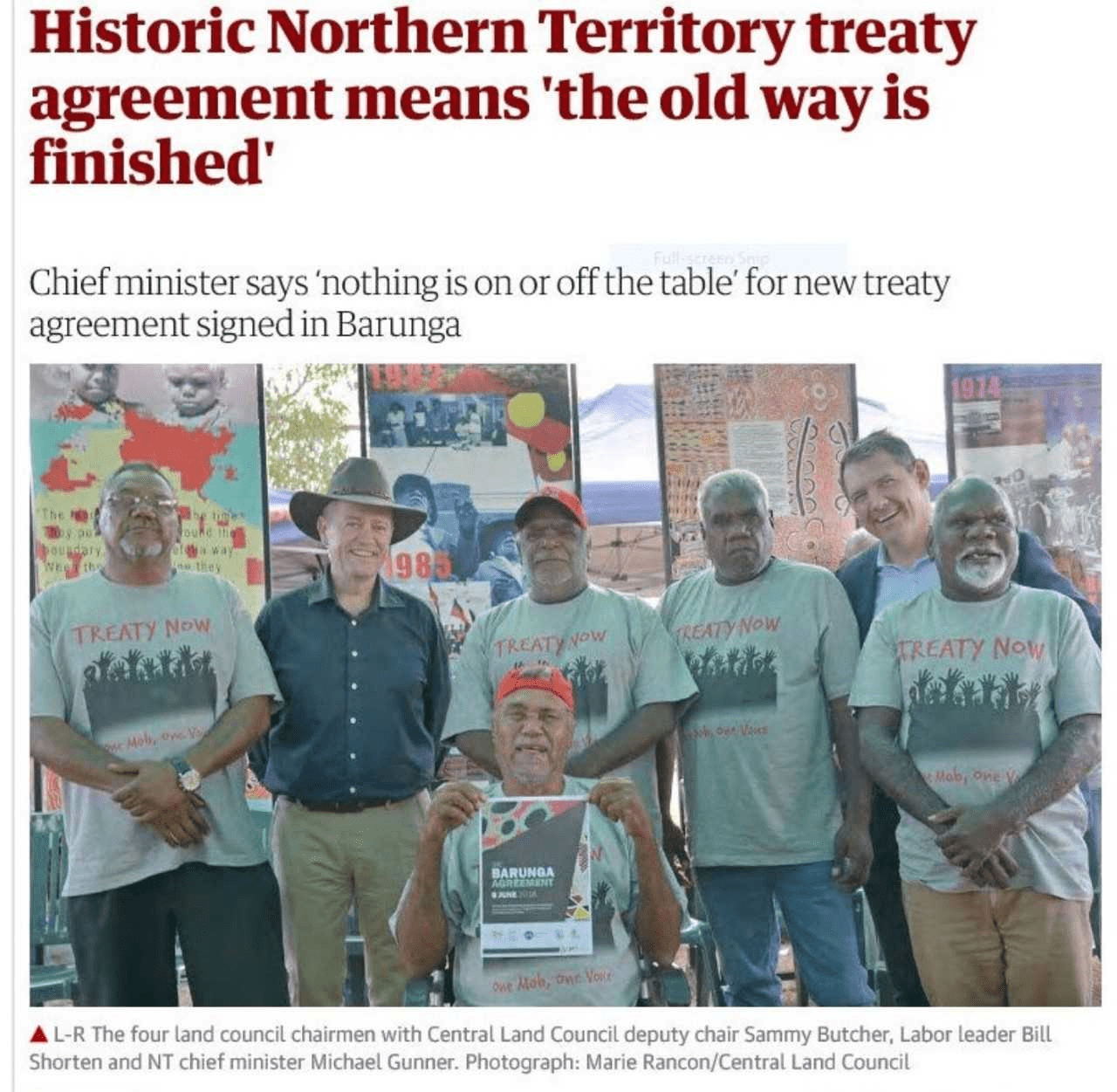
The Northern Territory’s four Land Councils and the Northern Territory Government have today signed an historic Memorandum of Understanding (the “Barunga Agreement”), paving the way for consultations to begin with Aboriginal people about a Treaty.

A joint meeting of the four Land Councils at Barunga this week voted to empower their Chairmen to sign the MOU “

Combined Land Councils and the Northern Territory Government Prees Release see Part 1 Below

And we also need to make clear that if we can establish a Voice for our first Australians – the decisions made about them are made with them and by them.

This is not a radical concept. It is nothing less than we should expect in any other circumstances.

We should not be afraid either, of the using our voice and the voice of first Australians to talk about treaties and agreement-making between our first Australians and levels of government within Australia.

I believe that Australians have the goodwill to reconcile this country. What they don’t have is the leadership in this country to drive proper and meaningful reconciliation.”

Leader of the Opposition Bill Shorten see full speech Part 2 below

Indigenous Affairs Minister Nigel Scullion said it was “irresponsible” for supporters of the indigenous voice concept to leave it open and undefined.

He said it was his personal opinion that it would be more effective to have indigenous people having direct influence and power through the office of minister for indigenous affairs.

“Whether or not you can run my job by a committee, well it hasn’t been done before,” Senator Scullion said.

“Don’t just get on the voice like it’s a life ring, it’s the only thing we’ve got, stick our head in it, start paddling, hope there’s no sharks.”

From the Australian June 11 Indigenous deride Scullion for his offer: ‘Take my job’

The proposal to replace a minister of the crown with a group of unelected indigenous leaders is far more radical than what the Uluru reform calls for, a voice to the parliament .It suggests a lack of understanding of how cabinet government works.”

Aboriginal activist and constitutional law professor Megan Davis was highly critical of Senator Scullion’s idea see part 3 below


 “What does the Victorian bill say?

If passed in the upper house, it will legislate a process for establishing a state Aboriginal representative body and a treaty, or treaties.

The bill will also require the Victorian government to provide annual updates on progress.

“It is about the recognition of us as the first people of this country,” said Victorian Treaty Advancement Commissioner Jill Gallagher.

Aboriginal history Prof Richard Broome, from La Trobe University, told the BBC: “It is very significant because it is the first move from any government in the country.”

See Full Guardian Coverage

The South Australian Government has scrapped a process to negotiate treaties with the state’s Aboriginal nations.

It comes on the same day the Northern Territory pledged to work towards a treaty with its Indigenous peoples.

Premier Steven Marshall said his government was instead in the process of developing a “state-wide plan with a series defined outcomes for Aboriginal people across areas including education, child protection, health and jobs”.

“Treaty commissioner Roger Thomas pictured above has provided advice to the incoming government regarding the positives and negatives of the treaty consultation,” Mr Marshall, who is also Aboriginal Affairs Minister, said.

See SA Coverage HERE


Part 1

The Northern Territory’s four Land Councils and the Northern Territory Government have today signed an historic Memorandum of Understanding (the “Barunga Agreement”), paving the way for consultations to begin with Aboriginal people about a Treaty.

A joint meeting of the four Land Councils at Barunga this week voted to empower their Chairmen to sign the MOU.

“This is a momentous day in the history of the Territory, a chance to reset the relationship between the Territory’s First Nations and the Government,” Northern Land Council Chairman Samuel Bush-Blanansi said. “We’ve got big journey ahead of us. The MOU gives us high hopes about the future and I hope the Government stays true to spirit of the MOU.”


Central Land Council Chairman Francis Jupurrurla Kelly said: “I hope a treaty will settle us down together and bring us self-determination. Today we bounced the ball but we don’t want to stay the only players in this game. The next steps must be led by Aboriginal people across the Territory so that everyone can run with the ball and have their say.”

Anindilyakwa Land Council Chairman Tony Wurramarrba said: “We celebrate the highly significant step that has been achieved today and will work with the Northern Territory Government and other Land Councils to continue the important work required to achieve the goal of a Northern Territory Treaty.”

Tiwi Land Council Gibson Farmer Illortaminni said: “We’ve got to be careful and understand each other about what we want, because we don’t want to have the same problems we’ve had in the past. The MoU is a good start, but we’ve got a long way to go. The Government needs to be honest and transparent.”

Chief Minister Michael Gunner, who signed on behalf of the Government, said: “This is the first day of a new course for the Northern Territory. The MoU we have signed today commits us to a new path of lasting reconciliation that will heal the past and allow for a cooperative, unified future for all.

“A Territory where everyone understands our history, our role in a modern society and our united and joint future will be an important achievement for all Territorians.”

The Territory Labor Government promised soon after the election in 2016 to advance a Treaty, and the MoU is the result of intensive discussions and negotiations between the Land Councils and the Government.

Significantly, the MoU was signed on the first day of the Barunga Sport and Cultural Festival – the 30th anniversary of the presentation of the Barunga Statement to Prime Minister Bob Hawke, who went on to promise a Treaty between the Commonwealth and Australia’s Indigenous peoples, but has remained undelivered.

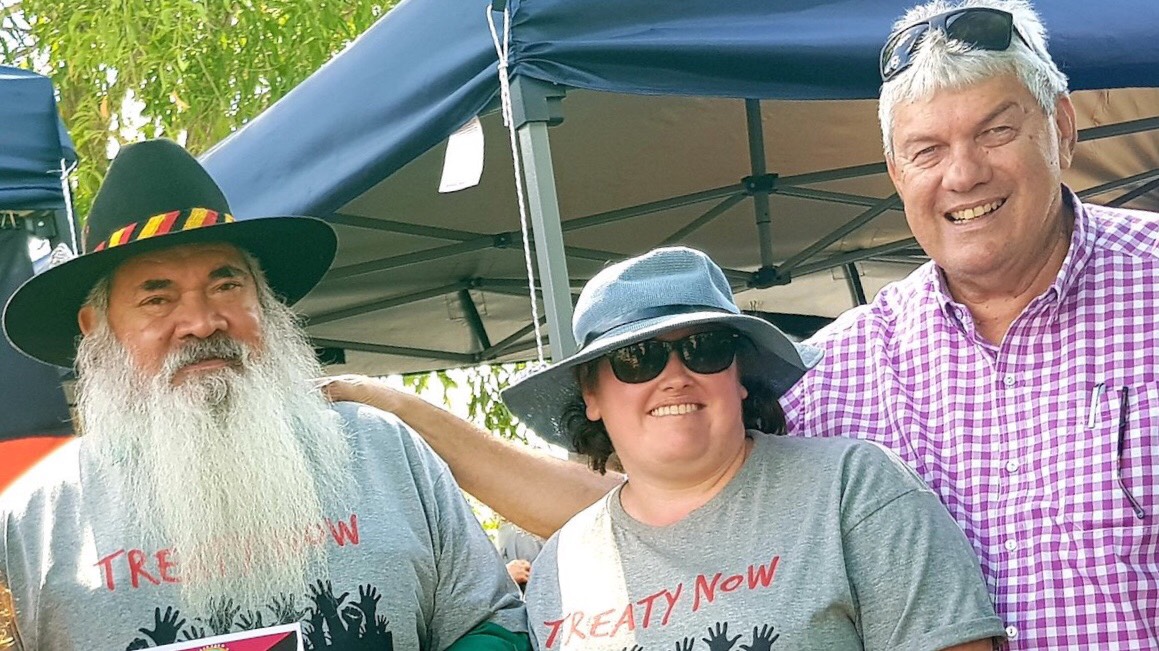
AMSANT CEO John Paterson was at the signing of the agreement with Senator Dodson

Under the terms of the MOU NT Government will appoint an independent Treaty Commissioner who will lead the consultations with Aboriginal people and organisations across the Territory, and develop a framework for Treaty negotiations. The Commissioner will be an Aboriginal person with strong connections to the Territory, and expressions of interest will be called for the position.

The Land Councils and the Northern Territory Government will make their extensive regional staffing networks available to the Treaty Commission to organise consultations in communities.

The MoU prescribes that all Territorians should ultimately benefit from any Treaty, which must provide for substantive outcomes. It’s founded on the agreement that there has been “deep injustice done to Aboriginal people, including violent dispossession, the regression of their languages and cultures and the forcible removal of children from their families, which have left a legacy of trauma and loss that needs to be addressed and healed”.

“The process will begin with an open slate. We will start with nothing on or off the table,” Mr Gunner said.

The MoU acknowledges that there is a range of Aboriginal interests in the Territory, and that all Aboriginal people must have the opportunity to be fully engaged. It further acknowledges that non-Aboriginal people “need to be brought along in this process.”

The document leaves open the possibility of multiple treaties, and lays out a timetable for the work of the Treaty Commissioner.

Part 2 Bill Shorten Speech at Barunga

I acknowledge the traditional custodians of this land, I pay my respects to elders past, present and emerging.

It’s true everywhere on this mighty continent but no more so than here and now: this is, was and always will be Aboriginal land.

I also want to acknowledge, amongst all of the distinguished guests, including Nigel Scullion, I want to acknowledge all the leaders and the Land Council members.

Not just now but those who were here 30 years ago making such significant decisions. And we should remember those who have passed between then and now.

I thank the Bagala mob for having us on their land.

I also want to acknowledge members of the Stolen Generations who are here with us.

And to you, I wish to reiterate the commitment of my party that if we are elected we will provide overdue compensation to the remaining survivors of the Stolen Generations here in the Northern Territory and everywhere else in Australia.

Thirty years ago, the Barunga Statement was made. It was only 327 words but they were powerful.

But let me acknowledge that in the intervening 30 years not enough of the words, or the spirit,  have been kept.

I’m embarrassed the Barunga Statement hangs on a wall in Parliament House and too many members of parliament wouldn’t even know it was there. And too many walk past it, their eyes looking the other way.

But I’m not here today to talk about failure, I want to add words of hope.

When I see and meet the elders and the leaders of the Land Councils, I see hope.

When I see Senator Pat Dodson, Senator Malarndirri McCarthy, Linda Burney – first Australians in the Parliament – I see hope.

When I see so many of you here, here for the music and the sport, here to listen and to learn, I see hope.

Yesterday at Katherine High School, remarkable young teenage girls from the Stars Foundation, I saw hope. Remarkable young Aboriginal boys, teenagers at the Clontarf Foundation, I see hope.

I see hope but I also acknowledge there is unfinished business.

Not unfinished business here but unfinished business across our nation. We have not come far enough.

We need to reset the relationship between our first Australians and all other Australians, we need to change the way we do business.

Not until we are a reconciled nation can any of us help fulfil the destiny this nation has.

We need to change the way we talk to each other and act to each other.

I see that we need to use honour, equality, respect and recognition.

For me coming here is a privilege but it is also a reminder. We need to take the Barunga Statement and use it as a map on our journey to deliver a voice for our first Australians in the parliament and in the constitution.

We need to work towards a Makarrata Commission, a truth-telling commission.

Because until our communities can reconcile a joint narrative about the history of this country, we cannot truly be reconciled.

And we also need to make clear that if we can establish a Voice for our first Australians – the decisions made about them are made with them and by them.

This is not a radical concept. It is nothing less than we should expect in any other circumstances.

We should not be afraid either, of the using our voice and the voice of first Australians to talk about treaties and agreement-making between our first Australians and levels of government within Australia.

I believe that Australians have the goodwill to reconcile this country. What they don’t have is the leadership in this country to drive proper and meaningful reconciliation.

I say to the people who fear the concepts of agreement-making, of a Voice, of treaties.

I say to these people who fear this: you have nothing to lose.

You still will be able to play football on the MCG, your backyard hills-hoists will not be part of any claim, the chickens will still lay eggs.

We are not giving a special deal to our first Australians – because they don’t get a special deal in our country.

A famous man once said, it’s all very well that to say that you lift yourself up by your bootstraps but if you don’t own a pair of boots, you’re not starting from the same position.

So I regard the spirit of Barunga as a reminder to trust the better angels of the nature of the Australian people, to recognise that we can’t honour our country unless we honour our first Australians.

Unless we recognise and respect and have equality this nation will not be the country it should be when – because of the colour of your skin – your life expectancy, your access to healthcare, your educational opportunity, your access to housing and to justice are discriminated against.

So I understand very keenly not just the obligation here but the obligation elsewhere for leadership and I thank you very much for inviting me to be part of this great festival today.

Part 3 Indigenous deride Scullion for his offer: ‘Take my job’

Aboriginal leaders and constitutional lawyers have slammed a proposal from Indigenous Affairs Minister Nigel Scullion to replace his job with an indigenous committee, arguing it is “far more radical” than their proposal for a constitutionally enshrined indigenous voice to parliament.

Senator Scullion made the call during an interview at the Barunga Festival near Katherine in the Northern Territory yesterday, declaring the voice to parliament was “nothing” next to the decision-making and policymaking powers that come with his office.

The voice to parliament has been championed by the Referendum Council and would involve an indigenous representative voice being enshrined in the constitution, as called for by indigenous leaders from across Australia in last year’s Uluru Statement.

Aboriginal activist and constitutional law professor Megan Davis was highly critical of Senator Scullion’s idea.

“The proposal to replace a minister of the crown with a group of unelected indigenous leaders is far more radical than what the Uluru reform calls for, a voice to the parliament,” Professor Davis said. “It suggests a lack of understanding of how cabinet government works.”

Indigenous academic Marcia Langton said she believed Aboriginal people were “perfectly well aware” of the power held by the Indigenous Affairs Minister.

“The Uluru Statement from the Heart calls for a voice to ­parliament, and I’m pretty sure this was not what was meant by the Uluru indigenous Convention delegates,” Professor Langton said.

Former Kimberley Land Council CEO Nolan Hunter said the idea was unworkable.

“If you applied the same thinking to all the other portfolio areas, how would that work?” he said.

Mr Hunter said Senator Scullion’s idea was a distraction from constructive work the indigenous community had been doing towards the voice to parliament.

Constitutional law professor Cheryl Saunders, who is not indigenous, was also sceptical, tweeting: “So much for the Parliament. And, for that matter, the cabinet.”

Senator Scullion accused the Referendum Council of being “irresponsible” in proposing the voice to parliament without also proposing a question to put to a referendum.

A parliamentary committee co-chaired by Labor senator Pat Dodson and Liberal MP Julian Leeser is examining recognition for indigenous Australians in the constitution, with submissions due today.

Senator Scullion said a voice to ­parliament was “all fluff” compared with the power his job holds.

“It’s my job, mate. It’s my job,” he told Sky News. “I have the money and I have the capacity, not me, but the job has the capacity to allocate funds, to create policy, to create change and to do stuff … Now if you don’t have that you’re just fluffing around the edges. You don’t want a voice to parliament, you don’t want a third chamber … it is nothing next to the decision-making, the policymaking, that comes with my office”.

Asked whether he was proposing putting the powers of his job in the hands of indigenous Australians, Senator Scullion said: “Absolutely. Because they would run their own thing.”

He knew from his interactions with Aboriginal people “that part of what they want is more control. So this should be a part of the conversation, a wider conversation.”

He had not “specifically” discussed his idea with Prime Minister Malcolm Turnbull. “My utterances are not necessarily the views of government,” he said.

NACCHO Aboriginal Health , #ACCHO’s and #Medicare : Download Your guide to Medicare for Indigenous health services’ : Includes tips from people who work with Indigenous communities every day.

The Department of Human Services has a new guide to support health professionals with all aspects of Indigenous health services available under Medicare

Your guide to Medicare for Indigenous health services includes tips from people who work with Indigenous communities every day.

The department’s Medicare Liaison Officers – Adam from the Northern Territory and Hazel from north Queensland – contribute insights based on their own experiences.

The guide can help you find out more about:

  • family and domestic violence
  • the Practice Incentives Program including the PIP Indigenous Health Incentive
  • the Practice Nurse Incentive Program
  • Closing the Gap PBS prescriptions, and
  • Indigenous Medicare servicing

Your guide to Medicare for Indigenous health services  is available online for downloading and features artwork by Indigenous Australians.

Next steps 

Read more News for health professionals

INFO HERE

Education guides

These guides support health professionals who provide services to Aboriginal and Torres Strait Islander Australians. The guides also include case studies.

NACCHO Aboriginal Health #ACCHO Deadly Good News stories : Features @DeadlyChoices #NSW Armajun #QLD @GidgeeHealing and Carbal ACCHO #VIC @VAHS1972 #SA @AHCSA #WA #Tasmanian Aboriginal Centre #ACT #NT @DanilaDilba Plus @FaCtS_Study #IGAwards2018

1.1 National : Reconciliation Australia’s 2018 Indigenous Governance Awards Closes 30 June

1.2 National : Partnerships and up to $40,000 funding for each Aboriginal communities to conduct research to find out what communities need to promote and improve safety for families closes 29 June 2018

1.3 NACCHO offers discounted subscriptions and trials of the Clinical Decision Support System UpToDate for all practices

2.1 SA : Aboriginal Health Council of South Australia, Moorundi Aboriginal Controlled Community Health Service, Quitline and Puyu Blasters jion forces in Murray Bridge health promotion

2.2 SA : Pika Wiya Aboriginal Health Service hosted a Social and Emotional Wellbeing Day on Tuesday, June 5 to address chronic diseases in a culturally sensitive way.

3.NSW : Armajun Aboriginal Health Services tours New England to understand the challenges facing our Indigenous communities

4.QLD : Carbal Medical Services expands health services for the Aboriginal and Torres Strait Islander community

5.VIC : VAHS and Deadly Choices health promotion at the AFL Long Walk

6.NT : Danila Dilba ACCHO staff came out in force for the Larrakia Nation Family Fun day 

7.WA :Tracy Westerman visited Karratha for Indigenous mental health in the Pilbara

8. TAS: The latest Virgin aircraft Tinamirakuna named after the Macquarie River in lutruwita (Tasmania)

9.ACT : Winnunga Nimmityjah Aboriginal Health Service $11 million delayed

 View hundreds of ACCHO Deadly Good News Stories over past 6 years

How to submit a NACCHO Affiliate  or Members Good News Story ?

 Email to Colin Cowell NACCHO Media    

Mobile 0401 331 251

Wednesday by 4.30 pm for publication each Thursday /Friday

1.1 National : Reconciliation Australia’s 2018 Indigenous Governance Awards Closes 30 June

Aboriginal and Torres Strait Islander-led organisations that place culture at the heart of their governance are invited to apply for the 2018 Indigenous Governance Awards (IGAs), which were launched today.

Reconciliation Australia and BHP Billiton are proud to run the awards for the first time in partnership with the Australian Indigenous Governance Institute, a national centre of governance excellence.

Established in 2005, the IGAs publicly recognise and celebrate outstanding Aboriginal and Torres Strait Islander-led organisations and projects that make extraordinary contributions to communities and the nation.

Organisations that are displaying effective Indigenous governance are encouraged to apply, with prizes including corporate mentoring, feedback from the judging panel, media and networking opportunities, and a share in $60,000.

Reconciliation Australia CEO Karen Mundine said it was important to showcase the high achievers in Indigenous governance, so that they get the accolades they deserve – and so that broader Australia understands their important contributions.

“For more than a decade, the IGA winners have shown that so much is possible when Aboriginal and Torres Strait Islander develop innovative and robust systems of governance by putting culture at the heart of what they do,” Ms Mundine said.

Australian Indigenous Governance Institute CEO Michelle Deshong said governance was the foundation stone that enabled Indigenous peoples and communities to build a prosperous future.

“The ability to come together, set goals, and put things in place to achieve their goals, allows people to build a self-determined future,” Ms Deshong said.

“For Indigenous peoples, this means navigating a complex and interconnected web of cultural, environmental, economic and political influences. Celebrating those who have done this well fills us with ideas, confidence and inspiration.”

The two award categories are Category A: Indigenous-led incorporated organisations and Category B: Indigenous-led non-incorporated initiatives or projects.

Winners in each of the two categories will receive $20,000, and highly commended organisations in each category will each be awarded $10,000. Ms Mundine said the IGAs have a history of attracting high caliber nominations from organisations around the country, from the bustling capital cities to our most remote communities.

“In 2018, we want to see applications from organisations and projects that are making a difference in their communities, through community engagement, varying governance models and cultural practices.

Applications or recommendations for the 2018 Indigenous Governance Awards can be made online at http://www.reconciliation.org.au/iga or by calling 02 6273 9200. Applications close Saturday 30 June 2018.

There are two award categories:

  • Category A: Outstanding examples of Indigenous governance in Indigenous incorporated organisations.
  • Category B: Outstanding examples of Indigenous governance in non-incorporated initiatives or projects.

Each category is looking for governance that demonstrates:

  • Innovation
  • Effectiveness
  • Self-determination and leadership
  • Cultural relevance and legitimacy
  • Future planning, sustainability and governance resilience.

1.2 National : Partnerships and up to $40,000 funding for each Aboriginal communities to conduct research to find out what communities need to promote and improve safety for families closes 29 June 2018

The Australian National University is seeking partnerships with Aboriginal and Torres Strait Islander communities to conduct research to find out what communities need to promote and improve safety for families. We want to partner and work with local organisations and communities to make sure the research benefits the community.

Who are we?

We work at the Australian National University (ANU). The study is led by Aboriginal and Torres Strait Islander researchers. Professor Victoria Hovane (Ngarluma, Malgnin/Kitja, Gooniyandi), along with Associate Professor Raymond Lovett (Wongaibon, Ngiyampaa) and Dr Jill Guthrie (Wiradjuri) from NCEPH, and Professor Matthew Gray of the Centre for Social Research and Methods (CSRM) at ANU will be leading the study.

Study Question: What would it take to address Family Violence in Aboriginal and Torres Strait Islander Communities?

How are we going to gather information to answer the study question?

A Community Researcher (who we would give funds to employ) would capture the data by interviewing 100 community members, running 3 focus groups for Men / Women / Youth (over 16).  We would interview approx. 5 community members to hear about the story in your community.

We know Family Violence happens in all communities. We don’t want to find out the prevalence, we want to know what your communities needs to feel safe. We will also be mapping the services in your community, facilities and resources available in a community.  All this information will be given back to your community.

What support would we provide your service?

We are able to support your organisation up to $40,000 (including funds for $30 vouchers), this would also help to employ a Community Researcher.

Community participants would be provided with a $30 voucher to complete a survey, another $30 for the focus group, and another $30 for the interview for their time.

What will we give your organisation?

We can give you back all the data that we have captured from your community, (DE identified and confidentialised of course).We can give you the data in any form you like, plus create a Community Report for your community. There might be some questions you would like to ask your community, and we can include them in the survey.

How long would we be involved with your community / organisation?

Approximately 2 months

How safe is the data we collect?

The data is safe. It will be DE identified and Confidentialised. Our final report will reflect what Communities (up to 20) took part in the study, but your data and community will be kept secret.  Meaning, no one will know what data came from your community.

If you think this study would be of benefit to your community, or if you have any questions, please do not hesitate to contact Victoria Hovane and the FaCtS team on 1800 531 600 or email facts.study@anu.edu.au.

1.3 NACCHO offers discounted subscriptions and trials of the Clinical Decision Support System UpToDate for all practices. 

 Download the brochure

UpToDate Brochure – Staying UpToDate

UpToDate is an evidence-based clinical decision support system and extensive medical database. Used to answer clinical questions, improve medical knowledge and helps provide consistent, best practice care on the full spectrum of medical conditions.

It is proven to change the way medical professionals practice medicine, and is currently used across a range of our practices.

Key features of UpToDate® include:

  • Evidence-based medical content that is researched, created, and continually updated by over 6,500 leading physicians
  • Practice Changing Updates – highlights specific new recommendations and/or updates that UTD anticipate may change usual clinical practice
  • 25 Specialties – UTD contains all of the internal medicine subspecialties (at a level that meets the needs of the subspecialist), all of primary care, internal medicine, ob/gyn, pediatrics, general surgery, and more – all in one resource.
  • Graphics Search – This powerful search engine feature allows you to search tens of thousands of pictures, charts, movies, illustrations and more – all without ever leaving UpToDate®
  • Medical Calculators – More than 165 medical calculators are available with the subscription
  • Drug Information – A select drug database of more than 5,600 unique drug entries (in partnership with Lexicomp®) including adult, pediatric, and international drugs and a drug interactions tool that provides graded adverse reaction information between drug-to-drug and drug-to-herb interactions.
  • Patient Information – UTD includes more than 1,500 Patient Information articles about the most common medical conditions and therapies.
  • Accredited Education Resource – accredited from a range of colleges including the RACGP & ACRRM allowing staff to earn CME/CPD Points

Contact details

James Dixon from UpToDate

In the meantime, don’t hesitate to contact me at james.dixon@wolterskluwer.com or Mobile: 0401 855 882, if you have any questions.

2.1 SA : Aboriginal Health Council of South Australia, Moorundi Aboriginal Controlled Community Health Service, Quitline and Puyu Blasters jion forces in Murray Bridge health promotion

Smoking is more than just an expensive habit – it steals lifetimes and tears families apart, those present at a World No Tobacco Day event have been told.

In Edwards Square, Murray Bridge last Thursday, several Aboriginal health organisations joined forces to warn about the long-term consequences of smoking.

Originally published here

T-shirts designed by local artist Harley Hall were given out as people pledged to live smoke-free, or help friends and family do so; sausages were cooked and songs sung.

Mr Hall said smoking had always been a big part of his family.

He had lost both of his nannas to emphysema, he said; his father had had lung cancer and his mother now had a reduced lung capacity as well.

“So much of our community is smoking,” he said.

“Family means everything to us blackfellas, so it’s time to start now, time to take the pledge.”

Harold Bundamarra Stewart, now aged in his 60s, said he finally managed to quit 25 years ago.

“I struggled all my life,” he said.

“I had my first cigarette when I was 15 years old.

“Now I’ve dedicated my life to helping get that message out there about the dangers of smoking.”

It was a significant factor in diabetes, he said, and three or four other diseases came along with it.

He urged all smokers to seek help from health services.

“It’s very important to have support,” he said.

“I struggled – I quit seven times in my life and always went back.

“But you can give up successfully.”

The event was organised by the Aboriginal Health Council of South Australia, Moorundi Aboriginal Controlled Community Health Service, Quitline and Puyu Blasters.

Get help: Quitline 13 78 48, Moorundi Aboriginal Controlled Community Health Service 8531 0289.


2.2 SA : Pika Wiya Aboriginal Health Service hosted a Social and Emotional Wellbeing Day on Tuesday, June 5 to address chronic diseases in a culturally sensitive way.

HEALTH: Pika Wiya CEO Alan Morris and Country and Outback Health Indigenous Health Project Officer Jacinta McKenzie at Pika Wiya’s Social and Emotional Wellbeing Day

Originally published HERE

The theme of the event, which was held in conjunction with Country and Outback Health, was ‘Wellness our way’, bringing a host of traditional healers on site for consultation.

The event showcased programs that focus on mental and physical personal care, such as Stepping Stones, headspace and Family Violence Legal Service Aboriginal Corporation.

Pika Wiya CEO Alan Morris highlighted the importance of integrating traditional healers into medicine.

“We (Pika Wiya) are the largest users of traditional healers, or Ngangkari’s, outside of the APY,” Mr Morris said.

“Using bush medicine to heal mind, spirit and body are integral to the ongoing success of the Aboriginal community.

“Their medicine and ways of healing compliment the more traditional western medicine.”

Tom Powell from Red Dust Healing was a guest speaker at the event, focusing on how to deal with grief, loss and trauma.

Country and Outback Health’s Indigenous Health Project Officer Jacinta McKenzie said the day was all about caring for the mind and making better choices.

“Every person and family has different things going on within their life to overcome to be able to get to that next stage,” she said.

“Grief and loss; we have a lot in the community that impacts on people as well. We try to encourage people to look after themselves a bit better to try to deal with it separately.”

The event also gave the organisations the chance to bring Aboriginal and Torres Strait Islander people into Pika Wiya to complete their Medicare Health Assessment.

3.NSW : Armajun Aboriginal Health Services tours New England to understand the challenges facing our Indigenous communities

Service providers with Aboriginal clients are invited to attend a local workshop this month to understand the challenges facing our Indigenous communities.

SEE EVENTS Calendar

The workshops have been developed by Spirit Dreaming for the Armajun Aboriginal Health Service in response to feedback they received from communities in the areas where they provide primary health care services: Tenterfield, Armidale, Glen Innes, Inverell, Tingha and Walcha.

Originally published HERE

“The workshops came about through consultation with our communities in our service region,” said Armajun program manager James Sheather.

“They’ve told us there is a need for more mental health wellbeing services in community, so we are hoping these workshops will start the ball rolling by providing community and service suppliers with information sessions to help them understand the issues being faced by their clients.”

Mr Sheather said the workshop would challenge and test past perceptions of Aboriginal Peoples and their culture.

“It is designed to address cultural realities in order to improve service delivery to Aboriginal clients and co-workers,” he said.

“We will explore the three major issues which impact on Aboriginal peoples of today; transgenerational trauma; lateral violence and cultural loads.”

Facilitator Mel Brown, an Aboriginal Ngunnawal woman, will identify and ask participants to consider the actual and potential impacts of these issues upon their community.

“She will also show them available resources and help them develop the skills for managing clients and families who are affected by these issues,” Mr Sheather said.

The Tenterfield workshop will be held at the Visitor Information office on June 15 between 9.30am and 3.30pm.

4.QLD : Carbal Medical Services expands health services for the Aboriginal and Torres Strait Islander community

Carbal Medical Services has opened a new centre in Guy St as it prepares to ramp up its clinical practice and community services.

CEO Brian Hewitt said the clinic in Warwick was “bulging at the seams”.

“We now deliver 29 different programs across the darling downs on top of the two full clinics that we operate in Warwick and Toowoomba.”

Originally published HERE

The increased services in Warwick will address an growing demand for culturally appropriate medical care in the region.

Carbal Medical Services now has 7000 clients across the Darling Downs.

Toni Park with Carbal Medical Centre patient, Githabul elder Amos Close. Photo Jayden Brown / Warwick Daily News
Toni Park with Carbal Medical Centre patient, Githabul elder Amos Close. Photo Jayden Brown / Warwick Daily News Jayden Brown

“If we identify a gap, we don’t sit around and wait for funding. We will set up a program and make it happen,” Mr Hewitt said.

The new community services centre in Guy St would focus on delivering health programs to tackle smoking, drug and alcohol abuse and low-intensity mental health.

The Warwick clinic also plans to increase the number of doctors to cater to rising demands for GP and allied health care.

Practice manager Kerry Stewart said the waiting list for doctor appointments signified the community’s investment in health.

“We certainly get a strong engagement from the community,” Ms Stewart said.

She put the success down to staff cultural awareness training and empowering patients.

“There is a focus on assisting people to take initiative on their own health which makes them want to attend their appointments,” Ms Stewart said.


EVERYONE COUNTS: Carbal helps Indigenous and non-Indigenous people of all ages.
EVERYONE COUNTS: Carbal helps Indigenous and non-Indigenous people of all ages. Contributed

Patients travel from as far as Stanthorpe and Inglewood to access specialised care in Warwick.

Ms Stewart said the expansion of services for the community’s Indigenous population was a positive step in reconciliation week.

“Being able to offer more services for Indigenous people in the community contributes to the broader reconciliation movement and making Aboriginal and Torres Strait Islander people feel valued.”

“It is a long road but if everyone works together we will eventually get there in closing the gaps.”

4.2 :  Queensland State Minister for Health checks out Gidgee Healing Deadly Choices Program

Steven Miles, Queensland State Minister for Health and Paul Woodhouse, North West Hospital and Health Service Chair who came down to Mount Isa Special School today to check out the Deadly Choices program!

5.VIC : VAHS and Deadly Choices health promotion at the AFL Long Walk

Check it out the Essendon legend himself Anthony McDonald-Tipungwuti wearing the VAHS Deadly Choices Shirt out during the warm up for Dream Time at the G. The other players also wore the shirts as well… What a moment !

If you want your very own VAHS Deadly Choices Shirt just like Tippa the only way you can get one is to complete a health check at VAHS. So call us and book your health check on 03 9419 3000

6.NT : Danila Dilba ACCHO staff came out in force for the Larrakia Nation Family Fun day 

Danila Dilba staff came out in force for the Larrakia Nation Family Fun day to celebrate their 20th Anniversary at the Jingili Water Gardens on 26 May.

It was a great day with lots of cultural activities and community coming down. Congratulations to Larrakia Nation for this important milestone and thanks to all our staff who helped out on the day. #LivingStronger #LivingLonger

7.WA :Tracy Westerman visited Karratha for Indigenous mental health in the Pilbara

Pioneering Aboriginal psychologist and WA Australian of the Year winner Tracy Westerman visited Karratha last week to deliver specialised training in indigenous mental health to psychologists and social workers from across the region.

Originally published HERE

Over a two-day workshop at the Karratha Leisureplex, the internationally recognised psychologist spoke to local staff about how to identify signs of mental health issues such as depression in Aboriginal clients and intervene early in a culturally appropriate way.

The event marks the first time Dr Westerman, who grew up in Tom Price, has returned to the Pilbara since winning WA Australian of the Year in November.

She said the training would fill in gaps in professionals’ knowledge on indigenous mental health, which was too often “invisible” in mainstream psychology training.

“We get people skilled up in identifying the different signs of depression and knowing how to treat depression in a more culturally specific way, because the more we can get conditions at an early stage, the more we can prevent the escalation of those issues in the community more generally,” she said.

“I want people to be more tuned into those early signs and also how to work on and prevent mental health issues in Aboriginal communities, which are often very different to working with non-indigenous communities.”

The workshop, which was supported by the WA Primary Health Alliance and facilitated by Mission Australia, was attended by about 40 mental health and drug and alcohol counselling staff from Mission Australia, headspace, Hedland’s Youth Involvement Council and Bloodwood Tree.

Mission Australia Hedland clinical lead Amanda MacBride said Dr Westerman’s training was invaluable for her and her colleagues for its focus on indigenous mental health.

“We can get cultural training but it’s general, and we can get more mental health training in our field, but to find that combination is rare, so that’s what makes this so enriching because we need that combination up here in the Pilbara,” she said.

“You are going to have Aboriginal clients here … so you need those tools.”

8. TAS: The latest Virgin aircraft Tinamirakuna named after the Macquarie River in lutruwita (Tasmania)


9.ACT : Winnunga Nimmityjah Aboriginal Health Service $11 million delayed

About $11 million has been set aside over three years for a new facility for Winnunga Nimmityjah Aboriginal Health Service, a 2016 election promise.

The majority of the money will be delivered to Winnunga later than proposed, with about $8 million of the funding being delivered in 2020-21

NACCHO Aboriginal Health Alcohol and other Drugs : Critical Aboriginal health Drug and Alcohol services cut during #NRW Reconciliation Week

First Nations people in crisis will be left without a place to go after Minister Scullion announced the Aboriginal Drug and Alcohol Council in South Australia, the Institute for Urban Indigenous Health in Brisbane and the Queensland Aboriginal and Islander Health Council will all have their alcohol and other drug support funding cut.

This is yet another example of the Government doing things ‘to’ and not ‘with’ First Nations people and clearly demonstrates why First Nations people need a Voice to Parliament.”

Senator Patrick Dodson and The Hon Warren Snowdon Press release See Part 3 Below

NACCHO has published close the 200 Aboriginal Health Alcohol and other Drugs articles over the past 6 years

We believe at the current time this must be some kind of oversight.  It will take Aboriginal health in this country backwards in a massive way if there is no Aboriginal Drug and Alcohol Council.

We urge the Prime Minister and Minister Scullion to reconsider urgently and to announce that our funding will continue ”

The CEO of the Aboriginal Drug and Alcohol Council (ADAC) urges the Prime Minister to reconsider following shocking news from the Federal Government that the Aboriginal Drug and Alcohol Council is to be closed down. See Part 2 below

Scott Wilson says the news is devastating and will have a massive negative impact on Indigenous Australian highlighting that ADAC helps close to 30,000 Indigenous people a year and costs the Federal Government just $700,000.

Part 1 Press Coverage SBS

An Indigenous rehabilitation centre in South Australia could be forced to stop taking clients from September because of funding cuts, its chief executive says.

The head of an Indigenous drug and alcohol rehabilitation centre believes it will have to stop taking clients from September because of federal government funding cuts.

Originally published here

Services provided by the Aboriginal Drug and Alcohol Council in South Australia can’t continue without ongoing funding for its main body, its chief executive Scott Wilson says.

The council receives $4.5 million a year from the federal government to operate a residential rehabilitation centre in Port Augusta and two day centres in Ceduna and Port Augusta.

But Mr Wilson says he received a call last week, during reconciliation week, to say while funding for the facilities would continue they’d stop receiving $700,000 a year for administrative facilities and wages, including his own, from January 1.

“When you don’t actually have the legal entity being funded you can’t actually operate the other services at all,” he told Sky News.

“It’s almost like having an airline but no airport to land.”

A spokesman for Indigenous Affairs Minister Nigel Scullion said the government has provided $1.38 million a year to continue the alcohol and drug treatment service until June 2020.

“The Minister is absolutely focused on delivering the best outcomes for Aboriginal and Torres Strait Islander communities and does not apologise for holding service providers like Mr Wilson to account for the outcomes they deliver,” the Minister’s spokesman said.

He said the government was also assessing the effectiveness of the service.

Mr Wilson said the cut would mean staff could only be offered six-month contracts and the residential treatment centre would probably stop taking clients from September this year.

“Without us there is simply no voice,” Mr Wilson said in a statement.

“We need the funding back. We have so many clients in crisis who need our help.”

Part 2 Press Release

The CEO of the Aboriginal Drug and Alcohol Council (ADAC) – which was set up as a direct result of the Royal Commission into Aboriginal Black Deaths in Custody – is urging the Federal Government not to close the Aboriginal Drug and Alcohol Council.

On May 31st 2018, the Prime Minister’s Office called Scott Wilson indicating that from January 1st of next year there will be no funding for ADAC.

Scott Wilson says the news is devastating and will have a massive negative impact on thousands and thousands of Indigenous Australians.

The Aboriginal Drug and Alcohol Council helps over 20,000 Indigenous people through its day centres’ diversionary programs. A further 10,000 people use other services. ADAC costs the Federal Government just $700,000 a year.

Scott Wilson says minor savings in money will lead to massive drug and alcohol problems for the Aboriginal community. He says the cutback is a false economy.

ADAC has been operating for 25 years. It represents the only collective voice for over 30 Indigenous community controlled member organisations across South Australia.

ADAC provides alcohol and other drugs resources to close to 2,000 community organisations across the nation. 30 Aboriginal community organisations across South Australia are members of ADAC.

ADAC is the largest provider of alcohol and other drugs services for Indigenous people in the State and employs 57 staff across South Australia.

CEO Scott Wilson has had numerous Ministerial appointments including twoPrime Ministerial appointments onto the Australian National Council of Drugs (now called ANACAD) for a decade and he is the founding director of the Alcohol Education Rehabilitation Foundation (now called FARE).

Scott Wilson said, “We cannot believe that the Federal Government is intending to close the Aboriginal Drug and Alcohol Council. The impact would be massive.

ADAC runs a wide range of services across the State including doing all the payroll and purchasing. I have absolutely no idea how staff would get paid without us.”

“To be clear, we advocate on behalf of Aboriginal people facing drug and alcohol issues. Without us there is simply no voice. We don’t believe day centres and rehabilitation centres will be able to continue without ADAC so we are talking about 57 jobs going.”

“We ask the Federal Government to urgently review and reconsider its decision.

We need the funding back. We have so many clients in crisis who need our help. If the Federal Government pursues this track, staff will leave all parts of ADAC in droves because there will be no job security.

We won’t be able to offer contracts to people and everything will be very different indeed.” ADAC was formed in 1993 as a South Australian community response to the Royal Commission into Black Deaths in Custody. It was recommended that there should be a community controlled response through a statewide peak substance misuse organisation.

ADAC has received consecutive funding from the Australian Federal Government for 25 years. Scott Wilson says it is well known that the most effective and sustainable approaches to alcohol and drug misuse are those that are actually delivered by Indigenous community controlled organisations.

Staff at ADAC include five Aboriginal people with either a Master in Indigenous Health or a Graduate Diploma.

They also have registered nurses, enrolled nurses, counsellors and a range of other experts.

ADAC expertise has been recognised by the Federal Government over numerous years with ADAC staff being members of nearly every national drug strategy committee since 1998.

ADAC has held over 15 community forums on alcohol and other drugs and ice in the past 12 months.

ADAC is also involved with four National Health and Medical Research Council grants.

Since taking over, day centre client contacts have climbed massively from 900 a year to 20,000 per year.

Scott Wilson added, “We believe at the current time this must be some kind of oversight. It will take Aboriginal health in this country backwards in a massive way if there is no Aboriginal Drug and Alcohol Council.

We urge the Prime Minister and Minister Scullion to reconsider urgently and to announce that our funding will continue.

WEBSITE

ADAC FACT SHEET

Formed in 1993 (25 years ago) as a South Australian Community response to the Royal Commission into Black Deaths in Custody (RCIADIC) recommendations to provide a community-controlled response through a statewide peak substance misuse organization.

With recurrent funding from the Australian Government, ADAC has successfully provided Peak Body AOD services in South Australia for over 25 years.

It is well known that the most effective and sustainable approaches to alcohol and drug misuse are those delivered by Indigenous community-controlled organisations.

Saggers & Gray (2010) therefore, ADAC is unique as it is the only Indigenous peak body of its kind in Australia and represents the only collective voice for over 20 Indigenous community-controlled member organisations across South Australia.

30 Aboriginal community organisations across SA are members of ADAC

ADAC employ 57 staff across SA and is the largest provider of AOD for indigenous people in the state. Our staff include 5 Aboriginal people with either a Master in Indigenous health or Graduate Diploma, Registered Nurses, enrolled nurses, Counselors and a range of other qualifications including aboriginal Primary Health.

ADAC expertise has been recognized by the Commonwealth government over numerous years with ADAC staff being members of nearly every National drug Strategy Committee since 1998.

The CEO Scott Wilson has had numerous Ministerial appointments including 2 Prime Ministerial appointments onto the Australian National Council on Drugs (ANCD) for 10 years and the founding Director of the Alcohol Education Rehabilitation Foundation for 11 years.

Part 3 Labor Press Release

First Nations people in crisis will be left without a place to go after Minister Scullion announced the Aboriginal Drug and Alcohol Council in South Australia, the Institute for Urban Indigenous Health in Brisbane and the Queensland Aboriginal and Islander Health Council will all have their alcohol and other drug support funding cut.

This is yet another example of the Government doing things ‘to’ and not ‘with’ First Nations people and clearly demonstrates why First Nations people need a Voice to Parliament.

CEO of the Aboriginal Drug and Alcohol Council in South Australia Mr Wilson received a call during reconciliations week, to inform him of the cut, which includes his own wages from January 1.

The Institute for Urban Indigenous Health received a call yesterday confirming their Inner City Referral Service will face cuts. The Queensland Aboriginal and Islander Health council will lose the equivalent of two full-time alcohol and other drug workers.

This is just the beginning, with other state and territory bodies anticipating similar cuts.

You can’t make this stuff up, the Turnbull Government has cut critical rehab services during reconciliation week.

Aboriginal Drug and Alcohol services support members of the First Nations community at their most vulnerable. Alcoholic and drug dependant patients have a high incidence of entering the criminal justice system, it is only through rehabilitative services that people get the second chance they deserve. First Nations people need access to crisis alcohol and other drug support, not a hall pass to correctional centres.

Alarmingly, the Aboriginal Health Council of South Australia (AHCSA),Institute for Urban Indigenous Health in Brisbane (IUIH), Queensland Aboriginal and Islander Health Council (QAIHC) and the National Aboriginal Community Controlled Health Organisation (NACCHO) were not consulted prior to the decision to cease funding.

Labor calls upon the Government to rethink their ill-advised decision to cut funding to critical Aboriginal Drug and Alcohol services across Australia.

NACCHO Aboriginal Health #ACCHO Job Opportunities Inc CEO @ahmrc @TISprogramme #NT #Sunrise @MiwatjHealth @CAACongress #QLD @QAIHC_QLD @ATSICHSBris @IUIH_ @Apunipima @NATSIHWA #Aboriginal Health Workers @IAHA_National Allied Health @CATSINaM #Nursing

This weeks #ACCHO #Jobalerts

Please note  : Before completing a job application please check with the ACCHO that the job is still open

Job of the Week CEO AHMRC Expression of interest


Purpose of the position:

The CEO establishes the core values and strategy of the workplace and is accountable for developing, communicating and executing strategic plans to facilitate the sustainable business success of the AH&MRC. The CEO will lead the development of annual goals and will work with Senior Management Team to guide the successful implementation of strategies that promotes the organisation’s values.

The AH&MRC CEO is ultimately responsible to the Chairperson and the Board of Directors (the Board) for implementing strategic and operational policy and for the continued growth and viability of the organisation.  The CEO will be building the confidence, reputation and profile of the AH&MRC amongst the Members and across the Aboriginal health sector of NSW.  The CEO will develop and grow the organisation’s services to members and provide strategies and advice to the Board.

Depending on the notice period of the successful applicant this position is expected to commence around August/September for a period of a three (3) year contract, based in our Surry Hills office (66 Wentworth Ave, NSW).

Criteria:

  1. Knowledge of the Aboriginal Health sector
  2. Demonstrated experience working at a high level
  3. Current CEO experience and management
  4. This vacancy is an identified Aboriginal or Torres Strait Islander recruitment under Part 22, section 22.9 of the AH&MRC Constitution. Applicants for this role must satisfy the Aboriginality criteria you will need to provide information on how you satisfy the Aboriginality

A detailed position description is attached which includes the duties of the position and the salary.

EOI should be forwarded to the HR department via email to gagic@ahmrc.org.au included with the application should be a current CV and a Cover Letter outlining the above criteria.

Please contact the HR Department via email gagic@ahmrc.org.au should you wish to discuss the position further.

Applications close Friday, 22 June 2018

 Download AHMRC_CEO_PD_May_2018

Rural Doctor job of the week

Gidgee Healing is currently seeking a General Practitioner to deliver integrated, comprehensive primary health care services at their Burke St Clinic in Mount Isa.

You will be supported by a team of dedicated clinic staff including Registered Nurses, Aboriginal Health Workers, Medical Receptionists, Practice Managers and visiting Specialists and Allied Health providers; in addition to community and secondary service providers.

ESSENTIAL CRITERIA:

  • Qualified Medical Practitioner, holding unconditional current registration with AHPRA
  • Vocationally Registered, FRACGP or FACRRM
  • Eligible for unrestricted Medicare Provider Number
  • Knowledge, understanding and sensitivity towards the social, economic and cultural factors affecting Aboriginal and Torres Strait Islander peoples health.

ABOUT US:

Gidgee Healing is a dynamic Aboriginal Community Controlled Health Service that provides a comprehensive and growing range of primary health care services to Aboriginal and Torres Strait Islander people residing in the Mount Isa, North West and Lower Gulf of Carpentaria regions. Our services include General Practice, maternal and child health, social and preventative health, health promotion and education, allied health and specialist services. Gidgee Healing is also the lead agency for headspace Mount Isa and the Normanton Recovery and Community Wellbeing Service. The organisation strives to provide high quality health and wellbeing services in a culturally welcoming environment, to enhance the accessibility and uptake of health services by our clients and support the early identification and management of illness and chronic diseases.

THE LIFESTYLE:

The North West offers a relaxed and casual lifestyle, with a wealth of camping and exploring, scenic national parks, gorges, as well as pristine river, lake and open water fishing and recreation.

Applications close COB Friday 15th June, 2018

To apply online, please click on the appropriate link below. Alternatively, for a confidential discussion, please contact Lauren Taylor on (07) 4743 6681, quoting Ref No. 798746.

APPLY HERE

General Practitioners Awabakal

We are currently seeking two dedicated and talented General Practitioners to join our growing team. A strong interest in, and commitment to Aboriginal Health is a must. You will form an essential part of our multidisciplinary team, serving the local community in strong consultation with a network of excellent nursing, allied health and administration specialists.

Our GP’s will rotate across our Medical Facilitates based at Hamilton, Raymond Terrace and Cardiff, and through Outreach programs.

Why work for Awabakal?

Awabakal is a dynamic and innovative community organisation with the support and wellbeing of the Aboriginal community in Newcastle, Hunter Valley, Lake Macquarie and Port Stephens at the heart of everything we do.

Our highly skilled teams across medical, aged care, housing and preschool services are passionate and driven to provide the most progressive and flexible services to our local Aboriginal communities and we actively empower our staff to be creative and forward thinking.

The positions:

You will work as an integral part of Awabakal’s Medical team, and report to the Senior Medical Officer.

The role will require you to provide quality, integrated, best practice primary health care to the patients of the Aboriginal Medical Service, both within the confines of the medical practice and through Outreach programs.

You will improve the health of the Awabakal community by improving patient access to appropriate treatment and health care plans.

What you need to be successful:

Professional medical registration with the Australian Health Practitioners Regulation Authority (AHPRA)

Fellowship of the Royal Australian College of General Practitioners FRACGP

Fellowship of the Australian College of Rural and Remote Medicine (FACRRM) or equivalent

Accredited GP registrar supervisor (desirable)

Demonstrated relevant experience as a General Practitioner as a vocationally registered/fellow in a community setting

Demonstrated experience of working effectively with Aboriginal clients and community

Demonstrated understanding of cultural issues impacting access to care for Aboriginal people

Extensive experience with patient consultation

Experience with Medicare Billing

Current Class C Drivers Licence

Salary:

Our teams are professional, hardworking and passionate, best describing our culture as innovative, flexible and supportive and we are committed to ensuring our leadership team members reflect our important organisational values.

A competitive salary will be negotiated with the right candidate, to match skills, experience and qualifications.

Please note as part of Awabakal’s recruitment process, prior to an offer of employment being made, recommended candidates will be required to undertake and provide a current Working with Children and National Police Check, and demonstrate evidence of current registration, and original qualifications.

All General Practitioners employed by Awabakal are required to maintain individual medical indemnity insurance, always, and as appropriate to their position at Awabakal. Medical indemnity insurance is an essential requirement of registration with the Medical Board of Australia.

How to Apply:

To apply please forward your resume and supporting covering letter, or alternatively contact Dr Dean Wright on 0419 638 796 or Jessica Gossage, Human Resource Consultant on (02) 4940 8743 for a confidential discussion.

We site www.yerin.org.au

Check out the Website

Jobs of the week 

Queensland Aboriginal and Islander Health Council

Research and Evidence Manager

We seek a high calibre professional, to undertake a range of research projects in the Aboriginal and Islander Community Controlled Health Sector.

* Indigenous Health Organisation

* Salary: $100,000 + superannuation

* Attractive health promotion charity salary packaging

* South Brisbane location

* This is an Indigenous – identified position.  Applicants must be an Aboriginal or Torres Strait Islander person (pursuant to Section 25 of the Queensland Anti-discrimination act 1991).

QAIHC is a non-partisan peak organisation representing 28 Aboriginal and Islander Community Controlled Health Organisations (AICCHOs) across Queensland at both state and national level. Our members deliver comprehensive and culturally appropriate, world class primary health care services to their communities.

We are seeking a high calibre professional for the newly created position of Research and Evidence Manager.

Role Overview

The Research and Evidence Manager will be responsible for managing the Research Division, consisting of the Health Information Team and Research Team (including funded programmes).  This includes undertaking a diverse range of research projects including the development of a research plan that will strengthen the capacity of QAIHC to develop innovative, culturally responsive and evidence informed programs and policy responses in high profile policy areas in the Aboriginal and Islander Community Controlled Health Sector in Queensland.

Pre-requisite skills & experience

* Understanding of Indigenous Health.

* Demonstrated capability in conducting evaluation projects, including design, analysis and interpretation of data.

* Knowledge of ethics committees.

* High level quantitative and qualitative data analysis skills.

* Ability to conduct literature reviews to a high standard including search, collation and summarising skills.

* Understanding of the Aboriginal and Islander Community Controlled health organisations and the issues facing them.

* Ability to work with Aboriginal and Torres Strait Islander communities and their leaders, respecting traditional culture, values and ways of doing business.

* Relevant tertiary qualifications and demonstrated experience in a similar role.

To apply, obtain an application pack or any query, please email – applications@qaihc.com.au.

Queensland Aboriginal and Islander Health Council

Health Policy Manager

An exciting opportunity for a high calibre professional, to provide high quality policy advice in the Aboriginal and Islander Community Controlled Health Sector.

  • Indigenous Health Organisation
  • Salary: $100,000 + superannuation
  • Attractive health promotion charity salary packaging
  • South Brisbane Location
  • This is an Indigenous – identified position.  Applicants must be an Aboriginal or Torres Strait Islander person (pursuant to Section 25 of the Queensland Anti-discrimination act 1991).

QAIHC is a non-partisan peak organisation representing 28 Aboriginal and Islander Community Controlled Health Organisations (AICCHOs) across Queensland at both state and national level. Our members deliver comprehensive and culturally appropriate, world class primary health care services to their communities.

We are seeking a high calibre professional for the newly created position of Health Policy Manager.

Role Overview

The Health Policy Manager, will provide leadership to a small team responsible for providing high quality policy advice on complex and high-profile policy areas in the Aboriginal and Islander Community Controlled Health Sector in Queensland.

Pre-requisite skills & experience

  • Specific policy development knowledge.
  • Experience in developing state or national health policy.
  • Understanding of relevant state and federal government decision making process.
  • Understanding of the AICCHOs and the issues facing them.
  • Demonstrated experience of working with Aboriginal and Torres Strait Islander communities and their leaders, respecting traditional culture, values and ways of doing business.
  • Relevant tertiary qualifications and demonstrated experience in a similar role.

To apply, obtain an application pack or any query, please email – applications@qaihc.com.au

Queensland Aboriginal and Islander Health Council

Workforce Coordinator – Medicare Specialist

We are seeking a Medicare Specialist to support and train clinics in the Aboriginal and Islander Community Controlled Health Sector.

* Indigenous Health Organisation

* South Brisbane location

* Salary: $82,500 + superannuation

* Attractive health promotion charity salary packaging

QAIHC is a non-partisan peak organisation representing 28 Aboriginal and Islander Community Controlled Health Organisations (AICCHOs) across Queensland at both state and national level. Our members deliver comprehensive and culturally appropriate, world class primary health care services to their communities.

Role Overview

The Medicare Specialist will be responsible for supporting QAIHCs Member Services across Queensland in the management and use of electronic patient information and recall systems and in maximising access to health incentives, Pharmaceutical Benefits Scheme and Medicare Benefits Schedule opportunities.

Pre-requisite skills & experience

* Well-developed knowledge, skills and experience in Medical claims and incentives programs is essential in this role, in particular:

o Medicare

o Pharmaceutical Benefits Scheme

o Practice Incentives Program

* Ability to build relationships and engage with a broad range of stakeholders, including relevant government departments, networks and specialist providers

* High level communication, collaboration and interpersonal skills

* Project management experience

* Understanding of the Aboriginal and Torres Strait Islander Community Controlled Health Organisations and the issues facing them

* Ability to work with Aboriginal and Torres Strait Islander communities and their leaders, respecting traditional culture, values and ways of doing business

* A certificate IV in Training and Assessment and knowledge of the VET sector is desirable

* A current drivers licence is required

* Aboriginal and Torres Strait Islander people are strongly encouraged to apply for this position

To apply, obtain an application pack or any query, please email – mailto:applications@qaihc.com.au

Please apply only via this method.

Applications are required by midnight on Sunday 10th June 201

How to submit a Indigenous Health #jobalert ? 

NACCHO Affiliate , Member , Government Department or stakeholders

If you have a job vacancy in Indigenous Health 

Email to Colin Cowell NACCHO Media

Tuesday by 4.30 pm for publication each Wednesday

There are 5 JOBS AT Apunipima Cairns and Cape York

The links to  job vacancies are on website

MAMU HEALTH SERVICE LIMITED

Mamu Health Service Limited is an Aboriginal community controlled health service providing comprehensive primary health care services to the Aboriginal and Torres Strait Islander communities in Ravenshoe and surrounding districts.  We are recruiting the following positions for our Ravenshoe Clinic:-

Aboriginal & or Torres Strait Islander Health Worker Practice Certificate III/IV Fixed Term. Applicant must have previous experience in similar role.

Traineeship – Aboriginal and/or Torres Strait Islander Primary Health Care (Practice) HLT30113 Certificate III – If you have a passion to work in the health industry we are offering a Traineeship in Certificate III ATSI Primary Health Care (Practice) fixed term (12- 14 months) (It is a genuine occupational requirement that the position be filled by an Aboriginal or Torres Strait Islander person as permitted by Section 25, 105 & 106 Queensland Anti-Discrimination (1991) Act.)

Registered Nurse – A Full time position is available. Applicants must have previous experience in working with the Aboriginal & Torres Strait Islander people. This is a Rural & Remote position which offers an attractive employment package including accommodation & fuel allowance.

All applicants must be willing to undertake an AFP Criminal History Check, and a Blue Card with Commission for Children and Young People and Child Guardian.

To apply for this vacancy, a full application package can be obtained from our website on http://www.mamuhsl.org.au, or please don’t hesitate to contact Julie Browne on 07 4061 9988 or jbrowne@mamuhsl.org.au to register your interest.

Please submit your resume and written responses addressing the Knowledge, Skills and Personal Attributes/Selection Criteria outlined in the Position Description to: The Chief Executive Officer Mamu Health Service Limited PO Box 1537 INNISFAIL Q 4860 Applications close at 5.00 pm on Friday 8th June 2018

Mamu Website

Ravenshoe Positions:

RAV-067 Trainee Health Worker_Position Description

RAV-066 ATSI Health Worker_3

RAV-060 Registered Nurse_Position Description3

Innisfail Positions:

IFL-267 Trainee Health Worker

IFL-264 ATSI Health Worker_2

IFL-263 ATSI Health Worker_2

IFL 269 Community Liason Officer_Female (002)

IFL-261 Sport Rec Officer_Position Description_110518 (003)

FOR ALL POSITIONS

APPLICATION CLOSING DATE: FRIDAY 8th JUNE 2018 5.00PM


There are 3 JOBS AT IUIH Brisbane

+ Clinical Optometrist (Full Time or Part Time position based at Windsor) + Indigenous Outreach Worker (Ongoing Full Time position based at Strathpine) + Medical Quality Coordinator (Regional Fixed Term Position)

 There are 14 JOBS at ATSICHS Brisbane

As part of our commitment to providing the Aboriginal and Torres Strait Islander community of Brisbane with a comprehensive range of primary health care, youth, child safety, mental health, dental and aged care services, we employ approximately 150 people across our locations at Woolloongabba, Woodridge, Northgate, Acacia Ridge, Browns Plains, Eagleby and East Brisbane.

The roles at ATSICHS are diverse and include, but are not limited to the following:

  • Aboriginal Health Workers
  • Registered Nurses
  • Transport Drivers
  • Medical Receptionists
  • Administrative and Management roles
  • Medical professionals
  • Dentists and Dental Assistants
  • Allied Health Staff
  • Support Workers

Current vacancies

Jobs of the week 28 positions in the NT Alice Spring ,Darwin East Arnhem Land and Katherine

Director, Primary Health Care

Sunrise Health Service Aboriginal Corporation (SHSAC) is an independent, community controlled health service, directed by a Board of representatives from the remote Aboriginal communities. SHSAC has a philosophy of community participation and a strong focus on Care Coordination and Chronic Disease prevention and management including population health, health promotion and awareness.

The Director, Primary Health Care (DPHC) plays an Executive leadership role ensuring the organisation is operationally sustainable and responsive to the needs of people within the remote areas. This includes effective planning and management of human, financial and physical resources and the evaluation of services, ensuring effective systems are in place to support daily practice and the maintenance of all health related accreditation and standards underpinned by high quality service delivery.

Your new role

As the DPHC, you’ll provide professional direction to staff, influence the achievement of the strategic and operational goals, and provide progressive planning and operational service delivery advice to the Executive Management Team. As an advocate for change, you’ll shape an environment of strategic thinking, develop policies and cost savings measures, MOU’s and provide regular analysis of community health data.

Taking the lead in the review of activities and operations Clinic by Clinic including staffing levels, resource and accommodation requirements, you’ll collaborate with other managers and health service providers to ensure their participation in the activity and service delivery planning processes. You’ll manage and regularly review structures, budgets and operational costs across 9 Clinics in excess of $9m; audit all fiscal expenditure under your control and ensure full compliance and oversight of all clinical governance matters.

Via sound forward planning, you’ll support the Health Centre Managers with innovative and effective plans and solutions to workforce, recruitment and retention issues arising from working in rural and remote areas, to ensure an improved, merit based qualified and adequate remote health workforce across all of the Health Centres.

With the ability to inspire confidence and trust, and resolve workplace conflict, you’ll drive an effective, positive and united culture; fostering cohesive, respectful communication and a ‘one team’ outlook throughout remote clinics and head office. Continuously working to maximise access to accredited health services by community members, you’ll forge strong relationships at both community and professional level, working proactively to strengthen regional consensus and solidarity on health service delivery policy.

What you’ll need to succeed

You’ll have proven Executive / Senior level expertise in the management of complex operational and contentious issues in a health context, providing strategic leadership and advice with the management of clinical operations and strict budgets, complex projects, policy development, and improved resource mobilisation and efficiency. With contemporary problem solving, people and risk management skills, you’ll have the capability to lead significant change and negotiate through differences to achieve positive outcomes.

With a relevant tertiary qualification (i.e. Masters, MBA or PhD) and current health practitioner registration or eligibility, you’ll have a thorough understanding of the provision of advanced clinical care and health programs, and clinical leadership.

What you’ll get in return

On offer is an attractive package for a 1 year maternity cover contract. Benefits include salary packaging, 6 weeks Leave, 10 days study leave and relocation.

What you need to do now If you’re interested, please click apply now or forward a copy of your CV to mailto:hayley.schwab@hays.com.au

PLEASE NOTE – Please direct all applications to Hays who are exclusively managing the recruitment for this vacancy on behalf of Sunrise H

There are 5 JOBS at Congress Alice Springs

More info and apply HERE

There are 21 JOBS at Miwatj Health Arnhem Land

More info and apply HERE

There are 5 JOBS at Wurli Katherine

More info and apply HERE


Deputy Chief Executive Officer

About the Organisation

The name Derbarl Yerrigan is the Wadjuk Noongar name for the Swan River. Derbarl Yerrigan Health Service Aboriginal Corporation (DYHSAC) is an Aboriginal community controlled health organisation which was established in 1974 as the Perth Aboriginal Medical Service and later changed its name to DYHSAC in 1998

To view the full position description and selection criteria, please visit www.ahcwa.org.au/employment

To view and download the application pack, please visit www.ahcwa.org.au/employment

Durri servicing the Macleay and Nambucca Valleys – making a difference


Durri’s vision is to achieve and maintain better health and wellbeing outcomes for our Aboriginal people and communities.

Durri aims to be an employer of choice in Aboriginal health, supporting a skilled and flexible workforce.

Durri is a great place to work – a family friendly and culturally sensitive work environment that values people.

If you have a passion for indigenous health and are committed to closing the gap, then why not join us?

Please view our current vacancies .

We are currently hiring for 2 Senior Policy & Research Officers
The link to the role on Ethical Jobs is here:

ACCHO Member : Stakeholder PHN Murray

Position: Aboriginal Access Advisor Intern

Location : Bendigo

Closing Date : 24 June

More Info apply: http://www.murrayphn.org.au/aboriginal-internship

Job Ref : N2018 – 37


Academic Leader: Indigenous Health (Identified*) – 180357

School of Medicine

Closing Date: 02/07/2018

NACCHO Aboriginal Health This Weeks Events #TheBarungaFestival #Saveadate @ANU_CAEPR #FirstNationsGovernance #BecauseOfHerWeCan #NACCHOagm2018 , @NATSIHWA , @AIDAAustralia , @CATSINaM @hosw2018

June 8-10 30th anniversary Barunga Statement

In 1988, the Jawoyn community in Barunga, Northern Territory, invited people from across Australia and the world to their annual Barunga Sport and Cultural Festival. Former Prime Minister the Hon. Bob Hawke along with Galarrwuy Yunupingu AM and Wenten Rubuntja AM, chairs of the Northern and Central Land Councils, accepted their invitation.

At the festival, Yunupingu and Rubuntja presented Hawke with The Barunga Statement, a painted declaration that included the aspirations of ‘the Indigenous owners and occupiers of Australia’ and a request to the Australian Government and people to ‘recognise our rights’. The Statement was a product of extensive engagement between Aboriginal leaders in the Northern Territory and the Australian Government.

The dot-style painting of Central Australia and the cross-hatching paintings of Northeast Arnhem Land show that Aboriginal people of different countries, speaking different languages, can unite in the same struggle.

Galarrwuy Yunupingu, excerpted from his essay ‘Indigenous Art in the Olympic Age’ published in Art and Australia, vol. 35, no. 1, 1997

See AIATSIS Website

The event

An iconic event on the national festival calendar, Barunga Festival boasts a long and proud tradition of celebrating the best of remote Indigenous Australia. This much-loved Territory festival attracts a 4000-strong audience of Indigenous and non-Indigenous people from all over the world who descend upon the small remote community to camp and take part in a program of music, sport, traditional arts and cultural activities over the 3-day long weekend in June each year, welcomed by the traditional owners.

Barunga Festival has a strong history of showcasing the Katherine region and supporting remote indigenous communities to come together and celebrate the positive aspects of community life. Visitors of all ages are encouraged to join in the festivities and enjoy this unique opportunity to engage with a remote Indigenous community.

HISTORY

The first Barunga Festival was held in 1985 at the instigation of the leader of the Bagala clan, Bangardi Lee. The community was then known as Bamyilli. The festival has been held every year since on the Queen’s Birthday long weekend in June.

In 1988, Barunga was the site of Aboriginal leaders coming together and presenting Prime Minister Bob Hawke with the Barunga Statement which called for a treaty. Prime Minister Hawke signed the statement in his visit to the Festival but sadly, it was never brought before Parliament. Yothu Yindi went on to write the worldwide hit ‘Treaty’ as a result of this gathering at the Barunga Festival.

June 11 .New : Finding Common Ground and a Way Forward for Indigenous Recognition 

Written submissions should be received by Monday 11 June

Above NACCHO Library image

A new committee met yesterday, to further consider matters regarding recognition of Australia’s indigenous people, and will be co-chaired by Senator Patrick Dodson, Senator for Western Australia, and Mr Julian Leeser MP , Member for Berowra.

The Joint Select Committee on Constitutional Recognition Relating to Aboriginal and Torres Strait Islander Peoples is expected to report by the end of November this year, with an interim report due in July.

The Committee is calling for submissions and is considering options for public meetings and hearings.

Co-Chairs Senator Dodson and Mr Leeser MP said: ‘As a committee, we are looking for common ground and ways forward on these critical matters for Australia’s future. We hope to hear from Australians about the next steps for recognition of First Nations peoples.

We plan to consult widely, starting with First Nations leadership. We understand that a great deal of work has already been done: the job of this committee is to build on that work and to now take the next steps.’

The Committee website has details of Committee membership, and will be the first point of information about the work of the Committee.

Written submissions should be received by Monday 11 June, to assist with planning meetings and hearings, but the Committee may accept submissions after this date.

For background:

Please contact the Committee secretariat on 02 6277 4129

or via email at jsccr@aph.gov.au

Interested members of the public may wish to track the committee via the website.

WEBSITE

Click on the blue ‘Track Committee’ button in the bottom right hand corner and register

13 June Should Non-Indigenous ppl have a connection to Country”?

CIRI event at the National Press Club. with speakers Tom Calma, Devin Bowles & Charlie Massy


19 June 21 St Century Aboriginal Health Research

21st Century Aboriginal Health Research

The Aboriginal Health College is thrilled to be hosting a showcase of Aboriginal Health Research projects. This event is the first in a series of educational seminars promoting best practice in Aboriginal Health Research by exploring community engagement, Aboriginal Governance, evidence-based practice and how researchers achieved success working with community.

Please join us to hear from the SEARCH team at the Sax Institute, the POCHE Centre’s Adjunct Associate Professor Kylie Gwynne and University of Wollongong’s Professor Kathleen Clapham.

Bookings

2 – 4 July 2018 First Nations Governance Forum; :  Canberra

Museum of Australian Democracy
Old Parliament House, Canberra

As Australia’s national university, ANU has an obligation to constructively contribute to the discussion of policy reform and processes of significant issues concerning Indigenous Australia.

The University seeks to reignite national debate about Australia’s First Nations governance models and their contribution to policy. We are in a unique position to facilitate an International Indigenous-led discussion, with academic rigour, on some of the most challenging issues affecting the country.

We recognise that the academic expertise on these issues is distributed among universities around Australia and the world and welcomes contributions from interested parties.

Forum details

In 2018 ANU will host the First Nations Governance Forum with a goal to provide a series of policy options relevant to Australia through learning from models in other colonial settler states that demonstrate Indigenous peoples leadership in the governance of their affairs. The Forum will include a welcome dinner, keynote presentations, a series of high-level panel discussions and workshop sessions.

The Forum will be hosted with the support of Australia’s Federal Indigenous parliamentarians, Indigenous leaders, academics, government, leading international policy makers and other interested stakeholders. The Forum will consider First Nations governance reform in Australia and, share the experiences of Indigenous people in comparable jurisdictions including Aotearoa (New Zealand), Canada, USA and Scandinavian countries. The Forum will build on the extensive work undertaken on this issue including the Report of the Expert Panel on Recognising Aboriginal and Torres Strait Islander Peoples in the Constitution (2012), the Report of the Joint Select Committee on Constitutional Recognition of Aboriginal and Torres Strait Islander Peoples (2015) and the Uluru Statement from the Heart (2017).

Attendance options

Broad participation in the Forum from across the community is encouraged and supported. The Forum is a public event. Attendance is free (though attendees will be responsible for their own expenses including travel, accommodation and meals). The Forum will also be live-streamed and recorded to ensure remote access.

The following attendance options are available:

  1. Onsite
    An Expression of Interest process will be conducted for a limited number of seats available at the Museum of Australian Democracy. Complete the Expression of Interest form by 13 June. Applicants will be selected across representative groups and notified in the first week of June.
  2. Live-stream at ANU
    A facilitated, live-streamed broadcast will be hosted at Llewellyn Hall on the ANU campus. Those who are unsuccessful in registering a place at the Museum of Australian Democracy are encouraged to register to attend this event at Llewellyn Hall.
  3. Remote live-streaming
    The Forum will also be live-streamed across the internet, ensuring access for everyone. Register your interest to participate in the national live-stream.

* Note: the Forum is a public event and will be live-streamed and recorded, and research may be conducted using data obtained from the event. Live-stream analytics data from the event may be collected and used in research.

EVENT WEBSITE

July 11-12 National NAIDOC Aboriginal and Torres Strait Islander Woman’s Conference in Sydney.

When the National NAIDOC Committee announced the 2018 Theme: Because of Her, We Can in November 2017 there was a huge round of applause around Australia particularly from Aboriginal and Torres Strait Islander Women.

Amongst those women were Christine Ross, Sharon Kinchela and Chris Figg who all agreed we needed to celebrate this fabulous theme.

So, with great excitement Ngiyani Pty Ltd announced they would host a National NAIDOC Aboriginal and Torres Strait Islander Women’s Conference to be held on 11 – 12 July 2018 at UNSW Kensington Campus Sydney. They are utlising the services of Christine Ross Consultancy as the Project Manager.

For all event enquires please call 1300 807 374 or email christine.ross@live.com.au

Only 200 spots left. Go to the Registration Site

Download HERE

October 30 2018 NACCHO Annual Members’ Conference and AGM SAVE A DATE

Follow our conference using HASH TAG #NACCHOagm2018

This is Brisbane Oct 30—Nov 2

The NACCHO Members’ Conference and AGM provides a forum for the Aboriginal community controlled health services workforce, bureaucrats, educators, suppliers and consumers to:

  • Present on innovative local economic development solutions to issues that can be applied to address similar issues nationally and across disciplines
  • Have input and influence from the ‘grassroots’ into national and state health policy and service delivery
  • Demonstrate leadership in workforce and service delivery innovation
  • Promote continuing education and professional development activities essential to the Aboriginal community controlled health services in urban, rural and remote Australia
  • Promote Aboriginal health research by professionals who practice in these areas and the presentation of research findings
  • Develop supportive networks
  • Promote good health and well-being through the delivery of health services to and by Indigenous and non-Indigenous people throughout Australia.

More Info soon

6. NACCHO Aboriginal Male Health Ochre Day

Hobart  Aug 27 –28

More Info soon

7. NATSIHWA National Professional Development Symposium 2018

We’re excited to release the dates for the 2018 National Professional Development Symposium to be held in Alice Springs on 2nd-4th October. More details are to be released in the coming weeks; a full sponsorship prospectus and registration logistics will be advertised asap via email and newsletter.

This years Symposium will be focussed on upskilling our Aboriginal and/or Torres Strait Islander Health Workers and Health Practitioners through a series of interactive workshops. Registrants will be able to participate in all workshops by rotating in groups over the 2 days. The aim of the symposium is to provide the registrants with new practical skills to take back to communities and open up a platform for Health Workers/Practitioners to network with other Individuals in the workforce from all over Australia.

We look forward to announcing more details soon!

8.AIDA Conference 2018 Vision into Action


Building on the foundations of our membership, history and diversity, AIDA is shaping a future where we continue to innovate, lead and stay strong in culture. It’s an exciting time of change and opportunity in Indigenous health.

The AIDA conference supports our members and the health sector by creating an inspiring networking space that engages sector experts, key decision makers, Indigenous medical students and doctors to join in an Indigenous health focused academic and scientific program.

AIDA recognises and respects that the pathway to achieving equitable and culturally-safe healthcare for Indigenous Australians is dynamic and complex. Through unity, leadership and collaboration, we create a future where our vision translates into measureable and significantly improved health outcomes for our communities. Now is the time to put that vision into action.

AIDA Awards
Nominate our members’ outstanding contributions towards improving the health and life outcomes of Aboriginal and Torres Strait Islander Peoples.

9.CATSINaM Professional Development Conference

Venue: Hilton Adelaide 

Location:  233 Victoria Square, Adelaide, SA 

Timing: 8:30am – 5:30pm

We invite you to be part of the CATSINaM Professional Development Conference held in Adelaide, Australia from the 17th to the 19th of September 2018.
The Conference purpose is to share information while working towards an integrated approach to improving the outcomes for Aboriginal and Torres Strait Islander Australians. The Conference also provides an opportunity to highlight the very real difference being made in Aboriginal and Torres Strait Islander health by our Members.
To this end, we are offering a mixed mode experience with plenary speaker sessions, panels, and presentations as well as professional development workshops.

More info

The CATSINaM Gala Dinner and Awards evening,  held on the 18th of September, purpose is to honour the contributions of distinguished Members to the field.

10.Healing Our Spirit Worldwide

Global gathering of Indigenous people to be held in Sydney
University of Sydney, The Healing Foundation to co-host Healing Our Spirit Worldwide
Gawuwi gamarda Healing Our Spirit Worldwidegu Ngalya nangari nura Cadigalmirung.
Calling our friends to come, to be at Healing Our Spirit Worldwide. We meet on the country of the Cadigal.
In November 2018, up to 2,000 Indigenous people from around the world will gather in Sydney to take part in Healing Our Spirit Worldwide: The Eighth Gathering.
A global movement, Healing Our Spirit Worldwidebegan in Canada in the 1980s to address the devastation of substance abuse and dependence among Indigenous people around the world. Since 1992 it has held a gathering approximately every four years, in a different part of the world, focusing on a diverse range of topics relevant to Indigenous lives including health, politics, social inclusion, stolen generations, education, governance and resilience.
The International Indigenous Council the governing body of Healing Our Spirit Worldwide has invited the University of Sydney and The Healing Foundation to co-host the Eighth Gathering with them in Sydney this year. The second gathering was also held in Sydney, in 1994.
 Please also feel free to tag us in any relevant cross posting: @HOSW8 @hosw2018 #HOSW8 #HealingOurWay #TheUniversityofSydney

NACCHO Aboriginal Health and the #UluruStatement promoted during #NRW18 and @TheLongWalkOz Thanks to @AMAPresident @EssendonFC @VAHS1972 @quitvic @DeadlyChoices

” What you (Victorian Premier Daniel Andrews ) said about Aboriginal and Torres Strait Islander advancement being led by Aboriginal and Torres Strait Islander people is absolutely right,

The great Australian Chris Sarra said very wisely … governments have got to stop doing things to Aboriginal people and start doing things with them and that is my commitment.”

Prime Minister Malcolm Turnbull has told a Reconciliation event The Long Walk he is committed to following the lead of Indigenous people, less than a year after rejecting their call for an enshrined voice in parliament.

After Premier Daniel Andrews spoke of his government’s efforts to create a state Treaty at the Long Walk event at Melbourne’s Federation Square, Mr Turnbull said the two leaders were “starting to agree on more things all the time”.

During a summit at Uluru in May 2017, Indigenous leaders rejected symbolic constitutional recognition in favour of an elected parliamentary advisory body and a treaty.

But in October, Mr Turnbull said a new representative body was not desirable or capable of winning acceptance at a referendum

NACCHO Aboriginal Health #treaty : #Uluru Summit calls for the establishment of a First Nations Voice enshrined in the Constitution

Australian Medical Association has thrown its support behind last year’s Uluru Statement from the Heart: It was a fairly clear-cut decision for us to make.

We recognise the issue regarding the will to want to have the right to self-determination. We recognise the health inequities, the social justice inequities, the wellness inequities that confront our Indigenous population.

And this Statement is just another way of trying to ensure that we can continue to work and get all governments, both State, Federal, and Territory, to work towards closing the gap, improving the social determinants of health, and recognising the need and the required improvements that are necessary to address the gap that currently exists.

The ACCHOs, or Aboriginal Community Controlled Health Organisations, are a very important part of the health delivery process. It recognises that the usual relationships, when it comes to health facilities in a different way, it’s a different connectivity. “

The recently elected Australian Medical Association’s President, Tony Bartone, who participated in the Long Walk spoke with ABC Radio reporter, Dan Conifer . See full interview and AMA press release Part 1 and 2 below


 ” Politicians, footballers and campaigners have joined thousands of Australians in the Long Walk event to support moves to improve Indigenous health and celebrate Aboriginal and Torres Strait Islander culture.

It has been 14 years since AFL champion Michael Long’s momentous journey from his home in Melbourne to the Prime Minister to get the lives of Aboriginal and Torres Strait Islander people back on the national agenda.

Indigenous health is focal point of this year’s walk, with the Victorian Aboriginal Health Service Australian Medical Association (AMA) and Quit Victoria both throwing their support behind the event.

Ill health forced Essendon great Michael Long to miss this year’s Long Walk.

Part 1 : Australian Medical Association has thrown its support behind last year’s Uluru Statement from the Heart

The AMA Federal Council has endorsed the Uluru Statement from the Heart, which calls for a First Nations’ voice in the Australian Constitution.

AMA President, Dr Tony Bartone, said today that the AMA has for many years supported Indigenous recognition in the Australian Constitution, and that the Uluru Statement is another significant step in making that recognition a reality.

“The Uluru Statement expresses the aspirations of Aboriginal and Torres Strait Islander people in regard to self-determination and status in their own country,” Dr Bartone said.

“The AMA is committed to improving the health and wellbeing of Aboriginal and Torres Strait Islander peoples.

“Closing the gap in health services and outcomes requires a multi-faceted approach.

“Cooperation and unity of purpose from all Australian governments is needed if we are to achieve meaningful and lasting improvements.

“This will involve addressing the social determinants of health – the conditions in which people are born, grow, live, work, and age.

“Constitutional recognition can underpin all these endeavours, as we work to improve the physical and mental health of Indigenous Australians.”

Dr Bartone said the AMA was proud to announce its endorsement of the Uluru Statement during National Reconciliation Week.

Part 2 :The recently elected Australian Medical Association’s President, Tony Bartone, who participated in the Long Walk spoke with ABC Radio reporter, Dan Conifer

ELIZABETH JACKSON: Within the next couple of years, your local doctor’s surgery could be adorned with posters supporting Indigenous Constitutional change. The highly influential

Australian Medical Association has thrown its support behind last year’s Uluru Statement from the Heart. The peak body says including Aboriginal and Torres Strait Islander people in the nation’s founding document could help make Indigenous patients healthier. The AMA’s President Tony Bartone has told our political reporter Dan Conifer the organisation is unequivocal in its support.

TONY BARTONE: It was a fairly clear-cut decision for us to make. We recognise the issue regarding the will to want to have the right to self-determination. We recognise the health inequities, the social justice inequities, the wellness inequities that confront our Indigenous population. And this Statement is just another way of trying to ensure that we can continue to work and get all governments, both State, Federal, and Territory, to work towards closing the gap, improving the social determinants of health, and recognising the need and the required improvements that are necessary to address the gap that currently exists.

DAN CONIFER: Can you just explain for us how something like the Uluru Statement from the Heart, and the changes that it calls for, would support health outcomes, would improve life expectancy and so on?

TONY BARTONE: They’re fairly fundamental aspirations that are part of the Uluru Statement, and those aspirations and recognitions really speak to a number of emotional, physical, and broader social, environmental issues that really will address, as we say, the social determinants of health. We can’t really seek to close the gap when it comes to health outcomes until we address the fundamental building blocks.

DAN CONIFER: Now, one of the key elements of the Uluru Statement is about involving Aboriginal and Torres Strait Islander Australians in decision-making processes. In the medical profession, how has involving Indigenous Australians driven improvements?

TONY BARTONE: The ACCHOs, or Aboriginal Community Controlled Health Organisations, are a very important part of the health delivery process. It recognises that the usual relationships, when it comes to health facilities in a different way, it’s a different connectivity. Put another way, it recognises the inherent qualities and behavioural patterns of our Indigenous population, and that is different from a traditional Western-type setting which we’ve become experienced with.

DAN CONIFER: And if a referendum were to be held on any of the elements of the Uluru Statement, how would the AMA, individual doctors and specialists around the country, take part or be involved in that campaign?

TONY BARTONE: We would use all avenues open to us, both in terms of our advocacy and communication with our members, to ensure that the information and the sharing of that information, in terms of the wider community, patients who come to our surgery, the access points that we do have, are used to the fullest in terms of ensuring a proper address of the Statement’s initiatives.

DAN CONIFER: So we could see Vote Yes posters or pamphlets or badges in GP surgeries when this, or if this comes to a vote?

TONY BARTONE: What we’d see is the Association taking a front foot in our communication and advocacy on behalf of members. Of course, each individual member is free and would be wanting to participate to perhaps even a fuller extent, which would lead to putting up of posters and sharing that material in a surgery environment. But we would take a front foot more at an Association level to ensure that we communicate with our stakeholders, with our leaders in Parliament, and with the community in general through our media connectivity to communicate that wish and desire.

Part 3 The Long Walk ,VAHS and Quit Victoria promotes Indigenous health

Smoking rates among Aboriginal and Torres Strait Islander people are almost three times the national average of non-Indigenous people, although the prevalence in Indigenous communities is falling steadily.

In Victoria, 41 per cent of the Aboriginal and Torres Strait Islander population are smokers.

Quit Victoria’s Aboriginal Tobacco Control Program Coordinator Jethro Pumirri Calma-Holt told SBS News the health of Indigenous Australians should be kept at the top of the agenda.

“Indigenous health is something that needs to be invested in by everyone and that’s part of national reconciliation week.”

“What Michael Long did all those years ago has created a really big legacy for everyone to follow in his footsteps,” he said

Check it out the legend himself Anthony McDonald-Tipungwuti wearing the VAHS Deadly Choices Shirt out during the warm up for Dream Time at the G. The other players also wore the shirts as well… What a moment !

If you want your very own VAHS Deadly Choices Shirt just like Tippa the only way you can get one is to complete a health check at VAHS. So call us and book your health check on 03 9419 3000


NACCHO Aboriginal Health #IHMayDay18 #ACCHO Deadly Good News stories : Features #WorldNoTobaccoDay events from #NSW @ReadyMob @Galambila #QLD @Apunipima #VIC @VAHS1972 #SA #WA #NT @DanilaDilba

1.1 National :The Northern Territory Government, a serial offender, has again received the Dirty Ashtray Award, for putting in the least effort to reduce smoking over the past 12 months.

1.2 RACGP and NACCHO presents Smoking podcast

2 .NSW : Galambila ACCHO – READY MOB Tackling Smoking and Healthy Lifestyles team host #IHMayday18

3.1 VACCHO Quit the smokes today 

3.VIC : VAHS Healthy Lifestyle Team launch new Deadly Dan movie and education package on World No Tobacco Day

4.QLD : Apunipima ACCHO Cape York launches 3 great videos on World No Tobacco Day


5.WA : Listen in, as Jodi from the TIS team at Wirraka Maya ACCHO , offers a few key messages to help you protect those around you from harmful second-hand smoke.

6 .SA : Zena Wingfield is the Tackling Indigenous Smoking Project Officer at Nunyara Aboriginal Health Service

7.1 NT : Danila Dilba ACCHO Darwin launches community campaign

7.2 NT Congress Alice Springs World No Tobacco Day Event  

8. ACT : Deadly Choices World No Tobacco Day

Video From Congress Alice Springs


 View hundreds of ACCHO Deadly Good News Stories over past 6 years

How to submit a NACCHO Affiliate  or Members Good News Story ?

 Email to Colin Cowell NACCHO Media    

Mobile 0401 331 251

Wednesday by 4.30 pm for publication each Thursday /Friday


1.National : The Northern Territory Government, a serial offender, has again received the Dirty Ashtray Award, for putting in the least effort to reduce smoking over the past 12 months.

“Smoking kills. Smoking robs people, including young people, of their health.

“Governments must do more to help people to stop smoking, or to not take up the deadly habit in the first place.

“Strong government actions, including making packaging unappealing, keeping tobacco products out of view, and keeping tobacco prices high, have helped to encourage people to quit, or young people not to start.

“The Minister for Indigenous Health, Ken Wyatt, is to be commended for continuing funding of $183.7 million over four years for the Tackling Indigenous Smoking program.

Releasing the AMA/ACOSH National Tobacco Control Scoreboard 2018 on World No Tobacco Day, AMA President, Dr Tony Bartone, said it is the third year in a row that the NT has earned the dubious honour.

“The NT scored an E this year, and continues to fail miserably when it comes to protecting Territorians from the harms from smoking,” Dr Bartone said.

“This completes a ‘dirty dozen’ for the Territory – its 12th ‘win’ since the Award was first presented in 1994.

“The Queensland Government has won the Achievement Award for the second year in a row, but it still only scored a C – a C for complacency.”

Queensland was narrowly the best of the C-graders, scoring highest in the provision of smoke-free environments. It was just ahead of the Australian Government for its appropriate, evidence-based decisions about liquid nicotine and e-cigarettes.

Dr Bartone said that all Australian governments must urgently step up their efforts to combat smoking, including reintroducing education campaigns, and banning shop assistants and employees under the age of 18 from selling tobacco products.

“While Australia has made remarkable progress in tackling tobacco, we are in danger of losing momentum in the face of constant efforts by the tobacco industry to promote smoking,” Dr Bartone said.

“Tobacco is unique among consumer products in that it causes disease and premature death when it is used exactly as intended. Two out of three smokers will die from their habit.

“We know that public education and awareness campaigns can have a powerful effect on people’s decisions, yet there has been no national media campaign on tobacco since 2012.

“It is especially disappointing that, yet again, the latest Federal Budget provides no new funding, despite expecting to raise more than $11 billion a year from tobacco taxes.

“It is important that we stay vigilant against any attempts to normalise smoking, or make it appealing to young people.

Above : Katherine West Health Board NT

“This includes regulating e-cigarettes in exactly the same manner as tobacco cigarettes, and not allowing them to be marketed as quit smoking aids until such time as there is scientific evidence that they work as cessation aids, and do not cause further harm

“But no one government is excelling.

“Tobacco control is still a public health priority, here and around the world.

“Australia has to reclaim its reputation as the world leader in tobacco control.”

The AMA/ACOSH National Tobacco Control Scoreboard is compiled annually to mark World No Tobacco Day on 31 May.

Judges from the Australian Council on Smoking and Health (ACOSH) allocate points to the State, Territory, and Commonwealth Governments in various categories, including legislation, to track how effective each has been at combating smoking in the previous 12 months.

The judges called on all jurisdictions to allocate consistent funding for strong media campaigns, and to ban all remaining forms of tobacco marketing and promotion.

They also called on all States and Territories to strengthen controls on the sale of tobacco by banning employees under 18 from selling tobacco products.

1.2 RACGP and NACCHO presents Smoking podcast

‘Do you smoke?’ A simple preventive activity for clinicians to engage with every patient. Listen to Episode one:

Smoking & Smoking Cessation with Prof David Thomas on The National Guide Podcast

2 .NSW : READY MOB ACCHO’s Tackling Smoking and Healthy Lifestyles team host #IHMayday18

Kristy Pursch and David ReidStepping into a smoke free future

Pursch and Reid are members of the READY MOB Tackling Smoking and Healthy Lifestyles team, and are passionate about raising the awareness of the health impacts of tobacco smoking and chronic disease in Aboriginal communities and promoting positive lifestyle changes.


READY MOB is: Really Evaluate And Decide Yourself Make Ourselves Better.

We couldn’t do what we do without great relationships and collaboration. Working together for community

The name also signifies that the team is READY to work with the community to promote healthy lifestyles. They are based at the Galambila Aboriginal Health Service on the mid north coast of NSW.

Follow – @KristyPursch


2.2 NSW  : Tamworth says no to smokes

How young minds are getting blown away from  smokes

http://www.northerndailyleader.com.au/story/5440414/how-young-minds-are-getting-blown-away-from-smokes/?cs=159 via @The_NDL

3.1 VACCHO Quit the smokes today 

Quit the smokes today on to improve your health and reduce your risk of heart disease and stroke.

Contact your local ACCO or the Aboriginal Quitline today for support


3.VIC : VAHS Healthy Lifestyle Team launch new Deadly Dan movie and education package on World No Tobacco Day

 WATCH HERE


The VAHS Healthy Lifestyle Team and Darebin City Council launched the Deadly Dan Education Suite to teachers within the Darebin area. The new resource will include the book, our new film and 2 lesson plans with heaps of resources!

Thank you to Darebin Mayor Kim Le Cerf for attending and supporting this resource!

We’re excited to continue spreading Deadly Dan’s healthy lifestyle messages to early years and primary schools across Darebin.

If you couldn’t make it to the education launch or want more info about Deadly Dan’s education suite pleas contact Lena at 9403 3300 or message

4.QLD : Apunipima ACCHO Cape York launches 3 great videos on World No Tobacco Day

Today is #WNTD #WorldNoTobaccoDay is a day to raise awareness about the devastating health effects that tobacco use and exposure to second-hand tobacco smoke has on an individual, their family and the community

The Team in Coen

This we have launched 3 more of our campaign videos, we are showcasing some locals in Hope Vale’s real stories. Check out why Desmond stopped smoking

WATCH HERE

“My brother had emphysema, he would be still here if he didn’t smoke.” Lex from Hope Vale.

View Lex’s inspiring video here

Watch Here

Giving up is not as hard as what everyone predicted it to be” What’s your story Cape York?

Don’t make smokes your story!

5.WA : Listen in, as Jodi from the TIS team at Wirraka Maya ACCHO , offers a few key messages to help you protect those around you from harmful second-hand smoke.

Are you aware of the dangers of passive smoking?

Listen in, as Jodi from the TIS team at Wirraka Maya, offers a few key messages to help you protect those around you from harmful second-hand smoke.
If you need help quitting smoking, give us a call on 08 9172 0444#WMHSAC #BeAtYourBest #WirrakaMaya


VIEW HERE

6 .SA : Zena Wingfield is the Tackling Indigenous Smoking Project Officer at Nunyara Aboriginal Health Service

chatting on Community Soapbox today about , next Wednesday, 31st May.

Listen up: 

7.NT : Danila Dilba ACCHO Darwin launches community campaign\

Thanks to Larrakia TV (Aboriginal TV) for sharing this video showing Danila Dilba’s Tackling Indigenous Smoking team out and about promoting World No Tobacco day all this week in the community.

Great work by our team in spreading the message about the dangers of smoking.

Watch Here


7.2 NT Congress Alice Springs World No Tobacco Day Event  


8. ACT : Deadly Choices World No Tobacco Day

Did you know that pack-a-day smoking can cost more than just your health? Give it up for a year, and you could save $10,000!

Contact our clinics to have a yarn about quitting the smokes

8. Tasmania Aboriginal Centre not available at publication date


NACCHO Aboriginal Health and @RuralDoctorsAus #Remote #NRW2018 #IHMayDay18 #ACCHO Job Opportunities Inc #NT @MiwatjHealth @CAACongress #QLD @QAIHC_QLD @ATSICHSBris @IUIH_ @Apunipima @NATSIHWA #Aboriginal Health Workers @IAHA_National Allied Health @CATSINaM #Nursing

This weeks #NRW2018 #IHMayDay18 #Jobalerts

All jobs a listed Part 2 below


Please note  : Before completing a job application please check with the ACCHO that the job is still open


Rural doctors and other rural health professionals have always been concerned about the health and welfare of Aboriginal and Torres Strait Islander people.

With two thirds of all Indigenous Australians living in rural or remote areas, we are often on the frontline of Indigenous healthcare provision.

Because of this, we are acutely aware of the inequities suffered by Indigenous Australians and their communities in terms of health outcomes, chronic disease and life expectancy.

We all have a role to play when it comes to Closing the Gap.”

The Rural Doctors Association of Australia (RDAA )  has chosen National Reconciliation Week to launch its revised policy, Aboriginal and Torres Strait Islander Health, which puts forward actions that need to be taken by Australia’s governments and other stakeholders like RDAA to Close the Gap in Indigenous health outcomes.

RDAA President, Dr Adam Colza, said the policy “puts right at the centre” the need to recognise the fundamental importance of socio-economic, environmental and cultural factors in improving health outcomes of Aboriginal and Torres Strait Islander people.

Download NACCHO RDAA Revised Aboriginal Health Policy May 2018

RDAA Press Release : Reconciliation — “at the heart” of Closing the Gap

The Rural Doctors Association of Australia (RDAA) says the crucial role of Australia’s journey towards reconciliation — in empowering Aboriginal and Torres Strait Islander people and improving their health outcomes — should not be underestimated.

“We know that additional, special efforts are still required to raise the health status of Aboriginal and Torres Strait\ Islander people to that of other Australians” he said.

“Crucially, these efforts will not just rely on improving health infrastructure or improving access to healthcare alone.

“They must also include recognition of Aboriginal and Torres Strait Islander people in Australia’s Constitution; recognition of Indigenous intergenerational trauma and the negative health effects that stem from it; and recognition of the importance of homeland, infrastructure, education, transport and employment on the health status of Indigenous Australians.

“These are not just throw-away lines — they are major determinants of health and well-being, and they must be factored into all strategies to better support Aboriginal and Torres Strait Islander people and communities.

“They are just as important to Closing the Gap as ensuring access to basic living conditions like clean and continuous water supply, good housing, functional sewerage systems, a reasonable diet and nutrition, and education.

“Other crucial factors that are key to improving health outcomes for Indigenous Australians include:

  • involvement, partnership and leadership from local Aboriginal and Torres Strait Islander people in determining the type of health services best suited to local needs and resources
  • support for Aboriginal Community Controlled Health Services
  • a culturally respectful and consultative approach to policy and program development on all Aboriginal and Torres Strait Islander health issues
  • an ongoing commitment in the healthcare sector to improving cultural sensitivity and understanding, to ensure the health and hospital system does not deter Aboriginal and Torres Strait Islander people from seeking care.

“And we all have a responsibility to recognise the trauma that multiple generations of Aboriginal and Torres Strait Islander people have been through — and why reconciliation is so important for all of us in moving forward.”

The theme of National Reconciliation Week is Don’t Keep History A Mystery: Learn. Share. Grow. All Australians are being encouraged to learn more about Aboriginal and Torres Strait Islander cultures and histories, to share that knowledge and help Australia grow as a nation.

Visit http://www.reconciliation.org.au for more information on National Reconciliation Week and visit www.rdaa.com.au to read the RDAA policy, Aboriginal and Torres Strait Islander Health (see Resources and Policy Papers).

Rural Doctor job of the week

Gidgee Healing is currently seeking a General Practitioner to deliver integrated, comprehensive primary health care services at their Burke St Clinic in Mount Isa.

You will be supported by a team of dedicated clinic staff including Registered Nurses, Aboriginal Health Workers, Medical Receptionists, Practice Managers and visiting Specialists and Allied Health providers; in addition to community and secondary service providers.

ESSENTIAL CRITERIA:

  • Qualified Medical Practitioner, holding unconditional current registration with AHPRA
  • Vocationally Registered, FRACGP or FACRRM
  • Eligible for unrestricted Medicare Provider Number
  • Knowledge, understanding and sensitivity towards the social, economic and cultural factors affecting Aboriginal and Torres Strait Islander peoples health.

ABOUT US:

Gidgee Healing is a dynamic Aboriginal Community Controlled Health Service that provides a comprehensive and growing range of primary health care services to Aboriginal and Torres Strait Islander people residing in the Mount Isa, North West and Lower Gulf of Carpentaria regions. Our services include General Practice, maternal and child health, social and preventative health, health promotion and education, allied health and specialist services. Gidgee Healing is also the lead agency for headspace Mount Isa and the Normanton Recovery and Community Wellbeing Service. The organisation strives to provide high quality health and wellbeing services in a culturally welcoming environment, to enhance the accessibility and uptake of health services by our clients and support the early identification and management of illness and chronic diseases.

THE LIFESTYLE:

The North West offers a relaxed and casual lifestyle, with a wealth of camping and exploring, scenic national parks, gorges, as well as pristine river, lake and open water fishing and recreation.

Applications close COB Friday 15th June, 2018

To apply online, please click on the appropriate link below. Alternatively, for a confidential discussion, please contact Lauren Taylor on (07) 4743 6681, quoting Ref No. 798746.

APPLY HERE

Jobs of the week 

Queensland Aboriginal and Islander Health Council

Research and Evidence Manager

We seek a high calibre professional, to undertake a range of research projects in the Aboriginal and Islander Community Controlled Health Sector.

* Indigenous Health Organisation

* Salary: $100,000 + superannuation

* Attractive health promotion charity salary packaging

* South Brisbane location

* This is an Indigenous – identified position.  Applicants must be an Aboriginal or Torres Strait Islander person (pursuant to Section 25 of the Queensland Anti-discrimination act 1991).

QAIHC is a non-partisan peak organisation representing 28 Aboriginal and Islander Community Controlled Health Organisations (AICCHOs) across Queensland at both state and national level. Our members deliver comprehensive and culturally appropriate, world class primary health care services to their communities.

We are seeking a high calibre professional for the newly created position of Research and Evidence Manager.

Role Overview

The Research and Evidence Manager will be responsible for managing the Research Division, consisting of the Health Information Team and Research Team (including funded programmes).  This includes undertaking a diverse range of research projects including the development of a research plan that will strengthen the capacity of QAIHC to develop innovative, culturally responsive and evidence informed programs and policy responses in high profile policy areas in the Aboriginal and Islander Community Controlled Health Sector in Queensland.

Pre-requisite skills & experience

* Understanding of Indigenous Health.

* Demonstrated capability in conducting evaluation projects, including design, analysis and interpretation of data.

* Knowledge of ethics committees.

* High level quantitative and qualitative data analysis skills.

* Ability to conduct literature reviews to a high standard including search, collation and summarising skills.

* Understanding of the Aboriginal and Islander Community Controlled health organisations and the issues facing them.

* Ability to work with Aboriginal and Torres Strait Islander communities and their leaders, respecting traditional culture, values and ways of doing business.

* Relevant tertiary qualifications and demonstrated experience in a similar role.

To apply, obtain an application pack or any query, please email – applications@qaihc.com.au.

Queensland Aboriginal and Islander Health Council

Health Policy Manager

An exciting opportunity for a high calibre professional, to provide high quality policy advice in the Aboriginal and Islander Community Controlled Health Sector.

  • Indigenous Health Organisation
  • Salary: $100,000 + superannuation
  • Attractive health promotion charity salary packaging
  • South Brisbane Location
  • This is an Indigenous – identified position.  Applicants must be an Aboriginal or Torres Strait Islander person (pursuant to Section 25 of the Queensland Anti-discrimination act 1991).

QAIHC is a non-partisan peak organisation representing 28 Aboriginal and Islander Community Controlled Health Organisations (AICCHOs) across Queensland at both state and national level. Our members deliver comprehensive and culturally appropriate, world class primary health care services to their communities.

We are seeking a high calibre professional for the newly created position of Health Policy Manager.

Role Overview

The Health Policy Manager, will provide leadership to a small team responsible for providing high quality policy advice on complex and high-profile policy areas in the Aboriginal and Islander Community Controlled Health Sector in Queensland.

Pre-requisite skills & experience

  • Specific policy development knowledge.
  • Experience in developing state or national health policy.
  • Understanding of relevant state and federal government decision making process.
  • Understanding of the AICCHOs and the issues facing them.
  • Demonstrated experience of working with Aboriginal and Torres Strait Islander communities and their leaders, respecting traditional culture, values and ways of doing business.
  • Relevant tertiary qualifications and demonstrated experience in a similar role.

To apply, obtain an application pack or any query, please email – applications@qaihc.com.au

Queensland Aboriginal and Islander Health Council

Workforce Coordinator – Medicare Specialist

We are seeking a Medicare Specialist to support and train clinics in the Aboriginal and Islander Community Controlled Health Sector.

* Indigenous Health Organisation

* South Brisbane location

* Salary: $82,500 + superannuation

* Attractive health promotion charity salary packaging

QAIHC is a non-partisan peak organisation representing 28 Aboriginal and Islander Community Controlled Health Organisations (AICCHOs) across Queensland at both state and national level. Our members deliver comprehensive and culturally appropriate, world class primary health care services to their communities.

Role Overview

The Medicare Specialist will be responsible for supporting QAIHCs Member Services across Queensland in the management and use of electronic patient information and recall systems and in maximising access to health incentives, Pharmaceutical Benefits Scheme and Medicare Benefits Schedule opportunities.

Pre-requisite skills & experience

* Well-developed knowledge, skills and experience in Medical claims and incentives programs is essential in this role, in particular:

o Medicare

o Pharmaceutical Benefits Scheme

o Practice Incentives Program

* Ability to build relationships and engage with a broad range of stakeholders, including relevant government departments, networks and specialist providers

* High level communication, collaboration and interpersonal skills

* Project management experience

* Understanding of the Aboriginal and Torres Strait Islander Community Controlled Health Organisations and the issues facing them

* Ability to work with Aboriginal and Torres Strait Islander communities and their leaders, respecting traditional culture, values and ways of doing business

* A certificate IV in Training and Assessment and knowledge of the VET sector is desirable

* A current drivers licence is required

* Aboriginal and Torres Strait Islander people are strongly encouraged to apply for this position

To apply, obtain an application pack or any query, please email – mailto:applications@qaihc.com.au

Please apply only via this method.

Applications are required by midnight on Sunday 10th June 201

How to submit a Indigenous Health #jobalert ? 

NACCHO Affiliate , Member , Government Department or stakeholders

If you have a job vacancy in Indigenous Health 

Email to Colin Cowell NACCHO Media

Tuesday by 4.30 pm for publication each Wednesday

There are 5 JOBS AT Apunipima Cairns and Cape York

The links to  job vacancies are on website

Men’s Health Worker Social Emotional Wellbeing

3 x full time fixed term (FIFO from Cairns) positions
Servicing Kowanyama, Wujal Wujal and Mapoon Communities

With over 230 team members, Apunipima Cape York Health Council is one of Australia’s leading Aboriginal Community Controlled health services, delivering a broad spectrum of comprehensive primary health care services to 11 communities of Cape York.

We are currently seeking applications for three full time fixed term Men’s Health Workers, who will provide and coordinate a range of quality and culturally appropriate primary health care services, to Aboriginal and or Torres Strait Islander men over the age of 16 who are affected by alcohol and violence. The program aims to improve the safety and wellbeing of families and the broader communities to increase their sense of healing and personal wellbeing.

An attractive salary package is available for these positions dependent on qualifications and experience, including options for generous salary sacrifice, a great team environment, supportive networks and diverse duties, which make for an exciting opportunity.

Applications close 8 June

Under s25 of the Anti-Discrimination Act 1991, there is a genuine occupational requirement for the incumbent to be Indigenous to the Aboriginal and/or Torres
Strait Islander Community

MAMU HEALTH SERVICE LIMITED

Mamu Health Service Limited is an Aboriginal community controlled health service providing comprehensive primary health care services to the Aboriginal and Torres Strait Islander communities in Ravenshoe and surrounding districts.  We are recruiting the following positions for our Ravenshoe Clinic:-

Aboriginal & or Torres Strait Islander Health Worker Practice Certificate III/IV Fixed Term. Applicant must have previous experience in similar role.

Traineeship – Aboriginal and/or Torres Strait Islander Primary Health Care (Practice) HLT30113 Certificate III – If you have a passion to work in the health industry we are offering a Traineeship in Certificate III ATSI Primary Health Care (Practice) fixed term (12- 14 months) (It is a genuine occupational requirement that the position be filled by an Aboriginal or Torres Strait Islander person as permitted by Section 25, 105 & 106 Queensland Anti-Discrimination (1991) Act.)

Registered Nurse – A Full time position is available. Applicants must have previous experience in working with the Aboriginal & Torres Strait Islander people. This is a Rural & Remote position which offers an attractive employment package including accommodation & fuel allowance.

All applicants must be willing to undertake an AFP Criminal History Check, and a Blue Card with Commission for Children and Young People and Child Guardian.

To apply for this vacancy, a full application package can be obtained from our website on http://www.mamuhsl.org.au, or please don’t hesitate to contact Julie Browne on 07 4061 9988 or jbrowne@mamuhsl.org.au to register your interest.

Please submit your resume and written responses addressing the Knowledge, Skills and Personal Attributes/Selection Criteria outlined in the Position Description to: The Chief Executive Officer Mamu Health Service Limited PO Box 1537 INNISFAIL Q 4860 Applications close at 5.00 pm on Friday 8th June 2018

Mamu Website

Ravenshoe Positions:

RAV-067 Trainee Health Worker_Position Description

RAV-066 ATSI Health Worker_3

RAV-060 Registered Nurse_Position Description3

Innisfail Positions:

IFL-267 Trainee Health Worker

IFL-264 ATSI Health Worker_2

IFL-263 ATSI Health Worker_2

IFL 269 Community Liason Officer_Female (002)

IFL-261 Sport Rec Officer_Position Description_110518 (003)

FOR ALL POSITIONS

APPLICATION CLOSING DATE: FRIDAY 8th JUNE 2018 5.00PM


There are 3 JOBS AT IUIH Brisbane

+ Traineeship Coordinator (Ongoing Full Time position based at Windsor) + Clinical Optometrist (Full Time or Part Time position based at Windsor) + Social Health Care Coordinator – MATSICHS (Ongoing Full Time position located at Morayfield)

 There are 14 JOBS at ATSICHS Brisbane

As part of our commitment to providing the Aboriginal and Torres Strait Islander community of Brisbane with a comprehensive range of primary health care, youth, child safety, mental health, dental and aged care services, we employ approximately 150 people across our locations at Woolloongabba, Woodridge, Northgate, Acacia Ridge, Browns Plains, Eagleby and East Brisbane.

The roles at ATSICHS are diverse and include, but are not limited to the following:

  • Aboriginal Health Workers
  • Registered Nurses
  • Transport Drivers
  • Medical Receptionists
  • Administrative and Management roles
  • Medical professionals
  • Dentists and Dental Assistants
  • Allied Health Staff
  • Support Workers

Current vacancies

Jobs of the week 28 positions in the NT Alice Spring ,Darwin East Arnhem Land and Katherine

There are 3 JOBS at Congress Alice Springs

More info and apply HERE

There are 21 JOBS at Miwatj Health Arnhem Land

More info and apply HERE

There are 5 JOBS at Wurli Katherine

More info and apply HERE


Deputy Chief Executive Officer

About the Organisation

The name Derbarl Yerrigan is the Wadjuk Noongar name for the Swan River. Derbarl Yerrigan Health Service Aboriginal Corporation (DYHSAC) is an Aboriginal community controlled health organisation which was established in 1974 as the Perth Aboriginal Medical Service and later changed its name to DYHSAC in 1998

To view the full position description and selection criteria, please visit www.ahcwa.org.au/employment

To view and download the application pack, please visit www.ahcwa.org.au/employment

Durri servicing the Macleay and Nambucca Valleys – making a difference


Durri’s vision is to achieve and maintain better health and wellbeing outcomes for our Aboriginal people and communities.

Durri aims to be an employer of choice in Aboriginal health, supporting a skilled and flexible workforce.

Durri is a great place to work – a family friendly and culturally sensitive work environment that values people.

If you have a passion for indigenous health and are committed to closing the gap, then why not join us?

Please view our current vacancies .

We are currently hiring for 2 Senior Policy & Research Officers
The link to the role on Ethical Jobs is here:

ACCHO Member : Stakeholder PHN Murray

Position: Aboriginal Access Advisor Intern

Location : Bendigo

Closing Date : 24 June

More Info apply: http://www.murrayphn.org.au/aboriginal-internship

Job Ref : N2018 – 37


Academic Leader: Indigenous Health (Identified*) – 180357

School of Medicine

Closing Date: 02/07/2018