NACCHO Coverage #Budget2018 No 5/5 : Senator Nigel Scullion’s #Indigenous #budget2018 under fire from opposition forces for not #ClosingTheGap

 ” Malcolm Turnbull is more interested in giving a $80-billion-dollar tax cut to big business than he is to improving the lives of First Nations People.

This budget is an indictment on the Turnbull Government that pretends it wants to do things with First Nations peoples.

The Turnbull Government has shown no vision, no plan, no insight and no desire to close the gap and provide a pathway out of poverty for First Nations people.

The 2018 Budget contains a litany of decisions which demonstrate neglect of First Nations people, including housing , The Closing the Gap Strategy , Community Development Program and over-incarceration of First Nations Peoples

Leader of the Opposition, Bill Shorten, Shadow Assistant Minister for Indigenous Affairs, Patrick Dodson, and Shadow Assistant Minister for Indigenous Health, Warren Snowdon

See Attached Press Release or Read Part 1 Below

Labor Response Indigenous Budget 2018

 ” There is very little money going into the Closing the Gap service areas, in fact there is no new money that has been allocated there.

So, the priorities for Closing the Gap which are linked to the reduction in housing funding is a serious worry for many of our people.

And not just Indigenous Peoples, but service providers and public sector health providers.

The whole approach of this Government is neglectful of First Nations People in the remote areas.

ABC Interview with Senator Patrick Dodson SUBJECTS: Budget, Remote Housing, CDP, Closing the Gap, Captain Cook monuments

See Attached Press Release or Read Part 2 Below

ABC interview

“We are pleased that there will be subsidies for 6000 jobs and an improved assessment process to ensure vulnerable people are not forced to participate beyond their capabilities.

However, the Government has engaged in a cherry-picking exercise rather than wholeheartedly adopting the positive Aboriginal community-driven model developed by APO NT, which will limit the benefits possible on the ground,”

John Paterson, spokesperson for APO NT, said that for three years Aboriginal and Torres Strait Islander organisations have been dealing with the devastation wrought by the Government’s program

See Attached Press Release or Read Part 3 Below

APONT_HRLC

 ” Yet again, our people have been let down with this year’s Federal Budget. The investment in our communities is more eroded, our quality of life more diminished, our voices and needs more blatantly ignored.

While the Budget seeks to commemorate colonisation, it fails to address its ongoing consequences and the oppression that our people continue to experience. The most alarming aspects of the Budget further stack the system against our people and punish people living in poverty.

As a co-chair of NATSILS, I have been actively involved in trying to engage with governments to provide insight and solutions into justice and social issues we face, and the need for greater  investment. It is disheartening that they are not listening, and actively doing damage to our communities.

Closing the Gap is not mentioned, despite a year-long refresh agenda. There is some welcome investment in Indigenous health organisations and aged care for Aboriginal and Torres Strait Islander people.

On the other hand, the Budget is strangely silent on justice, family violence, Closing the Gap and child protection. All of these areas have been identified as ‘a national crisis’ and are all interlinked.”

Cheryl Axleby co-chair of NATSILS writing for IndigenousX Budget ignores solutions and damages our communities see part 4

Post 1 of our NACCHO Posts on #Budget2018 NACCHO

Post 2 will be the NACCHO Chair Press Release

Post 3 will be Health Peak bodies Press Release summary

Post 4 will be Government Press Releases

Post 5 Opposition responses to Budget 2018 Here

ALL NACCHO BUDGET COVERAGE HERE

The Government has shown no respect, no vision, no plan, no insight and no desire to improve the lives of First Nations people.

This budget clearly demonstrates why First Nations people need a Voice to the Parliament.

Senator Malarndirri McCarthy – Northern Territory Linda Burney Warren Snowdon MP

View Interview with above Labor Team

Part 1 Press Release from Leader of the Opposition, Bill Shorten, Shadow Assistant Minister for Indigenous Affairs, Patrick Dodson, and Shadow Assistant Minister for Indigenous Health, Warren Snowdon

HOUSING

  •  Slashing 1.5 billion dollars to remote housing over the next four years.
  •  Western Australia, South Australia and Queensland will no longer receive any funding for remote housing. These savage cuts to housing will have a devastating effect in remote communities, where overcrowding and homelessness are rife.
  •  Housing is key determinant to close the gap and underpins the health and well-being of First Nations Peoples. Without safe and secure housing, the gap will never be closed.

Read Housing article Here

CLOSING THE GAP STRATEGY

  •  No new funding has been allocated to the Closing the Gap strategy, despite the Government announcing a 10 year refresh process in February this year.
  •  The fact that the Government has failed to allocate adequate funding to the Closing the Gap Refresh is insulting to First Nations peoples and their peak organisations who have been trying to cooperate with the Government on new Closing the Gap targets.
  •  The closing the gap strategy has been left to languish under this Government, while the gap widens.
  •  Further, the government has yet again failed to fund the Implementation Plan for the National Aboriginal and Torres Strait Islander Health Plan 2013-2023.

COMMUNITY DEVELOPMENT PROGRAM

  •  Failing to address the strategic, integrated and practical reform needed to the CDP program.
  •  The Minister for Indigenous Affairs Nigel Scullion announced 6,000 new wage-based subsides, but this leaves some 30,000 First Nations peoples subject to the current punitive, discriminatory CDP scheme, which is driving up poverty in remote areas.

INCARCERATION

  •  Failing to address the shameful over-incarceration of First Nations Peoples.
  •  The Government has not provided funding to implement the recommendations from the Northern Territory Royal Commission, or the Australian Law Reform Commissions ‘Pathways to Justice’ report.
  •  Both the Northern Territory Royal Commission and the ALRC Inquiry into the incarceration rates of Aboriginal and Torres Strait Islander People were called for by the Turnbull Government, to effectively wash their hands of its findings and provide no fiscal outlays for the recommendations exhibits a shameful lack of leadership.
  •  This is a human rights abrogation and shows a callous disregard for equal justice for First Nations people.
  •  Labor has long called for national justice targets, to reduce incarceration rates and improve community safety.

FIRST NATIONS CHILDREN

  •  First Nations children, our future Australians, are left behind in this budget.
  •  In 2017, more than 17,000 Aboriginal and Torres Strait Islander children were living in out-of-home care, compared with about 9,000 a decade ago.
  •  To respond to the shocking number of Aboriginal kids growing up away from country and culture, a Labor Government will convene a national summit on First Nations Children in our first 100 days.

This budget is an indictment on the Turnbull Government that pretends it wants to do things with First Nations peoples.

The Turnbull Government has shown no vision, no plan, no insight and no desire to close the gap and provide a pathway out of poverty for First Nations people.

Part 2 ABC Interview SUBJECTS: Budget, Remote Housing, CDP, Closing the Gap, Captain Cook monuments.

MOLLY HUNT: Senator, what’s your reaction to last night’s budget?

SENATOR DODSON: Well, from the First Nations perspective it’s pretty poor.

It’s unimaginative and disastrous. Remote housing to the State (of WA) is not being supported by the Federal Government’s budget which means over the next couple of years there will be at least 1.5 billion dollars slashed to remote housing.

The Western Australian portion of that is annually is around $100 million dollars. This means serious impacts for people in the regions in relation to housing.

We have no money allocated for roads in this budget. The Territory is getting an upgrade to the Buntine Highway; most of the roads money for WA is going into the metropolitan areas.

There is very little money going into the Closing the Gap service areas, in fact there is no new money that has been allocated there.

So, the priorities for Closing the Gap which are linked to the reduction in housing funding is a serious worry for many of our people.

And not just Indigenous Peoples, but service providers and public sector health providers.

The whole approach of this Government is neglectful of First Nations People in the remote areas.

There are some positives in the procurement area in other states but that doesn’t help in many of these places.

There’s some money allocated into Indigenous Protected Areas, $15 million dollars, but what take of that comes into the Kimberley is unclear at this point, but hopefully some of it comes there.

There is also some money in age care which we hope will help in some of those cases where carers have to look after their families at home.

Again the detail around that in relation to the Northern part of the State is not clear.

There’s a bit of a tantalising flirt with the CDP, with a promise of 6000 new wage type subsidies for a scheme that has absolutely failed First Nations peoples.

There are 30,000 current CDP participants and there is no clarity about what their destinies are going to be.

Overall, it’s a bit like being a kid who’s in a foster home watching all the other kids get a present off the Christmas tree and being left to pick up the glittering wrappers and hopefully play with the busted toys once they have been discarded.

So the budget is very disappointing. A very sad neglect of First Nations peoples and an indictment on the Turnbull Government that pretends it wants to do things with First Nations peoples.

And it’s a neglect of the bush as well. There is no clarity around the mobile black spot concerns that many of our people in remote areas have got or any improvement of communication systems to the remote areas.

The whole question of how that could assist families, pastoral properties and others – there is no clarity around that at all and that is a major concern.

We know there is some funding for the Cape Leveque Road which is a good thing, but that’s not out of this budget, that has come with the state’s contributions as well.

So overall, a very sad return for First Nations. It looks like the cuts to the IAS overall is going to mean a lot of hardship to service providers.

The clarity around that we are yet to distil but there will be cuts like there are to all departments, I think of about $32 million dollars to the IAS… but there is no reform, no insight and no real plan to move things to a better place for Indigenous peoples.

MOLLY HUNT: You’re with ABC Kimberley, I’m talking to WA Senator Patrick Dodson, my name is Molly Hunt. Senator, we have about three minutes until the seven o’clock news, I just want to know, is the Government making any substantiative changes to the ongoing trial of the cashless welfare card in this year’s extension?

SENATOR DODSON: The Government wants to roll it out in Kalgoorlie. Labor is obviously not happy about that. There is not sufficient evidence to say its working either in Kununurra or Ceduna.

The need for wrap around services obviously have to be improved. The Government wanted to introduce drug testing, we’ve opposed that, but it will more than likely come up in the Senate during these sittings with Kalgoorlie.

But it has no other mandate from the Parliament to go further than Kalgoorlie until there is some clear and unequivocal evidence that this particular draconian measure actually works.

MOLLY HUNT: And just lastly Senator, overall impression of last night’s budget?

SENATOR DODSON: Well as I said I’m like the kid at the Christmas tree watching all the other kids jumping with joy and celebrating and waiting for their wrappers to be dropped to the floor so we can pick them up.

MOLLY HUNT: Senator, do you support the money for the Captain Cook anniversary?

SENATOR DODSON: Well no, not really. I think we have got to find ways to deal with our history and we have heard from the Uluru Statement from the Heart for the need for a truth telling commission, for a Makarrata Commission, so we can come to a greater consensus around the settlement narrative, the occupation narrative and the so called discovery narrative of this nation.

I think we have to get beyond these colonial and draconian measures that keep continuing to divide us.

Part 3 The Aboriginal Peak Organisations NT (APO NT) and the Human Rights Law Centre Discriminatory remote work scheme improved but onerous work hours and harsh penalties will drive poverty

The need for fair pay for work in Aboriginal and Torres Strait Islander communities has finally been acknowledged by the Federal Government but Budget measures outlined for its remote work for the dole scheme fall well-short of realising this in practice.

The Aboriginal Peak Organisations NT (APO NT) and the Human Rights Law Centre cautiously welcomed some changes to the Community Development Program (CDP), but expressed deep concern about the Government’s piecemeal approach and its decision to continue with onerous obligations while introducing a harsher penalty system in remote communities.

John Paterson, spokesperson for APO NT, said that for three years Aboriginal and Torres Strait Islander organisations have been dealing with the devastation wrought by the Government’s program.

“The hard work of APO NT and other Aboriginal organisations and CDP providers has started to pay-off, with the Minister for Indigenous Affairs recognising that paid work with proper entitlements is the key to lifting families out of poverty, stimulating social enterprise and creating meaningful employment opportunities,” said Mr Paterson.

Mr Paterson welcomed the announcement of 6000 subsidised jobs with proper work entitlements and improvements to the way that people’s work capacity is assessed but said the Government should be adopting the Aboriginal-led model already developed by APO NT.

“We are pleased that there will be subsidies for 6000 jobs and an improved assessment process to ensure vulnerable people are not forced to participate beyond their capabilities.

However, the Government has engaged in a cherry-picking exercise rather than wholeheartedly adopting the positive Aboriginal community-driven model developed by APO NT, which will limit the benefits possible on the ground,” said Mr Paterson.

The Budget measures include a reduction in work requirements from 25 to 20 hours, but people in remote communities, 83 per cent of whom are Aboriginal and Torres Strait Islander, will still have to work around 270 hours more each year than people in urban areas.

Adrianne Walters, senior lawyer at the Human Rights Law Centre, said that it was mind-boggling that after three years, a racist and inflexible work hours requirement will continue to be imposed on remote communities, albeit in slightly modified form.

“Equal pay for equal work is a core tenet of Australian society. The Federal Government must eliminate the blatantly discriminatory requirement which sees people in remote Aboriginal and Torres Strait Islander communities forced to work more hours for the same basic Centrelink payment as people in cities,” said Ms Walters.

Both organisations have also warned that the new compliance measures announced in the Budget will undermine the potential for positive outcomes.

“The inclusion of more onerous compliance measures is likely to drive up poverty and disengagement.

The Government’s own data indicates that people subject to the remote CDP scheme are already at least 20 times more likely to be financially penalised,” said Mr Paterson.

“Unfair financial penalties have already seen parents struggling to put food on the table for their kids.

The Government appears satisfied to dump a new harsh one-size-fits-all penalty system on remote communities, but still discriminate against them in terms of work hours,” said Ms Walters.

Further information

The Aboriginal Peak Organisations NT has worked with other Aboriginal and Torres Strait Islander organisations to develop an alternative model for fair work and strong resilient communities. The model focuses on waged work, fair participation obligations, access to support services and

Aboriginal-led institutional arrangements.

Key aspects of the alternative model that are missing from Minister Scullion’s CDP reforms include:

  •  Flexibility and community governance structures so that jobs and community projects meet the needs of communities and remote employers.
  •  An approach to participation obligations that allows local organisations to tailor arrangements to their own communities, with a focus on support and incentives, rather than heavy-handed compliance and financial penalties.
  •  Work activity obligations that are no greater than those that apply to people in the urban Jobactive program.
  •  1500 paid jobs with training for people under 25, giving disengaged young people a reason to re-engage and a pathway to future employment.
  •  An Aboriginal and Torres Strait Islander led agency to manage the scheme instead of the current non-Indigenous led Canberra-based model.
  •  A reduction in pointless and excessive administration requirements, which is a hallmark of the current program and consumes valuable funding.

Part 4 Cheryl Axleby writing for IndigenousX Budget ignores solutions and damages our communities

Originally published on Indigenous X

Yet again, our people have been let down with this year’s Federal Budget. The investment in our communities is more eroded, our quality of life more diminished, our voices and needs more blatantly ignored.

While the Budget seeks to commemorate colonisation, it fails to address its ongoing consequences and the oppression that our people continue to experience. The most alarming aspects of the Budget further stack the system against our people and punish people living in poverty.

As a co-chair of NATSILS, I have been actively involved in trying to engage with governments to provide insight and solutions into justice and social issues we face, and the need for greater  investment. It is disheartening that they are not listening, and actively doing damage to our communities.

Housing

One role of the Government is to recognise that poverty, racial and structural disadvantage exists and to do something about it, including making the right investments to drive change.

More pressure has been placed on rural and remote communities to increase employment where there are no opportunities, and at the same time, the National Partnership agreements on remote housing for WA, Qld and SA have not been funded.

Yet we know that many people accessing Aboriginal and Torres Strait Islander Legal Services need help with housing and tenancy. These measures are set to create more legal need and greater barriers to accessing justice which directly impacts upon people’s physical, emotional and social wellbeing.

Welfare & CDP

Stringent measures deducting welfare payments from people with unpaid fines and outstanding warrants have been introduced. These measures come in the face of increasing rates of over-representation, and a demonstrated connection between poverty and imprisonment for Aboriginal and Torres Strait Islander people.

Across Australia, governments should be abolishing imprisonment for unpaid fines, not deducting welfare payments from people who are already oppressed by the system. This will likely have a huge impact on Aboriginal and Torres Strait Islander communities. We cannot afford to lose more lives to unpaid fines.

The concerning welfare measures include extending a punitive demerit point system to Community Development Program (CDP) participants. This cuts and suspends welfare payments for weeks at a time, risking further deep financial disadvantage for our most vulnerable people.

The over-penalising of CDP participants is causing high levels of financial hardship and shows that the program is deeply flawed. Since the introduction of the CDP, 300,000 financial penalties were applied, despite having only around 33,000 participants.

Despite the clear failures of the CDP, only minor improvements were introduced, including a new wage subsidy scheme and slight reduction in the hours participants need to work for their benefits. But for a wage subsidy scheme to have any impact, there must be jobs available in the first place. The loss of people’s income is causing deep distress and harming health. The CDEP programs previously supported within our communities, in my view, more adequately met the needs of our people and contributed to building community capacity.

Closing the Gap

Closing the Gap is not mentioned, despite a year-long refresh agenda. There is some welcome investment in Indigenous health organisations and aged care for Aboriginal and Torres Strait Islander people.

On the other hand, the Budget is strangely silent on justice, family violence, Closing the Gap and child protection. All of these areas have been identified as ‘a national crisis’ and are all interlinked.

Yet the Government has neglected the needs of our people who are victims and survivors of family violence. And while the NDIS is fully funded, there is no funding to ensure Aboriginal and Torres Strait Islander people with disability will have equal access to culturally-safe support services under the NDIS.

Justice

When it comes to justice, the Australian Government has ignored the findings from their own Law Reform Commission ‘Pathways to Justice’ and Northern Territory Royal Commission inquiries. The recommendations, including introducing national justice targets, support for justice reinvestment and Aboriginal and Torres Strait Islander Legal Services to deliver essential legal help, did not form part of the Budget. Instead, they have introduced oppressive, punitive measures which will disproportionately affect Aboriginal and Torres Strait Islander people’s quality of life.

We all know the statistics. Aboriginal and Torres Strait Islander people are 13 times more likely to be imprisoned than non-Indigenous people. This is worse, and increasing, for Aboriginal and Torres Strait Islander women, who are imprisoned at 21 times the rate of non-Indigenous women. Aboriginal and Torres Strait Islander children, who are 6% of the Australian youth population, make up 55% of children and young people in prison are 25 times more likely to be imprisoned.

How can it be, that these shameful statistics, continue to be ignored by our Commonwealth, state and territory governments.

The escalation of increasing rates of overrepresentation demonstrates current government policy and programs are not meeting the needs of our people. And we know that the Government could save $19 billion annually by 2040 if the gap between Indigenous and non-Indigenous rates of incarceration were closed.

The welcome investment in Indigenous health will not outweigh the government’s changes to housing and welfare, which will further entrench disadvantage. This will lead to more unmet legal need for Aboriginal and Torres Strait Islander Legal services, already at crisis level. This need must be comprehensively mapped to determine the gaps in providing essential legal help.

Part 5 Government’s Indigenous budget strategy blasted for failures and hundreds of millions to non-Indigenous organisations


NACCHO #HealthBudget18 Coverage 3/5 Read and Download the Top 10 Peak Health Organisation Press Release responses to #Budget2018NACCHO

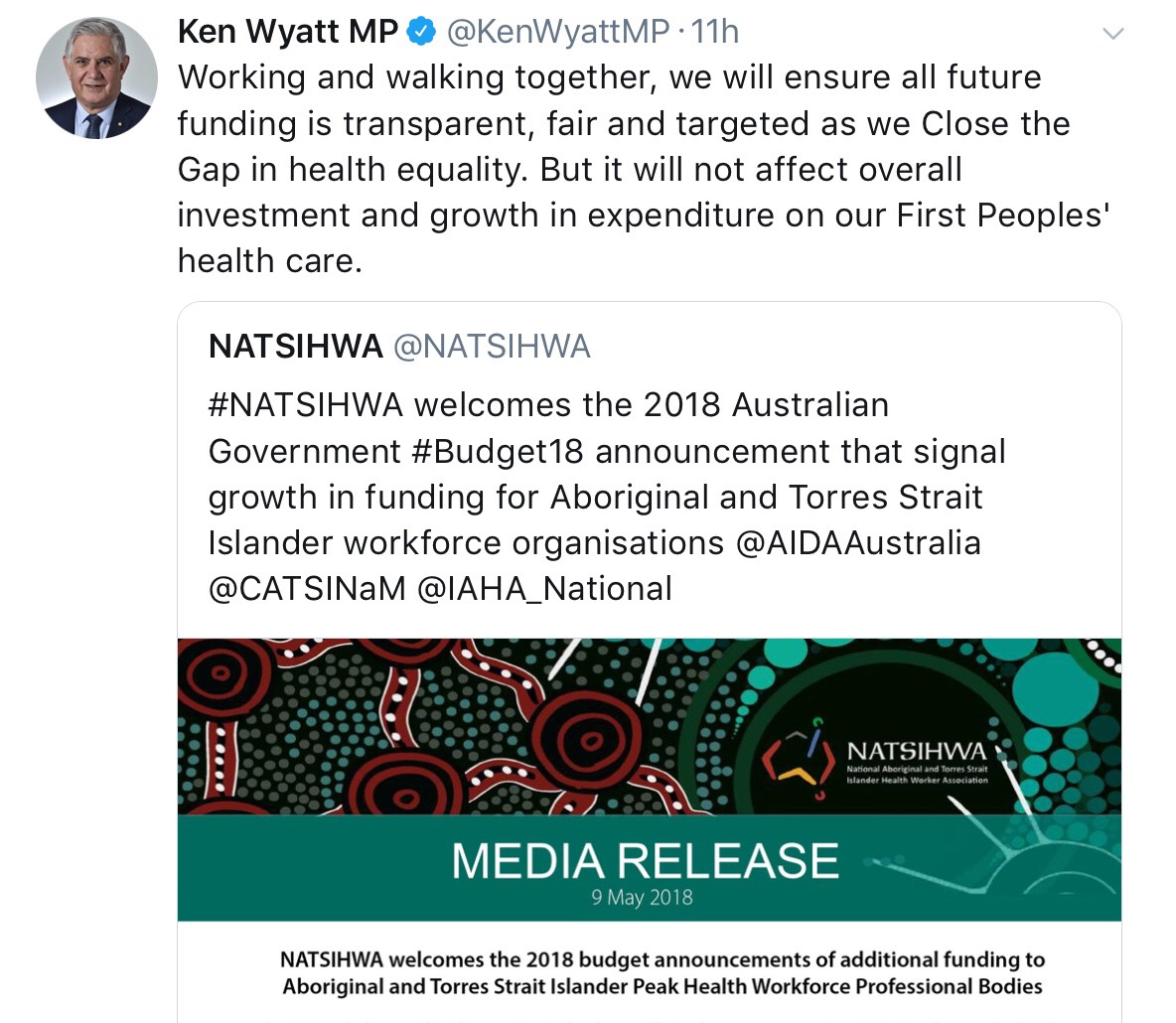
1.NATSIHWA welcomes the 2018 budget announcements of additional funding to Aboriginal and Torres Strait Islander Peak Health Workforce Professional Bodies

2. IAHA : Allied health undervalued in 2018 Federal Budget

3.AIDA funded to continue our work in improving health outcomes for Indigenous Australians

4.1 AMA : SAFE AND STEADY HEALTH BUDGET, BUT BIGGER REFORMS ARE STILL TO COME

5.NRHA :RURAL HEALTH BUDGET $$ WELCOME – BUT NOT ENOUGH

6.AHHA : Health data boost right step on the road to reform

7. PHAA : Budget 2018 – prevention focus goes missing

8.RACGP : Signs Federal Government beginning to recognise vital role of specialist GPs in Australia’s healthcare system

9.CHF Health budget includes welcome consumer focus

10. Vision 2020 Australia welcomes the Australian Government’s investment to target major causes of vision loss in Aboriginal and Torres Strait Islander communities.

Post 1 of our NACCHO Posts on #Budget2018 NACCHO

Post 2 will be the NACCHO Chair Press Release

Post 3 will be Health Peak bodies Press Release summary

Post 4 will be Government Press Releases

Post 5 Opposition responses to Budget 2018 (Monday )

ALL NACCHO BUDGET COVERAGE HERE

1.NATSIHWA welcomes the 2018 budget announcements of additional funding to Aboriginal and Torres Strait Islander Peak Health Workforce Professional Bodies

“Today’s budget announcement presents an important opportunity for NATSIHWA. It will enable us to progress key strategic priorities, including the development of a National Mentor program to support Aboriginal and/or Torres Strait Islander Health Workers and Health Practitioners. This is a very exciting time for our members”

Mr Karl Briscoe, NATSIHWA CEO.

Download full Press Release

1.NATSIHWA BUDGET Media Release 2018

The National Aboriginal and Torres Strait Islander Health Workers Association (NATSIHWA) welcomes the 2018 Australian Government budget announcement that signal growth in funding for Aboriginal and Torres Strait Islander workforce organisations.

These organisations (NATSIHWA, CATSINaM, IAHA and AIDA) work togetherto support the Aboriginal and Torres Strait Islander health workforces and improve health outcomes for Aboriginal and Torres Strait Islander people.

“We thank the Australian government for the continued support of NATSIHWA. This funding will not only enhance the sustainability of our profession, but will also lead to opportunities that promote the recognition and professionalism of Aboriginal and/or Torres Strait Islander Health Workers and Health Practitioners” said Ms Josslyn Tully, NATSIHWA Chairperson.

In particular, the budget announcement support the progression of NATSIHWA’s strategic plan 2017-2020. Key strategic priorities for NATISHWA over the next 12 months, include the:

  • Development of a National Mentoring Program for Aboriginal and/or Torres Strait Islander Health Workers and Health Practitioners;
  • Implementation of the National Professional Development Symposium which will bring together over 100 Aboriginal and/or Torres Strait Islander Health Workers and Health Practitioners in Alice Springs in October 2018;
  • Continuation of Regional forums to support professional development and networking of Aboriginal and/or Torres Strait Islander Health Workers and Health Practitioners in regions across Australia;
  • Development of further educational resources to support individuals and services in defending Aboriginal and/or Torres Strait Islander Health Workers and Health Practitioners’ Scope of Practice; and,
  • Enhanced influence of national policy and program that improve Aboriginal and Torres Strait Islander health and health workforce outcomes that support a culturally safe work environment.

“NATSIHWA looks forward to progressing these initiatives with our membership, which includes over 750 full members who are qualified Aboriginal and/or Torres Strait Islander Health Workers and Health Practitioners across Australia”, said Ms Josslyn Tully

2. IAHA : Allied health undervalued in 2018 Federal Budget

Improving Aboriginal and Torres Strait Islander health and wellbeing must remain a national priority. Action is needed to improve outcomes for Aboriginal and Torres Strait Islander people.

Download full Press Release

2. Media-Release_allied-health-undervalued-in-2018-Federal-Budget

Those actions must involve: a coherent strategy to tackle the causes of disadvantage and enable our people to achieve their potential; governments showing the stamina to address issues that come from generations of trauma and disadvantage; and commitment to work with, hear and respect Aboriginal and Torres Strait Islander people and the knowledge they bring to issues that shape their lives.

IAHA now has a commitment of funding for a further four years. We also have a commitment of $1.55M per year in additional funding to share with our fellow Aboriginal and Torres Strait Islander health workforce peak organisations: AIDA, CATSINAM and NATSIHWA. We have proven our approaches deliver results and build the Aboriginal and Torres Strait Islander health workforce.

IAHA has a significant advocacy role and interest in several other initiatives announced in the 2018-19 Budget, including measures responding to urgent needs across Australian communities, including:

  • $105M over four years to improve access to aged care for Aboriginal and Torres Strait Islander people
  • $30M over four years for ear health assessment in pre-schools
  • $34.3M over four years for eye health and
  • Extra commitment to suicide prevention, additional mental health care.

IAHA CEO Donna Murray said “For initiatives to deliver for Aboriginal and Torres Strait Islander people, community must be involved in how those measures are developed and implemented. This applies to new measures and to addressing existing acute allied health shortages in health, disability, aged care and other social services.”

A culturally safe and responsive skilled workforce, is critical in working with Aboriginal and Torres Strait Islander people and communities. To ensure the workforce has the skills needed to deliver results, strategies and solutions need to be developed and delivered in partnership with IAHA, our members and communities.

“IAHAs success thus far in developing and implementing innovative allied health career pathway programs and supports, providing leadership opportunities and development, mentoring, in partnering and in promoting person-centred, multidisciplinary care needs to be leveraged further. We, therefore, welcome a stronger partnership with Government to enable this success to continue and grow”, said Ms Murray.

IAHA chairperson, Nicole Turner, commented “By leading and facilitating inter-professional approaches that fit with Aboriginal and Torres Strait Islander notions of health and wellbeing, we’ve supported and enabled rapid growth in the Aboriginal and Torres Strait Islander health workforce. But we still represent less than 1 percent of the allied health workforce. Our workforce must continue to grow. Continued funding for IAHA is a vital step in the right direction.”

IAHA welcomes the $550M allocated to the Stronger Rural Health Strategy and the aim of ensuring the right health professionals are available when and where they are needed. However, IAHA remains concerned and disappointed that acute shortages in rural and remote allied health services have been largely ignored, and particularly that there appears to be almost no gain for Aboriginal and Torres Strait Islander communities who have little or no access to allied health services at present.

CEO, Donna Murray, added “IAHA will continue to advocate for the National Aboriginal and Torres Strait Islander Health Plan and Implementation Plan to be fully funded. IAHA will continue to seek opportunities to work constructively with Government to achieve this result.”

3.AIDA funded to continue our work in improving health outcomes for Indigenous Australians

This week the Australian Government announced the 2018/2019 Budget to the Australian public. The Australian Indigenous Doctors’ Association (AIDA) welcomes the news of increased government investment into Aboriginal and Torres Strait Islander peak workforce organisations of $33.4 million over four years from 2018-2019.

Download full Press Release

3.AIDA-budget-response_MEDIA-RELEASE-9-May-2018

We take this as a tangible measure of the genuine commitment of the Turnbull Government to work with us to build the Aboriginal and Torres Strait Islander health workforce.

As the only professional association for both Aboriginal and Torres Strait Islander doctors and medical students, AIDA is committed to improving the health of our people and enriching the health profession by growing the numbers of Indigenous doctors.

This renewed funding certainty will allow AIDA, through our strong relationships with key stakeholders, to keep supporting efforts to increase the cultural safety of mainstream medical education and health care systems.

This continued financial support from the government means job security for our employees, increased resourcing for emerging issues and the ability to continue to implement our long-term strategic agenda.

This includes:

  •  Development of our 2018 policy priorities
  •  Further investment in Indigenous-led health research
  • The delivery of a cultural safety program for doctors, by Indigenous doctor
  • Ongoing support to our student and doctor member base

Doing things with, not to Aboriginal and Torres Strait Islander Peoples

AIDA encourages the Turnbull Government to maintain its stated commitment to work in a consultative and collaborative way with Aboriginal and Torres Strait Islander Peoples.

We remain concerned that there is no commitment in the 2018/19 Budget to adequately resource the Implementation Plan for the National Aboriginal and Torres Strait Islander Health Plan 2013-2023.

AIDA maintains that this is the roadmap for the government to work with us to genuinely redress health disparity and deliver culturally appropriate and needs-based health care to Aboriginal and Torres Strait Islander Peoples.

We encourage the government to commit to implementing the social determinants of health framework into future Indigenous health policy development.

AIDA also remains concerned about the lack of targeted funding commitment around Closing the Gap.

We maintain that measureable targets, accountability mechanisms and appropriately funded policy design and program delivery are essential to closing the gap on Indigenous disadvantage.

With this renewed funding certainty, AIDA will continue working towards our vision for an Australian health care system that is free of racism, and one that affords Aboriginal and Torres Strait Islander Peoples the health care they have a right to expect and receive.

4.1 AMA : SAFE AND STEADY HEALTH BUDGET, BUT BIGGER REFORMS ARE STILL TO COME

VIEW NACCHO TV HERE

The Government has tonight delivered a safe and steady Health Budget, which outlines a broad range of initiatives across the health portfolio – but some of the bigger reforms and the biggest challenges are yet to come.

AMA President, Dr Michael Gannon, said the Government has provided some necessary funding to aged care, mental health, rural health, the PBS, and medical research, with many decisions directly responding to AMA policy.

Download full Press Release

4.1 Safe and Steady Health Budget, But Bigger Reforms Are Still to Come

4.2 AMSA Rural

AMSA Rural enthusiastically supports the changes to rural bonding and the opportunities presented by the Junior Doctor Training Program and the National Rural Generalist Pathway.

While the MDMS network may represent an expensive mis-step in addressing rural health workforce shortages, with funds better spent on rural Specialty Training Places, the announcement of better targeting, monitoring and planning for future rural workforce needs is encouraging.

Overall, AMSA Rural welcomes the government’s renewed focus on health equity for rural and regional communities, and looks forward to hearing more details of the Stronger Rural Health Strategy.

Download full Press Release

4.2 AMSA RH MR-  RURAL HEALTH IN FOCUS

5.NRHA :RURAL HEALTH BUDGET $$ WELCOME – BUT NOT ENOUGH

New funding to attract more doctors to country areas has been welcomed by the National Rural Health Alliance, Australia’s peak body for rural and remote health.

“We are pleased tonight’s Federal Budget allocates $550 million over 10 years to help fill the health workforce gaps that exist in so many parts of country Australia,” said Alliance CEO Mark Diamond.

The government says it will deliver 3,000 new specialist GPs, and 3,000 additional nurses over ten years mainly through providing end to end training in country areas.

“It’s not only doctors and nurses that are missing outside major cities. Equally there are not enough allied health professionals. Some areas have no psychologists, no physiotherapists, no occupational therapists,” Mr Diamond said.

A new Workforce Incentive Program will provide some funds to general practices to employ more nurses, doctors and, for the first time, allied health workers.

Download full Press Release

5. National Rural Health Alliance

6.AHHA Health data boost right step on the road to reform

‘The lack of any concrete action on preventive health is concerning—it has been allowed to slip down health budget priorities, despite its proven benefits in preventing big health bills later. This particularly applies to dental health, which once again has been overlooked.

‘In terms of Closing the Gap in Aboriginal and Torres Strait Islander health, we note some modest investments, including the commitment of $5 million per year for the next 3 years to address trachoma in Aboriginal communities’, Ms Verhoeven said.

‘It is disappointing that the government didn’t take the opportunity to address one of our pre-Budget recommendations to make the administrative changes to ensure patients discharged from hospital have access to Closing the Gap prescriptions.

This would have been a practical and relatively inexpensive measure to improve health outcomes for Aboriginal and Torres Strait Islander peoples.’

7.1 PHAA : Budget 2018 – prevention focus goes missing

Tonight’s national Budget continues to fund the health care systems, but is woefully short on preventative health measures to keep Australians from becoming sick in the first place, according to Public Health Association Australia (PHAA) Chief Executive Michael Moore AM.

“Despite repeated advice – and repeated commitments in principle – the Government is still not developing a preventative health focus for our health system,” said Mr Moore.

“It’s true there are a few modest measures tonight – including additional vaccinations funded, very welcome measures to promote mental wellbeing, and the Good Sports Program to reduce alcohol consumption in sporting contexts.”

“But Australia’s people will continue to experience avoidable chronic disease in the years ahead. People who should be destined to live healthy lives will not because of the preventable diseases they will suffer. While we need to look after the aged populations and those requiring medical treatment, we need to focus even more heavily on the younger generation we are failing,” Mr Moore said.

“The inevitable cost to Budgets far into the future will be greater than the investments that might have been funded.”

“What is also noticeable is that there are no preventive measures in this budget which impact negatively on industry.”

“Just last week we saw Australia’s first ever dedicated conference of preventative health professionals, with 300 expert Australians gathering in Sydney to debate the way forward to a more preventive approach to health and wellbeing.

“Yet tonight, preventive health has again been relegated to a low priority.”

“Future Health Ministers and Treasurers will rue the mistakes of this generation, including tonight’s Budget, in failing to invest in preventive health.”

Mr Moore also acknowledged Minister for Aged Care and Indigenous Health Ken Wyatt for securing a number of important initiatives in Indigenous health, Australia’s most agonizing continuing health crisis.

The Public Health Association welcomed a number of specific initiatives in tonight’s Budget:

  • Improving physical activity with a $50.4m investment to get people moving and expanding other physical activity.
  • Funding to expanding four forms of vaccinations, including Pertussis, and a targeted program to address low vaccination rate areas.
  • A National Injury Prevention Strategy for children and older people, including a program to prevent water and snow sport injuries
  • Additional funding for suicide prevention

Download 2 full Press Release

7.1 PHAA Prevention

7. 2 PHAA

NACCHO would also wish Michael a healthy future

8.RACGP Signs Federal Government beginning to recognise vital role of specialist GPs in Australia’s healthcare system


The Federal Government’s commitment to fund training for general practice is a sign political leaders are finally beginning to understand the vital role of specialist GPs in Australia’s healthcare system.

Royal Australian College of General Practitioners (RACGP) President Dr Bastian Seidel commended the government for investing to fund a world class, contemporary postgraduate training program for medical graduates through Australian medical colleges and in particular through the RACGP.

“We are cautiously optimistic that the penny has finally dropped,” Dr Seidel said.

“A commitment to unconditionally fund postgraduate GP training will ensure that all Australians have access to a doctor with specialist qualifications in general practice, and this has not always been the case.

Additionally, the commitment to support 3,000 international medical graduates (IMGs) to attain Fellowship as a specialist general practitioner is welcomed.

“Far too often, doctors without any postgraduate qualifications were placed in so called ‘areas of need’ and ‘district workforce shortages’.

“They were asked to work there with little or no professional support or continuous professional training.

“The funding made available in this year’s Federal Budget will finally start to rectify this shortcoming.”

Dr Seidel said while Australian GPs would be pleased with the Federal Government’s commitment to improving general practice training, there were still significant issues that needed to be addressed before the next Federal election. The indexation of general practice consultation item numbers, whilst welcome, does not go far enough.

Dr Seidel said he would like to see the Federal Government show its commitment to general practice by increasing the Medicare rebate for GP attendances by 18.5% to bring specialist GPs into line with other medical specialist attendance items.

“We must see coherent and cohesive funding for general practice that reflects the expertise of all specialist GPs.

“Appropriate investment in general practice has been proven, repeatedly, to be the most cost-effective way to deliver effective healthcare to the Australian population, particularly as the numbers of patients with chronic conditions continue to increase.

“Patients want to spend more time with their GP, and the evidence shows that time with your GP is good for patients,” Dr Seidel said.

“The Federal Government can really make a difference to the quality of care GPs are able to provide Australians by increasing this rebate before the Federal election and as a matter of urgency


9.CHF Health budget includes welcome consumer focus

The #digitalhealth slides from @CHFofAustralia #HealthBudget18 response. Note : Funding for things where digital health is a big part. Especially interesting is the work happening with Healthy Active Beginnings.Thx @deanhewson ‬

All 23 slides here:

Record funding for hospitals from 2020 and a $5 billion rise for aged care are contained in a Federal Budget which also provides for more consumer-focused approaches to care and research.

Download full Press Release

9. CHF Federal Health Budget

10. Vision 2020 Australia welcomes the Australian Government’s investment to target major causes of vision loss in Aboriginal and Torres Strait Islander communities.

Vision 2020 Australia welcomes the Australian Government’s investment to target major causes of vision loss in Aboriginal and Torres Strait Islander communities.

Download full press release

10. Vision Australia welcomes Eye Health Funding

The Government’s 2018-19 budget allocated $34.3 million to the eye health issues that disproportionately impact on Aboriginal and Torres Strait Islander people.

Vision 2020 Australia CEO Carla Northam said “Our members consistently tell us that the three major causes of vision loss for Aboriginal and Torres Strait Islander people are eye problems associated with diabetic retinopathy, uncorrected refractive error and the length of time people wait for cataract surgery.

“With the right amount of funding, we can address these debilitating eye conditions.”

Dr Dawn Casey, Acting CEO of the National Aboriginal Community Controlled Health Organisation (NACCHO) welcomed the focus on providing eye health checks, especially for Aboriginal and Torres Strait Islander people who have diabetes. “We need to do all we can to make sure all Aboriginal people with diabetes have an annual eye test. At the moment, only around half are getting their eyes checked every year.”

Professor Hugh Taylor from Indigenous Eye Health, the University of Melbourne identified access to cataract surgery as needing serious attention. He said “Vision loss from cataract is twice as common in Indigenous Australians and they have to wait almost twice as long for surgery.”

Professor Taylor added “Eye care services at the local and regional levels must be planned and resourced to meet population-based needs.”

While the details on how the Government will spend the $34.3 million are unclear, Vision 2020 Australia believes that activity must focus on cutting cataract surgery wait times, making sure everyone with diabetes has an annual eye test and getting glasses to people who need them. Through these measures the Government will meet its commitment to address the major causes of vision loss in Aboriginal and Torres Strait Islander communities.


NACCHO #Budget2018 Coverage 4 of 5 : Government Press Releases @GregHuntMP #HealthBudget18 @senbmckenzie #RuralHealthBudget @KenWyattMP #IndigenousHealth @NigelScullion #IndigenousAffairs #Budget2018NACCHO


1.Minister Health Greg Hunt

1.1 Guaranteeing essential services – record investment in health

1.2 Guaranteeing Medicare with record funding

1.3 More choices for a longer life

1.4 Providing record access to life-saving and life-improving medicines

1.5 Record Commonwealth funding for public hospitals

1.6 Supporting better mental health for all Australians

1.7 Boosting essential infant and maternal health services

1.8 Promoting a healthy and active Australia

2.Minister Rural Health Bridget McKenzie

2.1 Stronger Rural Health Strategy to deliver high quality care

3.Minister Indigenous Health Ken Wyatt

3.1 Better targeting support to improve Indigenous health

3.2 : Close to Country: $25 million for remote area dialysis

4. Minister Indigenous Affairs Nigel Scullion

4.1: 2018-19 Budget to strengthen economic, employment and health opportunities for First Australians

 “ This Budget confirms the Coalition Government’s continued investment of $5 billion over four years through the Indigenous Advancement Strategy which is making targeted investments in the three priorities fundamental to improving outcomes – getting kids to school, adults to work and making communities safer. Importantly, the number of Indigenous organisations delivering services has drastically increased under the Indigenous Advancement Strategy from 30 to 45 per cent now. “

Post 1 of our NACCHO Posts on #Budget2018 NACCHO

Post 2 will be the NACCHO Chair Press Release

Post 3 will be Health Peak bodies Press Release summary

Post 4 will be Government Press Releases

Post 5 Opposition responses to Budget 2018

ALL NACCHO BUDGET COVERAGE HERE

1.Minister Health Greg Hunt

1.1 Guaranteeing essential services – record investment in health

Download Health Budget HERE  NACCHO Budget INFO

The 2018–19 Budget is guaranteeing the essential health services that Australians rely on, with a $12.4 billion increase in the Health Budget and a $414.5 billion investment in health, aged care and sport.

We will increase:

Medicare funding by $4.8 billion;

public hospital funding by more than $30 billion;

investment in new medicines by $2.4 billion; and

funding for aged care by $5.0 billion.

We will invest in a National Health and Medical Industry Growth Plan of $1.3 billion, including a ground-breaking $500 million Australian Genomics Health Futures Mission.

The Government is also delivering the More Choices for a Longer Life Package to help Australians maximise the opportunities that a longer life brings.

1.2 Guaranteeing Medicare with record funding

The Turnbull Government will continue our absolute rock-solid commitment to Medicare with an additional $4.8 billion investment, building on the Medicare Guarantee Fund we established last year.

For 2017-18, $34.4 billion has been credited to the Fund. A further credit of $35.3 billion will be made to meet the estimated Medicare Benefits Schedule (MBS) and Pharmaceutical Benefits Scheme (PBS) expenditure for 2018-19.

Medicare spending is guaranteed and increasing every year from $24 billion in 2017-18 to $28.8 billion in 2021-22 to support healthcare for every Australian.

Indexation of the Medicare Benefits Schedule, which the Government reintroduced in last year’s Budget will deliver an additional $1.5 billion for Medicare services through to 2021-22.

Following recommendations from the expert MBS Review Taskforce and the independent Medical Services Advisory Committee we will provide new Medicare support for renal dialysis in remote communities, MRI scans for prostate cancer checks, a new cutting edge 3D mammography test for the early detection of breast cancer and new genetic testing for cystic fibrosis.

1.3 More choices for a longer life

The 2018-19 Budget will deliver the More Choices For a Longer Life package which will support older Australians to live longer and be better prepared, healthier, more independent and connected to their communities,

The Package gives older Australians more choices and greater flexibility, including:

An additional 14,000 high-level home care packages so older Australians can stay in their homes longer if they want to;

Allowing pensioners to earn more without reducing their pension;

Greater flexibility to use home equity to increase retirement incomes.

Since the last Budget, the Turnbull Government has delivered an extra 20,000 high-level home care packages, to support people to live at home longer.

We will provide 13,500 new residential aged care places and 775 short-term restorative places to be made available where they are most needed, plus $60 million for capital investment.

We will also invest $40.0 million to support aged care providers in regional, rural and remote Australia for urgent building and maintenance works.

More than $105 million will improve access to culturally safe aged care services in remote Indigenous communities.

The Turnbull Government will establish an Aged Care Quality and Safety Commission to create a tough cop on the beat to ensure older Australians receive the best possible care, with an additional $50 million to assist providers implement the new standards.

MyAged Care will be improved with an investment of $61.7 million to make it easier to use, along with simplifying the forms required to apply for aged care services, and $7.4 million to trial navigators to assist people to choose the aged care services that suit their needs.

We will invest $32.8 million to improve palliative care for older Australians living in residential aged care, filling current gaps in support services, $5.3 million for innovations in managing dementia, and $102.5 million for mental health programs for older Australians.

And people over 65 will be assisted to undertake more physical activity, with locally-based sporting organisations receiving grants totalling $22.9 million to deliver new programs for older Australians.

The Government is helping Australians to work for as long as they want, laying the foundations for a secure retirement. We will provide up to $10,000 in Restart wage subsidies for employing Australians aged 50 and over. The Skills and Training incentive will provide up to $2,000 to fund up-skilling opportunities for mature aged workers.

The 2018-19 Budget delivers measures to boost living standards and expand retirement income options to give retirees confidence in their financial security.

We are increasing the Pension Work Bonus to allow age pensioners to earn an extra $50 per fortnight without reducing their pension. The Pension Loans Scheme will be expanded giving greater flexibility to use home equity to boost retirement incomes, e.g. up to $17,787 a year for a full rate age pensioner (couple).

1.4 Providing record access to life-saving and life-improving medicines

The Turnbull Government will invest $2.4 billion on new medicines to build on our commitment to guarantee those essential services that all Australians rely on. This includes a new $1 billion provision to maintain our commitment to listing all new medicines recommendation by the independent Pharmaceutical Benefits Advisory Committee.

Unlike Labor, we list and will continue to list, every single drug recommended by the medical experts – the Pharmaceutical Benefits Advisory Committee – with approximately $9 billion of investment in new drug listings since coming into government.

In particular, the Government will provide $703.6 million for the listing of Kisqali ® on the PBS to support women with breast cancer. Without subsidy, patients would pay $71,820 per year.

We will also list Spinraza ® on the PBS, a life-changing medicine which treats the devastating illness Spinal Muscular Atrophy. Without subsidy, patients would pay more than $367,850 per year. These new listings mean patients will have access to these medicines paying a maximum of $39.50 per script. Concessional patients, including pensioners, will pay just $6.40.

The Turnbull Government has also signed a landmark agreement with Medicines Australia to improve access to life saving medicines for rare diseases through key reforms to the Life Saving Drugs Program.

1.5 Record Commonwealth funding for public hospitals

The Government will deliver more than $30 billion in additional public hospital funding under a five-year National Health Agreement, with funding increasing for every state and territory, every year.

From 2020-21 to 2024-25, the new agreement will deliver a record $130.2 billion in public hospital funding, with six of Australia’s eight states and territories now covered by this new agreement, including three Labor governments and three Liberal governments.

This represents a more than doubling of public hospital funding under the Coalition Government, rising from $13.3 billion in 2012-13 to $28.7 billion in 2024-25.

1.6 Supporting better mental health for all Australians

The Turnbull Government will deliver an increase of $338.1 million in mental health funding, with a focus on suicide prevention, research and older Australians and advancing the Fifth National Mental Health and Suicide Prevention Plan.

We will expand the beyondblue Way Back Support Service across Australia, which provides outreach, follow-up care and practical support to people discharged from hospital after a suicide attempt. This will see an investment of $37.6 million.

We will provide Lifeline Australia $33.8 million to support its phone counselling services, and SANE Australia will receive $1.2 million for the Better off With You campaign.

The Government will fund a new Million Minds Mission through the Medical Research Future Fund. Over the next 10 years, $125 million will be invested in new research to support an additional million people with mental illness, through new research, diagnosis and treatment.

Men over 85 years of age have the highest risk of suicide for all ages. That’s why the Government will deliver $82.5 million for psychological services in residential aged care, while mental health nurses will help develop and deliver a $20 million program to support older Australians in the community who are isolated and at risk.

The National Mental Health Commission will receive an increase of $12.4 million to oversee mental health reform and take an expanded role under the Fifth National Mental Health and Suicide Prevention Plan. Funding of $4.7 million will support the continued operation of Head to Health, the new digital gateway for mental health services.

We will also fund the Royal Flying Doctor Service for mental health outreach, which will receive $20.4 million to ensure regional and rural Australians get care wherever they are.

1.7 Boosting essential infant and maternal health services

To give Australian children the best possible start in life, we are investing $77.9 million in infant and maternal health and for the first 2,000 days of a child’s life.

This includes $17.5 million for maternal and infant health medical research.

Health professionals will give parents-to-be simple and effective guidance on staying healthy during pregnancy with a $3.0 million program.

The Government will extend the childhood immunisation education campaign, targeting areas with low vaccination rates.

Every mother will be given the opportunity to vaccinate against whooping cough, with $39.5 million to fund the pertussis vaccine to all pregnant women.

To help parents keep track of their children’s health from birth, the Government will introduce a national digital baby book with $5.0 million of funding, replacing state and territory hard copy baby books, and giving children their passport to a lifelong health record.

We will invest $6.2 million to subsidise the cost of more insulin pumps for children with type 1 diabetes.

With injury the leading cause of death of children aged one to 16 years, the Government will fund $0.9 million for the development of a new National Injury Prevention Strategy aimed at reducing childhood injuries. In addition, funding of $1.0 million for the SeeMore Safety Program will support preschool and kindergarten children and their families to reduce the number of preventable childhood injuries.

We will also roll out a new $1 million program to assist GPs to learn more about endometriosis, so they can better diagnose and treat the condition, which can affect around one in ten women and is a key contributor to infertility.

1.8 Promoting a healthy and active Australia

The Turnbull Government will invest $230 million to implement a range of sport and physical activity initiatives that will see more Australians, more active, more often.

This investment builds on our national strengths and will provide more opportunities for Australians to participate in sport and physical activity and promote healthy, active life styles.

The Government will invest $28.9 million in participation grants targeted at less active Australians.

This includes an extension of the Local Sporting Champions grants program which will see more than 3,000 additional young athletes receiving support, including for young athletes in the regions to attend competitions.

The Government will also provide $41.7 million towards extending the popular Sporting Schools Program which provides opportunities for children to participate in sport by reducing the financial burden for parents and building a culture of the enjoyment and benefits of sport for a digitally focused generation.

The Government is acting to reduce drowning at Australia’s beaches, rivers and waterways, as well as improving safety on our snow fields through the Water and Snow Safety Program, with a total investment of $48.5 million.

Participation in sport is vital for the health and wellbeing of all Australians, and is foundational to the Government’s sport plan which will be released later this year.

The Turnbull Government is delivering a strong economy which means we can guarantee the essentials that Australians rely on like Medicare, hospitals, lifesaving medicines and aged care.

2.1 Stronger Rural Health Strategy to deliver high quality care

The Turnbull Government will deliver the most comprehensive rural health package in decades, which will improve access to doctors, nurses and other health care services for all Australians, especially those in the regions.

The Stronger Rural Health Strategy will improve the delivery of healthcare by ensuring we have the right health care professionals located in the regions. It will provide greater opportunities for Australian doctors through better teaching, training, recruitment and retention. The package will see growth in multidisciplinary care and increased access to nursing and allied health services.

This comprehensive strategy has been developed in close consultation with the AMA, RACGP, ACRRM and other rural medical leaders.

In order to support teaching in the regions, we will invest $95.4 million to create the new Murray Darling Medical Schools Network comprising of the University of NSW (Wagga Wagga), University of Sydney (Dubbo), Charles Sturt University/Western Sydney University (Orange), Monash University (Bendigo, Mildura), and University of Melbourne/La Trobe University (Bendigo, Wodonga, Shepparton). The Government will also include Curtin University (for medical training) and La Trobe University (for nursing and allied health training) in the Rural Health Multidisciplinary Training (RHMT) program.

This will be done while retaining the existing number of Commonwealth Supported Places for medical students.

This is a fundamental change in the teaching and supply of rural and regional doctors and will transform rural training schools, enabling students to undertake most of their education and training in rural areas to provide a continuum for doctors to learn, train and work in the regions.

The Stronger Rural Health Strategy will mean more Australian doctors for the regions.

3.1 Better targeting support to improve Indigenous health

The Budget provides ever greater support for our effort to Close the Gap and better targets funding to improve outcomes for Aboriginal and Torres Strait Islander people, with funding for Indigenous Health of $3.9 billion from 2018-19 to 2021-22 and $10 billion over a decade.

In particular, the Turnbull Government will deliver $33.4 million for Aboriginal and Torres Strait Islander health workforce, and provide funding to prevent and treat complex and chronic health conditions including eye disease ($34.3 million), hearing loss ($30.0 million), and crusted scabies ($4.8 million).

3.2 : Close to Country: $25 million for remote area dialysis

The Australian Government is funding a $25 million expansion of remote renal clinics, so more Aboriginal people in Central Australia who suffer from kidney disease can receive dialysis on country or as near to their communities as possible.

Minister for Indigenous Health, Ken Wyatt AM, said the Government was proud to support the highly successful Western Desert Nganampa Walytja Palyantjaku Tjutaku, also known as Purple House, to complete four new clinics and extend a fifth.

“Purple House is making a huge difference to the physical, mental and spiritual health of people across Central Australia, by allowing them to receive care while remaining connected to their land and their people,” Minister Wyatt said.

“This expansion will take the number of remote clinics in the region to 17 and builds on this community driven project’s outstanding record.

“Purple House now provides 70 per cent of Central Australian dialysis services and is not only changing lives, its vast program has saved many lives, because patients don’t have to leave their families and communities for treatment.”

Recent clinical data shows the mortality rate for people on dialysis in Central Australia is now less than half the rate of the rest of the nation.

The funding will allow completion of clinics this year at Utopia, Ampilawatja, Kalkarindji and Ernabella, plus the expansion of the Lajamanu clinic. It will also support the operating costs of another three clinics

The expansion will take the number of remote dialysis machines from 36 to 54 and increase the remote patient group from around 250 to more than 400.

Chronic kidney disease is a significant health challenge among Aboriginal and Torres Strait Islander communities. More than 1,800 First Nations people are currently receiving dialysis, with almost 60 per cent of these starting dialysis before they were 55 years old.

Minister Wyatt said reducing the misery and death caused by kidney disease was a key Turnbull Government priority.

“Following a recent roundtable in Darwin, development of an Aboriginal and Torres Strait Islander renal health road map is underway,” said the Minister.

“Prevention is crucial and it starts during pregnancy, with low birthweight babies born with weaker kidneys.

“Organisations like Purple House are showing the way, through community based, holistic services and strong and effective Aboriginal governance.

“An independent study has shown Purple house delivers remote renal services at a cost comparable to or even lower than the standard Australian hospital dialysis cost.”

Purple House was formed in 2003, following years of work by Aboriginal leaders and supporters that culminated in a million-dollar fundraising auction of local art to establish the project.

The Commonwealth Government has previously provided $17.6 million over four years to Purple House for renal support services in the NT and Western Australia, including $6.45 million to enable the Purple House to build and expand renal infrastructure in Central Australia at six locations in the NT and one in South Australia.

The new funding, under the Government’s Indigenous Australians’ Health Program, will apply for three years from July 2018.

4.1: 2018-19 Budget to strengthen economic, employment and health opportunities for First Australians


First Australians right across the nation will benefit from a stronger economy, more jobs and guaranteed essential services through the 2018-19 Federal Budget.

Minister for Indigenous Affairs, Nigel Scullion, said this year’s Budget is delivering for First Australians across the board by investing in health, safety and security through economic and employment opportunities.

“The Coalition Government’s economic plan has already delivered over 400,000 jobs last year – the highest number of any year on record.

“We are delivering tax relief to hard-working Australian families, guaranteeing the essential services in health, education and community safety that all Australians rely upon, returning the Budget to a credible trajectory to surplus, while setting the stage for a return of business confidence and the jobs boom. We are also ensuring that First Australians have their fair share of this economic success.”

The Coalition Government’s cross-portfolio investment in initiatives to improve outcomes for Aboriginal and Torres Strait Islander Australians include:

  • The Community Development Programme (CDP) reforms to ensure remote job seekers are further supported on their pathway to employment. It will now be a simpler, more streamlined program, with less interactions with the national welfare system for remote job seekers. This is being complemented by a government-funded employment program for 6,000 jobs in remote Australia.
  • A new Aboriginal and Torres Strait Islander Land and Sea Future Fund (ATSILSFF) will replace the $2 billion Aboriginal and Torres Strait Islander Land Account (Land Account) leaving the Fund up to $1.5 billion better off, over 20 years, compared to the current investment mandate.
  • $550 million over five years ($110 million per annum) to support remote housing in Aboriginal and Torres Strait Islander communities across the Northern Territory. This funding will be matched by Northern Territory Government contributions. Negotiations remain ongoing with Western Australia, South Australia and Queensland however the Commonwealth remains hopeful of reaching an agreement with these jurisdictions soon.
  • $3.8 billion investment to the Indigenous Australians’ Health Programme (IAHP) from 2018‑19, an increase of over $800 million compared with the previous four years.
  • $38.1 million, over five years, to support Aboriginal and Torres Strait Islander students who need to travel away from home for education, in recognition of the 50th anniversary of ABSTUDY.
  • $105 million for better access to aged care Aboriginal and Torres Strait Islander people.
  • $18.2 million to support domestic violence prevention and protection programs for women and girls including maintaining the current DV alert service and 1800RESPECT trauma counselling service.
  • $34.8 million over four years to support the delivery of dialysis by nurses, including Aboriginal and Torres Strait Islander health workers in remote areas, under a new Medicare Benefits Schedule item.
  • $23.2 million over four years for Healthy Active Beginning Package which includes a policy to reduce the traumatic injury rate among young Indigenous Australians, who are 4.5 times more likely to sustain serious injury than non-Indigenous children.
  • $200 million for a third round of the Building Better Regions Funding to support rural, regional and remote community infrastructure projects.
  • $28.3 million over four years for Remote Airstrip Upgrade works supporting air access to remote towns and Indigenous communities.
  • $2 million over three years to the Australian Institute for Aboriginal and Torres Strait Islander Studies (AIATSIS) for a program of preservation and celebration of Indigenous languages and culture.

This Budget confirms the Coalition Government’s continued investment of $5 billion over four years through the Indigenous Advancement Strategy which is making targeted investments in the three priorities fundamental to improving outcomes – getting kids to school, adults to work and making communities safer. Importantly, the number of Indigenous organisations delivering services has drastically increased under the Indigenous Advancement Strategy from 30 to 45 per cent now.

Minister Scullion said efforts across the government would build on the success of initiatives such as the Indigenous Procurement Policy, which has seen over 1,000 Indigenous businesses win Australian Government contracts worth more than $1 billion since the policy’s inception in July 2015.

The IPP stands in stark contrast to the pathetic $6.2 million to just 30 Indigenous businesses in Labor’s last year in government.

“The Indigenous Grants Policy (IGP) we unveiled in February will see services intended specifically for Aboriginal and Torres Strait Islander communities to be delivered by local Indigenous organisations.

The policy will be trialled later this year for grants administered by the Department of Communications and the Arts, the Department of Social Services and the Department of the Prime Minister and Cabinet.

“The IGP builds on the Coalition’s efforts to deliver more grant funding through the Indigenous Advancement Strategy to Aboriginal and Torres Strait Islander organisations.

We are now delivering 55 per cent of grants through First Australian owned or controlled organisations compared with 35 per cent under Labor.

“To drive greater change and to close the gap, we need to harness greater opportunities for Aboriginal and Torres Strait Islander peoples across all areas of government expenditure and investment and that is precisely what we are doing,” Minister Scullion said.

“Through the Indigenous Business Sector Strategy, the Employment Parity Initiative, the Vocational Training and Employment Centre programme and the Indigenous Rangers Programme we are supporting First Australians realise their economic aspirations.

“Our strategic partnerships with First Nations’ representative bodies like the New South Wales Aboriginal Land Council in Western Sydney to include procurement and employment targets as part of the $5 billion Western Sydney Airport, and with the Northern Land Council on remote housing in the Northern Territory, demonstrates our strong commitment to putting First Australians at the heart of our economic plan for the nation,” Minister Scullion said today.


“The IGP builds on the Coalition’s efforts to deliver more grant funding through the Indigenous Advancement Strategy to Aboriginal and Torres Strait Islander organisations. We are now delivering 55 per cent of grants through First Australian owned or controlled organisations compared with 35 per cent under Labor.

“To drive greater change and to close the gap, we need to harness greater opportunities for Aboriginal and Torres Strait Islander peoples across all areas of government expenditure and investment and that is precisely what we are doing,” Minister Scullion said.

“Through the Indigenous Business Sector Strategy, the Employment Parity Initiative, the Vocational Training and Employment Centre programme and the Indigenous Rangers Programme we are supporting First Australians realise their economic aspirations.

“Our strategic partnerships with First Nations’ representative bodies like the New South Wales Aboriginal Land Council in Western Sydney to include procurement and employment targets as part of the $5 billion Western Sydney Airport, and with the Northern Land Council on remote housing in the Northern Territory, demonstrates our strong commitment to putting First Australians at the heart of our economic plan for the nation,” Minister Scullion said today.

.

.

….


NACCHO Aboriginal #HealthBudget18 Press Release @KenWyattMP Federal Government announces new funding model for ACCHS Aboriginal Community Controlled Health Services #Budget2018NACCHO


 ” It is important to strengthen and expand our Aboriginal Community Controlled Health Services  role as primary care providers in our communities as there will be 1 million Aboriginal people 2030, ”

NACCHO Chair Mr John Singer believes ‘that funding certainty is critical to ACCHSs achieving good health outcomes.


See our live interviews on NACCHO Facebook

Picture above : Day after Budget night and NACCHO Chair faces media at Parliament House

The National Aboriginal Community Controlled Health Organisation (NACCHO) has welcomed the Budget announcement of a new needs based funding formula model for the Indigenous Australians’ Health Program (IAHP).

Although this new model requires further refinement, feedback and work.

Download this NACCHO Press Release

NACCHO Press Release Government announces new funding model for ACCHS

This new model for our 144 Aboriginal Community Controlled Health Service (ACCHS) provides funding for our primary health care services and now excludes 7 inconsistent data points related to NKPIs.

NACCHO Chair Mr John Singer believes ‘that funding certainty is critical to ACCHSs achieving good health outcomes.

Mr John Singer called on the government to ensure there was no adverse impact on our Model of Care.

NACCHO welcomes the 5-year funding agreements and grandfathering arrangements under this new model.

NACCHO welcomes the new money for preventing and treating complex chronic health conditions such as Eye disease ($34.3 million) hearing loss ($30.0 million) and crusted scabies ($4.8 million).

Acknowledges the new investment in remote renal services and infrastructure with a MBS item for dialysis.

Also, the $105.7 over four years to deliver additional residential aged care places and home care packages in remote Indigenous communities.

The Government has advised that the new funding model can be varied up to July 2019 and NACCHO will continue work in consultation with the Funding Model committees.

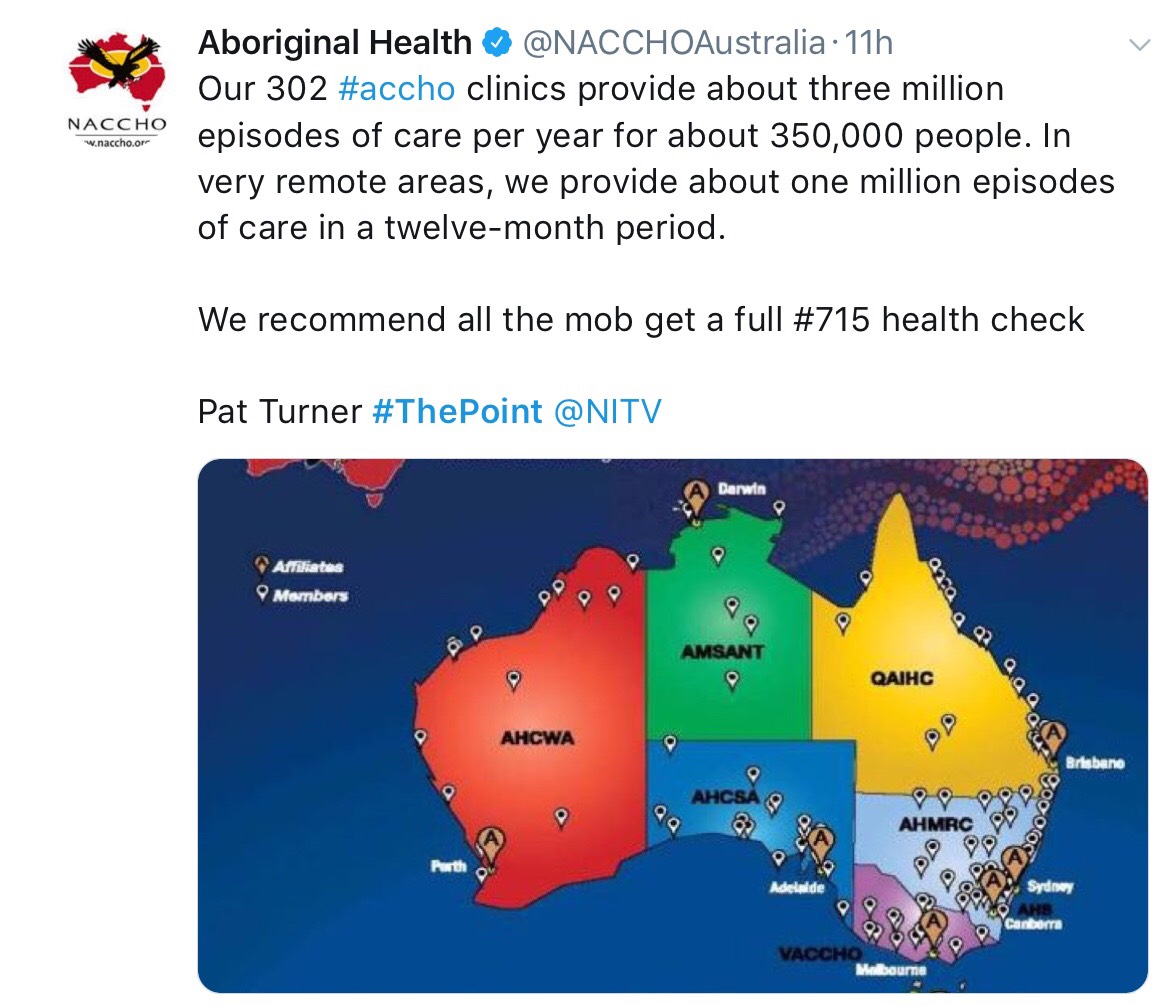
Aboriginal controlled health services provide about three million episodes of care each year for about 350,000 people and employ about 6,000 staff.

Post 1 of our NACCHO Posts on #Budget2018 NACCHO HERE

Post 2 will be the NACCHO Chair Press Release and Analysis above

Post 3 will be Health Peak bodies press release summary

Post 4 will be Government Press Releases


NACCHO Aboriginal Health #HealthBudget18 : Will the #Budget2018NACCHO Improve health outcomes for Indigenous Australians ?


” A greater focus on outcomes and transparency of funding will support our ongoing commitment to Closing the Gap in Indigenous health with a total of $10 billion for Indigenous health over the next decade.”

Extract from Health budget papers See Part 2 below Improving health outcomes for Indigenous Australians : download full copy of Health Budget

 ” Funding for a key Aboriginal health program will climb $200 million to nearly $4 billion as the Turnbull government negotiates with the states over other investments.

The government will implement a new primary care funding model for the Indigenous Australians’ Health Program to provide greater transparency of funding and improve health outcomes.

This new transparency initiative would be based on patient numbers, episodes of care and the remote nature of the treatment and be designed to ensure resources are directed to the right areas, minimising waste.

The contribution will total $3.9bn over four years from 2018-19 and the budget papers state that extra funding could also be provided under the Medicare system.”

From the Australian see Part 1 Below

Post 1 of our NACCHO Posts on #Budget2018 NACCHO below

Post 2 will be the NACCHO Chair Press Release and Analysis

Post 3 will be Health Peak bodies press release summary

Post 4 will be Government Press Releases

See our live interviews on NACCHO Facebook

 ” National Congress welcomes the renewal of funding for our health organisations and programs. In particular, we appreciate the recognition of the crucial role which the Aboriginal and Torres Strait Islander workforce plays in delivering positive health outcomes for our peoples.

However, we note that the provision of culturally safe and appropriate healthcare must also be integrated into the mainstream health system.

We also acknowledge the Government’s commitment to provide new funding to aged care, but unless the large gap in life expectancy is resolved, many of our peoples may not enjoy the longevity to benefit from these services.”

National Congress Press Release see Part 3 Below

Part 1 The Australian Continued

Existing eye health initiatives will be bolstered by $34m to provide further health checks and address the issue of vision loss. The government has pledged more than $33m to bolster the Aboriginal and Torres Strait Islander workforce.

Indigenous Affairs Minister Nigel Scullion also earmarked $550m over five years for remote housing in the Northern Territory, with matched funding from the territory government.

“Local Aboriginal decision-making, local Aboriginal employment and local Aboriginal procurement are at the heart of our investment,” he said.

Senator Scullion said the government was in negotiations with the Queensland, South Australian and West Australian governments about future funding.

The budget would support 6000 jobs in remote areas, with so-called tailored support to indigenous jobseekers.

The overhaul of the Community Development Program would start from early next year, cutting income reporting demands to Centrelink.

Senator Scullion said the new system would ensure that all jobseekers — regardless of their location — would face the same compliance framework

Part 2 From Health Budget Papers : Improving health outcomes for Indigenous Australians


Download the 472 Page Health budget here

NACCHO Budget INFO

 Funding for the Indigenous Australians’ Health Programme (IHAP) will increase by $200 million to total $3.9 billion over four years from 2018-19.

As part of the Closing the Gap agenda, the Government will implement a new primary care funding model for IHAP to improve outcomes for Aboriginal and Torres Strait Islander peoples.

Greater transparency of funding based on patient numbers, episodes of care and remoteness will assist in ensuring resources are directed to areas of need.

The program will be introduced in consultation with the community and overall funding is retained, while increased opportunities will exist for additional funding under Medicare.

The Government will target specific health conditions that disproportionately affect Aboriginal and Torres Strait Islander peoples, including a focus on avoiding hearing loss and vision impairment.

The Government will allocate approximately $30 million to expand hearing assessments. Aboriginal and Torres Strait Islander children have high rates of otitis media and subsequent hearing loss.

Poor vision is a barrier to education and employment, and impacts mobility, independence and social interaction.

The Government will boost existing eye health initiatives, investing $34.3 million to provide eye health checks and target the major causes of vision loss in Aboriginal and Torres Strait Islander communities.

The detection, treatment and management of crusted scabies in remote Aboriginal and Torres Strait Islander communities in Northern Australia will also be improved through an investment of $4.8 million.

The measure will help eliminate the highly infectious condition, which can lead to acute rheumatic fever, rheumatic heart disease and renal disease.

This initiative builds on a successful pilot in East Arnhem, which achieved a 44 per cent reduction in recurring crusted scabies over four years.

Funding for Aboriginal and Torres Strait Islander Health Professional Organisations will also be boosted, with funding of $33.4 million over four years to enable further increases to the Aboriginal and Torres Strait Islander health workforce.

This will assist with meeting increased demand for services and will also help non-Indigenous Australians develop cultural understanding and capability.

The Government will also expand the National Aboriginal and Torres Strait Islander Flexible Aged Care (NATSIFAC) program to improve access to culturally safe aged care services in remote Indigenous communities.

From 2018-19 to 2021-22, the Government will provide $105 million to better support older Aboriginal and Torres Strait Islander people.

Part 3 National Congress


The Government’s priority for First Australians focuses primarily on economic prosperity. While many would welcome this outcome, the Government’s roadmap to accomplishing this prosperity is fanciful, incoherent and sorely lacking in the detail necessary for success.

Although the Government has listened to a few of our concerns regarding the Community Development Program, major issues largely remain unresolved in this budget.

The harsh and discriminatory penalty system is largely intact. In fact, penalties have worryingly been strengthened in cases involving participants who need the greatest amount of support. For this reason alone we renew our call for the CDP to be replaced with a wage-based program which provides meaningful employment and training for our peoples.

We are deeply concerned by the Government’s proposal to withhold income support payments from individuals who default on fines. This is a recipe for ensuring that the poorest and most vulnerable members of our society will remain so, with unpaid fines likely leading to increased rates of incarceration rather than pathways to prosperity. Our peoples cannot achieve economic prosperity if we cannot meet our basic needs.

In claiming that it will provide $550 million in new funding for remote housing in the Northern Territory, the Government has attempted to hide its abandonment of a national housing strategy.

The National Partnership Agreements on Remote Indigenous Housing have expired. Prospects of renewal are slim, particularly if negotiations with state and territory governments are unsuccessful.

If Aboriginal and Torres Strait Islander peoples are forced to live in insecure, overcrowded and unsafe homes, or are homeless, the barriers to economic empowerment are overwhelming.

The Federal Budget fails to address the shameful over-incarceration of Aboriginal and Torres Strait Islander peoples. We make up 3% of Australia’s population, but 27% of its prisoners.

If anything, the Government’s callous disregard for our basic human rights to equality and quality health, education, housing and employment opportunities makes this problem worse.

These factors are also responsible for child removal rates being ten times greater than for non-Indigenous Australians, which threatens to create a new Stolen Generation and perpetuates intergenerational trauma.

Aboriginal and Torres Strait Islander legal services have highlighted gross inadequacies in government funding for civil cases.

As Centrelink breaches, inability to repay fines and housing tenancy disputes become more commonplace due to Budget measures, the demand for legal services will only increase and these inadequacies are likely to become more severe.

Attempts to Close the Gap appear to have stalled, with Minister Scullion making no reference to the program in his media release.

No new funding has been allocated to the strategy, despite a dire need for further community consultation and national co-operation between governments and our organisations.

The Government’s failure to Close the Gap must not be used as an excuse to abandon the targets altogether, lower expectations and wide the life expectancy gaps or shift responsibilities to state and territory governments.

We note in this budget that $50 million has been allocated for the memorialisation of the 250th Anniversary of Captain Cook’s voyage to Australia. Whilst gaining pockets of local support, this appears a controversial investment in the Treasurer’s own electorate.

Our preference would be to redirect these funds into community based Closing the Gap initiatives to address the negative impacts of the European invasion of Australia.

National Congress welcomes the renewal of funding for our health organisations and programs. In particular, we appreciate the recognition of the crucial role which the Aboriginal and Torres Strait Islander workforce plays in delivering positive health outcomes for our peoples.

However, we note that the provision of culturally safe and appropriate healthcare must also be integrated into the mainstream health system.

We also acknowledge the Government’s commitment to provide new funding to aged care, but unless the large gap in life expectancy is resolved, many of our peoples may not enjoy the longevity to benefit from these services.

We reiterate our call for the Government to work collaboratively with us. The need for an independent and well funded national representative body to inform Governments is greater now than ever.

Our organisations are in the best position to provide culturally safe and appropriate services to our peoples. However, we cannot achieve this without adequate resources and support.

On reflection this budget leaves so many of us uncertain of the true value of our extensive consultations with Government over the past year. So little of what we have said, like so little of what we have recommended, has been taken up by this Government in this underwhelming budget.

Our political leaders have seemingly exhibited an attention deficit; one proportional to the surplus evident in their own self-interest.

NACCHO Guide to Aboriginal Health and the #Budget2018NACCHO : What @NACCHOAustralia @AMAPresident @RACP @CroakeyNews and 21 peak health groups would like to see in tonight’s #Healthbudget18 ?


We need political will to #CloseTheGap. There are volumes of research, strategies and action plans sitting with governments – but they are not being properly resourced and funded. Make it right in tonight’s Budget “

AMA President, Dr Michael Gannon, said that the culmination of key reviews, under the guidance of Health Minister Greg Hunt, provides the Government with a rare opportunity to embark on a new era of ‘big picture’ health reform – but it will need significant long-term investment.

Also read NACCHO Aboriginal Health @AMAPresident Download AMA Pre-Budget Submission 2018-19 #Indigenous health reform – needs significant long-term investment

 ” The Federal Government must provide long-term funding certainty for the Medical Outreach Indigenous Chronic Disease Program, which is focused on preventing, detecting and managing chronic disease for Aboriginal and Torres Strait Islander people.”

RACP President Dr Catherine Yelland

Download the full submission here or read Aboriginal health extracts below

racp-2018-19-pre-budget-submission

Historical background RACP Associate Professor Noel Hayman

 “I’ve been working in the field of Indigenous health for 20 years now. The major changes, trends that I’ve seen over the years, has been improvements in infant mortality. But the one that contrasts that is the worsening mortality in middle age—we see high rates of mortality in Aboriginal people in their 40s and 50s. And this is due to chronic disease, particularly diabetes, ischaemic heart disease and chronic kidney disease.

Associate Professor Noel Hayman, Clinical Director of the Inala Indigenous Health Service in Brisbane.

He was the first Aboriginal GP in Queensland, and the first Aboriginal and Torres Strait Islander person to become a Fellow of the Australasian Faculty of Public Health Medicine at the RACP.

From Interview June 2016 Listen HERE

RACP Press Release

Doctors are calling for the Federal Government to provide long-term funding to programs that prevent, detect and manage chronic disease for Aboriginal and Torres Strait Islander people.
As detailed in the Royal Australasian College of Physicians’ pre-budget submission, these programs could help ensure better health outcomes and close the gap between Aboriginal and Torres Strait Islander health outcomes and those of the non-Indigenous community.

The RACP recommends that the Australian government :

Aboriginal and Torres Strait Islander Health

• Allocate secure long-term funding to progress the strategies and actions identified in the National Aboriginal and Torres Strait Islander Health Plan (NATSIHP) Implementation Plan.

• Provide secure, long-term funding for the Rural Health Outreach Fund (RHOF) and Medical Outreach Indigenous Chronic Disease Program (MOICDP).

• Build and support the capacity of Aboriginal and Torres Strait Islander health leaders by committing secure long-term funding to the Indigenous National Health Leadership Forum.

• Reinstate funding for a clearinghouse modelled on the previous Closing the Gap clearinghouse, in line with the recommendations of the Fifth National Mental Health and Suicide Prevention Plan. Allocate sufficient funding for the implementation of the Fifth National Aboriginal and Torres Strait Islander Blood-Borne Viruses (BBV) and Sexually Transmissible Infections (STI) Strategy.

• Fund the syphilis outbreak short-term action plan and coordinate this response with long term strategies.

• Allocate long-term funding for primary health care and community- led sexual health programs to embed STI/BBV services as core primary health care (PHC) activity, and to ensure timely and culturally supported access to specialist care when needed, to achieve low rates of STIs and good sexual health care for all Australians.

• Invest in and support a long-term multi-disciplinary sexual health workforce and integrate with PHC to build longstanding trust with communities.

• Allocate funding for STI and HIV point of care testing (POCT) devices, the development of guidelines for POCT devices and Medicare funding for the use of POCT devices.

Extract from Pre budget submission

Aboriginal and Torres Strait Islander Health

Aboriginal and Torres Strait Islander people continue to experience poorer health outcomes than non-Indigenous Australians.

The latest ‘Closing the Gap’ report found that Australia is not on track to close the life expectancy gap by 2031 – with the gap remaining close to ten years for both men and women.

The gap for deaths from cancer between Aboriginal and Torres Strait Islander and non-Indigenous Australians has in fact widened in recent years, with Aboriginal and Torres Strait Islander cancer death rates increasing by 21 percent between 1998 and 2015, while there was a 13 per cent decline for non-Indigenous Australians in the same period8.

To address these inequities and improve access to care, continuing and strengthened focus and appropriate long-term funding is required. It is imperative that there is secure funding for the National Aboriginal and Torres Strait Islander Health Plan 2013-2023 (NATSIHP) Implementation Plan.

Funding uncertainty and frequent changes create significant issues that impact the continuity of services to patients and organisations in their ability to retain and build their capacity.

Read in full NACCHO Aboriginal Health and #Sexual Health @TheRACP 2018-19 Pre-#budget submission : Long-term funding needed to improve #Indigenous health


”  A December 2017 report from the Australian Institute of Health and Welfare (AIHW) shows that the mortality gaps between Indigenous and non-Indigenous Australians are widening, not narrowing.

Urgent action is needed to reverse these trends to have any prospect of meeting the Council of Australian Governments’ goal to Close the Gap in life expectancy within a generation (by 2031).

The following submission by the National Aboriginal Community Controlled Health Organisation (NACCHO) in relation to the Commonwealth Budget 2018 aims to reverse the widening mortality gaps.

The following policy proposals are divided into four areas below and summarised in the following table:

  1. Proposals that strengthen and expand ACCHOs’ capacity and reach to deliver health services for Indigenous people
  2. Proposals that improve responsiveness of mainstream health services for Indigenous people
  3. Proposals that address specific preventable diseases
  4. Proposals that build in an Indigenous position into policy considerations that impact on health.

NACCHO is committed to working with the Australian Government to further develop the proposals, including associated costings and implementation plans and identifying where current expenditure could be more appropriately targeted ”

Download the full NACCHO submission HERE or part 3 below

NACCHO-Pre-budget-submisson-2018

Connect tonight with NACCHO #Budget2018NACCHO

Live coverage and interviews


NACCHO Communique   Visit Communique

Twitter @NACCHOAustralia  Visit us on Twitter 

Facebook #NacchoAboriginalHealth Visit us on Facebook

YouTube #NACCHOTV  Visit us on YouTube

Besides our NACCHO live and recorded interviews

What will the 2018 Federal Budget mean for the health sector and consumers?

Consumers Health Forum of Australia Policy Team will be holding a free public webinar next Wednesday 16 May, 12:30pm AEST, to discuss the key health measures in the budget from a consumer perspective.

They will share our position on them, and take participants’ feedback and questions.

To join , register herehttps://chf.org.au/events/budget-2018-consumer-perspective

Part 2 Federal Budget 2018/19 – Preview and review of 21 health sector submissions

What is the number one health issue that the Government should address in tonight’s  Federal Budget?  Jennifer Doggett from Croakey analyses the pre-Budget Submissions from 21 health groups and finds surprising agreement among them on the urgent need for action in one key area.

Read on to find out what this issue is and the six key measures the Government should announce on Tuesday night if it wants to keep the health sector onside.  Check back on Wednesday to see how closely the Federal Government has followed the proposals from health and medical groups in this (possibly) pre-election Budget.

Bookmark this link for our coverage of the Federal Budget, and please use the hashtag #HealthBudget18 to share health-related budget news.

Read and subscribe here

Read full article here

2018/19 Federal Budget priorities

So what do this year’s crop of Pre-Budget submissions tell us about the current priorities of the health sector? After reviewing a slew of health-related pre-Budget submissions it is clear that there is one stand-out issue that has the overwhelming support of the health sector, with virtually every submission supporting action on this issue in some form or other.

That issue is prevention.  The clear message emerging from the submissions was that preventive health is the glaring gap in health policies at the federal level and the most pressing issue that needs to be addressed to improve the health of our community.

Almost every health-related pre-Budget submission included a strong focus on prevention, in particular those from the Public Health Association of Australia (PHAA), the Consumers Health Forum (CHF), the Australian Healthcare and Hospitals Association (AHHA), the Australian Medical Association (AMA), the Complementary Medicines Association (CMA), the Victorian Healthcare Association (VHA) and the Royal Australian College of Physicians (RACP).

The most strongly supported proposal overall was for the establishment of a national preventive health body to oversee and coordinate preventive health policies across all sectors and level of government.

The AMA’s submission reflected the reasons expressed in many submissions for such a national body: Obesity, nutrition, alcohol, tobacco and physical activity are health policy areas desperately in need of funded national strategies and measurable targets. These are best delivered through an independent, dedicated organisation.

Obesity was the most commonly mentioned health issue with a number of groups supporting a sugar tax, junk food advertising restrictions and physical activity programs.

Indigenous health

There was broad agreement across the submissions that we need to do more to close the health and life expectancy gap between Indigenous and non-Indigenous Australians and that supporting Indigenous community-controlled initiatives and services are the best way to achieve this.

Supporting and growing the Indigenous health workforce was a key feature of NACHHO’s submission, along with establishing an Aboriginal and Torres Strait Islander Commonwealth Advisory Group to support consideration, implementation and monitoring of an Indigenous position in efforts to Close the Gap and on jurisdictional agreements that have high impact on Indigenous peoples.

The AHHA and the AMA called for funding to implement the National Aboriginal and Torres Strait Islander Health Plan and the AMA also called for the Government to support the Redfern Statement.

Six key actions

After reviewing these submissions, the message is clear.  If the Government wants to win over the health sector on Tuesday night it needs to do the following:

  1. Establish a National Preventive Health Body (although this could be slightly awkward for the Government, given it abolished a similar body, the Australian National Preventive Health Agency in 2014)
  2. Announce a national obesity strategy
  3. Set up a Productivity Commission review of private health insurance
  4. Increase funding for the community-controlled Indigenous health sector
  5. Increase funding for public dental services
  6. Take action on mental health

Part 3

Widening mortality gaps require urgent action

The life expectancy gap means that Indigenous Australians are not only dying younger than non-Indigenous Australians but also carry a higher burden of disease across their life span, impacting on education and employment opportunities as well as their social and emotional wellbeing.

Preventable admissions and deaths are three times as high in Indigenous people yet use of the main Commonwealth schemes, Medicare Benefits Scheme (MBS) and Pharmaceutical Benefits Scheme (PBS) are at best half the needs based requirements.

It is simply impossible to close the mortality gaps under these conditions. No government can have a goal to close life expectancy and child mortality gaps and yet concurrently preside over widening mortality gaps.

Going forward, a radical departure is needed from a business as usual approach.

Funding considerations, fiscal imbalance and underuse of MBS/PBS

The recent Productivity Commission Report found that per capita government spending on Indigenous services was twice as high as for the rest of the population.

The view that enormous amounts of money have been spent on Indigenous Affairs has led many to conclude a different focus is required and that money is not the answer.

Yet, the key question in understanding the relativities of expenditure on Indigenous is equity of total expenditure, both public and private and in relation to need.

In terms of health expenditure, the Commonwealth spends $1.4 for every $1 spent on the rest of the population, notwithstanding that, on the most conservative assumptions, Indigenous people have at least twice the per capita need of the rest of the population because of much higher levels of illness and burden of disease.

This represents a significant market failure. The health system serves the needs of the bulk of the population very well but the health system has failed to meet the needs of the Indigenous population.

A pressing need is to address the shortfall in spending for out of hospital services, for which the Commonwealth is mainly responsible, and which is directly and indirectly responsible for excessive preventable admissions funded by the jurisdictions – and avoidable deaths.

The fiscal imbalance whereby underspending by the Commonwealth leads to large increases in preventable admissions (and deaths) borne by the jurisdictions needs to be rectified.

Ultimately, NACCHO seeks an evidenced based, incremental plan to address gaps, and increased resources and effort to address the Indigenous burden of disease and life expectancy.

The following list of budget proposals reflect the burden of disease, the underfunding throughout the system and the comprehensive effort needed to close the gap and ideally would be considered as a total package.

NACCHO recommends initiatives that impact on the greatest number of Indigenous people and burden of preventable disease and support the sustainability of the Aboriginal Community Controlled Health Organisation (ACCHO) sector – see proposals 1. a) to e) and 3. a) and b) as a priority.

NACCHO is committed to working with the Australian Government on the below proposals and other collaborative initiatives that will help Close the Gap.

National Aboriginal Community Controlled Health Organisation

NACCHO is the national peak body representing 144 ACCHOs across the country on Aboriginal health and wellbeing issues

In 1997, the Federal Government funded NACCHO to establish a Secretariat in Canberra, greatly increasing the capacity of Aboriginal peoples involved in ACCHOs to participate in national health policy development.

Our members provide about three million episodes of care per year for about 350,000 people. In very remote areas, our services provided about one million episodes of care in a twelve-month period.

Collectively, we employ about 6,000 staff (most of whom are Indigenous), which makes us the single largest employer of Indigenous people in the country.

The following proposals are informed by NACCHO’s work with Aboriginal health services, its members, the views of Indigenous leaders expressed through the Redfern Statement and the Close the Gap campaign and its engagement and relationship with other peak health organisations, like the Australian Medical Association (AMA).

Guiding principles

Specialised health services for Indigenous people are essential to closing the gap as it is impossible to apply the same approach that is used in health services for non-Indigenous patients.

Many Indigenous people are uncomfortable seeking medical help at hospitals or general practices and therefore are reluctant to obtain essential care. Access to healthcare is often extremely difficult due to either geographical isolation or lack of transportation.

Many Indigenous people live below the poverty line so that services provided by practices that do not bulk bill are unattainable. Mainstream services struggle to provide appropriate healthcare to Indigenous patients due to significant cultural, geographical and language disparities: ACCHOs attempt to overcome such challenges.

An ACCHO is a primary health care service initiated and operated by the local Aboriginal community to deliver holistic, comprehensive, and culturally appropriate health care to the community which controls it, through a locally elected Board of Management.

They form a critical part of the Indigenous health infrastructure, providing culturally safe care with an emphasis on the importance of a family, community, culture and long-term relationships.

Studies have shown that ACCHOs are 23% better at attracting and retaining Indigenous clients than mainstream providers and at identifying and managing risk of chronic disease.

Indigenous people are more likely to access care if it is through an ACCHO and patients are more likely to follow chronic disease plans, return for follow up appointments and share information about their health and the health of their family.

ACCHOs provide care in context, understanding the environment in which many Indigenous people live and offering true primary health care. More people are also using ACCHOs.

In the 24 months to June 2015, our services increased their primary health care services, with the total number of clients rising by 8%. ACCHOs are also more cost-effective providing greater health benefits per dollar spent; measured at a value of $1.19:$1.

The lifetime health impact of interventions delivered our services is 50% greater than if these same interventions were delivered by mainstream health services, primarily due to improved Indigenous access.

If the gap is to close, the growth and development of ACCHOs across Australia is critical and should be a central component to policy considerations.

Mainstream health services also have a significant role in closing the gap in Indigenous health, providing tertiary care, specialist services and primary care where ACCHOs do not exist.

The Indigenous Australians’ Health Programme accounts for about 13% of government expenditure on Indigenous health.

Given that other programs are responsible for 87% of expenditure on Indigenous health, it reasonable to expect that mainstream services should be held more accountable in closing the gap than they currently are.

Greater effort is required by the mainstream health sector to improve its accessibility and responsiveness to Indigenous people and their health needs, reduce the burden of disease and to better support ACCHOs with medical and technical expertise.

The health system’s response to closing the gap in life expectancy involves a combination of mainstream and Indigenous-specific primary care providers (delivered primarily through ACCHOs) and where both are operating at the highest level to optimise their engagement and involvement with Indigenous people to improve health outcomes.

ACCHO’s provide a benchmark for Indigenous health care practice to the mainstream services, and through NACCHO can provide valuable good practice learnings to drive improved practices.

NACCHO also acknowledges the social determinants of health, including housing, family support, community safety, access to good nutrition, and the key role they play in influencing the life and health outcomes of Indigenous Australians.

Elsewhere NACCHO has and will continue to call on the Australian and state and territory governments to do more in these areas as they are foundational to closing the gap in life expectancy.

Addressing the social determinants of health is also critical to reducing the number of Indigenous incarceration. Comprehensively responding to the Royal Commission into the Protection and Detention of Children in the Northern Territory must be a non-negotiable priority.

Proposals

The following policy proposals are divided into four areas below and summarised in the following table:

  1. Proposals that strengthen and expand ACCHOs’ capacity and reach to deliver health services for Indigenous people
  2. Proposals that improve responsiveness of mainstream health services for Indigenous people
  3. Proposals that address specific preventable diseases
  4. Proposals that build in an Indigenous position into policy considerations that impact on health.

NACCHO is committed to working with the Australian Government to further develop the proposals, including associated costings and implementation plans and identifying where current expenditure could be more appropriately targeted

Continued HERE NACCHO-Pre-budget-submisison-2018

NACCHO Aboriginal Health and #SDOH : Sir @MichaelMarmot Visits @CAACongress ACCHO Alice Springs : Watch 90 minute @Flinders seminar TAKING ACTION Social Justice , #SocialDeterminants and #HealthEquity @baumfran

“What I have seen in Alice Springs are examples of good news stories – committed people, adequately resourced, who are engaged with the Indigenous community, doing good things”

Professor Sir Michael Marmot visited Alice Springs  last week to speak at a seminar ( View 90 minute broadcast Part 1 below ) and witness Congress Aboriginal Community Controlled Health Service’s work in reducing the impact of disadvantage and the effects this has on health outcomes for Aboriginal people.

Picture above Sir Michael at the CAAC health clinic Areyonga, NT

Sir Marmot, Director of the University College London’s Institute of Health Equity and a leading researcher on health inequality issues, is a powerful international advocate for the social determinants of health.

Principal Investigator of the Whitehall Studies of British civil servants, Sir Marmot has investigated the reasons for the striking inverse social gradient in morbidity and mortality.

1.Flinders University Lecture

Kath Martin welcome to Arrernte Country

Why treat people and send them back to what made them sick !

Watch Sir Michaels 90 minute presentation here

Noting that it will start at the 15 Minute mark

“Welcome to my fantasy land & let’s imagine a fairer world”, closing words from … such wonderful, inspiring, lecture

Read background to Fantasy Land

2.Alcohol & overcrowding – Sir Michael Marmot talks on the NT health challenge       

Overcrowded houses and alcohol ravaging families are just some of the many challenges which face the health system in the Northern Territory.

But how well is the Territory tackling these issues?

Paul Serratore speaks with Sir Michael Marmot, a professor of Epidemiology and Public Health at University College London, to find out.

Listen Here

3. Sir Marmot visited Congress specifically to learn how Aboriginal Community Controlled health services improve the lives of Aboriginal people.

“Importantly, through our use of data we have been able to clearly demonstrate to Sir Marmot how effective Congress is as a leading Aboriginal Community Controlled Health Service” Congress CEO, Donna Ah Chee, said.

“The way we collect and use data is building an evidence base about what works, and he commented on the importance of this approach. He was also clear that one of the key ways that health services implement a social determinants approach is by providing Aboriginal employment and in this regard, he was very impressed with the current 50% Aboriginal employment rate and strategic target of 60%.

He was impressed that there are so many good things happening in Aboriginal health as compared with the doom and gloom he had previously heard about.”

“This has been a fantastic opportunity to show case the great work of Congress to an internationally renowned advocate for social determinants of health” Ms Ah Chee said.

“We are very pleased that Sir Marmot will be taking what he has learnt here to the rest of the world.”

 Local Aboriginal health worker, Sarah and , in local health clinic Areyonga, NT

Downtown Areyonga/Utju – an Aborigine population of about 150, with a well-resourced health centre

NACCHO Aboriginal Health #ACCHO Deadly Good News stories : Features Pat Turner CEO co hosting @NITV #ThePoint #Budget2018NACCHO @GidgeeHealing #BecauseofHerWeCan @awabakalltd @Wuchopperen @CAACongressPlus News from #NSW #QLD #VIC #ACT

1.1 National : Our NACCHO CEO Pat Turner co hosts a special Indigenous Health edition of NITV The Point 3 May 2018

1.2 National : NACCHO’s Budget proposal to accelerate Closing the Gap in Indigenous Life Expectancy

1.3 National : SistaQuit needs a few more ACCHO sites for an Indigenous smoking cessation trial for pregnant Aboriginal & Torres Strait Islander women who smoke 

2.1 QLD : Gidgee Healing Mt Isa An Indigenous health forum with more than advice for women

2.2 QLD  : Wuchopperen Health Service to raise awareness for Domestic Violence Prevention Month

3.NSW :Awabakal ACCHO Newcastle : Australian Ninja Warrior star Jack Wilson signs on to help fight chronic Indigenous obesity

4. ACT : Winnunga ACCHO leads the way May 27 , Reconciliation Day, to recognise and celebrate reconciliation in the ACT between Aboriginal and Torres Strait Islander people and non-Aboriginal people.

5.1 NT : Congress Alice Springs Foetal alcohol spectrum disorder diagnostic centre opens in Alice Springs amid ‘huge demand’

5.2 NT : Sir Michael Marmot visits Congress Alice Springs  

6.VIC : Planning the Closing the Gap future

 View hundreds of ACCHO Deadly Good News Stories over past 6 years

How to submit a NACCHO Affiliate  or Members Good News Story ?

 Email to Colin Cowell NACCHO Media    

Mobile 0401 331 251

Wednesday by 4.30 pm for publication each Thursday /Friday


1.National : Our NACCHO CEO Pat Turner co hosts a special Indigenous Health edition of NITV The Point 3 May 2018

View the full program here

https://www.sbs.com.au/ondemand/video/1214949955803/the-point-3-may

In my view, the only way to improve outcomes for Aboriginal people – no matter what the sector – is to put Aboriginal programs in Aboriginal hands

It would come as no surprise to any of you to hear me say that an ideal Australia should be one without any gaps between Indigenous and non-Indigenous Australians

We are all aware of the gap between Indigenous and non-Indigenous Australians and how a succession of well-intended Governments have struggled to make any progress

Just look at the situation for our young people

At the moment, Indigenous children starting school have twice as many developmental hurdles

Young Aboriginal people are almost five times as likely to commit suicide

Young Aboriginal people are over 30-times more likely to be in juvenile detention

None of us want to see these sorts of statistics

None of us want to see the horrific system failures such as Dondale ever repeated again

We must build a fair and just society in which first Australians can flourish on equal terms and in which our kids get the chance they deserve

We need to do this by putting Aboriginal programs into Aboriginal hands

Closing the health gap with #715 Health checks

The gap in health and life expectancy between Aboriginal and other Australians is not closing

The burden of disease for the Aboriginal and Torres Strait Island population is 2.3 times higher than for the rest of the population – Funding should reflect this

But it is much higher in remote areas

Yet a dangerous myth persists that Aboriginal and Torres Strait people receive ample funding

To address the disparity, the Commonwealth, in particular, needs to do more

The Commonwealth must lift expenditure not just to match the States’ spend of $2 per Aboriginal and Torres Strait Islander for every $1 for the rest of the population, but to match the burden of disease – i.e. $2.30 for every non-Indigenous dollar The Commonwealth only spent $1.21 per Aboriginal and Torres Strait Island person for every $1 spent on the rest of the population

The Closing the Gap targets should remain

But the Government seems to be walking away from these targets and reinventing a softer scheme in which it is less accountable

Until Aboriginal and Torres Strait Islander peoples are fully engaged and have control over their health and wellbeing any ‘refresh’ will be marginal at best, and certainly won’t close the gap

We need radically different action to achieve the targets, but let’s start simply by putting Aboriginal programs in Aboriginal hands

1.2 National : NACCHO’s Budget proposal to accelerate Closing the Gap in Indigenous Life Expectancy

On Budget night follow #Budget2018NACCHO

Aboriginal Health Download NACCHO Pre #Budget2018 Submission : Budget proposals to accelerate #ClosingTheGap in #Indigenous life expectancy

1.3 National : SistaQuit needs a few more ACCHO sites for an Indigenous smoking cessation trial for pregnant Aboriginal & Torres Strait Islander women who smoke 

The SISTAQUIT Study aims to improve the provision of timely, evidence-based smoking cessation care to pregnant Aboriginal & Torres Strait Islander women who smoke and who attend an Aboriginal Medical and Health Service for their ante-natal care.

The study involves a randomized controlled trial testing the SISTAQUIT intervention against ‘usual care’ (all sites receive SISTAQUIT either now or later).

We will to do this through on-site face to face interactive webinar training, free trial resources, free oral NRT for all study sites and financial reimbursement to both study sites and Aboriginal and Torres Strait Islander women who consent to participate in the study.

The SISTAQUIT Team are aiming to recruit 30 study sites nationally and are very excited to have already recruited 22 ACCHOs from NSW, Queensland, NT, WA and SA.

We would love to hear from any ACCHOs who would be interested in becoming a study site or those who would like more information on the study.

If your service would like to be a part of this vital trial to help us understand how to provide the best chance of quitting during pregnancy then please call or email Ms Joley Manton on (02) 4033 5720 Mobile 0439 613 836 or email: joley.manton@newcastle.edu.au or sistaquit@newcastle.edu.au

2.QLD  : Gidgee Healing Mt Isa An Indigenous health forum with more than advice for women

The first Indigenous Women’s Health Forum launched at the Mount Isa Golf Clubhouse on Tuesday, May 1.

Gidgee Healing Regional Manager of Deadly Choices Daniella Solakovic said Aboriginal and Torres Strait Islander women have some of the poorest health statistics, so the aim of this event is for women to come together to hear from their peers and specialists on key aspects of health and share their personal experiences.

Originally Published here

The two-day event discussed the subjects of nutrition, sexual health, domestic violence, cancer and wellbeing and self care.

Ms Solakovic said they wanted the women to leave after the event with confidence.

“Confidence with the knowledge acquired from the topics we have discussed. Confidence to share the information with others in the community, confidence to access the support services within the community and confidence to remember they are worthy, loved and not alone,” she said.

The second day of the event had a pamper element as the women participated in a number of wellness based activities.

“We had weaving classes, cooking, nail painting, yoga, waxing, face masks and even hair cutting,” Ms Solakovic said.

“We want to acknowledge women and the hard work they do on a day-to-day basis.”

Special guest speaker and Deadly Choice ambassador Rhonda Purcell said meeting together and building networks is were we can get strength from one another.

“We come from a long line of women in our culture from which to draw strength from.

“I grew up in a house with domestic violence and saw a lot of things a child should never see,” Ms Purcell said

I can say today, I got my strength from my mother, she is my inspiration and always will be.”

Special Guest Shellie Morris is an indigenous Australian singer who in 2014 won the NAIDOC National Artist of the Year award.

Ms Morris has worked with numerous organisations using music as a healing tool.

“Meeting together like this is like a moment of respite used to empower us to be strong and know our self worth and that we can achieve anything,” she said.

2.2 QLD  : Wuchopperen Health Service to raise awareness for Domestic Violence Prevention Month

Wuchopperen Health Service Limited will hold outreach, clinic – based and online activities across Domestic Violence Prevention Month (May 1 – 31) to raise awareness of domestic and family violence and the pathways to change.

Social and Emotional Health Acting Manager Spencer Browne said Domestic Violence Prevention Month was all about encouraging people to speak up.

‘Wuchopperen’s theme for Domestic Violence Prevention Month 2018 is #SaySomething. Wuchopperen is encouraging anyone  affected by domestic or family violence to say something, whether it’s to ring an organisation like ours and ask for help, or check in on someone you are concerned about, speaking up makes a difference.’

‘Wuchopperen recognises that domestic and family violence harms individuals, families and communities and we have a range of culturally appropriate, specialised programs to provide advice, care and support for people experiencing, or committing domestic violence.

‘Our services include men’s and women’s yarning groups, youth programs, specialist counselling for men and women, a psychologist and clinical psychologist, court support and free legal advice.

‘Wuchopperen is committed to supporting healthy, respectful relationships which generate healthy families and healthy communities.’

Activities

#SaySomething Social Media Campaign

Community organisations, local schools and individuals will be encouraged to use the hashtag to promote domestic and family violence prevention and awareness.

Sample messages include:

[SCHOOL] says domestic and family violence is everyone’s business #SaySomething #DVPM18

[ORGANISATION] says healthy relationships matter #SaySomething #DVPM18

Week 1

Tuesday 1 – Friday 4 May

School based activities – domestic and family violence education and awareness, healthy relationships education and awareness

Week 2 

Tuesday 8 May, Wednesday 9 May

Wuchopperen male and female Family Support Workers providing outreach services at Manoora Community Centre

Murray St, Manoora

Thursday 10, Thursday 11, Friday 12 May

Wuchopperen male and female Family Support Workers providing outreach services at the Mooroobool Community Hub

Shang St, Mooroobool

Week 3 

Monday 14 – Friday 18 May

Information and awareness activities at Stockland Shopping Centre and Pease St IGA

Week 4 

Tuesday 21 – Friday 25 May

Community event at Wuchopperen Manoora featuring guest speakers, the community sector and a healthy meal

This release can be accessed online here.


3.NSW :Awabakal ACCHO Newcastle : Australian Ninja Warrior star Jack Wilson signs on to help fight chronic Indigenous obesity

Jack Wilson, the ‘Deadly Ninja’ from Channel 9’s Australian Ninja Warrior (ANW) series visited with Awabakal on Monday 23 April, showing off his deadly ninja moves and helping to inspire the Indigenous community.

Jack is a proud Indigenous Australian from Mount Isa who is on a mission to educate Aboriginal men, women and children to live a healthy lifestyle and always reach for their goals.

See full media coverage here

During his time on ANW Jack was best known for proudly wearing traditional body paint and Budgie Smugglers in the colours of the Aboriginal flag.

After a difficult upbringing, Jack has overcome his struggles with drug and alcohol abuse to become a successful distance runner and role model to Indigenous youth. He has now partnered with Awabakal to become an ambassador for their Indigenous health programs.

“Jack is the type of personality that our young people will really connect with and look up to,” says Raylene Gordon, Chief Executive Officer of Awabakal.

“His connection to culture and ability to overcome the challenges in his life is really inspiring,” Raylene continued.

Jack’s recent visit to Awabakal included an exercise session and motivational talk with the participants of their Knock Out Health Challenge, which is a collaboration between Awabakal and Love the Life (LTL) to encourage healthy living amongst staff and Awabakal community members.

Awabakal also arranged for Jack to show the Awabakal kids his moves at the Ninja Parc obstacle course at Howat Gym in Cooks Hill as part of their school holiday program. This was intended as a fun and engaging activity which helped to inspire and educate the kids to exercise and navigate the obstacles in everyday life.

For more details about Awabakal’s services and work with the Indigenous community, visit http://www.awabakal.org or phone (02) 4918 6400.

4. ACT : Winnunga ACCHO leads the way May 27 , Reconciliation Day, to recognise and celebrate reconciliation in the ACT between Aboriginal and Torres Strait Islander people and non-Aboriginal people.

IGPA CANBERRA CONVERSATION PUBLIC LECTURE SERIES

RECONCILIATION IN THE ACT – ARE WE THERE YET?

DATE: Thursday 31 May 2018

TIME: 12.30pm – 1.30pm

VENUE: Function Room, Theo Notaras Multicultural Centre, 180 London Circuit, CANBERRA CITY

ABOUT: On 27 May 2018 the residents of Canberra will enjoy a public holiday, Reconciliation Day, to recognise and celebrate reconciliation in the ACT between Aboriginal and Torres Strait Islander people and non-Aboriginal people.

This seminar will explore the extent to which genuine and sustainable progress has been made in achieving reconciliation in the ACT.

Discussion will centre on a range of data, summarised below, which reflects the extent to which Aboriginal people in Canberra continue to experience disadvantage and of the adequacy of the local response to these matters, including the degree of self-determination accorded the Aboriginal community.

  •  Native title has been completely extinguished in the ACT;
  •  Canberra’s Indigenous students fall two years behind their non-Indigenous peers in educational outcomes;
  • Canberra’s Indigenous people are 21 times more likely to be incarcerated compared to non-Indigenous people, and the ACT has the second highest rate of Indigenous incarceration in Australia;
  • An Aboriginal child in Canberra is 12 times more likely than a non-Aboriginal child to be removed, under a care and protection order, from its parents and the ACT has the second highest rate of removal of Aboriginal children in Australia;
  •  7.6% of Canberra’s Aboriginal community report that they live in housing in which they do not have access to working sewerage facilities;
  •  46% of Indigenous males and 39% of indigenous females in the ACT over the age of 15 used an illicit drug or other substance in the last year; and
  • 35% of Aboriginal children in Canberra live in poverty;

This IGPA seminar is co-sponsored by Winnunga Nimmityjah AHCS and is jointly convened by Professorial Fellow Jon Stanhope AO and Adjunct Professor Dr Khalid Ahmed PSM.

THE PANEL JULIE TONGS OAM has been the Chief Executive Officer of Winnunga Nimmityjah Aboriginal Health Service since 1998. Julie is a Wiradjuri woman and was born in Whitton. She has more than 30 years’ experience working in Aboriginal and Torres Strait Islander affairs and in particular in advising, formulating, implementing and evaluating public health initiatives, programs and policy at a local, regional and national level.

Julie has been a national leader and strong advocate of quality improvement initiatives within the Aboriginal Community Controlled sector. She is the recipient of a number of awards, including the ACT Governor General’s Centenary Medal, the ACT Indigenous Person of the Year, and the ACT Local Hero Award. In 2012 Julie was honoured with the Medal of the Order of Australia.

LOUISE TAYLOR is currently the Deputy Chief Executive Officer of Legal Aid ACT. Louise is a Kamilaroi woman born and raised in inner city Sydney. For a significant portion of her career Louise was a specialist Family Violence prosecutor at the Office of the ACT Director of Public Prosecutions.

Louise has a particular interest in women’s issues especially in relation to family, domestic and sexual violence and is passionate about the importance of access to justice for women, particularly for Aboriginal and other marginalised women. She is a long time Convenor of the ACT Women’s Legal Centre Management Committee, a past member of the ACT Domestic Violence Prevention Council and former Chair of the ACT Ministerial Advisory Council on Women. Louise was the 2009 recipient of the ACT International Women’s Day Award, and is a member of the Law Council of Australia’s Indigenous Legal Issues Committee.

5.1 NT : Congress Alice Springs Foetal alcohol spectrum disorder diagnostic centre opens in Alice Springs amid ‘huge demand’


The Northern Territory’s first diagnostic centre for foetal alcohol spectrum disorder has opened in Central Australia — where paediatricians estimate one in five children could suffer from the disorder.

Key points:

  • It is estimated more than 500,000 Australians have FASD but it is often not diagnosed
  • The new centre aims to diagnose children early so they can get listed on the NDIS
  • Early diagnosis could also help keep those with the disorder out of prison


The centre, launched by the Central Australian Aboriginal Congress (CAAC), will use the first commonly adapted diagnostic tool to ensure early diagnosis of the disorder.

It will also offer a team of paediatricians, psychologists and other health professionals like speech pathologists to help asses at-risk children.

Foetal alcohol spectrum disorder (FASD) is an impairment to the brain caused by mothers consuming alcohol while pregnant.

It causes severe developmental delays, disability, learning difficulties, memory impairment and behavioural problems.

Known as the invisible disability, people with FASD can often go undiagnosed and untreated.

Yet it is estimated more than 500,000 people have FASD in Australia.

Congress child and family services senior manager Dawn Ross said the centre would help ensure those impacted were diagnosed early and services would be immediately available.

“Many children are presenting with [developmental] delays and Congress felt that it was important to not only do full health checks, but that wraparound services and support was given for children,” Ms Ross said.

“Every parent wants to know if there’s a delay that there’s a service out there that’s going to be provided for them.”

Diagnosis could keep children out of prison

Dr James Fitzpatrick, a paediatrician and researcher working with children who have FASD, said 36 per cent of people in juvenile detention in Western Australia had the disorder.

Not only would early diagnosis help get children listed on the National Disability Insurance Scheme and accessing support, he believed it could help lower prison rates.

Drug and Alcohol Services Australia chief executive Carol Taylor agreed, saying a lot of the youth problems in Alice Springs stemmed from intellectual impairment, and “throwing them in prison won’t solve the problem”.

Disorder is a ‘threat to culture’

While Ms Taylor welcomed the new centre opening, she warned that demand would be huge, particularly from Indigenous residents.

“We do have a lot of babies that come into DASA, they’re almost all Aboriginal kids,” Ms Taylor said.

For this reason, Dr Fitzpatrick indicated that reducing the impacts of the disorder could also help preserve Indigenous culture.

“[FASD] is a threat to the very culture that needs to be passed on through stories, song and tradition,” he said.

5.2 NT : Sir Michael Marmot visits Congress Alice Springs  

6.VIC : Planning the Closing the Gap future

The national Closing the Gap agenda and the Victorian Aboriginal Affairs Framework are being refreshed this year. These are important documents. They guide policy and funding priorities in Aboriginal affairs, and set out how government will be held accountable for achieving those priorities.

Aboriginal people know what’s best for themselves, their families and their communities. That’s why the Victorian Government will be led by Aboriginal Victorians around what the new Closing the Gap agenda and Victorian Aboriginal Affairs framework should look like.

Throughout the first half of 2018, there will be a range of opportunities for Aboriginal Victorians to have their say and lead the refresh of both national and Victorian frameworks.

For more information on Closing the Gap or the Victorian Aboriginal Affairs Framework see the Discussion Guide and Factsheet.


NACCHO Aboriginal Children’s Health #Prevention2018 : #Indigenous Health Minister @KenWyattAM launches the first edition of the @telethonkids National Healthy Skin Guideline: For the #Prevention, Treatment and Public Health Control

Research shows hospitalisation rates for skin infections in Aboriginal children are on average 15 times higher than those of non-Aboriginal children, with nearly half of all children living in remote communities having a skin infection at any one time,

Used in close collaboration with local families and communities, this new guideline will help combat common infections that can lead to cause serious, life-threatening illnesses.

For example, repeated childhood skin infections can lead to kidney disease, as well as rheumatic heart disease, which claims the lives of around 100 mainly young people each year.”

Indigenous Health Minister Ken Wyatt AM launched the first edition of the National Healthy Skin Guideline: For the Prevention, Treatment and Public Health Control of Impetigo, Scabies, Crusted Scabies and Tinea for Indigenous Populations and Communities in Australia at the Science on the Swan Conference in Perth today.

Ken Wyatt congratulates Dr Asha Bowen Institute on Australia’s first Healthy Skin Guideline, with a focus on First People’s health. A great resource for chronic disease prevention. Thanks to Centre of Vaccines & Infectious Diseases.


Download the report Here

national-healthy-skin-guideline-1st-ed.-2018

With Aunty Margaret and friends to open the Indigenous stream of the conference

Research shows hospitalisation rates for skin infections in Aboriginal children are 15 times higher than those of non-Aboriginal children, with nearly half of all children living in remote communities having a skin infection at any one time.

A big part of the problem is that skin infections have become so common that they are considered ‘normal’ and are left untreated, leading to serious, life-threatening illnesses such as chronic heart and kidney disease.

The first-ever National Healthy Skin Guideline is designed to help health care providers easily recognise, diagnose, and treat skin infections using online resources such as photographs, learning tools and an interactive questionnaire. The Guideline also provides plenty of information on how to stop the spread of germs and keep skin strong and healthy.

Watch Video here

Australia’s first healthy skin guideline will promote and support protection against the precursors of chronic diseases, particularly among Aboriginal Torres Strait Islander people at greater risk of infectious skin conditions.

The inaugural National Healthy Skin Guideline is designed to help health care providers easily diagnose, treat and prevent skin infections, especially in First Nations communities.

Led by Dr Asha Bowen, paediatric specialist and head of skin health at the Wesfarmers Centre of Vaccines and Infectious Diseases in the Telethon Kids Institute, the guideline took three years to develop, in collaboration with leading skin researchers and clinicians.

The guideline is available online at https://www.telethonkids.org.au/our-research/

NACCHO Aboriginal Health 50 + #JobAlerts and @senbmckenzie #Scholarship opportunities #Rural Health @RoyalFlyingDoc #Features @Apunipima @MiwatjHealth @CAACongress #QLD @IUIH_ @NATSIHWA #Aboriginal Health Workers @IAHA_National Allied Health @CATSINaM #Nursing

This weeks #Jobalerts

Please note  : Before completing a job application please check with the ACCHO that the job is still open

For scholarships see Part 2 below after job listings

Jobs of the week 

Job opportunities at NACCHO – Canberra

Senior Project Officer Closing 10 May

Senior Grants Officer Closing 10 May

The National Aboriginal Community Controlled health organisation (NACCHO) is the national peak body representing Aboriginal health through its membership of Aboriginal Community Controlled Health Services (ACCHS). ACCHSs are the leading and preferred provider of culturally safe and comprehensive multidisciplinary primary health care to Aboriginal and Torres Strait Islander families and communities.

NACCHO represents its Membership of over 140 Aboriginal Community Controlled Health Services at the Commonwealth government level, advocating to government for evidence-supported, community-developed responses and solutions to the deep-seated social, economic and political conditions that prevail in many Aboriginal communities

The Senior Policy Officer is one of a team of policy officers and has responsibility for the development and implementation of the NACCHO’s policy papers.

The NACCHO’s Senior Policy Officer role is broad and covers a range of duties and activities across the policy lifecycle. The Senior Policy Officer provides timely, accurate and persuasive advice, underpinned by analysis, contextual awareness and stakeholder consultation. The NACCHO undertakes policy work in a range of different environments.

Officers in this role provide advice on highly complex and sensitive policy matters that contribute to the NACCHO’s and stakeholder’s strategic policy direction.

More info apply HERE

NACCHO is seeking a qualified Senior Grants Manager.

The Senior Grants Manager is responsible for overseeing the orderly administration of NACCHO’s grants management program and executing the National Network Funding Agreements. This will include developing implementation plans, tracking and reporting on deliverables, assessing application budget reviews and any other work assignments in accordance with established fiscal year work flow and job priorities.

Working collaboratively as part of the wider team, this role will develop systems and tools for efficient grant management and reporting; and ensure a coordinated approach to risk-management in cooperation with the Finance Team.

More info Apply HERE

There are 6 JOBS AT Apunipima Cairns and Cape York

  • Medicare Coordinator
  • Primary Health Care Manager – Napranum
  • Aboriginal and/or Torres Strait Islander Health Practitioner – Napranum
  • Patient Safety Coordinator
  • Program Advisor Nutrition Strategy
  • Health Worker – Tackling Indigenous Smoking – Mapoon 
The link to  job vacancies on website is


There are 3 JOBS AT IUIH Brisbane

 + Podiatrist (Ongoing Full Time Position based at Windsor) + Care Coordinator CCSS (Ongoing, Full Time position located in Caboolture) MATSICHS + Family Partnership Worker – ANFPP South (Ongoing, Full Time Position)

 There are 13 JOBS at ATSICHS Brisbane

As part of our commitment to providing the Aboriginal and Torres Strait Islander community of Brisbane with a comprehensive range of primary health care, youth, child safety, mental health, dental and aged care services, we employ approximately 150 people across our locations at Woolloongabba, Woodridge, Northgate, Acacia Ridge, Browns Plains, Eagleby and East Brisbane.

The roles at ATSICHS are diverse and include, but are not limited to the following:

  • Aboriginal Health Workers
  • Registered Nurses
  • Transport Drivers
  • Medical Receptionists
  • Administrative and Management roles
  • Medical professionals
  • Dentists and Dental Assistants
  • Allied Health Staff
  • Support Workers

Current vacancies

Jobs of the week 30 positions in the NT Alice Spring ,Darwin East Arnhem Land and Katherine

There are 6 JOBS at Congress Alice Springs

More info and apply HERE

There are 21 JOBS at Miwatj Health Arnhem Land

More info and apply HERE


There are 3 JOBS at Wurli Katherine

More info and apply HERE

Clinical Services Coordinator

Job No: 97950
Location: Adelaide, SA
Closing Date: 9 May 2018
  • Dynamic leadership opportunity for a Registered Nurse (RN3) or Aboriginal Health Practitioner (HS L6) to drive improved health outcomes for Aboriginal people
  • Predominant and well-respected Aboriginal Community Controlled Health Organisation in Adelaide, South Australia
  • Attractive remuneration with salary sacrificing options

About the Organisation 

Nunkuwarrin Yunti is the foremost Aboriginal Community Controlled Health Organisation in Adelaide, South Australia, providing a range of health care and community support services to Aboriginal and Torres Strait Islander people.

Nunkuwarrin Yunti aims to promote and deliver improvement in the health and well-being of all Aboriginal and Torres Strait Islander people in the greater metropolitan area of Adelaide and advance their social, cultural and economic status.

More info Apply HERE

The MJD Foundation is seeking Expressions of Interest to fill the important role of Chairperson for the organisation.
The current Chairperson Neil Westbury PSM has informed the Board that he wishes to stand aside after 7 years in the position.
Neil’s succession plan has been openly discussed with Board members and Senior Management and the plan is for him to step down as Chair once a suitable replacement is found.
As a volunteer Chairperson, you will have the skills and experience to drive the Strategic direction of the organisation and will be required to work in close partnership with its CEO. You will have Board experience as well as a strong track record of successfully working with Aboriginal people and be familiar with issues and challenges facing remote communities.
The MJDF enjoys a cohesive and multi-skilled Board that is supported by Finance,  Research and Risk Management Sub-committees that provide expert advice and support to the Board. The organisation also has a highly professional and dedicated staff team with an impressive track record in supporting our clients.
Attached is a Position Description outlining the role and the skills we are seeking.
Please send your Expression of Interest, addressing the selection criteria to Board member Janice Oake (janiceoake@icloud.com) by 31st May 2018.
The preferred candidate may be invited to meet with the Board as a guest at Board meetings before a final decision is made.
Download Position details HERE

More Info apply :

How to submit a Indigenous Health #jobalert ? 

NACCHO Affiliate , Member , Government Department or stakeholders

If you have a job vacancy in Indigenous Health 

Email to Colin Cowell NACCHO Media

Tuesday by 4.30 pm for publication each Wednesday

1.Scholarships to improve regional health services

Health professionals in rural and regional Australia wanting to increase their skills are being encouraged to apply for financial support under the Australian Government’s Health Workforce Scholarship Program.

Officially launching the program today, Minister for Rural Health, Bridget McKenzie, said the Government was investing $11 million in the scholarships over three years from 2017-18 to help make health services more accessible for people living in country areas.

“The Health Workforce Scholarship Program provides support based on the needs of communities — whether for GPs, nurses, dentists or allied health professionals,” Minister McKenzie said.

“The program is delivering better outcomes for patients in rural and regional communities across Australia by supporting health practitioners to build up their professional skills.

“Support may be provided to health professionals already working in areas experiencing a shortage of services, or to those willing to move to areas where there is a lack of services.

“Importantly, most of the scholarships in the forthcoming round will include a ‘return of service’ obligation to ensure the recipients practise in rural and regional Australia for at least 12 months on completion of their studies.”

Geraldton resident and Indigenous Community Business Development Officer, Lenny Papertalk, is one health professional who has made the decision to apply for a scholarship.

“I will be applying for a scholarship to pursue a Masters of Social Work at University of Western Australia after having identified a high number of youth suffering from depression and mental illness within the Indigenous communities in Geraldton,” she said.

“I’m very committed to making a difference in rural health, so am hopeful of gaining this scholarship in order to improve health outcomes in my community.”

Tim Shackleton, CEO of Rural Health West in Western Australia, said the scholarship program would ultimately help to expand the range of health services available for people living in rural and remote communities in WA.

“The Health Workforce Scholarship Program will provide grants to postgraduate rural health professionals undertaking further study in the field of medicine, nursing or allied health,” he said.

“One-off bursary and support payments are available to help cover the cost of attending training and these payments can be put towards course fees, conference registrations, and accommodation and transports costs.”

The Health Workforce Scholarship Program is administered by a consortium of Rural Workforce Agencies (RWAs) led by Health Workforce Queensland. RWAs are located in all states and the Northern Territory, and all RWAs are included in the consortium.

The RWAs work closely with Primary Health Networks, local and state governments and other workforce planning groups to determine what skills are needed and where.

Further information about the Health Workforce Scholarship Program, including how to apply for a scholarship can be found on each of the Rural Workforce Agencies websites.

State Rural Workforce Agency Website Address
QLD Health Workforce Queensland https://www.healthworkforce.com.au/
NSW Rural Doctors Network https://www.nswrdn.com.au/site/index.cfm
VIC Rural Workforce Agency Victoria https://www.rwav.com.au/
TAS HR Plus https://www.hrplustas.com.au/
SA Rural Doctors Workforce Agency https://www.ruraldoc.com.au/
WA Rural Health West http://www.ruralhealthwest.com.au/
NT Northern Territory Primary Health Network https://www.ntphn.org.au/health-professionals


Applications are now open to lead the Indigenous Girls’ STEM Academy!

An exciting opportunity to invest in a generation of . Apps close 4 May.

More info

Applications are open for Round 1 of the IAHA RFDS Aboriginal and Torres Strait Islander Health Scholarship, which aims to support Aboriginal and/or Torres Strait Islander allied health students to undertake a remote/rural clinical placement.

Apply here –

Applications for Milparanga – developing Aboriginal and Torres Strait Islander Leadership.

Milparanga is a leadership development program and was formerly known as the National Aboriginal and Torres Strait Islander Leaders Program (NATSILP).

It is an 11-day, two session program, with the first session taking place in a regional location and the second session taking place in Canberra. Milparanga is for Aboriginal and/or Torres Strait Islander person who are 21 years or older.

There are full scholarships available (Australian Government), as well as placements for those who obtain their own funding.

The cost of Milparanga is $12,500 plus GST. This includes all accommodation, meals, on course travel, and equipment. Participants may be responsible for a small component of their travel to and from major transport services.

The participant contribution is $200 plus GST towards program costs and for lifetime membership of the Network of Fellows of the Australian Rural Leadership Foundation. They may also be responsible for a small component of their travel to and from major transport services.

Below are links to the website and social media posts, to share through your networks:


Young Aboriginal and Torres Strait Islander people across Queensland can now apply to participate in this year’s Queensland Indigenous Youth Leadership Program (QIYLP).

Deputy Premier, Treasurer and Minister for Aboriginal and Torres Strait Islander Partnerships Jackie Trad urged eligible people to apply and reap the benefits of QIYLP.

“This program is extremely beneficial to some of our youngest generations as it allows participants to develop their skills and gain valuable leadership experience,” Ms Trad said.

“QIYLP nourishes the ideas of young and emerging Aboriginal and Torres Strait Islander leaders – allowing them to grow and create positive change in their communities.”

Minister for Child Safety, Youth and Women Di Farmer said the Queensland Indigenous Youth Leadership Program was a wonderful opportunity for young Aboriginal and Torres Strait Islander people to develop leadership skills and learn about influencing change.

“The program brings together 40 participants from across the state to participate in a six-day residential program where not only will they develop leadership skills but they will also learn about the democratic processes in Queensland,” Ms Farmer said.

“The program is one of the country’s most prestigious and effective Aboriginal and Torres Strait Islander young leadership

programs.

“The young participants will undertake a range of experiences in QIYLP including leadership and professional development workshops, mentoring and networking opportunities and attend parliament workshops.”

“Many of these young people could be Indigenous or community leaders of the future and it is a great chance for them to have this type of experience under their belts as they embark into leadership roles,” Ms Farmer said.

“Applications are now open for those aged 18 to 25 years, for the six-day residential program that will take place in Brisbane from 30 June 2018 to 5 July 2018.

“There has already been more than 450 young people participate in QIYLP since its original inception in 2004 as a three day program, and what is even more pleasing is to see some returning as mentors and co-facilitators at this year’s program.

“I’d urge any young Aboriginal and Torres Strait young person to consider applying for the QIYLP.”

QIYLP is co-delivered by the Department of Child Safety, Youth and Women and the Queensland Parliamentary Service, and supported through a partnership with mining company Glencore.

Applications are open now and will close on 4 May 2018.

For more information visit

http://www.qld.gov.au/atsi ( http://www.qld.gov.au/atsi )