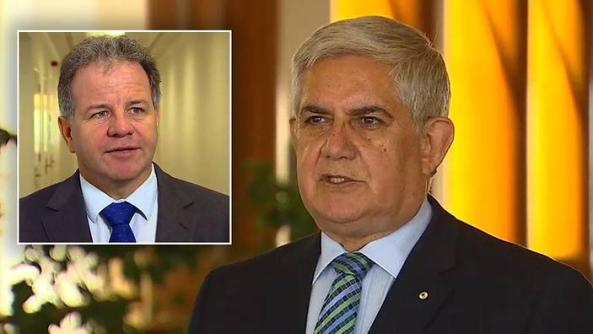
NACCHO #ThePointNITV Stan Grant : PM’s tears and empathy must now be turned action

PM

“In a country where Indigenous people die ten years younger than other Australians, hope has often not been enough.”

The Prime Minister acknowledges there is no ‘magic bullet’, he says there is no one policy solution.

What he will commit to is talking with Indigenous people, trying to find solutions to chronic disparities in health, housing, employment, and education. He wants to break the cycle of black imprisonment – a quarter of the jail population – and create pathways from prison to work

It’s the first time that the Prime Minister has accepted an interview at the residence – and one that left him in tears.

By Stan Grant WATCH Highlight here

Stan

 Interview Monday 29 February 9.00pm NITV follow #ThePointNITV

I am looking at the Prime Minister and there are tears in his eyes. He is recalling an old recording of a lullaby sung in the Ngunawal language. This is the language Malcolm Turnbull spoke in the parliament as part of his closing the gap speech earlier this month.

Never before had an Indigenous language been spoken in our Federal Parliament, now the Prime Minister was giving voice to tens of thousands of years of tradition. These things matter to Malcolm Turnbull: language matters; story matters.

Now he is wiping away a tear imagining a time when this language was widely spoken. He can picture the lady and her child, that moment, he said, when the child would have last felt truly safe.

The Prime Minister wants to respect and acknowledge Indigenous peoples and culture, it is essential he says to ending generations of disadvantage. In his speech he spoke of respect, of rescuing hope from despair, and of speaking with – not to – Indigenous communities.

Malcolm Turnbull has invited NITV to the Lodge – the Prime Ministerial residence in Canberra – for a wide-ranging interview for the first episode of The Point.

Like his predecessor Tony Abbott he wants to be known as the Prime Minister for Indigenous people, just as, he says, he is Prime Minister for all Australians. But he won’t commit to continuing Mr Abbott’s tradition of spending a week each year in an Indigenous community.

Stan Grant Malcolm Tunrbulll

What he will commit to is talking with Indigenous people, trying to find solutions to chronic disparities in health, housing, employment, and education. He wants to break the cycle of black imprisonment – a quarter of the jail population – and create pathways from prison to work.

He speaks a lot about hope. He wants to celebrate success and promote innovation and entrepreneurship. But the reality of black lives often mocks optimism.

In a country where Indigenous people die ten years younger than other Australians, hope has often not been enough.

The Prime Minister acknowledges there is no ‘magic bullet’, he says there is no one policy solution. He says employment and education feed into empowered communities. But he stresses there is no single Indigenous community, there needs to be a focus in remote and regional Australia as equally as urban Australia.

He would like to be able to bring the country together around Indigenous recognition in the constitution and hopefully by 2017, but he says there needs to be a referendum question Indigenous people agree on, and the rest of the country can support.

.Stan Grant Malcolm Turnbull The Lodge

Malcolm Turnbull is being criticised for not taking tough decisions, for being reluctant to spend his political capital. He has backed away from a potential rise in the GST. The Government’s popularity has dropped in recent polls. He rejects the criticism. He says he is focused on making the right decisions not the quickest.

For Indigenous people dealing with a legacy of policy failure this is critical. The Prime Minister has spoken Indigenous language, he has shed a tear over our past, now words and empathy must be measured by action.

Weeknights, 9pm on NITV.
Channel 34 & Foxtel 144 (and on SBS On Demand)

Use the hashtag #ThePointNITV to join the discussion

NACCHO Eye Health News Alert : Following in Fred Hollows’ footsteps

EYE DOC

I went into medicine with the hope I could help other people, but for me it seemed like an impossible dream,” he said.

“When my school careers councillor advised me that perhaps I shouldn’t do medicine, the reason was because Aboriginal doctors were virtually unheard of.

Doctor Kris Rallah-Baker, ophthalmology registrar from the Biri-Gubba-Juru/Yuggera people and the man set to be Australia’s first Indigenous eye doctor.

It is a milestone for a nation in which indigenous adults are six times more likely than other Australians to go blind; in which remote Aboriginal communities endure eye diseases otherwise confined to the developing world; and whose residents rarely dare to venture to the big cities and their alien hospitals.

Watch video here

It was the 1970s, the peak of the Aboriginal land and civil rights movement, when Professor Fred Hollows received a grant through the Royal Australian College of Ophthalmology to go and look at eye health in remote and rural Australian communities.

Fred Hollows Foundation Website

The program took years, with Hollows leading a permanent team of eye health workers thousands of miles around the country.

“Aboriginal and Torres Strait Islander people were still seen as second class citizens in Australia,” says psychologist Melanie Jones.

“So for a white guy from Sydney to want to go out and take a team to do something about Aboriginal health, it was just amazing for his time.”

That was almost 40 years ago, with a group of people close to Hollows’ and who worked on his original team returning to the locations they visited some 23 years after he passed away.

Yet the fight is far from over, with Australia still the only developed country in the world where trachoma is still a problem.

;Aboriginal

“What can we learn from Fred Hollows that might help us with the current situation?” asked Karn Nelson, director of research at the Whiddon Group.

“If anything, it’s around engagement: putting the tools in the hands of Aboriginal people to make the difference.”

One of these key people is Doctor Kris Rallah-Baker, ophthalmology registrar from the Biri-Gubba-Juru/Yuggera people and the man set to be Australia’s first Indigenous eye doctor.

“I went into medicine with the hope I could help other people, but for me it seemed like an impossible dream,” he said.

“When my school careers councillor advised me that perhaps I shouldn’t do medicine, the reason was because Aboriginal doctors were virtually unheard of.

“I think we had five in the whole country.

“The ultimate goal for him (Hollows), I imagine, was to have an Aboriginal person as an ophthalmologist.”

Jones agreed, stating: “It’s Aboriginal health in Aboriginal hands.”

Previous related articles

Moses and Joycie Silver are leaving home, a tarpaulin over a foam mattress on the hard-baked earth of Mataranka, more than 400 kilometres south of Darwin. The old couple are off to see the doctor. “The special one,” Joycie says.

They will meet 35-year-old Kris Rallah-Baker, but they do not quite know how special he is. He is about to become the nation’s first Aboriginal ophthalmologist.

It is a milestone for a nation in which indigenous adults are six times more likely than other Australians to go blind; in which remote Aboriginal communities endure eye diseases otherwise confined to the developing world; and whose residents rarely dare to venture to the big cities and their alien hospitals.

 So for the past few months, Rallah-Baker has been the senior outreach registrar based at Royal Darwin Hospital, among teams employed by the Northern Territory government but funded by the Fred Hollows Foundation to fly or drive to remote places to restore or save the eyesight of their inhabitants.And Rallah-Baker says: “There is an element of difference when you have an Aboriginal face on the other side of the table.”

Truth be known, Joycie Silver is not seeing much of his face. At 70, she bluffs well. “I can look pretty good,” she tells her long-time friend Gay English, a Northern Territory anthropologist working with the Hollows foundation, who drives the couple from the Molgin community on the edge of town to the Aboriginal-controlled Sunrise health clinic. Joycie soon concedes that she doesn’t walk around too much these days, lest she “bump into a big tree”.

It takes Rallah-Baker little time to establish that Joycie is legally blind. She has no sight in one eye, the result of a physical trauma. The lens in her “good eye” has been dislocated to the back of the globe. At close range she can count the doctor’s blurry fingers, but this improves significantly when Rallah-Baker directs her to look through a glass lens. He offers her a solution: a trip to Darwin for surgery.

“Nah,” Joycie says.

“Just one night in hospital,” the doctor says.

“Quick one,” Moses Silver, a senior cultural Rembarrnga man, encourages his wife. But she shakes her head. Darwin is a foreign country.

Rallah-Baker knows how scary it can be for patients such as Joycie, and he assures her it will be her own decision.

“My nanna was 12 when her mother died,” he says, “because she didn’t trust white doctors … On her death bed, [she] still couldn’t quite believe that her own grandson was a doctor. It seemed like an insurmountable achievement.”

Rallah-Baker’s careers adviser at his private school in Brisbane had thought so, too. He advised a young Kris that he would not get into medicine. “Classmates who were straight-A students were never told they couldn’t do medicine. I was a straight-A student but I was black,” Rallah-Baker says.

On his mother’s side, Rallah-Baker is a Biri-Gubba-Juru/Yuggera man, descended from the people of north Queensland and Brisbane. She is part-Indian, too, but he identifies as Aboriginal because “that is the culture I live in”. And he is proud of his father’s bloodlines: Scottish, Jewish and, only recently discovered, an indigenous Australian heritage that is “still emerging”.

Two of Rallah-Baker’s brothers are dentists. He is one of 204 indigenous doctors in the country, on the count of the Australian Indigenous Doctors Association. Its president, Tammy Kimpton – his classmate at Newcastle University – stresses the importance of the cultural bridge being created for indigenous patients, many of whom associate hospitals with death.

A past president of the association, Helen Milroy, became the first indigenous Australian to become a medical doctor in 1983. Milroy also became Australia’s first Aboriginal psychiatrist.

There are too few indigenous specialists, although Rallah-Baker – with his final exams early next year – is among another 22 in training.

“It’s a sign of the times,” says Brian Doolan, chief executive officer of the Fred Hollows Foundation, the charity which has extended the medical mission of its late namesake – to save and restore sight – to  27 countries, from Africa to Asia and the Pacific. “In my own lifetime, I’ve seen the first Aboriginal man to graduate from university, Fred Hollows’ great mate Charles Perkins [in 1966], to a stage where almost 30,000 now have a tertiary education.”

Doolan acknowledges the risk that the foundation’s outreach funding could absolve governments of their responsibility. He hopes the NT government will take over, once the value of the program is proved, but he says the foundation cannot stand by in the face of an appalling health gap.

He recites the bleak statistics: Indigenous Australians are 12 times more likely than the rest of the population to suffer blinding cataracts, but their rate of sight-saving surgery is seven times lower. A century after the United States eliminated trachoma, Australia remains the only developed nation where the blinding disease persists – in 60 per cent of remote indigenous communities – although the foundation predicts this battle could be won in five years with campaigns to encourage hygiene, eye-washing and medical intervention.

Thirty-seven per cent of indigenous adults have diabetes and 13 per cent have already lost vision through diabetic retinopathy. Almost all cases of diabetic blindness are preventable, but only 37 per cent of indigenous people needing laser surgery have received it, and only 20 per cent have had an eye exam in the past year.

Rallah-Baker’s experience with these conditions in Australia may yet lead him to work with Hollows overseas. Doolan summarises the global challenge: “There are 366 million people today living with diabetes. By 2035, we estimate that will be somewhere between 550 million and 600 million.

“Now, every one of those people will need an eye exam every year because somewhere around 10 per cent of them will develop diabetic retinopathy. And if you don’t get it in the early stages, people go blind. If we can catch it early enough, they don’t.”

But it would amount to 35 eye exams every second. “That would overwhelm global health services,” Doolan says.

He doesn’t despair though. The answer, he says in the shade of the health clinic at Mataranka, is in “the cloud”. Within a few years, he predicts, tele-ophthalmology will allow a local health worker “in Pakistan, Vietnam, Mataranka, wherever” to use a hand-held device to photograph a patient’s eyes. These images will be beamed into the electronic cloud, where algorithms will compare them with a databank of thousands of pictures of eye conditions, and within seconds the health worker will be armed with an initial diagnosis.

Joycie Silver’s consultation is a more down to earth. Outside the clinic, Gay English cajoles her about “your trip to Darwin”.

“It’s only a maybe,” Joycie responds, but it is a big advance on no. Joycie has diabetes but no sign of diabetic blindness. She does not have trachoma, although until last year, when their camp was connected to bore water, she and Moses had no running water for bathing.

“It’s good now,” 68-year-old Moses says of their new communal shower.

Joycie simply needs a new lens for her one “good eye”, as Rallah-Baker has explained to her. By day’s end, she is the one talking about her forthcoming trip to Darwin.


NACCHO Diabetes Health Alert :Maps show widespread impact of diabetes across Australia, Indigenous communities


aboriginal-woman-at-dialysis

“The number of Indigenous Australians affected by the disease is particularly alarming. 

Statistics show that one in six Aboriginal and Torres Strait Islander people (18 per cent of the population) have diabetes or high blood sugar levels. 

Rates of diabetes are higher in remote areas, and compared to the rest of the population, Indigenous Australians are more than three times as likely as non-Indigenous people to have the disease. 

According to the NDSS map, over 10 per cent of the population around Alice Springs suffers from diabetes. “

The prevalence of diabetes, particularly Type 2, is rapidly increasing around the country. These maps show just how far it has spread, and the physical toll it is taking.

By Madeleine King, Jason Thomas

Every five minutes, someone in Australia is diagnosed with diabetes. That’s 280 people, every day.

Of those cases, it is estimated 85 per cent of them are being diagnosed as Type 2 diabetics.

It’s the form of the disease that is arguably most preventable, caused when the body becomes resistant to the effects of insulin, or cannot produce enough of the hormone, produced by the pancreas to keep the body’s blood sugar levels under control.

This week, Insight is looking into this particular strain of the disease.

Who is vulnerable, what are the causes, where does it occur, and is it preventable?

Diabetes Australia has developed an interactive map that shows how widespread the disease is, based off data provided by registrants to the government’s National Diabetes Services Scheme (NDSS).

Light blue parts of the map show electoral districts where diabetes has a low rate of occurrence in the population, through to dark red where the disease is highly prevalent.

In Sydney, more affluent suburbs in the east have a very low rate of diabetes, whereas people in the west, in areas around Fairfield, Blacktown and Liverpool, are much more affected by the disease.

In the suburbs around Wetherill Park, 8.3 per cent of the population are signed up for the scheme.

 Diabetes Australia map of diabetes prevalence in Sydney

The prevalence of diabetes in the Sydney region: NDSS

Disadvantaged areas are more likely to see cases of diabetes, and people from particular ethnic backgrounds – including Indigenous Australian, Pacific Islander, Chinese and sub-continental India – are more susceptible.

Does your area have a greater rate of diabetes? Find out here.

The number of Indigenous Australians affected by the disease is particularly alarming.

Statistics show that one in six Aboriginal and Torres Strait Islander people (18 per cent of the population) have diabetes or high blood sugar levels.

Rates of diabetes are higher in remote areas, and compared to the rest of the population, Indigenous Australians are more than three times as likely as non-Indigenous people to have the disease.

According to the NDSS map, over 10 per cent of the population around Alice Springs suffers from diabetes.

 Rate of diabetes in and around Alice Springs

The rate of diabetes in and around Alice Springs: NDSS

A greater rate of diabetes comes with a higher likelihood of its associated complications: heart disease, stroke, amputation and blindness, to name a few.

The map below shows the rate of diabetes-related, preventable hospitalisations in the year 2013-2014.

In areas with large, remote Indigenous populations – northwest WA and central NT – there were over 800 hospitalisations.

NACCHO Promotion

Celebrating the 10th Anniversary of the Close the Gap Campaign for the governments of Australia to commit to achieving equality  for Indigenous people in the areas of health and  life expectancy within 25 years.”

Next publication date 6 April 2016

Advertising and editorial closes 18 March 2016

Download Advertising rate card

Response to this NACCHO media initiative has been nothing short of sensational over the past 3 years , with feedback from around the country suggesting we really kicked a few positive goals for national Aboriginal health.

Thanks to all our supporters, most especially our advertisers, NACCHO’S Aboriginal Health News is here to stay.

We are now looking to all our members, programs and sector stakeholders for advertising, compelling articles, eye-catching images and commentary for inclusion in our next edition.

This 24-page newspaper is produced and distributed as an insert in the Koori Mail, circulating 14,000 full-colour print copies nationally via newsagents and subscriptions.

Our audited readership (Audit Bureau of Circulations) is 100,000 readers!

Our target audience also includes over 500 NACCHO member and affiliate health organisations, relevant government departments, subsidiary indigenous health services and suppliers, as well as the end-users of Australian Indigenous health services nationally.

Your advertising support means we can build this newspaper to a cost-neutral endeavour, thereby guaranteeing its future.

DOWNLOAD OUR 2016 ADVERTISING RATE CARD

HERE

NACCHO Political alert : Ken Wyatt criticises fellow Liberal’s ‘noble savage’ comments, read full speech here


k-wyatt-jensen

“Whether Dennis apologises or not is up to him, but what it demonstrates to me is that he’s not prepared to have an open mind,”

I repudiate Mr Jensen’s calls for colour blind policies that didn’t positively discriminate against Indigenous people.”

Mr Wyatt has Nyoongar, Yamatji and Wongi heritage, and became Assistant Health Minister in 2015.

EXCLUSIVE | As WA politician Dennis Jensen refuses to apologise for his comments, Australia’s first Indigenous minister is joined by Coalition colleagues in distancing themselves from Mr Jensen’s speech in parliament earlier this week.

Read the full speech as published in NEW Matilda  or republished below

EXCLUSIVE

They’re electoral neighbours in Western Australia: Ken Wyatt represents Hasluck while Dennis Jensen serves Tangney.

But in a turn of sorts, Australia’s first federal Indigenous minister has given a dressing down to his fellow Liberal.

Mr Jensen hasn’t backed away from describing Aboriginal people in remote communities as pursuing a ‘noble savage’ lifestyle.

“Whether Dennis apologises or not is up to him, but what it demonstrates to me is that he’s not prepared to have an open mind,” Ken Wyatt told NITV.

Mr Wyatt has Nyoongar, Yamatji and Wongi heritage, and became Assistant Health Minister in 2015.

He repudiated Mr Jensen’s calls for colour blind policies that didn’t positively discriminate against Indigenous people.

Earlier this week, Mr Jensen told parliament the taxpayer shouldn’t be expected to fund ‘lifestyle choices’ – echoing an infamous remark from former Prime Minister Tony Abbott.

“In essence, if the ‘noble savage’ lifestyle, à la Jean-Jacques Rousseau, the same one often eulogised, is true, then there is nothing stopping any Indigenous men or women from pursuing such an existence on their own,” Mr Jensen told the House of Representatives.

It’s a view Mr Wyatt said he would like to challenge, not condemn.

“If you want to discuss and debate issues then let’s lay them on the table and have the debates around them, but do them from an informed position, not one based on prejudices or viewpoints that are stuck in an era long before this one,” he told NITV.

Politicians from both sides critical

The Indigenous Affairs Minister, Nigel Scullion told the Senate this afternoon that Mr Jensen’s commentary was uncalled for.

“In this place, those remarks are usually described as unhelpful by Mr Jensen, and no I do not support his remarks in any way,” Senator Scullion said.

Opposition Leader Bill Shorten has called on Prime Minister Turnbull to condemn the comments.

“Before he became leader, [Prime Minister Turnbull] would have slapped down the far-right of his party,” Mr Shorten told reporters in Canberra this morning.

“We saw this Dennis Jensen chap say things which I am sure Malcolm Turnbull doesn’t personally believe, but he has been silent.”

NITV understands the Prime Minister’s own Indigenous Advisory Council will bring up the issue with Malcolm Turnbull when it meets with him next week in Canberra.

Mr Jensen has no understanding of what goes on in remote Indigenous communities, according to West Australian Labor candidate and Aboriginal lawyer Tammy Solonec.

“To call us a ‘savage’ suggests we’re not as human as other people, we’re not as intelligent as other people and we are. It is a complete lie to say these things about Aboriginal people,” she said in Perth today.

“Perhaps he should keep his comments to Tangney, which he represents.”

‘To call us ‘savage’ suggests we’re not as human as other people’: Tammy Solonec.

Jensen stands by the term ‘noble savage’

When asked by NITV whether he could have used another term instead of ‘noble savage’ to describe Indigenous people, Mr Jensen was unequivocal in his response.

“In the context of the speech, no I don’t think so,” he said.

“It is a very specific term with a very specific idea to it.”

Mr Jensen, who represents the Western Australian electorate of Tangney, said he was using ‘noble savage’ in its literary meaning.

It is a romantic, idealised concept of a person untouched and uncorrupted by Western civilisation, according to the South African-born politician.

“I don’t think it’s a provocative term, I think people choose to take it provocatively. I think people choose to take offence,” he said.

‘Any notion of race is harmful’

Since leaving South Africa, Mr Jensen said he no longer wanted to see citizens divided by their race.

“All I’m after is a policy where all Australians are treated the same. I find very distasteful looking at paperwork asking ‘Are you an Aboriginal or Torres Strait Islander?’ he told NITV.

“It brings me back to the Apartheid days in South Africa.”

The backbencher also told parliament earlier in the week that he wholeheartedly supported Tony Abbott’s infamous ‘lifestyle choices’ remark.

Indigenous people are free to live in remote communities, but shouldn’t expect unquestioning support from the Government, according to Mr Jensen.

He also said he was well aware of the connection First Nations people feel to their country.

It was his visits to remote communities in the Kimberley and the Northern Territory that had reinforced his views.

“No jobs, no employment prospects at all, little-to-no education, that is something I’m not in favour of supporting,” he said.

“I’ve just seen squalor and no hope. It appals me that you have these young children running around and you know they’re going to be their parents and their grandparents in the decades hence.

The Member for Tangney’s speech to federal parliament on Monday, February 22, 2016.

I rise to speak on Appropriation Bill (No. 3) 2015-2016, and Appropriation Bill (No. 4) 2015-2016. I was born in South Africa into a nation that had a vile racist policy. I fought against this policy when at school and in university. I found reprehensible the various apartheid laws, such as those reserving certain jobs for whites and defining race, the pass laws and so on. But racism, whether positive or negative in intent, is still racism. This brings me to the issue of Indigenous policy.

I will be blunt. In my view, there should be no specific Indigenous policy. There should be no race descriptors. There should be no definition of what it is to be Aboriginal, any more than, say, an Irish-Australian should have a definition and a percentage of Irish blood that he or she should have in order to be described as Irish-Australian. Self-identification is the key to this puzzle. Indeed, the only reason that this is done is due to the racist laws that we have here in Australia. The road to hell is paved with good intentions. Alternatively, hell is full of good meanings but heaven is full of good works.

I am particularly disgusted with the headline in Saturday’s Weekend Australian, ‘Push for Aboriginal ID tests’. This takes me back to various racial identity tests that took place in South Africa. They were absolutely disgraceful. People would have to attend an office, and the authorities would look at their fingernails to determine whether they were blue or pink, because people with some ‘black’ blood were more likely to have more bluish-tinged fingernails. They would also do a pencil test in their hair, because people with ‘black’ blood were more likely to have curlier hair, so the pencil was more likely to stick. This sort of disgraceful nonsense ended up with a situation where you could have a brother and sister getting different racial designations, and the one who had the ‘white’ designation would then have nothing to do with their sibling for fear of being reclassified. This sort of disgraceful thing has got no place in civilised society.

I thought, when I migrated to Australia nearly 35 years ago, that I had left all of that behind. The fact that we are attempting to define what is Aboriginal or not, and what percentage blood makes a person Aboriginal, is racist and it is due to the nature of our laws, where many issues such as benefits, jobs et cetera are defined on the basis of race. I thought I had left behind a situation where certain people, based on race, had a privileged status when it comes to jobs. In South Africa, it was called job reservation. But here we have a situation where certain jobs are reserved for Aboriginals or Torres Strait Islanders. To add insult, many of the advertisements for these jobs say, at the end of the advertisement, that it is a position under the equal employment opportunity act. Really? Talk about Orwellian doublespeak!

Then we allow our Aboriginal Australians to live in situations — and we support these situations financially — that we would support with nobody else. Here I talk of the remote communities and allowance of the lack of attendance of Aboriginal children at school. With any other Australians, we would insist that they attend school and insist that they move to areas where there is the opportunity to find work and for the children to attend school. Racism is racism, whatever the intent. There is an argument about historical disadvantage, and that is true. Australia was invaded over 200 years ago. No Australians, regardless of race, were alive at that time, so none suffered directly as a result of that invasion. What is a stain on Australia is that it took so long, until 1967, for Aborigines to get voting rights and other rights as citizens. That is something I think we can justifiably apologise for as a nation. But you do not correct an injustice by instituting another injustice, however worthy the aim. You do not address inequity by imposing other inequities. We will never close the gap while we have racist and discriminatory policy. We will only do it by making sure that everyone is in the same tent, not some halfway in, halfway out.

We need to have policy to address issues, not race. Very few policy problems are absolutely unique to Aborigines, and even where they do exist they are best addressed in terms of the issue, not the race. So we should not deal with Aboriginal alcoholism, Aboriginal child abuse, Aboriginal incarceration or a whole host of other issues; instead, we should deal with alcoholism, child abuse, incarceration et cetera, wherever we find it. I can already hear the ‘but, but, buts’. Here is the question, though: have all those ‘but, but, buts’ had a real impact? Or would it have been better from the start to have a colour blind policy? An Aborigine with a university degree, working in a high-powered job, has far less in common with some of the disadvantaged Indigenous youth not getting an education and with all sorts of social problems than does some disadvantaged non-Aboriginal youth with no job and little education. As I said, we need to deal with the issue, not the race.

‘Insanity: doing the same thing over and over again and expecting different results.’ That was from Albert Einstein. Yet here we are doing precisely that. Martin Luther King dreamed of a time where his four children ‘will one day live in a nation where they will not be judged by the colour of their skin but by the content of their character’. Yet today, in Australia, we have a situation where I, for instance, have been castigated by some as being a racist for having the view that we should be colour blind. To quote one such critic: ‘To be colour blind is to be racist.’ Is that really the way we want our nation to be? That is what we are doing with our policy. The word ‘racist’ in terms of our policy and legislation is extremely confronting, but it makes it no less true.

We have a 40-year failed experiment in terms of affirmative action and positive discrimination. South Africa, similarly, is disastrously pushing on with its Black Economic Empowerment program, positively discriminating. It is a disaster, and the situation in South Africa, after so much early promise from 1994, is going backwards. Look at Zimbabwe, with their disastrous programs of positive discrimination. They are a basket case, and this previous food bowl is now having problems feeding its own people. Discrimination is still discrimination, whether positive or negative. Indeed, categorising, distinguishing, people and hoping to help them on the basis of discrimination means that negative stereotypes become self-actualising. What a terrible burden to put on people.

I put it to the members of this place that the taxpayers of Australia should not be funding lifestyle choices. Yes, I agree with the former Prime Minister, the member for Warringah, when he refers to Indigenous Australians’ choice to live in remote communities as ‘a lifestyle choice’. In essence, if the ‘noble savage’ lifestyle, a la Jean-Jacques Rousseau, the same one often eulogised, is true, then there is nothing stopping any Indigenous men or women from pursuing such an existence on their own. Just do not expect the taxpayers to subsidise it. My contention is that the ideal of the noble savage may be less sanguine and altogether more Hobbesian: ‘nasty, brutish and short’.

Separate to that fact is the intractable predicament of Indigenous positive discrimination programs being anticompetitive and anti-Liberal. The whole founding ethos and values of the Liberal Party were that we seek equality of opportunity, not equality of outcome. We seek to bring all the horses to the same starting position, not to slow down our fastest horse. Robert Menzies would be appalled by what is being prosecuted.

Let me expand on what is broken with our current system and our current way of doing business with Indigenous Australia. I recall going on a trip to Broome, where we were driven around by the local chamber of commerce. We were driven past a region where there were lean-tos and a whole lot of smashed alcohol bottles and so on. The leader of the delegation said: ‘The Indigenous elders are extremely disgusted with us. We can’t do anything about it because it’s native title land. We can only do something about it with caravanning and camping legislation. After three days we can get them to move on, but they just cross to the other side of the road, which is also native title land.’ Here was the problem, and here was the question I asked: ‘If the Indigenous elders are disgusted by this and it is their native title land, why are they not doing something about it? On one hand we are saying we should not be paternalistic, but on the other hand we are being paternalistic by saying we will fix it and get the council to do it rather than having the owners of that land do something about it.’

There is almost no employment gap between Indigenous and non-Indigenous university graduates. The target to halve the gap in employment by 2018 is not on track. So the question then is: where is the critical comment? Where are those people demanding better for Indigenous Australians? Those policies and prescriptions are not working and need to be scrapped, and the victim mentality must end. The gap exists because too many Indigenous people do not participate in the real economy. It will not close unless Indigenous policy shifts from welfare centricity to economic strategy.

Education and employment are the foundations of economic development. Without them, people cannot innovate or produce. If governments do not believe we can get Indigenous kids to school and Indigenous adults to work, they should simply abandon Close the Gap. Everything else is a waste of time and money because the gap will never close.

Between 1990 and 2015, Sub-Saharan Africa increased school enrolment from 52 per cent to 80 per cent. We need the same focus here. Indigenous adults need to work in real jobs. Nearly 80 per cent of Indigenous people live in urban and regional areas around the eastern and south-western coasts of Australia — areas with viable populations and real economies. Less than 22 per cent of Indigenous Australians live in remote areas. Economies have been built in remote and isolated places before. Look at Sydney and Melbourne. When Arthur Phillip sailed into Sydney Cove he did not say, ‘ There are no jobs, let’s go home.’ But Sydney did not become a thriving city because of bureaucrats or not-for-profits or welfare or governments.

In Aboriginal affairs, there is a preoccupation with things that do not deliver economic development, such as welfare and government programs, services and grants. All of these centre on government dependency. When they do not work, the typical response is to try more innovative or complicated versions of them, as if government dependency will somehow deliver economic development if you sex it up. Cashless welfare and income management, for example, may tackle social issues but they do not help people to get a job, buy a home or get a loan.

For decades, the central plank of Indigenous employment policy was the Community Development Employment Program, which employed Indigenous people on community projects and paid an income equivalent to welfare payments. Many ‘jobs’ involved people doing things that they normally do without being paid, such as mowing their own lawn. Giving it a fancy name — Work for the Dole — and calling it employment does not make it a real job. None of these things generates economic development.

Empowered Communities is another initiative with government dependency at its core. Here ’empowerment’ means shifting control of government programs, services and funding to local Indigenous community groups within a complex organisational, governance and legal structure.

This is not empowerment. Indigenous people are not empowered if they depend on government for everything, whether administered centrally or locally.

Welfare and government dependency do not generate economic development no matter how fancy you make them.


NACCHO #closethegap News Alert : INSPIRING Stories Aboriginal workforce and culture

Three

“Trying to balance my Aboriginal culture within a westernised Australian community is also very difficult. One thing I do know is that I’m proud of the many people that have fought for the rights that have given us more opportunities.

One of the key ways to improving Indigenous health will be to improve access to quality, culturally responsive, multidisciplinary care. To do this Aboriginal and Torres Strait Islander health needs to have a significant presence in the core curriculum of all health degrees across Australia”

Danielle Dries, 28, is one of many exceptional young Aboriginal people making their mark today. A Kaurna woman (whose traditional country includes Adelaide), she will soon graduate as a doctor.

Photo above Closing the Gap Parliamentary Breakfast presenters (from left): Danielle Dries, a Kaurna-Meyunna woman, physiotherapist and final year medical student at the Australian National University; Katarina Keeler, a Kokatha woman and registered nurse. Photo Colin Cowell.

Close the Gap Campaign Lead, Tom Widdup, finds out how — despite continued high levels of Indigenous disadvantage, and a disconnect that still hinders relations between Indigenous and non-Indigenous Australia — Danielle and many young Indigenous Australians like her are working to overcome these barriers.

What is it like being a young Aboriginal woman in Australia at the moment?

This is a very difficult question to answer.

I believe young Aboriginal women have a certain level of privilege that our parents and our elders never had. On the whole we have more opportunities, but many Aboriginal girls and women continue to suffer significant disadvantage in comparison to non-Indigenous Australians.

I’m not saying I’ve had it easy. I have experienced a lot of racism and discrimination as a young Aboriginal woman. It’s rarely blatant racism, but I am regularly made to feel less than those around me; people question why I would want to identify as Aboriginal. There’s still definitely a lack of understanding in Australia about Aboriginal history, culture and the vast diversity among our people.

Trying to balance my Aboriginal culture within a westernised Australian community is also very difficult. One thing I do know is that I’m proud of the many people that have fought for the rights that have given us more opportunities.

Why did you choose to study medicine?

I started off as a physiotherapist but am now a final year medical student at ANU. An elective subject in Aboriginal and Torres Strait Islander health, together with my Aboriginal ancestry, made me want to do more for our people.

As a physio, I couldn’t find many jobs in Aboriginal Medical Services or in remote communities, so I decided to study medicine. This opens up more opportunities to work in Aboriginal health, but also to advocate for allied health positions.

Access to services is a complex issue; and it doesn’t necessarily improve for Aboriginal people living in the city. My Nan, who is now 80 years old, has had diabetes since she was 29. Three of my uncles have diabetes as well, and two had a stroke in their 50s. All live in the city, not rural or remote locations. Levels of chronic disease are high among our people everywhere. But while living in the city has helped my grandmother live longer (with good access to multidisciplinary care) services in cities are not always accessible to Indigenous people for other reasons, such as cultural appropriateness.

One of the key ways to improving Indigenous health will be to improve access to quality, culturally responsive, multidisciplinary care. To do this Aboriginal and Torres Strait Islander health needs to have a significant presence in the core curriculum of all health degrees across Australia.

What are Indigenous communities saying about Indigenous health?

I hear communities saying: “too many of our people are sick” and “too many of us are dying too young”. For years there have been policies and ‘interventions’ that have been trialled and failed. There is a belief that health programs will fail before they begin, or when they do work, that funding will be cut.

This is a huge stress for our people. Communities want mainstream Australia to listen to them and understand the health problems they face; they want to have empowerment over their health and their health care.

Closing the gap will take time: health outcomes won’t improve overnight.

How do you get people to listen?

I used to get frustrated when people blamed Aboriginal and Torres Strait Islander people for their poor health: saying things like “they’re lazy”, or “they don’t want to work”, or our problems are just alcohol and other ‘lifestyle’ diseases. As if the levels of disadvantage we face today (and the subsequent health problems we face) is a lifestyle choice.

But with guidance from both Indigenous and non-Indigenous mentors, I’ve realised that it’s not helpful to get angry or frustrated at comments like these. It just makes people shut down. I’ve learnt to be more open and understand why people have these negative stereotypes and to start a conversation about Aboriginal culture, history and the strengths of our people. Education is key.

How did you find the Closing the Gap Parliamentary Breakfast you attended earlier this month?

It was difficult to hear the Prime Minister report the poor progress in closing the health gap. We do need to remember though that it has only been 10 years since the campaign was launched and less since the Australian Government committed to take stronger action. It also highlighted for me that we need strong bipartisanship when it comes to achieving Indigenous health equality.

Another highlight of the breakfast was hearing Aboriginal and Torres Strait Islander leaders Professor Tom Calma and Dr Jackie Huggins speak. They were both really inspiring and provide strong, positive role models for our youth. (I’m also really excited that Dr Huggins is going to speak at our Australian National University National Close the Gap Day event.)

What is your take on the Aboriginal and Torres Strait Islander community’s reaction to the Closing the Gap comments that came from the various party leaders?

This is something that hits the media around this time every year; there are lots of promises made, and then after a couple months it fades away. On the other hand, there is still a lot of hope. Of course people would like to see significant changes, but we’re addressing hundreds of years of disempowerment and human rights abuses. As I said earlier, this is not an issue we’re going to solve overnight.

What can you do to promote Indigenous health equality?

1. Leave a comment below
2. Share Danielle’s story
3. Sign the Close the Gap pledge
4. Register your own National Close the Gap Day event

NACCHO Aboriginal Dental Health Alert : National Oral Health Plan identifes Aboriginal People as Priority Population

2015-09-23 13.11.56

The Healthy Mouths, Healthy Lives: Australia’s National Oral Health Plan 2015–2024 has been prepared by the Oral Health Monitoring Group, a subcommittee of the Community Care and Population Health Principal Committee which reports through the Australian Health Ministers’ Advisory Council to the COAG Health Council.
Oral health is fundamental to overall health, wellbeing and quality of life. A healthy mouth enables people to eat, speak and socialise without pain, discomfort or embarrassment.
Oral-Health-Plan-212x300
The National Oral Health Plan outlines guiding principles that will underpin Australia’s oral health system and provides national strategic direction including targeted strategies in six Foundation Areas and across four Priority Populations. Aboriginal and Torres Strait Islander People being a priority population.
Download plan here
A proportion of Aboriginal and Torres Strait Islander people have good oral health. On average, however, Aboriginal and Torres Strait Islander people experience poor oral health earlier in their lifespan and in greater severity and prevalence than the rest of the population. Aboriginal and Torres Strait Islander people are also less likely to receive treatment to prevent or address poor oral health, resulting in oral health care in the form of emergency treatment.

  • There is limited representation of Aboriginal and Torres Strait Islander people in the oral health workforce and many dental services are not culturally sensitive. For example, strict appointment times and inflexibility regarding ‘failure to attend’ may result in a fee to the consumer.
  • Trends indicate that the high-level dental decay in deciduous (baby) teeth is rising
  • Aboriginal people aged 15 years and over, attending public dental services, experience tooth decay at three times the rate of their Non-Indigenous counterparts and are more than twice as likely to have advanced periodontal (gum) disease
  • Aboriginal people experience complete tooth loss at almost five times the rate of the non-Indigenous population
  • The rate of potentially preventable dental hospitalisations for Aboriginal and Torres Strait Islander people is higher than other Australians. Accessibility of services is a key factor contributing to the current gap between the oral health of Aboriginal and Torres Strait Islander people and the rest of the population.
  • More than two in five Aboriginal and Torres Strait Islander people over the age of 15 defer or avoid dental care due to cost. This is compared with one in eight (12.2%) who delayed or did not go to a GP.

Improving the overall oral health of the Aboriginal and Torres Strait Islander people will require more than a focus on oral health behaviours. Culture, individual and community social and emotional wellbeing, history, demography, social position, economic characteristics, biomedical factors, and the available health services within a person’s community all form part of the complex causal web which determines an individual’s oral health status.

Picture Above : Gari Watson – Dentistry Full Bio


NACCHO Aboriginal Health News Alert : A new hope for Indigenous health in remote communities

ACA

“Scabies remains a scourge of remote Indigenous communities although new strategies are promising.

In the light of recent research, crusted scabies was now managed not simply as an infectious disease, but as a chronic condition, 

“So as for diabetes or kidney disease, if you have ever been diagnosed with crusted scabies you’ll now be on a recall list, You get monitored every month or so to make sure you’re not infecting everyone else.

Before ivermectin was introduced in the Northern Territory, around half of people with crusted scabies died within five years”

Dr Thérèse Kearns of the Menzies School of Health Research.

Seven out of 10 children in such communities are thought to be affected with scabies, and infection with Group A streptococcus bacteria can lead to sepsis, rheumatic fever, acute kidney disease and rheumatic heart disease.

Posted byMic Cavazzini In the Medical Republic

A trial in Fiji found treating entire communities with a single dose of oral ivermectin, whether individuals were infected or not, reduced rates of scabies by 95%. This compared with a 62% reduction in a neighbouring island community randomly assigned to mass administration of topical permethrin.

The prevalence of impetigo also declined, from 21% to 8% in the ivermectin group, and from 25% to 11% in the permethrin group.

But the same strategy was not as effective for an ivermectin trial in the Northern Territory, which saw infection rates bounce back after 12 months.

An Australian expert said crusted scabies was of particular concern, where people were infested with thousands of mites compared with a more usual infection where a person might about 10 mites.

In the light of recent research, crusted scabies was now managed not simply as an infectious disease, but as a chronic condition, said Dr Thérèse Kearns of the Menzies School of Health Research.

“So as for diabetes or kidney disease, if you have ever been diagnosed with crusted scabies you’ll now be on a recall list,” Dr Kearns said. “You get monitored every month or so to make sure you’re not infecting everyone else.”

“But there will be some people that don’t show strong symptoms though they have a mite burrowing into the skin,” she explained. “In our ivermectin interventions, we go household to household and treat the entire household, whether they show scabies or not.”

These public health responses are implemented when prevalence reaches 5% or higher.

Before ivermectin was introduced in the Northern Territory, around half of people with crusted scabies died within five years, she said.

Thorough screening of visitors for crusted scabies to indigenous communities for crusted scabies was also essential, Dr Kearns said.

Individuals with crusted scabies were extremely contagious and could be hard to track as they often covered up out of embarrassment, however, the arrival of one or two individuals with crusted scabies in an Aboriginal community could spark a widespread outbreak, she told The Medical Republic.

The population approach was supported by the finding of a 15-year follow-up of mass ivermectin in the Solomon Islands, which found only one case of scabies out of around 1500 people, as reported in PLoS Neglected Tropical Medicines.

Further food for thought comes from recent Australian research on the genetics of scabies mites in indigenous communities, which found a patient was infected with mites more similar to those typically found on pigs.

“This suggests it may be possible for certain animal strains of mites to infect humans, which we did not previously know was possible. This could have major implications for disease control programs,” said author Dr Katja Fischer of the Queensland Institute of Medical Research.

NEJM 2015 Dec 10;373(24):2305-13
PLoS Negl Trop Dis. 2015 Dec 1;9(12):e0004246
PLoS Negl Trop Dis. 2015 Oct 30;9(10):e0004151

NACCHO Aboriginal Health Newspaper April 2016 :Opportunity to contribute editorial and advertising

Next issue Celebrating the 10th Anniversary of the Close the Gap Campaign for the governments of Australia to commit to achieving equality  for Indigenous people in the areas of health and  life expectancy within 25 years. Time to send a reminder message !

Next publication date 6 April 2016

Advertising and editorial closes 18 March 2016

Download Advertising rate card

Response to this NACCHO media initiative has been nothing short of sensational over the past 3 years , with feedback from around the country suggesting we really kicked a few positive goals for national Aboriginal health.

Thanks to all our supporters, most especially our advertisers, NACCHO’S Aboriginal Health News is here to stay.

Contact nacchonews@naccho.org.au


NACCHO Aboriginal Children’s Health :Indigenous children to be big losers in childcare package: report

_StoryImages_2262136976_a20a9f295f_z

We are really concerned that Deloitte Access Economics’ findings show that key components of the package will significantly reduce access to early years services for Aboriginal and Torres Strait Islander children,”

Deloitte says the childcare package, which was announced in last year’s budget but is yet to pass Parliament, will impact Indigenous children in two key ways.’

SNAICC deputy chairperson Geraldine Atkinson .Photo: flickr.com /Mark Roy

Early childhood and education services for Indigenous children prior to starting school   : AIHW Report

What we know

• High-quality early intervention/education improves children’s lifelong outcomes across all areas—education, health (mental and physical) and wellbeing.

• Early intervention/education is more effective, particularly for vulnerable families, when it is holistic— i.e. addresses children’s and families’ learning needs taking into account the contexts in which they live.

• Closing the gap in outcomes between Indigenous and non-Indigenous Australians requires a focus on early intervention/education of Indigenous young children (from birth), their families and communities.

What works

• Services are more effective for Indigenous children and families when they are aware of and address cultural competence/cultural safety in their service delivery.

• A key component of cultural competence/safety often rests on employing Indigenous workers.

• It is critical that non-Indigenous staff have awareness of how to engage and support all cultures, but particularly Indigenous cultures.

Honest engagement, building trust, working with community members is essential.

• A focus on empowerment, and working from strengths makes a difference

What doesn’t work

• We cannot assume that what works for families from the non-Indigenous culture can be used to successfully shape Indigenous programs.

Mainstream services offering generic support without taking into account issues of cultural competence/ safety for Indigenous children and families do not help.

Developing a one-size-fits-all approach (e.g. rolling out across the country a program that is successful in one context on the assumption that it will be successful everywhere) does not result in effective services.

• Assuming we, as outsiders to a particular community, know what will work best in that community does not result in programs that meet community needs.

As reported Judith Ireland

Indigenous children will be big losers in the Turnbull government’s new childcare package, according to research by Deloitte Access Economics.

The analysis, commissioned by the peak body for Aboriginal and Torres Strait children, finds more than 50 per cent of families currently accessing a government program mainly used for Indigenous childcare would face higher costs under the new plan.

It also finds the new package is likely to “significantly reduce access” to early learning for Indigenous children and threaten the viability of remote services.

The findings are disputed by Education Minister Simon Birmingham, who says Indigenous children will be better supported under the reforms and that the report “only looks at one element of a comprehensive package”.

Deloitte says the childcare package, which was announced in last year’s budget but is yet to pass Parliament, will impact Indigenous children in two key ways.

The first is that a program (the Budget Based Funding program), designed for areas where user-pays models for childcare are not viable, will be abolished. At the moment, 80 per cent of BFF services are for Indigenous children.

The second major impact will be the halving of subsidised access to services (from 24 hours to 12 hours a week) in the mainstream system for families who earn less than $65,000. This group also involves a high percentage of Indigenous families.

Deloitte has found that 40 per cent of families who currently access BFF services would receive fewer subsidised hours of childcare than they do at the moment, with an average reduction of 13 hours a week.

It has also found that 54 per cent of families accessing BFF services will have an average increase of $4.42 per hour in their out-of-pocket costs.

The Secretariat of National Aboriginal and Islander Child Care said that even though the government was also proposing a childcare safety net for disadvantaged families, it will not “adequately redress these outcomes”.

In its place, SNAICC recommends a specific Indigenous program, higher subsidies for services in remote and Indigenous areas and up to two full days of subsidised care for families earning less than $65,000 a year.

“We are really concerned that Deloitte Access Economics’ findings show that key components of the package will significantly reduce access to early years services for Aboriginal and Torres Strait Islander children,” SNAICC deputy chairperson Geraldine Atkinson said.

In its submission to a Senate inquiry into the new childcare package, the Department of Education said the majority of Indigenous children who attend childcare do so through the mainstream (non-BFF) system.

It says the BFF funding allocations are “inconsistent and lack transparency,” adding it was the “right time” to bring the services involved into the new childcare system, due to start in July 2017.

Senator Birmingham, who is the minister with responsibility for childcare, said the new package would provide an extra $3 billion in funding, which included $178 million for additional subsidies and $271 million for a community fund to support vulnerable families.

“Indigenous children will be better supported and provided with enhanced learning opportunities through the transition to the new fairer, simpler and more affordable and accessible child care system,” he said.

“While I welcome all consultation and feedback, unfortunately this report looks at only one element of a comprehensive package – and ignores the elements specifically designed to address concerns of disadvantage.”

According to the Department, 104,1000 families earning $65,000 will be better off under the new system, while 81,000 will experience no change and 52,100 will receive a reduced level of support.


NACCHO Aboriginal News Alert : Agencies struggle on Indigenous quota’s in Public Service

Stan2

This is why we have a sorry legacy of government failure to this day. How many prime ministers are going to leave office and say that their biggest regret would be that they didn’t do enough for indigenous affairs?

“We’ve heard that from Bob Hawke, from Paul Keating, Kevin Rudd and Tony Abbott. Is Malcolm Turnbull going to leave office and say the same thing?”

Broadcaster and journalist Stan Grant raised the dearth of indigenous public service outcomes while delivering an address to the National Press Club :

The Mandarin Reports on the state of Indigenous agencies around Australia

As agencies from all jurisdictions around the country scramble to diversity their workforce with indigenous employees and expertise, the Department of the Prime Minister and Cabinet has struggled to get rid of theirs.

Three months after it was revealed 200 additional full-time equivalent jobs would be targeted for cuts at PM&C — primarily from the Indigenous Affairs portfolio — only 39% have been achieved through voluntary redundancies.

The details, tabled with the Senate Finance and Administration Committee, show the redundancy payout bill came to a little over $4.5 million for the 79 accepted offers.

The 200 redundancies were to come on top of 276 offers already accepted in 2014. The majority of the cuts have come from the Indigenous Affairs portfolio’s regional network — by a wide margin. Of the 79 accepting offers in the latest round, 13 were Aboriginal or Torres Strait Islander employees.

There are a few reasons for the reduction, including duplicated functions after 10 separate agencies were brought into PM&C, and a need to resize the department to “affordable levels”.

Ben Neal, PM&C’s first assistant secretary for corporate services, said the department’s Aboriginal and Torres Strait Islander employment rate was currently at 15.1%, rising significantly in just the Indigenous Affairs portfolio where it is currently 34%. From those figures it’s clear nearly all of PM&C’s indigenous representation in the department comes from the Indigenous Affairs portfolio.

Rising targets across the nation

Most central and policy agencies, at federal and state level, are targeting between 2% and 3% rate of Aboriginal and Torres Strait Islander employment, with few actually meeting that target. The Australian Public Service Commission in particular has pushed strategies to help agencies reach those modest targets, including:

  • “Expand the range of Indigenous employment opportunities”
  • “Invest in developing the capability of Indigenous employees”
  • “Increase the representation of Indigenous employees in senior roles”
  • “Improve awareness of Indigenous culture in the workplace”

But in recent weeks, some much-higher targets have been announced.

South Australia’s Department of Premier and Cabinet seeks to double its indigenous staff from 2% to 4% in four months.

In the Northern Territory, Chief Minister Adam Giles has set a longer timeframe to double his indigenous public servants, aiming to achieve this by 2020. He is also working with a significantly larger target. Indigenous representation in the NT public service is currently 9.5%. Giles said in a statement earlier this month:

“We’ve set a number of ambitious employment targets and policies including doubling public sector indigenous employment from 1800 to 3600 employees by 2020, and initiating Aboriginal employment requirements for all government infrastructure contracts above $500,000.”

The Mandarin revealed disquiet among some indigenous public servants last week when the race for numbers becomes a mere box ticking exercise.

“Bums on seats — have they thought beyond that to ‘once we’ve got them what do they want to do? Why are they going to come and work for us?’,” said one who did not wish to be named.

He said not enough organisations ask themselves “who are we benefiting: the Aboriginal people who come and work for us, or ourselves because we can say we’ve got blackfellas working for us?”

Do not miss out on Advertising or editorial opportunities in the next NACCHO Aboriginal Health Newspaper -Closing 18 March

Celebrating the 10th Anniversary of the Close the Gap Campaign for the governments of Australia to commit to achieving equality  for Indigenous people in the areas of health and  life expectancy within 25 years.”

Next publication date 6 April 2016

Published in the Koori Mail with 100,000 readers. Plus available free at our 302 ACCHO Medical Clinics

Advertising and editorial closes 18 March 2016

Download Advertising rate card

NACCHO: Aboriginal Health Workers Resource Kit alert- Living Longer Stronger


ahmrc cd llsrk example

The Aboriginal Health & Medical Research Council of NSW (AH&MRC) Chronic Disease Program has developed the Living Longer Stronger Resource Kit for Aboriginal Community Controlled Health Services (ACCHS) in NSW.

To preorder your copy of this resource kit please download the order form

The Resource Kit includes a specialist poster to help patients identify the health professionals they may need to see according to their chronic disease, an Aboriginal Health Worker Guide to assist AHWs to talk with their patients about their chronic disease and a patient tool that will help patients understand how their body is affected by their disease.

This resource has been developed for Aboriginal Health Workers and other staff working in Aboriginal Community Controlled Health Services in NSW.

  • 5 Specialist Posters
  • 5 Aboriginal Health Worker Guides
  • 10 Patient Tools (female)
  • 10 Patient Tools (male)

Please download the order form and return it to us by emailing to: chronicdisease@ahmrc.org.au This e-mail address is being protected from spambots. You need JavaScript enabled to view it  or by faxing it back to (02) 9212 7211(02) 9212 7211. After we receive your order we will be in touch with you.

For further information please use the contact form below or send an email directly to the Chronic Disease Team:

  • Email:  chronicdisease@ahmrc.org.au This e-mail address is being protected from spambots. You need JavaScript enabled to view it
  • Phone: (02) 9212 4777(02) 9212 4777

Download

Living Longer Stronger resource kit – Order Form (.PDF file | 0.9 mb)