NACCHO Aboriginal Health and Incarceration Debate #JustJustice : Download : IPA releases report on their solutions

The standard of living of Indigenous Australians fall far short of the standard that the rest of the nation enjoys, many aspects of this disadvantage are correlated, in general, with higher offending and incarceration.”

“However, these correlations also exist for non-indigenous cultural groups, and therefore it is incorrect and counter-productive to believe that the criminal justice system must treat Indigenous Australians in an exceptional way.”

The fourth major report of the IPA’s Criminal Justice program authored by IPA Research Fellow, Andrew Bushnell, was recently incorporated into a submission to the Australian Law Reform Commission’s Inquiry into the Incarceration rates of Aboriginal and Torres Strait Islander peoples.

Download the IPA Report

IPA report Indigenous Australians and the criminal justice system

NACCHO Note : This article and the attached report has not been endorsed in any way by NACCHO and has been only published for research purposes only

“Australia’s prison population grew by 43 percent between 2007 and 2016, with more than one third of this growth caused by the incarceration of Indigenous Australians. Indigenous Australians make up 3 percent of the general population, but 27 percent of the prison population.”

For balance to this attached report read

NACCHO 20 + Articles Just Justice articles 

NACCHO 40 + Articles NT Royal Commission

A new report released last by the free market think tank the Institute of Public Affairs: Indigenous Australians and the criminal justice system, examines the very high rate of incarceration among Indigenous Australians.

The report makes an original contribution through a renewed focus on core principles of justice and corrections, while being mindful of Indigenous disadvantage.

It finds that despite decades of special programs for Indigenous offenders, recidivism and incarceration rates have continued to climb, and calls for enhanced options for punishment and reform outside of the traditional prison system

“The standard of living of Indigenous Australians fall far short of the standard that the rest of the nation enjoys,” Mr Bushnell said. “Many aspects of this disadvantage are correlated, in general, with higher offending and incarceration.”

“However, these correlations also exist for non-indigenous cultural groups, and therefore it is incorrect and counter-productive to believe that the criminal justice system must treat Indigenous Australians in an exceptional way.”

“The high level of Indigenous offending and incarceration can and should be addressed in a manner consistent with the traditional bases of the criminal justice system: community safety, fair punishment, and personal responsibility.”

“All of the tools necessary for improving Indigenous outcomes in criminal justice are known and available,” said Mr Bushnell.

However, there are unique difficulties in finding alternatives to incarceration. Indigenous offenders are more likely than the non-Indigenous to be imprisoned for violent crimes and to have been in prison before. Moreover, Indigenous Australians are more likely to live in remote areas where the delivery by Government of alternatives to incarceration, like home detention and work and community orders, is more difficult.

But Mr Bushnell said the problems were not insurmountable.

“More should be done to fill in the spectrum of coercion that exists between release into the community and imprisonment. In particular, residential programs in larger population centres that can sustain them would make employment programs and rehabilitation services more viable.”

“It is important to improve Indigenous Australians’ ability to access our universal system of justice, including alternative punishments, rather than developing parallel systems of justice than only reinforce social division,” said Mr Bushnell.

In the report Mr Bushnell the search for solutions should not lead to setting aside traditional principles of justice. He said the criminal justice system must remain focused on defending individual rights and delivering retribution on behalf of victims and society, and the correction of offenders’ antisocial behaviour, for the long-term benefit of all Australians of all backgrounds.

“To view this issue through any other prism is to diminish the agency and dignity of Indigenous Australians and perpetuate a racial separatism that is not in the long-term interests of Australians and national solidarity.”

Australia’s prison population grew by 43 percent between 2007 and 2016, with more than one third of this growth caused by the incarceration of Indigenous Australians. Indigenous Australians make up 3 percent of the general population, but 27 percent of the prison population.

There is growing awareness that incarceration in Australia is rising at an unsustainable rate. In previous reports, the Institute of Public Affairs Criminal Justice Project has demonstrated the potential benefits of reforming punishment for nonviolent, low-risk offenders and the importance of skills training and work to the reduction of recidivism. The lessons of successful criminal justice reform in the United States and elsewhere apply with equal validity to the problem of rising Indigenous incarceration.

NACCHO welcomes comments below

NACCHO Aboriginal Health : Tributes to Dr G Yunupingu and Mr Yami Lester – Men without sight but not without a vision


Not far from that creek crossing, at Maralinga, when Yami Lester was a 12-year-old, the British government, in collusion with our Australian government, exploded a series of atomic weapons.

A black mist rolled over their lands, hurting the eyes of this young boy. After a relatively short period of time he became blind.

At his funeral service, we were moved by the singing of Paul Kelly, whose song Maralinga told the story of Mr Lester.

Paul Kelly also worked with the second blind man I wish to commemorate today, Dr G Yunupingu, who brought his beautiful, ethereal voice, in his Yolngu language, to people across the world.

Both men died, in part, due to kidney disease.

Dr Yunupingu had suffered from liver and kidney diseases for many years. He was just 46 years of age. Mr Lester died from end-stage renal failure.”

Extracts from Senator DODSON (Western Australia) Senate Tribute in full Part 2

Picture above from  : Yami Lester: More than 500 people travel to South Australia’s far north for leader’s funeral  : Image and full name used with Permission from family

 ” Dr G Yunupingu ‘s uncle, senior Gumatj elder Djunga Djunga Yunupingu, is reported to have told the crowd at the National Indigenous Awards last week that Dr G Yunupingu ‘built a bridge between Indigenous and non- Indigenous Australia with his music.

Both Yolngu and Balanda walking together hand in hand—two laws, two people, one country.’

These words speak to the moving and reconciling impact of the life Dr G Yunupingu lived, which, sadly, was all too short.

The coalition government and this parliament recognise kidney disease as an important health condition impacting too greatly on our first Australians. Recognising this, we have invested in significant renal services, including dialysis, and we will continue to push for improved services for Territorians.

Dr G Yunupingu’s achievements over his life have left a legacy in the music industry. He will remain one of Australia’s most treasured music artists, described by the Prime Minister as a remarkable Australian who shared Yolngu language with the world through music.

Extracts from Senator Scullion (Northern Territory ) Senate tribute Part 1 Below

 ” We owe him (Mr Lester)  a great debt because he faced adversity with understated courage, with humility, with humour, with great strength.

In a world without nuclear threats and risks Mr Lester would have been a great stockman. In a world with nuclear threats and risks he would crack his whip loud, hard, sharp and constant to sound a different alarm.

Mr Lester made it part of his life’s work to fight for people affected by nuclear testing and to campaign for Indigenous land rights, and we’ve just heard today what a success he made of that and what a difference he made.

Vale, Mr Lester, and our condolences go out to his family and friends.

I was at Garma just a couple of weeks ago, where his legacy was celebrated and his passing very strongly felt.

You could feel it everywhere over the weekend at the time of Garma.

I just want to add, very briefly, to the comments that Senator Dodson just made around kidney disease and the need to address kidney disease in this country, given the impact it has had on these two great Aboriginal Australians.”

Extracts Senator SIEWERT (Western Australia ) senate Tribute in full Part 3 Below

Part 1 Full Text  Senator SCULLION: I move:

That the Senate records its sincere condolences at the deaths, on 21 July 2017 of Mr Kunmanara Lester OAM, and on 25 July 2017 of Dr G Yunupingu, places on record its gratitude and admiration for their service to the nation, and tenders its profound sympathy to their family and community in their bereavement.

I rise on behalf of the coalition government to pay respects and provide sincere condolences to the families, friends and communities of two remarkable men, two First Australians, who have each made such a difference to the nation through their own respective life paths.

Today the Senate pays respects to the outstanding and remarkable contributions of Dr G Yunupingu and Mr Yami Lester. Perhaps what is most striking is that both of these men lived a life without sight, but certainly not without insight and vision, for these two men saw and strived for a better future for their people using both words and action.

I was incredibly saddened by the news of Dr G Yunupingu’s passing, having had the delight of spending time with him in very different circumstances to most people, on his country.

In my previous life as a commercial fisherman, I and my young family at the time spent many years around Dr G Yunupingu’s country, around his home, particularly on the northern end of Elcho Island.

I consider myself blessed to have been able to know this man on his country, when many would see he was most himself.

In fact, I learned that, despite being born blind, Mr G Yunupingu was a great optimist and a man who made the best of everything.

He was a hero of his people and his community and a champion of the Indigenous music industry.

In fact, he was a champion of the Australian music industry, taking Indigenous music and Australian culture to the world.

Learning to play the guitar from an early age, Dr G Yunupingu joined the acclaimed Yothu Yindi band as a teenager.

This band changed the Australian music industry for the better and, more importantly, changed the psyche of our nation through its thought-provoking songs and powerful lyrics.

This music compelled you to listen.

It was music that made all who heard it stop and listen, to listen and learn.

Dr G Yunupingu ‘s uncle, senior Gumatj elder Djunga Djunga Yunupingu, is reported to have told the crowd at the National Indigenous Awards last week that Dr G Yunupingu ‘built a bridge between Indigenous and non- Indigenous Australia with his music.

Both Yolngu and Balanda walking together hand in hand—two laws, two people, one country.’

These words speak to the moving and reconciling impact of the life Dr G Yunupingu lived, which, sadly, was all too short.

The coalition government and this parliament recognise kidney disease as an important health condition impacting too greatly on our first Australians. Recognising this, we have invested in significant renal services, including dialysis, and we will continue to push for improved services for Territorians.

Dr G Yunupingu’s achievements over his life have left a legacy in the music industry. He will remain one of Australia’s most treasured music artists, described by the Prime Minister as a remarkable Australian who shared Yolngu language with the world through music.

Dr G Yunupingu stands among the many Yolngu leaders who have gone before him, including those who were signatories of the Yirrkala bark petitions that were tabled in Parliament this very week back in 1963. Family, friends, fellow Territorians, fans and followers will mark Dr G Yunupingu’s life and provide a final farewell on Tuesday, 19 September at the Darwin Convention Centre.

Today the Senate also provides its sincere condolences to the family and friends of Mr Yami Lester OAM, who passed away on 21 July 2017.

Born in the early 1940s in the APY Lands, on Granite Downs Station in the far north of South Australia, Yami, a Yankunytjatjara man, would go on to live a legacy of leadership that our country acknowledges with sincerity.

The stature of Mr Lester’s leadership was demonstrated in all he did, including as first chair of Pitjantjatjara Council, regional councillor, zone commissioner, driving force of the Institute of Aboriginal Development and chair of the Nganampa Health Council.

Mr Lester is a man who rose from personal tragedy. He was tragically blinded as a young man as a result of the black mist from the nuclear bomb test that blew through his homelands in South Australian when he was only a child. In the decades that followed, Mr Lester’s passion was to fight for justice and restoration for his people and rightful recognition.

He was courageous and persistent. He succeeded in delivering better outcomes for the community he served—for land rights, the health of his people, education, language and culture. He fought for a better future, better health, better education and better jobs.

In all of this, he demonstrated the power of his influence in bringing about major change.

At the state funeral, which I attended with my colleagues Senator Dodson and the member for Lingiari from the other place, I spoke with Mr Lester’s son, Leroy, who shared with me his father’s passion about improving school attendance in his own community.

Mr Lester knew the benefits education can bring not only to his people but to all Australians.

His record of achievement has left a legacy of better outcomes for his community, his people and his nation. Mr Lester advocated for the Pitjantjatjara land rights act. He was part of the historic handover of Uluru-Kata Tjuta, and we remember how he stood alongside Governor-General Sir Ninian Stephen in 1975 and interpreted speech.

He tirelessly advocated for the McMillan royal commission into the British nuclear test that later saw his people compensated.

Mr Lester’s leadership created a legacy that will not be forgotten. He will be remembered as a man of great strength, intelligence, courage and great kindness.

The Prime Minister has described Yami as an extraordinary Australian whose courageous life will be remembered forever.

Both Yami Lester and Dr G Yunupingu leave behind loving families and a nation that is better off for their contribution and worse off for their passing.

We the Australian government commemorate the remarkable lives they lived and pay respect to the legacy they leave. Vale Dr G Yunupingu and Yami Lester.

Part 2 Senator DODSON (Western Australia) :

Today I rise to commemorate the memory of two great Indigenous Australians who have passed since the last sitting of the Senate—Mr Yami (Kunmanara) Lester and Dr G Yunupingu, two blind Aboriginal men who had a vision for Australia. Despite their physical impairment they were far-seeing and insightful, and their lives give testament to their strength and resilience.

From humble beginnings in remote and isolated parts of our continent, one in the desert, the other in the saltwater country, they changed our nation for the better.

Of the two men, I knew Yami Lester the better.

I am proud to call him a friend, a leader and a mentor.

Last week, thanks to the generosity of the Minister for Indigenous Affairs, I was privileged to attend his state funeral in the remote South Australian community of Walatina.

Very few state funerals have occurred in a place so remote.

The hearse, a Land Cruiser embellished with flowers, stopped at a dry creek crossing.

Senior women travelling with his body took the opportunity to point to the dry creek bed at Walkinytjanu, in the middle of the desert, where Mr Lester was born.

While we waited for the Governor, the Premier, the South Australian Minister for Aboriginal Affairs, the Leader of the Opposition and other dignitaries we had a chance to feel the power of the simple birthplace, under the gum trees in the red sand, at a soakage in the desert.

Not far from that creek crossing, at Maralinga, when Yami Lester was a 12-year-old, the British government, in collusion with our Australian government, exploded a series of atomic weapons.

A black mist rolled over their lands, hurting the eyes of this young boy. After a relatively short period of time he became blind.

He believed this was as a direct result of this evil mist. He spent six or so years in a home in Adelaide, where only a younger person spoke his language, Yankunytjatjara. He became a ‘broomologist’, as he used to say, making brooms in the Adelaide school for the blind.

As an adult, with his wife Lucy, he moved to Alice Springs, where I came to know him and learn from his wisdom and insight into life and politics.

He became a leader of Aboriginal organisations there. With the late Reverend Jim Downing he established the Institute for Aboriginal Development, promoting Aboriginal language and culture against the grain of assimilation and forced social and cultural change.

They developed practical measures to assist families living in poverty and worked to reduce infant mortality by helping people to understand the causes of poor health and disease.

I recall giving a speech in Alice Springs on a topic I’ve now forgotten.

Yami pulled me up in the middle of the speech and said words that I took to heart. He said: ‘You’re a smart young man but you have to make a picture book for me in your speech; you need to paint a picture, so that I can see what you are talking about!’.

He was a leader in the struggle to establish Aboriginal controlled and managed organisations in Central Australia; to get recognition of land rights in South Australia; to get Uluru and Kata-Tjuta National Parks returned to traditional owners; and to establish a royal commission into the Maralinga tests.

In all of these struggles his wisdom, courage, determination and commitment were tempered by a wicked and irrepressible sense of humor and an infectious delight in life.

He was a mad supporter of the Melbourne Football Club.

This man, who could not see, showed us a vision of a reconciled Australia and led us on that path.

To his family—Lucy, Leroy, Rosemary and Karina—we express our thanks to you for allowing him to share his time with so many of us.

We wish you well in your future. At his funeral service, we were moved by the singing of Paul Kelly, whose song Maralinga told the story of Mr Lester.

Paul Kelly also worked with the second blind man I wish to commemorate today, Dr G Yunupingu, who brought his beautiful, ethereal voice, in his Yolngu language, to people across the world.

He was born on Elcho Island in the Northern Territory. As his song says, ‘I was born blind. I don’t know why.’ Dr G Yunupingu grew up in Galiwinku, the settlement on Elcho Island, off the north coast of Australia, which is over 500 kilometres northeast of Darwin.

Being blind, he spent his youth with his family absorbed in the Methodist mission environment, and become immersed in the world of music. He was a member of the famous Yothu Yindi band, whose classic song Treaty still resonates today, and the Saltwater Band. It was his solo albums that brought him fame and worldwide acclaim.

His amazing voice was complemented by the cello playing of his collaborator, friend and translator, Michael Hohnen.

Dr G Yunupingu performed for Her Majesty the Queen and for President Barack Obama, but it was the way in which his songs and music brought Yolngu culture and ideas into the minds of so many Australians that is his great gift to us all.

Dr G Yunupingu’s uncle—as the minister has said—senior Gumatj leader David Djunga Djunga Yunupingu, told the crowd in Darwin that his nephew had built a bridge between Indigenous and non-Indigenous Australians with music, but died before the country was truly at peace. He said:

He left us without knowing his place in this nation, without knowing true unity for all Australians.

Both men died, in part, due to kidney disease.

Dr Yunupingu had suffered from liver and kidney diseases for many years. He was just 46 years of age. Mr Lester died from end-stage renal failure.

He made the choice not to move from his home in Walatinna to Alice Springs for dialysis, allowing the disease to take him on his home country.

We’ve lost two great Aboriginal Australians to the scourge of renal disease. In this place we must mark the passing of these great Australians by committing ourselves to doing more to eradicate this epidemic.

Part 3 Senator SIEWERT (Western Australia )

It was with great sadness that I learned of the passing within days of each other of Mr Lester and Mr G Yunupingu.

Both men have made such a great contribution to this country.

I should say that Scott Ludlam would like to be here today to talk about and share his condolences for Mr Lester, because he worked with Mr Lester and other anti-nuclear campaigners to get justice and to campaign against the nuclear industry.

I think it was very fitting, and I’m so pleased, that Mr Lester got to see the commitment to the expansion of the gold card to those affected by the nuclear tests, in the budget in May.

I’m really pleased that he got to see that because he campaigned for such a long time for justice, for the people who are affected by the radiation from the British nuclear tests in Maralinga.

At least he got to see that.

It is a shame that Scott isn’t here to also add to the condolences.

Mr Dave Sweeney, who is a very well-known antinuclear campaigner and who worked with Mr Lester for a very long time, said of his passing:

We owe him a great debt because he faced adversity with understated courage, with humility, with humour, with great strength.

In a world without nuclear threats and risks Mr Lester would have been a great stockman. In a world with nuclear threats and risks he would crack his whip loud, hard, sharp and constant to sound a different alarm.

Mr Lester made it part of his life’s work to fight for people affected by nuclear testing and to campaign for Indigenous land rights, and we’ve just heard today what a success he made of that and what a difference he made.

Vale, Mr Lester, and our condolences go out to his family and friends.

Mr G Yunupingu—what a huge contribution he made to Australia and the world, sharing his music with the world.

It was such beautiful music which made such strong statements, such heartfelt statements, and enabled people to understand his culture through his words and his music.

His music is a lasting contribution to this country.

I was at Garma just a couple of weeks ago, where his legacy was celebrated and his passing very strongly felt.

You could feel it everywhere over the weekend at the time of Garma.

I just want to add, very briefly, to the comments that Senator Dodson just made around kidney disease and the need to address kidney disease in this country, given the impact it has had on these two great Aboriginal Australians.

People are aware that this has been discussed extensively in this chamber, and we need to keep talking about it until it gets the attention that it needs and we stop the going backwards and forwards between the state and territories and the Commonwealth about who pays for what.

It absolutely needs to be addressed. The causes need to be addressed, so that we don’t get to the point where we need end-stage treatment such as dialysis.

These two men’s legacies will constantly remind us of that.

Vale, Dr G Yunupingu and, as I said, the Greens add their condolences to this motion. I should also say thank you to Minister Scullion and Senator Dodson who ensured that we do get to commemorate these two great men in this chamber.

The ACTING DEPUTY PRESIDENT: I now ask all senators to stand in silent support of the motion.

Question agreed to, honourable senators standing in their places.

Aboriginal Health #ThePointNITV and Stolen Generation : Guilty of Being Aboriginal reveals the nation-wide practice of giving #StolenGeneration children criminal records.

NITV news has uncovered the story of how thousands of Stolen Generation children had their lives permanently affected after they were charged and given criminal records – purely for being an Indigenous child taken away from their family.

Featuring both on The Point tonight at 9pm, and in an investigative story online Guilty of Being Aboriginal, NITV unearths forgotten evidence of the widespread practice and reveals that these ‘offences’ still appear on full police records requested by individuals today.

Research by Woor-Dungin volunteer Elizabeth Proctor and Law Professor Bronwyn Naylor from RMIT University reveals that in Victoria, it was a systematic, standard practice up until 1989 for Aboriginal children to get a police record for being an Indigenous child in ‘need of protection’.

This means for decades, Aboriginal and Torres Strait children were given criminal records by the courts after being forcibly taken away from their families.

In particular, the story follows 63-year-old Larry Walsh and his journey of uncovering the truth behind his criminal record from 1956, when he was only two and a half years old. During the course of going through old court documents, Walsh discovered that he had been branded a criminal because he was a ‘stolen child’.

Walsh says that having a police record has affected his life: “They picked on me as a kid, the police, saying I had a criminal record. If they’d left me alone in peace, who knows what my life would have been.”

As well as leading to him being targeted and harassed by local police, Walsh says that this childhood record meant that Magistrates referred to his ‘criminal record from 1956’ on more than one occasion, for example when he went to court for driving without a licence.

“As far as I’m concerned it has been used against me, as part of painting a picture of me as a very bad person. I’ve been telling people about this for years but nobody believed me. How many other people in my age group, or as young as their 30s, have they done this to?”

The Victorian Children’s Court has published documents stating that there was a “failure of the previous system to distinguish between children [deemed to be] in need of protection and young people who were offending against the criminal law.”

There have been calls for the official removal of the charges from people’s records.

The story airs on The Point tonight, Thursday 24 August, on NITV at 9pm. Visit The Point online or get involved on Twitter and Facebook using #ThePointNITV

.


Aboriginal Health and the @AusLawReform inquiry into the incarceration rate of Aboriginal peoples


” The Terms of Reference for this Inquiry ask the ALRC to consider laws and legal frameworks that contribute to the incarceration rate of Aboriginal and Torres Strait Islander peoples and inform decisions to hold or keep Aboriginal and Torres Strait Islander people in custody.

ALRC Home page

Download this 236 page discussion paper

discussion_paper_84_compressed_no_cover

Full Terms of reference part B below

The ALRC was asked to consider a number of factors that decision makers take into account when deciding on a criminal justice response, including community safety, the availability of alternatives to incarceration, the degree of discretion available, and incarceration as a deterrent and as a punishment

The Terms of Reference also direct the ALRC to consider laws that may contribute to the rate of Aboriginal and Torres Strait Islander peoples offending and the rate of incarceration of Aboriginal and Torres Strait Islander women.

Submissions close on 4 September 2017.

Make a submission

Part A Proposals and Questions

1. Structure of the Discussion Paper

1.40     The Discussion Paper is structured in parts. Following the introduction, Part 2 addresses criminal justice pathways. The ALRC has identified three key areas that influence incarceration rates: bail laws and processes, and remand; sentencing laws and legal frameworks including mandatory sentencing, short sentences and Gladue-style reports; and transition pathways from prison, parole and throughcare. These were the focus of stakeholder comments and observations in preliminary consultations.

1.41     Part 3 considers non-violent offending and alcohol regulation. It provides an overview of the detrimental effects of fine debt on Aboriginal and Torres Strait Islander peoples, including the likelihood of imprisonment in some jurisdictions. Fine debt can be tied to driver licence offending, and the ALRC asks how best to minimise licence suspension caused by fine default. Part 3 also looks at ways laws and legal frameworks can operate to decrease alcohol supply so as to minimise alcohol-related offending in Aboriginal and Torres Strait Islander communities.

1.42     Part 4 discusses the incarceration of Aboriginal and Torres Strait Islander women. It contextualises Aboriginal and Torres Strait Islander female offending within experiences of trauma, including isolation; family and sexual violence; and child removal. It outlines how proposals in other chapters may address the incarceration rates of Aboriginal and Torres Strait Islander women, and asks what more can be done.

1.43     Part 5 considers access to justice, and examines ways that state and territory governments and criminal justice systems can better engage with Aboriginal and Torres Strait Islander peoples to prevent offending and to provide better criminal justice responses when offending occurs. The ALRC places collaboration with Aboriginal and Torres Strait Islander organisations at the centre of proposals made in this Part, and suggests accountability measures for state and territory government justice agencies and police. The remoteness of communities, the availability of and access to legal assistance and Aboriginal and Torres Strait Islander interpreters are also discussed. Alternative approaches to crime prevention and criminal justice responses, such as those operating under the banner of ‘justice reinvestment’, are also canvassed.

2. Bail and the Remand Population

Proposal 2–1        The Bail Act 1977 (Vic) has a standalone provision that requires bail authorities to consider any ‘issues that arise due to the person’s Aboriginality’, including cultural background, ties to family and place, and cultural obligations. This consideration is in addition to any other requirements of the Bail Act.

Other state and territory bail legislation should adopt similar provisions.

As with all other bail considerations, the requirement to consider issues that arise due to the person’s Aboriginality would not supersede considerations of community safety.

Proposal 2–2        State and territory governments should work with peak Aboriginal and Torres Strait Islander organisations to identify service gaps and develop the infrastructure required to provide culturally appropriate bail support and diversion options where needed.

3. Sentencing and Aboriginality

Question 3–1        Noting the decision in Bugmy v The Queen [2013] HCA 38, should state and territory governments legislate to expressly require courts to consider the unique systemic and background factors affecting Aboriginal and Torres Strait Islander peoples when sentencing Aboriginal and Torres Strait Islander offenders?

If so, should this be done as a sentencing principle, a sentencing factor, or in some other way?

Question 3–2        Where not currently legislated, should state and territory governments provide for reparation or restoration as a sentencing principle? In what ways, if any, would this make the criminal justice system more responsive to Aboriginal and Torres Strait Islander offenders?

Question 3–3        Do courts sentencing Aboriginal and Torres Strait Islander offenders have sufficient information available about the offender’s background, including cultural and historical factors that relate to the offender and their community?

Question 3–4        In what ways might specialist sentencing reports assist in providing relevant information to the court that would otherwise be unlikely to be submitted?

Question 3–5        How could the preparation of these reports be facilitated? For example, who should prepare them, and how should they be funded?

4. Sentencing Options

Question 4–1        Noting the incarceration rates of Aboriginal and Torres Strait Islander people:

(a)     should Commonwealth, state and territory governments review provisions that impose mandatory or presumptive sentences; and

(b)     which provisions should be prioritised for review?

Question 4–2        Should short sentences of imprisonment be abolished as a sentencing option? Are there any unintended consequences that could result?

Question 4–3        If short sentences of imprisonment were to be abolished, what should be the threshold (eg, three months; six months)?

Question 4–4        Should there be any pre-conditions for such amendments, for example: that non-custodial alternatives to prison be uniformly available throughout states and territories, including in regional and remote areas?

Proposal 4–1        State and territory governments should work with peak Aboriginal and Torres Strait Islander organisations to ensure that community-based sentences are more readily available, particularly in regional and remote areas.

Question 4–5        Beyond increasing availability of existing community-based sentencing options, is legislative reform required to allow judicial officers greater flexibility to tailor sentences?

5. Prison Programs, Parole and Unsupervised Release

Proposal 5–1        Prison programs should be developed and made available to accused people held on remand and people serving short sentences.

Question 5–1        What are the best practice elements of programs that could respond to Aboriginal and Torres Strait Islander peoples held on remand or serving short sentences of imprisonment?

Proposal 5–2        There are few prison programs for female prisoners and these may not address the needs of Aboriginal and Torres Strait Islander female prisoners. State and territory corrective services should develop culturally appropriate programs that are readily available to Aboriginal and Torres Strait Islander female prisoners.

Question 5–2        What are the best practice elements of programs for Aboriginal and Torres Strait Islander female prisoners to address offending behaviour?

Proposal 5–3        A statutory regime of automatic court ordered parole should apply in all states and territories.

Question 5–3        A statutory regime of automatic court ordered parole applies in NSW, Queensland and SA. What are the best practice elements of such schemes?

Proposal 5–4        Parole revocation schemes should be amended to abolish requirements for the time spent on parole to be served again in prison if parole is revoked.

6. Fines and Driver Licences

Proposal 6–1        Fine default should not result in the imprisonment of the defaulter. State and territory governments should abolish provisions in fine enforcement statutes that provide for imprisonment in lieu of unpaid fines.

Question 6–1        Should lower level penalties be introduced, such as suspended infringement notices or written cautions?

Question 6–2        Should monetary penalties received under infringement notices be reduced or limited to a certain amount? If so, how?

Question 6–3        Should the number of infringement notices able to be issued in one transaction be limited?

Question 6–4        Should offensive language remain a criminal offence? If so, in what circumstances?

Question 6–5        Should offensive language provisions be removed from criminal infringement notice schemes, meaning that they must instead be dealt with by the court?

Question 6–6        Should state and territory governments provide alternative penalties to court ordered fines? This could include, for example, suspended fines, day fines, and/or work and development orders.

Proposal 6–2        Work and Development Orders were introduced in NSW in 2009. They enable a person who cannot pay fines due to hardship, illness, addiction, or homelessness to discharge their debt through:

  • work;
  • program attendance;
  • medical treatment;
  • counselling; or
  • education, including driving lessons.

State and territory governments should introduce work and development orders based on this model.

Question 6–7        Should fine default statutory regimes be amended to remove the enforcement measure of driver licence suspension?

Question 6–8        What mechanisms could be introduced to enable people reliant upon driver licences to be protected from suspension caused by fine default? For example, should:

(a)     recovery agencies be given discretion to skip the licence suspension step where the person in default is vulnerable, as in NSW; or

(b)     courts be given discretion regarding the disqualification, and disqualification period, of driver licences where a person was initially suspended due to fine default?

Question 6–9        Is there a need for regional driver permit schemes? If so, how should they operate?

Question 6–10      How could the delivery of driver licence programs to regional and remote Aboriginal and Torres Strait Islander communities be improved?

7. Justice Procedure Offences—Breach of Community-based Sentences

Proposal 7–1        To reduce breaches of community-based sentences by Aboriginal and Torres Strait Islander peoples, state and territory governments should engage with peak Aboriginal and Torres Strait Islander organisations to identify gaps and build the infrastructure required for culturally appropriate community-based sentencing options and support services.

8. Alcohol

Question 8–1        Noting the link between alcohol abuse and offending, how might state and territory governments facilitate Aboriginal and Torres Strait Islander communities, that wish to do so, to:

(a)     develop and implement local liquor accords with liquor retailers and other stakeholders that specifically seek to minimise harm to Aboriginal and Torres Strait Islander communities, for example through such things as minimum pricing, trading hours and range restriction;

(b)     develop plans to prevent the sale of full strength alcohol within their communities, such as the plan implemented within the Fitzroy Crossing community?

Question 8–2        In what ways do banned drinkers registers or alcohol mandatory treatment programs affect alcohol-related offending within Aboriginal and Torres Strait Islander communities? What negative impacts, if any, flow from such programs?

9. Female Offenders

Question 9–1        What reforms to laws and legal frameworks are required to strengthen diversionary options and improve criminal justice processes for Aboriginal and Torres Strait Islander female defendants and offenders?

10. Aboriginal Justice Agreements

Proposal 10–1       Where not currently operating, state and territory governments should work with peak Aboriginal and Torres Strait Islander organisations to renew or develop Aboriginal Justice Agreements.

Question 10–1      Should the Commonwealth Government develop justice targets as part of the review of the Closing the Gap policy? If so, what should these targets encompass?

11. Access to Justice Issues

Proposal 11–1       Where needed, state and territory governments should work with peak Aboriginal and Torres Strait Islander organisations to establish interpreter services within the criminal justice system.

Question 11–1      What reforms to laws and legal frameworks are required to strengthen diversionary options and specialist sentencing courts for Aboriginal and Torres Strait Islander peoples?

Proposal 11–2       Where not already in place, state and territory governments should provide for limiting terms through special hearing processes in place of indefinite detention when a person is found unfit to stand trial.

Question 11–2      In what ways can availability and access to Aboriginal and Torres Strait Islander legal services be increased?

Proposal 11–3       State and territory governments should introduce a statutory custody notification service that places a duty on police to contact the Aboriginal Legal Service, or equivalent service, immediately on detaining an Aboriginal and Torres Strait Islander person.

12. Police Accountability

Question 12–1      How can police work better with Aboriginal and Torres Strait Islander communities to reduce family violence?

Question 12–2      How can police officers entering into a particular Aboriginal or Torres Strait Islander community gain a full understanding of, and be better equipped to respond to, the needs of that community?

Question 12–3      Is there value in police publicly reporting annually on their engagement strategies, programs and outcomes with Aboriginal and Torres Strait Islander communities that are designed to prevent offending behaviours?

Question 12–4      Should police that are undertaking programs aimed at reducing offending behaviours in Aboriginal and Torres Strait Islander communities be required to: document programs; undertake systems and outcomes evaluations; and put succession planning in place to ensure continuity of the programs?

Question 12–5      Should police be encouraged to enter into Reconciliation Action Plans with Reconciliation Australia, where they have not already done so?

Question 12–6      Should police be required to resource and support Aboriginal and Torres Strait Islander employment strategies, where not already in place?

13. Justice Reinvestment

Question 13–1      What laws or legal frameworks, if any, are required to facilitate justice reinvestment initiatives for Aboriginal and Torres Strait Islander peoples?

Part B The Term of reference

ALRC inquiry into the incarceration rate of Aboriginal and Torres Strait Islander peoples

I, Senator the Hon George Brandis QC, Attorney-General of Australia, refer to the Australian Law Reform Commission, an inquiry into the over-representation of Aboriginal and Torres Strait Islander peoples in our prisons.

It is acknowledged that while laws and legal frameworks are an important factor contributing to over‑representation, there are many other social, economic, and historic factors that also contribute. It is also acknowledged that while the rate of imprisonment of Aboriginal and Torres Strait Islander peoples, and their contact with the criminal justice system – both as offenders and as victims – significantly exceeds that of non‑Indigenous Australians, the majority of Aboriginal and Torres Strait Islander people never commit criminal offences.

Scope of the reference

  1. In developing its law reform recommendations, the Australian Law Reform Commission (ALRC) should have regard to:
    1. Laws and legal frameworks including legal institutions and law enforcement (police, courts, legal assistance services and prisons), that contribute to the incarceration rate of Aboriginal and Torres Strait Islander peoples and inform decisions to hold or keep Aboriginal and Torres Strait Islander peoples in custody, specifically in relation to:
      1. the nature of offences resulting in incarceration,
      2. cautioning,
      3. protective custody,
      4. arrest,
      5. remand and bail,
      6. diversion,
      7. sentencing, including mandatory sentencing, and
      8. parole, parole conditions and community reintegration.
    2. Factors that decision-makers take into account when considering (1)(a)(i-viii), including:
      1. community safety,
      2. availability of alternatives to incarceration,
      3. the degree of discretion available to decision-makers,
      4. incarceration as a last resort, and
      5. incarceration as a deterrent and as a punishment.
    3. Laws that may contribute to the rate of Aboriginal and Torres Strait Islander peoples offending and including, for example, laws that regulate the availability of alcohol, driving offences and unpaid fines.
    4. Aboriginal and Torres Strait Islander women and their rate of incarceration.
    5. Differences in the application of laws across states and territories.
    6. Other access to justice issues including the remoteness of communities, the availability of and access to legal assistance and Aboriginal and Torres Strait Islander language and sign interpreters.
  2.  In conducting its Inquiry, the ALRC should have regard to existing data and research[1] in relation to:
    1. best practice laws, legal frameworks that reduce the rate of Aboriginal and Torres Strait Islander incarceration,
    2. pathways of Aboriginal and Torres Strait Islander peoples through the criminal justice system, including most frequent offences, relative rates of bail and diversion and progression from juvenile to adult offending,
    3. alternatives to custody in reducing Aboriginal and Torres Strait Islander incarceration and/or offending, including rehabilitation, therapeutic alternatives and culturally appropriate community led solutions,
    4. the impacts of incarceration on Aboriginal and Torres Strait Islander peoples, including in relation to employment, housing, health, education and families, and
    5. the broader contextual factors contributing to Aboriginal and Torres Strait Islander incarceration including:
      1. the characteristics of the Aboriginal and Torres Strait Islander prison population,
      2. the relationships between Aboriginal and Torres Strait Islander offending and incarceration and inter‑generational trauma, loss of culture, poverty, discrimination, alcohol and drug use, experience of violence, including family violence, child abuse and neglect, contact with child protection and welfare systems, educational access and performance, cognitive and psychological factors, housing circumstances and employment, and
      3. the availability and effectiveness of culturally appropriate programs that intend to reduce Aboriginal; and Torres Strait Islander offending and incarceration.
  3. In undertaking this Inquiry, the ALRC should identify and consider other reports, inquiries and action plans including but not limited to:
    1. the Royal Commission into Aboriginal Deaths in Custody,
    2. the Royal Commission into the Protection and Detention of Children in the Northern Territory (due to report 1 August 2017),
    3. Senate Standing Committee on Finance and Public Administration’s Inquiry into Aboriginal and Torres Strait Islander Experience of Law Enforcement and Justice Services,
    4. Senate Standing Committee on Community Affairs’ inquiry into Indefinite Detention of People with Cognitive and Psychiatric impairment in Australia,
    5. Senate Standing Committee on Indigenous Affairs inquiry into Harmful Use of Alcohol in Aboriginal and Torres Strait Islander Communities,
    6. reports of the Aboriginal and Torres Strait Islander Social Justice Commissioner,
    7. the ALRC’s inquiries into Family violence and Family violence and Commonwealth laws, and​
    8. the National Plan to Reduce Violence against Women and their Children 2010-2022.

The ALRC should also consider the gaps in available data on Aboriginal and Torres Strait Islander incarceration and consider recommendations that might improve data collection.

  1. In conducting its inquiry the ALRC should also have regard to relevant international human rights standards and instruments.

Consultation

  1. In undertaking this inquiry, the ALRC should identify and consult with relevant stakeholders including Aboriginal and Torres Strait Islander peoples and their organisations, state and territory governments, relevant policy and research organisations, law enforcement agencies, legal assistance service providers and the broader legal profession, community service providers and the Australian Human Rights Commission.

Timeframe

  1. The ALRC should provide its report to the Attorney-General by 22 December 2017.


NACCHO Congratulates #Lowitja @LowitjaInstitut 20 years of making a difference in Aboriginal health and wellbeing

 “It has been 20 years since I was asked to be the inaugural Chairperson of the Cooperative Research Centre for Aboriginal and Tropical Health.

One of my fundamental objectives as a Chairperson was to work towards reconciliation between Aboriginal and Torres Strait Islander and Western perspectives of health and wellbeing and encourage a different way of doing research.

That meant bringing the academics and the researchers together with those who are qualified to know what’s needed on the ground. I wanted practical people to investigate the changes that need to be made in Aboriginal and Torres Strait Islander communities to bring about the change we all want to see for our peoples.

I told them that I wanted them to be a courageous organisation committed to social justice and equity for Aboriginal and Torres Strait Islander people, to match words to action, to achieve real, tangible outcomes. “

Dr Lowitja O’Donoghue AC CBE DSG august 2017

 “When these ( ACCHO ) services are set up, it was very clear that the mainstream system was failing us.

So we decided we had to set up our own services… those original AMSs, Redfern and Congress and all the others that followed… were… hotbeds of political activism as well.

We were flexing our muscles in terms of, not only self-management, but self-determination.”

Pat Anderson Lowitja Chair and former NACCHO Chair Interview , 14 November 2014)

 ” Honoured to be marking 20 years of the two decades of Aboriginal-led excellence in research and making a difference.”

The Hon Ken Wyatt Minister for Indigenous Health launching the report  

Paul House welcomes the audience above to country at launch of report Changing the Narrative in ATSI Health Research. Improving our wellbeing

In 2017 Lowitja is celebrating 20 years of Aboriginal and Torres Strait Islander led and focused health research – recognising the journey of the Lowitja Institute and the four associated Cooperative Research Centres (CRCs).

To mark this anniversary they released at Parliament House in Canberra on Wednesday 9 August 2017 a publication titled


Changing the Narrative in Aboriginal and Torres Strait Islander Health Research


Four Cooperative Research Centres and the Lowitja Institute: The story so far

Download a copy here  LOWITJA Changing-the-narrative

Changing the Narrative outlines the journey and the successes of the Institute and the CRCs, and showcases how their cumulative efforts have pioneered a new way of conducting  health research in Aboriginal and Torres Strait Islander communities.

It maps the evolution of a new, collaborative and culturally appropriate way of carrying out health research.

It’s an approach driven by Aboriginal and Torres Strait Islander priorities – an approach developed by the CRCs, and embodied in the Institute.

Each of the CRCs and the Institute has progressed the work to develop health research expertise and processes to achieve lasting reform. Efforts are based on key principles of Aboriginal and Torres Strait Islander control of the research agenda, a broader understanding of health that incorporates wellbeing, and the need for research to have a clear and positive impact.

The Lowitja Institute commissioned the Australian Institute of Aboriginal and Torres Strait Islander Studies (AIATSIS) to write a brief history of our organisation – including audiovisual recordings that highlight the vision of influential individuals.

In addition, the writing, editorial and production work of the Lowitja Institute team have created the hard copy Changing the Narrative publication, and a companion e-book which will be available soon.

Extracts from Report ( for references see report )

Background Aboriginal Community Controlled Health

While this sense of outrage at inequality was being expressed at the universities and in the big cities, little change was occurring in the rural and remote areas of Australia where services for Aboriginal and Torres Strait Islander people were limited.

Those that did exist were segregated and hidden in Aboriginal and Torres Strait Islander welfare departments, missions, reserves and pastoral stations.

In the 1970s, however, there was a significant increase in Aboriginal and Torres Strait Islander health research.11 The results of much of this research confirmed that Aboriginal and Torres Strait Islander life expectancy was lower, and morbidity higher, than for other Australians. In the Northern Territory, these statistics were worse than they had been for non-Indigenous Australians at the turn of the twentieth century.12 Other indicators – such as living conditions, maternal and infant health and chronic disease – highlighted a huge gap in health outcomes between Aboriginal and Torres Strait Islander and non-Indigenous Australians.

This crucial time of activism followed the 1967 referendum to allow amendments to the Australian Constitution that would give the Commonwealth Government the right to make laws affecting Aboriginal affairs and to include Aboriginal peoples in the national Census.13 It was a movement that was ‘most symbolically expressed through the land rights campaigns, but first gained concrete organisational form through the establishment of the Aboriginal legal aid and health services’.14

Change would not happen until the 1970s. The first Aboriginal Community Controlled Health Service (ACCHS) was established in Sydney’s Redfern in 1971, with the Victorian Aboriginal Health Service in Melbourne’s Fitzroy and the Central Australian Aboriginal Congress (CAAC) in Alice Springs two years later.15 The CAAC prides itself today as ‘the voice of Aboriginal health’, from its beginnings in the early 1970s and on its foundation objective that ‘Aboriginal health must be in Aboriginal hands’.16

However, it was not until 1991 that Darwin’s Danila Dilba Biluru Butji Binnilutlum17 and smaller services like18 Miwatj in East Arnhem Land the following year.19 A noticeable exception was Utopia’s Urapuntja Health Service, which opened in 1977.20

When these services are set up, it was very clear that the mainstream system was failing us. So we decided we had to set up our own services… those original AMSs, Redfern and Congress and all the others that followed… were… hotbeds of political activism as well. We were flexing our muscles in terms of, not only self-management, but self-determination. (Pat Anderson Interview 3, 14 November 2014)

Pat Anderson drew attention to the sense of ‘struggle’ against inefficient government control and past polices and the desperately poor health situation for Aboriginal and Torres Strait Islander peoples that framed their thinking in setting up these Northern Territory community controlled health services.

There was a whole range of Aboriginal national bodies that was set up around that time, but in particular with the health services, that was a very conscious decision to be able to be part of the struggle. We used to sign letters in those days, ‘Yours in the Struggle’, with a capital ‘S’. (Pat Anderson Interview 1, 23 October 2014)

The independence of the ACCHSs was enabled by a wide range of people from within the medical profession in Alice Springs and Darwin:

… When we decided that we were going to set up our own organisation, not a government initiative, doctors and nurses and a whole lot of people, as well as Aboriginal people… worked for nothing in those days. They would donate some of their time. The doctors, for instance, when they finished their shifts, they would come to the AMS and they did that for quite a while… NACCHO remains because it came out of the Aboriginal and Torres Strait Islander local communities. (Pat Anderson interview 3, 14 November 2014)

Aboriginal Health Strategy

The other thread that provides crucial background to the establishment of the CRCATH and changes to the Aboriginal and Torres Strait Islander health research landscape that began to emerge at this time was the 1989 National Aboriginal Health Strategy (NAHS).21

It aimed at developing mechanisms to achieve improvements in Aboriginal and Torres Strait Islander health; in particular it focused on taking into account ‘specific health issues, health service provisions, Aboriginal and Torres Strait Islander participation, research and data collection and ongoing monitoring’. It also aimed at maximising the involvement of Aboriginal and Torres Strait Islander people in their own health care.22

A Working Party was established in 1987, which included stakeholders from across a number of sectors involved in Aboriginal and Torres Strait Islander health, including government, communities and the Aboriginal controlled health sector. Its Chairperson was Dr Naomi Mayers, Director of the Redfern Aboriginal Medical Service. Other members of the group included Associate Professor Ted Wilkes and Professor Shane Houston, both of whom would go on to serve on the Board of the CRCAH. The Working Party carried out consultations with interested parties from across all Australian jurisdictions and received approximately 120 submissions for its consideration.23

The Working Party’s report highlighted many of the Aboriginal and Torres Strait Islander community’s concerns regarding the nature of health research. It noted that research was too often imposed on communities, with the communities having little control or redress, and seldom of actual benefit to them. The report also acknowledged that the pervasive nature of the existing Western-centric approach to research needed to be questioned and re-examined.24 The Working Party called for reform of the research processes in Aboriginal and Torres Strait Islander health and, in particular, for more involvement by Aboriginal and Torres Strait Islander people:

… The community should be involved in framing the questions so that the research is relevant to their needs. The Aboriginal community must actively participate in the research process, be kept fully informed, and have some say in how research findings are publicised and used. Only when research projects are subject to Aboriginal community influence, will they be both relevant and of benefit to the community.25

Shane Houston described the Working Party as ‘visionary’ to ‘embrace this notion that good data and good research could be the bedrock or the springboard on which we built really quite an innovative model and approach to Aboriginal health and research’. This was in spite of the fact that, up to that point, ‘appalling relationships [existed] between Aboriginal communities and researchers’ resulting from ‘countless examples’ of research failing to engage in ethical and effective ways with Aboriginal and Torres Strait Islander communities (Shane Houston interview, 1 December 2014).

Shane Houston was critical of what he saw as the dilution of the recommendations of the Working Party in the final report.26 Nevertheless, he later also recognised that it helped reshape the discussions around some of the most important issues regarding Aboriginal and Torres Strait Islander health and continued to be influential 25 years later. He pointed out that the NAHS was a breakthrough for policymakers and for Aboriginal and Torres Strait Islander community controlled health services, as it carried the debates beyond blaming researchers for their self-interest, and grasped the idea of influencing good and ethical research to create better data.

The report talked about intersectoral collaboration before people were talking in this country about the social determinants of health. It argued the case that housing affected health, that education affected health, that education affected housing. And it did so in a really coherent [way] that both government and communities agreed with. It argued for a reform to the style of service delivery in communities. It argued for more collaborative planning – ongoing planning, joint planning by state, territory and Aboriginal communities in the Aboriginal health arena…

And I think, looking back on it, it was one of those key turning points in the Aboriginal health movement across the country that just flipped the debate, that created a new way of talking about, a new way of engaging [with] and a new way of solving the challenges that we confronted. It was never going to be a panacea that would solve every problem. But it gave us the experience and the tools to approach problems in a new way. (Shane Houston Interview, 1 December 2016 )

Aboriginal Health #Garma2017 : #Makarrata ,canoes and the #UluruStatement @TurnbullMalcolm @billshortenmp Full Speech transcripts

 ” Djapiri said Bill and I are in the same canoe and on this issue we certainly are – but we are not alone, we are not alone in the canoe. We are in the same canoe with all of you as well and we need to steer it wisely to achieve our goal, to achieve that goal of Makarrata.

Beyond Constitutional Recognition, that work continues every day. I reflect on the Makarrata discussion of the late 70’s and 80’s. A list of demands was sent to the Minister for Aboriginal Affairs in 1981. It called for rights to land and resources, compensation, the creation of Aboriginal schools, medical centres and an Aboriginal bank.

Despite a final agreement not being reached at the time, we have achieved some of the policies called for. The Commonwealth provided $433 million to 137 Aboriginal Medical Services across the country last financial year.

As Prime Minister I will continue to do all I can to ensure that being an Aboriginal and Torres Strait Islander Australian means to be successful, to achieve, to have big dreams and high hopes, and to draw strength from your identity as an Indigenous person in this great country.

That’s why, as we renegotiate the Closing the Gap targets with the various state and territory jurisdictions later this year, my Government has insisted on a strengths based approach.

Indigenous people are not a problem to be solved.

You are our fellow Australians. Your cultures are a gift to our nation.”

Selected extracts from the full Prime Minister Speech 5 August Garma see Part 2 Full Speech

Download full copy Garma 2017 PM full Speech

” Djapirri said, she told me of a dream of a canoe, paddled by the Prime Minister and myself.

That in itself is an arresting image. Two captains. But in all seriousness, we appreciated I think the power of that illusion, the power of that dream.

Here at Garma, on the lands of the Gumatj, we gather to talk about a Yolngu word. Makarrata.

It is not just now a Yolngu word – I put it to you it’s a national test.

Coming together, after a struggle.

And for the first Australians, it has been a very long struggle indeed.

– A struggle against dispossession and discrimination, exclusion and inequality.

– A struggle against violence and poverty, disease and diminished opportunity.

– A struggle for better health, for better housing, for safer communities, more jobs, for longer lives.

– A struggle against injustice and racism: from the sporting field to the courts of our land.

Above all, a struggle for a better future for their children: a struggle to be counted, to be heard, to be recognised.

At Uluru, you gave us the statement from the heart.

A call for:

– A voice enshrined in the Constitution

– A declaration to be passed by all parliaments, acknowledging the unique place of the first nations in Australian history, their culture, their connection.

And a Makarrata Commission to oversee a process of agreement-making and truth-telling.

All three of these objectives speak to the long-held and legitimate aspirations of our First Australians:

– A proper acknowledgment of Aboriginal histories and the dispossession that followed upon the arrival of the Europeans

– A bigger say in the issues which affect you – no more ‘solutions’ imposed without consultation or consent

And a more lasting settlement, a new way forward, a new pathway including through treaties.

These ideas are not new – but the Uluru statement did articulate these with new clarity, a new passion, a new sense of truth and purpose “

Selected extracts The Hon Bill Shorten speech  Garma 5 August 2017 see in full Part 3 Below

Download full speech Garma 2017 PM full Speech

Part 1 Media Coverage

View NITV Media coverage

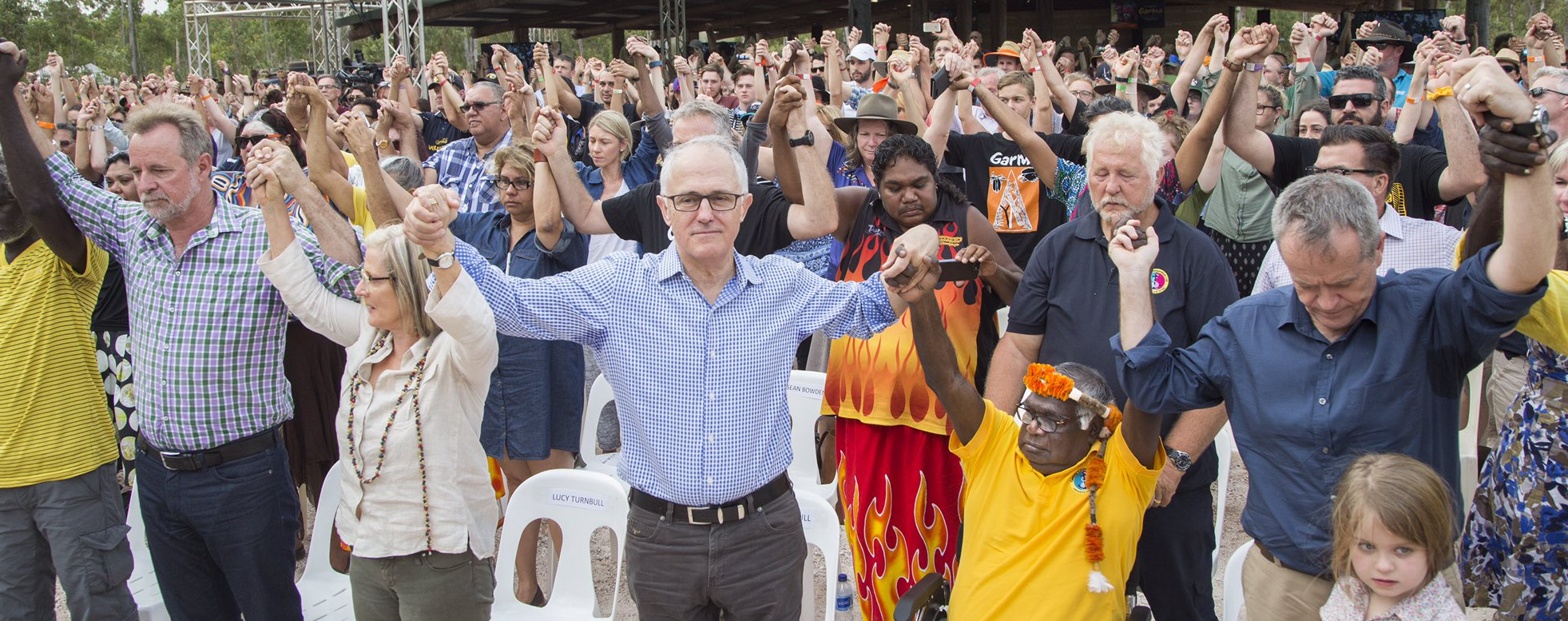
When it comes to Aboriginal constitutional reform, picture Malcolm Turnbull and Bill Shorten sitting in a canoe – and the opposition leader thinks he’s the only one paddling.

The Labor leader has backed a referendum question on an indigenous voice to parliament, while the prime minister has failed to commit bipartisan support.

The two politicians are moving together downstream, struggling to balance the boat to achieve reconciliation, Gumatj leader Djapirri Mununggirritj has told Garma Festival in northeast Arnhem Land.

Mr Shorten called it an “arresting image” but said he was disappointed Mr Turnbull dismissed his end of year referendum question deadline as “very ambitious”.

“We support a declaration by all parliaments, we support a truth telling commission, we are not confronted by the notion of treaties with our first Australians,” he said.

Mr Turnbull acknowledged many Aboriginal leaders were disappointed the government didn’t give “instant fulfilment” to the Referendum Council’s recommendations.

He described the Yolgnu elder’s canoe analogy as apt, saying his cabinet will give the matter careful consideration to keep the aspiration of Makarrata, or coming together after a struggle, from capsizing.

An “all or nothing approach” to constitutional change risks rocking the boat, resulting in a failed referendum, and Mr Turnbull called for time to develop a winnable question to put to Australian voters.

“We are not alone in the canoe, we are in the canoe with all of you and we need to steer it wisely to achieve that goal of Makarrata,” he said.

Mr Turnbull said there’s still many practical questions about what shape the advisory body would take, whether it would be elected or appointed and how it would affect Aboriginal people around the country.

Specifically, he questioned what impact the voice to parliament would have on issues like child protection and justice, which are largely the legislative domain of state and territory governments.

But Mr Shorten said debate over Aboriginal recognition in the nation’s founding document has dragged on for the past decade.

“I can lead Mr Turnbull and the Liberal party to water but I can’t make them drink,” he said.

Having led the failed 1999 republic referendum campaign, Mr Turnbull warned that Australians are “constitutionally conservative”, with just eight out of 44 successful since federation.

But Mr Shorten said “Aboriginal Australians do not need a balanda [white person] lecture about the difficulty of changing the constitution”.

Mr Shorten’s proposal of a joint parliamentary committee to finalise a referendum question has been met with cynicism by indigenous leaders.

The Above AAP


 Part 2 PRIME MINISTER Garma SPEECH :

Ngarra buku-wurrpan bukmak nah! Nhuma’lanah.

Ngarra Prime Minister numalagu djal Ngarra yurru wanganharra’wu nhumalangu bukmak’gu marrigithirri.

Ngarra ga nhungu dharok ga manikay’ ngali djaka wanga’wu yirralka.

I acknowledge and pay respect to your country, and your elders.

As Prime Minister, I’m here to talk to you and learn from you.

I acknowledge and respect your language, your song lines, your dances, your culture, your caring for country, and your estates.

I pay my respects to the Gumatj people and traditional owners past, present and future, on whose land we are gathered.

I also acknowledge other Yolngu people, First Peoples from across the country and balanda here today including Bill Shorten, Nigel Scullion and all other Parliamentary colleagues but above all I acknowledge our Parliamentary colleagues, Indigenous Parliamentary colleagues. Truly, voices of First Australians in the Parliament. Thank you for being here today and for the wisdom you give us, you together with my dear friend Ken, so much wisdom in the Parliament.

I offer my deep respect and gratitude to the Chairman of the Yothu Yindi Foundation, Dr Galarrwuy Yunupingu for hosting Lucy and me with your family. It was lovely to camp here last night and the last music was beautiful, serene and like a lullaby sending us all off to our dreams. Thank you. Emily was the last singer – beautiful.  And of course we woke here to the beautiful sounds of Gulkala.

I again as I did yesterday extend our deep condolences to the family of Dr G Yunupingu at this very sad time. He brought the Yolngu language to the people of Australia and his music will be with us forever.

I’ve come here to North East Arnhem Land to learn, participate respectfully and can I thank everyone so far I’ve had the chance to talk with. I am filled with optimism about our future together as a reconciled Australia.

Last month scientists and researchers revealed new evidence that our First Australians have been here in this land for 65,000 years.

These findings show that Indigenous people were living at the Madjedbebe rock shelter in Mirarr Country, at Kakadu east of Darwin, 18,000 years earlier than previously thought.

Among the middens, rock paintings, remains, plants and ochre, was the world’s oldest-known ground-edge axe head.

These findings place Australia on centre stage in the story of human origin, including mankind’s first long-distance maritime voyage – from Southeast Asia to the Australian continent.

Our First Peoples are shown as artistically, as technologically advanced, and at the cutting edge of technology in every respect.

Importantly, they confirm what Aboriginal people have always known and we have known – that your connection, your intimate connection to the land and sea are deep, abiding, ancient, and yet modern.

This news is a point of great pride for our nation. We rejoice in it, as we celebrate your Indigenous cultures and heritage as our culture and heritage – uniquely Australian.

As Galarrwuy said yesterday as he spoke in Yolngu, he said: “I am speaking in Australian.” Sharing, what a generosity, what a love, what a bigness he showed there as he does throughout his life and his leadership.

I want to pay tribute to the work of so many of you here today, who are leading the healing in communities, building bridges between the old and new, and looking for ways to ensure families and communities are not just surviving, but thriving.

Particularly the Indigenous leaders who every day wear many hats, walk in both worlds, and yet give tirelessly for their families and their communities. You often carry a very heavy load, and we thank you.

Where western astronomers look up at the sky and look for the light, Yolngu astronomers look also deep into the dark, using the black space to uncover further information, to unravel further mysteries.

So while we are both looking at the night sky, we are often looking at different parts. And yet through mutual respect, sharing of knowledge and an openness to learning, together we can see and appreciate the whole sky.

Those same principles are guiding us toward Constitutional Recognition.

The final Referendum Council report was delivered, as you know, on the 30th of June. Bill Shorten and I were briefed by the Referendum Council two weeks ago. The report was a long time coming and I know some would like an instant fulfillment of its recommendations.

Let me say, I respect deeply the work of the Referendum Council and all of those who contributed to it, and I respect it by considering it very carefully and the Government is doing so, in the first instance with my colleagues, including Ken Wyatt the first Indigenous Australian to be a Federal Minister, and together we consider it with our Cabinet. That is our way, that is our process, that is how we give respect to serious recommendations on serious matters.

And I do look forward to working closely and in a bipartisan way with the Opposition as we have done to date.

Djapiri said Bill and I are in the same canoe and on this issue we certainly are – but we are not alone, we are not alone in the canoe. We are in the same canoe with all of you as well and we need to steer it wisely to achieve our goal, to achieve that goal of Makarrata. Thank you again Galarrwuy for that word.

We share a sense of the significance of words. I love words and language. There is a great definition. What is the difference between poetry and prose? The best definition of poetry that I have ever found is that which cannot be translated, it can only be felt.

The Referendum Council’s report as Marcia reminded us is the fourth major report since that time and it adds immensely to the depth of knowledge. It gave us the Uluru Statement from the Heart, and I congratulate all those who attended on reaching an agreement. That was no small task.

It tells us that the priority for Aboriginal and Torres Strait Islander peoples is to resolve the powerlessness and lack of self-determination experienced – not by all, but certainly by too many.

I have been discussing it with leaders, the leaders of our First Australians and will continue to do so as we develop the next steps.

But there are still many questions:

What would the practical expression of the voice look like? What would the voice look like here for the Yolngu people? What would it look like for the people of Western Sydney, who are the largest population of Aboriginal peoples in Australia?

Is our highest aspiration to have Indigenous people outside the Parliament, providing advice to the Parliament? Or is it to have as many Indigenous voices, elected, within our Parliament?

What impact would the voice have on issues like child protection and justice, where the legislation and responsibility largely rest with state and territory governments?

These are important questions that require careful consideration. But the answers are not beyond us.

And I acknowledge that Indigenous Australians want deeper engagement with government and their fellow Australians, and to be much better consulted, and represented in the political, social and economic life of this nation.

We can’t be weighed down by the past, but we can learn from it.

Australians are constitutionally conservative. The bar is surmountable, you can get over it but it is a high bar. That’s why the Constitution has often been described as a frozen document.

Now many people talk about referendums, very few have experienced leading a campaign. The 1999 campaign for a Republic – believe me, now, one of the few subjects on which I have special knowledge – the 1999 campaign for a Republic has given me a very keen insight into what it will take to win, how hard it is to win, how much harder is the road for the advocate for change than that of those who resist change. I offer this experience today in the hope that together, we can achieve a different outcome to 1999. A successful referendum.

Compulsory voting has many benefits, but one negative aspect is that those who for one reason or another are not interested in an issue or familiar with it, are much more likely to vote no – it reinforces an already conservative constitutional context.

Another critical difference today is the rise of social media, which has changed the nature of media dramatically, in a decade or two we have a media environment which is no longer curated by editors and producers – but freewheeling, viral and unconstrained.

The question posed in a referendum must have minimal opposition and be clearly understood.

A vital ingredient of success is popular ownership. After all, the Constitution does not belong to the Government, or the Parliament, or the Judges. It belongs to the people.

It is Parliament’s duty to propose changes to the Constitution but the Constitution cannot be changed by Parliament. Only the Australian people can do that.

No political deal, no cross party compromise, no leaders’ handshake can deliver constitutional change.

Bipartisanship is a necessary but far from a sufficient condition of successful constitutional reform.

To date, again as Marcia described much of the discussion has been about removing the racially discriminatory provisions in the Constitution and recognising our First Australians in our nation’s founding document.

However, the Referendum Council has told us that a voice to Parliament is the only option they advise us to put to the Australian people. We have heard this, and we will work with you to find a way forward.

Though not a new concept, the voice is relatively new to the national conversation about constitutional change.

To win, we must all work together to build a high level of interest and familiarity with the concept of a voice, and how this would be different, or the same, as iterations of the past like the National Aboriginal Conference or the Aboriginal and Torres Strait Islander Commission.

We also need to look to the experience of other countries, as we seek to develop the best model for Australia.

The historic 1967 Referendum was the most successful in our history because of its simplicity and clarity. The injustices were clearly laid out – Indigenous people were not enjoying the rights and freedoms of other citizens. The question was clearly understood – that the Commonwealth needed to have powers to make laws for Indigenous Australians. And the answer seemed obvious – vote yes to ensure the Commonwealth gave Indigenous people equal rights.

To succeed this time around, we need to develop enough detail so that the problem, the solution and therefore the question at the ballot box are simple, easily understood and overwhelmingly embraced.

One of the toughest lessons I learnt from the Referendum campaign of ‘99 was that an ‘all or nothing’ approach sometimes results in nothing. During the campaign, those who disagreed with the model that was proposed urged a “no” vote, arguing that we could all vote for a different Republic model in a few years. I warned that a “no” vote meant no republic for a very long time.

Now, regrettably, my prediction 18 years ago was correct. We must avoid a rejection at a referendum if we want to avoid setting Makarrata reconciliation back.

We recognise that the Uluru statement is powerful because it comes from an Indigenous-designed and led process. And because it comes from the heart, we must accept that it is grounded in wisdom and truth.

It is both a lament and a yearning. It is poetry.

The challenge now is to turn this poetry that speaks so eloquently of your aspiration into prose that will enable its realisation and be embraced by all Australians.

This is hard and complex work. And we need to take care of each other as we continue on this journey. We need to take care of each other in the canoe, lest we tip out of it.

Yesterday afternoon was a powerful show of humanity. As we stood together holding hands – Indigenous and non-Indigenous people – we stood together as Australians. As equals.

And we will have the best chance of success by working together. This cannot be a take it or leave it proposal. We have to come to the table and negotiate in good faith, and I am committed to working with you to find a way forward.

Galarrwuy – you gave us your fire words yesterday, thank you again. We will draw on them as we look to light the path forward for our nation.

And when considering how to do that, we are inspired by the success of the Uluru process. The statement that emerged from Uluru was designed and led by Indigenous Australians and the next steps should be too.

To go to a referendum there must be an understanding between all parties that the proposal will meet the expectations of the very people it claims it will represent.

Now we have five Aboriginal members of our Parliament. They will be vital in shaping and shepherding any legislation through the Parliament. They too are bridge builders, walking in both worlds, and their contribution to the Parliament enriches us all.

The Australian Parliament and the nation’s people – Indigenous and non-Indigenous – must be engaged as we work together to find the maximum possible overlap between what Indigenous people are seeking, what the Australian community overall will embrace and what the Parliament will authorise.

I have been learning that the word Makarrata means the ‘coming together after a struggle’— Galarrwuy told us a beautiful story this morning about a Makarrata here in this country. And a Makarrata is seen as necessary, naturally, if we are to continue our path to reconciliation.

But just like the night sky, reconciliation means different things to different people. This complexity convinces me that our nation cannot be reconciled in one step, in one great leap. We will only be reconciled when we take a number of actions, both practical and symbolic.

Beyond Constitutional Recognition, that work continues every day. I reflect on the Makarrata discussion of the late 70’s and 80’s. A list of demands was sent to the Minister for Aboriginal Affairs in 1981. It called for rights to land and resources, compensation, the creation of Aboriginal schools, medical centres and an Aboriginal bank.

Despite a final agreement not being reached at the time, we have achieved some of the policies called for. The Commonwealth provided $433 million to 137 Aboriginal Medical Services across the country last financial year. Indigenous Business Australia provides low interest loans to help Indigenous Australians secure economic opportunities including home ownership with 544 new housing loans made last year. The Aboriginal Benefits Account supports Northern Territory Land Councils and provides grants for the benefit of Aboriginal people living in the Territory.

We now spend $4.9 billion on the Indigenous Advancement Strategy.

And we are empowering communities through our Indigenous Procurement policy.

I am pleased to announce today the Commonwealth has officially surpassed half a billion dollars in spending with Indigenous businesses all over Australia. I am looking forward to sharing the full two-year results in October. This is a spectacular increase from just $6.2 million being won by Indigenous businesses only a few years ago under former policies.

Since 2008 the Commonwealth has been helping improve remote housing and bring down rates of overcrowding, with $5.4 billion to build thousands of better homes over ten years.

And the land is returning to its traditional owners.

More than 2.5 million square kilometres of land, or about 34 per cent of Australia’s land mass is today recognised under Native Title. Another 24 per cent is covered by registered claims and by 2025, our ambition is to finalise all current Native Title claims.

So we are standing here on Aboriginal land – land that has been rightfully acknowledged as yours and returned to you. And we are standing here near the birthplace of the land rights movement. A movement of which the Yolngu people were at the forefront.

As a nation we’ve come a long way.

In the Northern Territory, more than 50 per cent of the land is now Aboriginal land, recognised as Aboriginal land.

Just like the land at Kenbi which, on behalf of our nation, I returned to the traditional owners, the Larrakia people last year.

Earlier this year I appointed June Oscar AO, who has been acknowledged earlier, as the first female Aboriginal and Torres Strait Islander Social Justice Commissioner, who has agreed to report on the issues affecting Indigenous women and girls’ success and safety.

And all of that work contributes to a better future for our First Australians.

But there is much more to be done in not just what we do, but how we do it – as we work with our First Australians. We are doing things with our First Australians, not to them.

Now Galarrwuy – I have read and read again your essay Rom Watungu. It too is a story from the heart, of your father, of his life and when his time came, how he handed his authority to you, the embodiment of continuity, the bearer of a name that means “the rock that stands against time”

But rocks that stand against time, ancient cultures and lore, these are the strong foundations on which new achievements are built, from which new horizons can be seen – the tallest towers are built on the oldest rocks.

You, Galarrwuy, ask Australians to let Aboriginal and Torres Strait Islanders breathe and be free, be who you are and ask that we see your songs and languages, the land and the ceremonies as a gift.

As Prime Minister I will continue to do all I can to ensure that being an Aboriginal and Torres Strait Islander Australian means to be successful, to achieve, to have big dreams and high hopes, and to draw strength from your identity as an Indigenous person in this great country.

That’s why, as we renegotiate the Closing the Gap targets with the various state and territory jurisdictions later this year, my Government has insisted on a strengths based approach. Indigenous people are not a problem to be solved. You are our fellow Australians. Your cultures are a gift to our nation.

There’s so much more work to be done.

But in doing so, Aboriginal and Torres Strait Islander people, and all Australians, continue to connect with pride and optimism – with mabu liyan, in Pat’s language from the Yawuru people – the wellbeing that comes with a reconciled harmony with you, our First Australians, our shared history truthfully told and a deeper understanding of the most ancient human cultures on earth, and the First Australians to whom we have so much to thank for sharing them with us.

Thank you so much.

Part 3 Opposition Leader’s Garma Speech

Good morning everybody.

I’d like to acknowledge the traditional owners of the land upon which we meet, I pay my respects to elders both past and present.

I recognise that I stand on what is, was and always will be Aboriginal land.

I acknowledge the Prime Minister and his wife Lucy.

I wish to thank Gallarwuy and the Gumatj for hosting us – and on behalf of my Labor team who are here, Senator Pat Dodson, Senator Malarndirri McCarthy, the Hon Linda Burney, the Hon Kyam Maher, supported also by local Members of Parliament the Hon Warren Snowden and Luke Gosling, and Territory Minister Eva Lawler.

We are very grateful to be part of this gathering.

Also Clementine my daughter asked me to thank you for letting her join in the bunggul yesterday afternoon, she loved it.

At the opening yesterday, we were privileged, all of us, to be at a powerful ceremony, where we remembered Dr G Yunupingu, a man who was born blind – but helped Australians see.

From his island, his words and his music touched the world.

But I also understand that the words of our host were about setting us a test, reminding all of us privileged to be here that there is serious business to be done.

Here at Garma, on the lands of the Gumatj, we gather to talk about a Yolngu word. Makarrata.

It is not just now a Yolngu word – I put it to you it’s a national test.

Coming together, after a struggle.

And for the first Australians, it has been a very long struggle indeed.

– A struggle against dispossession and discrimination, exclusion and inequality.

– A struggle against violence and poverty, disease and diminished opportunity.

– A struggle for better health, for better housing, for safer communities, more jobs, for longer lives.

– A struggle against injustice and racism: from the sporting field to the courts of our land.

Above all, a struggle for a better future for their children: a struggle to be counted, to be heard, to be recognised.

In 2015, the Referendum Council was created with a very clear mission.

To consult on what form Constitutional Recognition should take – how it should work.

To listen to Aboriginal people and to be guided by their aspirations.

And to finally give them a say in a document from which too long they been excluded.

Since then, thousands of the first Australians have explained to the rest us what

Recognition means – for all of us, for our children and indeed for all of our futures.

We asked for your views, we sought your counsel – and, in large numbers, it was answered.

At Uluru, you gave us the statement from the heart.

A call for:

– A voice enshrined in the Constitution

– A declaration to be passed by all parliaments, acknowledging the unique place of the first nations in Australian history, their culture, their connection.

– And a Makarrata Commission to oversee a process of agreement-making and truth-telling.

All three of these objectives speak to the long-held and legitimate aspirations of our

First Australians:

– A proper acknowledgment of Aboriginal histories and the dispossession that

followed upon the arrival of the Europeans

– A bigger say in the issues which affect you – no more ‘solutions’ imposed without consultation or consent

– And a more lasting settlement, a new way forward, a new pathway including through treaties.

These ideas are not new – but the Uluru statement did articulate these with new clarity, a new passion, a new sense of truth and purpose.

And let me speak truthfully on behalf of Labor, the Opposition.

I cannot be any more clear than this: Labor supports a voice for Aboriginal people in our Constitution, we support a declaration by all parliaments, we support a truth-telling commission.

We are not confronted by the notion of treaties with our first Australians.

For us the question is not whether we do these things, the question is not if we should do these things but when and how.

The Parliament needs to be engaged.

The Parliament needs to be engaged now.

The Parliament needs to start the process of engaging with the people of Australia now.

It does not come as a surprise to me, that following upon a report of the

Referendum Council, the Parliament’s next step must be to consider this report.

And in doing so, we must carry its message from the heart of Australia into our hearts as parliamentarians. With optimism, with understanding, not with a desire to find what is wrong, but to find the desire to make these concepts work in the interests of all.

If we were all gathered here now, back in 1891 and 1894 and 1897 to write the Constitution, we would never dream of excluding Aboriginal people from the Census.

But in 1901, they did.

If we were starting the Constitution from scratch, we would not diminish the independence of Aboriginal people – with racist powers.

But in 1901, they did.

And if we were starting on an empty piece of paper, we would, without question, recognise the First Australians’ right to a genuine, empowered voice in the decisions that govern their lives.

Now as you know, we cannot unmake history. We do not get the change to start all over again – but it doesn’t mean that we are forever chained to the prejudices of the past.

The Prime Minister’s observations though are correct about the difficulties of constitutional change. But I ask also that we cannot let the failure of 1999 govern our future on this question.

Voting for a constitutional voice is our chance to bring our Constitution home, to make it better, more equal and more Australian.

A document that doesn’t just pay respect to the weight of a foreign crown, but also recognises the power and value of the world’s oldest living culture, recognises that

Aboriginal people were here first.

And of course, let us reject those who say that symbolic change is irrelevant because dealing with these questions does not mean walking away from the real problems of inequality and disadvantage.

– Talking about enshrining a voice does not reduce our determination to eradicate family violence

– It doesn’t stop us creating good local jobs, training apprentices, treating trachoma or supporting rangers on country.

– It doesn’t distract us from the crisis in out-of-home care, youth suicide or the shocking, growing number of Aboriginal people incarcerated for not much better reason than the colour of their skin.

Aboriginal and Torres Strait Islander peoples don’t have to choose between historical justice and real justice, you don’t have to choose between equality in society and equality in the Constitution – you have an equal right to both.

The Uluru Statement has given us a map of the way forward – and today I finally want to talk about how we follow it, how we take the next step.

Not the obstacles ahead, not the problems, real as they are.

Aboriginal Australians don’t need a balanda lecture about the difficulty of changing the Constitution, our inspiration friends, should not be the 1999 referendum, it should be the 1967 referendum.

You have lived that struggle, every day.

Let me be very clear. In my study of our history, in my experience, nothing has ever been given to Aboriginal people – everything that is obtained has been fought for, has been argued for, has been won and built by Aboriginal people.

Think of the Freedom Riders

Think of the Bark Petition, which Gallarwuy was witness to

Think of the Gurindji at Wave Hill

Eddie Mabo and his fight for justice

Nothing was ever sorted by simply waiting until someone came along said let me do it for you. It is not the way the world is organised.

Every bit of progress has been driven by pride, by persistence by that stubborn refusal to not take no for an answer when it comes to the pursuit of equality.

Now making the case for change and encouraging Australians to vote yes for a recognition, reconciliation, and truth – this is not easy.

But before we can do that we surely must agree on the referendum question that has to be the long overdue next step.

I have written to our Prime Minister, we’ve proposed a joint parliamentary committee – which they’re taking on board, having a look at – to be made up of Government, the Opposition and crossbench MPs – to work with Aboriginal leaders right across Australia.

This committee will have two key responsibilities.

One – advising the Parliament on how to set-up a Makarrata Commission and create a framework for truth-telling and agreement making, including treaties.

Two – what would a voice look like. Whilst there are many questions, none of these are insurmountable.

And three, as a matter of overdue recognition – to endeavour to finalise a referendum question in a timely fashion. There’s no reason why that couldn’t be done by the end of this year.

The issues have been traversed for a decade.

Now friends this is not a committee for the sake of a committee, it’s not another mechanism for delay. It is the necessary process of engagement of the Parliament.

But we have had ten years plus of good intentions, but it is time now perhaps, for more action.

The Parliament does have a key role to play here, in setting the question.

The Parliament could agree on the question this year if we all work together so that the people could vote not long after that.

Voting to enshrine a voice in a standalone Referendum – free from the shadow of an election, or the politics of other questions.

It may seem very hard to imagine, it may seem very hard to contemplate.

But it is possible to imagine a great day, a unifying day, a famous victory, a Makaratta for all.

As I said yesterday, we’ve heard plenty of speeches, there are many fine words… but perhaps people have a right to be impatient after ten years – indeed after 117 years.

So the test I set isn’t what we say here, in this beautiful place.

It’s what we do when we leave.

It’s the honesty of admitting that after the event, what is it that we do.

The test I set for myself is can I come here at future Garmas and look you in the eye and say I have done everything I can, because if I cannot say to you that I have done everything I that I can, then I can’t be truthful with my heart.

Yesterday Gallarwuy spoke with a tongue of fire, he told a powerful truth.

He said that for more than two centuries we had been two peoples – living side-by-side, but not united.

I think that is the challenge for politics too.

Djapirri who just spoke up before me, she’s talked about hope. There is the hope that you refer to, you have the Prime Minister and the Leader of the Opposition. We are here side-by-side, and now we need to be united, not to kick the can down the road, but united on a process that says this parliament will respect what we have heard from Aboriginal people.

Not just at Uluru, but for decades.

In 1967, Aboriginal and Torres Strait Islanders were counted. In 2017, you are being heard.

There is no reason why we can’t enshrine a voice for Aboriginal people in our Constitution.

Djapirri said, she told me of a dream of a canoe, paddled by the Prime Minister and myself. That in itself is an arresting image. Two captains. But in all seriousness, we appreciated I think the power of that illusion, the power of that dream.

My party is ready.

I think Australia is ready.

The fine words that we heard at the opening yesterday, they remind me of the fire dreaming symbol, which is in the front of the Parliament of Australia.

Fire.

That fire dreaming symbol is from central Australia but it is connected isn’t it, by the word of Djapirri yesterday.

Again, that spirit of fire it is a gift from Indigenous people to all Australians and I sincerely will endeavor to make sure that spirit of fire infuses our Parliament.

NACCHO Aboriginal Health #NAIDOC2017 : Recognising the communication gap in Indigenous health care

 ” The communication gap between health professionals and Indigenous Australians has a significant impact on health outcomes

Limited health literacy is not confined to Indigenous people, but it is greatly magnified for speakers of Indigenous languages in comparison, for example, to non-English speaking migrants from countries where a scientific approach to medicine is practised and where these health concepts are already codified.”

Dr Robert Amery Medical Journal Australia NAIDOC Week 2017


Introduction Press Release

Communication gap puts Indigenous health at risk

The need for health professionals to have a stronger focus on communication with Indigenous people has been highlighted by the University of Adelaide’s Head of Linguistics, who says some lives are being put at risk because of a lack of patient-doctor understanding.

In a paper published (Monday 3 July) in the Medical Journal of Australia coinciding with the NAIDOC Week theme of Our Languages Matter – Dr Robert Amery has raised concerns not just about language but also a lack of cultural awareness that also impacts on good communication with Indigenous patients.

Dr Robert Amery, who heads Linguistics within the University of Adelaide’s School of Humanities and is a Kaurna language expert, says poor communication can lead to “mistrust and disengagement with the health sector” among

Indigenous patients, leading to a lack of compliance with treatment, and ultimately poor health outcomes.

He says there’s a 16-year gap in life expectancy for Indigenous people living in the Northern Territory compared with non-Indigenous Australians. Of these Indigenous people in the NT, 70% live in remote areas, and 60–65% speak an Indigenous language at home.

“While many speakers of Indigenous languages living in remote areas can engage with outsiders and converse in English about everyday matters, they often have a poor grasp of English when it comes to health communications and other specialised areas,” Dr Amery says.

Miscommunication can be subtle, and previous studies have shown that while both parties think they have understood each other, they can in fact come away with very different understandings.

“Miscommunication isn’t just about language. Some of these difficulties also arise from the interface of communication and culture, which are often derived from differences in worldview,” he says.

“For traditionally oriented Aboriginal people living in remote areas, understanding of disease causation is fundamentally different. Serious diseases, even accidents, are often attributed to sorcery. Germ theory and the immune system are foreign concepts.

“Silence plays an important role in Indigenous cultures. Indigenous people often respond to questions after a prolonged pause, a concept foreign to those doctors who see silence as impolite in their own cultures.

They compensate by filling the silence and disrupting Indigenous patients’ thoughts. There is a simple solution: pause and allow the patient to think.”

He also suggests healthcare professionals avoid the use of “intangible” conceptual English words and vague sentences, instead focusing on factual communication; that they demonstrate how a medical procedure works; and use simple diagrams to explain medical issues.

“These examples may seem plain and obvious, but astoundingly, despite the many hours dedicated to communication in medical education, such concepts are not taught,” Dr Amery says.

“An investment of time in the consult will have immense payoffs over the long term.”

 Download MJA paper here MJA Dr Robert Amery

Published with permission from Robert Amery and Medical  Journal Australia

 See website for references or PDF

The communication gap is most pronounced in remote areas where cultural and linguistic differences are greatest. The close interdependence of language and culture amplifies the gap, such that communication difficulties in these communities run deeper than language barriers alone.

Life expectancy for Indigenous Australians living in remote areas is considerably shorter than for those living in rural and urban areas.6 Figures are not available for the life expectancy of native speakers of Indigenous languages as a cohort, but the gap in life expectancy exceeds 16 years for Indigenous people living in the Northern Territory,7 70% of whom live in remote areas, and 60–65% speak an Indigenous language at home. The life expectancy gap is, of course, multifactorial, although most studies focus on causes of death.8 The communication gap as a contributor is under-rated and under-researched.1,9

An understanding of the Indigenous language landscape is critical to improving communication. In the 2011 Australian census, 60 550 people, or 11.8% of Indigenous respondents, claimed to speak an Indigenous language at home, and 17.5% claimed not to speak English well.10

More have difficulty with specialised language, with common terms such as infection, tumour, high blood pressure, stroke and bacteria often misunderstood. Native Indigenous language speakers communicate in over 100 different traditional languages and live primarily in the NT, the Kimberley region of Western Australia, northern South Australia and northern Queensland, including Torres Strait.

None of these languages have more than 6000 speakers, and many are now reduced to a mere handful, yet each of these languages is a vast storehouse of knowledge built up over thousands of years. It can be daunting to enter a large English-speaking hospital if you communicate in a language spoken by so few people.

Speakers of some languages have shifted to dominant regional languages, such as Murrinh-Patha (Wadeye, NT), while others have shifted to a creole language, such as Kriol (the Kimberley region and the Barkly Tableland area of the NT and North West Queensland).

Aboriginal people often speak distinctive varieties of Aboriginal English that differ from mainstream English. For most Aboriginal people in remote areas, their Aboriginal English is an inter-language variety, in the same way that Japanese speakers have their own distinctive accent and turn of phrase in English, which may be a challenge for medical personnel to understand.

Data might suggest that only a small proportion (less than 10%) of Indigenous adults under 60 years do not speak English well, and that communication issues would therefore not be significant (Box 1).

However, while many speakers of Indigenous languages living in remote areas can engage with outsiders and converse in English about everyday matters, they often have a poor grasp of English when it comes to health communications and other specialised areas. In a study on comprehension of 30 common legal terms (assault, bail, guilty, warrant, etc),11 200 Yolŋu people (north-east Arnhem Land) were surveyed with over 95% unable to correctly identify the meaning of these terms (Box 2).

A parallel health study has not been conducted, but it is likely that understanding of common specialised health terms would be no better. Personal experience supports this view. In 1990, I taught a short course in medical interpreting to a group of Yolŋu students. In teaching the difference between idiomatic and literal language, I introduced an example (“He chucked his guts up”) that I thought everyone would understand. The Yolŋu students interpreted this idiom literally, thinking he ripped out his intestines and threw them in the air. Even simple little things that might be said, such as “let’s keep an eye on it”, can be baffling, because these expressions are often taken literally.

Proportion of Indigenous Australians who speak an Indigenous language and who are reported to speak English “not well” or “not at all”, 2006 and 2011*

Yolŋu comprehension of 30 common legal terms*

Misinterpretations also arise from the interface of communication and culture, here derived from differences in worldview rather than linguistics. In the 1980s, I talked with Tjapaltjarri (skin name, now deceased), a senior Pintupi Aboriginal health worker, about the location of a relative’s house in Alice Springs. Tjapaltjarri referred to various landmarks such as trees and rocks. I asked him about prominent street names including Bloomfield Street. We conversed with full understanding, but I could not follow Tjapaltjarri’s directions. I never paid attention to these landmarks, he never noticed street names. This was not a linguistic issue. It was literally a matter of different worldview. Extrapolate from this example to appreciate the difficulties first language speakers of Aboriginal languages might have in following medical explanations, even when they seemingly speak good English.

These communication gaps are confirmed in health settings. A study of Yolŋu patients undergoing dialysis in Darwin2 identified, through exit interviews, significant misunderstanding of test results despite both patient and renal nurse having revealed that they were satisfied with the communication.

Trudgen9 discusses a Yolŋu patient suffering from severe diabetes and renal failure who was able to avoid dialysis once his condition was explained to him in meaningful terms, and goes on to estimate that 75–95% of communication with Yolŋu patients fails, even with an Aboriginal health worker involved. Aboriginal health workers are not necessarily trained interpreters, nor is interpreting their primary role, although they are often expected to interpret.

How do we improve? Surprisingly simple communication methods, which are easy to teach within mainstream medical education, can help. Trudgen demonstrates how to explain to a Yolŋu patient their 2% residual renal function.9 Many Yolŋu and speakers of other Indigenous languages do not understand the concept of percentages. A picture of a kidney was drawn, shading in the 2% still functioning and showing the remainder, which was sclerosed (Box 3). The patient responded in shock and, no doubt, with better dialysis participation.

Box 3

Template to explain residual renal function of 2% (hatched area) in an otherwise sclerosed kidney (dots)

Aboriginal patients may not be as trusting of medical implements as others. Refusal of an ear examination, for example, may be overcome by allowing such a patient to look through the otoscope to understand how it works. Silence plays an important role in Indigenous cultures.9,12,13

Indigenous people often respond to questions after a prolonged pause, a concept foreign to those doctors who see silence as impolite in their own cultures. They compensate by filling the silence and disrupting Indigenous patients’ thoughts. There is a simple solution — pause and allow the patient to think.

Studies1,2,3,4,14 have identified a widespread belief among Yolŋu people that information is deliberately withheld, mirroring culturally based misconceptions that lead many professionals to believe that Aboriginal patients do not want to know or that they do not experience pain.15

However, several studies1,4,14 clearly demonstrate the desire of Aboriginal people, both from the Top End and from Central Australia, for information about their illnesses and treatment. Effective communication methods, including the use of interpreters, are grossly underutilised, and frequently there is a failure to recognise that patients do not understand.

In a study of 41 Yolŋu people, only 11 found explanations about diagnosis and treatment satisfactory.4 Other studies have shown that even when patients are satisfied, gross misunderstandings may still exist.2 Trudgen9 again gives an example of how this may occur. A doctor explained to a patient that he “could not tell conclusively why [the patient’s] heart was enlarged”. The patient subsequently interpreted this to be that the doctor had no idea why his heart was enlarged and decided not to engage in treatment. Had the doctor avoided use of “intangible” conceptual English words and vague unrevealing sentences, instead focusing on factual communication, this error could have been avoided.

A failure to develop an adequate understanding does run deeper than words. For traditionally oriented Aboriginal people living in remote areas, understanding of disease causation is fundamentally different. Serious diseases, even accidents, are often attributed to sorcery.16,17 Germ theory and the immune system are foreign concepts.

Traditionally oriented Aboriginal people typically have detailed knowledge of anatomy from hunting, butchering and observing nature,9,18 but the perceived function of the kidneys, lungs, pancreas and other internal organs may be quite different. Finding common ground between these understandings is no easy task, but it is important to understand that it may play into medical treatments in the same way as having insight into the use of alternative medicines does in other cultures.

These examples may seem plain and obvious, but astoundingly, despite the many hours dedicated to communication in medical education, such concepts are not taught. Some strategies are provided in Box 4. There is an urgent need to pay more attention to communication needs of remote Aboriginal people.

Communication strategies

A refusal to take Aboriginal languages seriously not only results directly in less than optimal medical outcomes, but also in mistrust and disengagement with the health sector and non-compliance with treatment regimens.3

An investment of time in the consult will have immense payoffs over the long term. We cannot expect our medical students and colleagues to adapt without teaching.

Concepts are simple to grasp with knowledge of the languages and cultures. Is effective establishment of the Aboriginal patient–doctor relationship not one of the more teachable aspects of communication for generations of doctors?

Education is the way forward to a practical and high impact population of medical staff who contribute to the health and pride of the people who are Australia’s national treasures.

NACCHO Aboriginal Health News : 10 Winners profiles National #NAIDOC2017 Awards

The National NAIDOC Committee on the weekend congratulated ten outstanding Aboriginal and Torres Strait Islander Australians who were honoured at the 2017 National NAIDOC Awards Ceremony in Cairns.

See all 10 winners profiles full below Part 2

Dianne Ryder, a proud Noongar woman from Western Australia, was honoured with the prestigious Lifetime Achievement Award. Dianne served a 21 year career in the Army, being awarded the Army Australia Day Medallion in 1990.

She is currently the President of the Aboriginal and Torres Strait Islander Veterans Association of WA and challenges us all to consider how we can improve outcomes for Aboriginal and Torres Strait Islander peoples.

Elverina Johnson, a highly respected Gurugulu and Indinji Gimuy women from Yarrabah in far north Queensland won the Artist of the Year award. Elverina has been involved in the arts industry for over 30 years as a singer, songwriter, playwright, actor, photographer and artist.

She believes that the arts can empower Aboriginal and Torres Strait Islander people and restore a genuine sense of pride in their culture and communities.

The Person of the Year Award, sponsored by the Commonwealth Bank, went to National Basketball Association (NBA) Champion and a three time Olympian, Patrick Mills. Patrick is a Muralag man from the Torres Strait, Ynunga man from South Australia who is dedicated to using his international profile to promote and raise awareness of Aboriginal and Torres Strait Islander cultures.

NACCHO extends its congratulations to all of the 2017 National NAIDOC Award winners and nomination

“It is inspiring to see the tireless work being done by so many talented and dedicated individuals to benefit themselves, their communities and Aboriginal and Torres Strait Islander people across our land,” said Committee Co-Chair, Benjamin Mitchell.

Congratulations to:

• Minjerribah Moorgumpin Elders-in-Council Aboriginal Corporation (QLD) – Caring for Country Award winner

• Latia Schefe (QLD) – Youth of the Year

• Elverina Johnson (QLD) – Artist of the Year

• Dr James Charles (SA) – Scholar of the Year

• Sharee Yamashita (QLD) – Apprentice of the Year

• Amanda Reid (NSW) – Sportsperson of the Year

• Faye Carr (QLD) – Female Elder of the Year

• Ollie George (WA) – Male Elder of the Year

• Patrick Mills (QLD/SA) – Person of the Year

• Dianne Ryder (WA) – Lifetime Achievement Award winner

2017 National NAIDOC Theme – Our Languages Matter

The importance, resilience and richness of Aboriginal and Torres Strait Islander languages will be the focus of national celebrations marking NAIDOC Week 2017.

The 2017 theme – Our Languages Matter – aims to emphasise and celebrate the unique and essential role that Indigenous languages play in cultural identity, linking people to their land and water and in the transmission of Aboriginal and Torres Strait Islander history, spirituality and rites, through story and song.

Some 250 distinct Indigenous language groups covered the continent at first (significant) European contact in the late eighteenth century. Most of these languages would have had several dialects, so that the total number of named varieties would have run to many hundreds.

 Search languages with this interactive website

Today only around 120 of those languages are still spoken and many are at risk of being lost as Elders pass on.

National NAIDOC Committee Co-Chair Anne Martin said languages are the breath of life for Aboriginal and Torres Strait Islander peoples and the theme will raise awareness of the status and importance of Indigenous languages across the country.

“Aboriginal and Torres Strait languages are not just a means of communication, they express knowledge about everything:  law, geography, history, family and human relationships, philosophy, religion, anatomy, childcare, health, caring for country, astronomy, biology and food.

“Each language is associated with an area of land and has a deep spiritual significance and it is through their own languages, that Indigenous nations maintain their connection with their ancestors, land and law,” Ms Martin said.

“We are grateful to have worked with some outstanding partners this year, whose support contributed to success of the 2017 national celebrations.” said Committee Co-Chair, Anne Martin.

The Awards were hosted at the Cairns Convention Centre and attended by just under 1000 guests including the Yirrganydi and Gimuy Walubara Yidinji people, the Cairns community, federal and state politicians and high profile Indigenous affairs identities.

The Committee welcomed back Hannah Hollis and Luke Carroll as hosts for the evening alongside a colourful line-up of entertainment including the AustraNeisia and Gondwana Indigneous Childrens choirs, Torres Strait Islander dance groups Gerib Sik and Naygayiw Gigi, local band The Nightshift and teen superstar Isaiah Firebrace.

The Committee thanks all involved in making this year another successful National NAIDOC event.

“It is a privilege to stage the Awards each year in a different city around our sacred country. I would like to thank the Cairns NAIDOC Committee for its assistance with the Awards and the Yirrganydi and Gimuy Walubara Yidinji people for welcoming us onto their land”, said Mr Mitchell.

Lastly, congratulations to Sydney which was announced last night as the National NAIDOC Host City for 2017.

Highlights of the night are available at http://www.nitv.org.au

For more information on NAIDOC Week and the 2016 National NAIDOC Awards winners, visit www.naidoc.org.au


Caring for Country Award – Minjerribah Moorgumpin Elders -in -Council

The Minjerribah Moorgumpin Elders-in-Council Aboriginal Corporation in Queensland was created to record and teach people about caring for Country for future generations. They represent descendants of the Noonuccal, Ngugi and Goenpul people of North Stradbroke (Minjerribah), Moreton (Moorgumpin) and the Moreton Bay (Quandamooka) islands.

Each year the Elders deliver cultural education services to approximately 6000 participants. They teach knowledge of local languages; bush plants, and environmental management skills that they learned growing up.

As well as education, the Elders are preserving a regional ecosystem which includes significant vegetation and habitats.

Their success has seen the Elders involved in cultural heritage assessments, the publication of books to unique flora, bush tucker and medicinal plants of Stradbroke Island, and the re-introduction of local language to the younger generation, through publication of the Jandai Language Dictionary

Youth of the year – Latia Schefe

Latia Schefe is a young Yuggera woman from Brisbane, Queensland who has overcome serious illness and adversity to become a strong role model among her peers.

Diagnosed with Neuroblastoma cancer when she was only 6 years old, Latia endured multiple operations, chemotherapy and the loss of a kidney.

Despite her hardships, Latia went on to complete Year 12 education and in her final year was awarded the Jane Prentice Award for Indigenous Student of the Year.

Latia stands out as a promising future leader, participating in a Biking Program which fixes old bikes for people with disability, and coordinating local NAIDOC celebrations.

For her future, Latia wants join the police force, or drive the giant trucks in the mining industry

Artist of the Year – Elverina Johnson

Elverina Johnson is a highly respected Gurugulu and Indinji Gimuy women from Yarrabah in far north Queensland – and one of Australia’s most highly respected Indigenous artists.

With creative talents spanning the spectrum of visual and performing arts, Elverina has been involved in the arts industry for over 30 years as a singer, songwriter, playwright, actor, photographer and artist.

She believes that the arts can empower Aboriginal and Torres Strait Islander people and restore a genuine sense of pride in their culture and communities, and works with youth and Elders alike to promote cultural respect and integrity.

Elverina volunteers her time to address critical social issues impacting on the lives of people in Indigenous communities, living true to her traditional family name -Bunya Badjil – which means “Good Woman”

Scholar of the year –Dr James Charles

Dr James Charles is a Kaurna man from Adelaide, South Australia and is currently working at Charles Sturt University as a lecturer in Podiatry.

He graduated from the University of South Australia in podiatry, completed his Masters, recently completed his PhD, and his research is being published in peer review journals.

James is passionate about providing podiatry services to the Aboriginal and Torres Strait Islander community and believes that foot health is undervalued. He has worked for many years at leading Universities, educating on providing culturally appropriate health care.

In 2008 James undertook a two year chairmanship of the newly formed Indigenous Allied Health Network, an organisation he helped build.

Always giving back to his community, James has raised significant money for the Rotary Indigenous Health Fund to provide scholarships for Aboriginal and Torres Strait Islander students.

Apprentice of the Year – Sharee Yamashita

Sharee Yamashita is a young Thanikwithi woman from Thursday Island who has recently completed her Electrical apprenticeship while managing the demanding responsibilities of a young family. She is now a full time employee working with Rio Tinto in Weipa on the Cape York Peninsula.

Sharee has overcome many obstacles along her journey, and says her determination has been inspired by many people, including her father. Her success in her apprenticeship has increased her confidence and she is keen to share her journey to inspire others.

Sharee’s leadership has a powerful positive impact on everyone that she interacts with. Her success in a male dominated industry makes Sharee an important role model for other young Indigenous women.

Sharee’s goal for the future is to help other young people to create opportunities and succeed in their chosen careers.

Sportsperson of the year – Amanda Reid

Amanda Reid is Gurinagi & Wamba Wamba women from Sydney, New South Whales and an accomplished Indigenous Paralympic athlete.

Amanda is the first Aboriginal cyclist and medallist, winning Silver at Rio 2016, and the first female athlete since 1992 to achieve a podium status.

Amanda is the current UCI Para World Cycling Champion in the 3000 meter Pursuit and the 500 meter time trail, breaking the Paralympic record in Rio.

Previously an Australia Day ambassador and currently delivering presentations in local schools, Amanda is an inspirational role model to all Australians. She mentors young disabled athletes as well as Aboriginal youth in care and plans to increase her community work prove that people with disability can achieve in their community.

Amanda lives every day by her mantra “dream it, believe it and you will be it.”

Female Elder of the year – Faye Carr

Faye Carr is a Yuggera Elder from Ipswich in Queensland, who has overcome a tough childhood to become a strong advocate and leader in her community.

Passionate about sharing her culture and knowledge with her community, Faye has been contributing to Aboriginal and Torres Strait Islander people since the 1960’s.

Faye was involved in establishing the Aboriginal and Torres Strait Islander Legal Service, the Kambu Progress Association and the Kambu Aboriginal to deliver important legal, housing, recreational and health services to Ipswich and broader Queensland. Among many accolades, Faye was honoured with Ipswich Citizen of the Year in 2016.

Always an advocate for her people, Faye recently met with Prime Minister Malcolm Turnbull and other key stakeholders to raise awareness about the impacts of domestic violence on women and families.

Male Elder of the year – Ollie George

Ollie George is a Badimaya Elder from Western Australia who has worked tirelessly since the early 1990s to preserve his mother tongue, Badimaya.

He has taught Badimaya at the school in his hometown of Mt Magnet and works with community members to create language materials and resources. He has recorded hundreds of hours of Badimaya language, much of it by himself.

Since 2012, Ollie has worked to produce 7 publications in Badimaya, has been featured in two ‘Indigenous Community Stories’ by the Film and TV Institute of WA, and the primary consultant on several projects on Badimaya language and country.

Ollie is now completing his ‘Nganang Badimaya Wangga’, a project based on 24 yarns he tells about life growing up on his country, learning language from old people, and the cultural and historical legacy of the Badimaya people.

Person of the year – Patrick Mills

Patrick Mills is a Muralag man from the Torres Strait, Ynunga man from South Australia and sporting legend.

A National Basketball Association (NBA) Champion and a three time Olympian Patrick is a member of the San Antonio Spurs who famously won the 2014 NBA Championship.

Patrick is the first Indigenous player to represent Australian Men’s Basketball at three consecutive Olympic Games and is preparing for his record fourth Games in Tokyo 2020.

He is the youngest player to represent Australia in Men’s Basketball and he holds the Olympic record for being the overall highest points scorer at the London Olympics in 2012. Patrick has won numerous awards including ACT Young Australian of the Year in 2015 and ACT Sports Male Athlete of the Year in 2016.

Patrick uses his international profile to promote and raise awareness of Aboriginal and Torres Strait Islander cultures and often takes time to share parts of his language with his teammates.

A strong role model, Patrick’s goal for the future is to be an ambassador for Indigenous people and continue educating the world on his culture. Patrick says ‘It’s who I am. It’s what I know – even more than basketball.’

Life time achievement award – Dianne Ryder

Dianne Ryder is a proud Noongar woman from Western Australia with a legendary reputation for her contribution to family, community and country.

After school, Dianne embarked on a 21-year career with the army and in 1990, she was awarded the Army Australia Day Medallion.

Since leaving the Army, Dianne has worked as a community outreach worker in Sydney and later Perth. She is currently the President of the Aboriginal and Torres Strait Islander Veterans Association of WA and heavily involved with the Indigenous Veterans Memorial Service.

Her contribution and involvement with her community has led to her being sought out to share her wisdom with government departments and politicians at a state and national level. In 2015, Dianne was nominated for Australian of the year in 2015 and for the Prime Ministers Advisory Council on Mental health.

Dianne’s favorite saying is “Just imagine …” where she challenges us all to consider how we can improve outcomes for Aboriginal and Torres Strait Islander peoples

NACCHO Aboriginal Health : #NTIntervention: Ten years on and what has been achieved?


” The intervention was a “debacle” and a new attempt with Indigenous involvement “couldn’t do any worse .

I suggest a “mark two of what was attempted under the intervention”: a 10-year “Marshall plan” between federal and territory governments but with Aboriginal people as expert advisers on a planning, oversight and implementation committee.

It’s not enough to pay us the cursory privilege of being consulted, where our voices are not listened to and where we have no role in decision-making,” she said. “We couldn’t do any worse than what’s being done today, surely.”

Olga Havnen, the chief executive of the Danila Dilba Aboriginal health service see Part 2 story below

 “I  describe the intervention as “a complete violation of the human rights of Aboriginal people in the Northern Territory.

The legacy is that Aboriginal people were completely disempowered.

They had the Army going into communities in their uniforms. They had no idea why the Army was there. People were terrified that they’d come to take the kids away.”

National Aboriginal Community Controlled Health Organisation chief executive Pat Turner see story part 3 NT Intervention: Australia’s most costly ‘political stunt’

As the national representative body for Aboriginal and Torres Strait Islander peoples, the National Congress of Australia’s First Peoples calls for a fundamental reset of government and community relations with us, beginning with the implementation of the Uluru Statement resolutions for constitutional reform. Congress stands ready to fill the role of the advisory body to parliament.”

“We also call for the immediate implementation of the Redfern Statement, which provides a roadmap for how governments can work collaboratively with us to develop efficient and effective programs”

Congress press release Part 1 Below

Part 1 The Northern Territory Intervention: Ten years on and what has been achieved?

As a federal election loomed a decade ago, facing disappointing polls the government of the day was scandalized by sexual abuse in Northern Territory Aboriginal communities and proposed an intervention to improve the life chances of Aboriginal children.

The program won bipartisan support and continued under a new name, Stronger Futures, when the government changed. Closing the Gap targets were announced and hundreds of millions of dollars have been spent to improve the health, education, housing and employment status of Aboriginal and Torres Strait Islander people around the country, and especially those living in remote communities.

A decade on, it is timely to consider results:

  • The annual Closing the Gap report shows that six of the seven targets are not on track.
  •  We understand that there has not been a single prosecution for child sexual abuse as a result of these programs.
  •  Aboriginal men have been stigmatized as drunken, irresponsible pedophiles.
  •  Provisions of the Racial Discrimination Act have been ignored to allow the Intervention to proceed.
  •  Communities have been weakened by the downgrading of local self-government. Those who presume to know what is best for Aboriginal and Torres Strait Islander peoples have had their way.
  •  Tax payers are askance at the shocking waste of public monies on ineffective programs, for which many blame Aboriginal people.
  •  Most notably in the Northern Territory, but in the states as well, shocking abuses of Aboriginal and Torres Strait Islander juveniles have been uncovered.
  •  Incarceration rates of Aboriginal and Torres Strait Islander men, women and children have sky rocketed.
  •  United Nations representatives have issued reports critical of the Intervention and of government relations with Aboriginal and Torres Strait Islander peoples.
  • The 97 recommendations of the 2007 Ampe Akelyernemane Meke Mekarle (Little Children are Sacred) report have been ignored.

A longer list would add to the inevitable conclusion that there is a crisis in Indigenous Affairs.

“The rationale for the Intervention was to protect Aboriginal children and to provide them with a better future. Health, education and well-being statistics demonstrate failure of the Intervention. There have been very few positive outcomes to show for the hundreds of millions of dollars that have been spent on the Intervention and related programs,” he said.

Part 2 NT intervention a ‘debacle’ and second attempt should be made, commission told

from Helen Davidson The Guardian

A 10-year Northern Territory intervention “mark two” could address the failings of the first one, which has seen most of the money “squandered”, the Northern Territory royal commission has heard.

Olga Havnen, the chief executive of the Danila Dilba Aboriginal health service, said the intervention was a “debacle” and a new attempt with Indigenous involvement “couldn’t do any worse”.

Havnen, who is also a former coordinator general for remote services in the NT, made the comments before the royal commission into the protection and detention of children on Thursday.

The hearing has coincided with the 10-year anniversary of the federal government’s emergency intervention into the region, which has been criticised as draconian and removing self-determination from Indigenous communities while failing to address Indigenous inequality.

Havnen told the hearing the NT was still reliant on federal funds and still failing to involve Indigenous people and organisations properly.

This week the commission heard the rates of child protection cases and notifications has more than doubled in the 10 years since the intervention. Separately, NT budget estimates revealed the number of children in out of home care had tripled, while the proportion in had dropped 20%.

Havnen said many government contracts were still procured without proper assessment of whether the organisation had the capability to work with Indigenous communities.

“These arrangements are absolutely stunning and I think are largely a legacy of the intervention supposedly committed to improving Aboriginal communities,” she said.

“By any measure the vast majority of that money has been squandered, and the people who made those decisions need to be held to account in my view.

“Just on the very cursory amount of information we have access to, you have to go: what the hell is actually really going on here and why does this continue to happen?”

Earlier this week the commission heard evidence a private business, Safe Pathways, had charged the Northern Territory government $85,000 a month to run a residential home for a maximum of four children.

A former Safe Pathways manager, Tracey Hancock, told the commission the amount would include staff wages but she didn’t have any further information on what the money was for.

Safe Pathways reportedly told the ABC the charges had been approved and accepted by the NT government.

“We get held up to be accountable as Aboriginal service providers and our level of accountability and transparency – every dollar we spend and commit, including performance outcomes, is well and truly documented,” Havnen said on Thursday.

“But you go and look at these websites for a lot of these NGOs running out-of-home services, there’s no detail about their governance arrangement, there’s no annual report, there’s no financial transparency or accountability. How is this good for anybody?”

Havnen earlier told the commission governments treated large non-Indigenous organisations as equal partners more than they did Indigenous organisations. She also said there were Indigenous organisations across the NT that were “well placed” to provide services currently contracted to non-Indigenous NGOs.

Aboriginal health services across the NT would be asked by the department to provide client medical records when there was an investigation “and yet we seem to be completely invisible to them as a capable partner and potential resource” to assist the department and vulnerable families, she said.

She said it seemed ironic and suggested the commission look at where remote Aboriginal health services were located. “Many of them are in those communities where we know large numbers of Aboriginal children are being removed from.”

Story 3 NT Intervention: Australia’s most costly ‘political stunt’

THE Federal Government’s radical plan to forcibly intervene in Aboriginal communities and impose restrictions on individuals was a billion dollar “political stunt”, a former political head has said.

WATCH SKYNEWS COVERAGE

The Northern Territory Emergency Response, known as “the Intervention”, was launched unilaterally by the Howard Government 10 years ago today.

It saw widespread alcohol bans and other restrictions imposed on 73 remote indigenous communities, as well as forced land leases, and changes to welfare under the Northern Territory Response Act 2007. The Racial Discrimination Act was suspended by the Commonwealth so thousands of indigenous people could have their welfare payments put onto “basics cards” for essential items. The Army, federal police and medical professionals were deployed to the communities for logistical support and health checks. The community development employment projects (CDEP) scheme was disbanded which limited job prospects for locals and an already limited support of bilingual education was cut off.

Communities that boasted distinctive ways of life as the oldest living culture in the world were suddenly referred to as “prescribed areas”, then “towns”, with individuals in need of reform.

Mr Howard said the Commonwealth had “responded” because the NT government of the day had failed to take action as recommended by the Little Children are Sacred report on child sexual abuse in NT indigenous communities.

The Intervention has cost Australian taxpayers more than one billion dollars but has largely proved ineffective in making a positive impact on the lives of those it denigrated.

NT’s first Labor chief minister Clare Martin said it was nothing more than a “political stunt” that was rolled out without her consultation when she was in power.

“(Then Prime Minister John Howard) didn’t ring me to say ‘can we talk about a possible intervention’, he rang me and said ‘there is an intervention taking place, I’m not going to talk to you about it, and it’s a done deal’,’ she told Sky News earlier today.

“I was stunned. I had no idea it was going to happen. I don’t think most people in the Territory — Aboriginal people who were the subject of it — they didn’t know it was going to happen, and very quickly you worked out it was mostly a political stunt.”

Ms Martin told the program she offered to fly to Canberra to discuss the plan but Mr Howard told her he was ‘too busy’ to meet.

“I thought for six years I had worked reasonably well with John Howard,” she said.

“I wasn’t in the same party as John Howard, but we always seemed to manage to sort things out, and then to be used as a political strategy like it obviously was, I just felt really deflated.

“My first thought when Howard rang me was to say expletives and resign and then I thought ‘well that’s just not mature’, but I did after that plan when I would leave.”

Ms Martin kept her position in the 2007 federal election then resigned as chief minister in November of the same year.

But she wasn’t the only one critical of the Intervention with the full scale of the blunder quickly revealing itself. It has widely been criticised for not directly involving Aboriginal people and instead giving rise to a remarkable spurt of government-funded activity that went on around them.

Twenty thousand Territorians are now on income management, despite the scheme not meeting its aims, according to a report.

Earlier this week, royal commissioners were told child protection notifications, substantiations and out-of-home placements had all more than doubled since 2007.

About 50 per cent of indigenous children in the NT now come to the attention of the child protection system by the age of 10, the Royal Commission into the Protection and Detention of Children in the Northern Territory heard on Monday.

Aboriginal women from the remote Central Australian community of Ampilatwatja performing at a public ceremony in 2010 to protest against the Northern Territory intervention. Picture: Chris Graham.

Aboriginal women from the remote Central Australian community of Ampilatwatja performing at a public ceremony in 2010 to protest against the Northern Territory intervention. Picture: Chris Graham.Source:Supplied

Signs — like this one outside Alice Springs — were erected in many Aboriginal communities following the rollout of the NT Intervention.

Signs — like this one outside Alice Springs — were erected in many Aboriginal communities following the rollout of the NT Intervention.Source:News Limited

New figures by the Menzies School of Health research that were presented to the Royal Commission indicated the intervention has not made a difference.

“The data that we have shows that since the intervention rates of child protection notifications, substantiations and out of home care have all doubled and so if that’s an outcome we’re looking at, the intervention has really failed to make a difference for that particular outcome,” school spokesperson Sven Silburn said.

Professor Silburn said the lack of proper community engagement, which he said might have given the Intervention a better chance of success, was a “great mistake”.

Footage of children detained at Don Dale recently sparked a royal commission into the maltreatment of youths in detention. It came as the Territory’s incarceration rate hit a 15-year high — the highest per capita rate in Australia — with one per cent of the population behind bars and more than 85 per cent of inmates indigenous.

Federal indigenous Affairs Minister Nigel Scullion recently said the Intervention was flawed.

“I think it would have been far better to do some of the same things with the full compliance of the community rather than the community having the sense that it was imposed on us, so yes of course we could have done it better,” Mr Scullion said during a recent visit to the central Australian community of Mutitjulu, which was at the front line of the Intervention.

“Aboriginal and Torres Strait Islander people, community, families have to be at the centre of the decisions, if we’re going to make substantive and sustainable change.”

Central Australian Aboriginal leader Bess Price has been vocal about the high level of violence in central Australian indigenous communities and supported the Northern Territory intervention.

Central Australian Aboriginal leader Bess Price has been vocal about the high level of violence in central Australian indigenous communities and supported the Northern Territory intervention.Source:Supplied


Some high profile indigenous politicians and community members have expressed support for the Intervention.

Former Chair of the Northern Territory’s indigenous Affairs Advisory Council, Bess Price previously said the Intervention has “had an impact on the grog, the alcohol, and it’s made life a bit better for the children”.

“It’s gonna take years to fix not everything, but right now, it’s done a huge amount of, you know, change in the way people have thought about children as well in regards to their health and wellbeing,” Ms Price told the ABC in 2011.

Ms Price later came under attack for her comments from indigenous lawyer Larissa Behrendt who used her Twitter account to describe watching bestiality on TV as “less offensive than Bess Price”.

News.com.au has contacted Ms Price for comment.

megan.palin@news.com.au

NACCHO Aboriginal Health : The #NTIntervention 10 years on – history and evaluations

 ” And when the government announced the Intervention and commenced it, they sent in what they called ‘government business managers’ who were, in effect, the old, you know, ‘protectors’ of Aboriginals, the, you know, the old superintendents, the mission managers.

I mean, this is 10 years ago, this is not a hundred years ago, and Aboriginal people were being treated like this. It was almost a violation of every possible human right you could think of.”

Pat Turner AM CEO NACCHO speaking to Nick Grimm ABC (see full Interview Below


 Picture above : Powerhouse panel at UTS Sydney last night talking about the 10th anniversary of the #NTIntervention: @KylieSambo @Bunbajee Pat Turner & @LarissaBehrendt #IndigenousX

  ” In August 2007 the Howard Liberal Government enacted the Northern Territory National Emergency Response Act, or, “the Intervention”. Liberal politicians marketed it as a solution to problems within Indigenous communities in the Northern Territory.

These problems include health, housing, employment and justice.  When Labor was in power it continued the Intervention’s major initiatives.

See 10 Years history of the NT Intervention Below Part 2 after the Interview

 Major General David Chalmers, of the Inter-Agency Northern Territory Emergency Response Task Force, and Mal Brough, indigenous affairs minister, are greeted by David Wongway, a member of the Imanpa Local Community Council

 ” In 2008, following the change of government after the 2007 Federal Election, the Rudd Labor Government re-framed the intervention through a new national policy focus on “Closing the Gap”. Rudds’ intention to re-work the Intervention to focus more closely on reforming the welfare system linked closely with the already existing targets of the Close the Gap Campaign.

The aims of the campaign are set out in the 2012 National Indigenous Reform Agreement ”

 The Intervention and the Closing the Gap Campaign see part 3

 ” Evaluating the Intervention is not an easy task. Impartial data is difficult to find and there is a mass of complex and conflicting information. However, by looking at the Closing the Gap targets that were set by the Government and considering human rights concerns, we have provided our assessment. Below we give major features of the Intervention a score out of 10.  We also score it for compliance with human rights.”

Issues with Evaluating the Interventionhow did we work out our grades? Part 4

NT Intervention – nothing has changed for the better: Pat Turner

Hear Interview HERE

NICK GRIMM: Ten years ago this week, one of the defining moments in Australian national life began unfolding in remote communities in the outback.

The Northern Territory intervention was launched by the then Howard government in response to reports of social dysfunction and allegations of endemic abuse of women and children in remote communities.

Since then, the policy has continued under governments of both persuasions.

But 10 years on critics of the Intervention say it’s fixed nothing.

Pat Turner is currently CEO of the National Aboriginal Community Controlled Health Organisation.

She was previously a CEO of the Aboriginal and Torres Strait Islander Commission, ATSIC, and had a long career as a senior Commonwealth public servant.

I spoke to Pat Turner a little earlier.

Pat Turner, can I start by asking you this: Ten years on, what’s the best thing you have to say about the Northern Territory Intervention?

PAT TURNER: (Laughs) Nothing, really, I’m afraid.

It was a complete violation of the human rights of Aboriginal people in the Northern Territory.

It came out of the blue, following the Commonwealth Government’s reading and response to The Little Children Are Sacred report.

NICK GRIMM: So how would you describe the legacy of the process that began 10 years ago?

PAT TURNER: Well, I think it’s still a shambles.

You know, both sides of politics were responsible.

While it was introduced by the Liberal government, the Coalition under John Howard and Mal Brough, it was carried on also by Jenny Macklin and Kevin Rudd and Gillard and so on.

So the legacy is that Aboriginal people were completely disempowered.

They had the Army going into communities in their uniforms. They had no idea why the Army was there.

You know, to send the Army in at a time like that was just totally confusing. People were terrified that they’d come to take the kids away. There would be no explanation as to why they were going in.

And it wasn’t their fault; it was the way the Government handled it.

The government also, at the time, insisted that every child under 16 have a full medical check. Now, actually what they were looking for, I think, was whether a child had been sexually abused.

And we said, at the time, those of us who were opposed to the way the Government was handling this, “You cannot do that without parental permission. You must have parental permission. You would not do a medical check on any other child in Australia and you should not do that with our children without their parents’ say-so”.

And what’s more, fine, go ahead, do a full medical check, but what are you going to do when you find the otitis media, when you find the trachoma, when you find the upper respiratory diseases, when you find rheumatic heart disease? Where…

NICK GRIMM: All those common medical conditions in those areas.

PAT TURNER: Absolutely, absolutely. And what are you going to do to treat these people?

Because you don’t have the health services that Aboriginal people should have. You don’t have those in place.

And they were paying doctors a phenomenal salary.

They also, of course, introduced the infamous cashless welfare card, called it ‘income management’, where 60 per cent of the income was quarantined for food and clothes and so on.

People weren’t allowed to get access to video, so that was a… and that was fine for X-rated videos and adult videos, but certainly not for entertainment, which a lot of families relied on in outlying communities.

And it had ramifications. I mean, there was a young Aboriginal businesswoman in Tennant Creek whose business went bust because she couldn’t hire out videos.

NICK GRIMM: Well, in your view, can we say that anything has changed for the better in those remote communities?

PAT TURNER: No.

Look, the other thing that happened at the time, Nick, was there was a reform in local government.

So, from the hundreds of Aboriginal community councils that were in place, they all became part of these super shires, nine super shires, so all the decision making at the local community level had evaporated.

And when the government announced the Intervention and commenced it, they sent in what they called ‘government business managers’ who were, in effect, the old, you know, ‘protectors’ of Aboriginals, the, you know, the old superintendents, the mission managers.

I mean, this is 10 years ago, this is not a hundred years ago, and Aboriginal people were being treated like this. It was almost a violation of every possible human right you could think of.

And what’s more, I called it at the time the Trojan Horse to get the land that our people have under freehold inalienable title in the Northern Territory.

And I thought it was a land grab, and I still believe that, you know, the Commonwealth certainly wanted to have a greater say over Aboriginal land in the Northern Territory – as did the Northern Territory Government, by the way.

NICK GRIMM: Yeah, well we’ve talked about the situation on the ground there in the Northern Territory.

What then would you say have been the national implications of the Intervention?

PAT TURNER: Well, I think without the evidence they’ve adopted – you know, Alan Tudge is very keen on the cashless welfare card, as is Twiggy Forrest, who promoted it.

While I see that, you know, there may be, you know, some opportunity for women to buy more food, it’s fine if you have access to fresh produce at a reasonable price that you could expect to pay in a major regional centre like Alice Springs.

You go out to the communities, the prices are at least double if not tripled, and they’re stale, rotten, old vegetables and meats and so on.

So, you know, that’s where government services need to step up through their outback stores and make sure that people are getting really fresh produce all the time, and healthy produce.

NICK GRIMM: Alright, Pat Turner, thanks very much for talking to us.

PAT TURNER: You’re most welcome. Thank you.

NICK GRIMM: Pat Turner is CEO of the National Aboriginal Community Controlled Health Organisation.

Part 2

” In August 2007 the Howard Liberal Government enacted the Northern Territory National Emergency Response Act, or, “the Intervention”. Liberal politicians marketed it as a solution to problems within Indigenous communities in the Northern Territory.

These problems include health, housing, employment and justice.  When Labor was in power it continued the Intervention’s major initiatives. “

See 10 Years history of the NT Intervention

Intervention was directed at addressing the disproportionate levels of violence in Indigenous communities in the Northern Territory, as well as the endemic disadvantage suffered in terms of health, housing, employment and justice.

It was also a direct response to the Ampe Akelyernemane Meke Mekarle Report (‘Little Children are Sacred Report’) into sexual abuse of Indigenous children. This report was commissioned by the then Northern Territory Chief Minister Clare Martin following an interview on the ABC’s Lateline program, in which Alice Springs Senior Crown Prosecutor Dr Nanette Rogers SC commented that the violence and sexual abuse of children that was entrenched in Indigenous society was ‘beyond most people’s comprehension and range of human experience’. The then Commonwealth Minister for Families, Community Services and Indigenous Affairs, Mal Brough, indicated in his second reading speech introducing the NTNERA that “[t]his bill… and the other bills introduced in the same package are all about the safety and wellbeing of children.”

The Little Children are Sacred Report was the result of in-depth research, investigation and community consultation over a period of over eight months by members of the Northern Territory Board of Inquiry. The focus of their inquiry was instances of sexual abuse, especially of children, in Northern Territory Indigenous communities. The findings were presented to Chief Minister Martin in April 2007 and released to the public in June. The striking facts, graphic imagery and ardent plea for action contained in this report saw this issue gain widespread attention both in the media and in the political agenda, inciting divisive debate and discussion.

The NTNERA was enacted by the Howard Government just two months after the report was released to the public, allowing little time for consultation with Indigenous communities. It was framed as a ‘national emergency’ with army troops being deployed to Indigenous communities in the Northern Territory. This took place in the lead up to the 2007 Federal Election, in which the Labor Party under Kevin Rudd defeated the Howard Government after four terms of Liberal government.

The Intervention in 2007

The Intervention was a $587 million package of legislation that made a number of changes affecting specified Indigenous communities in the Northern Territory. It included restrictions on alcohol, changes to welfare payments, acquisition of parcels of land, education, employment and health initiatives, restrictions on pornography and other measures.

The package of legislation introduced included:

  • NorthernTerritory National Emergency Response Act 2007.
  • Social Security and Other Legislation Amendment (Welfare Payment Reform) Bill 2007.
  • Families, Community Services and Indigenous Affairs and Other Legislation Amendment. (Northern Territory National Emergency Response and Other Measures) Act 2007.
  • Appropriation (NorthernTerritory National Emergency Response) Bill (No. 1) 2007-2008.
  • Appropriation (NorthernTerritory National Emergency Response) Bill (No. 2) 2007-2008.

In order to enact this package of legislation, several existing laws were affected or partially suspended, including:

  •  Racial Discrimination Act 1975.
  •  Aboriginal Land Rights (Northern Territory) Act 1976.
  • Native Title Act 1993(Cth).
  • Northern Territory Self-Government Act and related legislation.
  • Social Security Act 1991.
  • IncomeTax Assessment Act 1993.

A raft of reforms and regulations were introduced by this package of legislation, including:

  • Restricting the sale, consumption and purchase of alcohol in prescribed areas. This included the prohibition of alcohol in certain areas prescribed by the legislation, making collection of information compulsory for purchases over a certain amount and the introduction of new penalty provisions.
  • ‘Quarantining’ 50% of welfare payments from individuals living in designated communities and from beneficiaries who were judged to have neglected their children.
  • Compulsorily acquiring townships held under title provisions of the Native Title Act 1993 with the introduction of five year leases in order to give the government unconditional access. Sixty-five Aboriginal communities were compulsorily acquired.
  • Linking income support payments to school attendance for all people living on Aboriginal land, and providing mandatory meals for children at school at parents’ cost.
  • Introducing compulsory health checks for all Aboriginal children.
  • Introducing pornography filters on publicly funded computers, and bans on pornography in designated areas.
  • Abolishing the permit system under the Aboriginal Land Rights Act 1976 for common areas, road corridors and airstrips for prescribed communities,.
  • Increasing policing levels in prescribed communities. Secondments were requested from other jurisdictions to supplement NT resources.
  • Marshalling local workforces through the work-for-the-dole program to clean-up and repair communities.
  • Reforming living arrangements in prescribed communities through introducing market based rents and normal tenancy arrangements.
  • Commonwealth funding for the provision of community services.
  • Removing customary law and cultural practice considerations from bail applications and sentencing in criminal trials.
  • Abolishing the Community Development Employment Projects (CDEP).

Changes under successive governments

After an initial focus on preventing child sexual abuse, successive federal governments re-designed and re-framed the Intervention. This involved linking the Intervention with the broader ‘Closing the Gap’ campaign, introducing new measures such as the BasicsCard and tougher penalties for the possession of alcohol and pornography. Changes were also made to the operation of the Racial Discrimination Act (see section on Human Rights). The current package of legislation retains the support of the Liberal Government and is due to expire in 2022.

2008 Changes

The Intervention was introduced in 2007 by the Howard Government, but a change of government in September of that year saw the Labor Government under Kevin Rudd gain power. After some consultation and minor changes, the NTNERA and associated legislation were initially maintained.

In 2008 Rudd apologised to the members of the Stolen Generations on behalf of the nation. In 2009, Rudd also declared support for the most substantive framework for the rights of Indigenous peoples, the UN Declaration on the Rights of Indigenous Peoples. The previous Howard government had voted against the ratification of this treaty. Article 3 of the Declaration states that:

‘Indigenous peoples have the right of self-determination. By virtue of that right they freely determine their political status and freely pursue their economic, social and cultural development’.

The failure to recognise this right to self-determination would become one of the major points of criticism for the Intervention.

In 2009 Rudd implemented the BasicsCard.  The card is used to manage income in certain areas of the Northern Territory. It cannot be used to purchase alcohol, tobacco, tobacco-products, pornography, gambling products or services, home-brew kits or home-brew concentrate.

During the period 2009-2010 the Rudd Government committed itself to a re-design of the Intervention, with a focus on reinstating the suspended provisions of the Racial Discrimination Act (RDA). The Social Security and Other Legislation Amendment (Welfare Reform and Reinstatement of Racial Discrimination Act) Act 2010 (Cth) repealed the ‘special measures’ that had been created under the original Intervention to suspend the operation of the RDA. However, this new legislation still did not comply with the RDA as it continued to discriminate against Indigenous Australians through land acquisition and compulsory income management.These measures overwhelmingly  affect Indigenous people.

The focus of the government then shifted slightly, concentrating more closely on the need to ‘tackle the destructive, intergenerational cycle of passive welfare’ (see then Minister for Families, Community Services and Indigenous Affairs Jenny Macklin’s second reading speech). The Rudd government explicitly linked the Intervention to the ‘Closing the Gap’ targets, changing the focus of the Intervention from the protection of children from sexual abuse to the reform of the welfare system.

2012 changes

The legislative basis for the Intervention was due to expire in 2012.  Decisions regarding its future had to be made. Under the Gillard Government, the StrongerFuturesin the Northern Territory Act 2012 (Stronger Futures) replaced the NTNERA and extended the Intervention for a further ten years to 2022.  The StrongerFutureslegislation comprises three principal Acts (the Stronger Futures package), plus associated delegated legislation. The three Acts are:

  • Stronger Futures in the Northern Territory Act 2012;
  • Stronger Futures in the Northern Territory (Consequential and Transitional Provisions) Act 2012; and
  • Social Security Legislation Amendment Act 2012.

In 2013, the  Parliamentary Joint Committee on Human Rights examined Stronger Futures and the related legislation in their 11th Report. They noted that although the StrongerFutureslegislative package repealed the Northern Territory Emergency Response (‘NTER’) legislation, it retained three key policy elements:

  • The tackling alcohol abuse measure: the purpose of this measure was ‘to enable special measures to be taken to reduce alcohol-related harm to Aboriginal people in the Northern Territory.
  • The land reform measure: the land reform measure enabled the Commonwealth to amend Northern Territory legislation relating to community living areas and town
  • camps to enable opportunities for private home ownership in town camps and more flexible long-term leases.
  • The food security measure: the purpose of this measure was ‘to enable special measures to be taken for the purpose of promoting food security for Aboriginal communities in the Northern Territory’; modifying the legislation involves a 10 year timeframe with most provisions other than the alcohol measures being reviewed after 7 years.

The key changes imposed under the 2012 Stronger Futures legislation package consist of:

  • Expansion of income management through the BasicsCard and the increase of ‘quarantined’ payments to 70%.
  • Increased penalties related to alcohol and pornography, with as much as 6-months jail time for a single can of beer.
  • Expansion of policy that links school attendance with continued welfare payments.
  • Introduction of licences for ‘community stores’ to ensure the provisions of healthy, quality food.
  • Commonwealth given power to make regulations regarding the use of town camps.

{Sources: SBS Factbox, Stronger Futures in the NT, Listening but not Hearing Report}

Although consultation with Indigenous communities did take place, there was much criticism of the nature of the consultative process and the extent to which it was acted upon. The ‘Listening butnot Hearing’ report by the Jumbunna Indigenous House of Learning concluded that “the Government’s consultation process has fallen short of Australia’s obligation to consult with Indigenous peoples in relation to initiatives that affect them”.

The Australian Council of Human Rights Agencies has also stated that it was ‘invasive and limiting of individual freedoms and human rights, and require[s] rigorous monitoring’. Amnesty International commented that the new package of legislation was the same as the original ‘Intervention, but with the pretence of being non-discriminatory.’

2014 changes

The current Intervention legislation is not due to expire until 2022. During his time as Opposition Leader, Tony Abbott supported extending the intervention into the future.

In a speech in February of 2014, then Prime Minister Abbott identified the importance of closing the gap through investment in indigenous programs, with a specific focus on school attendance. However, this speech was followed by massive budget cuts to Aboriginal legal and health services, early childhood education and childcare, and the consolidation of 150 Indigenous programs into 5 core programs. While the 2015 Budget reinstated funding to Family Violence legal services, these ongoing cuts are expected to detrimentally affect attempts to Close the Gap of Indigenous disadvantage.

The 2015 Budget modified the  Stronger Futures NPA, redirecting $988.2 million in funds to the new National Partnership Agreement on Northern Territory Remote Aboriginal Investment  (NPA) over eight years. This new NPA prioritises schooling, community safety and employment. This funding also aims to help the Northern Territory Government take full responsibility for the delivery of services in remote Indigenous communities. Additional funding will also be made available to extend the income management scheme until 2017. However, the new NPA has halved the spending allocated to health measures, and means that the Federal Government will have less control over target outcomes.

Government administered funding of $1.4 billion, previously available under Stronger Futures, will not be transferred to the new NPA, but will be delivered by the departments of Prime Minister and Cabinet and Social Services, outside the NPA framework. The new NPA will be complemented by a Remote Indigenous Housing Strategy that will receive $1.1 billion nationally.

Part 3 The Intervention and the Closing the Gap Campaign

The Council of Australian Governments (COAG) had identified six areas of Indigenous disadvantage to target as the basis for the Closing the Gap Campaign. These were:

  1. Early childhood;
  2. Schooling;
  3. Health;
  4. Economic Participation;
  5. Safe Communities; and
  6. Governance and Leadership (see Right to Self Determination below).

The Closing the Gap in the Northern Territory National Partnership Agreement (2009) ceased on the 30 June 2012. The Stronger Futures in the Northern Territory package which started on 1 July 2012 continued to support the Closing the Gap reforms.

The 6th Annual Progress Report on Closing the Gap was tabled in Parliament by then Prime Minister Tony Abbott on 12 February 2014. It outlined the commitments made by the Coalition government, including:

  • Consolidating the administration of Indigenous programs from eight government departments into the Department of the Prime Minister and Cabinet.
  • Establishing the Prime Minister’s Indigenous Advisory Council.
  • Increasing indigenous school  attendance  through  providing  $28.4 million funding for a remote school attendance program.
  • Improving indigenous  access to employment by commissioning a review and funding employment initiatives.
  • Supporting a referendum for the recognition of the First Australians in the Australian Constitution.

However, in the seventh annual progress report of 11 February 2015, then PM Tony Abbott labelled progress as ‘profoundly disappointing‘. The report concluded that 4 out of 7 targets were not on track to be met by their deadlines, with little progress in literacy and numeracy standards and a decline in employment outcomes since 2008.

Link to 2012 National Indigenous Reform agreement here.

Part 4 Issues with Evaluating the Intervention – how did we work out our grades? Part 4

Quantity of Evaluation:

The controversial nature of the Intervention and the need for expenditure to be accounted for has meant that there have been a large number of evaluations undertaken regarding various aspects of the Intervention. Within five years of the establishment of the Intervention, by December 2012, 98 reports, seven parliamentary inquiries and hundreds of submissions had been completed. However, the sheer quantity of these reports actually hinders the evaluation process, as it obstructs proper evaluation of effectiveness.

Impartiality of Evaluation:

The majority of evaluations of the Intervention have been undertaken by government departments and paid consultants. Australian National University researchers Jon Altman and Susie Russell suggest that the evaluation of the Intervention, instead of being an independent objective process, has been merged into the policy process and, in many cases, is performed by the policy-makers themselves. This means there is a real risk of evidence being ignored or hidden to suit an agenda.

Independent reports and government commissioned reports have often contradicted each other, with the government seeking to discredit independent reports rather than gathering additional data. This includes independent reports by researchers at Jumbunna Indigenous House of Learning at the University of Technology Sydney, Concerned Australians and the Equality Rights Alliance, all of which have often come to different conclusions than government reports.

Quality and Consistency of Evaluation:

The ‘final evaluation’ of the Intervention under the NTNER occurred in November 2011 with the publication of the Northern Territory Emergency Response Evaluation ReportHowever, the Stronger Futures legislation did not come into effect until August 2012. This left eight months unaccounted for.

Closingthe Gap in the Northern Territory Monitoring Reports are conducted every six months. A significant criticism is that they focus on bureaucratic ‘outputs’ rather than outcomes. Income management studies, for example, have reported on ‘outputs’ such as the number of recipients of the Basics Card or the total amount of income quarantined, rather than focusing on the card’s effectiveness for health and child protection outcomes.

Much of the data collected has also relied on self-assessment in the form of surveys, such as asking individuals to rate their own health rather than collecting and analysing data on disease. Another issue is the ad hoc nature of some reports. For example, the review of the Alcohol Management Plan in Tennant Creek was only conducted once. This makes it difficult to make comparisons over the life of the policy and evaluate the effectiveness of particular measures.

Independent statistical data can be hard to find, since information compiled by the Australian Bureau of Statistics is national in scope and cannot be translated directly into the context of the individual Indigenous communities in the Northern Territory. Indigenous Australians also have a lower median age than other Australians, meaning data on employment rates or incarceration rates can be statistically skewed.

Benchmarks for Evaluation:

ANU researchers Jon Altman and Susie Russell have noted that the “absence of an overarching evaluation strategy has resulted in a fragmented and confused approach”. They found that the 2007 Intervention did not have any documentation articulating the basis of the policy, nor how it should be evaluated. The first document to address this was the unpublished Program Logic Options Report which was developed in 2010; three years after the Intervention began. This means that there are no original benchmarks for evaluation, and that the decision to extend the program in 2012 was made without clear evidence as to its effectiveness. Furthermore, there is a limited connection between the benchmarks proposed in the 2010 Report and those used in later evaluations.