NACCHO Aboriginal Eye Health Survey : Fred Hollows Foundation’s Indigenous Australia Program (IAP)

fred-1

The Fred Hollows Foundation’s Indigenous Australia Program (IAP) is conducting a survey of our partners.

As a valued partner of the IAP , we are keen to understand your views and use these to help us improve.

Completing the survey will take approximately 10 – 15 minutes. The survey is confidential and responses will not be attributed to any individual or organisation.

fred-2

The survey is open from Wednesday the 14th of November  to Wednesday the 30th of November 2016.

GO TO SURVEY

The survey consists of four short sections:

  • Section 1 asks you about your relationship with the IAP
  • Section 2 focuses on the IAP’s guiding principles
  • Section 3 asks you about our partnership approach
  • Section 4 focuses on our organisation, processes and people

Your input will be collated in a way that guarantees the anonymity of your responses. The results will help inform the IAP’s continuous improvement process. Depending on the feedback we receive, we expect to make specific program improvements and/or guide specific advocacy messages. Key survey results and how the IAP plans to address them will be disseminated to partners via email early next year.

Please contact myself jbarton@hollows.org  or Alison Rogers arogers@hollows.org if you have any questions.

Completing this survey can helps us make a positive impact on how the IAP works to increase access to eye health services for Aboriginal and Torres Strait Islander Australians.

GO TO SURVEY

Your participation is greatly appreciated.

Kind Regards,

Jaki Adams-Barton

Manager, Indigenous Australia Program | The Fred Hollows Foundation

fred-1

NACCHO Aboriginal Eye Health : Annual update -The Roadmap to Indigenous eye health is closing the gap

pt-vision

 ” Eye health and good vision is an important issue for everyone, but particularly for Aboriginal and Torres Strait Islander people.

It accounts for a significant proportion of the health gap between Indigenous and non-Indigenous people. I’m pleased to report that progress is being made.

The National Eye Health Survey, released on World Sight Day this year, also tells an important story. Rates of blindness amongst Aboriginal and Torres Strait Islander people have improved from 6 times to 3 times as much compared with non-Indigenous people.

And the prevalence of active trachoma among children in at-risk communities fell from 21% in 2008 to 4.6% in 2015.

The Roadmap to Close the Gap for Vision has played a part in prompting actions that contribute to this improvement. The Roadmap outlines a whole of system approach to improving Indigenous eye health, and achieving equity between Aboriginal and non-Aboriginal eye health outcomes.

There is however still work to be done on Closing the Gap for Vision. For example, half of Indigenous participants with diabetes had not had the recommended retinal examination.

NACCHO has been involved with the Roadmap from its inception, and had a long relationship with Indigenous Eye Health at the University of Melbourne, and with RANZCO. We’re pleased with the great work and good progress being made.”

 Ms Patricia Turner, Chief Executive Officer, of the National Aboriginal Community Controlled Health Organisation (NACCHO) launching  The 2016 Annual Update on the Implementation of the Roadmap to Close the Gap for Vision

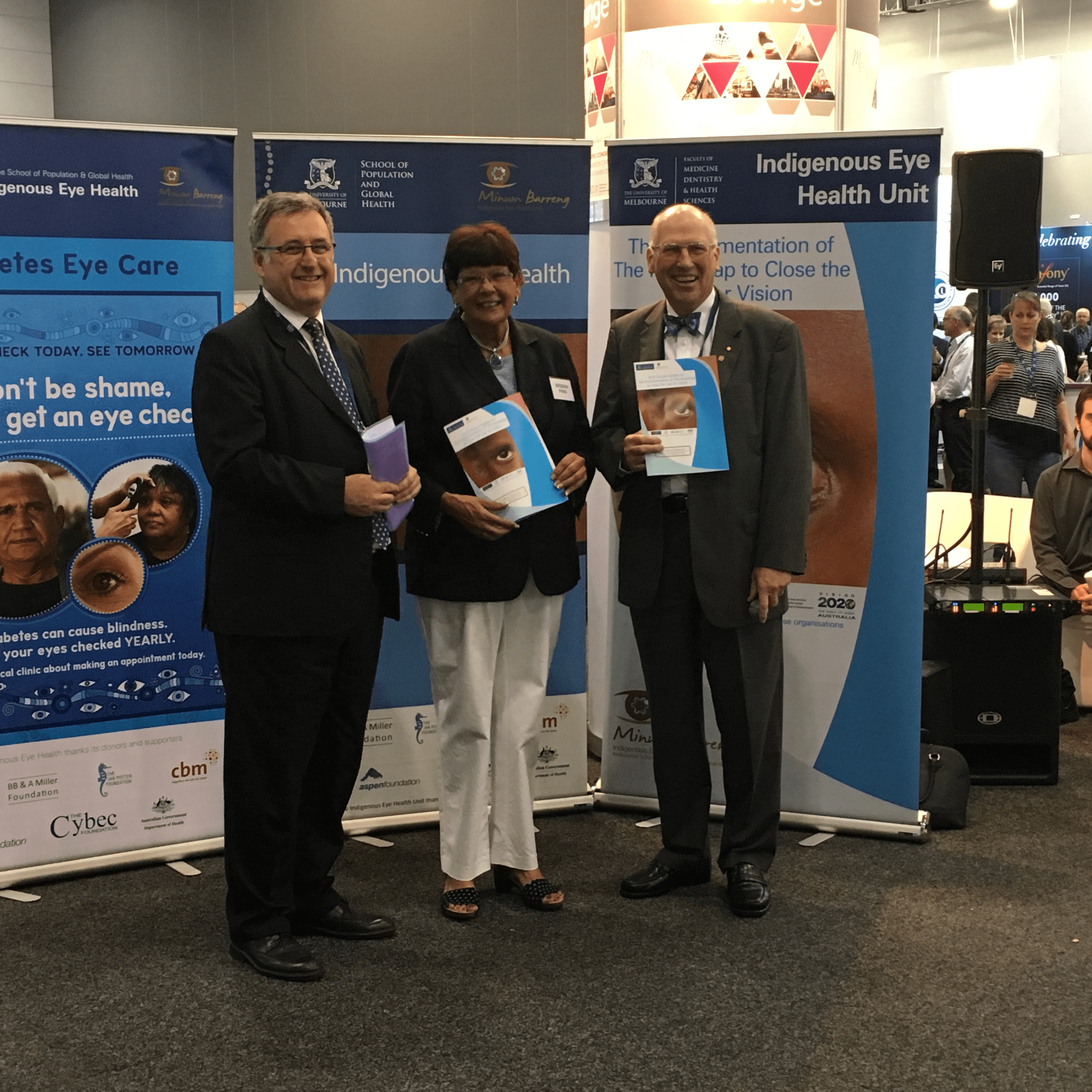
Pat Turner pictured above with Mark Daniell President, RANZCO,  and Prof Hugh Taylor at the launch.

vision-crowd

The gap in blindness in Indigenous communities has been halved since 2008 through collective implementation of the sector-supported Roadmap to Close the Gap for Vision, according to a report launched yesterday

Speaking at the Royal Australian and New Zealand College of Ophthalmologists (RANZCO) Annual Scientific Congress in Melbourne, Laureate Professor Hugh R Taylor AC, Harold Mitchell Chair of Indigenous Eye Health at the University of Melbourne said that progress is being made on every single recommendation in the Roadmap to Close the Gap for Vision, which was developed by Indigenous Eye Health at the University of Melbourne.

cover

Download copy of the Report 2016-annualupdate

Eleven of the 42 recommendations have now been fully implemented, with almost two thirds of all activities completed.

“In terms of regional implementation of the Roadmap, there has been positive engagement. We are working with 18 regions across the country covering almost half of the nation’s Indigenous population,” Professor Taylor said.

“We can report that at the beginning of this project, we found rates of blindness and impaired vision were up to six times higher than for non-Indigenous populations. This has now been halved,” he said.

“While the rate stands at three times more than the national average, this is still a very encouraging improvement. With on-going national support, we are determined to reach eye health parity with the rest of the Australian population.”

In his role as Chair of Indigenous Eye Health, Professor Taylor is also working with Indigenous leaders, partners and members of the community in a mission to eliminate trachoma in Australia.

“We are the only developed nation with endemic disease and only in Indigenous communities. Many Indigenous communities are now trachoma free and we can turn our attention to other main causes of blindness and poor vision in Indigenous communities: cataract, refractive error and diabetes,” Professor Taylor said.

Since 2008 rates of trachoma in children in outback communities has fallen from 21% to 4.6%. “We are really seeing some striking progress but we still need to focus on the hot spots.”

“The 2016 Roadmap update shows we are making great progress and are on track to close the gap for Indigenous vision completely in the next four years.”


caption


NACCHO Aboriginal Health Funding alert : $13.1m infrastructure grants for existing regional, rural and remote general practices.

rand-r

 ” Grants may be used for a range of infrastructure projects, including construction, fit-out and/or renovation of an existing general practice building, supply and installation of information and communication technology equipment or medical equipment.

Grants of up to $300,000 will be provided to successful applicants in 2017. All successful applicants will be required to match the Commonwealth funding contribution.”

Assistant Minister for Rural Health Dr David Gillespie

“Improved training facilities, such as communication technology, will also ensure that rural doctors can increase their own training opportunities, so they can continue to keep their skills current and maintain their practice at the high level that they strive for and that rural communities deserve.”

Dr Ewen McPhee, President of the Rural Doctors Association of Australia (RDAA) see full press release below

The Australian Government has committed $13.1 million in funding under the Rural General Practice Grants Program (the Program) for grants up to $300,000 each to deliver improved health services through additional infrastructure, increased levels of teaching and training for health practitioners, and more opportunities to deliver ‘healthy living’ education to local communities.

The Program will provide an opportunity for general practices within Modified Monash Classification 2-7 to deliver increased health services in rural and regional communities.

The Program commences with a call for Expressions of Interest (EOI), in which suitable organisations will be identified and subsequently invited to submit a full application.

Project Officer Details Name: Health State Network
Ph: 02 6289 5600 E-mail: Grant.ATM@health.gov.au
Closing date 2:00 pm AEDST on 13 December 2016

Submit your detail here

Teaching, training and retaining the next generation of health workers in rural, regional and remote Australia is a priority for the Coalition Government.

Assistant Minister for Rural Health Dr David Gillespie said the Coalition Government has moved to streamline the former Rural and Regional Teaching Infrastructure Grants program to better respond to the needs of rural communities and support the work of rural general practices.

“A more streamlined and simplified two-step application process is now open through the new Rural General Practice Grants (RGPG) program,” Dr Gillespie said.

“General practice in rural Australia faces unique challenges in healthcare including the ability to attract and retain a health workforce.

“The RGPG program will enable existing health facilities to provide teaching and training opportunities for a range of health professionals within the practice and for practitioners to develop experience in training and supervising healthcare workers.

“I believe that strong, accessible primary care in regional Australia helps alleviate pressure on the public hospital system and at the same time it also provides opportunities for earlier intervention and better patient outcomes.”

“Our Government wants Australians, no matter where they live, to have access to quality health services,” Dr Gillespie said.

“I also want our health professionals who live and work in rural, regional and remote Australia to have access to teaching and training opportunities so they remain in general practice and in the communities that need them the most.”

Grant documentation will be available from the Department of Health’s Tenders and Grants page at www.health.gov.au/tenders.

Rural doctors congratulate government on new grants program

Australian rural doctors are today welcoming the announcement of a streamlined Rural General Practice Grants (RGPG) program, just announced by Dr David Gillespie, Assistant Minister for Rural Health.

Dr Ewen McPhee, President of the Rural Doctors Association of Australia (RDAA), said that the announcement was a reflection of the importance the Coalition Government places on rural and remote health care.

“We are extremely pleased that Minister Gillespie has been so proactive in his Rural Health portfolio, and he has shown a great understanding of the need for increased training facilities to enable the education of the next generation of rural doctors,” Dr McPhee said.

“The RGPG will allow more of our highly skilled doctors in rural areas to improve their training capacity, allowing them to take on more young doctors in training and ensure they have access to quality educational opportunities in rural areas.

“Research shows us that young doctors who undertake training in rural areas, and have a good experience in their placement, are more likely to choose rural medicine as a career.

“Grants enabling doctors to improve and expand their training facilities will play a key role in the recruitment and retention of the rural doctor workforce of the future,” Dr McPhee said.

While infrastructure grants have been available for rural practices for some time, the application process was onerous, complicated and time consuming, putting it out of the reach of many small practices who did not have the time or expertise to successfully apply.

Grants can be used for a range of projects, including construction, fit-out and/or renovation of an existing general practice building, supply and installation of information and communication technology equipment or medical equipment.

“Simplifying and streamlining the process will ensure that these smaller clinics will no longer be disadvantaged by the system,” Dr McPhee said.

Many doctors enjoy the opportunity to engage with young doctors and be a part of their training journey. We look forward to more of our colleagues being able to participate in this way thanks to the Coalition’s commitment to rural health.

“Improved training facilities, such as communication technology, will also ensure that rural doctors can increase their own training opportunities, so they can continue to keep their skills current and maintain their practice at the high level that they strive for and that rural communities deserve.

“We thank Minister Gillespie for his recognition of the importance of this area.”

The third Rural Health Stakeholder Roundtable was held at Parliament House in Canberra on the 16 November 2016.

rural-health

Twenty years ago one of Australia’s greatest health challenges was a lack of doctors coming through the system.

Today, that challenge has been overcome with latest research predicting a surplus of 7000 doctors by 2030,” the Federal Minister for Rural Health, Dr David Gillespie, said today.

“The new challenge is no longer the number of doctors in our nation’s health workforce, but where they are distributed.

“This issue, along with the need for greater numbers of allied health professionals in the bush, are among the major topics to be discussed at the third Rural Health Stakeholder Roundtable at Parliament House in Canberra today,” Dr Gillespie said.

“The Roundtable was attended by an impressive representation of rural health stakeholders, from rural doctors associations, medical educators, rural health consumer and advocacy groups, Aboriginal medical services, rural and remote allied health organisations and health workforce professionals.

“We have an outstanding health workforce in the regional, rural and remote areas of this country and today’s roundtable is designed to get all the key players together with government to work out the very best strategies to support them and the work they do for our more isolated communities.”

Minister Gillespie said the Coalition Government is investing record funding in health as part of its commitment to strengthen the regional, rural and remote health system so that Australians living in these areas have access to the best care available.

“Our Government is working in partnership with these people to deliver health care to rural and remote communities through a broad range of initiatives as part of our record funding investment in the health portfolio.”

The Roundtable will discuss today the establishment of the National Rural Health Commissioner (the Commissioner), a new role to champion the cause of rural practice.

The Commissioner will work with rural, regional and remote communities, the health sector, universities, specialist training colleges and across all levels of Government to improve rural health policies.

Another priority item on the agenda is the development of the National Rural Generalist Pathway. This will improve access to training for doctors in rural, regional and remote Australia, and recognise the unique combination of skills required for the role of a rural generalist.

“General practitioners with advanced skills in areas such as general surgery, obstetrics, anaesthetics and mental health are commonly required in the bush also,” Dr Gillespie said.

“We want to make sure these skills are encouraged, developed and properly remunerated.”

Minister Gillespie said the Coalition Government had increased its investment in education and training initiatives both in medical and allied health professions to create a longer term ‘pipelines’ of boosting the rural health workforce.

“The new multidisciplinary training pipeline incorporating the Rural Clinical Schools and University Departments of Rural Health across regional Australia will be a critical component as we boost the capacity of training through our investment in Regional Training Hubs to bring more doctors and allied health professionals to the bush,” he said.

In response to recommendations put forward to the Rural Classification Technical Working Group, an independent group that has assisted the Government to implement the new geographical classification system, I announce today that more support will be provided to medical practitioners working in Cloncurry, Queensland and Roebourne, Western Australia.

“I am pleased to also announce an additional workforce support in the form of a rural loading will be applied to all doctors working in these two towns from 1 January 2017,”  Minister Gillespie said.

“The additional loading will be up to $25,000 per annum through the General Practice Rural Incentives Program and will recognise exceptional circumstances faced in attracting and retaining a workforce in these locations.

“The Coalition Government’s broader health reforms will have direct benefits for regional, rural and remote health, with the patient at the centre of care. Localised, integrated, community-driven health care is the order of the day,” Dr Gillespie said.

“The Rural Health Stakeholder Roundtable is a central part of informing policy reform in rural Australia and I am looking forward to fruitful discussions with participants today.”

rand-r

NACCHO Aboriginal Health Newspaper and NDIS : National Disability Insurance Scheme (NDIS) set to transform the lives of Aboriginal people living with a disability.

ndis

It’s great to be employed here because having a disability, I have a lot of knowledge to offer and I can be a strong advocate for locals because everyone knows me around here,” she said with a laugh.

This job means a lot to me. I really feel like I’m contributing. “

Stella Raymond, a proud Indigenous woman born and raised in Alice Springs, is the ‘face’ of the NDIS office in Tennant Creek.  See Case Study Below :

Articles are from Page 19  NACCHO Aboriginal Health Newspaper out Wednesday 16 November , 24 Page lift out Koori Mail : or download

naccho-newspaper-nov-2016 PDF file size 9 MB

The National Disability Insurance Scheme, commonly referred to as the NDIS, is set to transform the lives of Aboriginal and Torres Strait Islander people living with a disability.

The NDIS will provide all Australians under the age of 65 who have a permanent and significant disability with the reasonable and necessary supports they need to enjoy an ordinary life. NDIS participants include people with intellectual, physical, sensory and psychosocial disabilities.

It will help people with disability achieve their goals; whether it be greater independence, community involvement, employment and improved wellbeing.

Supports funded by the NDIS may include personal care and support, access to the community, therapy services and essential equipment.

The NDIS will progressively roll out across Australia over the next three years to ensure the Scheme is successful and sustainable. People will move to the NDIS at different times depending on where they live.

The NDIS is already transforming lives in the Barkly region in the Northern Territory, and from January 2017, will start to roll out in East Arnhem. Ultimately the Scheme will support more than 6,500 people across the Territory.

Once fully implemented , the NDIS is expected to support 460,000 people nationwide.

Staff from the National Disability Insurance Agency (NDIA) have worked with Aboriginal elders and community members to roll out the Scheme in Indigenous communities, which has been vital to building local understanding and ownership. Seventy five per cent of NDIA staff working in the Barkly region are Indigenous, including Stella Raymond.

National Disability Insurance Agency Chief Executive Officer David Bowen, said that the Scheme was much-welcomed by people with disability, their families and carers.

“The NDIS is exciting because, at long last, people with disability will have choice and control over the supports they need to live an ordinary life,” Mr Bowen said

“The Scheme is revolutionising the way we support people with disability in Australia – for the first time, all Australians with disability will have equity of access to support, no matter where they live.”

To become an NDIS participant, you must meet certain access criteria. For more information, contact the NDIS on 1800 800 110 or visit www.ndis.gov.au

Case study: Stella Raymond

Stella Raymond, a proud Indigenous woman born and raised in Alice Springs, is the ‘face’ of the NDIS office in Tennant Creek. Known for her smiling and welcoming demeanour, Stella was one of the first NDIS participants in the Northern Territory and later got a job with the NDIA.

“I’ve been an NDIS participant since the Scheme started here in the NT two years ago, and I’ve been working for the NDIS for 11 months now,” Stella said. “It’s been great. I’m a Business Support Officer. I do all the receptionist/admin work – I answer phones, check emails and I help my colleagues out when they need a hand.’

“The NDIS has helped me out with my new wheelchair. It will have automatic wheels and it’s going to make it a lot easier to get around,” Stella said.

“It’s great to be employed here because having a disability, I have a lot of knowledge to offer and I can be a strong advocate for locals because everyone knows me around here,” she said with a laugh.

“This job means a lot to me. I really feel like I’m contributing.

“At home, and right through school, I’ve been treated just like everyone else,” Stella said. “I’ve had a really great life and I have no regrets but it’s nice to have a great job at the NDIS and to know, as a participant, I’m covered by the Scheme for li

Learn more about these NACCHO programs  at the  NACCHO Members Conference in Melbourne

no

1. NACCHO Interim 3 day Program has been released -Download
2. The dates are fast approaching – so register today

ndis


NACCHO Aboriginal Health ” What Works Part 9 ” ; Hon Linda Burney’s Menzies Research Oration ” Community led programs “


Shadow Minister for Human Services Linda Burney makes her maiden speech in the House of Representatives at Parliament House in Canberra, Wednesday, Aug. 31, 2016. (AAP Image/Mick Tsikas) NO ARCHIVING

” Paternalism is symptomatic of a view of Aboriginal Australia which sees Indigenous people purely as the problem.

It speaks to that old lie – that Aboriginal people have inflicted this deprivation on themselves, and that governments must save them from themselves.

Despite my pessimism about the current direction of government approaches to the Aboriginal community I do see some cause for optimism.

The communities which are doing best are those which have found ways to support their own initiatives despite failing Government approaches.

I take heart from organisations like Tharawal in Sydney’s South-Western Suburbs – an Indigenous health services ( and NACCHO Member  ) which does not just focus on treating illness when it occurs.

They target what Sir Michael Marmot calls “the social determinants of health” and what the Menzies School of Health Research has worked so hard to identify. Stable housing, early education and social support.

And they are seeing excellent results. You know it is about providing this information to the organisations that already work in communities – it is not a lack of ideas, we know the programs that work and they are community led. ”

Hon Linda Burney MP : ” Truth telling and generosity – Healing the Heart of the nation  : Oration Menzies School of Health Research Darwin 18 Nov 2016

Photo above : the first elected Aboriginal woman in the House of Representatives Shadow Minister for Human Services Linda Burney makes her maiden speech at Parliament House in Canberra, Wednesday, Aug. 31, 2016. (AAP Image/Mick Tsikas)

I open by acknowledging the Larrakia people on whose land we meet today.

I pay my respects to their elders past and present. I also take this opportunity to acknowledge their long struggle for equality, for land rights and for self determination.

I pay tribute to the Larrakia peoples’ determination in the face of denial and I mourn with them the loss of so many elders before their 23 year struggle for land rights could be resolved.

In acknowledging country I do not just pay tribute and respect –

I am acknowledging the fundamental truth that this land has played host to thousands of years of lived human experience.

Cultures evolving and changing since the first sunrise.

I want to thank the school for hosting me today. The world class socio-medical research published by the Menzies School of Health Research will lead to very real improvement in the standard of living for many Aboriginal people.

I also acknowledge today the special guests in the audience;

 Commissioner Mick Gooda, of the Royal Commission in into Juvenile Detention

 Tony McAvoy SC, the first Aboriginal Senior Council

And of course my colleagues;

 Senator Malarndirri McCarthy

 Luke Gosling MP

 Various Northern Territory administrator and MPs.

It is an honour to be invited to deliver the Menzies’ School of Health Research Oration for 2016.

If I can I’d like to offer my thoughts on 4 things –

  1. Truth telling and forgiveness, as I did for the Lingiari Oration in 2007 I want to remind you all of the importance of narrative and the need for truth as the bedrock of our reconciliation process;
  2. Recognition of First Peoples in our constitution – our next great project in truth telling and the one to which we must turn our attention to now;
  3. The perilous state of our Governments’ Indigenous Affairs policy today. and;
  4. The way, as I see it, forward from here.

But I want to start by appealing to your optimism – the facts of our condition can be dispiriting but I am reminded of the lessons taught to me by the late Faith Bandler.

I had the extraordinary honour of being invited by Faith’s daughter, Lilon, to speak at her memorial service in the Great Hall at Sydney University.

Faith more than anyone understood that we are playing the long game – it require understanding and devotion but most of all it requires patience.

The memory of Faith is an appropriate one – it was the work of Faith, along with so many others like Jessie Street and Alan Duncan that convinced the Menzies and Holt Government to hold the 1967 Referendum.

That 10 year campaign saw the revitalisation of the fight for Aboriginal and Torres Strait Islander rights and began the journey of truth telling.

In my first speech to the Australian Parliament I told the story of an older non- Aboriginal woman making her way to the voting booth late on Election Day.

It was cold and dark and her daughter urged her just to give up and go home as she slowly made her way across the park to the local public school– but she insisted.

She said that her opportunity to vote for an Aboriginal woman “was history”. She saw that she had a stake in that election that transcended “bread and butter political issues”, she didn’t need to be an Aboriginal person to understand that.

She knew that the election of an Aboriginal woman was not just a victory for Aboriginal people; it was a part of our shared national history.

Not so long ago that would not have been the case – we had two distinct historical narratives.

A white one and a black one.

“White” Australia (as it was then) had no interest in Indigenous history, and “Black” Australia had no stake in engaging with a “White” future.

That old woman proved to me that we are changing this.

For the 1988 bicentenary campaign our signature poster was “white Australia has a black history.” –

That campaign, led by Kevin Cooke and Reverend Harris (with a young Linda Burney too) sums up the feeling.

I can think of few venues in which it is be more appropriate to discuss the reconciliation movement –

A school of health research; which, along with education, is one of the greatest areas of need for Aboriginal people and,

One named for our 12th Prime Minister; who governed in an era which saw the revitalisation and renewed push for equality and self-determination for our people.

His reign marked a turning point – the beginning of the end for the Australia which was nestled firmly in the bosom of the British Empire.

It was a time of national coming of age.

I am no political fan of Menzies but I think it is true to say that without him there could have been no Whitlam or Keating or Hawke.

Their fiercely independent and inclusive model of Australian identity was born of a rebellion against the era of Menzies.

So in this sense we owe him a debt of sorts.

When I was only 4 years old in 1961, Sir Robert Menzies hosted a delegation of Aboriginal people from mainland states.

They had already been fighting for years to see a referendum held which would grant Aboriginal people equal rights.

There was considerable excitement amongst the attendees, a meeting with Prime Minister was in itself a victory for a community almost completely excluded from the political process at that point.

Menzies served his guests alcoholic drinks.

Our Prime Minister was shocked when informed by one of the attendees that that act was illegal under state law.

Such was the denial of truth and the refusal to see discrimination in our country at that time – the sitting prime minister was, himself, unaware of this discrimination.

It was paternalism in its worst form.

Menzies resigned when I was 9 years old – he had been a constant on the radio and on TV for those who had them, for much longer than that.

This explains to some extent the reverence with which so many look back on this time. To them it was stable and prosperous.

But even looking back through the rose tinted glasses of nostalgia – we cannot help but catch glimpses of the rampant discrimination of that era in the corners of our eyes.

Forced removal; captured so hauntingly in Archie Roaches’ “Took the Children Away, Government or church run reserves dictating the terms on which Aboriginal people could live, and; Government decrees which saw indigenous languages banned or even outlawed.

This was an era in which the Indigenous people of this continent were still considered biologically inferior, in which the White Australia policy still enjoyed bipartisan support.

It was a time in which the voices of women, non-white Australians and marginalised groups were systematically silenced.

So, while I pay my respects to Robert Menzies I cannot deny this truth. Nostalgia and reverence aside, this was an age of acute racism and a total denial of history.

We still considered ourselves an outpost of the British Empire, the millennia of Aboriginal history on this continent not only ignored, it was actively being hidden and destroyed.

I don’t know what Sir Robert Menzies would think of me delivering an oration named for him;

A woman;

An Aboriginal person, and;

A Labor member of Parliament.

Things have certainly changed.

If he didn’t accuse me of being a communist first, he might ask whether we had any political views in common and he might be surprised to hear where things stand today.

The fact is, regardless of political stripe, Menzies and I share some core political beliefs.

Sir Robert Menzies believed that government intervention could be a tool for good; he believed that the role of government was to empower the “forgotten” Australians and; He did saw economic growth as a means to an end not an end unto itself.

In his 1961 election address he noted that “a growing nation must be a healthy one”, and while it would be up to Whitlam to introduce a nationwide health scheme,

Menzies invested significantly in the area.

He was amongst the first leaders in Australia to recognise that the health of the community was a valuable measure of its prosperity.

And while his view of the 1967 Referendum was in some ways conflicted (Menzies himself having campaigned against some proposals) he also oversaw the passage of the 1963 Commonwealth Electoral Act which granted universal suffrage to Aboriginal people regardless of the state in which they were born.

Like the story of all governments when it comes to First Peoples’, Menzies legacy is mixed.

Menzies to some extent defined his generation but he was still a captive of the more exclusionary views of his day.

Truth Telling and Reconciliation

When it comes to the reconciliation process to date, truth telling is important.

Truth telling has been a theme of my public life to date.

In my view the path to reconciliation must be grounded in a fundamental commitment to truthfulness – it is one of the cornerstones of reconciliation.

As Dr Alex Boraine, deputy chair of South Africa’s Truth and Reconciliation Commission, noted at the Melbourne Reconciliation convention in 1997;

“Reconciliation… must be grounded in reality. There are 3 anchors which can keep us on the ground…. The first of these anchors is the experience of truth… of telling, of coming to terms with the truth of our past and the truth understood in this way transcends lies… it rejects denial to come clean in order to build, to heal.”

I told you earlier how surprised Menzies was to hear that the law prohibited serving his Aboriginal guests alcohol.

If not deliberately, then subconsciously, he had chosen not to see this discrimination.

As has much of the Australian community for the majority of our post-colonial history.

We cannot afford to do that.

In the last 30 years we have started to lay the anchor of truth –

We have a curriculum which teaches the truth of our history, we have a political system which now includes a record number of First Peoples and we have almost reached a national consensus about the imperative for action on closing the gap.

This kind of truth telling is not purely symbolic.

Children in our schools now understand that the history of Australia, or at least the

Australian continent, extends far beyond 228 years of colonisation.

And that is important. We won’t really be able to treat the malaise which afflicts

Aboriginal communities until the broader community understands the impact of generational disadvantage and cyclical poverty.

When Kevin Rudd delivered the apology to the stolen generation in the federal parliament he undertook a momentous act of truth-telling.

When that speech concluded two older Aboriginal women handed the Prime Minister and the Opposition leader a coolomon – it was an astounding act of generosity.

For that generosity we owe considerable gratitude, but it also demonstrates in part why the apology was so important.

That act of truth telling opened the door to forgiveness – and without it we cannot see old enmities consigned to the past.

After The Apology, as I walked into the marble foyer of the parliament I ran into Aunty May Robinson, an elder from South Western Sydney.

She held in her hands a black and white photo – and her only words to me when we saw each other were;

“Linda! I bought mum.”

We fell into each other’s arms crying.

Recognition

It is my hope that the Recognition of First Peoples in our constitution will be another of these great moments of truth telling, and that it will pave the way for a greater depth of understanding.

As it stands we have a Constitution which tells the story of western democracy; the Westminster system of government and a thousand years of its development.

But it says nothing of the more than 40,000 years of lived experience on this continent that preceded European arrival.

Our Constitution, the document on which the Parliament I sit in is founded, does not tell the truth. It is a fundamental failing and one that we cannot continue to ignore.

This is a part of the reconciliation process that Dr Boraine talked about almost 20 years ago and it is a fundamental part of our nation building project.

The symbolism of recognition belies powerful consequences.

I saw the feeling of relief on the faces of those old women in the Parliament after the apology and felt the relief of the broader Australian community at finally having acknowledged the truth.

More than anything else Recognition will add another thread to the tapestry of our national identity – a history and a story that we can all share.

I do not concede to any argument that suggests this act will be divisive. The true act of division would be a continued denial of the truth of settlement and invasion.

Recognition and Paternalism

I am also hopeful that Recognition will pave the way to a more consistent and effective approach to Government policy in the area.

For all the talk of “Prime Ministers for Indigenous Affairs” and a bipartisan commitment to closing the gap, we are yet to see the progress we need.

Life expectancy for First Australians is almost 10 years shorter than the rest of the community – the number blows out considerably further for those in rural or remote communities.

Our young people are locked up at ever increasing rates – almost 48% of those in the juvenile justice system are Aboriginal.

Our birthweights are consistently lower, as are our educational outcomes and our average earnings.

We are making slow progress – but it is not enough.

For every year that passes without dramatic improvement in our condition we draw closer to a point at which we will have failed yet another generation.

In the last week of Parliament I attended the launch of a report on the National Aboriginal Suicide Prevention Strategy.

How can it be that for Aboriginal people attending the funerals of young people is so commonplace?

One of the women who attended, Norma Ashwin, a mother who has lost her child, summed up the feeling of her community –

“We have nothing. Our kids have no hope, nothing, just a sense of no belonging… [we have] Lost everything…”

It is easy to see how in the face of this despair, Governments can turn to lazy policy options and to the comfort of the past.

Perhaps in frustration at slow progress Conservatives have done what they usually insist they will not – let the government pick and choose winning initiatives while ignoring community voices.

Conservative forces have continued to drive us back towards the paternalism of the past – from the “10 point plan” on native title and the destruction of ATSIC in the late 1990s — through to the very recent cuts to legal services, defunding of advocacy organisations and of course the denial of support for the National Congress of Australia’s First Peoples.

Half a billion dollars has been pulled out of the Indigenous affairs budget.

The trend is clear.

A concerted effort to silence the voices of Aboriginal leaders and a refusal to accept what we already know to be true —- solutions to our problems need to be found with communities, not imposed upon them.

Don Dale provides a perfect example – the Koori media had reported this story months before any mainstream news agency did and members of the local community will tell you – they had raised these issues before.

Indeed we know now that the both the Federal and State Governments’ were well aware of the issue.

But the story received scant political attention. Key advocacy organisation which could have raised the issues more loudly, either didn’t have the resources or didn’t exist anymore.

Paternalism isn’t just a failed policy approach because it pacifies communities and because it deprives individuals of their rights to self-determination –

It necessarily makes communication one way, from top to bottom.

Inflicting policy decisions on Aboriginal communities and then arriving later for a photo op and twitter post is not a substitute for consultation.

In the 1886 Corranderk petition to the Victorian government William Barak wrote on behalf of his people;

“Could we get our freedom back…to come home when we wish and also to go for our good health when we need it…”

It troubles me that today that I am increasingly asked by our community those same questions today – “can WE offer a solution?”… “can WE provide the services?” … “can WE our own choices?”

Command and control policy from Canberra will not help – at best it might make politicians and public servants in Canberra feel better at not having to hear cries for help

Paternalism is symptomatic of a view of Aboriginal Australia which sees Indigenous people purely as the problem.

It speaks to that old lie – that Aboriginal people have inflicted this deprivation on themselves, and that governments must save them from themselves.

Optimism and a Way Forward

Despite my pessimism about the current direction of government approaches to the Aboriginal community I do see some cause for optimism.

The communities which are doing best are those which have found ways to support their own initiatives despite failing Government approaches.

I take heart from organisations like Tharawal in Sydney’s South-Western Suburbs – an Indigenous health services which does not just focus on treating illness when it occurs.

They target what Sir Michael Marmot calls “the social determinants of health” and what the Menzies School of Health Research has worked so hard to identify. Stable housing, early education and social support.

And they are seeing excellent results.

I also see innovative new approaches, like the University of Melbourne’s first thousand days campaign – recognising that supporting Aboriginal and Torres Strait Islander families in that vital period bears real long term fruit.

Increasing birthweight, providing drug and alcohol support for expectant and new mothers – along with a whole range of other early interventions.

I am optimistic because we know that many of the solutions we need already exist – they are not prohibitively expensive or impossible to institute.

Here at the Menzies School of Health Research for example, you’ve done the research.

You know it is about providing this information to the organisations that already work in communities – it is not a lack of ideas, we know the programs that work and they are community led.

They just require political bravery – and with a record number of First Australians inside our parliament and an increasingly active and determined community outside it, I am confident we can find that will.

I am confident that you can find it on my side of the chamber – I have never had more faith in my party’s commitment to Indigenous Affairs.

I am optimistic because for the first time since colonisation we have a parliament that is beginning to represent the community and we will soon have a constitution that tells the truth.

I talked earlier about Faith Bandler and her long game.

She saw better than most that the campaign for the 1967 referendum was much longer than 10 years – it was a starting point for the project we are still running today.

Martin Luther King Jr said that “The arc of the moral universe [was] long but [that it] bends towards justice”

I think Faith agreed, I know I do.

But Faith more than most saw that it was up to us to shape that arc – and I am confident that we can.

We will have set backs, and we’ve taken some steps backwards but those aberrations do not define the trend.

This is a process of national healing, it is a long journey and it does take time.

To do it we need to tell the truth; and we are starting to do that.

We need generosity; and believe that the First Peoples have that in spades.

And most of all we need to accept that Aboriginal and Torres Strait Islander people are a part of the solution not just the problem.

Most of all I take my optimism from the determination of Aboriginal and non- Aboriginal communities across Australia.

In her first speech to the Federal Parliament not so long ago your Senator for the Northern Territory Malarndirri McCarthy said in reference to her people’s struggle for land rights;

“[We are] battle fatigued, perhaps we are better to acquiesce? But we are here still, and we are not going away.”

I think the sentiment applies far more broadly – now more than ever I believe in our communities’ commitment to addressing these issues.

We are not going anywhere.

NACCHO Aboriginal Health ” What Works ” Part 8 : Aboriginal-run services can work but need to prove their worth, Indigenous leaders say

did

“We think it’s also been really important to try to dispel the public perception that somehow spending more money in Aboriginal health isn’t a worthwhile or a viable thing to do.

For every $1 invested we’re delivering a $4.18 return,

“We wanted to be able to show that the Aboriginal community-controlled health sector actually delivers good services and good outcomes, and they are cost-effective.”

Danila Dilba Health Service Darwin  CEO Olga Havnen said she had spent years pushing for evidence-based programs and governments needed to focus on Indigenous-run organisations that proved they could deliver

Photo caption  above from Page 3 NACCHO Aboriginal Health Newspaper out Wednesday 16 November , 24 Page lift out Koori Mail : or download

naccho-newspaper-nov-2016 PDF file size 9 MB

A lack of evaluation of Indigenous-run programs aimed at overcoming disadvantage is placing serious limits on positive outcomes, Aboriginal leaders have warned

Report from the ABC

The comments come after a report by the Productivity Commission found Indigenous Australians are becoming more disadvantaged, citing alarming increases in imprisonment rates, mental health problems and rates of self-harm.

The report also said of the $30 billion budget allocated to overcoming these disadvantages, just 34 of the 1,000 federally funded programs had been properly evaluated.

Northern Territory Aboriginal health service Danila Dilba has engaged a private economics consultancy firm to carry out a cost/benefit analysis of its key primary health care services, CEO Olga Havnen said.

“For every $1 invested we’re delivering a $4.18 return,” she said.

But the report also showed Danila Dilba’s outcomes were not the norm.

Indigenous leaders said the lack of economic evaluation left billions of dollars being spent in areas that may not have been proven effective.

“As a taxpayer you should be concerned that programs for which there is no evidence are being funded,” anthropologist Marcia Langton told the National Press Club.

The head of the Prime Minister’s Indigenous Advisory Council, Warren Mundine, said measurable data offered guidance for funding targets.

“It should be clear that you don’t get funding forever just for the sake of funding, you actually have to get clear outcomes, and outcomes that are successful,” he said.

There should be a real evaluation program in place if the federal government is “handing out taxpayers’ money”.

“We’ve got to totally revamp the way the evaluations are done and make them real so we get measurable data — and we can do that tomorrow morning,” Mr Mundine said.

Better evidence needed on program outcomes: Scullion

A spokesperson for Federal Indigenous Affairs Minister Nigel Scullion admitted there was a need for more evidence to demonstrate which programs were working.

“Minister Scullion acknowledged that in the areas of incarceration, domestic violence, mental health and substance misuse, increased effort was required to improve outcomes — and better evidence was needed to drive this progress,” the spokesman said in a statement.

Public sector governance expert Steven Bartos said allocating funds without evidence created a false economy.

“When you don’t know anything about any of the programs then you’re just relying on gut feelings, and that’s not good enough,” he said.

“The measurement of outcomes, the framework for doing that, has to come from Indigenous communities themselves.”

Danila Dilba Health Service Darwin 25 years strong

page-5-top

Photo caption  above from Page 3 NACCHO Aboriginal Health Newspaper out Wednesday 16 November , 24 Page lift out Koori Mail : or download

naccho-newspaper-nov-2016 PDF file size 9 MB

The 8th of November, 1991 was a day of great pride for Darwin’s Aboriginal community with the official opening of Danila Dilba Health Service.

Its beginnings as an Aboriginal community controlled health organisation go back to the 1970s — a time of great activism for Indigenous people across Australia.

After Cyclone Tracy hit in 1974, Darwin people were evacuated to southern cities where local Aboriginal medical services had started. People from the local Aboriginal community were impressed with the services and wanted their own one.

Danila Dilba grew out of the community, with people holding meetings, lobbying government, lodging petitions and even holding a ‘sit-in’ at government offices for a culturally appropriate primary health service for Indigenous people.

The name Danila Dilba Biluru Butji Binnilutlum was given to the service by the local Larrakia traditional custodians.

In the Larrakia language Danila Dilba means ‘dilly bag used to collect bush medicines’ and Biluru Butji Binnilutlum means ‘Aboriginal people getting better from sickness’.

Our logo reflects this meaning and was designed by Larrakia elder, the Reverend Wally Fejo.

The service was friendly, comfortable and provided holistic care. Danila Dilba was a safe place for Indigenous people to raise their concerns and find solutions to their health concerns.

Danila Dilba has grown significantly in size and capacity, from eight staff and one building in 1991 to five clinics, including separate men’s and women’s clinics, mobile and dental clinics, community programs and a staff of over 130 serving almost 12,000 clients in 2016.

Our Aboriginal Health Practitioner First policy, where new clients see an AHP before a GP, and our large Indigenous staff are the core of our culturally appropriate care.


NACCHO Overcoming Indigenous Disadvantage #Smoking and Healthy Lives report : Cigarettes favoured over fruit in Outback stores


smokes 
” Between 2001 and 2014-15, the crude daily smoking rate for Aboriginal and Torres Strait Islander adults declined from 50.7 to 41.4 per cent (table 8A.4.1).

  A similar decline in non-Indigenous smoking rates meant that the gap in (age-adjusted) daily smoking rates remained relatively constant at around 26 percentage points between 2001 and 2014-15 (table 8A.4.7).

There is no published robust evaluation of an intervention resulting in a decrease in the prevalence of tobacco smoking for Aboriginal and Torres Strait Islander people (Minichiello et al 2016). “

The Overcoming Indigenous Disadvantage report measures the wellbeing of Aboriginal and Torres Strait Islander Australians. Download Chapter 8 or see below

naccho-download-nov-2016-chapter8-healthy-lives

Read 90 NACCHO articles about Tackling Indigenous Smokes

Or Articles page 8 NACCHO Aboriginal Health Newspaper out Wednesday 16 November , 24 Page lift out Koori Mail : or download

naccho-newspaper-nov-2016 PDF file size 9 MB

” Tobacco turnover had remained “consistently high” with 8.34 million sticks sold over the year and tobacco accounting for 19 per cent of all food and grocery sales.

Customers spent 4.4 times more on cigarettes than fruit and vegetables in 2015/16.”

Chairman Stephen Bradley revealed in the annual report of Outback Stores Pty Ltd, the government-owned company which manages 37 businesses in some of the remotest parts of Australia.

Lung cancer is the highest-ranked cancer type among Indigenous people, but the fourth-ranked for non-indigenous Australians.

An incentive program to improve community health has resulted in a 0.5 per cent drop in soft drink sales and a five per cent increase in fruit and vegetable sales.

 Location of Outback stores across Australia.

Location of Outback stores across Australia.

But the company admitted more needed to be done.

“We remain convinced that a significant dietary change will take many years and our support programs need to operate for the longer term to be effective,” Mr Bradley wrote.

The government is aiming to close the gap between Indigenous and non-indigenous life expectancy within a generation, halving the gap in mortality rates for under-fives within a decade and halving the gap in employment outcomes.

The company reported 297 Indigenous staff were employed in Outback Stores businesses, which turned over $82.5 million in 2015/16.

Overcoming Indigenous Disadvantage: Key Indicators 2016

<!–

–>The Overcoming Indigenous Disadvantage report measures the wellbeing of Aboriginal and Torres Strait Islander Australians. Chapter 8.4

Tobacco consumption and harm[1]

Things that work

There is no published robust evaluation of an intervention resulting in a decrease in the prevalence of tobacco smoking for Aboriginal and Torres Strait Islander people (Minichiello et al 2016).

A systematic review of 73 interventions in indigenous communities globally found that there was no single intervention that was more likely to result in a reduction in tobacco use, but rather that more successful programs:

  • use a comprehensive approach inclusive of multiple activities
  • centre Aboriginal leadership
  • make long-term community investments
  • provide culturally appropriate health materials and activities to produce desired changes (Minichiello et al. 2016).

Research from the national Talking About The Smokes project also highlighted the importance of taking a comprehensive approach to tobacco control, reporting that a broad range of factors were associated (positively and negatively) with the desire by Aboriginal and Torres Strait Islander smokers to quit (Nicholson et. al 2015).

Box 8.4.1      Key messages
·      Between 2001 and 2014-15, the crude daily smoking rate for Aboriginal and Torres Strait Islander adults declined from 50.7 to 41.4 per cent (table 8A.4.1).

·      A similar decline in non-Indigenous smoking rates meant that the gap in (age-adjusted) daily smoking rates remained relatively constant at around 26 percentage points between 2001 and 2014-15 (table 8A.4.7).


Box 8.4.2      Measures of tobacco consumption and harm
There is one main measure for this indicator (aligned with the associated NIRA indicator), rates of current daily smokers, measured by the proportion of people aged 18 years and over who are current daily smokers (all jurisdictions; remoteness; age; sex).

Smoking rate data are available from the ABS Australian Aboriginal and Torres Strait Islander Health Survey (AATSIHS)/National Aboriginal and Torres Strait Islander Social Survey (NATSISS), with the most recent data available from the 2014‑15 NATSISS. Data for the non‑Indigenous population are sourced from the ABS Australian Health Survey (AHS)/National Health Survey (NHS), with the most recent data available from the 2014-15 NHS.

Previous editions of this report included a supplementary measure on tobacco-related hospitalisations. This is no longer included as the measure only related to conditions directly attributable to tobacco — not most conditions, where tobacco may be a contributing factor but the link is not immediate. Data are also difficult to interpret as they represent less than one per cent of all Aboriginal and Torres Strait Islander hospitalisations and are therefore highly volatile over time.

Tobacco consumption is a subsidiary performance measure for COAG’s target of ‘closing the life expectancy gap (between Indigenous and non-Indigenous Australians) within a generation’ (COAG 2012).

In Australia, up to two-thirds of deaths in current smokers can be attributed to smoking (AHMAC 2015). Among Aboriginal and Torres Strait Islander Australians, tobacco use is the leading risk factor contributing to disease and death (Vos et al. 2007). Studies have found that smoking tobacco increases the risk of developing numerous cancers, heart and vascular diseases, and depression (AHMAC 2012; Cunningham et al. 2008; Pasco et al. 2008). Smoking in pregnancy can lead to miscarriage, stillbirth or premature birth (Graham et al. 2007). Section 6.2 includes information on women reporting smoking during pregnancy.

Compared to non-Indigenous people, Aboriginal and Torres Strait Islander Australians who smoke generally commence at an earlier age and smoke for longer (CEITC 2010, 2014). Recent research (Knott et al. 2016) suggests also there may be fundamental differences in the determinants of smoking and the reasons for quitting, between Aboriginal and Torres Strait Islander men and women.

Research has found that the proportion of Aboriginal and Torres Strait Islander adults who want to quit smoking and those who have made a quit attempt in the past year, are similar to the general population. However fewer Aboriginal and Torres Strait Islander adults have made a sustained quit attempt for at least a month and a lower proportion agree that social norms disapprove of smoking, compared to the general population (Thomas et. al 2015).

Tobacco use is often associated with other lifestyle related health risk factors, such as excessive alcohol consumption and poor diet. Long term risky/high risk drinkers (both males and females) were more likely to be current smokers than those who drank at a low risk level (ABS 2006). Section 11.1 examines alcohol consumption and harm.

In Australia and many other countries smoking behaviour is inversely related to socioeconomic status, with those in disadvantaged groups in the population more likely to start and continue smoking. In addition to long-term health risks, low income groups (such as some Aboriginal and Torres Strait Islander families and communities) are affected by the financial strain associated with tobacco use (Greenhalgh 2015). A recent study in NSW found that more disadvantaged areas were significantly more likely to have higher tobacco outlet densities, with this density significantly and positively associated with smoking status (Marashi-Pour 2015).

Tobacco consumption

Current daily smokers are people who smoked one or more cigarettes (or pipes or cigars) per day at the time of survey interview.

The COAG performance measure and the data presented in this section focus on the proportion of people aged 18 years and over who are current daily smokers. However, as noted, Aboriginal and Torres Strait Islander Australians tend to start smoking at an earlier age than non‑Indigenous people — for 2014-15, in non-remote areas around one in six (16.2 per cent) Aboriginal and Torres Strait Islander 15 to 17 year olds were current daily smokers, compared with one in thirty (3.3 per cent) non‑Indigenous 15 to 17 year olds (table 8A.4.12).

Nationally in 2014-15, the crude daily smoking rate among Aboriginal and Torres Strait Islander adults was 41.4 per cent, a decline from 50.7 per cent in 2001 (table 8A.4.1). Rates varied across states and territories in 2014-15, from 38.8 per cent in SA to 46.2 per cent in the NT (table 8A.4.1). Smoking rates were higher in remote and very remote areas (49.3 per cent and 48.9 per cent) than in major cities (36.3 per cent) (table 8A.4.2). In non-remote areas in 2014-15, smoking was most prevalent among those aged 25–54 years (between 45.4 and 46.5 per cent), with smoking rates much lower for older people (31.3 per cent for those aged 55 years and over). A similar pattern was observed for non‑Indigenous Australians, although the daily smoking rates were consistently lower across all age groups (table 8A.4.12).

After adjusting for different population age structures, in 2014-15 the current daily smoking rate for Aboriginal and Torres Strait Islander Australians was 2.8 times the rate for non-Indigenous Australians (table 8A.4.7). The gap in smoking rates was widest in remote areas (table 8A.4.8).


Figure 8.4.1   Current daily smokers aged 18 years and over, 2001 to 2014-15a, b
a Error bars represent 95 per cent confidence intervals around each estimate. b Rates are age standardised.
Sources: ABS (unpublished) National Health Survey 2001; ABS (unpublished) National Health Survey and National Aboriginal Torres Strait Islander Health Survey 2004-05; ABS (unpublished) National Aboriginal Torres Strait Islander Social Survey 2008; ABS (unpublished) National Health Survey 2007-08; ABS (unpublished) Australian Aboriginal Torres Strait Islander Health Survey 2012-13 (core component); ABS (unpublished) Australian Health Survey 2011–13 (2011-12 core component); ABS (unpublished) National Aboriginal and Torres Strait Islander Social Survey, 2014-15; ABS (unpublished) National Health Survey, 2014-15; table 8A.4.7.

Between 2001 and 2014-15, after adjusting for differences in population age structures, the daily smoking rate declined for both Aboriginal and Torres Strait Islander adults and non‑Indigenous adults, leaving the gap relatively unchanged at around 26 percentage points (figure 8.4.1).

Data for smoking rates reported by State and Territory are available by remoteness in tables 8A.4.2–6 and 8A.4.8−10 and by sex in tables 8A.4.11-12.

Research from the national Talking About The Smokes project also highlighted the importance of taking a comprehensive approach to tobacco control, reporting that a broad range of factors were associated (positively and negatively) with the desire by Aboriginal and Torres Strait Islander smokers to quit (Nicholson et. al 2015).

[1]    The Steering Committee notes its appreciation to the National Health Leadership Forum, which reviewed a draft of this section of the report.

NACCHO Programs ” What Works ” Aboriginal Health : #FASD , Ear and Hearing , #Safeeyes and #Qumax

fasd

 ” The package of FASD Prevention and Health Promotion resources also include data system resources to facilitate routine screening and monitoring for alcohol and tobacco use in pregnancy, and screening of non-pregnant women of childbearing age, at risk of having a prenatal alcohol exposed pregnancy.”

NACCHO Report 1 below

 “The Safe Eyes trial program relies on the effective facilitation of engagement, ownership and leadership within each community to address hygiene and environmental health factors that lead to the spread of trachoma and other communicable disease.

The Safe Eyes program has been developed and implemented by each community with the success of each program evaluated and owned by those communities.”

NACCHO Report 2 Below

 ” The Ear and Hearing Health Skill Set Training was conducted over a two-week period and provided a pathway for Aboriginal and Torres Strait Islander health workers to specialise in the provision of ear and hearing health.

NACCHO coordinated 100 Aboriginal Health Worker Ear and Hearing Training which were delivered in Brisbane, Darwin, Melbourne, Cairns, Perth, Dubbo, Sydney, Kalgoorlie, Albany and Adelaide.”

NACCHO Report 3 Below

 ” The QUMAX Program aims to improve health outcomes of Aboriginal and Torres Strait Islander people who attend participating Aboriginal Community Controlled Health Organisations (ACCHOs) in major cities, inner and outer regional areas.

QUMAX achieves this through the allocation of funding to participating ACCHOs to reduce barriers experienced by their clients to Quality Use of Medicines.”

NACCHO Report 4 below

Articles are from Page 5,18,19,20 NACCHO Aboriginal Health Newspaper out Wednesday 16 November , 24 Page lift out Koori Mail : or download

naccho-newspaper-nov-2016 PDF file size 9 MB

page-1-copy

NACCHO Report 1 of 4 :Prevent and reduce the impacts of Fetal Alcohol Spectrum Disorders (FASD) 

NACCHO partnered with the Menzies School of Health Research and the Telethon Kids Institute (TKI) to develop and implement health promotion resources and interventions to prevent and reduce the impacts of Fetal Alcohol Spectrum Disorders (FASD) on Aboriginal and Torres Strait Islander families and young children.

FASD is an umbrella term used to describe the range of effects that can occur in individuals whose mother consumed alcohol during pregnancy. These effects may include physical, mental, behavioral, developmental, and or learning disabilities with possible lifelong implications.

Fetal Alcohol Spectrum Disorder Prevention and Health Promotion Resources (FPHPR) were developed for the 85 New Directions: Mothers and Babies Services (NDMBS) across Australia. These resources primarily focused on prevention of FASD, but also provide information about sexual and reproductive health, smoking and substance abuse.

The FASD project was announced by Senator the Hon Fiona Nash in June 2014 and forms part of the National FASD Action Plan to address the harmful impact of FASD on children and families.

The FPHPR Project seeks to achieve the following broad outcomes by 30 June 2017:

  • Reduced alcohol consumption during pregnancy.
  • Reduced tobacco smoking and substance misuse during pregnancy.
  • Reduced unplanned pregnancies.

The Project Partnership and Research team developed and implemented a flexible, modular package of health promotion resources and interventions based on the key components of the approach developed by the Ord Valley Aboriginal Health Services.

This includes a set of discrete FASD education and awareness modules targeting key New Directions: Mothers and Babies Services (NDMBS) client groups, including:

Pregnant women using NDMBS antenatal and other services, including  their partners and families.

  • Aboriginal and Torres Strait Islander women of childbearing age.
  • Aboriginal and Torres Strait Islander grandmothers.
  • NDMBS staff (including but not limited to administrative and clinical staff).
  • Aboriginal and Torres Strait Islander men.

The package of FASD Prevention and Health Promotion resources also include data system resources to facilitate routine screening and monitoring for alcohol and tobacco use in pregnancy, and screening of non-pregnant women of childbearing age, at risk of having a prenatal alcohol exposed pregnancy.

Participating NDMBS use this system to evaluate the impact of the FPHPR on target groups of pregnant women using NDMB antenatal and other services, including their partners and families and Aboriginal and Torres Strait Islander men.

The FPHPR Project team facilitated FASD train-the-trainer workshops with participants from NBMBS in each State and Territory.

Approximately 100 NDMBS staff – a diverse combination of clinical service providers and administrative staff, actively participated.

Workshops included information on FASD and its prevention by content experts; orientation to the FPHPR package; interactive training and rehearsal in the use of each component of the FPHPR package developed for each key NDMBS target groups; networking opportunities and strengthening links with other relevant service providers within each jurisdiction to reduce the impact of FASD.

NACCHO 2 Report : Australian Trachoma Alliance – Safe Eyes Program

In 2014 the Australian Trachoma Alliance (ATA) assembled a forum of Aboriginal Community Controlled Health Organisations ACCHOs) to develop an Aboriginal led, community owned action plan to address hygiene and environmental health factors to reduce the incidence of trachoma and other communicable diseases.

In 2015 three trial community sites were selected with guidance through the NACCHO Board of Directors in agreement with the relevant ACCHO:

  1. Yalata (South Australia) – services provided by Tullawon Health Services Inc.
  2. Kiwirrkurra (Western Australia) – services provided by Ngaanyatjarra Health Service
  3. Utju (Areyonga, Northern Territory) – services provided by Central Australian Aboriginal Congress

The criteria for the selection of each site included trachoma prevalence rate, population and available facilities (e.g. school, health service and sporting activities).

The Model: Engagement, Ownership and Leadership

The Safe Eyes trial program relies on the effective facilitation of engagement, ownership and leadership within each community to address hygiene and environmental health factors that lead to the spread of trachoma and other communicable disease.

The Safe Eyes program has been developed and implemented by each community with the success of each program evaluated and owned by those communities.

Moving from ownership of the problem to leading the development of a solution, empowers each community to drive the change process. Furthermore, owning the problem as well as understanding the benefits of addressing it are both necessary elements to embed behaviour change processes within families, organisations and whole communities.

The Safe Eyes program model continues to require a methodical and principled approach to its ongoing implementation.

The following three program stages demonstrate the programs continuing commitment to community engagement, ownership and enabling Aboriginal Leadership.

  1. The three trial community program sites were selected with the direct guidance of the national Aboriginal health leadership through the NACCHO Board of Directors and then through following the direction and agreement of the relevant Aboriginal Community Controlled Health Organisation (ACCHO).
  2. Following the site selection phase, each trial community program has been developed through the engagement, ownership and leadership from the relevant ACCHO and other key community organisations.
  3. All three trial community sites are developing their own Safe Eyes Action Plan to address the elimination of trachoma and other hygiene-related disease. These action plans will also include locally-developed, owned and led program indicators to ensure each community will measure its own success.

The three trial communities are currently at different stages of the planning process and implementation of their action plans. However, establishing and maintaining engagement with each of the trial communities continues to require a flexible and responsive approach.

Initially, formal and informal meetings occurred across each community to discuss the objective of Safe Eyes and to facilitate discussions about issues relating to hygiene and environmental health factors.

This has led to a broader group discussion about the health benefits to the community in addressing factors to stop the spread of germs and possibilities to address the issues identified.

From this starting point, these discussions developed into action plans in each of the three trial communities which provided answers relating to necessary actions, outcome measures, required resources and identifying those needed to be responsible for the actions.

The key elements of this approach undertaken by the Safe Eyes facilitators involve:

  • Demonstrating an ongoing commitment to reinforce community ownership of the action planning.
  • Respecting traditional knowledge and values.
  • Supporting rather than directing the change process.
  • Allowing time for change to occur.

The Safe Eyes program assumes that each community’s attempt to lead and own the elimination of trachoma and other communicable disease through hygiene and environmental health actions is based on the following principles:

  • Long term investment in, and commitment to change in public health behaviours at the individual, family (home) and broader community levels.
  • Community-led and owned solutions are sustainable because they are embedded in the community itself, since these solutions have actively valued and included local context within their development.

Evaluation

An external consultant has been engaged to evaluate the Safe Eyes model of Aboriginal leadership, community engagement and ownership within the three trial community sites.

This evaluation is essential to understanding and articulating how such a model of engagement, ownership and leadership may be applied and replicated within the 140+ trachoma-at-risk communities throughout remote and regional Australia.[1] The evaluation will document and assess the significant contextual factors at each of the three trial sites that have contributed to the successful development of community engagement, ownership and Aboriginal leadership in regard to the Safe Eyes program.[2]

[1] Australian Trachoma Surveillance Report 2013. Kirby Institute. University of New South Wales: p.10.

[2] The external evaluation of the ATA’s model of engagement, ownership and leadership will be completely distinct from the identification and development of measures of success undertaken within each trial community’s action plan.

NACCHO Report 3 of 4 . Ear and Hearing Health Project

Aboriginal and Torres Strait Islander people experience some of the highest levels of ear disease and hearing loss in the world, with rates up to 10 times more than those for non-Indigenous Australians.

Children and adolescents are particularly vulnerable to ear infections. The most common ear disease among Aboriginal Children is otitis media (OM), which is inflammation or infection of the middle ear, typically caused by bacterial and viralpathogens.

Ear infections are responsible for the bulk of hearing problems with lifelong consequences, many of which are preventable and treatable if diagnosed early.

Overview

NACCHOs Ear and Hearing Project, aimed to coordinate the development and delivery of Ear and Hearing Health Skill Set Training for up to 115 Aboriginal and Torres Strait Islander Health Workers.

The Project was funded under the Commonwealth Governments ‘Improving Eye and Ear Health Services for Indigenous Australians for Better Education and Employment Outcomes’ – a COAG measure, which also supported its implementation. The overall measure aimed to improve the early detection and treatment of eye and ear health conditions in Aboriginal and Torres Strait Islander people, leading to improved education and employment outcomes.

NACCHO received funding for five phases of the project by the Aboriginal and Torres Strait Islander Health Workforce Section of the Department of Health.

Selecting Registered Training Organisations

Registered Training Organisations (RTOs) were selected through a rigorous selection panel process with representatives from NACCHO, Department of Health and Hearing Services Australia.

The selection process was strict and services had to meet the following criteria:

  • Be a registered training provided – preference was be given to Aboriginal and Torres Strait Islander Health Registered Training Organisations (RTOs).
  • Have the capacity and scope to deliver the Ear and Hearing Skill Set for Aboriginal and Torres Strait Islander Primary Health Care training.
  • Provide qualified trainer and assessors to deliver Ear and Hearing Skill Set training.
  • Deliver the training within the required timeframe – April – October 2015.
  • Provide confirmation of training dates.
  • Be willing to take on bursary scheme participant/s as part of the delivery of training.
  • Take on eligible students to complete the training (list supplied by NACCHO).
  • Deliver training within the allocated budget.
  • Supply RTO details and provider number.
  • Lodgement of proposal by the closing date.

Outcomes

Four Registered Training Organistations rated as suitable to deliver training on behalf of NACCHO.

The successful organisations were:

  1. Central Australian Remote Health Development Service Ltd, Alice Springs, Northern Territory.
  2. Aboriginal Health Council of Western Australia, Perth, Western Australia.
  3. The Aboriginal Health College, Sydney, New South Wales.
  4. Nunkuwarrin Yunti of South Australia Inc.

Ear and Hearing Health Training

The Ear and Hearing Health Skill Set Training was conducted over a two-week period and provided a pathway for Aboriginal and Torres Strait Islander health workers to specialise in the provision of ear and hearing health. Additionally, the skill set units provide credit towards Aboriginal and Torres Strait Islander Primary Health Care qualifications at the Certificate IV level or higher.

NACCHO coordinated 100 Aboriginal Health Worker Ear and Hearing Training which were delivered in Brisbane, Darwin, Melbourne, Cairns, Perth, Dubbo, Sydney, Kalgoorlie, Albany and Adelaide.

Due to Sorry Business, minimal trainees participated in Darwin with training in Katherine cancelled all together.

NACCHO Report 4 of 4 Quality use of Medicines Maximised for Aboriginal and Torres Strait Islander People

The Quality Use of Medicines Maximised for Aboriginal and Torres Strait Islander Peoples (QUMAX) program is a collaboration between NACCHO and the Pharmacy Guild of Australia (PGoA) with funding provided by the Commonwealth Department of Health (DoH) under the Sixth Community Pharmacy Agreement (6CPA). Through the 6CPA, the QUMAX program received 12 months funding.

What is QUMAX?

The QUMAX Program aims to improve health outcomes of Aboriginal and Torres Strait Islander people who attend participating Aboriginal Community Controlled Health Organisations (ACCHOs) in major cities, inner and outer regional areas.

QUMAX achieves this through the allocation of funding to participating ACCHOs to reduce barriers experienced by their clients to Quality Use of Medicines. There are seven support categories specified under the 6CPA:

  1. a) Dose Administration Aids Agreements b) Flexible Funding
  2. Quality Use of Medicine Pharmacy Support
  3. Home Medicine Reviews (HMR) models of support
  4. Quality Use of Medicine Devices
  5. Quality Use of Medicine Education
  6. Cultural Education
  7. Transport

In 2015-2016, QUMAX engaged with over 50 per cent of NACCHO member organisations. This equated to 76 ACCHOs across each State and Territory participating in the program reaching 219,486 Aboriginal and Torres Strait Islander clients.

Challenges

The 2015-2016 QUMAX cycle has been a particularly challenging. The delay in notification of the 6CPA caused significant delays to the time sensitive QUMAX program cycle, placing additional administrative burden on NACCHO from a National Coordination stand point; and also at the ACCHO grassroots service delivery level.

The QUMAX program team supported ACCHOs through the completion and submission of their work plans and reporting requirements for this period. Despite these challenges, all program deliverables were met.

NACCHOs, QUMAX Programme: Quality use of Medicines Maximised for Aboriginal and Torres Strait Islander People report was published in March 2016 highlighting the value and effectiveness of QUMAX for Aboriginal and Torres Strait Islander clients of participating ACCHOs.

Funding for QUMAX is and remains capped at 11 million dollars for the five year (2010-2015) 5CPA agreement. Although funding has increased annually, it has not been sufficient in meeting the ongoing needs of patients requiring support through the program. Coupled with additional financial investment provided by ACCHOs across the 2013-2015 financial years, the report indicated that a higher level of funding is needed.

Key outcomes from the report:

  • 81 organisations participated in the QUMAX program from 2010 to 2015.
  • ACCHOs reported greater uptake of QUMAX supported activities for which funding has not kept pace.
  • Program participants are evenly distributed across major cities and inner and outer regional areas.
  • Across the seven support categories:
  • The highest proportion has been allocated to Dose Administration Aids for complex medications (50 per cent).
  • Asthma masks and spacers, nebulisers and peak flow meters are the most highly used device with over 22,500 being provided.
  • 21 per cent of funds have been used for transport assistance for clients to acquire medications. It was noted that 80 per cent of contracted pharmacies are located over one kilometre away from ACCHO clinics.
  • 508 community pharmacies participated as Dose Administration Aids contracted pharmacies.
  • Community Pharmacies actively participated in improving their own cultural awareness and support for client education on medications.

NACCHO continues to work towards ensuring the QUMAX Program, and quality use of medicine support to ACCHOs continues throughout the 6CPA.

The full report is available on the NACCHO website http://www.naccho.org.au/wp-content/uploads/QUMAX-Report-Final-2016-04-10-hiq.pdf

Learn more about these NACCHO programs  at the  NACCHO Members Conference in Melbourne

no

1. NACCHO Interim 3 day Program has been released -Download
2. The dates are fast approaching – so register today
page-1-copy


NACCHO Press Release : Self-determination needed to overcome Aboriginal disadvantage -NACCHO response to Overcoming Indigenous Disadvantage Report

prod

“It’s good news that we’re having success in improving mortality rates for mothers and babies,  But we owe these children a better future than one where they’re at higher risk of dislocation from Country and culture, poor mental health, suicide, family violence, imprisonment and poverty.

We owe them the same future as every other Australian child.

Political will was needed to address disadvantage and make more inroads into closing the gap between Indigenous and non-Indigenous Australians in health and well-being and social advantage.”

NACCHO Chair Matthew Cooke naccho-press-release

NACCHO Aboriginal Health What Works Part 7 : Overcoming Indigenous Disadvantage 2016 Productivity Commission Report shows some positive trends but…!

Overcoming Indigenous Disadvantage 2016 Report

Download PDF and Word copies of report here

Aboriginal health services must be given a greater front line role in overcoming Aboriginal disadvantage, Australia’s peak Aboriginal health body said today.

National Aboriginal Community Controlled Health Organisation (NACCHO) Chair Matthew Cooke said the Productivity Commission’s Overcoming Indigenous Disadvantage Report released today shows gains in some close the gap targets, but some areas of disadvantage are worse than the last report two years ago.

Mr Cooke said it was encouraging that child mortality rates have improved since 1998; more Aboriginal students are completing high school and university; and employment rates have increased.

However family violence rates, alcohol and substance use are unchanged; the mental health of Aboriginal communities is continuing to decline; and rates of juvenile incarceration have increased to 24 times the rate for non-Indigenous youth.

“Until governments show the political will to address all the determinants of health and well-being, we will not close these gaps,” he said.

“We’ve identified the disadvantage many, many times. The harder part is providing the services, the programs, and the changes to community attitudes that are need to overcome the disadvantage.

“It’s time to move beyond paper plans and strategies to action on the ground and that means real engagement with Aboriginal communities and empowering Aboriginal community controlled health services to take the lead.”

Matthew Cooke will keynote speakers at the  NACCHO Members Conference in Melbourne

no

1. NACCHO Interim 3 day Program has been released -Download
2. The dates are fast approaching – so register today

NACCHO Aboriginal Health What Works Part 7 : Overcoming Indigenous Disadvantage 2016 Productivity Commission Report shows some positive trends but…!

 prod

“Data alone cannot tell the complete story about the wellbeing of Aboriginal and Torres Strait Islander Australians, nor can it fully tell us why outcomes improve (or not) in different areas.

To support the indicator reporting, case studies of ‘things that work’ are included in this report. However, the relatively small number of case studies included reflects a lack of rigorously evaluated programs in the Indigenous policy area “

Overcoming Indigenous Disadvantage 2016 Report

Download PDF and Word copies of report here

The 2016 Overcoming Indigenous Disadvantage (OID) report shows some positive trends in the wellbeing of Aboriginal and Torres Strait Islander Australians, but also shows outcomes have stagnated or worsened in some areas.

Two years on from the previous report there continues to be improvement in many areas of health, economic participation and aspects of education. But areas such as justice and mental health remain concerning, with increases in imprisonment rates and hospitalisations for self-harm.

“It is encouraging to see improvement over the last decade in rates of year 12 completion and post school education. But alarmingly the national imprisonment rate has increased 77 per cent over the last 15 years, and hospitalisation rates for self-harm have increased by 56 per cent over the last decade” said Peter Harris, Chair of the Productivity Commission and of the Steering Committee.

The OID report continues to provide comprehensive reporting, with a ‘strengths-based’ focus. It also includes some case studies on ‘things that work’ to improve outcomes for Aboriginal and Torres Strait Islander Australians. “If we are to see improvements in outcomes we need to know which policies work and why. But the overwhelming lack of robust, public evaluation of programs highlights the imperative for Indigenous policy evaluation” said Deputy Chair Karen Chester.

The OID report should be compulsory reading for anyone interested in the wellbeing of Aboriginal and Torres Strait Islander Australians, including those working in service delivery or program design.

It is the most comprehensive report on Aboriginal and Torres Strait Islander wellbeing produced in Australia. It covers areas including governance and culture, early child development, health, education, economic participation and safe and supportive communities as well as reporting on indicators related to the Closing the Gap targets.

The report is produced by the Productivity Commission for the Steering Committee for the Review of Government Service Provision, with Aboriginal and Torres Strait Islander Australians involved in its development. This report is the seventh in the series.

The 2016 OID main report, Overview and short video can be found at: http://www.pc.gov.au\oid2016

    • This report measures the wellbeing of Aboriginal and Torres Strait Islander Australians, and was produced in consultation with governments and Aboriginal and Torres Strait Islander Australians. Around 3 per cent of the Australian population are estimated as being of Aboriginal or Torres Strait Islander origin (based on 2011 Census data).
    • Outcomes have improved in a number of areas, including some COAG targets. For indicators with new data for this report
    • Mortality rates for children improved significantly between 1998 and 2014, particular for 0<1 year olds, whose mortality rates more than halved (from 14 to 6 deaths per 1000 live births).
    • Education improvements included increases in the proportion of 20–24 year olds completing year 12 or above (from 2008 to 2014-15) and the proportion of 20–64 year olds with or working towards post-school qualifications (from 2002 to 2014-15).
    • The proportion of adults whose main income was from employment increased from 32 per cent in 2002 to 43 per cent in 2014-15, with household income increasing over this period.
    • The proportion of adults that recognised traditional lands increased from 70 per cent in 2002 to 74 per cent in 2014-15.
  • However, there has been little or no change for some indicators.
  • Rates of family and community violence were unchanged between 2002 and 2014-15 (around 22 per cent), and risky long-term alcohol use in 2014-15 was similar to 2002 (though lower than 2008).
  • The proportions of people learning and speaking Indigenous languages remains unchanged from 2008 to 2014-15.
  • Outcomes have worsened in some areas.
    • The proportion of adults reporting high levels of psychological distress increased from 27 per cent in 2004-05 to 33 per cent in 2014-15, and hospitalisations for self-harm increased by 56 per cent over this period.
    • The proportion of adults reporting substance misuse in the previous 12 months increased from 23 per cent in 2002 to 31 per cent in 2014-15.
    • The adult imprisonment rate increased 77 per cent between 2000 and 2015, and whilst the juvenile detention rate has decreased it is still 24 times the rate for non-Indigenous youth.
  • Change over time cannot be assessed for all the indicators — some indicators have no trend data; some indicators report on service use and change over time might be due to changing access rather than changes in the underlying outcome; and some indicators have related measures that moved in different directions.
  • Finally, data alone cannot tell the complete story about the wellbeing of Aboriginal and Torres Strait Islander Australians, nor can it fully tell us why outcomes improve (or not) in different areas. To support the indicator reporting, case studies of ‘things that work’ are included in this report. However, the relatively small number of case studies included reflects a lack of rigorously evaluated programs in the Indigenous policy area

Indigenous disadvantage getting worse in mental health and incarceration

in Darwin

Australia’s efforts to combat Indigenous disadvantage are continuing to see declining outcomes in mental health, family violence, and incarceration, the Productivity Commission has found.

The commission’s biannual report, Overcoming Indigenous Disadvantage, has measured the wellbeing of Aboriginal and Torres Strait Islander people since 2000. The data helps inform Australia’s progress on its closing the gap targets, agreed to by the council of Australian governments (Coag) in 2007 and 2008.

Among the new findings in the 2016 release were continued gains in some indicators, including early childhood health and education but further declines in other areas.

The proportion of Indigenous adults reporting high or very high psychological distress rose to 33% in 2014-15, more than triple the proportion for non-Indigenous adults. Hospitalisation rates for intentional self-harm increased by 56% in the 10 years to 2014-15. The commission’s previous report in 2014 had found the suicide death rate was double that of non-Indigenous Australians.

Advocates have called for a royal commission into the high rates of suicide among Indigenous Australians, which has been labelled a “humanitarian crisis”. Estimates suggest it accounts for at least 5.1% and up to 10% of all Indigenous deaths.

Between 2002 and 2014-15, the rate of family and community violence remained largely unchanged, at 2.5 times the rate for non-Indigenous adults. Risky alcohol use was lower than in 2008 and remained in line with 2002 rates.

In the 10 years to 2014-15 the rate of Indigenous children on care and protection orders increased from 21 per 1,000 to 58, more than nine times the rate of non-Indigenous children.

The report also found the adult imprisonment rate had risen steadily, increasing by 77% in the 15 years to 2015.

While the rate of Indigenous juveniles in detention had dropped, it was still 24 times higher than for non-Indigenous youth.

A separate royal commission into the protection and detention of children in the NT began this year, and last month Indigenous leaders cautiously welcomed the announcement of a federal inquiry into Indigenous incarceration rates. However many including the Labor senator Pat Dodson noted few of the 339 recommendations of the 25-year-old royal commission into Indigenous deaths in custody, had been enacted.

The Productivity Commission also found improvements, including continued declines in the mortality rates of children. Among infants less than a year old mortality rates more than halved from 14 to six deaths per 1,000 live births.

A key closing the gap target is to see the mortality rate of all children under five halved by 2018.

Some educational outcomes also improved, with the proportion of 20 to 24-year-olds having completed year 12 or above rising from 45% to 62% since 2008.

The rate of 17 to 24-year-olds participating in post-school education, training, or employment also increased from 32% to 42% from 2002 to 2014-15.

The report also measured indicators of cultural value, finding more than half of responders reported feeling proud of Indigenous culture, and more than 80% regarded it and Indigenous history as important.

The rates of people learning an Indigenous language remained similar to 2008 levels, with the highest proportion among children aged three to 14. In remote and very remote areas 50% spoke an Indigenous language, compared with 16% overall.

Recent years have seen a concerted push to maintain, revive, and rescue endangered Indigenous languages, of which the vast majority are considered endangered.

Between 2002 and 2014-15 the proportion of Indigenous people recognising traditional homelands increased to 74%. By February 2016 Aboriginal and Torres Strait Islander people collectively owned or controlled 16% of Australian land, the vast majority in very remote areas.

Homeownership rates among Indigenous people also increased, bucking the trend of non-Indigenous Australians, and rates of overcrowding decreased across the board, including from 63 to 49% in very remote areas.

The report included evaluations of “things that work” to support its indicator statistics, but noted a small number of case studies to draw on reflecting “a lack of rigorously evaluated programs in the Indigenous policy area”.

“If we are to see improvements in outcomes we need to know which policies work and why. But the overwhelming lack of robust, public evaluation of programs highlights the imperative for Indigenous policy evaluation,” said the deputy chair of the commission, Karen Chester.

The principles and practises underpinning successful programs included flexibility in design and delivery, community involvement, emphasis on building trust, a well-trained and well-resourced workforce, and continuity and coordination of the services, the report found