NACCHO Members Press Releases #NT #DonDalekids #RoyalCommission Canberra, Tasmania and Tennant Creek

image

MEDIA RELEASE FROM NT

ROYAL COMMISSION COMPROMISED FROM THE START

Three Northern Territory Aboriginal peak organisations say they are bitterly disappointed that the Prime Minister has ignored their request to be consulted about the terms of reference for the Royal Commission into child protection and youth detention in the Northern Territory, and utterly reject his choice of former NT Chief Justice Brian Martin as the Royal Commissioner.

The organisations are the Northern and Central Land Councils and the Aboriginal Medical Services Alliance NT (AMSANT).

On Tuesday, a wider group (APO NT – Aboriginal Peak Organisations Northern Territory) wrote to Prime Minister Turnbull, seeking an opportunity to comment on the terms of reference and urged him to ensure that the Royal Commission be led by an “independent” expert and include Aboriginal representation from the NT.

That wider group included two Aboriginal legal aid agencies, Central Australian Aboriginal Legal Aid Service (CAALAS) and North Australian Aboriginal Justice Agency (NAAJA) which are both unable to comment on today’s announcement of the Royal Commission appointment, because they will likely be representing parties before the Commission.

“Prime Minister Turnbull has comprehensively failed us,” said AMSANT Chief Executive John Paterson on behalf of the three organisations.

“Yet again the Commonwealth Government has refused to consult with Aboriginal people, in spite of Mr Turnbull’s commitment, now hollow, to ‘do things with Aboriginal people, not to us’.

“We are hurt and furious because, yet again, we have been ignored – this time on the most important matter of the safety of our children.

“We are also deeply disturbed that NT Chief Minister Adam Giles was party to developing the terms of reference and selecting the Royal Commissioner,” Mr Paterson said.

The Aboriginal organisations have challenged the statement by the Prime Minister and his Attorney General that the Royal Commission is independent of government.

“The appointment of Brian Martin does not satisfy any threshold of independence. On the facts and on perception, the appointment is unacceptable,” said AMSANT Deputy Chair Olga Havnen.

“Only a few weeks ago Brian Martin delivered to the NT Government a report about the establishment of a regime to investigate corruption, at the instigation of the now disgraced and former NT Corrections Minister, John Elferink. Mr Martin accepted that commission and was paid for it, so how can Mr Turnbull boast his independence from government?

“There are many other eminent former judges around the country who would qualify as truly independent, but the Prime Minister clearly did not canvas that field.

“This appointment is wrong for all manner of reasons, and Aboriginal people in the Territory will not have confidence in the appointment of Brian Martin. As Chief Justice, he sat at the apex of the NT’s justice system. He presided over all judicial officers who sentenced young Aboriginal offenders to detention, and he knew them all; he himself sentenced juveniles to detention.

“Worse, although Mr Martin retired as NT Chief Justice in 2010, he was later that same year appointed as an additional judge of the Supreme Court of the Northern Territory and he continues to hold that appointment.

“Finally, we are further upset that the terms of reference are not cast widely enough to include the wider NT youth justice system, rather than a narrow focus on youth detention, and that they do not specify an examination of the huge over-representation of Aboriginal youth in detention.

“Not only does the Northern Territory justice system lock up more juveniles than any other jurisdiction, more than 90 per cent of those detainees are Aboriginal.

“Mr Turnbull has let us down badly,” Ms Havnen said.

CANBERRA ACT 

Winnunga Nimmityjah Aboriginal Health Service, in its capacity as the primary healthcare provider for more than 6,000 Aboriginal and Torres Strait Islander community members per year in the ACT region, calls on the prime minister for the whole nation, Malcolm Turnbull, to broaden the proposed Royal Commission into Juvenile Justice in the Northern Territory to have a truly national focus.

Winnunga CEO, Julie Tongs, OAM, says that there is a strong link between what is happening in the Northern Territory and what is happening to Aboriginal and Torres Strait Islander prisoners in the rest of the country. Ms Tongs cites the case of Aboriginal man, Steven Freeman who died earlier this year in the ACT’s Alexander Maconochie Centre (AMC) prison.

“He was on remand, he was put in with the general population of sentenced prisoners,” Ms Tongs said. “Within three hours of his arrival at AMC he was so badly bashed that he was taken to Intensive Care at The Canberra Hospital,” she said.

As has been stated in judicial inquiries, and previously reported in The Canberra Times, the CCTV camera covering Mr Freeman’s cell “was turned away from the front of (his) cell before he was viciously bashed behind bars in April”, something lawyers for the (then) injured Mr Freeman described as a “remarkable coincidence”.

The AMC’s Deputy General Manager, Paul Rushton, gave evidence that the CCTV camera controlled by AMC staff, that in its default position monitors an area including Freeman’s cell, was manually turned away prior to Mr Freeman’s bashing.

“After Steven Freeman died in the AMC, the ACT Coroner refused to investigate the original bashing saying he could not see a link between that and Steven’s death,” Ms Tongs said. “So Winnunga strongly believes the Prime Minister is mistaken when he says the Royal Commission must focus only on the NT and that other states and territories should investigate themselves,” she said.

“Given the treatment of Aboriginal prisoners, where our young men and women are going straight from a life-threatening juvenile system to a life-threatening adult system throughout the country, we need a national response, and that national response has to be a broadening of the Royal Commission’s Terms of Reference to have a national focus.

We can’t wait, and we can’t rely on the good will of any future government, or worse, the leaking of more of what WA Liberal (federal parliamentarian), Ken Wyatt called Abu Ghraib-like video to make the broader community sit up and take notice,” Ms Tongs said.

TASMANIA

The refusal of Attorney-General George Brandis to expand the Northern Territory youth detention Royal Commission to include Tasmania and other jurisdictions has been slammed by the Tasmanian Aboriginal Centre.

Chief Executive Officer Heather Sculthorpe said, “Since George Brandis defunded the Tasmanian Aboriginal Legal Service, there has been little scrutiny of how our youth are treated at Ashley Detention Centre.

That implicates the Attorney General in the decision making processes that have left our children vulnerable. He should therefore be removed from the decisions about what the Royal Commission will examine and leave it to the Prime Minister to negotiate the terms of reference for the Commission.

It is decisions like those made by George Brandis and Nigel Scullion that need the Royal Commission’s scrutiny. Alternative programs operated by the Aboriginal community should have been funded to avoid the need for detention facilities like Don Dale and Ashley.”

Ms Sculthorpe said the Royal Commission should also examine the processes used by Tasmanian authorities when making funding decisions about Aboriginal programs, “Our complaint about young Tasmanian Aborigines being sent to residential programs in the Northern Territory was met by a public servant claiming our organisation was invited to apply for funds to run a similar program but we declined to do so.

That is factually incorrect. The State Government removed funding from our alternative to detention program: it was their decision, not ours. It is impossible for public scrutiny and transparency to apply when public officials feel free to mislead the public in the ways shown here as well as in the 4 Corners Program.”

TASMANIA 2

The Tasmanian Aboriginal Centre has called for greater Aboriginal involvement in deciding the terms of reference for the agreed national Royal Commission into Juvenile Detention in the Northern Territory.

Chief Executive of the TAC, Heather Sculthorpe, responded to the swift political decision to establish the Royal Commission by calling on the government to expand the enquiry to the youth detention facilities of other States and Territories and to examining the role of all State and Territory authorities when they assume the place of parents to Aboriginal youth.

Ms Sculthorpe said, “The cover-up of wrong doing had started by lunch time today when the Northern Territory Chief Minister Adam Giles held a press conference where he included statements about the unacceptable rate of juvenile offending in the Northern Territory, and the role of Aboriginal parents in causing their children to be damaged offenders at a young age.

Such statements are side-tracking the issue of the very grave failures of State and Territory juvenile detention facilities to serve their role as correctional facilities rather than torture chambers like those designed for international terrorists.

“In Tasmania before Attorney General George Brandis defunded our legal service and gave the funds to Victoria, we had a very active presence at youth detention facilities and operated youth programs and alternative to detention programs which kept most Aboriginal youth out of State detention. We established those programs because the State was failing our young people. This new Royal Commission must be extended to include the treatment of Aboriginal youth in Tasmanian detention. It is totally erroneous to imagine that such abuses happen only in northern Australia,”

Ms Sculthorpe said the defunding of Aboriginal youth programs in Tasmania also needs external scrutiny, “The Hodgman government has shut off funds for our alternative to detention program but is now spending more to send young Aborigines to programs in the Northern Territory, so far removed from their own families and in disregard of the need of young people to form close connections with their own community and culture. The Tasmanian government has effectively blocked us out from participation in planning for better futures of these young Aborigines. A Royal Commission would highlight this failure and make recommendations for a better future”.

“The Federal Government must ensure truly independent examination of the role of the States and Territories in their treatment of young Aborigines and this must exclude any decision making role for those whose failings are under scrutiny. No State or Territory involvement or else there will be no impartial examination of the horrendous accounts which have, and are still, emerging.”

TENNANT CREEK

NT GOVERNMENT CAN’T BE TRUSTED TO CARE FOR CHILDREN

One of the major Aboriginal-community controlled organisations in the Barkly says it has lost any confidence in the NT Government’s ability to govern the Territory following the fallout from this week’s 4 Corners program. Anyinginyi Health Aboriginal Corporation chairperson Mr Ross Jakamarra Williams said the Giles Government had shown it was not fit to run the Northern Territory.

“The Chief Minister has conducted himself shamefully since the horrific revelations on 4 Corners by refusing to take responsibility, shift the blame and continuing to try and demonise our children,” Mr Williams said.
“This is a Government that has shown itself to be incompetent, inhumane and dysfunctional. We do not trust them to play any sort of role that involves caring for Aboriginal children.

“We call on Prime Minister Turnbull to take responsibility for children who are in detention, in the care of the Government, as we don’t trust the NT Government to not further damage these children.

“We commend the Prime Minister for moving quickly to establish the Royal Commission but ask him to make sure the current NT Government is not involved in setting the scope or Terms of Reference. This would be a complete conflict of interest.”

Mr Jakamarra Williams said AHAC was calling for a new model of providing services to children in the NT’s juvenile justice system.
“The lock them up mindset of the current Government can’t continue.

“We have seen the harm this is causing, it’s hurting our kids and it’s hurting our community. It’s doing nothing to make our communities safer.
“There are better ways of caring for our young people and Aboriginal community controlled organisations must be involved in implementing these.
“There are successful program models that involve young people going bush on country, learning from elders, gaining skills and respect for themselves and others.

“These programs should be supported and dreadful places like Don Dale closed immediately.” July 28, 2016
NACCHO #DonDaleKids #4corners : Mistreatment of detained youth a national crisis

image


“The NT government has led a concerted and sustained campaign to demonise young people without attempting to properly understand the social determinants causing the problems these young people face, including the young people featured in the Four Corners program on ABC last night,” said Congress CEO, Donna Ah Chee.

Specialised youth health services, such as headspace, have for many years trained health professionals working with young people to learn to ask the question, ‘what’s happened to you’ rather than the judgemental question, ‘what’s wrong with you’. This approach leads to compassion, empathy and a productive relationship focused on treatment and support rather than judgement, blame and a hostile, non-productive relationship focused on punishment.

“It seems the NTG requires similar training as it chooses to continually blame very young people for their problems rather than to understand and work to change the circumstances that have caused the problems in the first place,” said Ms Ah Chee.

“The issues covered in the Four Corners program have been documented by the NT Children’s Commissioners previously and are well known to government including the Chief Minister, NT Police and Correctional Services.

“The NTG continues to pass draconian laws targeting Aboriginal people and which are inconsistent with the recommendations made by the NT Children’s Commissioner’s report on Don Dale.

“Just recently, Congress was part of a campaign to stop proposed draconian changes to the Bail Act (NT) that would have otherwise enabled young people to be detained in jail prior to presenting at court. This was only just averted.

Ms Ah Chee confirmed that Congress supports the demands formed by key peak Aboriginal organisations including the following:

  • The Commonwealth Government should immediately sack the NTG and call a new election as it is collectively, directly responsible for the punitive, barbaric treatment of young people.
  • Solitary confinement and use of physical restraints on young people should be immediately suspended.
  • An alternate provider of youth correctional services should be appointed. The NT Department of Corrections cannot continue to deliver these services – kids are ‘at risk’. This could perhaps be done through the immediate transfer of responsibility into a new Youth Justice section within the NT DoH where the focus is on treatment and support rather than punishment.
  • Office of the NT Children’s Commissioner must be appropriately and adequately resourced to perform her statutory responsibilities. Congress believes that a new Aboriginal Children’s Commissioner position is also required, as key to strengthening the office in the NT. Such positions already exist in Victoria and Queensland.
  • All children from Central Australia should be returned immediately and no further children should be transferred from Central Australia to Darwin.
  • Therapeutic support services should be provided to families and children impacted by these events.
  • The terms of reference of the Royal Commission need to be broad enough to include prevention and not only how to better care for young people in detention. NT Aboriginal representation on the Royal Commission should also be included in the ToR.
  • There needs to be a review into each case of all young people currently in detention in the NT, to ascertain whether these young people have been detained unnecessarily.
    END

Media Contact: Emily MacKenzie, 0408 741 691 or communications@caac.org.au.

NACCHO #4corners #DonDale Royal Commission: ‘do it with us, not to us’ NT Aboriginal organisations write to PM

image

The Northern Territory’s main Aboriginal land councils, medical and legal services have written to the Prime Minister, urging him to keep the Royal Commission into juvenile justice at arms’ length from the Giles government because it is part of the problem under investigation.

The coalition of peak NT Aboriginal organisations also asked the PM to honour his word and do things with rather than to Aboriginal people by involving them in the development of the commission’s terms of reference.

“We urge you to ensure that Aboriginal people and organisations are fully engaged in the
process and that it is one that is entirely independent of the Northern Territory Government,” the letter states.

The coalition, which represents the vast majority of Aboriginal people in the Territory, yesterday led calls on the Australian Parliament to dismiss the Northern Territory Government over the abuse of children in detention.

“We do not make this call lightly but any government that enacts policies designed to harm children and enables a culture of brutalisation and cover-ups, surrenders its right to govern,” the organisations write.

“In relation to the Royal Commission we would also like to make these specific requests of you:
1. Ensure that the Northern Territory Government has no role in the development or oversight of the Royal Commission, including the provision of funding or developing the terms of reference.We can have no confidence in the Northern Territory Government, given not only its protracted inaction in relation to the matters raised, but also the manner in which the public has been actively misled in relation to events.

2. The Aboriginal Peak Organisations of the Northern Territory (APO NT) be given an opportunity to comment on the draft Terms of Reference.

3. That the Royal Commission be chaired by an independent expert and must have Aboriginal representation from the NT.

4. The terms of reference must necessarily be broader than the incidents exposed in the Four Corners program. It is vital that it considers issues closely related to the treatment of young
people in detention, including:
• legislation and policies that underpin the treatment of young people in detention,
including the use of force and isolation;
• the over-representation of Aboriginal young people in detention, especially on remand;
• the role of the Department of Children and Families in caring for Aboriginal young
people who come in contact with the criminal justice system;
• the need for specialist approaches to the policing of young people;
• the availability of trauma support and counselling for Aboriginal young people in the
community;
• examine all previous enquiries relating to youth justice in the NT for cover ups and
uncover why the recommendations were not implemented; and
• not limit how far into the past the Commission can inquire.

5. It is imperative that Aboriginal organisations are properly funded to provide support to people in connection with the Royal Commission, including legal representation and counselling.

The letter thanks the PM for his leadership in recognising the national importance of these issues.

The APO NT letter is signed by David Ross and Joe Morrison on behalf of the Central and Northern land councils, Priscilla Collins and Eileen van Iersel on behalf of the NT Aboriginal Legal Services NAAJA and CAALAS and John Paterson on behalf of the Aboriginal Medical Services Alliance of the NT, AMSANT.

27 July 2016
A copy of the letter is at http://www.clc.org.au/publications/content/apo-nt-letter-to-pm-re-royal-commission/

Media contact: Elke Wiesmann, media@clc.org.au, 0417 877 579

NACCHO #4corners #DonDale : AMA supports Royal Commission into the mistreatment of juveniles in Northern Territory

AMA

The AMA supports the Prime Minister’s decision to establish a Royal Commission into the mistreatment of juveniles in Northern Territory detention, following the shocking revelations in the ABC’s Four Corners program last night.

AMA President, Dr Michael Gannon, said today that the disturbing images of the inhumane treatment of teenage boys in detention in 21st Century Australia have sent shockwaves through the Australian community.

“The cruelty, violence, and victimisation experienced by these young people will have impacts on their mental and physical health for the rest of their lives,” Dr Gannon said.

“The unacceptable abuse that took place at the Don Dale Detention Centre is clearly indicative of broader problems in the detention and prison systems in the Northern Territory.

“The AMA, at both the Federal and Territory level, has raised concerns over many years based on reports from doctors and other health professionals, including AMA members, about the poor condition and treatment of people in detention in the Territory, especially children – very often Indigenous teenagers.

“There must be a community debate about alternatives to incarceration, and serious investigation into alternative methods of rehabilitation for young offenders. This will require considering new ideas, and brave and creative thinking.

“A Royal Commission will put the spotlight on juvenile justice, and related health issues, and ensure that the inhumane treatment exposed by Four Corners never occurs in Australia again.”

Dr Gannon said that the AMA Indigenous Health Report Card 2015 – Treating the high rates of imprisonment of Aboriginal and Torres Strait Islander peoples as a symptom of the health gap: an integrated approach to both – called on the Australian Government to set a target for closing the gap in the rates of Aboriginal and Torres Strait Islander imprisonment.

“Our Report Card showed clearly that Aboriginal and Torres Strait Islander people are failed by the health and social justice systems in Australia, and the victims are too often young people and teenagers,” Dr Gannon said.

“Indigenous Australians are 13 times more likely to be imprisoned than their non-Indigenous peers.

“Health issues – notably mental health conditions, alcohol and drug use, substance abuse disorders, cognitive disabilities – are among the most significant drivers of incarceration. We must also look at the intergenerational effects of incarceration,” Dr Gannon said.

The AMA Indigenous Health Report Card 2015 is available at https://ama.com.au/2015-amareport-card-indigenous-health-closing-gap-indigenous-imprisonment-rates

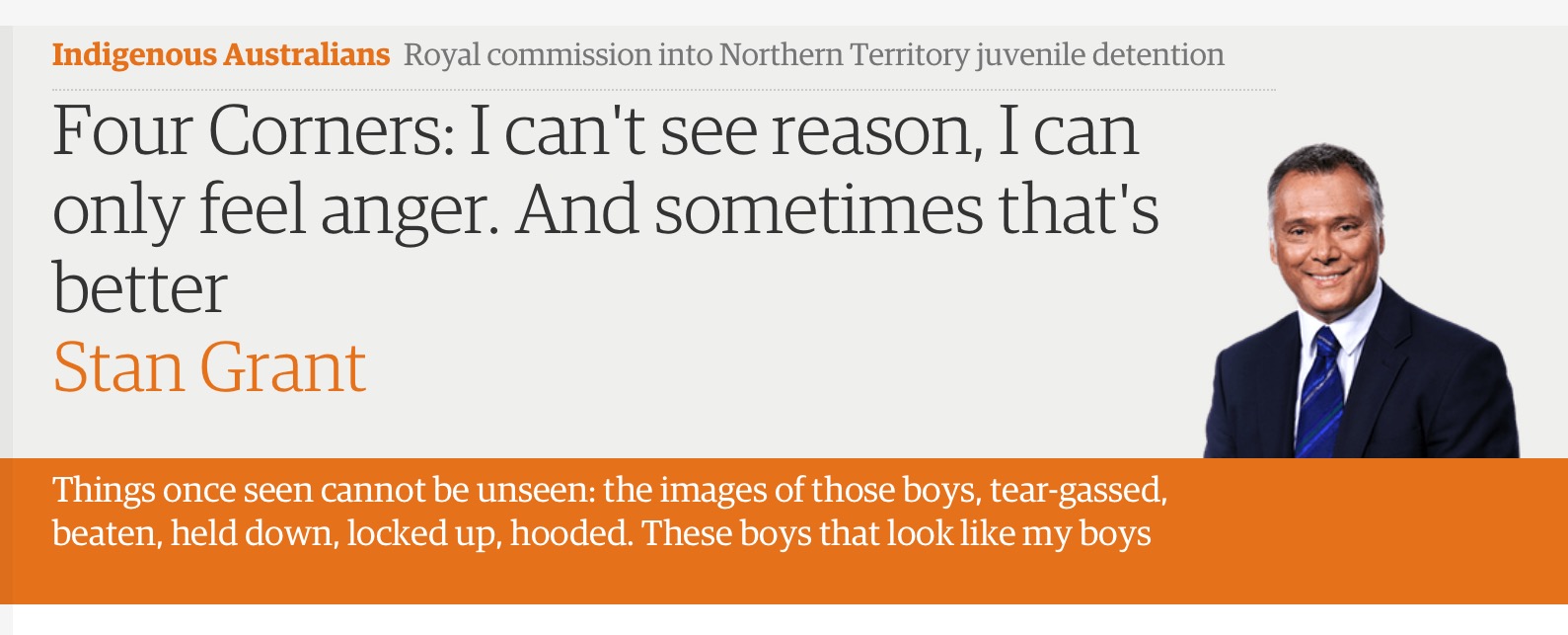
NACCHO #4corners : I can’t see reason, I can only feel anger. And sometimes that’s better Stan Grant

image

I have stepped out into the warm winter sun of a Sydney morning. I want to drink in that moment when the sun’s rays touch my skin and banish the darkness I am often prone to carrying inside.

It usually works. Basking for just a few moments can bring clarity and hope. Not today. Today not even nature’s most precious gifts can dispel the gloom I feel about our country.

I could call this anger. I could tell of rage. I could describe a suffocating, nauseating hopelessness. I feel all of that, my mood swinging between despair and resignation.

From The Guardian

The images of those boys on my television screen – tear-gassed, beaten, held down, locked up, hooded. These boys that look like my boys.

Northern Territory juvenile detention ‘may amount to torture’, says Unicef – as it happened
Chief minister takes over portfolio and PM announces royal commission after ABC airs footage of teenagers being teargassed, hooded and restrained for hours
Read more
I didn’t want to watch Four Corners last night. I knew what was to come. I couldn’t watch all of it. I got up, I walked around and every time I came back there was another boy talking about loneliness and depression and fear.

Things once seen cannot be unseen. I carry the twisted images of lifetime of reporting – bodies broken and lifeless, people screaming in pain, rivers of blood and burning flesh. These are things burned into my eyes and now there is that image of a boy – an Australian boy – bound to a chair, hooded and catatonic.

For Indigenous people these are far too often the images that give shape to Australia.

For me it is seeing the physical scars of my loved ones: bodies marked by knife wounds, broken bones, missing fingers, and dark ink tattoos. These tell stories of lives at the coalface of bigotry and poverty.

It is hearing stories of people arrested and chained like dogs to trees left to burn in the blazing summer sun.

It is stumbling on a book as a child and seeing Aboriginal people chained and bound to each other, staring blankly at a world that could not see them as anything but a problem to be solved or a people to be extinguished.

In 2016, the lives of our children are measured in statistics. Indigenous kids make up half of those juveniles behind bars. An Aboriginal or Torres Strait islander boy or girl is nine times more likely to kill themselves.

We are failing them and there are many reasons for it. We can look to history, we can look to politics, we can look to dysfunctional communities and families.

We bury 10 year-olds who feel Australia has no place for them.

We can blame grog and drugs, we can say kids should be at school. We can blame the kids themselves.

Right now none of this is enough. I can’t see reason, I can only feel anger, and anger sometimes is better than reason.

Let the royal commission do its job. Let it look at systemic failure and responsibility and retribution. Let it cast its inquiry over two centuries of neglect and injustice. Let it ask what justice even means.

After Four Corners I watched a little of the Q&A panel discuss the horrors of what they had seen. They discussed Indigenous incarceration, black deaths in custody. They answered questions about constitutional recognition.

A 10-year-old girl has taken her own life. How can we possibly look away?

They talked about the first peoples of this country and there wasn’t even an Indigenous person on the panel. Not one of them even mentioned how utterly inappropriate it is to be talking about us and not including us.

I just wanted to yell at the screen, get out of our lives!

The ignorant, the racist, the well-intentioned, whoever: just stop. Just for that moment I wanted them to stop.

For that moment recognition meant nothing to me.

It will lift. Anger will subside. Hope will fill despair. Reason will return. My inclination to diplomacy will return.

But right now I am angry: tearfully angry.

Right now I am in the sun and waiting for it to lift the gloom.

Still waiting.

NACCHO Census2016 : Census mission to collect data on Indigenous populations in urban areas

Page 12 AD


” There could me a myriad of reasons why there is population growth – it could be naturally occurring or it could be people coming in from country areas, rural and remote, and/or other places within Australia.

We offer stuff to do with smoke cessation, alcohol and other drug use emotional and social well being, and general health checks.

It is an Aboriginal community controlled health organisation so it is being given direction by a group of Aboriginal and Torres Strait Islander people who are from the region.

The DANILA DILBA organisation’s chair, Braiden Abala, isn’t sure what’s behind the population shift. 

The clinic was commissioned by Danila Dilba, after Census data in 2011 revealed Aboriginal people had moved from Darwin’s city centre to the northern suburbs.

Above ad Page 12 NACCHO Aboriginal Health Newspaper

Full ABC TV Interview

MARK COLVIN: The Australian Bureau of Statistics is about to embark on a huge Census data collection mission in Indigenous communities across Northern Australia.

A key aim of the research is to capture more accurate statistics on the number of Aboriginal and Torres Strait Islander people living in urban areas.

Sally Brooks compiled this report.

MALE SPEAKER: I’d just like to introduce James Parfit to do a welcome to country for Larrakia.

JAMES PARFIT: I’d first like to say welcome everyone and thank you all for coming and a big congratulations of the opening of this great new facility that will make our people healthy and strong again.

SALLY BROOKS: A new Aboriginal health clinic opened in a suburb outside Darwin today.

DANILA DILBA: We offer stuff to do with smoke cessation, alcohol and other drug use emotional and social well being, and general health checks. It is an Aboriginal community controlled health organisation so it is being given direction by a group of Aboriginal and Torres Strait Islander people who are from the region.

SALLY BROOKS: The clinic was commissioned by Danila Dilba, after Census data in 2011 revealed Aboriginal people had moved from Darwin’s city centre to the northern suburbs.

The organisation’s chair, Braiden Abala, isn’t sure what’s behind the population shift.

BRAIDEN ABALA: There could me a myriad of reasons why there is population growth – it could be naturally occurring or it could be people coming in from country areas, rural and remote, and/or other places within Australia.

SALLY BROOKS: The trend is something Northern Australia Census director Tony Grubb thinks is being replicated in other jurisdictions.

TONY GRUBB: I think we are seeing that in a lot of our capital cities and even in our regional areas and we need to remember that 60 per cent of our Aboriginal and Torres Strait Islander peoples are actually in urban environments.

SALLY BROOKS: Tony Grubb is about to oversee a huge five to six week mission to collect data from Indigenous communities across Northern Australia.

TONY GRUBB: From Darwin we actually manage all the remote teams for the NT, the Kimberlys, Cape York, Torres Strait, and in that we actually use about 65 teams of about 200 staff and whilst we are actually out in communities we employ up to 1,500 more people to actually help with that undertaking.

Actually, we like to say, you know, it’s the largest peace time logistical operation that the country does.

SALLY BROOKS: Many of the remote employees will help to collect data by interviewing people in their own language.

TONY GRUBB: In our remote areas, quite distinct to how we do mainstream Australia in terms of asking people to actually jump online or fill in a form, we will actually employ local facilitators and local interviewers and actually interview the population and that allows us to get across to meet some of those challenges of cultural differences and language.

SALLY BROOKS: Like with the health clinic opened in Darwin today, Tony Grubb thinks this Census data will be critical to informing how Governments allocate resources for Indigenous people in future.

TONY GRUBB: So in addition to being one of the drivers for the allocation of funding across states and territories it’s also used by all levels of Government for organising and planning for services such as housing, education, and transport, and infrastructure.

So, yeah very important Aboriginal and Torres Strait Islander people.

MARK COLVIN: Northern Australia Census director Tony Grubb ending that report by Sally Brooks.

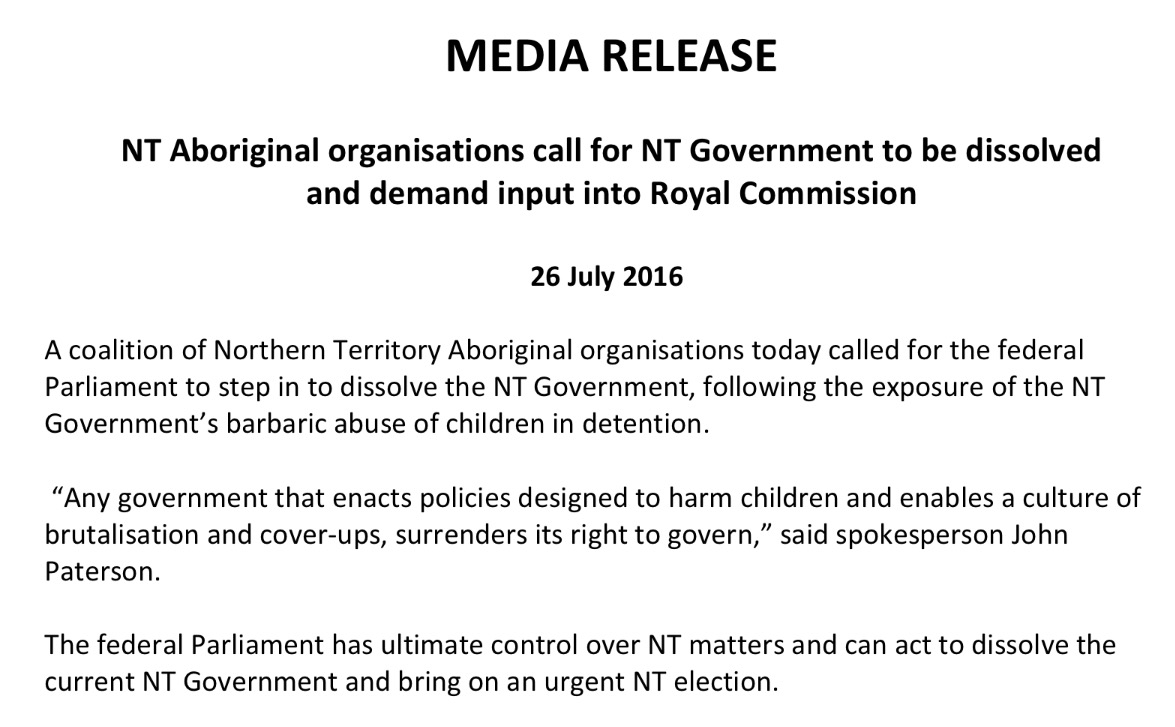
NT Aboriginal organisations call for NT Government to be dissolved and demand input into Royal Commission

image

A coalition of Northern Territory Aboriginal organisations today called for the federal Parliament to step in to dissolve the NT Government, following the exposure of the NT Government’s barbaric abuse of children in detention.

“Any government that enacts policies designed to harm children and enables a culture of brutalisation and cover-ups, surrenders its right to govern,” said spokesperson John Paterson.

The federal Parliament has ultimate control over NT matters and can act to dissolve the current NT Government and bring on an urgent NT election.

“We also urge the Prime Minister to ensure the NT Government plays no role in the development or oversight of the Royal Commission.

It must be entirely independent of the NT Government, and chaired by an appropriate independent expert and must have Aboriginal representation from the NT.

Local organisations and those working in this sector must have input into the terms of reference.

The terms of reference must:
• Encompass the entire NT youth justice system, not just issues relating to detention facilities;
• Examine all previous enquiries relating to youth justice in the NT for cover ups and uncover why the recommendations were not implemented.
• Not limit how far into the past the Commission can inquire.


We also call for further immediate interim actions:
• The Commonwealth must appoint an alternative provider of youth detention and child protection/out of home care for the NT. The NT Government cannot continue to deliver these services while our kids remain at risk.
• The youth currently on remand should also be removed from the Darwin and Alice Springs detention facilities immediately and placed in appropriate secure accommodation.
• The office of the NT Children’s Commissioner must be appropriately and adequately resourced to perform her statutory duties.

“That harm is being done to our children and our community in our name is unacceptable. Those responsible, including ministers, advisers, bureaucrats and corrections employees need to be held to account”, spokesperson Olga Havnen said.

“The NT Government has led a concerted and sustained campaign demonising young people and to pass draconian laws inconsistent with recommendations made by successive inquiries, including those of the NT Children’s Commissioner.

“We are seeking urgent discussions with the Prime Minister to ensure this Royal Commission actually meets the needs of those most affected, and ultimately creates the momentum for reform of the entire youth justice system in the NT.”

Media contacts
AMSANT – John Paterson 0418 904 727
Danila Dilba – Olga Havnen 0448 840 085
NAAJA – Priscilla Collins 0427 045 665
Central Land Council – David Ross 0417 877 579
CAALAS – Eileen Van Iersel 0418 855 043

NACCHO Press Release #4corners Aboriginal Health : Royal commission must focus on the full impacts of youth detention

image

Royal commission must focus on the full impacts of youth detention

The National Aboriginal Community Controlled Health Organisation (NACCHO) applauds the swift establishment of a royal commission into the treatment of children in Northern Territory youth detention centres after revelations raised on ABC’s Four Corners program.

“NACCHO was deeply shocked at the revelations from the Don Dale facility and applauds the swift action taken by Prime Minister Turnbull to ensure the safety of these young people and their mental wellbeing,” said NACCHO Chair, Matthew Cooke.

“Whilst NACCHO welcomes the swift action of Prime Minister Turnbull, it also hopes that the Royal Commission proceeds with the same immediacy, and delivers answers in a timely fashion.”

“Given the gravity of the situation NACCHO is calling for immediate administrative changes, and the Chief Minister needs to do so as a matter of urgency.”

“This Royal Commission should be the starting point of a wider inquiry that looks at the impacts of detention on mental health, and the devastating suicide rate of the Aboriginal and Torres Strait Island people, particularly young people.”

“There needs to be a bigger focus on modern day rehabilitation of all children in the NT who come into contact with the juvenile justice system – not just lock them up and keep them out of sight.”

“We need a system that justice system that is best practice and culturally safe for Aboriginal children faced with detention.”

“Young people should not be risking their lives in detention, and the price they pay for their crimes should not be life long.”

Last week, NACCHO called on all parties to back a Royal Commission into the devastating rate of suicide among Aboriginal and Torres Strait Island people as a priority for the new Federal parliament.

“We need to think about what detention is doing to our young people, and the devastating impacts it can have on their mental health – and the suicide risk that it poses.”

“We need to look at the whole cycle of what is happening with our young Aboriginal children, that they’re taking their own lives, or ending up in incarceration.”

Aboriginal health in Aboriginal hands | http://www.naccho.org.au
Stay connected, engaged and informed with NACCHO http://www.naccho.org.au/connect


NACCHO #4corners Aboriginal Health : Evidence of ‘torture’ of children in NT detention centres

NT 3

” The treatment of youth imprisoned in the Northern Territory is disgusting and inhumane.

The justice system has failed not only the individual but society. Shameful. Sickening.

Government Ministers and Departments should be held to account. How can we expect to have these youth integrated into society after their sentence when they are abused and no doubt scarred for life with mental issues.”

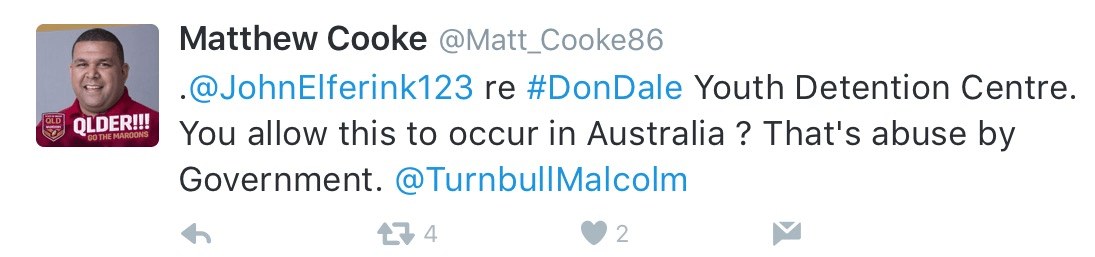
Matthew Cooke Chair NACCHO after watching #4corners

MC

UPDATE 7.30AM 26 July 2016

Malcolm Turnbull has announced a royal commission into the treatment of children in juvenile detention in the Northern Territory after revelations of abuse at the Don Dale detention facility in Berrimah, outside Darwin.

The prime minister told ABC’s AM that like all Australians he was “deeply shocked … and appalled” at the abuse, revealed on Four Corners on Monday.

Turnbull said there was “no question” about the mistreatment of young people as recently as 2014.

Petition

” The maltreatment of children in Northern Territory youth detention centres is a national disgrace that requires a national inquiry. A Four Corners report have revealed that children have been tear-gassed inside their cells, forcibly stripped naked, hooded and strapped to restraining chairs for hours, and isolated in windowless cells for weeks. The way that these children are being treated is classified by the UN as torture.”

Sign the petition : Chronic Child Abuse in NT Youth Detention – Royal Commission NOW

Vision of the tear-gassing of six boys being held in isolation at the Don Dale Youth Detention Centre in Darwin in August 2014 has been obtained by Four Corners, exposing one of the darkest incidents in the history of juvenile justice in Australia.

NT 1

Evidence of ‘torture’ of children in NT detention centres

Report By Caro Meldrum-Hanna and Elise Worthington

Chair

The vision is part of an investigation featuring a chilling catalogue of footage revealing a pattern of abuse, deprivation and punishment of vulnerable children inside Northern Territory youth detention centres.

The tear-gassing incident was described as a “riot” at the time, with media reporting multiple boys had escaped their cells in the isolation wing of the prison, known as the Behavioural Management Unit (BMU), and threatened staff with weapons.

A graffitied door opens to a cell inside the Don Dale Youth Detention Centre.

But CCTV vision and handy-cam recordings made by staff, obtained exclusively by Four Corners, show only one boy escaped his cell after it was left unlocked by a guard.

Former corrections commissioner Ken Middlebrook last year defended the officer’s actions in the wake of a damning report by the Northern Territory Children’s Commissioner.

“I am not in the business of overuse of force. There were two sprays from an aerosol in the area. Now it wasn’t overuse of gas,” Mr Middlebrook told the ABC at the time.

But CCTV vision from the incident shows 10 bursts of tear gas being sprayed into the enclosed area over the space of one-and-a-half-minutes.

All six boys were exposed to the tear gas, five while still locked in their cells.

A basic toilet and plastic chair inside a cell in the isolation wing of the Don Dale prison.

Not all the children were misbehaving — two boys can be seen on CCTV calmly playing cards before being exposed to the fumes. Another can be seen repeatedly smashing the wall of his cell with a broken light fitting.

The 14-year-old boy who escaped his cell can be heard repeatedly asking how long he had been in isolation and requesting to talk to staff.

Instead of negotiating with the boy, prison staff can be heard laughing and mocking him, calling the boy “an idiot” and a “little f****r”.

Four Corners has managed to track down several of the boys who were tear gassed. They describe being highly distressed, afraid for their lives, and say that two years on they are now suffering from disturbing flashbacks and nightmares from the ordeal.

The CCTV vision also shows the children’s reactions as they are affected by the gas, running to the back of their cells, hiding behind sheets and mattresses, gasping for air, crying, and bending over toilets.

One boy is left in his cell and exposed to tear gas for eight minutes. He is seen lying face down on the floor with his hands behind his back, before being handcuffed by two prison officers wearing gas masks and dragged out of his cell.

‘Ticking time bomb’ of potentially unlawful solitary confinement

The use of tear gas at the Don Dale Youth Detention Centre in 2014 came after months of tension, repeated escapes and incidents at the centre, which was staffed with under-trained Youth Justice Officers, in what has been described as a “ticking time bomb” by former staff.

Three weeks before the tear-gassing incident, five boys had escaped from Don Dale.

When they were recaptured, they were placed in the isolation wing of the prison for between 15 and 17 days, in what were described by both children and staff as appalling and inhumane conditions.

They were kept locked in their cells for almost 24 hours a day with no running water, little natural light, and were denied access to school and educational material.

The boys being kept in isolation were accidentally discovered by a group of lawyers, including solicitor Jared Sharp, when they were taken on a tour of the facility in August 2014.

“We all sort of looked at each other in shock that there was kids in these cells, because there was signs of life in there but we didn’t know who was in there or what was happening, or how long they’d been there,” Mr Sharp told Four Corners.

“To what extreme is that, is to my view is torture. To my view that is treating kids in a way that is just entirely unacceptable,” he said.

Human Rights Lawyer Ruth Barson said the isolation of the children was a clear violation of the United Nations Convention against Torture.

“The UN’s expert on torture has said there are no circumstances that justify young people being held in solitary confinement, let alone prolonged solitary confinement,” Ms Barson told Four Corners.

“I think the NT and in particular Don Dale has a long way to go to ensure their practices are compliant with Australia’s obligation on the convention against torture and against the right of the child.”

Government says improvements made

In the days after the tear gassing, NT Corrections Minister John Elferink praised the actions of his staff and the prison security dog used on the night of the incident.

“I congratulate again, and place my support behind, the staff who made this decision. The staff worked hard, Fluffy the Alsatian worked hard and, as far as we are concerned, it was a problem that was solved quickly,” Mr Elferink told Parliament.

In the wake of the incident, the Don Dale centre was closed and the children were moved to the run-down, old Berrimah adult prison.

The NT Government commissioned an independent report into the incident by former Long Bay prison boss Michael Vita, which was released in January 2015.

Mr Elferink told Four Corners the Government had learned from the mistakes of the past.

“It was a system that needed improvement. It was a system that had fundamental problems, which is why I’ve worked so hard to improve it and it has been improved,” he said.

“That was a circumstance that clearly demonstrated to me that something had to be done, which is what the Vita Report was all about.

“Those circumstances have now been changed… we hope that they won’t be repeated.”

NT Children’s Commissioner Colleen Gwynne confirmed to Four Corners there are still ongoing issues with youth detention in the Northern Territory, with many of her 2015 report recommendations still not implemented.

“The response has not been as urgent as we would have liked. The issues raised in that report are extremely serious and I would like to see a more full response,” she said.

“[We need] some urgency and some dedicated resources thrown at this.”

NT 2

NACCHO Aboriginal Health :Report : Perils of place: identifying hotspots of health inequality

image

Hospitalisation rates for diabetes, tooth decay and other conditions that should be treatable or manageable out of hospital show how Australia’s health system is consistently failing some communities.

Perils of place: identifying hotspots of health inequality

Download report here : NACCHO download Perils-of-Place

Places such as Frankston and Broadmeadows in Victoria and Mount Isa and Palm Island in Queensland have had potentially preventable hospitalisation rates at least fifty percent above the state average in every year for a decade.

Place

The problem can be addressed, but only if governments come up with targeted solutions for individual places. Australia is not a uniform country and a one-size-fits-all approach will not work. Local, tailored policy responses are required.

Reducing potentially preventable hospitalisations in hot spots in Victoria and Queensland — the two states the report studied – would save a total of at least $15 million a year. Indirect savings should be significantly larger.

The report introduces a method of identifying small areas where health inequalities are entrenched and, without intervention, are likely to endure.

To build up the limited evidence of what works in reducing place-based health problems, the report recommends that government combine with Primary Health Networks and local communities to run three- to five-year trials of tailored programs in selected places.

Rigorous evaluation is critical, so that the lessons from successful trials can be applied across the country.

Because persistent hotspots are rare, targeting them alone will not substantially reduce the growing burden of potentially preventable hospitalisations, but it’s an important first step.

Government and Primary Health Networks must ensure that all communities get a fair go. The government will save money and, more importantly, some of the most disadvantaged Australians will get the chance to lead healthier, more productive lives.