- Mandurah’s Nidjalla Waangan Mia to transition to Aboriginal Community Controlled Health Organisation
- Sole stories: yarning about foot health
- The importance of exercise physiology services in remote communities
- Professional development key to closing healthcare gap
- Improving mental health access in the bush
- Cultural leader for Hearing Australia urges ear checks for Indigenous children in Mid West-Gascoyne
- Sector Jobs
The NACCHO Sector News is a platform we use to showcase the important work being done in Aboriginal and Torres Strait Islander health, focusing on the work of NACCHO, NACCHO members and NACCHO affiliates.
We also share a curated selection of news stories that are of likely interest to the Aboriginal and Torres Strait Islander health sector, broadly.
Mandurah’s Nidjalla Waangan Mia to transition to Aboriginal Community Controlled Health Organisation
Aboriginal health and wellbeing centre Nidjalla Waangan Mia, in Greenfields, has provided health services to local Aboriginal people since 2010 and is currently operated by GP Down South. Nidjalla Waangan Mia regional communications manager for Aboriginal health George Walley said after discussions with GP Down South and members of the community, including Elders, the service will transition to operating independently as an Aboriginal Community Controlled Health Organisation (ACCHO).
The service provides culturally appropriate medical services from practitioners including doctors, nurses and Aboriginal outreach workers and has nearly 2000 clients in an area stretching from Mandurah to Pinjarra and Waroona and North Dandalup.
Mr Walley said having the organisation controlled by the Aboriginal community would mean the continuation of what he described as “50,000 years of health care in our traditional society”, as well as continuing the success the program has had since it began in 2010.
“We have been doing this amazingly well as a healthcare centre,” he said.
“All we’re doing really, is changing the current structure into something where we can do what we’ve been doing through an ACCHO structure.”
A $100,000 funding commitment from Regional Development Minister Don Punch was also announced on July 11 to support Nidjalla Waangan Mia’s transition.
This funding will go towards the registration and establishment of the Aboriginal corporation, important governance processes and the facilitation of ongoing community engagement and collaboration.
Mr Punch said the establishment of Nidjalla Waangan Mia as an ACCHO “will lead to improved health outcomes and community empowerment for the Bindjareb community”.
To read the Perth Now article in full, go here.

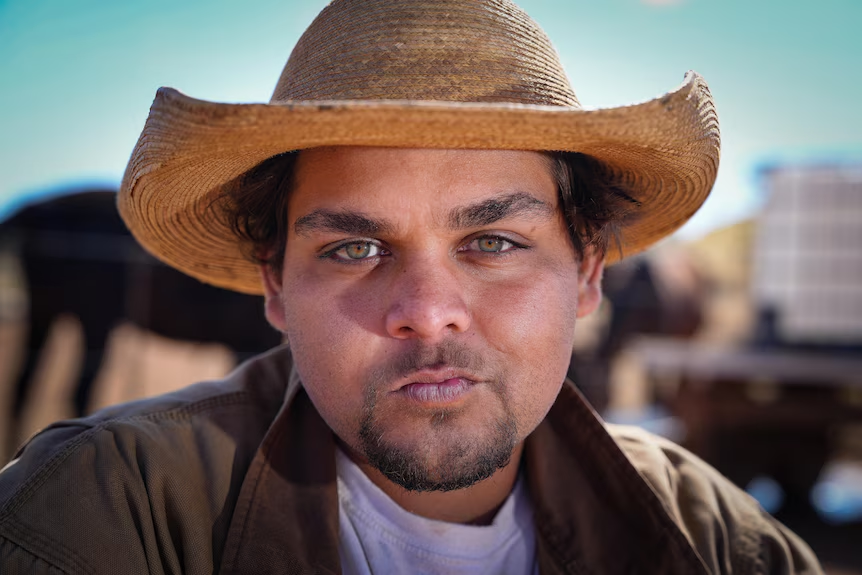
Mandjoogordap Dreaming director George Walley at Park Ridge Reserve in Bouvard near Mandurah.
Sole stories: yarning about foot health
Are you an Aboriginal and Torres Strait Isander person interested in foot health? Researchers from the University of Western Australia are seeking First Nations advisors to help explore cultural preferences on educational tools and medical footwear in diabetes treatment. With your guidance, they will co-design a culturally safe study that priorities Aboriginal and Torres Strait Islander voices in healthcare.
What am I expected to do?
Aboriginal advisory group commitments include:
- Attend 1-3 meetings in 2024 to yarn about the project and provide cultural guidance.
- If you choose, be available for contact via email or phone for non-urgent or smaller queries.
In meetings you may be asked for advice on upholding cultural safety when yarning with Aboriginal people, analysing data, and releasing project results. As a member of the advisory group, you may attend meetings as frequently as you are able to. The entire project is expected to run for four years. You can choose to be a part of the project for as little or long as you like.
The research team will finalise an involvement agreement that suits you personally.
What skills or experience do I need?
- You must identify as an Aboriginal person and have a deep understanding of Aboriginal culture.
- You will need to be able to discuss cultural safety.
- Advisors should have an interest in improving health outcomes for Aboriginal people.
- No research or healthcare experience is required.
For more information, please visit the website here.

Flyer – Sole Stories CAG
The importance of exercise physiology services in remote communities
The importance of exercise physiology services in remote Aboriginal Australia is evident with physical inactivity being an important risk factor associated with preventable chronic diseases.
Physical inactivity is the fourth leading modifiable risk factor that contributes to the loss of healthy life for Aboriginal people, with its effect manifested through a range of diseases, most notably coronary heart disease and diabetes (44% and 36% of the burden attributed to physical inactivity respectively).
Not only is regular exercise imperative for preventing, treating and managing diseases, it also contributes to overall quality of life through improved mental and social wellbeing, in particular by reducing stress, anxiety and depression.
To combat these statistics above, the Central Australian Aboriginal Congress is a strong political advocate of closing the gap on Aboriginal and Torres Strait Islander peoples’ health, in which exercise physiologists have a primary role.
Nicholle Cooke-Hayes is an Accredited Exercise Physiologist working within the Central Australian Aboriginal Congress. She provides exercise physiology services primarily to two remote Aboriginal Communities; Ltyentye Apurte (Santa Teresa) and Utju (Areyonga).
Her main approaches include lifestyle intervention and behaviour change initiatives through health and physical activity education, one-on-one AEP consults, women’s health and exercise groups, healthy ageing exercise group, alternate learning programs, and education about healthy tucker and cook-ups.
While these AEP-led services and groups have been successful and welcomed by community members, regular ongoing services like this are a rarity in remote communities due to staffing shortages, prescriptive funding streams and a lack of exercise physiology positions and services available in the NT.
Increasing awareness, referrals and access to AEPs is something Nicholle is continually advocating for and extremely passionate about improving, especially for Aboriginal and Torres Strait Islander peoples in rural and remote settings.
To read the full article, go here.

Image source: Unsplash.
Professional development key to closing healthcare gap
After three years of hard work, Aboriginal Liaison Officer Oceania Harris has completed her Graduate Diploma in Indigenous Health. In May, Oceania travelled to Sydney to accept her well-deserved diploma. Now she’s back in the South West using her new skills to further support health equity for Aboriginal communities.
As an Aboriginal Liaison Officer, Oceania’s role includes following-up with Aboriginal and Torres Strait Islander patients who present to emergency departments (EDs) in Busselton, Margaret River and Augusta.
“I provide referrals and support to people presenting to ED,” Oceania said.
“I link them in with what they need – child and maternal services, physios, social workers – my role is across the board, supporting patients from birth to end-of-life.”
A wealth of knowledge, Oceania is also registered as an Aboriginal Health Practitioner under APHRA, having worked at the South West Aboriginal Medical Service for five years before joining our team.
Undeterred by an already busy schedule of working and being a single mother of five, Oceania is always looking to upskill to help her community.
“I am driven by Aboriginal health, my goal and my passion is Aboriginal health, and I love that I get to do what I love,” she said.
“Every day, I get to come to work and deal with patients. But they’re not just patients, they’re family.
“The community know they can come to me because I know them and have built relationships with them.”
To read the full article, go here.

Oceania Harris. Image source: WA Country Health Service.
Improving mental health access in the bush
Western Plains shires will benefit from a trainee program aimed at improving Aboriginal and Torres Strait Islander mental health access in the bush. Twenty-nine people have already graduated or are training under the Marathon Health Aboriginal Wellness Worker traineeship program, where they gain on-the-job experience supporting young people alongside their studies.
Warren-based Shaana Daley was among the first cohort and graduated with a Certificate IV Mental Health. She said there wasn’t a lot of mental health support growing up and now helps to turn that around in her community. She said couldn’t have done it as easily without the training.
“It’s based around youth work, you know, getting to know them and for them to be confident enough to just come and chat,” Shaana said.
“I learned lots of things, strategies people can use and how to talk to people and help them advocate for themselves.
“A lot of people, when it comes to mental health, don’t want to talk about it. So, it’s giving them the confidence to be able to say they might have a problem and they want to get help.”
Andrew Higgins, Assistant Director of Regional Aboriginal Partnerships at NSW’s regional development department, said the program will allow graduates to provide culturally safe mental health support.
“It will essentially help them to listen to their community, especially young Aboriginal people. Mental health is not something that was spoken about for a lot of people for a long period of time,” Mr Higgins said.
“I think engaging in this program allows them to have those listening attributes and to support even one or two people in their community to help them.
“That’s going to make our community string in rural and remote NSW.”
To read the article in full, go here.
If this article brought up anything for you or someone you love, please reach out to, call or visit the online resources listed below for support. The four organisations in blue offer immediate help, 24 hours a day, 7 days a week.
- 13 Yarn(13 92 76)
- Beyond Blue(1300 224 636)
- Brother-to-brother(1800 435 799)
- Kids Helpline(1800 551 800 + webchat)
- Lifeline(13 11 14 + online chat)
- MensLine Australia(1300 789 978)
- NACCHO Connection, Strength and Resilience Portal
- QLife– anonymous LGBTIQ support (1800 184 527 + webchat)
- Suicide Call Back Service(1300 659 467)

Marathon Health Aboriginal Wellness Worker program graduate Shaana. PHOTO: Western NSW Local Health District.
Cultural leader for Hearing Australia urges ear checks for Indigenous children in Mid West-Gascoyne
Hearing Australia is encouraging families in the Mid West-Gascoyne to get their children’s ears checked, after an alarming 26% of First Nations children were found to have an undiagnosed ear disease. More than 120 children received hearing assessments in the Mid West-Gascoyne in 2022-23. Results found more than 25% had undiagnosed hearing loss and about 19% had ear disease.
Hearing Australia is urging parents and primary healthcare providers to ensure young Indigenous children are having regular hearing checks. Geraldton cultural leader and Hearing Australia representative Azizah Roe has first-hand experience and knows how important children’s hearing checks are. Her two-year-old grandson was diagnosed with glue ear and required grommets to prevent a build-up of fluid.
“Not hearing properly meant it would impact on his learning … a few months after his surgery, my grandson had another hearing check and his hearing had returned to normal,” she said.
“It was a great outcome and really reinforces the importance of getting our kids’ and grandkids’ hearing checked regularly, because if there are any issues, they can then be put on the path to treatment.”
Ms Roe said Hearing Australia worked closely with Geraldton Regional Aboriginal Medical Service and Meekatharra GP clinic to provide hearing services and support in the region.
“We encourage parents and carers of First Nations children to get their children’s hearing checked regularly because often bubs may not show any signs or symptoms of hearing trouble.”
To read the West Australian article in full, go here.

Hearing Australia representative Azizah Roe.

Sector Jobs – you can see sector job listings on the NACCHO website here.
Advertising Jobs – to advertise a job vacancy click here to go to the NACCHO website current job listings webpage. Scroll down to the bottom of the page to find a Post A Job form. You can complete this form with your job vacancy details – it will then be approved for posting and go live on the NACCHO website.