NACCHO Sector News: 16 May 2025

The NACCHO Sector News is a platform we use to showcase the important work being done in Aboriginal and Torres Strait Islander health, focusing on the work of NACCHO, NACCHO members and NACCHO affiliates.

We also share a curated selection of news stories that are of likely interest to the Aboriginal and Torres Strait Islander health sector, broadly.

NACCHO Welcomes Ministerial Appointments and Reaffirms Commitment to Closing the Gap

The National Aboriginal Community Controlled Health Organisation (NACCHO) congratulates Senator, the Hon Malarndirri McCarthy on her continued leadership as Minister for Indigenous Australians, the Hon Mark Butler MP on his appointment as Minister for Health and Ageing and his additional responsibility as Minister for Disability and the NDIS, the Hon Emma McBride MP on her reappointment as Assistant Minister for Mental Health and Suicide Prevention, and Assistant Minister for Rural and Regional Health, and the Hon Rebecca White MP on her new federal roles as Assistant Minister for Health and Aged Care, Assistant Minister for Indigenous Health, and Assistant Minister for Women. Additionally, we congratulate the Hon Marion Scrymgour MP on her appointment as Special Envoy for Remote Communities.

These ministerial appointments come at a crucial time for Aboriginal and Torres Strait Islander health, and NACCHO looks forward to enhanced collaboration with the Australian Government to improve health outcomes for Aboriginal and Torres Strait Islander communities.

Pat Turner AM, CEO of NACCHO, said:

“NACCHO congratulates all Ministers on their appointments and looks forward to collaborating closely on policies and initiatives that directly benefit Aboriginal and Torres Strait Islander communities. As Prime Minister Albanese has emphasised, ‘We will be a government that supports reconciliation with First Nations people, because we will be a stronger nation when we close the gap between Indigenous and non-Indigenous Australians.’ NACCHO remains committed to working in partnership with the government to ensure health programs and services effectively meet the needs and aspirations of our communities.”

Ms Turner added, “Closing the Gap requires a united, whole-of-government approach, and these appointments represent an encouraging step toward achieving meaningful, sustainable improvements in Aboriginal and Torres Strait Islander health and wellbeing.”

Image source: NACCHO

Yappera Children’s Service becomes VACCHO’s newest Asssociate Member

The Victorian Aboriginal Community Controlled Health Organisation (VACCHO) is excited to announce that Yappera Children’s Service Co-operative has become its latest Associate Member.

Since opening in 1981, Yappera Children’s Service Co-Operative has been providing high quality, culturally grounded and holistic health and education programs.

Yappera, which means “Belonging Place” is a gathering, learning and wellbeing space for Aboriginal children, their parents, carers, families and Community in Thornbury, Melbourne.

VACCHO CEO Dr Jill Gallagher AO, says she is excited to work with the Yappera team to support its range of programs and services for children and their families.

“It’s a great pleasure to welcome Yappera to the VACCHO family and to become our thirty-forth member.”

“Supporting our Members in the delivery of high-quality, culturally safe health and social services to the Aboriginal and Torres Strait Islander Community is a goal we all share, and I know Yappera will be a valued Member,” Dr Gallagher said.

Read more here.

Image source: VACCHO

‘Through Our Lens’ Coalition of Peaks photo competition

The Coalition of Peaks invites Aboriginal and Torres Strait Islander photographers to take part in the Through Our Lens photo competition—celebrating the strength, culture, connection and leadership of our people.

In a search for powerful images that capture ties to Country, community, and the changes shaping our future.

Winning and selected photos will feature across Coalition of Peaks communications—helping build a community-led image library for Closing the Gap and reflecting the diversity of who we are and how we see the world.

Entries close 13 June 2025.

To learn more, go here.

Image source: Coalition of Peaks

Abstract submissions for the 10th Rural and Remote Health Scientific Symposium closing soon

Abstract submissions for the 10th Rural and Remote Health Scientific Symposium close in 2 weeks – Friday 30 May!

With the theme ‘Research from the heart – shaping rural & remote health futures’, the 10th Rural and Remote Health Scientific Symposium will be held in Alice Springs, 8–9 October 2025.

If you have research findings, case studies, or innovative models of care to share, this is your chance to contribute to a growing national movement dedicated to improving rural and remote health.

The Symposium is your opportunity to:
– Present and translate your research
– Build connections and collaborations
– Learn from emerging rural, remote and Indigenous health research

Learn more here.

Image source: National Rural Health Alliance

Sector Jobs – you can see sector job listings on the NACCHO website here.

Advertising Jobs – to advertise a job vacancy click here to go to the NACCHO website current job listings webpage. Scroll down to the bottom of the page to find a Post A Job form. You can complete this form with your job vacancy details – it will then be approved for posting and go live on the NACCHO website.

NACCHO Sector News: 14 May 2025

The NACCHO Sector News is a platform we use to showcase the important work being done in Aboriginal and Torres Strait Islander health, focusing on the work of NACCHO, NACCHO members and NACCHO affiliates.

We also share a curated selection of news stories that are of likely interest to the Aboriginal and Torres Strait Islander health sector, broadly.

New national screening program aims to prevent many lung cancer deaths

On 1 July, just seven weeks from now, Australia will become one of the few countries in the world to launch a national lung cancer screening program, hoping to save hundreds of lives a year by finding and treating lung cancer earlier.

Despite dramatic cuts to smoking rates in Australia, lung cancer is the fifth most commonly diagnosed cancer in Australia, behind breast, prostate, colorectal cancer and melanoma. It is the leading cause of cancer death every year.’

For Aboriginal and Torres Strait Islander people, the toll is higher, in every age group: it is both the most common type of cancer and the most common cause of cancer death. Aboriginal and Torres Strait Islander people are twice as likely as non-Indigenous Australians to both be diagnosed with and to die from lung cancer.

Peter Bligh, a Kullilli and Wakka Wakka man and director of cancer for the National Aboriginal Community Controlled Health Organisation (NACCHO), hopes the screening program will “turn the tide” for Aboriginal and Torres Strait Islander people.

He is optimistic the program will be effective, so long as it builds on the strengths and resilience of communities and invests strongly in the Aboriginal and Torres Strait Islander health workforce to address barriers like access, stigma and lack of cultural safety.

“It’s Closing the Gap in a way that’s meaningful for communities,” he told Croakey.

Read the full Croakey Health Media article here.

First Nations leaders urge ‘bold’ reforms on truth, treaty and closing the gap

The Albanese government must use its historic mandate and standing with the electorate to deliver the remaining reforms of the Uluru Statement, namely treaty and truth-telling, Indigenous leaders say.

Pat Turner, NACCHO CEO who has spent decades working with governments to improve the lives of First Nations people, said the returning Albanese government “can’t rest on their laurels”.

“I’m really pleased that the Labor government has been returned,” she told Bridget Brennan on ABC News Breakfast on Tuesday.

“The alternative was unthinkable for Aboriginal and Torres Strait Islander people.”

But as one of the architects of the Closing the Gap national agreement, she said she was putting the government on notice because “there is so much to be done”.

Ms Turner said she wanted the federal government to take a stronger role in lifting the age of criminal responsibility, deliver needs-based funding to the community-controlled sector and finalise the Coalition of Peaks’s economic development partnership with Treasury.

“Closing the Gap is every minister’s responsibility, not just Malarndirri McCarthy’s, it belongs to every minister in the federal cabinet,” she said.

Read more here.

Pat Turner, NACCHO CEO on ABC News Breakfast.

New ABS data reveals 1 in 6 Aboriginal and Torres Strait Islander adults are living with diabetes, one of the highest rates in the world

1 in 6 Aboriginal and Torres Strait Islander adults are living with diabetes. 1 in 5 don’t even know they have it.

At NACCHO, we are taking action. In partnership with the Bupa Foundation, we’re training up to 500 Aboriginal and Torres Strait Islander Health Workers in culturally safe diabetes prevention, supporting local, community-led care.

This partnership invests in our people and recognises that solutions must come from within our communities. It’s a bold step to close the health gap, reduce preventable deaths, and build a stronger health workforce across the country.

Diabetes is the leading cause of death for Aboriginal and Torres Strait Islander women and the fourth for men. But with the right training, early detection, and culturally safe care, we can change the story.

Learn more here.

Watch Dr Jason Agostino, NACCHO Senior Medical Advisor on NITV (from 02:48 onwards).

Image source: NACCHO

Strong Born, Strong Communities: New FASD Guidelines empower healthy futures

The University of Queensland has released Australia’s first national clinical guidelines for the assessment and diagnosis of Fetal Alcohol Spectrum Disorder (FASD), aiming to improve early intervention, reduce stigma, and increase access to support across all communities.

The release of the guidelines aligns with the Strong Born campaign, launched by the National Aboriginal Community Controlled Health Organisation (NACCHO) and supported by the Foundation for Alcohol Research and Education.

Gudanji-Arrernte woman and NACCHO CEO Pat Turner said the campaign is focused on raising awareness and reducing shame around FASD in Aboriginal and Torres Strait Islander communities.

“The Strong Born campaign is about raising awareness and understanding of Fetal Alcohol Spectrum Disorder and reducing stigma and shame,” Ms Turner said.

“Growing strong healthy mums and bubs leads to healthy communities.”

The new guidelines are expected to support national efforts like Strong Born by equipping more practitioners with the tools to identify and support individuals with FASD, particularly in regional and remote communities.

Read the full National Indigenous Times article here.

Helping Indigenous families navigate genomic health

Being diagnosed with a genetic disease can be challenging for many people and their families, but it is hoped new resources will help them feel more empowered and less alone.

After working with First Nations communities over a decade, National Centre of Indigenous Genomics deputy director Azure Hermes said she had heard many stories from people navigating genomic health services.

“Patients and families were saying ‘I’m finding it difficult to understand what a genetic counsellor is, I don’t know what their job is’, or ‘I don’t know the questions I should ask’,” the Gimuy Walubara Yidinji woman told AAP.

The centre, alongside community organisations and with support from Australian Genomics, developed a series of animations, live videos and fact sheets exploring rare disease, DNA, genomics research and what to expect during appointments at a genetic health service.

The resources are being translated into Yolngu Matha, Anindilyakwa, Torres Strait Island creole, Warlpiri and Pitjantjatjara languages.

Read more here.

Navigating the health system after a genetic disease diagnosis can be complex, Azure Hermes says. (Image: Azure Hermes/AAP PHOTOS)

Sector Jobs – you can see sector job listings on the NACCHO website here.

Advertising Jobs – to advertise a job vacancy click here to go to the NACCHO website current job listings webpage. Scroll down to the bottom of the page to find a Post A Job form. You can complete this form with your job vacancy details – it will then be approved for posting and go live on the NACCHO website.

NACCHO Sector News: 9 May 2025

The NACCHO Sector News is a platform we use to showcase the important work being done in Aboriginal and Torres Strait Islander health, focusing on the work of NACCHO, NACCHO members and NACCHO affiliates.

We also share a curated selection of news stories that are of likely interest to the Aboriginal and Torres Strait Islander health sector, broadly.

Community-led solutions key as new data reveals Aboriginal and Torres Strait Islander people suffer one of the highest rates of diabetes in the world

Almost one in six (15.5 per cent) Aboriginal and Torres Strait Islander adults have diabetes and one in four (25.7 per cent) have abnormally high total cholesterol levels, according to data released this week by the Australian Bureau of Statistics (ABS).

“One in six adults with diabetes, and that being higher in remote areas is shocking,” says Dr Jason Agostino, NACCHO Senior Medical Advisor.

“They’re some of the highest rates of diabetes in the world and three times higher than non-Indigenous Australians.”

Early detection is critical – “With new treatments available, people with diabetes can live long, healthy lives, but the first step is to visit your local clinic for a health check to understand your risk.”

NACCHO is committed to strengthening the Aboriginal and Torres Strait Islander health workforce to tackle chronic diseases like diabetes.

“Through the First Nations Traineeship Program, we are on track to train 500 new Aboriginal and Torres Strait Islander Health Workers and Practitioners.

“Improving access to Aboriginal Community Controlled Health Services is also key to reducing diabetes rates.”

You can read the National Indigenous Times article here, the Australia article here, and the AAP article here.

Image source: NACCHO

Labor’s win an opportunity to accelerate action on health outcomes in the NT

The peak body for Aboriginal Community Controlled Health Services in the Northern Territory has welcomed Labor’s win in the federal election, calling it an opportunity to “accelerate action” on closing the gap challenges.

On Thursday, the Aboriginal Medical Services Alliance Northern Territory (AMSANT) congratulated Prime Minister Anthony Albanese on his election win, saying they “look forward to continuing to work” with the Government to “strengthen First Nations health outcomes as a matter of priority”.

The latest data for the NT showed life expectancy for First Nations women has gone backwards, as well as targets around employment, birthweight, early childhood education, child development, and youth engagement.

There has also been a regression in the targets around adult incarceration and youth detention, whilst the target to increase the rate of babies born at a healthy weight is also unlikely to be met.

“This election result presents an opportunity to accelerate action on those challenges,” AMSANT said.

Read more here.

Image: Josh Bean/Unsplash.

Positive reforms to GlassesSA for Mob

The DHS Concessions Department recently made further significant reforms to the GlassesSA subsidised spectacle scheme in keeping with their ongoing commitment to increasing access to free or low-cost glasses for Aboriginal people in South Australia.

In 2020, GlassesSA had made prescription glasses free for Aboriginal subsidy applicants but there were still Centrelink eligibility limitations, and many instances where remote area applications were being rejected based on a technicality.

Too many people with poor vision were missing the simple fix of glasses, so AHCSA’s Eye Health Project Officer (EHPO) took steps to work with DHS to fully understand these issues with the Scheme and their ground level impacts and the urgent need for a solution.

These efforts included:

  • Raising at meetings of the SA Aboriginal Eye Health Working Group (SAAEHWG), of which GlassesSA hold membership;
  • Setting up independent meetings between EHPO & the Department of Human Services (DHS), and bringing in key outreach optometrists.
  • AHCSA collaborating with DHS to modify the Aboriginal-specific GlassesSA promotional material
  • EHPO travelled throughout SA with the new posters/flyers to conduct a statewide GlassesSA promotional ‘roadshow’, to promote the Scheme to a lot more locations, seek feedback from GlassesSA participating providers along the way, and report all the feedback and findings to GlassesSA at the end.

Read more here.

Image source: AHCSA

Wuchopperen launches positive push for Flu vaccinations

Wuchopperen Health Service in Cairns has launched its “YES! I’m Ready for Flu Season” campaign, promoting flu vaccinations through empowering, community-driven messaging.

Moving away from fear-based approaches, the campaign focuses on protecting health and culture through positive choices. It features trusted Wuchopperen staff members, helping build confidence through familiar faces.

“A flu vaccination each year helps to keep our community and ourselves healthy,” said Dr. Nicci Roux, Director of Medical Services.

“It protects us against the flu virus going around this year, and is especially important protection for our elders, pregnant women, and young kids.”

Read more here.

Image source: Wuchopperen Health Service

Registrations for SNAICC’25 are now open!

The SNAICC National Conference will be held at the Brisbane Convention & Entertainment Centre in Meanjin/Brisbane from 7-9 October 2025.  The theme this year is Our Culture. Keep it Strong. We Belong, highlighting the strength and resilience of Aboriginal and Torres Strait Islander children and families. This event is one of the largest Aboriginal and Torres Strait Islander conferences in the country with over 2000 delegates from more than 400 organisations.

SNAICC’25 gives community organisations, policy makers, researchers, educators, front line support workers, government representatives and students the opportunity to gather and share knowledge and experience while renewing commitment to building systems and practices that support children and families to thrive.

Register now (Early Bird rates available until 30 May).

Image source: SNAICC

Sector Jobs – you can see sector job listings on the NACCHO website here.

Advertising Jobs – to advertise a job vacancy click here to go to the NACCHO website current job listings webpage. Scroll down to the bottom of the page to find a Post A Job form. You can complete this form with your job vacancy details – it will then be approved for posting and go live on the NACCHO website.

NACCHO Sector News: 7 May 2025

The NACCHO Sector News is a platform we use to showcase the important work being done in Aboriginal and Torres Strait Islander health, focusing on the work of NACCHO, NACCHO members and NACCHO affiliates.

We also share a curated selection of news stories that are of likely interest to the Aboriginal and Torres Strait Islander health sector, broadly.

‘Time for the rubber to hit the road’: Pat Turner calls on re-elected Labor government to step up

In the wake of the Albanese government’s landslide re-election, the longtime advocate, CEO of NACCHO, and convenor of the Coalition of Peaks is calling for stronger leadership on Closing the Gap.

She warns that key targets won’t be met unless governments fundamentally change how they work with First Nations communities.

“I expect [much] stronger leadership from the second term of the Labor government when it comes to the National Agreement on Closing the Gap,” Turner told Karla Grant on Living Black.

Turner says real change will only come when funding is tied to reform — and when Aboriginal and Torres Strait Islander organisations are not sidelined by bureaucracy, but properly empowered to lead the work

Read the full article here.

Aunty Pat Turner says she expects stronger leadership from the second term of the Labor government when it comes to Closing the Gap. Source: AAP / LUKAS COCH/AAPIMAGE

Tom Calma call to change Indigenous Closing the Gap strategy

The decade-long national agreement on Closing the Gap signed in 2020 includes a promise to invest heavily in community-controlled Aboriginal organisations so they can do the work in key areas, including Indigenous health, child protection and crime prevention. This is based on evidence that results are often better when the service provider is a local Aboriginal organisation with locals on its board.

However, Tom Calma, whose 2005 social justice report inspired Kevin Rudd to create the first Closing the Gap agreement, says community-controlled organisations should not be bolstered at the expense of all else.

The former social justice commissioner says big numbers of Indigenous Australians use main­stream services and there should be a focus on ensuring those deliver what they are paid to deliver.

“Those community-­controlled organisations by and large deliver a great service but we need to look at a move away from just investing in community-­controlled Indigenous organisations and work much more with the private and public systems to ensure their services are culturally sound and safe,” Professor Calma told The Australian on Tuesday.

Read the full article here.

Aboriginal leader Tom Calma. Picture: NewsWire / Martin Ollman

New campaign urges greater awareness and screening for cervical cancer in First Nations communities

Four of Australia’s leading health organisations recently joined forces with the federal government to ensure no one is left behind in the drive to eliminate cervical cancer in Australia.

The Australian Centre for the Prevention of Cervical Cancer (ACPCC), the National Aboriginal Community Controlled Health Organisation (NACCHO), ACON and the Australian Multicultural Health Collaborative have united in a new federally funded campaign – the Own It campaign – to improve cervical screening rates by highlighting Australia’s world-leading HPV self-collect test.

NACCHO Deputy CEO Dr Dawn Casey said the new national campaign is “a significant step forward in raising awareness about cervical screening within Aboriginal and Torres Strait Islander communities”.

“It builds on the successful implementation of human papillomavirus (HPV) self-collection already taking place in Aboriginal Community Controlled Health Organisations,” she said.

Read more here.

Lowanna with a self screening kit. Image: Own It.

New leadership for PSA Aboriginal and Torres Strait Islander Pharmacy Practice CSI

The Pharmaceutical Society of Australia (PSA) is proud to announce the appointment of a new leadership group for the Aboriginal and Torres Strait Islander Pharmacy Practice (ATSIPP) Community of Specialty Interest (CSI), chaired by respected pharmacist and proud Nywaigi Mamu woman, Chastina Heck MPS.

The ATSIPP CSI plays a vital role in championing culturally safe pharmacy practices, supporting Aboriginal and Torres Strait Islander pharmacists, and improving health outcomes across communities. With the appointment of this new leadership group, PSA reaffirms its commitment to equity, representation, and empowering Indigenous voices within the profession. PSA recognises culturally safe care and equity of health care access as critical drivers to improving health outcomes.

he 2025 Aboriginal and Torres Strait Islander Pharmacy Practice CSI Leadership Group includes:

  • Chastina Heck MPS (Chair)
  • Atinuke (Tinu) Abraham MPS
  • Jaimee Anderson MPS
  • Carli Berrill MPS
  • Jenny Cooper MPS
  • Hannah Mann (NACCHO)
  • Dr Jared Miles MPS
  • Yvette McGrath MPS
  • Alice Nugent MPS
  • Mike Stephens MPS
  • Cheyne Sullivan MPS
  • Kelly Tanner MPS
  • Shi-Anne Wallace (inaugural NAPSA Indigenous Chair)
  • Lisa Wark MPS
  • Lucky Zeniou MPS

Read more here.

Image source: Pharmaceutical Society of Australia

4th International Indigenous Health and Wellbeing Conference 2025: Donnella Mills keynote speaker

Lowitja Institute is proud to welcome Donnella Mills as a keynote speaker at the 4th International Indigenous Health and Wellbeing Conference 2025.

A proud Torres Strait Islander woman with family ties to Masig and Nagir, Donnella is the Chair of NACCHO, a strong advocate for justice and community controlled health, and a dedicated legal professional. Her career spans frontline legal work, pioneering health justice partnerships, and national leadership roles that continue to shape policy and outcomes for Aboriginal and Torres Strait Islander peoples.

For more information and the conference and to register, go here.

Image source: Lowitja Institute

Sector Jobs – you can see sector job listings on the NACCHO website here.

Advertising Jobs – to advertise a job vacancy click here to go to the NACCHO website current job listings webpage. Scroll down to the bottom of the page to find a Post A Job form. You can complete this form with your job vacancy details – it will then be approved for posting and go live on the NACCHO website.

NACCHO Sector News: 2 May 2025

The NACCHO Sector News is a platform we use to showcase the important work being done in Aboriginal and Torres Strait Islander health, focusing on the work of NACCHO, NACCHO members and NACCHO affiliates.

We also share a curated selection of news stories that are of likely interest to the Aboriginal and Torres Strait Islander health sector, broadly.

Election Day is tomorrow – make sure you have your say

If you haven’t voted yet, head over to a voting centre near you to cast your vote in person. For more information, visit the Australian Electoral Commission (AEC) website here.

This NITV article breaks down:

  • Why you should vote
  • The difference between the Upper and Lower Houses
  • Mob in parliament
  • What preferential voting is
  • The difference between voting above the line and below the line
  • What a donkey vote is
  • How you vote

Your voice matters – make your vote count.

Image source: VACCHO

Practitioner training expression of interest now open

NACCHO are pleased to support ACCHO staff to undertake ASQ-TRAK2 Practitioner Training – The practitioner training will teach you how to administer the ASQ-TRAK2 which is a culturally appropriate developmental screening tool for Aboriginal and Torres Strait Islander children aged 2 months to 5½ years.

Ways to Access Funded Training:

  • Host a training workshop at your ACCHO
  • Nominate individual staff to attend a regional workshop
  • Apply for reimbursement if staff have attended training between Jan–June 2025

EOIs for Round 1 close Friday, 9 May 2025. To apply, go here.

For more info, contact Tina Foster at naccho.asqtrak@naccho.org.au

ASQ-TRAK2_Set_display

Research shows young NT Mob at higher risk of sudden cardiac death

New research published in Sport Medicine Australia’s JSAMS Plus reveals Aboriginal and Torres Strait Islander people aged under 40 are at 15 times greater risk of sudden cardiac death than the general population.

The authors say cardiac screening in Aboriginal and Torres Strait Islander communities must: include electrocardiogram, echocardiogram and assessment of cardiovascular risk factors; have accessible point of care testing for lipids and blood sugar levels; provide a clear pathway to care; and be linked to exercise promotion as an essential part of modifying cardiac risk factors.

The authors said their recommendations are consistent with a 2020 consensus statement from the Royal Australian College of General Practitioners and the National Aboriginal Community Controlled Health Organisation (NACCHO) and 2024 guidelines from the Australasian College of Sport and Exercise Physicians.

Read the full National Indigenous Times article here.

Alice Springs Hospital. Image: Rural Generalist.

NACCHO Online Learning: Eye health modules

NACCHO has developed a series of eye health modules for staff working in the ACCHO sector to build knowledge, skills, and confidence in conducting eye health checks, referring clients for further assessment, and talking about eye health with community.

Modules include the following topics:
• Module 1: How the eye works
• Module 2a: Common eye conditions and diseases
• Module 2b Other eye conditions
• Module 3: Visual acuity screening
• Module 4: Referral pathways and the eye health journey
• Module 5: Eye health promotion and community engagement

Click here and log in to start your online learning today.

Image source: NACCHO

The percentage of Aboriginal and Torres Strait Islander children and young people with ear conditions has decreased

Ear and hearing health is vital for overall health and quality of life. Ear disease and associated hearing loss can have long-lasting impacts on education, wellbeing and employment.

Aboriginal and Torres Strait Islander children are more likely than non-Indigenous children to experience ear and hearing problems. This report presents new data for hearing health outreach services provided in 2023, through Northern Territory Remote Aboriginal Investment, the Healthy Ears–Better Hearing, Better Listening Program (until 30 June 2022) and other Australian Government funded programs and includes time trends for the period July 2012 to December 2023.

The percentage of Aboriginal and Torres Strait Islander children and young people with at least 1 ear condition decreased by 13 percentage points, from 66% (483 of 727 children and young people) to 54% (1,108 of 2,067 children and young people).

Read the full report here.

Image source: Australian Institute of Health and Welfare

Sector Jobs – you can see sector job listings on the NACCHO website here.

Advertising Jobs – to advertise a job vacancy click here to go to the NACCHO website current job listings webpage. Scroll down to the bottom of the page to find a Post A Job form. You can complete this form with your job vacancy details – it will then be approved for posting and go live on the NACCHO website.

NACCHO Sector News: 1 May 2025

The NACCHO Sector News is a platform we use to showcase the important work being done in Aboriginal and Torres Strait Islander health, focusing on the work of NACCHO, NACCHO members and NACCHO affiliates.

We also share a curated selection of news stories that are of likely interest to the Aboriginal and Torres Strait Islander health sector, broadly.

That’s a wrap on the National Yarning Circle 2025!

Over two powerful days on Kaurna Country, we’ve come together to honour Elders, strengthen culture-led aged care, and weave the wisdom of community into the future of care.

From dementia care grounded in culture, to navigating aged care reforms and measuring what matters, voices from across the country shared truth, strategy, and strength.

Workshops like “What’s Strong, Not What’s Wrong” reframed ageing through a cultural and strengths-based lens.

Culture Weave sessions brought generations together in quiet reflection and connection.

Together, we’re not just talking aged care, we’re leading it. The Elder Care Support Program is proof that when community leads, everyone is better cared for.

Thank you to every Elder, connector, carer and voice in the room. Onward, together.

Learn more about the National Yarning Circle here.

Learn more about the Elder Care Support program here.

Image source: NACCHO.

Don’t miss this powerful yarn with our CEO, Pat Turner AM

From a lifetime of public service to leading the Coalition of Peaks and NACCHO, Pat Turner has been at the forefront of the fight for First Nations justice. Tune in to Living Black with Karla Grant Monday 5 May, 8:30pm on NITV, as she reflects on her journey, shares her hopes for the 2025 Federal Election, and calls for change led by our people.

Image source: Coalition of Peaks.

New program to support healing and recovery from family, domestic and sexual violence in the Big Rivers region

Katherine West Health Board, in partnership with Wurli-Wurlinjang Health Service, Sunrise Health Service and NT Health, will soon accept referrals to their pilot program to support women and children across the Big Rivers region to heal and recover from family, domestic and sexual violence.

The pilot program has been funded and commissioned by Northern Territory Primary Health Network with funding received from the federal Department of Health and Aged Care.

The three Aboriginal community-controlled health services in the region, together with NT Health, have a long history and wide-ranging experience providing culturally safe health care and social and emotional wellbeing services to the Big Rivers communities.

Read the National Indigenous Times article here.

NT PHN chief executive Gill Yearsley. Image: NT News.

If you or someone you know is experiencing, or at risk of experiencing, domestic, family, or sexual violence, call 1800RESPECT on 1800 737 732, chat online via www.1800RESPECT.org.au, or text 0458 737 732.

If you are concerned about your behaviour or use of violence, you can contact the Men’s Referral Service on 1300 766 491 or visit http://www.ntv.org.au

Feeling worried or no good? No shame, no judgement, safe place to yarn. Speak to a 13YARN Crisis Supporter, call 13 92 76. This service is available 24 hours a day, 7 days a week.

Galangoor Duwalami Primary Health Care Service CEO Steven Ober receives Order of Australia

Galangoor Duwalami Primary Health Care Service was proud to see CEO Stevan Ober receive his Order of Australia medal at this week’s Investiture at Government House. Stevan has worked tirelessly for the community and the health sector, following in the footsteps of his Mum.

Image source: Galangoor Duwalami Primary Health Care Service

Deadly Choices and Dolphins continue to champion community health in 2025

Deadly Choices, an initiative of the Institute for Urban Indigenous Health’s (IUIH), empowers Aboriginal and Torres Strait Islander peoples to eat nutritious food, be physically active, quit smoking or vaping and connect with their local Community Controlled Health Service (CCHS) for a regular 715 Health Check. A 715 Health Check is an Aboriginal and Torres Strait Islander specific health check which identifies key areas of risk.

In particular, the Dolphins partnership supports Deadly Choices’ Moreton Bay and North Brisbane footprint through the Moreton Aboriginal and Torres Strait Islander Community Health Service (Moreton ATSICHS).

In 2025, the partnership will again promote the highly anticipated Deadly Choices x Dolphins health check shirts, featuring three new exclusive designs. The shirts are utilised as an impactful incentive to encourage community members to complete a 715 Health Check at their local CCHS and take home a free and exclusive shirt.

Read more here.

Image source: Deadly Choices

Sector Jobs – you can see sector job listings on the NACCHO website here.

Advertising Jobs – to advertise a job vacancy click here to go to the NACCHO website current job listings webpage. Scroll down to the bottom of the page to find a Post A Job form. You can complete this form with your job vacancy details – it will then be approved for posting and go live on the NACCHO website.

NACCHO Sector News: 28 April 2025

The NACCHO Sector News is a platform we use to showcase the important work being done in Aboriginal and Torres Strait Islander health, focusing on the work of NACCHO, NACCHO members and NACCHO affiliates.

We also share a curated selection of news stories that are of likely interest to the Aboriginal and Torres Strait Islander health sector, broadly.

AMSANT calls for national commitment to Closing the Health Gap ahead of Federal Election

The Aboriginal Medical Services Alliance Northern Territory (AMSANT) is calling for on all political parties to reaffirm their commitment to the National Agreement on Closing the Gap and to support better health outcomes for Aboriginal Territorians ahead of the Federal Election.

AMSANT CEO, Dr John Paterson, said the peak body is seeking meetings with all parties to discuss ways to uphold the Closing the Gap targets on First Nations-led service delivery and improving health outcomes.

“Stronger healthcare builds stronger communities,” Dr Paterson said.

“Aboriginal Community Controlled Health Services (ACCHS) have been central to improving the health of Aboriginal communities in the NT, but progress is too slow – held back by deep inequities in housing, education, poverty and other social determinants of health.

“We need a government that is willing to face these health gaps and meaningfully support the ACCHS sector, where they need it. The upcoming Federal Election provides an opportunity for all parties to recommit to the National Agreement and to act on the recommendations of the Productivity Commission’s Review of the National Agreement on Closing the Gap (2024).”

Read the full media release here.

Aboriginal Community Controlled Health Services chief executive John Paterson. (Image: Mitch Woolnough/ABC News)

Maximise Medicare for your ACCHO!

NACCHO, with support from the National Indigenous Australians Agency has free online courses to help ACCHO staff improve Medicare claiming and utilisation of other primary care funding sources.

Earn CPD points! These courses are fully accredited by RACGP, ACRRM, & NAATSIWHIP.

To register, go here.

For more information, go here.

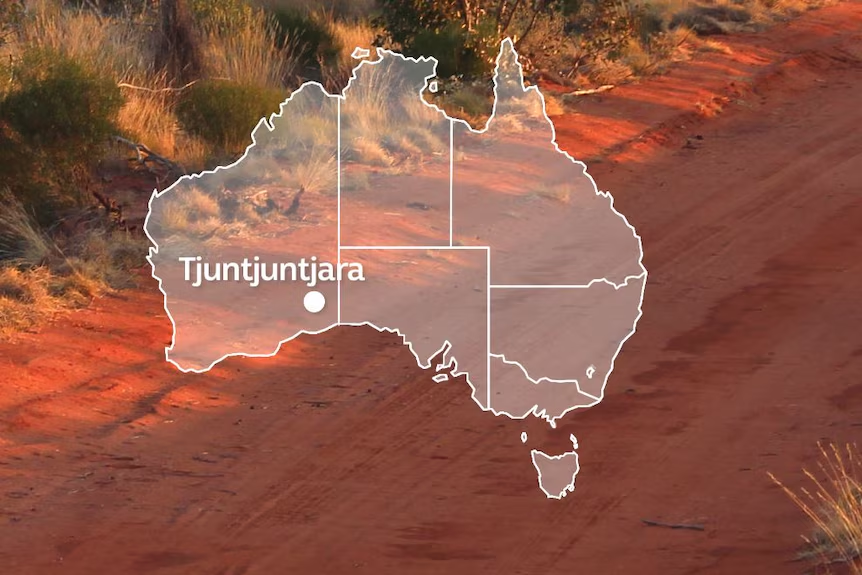
Amid high cigarette prices Tjuntjuntjarra locals call for help for smokers to quit

Across Australia, about 8.8% of adults smoke every day. In remote Aboriginal and Torres Strait Islander communities, the figure shoots to 46%. But in Tjuntjuntjara, community leaders fear smoking rates are far higher.

Community chief executive Jon Lark says the community urgently needs support to lower smoking rates, improve health outcomes and reduce reliance on some of the most expensive cigarettes in the country.

Read the article here.

Contact Quitline for help to quit smoking and vaping: 13 78 48

Tjuntjuntjara is one of Australia’s most remote communities. (ABC News: Sharon Gordon)

WA Aboriginal Youth Conference travel scholarship applications closing soon

Travel scholarship applications for the WA Aboriginal Youth Conference are closing soon on Friday, 2 May. If you’re travelling from a remote or regional area to attend the WA Aboriginal Youth Conference, support is available to help get you there. To apply go here.

The WA Aboriginal Youth Conference is an exclusive one-day event for Aboriginal and/or Torres Strait Islander youth to learn, speak up and discuss important issues in our communities. It provides an opportunity for personal and professional development, inspiration and connection with other like-minded young people.

Image source: AHCWA

Kaartajin Ngundabut Indigenous Cultural Knowledge

The second in a three-part video series, providing foundational learning about Aboriginal and Torres Strait Islander cultural knowledges, and exploring contemporary global issues, is now available.

This series will encourage self-reflection on individual roles as a student, emerging psychologist or researcher, and how to be a better ally, supporting Aboriginal and Torres Strait Islander peoples and social justice.

Watch it here.

Image source: AIPEP

Sector Jobs – you can see sector job listings on the NACCHO website here.

Advertising Jobs – to advertise a job vacancy click here to go to the NACCHO website current job listings webpage. Scroll down to the bottom of the page to find a Post A Job form. You can complete this form with your job vacancy details – it will then be approved for posting and go live on the NACCHO website.

NACCHO Sector News: 27 March 2025

The NACCHO Sector News is a platform we use to showcase the important work being done in Aboriginal and Torres Strait Islander health, focusing on the work of NACCHO, NACCHO members and NACCHO affiliates.

We also share a curated selection of news stories that are of likely interest to the Aboriginal and Torres Strait Islander health sector, broadly.

Aboriginal and Torres Strait Islander groups cautiously optimistic about budget

Money for early childhood development, mental health and infrastructure have left Aboriginal and Torres Strait Islander peak organisations with a feeling of ‘cautious optimism’ following the 2025 federal budget.

Much of the spending allocated in Tuesday night’s budget had been announced previously, including $50 million already earmarked to reduce the price of essential grocery items in remote communities.

Minister For Indigenous Australians Malarndirri McCarthy said she was “very pleased” with this effort towards food security in remote communities, and efforts to tackle rheumatic heart disease, with $11.4 million in the budget to establish or upgrade 12 laundry facilities in remote communities.

To read the full article, go here.

Indigenous Australians Minister Malarndirri McCarthy welcomed simple measures to improve lives. (Lukas Coch/AAP PHOTOS)

Rolling wrap of health sector reaction to the Budget

Many health initiatives in the Federal Budget had already been announced, although no doubt additional items of interest will be uncovered by those reading the Budget papers closely.

Croakey Media links us to key documents, and also a rolling wrap of reaction.

​To read more, go here.

Treasurer Jim Chalmers delivering the 2025-2026 Federal Budget

Plant-based diet trial boosts health for people living with kidney disease

World first research trial shows simple dietary changes can improve gut health and reduce toxins

New research from the University of Wollongong (UOW) has found that a diet rich in diverse plant foods can significantly benefit people living with chronic kidney disease (CKD).

To read the media release, go here.

Associate Professor Kelly Lambert says a diet rich in diverse plant foods can significantly benefit people living with chronic kidney disease. Photo: Michael Gray

Needs-based funding is a must for Aboriginal and Torres Strait Islander communities to access legal services

This powerful statement from Karly Warner, CEO of the Aboriginal Legal Service NSW/ACT, comes in response to Victoria’s controversial youth bail laws. Warner and other legal and community leaders are warning that such policies disproportionately harm Aboriginal and Torres Strait Islander children.

To read more, go here.

Victoria’s bail laws are being challenged (Image: Dechlan Brennan)

Disaster Resilience, Risk Reduction Projects – CLOSES Wed 2.4.25 – National

Funding is available for projects that support disaster resilience and risk reduction, including those that:

  • increase the understanding of natural disaster impacts, build resilience to future disasters and/or reduce natural disaster risk
  • target one or more eligible natural hazard types
  • deliver enduring benefits for communities at risk of future eligible disasters
  • involve one or more eligible activity types in the built, social, natural and/or economic domains.

For further information, applicants should contact the Lead Agency in their jurisdiction.

Sector Jobs – you can see sector job listings on the NACCHO website here.

Advertising Jobs – to advertise a job vacancy click here to go to the NACCHO website current job listings webpage. Scroll down to the bottom of the page to find a Post A Job form. You can complete this form with your job vacancy details – it will then be approved for posting and go live on the NACCHO website.

NACCHO Sector News: 26 March 2025

The NACCHO Sector News is a platform we use to showcase the important work being done in Aboriginal and Torres Strait Islander health, focusing on the work of NACCHO, NACCHO members and NACCHO affiliates.

We also share a curated selection of news stories that are of likely interest to the Aboriginal and Torres Strait Islander health sector, broadly.

Some good news for Aboriginal and Torres Strait Islander health

The National Aboriginal Community-controlled Health Organisation (NACCHO) is pleased to hear of measures which should have a positive effect on Aboriginal and Torres Strait Islander health.

The Chair of NACCHO, Donnella Mills, speaking in Melbourne this evening said, ‘We knew what was coming for our sector from the announcements related to the $842m package (over six years) that the Government negotiated with our colleagues at APONT in the Northern Territory. And we were also aware of some injections of funding in critical programs such as rheumatic heart disease (RHD). There is also funding for the Coalition of Peaks, which we are pleased to see. These are welcome announcements.’

In Canberra last night, Pat Turner, the CEO of NACCHO said, ‘The big thing for our sector in this Budget is the increased access to Medicare and the PBS. The $8.5b Medicare package will not only help our ACCHOs, but the better access to bulkbilling and medicines will directly benefit the half a million or so Aboriginal and Torres Strait Islander people who access our 550 clinics. It was also pleasing to hear that the Coalition supports this critical announcement.’

Notwithstanding the measures in tonight’s Budget, more needs to be done if we are serious about closing the health gap. NACCHO has been working with the Department of Health for over seven years on a new funding model for the ACCHO sector. Currently, most of the funding is tied to historical decisions, which can no longer be justified. So, we are on the cusp of instituting a new and fairer model which represents the best chance we have had in a generation to deliver real reform.

Read the full media release here.

Nunkuwarrin Yunti’s new medical facility

The Aboriginal Health Council of South Australia (AHCSA) were proud to attend the official opening of Nunkuwarrin Yunti’s new medical facility.

Designed with multiple consulting rooms for GPs, nurses, counsellors, and other health practitioners, this space will undoubtedly make a positive impact on the community.

“We look forward to seeing the continued growth and success of Nunkuwarrin Yunti as they serve the health and wellbeing of the community,” AHCSA wrote on social media.

Image source: AHCSA.

‘Excited to serve the community’: new gym is a first of its kind for Orange

Based out of the Orange Aboriginal Medical Service, a new gym specifically aimed at the disabled community opened on Tuesday.

Some of the equipment on offer includes attachments which allow users to lift weights as well as a ceiling hoist and plinth to tackle balancing exercises to work core muscles.

The gym will be operated by Neuromoves – a specialised service from Spinal Cord Injuries Australia – and will be open to all members of the public, not just OAMS patients.

Read more here.

The new gym for Orange’s disabled community, located out of the Orange Aboriginal Medical Service. Picture by Carla Freedman

Good Medicine Better Health: Understanding and Managing Vaping

Vaping is on the rise, and understanding its risks is more important than ever. The latest Good Medicine Better Health module on Understanding and Managing Vaping is here to help.

Gain the knowledge and skills to support clients who vape and help prevent uptake in your community – plus, earn National Association of Aboriginal & Torres Strait Islander Health Workers CPD points along the way.

To complete the GMBH module, go here.

After support to quit vaping or smoking? Reach out to Quit on 13 78 48, or go here.

‘Inspiring’ basketball program keeps young people out of prison system

First Nations-led basketball program Hoops 4 Health gave peer mentor Aaron Hyde the boost he needed to chase his dreams while serving time in prison.

The recently paroled 28-year-old now runs workshops for young people and adults in the Alice Springs men’s prison and in communities to help them tackle trauma.

Founded in Darwin in 2001 by Warumungu and Nyikina man and former pro-baller Timmy Duggan, the basketball program was rolled out in the territory’s youth detention centres in 2016.

Mr Duggan said the initiative combined peer-led emotional regulation sessions, basketball and money skills.

“It’s a traumatic experience going to prison, and what a lot of our participants have faced might have been intergenerational trauma as well, so we’re using this model around healing-centred sport to address it,” he said.

Read the full article here.

Aaron Hyde (left) and Timmy Duggan run trauma-informed basketball workshops in communities and prisons. (ABC News: Michael Donelly)

Sector Jobs – you can see sector job listings on the NACCHO website here.

Advertising Jobs – to advertise a job vacancy click here to go to the NACCHO website current job listings webpage. Scroll down to the bottom of the page to find a Post A Job form. You can complete this form with your job vacancy details – it will then be approved for posting and go live on the NACCHO website.

NACCHO Sector News: 21 March 2025

The NACCHO Sector News is a platform we use to showcase the important work being done in Aboriginal and Torres Strait Islander health, focusing on the work of NACCHO, NACCHO members and NACCHO affiliates.

We also share a curated selection of news stories that are of likely interest to the Aboriginal and Torres Strait Islander health sector, broadly.

2025 NACCHO Aboriginal and Torres Strait Islander Pharmacist Scholarship applications closing soon!

Applications for the 2025 NACCHO Aboriginal and Torres Strait Islander Pharmacist Scholarship are closing soon, Monday 24 March. To apply, go here.

The scholarship program aims to build the Aboriginal and Torres Strait Islander pharmacist workforce and to raise the profile of the beneficial role that pharmacy and pharmacists can play in supporting appropriate and culturally safe care for Aboriginal and Torres Strait Islander peoples.

Each recipient will receive up to $10,000 per annum to contribute to university expenses. The scholarship also includes support and mentorship from Aboriginal and Torres Strait Islander health professionals and organisations to ensure ongoing integration and connection with the Aboriginal and Torres Strait Islander community-controlled health sector.

For questions or further information, please contact Harrison Milne on 0481257904 or harrison.milne@naccho.org.au.

*Proudly supported by a grant from Sanofi

Webinar: Launch of the Australian Clinical Guidelines on HTLV-1 for Aboriginal Primary Health Care Settings

This webinar will launch the Australian Clinical Guidelines on HTLV-1 for Aboriginal Primary Health Care Settings. These guidelines are a comprehensive, culturally safe and evidence-based guide to the prevention, testing, diagnosis, management and care of Human T-lymphotropic virus subtype 1 (HTLV-1).

Date, Time & Venue

  • Monday, 24 March 2025 | 12:00pm – 1:00pm (AEDT)
  • Online via Teams

Target Audience

  • All healthcare workers, particularly those working in the Northern Territory, APY Lands and NG lands.

Register here.

Webinar: Launch of the Australian Clinical Guidelines on HTLV-1 for Aboriginal Primary Health Care Settings

Funding to help Indigenous women and children in the NT leave abusive relationships

Aboriginal and Torres Strait Islander women and children living in Darwin will be given support to leave violent intimate partner relationships through funding for an Indigenous legal organisation by the federal government.

On Friday, the Labor government announced the North Australian Aboriginal Family Legal Service (NAAFLS) had received $9 million in funding to work in partnership with Danila Dilba Health Services, the Darwin Aboriginal and Islander Women’s Shelter, and Yilli Rreung Housing to help support survivors.

NAAFLS will provide survivors with an option to access the Leaving Violence Program through their service as an Aboriginal and Torres Strait Islander Community Organisation.

Read more here.

Women pictured in Alice Springs in July. (Image: Jesse Tyssen)

If you or someone you know is experiencing, or at risk of experiencing, domestic, family, or sexual violence, call 1800RESPECT on 1800 737 732, chat online via www.1800RESPECT.org.au, or text 0458 737 732.

If you are concerned about your behaviour or use of violence, you can contact the Men’s Referral Service on 1300 766 491 or visit  http://www.ntv.org.au

Feeling worried or no good? No shame, no judgement, safe place to yarn. Speak to a 13YARN Crisis Supporter, call 13 92 76. This service is available 24 hours a day, 7 days a week.

VACCHO’s Community Question Time sparks fervent discussions ahead of the Federal Election

The Victorian Aboriginal Community Controlled Health Organisation (VACCHO) hosted their third Community Question Time at the Aborigines Advancement League on Tuesday 18 March.

The insightful evening provided a great platform for conversations that were powerful, raw and at times, emotionally charged. The all-Indigenous panel included Greens Senator Dorinda Cox, Labor Senator Jana Stewart, Independent Senator Lidia Thorpe and VACCHO CEO Dr. Jill Gallagher AO.

The panellists delved into 90 minutes of thought-provoking conversations that covered a broad range of topics such as advocating for better social care systems, changing the date of Australia Day and other matters impacting the health and wellbeing of Aboriginal and Torres Strait Islander people.

Read more here.


Image source: VACCHO

Supporting Aboriginal and Torres Strait Islander mothers and babies

RACGP Rural spoke to Dr Natasha Pavlin from Wurli-Wurlinjang Health Service (Wurli) about the Australian Family Partnership Program (AFPP), a culturally grounded initiative supporting Aboriginal and Torres Strait Islander mothers and babies. The dedication of Natasha and her team ensures that this evidence-based program delivers meaningful, long-lasting health outcomes.

At Wurli, Natasha and her team have tailored it to the needs of the Katherine community. The program pairs trained nurses with Aboriginal family partnership workers who offer culturally informed guidance, ensuring holistic support for families throughout pregnancy, birth and the first two years of a child’s life.

Read more here.

Rana Rankin RN Nurse Home Visitor and Maxine Coombe Family Partnership Worker.

Sector Jobs – you can see sector job listings on the NACCHO website here.

Advertising Jobs – to advertise a job vacancy click here to go to the NACCHO website current job listings webpage. Scroll down to the bottom of the page to find a Post A Job form. You can complete this form with your job vacancy details – it will then be approved for posting and go live on the NACCHO website.

Governance Workshops for ACCHOs: Melbourne, VIC

ACCHOs…Free Governance Workshops are coming your way in 2025! Melbourne you’re up first: Wednesday 26 March & Thursday 27 March.

To register, go here.

NACCHO’s Governance Workshops are designed for people working in member ACCHOs and run by legal and other experts in the field.
The workshops cover:

  • Principles of good governance.
  • Managing conflicts of interest.
  • Managing risk (e.g. contract execution, etc.).
  • Delegation of powers.
  • Finance for Boards.
  • Structure and role of boards and sub-committees; and
  • Governance documents.