NACCHO Sector News: 21 November 2025

Aboriginal and Torres Strait Islander Health News

The NACCHO Sector News is a platform we use to showcase the important work being done in Aboriginal and Torres Strait Islander health, focusing on the work of NACCHO, NACCHO members and NACCHO affiliates.

We also share a curated selection of news stories that are of likely interest to the Aboriginal and Torres Strait Islander health sector, broadly.

Join NACCHO’s COVID-19 Evaluation Report Webinar & Live Q&A

NACCHO’s Covid-19 Evaluation Report: Webinar and live Q&A is being held Wednesday 3 December 2025, 1:00 PM – 1:35 PM AEDT. To register, go here.

Hear from Jason Agostino, Senior Medical Advisor at NACCHO, and George McMahon, Manager at Nous Group, as they unpack findings from the national evaluation of ACCHOs’ COVID-19 response.

  • Learn how flexible funding, local decision-making, and culturally safe communication saved an estimated 2,000 lives.
  • Explore what worked, what didn’t, and recommendations for future emergency preparedness.
  • Understand the role of Elders, cultural knowledge holders, and trusted community leaders in shaping health outcomes.

Registration close Tuesday 2 December 2025.

Central Australia Aboriginal Congress Diabetes Education

The Diabetes Education Service aims to provide information to Aboriginal people living with diabetes in remote and town locations in Central Australia.

The service includes information on:

  • how to manage diabetes
  • treatment
  • healthy eating
  • blood sugar testing.

Learn more here.

Image source: Australian Indigenous HealthInfoNet

VAHS’ Preventative Health Unit the Koori Way keeping busy with school visits

After the successful launch of the postcard activity at recent Community events, Victorian Aboriginal Health Service’ (VAHS) Preventative Health Unit the Koori Way team is bringing it to schools, most recently, at Worawa Aboriginal College.

Students each wrote their own personal message to the tobacco industry, telling them they won’t be their future customer, and to stop killing Mob with their product

The Koori Way then sends these postcards to industry, inundating them with thousands of messages to hold them to account.

Learn more here.

Image source: Victorian Aboriginal Health Service

Goolburri Aboriginal and Torres Strait Islander Health Advancement now a registered provider under the Aged Care Act

Goolburri Aboriginal and Torres Strait Islander Health Advancement was honoured to welcome representatives from the Aged Care Quality & Safety Commission to the office last week for the hand-signing of its Certificate of Registration, alongside CEO, Lizzie Adams, recognising Goolburri as a registered provider under the Aged Care Act.

This milestone is not only a proud achievement for Goolburri, but it also means it can continue providing high-quality, culturally safe care that benefits Elders and strengthens community.

See more photos here.

Image source: Goolburri

Sector Jobs – you can see sector job listings on the NACCHO website here.

Advertising Jobs – to advertise a job vacancy click here to go to the NACCHO website current job listings webpage. Scroll down to the bottom of the page to find a Post A Job form. You can complete this form with your job vacancy details – it will then be approved for posting and go live on the NACCHO website.

Email us your story with some images to: NACCHOCommunicationsandMedia@naccho.org.au and we will feature it in the news.

Email us your story with some images to: NACCHOCommunicationsandMedia@naccho.org.au
and we will feature it in the news.

NACCHO Sector News: 3 November 2025

Aboriginal and Torres Strait Islander Health News

The NACCHO Sector News is a platform we use to showcase the important work being done in Aboriginal and Torres Strait Islander health, focusing on the work of NACCHO, NACCHO members and NACCHO affiliates.

We also share a curated selection of news stories that are of likely interest to the Aboriginal and Torres Strait Islander health sector, broadly.

PITCH First Nations: Using yarns to adapt dementia training for home care workers

First Nations Australians have around 3 times the prevalence of dementia of other Australians and face distinct aged care needs that are not well accommodated by mainstream services.

Dementia Training Australia (DTA) has commissioned National Ageing Research Institute (NARI) to produce PITCH First Nations, an evidence-based training package for home care workers who work with First Nations Elders and older people living with dementia. The project draws on the Promoting Independence Through quality Care at Home (PITCH) training previously developed at NARI.

PITCH First Nations will redevelop the original PITCH training to be culturally relevant, safe, appropriate and tailored to the needs of First Nations people. The training is being redeveloped via a collaborative process with First Nations communities and co-researchers embedded in Aboriginal Community Controlled (ACCO) aged care services, through Yarning Circles with First Nations Elders and older people.

Read the full article

Applications open for 2026 AMA Indigenous Medical Scholarship

Aboriginal and Torres Strait Islander medical students are invited to apply now for the Australian Medical Association’s 2026 Indigenous Medical Scholarship.
Since 1994, the scholarship has helped grow the Aboriginal and Torres Strait Islander medical workforce by supporting First Nations peoples who are enrolled in a medical degree in Australia.

The AMA hopes to build on the increasing success of the scholarship program, with 2025 marking the first time in the scheme’s history that three individual scholarships were awarded in a single year off the back of support from generous donors.

Applications for the 2026 scholarship opened on Saturday and will close on 31 January 2026.

AMA President Dr Danielle McMullen said the scholarship was a crucial part of the AMA’s long-running efforts to grow the Aboriginal and Torres Strait Islander medical workforce in the pursuit of improving health outcomes for Aboriginal and Torres Strait Islander peoples.

Read the full article

2026 AMA Indigenous Medical Scholarship - Apply Now.

2026 AMA Indigenous Medical Scholarship – Apply Now.

Kimberley Youth Night Space Success: Still Awaiting Department Funding

While Kununurra youth crime is in the spotlight, in Fitzroy Crossing – another town in WA’s Kimberley region – children’s laughter drifts through the Marra Worra Worra Aboriginal Corporation’s Night Space – a youth hub that MWWAC director Patrick Green calls a “home for the town’s kids”.

The smell of home-cooked food lingers as Elders swap stories around long tables, a gathering that feels more like a family barbecue than a celebration marking one year of the Night Space. In its first year, the Night Space has offered Fitzroy Crossing’s children warm meals, showers, mentoring and help reconnecting with school and services, with its impact rippling far beyond its walls.

The kitchen has served more than 25,000 meals and engaged nearly 700 young people.

Fitzroy Crossing Senior Sergeant Mark Howes said youth crime has declined significantly since the Night Space began operating 12 months ago.

Read the full article.

Marra Worra Worra Aboriginal Corporation night space one year anniversary.

Marra Worra Worra Aboriginal Corporation night space one year anniversary. Image: Natasha Clark.

We Breathe – Tackling Aboriginal and Torres Strait Islander Smoking

Deciding to quit smoking or vaping is a huge step, and it’s completely normal to feel like there’s a long journey ahead. But you don’t have to go it alone. We’re here to help, and we understand that finding the right support and tools can make all the difference.

That’s why we’ve put together a guide called “5 Hacks to Help Quit Smoking and Vaping.” It’s packed with simple, practical tips designed to help you get started and stay on track.

Ready to take the pledge for a healthier, smoke-free future? Just enter your details into the forms below to receive your free copy of “5 Hacks to Help Quit Smoking and Vaping,” and let’s start this journey together.

Read the full article.

Decorative image

Terminology update for MBS Aboriginal and Torres Strait Islander Health Worker and Practitioner Services

  • From 1 November 2025, the terminology used for MBS Aboriginal and Torres Strait Islander health worker and practitioner services will be updated to reflect the primary health care services the professions provide.
  •  This update will affect a name change to the Health Insurance (Section 3C General
    Medical Services – Allied Health Services) Determination 2024.
  • This change will not affect how the MBS items for these services are used

Access all the information.

Sector Jobs – you can see sector job listings on the NACCHO website here.

Advertising Jobs – to advertise a job vacancy click here to go to the NACCHO website current job listings webpage. Scroll down to the bottom of the page to find a Post A Job form. You can complete this form with your job vacancy details – it will then be approved for posting and go live on the NACCHO website.


Email us your story with some images to: NACCHOCommunicationsandMedia@naccho.org.au and we will feature it in the news.

Email us your story with some images to: NACCHOCommunicationsandMedia@naccho.org.au
and we will feature it in the news.

NACCHO Sector News: 27 August 2025

The NACCHO Sector News is a platform we use to showcase the important work being done in Aboriginal and Torres Strait Islander health, focusing on the work of NACCHO, NACCHO members and NACCHO affiliates.

We also share a curated selection of news stories that are of likely interest to the Aboriginal and Torres Strait Islander health sector, broadly.
Register now for the 2025 NACCHO National Youth Conference!

NACCHO is excited to announce that registrations for the 2025 NACCHO National Youth Conference are now open.

This year’s National Youth Conference is taking place on Monday 8 December 2025 at the Royal Randwick Racecourse, Sydney on Bidjigal & Gadigal Country. The National Youth Conference will bring together up to 100 youth from around Australia to gain experience and exposure to the Aboriginal and Torres Strait Islander sector on a national level. During the conference the youth will engage in discussion, share their experience and learn from other peers from across the country. The conference will allow the youth to learn about informing policy, influencing change and provide a pathway so their voices are heard and represented by NACCHO throughout the sector.

The NACCHO Members’ Conference will follow on Tuesday 9 December and Wednesday 10 December. The Conference theme is Strength Comes from Community Control.

Learn more here.

QAIHC celebrates 31 graduates of the Diploma of Aboriginal and/or Torres Strait Islander Primary Health Care Management

Congratulations to the 31 graduates of the Diploma of Aboriginal and/or Torres Strait Islander Primary Health Care Management as they take their new qualifications to lead with grace, humility and always with Community at heart.

QAIHC Workforce & Development Jurisdiction Manager, Adam Stephen emphasised the importance of growing strong leadership for a strong system, “building a strong sector requires investment in our workforce. This diploma of management goes a long way towards achieving that goal.”

The Diploma of Aboriginal and/or Torres Strait Islander Primary Health Care Management is designed for current and emerging leaders across the ACCHO sector, equipping them with culturally grounded skills to lead teams, manage services, and strengthen community health outcomes.

“As we graduate today, we’re not just celebrating the completion of a course – we’re celebrating a step forward for our people and our communities.

“Each of us now carries a stronger sense of connection to the work we do and the people whom we serve,” said Rory Busch, Aboriginal health practitioner, Gidgee Healing.

Read more here.

31 graduates of the Diploma of Aboriginal and/or Torres Strait Islander Primary Health Care Management. Image source: QAIHC.

RACGP celebrates addition to Aboriginal workforce

Victoria’s RACGP Fellowship ceremony has brought with it a significant milestone, with two New Fellows identifying as Aboriginal among the almost 150 new GPs.

As one of the 149 New Fellows and four Rural Generalist (RG) Fellows awarded, Dr Sharni Wilkes received both Fellowship of the RACGP and RG Fellowship at the Melbourne ceremony, held on Wurundjeri Country.

A Yamatji woman, Dr Wilkes’ Illawadjardi family group has strong connections to the Malgana lands and waters of Shark Bay, Western Australia, on Yamatji Country.

She told newsGP that receiving her Fellowship leaves her feeling ‘excited, relieved, and hopeful’, particularly in the face of recent adversity.

‘I feel incredibly fortunate to have such a legendary team around me throughout my training time and beyond,’ Dr Wilkes said.

Read more here.

Image source: newsGP

iSISTAQUIT Community of Practice Webinar

Learn how health professionals are adapting the iSISTAQUIT resources to their community context.

iSISTAQUIT Community of Practice Webinar:  

  • Wednesday 27th Aug 1.30-2.30 NSW time
  • Special Guest: Kate from Albury Wodonga Aboriginal Health Service
  • Microsoft Teams
  • Meeting ID: 463 353 841 895 6
  • Passcode: Jq73Sw9y

Image source: iSISTAQUIT

The Working Together Book…Ten years later

Working Together: Aboriginal and Torres Strait Islander Mental Health and Wellbeing Principles and Practice (colloquially known as “the Working Together book”) was first published in 2010, with the second edition released in 2014.

It was, and is, a seminal and pioneering text in the field of Indigenous psychology. With ten years passed since the publication of the second edition, we are looking back to acknowledge and celebrate its impact and legacy.

The book was written by a range of acknowledged experts in the mental health field. A strong Indigenous voice permeates throughout; the high number of Aboriginal and Torres Strait Islander authors and the strength of the collegiality and collaboration between authors made both the first and second editions unique.

Learn more here.

Editors: Professor Pat Dudgeon AM (Left) Professor Roz Walker
(Centre) Professor Helen Milroy AM (Right)

Sector Jobs – you can see sector job listings on the NACCHO website here.

Advertising Jobs – to advertise a job vacancy click here to go to the NACCHO website current job listings webpage. Scroll down to the bottom of the page to find a Post A Job form. You can complete this form with your job vacancy details – it will then be approved for posting and go live on the NACCHO website.

NACCHO Sector News: 20 August 2025

The NACCHO Sector News is a platform we use to showcase the important work being done in Aboriginal and Torres Strait Islander health, focusing on the work of NACCHO, NACCHO members and NACCHO affiliates.

We also share a curated selection of news stories that are of likely interest to the Aboriginal and Torres Strait Islander health sector, broadly.

Optimising heart failure care for First Nations people with reduced ejection fraction

This resource developed by NACCHO and developed through the national MAIA project is designed to support GPs and other clinicians working in Aboriginal Community Controlled Health Organisations (ACCHOs) to deliver holistic, person-centred care that strengthens heart health, promotes wellbeing, and empower individuals and families to get the most from the medicines for HFrEF.

Heart failure (HF) is a complex chronic condition that affects how the heart works, often leading to symptoms like breathlessness or tiredness. Wwith the right care, support, and lifestyle changes, people can live well and enjoy a good quality of life after a diagnosis of heart failure.

  • Over 60,000 Australians are diagnosed with heart failure every year.
  • Aboriginal and Torres Strait Islander people are 2.8 times more likely to be hospitalised for heart failure.
  • The average survival rate following a heart failure diagnosis is around five years.

For Aboriginal and Torres Strait Islander peoples, there are higher rates of health conditions such as high blood pressure, heart and kidney disease, diabetes, and rheumatic heart disease—many of which can begin earlier in life.4 While these conditions can increase the risk of heart failure, they also present powerful opportunities for early intervention, culturally safe care, and community-led health solutions.

Access the full resource.

Let’s track flu, COVID-19 & RSV in the community

FluTracking is a quick, 30-second weekly survey where you record if you’ve been feeling sick or well. The more mob that join, the stronger the data becomes — helping us see how illness is moving through community and keeping everyone informed.

It’s simple and quick, and it’s a powerful way to look after each other. Every report matters — whether you’ve got symptoms or not.
Learn more and join

This graph from last weeks data shows the level or respiratory illness among Aboriginal and Torres Strait Islander participants. Sign up today to help keep these weekly graphs accurate and stay aware of what is going around!

Graph showing respiratory illness activity among Aboriginal and Torres Strait Islander participants.

Graph showing respiratory illness activity among Aboriginal and Torres Strait Islander participants.

Help keep mob safe and join flutracking today!

Help keep mob safe and join flutracking today!

Bush medicine partnership to sow seeds of collaboration

An Australian-first $1.01 million research and commercial partnership aims to explore the development of a sustainable agribusiness model for traditional Australian medicinal plants growing in Northern Australia.

The partnership between Menzies School of Health Research (Menzies), Traditional Homeland Enterprises (T.H.E.), Integria Healthcare (Integria) and The University of Queensland has received $363,363 over 18 months in funding from the Cooperative Research Centre for Developing Northern Australia (CRCNA). Project participants have committed $188,845 in cash and $461,074 in-kind contributions towards the project, over the next 18 months.

The Traditional Australian Medicinal Plants Agribusiness collaboration brings together extensive research and industry experience to focus on traditional Australian medicinal plants as an important biological, cultural and economic resource.

The project originated from requests by a Menzies Indigenous Reference Group (IRG) seeking that more research be done on Indigenous medicinal plants. This IRG continues to have oversight of the project. According to Mark Mayo, the partnership’s Indigenous Steering Committee representative and Menzies researcher, the group initiated plans for this project with a view to creating important opportunities for collaboration and mutual learning through the application of modern science to Aboriginal and Torres Strait Islander knowledge.

Read the full article.

Decorative image

Sustainable partnership supports First Nations health workforce

Indigenous Allied Health Australia has partnered with leading IT asset lifecycle management company Greenbox to support Aboriginal health students and promote sustainability.

This partnership strengthens Indigenous Allied Health Australia’s (IAHA) purpose to grow and empower the Aboriginal and Torres Strait Islander health workforce through supportive and culturally safe education, training and employment pathways, while also contributing to digital equity and environmentally responsible practices.

The collaboration will see Greenbox provide repurposed and secure IT equipment to support IAHA’s programs, including the innovative IAHA National Aboriginal and Torres Strait Islander Health Academy.

The Academy program, which operates in five regions nationally, empowers Aboriginal and Torres Strait Islander young people to complete a school-based traineeship, a supportive step on their education, training and career journey.

Read the full article.

Indigenous Allied Health Australia deputy CEO Kylie Stothers.

Indigenous Allied Health Australia deputy CEO Kylie Stothers. Image: Croakey.

Young mob encouraged to FLIP THE VAPE and breathe easy

A mob-led health campaign is blazing a trail to encourage Aboriginal youth in Victoria to ditch vaping.

Led by The Koori Way, a Victorian statewide anti-tobacco and anti-vaping health promotion initiative from the Victorian Aboriginal Health Service, FLIP THE VAPE is designed to empower Aboriginal and Torres Strait Islander youth to take control of their health and quit vaping.

Co-created with 11 Aboriginal Community Controlled Health Organisations (ACCHOs), FLIP THE VAPE is the first anti-vaping initiative of its kind led by mob, for mob.

With involvement from young Aboriginal ambassadors from across Victoria, the campaign calls on the next generation to reclaim their wellbeing, reject the vape, and breathe easy.

Funded by the National Tackling Indigenous Smoking Program, the campaign takes an alternative approach to anti-vaping or smoking campaigns by skipping lectures, fear-based language, and scare tactics in favour of bold, positive, and empowering messaging, along with a community-driven approach.

Instead, FLIP THE VAPE encourages young people to ‘Be a quitter’, ‘Breathe easy’ and ‘Join the flipping movement’.

Read the full article.

Mob-lead health campaign FLIP THE VAPE is encouraging young mob throughout Victoria to ditch vaping.

Mob-lead health campaign FLIP THE VAPE is encouraging young mob throughout Victoria to ditch vaping.


Sector Jobs – you can see sector job listings on the NACCHO website here.

Advertising Jobs – to advertise a job vacancy click here to go to the NACCHO website current job listings webpage. Scroll down to the bottom of the page to find a Post A Job form. You can complete this form with your job vacancy details – it will then be approved for posting and go live on the NACCHO website.


NACCHO Sector News: 13 August 2025

The NACCHO Sector News is a platform we use to showcase the important work being done in Aboriginal and Torres Strait Islander health, focusing on the work of NACCHO, NACCHO members and NACCHO affiliates.

We also share a curated selection of news stories that are of likely interest to the Aboriginal and Torres Strait Islander health sector, broadly.

Celebrating our future leaders in health!

Last week, Queensland Aboriginal and Islander Health Council (QAIHC) proudly hosted a one-week workshop for students completing their Certificate III in Business – Medical Administration, coordinated by our Workforce Coordinator (Medicare and Chronic Disease), Sandy Robertson. Students travelled from across Queensland to take part.

The workshop marked the culmination of their course, and all 14 students proudly received their certificates at the end of the week.

For the past 16 years, QAIHC and UNE Partnerships have worked together to deliver this qualification, helping graduates progress into roles such as practice managers, primary health care managers, team leaders, Aboriginal and Torres Strait Islander health workers and practitioners, and human resource officers – strengthening the ACCHO sector and building community health leadership.

Congratulations to all our graduates – your hard work today is shaping the future of Aboriginal and Torres Strait Islander health in Queensland.

Image source: QAIHC

Milingimbi Public Health team launch Yaka Ŋarali (no smoking) mural

A couple of weeks ago the Milingimbi Public Health team celebrated the launch of the new Yaka Ŋarali (no smoking) mural at the clinic.

The team hosted a week of activities including screen printing, a colour run, and smoothie bikes. The artists shared the story behind the artwork and the team shared messages based on the mural’s key themes of healthy lifestyle and strong culture.

Miwatj Health Aboriginal Corporation hopes the artwork inspires the community to think healthy and come to the clinic when they need help. The Yaka Ŋarali program shares dhäwu on tobacco smoking to support Yolŋu who want to quit.

Image source: Miwatj Health Aboriginal Corporation

Studying in 2006? Lowitja Institute Health and Wellbeing Scholarships are now open

Applications for 2026 Lowitja Institute Health and Wellbeing Scholarships are now open to Aboriginal and Torres Strait Islander students and early career researchers across three streams.

These scholarships contribute to Aboriginal and Torres Strait Islander leadership of health by providing opportunities for Aboriginal and Torres Strait Islander people to develop skills in their chosen area of study.

Learn more here.

Image source: Lowitja Institute

Understanding Social and Emotional Wellbeing as an Aboriginal and Torres Strait Islander Paradigm for Wellbeing

On today, Wednesday 13 August, Gayaa Dhuwi (Proud Spirit) Australia will be hosting a webinar exploring social and emotional wellbeing as an Aboriginal and Torres Strait Islander paradigm for wellbeing. This webinar will unpack the cultural concepts of social and emotional wellbeing, its practical implementation, and its role in research and community-based mental health initiatives.

Join Professor Pat Dudgeon AM, Dr Clinton Schultz, Professor Gail Garvey, and Dr Graham Gee as they discuss the underlying principles of social and emotional wellbeing from an Aboriginal and Torres Strait Islander worldview, approaches to measuring social and emotional wellbeing, and how applying a social and emotional wellbeing lens can strengthen mental health research in community contexts.

  • Date: Wednesday 13 August 2025
  • Time: 3:00 pm – 4:00 pm AEST

Register here.

Image source: Gayaa Dhuwi (Proud Spirit) Australia

Sector Jobs – you can see sector job listings on the NACCHO website here.

Advertising Jobs – to advertise a job vacancy click here to go to the NACCHO website current job listings webpage. Scroll down to the bottom of the page to find a Post A Job form. You can complete this form with your job vacancy details – it will then be approved for posting and go live on the NACCHO website.

NACCHO Sector News: 28 April 2025

The NACCHO Sector News is a platform we use to showcase the important work being done in Aboriginal and Torres Strait Islander health, focusing on the work of NACCHO, NACCHO members and NACCHO affiliates.

We also share a curated selection of news stories that are of likely interest to the Aboriginal and Torres Strait Islander health sector, broadly.

AMSANT calls for national commitment to Closing the Health Gap ahead of Federal Election

The Aboriginal Medical Services Alliance Northern Territory (AMSANT) is calling for on all political parties to reaffirm their commitment to the National Agreement on Closing the Gap and to support better health outcomes for Aboriginal Territorians ahead of the Federal Election.

AMSANT CEO, Dr John Paterson, said the peak body is seeking meetings with all parties to discuss ways to uphold the Closing the Gap targets on First Nations-led service delivery and improving health outcomes.

“Stronger healthcare builds stronger communities,” Dr Paterson said.

“Aboriginal Community Controlled Health Services (ACCHS) have been central to improving the health of Aboriginal communities in the NT, but progress is too slow – held back by deep inequities in housing, education, poverty and other social determinants of health.

“We need a government that is willing to face these health gaps and meaningfully support the ACCHS sector, where they need it. The upcoming Federal Election provides an opportunity for all parties to recommit to the National Agreement and to act on the recommendations of the Productivity Commission’s Review of the National Agreement on Closing the Gap (2024).”

Read the full media release here.

Aboriginal Community Controlled Health Services chief executive John Paterson. (Image: Mitch Woolnough/ABC News)

Maximise Medicare for your ACCHO!

NACCHO, with support from the National Indigenous Australians Agency has free online courses to help ACCHO staff improve Medicare claiming and utilisation of other primary care funding sources.

Earn CPD points! These courses are fully accredited by RACGP, ACRRM, & NAATSIWHIP.

To register, go here.

For more information, go here.

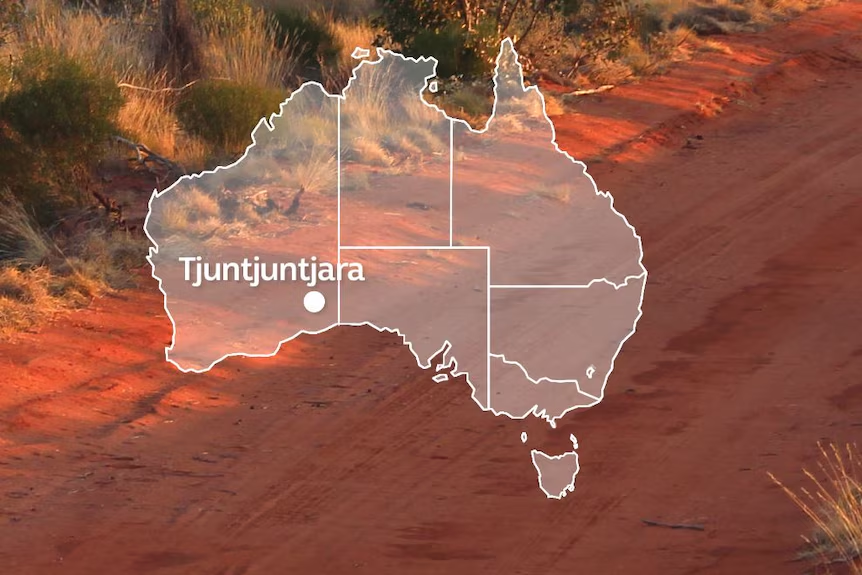
Amid high cigarette prices Tjuntjuntjarra locals call for help for smokers to quit

Across Australia, about 8.8% of adults smoke every day. In remote Aboriginal and Torres Strait Islander communities, the figure shoots to 46%. But in Tjuntjuntjara, community leaders fear smoking rates are far higher.

Community chief executive Jon Lark says the community urgently needs support to lower smoking rates, improve health outcomes and reduce reliance on some of the most expensive cigarettes in the country.

Read the article here.

Contact Quitline for help to quit smoking and vaping: 13 78 48

Tjuntjuntjara is one of Australia’s most remote communities. (ABC News: Sharon Gordon)

WA Aboriginal Youth Conference travel scholarship applications closing soon

Travel scholarship applications for the WA Aboriginal Youth Conference are closing soon on Friday, 2 May. If you’re travelling from a remote or regional area to attend the WA Aboriginal Youth Conference, support is available to help get you there. To apply go here.

The WA Aboriginal Youth Conference is an exclusive one-day event for Aboriginal and/or Torres Strait Islander youth to learn, speak up and discuss important issues in our communities. It provides an opportunity for personal and professional development, inspiration and connection with other like-minded young people.

Image source: AHCWA

Kaartajin Ngundabut Indigenous Cultural Knowledge

The second in a three-part video series, providing foundational learning about Aboriginal and Torres Strait Islander cultural knowledges, and exploring contemporary global issues, is now available.

This series will encourage self-reflection on individual roles as a student, emerging psychologist or researcher, and how to be a better ally, supporting Aboriginal and Torres Strait Islander peoples and social justice.

Watch it here.

Image source: AIPEP

Sector Jobs – you can see sector job listings on the NACCHO website here.

Advertising Jobs – to advertise a job vacancy click here to go to the NACCHO website current job listings webpage. Scroll down to the bottom of the page to find a Post A Job form. You can complete this form with your job vacancy details – it will then be approved for posting and go live on the NACCHO website.

NACCHO Sector News: 31 March 2025

The NACCHO Sector News is a platform we use to showcase the important work being done in Aboriginal and Torres Strait Islander health, focusing on the work of NACCHO, NACCHO members and NACCHO affiliates.

We also share a curated selection of news stories that are of likely interest to the Aboriginal and Torres Strait Islander health sector, broadly.

Have your say on Closing the Gap

How can we strengthen the National Agreement on Closing the Gap? This is your chance to share your experiences and shape the future of how governments and Aboriginal and Torres Strait Islander organisations work together to deliver change.

– Take the short survey
– Make a written submission
– Join an in-person discussion in a place-based partnership community

Your perspective matters.

Have your say by 16 April. Learn more here.

Image source: Coalition of Peaks.

From Yarrabah to Beyond: The Hygiene Program Saving Indigenous Lives to Combat Rheumatic Heart Disease

In Yarrabah, kilometres east of Cairns Renee Grosso is implementing Innovative and fun strengths focused health programs the expand hygiene access and education with a keen focus on Rheumatic Heat Disease (RHD).

Renee is the public health coordinator at Gurriny Yealamucka Health Services’ (GYHSAC) bring an array of health and hygiene programs such as The Yarrabah soap program, Healthy skin hearoes and directly engaging with communities like Groote Eylandt, Jambun and Palm Island. The most recent program that is being championed is the MOOGOO Prevent RHD Program providing ongoing natural hygiene products, including its Milk Wash, to high-risk communities to reduce the likelihood of risks and infections.

Read more here.

Young Child In Yarrabah Practicing Healthy Skin Hero Program With Dolly. Image source: NITV.

The unfinished business of Bringing Them Home

A new Healing Foundation report has found only 6% of the Bringing them home report recommendations – made to support Stolen Generations survivors and their families almost 28 years ago – have been clearly implemented.

It recommends a National Healing Package of priority changes to enable remaining elderly survivors to live out their days with dignity.

The report offers practical policy solutions to some of the big challenges facing survivors and their families, including:

  • access to culturally safe, trauma informed aged care and health services
  • urgent equitable redress
  • prioritised access to records, and
  • investment in Stolen Generation Organisations.

Learn more here.

Image source: The Healing Foundation.

Indigenous-led quit smoking program upscales nationally to help close the gap

An Indigenous-led intervention program tackling smoking and vaping – the leading preventable cause of chronic disease and preventable death for Aboriginal and Torres Strait Islander people — will be upscaled nationally.

The Which Way? Quit Pack pilot program developed by a Newcastle research team has been awarded a $4.7m Medical Research Future Fund (MRFF)* Indigenous Health Research grant through the National Health and Medical Research Council (NHMRC).

Led by Wiradjuri woman, University of Newcastle Associate Professor Michelle Kennedy, of the HMRI** Equity in Health and Wellbeing program, the Which Way? smoking and vaping cessation program builds on existing research by the team, to evaluate the impact of the innovative intervention for Aboriginal and Torres Strait Islander adolescents and adults.

Learn more here.

Which Way? Quit Pack research team members (l-r) Felicity Collis (Gomeroi), Kayden Roberts-Barker (Wiradjuri), Jessica Bennett (Gamilaroi) and lead researcher Associate Professor Michelle Kennedy (Wiradjuri).

Sector Jobs – you can see sector job listings on the NACCHO website here.

Advertising Jobs – to advertise a job vacancy click here to go to the NACCHO website current job listings webpage. Scroll down to the bottom of the page to find a Post A Job form. You can complete this form with your job vacancy details – it will then be approved for posting and go live on the NACCHO website.

Governance Workshops for ACCHOs

Register now for the NACCHO Governance Workshops 2025.

Sydney is up next on Tuesday 15 April and Wednesday 16 April. 

NACCHO’s Governance Workshops are designed for people working in member ACCHOs and run by legal and other experts in the field. 

The workshops cover: 

  • Principles of good governance.  
  • Managing conflicts of interest. 
  • Managing risk (e.g. contract execution, etc.). 
  • Delegation of powers. 
  • Finance for Boards. 
  • Structure and role of boards and sub-committees; and 
  • Governance documents. 

NACCHO Sector News: 28 March 2025

The NACCHO Sector News is a platform we use to showcase the important work being done in Aboriginal and Torres Strait Islander health, focusing on the work of NACCHO, NACCHO members and NACCHO affiliates.

We also share a curated selection of news stories that are of likely interest to the Aboriginal and Torres Strait Islander health sector, broadly.

Aboriginal and Torres Strait Islander-led quit smoking program expands nationally

An Indigenous-led program aimed at reducing smoking and vaping rates among Aboriginal and Torres Strait Islander people will be expanded nationally.

The initiative is led by Wiradjuri woman, Associate Professor Michelle Kennedy, through the HMRI Equity in Health and Wellbeing program.

It is designed to assess the impact of smoking and vaping cessation strategies for both adolescents and adults.

To read the full article, go here.

An Indigenous-led quit smoking program is expanding nationally to help reduce smoking rates. Image: Newcastle University.

Additional funding to support Aboriginal and Torres Strait Islander mothers and babies

A research project aiming to improve outcomes for Indigenous mothers and babies has received a substantial federal funding boost.

The research project, jointly led by Professor Della Forster and community Elder Aunty Gina Bundle, has received $2.9 million to expand its work throughout the state.

The funding will see a research team work with a number of communities in Victoria to implement and expand culturally safe continuity of care for women having an Aboriginal or Torres Strait Islander baby.

To read the media release, go here.

Aunty Gina Bundle will jointly lead the research project alongside La Trobe University’s Professor Della Forster. (Image: The Royal Women’s Hospital/X)

Work begins on new Aboriginal and Torres Strait Islander health centre in Ceduna

Yadu Health Service Aboriginal Corporation is at the forefront of a significant development in Ceduna, South Australia, as construction begins on a new, state-of-the-art health centre dedicated to serving the local Aboriginal and Torres Strait Islander community. This initiative enhances culturally appropriate healthcare services for Aboriginal and Torres Strait Islander people in the region.​

This new clinic will expand its services, provide modern facilities, and ensure that Aboriginal and Torres Strait Islander people in Ceduna, Koonibba, Scotdesco and surrounding homelands continue to receive the best possible care, close to home.

To read more, go here.

Men’s Places Grant Program – CLOSES Mon 31.3.25 – NT

If you have a project to support men’s places, you can apply for a grant of up to $10,000 per applicant.

You can use the grant to support a range of activities such as:

  • information sessions
  • skills development
  • health and wellbeing programs
  • education and peer-to-peer support programs
  • parenting programs and equipment.

Applications are now open until Monday, 31 March 2025.

Learn more here.

Sector Jobs – you can see sector job listings on the NACCHO website here.

Advertising Jobs – to advertise a job vacancy click here to go to the NACCHO website current job listings webpage. Scroll down to the bottom of the page to find a Post A Job form. You can complete this form with your job vacancy details – it will then be approved for posting and go live on the NACCHO website.

Health, Climate & Our Future – Online Consultation for ACCHOs & ACCOs

Hey Mob, we want to hear from you! Climate change isn’t just something happening out there—it’s something we’re feeling in our Communities, in our health, and in the way we do our jobs. Join us for a deadly online yarn about how climate and environment shifts are impacting our ACCOs and ACCHOs, our way of working, and our ways of keeping Mob safe and strong.

Event Details

Date: Thursday 10 April
Time: 12pm – 1:30pm (AEST) (90 mins)
Where: Online (we’ll send the link a week before)

Register now and be part of the yarn! Limited spots available!

NACCHO Sector News: 26 March 2025

The NACCHO Sector News is a platform we use to showcase the important work being done in Aboriginal and Torres Strait Islander health, focusing on the work of NACCHO, NACCHO members and NACCHO affiliates.

We also share a curated selection of news stories that are of likely interest to the Aboriginal and Torres Strait Islander health sector, broadly.

Some good news for Aboriginal and Torres Strait Islander health

The National Aboriginal Community-controlled Health Organisation (NACCHO) is pleased to hear of measures which should have a positive effect on Aboriginal and Torres Strait Islander health.

The Chair of NACCHO, Donnella Mills, speaking in Melbourne this evening said, ‘We knew what was coming for our sector from the announcements related to the $842m package (over six years) that the Government negotiated with our colleagues at APONT in the Northern Territory. And we were also aware of some injections of funding in critical programs such as rheumatic heart disease (RHD). There is also funding for the Coalition of Peaks, which we are pleased to see. These are welcome announcements.’

In Canberra last night, Pat Turner, the CEO of NACCHO said, ‘The big thing for our sector in this Budget is the increased access to Medicare and the PBS. The $8.5b Medicare package will not only help our ACCHOs, but the better access to bulkbilling and medicines will directly benefit the half a million or so Aboriginal and Torres Strait Islander people who access our 550 clinics. It was also pleasing to hear that the Coalition supports this critical announcement.’

Notwithstanding the measures in tonight’s Budget, more needs to be done if we are serious about closing the health gap. NACCHO has been working with the Department of Health for over seven years on a new funding model for the ACCHO sector. Currently, most of the funding is tied to historical decisions, which can no longer be justified. So, we are on the cusp of instituting a new and fairer model which represents the best chance we have had in a generation to deliver real reform.

Read the full media release here.

Nunkuwarrin Yunti’s new medical facility

The Aboriginal Health Council of South Australia (AHCSA) were proud to attend the official opening of Nunkuwarrin Yunti’s new medical facility.

Designed with multiple consulting rooms for GPs, nurses, counsellors, and other health practitioners, this space will undoubtedly make a positive impact on the community.

“We look forward to seeing the continued growth and success of Nunkuwarrin Yunti as they serve the health and wellbeing of the community,” AHCSA wrote on social media.

Image source: AHCSA.

‘Excited to serve the community’: new gym is a first of its kind for Orange

Based out of the Orange Aboriginal Medical Service, a new gym specifically aimed at the disabled community opened on Tuesday.

Some of the equipment on offer includes attachments which allow users to lift weights as well as a ceiling hoist and plinth to tackle balancing exercises to work core muscles.

The gym will be operated by Neuromoves – a specialised service from Spinal Cord Injuries Australia – and will be open to all members of the public, not just OAMS patients.

Read more here.

The new gym for Orange’s disabled community, located out of the Orange Aboriginal Medical Service. Picture by Carla Freedman

Good Medicine Better Health: Understanding and Managing Vaping

Vaping is on the rise, and understanding its risks is more important than ever. The latest Good Medicine Better Health module on Understanding and Managing Vaping is here to help.

Gain the knowledge and skills to support clients who vape and help prevent uptake in your community – plus, earn National Association of Aboriginal & Torres Strait Islander Health Workers CPD points along the way.

To complete the GMBH module, go here.

After support to quit vaping or smoking? Reach out to Quit on 13 78 48, or go here.

‘Inspiring’ basketball program keeps young people out of prison system

First Nations-led basketball program Hoops 4 Health gave peer mentor Aaron Hyde the boost he needed to chase his dreams while serving time in prison.

The recently paroled 28-year-old now runs workshops for young people and adults in the Alice Springs men’s prison and in communities to help them tackle trauma.

Founded in Darwin in 2001 by Warumungu and Nyikina man and former pro-baller Timmy Duggan, the basketball program was rolled out in the territory’s youth detention centres in 2016.

Mr Duggan said the initiative combined peer-led emotional regulation sessions, basketball and money skills.

“It’s a traumatic experience going to prison, and what a lot of our participants have faced might have been intergenerational trauma as well, so we’re using this model around healing-centred sport to address it,” he said.

Read the full article here.

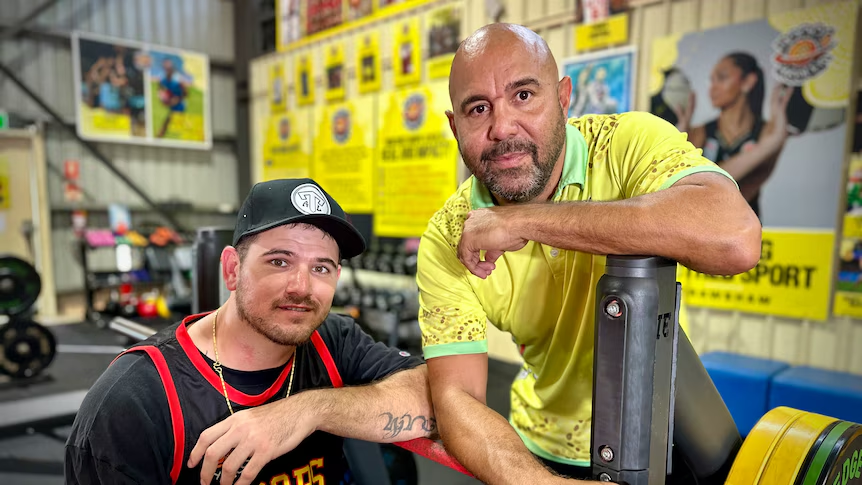
Aaron Hyde (left) and Timmy Duggan run trauma-informed basketball workshops in communities and prisons. (ABC News: Michael Donelly)

Sector Jobs – you can see sector job listings on the NACCHO website here.

Advertising Jobs – to advertise a job vacancy click here to go to the NACCHO website current job listings webpage. Scroll down to the bottom of the page to find a Post A Job form. You can complete this form with your job vacancy details – it will then be approved for posting and go live on the NACCHO website.

NACCHO Sector News: 3 March 2025

The NACCHO Sector News is a platform we use to showcase the important work being done in Aboriginal and Torres Strait Islander health, focusing on the work of NACCHO, NACCHO members and NACCHO affiliates.

We also share a curated selection of news stories that are of likely interest to the Aboriginal and Torres Strait Islander health sector, broadly.

$9 Return for Every Dollar Spent on FASD Campaigns

Strong Born is excited to announce the release of three new resources on its website, providing in-depth evaluations of the impact of Fetal Alcohol Spectrum Disorder (FASD) health promotion activities. These evaluations offer valuable insights into the effectiveness of Strong Born’s initiatives and their impact on communities.

The three resources available are:

  1. Evaluation of the Strong Born Campaign and FASD Communications and Engagement Grant (Round 1) for Aboriginal and Torres Strait Islander people in regional and remote communities
  2. Final Evaluation of the National Awareness Campaign on Alcohol, Pregnancy, Breastfeeding and Fetal Alcohol Spectrum Disorder, SAHMRI (2021-2024)
  3. Social Return on Investment for FASD health promotion campaigns (including Strong Born, stream 4 of the Every Moment Matters Campaign, 2024)

These reports reveal key findings, including that for every $1 spent on FASD awareness and education through this campaign, an impressive $9 was saved. These results speak to the incredible work ACCHOs do for their community – the holistic and wrap-around care ACCHOs are known for is clearly delivering results for mob.

Strong Born expresses its gratitude to all ACCHOs involved in the evaluation for their vital contributions and dedication.

Visit the Strong Born website to access these resources and learn more about the important work being done to promote FASD awareness and education.

If you would like to get involved and find out how NACCHO can support FASD prevention in your community, send us an email at fasdprograms@naccho.org.au

Left: Yura Yungi Medical Service Aboriginal Corporation community event (Sept 24). Right, top: Sunrise Health Service Strong Born movie night (Oct 24) Right, bottom: SAWCAN community event (May 24)

Free, culturally safe health clinic for Aboriginal and Torres Strait Islander women to open in Melbourne

Aboriginal and Torres Strait Islander women across metropolitan Melbourne will soon have access to free, comprehensive, and culturally safe care.

Minister for Health Mary-Anne Thomas announced on Thursday that the First Peoples’ Health and Wellbeing (FPHW) will deliver new clinics from their Thomastown and Frankston locations from mid-2025.

FPHW, previously known as Access Services for Koories, is an Aboriginal community-controlled health organisation (ACCHO) set up to improve primary health care access for Aboriginal and Torres Strait Islander women in the northwest of Melbourne.

​ To read the full article, go here.

Colleen Kelly (Board Chair), Bronwyn Halfpenny MP, Karinda Taylor (CEO) and Mary-Anne Thomas MP at the announcement this week (Image: nit.com.au)

Work starts on Australian-first South Coast Birthing on Country hub

Aboriginal and Torres Strait Islander organisations are actively leading disaster response efforts across Australia, demonstrating resilience and community solidarity.

In Cardwell, the Girringun Aboriginal Corporation has been coordinating local responses, with ranger groups providing relief to communities. In Victoria, the Barengi Gadjin Land Council has been communicating with traditional owners and assisting authorities in responding to the fires. In Western Australia, the Ngarluma Yindjibarndi Foundation Ltd. supported culturally appropriate communication and provided important advice to emergency service agencies during evacuations.

Recognising the essential role of Aboriginal and Torres Strait Islander organisations, there is a growing call for increased support and funding to enhance their capacity in disaster management and climate resilience.

​For more information, go here.

indigenousx.com.au

Culturally-led smoking study paving the way for healthier Aboriginal and Torres Strait Islander kids

A groundbreaking study is using culturally appropriate strategies to tackle the impacts of nicotine exposure on Aboriginal and Torres Strait Islander children.

This initiative works with communities to develop solutions reflecting their knowledge, values, and lived experiences. By prioritising community-led approaches, the study aims to empower families with practical, culturally safe interventions, contributing to healthier futures for Aboriginal and Torres Strait Islander children.

For more information, go here.

Researchers hope to understand why Aboriginal and Torres Strait Islander babies are disproportionately affected by nicotine exposure. (ABC Wide Bay: James Taylor)

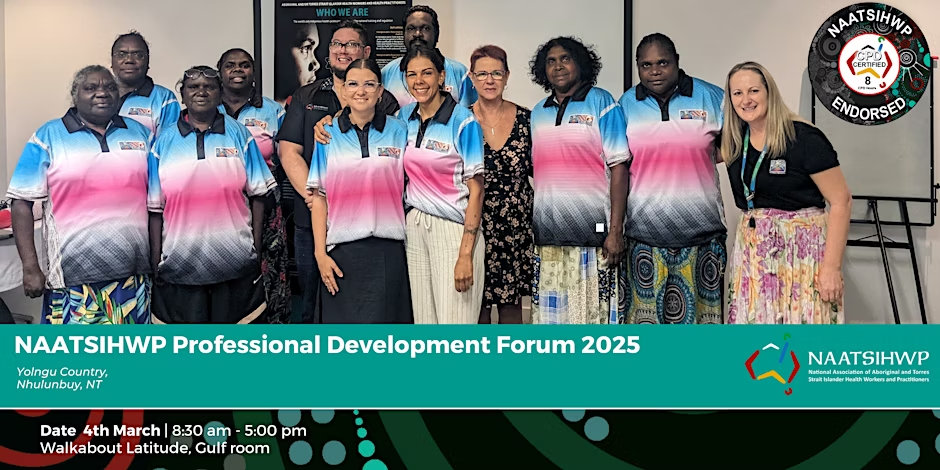
NAATSIHWP’s Professional Development Forums

The National Association of Aboriginal and Torres Strait Islander Health Workers and Practitioners (NAATSIHWP) Team hosts forums regularly, keep your eyes out on our website for further details!

Reasons to sign up:

  • This Professional Development Forum is FREE OF COST and open to everyone
  • Up to 8 Hours of CPD
  • Get awarded with a certificate for attendance
  • You will gain valuable knowledge which you can apply not only to your workplace but also within your communities and in your daily life

Register for Nhulunby, 4 March here.

Register for Albury Wodonga, 20 March here

Image source: NAATSIHWP

Sector Jobs – you can see sector job listings on the NACCHO website here.

Advertising Jobs – to advertise a job vacancy click here to go to the NACCHO website current job listings webpage. Scroll down to the bottom of the page to find a Post A Job form. You can complete this form with your job vacancy details – it will then be approved for posting and go live on the NACCHO website.