- PITCH First Nations: Using yarns to adapt dementia training for home care workers
- Over $9 million for health and medical research partnerships
- Exclusive: Noongar medical student Shakayla Walley-Wihongi and team pioneers a new pathway to treat syphilis
- Study shows world-first Australian preterm birth prevention program is working
- It’s good to know: Lung cancer screening is free and could save your life!
- Sector Jobs
- Events and training
The NACCHO Sector News is a platform we use to showcase the important work being done in Aboriginal and Torres Strait Islander health, focusing on the work of NACCHO, NACCHO members and NACCHO affiliates.
We also share a curated selection of news stories that are of likely interest to the Aboriginal and Torres Strait Islander health sector, broadly.
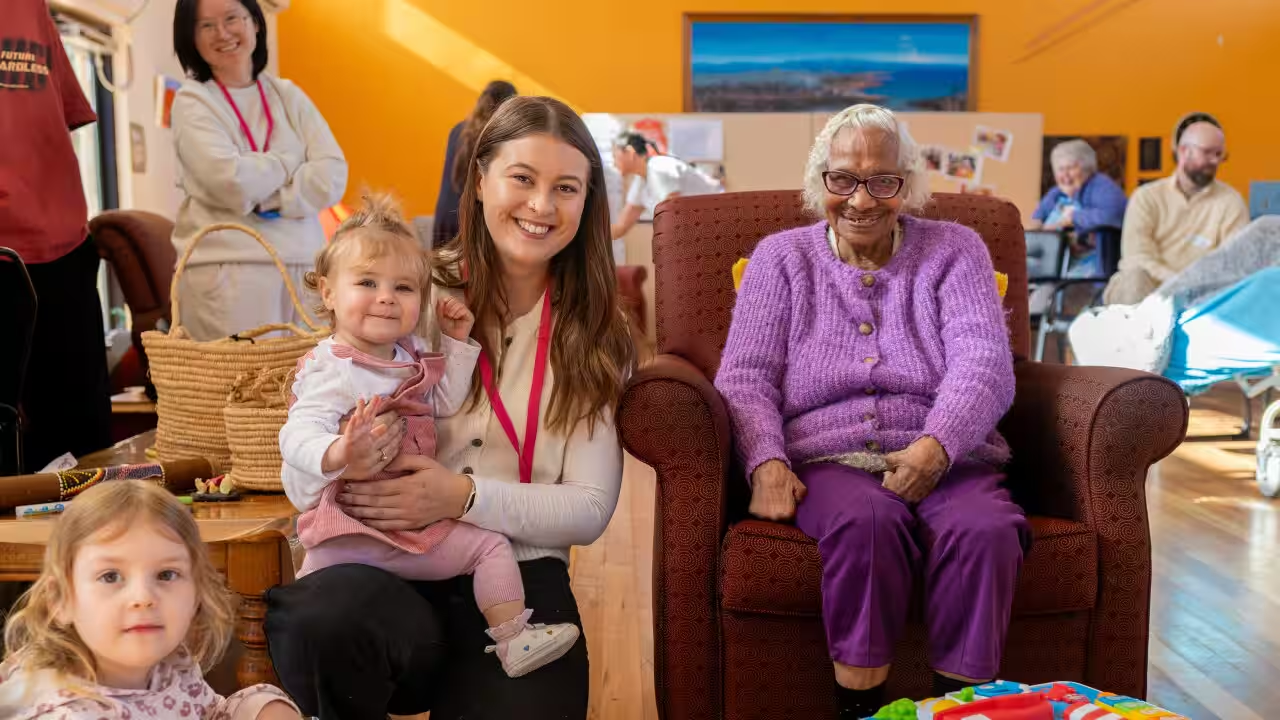
PITCH First Nations: Using yarns to adapt dementia training for home care workers
First Nations Australians have around 3 times the prevalence of dementia of other Australians and face distinct aged care needs that are not well accommodated by mainstream services.
Dementia Training Australia (DTA) has commissioned National Ageing Research Institute (NARI) to produce PITCH First Nations, an evidence-based training package for home care workers who work with First Nations Elders and older people living with dementia. The project draws on the Promoting Independence Through quality Care at Home (PITCH) training previously developed at NARI.
PITCH First Nations will redevelop the original PITCH training to be culturally relevant, safe, appropriate and tailored to the needs of First Nations people. The training is being redeveloped via a collaborative process with First Nations communities and co-researchers embedded in Aboriginal Community Controlled (ACCO) aged care services, through Yarning Circles with First Nations Elders and older people.
Over $9 million for health and medical research partnerships
The Australian Government is strengthening research partnerships that will deliver better care for Aboriginal communities across Australia, with more than $9 million invested in new health and medical research projects.
Through the National Health and Medical Research Council’s (NHMRC) Partnership Project scheme, the government is contributing $4 million, with an additional $5 million committed by funding partners.
Three chief investigators and their teams will lead projects, working hand in hand with partners to turn evidence into practical improvements in Aboriginal health services and outcomes.
Professor Asha Bowen from the University of Western Australia will work closely with Aboriginal Elders and community members to develop an Aboriginal health practitioner-led skin health assessment and research evaluation initiative.
Skin conditions that can lead to bacterial infections are common among Aboriginal children and can reduce their quality of life and lead to serious illness. There is an urgent need for better skin health services for Aboriginal children.
In partnership with the Child and Adolescent Health and South Metropolitan Health Services, this project will identify and treat harmful skin conditions in Aboriginal children leading to better outcomes.
Exclusive: Noongar medical student Shakayla Walley-Wihongi and team pioneers a new pathway to treat syphilis
23-year-old soon-to-be doctor Shakayla Walley-Wihongi, with a team of scientific powerhouses, has blazed a trail in the treatment of syphilis.
In its most dangerous form of mother-to-child transmission (MTCT), the illness claims the lives of 40 per cent of babies born with congenital syphilis. However, perinatal death is 100 per cent preventable.
Syphilis remains at an all-time high with a 251 per cent increase in Australia in the last decade, according to the University of New South Wales’ annual surveillance report released in 2023.Ms Walley-Wihongi graduated with her Honours in Biomedical Science at the University of Notre Dame with the penicillin team at The Kids Research Institute Australia, a research facility that focuses on improving the lives of children who require medical support.
The Australian syphilis epidemic disproportionately impacts two distinct populations: heterosexual Aboriginal and Torres Strait Islander Mob whose residences are dispersed across rural and remote communities, and urban living men who have sex with men.
Ms Walley-Wihongi’s primary supervisor, Associate Professor Laurens Manning of the University of Western Australia’s Medical School, conceptualised the subcutaneous infusion of benzathine penicillin G (SCIP) with the wider Penicillin team, before Shakayla’s academic journey.

Shakayla Walley-Wihongi at Australasian Society for Infectious Diseases Annual Scientific Meeting in Canberra in April. Image: supplied.
Study shows world-first Australian preterm birth prevention program is working
New data has shown that a world-first initiative to reduce preterm births in Australia has led to a significant decrease in rates of potentially harmful early birth and improved pregnancy outcomes for women across the country.
Published in The Lancet Obstetrics, Gynaecology, & Women’s Health, the study presents detailed outcomes from a six-year preterm birth prevention program first introduced in mid-2018.
Preterm birth – defined as birth before 37 completed weeks of pregnancy – remains a leading cause of death and long-term disability in children worldwide.
In response to rising rates of potentially harmful early birth across the country, the Australian Preterm Birth Prevention Alliance launched a comprehensive preterm birth prevention program in 2018.
Professor of Obstetrics at The University of Western Australia, and Chair and Founder of the Australian Preterm Birth Prevention Alliance, Professor John Newnham said the ‘proof of concept’ phase for the program had been modelled on a pioneering initiative delivered in Western Australia.
“From 2018-2021, broad implementation of preterm birth prevention strategies across the country through the Alliance were found to have lowered the rate of preterm birth by 10 per cent,” Professor Newnham said.
It’s good to know: Lung cancer screening is free and could save your life!
We are launching a new campaign, supported by the Australian Government, to raise awareness of the National Lung Cancer Screening Program.
Lung cancer is the leading cause of cancer-related death in Australia, but with lung screening we can change this. If found early, over 65% of lung cancers can be successfully treated.
If you’re aged 50 to 70 and have a history of smoking, talk to your doctor or healthcare provider about lung screening.
Find out more: www.lungcancerscreen.org.au

There’s a new lung cancer screening program. Visit lungcancerscreen.org.au

Sector Jobs – you can see sector job listings on the NACCHO website here.
Advertising Jobs – to advertise a job vacancy click here to go to the NACCHO website current job listings webpage. Scroll down to the bottom of the page to find a Post A Job form. You can complete this form with your job vacancy details – it will then be approved for posting and go live on the NACCHO website.

Email us your story with some images to: NACCHOCommunicationsandMedia@naccho.org.au
and we will feature it in the news.