NACCHO Sector News: 3 December 2025

Aboriginal and Torres Strait Islander Health News

The NACCHO Sector News is a platform we use to showcase the important work being done in Aboriginal and Torres Strait Islander health, focusing on the work of NACCHO, NACCHO members and NACCHO affiliates.

We also share a curated selection of news stories that are of likely interest to the Aboriginal and Torres Strait Islander health sector, broadly.

ACT is the first jurisdiction in the country to legislate its Closing the Gap commitments

The ACT is the first jurisdiction in the country to legislate its Closing the Gap commitments, with the bill passing late yesterday.

From July next year senior public servants will be required to uphold a “Closing the Gap principle”, with public sector entities to report annually on progress on the national agreement, which sets targets to address Indigenous inequality.

For Julie Tongs, the chief executive of Winnunga Nimmityjah Aboriginal Health and Community Services, it has “been a long time coming”.

“But the hard work’s still ahead,” she said.

“The proof is in the pudding, as they say, so we’ll see how this plays out in years to come, but this is a great first step.

“I hope that this is the turning point for [the government and its public servants], that they do take us seriously and that they take this bill seriously.”

Read the full article here.
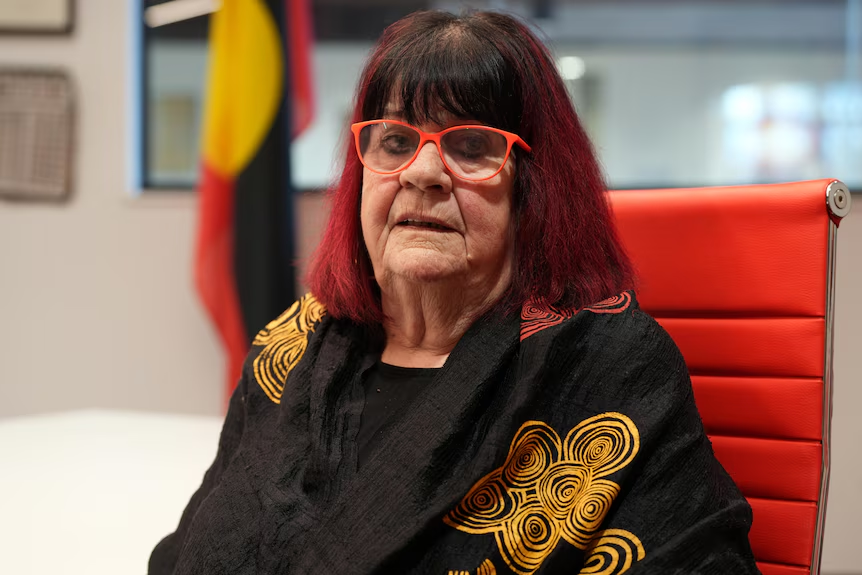
Julie Tongs says the bill is a great first step, but there is still hard work ahead. (ABC News: Adam Shirley)

International Day of People with Disability

Today is International Day of People with Disability – a day to celebrate inclusion, equity, and community-led change.

At NACCHO, we’re proud of our Aboriginal Disability Liaison Officers (ADLOs) across the country who are helping our mob navigate the NDIS with cultural care and support.

ADLOs are more than connectors, they’re changemakers. They strengthen community ties, remove barriers, and make sure our people living with disability are supported in ways that reflect our culture, rights, and lived experiences.

As Dr Sarah Hayton, Executive Director at NACCHO, said:
“Our ADLOs are helping to transform access and inclusion through cultural connection, respect, and rights-based support.”

Let’s honour the strength and resilience of our people living with disability, their carers, and the community teams walking alongside them every day.

Learn more here.

NACCHO Elder Care Support Workshop

We recently held the NACCHO Elder Care Support Workshop, a two-day training program in Adelaide focused on strengthening care for Elders across our communities.

Key focus areas included:

  • Building workforce training pathways
  • Enhancing communications and engagement
  • Developing a robust data strategy
  • Supporting our sector and shaping the future of the program

It was a productive workshop filled with collaboration and valuable insights. A big thank you to all attendees for their contributions, and to the Australian Government Department of Health, Disability and Ageing representatives for sharing their perspectives.

New Great Southern Aboriginal Medical Service leads country’s first Indigenous-focused first aid sessions

Aboriginal communities in the Great Southern are the first in the country to benefit from a national initiative delivering vital emergency training, thanks to a newly established Indigenous health service.

More than 50 Aboriginal people attended the first sessions in Albany last week, with many more scheduled to attend sessions in Mt Barker, Tambellup, Katanning, Gnowangerup and Kojonup.

A joint effort between the newly formed Great Southern Aboriginal Medical Service, Community First Responders Australia and the Heart Foundation, the initiative teaches residents basic first aid, including how to use a defibrillator, to improve survival rates from sudden cardiac arrest.

Read more here.

Gwyn Nichols, Sarah Williams, Lindsay Dean, Professor Sandra Eades AO, Patricia Williams and Leon Landau. Credit: Laurie Benson

Sector Jobs – you can see sector job listings on the NACCHO website here.

Advertising Jobs – to advertise a job vacancy click here to go to the NACCHO website current job listings webpage. Scroll down to the bottom of the page to find a Post A Job form. You can complete this form with your job vacancy details – it will then be approved for posting and go live on the NACCHO website.

Email us your story with some images to: NACCHOCommunicationsandMedia@naccho.org.au and we will feature it in the news.

Email us your story with some images to: NACCHOCommunicationsandMedia@naccho.org.au
and we will feature it in the news.

NACCHO Sector News: 26 November 2025

Aboriginal and Torres Strait Islander Health News

The NACCHO Sector News is a platform we use to showcase the important work being done in Aboriginal and Torres Strait Islander health, focusing on the work of NACCHO, NACCHO members and NACCHO affiliates.

We also share a curated selection of news stories that are of likely interest to the Aboriginal and Torres Strait Islander health sector, broadly.

Register for the 2025 NACCHO Members’ Conference by Sunday 30 November

Register for the 2025 NACCHO Members Conference by Sunday 30 November to avoid late fees.

Late fees will apply from 1 December. Any registrations not paid by the 30th will be reissued with an updated invoice with the late fee amount.

This year’s NACCHO Members’ Conference, National Youth Conference, and AGM is taking place from Monday 8 to Wednesday 10 December 2025 at the Royal Randwick Racecourse, Sydney. The Conference theme is Strength Comes from Community Control.

To register and for more information, go here.

AHCSA celebrates 150 graduates

Last week, Aboriginal Health Council of South Australia (AHCSA) celebrated close to 150 graduates of our Certificate III & IV in Aboriginal and/or Torres Strait Islander Primary Health, as well as the Aboriginal Maternal and Infant Care certificate, from the past few years.

Tanya McGregor (Yaruwu), AHCSA CEO, and The Hon. Kyam Maher MLC, Minister for Aboriginal Affairs, delivered graduate addresses that highlighted the vital role these graduates will play in contributing to positive health outcomes for Aboriginal and Torres Strait Islander communities in South Australia. They reminded graduates that this achievement marks only the beginning of their deadly journeys.

Justine Sampson (Ngarrindjeri), shared a heartfelt address, emphasising the importance of Aboriginal Health Workers and Aboriginal Health Practitioners in advocating for the health and wellbeing of all mob, and ensuring the next generations grow up stronger and healthier.

See more photos here.

Image source: AHCSA

2026 Deadly Sex NSW Forum

AH&MRC of NSW is thrilled to announce the inaugural Deadly Sex NSW Forum 2026. Taking place on 17–18 March 2026 at AH&MRC Training College in Little Bay (Bidjigal & Gadigal lands), the two-day event is for Aboriginal and Torres Strait Islander Primary Health Care Professionals to strengthen skills, share stories, and stay up to date on BBVs and STIs.

Why attend?
• Learn the latest evidence and culturally safe strategies
• Build confidence and workforce skills
• Connect with peers, mentors, and experts
• Celebrate community-led solutions

Register now to secure your spot.

Image source: AH&MRC

Sister Kate’s site to become home to Perth’s first Aboriginal aged care facility

Perth’s first Aboriginal aged care facility will be built on the old Sister Kate’s site in Queens Park.

It is hoped it will be a step toward reconciliation for a site with a dark history for some of Western Australia’s Stolen Generations.

The facility, with 100 beds and specialised supports and programs, is expected to open in 2028.

Read the ABC News article here.

The new facility will sit next door to existing long-time seniors’ accommodation and several heritage-listed buildings. (Supplied: Hall & Prior)

Sector Jobs – you can see sector job listings on the NACCHO website here.

Advertising Jobs – to advertise a job vacancy click here to go to the NACCHO website current job listings webpage. Scroll down to the bottom of the page to find a Post A Job form. You can complete this form with your job vacancy details – it will then be approved for posting and go live on the NACCHO website.

Email us your story with some images to: NACCHOCommunicationsandMedia@naccho.org.au and we will feature it in the news.

Email us your story with some images to: NACCHOCommunicationsandMedia@naccho.org.au
and we will feature it in the news.

NACCHO Sector News: 21 November 2025

Aboriginal and Torres Strait Islander Health News

The NACCHO Sector News is a platform we use to showcase the important work being done in Aboriginal and Torres Strait Islander health, focusing on the work of NACCHO, NACCHO members and NACCHO affiliates.

We also share a curated selection of news stories that are of likely interest to the Aboriginal and Torres Strait Islander health sector, broadly.

Join NACCHO’s COVID-19 Evaluation Report Webinar & Live Q&A

NACCHO’s Covid-19 Evaluation Report: Webinar and live Q&A is being held Wednesday 3 December 2025, 1:00 PM – 1:35 PM AEDT. To register, go here.

Hear from Jason Agostino, Senior Medical Advisor at NACCHO, and George McMahon, Manager at Nous Group, as they unpack findings from the national evaluation of ACCHOs’ COVID-19 response.

  • Learn how flexible funding, local decision-making, and culturally safe communication saved an estimated 2,000 lives.
  • Explore what worked, what didn’t, and recommendations for future emergency preparedness.
  • Understand the role of Elders, cultural knowledge holders, and trusted community leaders in shaping health outcomes.

Registration close Tuesday 2 December 2025.

Central Australia Aboriginal Congress Diabetes Education

The Diabetes Education Service aims to provide information to Aboriginal people living with diabetes in remote and town locations in Central Australia.

The service includes information on:

  • how to manage diabetes
  • treatment
  • healthy eating
  • blood sugar testing.

Learn more here.

Image source: Australian Indigenous HealthInfoNet

VAHS’ Preventative Health Unit the Koori Way keeping busy with school visits

After the successful launch of the postcard activity at recent Community events, Victorian Aboriginal Health Service’ (VAHS) Preventative Health Unit the Koori Way team is bringing it to schools, most recently, at Worawa Aboriginal College.

Students each wrote their own personal message to the tobacco industry, telling them they won’t be their future customer, and to stop killing Mob with their product

The Koori Way then sends these postcards to industry, inundating them with thousands of messages to hold them to account.

Learn more here.

Image source: Victorian Aboriginal Health Service

Goolburri Aboriginal and Torres Strait Islander Health Advancement now a registered provider under the Aged Care Act

Goolburri Aboriginal and Torres Strait Islander Health Advancement was honoured to welcome representatives from the Aged Care Quality & Safety Commission to the office last week for the hand-signing of its Certificate of Registration, alongside CEO, Lizzie Adams, recognising Goolburri as a registered provider under the Aged Care Act.

This milestone is not only a proud achievement for Goolburri, but it also means it can continue providing high-quality, culturally safe care that benefits Elders and strengthens community.

See more photos here.

Image source: Goolburri

Sector Jobs – you can see sector job listings on the NACCHO website here.

Advertising Jobs – to advertise a job vacancy click here to go to the NACCHO website current job listings webpage. Scroll down to the bottom of the page to find a Post A Job form. You can complete this form with your job vacancy details – it will then be approved for posting and go live on the NACCHO website.

Email us your story with some images to: NACCHOCommunicationsandMedia@naccho.org.au and we will feature it in the news.

Email us your story with some images to: NACCHOCommunicationsandMedia@naccho.org.au
and we will feature it in the news.

NACCHO Sector News: 3 November 2025

Aboriginal and Torres Strait Islander Health News

The NACCHO Sector News is a platform we use to showcase the important work being done in Aboriginal and Torres Strait Islander health, focusing on the work of NACCHO, NACCHO members and NACCHO affiliates.

We also share a curated selection of news stories that are of likely interest to the Aboriginal and Torres Strait Islander health sector, broadly.

PITCH First Nations: Using yarns to adapt dementia training for home care workers

First Nations Australians have around 3 times the prevalence of dementia of other Australians and face distinct aged care needs that are not well accommodated by mainstream services.

Dementia Training Australia (DTA) has commissioned National Ageing Research Institute (NARI) to produce PITCH First Nations, an evidence-based training package for home care workers who work with First Nations Elders and older people living with dementia. The project draws on the Promoting Independence Through quality Care at Home (PITCH) training previously developed at NARI.

PITCH First Nations will redevelop the original PITCH training to be culturally relevant, safe, appropriate and tailored to the needs of First Nations people. The training is being redeveloped via a collaborative process with First Nations communities and co-researchers embedded in Aboriginal Community Controlled (ACCO) aged care services, through Yarning Circles with First Nations Elders and older people.

Read the full article

Applications open for 2026 AMA Indigenous Medical Scholarship

Aboriginal and Torres Strait Islander medical students are invited to apply now for the Australian Medical Association’s 2026 Indigenous Medical Scholarship.
Since 1994, the scholarship has helped grow the Aboriginal and Torres Strait Islander medical workforce by supporting First Nations peoples who are enrolled in a medical degree in Australia.

The AMA hopes to build on the increasing success of the scholarship program, with 2025 marking the first time in the scheme’s history that three individual scholarships were awarded in a single year off the back of support from generous donors.

Applications for the 2026 scholarship opened on Saturday and will close on 31 January 2026.

AMA President Dr Danielle McMullen said the scholarship was a crucial part of the AMA’s long-running efforts to grow the Aboriginal and Torres Strait Islander medical workforce in the pursuit of improving health outcomes for Aboriginal and Torres Strait Islander peoples.

Read the full article

2026 AMA Indigenous Medical Scholarship - Apply Now.

2026 AMA Indigenous Medical Scholarship – Apply Now.

Kimberley Youth Night Space Success: Still Awaiting Department Funding

While Kununurra youth crime is in the spotlight, in Fitzroy Crossing – another town in WA’s Kimberley region – children’s laughter drifts through the Marra Worra Worra Aboriginal Corporation’s Night Space – a youth hub that MWWAC director Patrick Green calls a “home for the town’s kids”.

The smell of home-cooked food lingers as Elders swap stories around long tables, a gathering that feels more like a family barbecue than a celebration marking one year of the Night Space. In its first year, the Night Space has offered Fitzroy Crossing’s children warm meals, showers, mentoring and help reconnecting with school and services, with its impact rippling far beyond its walls.

The kitchen has served more than 25,000 meals and engaged nearly 700 young people.

Fitzroy Crossing Senior Sergeant Mark Howes said youth crime has declined significantly since the Night Space began operating 12 months ago.

Read the full article.

Marra Worra Worra Aboriginal Corporation night space one year anniversary.

Marra Worra Worra Aboriginal Corporation night space one year anniversary. Image: Natasha Clark.

We Breathe – Tackling Aboriginal and Torres Strait Islander Smoking

Deciding to quit smoking or vaping is a huge step, and it’s completely normal to feel like there’s a long journey ahead. But you don’t have to go it alone. We’re here to help, and we understand that finding the right support and tools can make all the difference.

That’s why we’ve put together a guide called “5 Hacks to Help Quit Smoking and Vaping.” It’s packed with simple, practical tips designed to help you get started and stay on track.

Ready to take the pledge for a healthier, smoke-free future? Just enter your details into the forms below to receive your free copy of “5 Hacks to Help Quit Smoking and Vaping,” and let’s start this journey together.

Read the full article.

Decorative image

Terminology update for MBS Aboriginal and Torres Strait Islander Health Worker and Practitioner Services

  • From 1 November 2025, the terminology used for MBS Aboriginal and Torres Strait Islander health worker and practitioner services will be updated to reflect the primary health care services the professions provide.
  •  This update will affect a name change to the Health Insurance (Section 3C General
    Medical Services – Allied Health Services) Determination 2024.
  • This change will not affect how the MBS items for these services are used

Access all the information.

Sector Jobs – you can see sector job listings on the NACCHO website here.

Advertising Jobs – to advertise a job vacancy click here to go to the NACCHO website current job listings webpage. Scroll down to the bottom of the page to find a Post A Job form. You can complete this form with your job vacancy details – it will then be approved for posting and go live on the NACCHO website.


Email us your story with some images to: NACCHOCommunicationsandMedia@naccho.org.au and we will feature it in the news.

Email us your story with some images to: NACCHOCommunicationsandMedia@naccho.org.au
and we will feature it in the news.

NACCHO Sector News: 30 October 2025

Aboriginal and Torres Strait Islander Health News

The NACCHO Sector News is a platform we use to showcase the important work being done in Aboriginal and Torres Strait Islander health, focusing on the work of NACCHO, NACCHO members and NACCHO affiliates.

We also share a curated selection of news stories that are of likely interest to the Aboriginal and Torres Strait Islander health sector, broadly.

PITCH First Nations: Using yarns to adapt dementia training for home care workers

First Nations Australians have around 3 times the prevalence of dementia of other Australians and face distinct aged care needs that are not well accommodated by mainstream services.

Dementia Training Australia (DTA) has commissioned National Ageing Research Institute (NARI) to produce PITCH First Nations, an evidence-based training package for home care workers who work with First Nations Elders and older people living with dementia. The project draws on the Promoting Independence Through quality Care at Home (PITCH) training previously developed at NARI.

PITCH First Nations will redevelop the original PITCH training to be culturally relevant, safe, appropriate and tailored to the needs of First Nations people. The training is being redeveloped via a collaborative process with First Nations communities and co-researchers embedded in Aboriginal Community Controlled (ACCO) aged care services, through Yarning Circles with First Nations Elders and older people.

Read the full article.

Over $9 million for health and medical research partnerships

The Australian Government is strengthening research partnerships that will deliver better care for Aboriginal communities across Australia, with more than $9 million invested in new health and medical research projects.

Through the National Health and Medical Research Council’s (NHMRC) Partnership Project scheme, the government is contributing $4 million, with an additional $5 million committed by funding partners.

Three chief investigators and their teams will lead projects, working hand in hand with partners to turn evidence into practical improvements in Aboriginal health services and outcomes.

Professor Asha Bowen from the University of Western Australia will work closely with Aboriginal Elders and community members to develop an Aboriginal health practitioner-led skin health assessment and research evaluation initiative.

Skin conditions that can lead to bacterial infections are common among Aboriginal children and can reduce their quality of life and lead to serious illness. There is an urgent need for better skin health services for Aboriginal children.

In partnership with the Child and Adolescent Health and South Metropolitan Health Services, this project will identify and treat harmful skin conditions in Aboriginal children leading to better outcomes.

Read the full media release.

Exclusive: Noongar medical student Shakayla Walley-Wihongi and team pioneers a new pathway to treat syphilis

23-year-old soon-to-be doctor Shakayla Walley-Wihongi, with a team of scientific powerhouses, has blazed a trail in the treatment of syphilis.

In its most dangerous form of mother-to-child transmission (MTCT), the illness claims the lives of 40 per cent of babies born with congenital syphilis. However, perinatal death is 100 per cent preventable.

Syphilis remains at an all-time high with a 251 per cent increase in Australia in the last decade, according to the University of New South Wales’ annual surveillance report released in 2023.Ms Walley-Wihongi graduated with her Honours in Biomedical Science at the University of Notre Dame with the penicillin team at The Kids Research Institute Australia, a research facility that focuses on improving the lives of children who require medical support.

The Australian syphilis epidemic disproportionately impacts two distinct populations: heterosexual Aboriginal and Torres Strait Islander Mob whose residences are dispersed across rural and remote communities, and urban living men who have sex with men.

Ms Walley-Wihongi’s primary supervisor, Associate Professor Laurens Manning of the University of Western Australia’s Medical School, conceptualised the subcutaneous infusion of benzathine penicillin G (SCIP) with the wider Penicillin team, before Shakayla’s academic journey.

Read the full article.

Shakayla Walley-Wihongi at Australasian Society for Infectious Diseases Annual Scientific Meeting in Canberra in April.

Shakayla Walley-Wihongi at Australasian Society for Infectious Diseases Annual Scientific Meeting in Canberra in April. Image: supplied.

Study shows world-first Australian preterm birth prevention program is working

New data has shown that a world-first initiative to reduce preterm births in Australia has led to a significant decrease in rates of potentially harmful early birth and improved pregnancy outcomes for women across the country.

Published in The Lancet Obstetrics, Gynaecology, & Women’s Health, the study presents detailed outcomes from a six-year preterm birth prevention program first introduced in mid-2018.

Preterm birth – defined as birth before 37 completed weeks of pregnancy – remains a leading cause of death and long-term disability in children worldwide.

In response to rising rates of potentially harmful early birth across the country, the Australian Preterm Birth Prevention Alliance launched a comprehensive preterm birth prevention program in 2018.

Professor of Obstetrics at The University of Western Australia, and Chair and Founder of the Australian Preterm Birth Prevention Alliance, Professor John Newnham said the ‘proof of concept’ phase for the program had been modelled on a pioneering initiative delivered in Western Australia.

“From 2018-2021, broad implementation of preterm birth prevention strategies across the country through the Alliance were found to have lowered the rate of preterm birth by 10 per cent,” Professor Newnham said.

Read the full article.

It’s good to know: Lung cancer screening is free and could save your life!

We are launching a new campaign, supported by the Australian Government, to raise awareness of the National Lung Cancer Screening Program. 

Lung cancer is the leading cause of cancer-related death in Australia, but with lung screening we can change this. If found early, over 65% of lung cancers can be successfully treated.  

If you’re aged 50 to 70 and have a history of smoking, talk to your doctor or healthcare provider about lung screening. 

Find out more: www.lungcancerscreen.org.au   

There's a new lung cancer screening program

There’s a new lung cancer screening program. Visit lungcancerscreen.org.au


Sector Jobs – you can see sector job listings on the NACCHO website here.

Advertising Jobs – to advertise a job vacancy click here to go to the NACCHO website current job listings webpage. Scroll down to the bottom of the page to find a Post A Job form. You can complete this form with your job vacancy details – it will then be approved for posting and go live on the NACCHO website.


Email us your story with some images to: NACCHOCommunicationsandMedia@naccho.org.au and we will feature it in the news.

Email us your story with some images to: NACCHOCommunicationsandMedia@naccho.org.au
and we will feature it in the news.

NACCHO Sector News: 21 October 2025

Aboriginal and Torres Strait Islander Health News

The NACCHO Sector News is a platform we use to showcase the important work being done in Aboriginal and Torres Strait Islander health, focusing on the work of NACCHO, NACCHO members and NACCHO affiliates.

We also share a curated selection of news stories that are of likely interest to the Aboriginal and Torres Strait Islander health sector, broadly.

Support at Home communication toolkit for older Aboriginal and Torres Strait Islander people

Providers, peak bodies, advocacy organisations and community groups can use this toolkit to inform older Aboriginal and Torres Strait Islander people, their families and carers about the new Support at Home program. The program starts along with the new Aged Care Act from 1 November 2025.

Learn more and access the toolkit.

Let's Yarn about ageing well - Support at home: Communication toolkit.

Let’s Yarn about ageing well – Support at home: Communication toolkit.

Cyclists unite to bring bike benefits to remote Kimberley communities

Fifteen cyclists from the United Kingdom will soon start pedalling to raise funds for Australian program, The Bike Creative, the brainchild of school teacher Chris Sellings.

In 2023, Chris Sellings, resident of Boorloo/Perth and originally from Twickenham, England, moved with his wife to work at a remote school over 3,000km away in Turkey Creek in the East Kimberley. Amid the challenges of isolation, about 200 kilometres from Kununurra in Gija Country, Mr Sellings saw a simple but powerful way to make a difference to the community: bikes.

A former cycling coach in Europe, Mr Sellings started a bike club at Ngalangangpum School (the name means ‘mother and child’) in the woodwork shop, teaching kids how to fix and build their own bikes.

The impact was immediate and positive. The club quickly became a go-to place; kids wanted to learn, to create, to ride.

Mr Sellings said parents watched with some amazement as their children returned home with bikes they’d built themselves and the community came alive with the sight of children cycling everywhere.

“The kids are happy, which makes the adults happier. They go to bed earlier because they’re tired and want to get up and ride their bikes,” said parent, Benita Everett.

Read the full article

three kids and an adult repairing bikes.

First Nations communities welcome local climate solutions

More than $650,000 has been given to 24 local clean energy initiatives that will benefit many First Nations communities

The Foundation for Rural & Regional Renewal is the only national foundation specifically focused on ensuring the social and economic strength of Australia’s remote, rural and regional communities.

Established in 2000, the FRRR awarded the 24 funding grants to address localised impacts of global warming and energy industry transitions via its Community Led Climate Solutions program.

The program supports locally-led projects that inform and empower locals to adapt or act to mitigate risks caused by a changing climate, and also supports initiatives that empower community groups to assist locals impacted by transitions away from fossil fuel industries and/or transitions to clean energy industry.

The $652,740 in grants are funded through two streams, with grants ranging from $19,186 for a native plant nursery in Moora, WA, to $75,000 for an Indigenous STEM education program to be rolled out in multiple remote communities across the country.

Read the full article.

The Yued ILUA area includes the towns of Leeman, Jurien Bay, Cervantes, Gingin, Calingiri, Coorow and Moora and covers more than 26,0000sqkm.

The Yued ILUA area includes the towns of Leeman, Jurien Bay, Cervantes, Gingin, Calingiri, Coorow and Moora and covers more than 26,0000sqkm. (Image: Supplied)

Chlamydia rates dip among teens

There’s been a substantial and sustained decline in chlamydia notifications in 15–19-year-olds since 2010 in QLD, according to Queensland Health.

Finally, some positive STI news!

We’ve seen significantly higher rates of STIs in line with increased testing nationally, and chlamydia is the most common bacterial STI in Australia.

But recent analysis of 20 years’ worth of ABS data for Queensland show the state may be heading in the right direction.

Chlamydia notifications per 100,000 people in those aged 15-19 years almost quadrupled between 2000 and 2010, but then a downward trend began, which was sustained until the end of the dataset in 2019.

Read the full article.

Decorative image

Looks like the kids are all right after all, at least in Queensland.


Sector Jobs – you can see sector job listings on the NACCHO website here.

Advertising Jobs – to advertise a job vacancy click here to go to the NACCHO website current job listings webpage. Scroll down to the bottom of the page to find a Post A Job form. You can complete this form with your job vacancy details – it will then be approved for posting and go live on the NACCHO website.


Email us your story with some images to: NACCHOCommunicationsandMedia@naccho.org.au and we will feature it in the news.

Email us your story with some images to: NACCHOCommunicationsandMedia@naccho.org.au
and we will feature it in the news.

NACCHO Sector News: 10 October 2025

Aboriginal and Torres Strait Islander Health News

The NACCHO Sector News is a platform we use to showcase the important work being done in Aboriginal and Torres Strait Islander health, focusing on the work of NACCHO, NACCHO members and NACCHO affiliates.

We also share a curated selection of news stories that are of likely interest to the Aboriginal and Torres Strait Islander health sector, broadly.

Remote Aboriginal Communities at High Exposure Risk from Pilbara Measles Outbreak

Aboriginal Health Council of Western Australia (AHCWA) & Pilbara Aboriginal Health Alliance (PAHA) Joint Media Statement

Western Australia’s remote Aboriginal communities are currently at high risk of measles exposure, with 47 cases confirmed Statewide in 2025, compared with only six cases last year.

All Pilbara residents and travellers are being urged to check their measles vaccination status after eight cases linked to a community outbreak were confirmed in Port Hedland, South Hedland, and Karratha. New exposure sites continue to be identified as the virus begins to spread locally within the region, not just via transmission from overseas travellers.

The Aboriginal Health Council of Western Australia’s Public Health Medical Officer Dr Caitlyn White said stopping the highly contagious measles outbreak was essential to ensuring the health of our communities, especially in areas where people live close together or where vaccination rates are lower.

“Measles is a highly contagious airborne virus that can stay in the air for up to 30 minutes after an infected person leaves a room. It can cause serious complications, including pneumonia and brain inflammation, and up to one-third of cases may require hospital care,” Dr White said.

Vaccination is the best way to protect yourself. Anyone born after 1965 who has not received two documented doses of a measles-containing vaccine should speak to their local clinic or health professional as soon as possible. If you are unsure about your vaccination history, you are eligible for a free measles vaccine, as extra doses are not harmful. Children at 12 and 18 months old can also receive a free vaccine as part of their routine childhood vaccination schedule.

Read more here.

Image source: AHCWA

Register now for the 2025 NACCHO Members’ Conference!

Join us on Bidjigal and Gadigal Country from Monday 8 December – Wednesday 10 December 2025 at the Royal Randwick Racecourse, Sydney for the NACCHO Members’ Conference, National Youth Conference, and AGM.

This year’s theme, “Strength Comes from Community Control,” celebrates the power of our mob coming together to share knowledge, connect, and shape the future of community-controlled health.

Registrations close 30 November.

For more information and to register, go here.

Indigenous leaders call for more mechanisms to reach Closing the Gap targets

With progress towards some Closing The Gap targets slowing, or even worsening, the Minister for Indigenous Australians Malarndirri McCarthy has floated the idea of penalising state and territory governments.

While all state and territory governments committed to improving outcomes for First Nations Australians, there are few mechanisms to hold their progress to account.

The latest Closing the Gap report from July revealed only four out of 19 targets are on track to be met, with the NT being the worst performing jurisdiction in the country.

ABC NewsRadio’s Sarah Morice spoke with Catherine Liddle, the CEO of SNAICC – the National Voice for Aboriginal and Torres Strait Islander Children.

Listen here.

Catherine Liddle. (ABC News: Xavier Martin)

Kambu Health Members Elders Group

This week, Kambu Health Members Elders Group were back out at the Laidley Family Wellbeing Service Arts and Crafts room – the room was alive with yarns, laughter, storytelling, and some deadly sing-alongs to their favourite country tunes.

The group supports Elders through offering social connection, cultural engagement, emotional and health wellbeing support, outings, guests speakers and activities.

See more here.

Image source: Kambu Health

Sector Jobs – you can see sector job listings on the NACCHO website here.

Advertising Jobs – to advertise a job vacancy click here to go to the NACCHO website current job listings webpage. Scroll down to the bottom of the page to find a Post A Job form. You can complete this form with your job vacancy details – it will then be approved for posting and go live on the NACCHO website.

Email us your story with some images to: NACCHOCommunicationsandMedia@naccho.org.au and we will feature it in the news.

Email us your story with some images to: NACCHOCommunicationsandMedia@naccho.org.au
and we will feature it in the news.

NACCHO Sector News: 30 September 2025

Aboriginal and Torres Strait Islander Health News

The NACCHO Sector News is a platform we use to showcase the important work being done in Aboriginal and Torres Strait Islander health, focusing on the work of NACCHO, NACCHO members and NACCHO affiliates.

We also share a curated selection of news stories that are of likely interest to the Aboriginal and Torres Strait Islander health sector, broadly.

Finalists for 2025 Victorian Early Years Awards (VEYA)

Improving Access and Participation in Early Learning

This award recognises one or more early childhood services and/or organisations that are taking action to promote access, ongoing participation and engagement in early learning, particularly for families experiencing vulnerability and/or disadvantage.

One of the finalists:

Victorian Aboriginal Community Services Association Ltd
In partnership with Goolum Goolum Aboriginal Cooperative, Gippsland and East Gippsland Aboriginal Cooperative, Wathaurong Aboriginal Cooperative, Njernda Aboriginal Cooperation and Dandenong & Districts Aborigines Cooperative Ltd

The Victorian Aboriginal Community Services Association Ltd (VACSAL) helps lead six Aboriginal Best Start sites. Best Start is a program run by local communities. It helps improve early childhood services by focusing on Aboriginal culture, identity, and self-determination.

VACSAL has worked with Best Start since it began in 2002. They give advice on what works to help more Aboriginal children go to kindergartens, Supported Playgroups, and Maternal Child Health services. They also help make sure these services make them feel welcomed, respected and safe.

VACSAL works with other groups to keep Aboriginal culture strong in the early learning centres they support. Their work is helping children go to early learning services, supporting families to connect with services, and fostering strong cultural identity amongst Aboriginal children.

Find out more about all the 2025 VEYA Finalists

Three simple items have powered a groundbreaking cognitive test

A dementia test developed for remote communities illustrates how science and local knowledge can help transform First Nations healthcare.

When health workers screen for dementia in the more than 100 remote Aboriginal communities of Western Australia’s far north, they bring a box of matches, a hair comb and an enamel-coated steel mug called a pannikin.

The clock-drawing test – a classic of mainstream medicine – was found long ago to be unreliable in the towns and settlements in and around Kimberley cattle stations. It simply never worked for almost 50 per cent of the population who are Aboriginal.

Instead, in the Kimberley, a health worker screening an Aboriginal patient will hold the matches, the comb and the pannikin one at a time and ask a different question for each item such as: “and what do you call this?” or “and what do you use this for?”. The patient responds in their first language, and an interpreter conveys the answers.

Read the full article.

The simple items that have helped make the Kimberley-led Indigenous dementia screening program work.

The simple items that have helped make the Kimberley-led Indigenous dementia screening program work. Source: Getty Images.

Members agree to enact a First Nations’ Collective voice to the country’s public health peak body

Members of peak body for public health, the Public Health Association of Australia (PHAA), have voted almost unanimously to create an Aboriginal and Torres Strait Islander voice to help guide its work.

After two years of hard work and consultation, the proposal known as the First Nations Collective Co-Design Project was passed at the association’s annual general meeting on Dharawal Country / Wollongong on 16 September. Formalising the work of the Collective required a change to the association’s constitution, and a vote from its members.

The Co-Design Project team was led by the immediate past PHAA Vice President (Aboriginal and Torres Strait Islander) Dr Alana Gall a proud Truwulway woman from north-east Coast Lutruwita / Tasmania. It included Elders, and a Co-Design Strategy Group comprising early and mid-career Aboriginal researchers and practitioners in public health. Other members were First Nations mentees, and senior officials from the PHAA Governance structure including its president.

“A huge amount of work by myself and nine other Indigenous people – all volunteers – went into the two-year project to co-design the Indigenous governance model for the PHAA Collective,” Dr Gall, who is based at Southern Cross University, said.

“To see it accepted by most of the PHAA membership gives me hope post the failed Voice referendum, and makes all the hard work worth it.”

Read the full article.

FASD Awareness Strengthened by Community and Collaboration in Walungurru

During September (FASD Awareness Month) the Health Promotion Officer for NOFASD Australia, Raina Quinny, at the invitation of community, spent some weeks in Walungurru (Kintore) participating in delivery of FASD awareness sessions and yarning circles. Raina noted how very much she valued the warm welcome she received from elders and the community, including invitations to be involved in sessions facilitated ‘on country’.

Chief Executive Officer of the Pintupi Homelands Health Service, Leander Menezes, commented, “Collaborating with NOFASD Australia here in Walungurru (Kintore), a very remote community in Central Australia, has been an incredibly rewarding experience. Seeing the local mob actively engage, share their stories, and participate so enthusiastically has been inspiring. Initiatives like this show the power of culturally safe partnerships in raising awareness about FASD and supporting our communities in meaningful ways. We are proud to work together to make a real difference on the ground, connecting with families, staff, and community members to strengthen understanding and care.”

Seen in the photo are from left: the CEO of Pintupi Homelands Health Services, Leander Menezes, along with the Pintupi health staff members and central- Raina Quinny, Health Promotion Officer of NOFASD Australia

Seen in the photo are from left: the CEO of Pintupi Homelands Health Services, Leander Menezes, along with the Pintupi health staff members and central- Raina Quinny, Health Promotion Officer of NOFASD Australia

New peak body set to improve First Nations housing outcomes in South Australia

The state government will commit $2.5 million over five years to support the establishment of a peak body aimed at improving First Nations housing outcomes.
The South Australian government will commit $2.5 million over five years to support the South Australian Aboriginal Community Controlled Organisation Network (SAACCON) in establishing a peak body to improve First Nations housing outcomes.

The funding will be delivered through the South Australian Housing Trust.

According to a communique from the state government, the peak body will:

  • “Recognise and empower Aboriginal leadership to drive Aboriginal-led decision making
  • Advocate for Aboriginal housing needs across South Australia
  • Support the development of an Aboriginal Community Controlled Housing Sector, which will provide both housing and housing support services, such as tenant management
  • Strengthen partnerships between Aboriginal communities and government
  • Drive innovation and accountability in housing outcomes.”

The communique notes that the body will “consult with communities and Aboriginal housing and homelessness services to effectively support and advocate for the needs of Aboriginal South Australians. It will also advise the government on how it can better interact, consult with and serve communities.”

Read the full article.

The state government notes the new peak body will “consult with communities and Aboriginal housing and homelessness services to effectively support and advocate for the needs of Aboriginal South Australians.”

The state government notes the new peak body will “consult with communities and Aboriginal housing and homelessness services to effectively support and advocate for the needs of Aboriginal South Australians.” Image: Denisbin/Flickr CC BY-ND 2.0


Sector Jobs – you can see sector job listings on the NACCHO website here.

Advertising Jobs – to advertise a job vacancy click here to go to the NACCHO website current job listings webpage. Scroll down to the bottom of the page to find a Post A Job form. You can complete this form with your job vacancy details – it will then be approved for posting and go live on the NACCHO website.


Email us your story with some images to: NACCHOCommunicationsandMedia@naccho.org.au and we will feature it in the news.

Email us your story with some images to: NACCHOCommunicationsandMedia@naccho.org.au
and we will feature it in the news.

NACCHO Sector News: 23 September 2025

Aboriginal and Torres Strait Islander Health News

The NACCHO Sector News is a platform we use to showcase the important work being done in Aboriginal and Torres Strait Islander health, focusing on the work of NACCHO, NACCHO members and NACCHO affiliates.

We also share a curated selection of news stories that are of likely interest to the Aboriginal and Torres Strait Islander health sector, broadly.

South Australian program supporting Aboriginal families through pregnancy and beyond

A new program empowering Aboriginal families by providing greater comfort and control during pregnancy is now enrolling mums at the Women’s and Children’s Hospital in Adelaide.

Created by the Aboriginal Communities and Families Health Research Alliance based at SAHMRI, the ICARE program, has enrolled eleven women so far through antenatal clinic referrals.

With consent to contact in place, ICARE researchers meet mums in clinic, listen to their priorities and work with them to co-design the right mix of supports. Where helpful, an Aboriginal counsellor will be available on-site, with additional services to reduce stress and system-navigation burden on families.

Program Co-Leaders, Dr Yvonne Clark and Ms Karen Glover say ICARE builds on evidence from its predecessor, Corka Bubs, a two-year pilot program that brought together a multidisciplinary team to deliver culturally safe, practical support.

“Mums have told us having access to counselling and practical help during pregnancy is what’s most useful to them,” Dr Clark said.

“Corka Bubs showed having trusted people and services close at hand can help families feel stronger, better informed and less stressed.”

Read the full article.

Simmayah and Louie. Image: Aboriginal Communities and Families Health Research Alliance.

Simmayah and Louie. Image: Aboriginal Communities and Families Health Research Alliance.

Aboriginal Community Grant: Improving Housing and Social Outcomes

A community co-designed, Aboriginal led initiative that focuses on improving a housing and social need with in your local community that will achieve positive outcome/s for Aboriginal people, families, and communities.

Program objective

The Client Experience Initiative (CEI) focuses on improving a housing and social need that will achieve a positive outcome/s for Aboriginal people, families, and communities. This can include but not limited to initiatives around health, wellbeing, education, and employment.

We are calling for Aboriginal Organisation to identify a housing and social need that is impacting your community and outline how it can be addressed.

The Client Experience Initiative (CEI) aims to improve a need that will achieve positive outcome/s for Aboriginal people, families and communities through the implementation of an Aboriginal-led Co-design approach with successful Aboriginal Organisation, the involvement of other organisations and community members. This approach will ensure that the initiative is delivered in a way that works for local Aboriginal communities.

The total funding available for a CEI grant is up to $150,000 to the successful applicant.

This program is administered by Department of Communities and Justice.

Learn more about this Grant

Closing the Gap is not optional: Urgent structural reform is needed now

You may have read the recent 2025 Closing the Gap Annual Data Report and felt a sense of déjà vu. I know I did. Despite the commitments made under the National Agreement, only four of the 19 socio-economic targets are on track. Gains in early childhood enrolment, employment and land and sea rights are encouraging – but they are far outweighed by a decline in crucial areas like life expectancy, adult incarceration, housing, and family safety.

This echoes findings from both the Productivity Commission’s review and the Coalition of Peaks’ landmark report, which together paint a troubling picture: governments are still failing to fully grasp the scale of reform required. Too often, funding and decision-making remain in government hands, while under-resourced Aboriginal and Torres Strait Islander organisations continue to do the heavy lifting on the ground. Unfortunately, these aren’t new issues. But they demand urgent action – not just more reviews.

The Annual Data Report must pave the way for a new constructive conversation on change. As a Worora and Walmajarri woman and leading businesswoman, I understand that there is simply too much at stake to wait any longer.

Read the full article.

Katina Law, Co-Founder and CEO of IPS Management Consultants.

Katina Law, Co-Founder and CEO of IPS Management Consultants. Image: supplied.

The new Aged Care Act – Culturally safe care for older Aboriginal & Torres Strait Islander people fact sheet

Culturally safe care for older Aboriginal and Torres Strait Islander people.

Aged care is important. It gives older people the support they need to age well and stay at home for longer. The new Aged Care Act starts from 1 November 2025 and will help to make aged care better for Aboriginal and Torres Strait Islander people.

New laws to protect older people The Royal Commission into Aged Care Quality and Safety (the Royal Commission) found that the existing laws to protect older people in aged care were no longer working well. The Royal Commission found these laws were written about providers and how to fund them – not the needs of older people who use aged care services.

A new Aged Care Act (the new Act) will replace these existing laws from 1 November 2025

Find out more about the new Aged Care Act.

Rural Generalist Medicine Recognised: A Health Win for Rural and Remote

Rural Generalist Medicine has been formally recognised as a specialised field in General Practice, reflecting over a decade of work by rural health leaders. Rural Generalists play a critical role in delivering high-quality, comprehensive healthcare in rural and remote communities across the nation.
Australia’s rural and remote communities are set to benefit from a stronger, more sustainable health workforce, as Rural Generalist Medicine becomes formally recognised as a specialised field within General Practice.

Announced by Minister for Health and Ageing the Hon Mark Butler MP, this formal recognition acknowledges the critical role Rural Generalists play in delivering high-quality, comprehensive healthcare to rural, remote, and First Nations communities across the nation.

Read the full article

Decorative image

Sector Jobs – you can see sector job listings on the NACCHO website here.

Advertising Jobs – to advertise a job vacancy click here to go to the NACCHO website current job listings webpage. Scroll down to the bottom of the page to find a Post A Job form. You can complete this form with your job vacancy details – it will then be approved for posting and go live on the NACCHO website.

Email us your story with some images to: NACCHOCommunicationsandMedia@naccho.org.au and we will feature it in the news.

Email us your story with some images to: NACCHOCommunicationsandMedia@naccho.org.au
and we will feature it in the news.

NACCHO Sector News: 19 September 2025

Aboriginal and Torres Strait Islander Health News

The NACCHO Sector News is a platform we use to showcase the important work being done in Aboriginal and Torres Strait Islander health, focusing on the work of NACCHO, NACCHO members and NACCHO affiliates.

We also share a curated selection of news stories that are of likely interest to the Aboriginal and Torres Strait Islander health sector, broadly.

Sponsorship opportunities for the 2025 NACCHO Members’ Conference still available!

This year’s NACCHO Members’ Conference, National Youth Conference, and AGM is taking place from Monday 8 to Wednesday 10 December 2025 at the Royal Randwick Racecourse, Sydney. The Conference theme is Strength Comes from Community Control.

By becoming a sponsor of the NACCHO 2025 Members’ Conference, your organisation will contribute to supporting the Aboriginal Community Controlled Health Sector to showcase their community[1]driven initiatives, collaboration efforts, and holistic, high-quality health care that is building a healthier future for Aboriginal and Torres Strait Islander people.

The coffee carts are an opportunity to deal directly with and promote your organisation, product or program to all NACCHO conference delegates and attendees.

  • 2 full registrations including admission to the Karaoke Dinner
  • Trade table for 2 days with 2 trade table attendants per day
  • Coffee cart including barista and coffee
  • Logo on NACCHO’s interview banner (medium)
  • 2 promotional items in conference pack

Learn more here.

Federal government announces $300m regional and remote aged care investment

The federal government has committed $300 million to strengthen the aged care system through the latest round of the Aged Care Capital Assistance Program (ACCAP). Of the total funding in the latest announcement, $87 million will be spread across 12 projects aimed at ensuring more older Aboriginal and Torres Strait Islander people can access services that respect culture, Country and community.

This includes almost $4 million for the Yadu Health Aboriginal Corporation in South Australia to expand residential care facilities and staff accommodation at the Seaview Village Aged Care Service, and $2.8 million for the Rumbalara Aboriginal Co-operative Limited in Victoria.

Read more here.

Ceremonial sod turning celebrates the construction of a new First Nations health centre at South Australia’s Yadu Health Aboriginal Corporation.

2025 Aboriginal Health and Wellbeing Conference

The Aboriginal Health and Medical Research Council (AH&MRC) is proud to co-host the 8th Annual Conference with the NSW Agency for Clinical Innovation, the Centre for Aboriginal Health and the NSW/ACT PHN Aboriginal Health Network.

Theme: From the Ground Up: Aboriginal Leadership Transforming Health Innovation and Research

This year, the conference is spotlighting the power of Aboriginal leadership in reshaping health systems and research—driving innovation, honouring cultural knowledge, and creating pathways to stronger, fairer health outcomes.

If you have any questions, please email ACI-AHW@health.nsw.gov.au

Image source: AH&MRC

Taypani Riyawina & Kani – Come, Play and Talk

This September is Fetal Alcohol Spectrum Disorder (FASD) Awareness Month. Tasmanian Aboriginal Centre is coming together across Lutruwita/Tasmania to raise awareness and support for the Foundation for Alcohol Research and Education (FARE).

Event details:

  • Friday 26th September
  • 2pm – 6pm
  • Piyura Kitina / Risdon Cove

Activities:
• Free kipli (food)
• Kids activities & entertainment
• immunisations information with Kristy Cooper
• Smokerlyzer demos with Tina Goodwin
• Junior Rangers: Identification Walk and, sample Preminghana honey
• Reptile interactive display
• Silent disco
• Face painting 

Feel free to wear red shoes (or anything red), together we can support community to raise awareness and help spark conversations about FASD.

Image source: Tasmanian Aboriginal Centre

Sector Jobs – you can see sector job listings on the NACCHO website here.

Advertising Jobs – to advertise a job vacancy click here to go to the NACCHO website current job listings webpage. Scroll down to the bottom of the page to find a Post A Job form. You can complete this form with your job vacancy details – it will then be approved for posting and go live on the NACCHO website.

Email us your story with some images to: NACCHOCommunicationsandMedia@naccho.org.au and we will feature it in the news.

Email us your story with some images to: NACCHOCommunicationsandMedia@naccho.org.au
and we will feature it in the news.