NACCHO Sector News: 17 September 2025

Aboriginal and Torres Strait Islander Health News

The NACCHO Sector News is a platform we use to showcase the important work being done in Aboriginal and Torres Strait Islander health, focusing on the work of NACCHO, NACCHO members and NACCHO affiliates.

We also share a curated selection of news stories that are of likely interest to the Aboriginal and Torres Strait Islander health sector, broadly.

Register now for the 2025 NACCHO Members’ Conference!

This year’s NACCHO Members’ Conference, National Youth Conference, and AGM is taking place from Monday 8 to Wednesday 10 December 2025 at the Royal Randwick Racecourse, on Bidjigal & Gadigal Country, Sydney. The Conference theme is Strength Comes from Community Control.

Key dates:
– Monday 8 December: NACCHO Youth Conference and NACCHO AGM
– Tuesday 9 December: NACCHO Conference Day 1
– Wednesday 10 December: NACCHO Conference Day 2 including the NACCHO Karaoke Dinner: Mardi Gras theme

For more information and to register, go here.

Australasian HIV & AIDS Conference

Dr Dawn Casey, Deputy CEO of NACCHO, and Professor Michael Kidd, Australia’s Chief Medical Officer, joined together on Kaurna Country this morning at the Australasian HIV & AIDS Conference to mark a turning point: the declaration of syphilis as a Communicable Disease Incident of National Significance.

The facts are stark: Aboriginal and Torres Strait Islander people face syphilis rates 5 times higher than the wider population, congenital syphilis rates 21 times higher and tragically 19 Aboriginal babies have died since 2015. Every death was preventable.

Dr Dawn Casey presented solutions, “When ACCHOs are backed, we get results. We can scale up quickly, we can build on what’s already working, and we can eliminate congenital syphilis.”

“We’re holding the line, but we are not yet winning. Because while some of our ACCHOs have the funding to take this on, most simply don’t. Out of 146 members, only about 40% have dedicated national funding for syphilis. That means the majority of ACCHOs are expected to tackle a national syphilis outbreak without the support they need.”

NACCHO is calling to:

  • Expand what works by funding every ACCHO
  • Back Aboriginal Health Workers and Aboriginal Health Practitioners with long term funding and job security
  • Secure equitable access to Benzathine Benzylpenicillin G (BPG)
  • Prevention campaigns that speak in our voices, in our languages, and in our ways.

The call to national action is clear and urgent.

Deadly Doctors Forum – last week to register!

If you’re a doctor working in a NSW ACCHO, you do not want to miss AH&MRC’s Deadly Doctors Forum this October. But you’ll need to be quick, as registrations are closing at the end of this week!

Connect with peers, gain practical tools, and learn from leading voices in Aboriginal health — all while being inspired and revitalised by Country in our beautiful seaside venue.

  • Date: Friday 17 & Saturday 18 October 2025​
  • Location: Little Bay, NSW​ | Bidjigal & Gadigal Country

For more information and to register, go here.

Image source: AH&MRC

AHCWA’s sixth WA Ear and Hearing Health Forum

Last month, AHCWA’s sixth WA Ear and Hearing Health Forum was held in collaboration with Rural Health West and the WA Child Ear Health Strategy, bringing together health providers and stakeholders across WA.

The Forum featured data discussions, research innovations, and educational sessions, and highlighted how collaboration among service providers can ensure consistent care. It stressed the significance of culturally safe, community-driven approaches and showcased innovative, data-inspired strategies to enhance service delivery.

Find more about the program here.

Image source: AHCWA

BACHS hold ‘RUOK?’ Day 2025

The Bourke Aboriginal Community Health Services (BACHS) hosted its annual R U OK? Day gathering last week, an event dedicated to fostering community connection and mental well-being.

The occasion saw approximately 30 attendees come together on Thursday to share stories and engage in conversations centred around mental health and support.

BACHS staff provided a barbecue and catering and invited everyone in the community to participate in the inclusive gathering.

The day emphasised the importance of checking in with loved ones and colleagues, underscoring that a simple question, “Are you OK?”, can make a significant difference to someone’s mental health.

Jay Forrester, CEO of BACHS, highlighted the core message of the day.

“It’s important to support the community, and one another by listening, “Mr Forrester said.

“It’s also crucial to support our families and to just check in and ask someone if they are OK.”

Read more here.

Meli Nawaqavou, BACHS Program Director Nathan Pollard, BACHS CEO Jay Forrester with Buddy Moore. Photo TWH

Sector Jobs – you can see sector job listings on the NACCHO website here.

Advertising Jobs – to advertise a job vacancy click here to go to the NACCHO website current job listings webpage. Scroll down to the bottom of the page to find a Post A Job form. You can complete this form with your job vacancy details – it will then be approved for posting and go live on the NACCHO website.

Email us your story with some images to: NACCHOCommunicationsandMedia@naccho.org.au and we will feature it in the news.

Email us your story with some images to: NACCHOCommunicationsandMedia@naccho.org.au
and we will feature it in the news.

NACCHO Sector News: 9 September 2025

Aboriginal and Torres Strait Islander Health News

The NACCHO Sector News is a platform we use to showcase the important work being done in Aboriginal and Torres Strait Islander health, focusing on the work of NACCHO, NACCHO members and NACCHO affiliates.

We also share a curated selection of news stories that are of likely interest to the Aboriginal and Torres Strait Islander health sector, broadly.

Kidney doctor to highlight Cape York at national leadership conference | Cape York Weekly

A Cape York doctor working to improve kidney health in First Nations communities has been selected to represent the region at the Australian College of Rural and Remote Medicine (ACRRM) Emerging Leaders Conference.
Dr Natalie Pink was just one of 23 rural generalists from across the country to be invited to the inaugural event, which will be held in Western Australia from 19-21 October.
Her selection was based on her leadership of the Cape York Kidney Care program, which has shown promising results in slowing kidney disease progression and reducing the commencement of dialysis, thanks to the flexible, community-based model, and use of clinical yarning.

Read the full article

Dr Natalie Pink’s dedication to improving health outcomes in her community has earned her a spot at the Australian College of Rural and Remote Medicine Emerging Leaders Conference. Photo: Facebook (Indigenous General Practice Trainee Network).

Dr Natalie Pink’s dedication to improving health outcomes in her community has earned her a spot at the Australian College of Rural and Remote Medicine Emerging Leaders Conference. Photo: Facebook (Indigenous General Practice Trainee Network).

Business award finalist recognition for Orange Aboriginal Medical Service

An esteemed finalist award recognition highlights 20 years of achievements and dedicated work for the Orange Aboriginal Medical Service (OAMS).

As an Outstanding Community Organisation, OAMS is committed to delivering culturally safe, holistic health and wellbeing services for Aboriginal and non-Aboriginal people in the Central West.

From starting out with a team of five in 2005, OAMS now employs more than 140 professionals across general practice, allied health, dental care, mental health, suicide prevention, family services, NDIS, AOD and social and emotional wellbeing programs.

Their holistic approach ensures that health care is not just about treating illness, but about addressing the whole person, family and community context.

Read the full article

OAMIES Meg, dietitian, Ashley, allied health assistant trainee, Debbie, healthy aging manager, and Tara, community connector - healthy ageing.

OAMIES Meg, dietitian, Ashley, allied health assistant trainee, Debbie, healthy aging manager, and Tara, community connector – healthy ageing.

Buway Giz – Connection Before Correction: A Torres Strait restorative justice solution

For more than a decade I have worked in prisons, courts, and communities across Queensland. I have seen firsthand the cycle of incarceration that grips our people. I have sat with men behind bars who want to return to their families, with women who feel unsafe in their homes, and with young people who believe there is no future beyond the justice system.

Through all of this experience, one truth has become clear: the answers will not come from more prisons, more punishment, or more reports. The answers lie within our communities, our culture, and in approaches that restore relationships and responsibilities rather than simply punishing individuals.

Read the full article.

Ed Mosby, Senior Psychologist – Wakai Waian Healing

Ed Mosby, Senior Psychologist – Wakai Waian Healing

Dr Kelvin Kong is on a mission to make a difference in the lives (and ears) of children in rural communities

Dr Kelvin Kong is on a mission to make a difference in the lives (and ears) of children in rural communities. A middle ear infection is a rite of passage for most Aussie kids and is typically easily treated. However, for Aboriginal and Torres Strait Islander children, persistent infections can be life-altering. Thanks to telehealth, Kelvin is connecting remote health workers with specialists in Newcastle, getting treatments to children in just weeks.

See the full story.

Decorative image

Closing the genomics data gap in First Nations Australians: UNSW project nets ARC funding

It’s hoped the project will help make blood transfusions safer and more effective for First Nations Australians.

UNSW Sydney Professor Maree Toombs has been awarded $1.59 million from the Australian Research Council (ARC) to address a 60-year research gap in blood group genetics among First Nations Australians.

Aboriginal and Torres Strait Islander people who need blood transfusions currently face a higher risk of immune reactions, as for years they have been underrepresented in genomics data.

Prof. Toombs’ project aims to create the first large-scale map of blood group variation in Aboriginal and Torres Strait Islander peoples by utilising advanced DNA technology to map blood group genes and compile a detailed catalogue of genetic differences.

“This type of research is crucial because it fills a long-standing gap in understanding the blood group diversity of Australia’s First Peoples,” Prof. Toombs said.

“It could improve transfusion safety, lead to better medical treatments and create fairer blood typing methods.”

Read the full article.

Prof. Toombs says the underrepresentation of Indigenous Australians in genomics research has led to several serious challenges including blood transfusion complications.Photo: UNSW

Prof. Toombs says the underrepresentation of First Nations Australians in genomics research has led to several serious challenges including blood transfusion complications. Photo: UNSW

Landmarks turn red to raise awareness of hidden disability that affects up to one million Australians

Key Facts:

  • More than 70 Australian landmarks will light up red for Red Shoes Rock campaign, raising awareness of Fetal Alcohol Spectrum Disorder (FASD)
  • Up to one million Australians (3.64% of population) may have FASD, according to a new University of Sydney study that is the first ever to estimate prevalence in the general population of Australia
  • Alcohol consumed at any stage of pregnancy passes directly to the baby and can damage their developing brain, body and organs. This can lead to FASD, a lifelong disability
  • Campaign encourages wearing red shoes or socks in September to spark conversations about FASD and support alcohol-free pregnancies

More than 70 landmarks across Australia will light up in red today as part of Red Shoes Rock, a campaign to raise awareness of Fetal Alcohol Spectrum Disorder (FASD), a hidden and under-diagnosed disability that affects up to one million Australians.

The Red Shoes Rock campaign encourages people to wear red shoes or socks throughout September to spark conversations about FASD, and to create supportive communities for alcohol-free pregnancies.

Foundation for Alcohol Research and Education (FARE) CEO Ayla Chorley said alcohol consumed at any stage of pregnancy passes directly to the baby and can damage their developing brain, body, and organs, and this can lead to the lifelong disability called FASD.

“With the right supports and understanding from health professionals and communities, people who live with FASD can be given every opportunity to thrive. That’s why it’s so important to have conversations about FASD, and invest in prevention, early screening and informed supports,” she said.

Read the full article.

Decorative image

Sector Jobs – you can see sector job listings on the NACCHO website here.

Advertising Jobs – to advertise a job vacancy click here to go to the NACCHO website current job listings webpage. Scroll down to the bottom of the page to find a Post A Job form. You can complete this form with your job vacancy details – it will then be approved for posting and go live on the NACCHO website.

Email us your story with some images to: NACCHOCommunicationsandMedia@naccho.org.au and we will feature it in the news.

Email us your story with some images to: NACCHOCommunicationsandMedia@naccho.org.au
and we will feature it in the news.

NACCHO Sector News: 26 August 2025

The NACCHO Sector News is a platform we use to showcase the important work being done in Aboriginal and Torres Strait Islander health, focusing on the work of NACCHO, NACCHO members and NACCHO affiliates.

We also share a curated selection of news stories that are of likely interest to the Aboriginal and Torres Strait Islander health sector, broadly.

Deadly Doctors Forum 2025

The AH&MRC, in partnership with the Rural Doctors Network, will be holding the Deadly Doctors forum over two days on Friday 17 and Saturday 18 October in Little Bay, NSW. The event will bring together doctors working in NSW ACCHOs to share knowledge, strengthen networks, and celebrate the dedicated work being done by skilled and passionate GPs across the sector.

Speakers include NSW Chief Health Officer, Dr Kerry Chant and cardiologist Dr Raj Puranick, who will return to deliver high-quality clinical education. Bulgarr Ngaru GP Dr Marion Tait will share insights into the RHD story in her region and from Bullinah GPs sharing lessons learnt working through disasters. There will be plenty of time for audience questions, and GPs are encouraged to share their own experiences, challenges, and insights.

Learn more here.

Image source: AH&MRC

WA Ear and Hearing Health Forum

Earlier this month, Puntukurnu Aboriginal Medical Service (PAMS) was proud to take part in the WA Ear and Hearing Health Forum in Perth, supported by BHP and the Ear Science Institute Australia.

The forum was all about coming together to share knowledge and ideas on how we can improve ear health for Aboriginal and Torres Strait Islander children and families. It was a safe and supportive space where community voices and experts worked side by side.

PAMS Director of Clinical Services, Christina Hunn, spoke alongside Ear Science, sharing important stories and experiences from the Pilbara.

Learn more about the forum here.

Image source: Puntukurnu Aboriginal Medical Service

Calling Aboriginal and Torres Strait Islander young people aged 15-24 living on Darkinung Country

The Guyung Minig Youth Leadership Program is designed to empower young Aboriginal and Torres Strait Islander people on Darkinung Country to strengthen their leadership skills, community connection and elevate their voice.

Over the next 12 months, guyung minig will be delivered through workshops, mentoring, and on-Country experiences. Participants will develop confidence, resilience, and a deeper connection to community and their leadership.

Who Can Apply?
You leaders who are:
– Aged 15-24
– Aboriginal and/or Torres Strait Islander
– Connected to the Darkinung Community
– Passionate about culture, community, and leadership
– Ready to grow, learn and support others

No previous leadership experience needed — just a willingness to participate and give it a go!

To apply click the link in our bio to complete the Expression of Interest Form (EOI) here.

Applications close on Friday 5th of September.

Indigenous Literacy Day to be celebrated with free film and livestream

The Indigenous Literacy Foundation is inviting Australians to celebrate Indigenous Literacy Day on September 3, with a free film and livestream produced in collaboration with the Sydney Opera House.

Now in its 18th year, Indigenous Literacy Day (ILD) will be celebrated under the theme “Strength In Our Stories: For Now & Future Generations”, honouring the power of storytelling to connect people across generations and inspire the future.

ILF CEO Ben Bowen said this year’s theme is a “celebration of not only the stories shared, written down and published, but of all the storytellers across the generations that have fostered the education and intergenerational strength of countless generations”.

Read more here.

The Indigenous Literacy Foundation will celebrate this year’s Indigenous Literacy Day by showing a film featuring Indigenous communities from South Australia, the Northern Territory and Western Australia. (Image: supplied, Indigenous Literacy Foundation)

Sector Jobs – you can see sector job listings on the NACCHO website here.

Advertising Jobs – to advertise a job vacancy click here to go to the NACCHO website current job listings webpage. Scroll down to the bottom of the page to find a Post A Job form. You can complete this form with your job vacancy details – it will then be approved for posting and go live on the NACCHO website.

NACCHO Sector News: 12 August 2025

The NACCHO Sector News is a platform we use to showcase the important work being done in Aboriginal and Torres Strait Islander health, focusing on the work of NACCHO, NACCHO members and NACCHO affiliates.

We also share a curated selection of news stories that are of likely interest to the Aboriginal and Torres Strait Islander health sector, broadly.

The impact of climate change on the health of First Nations peoples

One expert is speaking out about the need to embed First Nations knowledges to mitigate and adapt to climate change and protect health and wellbeing.

‘For Aboriginal and Torres Strait Islander people, Country is not just land, it’s a living system that holds our ancestors, our stories, our identity.’

That is according to Francis Nona, a proud Torres Strait Islander man and a lecturer and researcher at the Queensland University of Technology. He is currently undertaking a PhD examining climate health and how to embed First Nations knowledge into mitigation and adaptation in a changing climate – and he is calling for change.

‘First Nations people aren’t being heard or listened to,’ Mr Nona told newsGP. ‘We can draw off inherited First Nations knowledge that goes back 60,000 years, why isn’t this deemed as gold standard evidence?’ ‘We should be making those correlations, standing in allyship, advocating for Indigenous communities as we see that they’re taking the brunt of climate change that’s impacting health outcomes.’

Mr Nona’s calls come in the midst of International Day of the World’s First Nations Peoples, which is observed on 9 August each year to recognise the 476 million First Nations peoples living across 90 countries.

Read the full article.

Indigenous peoples make up 6% of the global population but they safeguard 80% of the planet’s remaining biodiversity.

Indigenous peoples make up 6% of the global population but they safeguard 80% of the planet’s remaining biodiversity.

Walking Together: How Yolŋu and researchers are changing health stories together

Who controls research, and who benefits from it? Across Australia, First Nations communities have often been the subjects of research rather than actively leading and shaping it. But in Galiwin’ku (Elcho Island), a different approach is taking hold – one built on co-design, mutual respect, and shared knowledge. In this episode, Dr. Sarah Hanieh speaks with Mrs Ruth Gulamanda Dhurrkay, Mr George Garambaka Gurruwiwi and Dr Ros Beadle, who are working together to create and deliver research that is community driven, shaped by cultural knowledge, and focused on real-world impact.
What happens when Aboriginal and Torres Strait Islander communities set the agenda? And can two very different knowledge systems truly work side by side?

For Yolŋu people, knowledge isn’t something to be taken – it’s something to be shared. While research in First Nations communities has historically been led by outsiders, there is a growing shift toward community-driven approaches.

Listen to this NITV radio story.

Mr George Garambaka Gurruwiwi and Mrs Ruth Gulamanda Dhurrkay

Mr George Garambaka Gurruwiwi and Mrs Ruth Gulamanda Dhurrkay

Outcomes of the Fifth Global Conference on Climate and Health

Leaders in health and climate worldwide gathered in Brasilia from 29 to 31 July for a Fifth Global Conference on Climate and Health, a three-day milestone event dedicated to shaping the future of climate and health policy ahead of COP30. Representatives from ministries of health, philanthropic organizations, nongovernmental organizations and climate health experts came together to move forward on global climate and health policy.

“This Conference can be a springboard to build healthier, more resilient, and more equitable societies,” said Dr Tedros Adhanom Ghebreyesus, Director-General, World Health Organization via an opening video message.

The Global Conference participants worked collectively to advance practical solutions, strengthen political will, and commit to policies to protect both human and planetary health. It was also an opportunity to bridge health and climate agendas, elevate First Nations leadership, and drive forward coordinated global action.

Read the full article.

Groundbreaking AI project tunes into NT ear health

NT Hearing Services has developed a cutting-edge tool that combines AI-powered geospatial mapping with analytics to track the prevalence of ear conditions and hearing loss across 93 communities and outstations in the Territory.

Minister for Health, Steve Edgington said the ground-breaking project, which won a prestigious award at the international AI for Good Global Summit 2025 in Geneva, will play a significant role in improving ear and hearing health outcomes, especially for vulnerable Territorians.

“Aboriginal children have the highest rate of middle-ear infections in the world,” he said.

“If left untreated, this can cause hearing loss and affect speech, language development and learning, as well as resulting in long-term damage to ears.

“This standout innovative tool, developed by our Territory health practitioners, will be made available to remote communities across the Territory to track changes in ear and hearing health.

Read the full article.

Decorative image

Sector Jobs – you can see sector job listings on the NACCHO website here.

Advertising Jobs – to advertise a job vacancy click here to go to the NACCHO website current job listings webpage. Scroll down to the bottom of the page to find a Post A Job form. You can complete this form with your job vacancy details – it will then be approved for posting and go live on the NACCHO website.

NACCHO Sector News: 11 August 2025

The NACCHO Sector News is a platform we use to showcase the important work being done in Aboriginal and Torres Strait Islander health, focusing on the work of NACCHO, NACCHO members and NACCHO affiliates.

We also share a curated selection of news stories that are of likely interest to the Aboriginal and Torres Strait Islander health sector, broadly.

Groundbreaking project tunes into ear health across Territory remote communities

The Finocchiaro CLP Government is strengthening health innovation in the Territory with the global recognition of an AI project designed to reduce the rate of ear disease and hearing loss in remote communities.

NT Hearing Services has developed a cutting-edge tool that combines AI-powered geospatial mapping with analytics to track the prevalence of ear conditions and hearing loss across 93 communities and outstations in the NT. Minister for Health Steve Edgington said the ground-breaking project, which won a prestigious award at the international AI for Good Global Summit 2025 in Geneva, will play a significant role in improving ear and hearing health outcomes, especially for vulnerable Territorians.

“Aboriginal children have the highest rate of middle-ear infections in the world,” he said. “If left untreated, this can cause hearing loss and affect speech, language development and learning, as well as resulting in long-term damage to ears. “This standout innovative tool, developed by our Territory health practitioners, will be made available to remote communities across the Territory to track changes in ear and hearing health. “In our year of action, this is exactly the kind of innovation we’re proud to back-cutting-edge Territory-led solutions that deliver better health outcomes and lasting change.

Read the full article.

Sharing knowledge to empower health restoration and survival in the Torres Strait

Flinders University will host the Torres Strait Health Research Symposium on August 12, showcasing ground breaking health and clinical research guided by Torres Strait Islander knowledge systems and leadership.

The symposium, taking place on Thursday Island, brings together Torres Strait Islander researchers, clinicians, and community leaders to share research findings, return knowledge to the region, and celebrate the voices shaping health advancement in the Torres Strait.

The program will feature updates from key initiatives, including:

  • Kikirriu Dan Walmai– a community-led initiative focused on Torres Strait research priorities
  • The eGFR3 Study – a cohort study exploring long-term kidney health in partnership with Aboriginal and Torres Strait Islander communities across northern Australia
  • The National Indigenous Kidney Transplantation Taskforce – a government-funded program working to improve equity in kidney transplantation access

Presentations will be delivered by Professor Jaquelyne Hughes (Wagadagam and Panay), and Associate Professor Karla Canuto (Kulkalgal), with facilitation by Mayor Elsie Seriat OAM (Sipungurr and Kaurareg).

Find out more about this symposium.

Torres Strait waterfront - Getty ImagesTorres Strait waterfront - Getty Images

Torres Strait waterfront – Getty Images

Armajun Aboriginal Health Service to receive grant to boost cervical screenings

The NSW Government has awarded more than $470,000 in Cervical Screening Community Engagement Grants to organisations across Hunter New England to improve screening rates in priority populations.

Armajun Aboriginal Service is among 11 recipients of the $1.6 million Cervical Screening Community Engagement Grants awarded by the Cancer Institute NSW in 2025.

“Cervical cancer claims the lives of hundreds of Australians each year – and yet it is preventable if detected early,” Minister for Women Jodie Harrison said. “These grants are so important to make sure that Aboriginal communities, culturally and linguistically diverse communities, and LGBTIQ+ communities are aware of the tests available and to get tested. A test could save their lives, and I urge people to make it a priority.”

Organisations will use the grants to develop tailored solutions to increase cervical screening in under-screened populations including Aboriginal communities and LGBTQ+ communities.

The projects focus on the development of culturally appropriate education, increase training for staff and identify priorities and tailor action plans to better reach under-screened populations.

Read the full article.

Armajun Aboriginal Health Service

Armajun Aboriginal Health Service building.

New guide supports Aboriginal and Torres Strait Islander health workforce

The RACGP-endorsed guide aims to boost the workforce in culturally safe general practices and sustainably improve health outcomes.
A new RACGP-endorsed guide to support general practices to understand the ‘extremely crucial’ role of Aboriginal and/or Torres Strait Islander Health Workers and Health Practitioners is now available.

The Aboriginal and/or Torres Strait Islander Health Workers and Health Practitioners in Primary Health Care: A guide for general practice was officially launched to mark National Reconciliation Week.

Effectively embedding these roles into models of care is ‘a cost-effective and sustainable way of ensuring healthcare services are culturally safe and responsive to the needs of Aboriginal and/or Torres Strait Islander people’, according to the National Association of Aboriginal and Torres Strait Islander Health Workers and Practitioners (NAATSIHWP). But these critical roles remain underutilised in general practice settings. In response, NAATSIHWP developed the comprehensive guide to support general practices, recruit, effectively use, and retain these professionals as integral members of their healthcare teams.

Read the full article.

Main: (L–R) RACGP CEO Georgina van de Water, RACGP President Dr Michael Wright, NAATSIHWP Chair David Follent, NAATSIHWP CEO Karl Briscoe, at the Practice Owners Conference.

Main: (L–R) RACGP CEO Georgina van de Water, RACGP President Dr Michael Wright, NAATSIHWP Chair David Follent, NAATSIHWP CEO Karl Briscoe, at the Practice Owners Conference. (Image: Jake Pinskier)

WA government announces new Aboriginal-led support programs for children and families at risk

The Western Australian government announced new Earlier Intervention and Family Support (EIFS) programs across the state on Thursday – delivering what it called “a record level” of Aboriginal-led support for children and families. Eighteen new contracts have been awarded to deliver the Family Support Network (FSN) and the Intensive Family Support Services (IFSS) programs to support children and families at risk of involvement or involved with the child protection system.

The programs are being delivered by Aboriginal Community Controlled Organisations – or in partnership with an ACCO – to provide culturally responsive services that prioritise the needs of Aboriginal families. The FSN provides two streams of support for families across the Perth metro area, including assessment and co-ordination and intensive case management.

The IFSS is an intensive in-home support service operating in metropolitan and regional locations including the Perth metropolitan area, Goldfields, Great Southern, Mid West/Gascoyne, West Kimberley and the Wheatbelt.

WA Child Protection Minister Jessica Stojkovski the announcement means there will be more Aboriginal organisations delivering important family support services in WA than ever before. “This represents a major step forward in the State Government’s early intervention approach – ensuring Aboriginal leadership is at the heart of our work to keep children safely at home,” she said.

Read the full article.

WA Parliament House.

WA Parliament House. Image: Giovanni Torre.

Sector Jobs – you can see sector job listings on the NACCHO website here.

Advertising Jobs – to advertise a job vacancy click here to go to the NACCHO website current job listings webpage. Scroll down to the bottom of the page to find a Post A Job form. You can complete this form with your job vacancy details – it will then be approved for posting and go live on the NACCHO website.

NACCHO Sector News: 17 July 2025

The NACCHO Sector News is a platform we use to showcase the important work being done in Aboriginal and Torres Strait Islander health, focusing on the work of NACCHO, NACCHO members and NACCHO affiliates.

We also share a curated selection of news stories that are of likely interest to the Aboriginal and Torres Strait Islander health sector, broadly.

Australia’s new lung cancer screening program has chosen simplicity over equity, and we’re concerned

Australia’s lung cancer screening program launched on July 1, and marks real progress and opportunity.

It aims to reduce the number of people dying from lung cancer by offering regular low-dose CT scans to people who smoke, and those who have quit. The aim is to detect and treat cancer early before it has spread.

But the program’s design may further disadvantage Aboriginal and Torres Strait Islander peoples, who are disproportionately affected by lung cancer.

So Australia’s first new cancer screening program in almost 20 years risks entrenching health inequities rather than addressing them.

Read the full article.

L-R: Shane Bradbrook, Tom Calma and Shannon best are among many guests at the Oceania Tobacco Control Conference.

L-R: Shane Bradbrook, Tom Calma and Shannon best are among many guests at the Oceania Tobacco Control Conference in Oct 2024. Source

The hidden harm of fluctuating ear disease in First Nations Children

Following NAIDOC Week 2025 (6–13 July), renewed attention is being drawn to the issue of preventable ear disease among Aboriginal and Torres Strait Islander children.

New findings from Hearing Australia show that more than one in three (35 per cent) young First Nations children experience fluctuating ear disease, with 8 per cent living with persistent ear trouble.

These findings have prompted calls for a sustained, nationwide effort to improve early detection and treatment ensuring that children do not miss out on critical speech, learning and social development opportunities.

Middle ear infection, or otitis media, remains one of the most common health conditions affecting First Nations children in the early years, often without obvious symptoms. It can cause significant impacts on a child’s ability to hear, speak, and participate in early learning.

“It can often start in infancy without clear signs, which is why regular ear health checks are so important,” said Kirralee Cross, a Yorta Yorta woman and Partnership Specialist at Hearing Australia.

Read the full article

Photo of a headphone

A welcome to babies

Dhelkaya’s Aboriginal Health Liaison team partnered with Mount Alexander Shire Council to bring a much-anticipated event to Castlemaine – the very first Welcome Baby to Country ceremony, held last Wednesday at the Botanic Gardens during NAIDOC Week.

The Maternal and Child Health staff, along with the Midwifery Group Practice staff, all contributed to this cultural welcoming.

Thanks to Uncle Rick and Aunty Kerri, a large number of local families brought their babies and toddlers along to be welcomed to country and community, and to be blessed with a spot of ochre on their foreheads.

Read the full article

L-R: Aysha Nelson and her two children with Uncle Rick Nelson at the Welcome Baby to Country ceremony. Photo: Penny Ryan

L-R: Aysha Nelson and her two children with Uncle Rick Nelson at the Welcome Baby to Country ceremony. Photo: Penny Ryan

Little footsteps big future! Aboriginal and Torres Strait Islander children’s day

Join Winnunga’s “Connected Beginnings” team in celebrating our little ones with a day full of food, activities, and fun! Featuring Gugan Gulwan Troupe.

Monday 4th August 2025 – 11am – 2pm at Winnunga Community Room

Little footsteps big future! Aboriginal and Torres Strait Islander children's day poster.

Little footsteps big future! Aboriginal and Torres Strait Islander children’s day poster.

Sector Jobs – you can see sector job listings on the NACCHO website here.

Advertising Jobs – to advertise a job vacancy click here to go to the NACCHO website current job listings webpage. Scroll down to the bottom of the page to find a Post A Job form. You can complete this form with your job vacancy details – it will then be approved for posting and go live on the NACCHO website.


NACCHO Sector News: 4 July 2025

The NACCHO Sector News is a platform we use to showcase the important work being done in Aboriginal and Torres Strait Islander health, focusing on the work of NACCHO, NACCHO members and NACCHO affiliates.

We also share a curated selection of news stories that are of likely interest to the Aboriginal and Torres Strait Islander health sector, broadly.

Oral Health Online Yarning Circle

Oral health gaps affect our mob’s overall health – Join the conversation and be part of bridging the gap by informing the National Oral Health Plan (2025-2034).

Details:

Wednesday 16 July: 3.30PM-5PM: Register here.

Speakers:

  • Cas Nest (She/her) Endorsed Midwife, Managing Director, First Peoples Health Consulting, Co-founder and Managing Director, Gullidala
  • Nadine Blair, Director ‑ Policy, NACCHO
Oral Health Online Yarning Circle

Oral Health Online Yarning Circle – Wednesday 16 July 2025

Untreated ear infections hindering First Nations children’s speech and learning

A leading hearing health advocate says undetected ear disease is preventing many First Nations children from developing key skills needed to thrive.

Yorta Yorta woman and Hearing Australia Cultural Leader, Kirralee Cross, said early, frequent and long-lasting ear infections continue to have a serious impact on Aboriginal and Torres Strait Islander children.

“These type of ear infections are very common but in Aboriginal and Torres Strait Islander kids they usually occur more often, they start very early in life and it actually lasts longer,” Ms Cross said.

“It can start in infancy without any obvious symptoms.”

New data from Hearing Australia shows 35 per cent of young First Nations children experience fluctuating middle ear disease, while 8 per cent have persistent trouble.

The findings come from the government-funded Hearing Assessment Program – Early Ears (HAPEE), which has supported more than 10,000 Aboriginal and Torres Strait Islander children aged 0–6 each year since 2019.

Read the full article.

A Hearing Australia audiologist conducting an ear examination. (Image: Hearing Australia)

A Hearing Australia audiologist conducting an ear examination. (Image: Hearing Australia)

Yarning about Dementia videos in Armidale

Currently there are more than 433,000 Australians living with dementia, and by 2058, that figure is expected to rise to almost 1.1 million people, according to Dementia Australia, with rates of dementia three to four times higher in Aboriginal populations than the rest of the country.

Talking, or in Aboriginal and Torres Strait Islander communities, “yarning,” about dementia can help people maintain their dignity and self-esteem, according to health professionals’ group HealthWISE.

HealthWISE New South Wales recently launched a new video series about dementia, at the Armidale Cultural Centre, to support Aboriginal and Torres Strait Islander carers looking after people with dementia and related illnesses.

Integrated Team Care coordinator Valerie Cutmore said the videos offer practical guidance and personal stories from other carers who’ve walked the same path.

Read the full article.

Kerry Strong, Lesley Widders, Sally Henry, Valerie Cutmore, Cate Doyle and Letecia Kearney at the series launch.

Kerry Strong, Lesley Widders, Sally Henry, Valerie Cutmore, Cate Doyle and Letecia Kearney at the series launch.

NSW birthing centre next step to better maternity services for Aboriginal mothers

To be built among the trees in South Nowra, the maternity centre will aim to improve clinical outcomes for women and babies by fusing traditional and non-traditional practices.
Melanie Briggs is gazing out at a grassy field, swatting away mosquitoes as we walk through the brush and scrub on a sunny autumn afternoon on the New South Wales south coast. We come to a stop amid the knee-length grasses where the tall eucalyptus trees reach up to the blue sky. Here she unfurls her vision for women giving birth on country.

“I can see the first birth here,” she says. “It will happen at night.”

The birth will take place at a new, culturally safe holistic maternity care centre. The NSW government has committed $45m over seven years to Waminda Minga Gudjaga Gunyah, a local Aboriginal health clinic, for the three-storey Gudjaga Gunyahlamai birth centre. Some of the eucalypts that surround us will have to be felled to make way for the clinic but the wood will be used in the building and to make coolamons – traditional

Read the full article.

Waminda midwife Melanie Briggs says the new centre will use cultural practices Indigenous women cannot access in the mainstream medical system. Photograph: Tamara Dean/The Guardian

Waminda midwife Melanie Briggs says the new centre will use cultural practices First Nations women cannot access in the mainstream medical system. Photograph: Tamara Dean/The Guardian

Geraldton teenager Trevor Farrell named finalist for Youth of the Year in National NAIDOC Awards

As an advocate for multicultural unity, Geraldton teenager Trevor Farrell is already quite the high achiever and role model, which has seen him nominated as a finalist for the NAIDOC Youth of the Year award.

The 16-year-old from Yued Wilunyu country has been recognised in the National NAIDOC Awards for his cultural leadership, sporting achievements and commitment to uplifting the community.

A speaker at Yamatji Country and the NACCHO Youth Forum, Trevor wears many hats throughout his week — coaching junior boxing, playing colts with Brigades Football Club and being a boundary umpire for the GNFL.
He has also represented WA in the State Performance Program and First Nations Basketball Australia tournament which was run by Patty Mills, playing a three-point contest against the Australian NBA star.

Trevor believes Australia’s strength lies in its willingness to embrace differences.

“I think the fact that everyone is different from one another is what’s so beautiful about this country. It should be the thing that unites us, that we all come from different backgrounds, that we all love different things, that we all have different cultures,” he said.

Read the full article

NAIDOC youth finalist Trevor Farrell. Credit: Stuart Quinn

NAIDOC youth finalist Trevor Farrell. Credit: Stuart Quinn

Sector Jobs – you can see sector job listings on the NACCHO website here.

Advertising Jobs – to advertise a job vacancy click here to go to the NACCHO website current job listings webpage. Scroll down to the bottom of the page to find a Post A Job form. You can complete this form with your job vacancy details – it will then be approved for posting and go live on the NACCHO website.


NACCHO Sector News: 2 May 2025

The NACCHO Sector News is a platform we use to showcase the important work being done in Aboriginal and Torres Strait Islander health, focusing on the work of NACCHO, NACCHO members and NACCHO affiliates.

We also share a curated selection of news stories that are of likely interest to the Aboriginal and Torres Strait Islander health sector, broadly.

Election Day is tomorrow – make sure you have your say

If you haven’t voted yet, head over to a voting centre near you to cast your vote in person. For more information, visit the Australian Electoral Commission (AEC) website here.

This NITV article breaks down:

  • Why you should vote
  • The difference between the Upper and Lower Houses
  • Mob in parliament
  • What preferential voting is
  • The difference between voting above the line and below the line
  • What a donkey vote is
  • How you vote

Your voice matters – make your vote count.

Image source: VACCHO

Practitioner training expression of interest now open

NACCHO are pleased to support ACCHO staff to undertake ASQ-TRAK2 Practitioner Training – The practitioner training will teach you how to administer the ASQ-TRAK2 which is a culturally appropriate developmental screening tool for Aboriginal and Torres Strait Islander children aged 2 months to 5½ years.

Ways to Access Funded Training:

  • Host a training workshop at your ACCHO
  • Nominate individual staff to attend a regional workshop
  • Apply for reimbursement if staff have attended training between Jan–June 2025

EOIs for Round 1 close Friday, 9 May 2025. To apply, go here.

For more info, contact Tina Foster at naccho.asqtrak@naccho.org.au

ASQ-TRAK2_Set_display

Research shows young NT Mob at higher risk of sudden cardiac death

New research published in Sport Medicine Australia’s JSAMS Plus reveals Aboriginal and Torres Strait Islander people aged under 40 are at 15 times greater risk of sudden cardiac death than the general population.

The authors say cardiac screening in Aboriginal and Torres Strait Islander communities must: include electrocardiogram, echocardiogram and assessment of cardiovascular risk factors; have accessible point of care testing for lipids and blood sugar levels; provide a clear pathway to care; and be linked to exercise promotion as an essential part of modifying cardiac risk factors.

The authors said their recommendations are consistent with a 2020 consensus statement from the Royal Australian College of General Practitioners and the National Aboriginal Community Controlled Health Organisation (NACCHO) and 2024 guidelines from the Australasian College of Sport and Exercise Physicians.

Read the full National Indigenous Times article here.

Alice Springs Hospital. Image: Rural Generalist.

NACCHO Online Learning: Eye health modules

NACCHO has developed a series of eye health modules for staff working in the ACCHO sector to build knowledge, skills, and confidence in conducting eye health checks, referring clients for further assessment, and talking about eye health with community.

Modules include the following topics:
• Module 1: How the eye works
• Module 2a: Common eye conditions and diseases
• Module 2b Other eye conditions
• Module 3: Visual acuity screening
• Module 4: Referral pathways and the eye health journey
• Module 5: Eye health promotion and community engagement

Click here and log in to start your online learning today.

Image source: NACCHO

The percentage of Aboriginal and Torres Strait Islander children and young people with ear conditions has decreased

Ear and hearing health is vital for overall health and quality of life. Ear disease and associated hearing loss can have long-lasting impacts on education, wellbeing and employment.

Aboriginal and Torres Strait Islander children are more likely than non-Indigenous children to experience ear and hearing problems. This report presents new data for hearing health outreach services provided in 2023, through Northern Territory Remote Aboriginal Investment, the Healthy Ears–Better Hearing, Better Listening Program (until 30 June 2022) and other Australian Government funded programs and includes time trends for the period July 2012 to December 2023.

The percentage of Aboriginal and Torres Strait Islander children and young people with at least 1 ear condition decreased by 13 percentage points, from 66% (483 of 727 children and young people) to 54% (1,108 of 2,067 children and young people).

Read the full report here.

Image source: Australian Institute of Health and Welfare

Sector Jobs – you can see sector job listings on the NACCHO website here.

Advertising Jobs – to advertise a job vacancy click here to go to the NACCHO website current job listings webpage. Scroll down to the bottom of the page to find a Post A Job form. You can complete this form with your job vacancy details – it will then be approved for posting and go live on the NACCHO website.

13 November 2024

The NACCHO Sector News is a platform we use to showcase the important work being done in Aboriginal and Torres Strait Islander health, focusing on the work of NACCHO, NACCHO members and NACCHO affiliates.

We also share a curated selection of news stories that are of likely interest to the Aboriginal and Torres Strait Islander health sector, broadly.

Connected Beginnings National Gathering: Strong Born

NACCHO’s Maternal and Child Health team had the opportunity to promote Strong Born and Care for Kids Ears at the Connected Beginnings National Gathering on Kaura Country (Adelaide) last week.

Over 250 people at the conference were exposed to the Strong Born message, raising awareness of Fetal Alcohol Spectrum Disorder (FASD) and the harms of drinking alcohol while pregnant and breastfeeding.

At the event, Maternal and Child Health team distributed 110 Strong Born booklets, 50 Strong Born baby bucket hats, 42 Strong Born maternity tops, 25 Strong Born polo shirts, 2 Strong Born Baby Bags, 200 Care for Kids’ ears booklets and 100 Care for Kids’ Ears activity books and crayons.

The Strong Born animation was playing on the trade table over both days and received excellent feedback.

To learn more about Strong Born, go here.

To learn more about Care for Kids Ears, go here.

Baby Lyra in Strong Born merch.

More dialysis units for remote communities

Dialysis will be made available in more remote locations to allow Aboriginal and Torres Strait Islander people to stay closer to home and on Country during treatment for end-stage kidney disease.

Funding of $18.58 million has been made available for additional dialysis units under the third round of the Albanese Labor Government’s $73.2 million investment in Better Renal Services for First Nations Peoples.

This new grant opportunity will target seven remote locations:
•    Alekarenge (Ali Curung) (NT)
•    Galiwin’ku (NT)
•    Maningrida (NT)
•    Yuendumu (NT)
•    Jigalong (WA)
•    Warburton (WA)
•    Normanton (Qld).

Dialysis is essential, lifesaving treatment for patients with end stage kidney disease, which can otherwise only be treated by a kidney transplant. Aboriginal and Torres Strait Islander people are almost four times as likely to die from chronic kidney disease.

Aboriginal and Torres Strait Islander people in remote areas often travel hundreds of kilometres to access dialysis, making treatment difficult to maintain and resulting in poor health outcomes.

Providing dialysis treatment closer to home and on Country increases the likelihood of regular treatment, continued support and care from families and better management of health and wellbeing.

Read more here.

Image source: Purple House.

First Nations psychologists from around the world meet in BoorlooFirst Nations psychologists from around the world meet in Boorloo

A gathering of global Indigenous psychologists recently took place at the University of Western Australia on Whadjuk Noongar boodjar. Professor Pat Dudgeon, Chief Investigator of Transforming Indigenous Mental Health and Wellbeing and Australia’s first Indigenous psychologist, welcomed visiting scholars from Canada, the US, and New Zealand.

While in Boorloo, the cohort took the opportunity to visit Wungening Aboriginal Corporation and the Aboriginal Health Council of Western Australia (AHCWA) to network and share Indigenous knowledges from around the globe with local experts, and vice versa.

The public lecture centred around the theme ‘Mental Health is Political: Global Indigenous Struggles for Racial Justice and Collective Healing.’

“Indigenous research methods have shown community engagement and cultural empowerment is vital in understanding and addressing real-world issues,” Professor Dudgeon said.

The group of international Indigenous scholars and practitioners have committed to working together further in the future, collaborating on papers and research grants, and by continuing to share Indigenous knows of waying, being, and doing.

Read more here.

Image: supplied to National Indigenous Times.

NT Supreme Court ruling strengthens call for safe water in remote communities

In the wake of a landmark Northern Territory Supreme Court ruling, calls for safe drinking water are intensifying in remote Aboriginal and Torres Strait Islander communities after high fluoride levels were found to impair cognitive development in children.

A low dose of fluoride in drinking water has therapeutic purposes and reduces the likelihood of certain conditions, many of which require treatment with antibiotics, but the Central Australian communities of Nyirripi and Alpurrurulam (Lake Nash) have reported fluoride levels in their water that exceed the World Health Organisation’s safe limit, prompting concerns over children’s health and demands for swift governmental action.

The NT Supreme Court’s 2023 decision has been transformative for Indigenous rights to safe housing, legally mandating the NT government to provide potable water to its tenants. Originally centred on uranium contamination in Laramba’s water supply, the ruling set a precedent that empowers all tenants, particularly in remote Aboriginal and Torres Strait Islander communities, to demand access to safe, health-compliant drinking water.

Under the strengthened legal framework established by the NT Supreme Court, residents in communities facing unsafe water can now insist that the government meet minimum health standards for all tenants.

Read more here.

The remote community of Laramba (Image: Chris Taylor ABC news).

Sector Jobs – you can see sector job listings on the NACCHO website here.

Advertising Jobs – to advertise a job vacancy click here to go to the NACCHO website current job listings webpage. Scroll down to the bottom of the page to find a Post A Job form. You can complete this form with your job vacancy details – it will then be approved for posting and go live on the NACCHO website.

Cervical Cancer Awareness Week

Cervical Cancer Awareness Week (10-16 November 2024) is the Australian CervicalCancer Foundation’s annual awareness campaign. The cervix is the narrow passage that connects the vagina and the uterus (womb). Cervical cancer is the growth of cancerous cells in the lining of the cervix. Cervical cancer is usually caused by a HPV infection that stays in the body for a long time sometimes over 10-15 years without symptoms.

Why screen?

The Cervical Screening Test checks for the human papillomavirus (HPV), a common infection that can lead to cervical cancer.

Even if you’ve had the HPV vaccine, it’s still important to get regular Cervical Screening Tests. The vaccine doesn’t protect against all types of HPV that can cause cervical cancer.

Who needs to screen?

You should get a Cervical Screening Test every 5 years if you:

  • Are a woman or person with a cervix
  • Are between age 25-74 and
  • Have ever had sexual contact.

Where to screen:

You can get a Cervical Screening Test from most health clinics or services including your local Aboriginal Medical Service.

Cervical Screening Test options:

You have choices when it comes to your Cervical Screening Test:

  • Do the test yourself using a small self-swab.
  • Have a healthcare worker take a sample using a speculum to access your cervix. They can also assist with the self-swab if needed.

For more information, go here.

2024 NACCHO Members’ Conference

The 2024 NACCHO Members’ Conference will be held at the National Convention Centre Canberra, Ngunnawal and Ngambri Country, on Wednesday 4 and Thursday 5 December as part of a broader program commencing on Sunday 1 December with the NACCHO Men’s Health Day, NACCHO Youth Conference on Monday 2 December and the 2024 NACCHO Annual General Meeting and Extraordinary General Meeting on Tuesday 3 December. A Conference dinner will be held on Wednesday 4 December.

If you are thinking about coming to the NACCHO Conference, the only way to register is via the NACCHO Website – www.naccho.org.au/conference. We are using the secure Cvent system for registrations. NACCHO will not call you directly about registering for the conference.

 If you have any queries, please contact the NACCHO Conference Team: conference@naccho.org.au

To register, go here.

28 October 2024

The NACCHO Sector News is a platform we use to showcase the important work being done in Aboriginal and Torres Strait Islander health, focusing on the work of NACCHO, NACCHO members and NACCHO affiliates.

We also share a curated selection of news stories that are of likely interest to the Aboriginal and Torres Strait Islander health sector, broadly.

Register now for the 2024 NACCHO National Youth Conference!

The 2024 NACCHO Youth Conference will be held at the National Convention Centre Canberra, Ngunnawal and Ngambri Country, on Monday 2 December as part of a broader program commencing on Sunday 1 December with the NACCHO Men’s Health Day, the 2024 NACCHO Annual General Meeting on Tuesday 3 December, and the NACCHO Members’ Conference on Wednesday 4 and Thursday 5 December 2024. A Conference dinner will be held on Wednesday 4 December 2024.

The National Youth Conference will bring together up to 100 youth from around Australia to gain experience and exposure to the Aboriginal and Torres Strait Islander sector on a national level. During the conference the youth will engage in discussion, share their experience and learn from other peers from across the country. The conference will allow the youth to learn about informing policy, influencing change and provide a pathway so their voices are heard and represented by NACCHO throughout the sector.

To register, go here.

If you have any queries, please contact the NACCHO Conference Team conference@naccho.org.au

‘Own It:’ Supporting choice in cervical screening

In September 2024, the ‘Own It’ campaign was launched, funded by the Commonwealth Government. The campaign focusses on supporting choice in cervical screening and increasing awareness and uptake of HPV self-collection.

Self-collection is:

  • available for all (asymptomatic) women and people with a cervix aged 25-74
  • highly accessible for many Aboriginal and/or Torres Strait Islander people
  • just as sensitive for detecting HPV and CIN2+/adenocarcinoma in situ as a clinician-collected test taken with a speculum.

The campaign has a particular focus on priority populations including Aboriginal and Torres Strait Islander women and people with a cervix, to ensure no one is left behind in the elimination of cervical cancer. The campaign will be delivered through paid media including national TV, Aboriginal Health TV (in select ACCHOs), social media, Spotify, YouTube, radio, community education and grassroots engagement.

We anticipate that the national campaign will drive demand for HPV self-collection, due to an increased awareness of this option. NACCHO has developed several clinical resources in collaboration with the Australian Centre for the Prevention of Cervical Cancer (ACPCC) to support services with this increased demand. To find out more about the resources available follow the links below:

If you have any questions, please contact the NACCHO Cancer Team at:cancer.team@naccho.org.au

Sydney eye clinic gives regional towns across NSW access to top doctors via remote retinal cameras

After once losing almost all of his vision, 30-year-old John Redi can now see images of his cornea, retina and optic nerve displayed in high-definition on a screen at the Sydney Eye Hospital.

Perhaps even more impressive, is that the images were taken on a machine that can be installed almost anywhere and operated by almost anyone. The machine is an auto-focusing retinal camera that roughly resembles a microscope. It’s designed to send high-quality images from patients in remote areas to specialists who are hundreds of kilometres away.

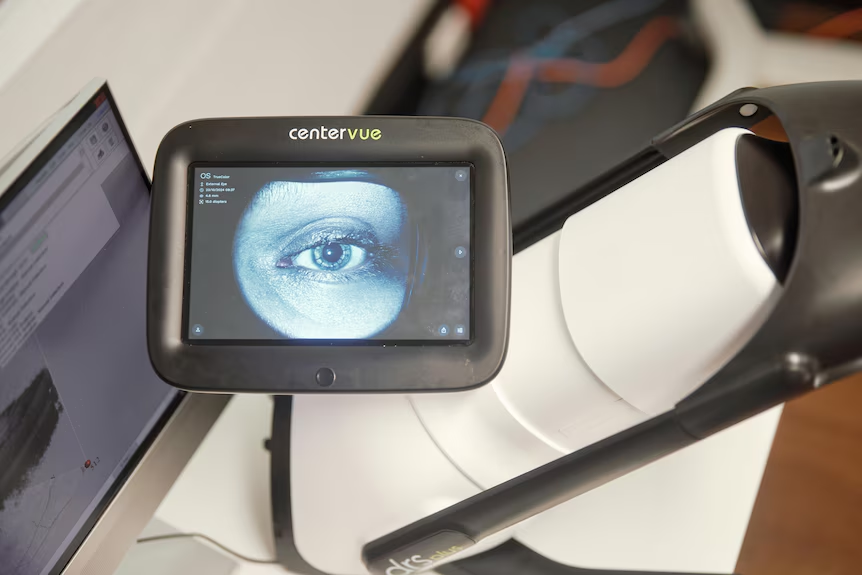
One retinal camera has already been installed at the Pius X Aboriginal Medical Service centre in Moree and another will soon be connected in Tamworth.

Professor Andrew Chang, Head of ophthalmology at the Sydney Eye Hospital hopes that by sending the new retinal cameras into regional and remote communities, patients will get access to specialist advice without having to make long and costly journeys to Sydney.

To read more, go here.

It’s hoped these new retinal cameras will be dispersed into regional and remote communities. (ABC News: Timothy Ailwood).

Breaking down the stigma of suicide: Aboriginal and Torres Strait Islander Lived Experience Centre gathers in Naarm for annual conference

Content warning: this article contains reference to suicide. Please refer to the services at the bottom of this article for support.

This year’s annual gathering of the Aboriginal and Torres Strait Islander Lived Experience Centre (ILEC) took place in Naarm. The aim of the ILEC, which is housed by the Black Dog Institute, is to elevate the voices of Aboriginal and Torres Strait Islander people with experiences of suicide – either those who have lost a loved one to suicide or survived a suicide attempt themselves – to help create a positive change across the entire mental health sector.

Not just a conference; the gathering was a space for connection, planning, empowerment and healing, with people coming from as far away as Broome and the Torres Strait Islands. It serves as a reminder to break down stigma, which only results in further tragedy when people remain silent, in a space of learning, healing and hope. By fostering connection and solidarity, organisers said the event strengthens the network’s resilience along with their capacity to drive meaningful change at both the local and national levels.

To read more, go here.

The Aboriginal and Torres Strait Islander Lived Experience Centre’s annual gagthering recently took place in Naarm. (Image: Dechlan Brennan).

If this article brought up anything for you or someone you love, please reach out to, call or visit the online resources listed below for support.

Borroloola community leaders appeal to federal government to make healthy food accessible

Residents in Borroloola, off the Gulf of Carpentaria, about 970 kilometres south-east of Darwin by road, have welcomed the Commonwealth’s commitment to build a new $13 million dialysis clinic in the community if it is re-elected – one of 30 promised for remote areas around Australia.

But many in the 900-strong community say they are worried the government’s commitment to reducing the effects of kidney disease will be undermined because many remote people cannot afford to eat healthily.

Borroloola Garawa community leader Keith Rory said the promised dialysis clinic was welcome after too many elders, including members of his own family, had to move hundreds of kilometres away to access regular treatment.

But, after a recent diabetes diagnosis of his own, Mr Rory says he worries residents will continue to struggle to afford the healthy, fresh food he has been told he needs to stave off kidney disease.

“We can see how the food prices [are] going up,” he said.

“We want the federal government to get more healthy food into our shop and reduce the price down. That’s what we need.

To read more, go here.

Keith Rory is worried he cannot afford the healthy diet he has been told he needs to manage his diabetes. (ABC News: Jane Bardon).

AHCWA Simon Says Ear Health Series

The latest instalment in the Aboriginal Health Council of Western Australia’s (AHCWA) Simon Says Ear Health Series is here! This time, Simon, Curtis, Keisha and friends tackle the topic of hearing loss.

Now an animation for the first time, this engaging and informative illustrated comic series has been purpose-created, responsive to the specific health promotion needs of AHCWA’s Member Services.

For more information, go here.

Sector Jobs – you can see sector job listings on the NACCHO website here.

Advertising Jobs – to advertise a job vacancy click here to go to the NACCHO website current job listings webpage. Scroll down to the bottom of the page to find a Post A Job form. You can complete this form with your job vacancy details – it will then be approved for posting and go live on the NACCHO website.