NACCHO Sector News: 24 November 2025

Aboriginal and Torres Strait Islander Health News

The NACCHO Sector News is a platform we use to showcase the important work being done in Aboriginal and Torres Strait Islander health, focusing on the work of NACCHO, NACCHO members and NACCHO affiliates.

We also share a curated selection of news stories that are of likely interest to the Aboriginal and Torres Strait Islander health sector, broadly.

A call for action to address long COVID in Aboriginal communities

The impact of long COVID upon Aboriginal people in the Northern Territory is poorly understood, and more needs to be done to improve diagnosis, treatment and support, according to Dr Andrew Nguyen, public health registrar and infectious diseases physician at Aboriginal Medical Services Alliance Northern Territory (AMSANT).

“Long COVID will not disappear simply because we have stopped talking about COVID,” he writes below.

“It demands attention and equity-focused action. The longer we wait, the greater the risk that this invisible pandemic becomes another entrenched health inequity.”

Read the full Croakey Health Media article here.

Photo by Alison Barrett

WA camp aims to reduce high rates of domestic violence by teaching teenage boys

Last year, Wilinggin Aboriginal Corporation Wunggur ranger coordinator Steve Martin, started a camp to teach his rangers about relationships.

Mr Martin said family and domestic violence cannot be tolerated, but also cannot be ignored — it should be prevented. He says the focus on prevention means young people should understand what a healthy relationship is. It was key feedback from men who participated in last year’s camp.

“The first thing they said was ‘we would have wanted this when we were kids, we need to get this out to the youth,'” he explained.

Derby Aboriginal Health Service programs coordinator Mick Leamy, who used to counsel domestic violence offenders in prison, said they were supporting the change the community had been asking for.

“When (a program) is community-led it is often much more successful because it’s coming from a place the community needs,” he said.

Read the full article here.
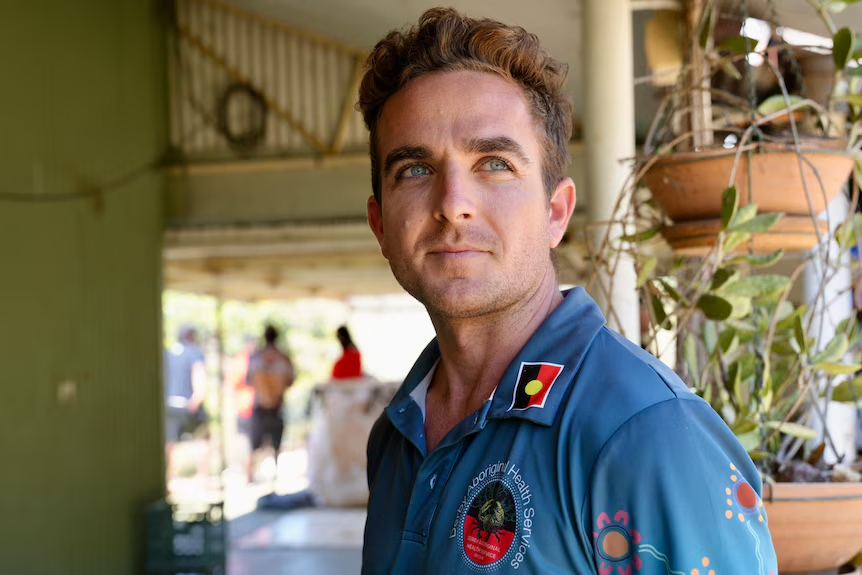
Mick Leamy from Derby Aboriginal Health Service says community-led initiatives are the most effective. (ABC Kimberley: Giulia Bertoglio)

Family and domestic violence support:

Strengthening oversight for children in care confirmed, welcomed by advocates

The Joint Council on Closing the Gap has agreed to strengthen oversight of how governments implement existing commitments for Indigenous children, marking what advocates say is an important step toward changing outcomes for First Nations children and young people.

Meeting in Hobart on Friday, the Council committed to prioritising key reforms under Target 12 of Closing the Gap, which aims to reduce by 45 per cent the over-representation of Aboriginal and Torres Strait Islander children in out-of-home care (OOHC) by 2031.

“Right now this country is still failing too many of our kids in early childhood development, education, out-of-home care, youth justice and access to safe housing and services,” deputy lead convenor of the Coalition of Peaks, Scott Wilson, told reporters.

“These are failures of government systems — not about children and their families — and they demand action, not excuses.”

Mr Wilson said the Council was hopeful of making “progress on addressing the policies and practices that continue to disproportionately harm our young people and agree to work together with the Community-Controlled sector to support our kids”.

Read more here.

The Joint Council on Closing the Gap met in Hobart on Friday. (Image: supplied to National Indigenous Times)

2025 IAHA Leadership Program graduates

Yesterday Indigenous Allied Health Australia (IAHA) celebrated the successes of the graduates from the 2025 IAHA Leadership Program. Over the past 9 months, the leadership participants have developed a greater understanding of Aboriginal and Torres Strait Islander leadership, cultural governance, advocacy, influencing others, community development and Nation building approaches.

Guided by Aboriginal and Torres Strait Islander ways of working, including knowing, being and doing, the program develops the attributes and skills to become an effective, culturally responsive Aboriginal and or Torres Strait Islander leader.

Expressions of interest are now open for the 2026 program! For more information and to apply, visit the IAHA website.

Image source: Indigenous Allied Health Australia

Sector Jobs – you can see sector job listings on the NACCHO website here.

Advertising Jobs – to advertise a job vacancy click here to go to the NACCHO website current job listings webpage. Scroll down to the bottom of the page to find a Post A Job form. You can complete this form with your job vacancy details – it will then be approved for posting and go live on the NACCHO website.

Email us your story with some images to: NACCHOCommunicationsandMedia@naccho.org.au and we will feature it in the news.

Email us your story with some images to: NACCHOCommunicationsandMedia@naccho.org.au
and we will feature it in the news.

NACCHO Sector News: 13 October 2025

Aboriginal and Torres Strait Islander Health News

The NACCHO Sector News is a platform we use to showcase the important work being done in Aboriginal and Torres Strait Islander health, focusing on the work of NACCHO, NACCHO members and NACCHO affiliates.

We also share a curated selection of news stories that are of likely interest to the Aboriginal and Torres Strait Islander health sector, broadly.

Air Force, NACCHO partnership supports Indigenous health in Far North Queensland

The Royal Australian Air Force is visiting Mareeba, Queensland, from 1 October to 6 November for Exercise Kummundoo 2025. The initiative will deliver essential health services and deepening ties with local Aboriginal and Torres Strait Islander communities across Far North Queensland.

Now in its 11th year, Exercise Kummundoo is a community engagement initiative delivered in partnership with the National Aboriginal Community Controlled Health Organisation (NACCHO). The program supports Air Force’s reconciliation commitments while contributing to better health outcomes in regional and remote Indigenous communities.

NACCHO CEO Pat Turner AM, emphasised the importance of community control in improving health outcomes.

“Through Exercise Kummundoo, the Air Force is walking alongside our sector, listening, learning, and contributing in practical ways that make a difference. This is how we strengthen trust, improve health, and create real opportunities for our communities,” Ms Turner said.

Read more here.

Chief of Air Force Air Marshal Stephen Chappell, DSC, CSC, OAM (right) and National Aboriginal Community Controlled Health Organisation Chairperson Donnella Mills formalise a renewed Memorandum of Understanding between the Royal Australian Air Force (RAAF) and NACCHO.

Help shape the new Aboriginal and Torres Strait Islander Peak Body for Family, Domestic and Sexual Violence – Survey deadline extended

You now have until 17 October to help shape the new National Aboriginal and Torres Strait Islander Peak Body for Family, Domestic and Sexual Violence.

Find out more and take the surveys now, here.

Your expertise – whether in response, prevention, early intervention or advocacy – is crucial in building a Peak Body that genuinely serves our communities and sector needs.

Understanding consultation fatigue, previous consultations have been used as a starting point. Specific feedback is now being sought on the Peak Body’s operational model and priorities. These surveys, together with a series of online workshops and sector engagement, will help shape how family violence is collectively addressed in our communities.

Image source: Coalition of Peaks

Ballarat Aboriginal Co-op becomes first ACCO to lead early years management in Victoria

The Victorian Government has announced the establishment of the first Aboriginal Community-Controlled Organisation (ACCO) to operate as an Early Years Management (EYM) authority.

The Ballarat and District Aboriginal Co-operative (BADAC) has been officially registered as the state’s first ACCO EYM.

BADAC currently oversees kindergartens at Perridak Burron in Brown Hill, Yirram Burron in Sebastopol, and Yaluk Burron in Ballan, providing culturally inclusive early learning programs to local families.

“We are very proud of the Early Years centres that we have established and the growth within the community over the past five years,” BADAC chief executive Karen Heap said.

“Becoming the first ACCO EYM enables us to guide, support and inspire other ACCOs across the state, ensuring Aboriginal and Torres Strait Islander families and children are supported in Early Years Education.”

Read more here.

Universities Australia welcomes more places for First Nations medical students

Universities Australia has welcomed the federal government’s decision to remove caps on Commonwealth Supported Places for First Nations medical students through the Education Legislation Amendment (Integrity and Other Measures) Bill 2025.

“If passed by the Parliament, it will be a really important reform that will change the lives of First Nations students, their families and communities, as well as our health system,” Universities Australia, Chief Executive Officer, Mr Luke Sheehy said this week.

The number of First Nations students studying medicine continues to grow, with 489 enrolled in 2024; a 17 per cent increase since 2021, including 124 new students.

“The growth in First Nations medical student numbers shows what’s possible when governments and universities work together to expand opportunity and support success,” Mr Sheehy said.

Read more here.

Indigenous medical school graduates celebrating, 2025.

Sector Jobs – you can see sector job listings on the NACCHO website here.

Advertising Jobs – to advertise a job vacancy click here to go to the NACCHO website current job listings webpage. Scroll down to the bottom of the page to find a Post A Job form. You can complete this form with your job vacancy details – it will then be approved for posting and go live on the NACCHO website.

Email us your story with some images to: NACCHOCommunicationsandMedia@naccho.org.au and we will feature it in the news.

Email us your story with some images to: NACCHOCommunicationsandMedia@naccho.org.au
and we will feature it in the news.

NACCHO Sector News: 2 October 2025

Aboriginal and Torres Strait Islander Health News

The NACCHO Sector News is a platform we use to showcase the important work being done in Aboriginal and Torres Strait Islander health, focusing on the work of NACCHO, NACCHO members and NACCHO affiliates.

We also share a curated selection of news stories that are of likely interest to the Aboriginal and Torres Strait Islander health sector, broadly.

HAVE YOUR SAY: Shaping the National Peak Body for Family, Domestic & Sexual Violence

NACCHO is calling on Aboriginal and Torres Strait Islander services and sector professionals to have your say in shaping the new National Peak Body for Family, Domestic & Sexual Violence.

The national survey (open until 10 October 2025) is broken up into three parts .

Please click on the links below to have your say in each section:

Your voices have already shaped this journey, we’re building on that foundation to ensure the Peak Body reflects community wisdom, sector expertise and lived realities. Please complete the survey and share it widely.

Find out more and access the survey.

If you have questions or wish to discuss further, you can contact the Coalition Secretariat at secretariat@coalitionofpeaks.org.au.

HAVE YOUR SAY: Shaping the National Peak Body for Family, Domestic & Sexual Violence.

Speech from Chief Medical Officer, Australasian Sexual and Reproductive Health Conference – 16 September 2025

The recent declaration of syphilis as a Communicable Disease Incident of National Significance (CDINS) highlights the growing urgency of addressing its spread across Australia. Unlike previous CDINS declarations for COVID-19, Japanese encephalitis, and mpox, syphilis has shown a steady increase over the past decade, with cases rising by an average of 13% annually since 2011. This declaration enables a nationally coordinated response to a long-standing public health challenge.

Read the speech by the Chief Medical Officer, Professor Michael Kidd AO, at the Australasian Sexual and Reproductive Health Conference in Adelaide about his declaration of syphilis as a Communicable Disease Incident of National Significance.

Outback nurse transforms remote diabetes care with cans, rocks and bush tucker

When Rishoniy Caine arrived in a tiny outback NSW town with one general store, no gym and the task of fixing its diabetes problem, she decided to do things a differently.

The Bundjalung woman knew from her experience as a nurse in remote Kimberly and Cape York communities the difficulties residents faced buying healthy food.

“If you can imagine the nearest town is 1,000 kilometres away, it can be very challenging to get fresh food. It’s almost non-existent,” she said. “Also a lettuce might be $16 and two litres of milk $12, while a can of coke is $2, a pie is cheap.”

She incorporated what she learnt from elders about bush foods and traditional medicine into a pilot program in a rural NSW town that faces similar issues — Collarenebri, about 75 kilometres from Walgett in the state’s north-west.

Cooking and gardening lessons are provided alongside medical treatment and, instead of weights, participants are encouraged to lift cans.

Read the full story.

Kellie Henderson (left) has lost 30 kilograms and tamed her diabetes with Rishoniy Caine's simple approach. (ABC Western Plains: Zaarkacha Marlan)

Kellie Henderson (left) has lost 30 kilograms and tamed her diabetes with Rishoniy Caine’s simple approach. (ABC Western Plains: Zaarkacha Marlan)

A new First Nations voice to guide Australia’s public health sector

The Public Health Association of Australia has announced they will be establishing an Aboriginal and Torres-Strait Islander voice to help guide their work after a near unanimous vote by their members. Nearly two years after the failed referendum saw a First Nations voice to parliament shot down, NGOs like the PHAA and state governments have chosen to follow the wishes of the majority of Aboriginal and Torres Strait islander communities in Australia who voted for this special representation.

Listen to the podcast or read the transcript.

Young Aboriginal girl gets a check up at the doctor’s surgery

Young Aboriginal girl gets a check up at the doctor’s surgery Source: Getty / LOUISE BEAUMONT\

Healing land and spirit through Noongar knowledge and regenerative land management

In Western Australia’s Wheatbelt, a region long shaped by industrial farming practices, a new model of regenerative agriculture is taking root. At Yaraguia farm, Ballardong Noongar man Oral McGuire is healing Country, reconnecting First Nations knowledge of caring for Country with modern land management to restore ecosystems and produce food that benefits both the land and the community.

Out in the Wheatbelt of Western Australia, something is happening … It’s a movement to heal Country – and community.

“And you can see the soil, how degraded it is.”

For generations, acres of land in the Wheatbelt was stripped by clearing, cropping and overgrazing. Ballardong Noongar man Oral McGuire says settlement and colonisation left scars on both soil and spirit.

“All of these activities are very extractive activities that for 170 odd years this little piece of land here, the whole landscape through this region, has suffered that abuse from, you know, settlement colonisation.”

Today, Mr McGuire works as a regenerative land manager, guided not by commodity farming, but by cultural law.

“Slow burning, or our cool burning that we do as Noongars, and we do it to replenish country. The season we are in now is the right season for us to be doing it.”

Fire, water, native plants – all are central to reviving ecosystems that once thrived here.

“So they are indicators that the soil, the balance and the health of the soil is returning, because they haven’t been here.”

Listen to the podcast or read the full story

Ballardong Noongar man Oral McGuire Source: SBS News / Christopher Tan

Ballardong Noongar man Oral McGuire Source: SBS News / Christopher Tan


Sector Jobs – you can see sector job listings on the NACCHO website here.

Advertising Jobs – to advertise a job vacancy click here to go to the NACCHO website current job listings webpage. Scroll down to the bottom of the page to find a Post A Job form. You can complete this form with your job vacancy details – it will then be approved for posting and go live on the NACCHO website.


Email us your story with some images to: NACCHOCommunicationsandMedia@naccho.org.au and we will feature it in the news.

Email us your story with some images to: NACCHOCommunicationsandMedia@naccho.org.au
and we will feature it in the news.

NACCHO Sector News: 1 October 2025

Aboriginal and Torres Strait Islander Health News

The NACCHO Sector News is a platform we use to showcase the important work being done in Aboriginal and Torres Strait Islander health, focusing on the work of NACCHO, NACCHO members and NACCHO affiliates.

We also share a curated selection of news stories that are of likely interest to the Aboriginal and Torres Strait Islander health sector, broadly.

NACCHO welcomes Maari Ma (NSW) and Indigenous Wellbeing Centre (Qld), growing the ACCHO network to 148

The National Aboriginal Community Controlled Health Organisation (NACCHO) has welcomed two new members, Maari Ma (New South Wales) and the Indigenous Wellbeing Centre (Queensland), bringing the national network to 148 Aboriginal Community Controlled Health Organisations (ACCHOs).

ACCHOs are locally governed, community-owned services that deliver comprehensive, culturally informed primary health care. They are built on a model of trust and accountability to community. This approach has consistently delivered better access, better engagement, and better outcomes for Aboriginal and Torres Strait Islander peoples for over 50 years.

NACCHO Chair, Donnella Mills, said the milestone is more than an increase in numbers; it is a story of community strength and determination.

“Every ACCHO begins with communities coming together and saying: we deserve better health, and we will take charge of it ourselves. To welcome Maari Ma and the Indigenous Wellbeing Centre into our fold is to welcome the voice and leadership of two more communities.

When communities run their own health services, they bring lived experience, culture, and deep knowledge of local needs to the centre of care. That is why ACCHOs have stood the test of time, because they are built by community, for community.

Reaching 148 members shows the resilience and growth of our sector. It’s proof that the community-controlled model not only works, it thrives. That is something to be proud of, and something Australia should celebrate.”

NACCHO CEO, Pat Turner AM, said the growth of the sector underscores the need for sustained investment in community-controlled health if Australia is to meet Closing the Gap targets.

“Community control is not just an idea; it is a proven model that delivers results. For over five decades, ACCHOs have shown that when Aboriginal and Torres Strait Islander peoples design, deliver, and govern their own health services, health outcomes improve. That is why the growth to 148 ACCHOs is so important.

More ACCHOs mean more access to culturally safe, comprehensive primary health care. This is Priority Reform Two in action: building the community-controlled sector to deliver services where they are needed most.

If governments are serious about Closing the Gap, they must continue to invest in what works. Our communities have spoken; they want community-controlled health care, and our sector is ready to deliver. We have the solutions, and we are growing stronger every day.”

NACCHO now represents 148 ACCHOs, operating more than 550 clinics nationwide and delivering over 3.6 million episodes of care annually. With Maari Ma and the Indigenous Wellbeing Centre joining the network, NACCHO’s reach is deeper than ever, and its message clearer: community control saves lives, strengthens communities, and is the path to health equity.

Now you can get PBS medicines for less or free through the Closing the Gap PBS Program

The Closing the Gap (CTG) PBS Program helps Aboriginal and Torres Strait Islander people and families access the medicines they need, wherever they live in Australia.

Once you’re registered, the price of most PBS medicines is reduced, and in some cases, they are even free. Registration is a one-time, for-life process. Yarn with your clinic, pharmacist or Aboriginal Health Practitioner to check your status and get registered.

Learn more here.

First Nations Economic Partnership formally signed at Parliament House

This week’s signing by Treasurer Chalmers represents a significant milestone in our journey toward economic self-determination.

The Partnership is a national commitment to fundamentally shift how governments and First Nations peoples work together to create secure and meaningful jobs in communities, grow Indigenous businesses through improved access to capital, and improve our people’s economic security.

The agreement emerged from extensive national engagement led by the Coalition of Peaks. Every commitment made was informed by Aboriginal and Torres Strait Islander insights and experiences.

Learn more.

Image source: Coalition of Peaks.

Strengthening diabetes care in Aboriginal and Torres Strait Islander communities

At the National Medicines Symposium 2025, hear from Dr Jason Agostino, NACCHO Senior Medical Advisor, as he explores how integrated care models can improve outcomes where diabetes, cardiovascular disease, and kidney disease frequently overlap.

This keynote will highlight:

  • Opportunities to improve access to new medicines
  • The role of integrated pharmacists in primary care teams
  • How culturally safe care supports quality use of medicines

Learn more here.

Image source: Australian Commission on Safety and Quality in Health Care

Sector Jobs – you can see sector job listings on the NACCHO website here.

Advertising Jobs – to advertise a job vacancy click here to go to the NACCHO website current job listings webpage. Scroll down to the bottom of the page to find a Post A Job form. You can complete this form with your job vacancy details – it will then be approved for posting and go live on the NACCHO website.

Email us your story with some images to: NACCHOCommunicationsandMedia@naccho.org.au and we will feature it in the news.

Email us your story with some images to: NACCHOCommunicationsandMedia@naccho.org.au
and we will feature it in the news.

NACCHO Sector News: 29 September 2025

Aboriginal and Torres Strait Islander Health News

The NACCHO Sector News is a platform we use to showcase the important work being done in Aboriginal and Torres Strait Islander health, focusing on the work of NACCHO, NACCHO members and NACCHO affiliates.

We also share a curated selection of news stories that are of likely interest to the Aboriginal and Torres Strait Islander health sector, broadly.

Sponsorship opportunities for the 2025 NACCHO Members’ Conference still available!

The NACCHO Members’ Conference has grown in stature, scope, and attendance, making it the premier gathering for leaders and practitioners from the Aboriginal and Torres Strait Islander health sector.

Bark sponsorship package still available:

  • 2 full registrations including admission to the Karaoke Dinner
  • Naming rights to 1 break out room
  • Logo in program and conference APP
  • Logo display on entrance to the room
  • Logo on NACCHO’s interview banner (medium)
  • Pull-Up Banner in the room (to be provided by sponsor prior to conference)
  • Half page article/information in program
  • 30 second video playing on screen during event (to be provided by sponsor prior to conference)

Learn more here.

QAIHC Members Conference: Dr Dawn Casey to deliver keynote

Dr Dawn Casey, NACCHO Deputy CEO will deliver a keynote on Day 1 of the QAIHC Members Conference 2025: Led by culture; driven by purpose.

Dr Casey is a proud Tagalaka woman with an extraordinary career across Indigenous health, government, museums and cultural institutions. Her contributions have been recognised with the Sidney Sax Public Health Medal, three honorary doctorates, the Public Service Medal and Centenary Medal.

  • Conference: 21–22 October 2025
  • Cairns Convention Centre
  • AGM: Monday 20 October for Member CEOs/Board only

Conference registrations are open to QAIHC Member CEOs/Board + invited guests only. Register here.

Image source: QAIHC.

Sector input needed: Shaping the National Aboriginal and Torres Strait Islander FDSV Peak Body

Input is being sought from Aboriginal and Torres Strait Islander services and sector professionals to shape the new National Peak Body for Family, Domestic and Sexual Violence.

Understanding consultation fatigue, previous consultations have been used as a starting point. Specific feedback is now being sought on the Peak Body’s operational model and priorities.

Engagement opportunities:
– National online survey (closes 10 October)
– Sector-specific online workshops
– National online workshops
– Via your Peak Body

Your expertise – whether in response, prevention, early intervention or advocacy – is crucial in building a Peak Body that genuinely serves our communities and sector needs.

This is your opportunity to shape how family violence is collectively addressed in our communities.

Survey links:
Vision and purpose
Activities and functions
Membership and governance

Image source: Coalition of Peaks

Embedding Cultural Healing as a Core Component to Australia’s Mental Health System

Gayaa Dhuwi has released a position paper on Embedding Cultural Healing as a Core Component to Australia’s Mental Health System.

This paper calls for cultural healing to be recognised as a right and embedded as a core part of Australia’s mental health system, not as a supplementary practice, but as central to healing, recovery, and wellbeing for Aboriginal and Torres Strait Islander peoples.

It sets out six key recommendations, including embedding cultural healing in national agreements, legislating cultural governance, recognising cultural practitioners in the workforce, and investing in long-term healing infrastructure.

Read the paper here.

Image source: Gayaa Dhuwi

Sector Jobs – you can see sector job listings on the NACCHO website here.

Advertising Jobs – to advertise a job vacancy click here to go to the NACCHO website current job listings webpage. Scroll down to the bottom of the page to find a Post A Job form. You can complete this form with your job vacancy details – it will then be approved for posting and go live on the NACCHO website.

Email us your story with some images to: NACCHOCommunicationsandMedia@naccho.org.au and we will feature it in the news.

Email us your story with some images to: NACCHOCommunicationsandMedia@naccho.org.au
and we will feature it in the news.

NACCHO Sector News: 18 August 2025

The NACCHO Sector News is a platform we use to showcase the important work being done in Aboriginal and Torres Strait Islander health, focusing on the work of NACCHO, NACCHO members and NACCHO affiliates.

We also share a curated selection of news stories that are of likely interest to the Aboriginal and Torres Strait Islander health sector, broadly.

VAHS, second oldest Aboriginal Community Controlled Health Organisation celebrates 52nd birthday

18 August 1973 is formally recognised as Victorian Aboriginal Health Service’s (VAHS) birthday, despite the organisation having had a local committee and working within Community since 1972.

During the past five decades, VAHS has supported Mob’s physical, emotional, and spiritual health and wellbeing and providing culturally safe healthcare as Australia’s second oldest Aboriginal Community Controlled Health Organisation.

From humble beginnings in Fitzroy, VAHS has grown to four clinics across metro Melbourne, and in the past year 83,500 client contacts from more than 14,300 registered clients.

None of this would have been possible without the courageous, visionary people who started it all, the amazing clients, Community, the many board members, and all past and present staff who put their hearts and souls into Aboriginal health.

Thank you for the past 52 years of helping VAHS to make a difference and save lives.

Image source: VAHS

What are the four Priority Reforms in the Closing the Gap Agreement?

The reforms have been designed to shift power to Aboriginal and Torres Strait Islander people and organisations so they can drive the change that affects their lives.

They’re not about fixing symptoms – they’re about changing the system. Here’s why they matter:

  • When we have a seat at the table, solutions are stronger – grounded in culture, community, and lived experience.
  • When our organisations are properly funded, services have greater impact, because they’re trusted, local, and long-term.
  • When governments change how they work, services become safer, fairer, and more culturally respectful.
  • When we have the right data, communities can make better decisions and hold governments to their commitment.

Learn more here.

Lowitja Institute Seeding Grants

Lowitja Institute’s Aboriginal and Torres Strait Islander Seeding Grants are now open across two streams: the Aboriginal and Torres Strait Islander Community Seeding Grant and the Aboriginal and Torres Strait Islander Seeding Symposium.

These grants support Aboriginal and Torres Strait Islander communities to grow small ideas, transform, and action research from community priorities into meaningful research projects.

Learn more and apply here.

Image source: Lowitja Institute

Delivering more Medicare Urgent Care Clinics in Tasmania

The Australian Government is delivering on its commitment to open a further 50 Medicare Urgent Care Clinics, including 3 in Tasmania.

The Tasmanian Primary Health Network will be commencing a tender process from to identify suitable providers to operate clinics in Burnie, Kingston and Sorell.

This tender process will be open to general practices, community health centres and Aboriginal Community Controlled Health Services.

Learn more here.

Image / Pulse

Sector Jobs – you can see sector job listings on the NACCHO website here.

Advertising Jobs – to advertise a job vacancy click here to go to the NACCHO website current job listings webpage. Scroll down to the bottom of the page to find a Post A Job form. You can complete this form with your job vacancy details – it will then be approved for posting and go live on the NACCHO website.

NACCHO Sector News: 4 August 2025

The NACCHO Sector News is a platform we use to showcase the important work being done in Aboriginal and Torres Strait Islander health, focusing on the work of NACCHO, NACCHO members and NACCHO affiliates.

We also share a curated selection of news stories that are of likely interest to the Aboriginal and Torres Strait Islander health sector, broadly.

Like writing in the sand: government promises of transformational change fail to eventuate

The latest Closing the Gap data has backed up earlier reviews showing that, when governments do relinquish total control and share decision-making with First Nations organisations, change is possible.

The latest update from the Productivity Commission found just four of the 19 targets were on track to be met by 2031. Closing the Gap targets are part of a national agreement aimed at reducing First Nations peoples’ disadvantage.

The findings echo those of the Independent Review of the National Agreement on Closing the Gap, released in June, which found that governments are falling short in their obligations and need to urgently shift how they work in partnership with Aboriginal and Torres Strait Islander people.

“Governments need to stop, take stock, and change their approach,” said Pat Turner, NACCHO CEO and lead convenor of the Coalition of Peaks, which represents Aboriginal community-controlled organisations.

“We now have two independent reports telling us the same thing: where our organisations lead and are properly supported, we see progress.

“But when governments fail to meet their commitments, the gap doesn’t just remain, it widens.”

Read the full article here.

NACCHO CEO Pat Turner says when governments share power with First Nations organisations Closing the Gap is possible. Source: AAP / LUKAS COCH/AAPIMAGE

Aboriginal and Torres Strait Islander Children celebrated as leaders of tomorrow

Aboriginal and Torres Strait Islander children took centre stage today as communities across the country came together to honour their strength, voice and deep cultural identity on National Aboriginal and Torres Strait Islander Children’s Day.

Catherine Liddle, CEO of SNAICC – National Voice for our Children, said Children’s Day plays a vital role in recognising, uplifting and raising the voices of Aboriginal and Torres Strait Islander children.

“It’s a day where our next-generation leaders get to share their culture and celebrate how special they are, how deeply they belong and how important their voice is, now and into the future,” Ms Liddle said.

“Our children carry the world’s oldest living culture. That’s something all Australians should take pride in.

“Celebrating Aboriginal and Torres Strait Islander children is how we protect and grow that legacy.

“We celebrate on August 4 as it has historically been used to communally celebrate the birthdays of Aboriginal and Torres Strait Islander children who were taken from their families without knowing their birthday – the Stolen Generations.”

Read the full media release here.

Image source: SNAICC – National Voice for our Children

Key health organisations stand with community sector for urgent climate action

Prominent health organisations have joined a call by Australia’s community sector for the Albanese Government to aim for net zero emissions by 2035. A statement signed by 88 organisations says that to protect people and the planet, “waiting until 2050 is too late”.

Signatories to the statement include the National Aboriginal Community Controlled Health Organisation (NACCHO), Consumers Health Forum of Australia, the Australian Health Promotion Association, Public Health Association of Australia, and community health service provider cohealth.

Read more here.

Image source: Croakey Health Media

Champion of truth-telling Sue-Anne Hunter appointed Commissioner for Aboriginal and Torres Strait Islander Children and Young People

The federal government has appointed Australia’s first permanent National Commissioner for Aboriginal and Torres Strait Islander Children and Young People.

Late on Sunday, Minister for Indigenous Australians, Malarndirri McCarthy, and Minister for Social Services, Tanya Plibersek, announced Adjunct Professor Sue-Anne Hunter will take on the role, commencing later this year.

A proud Wurundjeri and Ngurai Illum Wurrung woman, Professor Hunter brings more than 20 years of experience in the family services sector, including senior roles at SNAICC – National Voice of Our Children, the Victorian Aboriginal Child Care Agency (VACCA), and as a social worker.

Read more here.

Sue-Anne Hunter at the tabling of a Yoorrook Justice Commission report in September, 2023. Image: Joel Carrett (AAP).

Sector Jobs – you can see sector job listings on the NACCHO website here.

Advertising Jobs – to advertise a job vacancy click here to go to the NACCHO website current job listings webpage. Scroll down to the bottom of the page to find a Post A Job form. You can complete this form with your job vacancy details – it will then be approved for posting and go live on the NACCHO website.

NACCHO Sector News: 1 August 2025

The NACCHO Sector News is a platform we use to showcase the important work being done in Aboriginal and Torres Strait Islander health, focusing on the work of NACCHO, NACCHO members and NACCHO affiliates.

We also share a curated selection of news stories that are of likely interest to the Aboriginal and Torres Strait Islander health sector, broadly.

ACCOs lead the way in the new Lung Cancer Screening Program

The Victorian Aboriginal Health Service (VAHS) and Gippsland and East Gippsland Aboriginal Co-Operative (GEGAC) are paving the way for culturally safe lung cancer screening for Aboriginal and Torres Strait Islander people in Victoria.

The Victorian Aboriginal Community Controlled Health Organisation (VACCHO) has partnered with the Victorian Comprehensive Cancer Centre (VCCC) Alliance to support VAHS and GEGAC in the implementation of the lung cancer screening pilot project.

As part of the project, VAHS and GEGAC will design, implement and promote screening initiatives, and research key factors that encourage and support eligible Aboriginal and Torres Strait Islander people’s participation in the National Lung Cancer Screening program, which launched across Australia on 1 July 2025.

Learn more about the National Lung Cancer Screening Program here.

Read the full media release here.

Image source: VACCHO

Aboriginal Medical Services call for community-led solutions as Territory’s Closing the Gap targets “go backwards”

The Aboriginal Medical Services Alliance Northern Territory (AMSANT) expressed “deep concern” at the continued failure to meet Closing the Gap targets in the Northern Territory, following the release of the Productivity Commission’s 2025 Annual Data Compilation Report on Wednesday night.

While the Alliance welcomed improvements in some national indicators, such as healthy birthweight, it said the latest data “makes clear that the NT is being left behind; with many critical targets not only off track, but worsening”.

“This report serves as a stark reminder that the current approach isn’t working for the Northern Territory, and it is not delivering the change our communities need, particularly for the next generation,” said AMSANT chief executive Dr John Paterson.

“The NT is home to some of the highest levels of disadvantage in the country, yet too many targets are going backwards.”

Read the full article here.

Aboriginal Medical Services Alliance Northern Territory chief executive Dr John Paterson. Image: AMSANT.

What are the four Priority Reforms in the Closing the Gap Agreement?

The four Priority Reforms in the Closing the Gap Agreement have been designed to shift power to Aboriginal and Torres Strait Islander people and organisations so they can drive the change that affects their lives.

They’re not about fixing symptoms – they’re about changing the system. Here’s why they matter:

  • When we have a seat at the table, solutions are stronger – grounded in culture, community, and lived experience.
  • When our organisations are properly funded, services have greater impact, because they’re trusted, local, and long-term.
  • When governments change how they work, services become safer, fairer, and more culturally respectful.
  • When we have the right data, communities can make better decisions and hold governments to their commitment.

This is how we create real, lasting change. Learn more here.

PSA25 Excellence Awards announced

The winners of the highly anticipated 2025 PSA Symbion Excellence Awards were announced this morning at PSA25 in Sydney.

Jaimee Anderson of Katherine, NT, was named PSA Symbion Pharmacist of the Year, recognised for her exceptional leadership, innovation, and “unwavering commitment to the health and wellbeing of the Katherine community”.

Working initially in one of Katherine’s two pharmacies, Anderson has built a reputation for delivering high-quality, patient-centred care to both urban and remote populations.

She played a key role in the rollout of the NT’s pharmacy-based vaccination services, and then became involved in primary healthcare teams working with First Nations people.

Identifying a critical gap in diabetes care, she became a credentialed diabetes educator (CDE) and now serves as the pharmacist CDE at Wurli Wurlinjang Health Service, providing culturally safe, trauma-informed care to First Nations clients.

Read the full article here.

Image source: Pharmacy Daily.

Sector Jobs – you can see sector job listings on the NACCHO website here.

Advertising Jobs – to advertise a job vacancy click here to go to the NACCHO website current job listings webpage. Scroll down to the bottom of the page to find a Post A Job form. You can complete this form with your job vacancy details – it will then be approved for posting and go live on the NACCHO website.

NACCHO Sector News: 31 July 2025

The NACCHO Sector News is a platform we use to showcase the important work being done in Aboriginal and Torres Strait Islander health, focusing on the work of NACCHO, NACCHO members and NACCHO affiliates.

We also share a curated selection of news stories that are of likely interest to the Aboriginal and Torres Strait Islander health sector, broadly.

Launch of the National Lung Cancer Screening Program

This week, Donnella Mills, NACCHO Chair and NACCHO Cancer Team members joined the Hon. Mark Butler MP, Minister for Health, Disability and Ageing, Cancer Australia and an incredible group of experts, clinicians and lived experience advocates at Parliament House to celebrate the launch of the National Lung Cancer Screening Program.

The National Lung Cancer Screening Program is the first new national cancer screening program in nearly 20 years. NACCHO’s partnership with the Department of Health, Disability and Ageing highlights the value of prioritising equitable, accessible and culturally safe cancer care for Aboriginal and Torres Strait Islander communities.

If you’re aged 50-70 years and currently smoke or have quit in the past 10 years, yarn with your doctor or health worker about being screened.

Learn more about the NLCSP here.

Donnella Mills, NACCHO Chair and NACCHO Cancer Team members.

Aboriginal Community Controlled and First Nations Led Registered Training Organisations CoP

Over the past two days, NACCHO and the Aboriginal Community Controlled (ACC) and First Nations Led (FNL) Registered Training Organisations (RTOs) came together on Bidjigal & Dharawal County at AH&MRC in Little Bay for the first ACC & FNL RTO Community of Practice (CoP) meeting.

We networked, shared best practice and had collaborative conversations on all thing’s RTOs. For many it was the first time coming together with like-minded people with a focus on building the capability and capacity of the ACC & FNL RTO sector. This ensures Community has opportunities to access Culturally Safe and relevant training.

View photos here.

ACC & FNL RTO Community of Practice (CoP) members at AH&MRC

New Closing the Gap data confirms what works: partnership and community control

The latest Productivity Commission annual Closing the Gap data report confirms that  when Aboriginal community-controlled organisations are treated as partners and  properly resourced, they deliver real results.

The findings echo those of the Independent Review of the National Agreement on Closing  the Gap, released last month, which found that governments are falling short in their  obligations and need to urgently shift how they work in partnership with Aboriginal and Torres Strait Islander people.

“Governments need to stop, take stock, and change their approach,” said Pat Turner AM, Lead Convenor of the Coalition of Peaks, which represents Aboriginal community controlled organisations.

“We now have two independent reports telling us the same thing: where our organisations lead and are properly supported, we see progress. But when governments fail to meet their commitments, the gap doesn’t just remain, it widens.”

Read the full media release here.

Image source: Coalition of Peaks

Closing the Gap progress report: QAIHC says same, same – now we need different

The Queensland Aboriginal and Islander Council (QAIHC) is urging governments nationally to strengthen their commitment to the National Agreement on Closing the Gap and its priority reforms, with yet another progress report highlighting few improvements over the past 12 months.

Only four out of 19 targets in the National Agreement on Closing the Gap remain on track to be met by 2031, according to the Productivity Commission’s new 2025 Annual Data Compilation Report.

Although healthy birthweights (Target 2) are improving, they remain off track. Four key targets are continuing to worsen – suicide rates (Target 14), incarceration rates for adults (Target 10), developmental outcomes for children (Target 4), and the number of children in out-of-home care (Target 12).

“This year’s CTG report card remains disappointing and continues to demonstrate a lack of collective focus on delivering priority reforms. We need local practical solutions to the challenges of Closing the Gap,” QAIHC Acting Chief Executive Officer Paula Arnol said.

Read the full media release here.

Image source: QAIHC

Sector Jobs – you can see sector job listings on the NACCHO website here.

Advertising Jobs – to advertise a job vacancy click here to go to the NACCHO website current job listings webpage. Scroll down to the bottom of the page to find a Post A Job form. You can complete this form with your job vacancy details – it will then be approved for posting and go live on the NACCHO website.

NACCHO Sector News: 23 July 2025

The NACCHO Sector News is a platform we use to showcase the important work being done in Aboriginal and Torres Strait Islander health, focusing on the work of NACCHO, NACCHO members and NACCHO affiliates.

We also share a curated selection of news stories that are of likely interest to the Aboriginal and Torres Strait Islander health sector, broadly.

AMSANT and Red Lily slam Territory government “broken promises” on Gunbalanya health centre

The Aboriginal Medical Services Alliance Northern Territory (AMSANT) and Red Lily Health Board have condemned the Northern Territory government’s decision to defer the tender for a new health facility in Gunbalanya and reallocate the $20 million that had been budgeted for its construction since 2023–24.

The medical groups said that despite assurances that funding was secured in the 2024–25 Budget, no progress has been made.

The building tender was then “quietly deferred” in the 2025–26 Budget, leaving community leaders and health sector partners seeking answers on where the money has gone; and why a project long acknowledged as urgent has been deprioritised.

“The Gunbalanya clinic is not fit for purpose and has been on the priority replacement list for over 20 years,” said Red Lily CEO Brad Palmer.

“The project was approved, supported, and budgeted for. After two years of promises, the funding has now been redirected without consultation or explanation. It is incredibly disappointing, and the community deserves to know why it’s no longer being delivered and why their health infrastructure has been sidelined.”

Read the full article here.

A CGI render of the promised Gunbalanya health centre revamp. Image: NT News.

2025 Aboriginal Suicide Forum

Recently, AH&MRC proudly partnered with the NSW Ministry of Health to co-host the Suicide Prevention Forum – a vital gathering grounded in shared commitment and collective responsibility.

By bringing together voices from across community and sector, the forum highlighted the importance of working in partnership to drive change. It showcased the strength and innovation already at work in Aboriginal communities, while also calling for systemic change to ensure our people are visible, valued, and leading suicide prevention efforts.

Suicide prevention in our communities must be led by Aboriginal people with our voices at the centre, our knowledge informing the work, and our presence guiding the delivery of culturally safe services.

If you are feeling stressed, not sleeping well or have increased anxiety and depression you can seek immediate help, 24 hours a day, 7 days a week from:
13 Yarn (13 92 76)
Brother-to-brother (1800 435 799)
Lifeline (13 11 14 + online chat)
Kids Helpline (1800 55 1800 + webchat)

Other support lines:
MensLine Australia (1300 78 99 78)
Suicide callback service (1300 659 467)
Beyond Blue (1300 22 4636)
Qlife – anonymous LGBTIQ support (1800 184 527 + webchat)

When Aboriginal and Torres Strait Islander communities lead, our children thrive

Under the Closing the Gap Agreement, community-led action is delivering real change:

  • More babies are being born strong and healthy
  • More kids are starting early childhood education, setting them up for a better future

These outcomes reflect the power of the Aboriginal Community Controlled sector, grounded in culture, trusted by community, and driven by self-determination.

Community-led solutions are working. It’s time to build on that progress.

See the latest data and how the Agreement is backing local leadership, here.

Image source: Coalition of Peaks

Teaming up for meaningful conversations about Indigenous health

A community and multi-agency group are collaborating with Aboriginal and Torres Strait Islander women to share stories and have meaningful conversations about health.

Yarn Up gatherings aim to raise awareness about immunisation and women’s cancer screenings, as well as providing education and resources on social and emotional wellbeing, and family and domestic violence.

NNSWLHD Aboriginal immunisation support officer Virginia Paden said the Yarn Ups were helping Aboriginal women spread word among families in their communities about the importance of timely immunisations and women’s health checks.

“At each Yarn Up, women gain the knowledge to feel empowered to make informed health choices for themselves and their families,” Paden said.

“By sharing stories and cultural knowledge in a safe and welcoming space, we hope to share key health messages.

“Anything that generates discussion about why vaccinations and screenings are important is beneficial.”

Read the full article here.

Virginia Paden at an earlier Murwillumbah Yarn Up.

Sector Jobs – you can see sector job listings on the NACCHO website here.

Advertising Jobs – to advertise a job vacancy click here to go to the NACCHO website current job listings webpage. Scroll down to the bottom of the page to find a Post A Job form. You can complete this form with your job vacancy details – it will then be approved for posting and go live on the NACCHO website.