NACCHO Sector News: 5 December 2025

Aboriginal and Torres Strait Islander Health News

The NACCHO Sector News is a platform we use to showcase the important work being done in Aboriginal and Torres Strait Islander health, focusing on the work of NACCHO, NACCHO members and NACCHO affiliates.

We also share a curated selection of news stories that are of likely interest to the Aboriginal and Torres Strait Islander health sector, broadly.

Donna Ah Chee appointed CEO of AMSANT

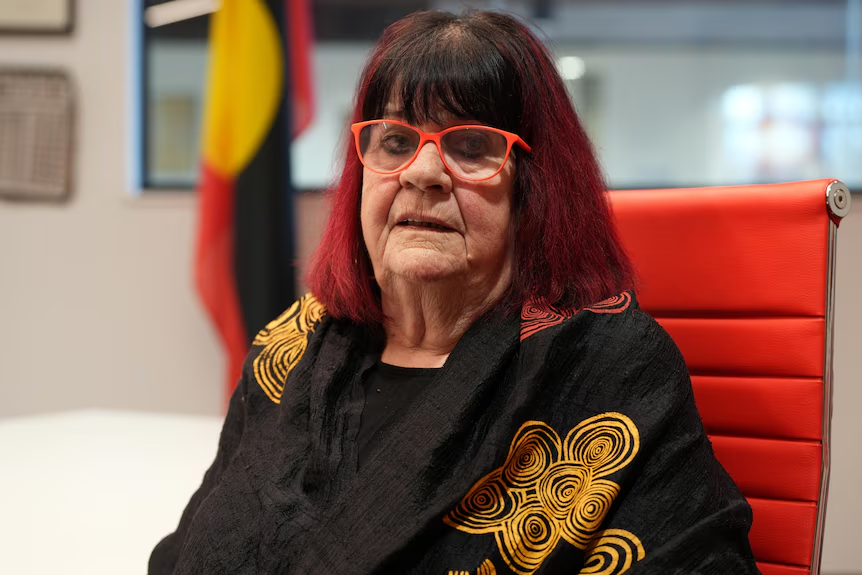
The Aboriginal Medical Services Alliance of the Northern Territory (AMSANT) has appointed Dr Donna Ah Chee as its new chief executive officer.

Dr Ah Chee is currently the chief executive officer of Central Australian Aboriginal Congress, an Aboriginal community controlled primary health care service employing over 500 staff to deliver integrated services to Mparntwe (Alice Springs) and nine remote communities across the region. She is a proud Bundjalung woman from the far north coast of New South Wales who has lived in Mparntwe for over 36 years. She is married to a local Yankunytjatjara/Arrernte man and together they have three children and three grandchildren.

Dr Ah Chee has devoted herself to the movement for health and justice for Aboriginal people at a local, Northern Territory and national level. Her advocacy to improve health and wellbeing outcomes through collaborative action, and her firm commitment to holding governments accountable for closing the gap in health outcomes has earned her a national profile. She has made a significant contribution to the health of Aboriginal people through her leadership in primary health care, research, education and public health. She has also made important contributions to reducing the harms caused by alcohol, and to improving early childhood outcomes for Aboriginal children.

Dr Ah Chee will be based in Alice Springs and will commence on 23 February 2026.

Read more here.

Dr Donna Ah Chee. Image source: AMSANT

Planning transition of trachoma health promotion to community control

In November 2025, Minum Barreng: Indigenous Eye Health Unit and NACCHO co-hosted a trachoma health promotion transition workshop in Mparntwe (Alice Springs) held over two days (11-12 November). This workshop identified a number of the critical next steps to support the transition of trachoma health promotion to NACCHO and the Aboriginal Community Controlled Health (ACCH) sector from 1 July 2026.

The meeting was held at the newly completed Congress (CAAC Central Australian Aboriginal Congress) Mparntwe Health Hub, and participants enjoyed the opportunity to gather in such a welcoming space for the workshop.

Workshop discussions reflected on the history and many successes of trachoma health promotion over the past decade, as well as the key activities Minum Barreng will undertake up to 30 June 2026 to support a strong transition. Planning and funding considerations for NACCHO and the ACCH sector to sustainably lead and deliver trachoma health promotion beyond mid 2026 were also explored.

Read more here.

Trachoma Health Promotion Transition Workshop in Mparntwe. Image source: The University of Melbourne

2024 Aboriginal and Torres Strait Islander Health Roundtable – Outcomes Report

The Aboriginal and Torres Strait Islander Health Roundtable brought together Health Ministers and Chief Executives, Aboriginal and Torres Strait Islander Collaboration Group members, NACCHO and Affiliates, the National Health Leadership Forum members, and other Aboriginal and Torres Strait Islander experts to discuss current and future health policies, strategies, and reforms.

This report focuses on enabling Aboriginal and Torres Strait Islander peoples to share their experience and expertise with each other and governments, as well as to identify priority areas where parties can work together and in partnership to achieve better outcomes.

Learn more here.

University of Sydney honours Professor Scott Wilson’s decades of service to Indigenous health

Adjunct Professor Scott Wilson, an Aboriginal man of the Stolen Generation from Darwin, has been admitted as an Honorary Fellow of the University of Sydney, in a ceremony recognising his many years of work in alcohol and drug use care.

Professor Wilson has dedicated his career to advancing the health and well-being of Aboriginal and Torres Strait Islander communities around Australia, and to Indigenous peoples internationally.

He described the recognition of his work as “an honour”.

“I have always been absolutely committed to closing the gap and addressing issues with alcohol and other drugs – locally, nationally and internationally,” he said.

“Working with Aboriginal people and communities to close the gap means ensuring that health outcomes, access to care and support are improved.

“This recognition demonstrates that the University is likewise committed to continuing this crucial work.”

Read the full National Indigenous Times article here.

Professor Brendan McCormack, Adjunct Professor Scott Wilson, and Presiding Pro-Chancellor, Professor Stephen Garton. Image: University of Sydney.

Sector Jobs – you can see sector job listings on the NACCHO website here.

Advertising Jobs – to advertise a job vacancy click here to go to the NACCHO website current job listings webpage. Scroll down to the bottom of the page to find a Post A Job form. You can complete this form with your job vacancy details – it will then be approved for posting and go live on the NACCHO website.

Email us your story with some images to: NACCHOCommunicationsandMedia@naccho.org.au and we will feature it in the news.

Email us your story with some images to: NACCHOCommunicationsandMedia@naccho.org.au
and we will feature it in the news.
NACCHO Sector News: 3 December 2025

Aboriginal and Torres Strait Islander Health News

The NACCHO Sector News is a platform we use to showcase the important work being done in Aboriginal and Torres Strait Islander health, focusing on the work of NACCHO, NACCHO members and NACCHO affiliates.

We also share a curated selection of news stories that are of likely interest to the Aboriginal and Torres Strait Islander health sector, broadly.

ACT is the first jurisdiction in the country to legislate its Closing the Gap commitments

The ACT is the first jurisdiction in the country to legislate its Closing the Gap commitments, with the bill passing late yesterday.

From July next year senior public servants will be required to uphold a “Closing the Gap principle”, with public sector entities to report annually on progress on the national agreement, which sets targets to address Indigenous inequality.

For Julie Tongs, the chief executive of Winnunga Nimmityjah Aboriginal Health and Community Services, it has “been a long time coming”.

“But the hard work’s still ahead,” she said.

“The proof is in the pudding, as they say, so we’ll see how this plays out in years to come, but this is a great first step.

“I hope that this is the turning point for [the government and its public servants], that they do take us seriously and that they take this bill seriously.”

Read the full article here.

Julie Tongs says the bill is a great first step, but there is still hard work ahead. (ABC News: Adam Shirley)

International Day of People with Disability

Today is International Day of People with Disability – a day to celebrate inclusion, equity, and community-led change.

At NACCHO, we’re proud of our Aboriginal Disability Liaison Officers (ADLOs) across the country who are helping our mob navigate the NDIS with cultural care and support.

ADLOs are more than connectors, they’re changemakers. They strengthen community ties, remove barriers, and make sure our people living with disability are supported in ways that reflect our culture, rights, and lived experiences.

As Dr Sarah Hayton, Executive Director at NACCHO, said:
“Our ADLOs are helping to transform access and inclusion through cultural connection, respect, and rights-based support.”

Let’s honour the strength and resilience of our people living with disability, their carers, and the community teams walking alongside them every day.

Learn more here.

NACCHO Elder Care Support Workshop

We recently held the NACCHO Elder Care Support Workshop, a two-day training program in Adelaide focused on strengthening care for Elders across our communities.

Key focus areas included:

  • Building workforce training pathways
  • Enhancing communications and engagement
  • Developing a robust data strategy
  • Supporting our sector and shaping the future of the program

It was a productive workshop filled with collaboration and valuable insights. A big thank you to all attendees for their contributions, and to the Australian Government Department of Health, Disability and Ageing representatives for sharing their perspectives.

New Great Southern Aboriginal Medical Service leads country’s first Indigenous-focused first aid sessions

Aboriginal communities in the Great Southern are the first in the country to benefit from a national initiative delivering vital emergency training, thanks to a newly established Indigenous health service.

More than 50 Aboriginal people attended the first sessions in Albany last week, with many more scheduled to attend sessions in Mt Barker, Tambellup, Katanning, Gnowangerup and Kojonup.

A joint effort between the newly formed Great Southern Aboriginal Medical Service, Community First Responders Australia and the Heart Foundation, the initiative teaches residents basic first aid, including how to use a defibrillator, to improve survival rates from sudden cardiac arrest.

Read more here.

Gwyn Nichols, Sarah Williams, Lindsay Dean, Professor Sandra Eades AO, Patricia Williams and Leon Landau. Credit: Laurie Benson

Sector Jobs – you can see sector job listings on the NACCHO website here.

Advertising Jobs – to advertise a job vacancy click here to go to the NACCHO website current job listings webpage. Scroll down to the bottom of the page to find a Post A Job form. You can complete this form with your job vacancy details – it will then be approved for posting and go live on the NACCHO website.

Email us your story with some images to: NACCHOCommunicationsandMedia@naccho.org.au and we will feature it in the news.

Email us your story with some images to: NACCHOCommunicationsandMedia@naccho.org.au
and we will feature it in the news.

NACCHO Sector News: 24 November 2025

Aboriginal and Torres Strait Islander Health News

The NACCHO Sector News is a platform we use to showcase the important work being done in Aboriginal and Torres Strait Islander health, focusing on the work of NACCHO, NACCHO members and NACCHO affiliates.

We also share a curated selection of news stories that are of likely interest to the Aboriginal and Torres Strait Islander health sector, broadly.

A call for action to address long COVID in Aboriginal communities

The impact of long COVID upon Aboriginal people in the Northern Territory is poorly understood, and more needs to be done to improve diagnosis, treatment and support, according to Dr Andrew Nguyen, public health registrar and infectious diseases physician at Aboriginal Medical Services Alliance Northern Territory (AMSANT).

“Long COVID will not disappear simply because we have stopped talking about COVID,” he writes below.

“It demands attention and equity-focused action. The longer we wait, the greater the risk that this invisible pandemic becomes another entrenched health inequity.”

Read the full Croakey Health Media article here.

Photo by Alison Barrett

WA camp aims to reduce high rates of domestic violence by teaching teenage boys

Last year, Wilinggin Aboriginal Corporation Wunggur ranger coordinator Steve Martin, started a camp to teach his rangers about relationships.

Mr Martin said family and domestic violence cannot be tolerated, but also cannot be ignored — it should be prevented. He says the focus on prevention means young people should understand what a healthy relationship is. It was key feedback from men who participated in last year’s camp.

“The first thing they said was ‘we would have wanted this when we were kids, we need to get this out to the youth,'” he explained.

Derby Aboriginal Health Service programs coordinator Mick Leamy, who used to counsel domestic violence offenders in prison, said they were supporting the change the community had been asking for.

“When (a program) is community-led it is often much more successful because it’s coming from a place the community needs,” he said.

Read the full article here.

Mick Leamy from Derby Aboriginal Health Service says community-led initiatives are the most effective. (ABC Kimberley: Giulia Bertoglio)

Family and domestic violence support:

Strengthening oversight for children in care confirmed, welcomed by advocates

The Joint Council on Closing the Gap has agreed to strengthen oversight of how governments implement existing commitments for Indigenous children, marking what advocates say is an important step toward changing outcomes for First Nations children and young people.

Meeting in Hobart on Friday, the Council committed to prioritising key reforms under Target 12 of Closing the Gap, which aims to reduce by 45 per cent the over-representation of Aboriginal and Torres Strait Islander children in out-of-home care (OOHC) by 2031.

“Right now this country is still failing too many of our kids in early childhood development, education, out-of-home care, youth justice and access to safe housing and services,” deputy lead convenor of the Coalition of Peaks, Scott Wilson, told reporters.

“These are failures of government systems — not about children and their families — and they demand action, not excuses.”

Mr Wilson said the Council was hopeful of making “progress on addressing the policies and practices that continue to disproportionately harm our young people and agree to work together with the Community-Controlled sector to support our kids”.

Read more here.

The Joint Council on Closing the Gap met in Hobart on Friday. (Image: supplied to National Indigenous Times)

2025 IAHA Leadership Program graduates

Yesterday Indigenous Allied Health Australia (IAHA) celebrated the successes of the graduates from the 2025 IAHA Leadership Program. Over the past 9 months, the leadership participants have developed a greater understanding of Aboriginal and Torres Strait Islander leadership, cultural governance, advocacy, influencing others, community development and Nation building approaches.

Guided by Aboriginal and Torres Strait Islander ways of working, including knowing, being and doing, the program develops the attributes and skills to become an effective, culturally responsive Aboriginal and or Torres Strait Islander leader.

Expressions of interest are now open for the 2026 program! For more information and to apply, visit the IAHA website.

Image source: Indigenous Allied Health Australia

Sector Jobs – you can see sector job listings on the NACCHO website here.

Advertising Jobs – to advertise a job vacancy click here to go to the NACCHO website current job listings webpage. Scroll down to the bottom of the page to find a Post A Job form. You can complete this form with your job vacancy details – it will then be approved for posting and go live on the NACCHO website.

Email us your story with some images to: NACCHOCommunicationsandMedia@naccho.org.au and we will feature it in the news.

Email us your story with some images to: NACCHOCommunicationsandMedia@naccho.org.au
and we will feature it in the news.
NACCHO Sector News: 16 October 2025

Aboriginal and Torres Strait Islander Health News

The NACCHO Sector News is a platform we use to showcase the important work being done in Aboriginal and Torres Strait Islander health, focusing on the work of NACCHO, NACCHO members and NACCHO affiliates.

We also share a curated selection of news stories that are of likely interest to the Aboriginal and Torres Strait Islander health sector, broadly.

‘No understanding’: The extreme cost of living crisis affecting Australia’s most remote communities

It’s just before dusk and a warm breeze is blowing off the Gulf of Carpentaria, carrying the voices of the Yunkaporta family in Wik Mungkan across the top of the scrub. Bare-footed and waist-high in the grass, they collect what looks like clumps of bird’s nests. This is not a traditional practice, but a more contemporary way to make ends meet.

The Yunkaportas, just like many other families in Aurukun, are collecting grass seeds to sell to mining giant Rio Tinto. The scene is peaceful but freighted with symbolism; they stuff the seeds into reusable shopping bags, and most of the money they earn will be spent on groceries. As Eloise Yunkaporta watches on with her baby daughter nestled on her hip, she says the cost of living crisis is hitting her community hard.

“A weekly shop would cost me about $1,000 for only seven or eight bags of shopping,” she says.

“I do my shopping for the whole family, all the meat and vegetables, fruit … the basic needs for our household and [the cost] just blows my mind.”

Read the full article.

Members of the Wik community in Aurukun set out to gather seeds during the dry season. (ABC News: Billy Cooper)

Members of the Wik community in Aurukun set out to gather seeds during the dry season. (ABC News: Billy Cooper)

I’m a mother of five and a world champion. I refuse to let trauma define me

Shantelle’s story is one of strength. The proud Barkindji and Ngiyampaa woman says some people prefer to see her as a victim.
After 17 years, less than 15 per cent of Closing the Gap targets are on track to be met. Karla Grant hosts this special NITV Insight, asking what’s working to improve First Nations peoples’ lives? Watch episode Closing the Gap on SBS On Demand.

Growing up on Barkindji Country, I was a proud Aboriginal girl with mixed heritage whose identity was constantly challenged. My childhood was filled with paradoxes and intersections; connection and belonging in one breath, hardship in the next. But there were safe people and places anchoring me — my nan, Elders, aunties and uncles, country, culture, and community-run spaces.
Swimming at the local swimming pool with my siblings and cousins, and spending time by the river on Country are some of my strongest childhood memories. It was also from the water — a place of safety, guidance and Dreaming — where I first felt my ancestors call to me as a child. So, when I faced challenges growing up, I knew I carried a compass far older and stronger than any colonial system.

Read the full article.

Three-time jiu-jitsu world champion Shantelle Thompson says she refuses to be a 'trauma token'. Source: SBS

Three-time jiu-jitsu world champion Shantelle Thompson says she refuses to be a ‘trauma token’. Source: SBS

Federal government puts states, territories on notice over failure to close the gap for First Nations peoples

Indigenous Australians Minister Malarndirri McCarthy has called out Queensland and the Northern Territory for their high incarceration rates of First Nations people as she outlines plans to impose penalties on states and territories failing to close the gap.

“The rising rates of incarceration and the early deaths still of First Nations people demand our country’s full attention, and we must do our utmost to make sure we meet those targets,” she told the ABC.

“There is no doubt that Queensland and the Northern Territory’s targets are alarming, in particular the Northern Territory around the high incarceration rates of First Nations people, in particular youth.”

Read the full article.

Minister for Indigenous Australians Malarndirri McCarthy says the rate of young people being locked up in the Northern Territory is "alarming".

Minister for Indigenous Australians Malarndirri McCarthy says the rate of young people being locked up in the Northern Territory is “alarming”. (ABC: Matt Roberts)

‘He rode and ran to freedom’: Remembering Gunditjmara Elder Alby Clarke

WARNING: Aboriginal and Torres Strait Islander readers are advised the following story contains the name of a person who has died.

Alby Clarke, a respected Gunditjmara Elder known for his tireless advocacy through sport, has been remembered for a life defined by resilience, transformation and determination.

Mr Clarke entered the Dreamtime on 16 September 2025, aged 90.

Born in Melbourne in 1934, he moved to the Framlingham Aboriginal Reserve near Warrnambool with his family after his father’s death when he was 10. An active child, he cycled to collect supplies and later joined a travelling boxing troupe, competing at country shows across Victoria and New South Wales.

In his ’60s, Mr Clarke faced a serious health warning after being diagnosed with type 2 diabetes. Determined to change his future, he gave up alcohol, began exercising and set himself a new mission – to use sport to advocate for First Nations health and reconciliation.

Read the full story.

Gunditjmara Elder Alby Clarke, a champion for health and reconciliation through sport, passed away aged 90. (Image: Anthony Brady)

Gunditjmara Elder Alby Clarke, a champion for health and reconciliation through sport, passed away aged 90. (Image: Anthony Brady)

Innovative nurse-led clinics boost healthcare access in regional Australia

A new healthcare initiative in regional New South Wales is expanding, after successfully demonstrating how nurse-led clinics can improve access to care while reducing pressure on overstretched general practitioners and emergency departments.

A pilot program, led by Murrumbidgee Primary Health Network, saw over 25 nurses deliver chronic disease management and preventative healthcare across 18 general practices in Wagga Wagga and surrounding areas from October 2024 to May 2025. The Primary Health Network has been commissioned to run the strategy again, with 28 practices set to take part.
Operating in a region facing critical health workforce shortages and poorer health outcomes than metropolitan areas, the nurse-led clinics provided care for chronic respiratory diseases, chronic heart failure, diabetes, First Nations preventive health, and healthy ageing in residential facilities.

Read the full article.

Decorative image


Sector Jobs – you can see sector job listings on the NACCHO website here.

Advertising Jobs – to advertise a job vacancy click here to go to the NACCHO website current job listings webpage. Scroll down to the bottom of the page to find a Post A Job form. You can complete this form with your job vacancy details – it will then be approved for posting and go live on the NACCHO website.


Email us your story with some images to: NACCHOCommunicationsandMedia@naccho.org.au and we will feature it in the news.

Email us your story with some images to: NACCHOCommunicationsandMedia@naccho.org.au
and we will feature it in the news.

NACCHO Sector News: 15 October 2025

Aboriginal and Torres Strait Islander Health News

The NACCHO Sector News is a platform we use to showcase the important work being done in Aboriginal and Torres Strait Islander health, focusing on the work of NACCHO, NACCHO members and NACCHO affiliates.

We also share a curated selection of news stories that are of likely interest to the Aboriginal and Torres Strait Islander health sector, broadly.

Now you can get medicines for less or free through the Closing the Gap PBS Program

The Closing the Gap (CTG) PBS Program helps Aboriginal and Torres Strait Islander people and families access the medicines they need, wherever they live in Australia.

Once you’re registered, the price of most PBS medicines is reduced, and in some cases, they are even free. Registration is a one-time, for-life process. Yarn with your clinic, pharmacist or Aboriginal Health Practitioner to check your status and get registered.

Learn more here.

MBS Webinar – Changes Under the Better Access Initiative from 1 November 2025

ACCHOs, learn about upcoming changes under the Better Access Initiative from 1 November 2025.

Webinar: Wednesday 29 October | 10:30AM – 11:30AM AEDT

Register here.

From 1 November 2025, changes will be made to the Better Access to Psychiatrists, Psychologists and General Practitioners through the Medicare Benefits Schedule (Better Access) initiative. This includes the removal of some Mental Health treatment items and access to the Mental Health Treatment Plan through the patients mymedicare practice or their usual medical practitioner.

To help ACCHOs understand the program changes, we invite you to attend a Webinar hosted by NACCHO in collaboration with the Department of Health, where we will provide further details and answer your questions about these changes and how it will affect your patients.

We encourage all ACCHOs to attend so that you are better prepared for the changes with the removal of item numbers under the Better Access program. The webinar will specifically focus on ACCHOs and we are encouraging services to submit questions in advance relevant to your organisation.

Get ready to sing, sparkle, and celebrate at the 2025 NACCHO Members’ Conference Karaoke Night!

The 2025 NACCHO Members’ Conference Karaoke Night will take place on Wednesday, 10 December, the final night of the Members’ Conference.

This year’s theme is ‘Mardi Gras’ and is all about celebrating inclusion, pride, and the strength of our NACCHO family. It’s a night to express yourself, connect with others, and have a deadly time doing it.

Bring your pride, your people, your best moves, and your loudest vocals for a night that celebrates who we are together.

Prizes for Best Performance and Best Dressed, so bring your A-game (and maybe a little glitter).

Register now.

Australian Society of Ophthalmologists urges government to close the Indigenous eye health gap

The Australian Society of Ophthalmologists has called on the federal government to urgently address the widening gap in eye health, as new figures reveal First Nations people are still three times more likely to experience vision impairment and six times more likely to suffer moderate vision loss than other Australians.

Released ahead of World Sight Day, the Australian Eye and Ear Health Survey – prepared by the Centre for Vision Research, Westmead Institute for Medical Research on behalf of the AEEHS Consortium – reveals that despite measurable progress, eye health outcomes for First Nations peoples continue to lag far behind the national average, particularly in remote and regional communities where access to ophthalmic care is limited.

Read more here.

Images taken throughout an outreach trip to the Northern Territory. (Image: IRIS)

ABC New Breakfast shines spotlight on Notre Dame’s Kimberly Centre for Remote Medical Training

Last week, ABC News Breakfast brought national attention to a powerful, community-driven solution to Western Australia’s regional healthcare crisis, broadcasting live from The University of Notre Dame Australia’s Broome Campus.

Broadcasting from the dedicated teaching lab of the Kimberley Centre for Remote Medical Training (KCRMT), ABC journalist Emma Rebellato spoke with staff and students from the Doctor of Medicine program about how this innovative initiative is addressing the critical shortage of doctors in regional, rural, and remote WA.

The KCRMT launched in January 2025 and is WA’s first fully regionally based medical school and one of the most remote full medical programs in the world. It was established to train doctors in the region, for the region—embedding students in local communities from day one and offering a unique, hands-on learning experience that fosters long-term commitment to rural practice.

Alyssa Monte, who previously worked with the Kimberley Aboriginal Medical Services on an Indigenous smoking program, said she fell in love with the region and plans to stay long-term.

“It’s been amazing to be part of something so meaningful. I’ve seen firsthand the challenges in accessing healthcare here and I want to be part of the solution,” she said.

Read more here.

Sector Jobs – you can see sector job listings on the NACCHO website here.

Advertising Jobs – to advertise a job vacancy click here to go to the NACCHO website current job listings webpage. Scroll down to the bottom of the page to find a Post A Job form. You can complete this form with your job vacancy details – it will then be approved for posting and go live on the NACCHO website.

Email us your story with some images to: NACCHOCommunicationsandMedia@naccho.org.au and we will feature it in the news.

Email us your story with some images to: NACCHOCommunicationsandMedia@naccho.org.au
and we will feature it in the news.

NACCHO Sector News: 13 October 2025

Aboriginal and Torres Strait Islander Health News

The NACCHO Sector News is a platform we use to showcase the important work being done in Aboriginal and Torres Strait Islander health, focusing on the work of NACCHO, NACCHO members and NACCHO affiliates.

We also share a curated selection of news stories that are of likely interest to the Aboriginal and Torres Strait Islander health sector, broadly.

Air Force, NACCHO partnership supports Indigenous health in Far North Queensland

The Royal Australian Air Force is visiting Mareeba, Queensland, from 1 October to 6 November for Exercise Kummundoo 2025. The initiative will deliver essential health services and deepening ties with local Aboriginal and Torres Strait Islander communities across Far North Queensland.

Now in its 11th year, Exercise Kummundoo is a community engagement initiative delivered in partnership with the National Aboriginal Community Controlled Health Organisation (NACCHO). The program supports Air Force’s reconciliation commitments while contributing to better health outcomes in regional and remote Indigenous communities.

NACCHO CEO Pat Turner AM, emphasised the importance of community control in improving health outcomes.

“Through Exercise Kummundoo, the Air Force is walking alongside our sector, listening, learning, and contributing in practical ways that make a difference. This is how we strengthen trust, improve health, and create real opportunities for our communities,” Ms Turner said.

Read more here.

Chief of Air Force Air Marshal Stephen Chappell, DSC, CSC, OAM (right) and National Aboriginal Community Controlled Health Organisation Chairperson Donnella Mills formalise a renewed Memorandum of Understanding between the Royal Australian Air Force (RAAF) and NACCHO.

Help shape the new Aboriginal and Torres Strait Islander Peak Body for Family, Domestic and Sexual Violence – Survey deadline extended

You now have until 17 October to help shape the new National Aboriginal and Torres Strait Islander Peak Body for Family, Domestic and Sexual Violence.

Find out more and take the surveys now, here.

Your expertise – whether in response, prevention, early intervention or advocacy – is crucial in building a Peak Body that genuinely serves our communities and sector needs.

Understanding consultation fatigue, previous consultations have been used as a starting point. Specific feedback is now being sought on the Peak Body’s operational model and priorities. These surveys, together with a series of online workshops and sector engagement, will help shape how family violence is collectively addressed in our communities.

Image source: Coalition of Peaks

Ballarat Aboriginal Co-op becomes first ACCO to lead early years management in Victoria

The Victorian Government has announced the establishment of the first Aboriginal Community-Controlled Organisation (ACCO) to operate as an Early Years Management (EYM) authority.

The Ballarat and District Aboriginal Co-operative (BADAC) has been officially registered as the state’s first ACCO EYM.

BADAC currently oversees kindergartens at Perridak Burron in Brown Hill, Yirram Burron in Sebastopol, and Yaluk Burron in Ballan, providing culturally inclusive early learning programs to local families.

“We are very proud of the Early Years centres that we have established and the growth within the community over the past five years,” BADAC chief executive Karen Heap said.

“Becoming the first ACCO EYM enables us to guide, support and inspire other ACCOs across the state, ensuring Aboriginal and Torres Strait Islander families and children are supported in Early Years Education.”

Read more here.

Universities Australia welcomes more places for First Nations medical students

Universities Australia has welcomed the federal government’s decision to remove caps on Commonwealth Supported Places for First Nations medical students through the Education Legislation Amendment (Integrity and Other Measures) Bill 2025.

“If passed by the Parliament, it will be a really important reform that will change the lives of First Nations students, their families and communities, as well as our health system,” Universities Australia, Chief Executive Officer, Mr Luke Sheehy said this week.

The number of First Nations students studying medicine continues to grow, with 489 enrolled in 2024; a 17 per cent increase since 2021, including 124 new students.

“The growth in First Nations medical student numbers shows what’s possible when governments and universities work together to expand opportunity and support success,” Mr Sheehy said.

Read more here.

Indigenous medical school graduates celebrating, 2025.

Sector Jobs – you can see sector job listings on the NACCHO website here.

Advertising Jobs – to advertise a job vacancy click here to go to the NACCHO website current job listings webpage. Scroll down to the bottom of the page to find a Post A Job form. You can complete this form with your job vacancy details – it will then be approved for posting and go live on the NACCHO website.

Email us your story with some images to: NACCHOCommunicationsandMedia@naccho.org.au and we will feature it in the news.

Email us your story with some images to: NACCHOCommunicationsandMedia@naccho.org.au
and we will feature it in the news.

NACCHO Sector News: 10 October 2025

Aboriginal and Torres Strait Islander Health News

The NACCHO Sector News is a platform we use to showcase the important work being done in Aboriginal and Torres Strait Islander health, focusing on the work of NACCHO, NACCHO members and NACCHO affiliates.

We also share a curated selection of news stories that are of likely interest to the Aboriginal and Torres Strait Islander health sector, broadly.

Remote Aboriginal Communities at High Exposure Risk from Pilbara Measles Outbreak

Aboriginal Health Council of Western Australia (AHCWA) & Pilbara Aboriginal Health Alliance (PAHA) Joint Media Statement

Western Australia’s remote Aboriginal communities are currently at high risk of measles exposure, with 47 cases confirmed Statewide in 2025, compared with only six cases last year.

All Pilbara residents and travellers are being urged to check their measles vaccination status after eight cases linked to a community outbreak were confirmed in Port Hedland, South Hedland, and Karratha. New exposure sites continue to be identified as the virus begins to spread locally within the region, not just via transmission from overseas travellers.

The Aboriginal Health Council of Western Australia’s Public Health Medical Officer Dr Caitlyn White said stopping the highly contagious measles outbreak was essential to ensuring the health of our communities, especially in areas where people live close together or where vaccination rates are lower.

“Measles is a highly contagious airborne virus that can stay in the air for up to 30 minutes after an infected person leaves a room. It can cause serious complications, including pneumonia and brain inflammation, and up to one-third of cases may require hospital care,” Dr White said.

Vaccination is the best way to protect yourself. Anyone born after 1965 who has not received two documented doses of a measles-containing vaccine should speak to their local clinic or health professional as soon as possible. If you are unsure about your vaccination history, you are eligible for a free measles vaccine, as extra doses are not harmful. Children at 12 and 18 months old can also receive a free vaccine as part of their routine childhood vaccination schedule.

Read more here.

Image source: AHCWA

Register now for the 2025 NACCHO Members’ Conference!

Join us on Bidjigal and Gadigal Country from Monday 8 December – Wednesday 10 December 2025 at the Royal Randwick Racecourse, Sydney for the NACCHO Members’ Conference, National Youth Conference, and AGM.

This year’s theme, “Strength Comes from Community Control,” celebrates the power of our mob coming together to share knowledge, connect, and shape the future of community-controlled health.

Registrations close 30 November.

For more information and to register, go here.

Indigenous leaders call for more mechanisms to reach Closing the Gap targets

With progress towards some Closing The Gap targets slowing, or even worsening, the Minister for Indigenous Australians Malarndirri McCarthy has floated the idea of penalising state and territory governments.

While all state and territory governments committed to improving outcomes for First Nations Australians, there are few mechanisms to hold their progress to account.

The latest Closing the Gap report from July revealed only four out of 19 targets are on track to be met, with the NT being the worst performing jurisdiction in the country.

ABC NewsRadio’s Sarah Morice spoke with Catherine Liddle, the CEO of SNAICC – the National Voice for Aboriginal and Torres Strait Islander Children.

Listen here.

Catherine Liddle. (ABC News: Xavier Martin)

Kambu Health Members Elders Group

This week, Kambu Health Members Elders Group were back out at the Laidley Family Wellbeing Service Arts and Crafts room – the room was alive with yarns, laughter, storytelling, and some deadly sing-alongs to their favourite country tunes.

The group supports Elders through offering social connection, cultural engagement, emotional and health wellbeing support, outings, guests speakers and activities.

See more here.

Image source: Kambu Health

Sector Jobs – you can see sector job listings on the NACCHO website here.

Advertising Jobs – to advertise a job vacancy click here to go to the NACCHO website current job listings webpage. Scroll down to the bottom of the page to find a Post A Job form. You can complete this form with your job vacancy details – it will then be approved for posting and go live on the NACCHO website.

Email us your story with some images to: NACCHOCommunicationsandMedia@naccho.org.au and we will feature it in the news.

Email us your story with some images to: NACCHOCommunicationsandMedia@naccho.org.au
and we will feature it in the news.

NACCHO Sector News: 1 October 2025

Aboriginal and Torres Strait Islander Health News

The NACCHO Sector News is a platform we use to showcase the important work being done in Aboriginal and Torres Strait Islander health, focusing on the work of NACCHO, NACCHO members and NACCHO affiliates.

We also share a curated selection of news stories that are of likely interest to the Aboriginal and Torres Strait Islander health sector, broadly.

NACCHO welcomes Maari Ma (NSW) and Indigenous Wellbeing Centre (Qld), growing the ACCHO network to 148

The National Aboriginal Community Controlled Health Organisation (NACCHO) has welcomed two new members, Maari Ma (New South Wales) and the Indigenous Wellbeing Centre (Queensland), bringing the national network to 148 Aboriginal Community Controlled Health Organisations (ACCHOs).

ACCHOs are locally governed, community-owned services that deliver comprehensive, culturally informed primary health care. They are built on a model of trust and accountability to community. This approach has consistently delivered better access, better engagement, and better outcomes for Aboriginal and Torres Strait Islander peoples for over 50 years.

NACCHO Chair, Donnella Mills, said the milestone is more than an increase in numbers; it is a story of community strength and determination.

“Every ACCHO begins with communities coming together and saying: we deserve better health, and we will take charge of it ourselves. To welcome Maari Ma and the Indigenous Wellbeing Centre into our fold is to welcome the voice and leadership of two more communities.

When communities run their own health services, they bring lived experience, culture, and deep knowledge of local needs to the centre of care. That is why ACCHOs have stood the test of time, because they are built by community, for community.

Reaching 148 members shows the resilience and growth of our sector. It’s proof that the community-controlled model not only works, it thrives. That is something to be proud of, and something Australia should celebrate.”

NACCHO CEO, Pat Turner AM, said the growth of the sector underscores the need for sustained investment in community-controlled health if Australia is to meet Closing the Gap targets.

“Community control is not just an idea; it is a proven model that delivers results. For over five decades, ACCHOs have shown that when Aboriginal and Torres Strait Islander peoples design, deliver, and govern their own health services, health outcomes improve. That is why the growth to 148 ACCHOs is so important.

More ACCHOs mean more access to culturally safe, comprehensive primary health care. This is Priority Reform Two in action: building the community-controlled sector to deliver services where they are needed most.

If governments are serious about Closing the Gap, they must continue to invest in what works. Our communities have spoken; they want community-controlled health care, and our sector is ready to deliver. We have the solutions, and we are growing stronger every day.”

NACCHO now represents 148 ACCHOs, operating more than 550 clinics nationwide and delivering over 3.6 million episodes of care annually. With Maari Ma and the Indigenous Wellbeing Centre joining the network, NACCHO’s reach is deeper than ever, and its message clearer: community control saves lives, strengthens communities, and is the path to health equity.

Now you can get PBS medicines for less or free through the Closing the Gap PBS Program

The Closing the Gap (CTG) PBS Program helps Aboriginal and Torres Strait Islander people and families access the medicines they need, wherever they live in Australia.

Once you’re registered, the price of most PBS medicines is reduced, and in some cases, they are even free. Registration is a one-time, for-life process. Yarn with your clinic, pharmacist or Aboriginal Health Practitioner to check your status and get registered.

Learn more here.

First Nations Economic Partnership formally signed at Parliament House

This week’s signing by Treasurer Chalmers represents a significant milestone in our journey toward economic self-determination.

The Partnership is a national commitment to fundamentally shift how governments and First Nations peoples work together to create secure and meaningful jobs in communities, grow Indigenous businesses through improved access to capital, and improve our people’s economic security.

The agreement emerged from extensive national engagement led by the Coalition of Peaks. Every commitment made was informed by Aboriginal and Torres Strait Islander insights and experiences.

Learn more.

Image source: Coalition of Peaks.

Strengthening diabetes care in Aboriginal and Torres Strait Islander communities

At the National Medicines Symposium 2025, hear from Dr Jason Agostino, NACCHO Senior Medical Advisor, as he explores how integrated care models can improve outcomes where diabetes, cardiovascular disease, and kidney disease frequently overlap.

This keynote will highlight:

  • Opportunities to improve access to new medicines
  • The role of integrated pharmacists in primary care teams
  • How culturally safe care supports quality use of medicines

Learn more here.

Image source: Australian Commission on Safety and Quality in Health Care

Sector Jobs – you can see sector job listings on the NACCHO website here.

Advertising Jobs – to advertise a job vacancy click here to go to the NACCHO website current job listings webpage. Scroll down to the bottom of the page to find a Post A Job form. You can complete this form with your job vacancy details – it will then be approved for posting and go live on the NACCHO website.

Email us your story with some images to: NACCHOCommunicationsandMedia@naccho.org.au and we will feature it in the news.

Email us your story with some images to: NACCHOCommunicationsandMedia@naccho.org.au
and we will feature it in the news.

NACCHO Sector News: 29 September 2025

Aboriginal and Torres Strait Islander Health News

The NACCHO Sector News is a platform we use to showcase the important work being done in Aboriginal and Torres Strait Islander health, focusing on the work of NACCHO, NACCHO members and NACCHO affiliates.

We also share a curated selection of news stories that are of likely interest to the Aboriginal and Torres Strait Islander health sector, broadly.

Sponsorship opportunities for the 2025 NACCHO Members’ Conference still available!

The NACCHO Members’ Conference has grown in stature, scope, and attendance, making it the premier gathering for leaders and practitioners from the Aboriginal and Torres Strait Islander health sector.

Bark sponsorship package still available:

  • 2 full registrations including admission to the Karaoke Dinner
  • Naming rights to 1 break out room
  • Logo in program and conference APP
  • Logo display on entrance to the room
  • Logo on NACCHO’s interview banner (medium)
  • Pull-Up Banner in the room (to be provided by sponsor prior to conference)
  • Half page article/information in program
  • 30 second video playing on screen during event (to be provided by sponsor prior to conference)

Learn more here.

QAIHC Members Conference: Dr Dawn Casey to deliver keynote

Dr Dawn Casey, NACCHO Deputy CEO will deliver a keynote on Day 1 of the QAIHC Members Conference 2025: Led by culture; driven by purpose.

Dr Casey is a proud Tagalaka woman with an extraordinary career across Indigenous health, government, museums and cultural institutions. Her contributions have been recognised with the Sidney Sax Public Health Medal, three honorary doctorates, the Public Service Medal and Centenary Medal.

  • Conference: 21–22 October 2025
  • Cairns Convention Centre
  • AGM: Monday 20 October for Member CEOs/Board only

Conference registrations are open to QAIHC Member CEOs/Board + invited guests only. Register here.

Image source: QAIHC.

Sector input needed: Shaping the National Aboriginal and Torres Strait Islander FDSV Peak Body

Input is being sought from Aboriginal and Torres Strait Islander services and sector professionals to shape the new National Peak Body for Family, Domestic and Sexual Violence.

Understanding consultation fatigue, previous consultations have been used as a starting point. Specific feedback is now being sought on the Peak Body’s operational model and priorities.

Engagement opportunities:
– National online survey (closes 10 October)
– Sector-specific online workshops
– National online workshops
– Via your Peak Body

Your expertise – whether in response, prevention, early intervention or advocacy – is crucial in building a Peak Body that genuinely serves our communities and sector needs.

This is your opportunity to shape how family violence is collectively addressed in our communities.

Survey links:
Vision and purpose
Activities and functions
Membership and governance

Image source: Coalition of Peaks

Embedding Cultural Healing as a Core Component to Australia’s Mental Health System

Gayaa Dhuwi has released a position paper on Embedding Cultural Healing as a Core Component to Australia’s Mental Health System.

This paper calls for cultural healing to be recognised as a right and embedded as a core part of Australia’s mental health system, not as a supplementary practice, but as central to healing, recovery, and wellbeing for Aboriginal and Torres Strait Islander peoples.

It sets out six key recommendations, including embedding cultural healing in national agreements, legislating cultural governance, recognising cultural practitioners in the workforce, and investing in long-term healing infrastructure.

Read the paper here.

Image source: Gayaa Dhuwi

Sector Jobs – you can see sector job listings on the NACCHO website here.

Advertising Jobs – to advertise a job vacancy click here to go to the NACCHO website current job listings webpage. Scroll down to the bottom of the page to find a Post A Job form. You can complete this form with your job vacancy details – it will then be approved for posting and go live on the NACCHO website.

Email us your story with some images to: NACCHOCommunicationsandMedia@naccho.org.au and we will feature it in the news.

Email us your story with some images to: NACCHOCommunicationsandMedia@naccho.org.au
and we will feature it in the news.

NACCHO Sector News: 18 August 2025

The NACCHO Sector News is a platform we use to showcase the important work being done in Aboriginal and Torres Strait Islander health, focusing on the work of NACCHO, NACCHO members and NACCHO affiliates.

We also share a curated selection of news stories that are of likely interest to the Aboriginal and Torres Strait Islander health sector, broadly.

VAHS, second oldest Aboriginal Community Controlled Health Organisation celebrates 52nd birthday

18 August 1973 is formally recognised as Victorian Aboriginal Health Service’s (VAHS) birthday, despite the organisation having had a local committee and working within Community since 1972.

During the past five decades, VAHS has supported Mob’s physical, emotional, and spiritual health and wellbeing and providing culturally safe healthcare as Australia’s second oldest Aboriginal Community Controlled Health Organisation.

From humble beginnings in Fitzroy, VAHS has grown to four clinics across metro Melbourne, and in the past year 83,500 client contacts from more than 14,300 registered clients.

None of this would have been possible without the courageous, visionary people who started it all, the amazing clients, Community, the many board members, and all past and present staff who put their hearts and souls into Aboriginal health.

Thank you for the past 52 years of helping VAHS to make a difference and save lives.

Image source: VAHS

What are the four Priority Reforms in the Closing the Gap Agreement?

The reforms have been designed to shift power to Aboriginal and Torres Strait Islander people and organisations so they can drive the change that affects their lives.

They’re not about fixing symptoms – they’re about changing the system. Here’s why they matter:

  • When we have a seat at the table, solutions are stronger – grounded in culture, community, and lived experience.
  • When our organisations are properly funded, services have greater impact, because they’re trusted, local, and long-term.
  • When governments change how they work, services become safer, fairer, and more culturally respectful.
  • When we have the right data, communities can make better decisions and hold governments to their commitment.

Learn more here.

Lowitja Institute Seeding Grants

Lowitja Institute’s Aboriginal and Torres Strait Islander Seeding Grants are now open across two streams: the Aboriginal and Torres Strait Islander Community Seeding Grant and the Aboriginal and Torres Strait Islander Seeding Symposium.

These grants support Aboriginal and Torres Strait Islander communities to grow small ideas, transform, and action research from community priorities into meaningful research projects.

Learn more and apply here.

Image source: Lowitja Institute

Delivering more Medicare Urgent Care Clinics in Tasmania

The Australian Government is delivering on its commitment to open a further 50 Medicare Urgent Care Clinics, including 3 in Tasmania.

The Tasmanian Primary Health Network will be commencing a tender process from to identify suitable providers to operate clinics in Burnie, Kingston and Sorell.

This tender process will be open to general practices, community health centres and Aboriginal Community Controlled Health Services.

Learn more here.

Image / Pulse

Sector Jobs – you can see sector job listings on the NACCHO website here.

Advertising Jobs – to advertise a job vacancy click here to go to the NACCHO website current job listings webpage. Scroll down to the bottom of the page to find a Post A Job form. You can complete this form with your job vacancy details – it will then be approved for posting and go live on the NACCHO website.