NACCHO Sector News: 18 June 2025

The NACCHO Sector News is a platform we use to showcase the important work being done in Aboriginal and Torres Strait Islander health, focusing on the work of NACCHO, NACCHO members and NACCHO affiliates.

We also share a curated selection of news stories that are of likely interest to the Aboriginal and Torres Strait Islander health sector, broadly.

Bowel Cancer Screening Can Save Your Life

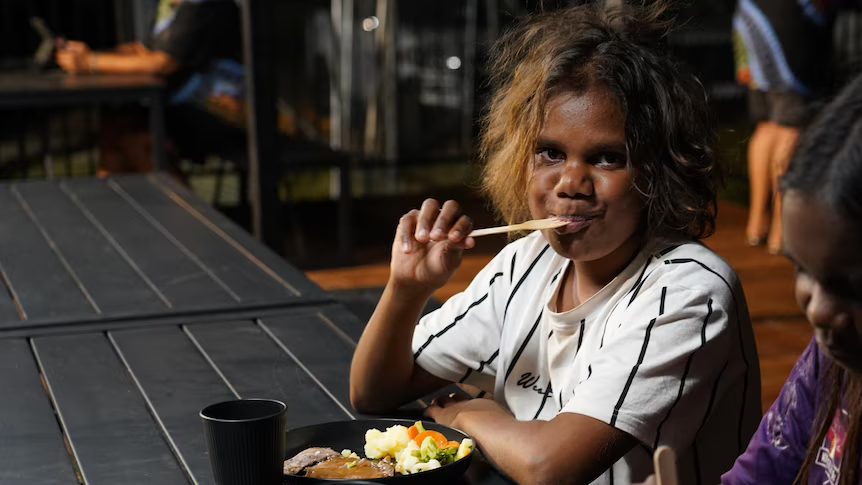
Bowel cancer is the third most commonly diagnosed cancer among Aboriginal and Torres Strait Islander people, yet many remain unaware that the disease can show no symptoms until it’s advanced. The good news? Bowel cancer is highly treatable if detected early; more than 90 per cent of cases can be successfully treated.

As Bowel Cancer Awareness Month has started, the National Aboriginal Community Controlled Health Organisation (NACCHO) is urging Aboriginal and Torres Strait Islander people to start vital conversations about bowel cancer screening with their families, communities, and health workers at their local Aboriginal Community Controlled Health Organisation (ACCHO).

“When it comes to bowel cancer, silence is not an option,” said Pat Turner, CEO of NACCHO. “Far too many of our people are being diagnosed too late, because no one talked about it, or because they didn’t know the test existed. Screening must be routine, understood, and embraced by our communities. The solutions lie in our ACCHOs, in community control, and in changing the story around bowel cancer. This is about staying strong and alive, for ourselves, for our families, and for the generations to come.”

A free bowel screening test is available for Aboriginal and Torres Strait Islander people aged 45 to 74 through the National Bowel Cancer Screening Program. Kits can be accessed through local ACCHOs or health services.

Read the full media release here.

The pioneering nurse behind one of our longest-running medical services

In a reflective interview on Living Black with Karla Grant, the veteran nurse, activist and 2024 NAIDOC Lifetime Achievement Award winner reflected on her decades of advocacy – from the referendum campaign to helping establish the Aboriginal Medical Service in Redfern. A proud Meriam woman, Flower was the first Torres Strait Islander to receive the national honour.

Flower was a founding member of the Aboriginal Medical Service in Redfern, alongside Mum Shirl, Gordon Briscoe and others. She also played a key role in mentoring and training Aboriginal nurses and health workers, helping to build an Indigenous health workforce where none had existed.

Now in her 80s, Auntie Dulcie says the future is still full of possibility — if the work continues.
“We’re in a time of change,” she said.

“We’ll lose a few battles, but we’ll win too.”

Read the full article here.
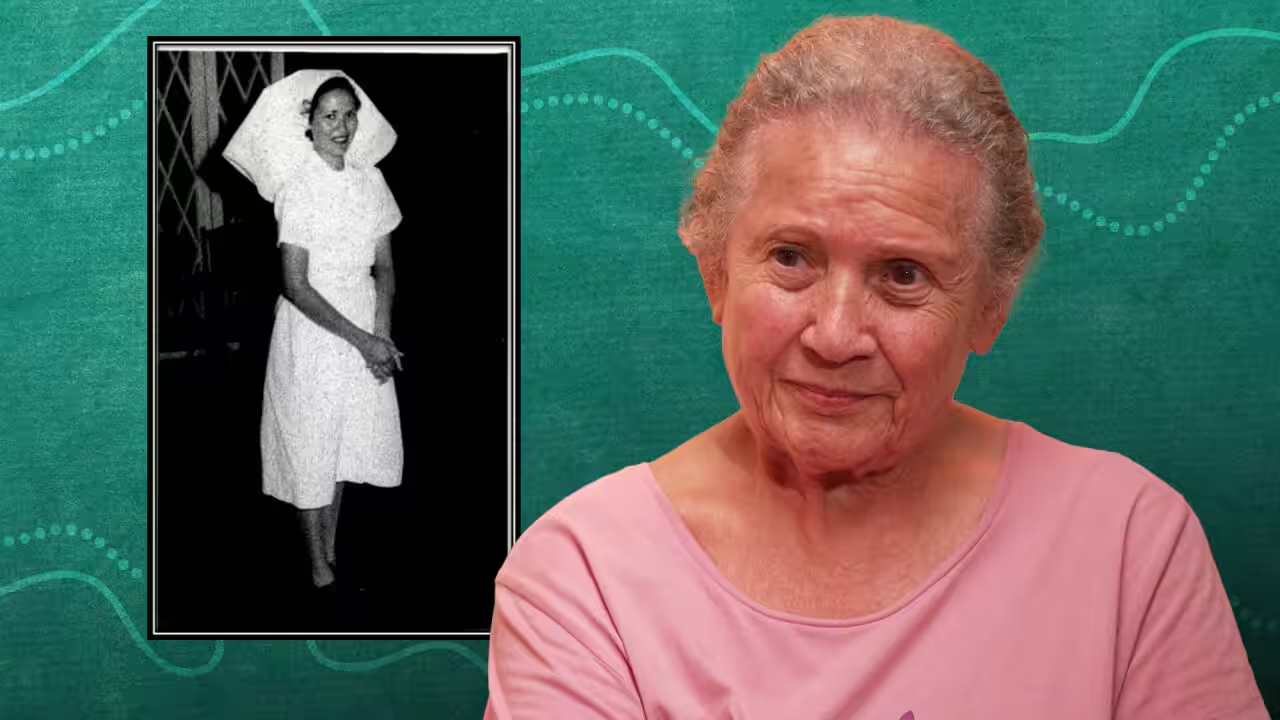
Dulcie Flower’s work in healthcare stretches back decades, when she established one of the longest-running Aboriginal healthcare centres in the country. Image source: NITV

Speech from Minister Butler, Lowitja Institute 4th International Indigenous Health and Wellbeing Conference

Mark Butler, Minister for Health and Ageing, Minister for Disability and the NDIS delivered a speech at the Lowitja Institute 4th International Indigenous Health and Wellbeing Conference on Kaurna Country, Adelaide:

“…Today, the Institute is forging ahead, strong, fearless, and together by continuing Dr O’Donoghue’s legacy of advocacy through investing in Aboriginal and Torres Strait Islander-led community driven research by translating knowledge to have the greatest impact to people and by supporting a growing and capable Aboriginal and Torres Strait Islander health research workforce.

“I’m proud to say that these priorities align very much with our Government’s approach to First Nations health as we prioritise culturally safe and appropriate healthcare for all Aboriginal and Torres Strait Islander people. Striving towards Closing the Gap targets, and targeting investment at areas of greatest need where they will deliver what we know is the greatest impact. Our Government is committed to funding the Aboriginal Community Controlled Health Services, or ACCHS, to continue providing community controlled healthcare that is deeply and firmly grounded in country, founded upon culture, and connected to community.”

To read the full speech, go here.

Image source: Lowitja Institute

Stay Lubly, Get Tested

Sexual health is an important part of our lives and wellbeing. Looking after ourselves means taking care of our sexual health, getting tested, and talking about our sexual health. The ‘Stay Lubly, Get Tested’ campaign is all about encouraging people to protect themselves and their community against STIs through safer sex.

It’s time to break down the stigma around sexual health. Talking openly about sexual health helps reduce shame and encourages more people to get tested. Whether it’s with a partner, a friend, or a health professional, these conversations can save lives.

Learn more here.

Image source: Aboriginal Health Council of South Australia

Sector Jobs – you can see sector job listings on the NACCHO website here.

Advertising Jobs – to advertise a job vacancy click here to go to the NACCHO website current job listings webpage. Scroll down to the bottom of the page to find a Post A Job form. You can complete this form with your job vacancy details – it will then be approved for posting and go live on the NACCHO website.

NACCHO Sector News: 17 June 2025

The NACCHO Sector News is a platform we use to showcase the important work being done in Aboriginal and Torres Strait Islander health, focusing on the work of NACCHO, NACCHO members and NACCHO affiliates.

We also share a curated selection of news stories that are of likely interest to the Aboriginal and Torres Strait Islander health sector, broadly.

First Nations Cancer Scholarship – Open for applications

Cancer Australia, in partnership with the Aurora Education Foundation is calling for applications for the second round of the First Nations Cancer Scholarships program.

Aboriginal and Torres Strait Islander post graduate students, early career researchers and health professionals in cancer related fields are encouraged to apply for up to $120,000 annually for up to 3 years, as well as academic, wellbeing and community support.

Recognising the urgent need to strengthen the Aboriginal and Torres Strait Islander cancer workforce, this scholarship program seeks to grow the capacity of Indigenous health professionals and researchers through advanced studies and research opportunities.

Expressions of Interest for the First Nations Cancer Scholarship are currently being accepted until 12 September 2025.

Learn more here.

Image source: Australian Government – Cancer Australia

4th International Indigenous Health and Wellbeing Conference 2025

This morning, at Lowitja Institute’s 4th International Indigenous Health and Wellbeing Conference the Opening Plenary featured Lowitja Institute Co-Patron Pat Anderson AO; the Hon Mark Butler Minister for Disability and the National Disability Insurance Scheme; Keynote Speaker, Donnella Mills, Chair of NACCHO; and Deb Edwards, Head of the Lowitja O’Donoghue Foundation.

Lowitja Institute’s International Indigenous Health and Wellbeing Conference is a biennial event attracting a global audience committed to sharing knowledge for the health and wellbeing of Indigenous peoples and communities from around the world. It is a space for sharing innovative ideas and transformational research grounded in our ways of knowingbeing and doing.

Learn more here.

Donnella Mills, Chair of NACCHO. Image source: Lowitja Institute

Empowering youth through connection, culture, and conversation

Over the past month, the Winnunga Nimmityjah Aboriginal Health and Community Services ‘Tackling Indigenous Smoking (TIS)’ team has continued to engage and inspire young people from the Ted Noffs Foundation through a series of enriching outdoor and wellness-focused activities. These included a relaxing day at Casuarina Sands, a dynamic boxing session at Cuz Boxing, and a fun-filled golf day at the Canberra Golf Club—each offering unique opportunities to connect, learn, and grow.

Across all activities, the TIS team focused on creating safe, engaging environments where young people could build skills, strengthen relationships, and reflect on their choices. These sessions not only promoted physical health but also nurtured emotional resilience and confidence.

Read more here.

Image source: Winnunga Nimmityjah Aboriginal Health and Community Services

Sector Jobs – you can see sector job listings on the NACCHO website here.

Advertising Jobs – to advertise a job vacancy click here to go to the NACCHO website current job listings webpage. Scroll down to the bottom of the page to find a Post A Job form. You can complete this form with your job vacancy details – it will then be approved for posting and go live on the NACCHO website.

Webinar: Shared decision-making for Aboriginal and Torres Strait Islander people – National Lung Cancer Screening Program

On Wednesday 25 June (1-2pm AEST) the Shared decision-making for Aboriginal and Torres Strait Islander people – National Lung Cancer Screening Program webinar will explore how to support meaningful shared decision-making with Aboriginal and Torres Strait Islander people. The webinar will feature guest presenter, Associate Professor Lisa Whop.

Shared decision-making is an essential part of the lung screening process. It involves both receiving and understanding key information about lung cancer screening, that enables individuals to make informed decisions about participation based on their values, preferences and personal circumstances. The way this conversation is held plays a vital role in building trust and fostering understanding.

To register, go here.

The webinar recording will be available after the event.

NACCHO Sector News: 11 June 2025

The NACCHO Sector News is a platform we use to showcase the important work being done in Aboriginal and Torres Strait Islander health, focusing on the work of NACCHO, NACCHO members and NACCHO affiliates.

We also share a curated selection of news stories that are of likely interest to the Aboriginal and Torres Strait Islander health sector, broadly.

Save the date! NACCHO Members’ Conference 2025

The 2025 NACCHO Members’ Conference, Youth Conference and AGM will be held from 8-10 December on Bidjigal and Gadigal Country (Sydney) at the Royal Randwick Racecourse. This year’s conference theme is ‘Strength Comes from Community Control.’

Registrations will open soon.

Schedule:

Monday 8 December

  • NACCHO Youth Conference
  • NACCHO AGM: from 12 noon

Tuesday 9 December

  • NACCHO Conference Day 1

Wednesday 10 December

  • NACCHO Conference Day 2
  • NACCHO Karaoke Dinner: Mardi Gras theme

Learn more here.

NACCHO Members’ Conference 2024

Webinar: Program entry and eligibility – National Lung Cancer Screening Program

Join the NACCHO Cancer Team for an informative webinar designed for ACCHO staff and healthcare professionals working with Aboriginal and Torres Strait Islander communities. Learn how to identify and engage individuals who may be eligible to participate in the National Lung Cancer Screening Program.

The session will provide an overview of how to support community members to access the program, including guidance on entry pathways and assessing eligibility for the program.

Register to the webinar

Winda-Mara Aboriginal Corporation new Heywood Medical Centre open

Winda-Mara Aboriginal Corporation’s brand-new Medical Centre which opened in March 2025, is a space designed to provide high-quality, culturally safe healthcare for our community.

The incredible Health Team offered their invaluable input and expertise into the design process, shaping the layout of clinical rooms, staff spaces, and overall functionality ensures this facility meets the needs of both staff and the community.

Read more here.

50 years of SBS

Pat Turner, NACCHO CEO was instrumental in the launch of NITV. Pat sat down with Karla Grant for a special episode of ‘Living Black,’ celebrating the 50th anniversary of SBS.

“I think most things about Aboriginal and Torres Strait Islander people are done better when it’s done by our own people.

“We needed to get on to the screens of Australians and into their lounge rooms, so that they could get a much better idea of who we were and what we were about,” Pat said.

Watch it here.

Karla Grant and Pat Turner. Image source: Coalition of Peaks

Sector Jobs – you can see sector job listings on the NACCHO website here.

Advertising Jobs – to advertise a job vacancy click here to go to the NACCHO website current job listings webpage. Scroll down to the bottom of the page to find a Post A Job form. You can complete this form with your job vacancy details – it will then be approved for posting and go live on the NACCHO website.

NACCHO Sector News: 28 May 2025

The NACCHO Sector News is a platform we use to showcase the important work being done in Aboriginal and Torres Strait Islander health, focusing on the work of NACCHO, NACCHO members and NACCHO affiliates.

We also share a curated selection of news stories that are of likely interest to the Aboriginal and Torres Strait Islander health sector, broadly.

Getting ready for the National Lung Cancer Screening Program: A checklist for primary healthcare services

From July 2025, some of your clients may be able to take part in the National Lung Cancer Screening Program.

Lung cancer screening involves a free low-dose CT scan every two years, or more often if needed, to check for early signs of lung cancer and monitor any changes. Screening helps detect cancer early – before symptoms appear, and when treatment is more likely to be effective.

Your health service and staff are essential to delivering the National Lung Cancer Screening Program in your community.

This checklist will provide information on how your service can prepare for the program:

  • Register with the National Cancer Screening Register (NCSR)
  • Complete lung cancer screening training and access program resources
  • Identify potential lung screening clients
  • Begin planning local implementation
  • Stay up to date with refresher courses to provide smoking cessation support

Learn more here.

Safety, food and hope replace youth crime at Fitzroy Crossing’s Night Place

Since opening in September 2024, the Night Place, run by Marra Worra Worra Aboriginal Corporation (MWW), has become a central hub for youth in the remote town, 2,400 kilometres north of Perth.

The Aboriginal-led program was created in response to concerns over disengaged children wandering the streets and rising youth crime. Similar youth night spaces have also opened in Broome.

Research shows juvenile offenders make up just 3.7% of the Kimberley youth population, with poverty and disadvantage driving criminal acts. Services including night spaces are seen as part of the solution.

Nearly 400 young people have attended the space in its first seven months, with over 8,000 visits and 12,500 hot meals served.

The Night Place started as a pilot program but has since secured longer-term state government funding.

Read more here.

Cyeahni Wallaby, 11, attends the Fitzroy Crossing Night Place. (ABC Kimberley: Rosanne Maloney)

Groundbreaking NITV documentary series ‘Our Medicine’ shines a light on communities taking back control of Indigenous health

Powerful new documentary series, Our Medicine, takes viewers behind the frontline of Australia’s strained medical services, shining an important light on First Nations professionals working to achieve better health outcomes for Aboriginal and Torres Strait Islander patients and communities. The six-part observational series premieres on National Indigenous Television (NITV) and SBS and SBS On Demand from 29 May at 7.30pm.

Narrated by screen icon Leah Purcell AM (The Drover’s Wife: The Legend of Molly Johnson, High Country), the groundbreaking series offers unique access to Aboriginal and Torres Strait Islander doctors, nurses, paramedics, traditional healers and other medical professionals, following their day-to-day challenges as they support patients on their journey through the system.

Learn more here.

Image source: SBS.

RACGP 2025 Aboriginal and Torres Strait Islander health awards

Nominations are now open for the 2025 RACGP Awards. Aboriginal and Torres Strait Islander Health awards include:

  • Standing Strong Together Award: celebrating partnerships between GPs and communities
  • Growing Strong Award: recognising exceptional Aboriginal and Torres Strait Islander GPs in training
  • Rising Strong Medical Student Award: supporting current Aboriginal and Torres Strait Islander medical students currently studying at an Australian university
  • The Aunty Val Dahlstrom Award: for Aboriginal Health Excellence, recognising excellence in Aboriginal health by an RACGP staff member, supervisor or registrar

These awards celebrate outstanding contributions to general practice and shine a light on the GPs, practices, supervisors, medical educators and registrars going above and beyond for their communities.

Submit nominations by 9AM AEST, Monday 30 June.

Image source: RACGP

Western Australia announces long awaited Stolen Generations redress scheme

Stolen Generations survivors from Western Australia will soon be eligible for compensation for the harm and suffering caused by decades of forced removal policies.

Living survivors would be eligible for $85,000 under the state government scheme, which is expected to open for applications later this year. The scheme will only apply to people who were removed as children from their families in WA before July 1st 1972.

Stolen Generations survivor and Co-Chair of Bringing Them Home WA Tony Hansen said it was a important step forward.

“By acknowledging such a brutal history, and evil policies that ripped the hearts out of children and families, this day will go down in history as a powerful moment of truth-telling,” he said.

Read more here.

The announcement has been long awaited by the state’s Stolen Generations members. Source: AAP / Lukas Coch

Sector Jobs – you can see sector job listings on the NACCHO website here.

Advertising Jobs – to advertise a job vacancy click here to go to the NACCHO website current job listings webpage. Scroll down to the bottom of the page to find a Post A Job form. You can complete this form with your job vacancy details – it will then be approved for posting and go live on the NACCHO website.

NACCHO Sector News: 23 May 2025

The NACCHO Sector News is a platform we use to showcase the important work being done in Aboriginal and Torres Strait Islander health, focusing on the work of NACCHO, NACCHO members and NACCHO affiliates.

We also share a curated selection of news stories that are of likely interest to the Aboriginal and Torres Strait Islander health sector, broadly.

Anniversary call to support Stolen Generations survivors “before it’s too late”

Ahead of National Sorry Day on 26 May, a national body has called for an urgent healing package for ageing Stolen Generations survivors, saying “we cannot wait another generation”.

“All survivors must have access to equitable redress and to the records that hold their stories,” The Healing Foundation said on Thursday.

National Sorry Day is about honouring survivors and also marks the 1997 tabling of the Bringing Them Home report, which shared Australia’s Stolen Generations history with the nation, and made a series of recommendations to address the damaging impacts.

28 years on, only six per cent of these recommendations have been fully implemented.

The Healing Foundation’s CEO Shannan Dodson urged all those with a responsibility to support Stolen Generations survivors to act without delay.

“Stolen Generations survivors have been through so much. Many suffered abuse in care, on top of the trauma of being separated from their families. They have seen how their trauma has affected their families. They deserve justice,” Ms Dodson said.

“A comprehensive and coordinated response is required from all sides of politics, all levels of government, police, churches and others, before it’s too late.

Read the full National Indigenous Times article here.

Image: Mick Tsikas (AAP).

Join the Evaluation of the Own It Campaign

NACCHO is looking for ACCHO staff to participate in a qualitative evaluation to understand how the cervical screening ‘Own It’ campaign has impacted cervical screening awareness and uptake in your Community.

If you would like to take part in the evaluation, please complete this short form and a member of the NACCHO Cancer Team will be in touch.

  • Will I be compensated for my time? Yes, from $150 and up, depending on your role in the form of an e-gift card
  • How long will it take? 1 hour
  • Where will the interviews take place? Interviews can be conducted at your convenience, either via phone or MS teams video and will be held across late May/early June.

Help shape a national education program on antidepressant use in young people

NACCHO, as part of the Quality Use of Medicines (QUM) Alliance is helping to develop a new education program to improve the use of antidepressants in young people.

The Alliance is seeking the following groups to get involved in the co-design process:

For more information, contact info@qumconnect.com.au or medicines@naccho.org.au

Construction begins on ACT Aboriginal health precinct

Work is underway on Canberra’s Watson Health Precinct redevelopment, the ACT Government has announced.

ACT Minister for Health, Rachel Stephen-Smith said the renewed Watson Health Precinct will enable delivery of better health services for young people and the Aboriginal and Torres Strait Islander community in Canberra.

The upgrades will provide new purpose-built facilities to support alcohol and other drug rehabilitation services, as well as residential mental health care for young people.

The precinct will also expand to include a new residential rehabilitation facility specifically for Aboriginal and Torres Strait Islander people – designed, constructed and operated by Winnunga Nimmityjah Aboriginal Health and Community Services.

“The new residential rehabilitation facility is designed to support the need for both cultural and therapeutic programs specifically designed indoor and outdoor spaces to allow for a holistic approach for all programs to be deliver seamlessly,” said Winnunga Nimmityjah Aboriginal Health and Community Services CEO, Julie Tongs.

Learn more here.

Roadmap unveiled to support Aboriginal and Torres Strait Islander LGBTQA+ youth

A new roadmap has detailed actions that family and community, services, and government can take to support Aboriginal and Torres Strait Islander LGBTQIA+ young people’s mental health and wellbeing, including creating visibility, seeking wider education and advocating for safe spaces.

“Five years ago, there was almost no research that had been done with Aboriginal and Torres Strait Islander LGBTQIA+ young people,” the roadmap’s lead author, The Kids Research Institute Australia (The Kids) researcher and UWA PhD student Mx Shakara Liddelow-Hunt said.

“But with the release of our national survey, and other research happening across Australia, we now have a body of evidence showing that there is a huge need to better support Aboriginal and Torres Strait Islander LGBTQIA+ young people.

“The roadmap provides concrete actions that we can all take to achieve this. Our end goal in releasing this roadmap is to empower individuals, families, communities and services to ensure Aboriginal and Torres Strait Islander LGBTQIA+ young people are safe, healthy and thriving.”

Learn more here.

If this article brought up anything for you or someone you love, please reach out to, call or visit the resources listed below for support.

Sector Jobs – you can see sector job listings on the NACCHO website here.

Advertising Jobs – to advertise a job vacancy click here to go to the NACCHO website current job listings webpage. Scroll down to the bottom of the page to find a Post A Job form. You can complete this form with your job vacancy details – it will then be approved for posting and go live on the NACCHO website.

NACCHO Sector News: 15 May 2025

The NACCHO Sector News is a platform we use to showcase the important work being done in Aboriginal and Torres Strait Islander health, focusing on the work of NACCHO, NACCHO members and NACCHO affiliates.

We also share a curated selection of news stories that are of likely interest to the Aboriginal and Torres Strait Islander health sector, broadly.

Lung cancer screening for First Nations communities

The launch of Australia’s national lung cancer screening program is expected to bring significant benefits for high-risk groups, with Aboriginal and Torres Strait Islanders high on the risk list.

Lung cancer is the fifth most commonly diagnosed cancer in Australia, behind breast, prostate, colorectal cancer and melanoma and for Aboriginal and Torres Strait Islander people, that toll is higher.

Aboriginal and Torres Strait Islander people are twice as likely as non-Indigenous Australians to both be diagnosed with and to die from lung cancer.

Peter Bligh, a Kullilli and Wakka Wakka man and director of cancer for the National Aboriginal Community Controlled Health Organisation (NACCHO) is optimistic the program will reduce that number.

“It’s Closing the Gap in a way that’s meaningful for communities,” he told Croakey Health.

“Patients must not be left in limbo with the threat of lung cancer hanging over them but no timely access to the downstream services such as respiratory specialists.”

Read the full article here.

LC-Early-Screening

Lung cancer early-screening

How Kimberley Benjamin captured the power of mob healing mob

Our Medicine is a six-part NITV documentary that honours Aboriginal and Torres Strait Islander health workers.

When filmmaker Kimberley Benjamin stepped into the emergency department at Cairns Hospital to begin filming Our Medicine, she was already feeling the weight of what this story meant.

“It was my first day, and a man came in with a machete wound to his arm,” she remembers.

“And I thought, ‘How am I going to do this?’ I can’t even look at blood.”

But what the Yawuru, Bardi and Kija young woman saw in that hospital — and across the many communities she visited while directing the six-part documentary series — was far more powerful than anything she expected.
“I got to witness our mob doing incredible, life-saving work. Not just in hospitals, but in communities, on Country, through ceremony, through bush medicine.

“And it reminded me — we’ve always had medicine.”

Our Medicine is, at its heart, a love letter to Aboriginal and Torres Strait Islander health workers, both those in scrubs and those in the bush.

It captures the quiet strength of First Nations doctors, nurses, paramedics, liaison officers, and traditional healers who are not just treating patients — they’re transforming the system from the inside out.

Read the full story here.

Kimberley Benjamin and Wunan Health professionals in the East Kimberley.

Kimberley Benjamin (middle) and Wunan Health professionals in the East Kimberley.

Aboriginal organisations, Elders help make day-to-day tasks easier for older mob

Elders are helping develop an assistance guide for when everyday tasks get a little more difficult with age.

Everyday Tools to Help Mob is a collection of free resources available online and in hard copy which provides older Aboriginal and Torres Strait Islander people with information and products to assist around the house, in the garden and getting from A to B. The end goal is to support strengthened social and emotional wellbeing.

Delivered by healthy ageing initiative LiveUp, the guide was developed in partnership with the Victorian Aboriginal Health Service, Victorian Aboriginal Community Controlled Health Organisation as well as an Elder working group.

VACCHO Journey to Dreaming Palliative Care senior project worker Robyn Bradley was involved workshops to develop the resources.

“I see great benefit”, she told National Indigenous Times, “enabling people to keep their independence”.

Ms Bradley said things many take for granted, such as putting on socks, can get a little tougher with age.

‘Low-risk assistive’ products within the guide include household items such as a two-handed mug, kettle tipper and easy-grip cutlery as well as pre-threaded needles and a seatbelt reacher for the car.

Read the full article here.

In partnership with healthy ageing initiative LiveUp, Victorian-based Aboriginal organisations and Elders have developed the Everyday Tools to Help Mob guide.

In partnership with healthy ageing initiative LiveUp, Victorian-based Aboriginal organisations and Elders have developed the Everyday Tools to Help Mob guide. (Image: Jarred Cross)

New report highlights urgency of climate action for mental health

Content warning: this article contains reference to mental health issues. Please refer to the services at the bottom of this article for support.

Underfunded mental healthcare systems are ill-equipped to cope with growing demand arising from the direct and indirect impacts of climate change upon mental health, according to a new report.

The report, ‘How climate change affects mental health in Australia’, says “substantial investment and innovation” are needed to develop a climate-resilient mental health sector.

Without a rapid transition away from fossil fuels and towards restoring nature, we can expect to see further increases in mental disorders and emergency mental health presentations among young people, it warns.

The report outlines the direct and indirect impacts of hotter temperatures and extreme weather events upon mental health, and highlights groups at increased risks, as well as making policy recommendations, including the need for “strong, decisive action to reduce the carbon emissions from healthcare”.

“Working with communities to drastically reduce emissions this decade, governments can still prevent the worst of global warming, with enormous benefits to mental health and wellbeing,” it says.

Read the full article here.

If this article brought up anything for you or someone you love, please reach out to, call or visit the resources listed below for support.

For the sake of our health, a new dawn for climate action is needed. Photo by Melissa Sweet, Melukerdee Country, 9 May 2025

For the sake of our health, a new dawn for climate action is needed. Photo by Melissa Sweet, Melukerdee Country, 9 May 2025

CEQ champions healthy start for First Nations infants with baby food range overhaul

Not-for-profit remote store operator Community Enterprise Queensland (CEQ) has reaffirmed its commitment to the health and wellbeing of children and families in remote First Nations communities, with a major update to its infant and toddler food range across all stores.

Driven by CEQ’s vision of Caring, Every Day, Always, the update follows a comprehensive review led by CEQ’s nutrition and buying teams and prioritised by the CEQ Board to ensure babies and young children have better access to healthier food options from their very first bites.

“The updated range focuses on nutritious, iron-rich, and lower-sugar options that support early development – such as meat-based meals, iron-fortified cereals, and vegetable-based meals – while reducing the shelf presence of products high in added sugars, such as sweetened custards and fruit-based purees,” according CEQ.

CEQ Nutrition and Health Manager Melinda Hammond says the changes reflect CEQ’s ongoing dedication to improving health outcomes in remote Aboriginal and Torres Strait Islander communities across North Queensland.

“A healthy start in life begins with good nutrition – and that’s something we take seriously,” says Ms Hammond.

Read the full story here.

Georgia Day CEQ Nutrition Health with Rohani Nona and Philicia Reimann

Georgia Day CEQ Nutrition Health with Rohani Nona and Philicia Reimann


Sector Jobs – you can see sector job listings on the NACCHO website here.

Advertising Jobs – to advertise a job vacancy click here to go to the NACCHO website current job listings webpage. Scroll down to the bottom of the page to find a Post A Job form. You can complete this form with your job vacancy details – it will then be approved for posting and go live on the NACCHO website.

NACCHO Sector News: 14 May 2025

The NACCHO Sector News is a platform we use to showcase the important work being done in Aboriginal and Torres Strait Islander health, focusing on the work of NACCHO, NACCHO members and NACCHO affiliates.

We also share a curated selection of news stories that are of likely interest to the Aboriginal and Torres Strait Islander health sector, broadly.

New national screening program aims to prevent many lung cancer deaths

On 1 July, just seven weeks from now, Australia will become one of the few countries in the world to launch a national lung cancer screening program, hoping to save hundreds of lives a year by finding and treating lung cancer earlier.

Despite dramatic cuts to smoking rates in Australia, lung cancer is the fifth most commonly diagnosed cancer in Australia, behind breast, prostate, colorectal cancer and melanoma. It is the leading cause of cancer death every year.’

For Aboriginal and Torres Strait Islander people, the toll is higher, in every age group: it is both the most common type of cancer and the most common cause of cancer death. Aboriginal and Torres Strait Islander people are twice as likely as non-Indigenous Australians to both be diagnosed with and to die from lung cancer.

Peter Bligh, a Kullilli and Wakka Wakka man and director of cancer for the National Aboriginal Community Controlled Health Organisation (NACCHO), hopes the screening program will “turn the tide” for Aboriginal and Torres Strait Islander people.

He is optimistic the program will be effective, so long as it builds on the strengths and resilience of communities and invests strongly in the Aboriginal and Torres Strait Islander health workforce to address barriers like access, stigma and lack of cultural safety.

“It’s Closing the Gap in a way that’s meaningful for communities,” he told Croakey.

Read the full Croakey Health Media article here.

First Nations leaders urge ‘bold’ reforms on truth, treaty and closing the gap

The Albanese government must use its historic mandate and standing with the electorate to deliver the remaining reforms of the Uluru Statement, namely treaty and truth-telling, Indigenous leaders say.

Pat Turner, NACCHO CEO who has spent decades working with governments to improve the lives of First Nations people, said the returning Albanese government “can’t rest on their laurels”.

“I’m really pleased that the Labor government has been returned,” she told Bridget Brennan on ABC News Breakfast on Tuesday.

“The alternative was unthinkable for Aboriginal and Torres Strait Islander people.”

But as one of the architects of the Closing the Gap national agreement, she said she was putting the government on notice because “there is so much to be done”.

Ms Turner said she wanted the federal government to take a stronger role in lifting the age of criminal responsibility, deliver needs-based funding to the community-controlled sector and finalise the Coalition of Peaks’s economic development partnership with Treasury.

“Closing the Gap is every minister’s responsibility, not just Malarndirri McCarthy’s, it belongs to every minister in the federal cabinet,” she said.

Read more here.

Pat Turner, NACCHO CEO on ABC News Breakfast.

New ABS data reveals 1 in 6 Aboriginal and Torres Strait Islander adults are living with diabetes, one of the highest rates in the world

1 in 6 Aboriginal and Torres Strait Islander adults are living with diabetes. 1 in 5 don’t even know they have it.

At NACCHO, we are taking action. In partnership with the Bupa Foundation, we’re training up to 500 Aboriginal and Torres Strait Islander Health Workers in culturally safe diabetes prevention, supporting local, community-led care.

This partnership invests in our people and recognises that solutions must come from within our communities. It’s a bold step to close the health gap, reduce preventable deaths, and build a stronger health workforce across the country.

Diabetes is the leading cause of death for Aboriginal and Torres Strait Islander women and the fourth for men. But with the right training, early detection, and culturally safe care, we can change the story.

Learn more here.

Watch Dr Jason Agostino, NACCHO Senior Medical Advisor on NITV (from 02:48 onwards).

Image source: NACCHO

Strong Born, Strong Communities: New FASD Guidelines empower healthy futures

The University of Queensland has released Australia’s first national clinical guidelines for the assessment and diagnosis of Fetal Alcohol Spectrum Disorder (FASD), aiming to improve early intervention, reduce stigma, and increase access to support across all communities.

The release of the guidelines aligns with the Strong Born campaign, launched by the National Aboriginal Community Controlled Health Organisation (NACCHO) and supported by the Foundation for Alcohol Research and Education.

Gudanji-Arrernte woman and NACCHO CEO Pat Turner said the campaign is focused on raising awareness and reducing shame around FASD in Aboriginal and Torres Strait Islander communities.

“The Strong Born campaign is about raising awareness and understanding of Fetal Alcohol Spectrum Disorder and reducing stigma and shame,” Ms Turner said.

“Growing strong healthy mums and bubs leads to healthy communities.”

The new guidelines are expected to support national efforts like Strong Born by equipping more practitioners with the tools to identify and support individuals with FASD, particularly in regional and remote communities.

Read the full National Indigenous Times article here.

Helping Indigenous families navigate genomic health

Being diagnosed with a genetic disease can be challenging for many people and their families, but it is hoped new resources will help them feel more empowered and less alone.

After working with First Nations communities over a decade, National Centre of Indigenous Genomics deputy director Azure Hermes said she had heard many stories from people navigating genomic health services.

“Patients and families were saying ‘I’m finding it difficult to understand what a genetic counsellor is, I don’t know what their job is’, or ‘I don’t know the questions I should ask’,” the Gimuy Walubara Yidinji woman told AAP.

The centre, alongside community organisations and with support from Australian Genomics, developed a series of animations, live videos and fact sheets exploring rare disease, DNA, genomics research and what to expect during appointments at a genetic health service.

The resources are being translated into Yolngu Matha, Anindilyakwa, Torres Strait Island creole, Warlpiri and Pitjantjatjara languages.

Read more here.

Navigating the health system after a genetic disease diagnosis can be complex, Azure Hermes says. (Image: Azure Hermes/AAP PHOTOS)

Sector Jobs – you can see sector job listings on the NACCHO website here.

Advertising Jobs – to advertise a job vacancy click here to go to the NACCHO website current job listings webpage. Scroll down to the bottom of the page to find a Post A Job form. You can complete this form with your job vacancy details – it will then be approved for posting and go live on the NACCHO website.

NACCHO Sector News: 7 May 2025

The NACCHO Sector News is a platform we use to showcase the important work being done in Aboriginal and Torres Strait Islander health, focusing on the work of NACCHO, NACCHO members and NACCHO affiliates.

We also share a curated selection of news stories that are of likely interest to the Aboriginal and Torres Strait Islander health sector, broadly.

‘Time for the rubber to hit the road’: Pat Turner calls on re-elected Labor government to step up

In the wake of the Albanese government’s landslide re-election, the longtime advocate, CEO of NACCHO, and convenor of the Coalition of Peaks is calling for stronger leadership on Closing the Gap.

She warns that key targets won’t be met unless governments fundamentally change how they work with First Nations communities.

“I expect [much] stronger leadership from the second term of the Labor government when it comes to the National Agreement on Closing the Gap,” Turner told Karla Grant on Living Black.

Turner says real change will only come when funding is tied to reform — and when Aboriginal and Torres Strait Islander organisations are not sidelined by bureaucracy, but properly empowered to lead the work

Read the full article here.

Aunty Pat Turner says she expects stronger leadership from the second term of the Labor government when it comes to Closing the Gap. Source: AAP / LUKAS COCH/AAPIMAGE

Tom Calma call to change Indigenous Closing the Gap strategy

The decade-long national agreement on Closing the Gap signed in 2020 includes a promise to invest heavily in community-controlled Aboriginal organisations so they can do the work in key areas, including Indigenous health, child protection and crime prevention. This is based on evidence that results are often better when the service provider is a local Aboriginal organisation with locals on its board.

However, Tom Calma, whose 2005 social justice report inspired Kevin Rudd to create the first Closing the Gap agreement, says community-controlled organisations should not be bolstered at the expense of all else.

The former social justice commissioner says big numbers of Indigenous Australians use main­stream services and there should be a focus on ensuring those deliver what they are paid to deliver.

“Those community-­controlled organisations by and large deliver a great service but we need to look at a move away from just investing in community-­controlled Indigenous organisations and work much more with the private and public systems to ensure their services are culturally sound and safe,” Professor Calma told The Australian on Tuesday.

Read the full article here.

Aboriginal leader Tom Calma. Picture: NewsWire / Martin Ollman

New campaign urges greater awareness and screening for cervical cancer in First Nations communities

Four of Australia’s leading health organisations recently joined forces with the federal government to ensure no one is left behind in the drive to eliminate cervical cancer in Australia.

The Australian Centre for the Prevention of Cervical Cancer (ACPCC), the National Aboriginal Community Controlled Health Organisation (NACCHO), ACON and the Australian Multicultural Health Collaborative have united in a new federally funded campaign – the Own It campaign – to improve cervical screening rates by highlighting Australia’s world-leading HPV self-collect test.

NACCHO Deputy CEO Dr Dawn Casey said the new national campaign is “a significant step forward in raising awareness about cervical screening within Aboriginal and Torres Strait Islander communities”.

“It builds on the successful implementation of human papillomavirus (HPV) self-collection already taking place in Aboriginal Community Controlled Health Organisations,” she said.

Read more here.

Lowanna with a self screening kit. Image: Own It.

New leadership for PSA Aboriginal and Torres Strait Islander Pharmacy Practice CSI

The Pharmaceutical Society of Australia (PSA) is proud to announce the appointment of a new leadership group for the Aboriginal and Torres Strait Islander Pharmacy Practice (ATSIPP) Community of Specialty Interest (CSI), chaired by respected pharmacist and proud Nywaigi Mamu woman, Chastina Heck MPS.

The ATSIPP CSI plays a vital role in championing culturally safe pharmacy practices, supporting Aboriginal and Torres Strait Islander pharmacists, and improving health outcomes across communities. With the appointment of this new leadership group, PSA reaffirms its commitment to equity, representation, and empowering Indigenous voices within the profession. PSA recognises culturally safe care and equity of health care access as critical drivers to improving health outcomes.

he 2025 Aboriginal and Torres Strait Islander Pharmacy Practice CSI Leadership Group includes:

  • Chastina Heck MPS (Chair)
  • Atinuke (Tinu) Abraham MPS
  • Jaimee Anderson MPS
  • Carli Berrill MPS
  • Jenny Cooper MPS
  • Hannah Mann (NACCHO)
  • Dr Jared Miles MPS
  • Yvette McGrath MPS
  • Alice Nugent MPS
  • Mike Stephens MPS
  • Cheyne Sullivan MPS
  • Kelly Tanner MPS
  • Shi-Anne Wallace (inaugural NAPSA Indigenous Chair)
  • Lisa Wark MPS
  • Lucky Zeniou MPS

Read more here.

Image source: Pharmaceutical Society of Australia

4th International Indigenous Health and Wellbeing Conference 2025: Donnella Mills keynote speaker

Lowitja Institute is proud to welcome Donnella Mills as a keynote speaker at the 4th International Indigenous Health and Wellbeing Conference 2025.

A proud Torres Strait Islander woman with family ties to Masig and Nagir, Donnella is the Chair of NACCHO, a strong advocate for justice and community controlled health, and a dedicated legal professional. Her career spans frontline legal work, pioneering health justice partnerships, and national leadership roles that continue to shape policy and outcomes for Aboriginal and Torres Strait Islander peoples.

For more information and the conference and to register, go here.

Image source: Lowitja Institute

Sector Jobs – you can see sector job listings on the NACCHO website here.

Advertising Jobs – to advertise a job vacancy click here to go to the NACCHO website current job listings webpage. Scroll down to the bottom of the page to find a Post A Job form. You can complete this form with your job vacancy details – it will then be approved for posting and go live on the NACCHO website.

NACCHO Sector News: 2 April 2025

The NACCHO Sector News is a platform we use to showcase the important work being done in Aboriginal and Torres Strait Islander health, focusing on the work of NACCHO, NACCHO members and NACCHO affiliates.

We also share a curated selection of news stories that are of likely interest to the Aboriginal and Torres Strait Islander health sector, broadly.

Closing the Gap Assembly

This week, more than 150 leaders from across the country have come together to strengthen our collective efforts to Close the Gap.

Yesterday’s discussions were honest and powerful — shining a light on what’s working, and what still isn’t, when it comes to how governments and mainstream institutions engage with Aboriginal and Torres Strait Islander people.

Because the gap we’re trying to close isn’t just about life outcomes — it’s also about the distance between systems and communities. A gap between the way governments operate and what our communities actually need.

That gap needs attention too.

Learn more here.

Have your voice heard by filling out a 10-minute survey or making a submission by 16 April, here.

Dr Dawn Casey, NACCHO Deputy CEO. Image source: Coalition of Peaks.

First Nations-led campaign promotes self-collection cervical screening

Australia has launched its first national cervical screening campaign in over two decades, aiming to increase participation rates with a new self-collection testing option.

The “Own It” campaign encourages individuals to take their own swab, providing a private and accessible alternative to traditional clinician-collected tests. With $10.2 million in funding, the initiative targets under-screened communities and will run across television, radio, and online platforms.

Dr. Dawn Casey, Deputy CEO of the National Aboriginal Community Controlled Health Organisation (NACCHO), emphasised the significance of the campaign for Aboriginal and Torres Strait Islander communities.

“I think it’s really important to have culturally appropriate campaigns,”

“The work that Dr. Lisa Whop did on cervical cancer and self-testing was really important, and this campaign builds on that. It strongly promotes self-collection and addresses concerns around privacy and comfort,” she said.

Read the full article here.

Racism in healthcare is unacceptable says RACGP

The Royal Australian College of GPs has outlined commitments to step towards eliminating racism in Australia’s healthcare system in a new position released today on the International Day for the Elimination of Racial Discrimination.

“We recognise the unique challenges and discrimination faced by Aboriginal and Torres Strait Islander peoples, their leadership in efforts to eliminate racism, and that truth telling is a fundamental step in eliminating racism…” said RACGP President Dr Michael Wright.

“The RACGP’s updated position on racism outlines our commitments to address it, including implementing our Aboriginal and Torres Strait Islander Cultural and Health Training Framework, which embeds Aboriginal and Torres Strait Islander values and ways of being and doing in GP education and training across Australia.”

RACGP Board Chair Dr Sian Goodson said racism is an urgent national health priority.

”… I also note our important and longstanding partnership with the National Aboriginal Community Controlled Health Organisation (NACCHO). Together, we jointly advocate for a culturally safe and accessible healthcare system that is free from racism, and develop key recourses, including the the NACCHO-RACGP National guide to preventive healthcare for Aboriginal and Torres Strait Islander people which includes a chapter on the health impacts of racism.”

Read the media release in full here.

NACCHO and RACGP launching the ‘National Guide to preventative healthcare for Aboriginal and Torres Strait Islander people – fourth edition’ at the 2024 NACCHO Members’ Conference

New Good Medicine Better Health module: Talk, Test, Protect

Complete the latest Good Medicine Better Health module to gain a better understanding of gonorrhoea – including testing, prevention and contact tracing.

The National Association of Aboriginal & Torres Strait Islander Health Workers has endorsed the activity with 1 CPD hour.

Start learning today.

Interim findings highlight positive impact of AHCWA’s Social and Emotional Wellbeing Model of Service

A recent evaluation of Aboriginal Health Council of Western Australia’s Social and Emotional Wellbeing (SEWB) Model of Service has highlighted positive impacts in supporting health outcomes for Aboriginal people and communities. This evaluation was undertaken by researchers Patricia Dudgeon, Rama Putu Agung-Igusti, and Emma Carlin from the School of Indigenous Studies University of WA and the University of WA, and Broome Rural Clinical School Division.

SEWB is a holistic concept encompassing the importance of connection to land, culture, spirituality, and ancestry, forming the foundation of physical and mental health for Aboriginal Australians. The Mental Health Commission funded AHCWA to undertake a three-year pilot project to support Aboriginal Community Controlled Health Services across WA. The SEWB Model of Service has embedded each site with a team encompassing seven positions with cultural and clinical expertise.

Learn more here.

Image source: AHCWA

Sector Jobs – you can see sector job listings on the NACCHO website here.

Advertising Jobs – to advertise a job vacancy click here to go to the NACCHO website current job listings webpage. Scroll down to the bottom of the page to find a Post A Job form. You can complete this form with your job vacancy details – it will then be approved for posting and go live on the NACCHO website.

Governance Workshops for ACCHOs

Register now for the NACCHO Governance Workshops 2025.

Sydney is up next on Tuesday 15 April and Wednesday 16 April. 

NACCHO’s Governance Workshops are designed for people working in member ACCHOs and run by legal and other experts in the field. 

The workshops cover: 

  • Principles of good governance.  
  • Managing conflicts of interest. 
  • Managing risk (e.g. contract execution, etc.). 
  • Delegation of powers. 
  • Finance for Boards. 
  • Structure and role of boards and sub-committees; and 
  • Governance documents. 

NACCHO Sector News: 1 April 2025

The NACCHO Sector News is a platform we use to showcase the important work being done in Aboriginal and Torres Strait Islander health, focusing on the work of NACCHO, NACCHO members and NACCHO affiliates.

We also share a curated selection of news stories that are of likely interest to the Aboriginal and Torres Strait Islander health sector, broadly.

Closing the Gap: Watch the live stream today

Leaders from across the country are gathering on Ngunnawal and Ngambri Country this week to shape the future of Closing the Gap.

You can get involved too! Live stream the discussions here.

Today’s livestream program

  • 9am – 10am: Keynote address from Coalition of Peaks Lead Convenor Pat Turner AM
  • 11am – 12:30pm Aboriginal-Led Review of the Closing the Gap Agreement
  • 1:30pm – 2pm Shared decision-making
  • 3:30pm – 4pm Partnership
  • 4:30pm – 5pm Day 1 wrap up

Have your voice heard by filling out a 10-minute survey or making a submission by 16 April here.

Image source: Coalition of peaks

New Government grants to tackle medicines issues in stroke prevention, osteoporosis, menopause, mental health and multimorbidity

The Quality Use of Medicines Alliance (QUM Alliance) is hailing the new Australian Government health education and literacy grants as a game changer in helping address some of Australia’s most prevalent and pressing health issues.

Over the next 3 years, the Alliance will implement programs to reduce stroke recurrence, prevent secondary fractures in osteoporosis, increase evidence-based care in menopause, ensure safe use of antidepressants in young people, and improve outcomes for older Australians managing multiple chronic conditions.

The announcement by the Department of Health and Aged Care on 7 March 2025 marks the second consecutive round of funding to improve health literacy and the quality use of medicines awarded to the QUM Alliance.

QUM-Alliance

‘Let’s Own It’ pouches available for ACCHOs

We have ‘Let’s Own It!’ pouches up for grabs!

These pouches are designed to support a culturally safe and empowering cervical screening experience for Aboriginal and Torres Strait Islander women and people with a cervix. The pouch provides extra privacy and comfort when the Cervical Screening Test swab is taken outside of the consultation room for a self-collected sample.

The pouch can be taken home after the test.

ACCHOs can order the pouches here.

Learn more about the Cervical Screening campaign here.

Celebrating Executive Manager Amanda Collins-Clinch’s Five-Year Milestone at AHCWA

This year on 13 January, Amanda Collins-Clinch marked five years of outstanding service as an Executive Manager at AHCWA, and 22 years working at a peak level in the Aboriginal Community-Controlled Health Sector.

Joining the organisation in 2020 during a time of significant change, Amanda brought to AHCWA a sense of calm and a strong leadership approach that gave confidence in her abilities. She transitioned into the role of Deputy Chief Executive Officer in July 2021. Three years later, in June 2024, Amanda was appointed Executive Manager of the Office of the CEO, a testament to her immense impact within the Sector.

Read more here.

Image source: AHCWA

Major funding granted to Mala’la Health Service

The Mala’la Health Service Aboriginal Corporation in Maningrida, Northern Territory, is set to receive $12.8 million in funding through the Aged Care Capital Assistance Program.

The money will be used to:

  • replace old building stock and to deliver four new rooms with ensuites
  • refurbish kitchen facilities, including a new cool room
  • delivery of new laundry and storage areas
  • improvements to staff amenities and a new care parking area
  • outdoor improvements including extensions to shaded areas and a new sensory dementia garden.

This funding comes in addition to the $2.4 million previously provided to Mala’la Aged Care Service to help support the delivery of home and residential care services under the National Aboriginal and Torres Strait Islander Flexible Aged Care program.

Read more here.

(iStock/Thurtell)

Sector Jobs – you can see sector job listings on the NACCHO website here.

Advertising Jobs – to advertise a job vacancy click here to go to the NACCHO website current job listings webpage. Scroll down to the bottom of the page to find a Post A Job form. You can complete this form with your job vacancy details – it will then be approved for posting and go live on the NACCHO website.

Governance Workshops for ACCHOs

Register now for the NACCHO Governance Workshops 2025.

Sydney is up next on Tuesday 15 April and Wednesday 16 April. 

NACCHO’s Governance Workshops are designed for people working in member ACCHOs and run by legal and other experts in the field. 

The workshops cover: 

  • Principles of good governance.  
  • Managing conflicts of interest. 
  • Managing risk (e.g. contract execution, etc.). 
  • Delegation of powers. 
  • Finance for Boards. 
  • Structure and role of boards and sub-committees; and 
  • Governance documents.