NACCHO Sector News: 24 November 2025

Aboriginal and Torres Strait Islander Health News

The NACCHO Sector News is a platform we use to showcase the important work being done in Aboriginal and Torres Strait Islander health, focusing on the work of NACCHO, NACCHO members and NACCHO affiliates.

We also share a curated selection of news stories that are of likely interest to the Aboriginal and Torres Strait Islander health sector, broadly.

A call for action to address long COVID in Aboriginal communities

The impact of long COVID upon Aboriginal people in the Northern Territory is poorly understood, and more needs to be done to improve diagnosis, treatment and support, according to Dr Andrew Nguyen, public health registrar and infectious diseases physician at Aboriginal Medical Services Alliance Northern Territory (AMSANT).

“Long COVID will not disappear simply because we have stopped talking about COVID,” he writes below.

“It demands attention and equity-focused action. The longer we wait, the greater the risk that this invisible pandemic becomes another entrenched health inequity.”

Read the full Croakey Health Media article here.

Photo by Alison Barrett

WA camp aims to reduce high rates of domestic violence by teaching teenage boys

Last year, Wilinggin Aboriginal Corporation Wunggur ranger coordinator Steve Martin, started a camp to teach his rangers about relationships.

Mr Martin said family and domestic violence cannot be tolerated, but also cannot be ignored — it should be prevented. He says the focus on prevention means young people should understand what a healthy relationship is. It was key feedback from men who participated in last year’s camp.

“The first thing they said was ‘we would have wanted this when we were kids, we need to get this out to the youth,'” he explained.

Derby Aboriginal Health Service programs coordinator Mick Leamy, who used to counsel domestic violence offenders in prison, said they were supporting the change the community had been asking for.

“When (a program) is community-led it is often much more successful because it’s coming from a place the community needs,” he said.

Read the full article here.
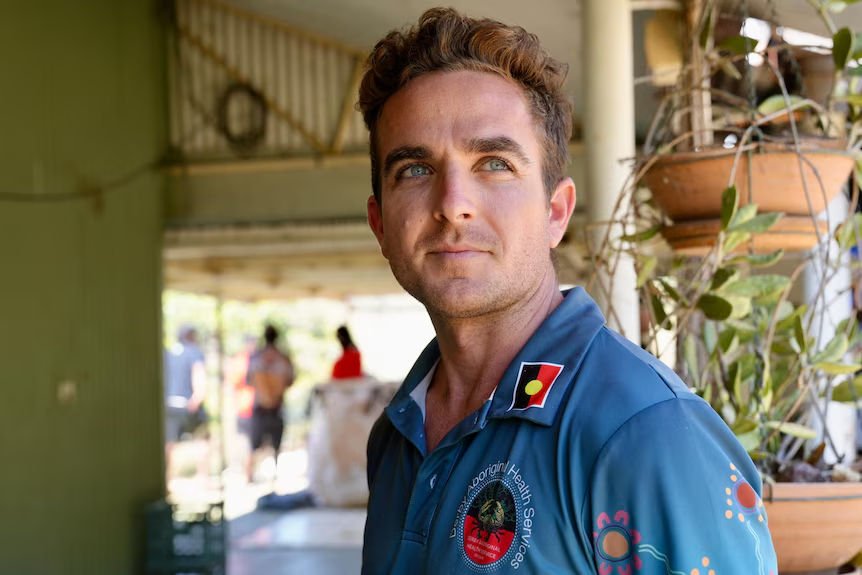
Mick Leamy from Derby Aboriginal Health Service says community-led initiatives are the most effective. (ABC Kimberley: Giulia Bertoglio)

Family and domestic violence support:

Strengthening oversight for children in care confirmed, welcomed by advocates

The Joint Council on Closing the Gap has agreed to strengthen oversight of how governments implement existing commitments for Indigenous children, marking what advocates say is an important step toward changing outcomes for First Nations children and young people.

Meeting in Hobart on Friday, the Council committed to prioritising key reforms under Target 12 of Closing the Gap, which aims to reduce by 45 per cent the over-representation of Aboriginal and Torres Strait Islander children in out-of-home care (OOHC) by 2031.

“Right now this country is still failing too many of our kids in early childhood development, education, out-of-home care, youth justice and access to safe housing and services,” deputy lead convenor of the Coalition of Peaks, Scott Wilson, told reporters.

“These are failures of government systems — not about children and their families — and they demand action, not excuses.”

Mr Wilson said the Council was hopeful of making “progress on addressing the policies and practices that continue to disproportionately harm our young people and agree to work together with the Community-Controlled sector to support our kids”.

Read more here.

The Joint Council on Closing the Gap met in Hobart on Friday. (Image: supplied to National Indigenous Times)

2025 IAHA Leadership Program graduates

Yesterday Indigenous Allied Health Australia (IAHA) celebrated the successes of the graduates from the 2025 IAHA Leadership Program. Over the past 9 months, the leadership participants have developed a greater understanding of Aboriginal and Torres Strait Islander leadership, cultural governance, advocacy, influencing others, community development and Nation building approaches.

Guided by Aboriginal and Torres Strait Islander ways of working, including knowing, being and doing, the program develops the attributes and skills to become an effective, culturally responsive Aboriginal and or Torres Strait Islander leader.

Expressions of interest are now open for the 2026 program! For more information and to apply, visit the IAHA website.

Image source: Indigenous Allied Health Australia

Sector Jobs – you can see sector job listings on the NACCHO website here.

Advertising Jobs – to advertise a job vacancy click here to go to the NACCHO website current job listings webpage. Scroll down to the bottom of the page to find a Post A Job form. You can complete this form with your job vacancy details – it will then be approved for posting and go live on the NACCHO website.

Email us your story with some images to: NACCHOCommunicationsandMedia@naccho.org.au and we will feature it in the news.

Email us your story with some images to: NACCHOCommunicationsandMedia@naccho.org.au
and we will feature it in the news.

NACCHO Sector News: 21 November 2025

Aboriginal and Torres Strait Islander Health News

The NACCHO Sector News is a platform we use to showcase the important work being done in Aboriginal and Torres Strait Islander health, focusing on the work of NACCHO, NACCHO members and NACCHO affiliates.

We also share a curated selection of news stories that are of likely interest to the Aboriginal and Torres Strait Islander health sector, broadly.

Join NACCHO’s COVID-19 Evaluation Report Webinar & Live Q&A

NACCHO’s Covid-19 Evaluation Report: Webinar and live Q&A is being held Wednesday 3 December 2025, 1:00 PM – 1:35 PM AEDT. To register, go here.

Hear from Jason Agostino, Senior Medical Advisor at NACCHO, and George McMahon, Manager at Nous Group, as they unpack findings from the national evaluation of ACCHOs’ COVID-19 response.

  • Learn how flexible funding, local decision-making, and culturally safe communication saved an estimated 2,000 lives.
  • Explore what worked, what didn’t, and recommendations for future emergency preparedness.
  • Understand the role of Elders, cultural knowledge holders, and trusted community leaders in shaping health outcomes.

Registration close Tuesday 2 December 2025.

Central Australia Aboriginal Congress Diabetes Education

The Diabetes Education Service aims to provide information to Aboriginal people living with diabetes in remote and town locations in Central Australia.

The service includes information on:

  • how to manage diabetes
  • treatment
  • healthy eating
  • blood sugar testing.

Learn more here.

Image source: Australian Indigenous HealthInfoNet

VAHS’ Preventative Health Unit the Koori Way keeping busy with school visits

After the successful launch of the postcard activity at recent Community events, Victorian Aboriginal Health Service’ (VAHS) Preventative Health Unit the Koori Way team is bringing it to schools, most recently, at Worawa Aboriginal College.

Students each wrote their own personal message to the tobacco industry, telling them they won’t be their future customer, and to stop killing Mob with their product

The Koori Way then sends these postcards to industry, inundating them with thousands of messages to hold them to account.

Learn more here.

Image source: Victorian Aboriginal Health Service

Goolburri Aboriginal and Torres Strait Islander Health Advancement now a registered provider under the Aged Care Act

Goolburri Aboriginal and Torres Strait Islander Health Advancement was honoured to welcome representatives from the Aged Care Quality & Safety Commission to the office last week for the hand-signing of its Certificate of Registration, alongside CEO, Lizzie Adams, recognising Goolburri as a registered provider under the Aged Care Act.

This milestone is not only a proud achievement for Goolburri, but it also means it can continue providing high-quality, culturally safe care that benefits Elders and strengthens community.

See more photos here.

Image source: Goolburri

Sector Jobs – you can see sector job listings on the NACCHO website here.

Advertising Jobs – to advertise a job vacancy click here to go to the NACCHO website current job listings webpage. Scroll down to the bottom of the page to find a Post A Job form. You can complete this form with your job vacancy details – it will then be approved for posting and go live on the NACCHO website.

Email us your story with some images to: NACCHOCommunicationsandMedia@naccho.org.au and we will feature it in the news.

Email us your story with some images to: NACCHOCommunicationsandMedia@naccho.org.au
and we will feature it in the news.

NACCHO Sector News: 14 November 2025

Aboriginal and Torres Strait Islander Health News

The NACCHO Sector News is a platform we use to showcase the important work being done in Aboriginal and Torres Strait Islander health, focusing on the work of NACCHO, NACCHO members and NACCHO affiliates.

We also share a curated selection of news stories that are of likely interest to the Aboriginal and Torres Strait Islander health sector, broadly.

NACCHO Media Release: World Diabetes Day 2025: Building the Workforce, Strengthening Community, and Closing the Gap

Today, on World Diabetes Day, NACCHO and the Bupa Foundation are shining a light on the power of community-led action to change the trajectory of diabetes across Aboriginal and Torres Strait Islander communities.

While the rate of diabetes-related deaths among Aboriginal and Torres Strait Islander people has fallen, from 100 per 100,000 in 2008 to 70 per 100,000 in 2019, diabetes still contributes to 7.3 per cent of all deaths and continues to affect families across generations. In some regions, rates of type 2 diabetes are among the highest in the world.

Through the NACCHO | Bupa Foundation Health Strong, Diabetes Gone partnership, Aboriginal and Torres Strait Islander communities are taking the next step, strengthening their workforce, improving early detection and prevention, and ensuring that culturally informed care is led from within.

Read the full media release.

NACCHO CEO Pat Turner said: “This is not about short-term fixes or symbolic gestures; it’s about investing in people, in training, and in the future of Aboriginal and Torres Strait Islander health.

NACCHO CEO Pat Turner said: “This is not about short-term fixes or symbolic gestures; it’s about investing in people, in training, and in the future of Aboriginal and Torres Strait Islander health.”

New country Victoria hub for Goolum Goolum Aboriginal Co-operative

Goolum Goolum Aboriginal Co-operative Limited have moved into its new digs in Victoria’s Wimmera region, following a $1 million contribution from the Indigenous Land and Sea Corporation.

GGAC’s new community hub, ‘Dalki Guli’, in Horsham, will be a service centre for the Wotjobaluk, Jaadwa, Jadawadjali, Jupagulk, and Wergaia peoples of the region.

The Aboriginal community-controlled health organisation, which delivers health, welfare, and family services to Indigenous people, had outgrown its previous home.

The new hub, which employs 22 First Nations people, will provide GGAC more space to deliver its programs, including various Indigenous training and employment opportunities to help empower future generations within the region.

Goolum Goolum board chairperson, Jake Goodes, said the hub had been designed to create an environment that feels welcoming, safe, and healing.

“One of our proudest milestones this year has been the official opening of the Dalki Guli Hub,” he said.

Read the full article.

Image: GGAC.

Image: GGAC.

New Great Southern Indigenous Healing Service for FDV youth

A new Indigenous Healing Service (IHS) for Aboriginal children and young people aged 5-18 impacted by family and domestic violence in the Great Southern will be delivered by Yorgum Healing Services Aboriginal Corporation.

  • Yorgum Healing Services Aboriginal Corporation to deliver new Indigenous Healing Service in the Great Southern
  • The Albany-based service will support Aboriginal children and young people impacted by family and domestic violence
  • Part of an $8.2 million package to deliver accessible therapeutic services to children and young people affected by family violence

A new Indigenous Healing Service (IHS) for Aboriginal children and young people aged 5-18 impacted by family and domestic violence in the Great Southern will be delivered by Yorgum Healing Services Aboriginal Corporation.

Based in Albany, the new service recognises Aboriginal children, young people and families who experience disproportionate levels of family and domestic violence, with devastating impacts on health and wellbeing.

It forms part of the Cook Government’s $8.2 million package to deliver accessible therapeutic healing services to children and young people affected by family violence.

Read the full article

North Australia Centre for Autonomous Systems completes medical drop via drone

Cut off by floods and running low on medical supplies, a remote community had to think outside the box to save a life. With the help of an expert team nearby, history was made.

A team of Northern Territory researchers made Australian history this week when they used their drone to deliver essential medication to a remote community.

On Wednesday evening, health workers at Gunbalunya Health Centre were treating a patient who had gone into cardiac arrest when they were forced to think outside the box.

The clinic was running low on medication and turned to its neighboring community, Jabiru, to lend a hand.

Jabiru Health Centre had what they needed, but was cut off due to flooding.

However, a tight-knit team from Charles Darwin University – the North Australia Centre for Autonomous Systems (NACAS) – happened to be stationed in the region where they had been testing their drone.

Read the full article.

North Australia Centre for Autonomous Systems have successfully delivered medical supplies via a drone in remote NT.

North Australia Centre for Autonomous Systems have successfully delivered medical supplies via a drone in remote NT.

Connection to ‘family, culture, and education’ key to youth justice, not jail time, says Indigenous advocate

Justice advocacy group ‘Change the Record’ has condemned the Victorian government’s plan to introduce “adult time for violent crime” legislation, which would see children as young as 14 tried, sentenced and imprisoned as adults.

Change the Record said on Thursday that the “dangerous” laws will “expose vulnerable children to longer, harsher sentences – including life imprisonment – and will disproportionately target First Nations children”.

Change the Record CEO and Indigenous justice advocate Jade Lane said the state government’s proposal “takes us in the wrong direction as a society”.

“We must seek to help and nurture children at every opportunity, particularly vulnerable children at risk of contact with the criminal legal system. The Victorian government should be investing in First Nations-led, community-based solutions that are proven to address the underlying health, social and economic drivers of offending,” she said.

Read the full article.

Children as young as 14 could spend up to life in prison for some offences under proposed new Victorian legislation. Image: Dechlan Brennan.

Children as young as 14 could spend up to life in prison for some offences under proposed new Victorian legislation. Image: Dechlan Brennan.


Sector Jobs – you can see sector job listings on the NACCHO website here.

Advertising Jobs – to advertise a job vacancy click here to go to the NACCHO website current job listings webpage. Scroll down to the bottom of the page to find a Post A Job form. You can complete this form with your job vacancy details – it will then be approved for posting and go live on the NACCHO website.


Email us your story with some images to: NACCHOCommunicationsandMedia@naccho.org.au and we will feature it in the news.

Email us your story with some images to: NACCHOCommunicationsandMedia@naccho.org.au
and we will feature it in the news.

NACCHO Sector News: 10 November 2025

Aboriginal and Torres Strait Islander Health News

The NACCHO Sector News is a platform we use to showcase the important work being done in Aboriginal and Torres Strait Islander health, focusing on the work of NACCHO, NACCHO members and NACCHO affiliates.

We also share a curated selection of news stories that are of likely interest to the Aboriginal and Torres Strait Islander health sector, broadly.

From Trainee to Vital Healthcare Provider: How CareFlight Training Strengthens Remote Communities

In the small Northern Territory community of Belyuen, local primary healthcare worker Sharon Walker is making a lasting impact, thanks to targeted training programs delivered by CareFlight.

Sharon, a proud Aboriginal woman from the Top End, returned to study in her 50s, enrolling in the Certificate IV in Aboriginal and/or Torres Strait Islander Primary Health Care Practice at Batchelor Institute. Originally working in aged care and later as a full-time ambulance driver, Sharon was inspired to pursue formal study in primary healthcare to give back to her community.

As part of the course, she completed three CareFlight emergency training programs: Remote Trauma Care, Sick Kids in the Bush (SIKITB), and Resuscitation training, which included hands-on simulations of adult and paediatric emergencies, car crashes, bush incidents, and low-resource scenarios.
“CareFlight’s training is above and beyond any other training I’ve had,” Sharon says.
“The remote training is perfect because it shows how to deal with trauma incidents using whatever resources you have, which isn’t a lot.”

Read the full article.

CareFlight Helicopter

New campaign to promote free lung cancer screening program

Reinforcing that when it comes to lung cancer It’s Good to Know early, the Albanese Government’s new national campaign will encourage eligible Australians to take part in the National Lung Cancer Screening Program.

Lung cancer is the leading cause of cancer death in Australia and has low survival rates. Early diagnosis is fundamental to improving outcomes.

The National Lung Cancer Screening Program will save hundreds of lives every year by detecting lung cancer at earlier stages, when survival rates are higher.

The program is already making a difference, with over 25,900 low-dose CT scans completed since it launched on 1 July 2025, with an average of 257 Australians getting a scan each day.

The program is now available for Australians aged 50 to 70 who currently smoke or have a smoking history.

Read the full media release.

First Nations advocate is Young Canberra Citizen of 2025

Peter Harris, a young Wiradjuri cultural leader, has been named the 2025 Young Canberra Citizen of the Year.

The Young Canberra Citizen of the Year Awards honour individuals and groups aged 12 to 25 who have made significant contributions to the ACT community across leadership, sustainability, the arts, personal achievement and advocacy.

An award ceremony was held on Friday 7 November at the Belconnen Arts Centre.

Mr Harris was recognised for his achievements in grassroots advocacy and work towards systemic reform, bridging community and government to support youth mental health and cultural connection.

Mr Harris is a public advocate on issues relating to youth mental health and wellbeing. He is co-designing the ACT’s first Aboriginal and Torres Strait Islander Youth Mental Health Service Model, and helped establish Canberra’s first Aboriginal Community Controlled Suicide Prevention Service, embedding culturally safe approaches.

Mr Harris also serves as Vice-President of the Winnunga Warriors Basketball Club, and mentors younger Aboriginal and Torres Strait Islander leaders.

“Being nominated for the Young Canberra Citizen of the Year Award is an honour that reflects the spirit of my community that is built on strength, hope, and self-determination,” Mr Harris said.

Read the full article.

Peter Harris.

Peter Harris. Photo: ACT Government

Alice Springs and Katherine health teams win in National Rural and Remote Health Award

Two Territorian health teams have been honoured for their extraordinary work in NT communities at this year’s National Rural and Remote Health Awards.

At the event in Canberra, 10 winners were selected from 30 finalists from across Australia.

More than 180 attendees gathered to celebrate the individuals and organisations that are changing lives for the better by leading community-driven and culturally responsive programs.

Among the winners selected across 10 categories, two initiatives and health teams from Katherine and Alice Springs were named.

Winning the award for Excellence in Aboriginal and Torres Strait Islander Healthcare was Culture Care Connect Suicide Prevention Team based in Alice Springs.

Based at the Central Australian Aboriginal Congress, the group is an all-Aboriginal, trauma-informed after-care team that helps provide support for Aboriginal individuals, families, and communities following suicide attempts, suicidal distress, or deaths by suicide.

Read the full article.

The winners at the 2025 National Rural and Remote Health Awards.

The winners at the 2025 National Rural and Remote Health Awards.


Sector Jobs – you can see sector job listings on the NACCHO website here.

Advertising Jobs – to advertise a job vacancy click here to go to the NACCHO website current job listings webpage. Scroll down to the bottom of the page to find a Post A Job form. You can complete this form with your job vacancy details – it will then be approved for posting and go live on the NACCHO website.


Email us your story with some images to: NACCHOCommunicationsandMedia@naccho.org.au and we will feature it in the news.

Email us your story with some images to: NACCHOCommunicationsandMedia@naccho.org.au
and we will feature it in the news.

NACCHO Sector News: 3 November 2025

Aboriginal and Torres Strait Islander Health News

The NACCHO Sector News is a platform we use to showcase the important work being done in Aboriginal and Torres Strait Islander health, focusing on the work of NACCHO, NACCHO members and NACCHO affiliates.

We also share a curated selection of news stories that are of likely interest to the Aboriginal and Torres Strait Islander health sector, broadly.

PITCH First Nations: Using yarns to adapt dementia training for home care workers

First Nations Australians have around 3 times the prevalence of dementia of other Australians and face distinct aged care needs that are not well accommodated by mainstream services.

Dementia Training Australia (DTA) has commissioned National Ageing Research Institute (NARI) to produce PITCH First Nations, an evidence-based training package for home care workers who work with First Nations Elders and older people living with dementia. The project draws on the Promoting Independence Through quality Care at Home (PITCH) training previously developed at NARI.

PITCH First Nations will redevelop the original PITCH training to be culturally relevant, safe, appropriate and tailored to the needs of First Nations people. The training is being redeveloped via a collaborative process with First Nations communities and co-researchers embedded in Aboriginal Community Controlled (ACCO) aged care services, through Yarning Circles with First Nations Elders and older people.

Read the full article

Applications open for 2026 AMA Indigenous Medical Scholarship

Aboriginal and Torres Strait Islander medical students are invited to apply now for the Australian Medical Association’s 2026 Indigenous Medical Scholarship.
Since 1994, the scholarship has helped grow the Aboriginal and Torres Strait Islander medical workforce by supporting First Nations peoples who are enrolled in a medical degree in Australia.

The AMA hopes to build on the increasing success of the scholarship program, with 2025 marking the first time in the scheme’s history that three individual scholarships were awarded in a single year off the back of support from generous donors.

Applications for the 2026 scholarship opened on Saturday and will close on 31 January 2026.

AMA President Dr Danielle McMullen said the scholarship was a crucial part of the AMA’s long-running efforts to grow the Aboriginal and Torres Strait Islander medical workforce in the pursuit of improving health outcomes for Aboriginal and Torres Strait Islander peoples.

Read the full article

2026 AMA Indigenous Medical Scholarship - Apply Now.

2026 AMA Indigenous Medical Scholarship – Apply Now.

Kimberley Youth Night Space Success: Still Awaiting Department Funding

While Kununurra youth crime is in the spotlight, in Fitzroy Crossing – another town in WA’s Kimberley region – children’s laughter drifts through the Marra Worra Worra Aboriginal Corporation’s Night Space – a youth hub that MWWAC director Patrick Green calls a “home for the town’s kids”.

The smell of home-cooked food lingers as Elders swap stories around long tables, a gathering that feels more like a family barbecue than a celebration marking one year of the Night Space. In its first year, the Night Space has offered Fitzroy Crossing’s children warm meals, showers, mentoring and help reconnecting with school and services, with its impact rippling far beyond its walls.

The kitchen has served more than 25,000 meals and engaged nearly 700 young people.

Fitzroy Crossing Senior Sergeant Mark Howes said youth crime has declined significantly since the Night Space began operating 12 months ago.

Read the full article.

Marra Worra Worra Aboriginal Corporation night space one year anniversary.

Marra Worra Worra Aboriginal Corporation night space one year anniversary. Image: Natasha Clark.

We Breathe – Tackling Aboriginal and Torres Strait Islander Smoking

Deciding to quit smoking or vaping is a huge step, and it’s completely normal to feel like there’s a long journey ahead. But you don’t have to go it alone. We’re here to help, and we understand that finding the right support and tools can make all the difference.

That’s why we’ve put together a guide called “5 Hacks to Help Quit Smoking and Vaping.” It’s packed with simple, practical tips designed to help you get started and stay on track.

Ready to take the pledge for a healthier, smoke-free future? Just enter your details into the forms below to receive your free copy of “5 Hacks to Help Quit Smoking and Vaping,” and let’s start this journey together.

Read the full article.

Decorative image

Terminology update for MBS Aboriginal and Torres Strait Islander Health Worker and Practitioner Services

  • From 1 November 2025, the terminology used for MBS Aboriginal and Torres Strait Islander health worker and practitioner services will be updated to reflect the primary health care services the professions provide.
  •  This update will affect a name change to the Health Insurance (Section 3C General
    Medical Services – Allied Health Services) Determination 2024.
  • This change will not affect how the MBS items for these services are used

Access all the information.

Sector Jobs – you can see sector job listings on the NACCHO website here.

Advertising Jobs – to advertise a job vacancy click here to go to the NACCHO website current job listings webpage. Scroll down to the bottom of the page to find a Post A Job form. You can complete this form with your job vacancy details – it will then be approved for posting and go live on the NACCHO website.


Email us your story with some images to: NACCHOCommunicationsandMedia@naccho.org.au and we will feature it in the news.

Email us your story with some images to: NACCHOCommunicationsandMedia@naccho.org.au
and we will feature it in the news.

NACCHO Sector News: 28 October 2025

Aboriginal and Torres Strait Islander Health News

The NACCHO Sector News is a platform we use to showcase the important work being done in Aboriginal and Torres Strait Islander health, focusing on the work of NACCHO, NACCHO members and NACCHO affiliates.

We also share a curated selection of news stories that are of likely interest to the Aboriginal and Torres Strait Islander health sector, broadly.

Sponsorship opportunities for the 2025 NACCHO Members’ Conference are still available!

Becoming a conference sponsor will expose your business to up to 1,000 individuals + 250 organisations that are focused on delivering positive health outcomes for Aboriginal and Torres Strait Islander Communities.

  • Contribute to the critical work of closing the health gap
  • Gain visibility and recognition
  • Amplify the voices of Aboriginal and Torres Strait Islander communities
  • Foster essential partnerships that lead to improved health outcomes across the nation

Learn more here.

World Immunisation Day ACCHO Video Competition

World Immunisation Day’s coming up and that means… ACCHOs, it’s your time to shine! We want to see your most creative, cheeky, and clever ideas to get community rolling up their sleeves.

Create a fun, 90-second video that shows how we can Fab Jab & Roll Up, Show Up, Power Up for a stronger, healthier mob. Sing it, rap it, dance it, yarn it, act it, whatever gets the message out and makes people smile.

We will select a winning ACCHO from each category:

  • Best Community Voice
  • Best Storytelling/Narrative
  • Best Original Song/Performance
  • Best Humour/Comedy
  • Best Youth-Led Video
  • Most Innovative Approach

Winners will receive tickets, flights and accommodation to the 2025 NACCHO Members’ Conference.

Submissions close THIS WEEK, 1 November!

Submit your entry via: immunisations@naccho.org.au

Congratulations Danila Dilba Health Service Midwives and deadly Kamika!

Danila Dilba Health Service is proud to announce that, on Saturday night, deadly Danila Dilba Midwives and AHP Trainee, Kamika Pollard, took out their categories at the Northern Territory Primary Health Network (NT PHN) Health Professional of the Year Awards.

The midwives were awarded the title of Fox Education & Consultancy – RTO 40674’s Primary Healthcare Team of the Year, and Kamika took home the Charles Darwin University Rising Star of the Year Award.

See more here.

Image source: Danila Dilba Health Service

Independent review finds SNAICC’s early years program transforms outcomes for Aboriginal children

The national peak body for Indigenous children and families says an independent review has confirmed a self-determined and culturally safe learning model is a “highly valued and effective initiative”.

An independent Deloitte evaluation of the Early Years Support (EYS) program, run by SNAICC – National Voice for our Children, found the community-controlled intermediary model plays a “critical role in delivering direct, responsive support to services,” which has “contributed to improved service quality, reduced barriers to effective delivery, and alleviated administrative burden”.

This comes despite Aboriginal Community-Controlled Organisations (ACCOs) continuing to face “significant operational and systemic challenges”.

“The strong relationships built by SNAICC Early Years Support have opened the doors for effective policy influence and development – fostered by a more connected ACCO sector,” the report said.

“This has created critical opportunities to work collectively with governments to lift child, family and community outcomes – in an increasingly co-ordinated, cohesive, and culturally strong ACCO service system.”

Read more here.

SNAICC CEO Catherine Liddle says the programs are proven to get the best outcomes for Indigenous children and families (Image: Ian Redfearn/ABC News)

Sector Jobs – you can see sector job listings on the NACCHO website here.

Advertising Jobs – to advertise a job vacancy click here to go to the NACCHO website current job listings webpage. Scroll down to the bottom of the page to find a Post A Job form. You can complete this form with your job vacancy details – it will then be approved for posting and go live on the NACCHO website.

Email us your story with some images to: NACCHOCommunicationsandMedia@naccho.org.au and we will feature it in the news.

Email us your story with some images to: NACCHOCommunicationsandMedia@naccho.org.au
and we will feature it in the news.

NACCHO Sector News: 23 October 2015

Aboriginal and Torres Strait Islander Health News

The NACCHO Sector News is a platform we use to showcase the important work being done in Aboriginal and Torres Strait Islander health, focusing on the work of NACCHO, NACCHO members and NACCHO affiliates.

We also share a curated selection of news stories that are of likely interest to the Aboriginal and Torres Strait Islander health sector, broadly.

More funding to steer Northern Territory boys away from violence

The Albanese Labor Government is investing almost $2 million in a targeted prevention program for 12 to18-year-old boys in the Northern Territory.

The Turtle Back – Learning and Leadership Centre will be delivered in Palmerston, working with young boys who have been exposed to family violence when growing up, aiming to give them the tools they need to break the cycle, manage emotions in a healthy way and to see a more hopeful future.

The Turtle Back program will be delivered by Grassroots Action Palmerston Aboriginal Corporation (GAP), an Aboriginal Community Controlled Organisation. They will work with boys from all backgrounds, and ensure connection with culture is front and centre to support First Nations boys.

This program is one of 14 that are funded under the $27 million Supporting Adolescent Boys Trial, with programs now being delivered across all states and territories.

Read the full Media Release.

‘Mob want to see mob’: First Nations clinics a priority for many young Indigenous Australians

Key points

  • A UQ-led study has found cultural connection are of high importance to young Aboriginal and Torres Strait Islanders when choosing to access healthcare.
  • The study of 35 Aboriginal and Torres Strait Islanders aged 15–24 in urban southeast Queensland, focuses on barriers and supports to primary healthcare.
  • Researchers say many studies have focused on young people in rural and remote areas, and this is one of the first to survey young Aboriginal and Torres Strait Islander people in an urban setting.

Cultural connection and positive healthcare experiences are of high value to young Aboriginal and Torres Strait Islander Australians when deciding to access healthcare.

A UQ-led study examined factors supporting or hindering young Aboriginal and Torres Strait Islander people from accessing primary healthcare services, finding many participants preferred Aboriginal providers where they can ‘be themselves.’

Senior research fellow Stephen Harfield, from UQ’s Poche Centre for Indigenous Health and a Narungga and Ngarrindjeri man from South Australia, said a cultural connection is important.

“This is especially the case during adolescence and early adulthood when there is significant physical, emotional and social development,’’ Mr Harfield said.

Read the full article.

Young Aboriginal and Torres Strait Islanders have shared their experiences with primary healthcare services in a new UQ-led study.

Young Aboriginal and Torres Strait Islanders have shared their experiences with primary healthcare services in a new UQ-led study. (Photo credit: Louise Beaumont/Getty Images. )

Help shape the next First Nations Health Research Fund grant opportunity

The Indigenous Health Research Fund is investing $160 million in First Nations-led research to tackle health issues facing Aboriginal and Torres Strait Islander people.

The 2026 grant opportunity will award $28.5 million through an open competitive process to an Aboriginal and/or Torres Strait Islander Community-Controlled program for health research projects.

A Working Group of the NHMRC-MRFF Indigenous Advisory Group, led by Professor Yvette Roe, has provided us with advice on the:

  • design of the 2026 grant opportunity
  • assessment scoring matrix.

Learn more and register to the webinar.

Decorative image

New campaign responds to rising syphilis cases in Western Australia

The Department of Health has launched a campaign to raise awareness of preventable sexually transmitted infections (STIs) such as syphilis. The campaign urges the community to take steps to protect their sexual health, following a sharp rise in the number of syphilis cases reported across the State.

Syphilis notifications have risen dramatically over the past two decades, increasing 32-fold, from 26 cases in 2004–05 to a peak of 823 cases in 2021–22. While numbers decreased to 653 in 2023-24, they rose again to 680 in 2024-25. In 2025 syphilis caused two stillbirths and one baby to be born with syphilis infection.

WA’s Chief Health Officer, Dr Andrew Robertson said syphilis is a serious infection that can cause long-term health impacts if left untreated. “It is often asymptomatic, which means many people may be unaware they are infected and can unknowingly pass it on,” he said.

Read the full article.


Sector Jobs – you can see sector job listings on the NACCHO website here.

Advertising Jobs – to advertise a job vacancy click here to go to the NACCHO website current job listings webpage. Scroll down to the bottom of the page to find a Post A Job form. You can complete this form with your job vacancy details – it will then be approved for posting and go live on the NACCHO website.


Email us your story with some images to: NACCHOCommunicationsandMedia@naccho.org.au and we will feature it in the news.

Email us your story with some images to: NACCHOCommunicationsandMedia@naccho.org.au
and we will feature it in the news.

NACCHO Sector News: 21 October 2025

Aboriginal and Torres Strait Islander Health News

The NACCHO Sector News is a platform we use to showcase the important work being done in Aboriginal and Torres Strait Islander health, focusing on the work of NACCHO, NACCHO members and NACCHO affiliates.

We also share a curated selection of news stories that are of likely interest to the Aboriginal and Torres Strait Islander health sector, broadly.

Support at Home communication toolkit for older Aboriginal and Torres Strait Islander people

Providers, peak bodies, advocacy organisations and community groups can use this toolkit to inform older Aboriginal and Torres Strait Islander people, their families and carers about the new Support at Home program. The program starts along with the new Aged Care Act from 1 November 2025.

Learn more and access the toolkit.

Let's Yarn about ageing well - Support at home: Communication toolkit.

Let’s Yarn about ageing well – Support at home: Communication toolkit.

Cyclists unite to bring bike benefits to remote Kimberley communities

Fifteen cyclists from the United Kingdom will soon start pedalling to raise funds for Australian program, The Bike Creative, the brainchild of school teacher Chris Sellings.

In 2023, Chris Sellings, resident of Boorloo/Perth and originally from Twickenham, England, moved with his wife to work at a remote school over 3,000km away in Turkey Creek in the East Kimberley. Amid the challenges of isolation, about 200 kilometres from Kununurra in Gija Country, Mr Sellings saw a simple but powerful way to make a difference to the community: bikes.

A former cycling coach in Europe, Mr Sellings started a bike club at Ngalangangpum School (the name means ‘mother and child’) in the woodwork shop, teaching kids how to fix and build their own bikes.

The impact was immediate and positive. The club quickly became a go-to place; kids wanted to learn, to create, to ride.

Mr Sellings said parents watched with some amazement as their children returned home with bikes they’d built themselves and the community came alive with the sight of children cycling everywhere.

“The kids are happy, which makes the adults happier. They go to bed earlier because they’re tired and want to get up and ride their bikes,” said parent, Benita Everett.

Read the full article

three kids and an adult repairing bikes.

First Nations communities welcome local climate solutions

More than $650,000 has been given to 24 local clean energy initiatives that will benefit many First Nations communities

The Foundation for Rural & Regional Renewal is the only national foundation specifically focused on ensuring the social and economic strength of Australia’s remote, rural and regional communities.

Established in 2000, the FRRR awarded the 24 funding grants to address localised impacts of global warming and energy industry transitions via its Community Led Climate Solutions program.

The program supports locally-led projects that inform and empower locals to adapt or act to mitigate risks caused by a changing climate, and also supports initiatives that empower community groups to assist locals impacted by transitions away from fossil fuel industries and/or transitions to clean energy industry.

The $652,740 in grants are funded through two streams, with grants ranging from $19,186 for a native plant nursery in Moora, WA, to $75,000 for an Indigenous STEM education program to be rolled out in multiple remote communities across the country.

Read the full article.

The Yued ILUA area includes the towns of Leeman, Jurien Bay, Cervantes, Gingin, Calingiri, Coorow and Moora and covers more than 26,0000sqkm.

The Yued ILUA area includes the towns of Leeman, Jurien Bay, Cervantes, Gingin, Calingiri, Coorow and Moora and covers more than 26,0000sqkm. (Image: Supplied)

Chlamydia rates dip among teens

There’s been a substantial and sustained decline in chlamydia notifications in 15–19-year-olds since 2010 in QLD, according to Queensland Health.

Finally, some positive STI news!

We’ve seen significantly higher rates of STIs in line with increased testing nationally, and chlamydia is the most common bacterial STI in Australia.

But recent analysis of 20 years’ worth of ABS data for Queensland show the state may be heading in the right direction.

Chlamydia notifications per 100,000 people in those aged 15-19 years almost quadrupled between 2000 and 2010, but then a downward trend began, which was sustained until the end of the dataset in 2019.

Read the full article.

Decorative image

Looks like the kids are all right after all, at least in Queensland.


Sector Jobs – you can see sector job listings on the NACCHO website here.

Advertising Jobs – to advertise a job vacancy click here to go to the NACCHO website current job listings webpage. Scroll down to the bottom of the page to find a Post A Job form. You can complete this form with your job vacancy details – it will then be approved for posting and go live on the NACCHO website.


Email us your story with some images to: NACCHOCommunicationsandMedia@naccho.org.au and we will feature it in the news.

Email us your story with some images to: NACCHOCommunicationsandMedia@naccho.org.au
and we will feature it in the news.

NACCHO Sector News: 17 October 2025

Aboriginal and Torres Strait Islander Health News

The NACCHO Sector News is a platform we use to showcase the important work being done in Aboriginal and Torres Strait Islander health, focusing on the work of NACCHO, NACCHO members and NACCHO affiliates.

We also share a curated selection of news stories that are of likely interest to the Aboriginal and Torres Strait Islander health sector, broadly.

Register now for the 2025 NACCHO National Youth Conference!

This year’s National Youth Conference is taking place on Monday 8 December 2025 at the Royal Randwick Racecourse, Sydney on Bidjigal & Gadigal Country. The National Youth Conference will bring together up to 100 youth from around Australia to gain experience and exposure to the Aboriginal and Torres Strait Islander sector on a national level.

During the conference the youth will engage in discussion, share their experience and learn from other peers from across the country. The conference will allow the youth to learn about informing policy, influencing change and provide a pathway so their voices are heard and represented by NACCHO throughout the sector.

The NACCHO Members’ Conference will follow on Tuesday 9 December and Wednesday 10 December. The Conference theme is Strength Comes from Community Control.

Register here.

World Immunisation Day ACCHO Video Competition

World Immunisation Day’s coming up and that means… ACCHOs, it’s your time to shine! We want to see your most creative, cheeky, and clever ideas to get community rolling up their sleeves.

Create a fun, 90-second video that shows how we can Fab Jab & Roll Up, Show Up, Power Up for a stronger, healthier mob. Sing it, rap it, dance it, yarn it, act it, whatever gets the message out and makes people smile.

We will select a winning ACCHO from each category:

  • Best Community Voice
  • Best Storytelling/Narrative
  • Best Original Song/Performance
  • Best Humour/Comedy
  • Best Youth-Led Video
  • Most Innovative Approach

Winners will receive tickets, flights and accommodation to the 2025 NACCHO Members’ Conference.

Submissions close 1 November!

Submit your entry via: immunisations@naccho.org.au

QAIHC Members’ Conference Keynote: Our future workforce – TAIHS Showcase

At the QAIHC Members’ Conference 2025: Led by Culture, Driven by Purpose, Dr Katherine (Kathy) Anderson, CEO of the Townsville Aboriginal and Torres Strait Islander Corporation for Health Services (TAIHS), will showcase how community control and investment in people are driving workforce success.

Dr Anderson will explore the value of staff training and share the real outcomes TAIHS has achieved by supporting staff to undertake professional development and accredited training.

Supporting the discussion, Adam Stephen, Workforce Development Jurisdiction Manager, will connect these on-the-ground lessons to broader workforce strategies that help strengthen capability, leadership and cultural safety across Queensland’s ACCHO sector.

The QAIHC Members’ Conference is taking place Wednesdaay 22 October at the Cairns Convention Centre. View the full agenda and register here.

Image source: QAIHC

The Beautiful Shawl Project is coming to Rumbalara Aboriginal Co-Operative

From 20-25 October, Aboriginal and Torres Strait Islander women can access free breast screens on board the Breast Screen Victoria mobile screening van at Rumbalara Aboriginal Co-operative in Mooroopna.

Every person who screens will receive a Beautiful Shawl to wear during the screening and take home afterwards. This year’s Goolum Goolum shawl was designed by Yorta Yorta artist, April Atkinson.

Describing her artwork, April says, “My art piece represents a Yorta Itjumatj Bayi which means healthy breast in the Yorta Yorta language. The middle symbol represents the nipple and areola, and also represents women sitting. The brown stems and pink flowers that flow off the nipple represent the veins and ducts of a woman’s bayi (breast). The strong blossom of the flower shows how strong women are within their bodies and the flowers that have not yet blossomed are the new beginnings ready to grow. And finally, the wiggled lines along the border and behind the nipple and ducts represents the stretch marks that many women are blessed to have.”

Image source: VACCHO

Sector Jobs – you can see sector job listings on the NACCHO website here.

Advertising Jobs – to advertise a job vacancy click here to go to the NACCHO website current job listings webpage. Scroll down to the bottom of the page to find a Post A Job form. You can complete this form with your job vacancy details – it will then be approved for posting and go live on the NACCHO website.

Email us your story with some images to: NACCHOCommunicationsandMedia@naccho.org.au and we will feature it in the news.

Email us your story with some images to: NACCHOCommunicationsandMedia@naccho.org.au
and we will feature it in the news.

NACCHO Sector News: 7 October 2025

Aboriginal and Torres Strait Islander Health News

The NACCHO Sector News is a platform we use to showcase the important work being done in Aboriginal and Torres Strait Islander health, focusing on the work of NACCHO, NACCHO members and NACCHO affiliates.

We also share a curated selection of news stories that are of likely interest to the Aboriginal and Torres Strait Islander health sector, broadly.

CSIRO report highlights need for First Nations-led approach to AI in healthcare

Scientists from CSIRO, Australia’s national science agency, together with First Nations partner organisations, have found that artificial intelligence (AI) has potential to improve healthcare in Aboriginal and Torres Strait Islander communities. However, its safe and effective use must be guided by Aboriginal and Torres Strait Islander voices and knowledges.

Aboriginal man from Iningai Country in Western Queensland and CSIRO Research Scientist and lead author Dr Andrew Goodman said current frameworks for AI development and application tended to be overly general and insufficiently detailed in relation to cultural diversity.

“In Australia, this has resulted in a gap in understanding of how AI can serve Aboriginal and Torres Strait Islander peoples,” Dr Goodman said.

The Artificial Intelligence for Healthcare in Australian First Nations Communities: Scoping Project to Explore Relevance addresses this gap. The scoping project engaged 53 leaders, clinicians, researchers, and health service providers across four workshops between 2023 and 2025.

“Although these are early findings, this report provides a critical starting point for how to build responsible AI systems in technology such as apps and data collection to improve Aboriginal and Torres Strait Islander healthcare outcomes,” said Dr Goodman.

The consultations identified three critical priorities for responsible AI use in First Nations health:

  • Building AI health literacy and cultural appropriateness by ensuring communities understand how AI works, what data it uses, and how it can support day-to-day care.
  • Protecting First Nations data sovereignty by guaranteeing that health data is held, governed, and used under the custodianship of Aboriginal and Torres Strait Islander organisations.
  • Supporting self-determination by placing Aboriginal and Torres Strait Islander organisations at the centre of AI design, implementation, and oversight.
  • These findings underscore the importance of embedding cultural knowledge in the design of AI systems.

Read the full article.

Family support service to keep Mid West and Gascoyne children safe at home

A vital service aimed at keeping children safe and reducing the number of WA youth entering out-of-home care is changing hands.

The Intensive Family Support Service, funded by the Department of Communities, will soon be delivered by MercyCare in partnership with Bundiyarra Aboriginal Community Aboriginal Corporation.

The program, which will slowly be rolled out from October 20, will offer in-home, practical help to families facing significant challenges, including poverty, housing instability and limited access to services.

Under the initiative, up to 45 families in Geraldton, Carnarvon, Meekatharra and nearby towns will receive intensive support each year over the next five years.

MercyCare’s general manager of youth, wellbeing and accommodation services Suzanne Caren said the program was designed to address the unique pressures affecting regional families in WA.

“Many families here are navigating remote living, housing shortages, unemployment and limited access to childcare and essential services,” she said.

“These challenges don’t just affect parents, they directly impact children’s safety, wellbeing and development. Without the right support, families can become isolated and overwhelmed and that’s when children are most at-risk of entering care.”

Read the full article

Suzanne Caren is MercyCare's general manager of youth, wellbeing and accommodation.

Suzanne Caren is MercyCare’s general manager of youth, wellbeing and accommodation. Credit: Jessica Antoniou/Kalgoorlie Miner

Racism a major issue in healthcare: RACGP Health of the Nation

Almost one third of GPs witnessed racism towards patients in the health system in the past year, according to the RACGP’s 2025 Health of the Nation report.

The nationwide survey of more than 2400 RACGP members also found that around two in 10 GPs personally experienced racism from a patient within their practice during that time, while one in 10 personally experienced racism from a colleague.

RACGP President Dr Michael Wright said these figures, along with separate statistics showing 30% of GPs have observed racism towards patients in the broader health system, are symptoms of a larger systemic issue.

“Racism in the health system is an issue that affects healthcare workers and patients alike. It is not something we can ignore, and it is certainly not something that will fix itself,” he said.

“These findings make it very clear that both action and resources are needed to tackle systemic racism in the health system, including general practice.

“The message is unmistakeable: Racism is bad for people’s health, and patients and GPs must be protected from it.”

Dr Wright said the RACGP has taken steps to address racism, such as implementing an Aboriginal and Torres Strait Islander cultural and health training framework to support culturally safe care, but called for wider action to eliminate racism across the health system.

Read the full article.

$5.5million First Nations Heritage Grants Program funds cultural preservation

A program designed to transfer knowledge from elders to younger generations and document cultural sites in the Kimberley has received a $200,000 funding boost.

The Wunambal Gaambera Aboriginal Corporation, located in the far north Kimberley, will use the grant from the State Government’s First Nations Heritage Grants Program to conduct cultural workshops and document significant cultural sites across the Wunambal Gaambera Country.

This vast region covers 2.5 million hectares of land (graa) and sea (wundaagu) and is part of the Uunguu Indigenous Protected Area, a Category VI IUCN Managed Resource Area, which is declared and managed by the Wunambal Gaambera people.

Minister for Indigenous Australians, Senator Malarndirri McCarthy, said the funding highlighted the Government’s commitment to recognising and preserving the cultural importance of First Nations sites across the nation.

“The Albanese Government is dedicated to enhancing the recognition of First Nations cultural heritage at World and National Heritage-listed places,” she said.

“Our country is rich in natural and culturally significant sites that are crucial for First Nations peoples. These locations need protection, and we are proud to work alongside Traditional Owners to ensure this happens.”

Read the full article.

Wunambal Gaambera Aboriginal Corporation, Uunguu Rangers completed a week of mapping and monitoring balguja (dugong) and jala (seagrass) in the Uunguu Indigenous Protected Area.

Wunambal Gaambera Aboriginal Corporation, Uunguu Rangers completed a week of mapping and monitoring balguja (dugong) and jala (seagrass) in the Uunguu Indigenous Protected Area. Credit: Supplied by Wunambal Gaambera


Sector Jobs – you can see sector job listings on the NACCHO website here.

Advertising Jobs – to advertise a job vacancy click here to go to the NACCHO website current job listings webpage. Scroll down to the bottom of the page to find a Post A Job form. You can complete this form with your job vacancy details – it will then be approved for posting and go live on the NACCHO website.


Email us your story with some images to: NACCHOCommunicationsandMedia@naccho.org.au and we will feature it in the news.

Email us your story with some images to: NACCHOCommunicationsandMedia@naccho.org.au
and we will feature it in the news.