NACCHO Sector News: 24 July 2025

The NACCHO Sector News is a platform we use to showcase the important work being done in Aboriginal and Torres Strait Islander health, focusing on the work of NACCHO, NACCHO members and NACCHO affiliates.

We also share a curated selection of news stories that are of likely interest to the Aboriginal and Torres Strait Islander health sector, broadly.

NACCHO & ASHM Webinar: STI prevention for Aboriginal and Torres Strait Islander communities: HIV PreP and Doxy-PeP 

Date: Tuesday 12/8/25
Time: 2-3pm AEST

Join NACCHO and ASHM for a practical webinar on the role and effectiveness of HIV PrEP and Doxy-PEP as key prevention strategies for HIV and STIs.
This webinar is designed for health professionals (Aboriginal Health Practitioners, Pharmacists, Nurses and General Practitioners) working in Aboriginal Community Controlled Health Organisations.

The webinar will address the following key learning outcomes:

  • Increase confidence in delivering culturally safe, respectful, and effective HIV and Sexual Health prevention strategies for Aboriginal and or Torres Strait Islander peoples
  • Explain the role and effectiveness of HIV PrEP and Doxy-PEP as prevention strategies for HIV and STIs
  • Identify and discuss key barriers and enablers to improving the uptake of HIV PrEP and Doxy-PEP among Aboriginal and Torres Strait Islander people
  • Outline clinical considerations and best practice approaches for prescribing HIV PrEP and Doxy-PEP

Get your questions ready— there will be plenty of opportunity to ask presenters about HIV PrEP and Doxy-PEP.

Register for this webinar

ASHM - STI prevention for Aboriginal and Torres Strait Islander communities: HIV PreP and Doxy-PeP 

ASHM – STI prevention for Aboriginal and Torres Strait Islander communities: HIV PreP and Doxy-PeP.

Community-led study secures $5M to address rates of injury in First Nations children

A first-of-its-kind research initiative into the long-term effects of injury in Aboriginal and Torres Strait Islander children has been awarded a $4.99 million grant from the National Health and Medical Research Council (NHMRC).

A joint initiative of The George Institute for Global Health’s Guunu-maana (HEAL) Program and Flinders University, ‘Transforming Health and Wellbeing Outcomes from Injury for Aboriginal and Torres Strait Islander Children’ will explore the risk factors, protective influences, and social and cultural drivers that shape recovery.

Injury is a leading cause of death and disability among children and adolescents in Australia.1 Aboriginal and Torres Strait Islander children experience not only significantly higher rates of hospitalisation and death from injury, but also have worse outcomes, than children in the general population.2 Despite these disparities, there is a lack of data that reflects First Nations perspectives and lived experiences that could inform better practice.

Read the full article.

Decorative image

Culture-led mentoring supports a stronger return to community

A community-designed and led mentoring program is supporting Aboriginal men as they leave prison, creating a culturally safe space for healing, reconnection and a stronger return to community.

Established in 2024, the More Cultural Rehab Less Jails pre-release program at Wellington Correctional Centre on Wiradjuri Country has so far supported more than 12 Aboriginal men in their journey. By walking alongside our men, this program strengthens Culture, identity and futures.

Wiradjuri man and program leader Jeffery Amatto says, “Giving the men a culturally safe space to yarn about their mental health and wellbeing, and to give them a bit of a head start when being released is so important for the brothers.”

Read the full article.

Jeffery Amatto Wellington Correctional Centre

Jeffery Amatto, Wellington Correctional Centre.

Historic justice reinvestment commitment to cover Mampu-Maninjaku program

The federal government has announced Mampu-Maninjaku – a community-spearheaded crime prevention, alcohol and drug counselling, and diversion program delivered by the Central Australian Youth Link-Up Service (CAYLUS) – as the latest initiative to be funded by the Commonwealth’s largest-ever justice reinvestment commitment.

This commitment includes:

  • $69m over four years from 2022–23 to support up to 30 community-led justice reinvestment initiatives under the National Justice Reinvestment Program, with ongoing funding of $20m per year from 2026–27
  • $12.5m over four years to design and establish an independent National Justice Reinvestment Unit to coordinate and support justice reinvestment initiatives at a national level, with ongoing funding of $2.6m per year from 2026–27
  • an additional $10m over four years to support place-based justice reinvestment partnerships in Central Australia, under the $250m plan for “A Better, Safer Future for Central Australia”

The Justice Reinvestment in Central Australia Program chose Mampu-Maninjaku as the second initiative it would fund after an independent panel’s stringent assessment process, according to a joint media release from Attorney-General Michelle Rowland and Northern Territory Senator Malarndirri McCarthy.

Read the full article.

decorative image


Sector Jobs – you can see sector job listings on the NACCHO website here.

Advertising Jobs – to advertise a job vacancy click here to go to the NACCHO website current job listings webpage. Scroll down to the bottom of the page to find a Post A Job form. You can complete this form with your job vacancy details – it will then be approved for posting and go live on the NACCHO website.


NACCHO Sector News: 18 July 2025

The NACCHO Sector News is a platform we use to showcase the important work being done in Aboriginal and Torres Strait Islander health, focusing on the work of NACCHO, NACCHO members and NACCHO affiliates.

We also share a curated selection of news stories that are of likely interest to the Aboriginal and Torres Strait Islander health sector, broadly.

As Black families worry for their kids, new research shows the importance of culturally safe care

New research from headspace reveals that a majority of First Nation families are highly concerned for their young people’s mental well-being, a rate significantly higher than the general population. This concern is amplified by experiences like Kadijah McPherson-Jabateh’s, who found existing mental health systems to be ill-equipped and even oppressive for Black people, citing a lack of cultural understanding and First Nations staff.

Despite higher rates of community discussion about mental health among First Nations families, these conversations aren’t leading to increased professional help-seeking. Jacara Egan of headspace emphasizes the critical need for culturally safe and responsive services to ensure Aboriginal and Torres Strait Islander individuals receive understanding and support when they bravely seek help.

Read the full article.

Kadijah McPherson encountered problematic assumptions about their family life when seeking mental health support as a child.

Kadijah McPherson encountered problematic assumptions about their family life when seeking mental health support as a child.

PhD opportunities based with Onemda Aboriginal and Torres Strait Islander Health and Wellbeing

Please see two exciting PhD opportunities based with Onemda Aboriginal and Torres Strait Islander Health and Wellbeing at the University of Melbourne.

Research Degree Opportunity: Fostering a healthy start to life for Aboriginal and Torres Strait Islander families

Relighting the Firesticks is a community-based participatory research project. This research is based on our learnings and evidence from the pilot project, Healing the Past by Nurturing the Future (HPNF), and the scale up…

Learn more about this opportunity

PhD Scholarship Opportunity – Indigenous Health Equity Unit, Onemda – In Partnership with Nairm Marr Djambana

The Indigenous Health Equity Unit, Onemda (School of Population and Global Health), in partnership with Nairm Marr Djambana, is offering a fully funded PhD scholarship to undertake a community-led research project that supports the development and implementation of an evaluation framework for Aboriginal community programs.

Learn more about this opportunity

New nurse-led liver cancer support line fills critical care gap

The Liver Foundation has launched a nationwide, nurse-led support line offering free, specialised care to Australians diagnosed with primary liver cancer.

Until now, these patients, who are often managed outside traditional cancer centres, have had limited access to tailored support. The new service provides patients and carers with guidance from nurses experienced in liver cancer and liver disease.

It’s designed to bridge a long-standing care gap, particularly for people in regional and remote areas, Aboriginal and Torres Strait Islander peoples, and those with limited English proficiency.

Support is available for people diagnosed with liver disease or liver cancer; family, friends and carers of people diagnosed with liver disease or liver cancer; anyone who is supporting someone with liver disease, including friends, family, multicultural support workers, GPs, Aboriginal health workers; and anyone with general concerns about liver cancer symptoms or testing.

Read the full article.

With survival rates still alarmingly low, the Liver Foundation’s free initiative offers guidance for the 3000-plus Australians diagnosed each year.

With survival rates still alarmingly low, the Liver Foundation’s free initiative offers guidance for the 3000-plus Australians diagnosed each year.

Central Australia Justice Reinvestment initiative announced

The Albanese Labor Government has announced the latest initiative as part of the largest commitment to justice reinvestment ever delivered by the Commonwealth.

Central Australian Youth Link-Up Service (CAYLUS) will deliver Mampu-Maninjaku, a community-led crime prevention, alcohol and drug counselling, and diversion program.

This is the second initiative funded under the Justice Reinvestment in Central Australia Program and was selected following a rigorous assessment process undertaken by an independent panel.

The Mampu-Maninjaku initiative aims to reduce the over-representation of First Nations people in the criminal justice system. It will also target alcohol and drug use issues through a partnership consortium with the Australian Childhood Foundation and the Southern Tanami Kurdiji Indigenous Corporation.

Justice reinvestment is a long-term, community-led approach to preventing crime, improving community safety and reducing the number of Aboriginal and Torres Strait Islander adults and children in custody.

Read the full media release.

Sector Jobs – you can see sector job listings on the NACCHO website here.

Advertising Jobs – to advertise a job vacancy click here to go to the NACCHO website current job listings webpage. Scroll down to the bottom of the page to find a Post A Job form. You can complete this form with your job vacancy details – it will then be approved for posting and go live on the NACCHO website.


NACCHO Sector News: 17 July 2025

The NACCHO Sector News is a platform we use to showcase the important work being done in Aboriginal and Torres Strait Islander health, focusing on the work of NACCHO, NACCHO members and NACCHO affiliates.

We also share a curated selection of news stories that are of likely interest to the Aboriginal and Torres Strait Islander health sector, broadly.

Australia’s new lung cancer screening program has chosen simplicity over equity, and we’re concerned

Australia’s lung cancer screening program launched on July 1, and marks real progress and opportunity.

It aims to reduce the number of people dying from lung cancer by offering regular low-dose CT scans to people who smoke, and those who have quit. The aim is to detect and treat cancer early before it has spread.

But the program’s design may further disadvantage Aboriginal and Torres Strait Islander peoples, who are disproportionately affected by lung cancer.

So Australia’s first new cancer screening program in almost 20 years risks entrenching health inequities rather than addressing them.

Read the full article.

L-R: Shane Bradbrook, Tom Calma and Shannon best are among many guests at the Oceania Tobacco Control Conference.

L-R: Shane Bradbrook, Tom Calma and Shannon best are among many guests at the Oceania Tobacco Control Conference in Oct 2024. Source

The hidden harm of fluctuating ear disease in First Nations Children

Following NAIDOC Week 2025 (6–13 July), renewed attention is being drawn to the issue of preventable ear disease among Aboriginal and Torres Strait Islander children.

New findings from Hearing Australia show that more than one in three (35 per cent) young First Nations children experience fluctuating ear disease, with 8 per cent living with persistent ear trouble.

These findings have prompted calls for a sustained, nationwide effort to improve early detection and treatment ensuring that children do not miss out on critical speech, learning and social development opportunities.

Middle ear infection, or otitis media, remains one of the most common health conditions affecting First Nations children in the early years, often without obvious symptoms. It can cause significant impacts on a child’s ability to hear, speak, and participate in early learning.

“It can often start in infancy without clear signs, which is why regular ear health checks are so important,” said Kirralee Cross, a Yorta Yorta woman and Partnership Specialist at Hearing Australia.

Read the full article

Photo of a headphone

A welcome to babies

Dhelkaya’s Aboriginal Health Liaison team partnered with Mount Alexander Shire Council to bring a much-anticipated event to Castlemaine – the very first Welcome Baby to Country ceremony, held last Wednesday at the Botanic Gardens during NAIDOC Week.

The Maternal and Child Health staff, along with the Midwifery Group Practice staff, all contributed to this cultural welcoming.

Thanks to Uncle Rick and Aunty Kerri, a large number of local families brought their babies and toddlers along to be welcomed to country and community, and to be blessed with a spot of ochre on their foreheads.

Read the full article

L-R: Aysha Nelson and her two children with Uncle Rick Nelson at the Welcome Baby to Country ceremony. Photo: Penny Ryan

L-R: Aysha Nelson and her two children with Uncle Rick Nelson at the Welcome Baby to Country ceremony. Photo: Penny Ryan

Little footsteps big future! Aboriginal and Torres Strait Islander children’s day

Join Winnunga’s “Connected Beginnings” team in celebrating our little ones with a day full of food, activities, and fun! Featuring Gugan Gulwan Troupe.

Monday 4th August 2025 – 11am – 2pm at Winnunga Community Room

Little footsteps big future! Aboriginal and Torres Strait Islander children's day poster.

Little footsteps big future! Aboriginal and Torres Strait Islander children’s day poster.

Sector Jobs – you can see sector job listings on the NACCHO website here.

Advertising Jobs – to advertise a job vacancy click here to go to the NACCHO website current job listings webpage. Scroll down to the bottom of the page to find a Post A Job form. You can complete this form with your job vacancy details – it will then be approved for posting and go live on the NACCHO website.


NACCHO Sector News: 15 July 2025

The NACCHO Sector News is a platform we use to showcase the important work being done in Aboriginal and Torres Strait Islander health, focusing on the work of NACCHO, NACCHO members and NACCHO affiliates.

We also share a curated selection of news stories that are of likely interest to the Aboriginal and Torres Strait Islander health sector, broadly.

Diabetes Awareness Week 2025: Community solutions saving lives, but the gap persists.

NACCHO is urging the nation to look beyond the headlines and acknowledge the lived experience and resilience of Aboriginal and Torres Strait Islander people living with diabetes.

“The message is clear: the solutions are in community hands,” says Pat Turner NACCHO CEO.

Now is the time for government and partners to step up, back Aboriginal and Torres Strait Islander leadership, and help us close the gap for good. We’ve proven community control works, now we need real, long-term commitment and funding to finish the job.”

Read the full media release.

Diabetes Awareness Week 2025

Diabetes Awareness Week 2025

How much salt is OK in drinking water? Without limits, Australia’s health gap widens in remote and regional areas

Most Australians consume far too much sodium, mostly in the form of salt (sodium chloride) in the food they eat.

The National Health and Medical Research Council recommends no more than 2,000 milligrams of sodium a day, roughly one teaspoon of salt.

Yet the average Australian consumes nearly twice that.

In some regional and remote communities, salty drinking water is quietly adding to this problem – yet sodium levels in tap water are often overlooked.

Our new research reviewed 197 countries and shows when drinking water standards for sodium exist, they’re usually based on taste, not health.

Most follow guidance from the World Health Organization (WHO) which, in its global campaign to lower sodium intake, has focused on diet but largely ignored drinking water.

Salty water is an overlooked health risk

Excess sodium is a major risk factor for high blood pressure and cardiovascular diseases, such as heart attacks and stroke. These are leading causes of death and disability across the world.

In 2013, these health risks led the WHO to set a global target to reduce sodium intake by 30% by 2025. The WHO has since extended this to 2030, due to slow progress.

Public health efforts to reduce sodium (salt) have focused mainly on food, not drinking water. This is because most tap water contains low sodium levels (usually below 20mg per litre).

But some natural water sources contain excessively high sodium. In Australia, this mainly affects remote and rural communities.

Read the full article.

The story behind TriMob, the triathlon club boosting First Nations participation

When Nat Heath started running triathlons in 2011, he noticed a significant lack of First Nations representation in the sport, so he created his own club to change that.

“From 2011 to 2019, I probably came across three First Nations people … participating in the sport,” Mr Heath said.

“It’s just very much a very white sport and (there’s) not much diversity in general.”
Mr Heath started First Nations charity and national triathlon club TriMob in 2020, aiming to provide better opportunity for First Nations participation in the sport.

“What we’re about is empowering First Nations people around their health and well-being by using the sport of triathlon or swim, bike, run,” he said.

“When we look at what is Indigenous health and well-being, it’s more than just a physical element.

“There’s the cultural connection, social connection, connection to country, and the sport actually allows all that, and that’s the big thing about what we do as an organisation.”

Read the full article.

The IronMob athletes at the Ironman Cairns in June – Kyal Atkinson, Anthony Rigby-Smith, Thomas Kelly, Olive Snell, Crystal Stephens, Kirsty Nichols and Malachi Murljacic.

The IronMob athletes at the Ironman Cairns in June – Kyal Atkinson, Anthony Rigby-Smith, Thomas Kelly, Olive Snell, Crystal Stephens, Kirsty Nichols and Malachi Murljacic.

Enhancing the Lives of First Nations Children and Families

The Albanese Labor Government is investing $9.8 million in child and family organisations to ensure all Australian children have the best start to life.

Ten Aboriginal Community Controlled organisations across the country will receive funding to deliver better and locally targeted early and preventative children and family supports.

Some examples include Mookai Rosie-Bi-Bayan, based in Cairns, which will receive $1.14 million to create a complete care system to expand community-controlled birthing services in remote and very remote communities in Far North Queensland. This project will also involve the provision of holistic, trauma-informed and culturally safe care to support families throughout pregnancy.

Katherine West Health Board Aboriginal Corporation will also receive $1 million for the Big Rivers region in the Northern Territory to transition child and family service funding to Aboriginal Community-Controlled Organisations, which will deliver localised community driven programs that make a real difference. This will involve working with Aboriginal leaders, service providers and families to map and evaluate existing child and family services.

Read the full media release


Sector Jobs – you can see sector job listings on the NACCHO website here.

Advertising Jobs – to advertise a job vacancy click here to go to the NACCHO website current job listings webpage. Scroll down to the bottom of the page to find a Post A Job form. You can complete this form with your job vacancy details – it will then be approved for posting and go live on the NACCHO website.


NACCHO Sector News: 10 July 2025

The NACCHO Sector News is a platform we use to showcase the important work being done in Aboriginal and Torres Strait Islander health, focusing on the work of NACCHO, NACCHO members and NACCHO affiliates.

We also share a curated selection of news stories that are of likely interest to the Aboriginal and Torres Strait Islander health sector, broadly.

Enough Talk, Time for Action: Nauiyu men redefining health care from the inside out

At the recent Lowitja Conference held on Kaurna Country, a powerful story was shared; not just about health care, but about community, culture, and what real leadership looks like when it’s driven from the ground up.

The Enough Talk, Time for Action (ETTA) project, presented by Cameron Stokes and Mick Heelan, spoke directly to a reality that many of us know too well: the health system has long fallen short for our Aboriginal and Torres Strait Islander men. But in Nauiyu, a remote Northern Territory community on the Daly River, men are rewriting that narrative on their own terms.

Backed by a research team from Flinders University and deeply rooted in community leadership, ETTA worked with the Nauiyu Men’s Group to design and deliver culturally safe, community-led health checks; a model that is as healing as it is practical.

And it worked. Over a short period, 34 men — more than 30 per cent of the community’s adult male population — participated in health checks through pop-up clinics that were male-only, private, and run by familiar faces. These weren’t just medical appointments. They were acts of courage. Of reclaiming agency. Of saying, “We matter. And we’re going to look after our health in ways that make sense to us”.

Read the full article.

Image: ETTA.

Image: ETTA.

‘Carving our path with spirit, strength and solidarity’

Sally Block* writes: The MJA has published its second Special Issue on Indigenous health to coincide with the 2025 NAIDOC week.

The issue is called ‘Carving our path with spirit, strength and solidarity’. And like last year’s Issue, it’s edited by a team of Aboriginal and Torres Strait Islander Guest Editors.

The authors of the articles in this issue have been guided by the Guest Editors through the editorial and publication process. The MJA’s Editor-in-Chief Virginia Barbour said the Journal has a special place in being able to publish these articles and address the Journal’s historical power imbalances.

“At the MJA, we understand the privilege that it is to publish articles from Aboriginal and Torres Strait Islander researchers,” Barbour said.

“We also understand that a journal like the MJA has a duty to acknowledge and address the imbalance of power that has led, in the past, to publication in the MJA being a hard and uncomfortable experience for many Aboriginal and Torres Strait Islander authors,” she said.

* Sally Block is News and Online Editor at The MJA.

Read the full article.

MJA special Issue

MJA special Issue. Details of artwork: https://www.mja.com.au/journal/2025/223/1

Webinar Series: Developing a National Diabetes, Cardiovascular and Renal Disease Strategy

Following the NACCHO Cardiovascular, Renal and Diabetes Sector Survey earlier this year, we are hosting a series of webinars seeking your input on the national strategy.

These webinars will explore chronic care coordination and how ACCHOs and mainstream services work together to deliver culturally responsive care for Aboriginal and Torres Strait Islander People.

Calling all program managers to please register for the Webinar relevant to your organisation’s location:

ACCHOs located in Very Remote and Remote areas (MMM 6-7):

ACCHOs located in Rural areas (MMM 3- 5):

ACCHOs located in Regional and Metropolitan areas (MMM 1- 2):

Webinar Series: Developing a National Diabetes, Cardiovascular and Renal Disease Strategy

Webinar Series: Developing a National Diabetes, Cardiovascular and Renal Disease Strategy.

Southern Cross University’s Birthing On Country initiative SISTABIRTH secures support of three Aboriginal health services

Southern Cross University’s Birthing On Country initiative – known as SISTABIRTH – has secured the support of three regional and remote Aboriginal health services to help deliver improved maternity care for Indigenous women across Australia.

The Aboriginal Community Controlled Health Services selected to partner with Southern Cross University are: Bullinah Aboriginal Health Service at Ballina (NSW North Coast); Pangula Mannamurna Aboriginal Corporation at Mt Gambier (southeast SA); and Urapuntja Health Service at Urapuntja (northeast of Alice Springs in remote NT).

The University’s federally funded, multi-faceted five-year Birthing On Country project aims to improve inequities in maternal and child outcomes in Indigenous communities.

Southern Cross University and the ACCHOs are working collaboratively to develop five-year plans for maternity services that are culturally safe and reflect the wishes of each local community. Each plan will also integrate “Indigenous-specific, evidence-based, localised” smoking cessation care through the University’s iSISTAQUIT program.

Read the full article

Bobbi Lockyer; Kym Yuke; Sylvia Ferguson with baby Anthony Walker Junior; Lisa Charmer; Suzanne Weir; and Deekeala “Lala” Glew. (Full caption details at the foot of the article). Image: Southern Cross University.

Bobbi Lockyer; Kym Yuke; Sylvia Ferguson with baby Anthony Walker Junior; Lisa Charmer; Suzanne Weir; and Deekeala “Lala” Glew. (Full caption details at the foot of the article). Image: Southern Cross University.


Sector Jobs – you can see sector job listings on the NACCHO website here.

Advertising Jobs – to advertise a job vacancy click here to go to the NACCHO website current job listings webpage. Scroll down to the bottom of the page to find a Post A Job form. You can complete this form with your job vacancy details – it will then be approved for posting and go live on the NACCHO website.


NACCHO Sector News: 8 July 2025

The NACCHO Sector News is a platform we use to showcase the important work being done in Aboriginal and Torres Strait Islander health, focusing on the work of NACCHO, NACCHO members and NACCHO affiliates.

We also share a curated selection of news stories that are of likely interest to the Aboriginal and Torres Strait Islander health sector, broadly.

First Nations mental health advocates welcome ACT reform on criminal responsibility, urge action nationwide

Gayaa Dhuwi (Proud Spirit) Australia has welcomed the ACT government’s decision to raise the minimum age of criminal responsibility to 14 years, describing it as “a significant and long-overdue step toward a justice system that is more developmentally and culturally appropriate for Aboriginal and Torres Strait Islander children and young people”.

Under the reform, children aged 13 and under will no longer be held criminally responsible for harmful behaviour, with exceptions for a limited range of serious and intentionally violent offences. Instead, children will be referred to a Therapeutic Support Panel that connects them with services such as mental health, housing, and education.

Gayaa Dhuwi, the national peak body for Aboriginal and Torres Strait Islander social and emotional wellbeing, mental health, and suicide prevention, said on Monday that the reform marks a “crucial milestone in acknowledging what Aboriginal and Torres Strait Islander communities have long known: our children need care, not custody”.

“This reform reflects a growing understanding that punitive systems do not heal trauma, they compound it,” said Gayaa Dhuwi chair, Professor Helen Milroy.

Read the full article.

The ACT's Legislative Assembly building. Image: Jordan-Mirchevski (Canberra Daily).

The ACT’s Legislative Assembly building. Image: Jordan-Mirchevski (Canberra Daily).

Aboriginal and Torres Strait Islander voices on the National Lung Cancer Screening Program: a qualitative study from Worimi and Awabakal country

Objective: To gather communities’ perspectives on the upcoming National Lung Cancer Screening Program (NLCSP) to guide appropriate and equitable access and uptake.

Design: Qualitative study using Yarning methods.

Setting, participants: Yarning circles were conducted with Aboriginal and Torres Strait Islander people on Awabakal and Worimi country in December 2023.

Results: Twenty‐nine Aboriginal and Torres Strait Islander people participated in Yarning circles held at three locations across Awabakal and Worimi country. Community participants felt that the need for equitable and culturally safe NLCSP pathways is critical, with the NLCSP implementation plan and associated guidelines requiring multiple modes of health promotion, flexible eligibility that is equitable, alternative referral pathways to overcome barriers to access, and screening pathways and processes that are culturally responsive and community led.

Conclusions: The NLCSP provides a timely opportunity to improve health outcomes for Aboriginal and Torres Strait Islander peoples. To achieve this, it is essential that the NLCSP is tailored to the needs of each community in accessing preventive health care and upholds rights to self‐determination.

Read the full article.

‘Stick with it’: Greg Inglis leads national mental health push for mob

Greg Inglis has launched the Stick With It campaign to raise mental health awareness in First Nations communities. The campaign encourages people to share messages of support on sports tape, with funds going toward education and outreach.
A powerful new mental health campaign is putting visibility, connection, and culture at the centre of healing – and it’s led by NRL great and Dunghutti man Greg Inglis.

Launched through his mental health organisation, the Goanna Academy, the Stick With It campaign invites people to write messages of strength, remembrance or hope on sports tape – a small gesture aimed at sparking big conversations.
“No matter what you’re going through – even if it feels tough or you’re not sure about the process – we want people to stay with it,” Inglis said.

“There’s always a light at the end of the tunnel.”

The campaign comes as new figures show more than one in three Aboriginal and Torres Strait Islander adults report having a current mental health condition, a rate significantly higher than for non-Indigenous Australians.

Read the full article.

Greg Inglis places a message on a mural in Redfern covered with handwritten notes, part of the Stick With It campaign raising awareness for mental health in First Nations communities.

Greg Inglis places a message on a mural in Redfern covered with handwritten notes, part of the Stick With It campaign raising awareness for mental health in First Nations communities.

Voice, Treaty, Truth key to closing health gap: GPs body takes a stand on NAIDOC Week

First Nations representation, leadership, community-controlled organisations, and cultural and practical knowledge are critical to achieving health equity, the Royal Australian College of General Practitioners says.

The RACGP have marked NAIDOC Week by reiterating its commitment to the Uluru Statement from the Heart with the launch of a position statement.

Group president Dr Michael Wright and Aboriginal and Torres Strait Islander Healthcare Chair Dr Karen Nicholls both highlighted improved health outcomes out of Indigenous-led care.

RACGP backed Aboriginal and Torres Strait Islander-led efforts for reform, broadly, alongside ongoing commitments to working with ACCHOs and First Nations health sector peak bodies, advocated for and called on Primary Health Networks to strengthen the space for Aboriginal and Torres Strait Islander health workers and service delivery, and backed those workers’ roles in closing the health gap.

RACGP acknowledged “the cultural and practical knowledge within the Aboriginal and Torres Strait Islander health sector as essential to improving the health and wellbeing of Aboriginal and Torres Strait Islander peoples to achieve health equity” in its position statement.

Read the full article

The Royal Australian College of General Practitioners has launched a position statement reiterating support of the Uluru Statement from the Heart. (Image: RACGP)

The Royal Australian College of General Practitioners has launched a position statement reiterating support of the Uluru Statement from the Heart. (Image: RACGP)

MBS webinar recording and FAQs now available

‘Understanding upcoming MBS changes’, the webinar recording and supporting FAQs are now accessible via the NACCHO LMS.
Simply log in (https://learn.naccho.org.au/) and search “MBS Optimisation” to view the recording.

Don’t have a NACCHO LMS account? Apply here.

Sector Jobs – you can see sector job listings on the NACCHO website here.

Advertising Jobs – to advertise a job vacancy click here to go to the NACCHO website current job listings webpage. Scroll down to the bottom of the page to find a Post A Job form. You can complete this form with your job vacancy details – it will then be approved for posting and go live on the NACCHO website.


NACCHO Sector News: 4 July 2025

The NACCHO Sector News is a platform we use to showcase the important work being done in Aboriginal and Torres Strait Islander health, focusing on the work of NACCHO, NACCHO members and NACCHO affiliates.

We also share a curated selection of news stories that are of likely interest to the Aboriginal and Torres Strait Islander health sector, broadly.

Oral Health Online Yarning Circle

Oral health gaps affect our mob’s overall health – Join the conversation and be part of bridging the gap by informing the National Oral Health Plan (2025-2034).

Details:

Wednesday 16 July: 3.30PM-5PM: Register here.

Speakers:

  • Cas Nest (She/her) Endorsed Midwife, Managing Director, First Peoples Health Consulting, Co-founder and Managing Director, Gullidala
  • Nadine Blair, Director ‑ Policy, NACCHO
Oral Health Online Yarning Circle

Oral Health Online Yarning Circle – Wednesday 16 July 2025

Untreated ear infections hindering First Nations children’s speech and learning

A leading hearing health advocate says undetected ear disease is preventing many First Nations children from developing key skills needed to thrive.

Yorta Yorta woman and Hearing Australia Cultural Leader, Kirralee Cross, said early, frequent and long-lasting ear infections continue to have a serious impact on Aboriginal and Torres Strait Islander children.

“These type of ear infections are very common but in Aboriginal and Torres Strait Islander kids they usually occur more often, they start very early in life and it actually lasts longer,” Ms Cross said.

“It can start in infancy without any obvious symptoms.”

New data from Hearing Australia shows 35 per cent of young First Nations children experience fluctuating middle ear disease, while 8 per cent have persistent trouble.

The findings come from the government-funded Hearing Assessment Program – Early Ears (HAPEE), which has supported more than 10,000 Aboriginal and Torres Strait Islander children aged 0–6 each year since 2019.

Read the full article.

A Hearing Australia audiologist conducting an ear examination. (Image: Hearing Australia)

A Hearing Australia audiologist conducting an ear examination. (Image: Hearing Australia)

Yarning about Dementia videos in Armidale

Currently there are more than 433,000 Australians living with dementia, and by 2058, that figure is expected to rise to almost 1.1 million people, according to Dementia Australia, with rates of dementia three to four times higher in Aboriginal populations than the rest of the country.

Talking, or in Aboriginal and Torres Strait Islander communities, “yarning,” about dementia can help people maintain their dignity and self-esteem, according to health professionals’ group HealthWISE.

HealthWISE New South Wales recently launched a new video series about dementia, at the Armidale Cultural Centre, to support Aboriginal and Torres Strait Islander carers looking after people with dementia and related illnesses.

Integrated Team Care coordinator Valerie Cutmore said the videos offer practical guidance and personal stories from other carers who’ve walked the same path.

Read the full article.

Kerry Strong, Lesley Widders, Sally Henry, Valerie Cutmore, Cate Doyle and Letecia Kearney at the series launch.

Kerry Strong, Lesley Widders, Sally Henry, Valerie Cutmore, Cate Doyle and Letecia Kearney at the series launch.

NSW birthing centre next step to better maternity services for Aboriginal mothers

To be built among the trees in South Nowra, the maternity centre will aim to improve clinical outcomes for women and babies by fusing traditional and non-traditional practices.
Melanie Briggs is gazing out at a grassy field, swatting away mosquitoes as we walk through the brush and scrub on a sunny autumn afternoon on the New South Wales south coast. We come to a stop amid the knee-length grasses where the tall eucalyptus trees reach up to the blue sky. Here she unfurls her vision for women giving birth on country.

“I can see the first birth here,” she says. “It will happen at night.”

The birth will take place at a new, culturally safe holistic maternity care centre. The NSW government has committed $45m over seven years to Waminda Minga Gudjaga Gunyah, a local Aboriginal health clinic, for the three-storey Gudjaga Gunyahlamai birth centre. Some of the eucalypts that surround us will have to be felled to make way for the clinic but the wood will be used in the building and to make coolamons – traditional

Read the full article.

Waminda midwife Melanie Briggs says the new centre will use cultural practices Indigenous women cannot access in the mainstream medical system. Photograph: Tamara Dean/The Guardian

Waminda midwife Melanie Briggs says the new centre will use cultural practices First Nations women cannot access in the mainstream medical system. Photograph: Tamara Dean/The Guardian

Geraldton teenager Trevor Farrell named finalist for Youth of the Year in National NAIDOC Awards

As an advocate for multicultural unity, Geraldton teenager Trevor Farrell is already quite the high achiever and role model, which has seen him nominated as a finalist for the NAIDOC Youth of the Year award.

The 16-year-old from Yued Wilunyu country has been recognised in the National NAIDOC Awards for his cultural leadership, sporting achievements and commitment to uplifting the community.

A speaker at Yamatji Country and the NACCHO Youth Forum, Trevor wears many hats throughout his week — coaching junior boxing, playing colts with Brigades Football Club and being a boundary umpire for the GNFL.
He has also represented WA in the State Performance Program and First Nations Basketball Australia tournament which was run by Patty Mills, playing a three-point contest against the Australian NBA star.

Trevor believes Australia’s strength lies in its willingness to embrace differences.

“I think the fact that everyone is different from one another is what’s so beautiful about this country. It should be the thing that unites us, that we all come from different backgrounds, that we all love different things, that we all have different cultures,” he said.

Read the full article

NAIDOC youth finalist Trevor Farrell. Credit: Stuart Quinn

NAIDOC youth finalist Trevor Farrell. Credit: Stuart Quinn

Sector Jobs – you can see sector job listings on the NACCHO website here.

Advertising Jobs – to advertise a job vacancy click here to go to the NACCHO website current job listings webpage. Scroll down to the bottom of the page to find a Post A Job form. You can complete this form with your job vacancy details – it will then be approved for posting and go live on the NACCHO website.


NACCHO Sector News: 1 July 2025

The NACCHO Sector News is a platform we use to showcase the important work being done in Aboriginal and Torres Strait Islander health, focusing on the work of NACCHO, NACCHO members and NACCHO affiliates.

We also share a curated selection of news stories that are of likely interest to the Aboriginal and Torres Strait Islander health sector, broadly.

Changing lives right from the start – Galiwin’ku’s Baby Hub

Surrounded by water, immersed with bright rich red dirt and wildlife, there is a small island called home to a First Nations community of 2,000 people. Located on the northeast cost of Arnhem Land in the Northern Territory, Galiwin’ku is also know as Elcho Island.

At its core amongst the beautiful bushland lies a very unique, culturally safe space called Baby Hub.

Established in 2012, Baby Hub was set up as a partnership between Miwatj Health Aboriginal Corporation and the Australian Red Cross.

Staffed predominantly by First Nations community workers, some with Certificate III in Early Childhood and others supported through one-on-one jobs mentoring with weekly training, Baby Hub provides essential support for expecting mothers, babies and families.

The team is exploring a tailored maternal care course and early childhood programs like the Abecedarian Approach (3A) to strengthen outcomes from birth onward.

The partnership directly supports Yolngu women into skilled community health roles, reinforcing a model of First Nations-led, place-based care.

Read the full article

A mother and her baby - Image: Tiesha Hewitt.

Image: Tiesha Hewitt.

Update to the Australian guideline for diagnosing and managing acute coronary syndromes

The goal of the updated guideline is to ensure that clinicians are supported by the best evidence-based recommendations available, to provide the best possible outcomes for people with acute coronary syndromes.

When someone calls triple zero (000), every minute counts. Acute coronary syndromes (ACS), most commonly unstable angina and acute myocardial infarction, still claim more than 17 000 deaths annually in Australia. Despite declining age-standardised rates of ACS, inequities persist for women, First Nations peoples, and people living outside major cities. Against this backdrop, the National Heart Foundation of Australia and the Cardiac Society of Australia and New Zealand have released the first full ACS guideline update since 2016, providing contemporary, evidence-based recommendations across the care continuum.

Read the full article. 

The guideline describes a spectrum of ACOMI ECG patterns

The guideline describes a spectrum of ACOMI ECG patterns (Roman023_photography / Shutterstock).

Remote First Nations Communities to see major price drop on essential items as Federal subsidy rolls out

The federal government’s food subsidy for First Nations communities begins Tuesday, cutting the cost of essential everyday items in remote areas.

First announced in February, the program will reduce prices for 30 basic items across 76 remote community stores, bringing them in line with prices in cities. The scheme also includes warehouse upgrades to strengthen remote supply chains.

“First Nations people living in remote communities have been paying significantly higher prices for essential items than people in the cities for far too long,” said Minister for Indigenous Australians, Malarndirri McCarthy.

“The start of the subsidy scheme marks a significant step in our work to ease cost-of-living pressures and improve food security issues for remote communities.”

Designed to ease the high cost of living and tackle food insecurity, the government says the subsidy will reduce prices on the selected items by between 30 and 50 per cent. It was introduced as part of the Prime Minister’s Closing the Gap speech in February and followed in March by the launch of a 10-year National Strategy to improve food security and access to affordable, nutritious food in remote First Nations communities.

Read the full article

Image: The Australian Prevention Partnership Centre.

Image: The Australian Prevention Partnership Centre.

First Indigenous Healing Service for Newman

Puntukurnu Aboriginal Medical Service (PAMS) will deliver the first Indigenous Healing Service in Newman, as part of the new Pilbara Safe Spaces program.

The Indigenous Healing Service will be run in collaboration with Kanyirninpa Jukurrpa (KJ) Aboriginal Corporation and the Newman Women’s Shelter, commencing later this year.

Together, the Aboriginal Community Controlled Organisations will provide children and young people at risk with a temporary safe place at night, as well as culturally appropriate supports during the day.

The Indigenous Healing Service will include services for children and young people impacted by abuse or family and domestic violence that are informed by traditional and local Aboriginal healing practices.

Outreach services will also be provided to the remote communities of Jigalong, Punmu, Parnngurr and Kunawarritji.

The First Nations Healing Service is anticipated to commence in late 2025.

Read the full article

The team at PAMS will provide culturally appropriate support services to complement night-time services offered through the Pilbara Safe Spaces program.

The team at PAMS will provide culturally appropriate support services to complement night-time services offered through the Pilbara Safe Spaces program.

Sector Jobs – you can see sector job listings on the NACCHO website here.

Advertising Jobs – to advertise a job vacancy click here to go to the NACCHO website current job listings webpage. Scroll down to the bottom of the page to find a Post A Job form. You can complete this form with your job vacancy details – it will then be approved for posting and go live on the NACCHO website.

NACCHO events

See all Naccho events

NACCHO Sector News: 26 June 2025

The NACCHO Sector News is a platform we use to showcase the important work being done in Aboriginal and Torres Strait Islander health, focusing on the work of NACCHO, NACCHO members and NACCHO affiliates.

We also share a curated selection of news stories that are of likely interest to the Aboriginal and Torres Strait Islander health sector, broadly.

Give your feedback on the draft National Health Genomics Policy Framework 2026 to 2030

The Department of Health, Disability and Ageing (DoHDA) is currently seeking feedback on the draft National Health Genomics Policy Framework and Implementation Plan 2026 – 2030. The framework and plan can be found here.

A team at NACCHO are working to prepare a submission to provide feedback on the document. Please reach out to NACCHO Public Health Registrar, Sophie if you would like to join the submission working group or provide feedback via email: sophie.moustaka@naccho.org.au

If you would like to provide feedback to NACCHO via email, please share your feedback by Friday 18th of July, so our team have time to synthesise feedback prior to the submission due date.

Alternatively, if you would like to share feedback from your Organisation directly to DoHDA, please see more information about the document and consultation process here.

New FASD diagnosis and assessment guidelines 

Updated Australian Guidelines for Assessment and Diagnosis of Fetal Alcohol Spectrum Disorder (FASD) were released in May 2025 to support Australian health practitioners involved in the assessment and diagnosis of FASD across the lifespan.

The University of Queensland is holding face-to-face workshops for health practitioners using these guidelines in each state and territory. The first workshop will be held in Meanjin on 28 July – see attached flyer for more details. Details of these workshops will be published on the University website when available:

Access the webinar recording introducing the guidelines.

Please reach out to fasdprograms@naccho.org.au if you have any questions.

Australian Guidelines for Assessment and Diagnosis of Fetal Alcohol Spectrum Disorder (FASD) Workshop flyer

Australian Guidelines for Assessment and Diagnosis of Fetal Alcohol Spectrum Disorder (FASD) Workshop flyer

Reform readiness for NATSIFAC providers – Webinar Q&A

This Q&A document covers questions and answers asked at the webinar Reform readiness for NATSIFAC providers. This document will help National Aboriginal and Torres Strait Islander Flexible Aged Care providers understand how the new Aged Care Act will impact them.

Access and download the Webinar Q&As – Reform Readiness for NATSIFAC Providers

Reform readiness for NATSIFAC providers – Webinar Q&A

Reform readiness for NATSIFAC providers – Webinar Q&A

AbSec launches program to help ACCOs access $350 million in NSW family preservation funding

The peak body for Aboriginal children, young people and families in New South Wales has launched a new initiative to help Aboriginal Community Controlled Organisations (ACCOs) prepare tenders for the state government’s $350 million Family Preservation funding package.

Last month, the NSW Labor government announced a $900 million five-year investment aimed at better supporting vulnerable families, improving child safety, and reforming the child protection system.

Forty per cent of the funding — almost $350 million — is earmarked for ACCOs, which the government says “are best-placed to support Aboriginal children and families to stay safely together”.

To support Aboriginal organisations through the application process, AbSec has launched a new initiative offering free, independent consultancy support during the Department of Communities and Justice’s (DCJ) eight-week tender window.

Read the full article here.

NSW Minister for Aboriginal Affairs and Treaty David Harris, NSW Coalition of Aboriginal Peak Organisations co-chair John Leha, NSW Premier Chris Minns and LGNSW President Cr Darriea Turley. (Image: LGNSW)

NSW Minister for Aboriginal Affairs and Treaty David Harris, NSW Coalition of Aboriginal Peak Organisations co-chair John Leha, NSW Premier Chris Minns and LGNSW President Cr Darriea Turley. (Image: LGNSW)

NSW Parliament empowers next generation of Aboriginal Leaders in historic program

In a step towards greater First Nations representation and political empowerment, the NSW Parliament recently introduced its first-ever Young Aboriginal Leaders Program, uniting aspiring young First Nations leaders from June 17 to 20 in Sydney.

Held at Parliament House, the program brought together selected Aboriginal and Torres Strait Islander Australians aged 18 to 25 from across NSW. Welcomed by the Parliament’s Aboriginal Engagement team, led by Joe Stewart and Damon Goolagong, participants engaged in leadership training, learnt about parliamentary processes and real-world policy case studies, and connected with established Aboriginal leaders.

Among the young leaders selected were proud Gamilaraay and Ngiyampaa man, Jayden Kitchener-Waters, and proud Wiradjuri woman, Eliza Darney.

Read the full article here.

2025 Young Aboriginal Leaders cohort pictured alongside the Premier and President in the Legislative Assembly Chamber (Image: CEE Team / Parliament of NSW)

2025 Young Aboriginal Leaders cohort pictured alongside the Premier and President in the Legislative Assembly Chamber (Image: CEE Team / Parliament of NSW)


Sector Jobs – you can see sector job listings on the NACCHO website here.

Advertising Jobs – to advertise a job vacancy click here to go to the NACCHO website current job listings webpage. Scroll down to the bottom of the page to find a Post A Job form. You can complete this form with your job vacancy details – it will then be approved for posting and go live on the NACCHO website.


NACCHO Sector News: 18 June 2025

The NACCHO Sector News is a platform we use to showcase the important work being done in Aboriginal and Torres Strait Islander health, focusing on the work of NACCHO, NACCHO members and NACCHO affiliates.

We also share a curated selection of news stories that are of likely interest to the Aboriginal and Torres Strait Islander health sector, broadly.

Bowel Cancer Screening Can Save Your Life

Bowel cancer is the third most commonly diagnosed cancer among Aboriginal and Torres Strait Islander people, yet many remain unaware that the disease can show no symptoms until it’s advanced. The good news? Bowel cancer is highly treatable if detected early; more than 90 per cent of cases can be successfully treated.

As Bowel Cancer Awareness Month has started, the National Aboriginal Community Controlled Health Organisation (NACCHO) is urging Aboriginal and Torres Strait Islander people to start vital conversations about bowel cancer screening with their families, communities, and health workers at their local Aboriginal Community Controlled Health Organisation (ACCHO).

“When it comes to bowel cancer, silence is not an option,” said Pat Turner, CEO of NACCHO. “Far too many of our people are being diagnosed too late, because no one talked about it, or because they didn’t know the test existed. Screening must be routine, understood, and embraced by our communities. The solutions lie in our ACCHOs, in community control, and in changing the story around bowel cancer. This is about staying strong and alive, for ourselves, for our families, and for the generations to come.”

A free bowel screening test is available for Aboriginal and Torres Strait Islander people aged 45 to 74 through the National Bowel Cancer Screening Program. Kits can be accessed through local ACCHOs or health services.

Read the full media release here.

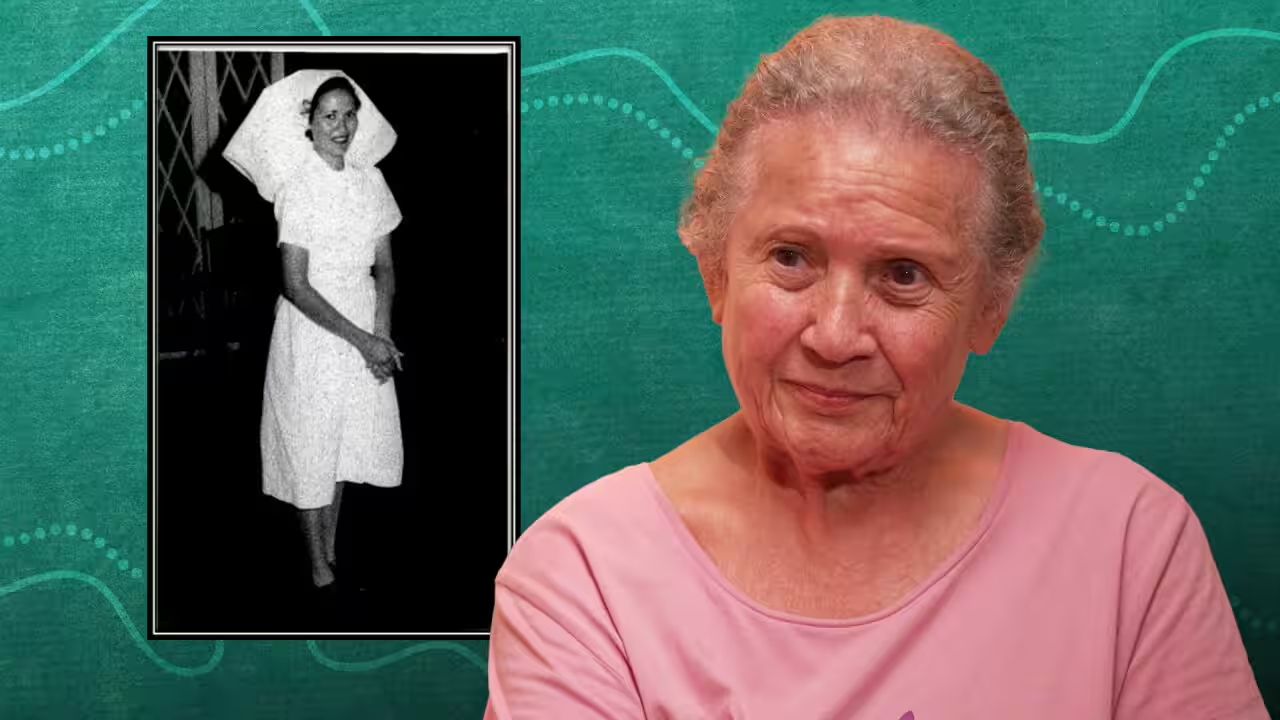
The pioneering nurse behind one of our longest-running medical services

In a reflective interview on Living Black with Karla Grant, the veteran nurse, activist and 2024 NAIDOC Lifetime Achievement Award winner reflected on her decades of advocacy – from the referendum campaign to helping establish the Aboriginal Medical Service in Redfern. A proud Meriam woman, Flower was the first Torres Strait Islander to receive the national honour.

Flower was a founding member of the Aboriginal Medical Service in Redfern, alongside Mum Shirl, Gordon Briscoe and others. She also played a key role in mentoring and training Aboriginal nurses and health workers, helping to build an Indigenous health workforce where none had existed.

Now in her 80s, Auntie Dulcie says the future is still full of possibility — if the work continues.
“We’re in a time of change,” she said.

“We’ll lose a few battles, but we’ll win too.”

Read the full article here.

Dulcie Flower’s work in healthcare stretches back decades, when she established one of the longest-running Aboriginal healthcare centres in the country. Image source: NITV

Speech from Minister Butler, Lowitja Institute 4th International Indigenous Health and Wellbeing Conference

Mark Butler, Minister for Health and Ageing, Minister for Disability and the NDIS delivered a speech at the Lowitja Institute 4th International Indigenous Health and Wellbeing Conference on Kaurna Country, Adelaide:

“…Today, the Institute is forging ahead, strong, fearless, and together by continuing Dr O’Donoghue’s legacy of advocacy through investing in Aboriginal and Torres Strait Islander-led community driven research by translating knowledge to have the greatest impact to people and by supporting a growing and capable Aboriginal and Torres Strait Islander health research workforce.

“I’m proud to say that these priorities align very much with our Government’s approach to First Nations health as we prioritise culturally safe and appropriate healthcare for all Aboriginal and Torres Strait Islander people. Striving towards Closing the Gap targets, and targeting investment at areas of greatest need where they will deliver what we know is the greatest impact. Our Government is committed to funding the Aboriginal Community Controlled Health Services, or ACCHS, to continue providing community controlled healthcare that is deeply and firmly grounded in country, founded upon culture, and connected to community.”

To read the full speech, go here.

Image source: Lowitja Institute

Stay Lubly, Get Tested

Sexual health is an important part of our lives and wellbeing. Looking after ourselves means taking care of our sexual health, getting tested, and talking about our sexual health. The ‘Stay Lubly, Get Tested’ campaign is all about encouraging people to protect themselves and their community against STIs through safer sex.

It’s time to break down the stigma around sexual health. Talking openly about sexual health helps reduce shame and encourages more people to get tested. Whether it’s with a partner, a friend, or a health professional, these conversations can save lives.

Learn more here.

Image source: Aboriginal Health Council of South Australia

Sector Jobs – you can see sector job listings on the NACCHO website here.

Advertising Jobs – to advertise a job vacancy click here to go to the NACCHO website current job listings webpage. Scroll down to the bottom of the page to find a Post A Job form. You can complete this form with your job vacancy details – it will then be approved for posting and go live on the NACCHO website.