NACCHO Sector News: 24 November 2025

Aboriginal and Torres Strait Islander Health News

The NACCHO Sector News is a platform we use to showcase the important work being done in Aboriginal and Torres Strait Islander health, focusing on the work of NACCHO, NACCHO members and NACCHO affiliates.

We also share a curated selection of news stories that are of likely interest to the Aboriginal and Torres Strait Islander health sector, broadly.

A call for action to address long COVID in Aboriginal communities

The impact of long COVID upon Aboriginal people in the Northern Territory is poorly understood, and more needs to be done to improve diagnosis, treatment and support, according to Dr Andrew Nguyen, public health registrar and infectious diseases physician at Aboriginal Medical Services Alliance Northern Territory (AMSANT).

“Long COVID will not disappear simply because we have stopped talking about COVID,” he writes below.

“It demands attention and equity-focused action. The longer we wait, the greater the risk that this invisible pandemic becomes another entrenched health inequity.”

Read the full Croakey Health Media article here.

Photo by Alison Barrett

WA camp aims to reduce high rates of domestic violence by teaching teenage boys

Last year, Wilinggin Aboriginal Corporation Wunggur ranger coordinator Steve Martin, started a camp to teach his rangers about relationships.

Mr Martin said family and domestic violence cannot be tolerated, but also cannot be ignored — it should be prevented. He says the focus on prevention means young people should understand what a healthy relationship is. It was key feedback from men who participated in last year’s camp.

“The first thing they said was ‘we would have wanted this when we were kids, we need to get this out to the youth,'” he explained.

Derby Aboriginal Health Service programs coordinator Mick Leamy, who used to counsel domestic violence offenders in prison, said they were supporting the change the community had been asking for.

“When (a program) is community-led it is often much more successful because it’s coming from a place the community needs,” he said.

Read the full article here.
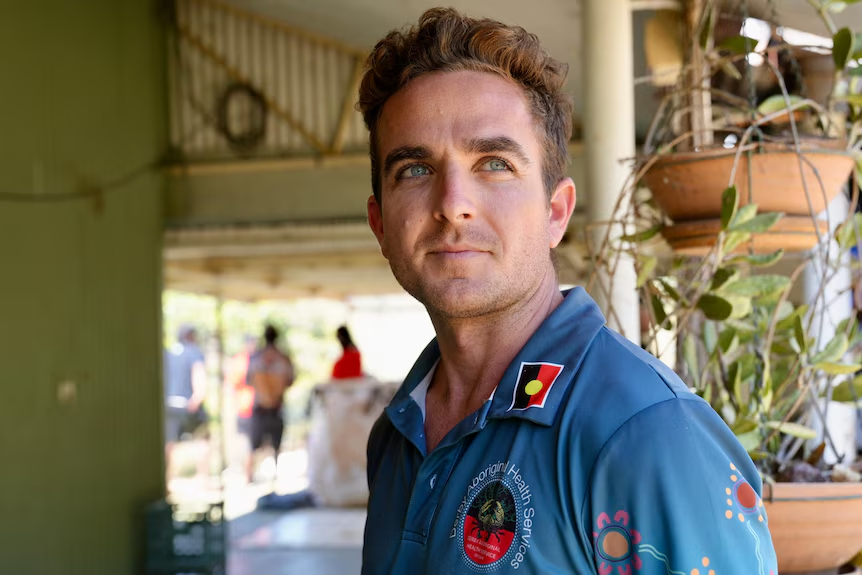
Mick Leamy from Derby Aboriginal Health Service says community-led initiatives are the most effective. (ABC Kimberley: Giulia Bertoglio)

Family and domestic violence support:

Strengthening oversight for children in care confirmed, welcomed by advocates

The Joint Council on Closing the Gap has agreed to strengthen oversight of how governments implement existing commitments for Indigenous children, marking what advocates say is an important step toward changing outcomes for First Nations children and young people.

Meeting in Hobart on Friday, the Council committed to prioritising key reforms under Target 12 of Closing the Gap, which aims to reduce by 45 per cent the over-representation of Aboriginal and Torres Strait Islander children in out-of-home care (OOHC) by 2031.

“Right now this country is still failing too many of our kids in early childhood development, education, out-of-home care, youth justice and access to safe housing and services,” deputy lead convenor of the Coalition of Peaks, Scott Wilson, told reporters.

“These are failures of government systems — not about children and their families — and they demand action, not excuses.”

Mr Wilson said the Council was hopeful of making “progress on addressing the policies and practices that continue to disproportionately harm our young people and agree to work together with the Community-Controlled sector to support our kids”.

Read more here.

The Joint Council on Closing the Gap met in Hobart on Friday. (Image: supplied to National Indigenous Times)

2025 IAHA Leadership Program graduates

Yesterday Indigenous Allied Health Australia (IAHA) celebrated the successes of the graduates from the 2025 IAHA Leadership Program. Over the past 9 months, the leadership participants have developed a greater understanding of Aboriginal and Torres Strait Islander leadership, cultural governance, advocacy, influencing others, community development and Nation building approaches.

Guided by Aboriginal and Torres Strait Islander ways of working, including knowing, being and doing, the program develops the attributes and skills to become an effective, culturally responsive Aboriginal and or Torres Strait Islander leader.

Expressions of interest are now open for the 2026 program! For more information and to apply, visit the IAHA website.

Image source: Indigenous Allied Health Australia

Sector Jobs – you can see sector job listings on the NACCHO website here.

Advertising Jobs – to advertise a job vacancy click here to go to the NACCHO website current job listings webpage. Scroll down to the bottom of the page to find a Post A Job form. You can complete this form with your job vacancy details – it will then be approved for posting and go live on the NACCHO website.

Email us your story with some images to: NACCHOCommunicationsandMedia@naccho.org.au and we will feature it in the news.

Email us your story with some images to: NACCHOCommunicationsandMedia@naccho.org.au
and we will feature it in the news.

NACCHO Sector News: 12 November 2025

Aboriginal and Torres Strait Islander Health News

The NACCHO Sector News is a platform we use to showcase the important work being done in Aboriginal and Torres Strait Islander health, focusing on the work of NACCHO, NACCHO members and NACCHO affiliates.

We also share a curated selection of news stories that are of likely interest to the Aboriginal and Torres Strait Islander health sector, broadly.

Closing the Gap in Orange: 10-year plan to help city’s Indigenous community thrive

A new 10-year plan to help Orange’s Indigenous community Close the Gap has been revealed.

The 59-page report was developed in collaboration with Aboriginal organisations in the city including the Orange Aboriginal Medical Service (OAMS), Orange Local Aboriginal Land Council (OLALC), Orange Aboriginal Education Consultative Group (OAECG) along with Orange City Council.

Chairwoman of OAMS, Alisha Agland, said the plan looked to prioritise housing, health, education, employment and culture.
“Plans like this recognise that while the policy settings are put in place in the national and state parliaments, the gap won’t be closed in Canberra or Macquarie Street,” she said. “It will only be closed by Aboriginal community controlled organisations working hard and smart in countless local communities across Australia.”

Read the full article.

The Aboriginal flag flying in Orange.

The Aboriginal flag flying in Orange. File picture

Support for Indigenous women and children in Central Australia with revamped Apmere Mwerre Visitors Park

The federal government has announced new funding to expand emergency accommodation for First Nations families in Alice Springs/Mparntwe.

On Tuesday, government officials – including Minister for Indigenous Australians, Malarndirri McCarthy – joined Aboriginal Hostels Limited (AHL) chief executive Shane Hamilton to open the newly upgraded Apmere Mwerre Visitors Park (AMVP).

The $4.9 million investment has added 20 short-term beds to the facility, which provides safe and affordable accommodation for First Nations people, including women and children escaping family and domestic violence.
Mr Hamilton said the expansion will “make a real difference” in the lives of Indigenous people in the region, arguing it refletcs AHL’s “ongoing commitment to providing culturally safe and affordable accommodation”.

“This milestone strengthens our capacity to support more First Nations people, including families, in need of a safe place to stay, especially in Central Australia,” he said.

Read the full article.

newly upgraded Apmere Mwerre Visitors Park (AMVP)

Newly upgraded Apmere Mwerre Visitors Park (AMVP) Image: AHL

Exclusive: ‘Our kids deserve better’ — Sue-Anne Hunter on building a future where Indigenous children are heard

As incarceration and out-of-home care rates for Indigenous children continue to rise across the country, Australia’s inaugural National Commissioner for Aboriginal and Torres Strait Islander Young People says her role is clear: it’s time to amplify children’s voices in policymaking.

For Sue-Anne Hunter, this is no symbolic appointment. It’s a responsibility built on decades of frontline work and advocacy, and one she doesn’t take lightly.

Speaking exclusively to National Indigenous Times, the Wurundjeri and Ngurai Illum Wurrung woman isn’t shy about the difficulties of her role. Having recently finished up as commissioner and deputy chair of the landmark Yoorook Justice Commission – Australia’s first official truth-telling body – she argues it’s not a burden “our kids need to carry”.

“I’ll carry that burden,” she says. “I want their voices to be heard, and… in a really safe way.”

Read the full article.

Sue-Anne Hunter says she is doing this for the children. Image: James Ross (AAP).

Sue-Anne Hunter says she is doing this for the children. Image: James Ross (AAP).

How I’m using ‘cultural dramaturgy’ to support Truth-telling in Australian theatre

This article was written with the consultation and permission of the cultural collaborative Mob who assisted with Fiasco.

We need to encourage more Truth-telling of the history of this nation, particularly in the wake of the failed Voice Referendum, and in the hopeful lead up to Australia’s first treaty.

Theatre is an important way to educate audiences about histories that still affect First Nations people today.

Blak theatremakers and companies such as Ilbijerri Theatre Company, Yirra Yaakin Theatre Company, and Moogahlin Performing Arts are leaders in best practices for staging First Nations stories. Their ways of working often involve collaboration and engagement with First Nations communities to ensure representation and staging of their stories are self-determined.

But Truth-telling can’t just be left up to us Mob. We need white Australians to be honest about this nation’s colonial histories too.

Read the full article.

Actors Sam McMillan (Sammy J), James Pender and Pirritu (Brett Lee) in Fiasco.

Actors Sam McMillan (Sammy J), James Pender and Pirritu (Brett Lee) in Fiasco. Photo by Nick Robertson


Sector Jobs – you can see sector job listings on the NACCHO website here.

Advertising Jobs – to advertise a job vacancy click here to go to the NACCHO website current job listings webpage. Scroll down to the bottom of the page to find a Post A Job form. You can complete this form with your job vacancy details – it will then be approved for posting and go live on the NACCHO website.


Email us your story with some images to: NACCHOCommunicationsandMedia@naccho.org.au and we will feature it in the news.

Email us your story with some images to: NACCHOCommunicationsandMedia@naccho.org.au
and we will feature it in the news.

NACCHO Sector News: 31 October 2025

Aboriginal and Torres Strait Islander Health News

The NACCHO Sector News is a platform we use to showcase the important work being done in Aboriginal and Torres Strait Islander health, focusing on the work of NACCHO, NACCHO members and NACCHO affiliates.

We also share a curated selection of news stories that are of likely interest to the Aboriginal and Torres Strait Islander health sector, broadly.

Victoria makes history with passage of Australia’s first Treaty bill

Victoria’s historic Treaty bill has passed the state’s upper house, paving the way for it to be formally signed before the end of the year and marking the first such agreement to be signed in Australia’s history.

The Statewide Treaty Bill passed the Legislative Council on Thursday night with support from the Greens and the crossbench. The Opposition voted against it, having withdrawn support for the previously bipartisan process last year.

The First Peoples’ Assembly of Victoria – which negotiated the Treaty on behalf of First Nations Victorians – welcomed the milestone with Co-Chair Ngarra Murray calling it a “historic moment for our people”.

“We will tell our children about today, and they will tell their children, passing down to future generations the story of how decades of Aboriginal resilience and activism led to Australia’s first Treaty,” the Wamba Wamba, Yorta Yorta, Dja Dja Wurrung and Dhudhuroa woman said.

“Treaty marks the beginning of a new era, one where First Peoples’ 60,000 years of knowledge and culture is respected and celebrated. It’s an opportunity for all Victorians to acknowledge our shared history, heal and move forward together.”

Read the full article.

Celebrations inside Parliament as the Treaty Bill is passed. Image: Justin McManus (The Age).

Celebrations inside Parliament as the Treaty Bill is passed. Image: Justin McManus (The Age).

Review Confirms SNAICC Early Years Success for First Nations Children

An independent evaluation by Deloitte has confirmed that SNAICC’s Early Years Support (EYS) program is a highly effective and trusted model that is strengthening the Aboriginal community controlled (ACCO) early education and care (ECEC) sector. 

The report found the EYS program is “a highly valued and effective initiative” that improves  service quality, reduces administrative burden on community leaders, and builds strong, culturally  safe relationships across the services involved.

Catherine Liddle, CEO of SNAICC, National Voice for our Children said the Deloitte findings confirm what Aboriginal and Torres Strait Islander communities have always known, when Aboriginal organisations lead the way in early childhood education, our children thrive.

“The evidence is clear, this model works and it’s changing lives,” Ms Liddle said.

“These are the services that are best places and are proven to get the best outcomes for our  children and families.

Read the full article.

Decorative image

Remote NT communities are being left behind due to ‘unacceptable’ healthcare

First Nations people continue to die younger and live with poorer health than other Australians. Addressing this disparity requires urgent attention from all governments. By DR John Paterson

After more than 40 years working alongside Aboriginal communities and advocating for better health outcomes, I am retiring as CEO of AMSANT and convener of the Aboriginal Peak Organisations Northern Territory. It has been my life’s work to fight for the health and wellbeing of our people and to create lasting, systemic change for future generations.

Progress on Closing the Gap health targets has been concerningly slow. While life expectancy has improved for Aboriginal people – driven largely by stronger investment in First Nations-led service delivery – the gap between Indigenous and non-Indigenous mortality remains unacceptably high.

In the Northern Territory, where disadvantage is greatest, many health outcomes are not only off track but going backwards. Chronic diseases such as rheumatic heart disease and diabetes remain common, children in remote areas still suffer from preventable illnesses such as scabies and anaemia, driven by overcrowded housing and the high cost of food, and mental health challenges weigh heavily on our communities.

The reality is this: First Nations people continue to die younger and live with poorer health than other Australians. Addressing this disparity requires urgent attention from all governments. Closing the health gap means backing Aboriginal Community Controlled Health Organisations to do the work they know best – and ensuring they have the facilities, workforce and resources to meet growing demand.

Read the full article.

Health leaders in remote parts of the NT want a long-term strategy to improve health care delivery, services, and infrastructure. Picture shows inside the Yirrkala health clinic.

Health leaders in remote parts of the NT want a long-term strategy to improve health care delivery, services, and infrastructure. Picture shows inside the Yirrkala health clinic.

Justice Health NSW establishes new partnership to support Aboriginal patients in state’s Central West

Justice Health and Forensic Mental Health Network (Justice Health NSW) will partner with Wellington Aboriginal Corporation Health Service (WACHS) to deliver trauma-informed, culturally safe healthcare to Aboriginal patients in custody in the state’s Central West. 

The in-reach model, based on the Justice Our Way program, involves local Aboriginal community-based health services delivering support to Aboriginal patients in custody and transitioning to community.

The expansion of the program is funded under the Domestic Family Sexual Violence National Partnership Agreement, and will see place-based throughcare, designed by WACHS, delivered at Wellington Correctional Centre to Aboriginal women on remand and in custody, and for the first time also piloted for Aboriginal men in custody.

First implemented in 2014 by the South Coast Women’s Health and Wellbeing Aboriginal Corporation (Waminda), The Justice Our Way program addresses a critical gap in support for Aboriginal people transitioning out of the justice system.

For the past 10 years, the Justice Our Way program has been successfully delivered to women in Dillwynia and Silverwater Correctional Centres.

Read the full article.


Sector Jobs – you can see sector job listings on the NACCHO website here.

Advertising Jobs – to advertise a job vacancy click here to go to the NACCHO website current job listings webpage. Scroll down to the bottom of the page to find a Post A Job form. You can complete this form with your job vacancy details – it will then be approved for posting and go live on the NACCHO website.


Email us your story with some images to: NACCHOCommunicationsandMedia@naccho.org.au and we will feature it in the news.

Email us your story with some images to: NACCHOCommunicationsandMedia@naccho.org.au
and we will feature it in the news.

NACCHO Sector News: 28 October 2025

Aboriginal and Torres Strait Islander Health News

The NACCHO Sector News is a platform we use to showcase the important work being done in Aboriginal and Torres Strait Islander health, focusing on the work of NACCHO, NACCHO members and NACCHO affiliates.

We also share a curated selection of news stories that are of likely interest to the Aboriginal and Torres Strait Islander health sector, broadly.

Sponsorship opportunities for the 2025 NACCHO Members’ Conference are still available!

Becoming a conference sponsor will expose your business to up to 1,000 individuals + 250 organisations that are focused on delivering positive health outcomes for Aboriginal and Torres Strait Islander Communities.

  • Contribute to the critical work of closing the health gap
  • Gain visibility and recognition
  • Amplify the voices of Aboriginal and Torres Strait Islander communities
  • Foster essential partnerships that lead to improved health outcomes across the nation

Learn more here.

World Immunisation Day ACCHO Video Competition

World Immunisation Day’s coming up and that means… ACCHOs, it’s your time to shine! We want to see your most creative, cheeky, and clever ideas to get community rolling up their sleeves.

Create a fun, 90-second video that shows how we can Fab Jab & Roll Up, Show Up, Power Up for a stronger, healthier mob. Sing it, rap it, dance it, yarn it, act it, whatever gets the message out and makes people smile.

We will select a winning ACCHO from each category:

  • Best Community Voice
  • Best Storytelling/Narrative
  • Best Original Song/Performance
  • Best Humour/Comedy
  • Best Youth-Led Video
  • Most Innovative Approach

Winners will receive tickets, flights and accommodation to the 2025 NACCHO Members’ Conference.

Submissions close THIS WEEK, 1 November!

Submit your entry via: immunisations@naccho.org.au

Congratulations Danila Dilba Health Service Midwives and deadly Kamika!

Danila Dilba Health Service is proud to announce that, on Saturday night, deadly Danila Dilba Midwives and AHP Trainee, Kamika Pollard, took out their categories at the Northern Territory Primary Health Network (NT PHN) Health Professional of the Year Awards.

The midwives were awarded the title of Fox Education & Consultancy – RTO 40674’s Primary Healthcare Team of the Year, and Kamika took home the Charles Darwin University Rising Star of the Year Award.

See more here.

Image source: Danila Dilba Health Service

Independent review finds SNAICC’s early years program transforms outcomes for Aboriginal children

The national peak body for Indigenous children and families says an independent review has confirmed a self-determined and culturally safe learning model is a “highly valued and effective initiative”.

An independent Deloitte evaluation of the Early Years Support (EYS) program, run by SNAICC – National Voice for our Children, found the community-controlled intermediary model plays a “critical role in delivering direct, responsive support to services,” which has “contributed to improved service quality, reduced barriers to effective delivery, and alleviated administrative burden”.

This comes despite Aboriginal Community-Controlled Organisations (ACCOs) continuing to face “significant operational and systemic challenges”.

“The strong relationships built by SNAICC Early Years Support have opened the doors for effective policy influence and development – fostered by a more connected ACCO sector,” the report said.

“This has created critical opportunities to work collectively with governments to lift child, family and community outcomes – in an increasingly co-ordinated, cohesive, and culturally strong ACCO service system.”

Read more here.

SNAICC CEO Catherine Liddle says the programs are proven to get the best outcomes for Indigenous children and families (Image: Ian Redfearn/ABC News)

Sector Jobs – you can see sector job listings on the NACCHO website here.

Advertising Jobs – to advertise a job vacancy click here to go to the NACCHO website current job listings webpage. Scroll down to the bottom of the page to find a Post A Job form. You can complete this form with your job vacancy details – it will then be approved for posting and go live on the NACCHO website.

Email us your story with some images to: NACCHOCommunicationsandMedia@naccho.org.au and we will feature it in the news.

Email us your story with some images to: NACCHOCommunicationsandMedia@naccho.org.au
and we will feature it in the news.

NACCHO Sector News: 27 October 2025

Aboriginal and Torres Strait Islander Health News

The NACCHO Sector News is a platform we use to showcase the important work being done in Aboriginal and Torres Strait Islander health, focusing on the work of NACCHO, NACCHO members and NACCHO affiliates.

We also share a curated selection of news stories that are of likely interest to the Aboriginal and Torres Strait Islander health sector, broadly.

Return to traditional birthing practices brings joy to Bundjalung mothers, elders

In short:

An Aboriginal Health Service in northern New South Wales has held its first smoking ceremony for babies and toddlers.

It is part of a federally funded birthing-on-country program designed to redress inequities and maternal and child health outcomes.

What’s next?

The Bullinah Aboriginal Health Service hopes to establish its own culturally safe birthing centre.

The guests of honour at a smoking ceremony on Bundjalung country in northern New South Wales may not have understood the significance of the event, but it was not lost on their parents and grandparents.

The event was a first for the Ballina-based Bullinah Aboriginal Health Service, and part of its birthing-on-country Sistabirth initiative.

Mother-of-four Relicca Kelly brought along her youngest child, Yarambati. “It’s really nice … we can get a bit of our culture back,” she said.

“People are raising their voice now just to show that our culture is still there, even though the majority of it got taken away. “It’s good to have these events just to feel connected.”

Read the full article.

Baby Yarambati Kelly-Pati is welcomed to country by elder Mildred Cameron. (ABC North Coast: Hannah Ross)

Baby Yarambati Kelly-Pati is welcomed to country by elder Mildred Cameron. (ABC North Coast: Hannah Ross)

Meet the Yolngu woman working to feed her remote island community

41-year-old Vanessa Maymuru is part of a mentor program that provides employment and training opportunities to women in northeast Arnhem Land.

Among the renowned rich red dirt of the Northern Territory’s Arnhem Land region, a demountable building sits among the stringybark forest on the outskirts of Galiwin’ku’s only town. The remote island community is home to around 2000 people, and is one of the most remote regions of Australia’s north, around 550 kilometers northeast of Darwin.

Vanessa Maymuru makes her way inside to the break room, the first to arrive from her cohort, quietly brewing herself a coffee before her shift starts.
“We just put our name and the time and start doing work,” the Yolngu woman told NITV.

After three years of working at Miyalk Kitchen, it’s a familiar routine. The kitchen provides meals to local contractors, catering, and NDIS home delivery. Vanessa is in charge of packing and delivering the food to community members participating in the NDIS food delivery program.

“It’s good, I’m helping Yolngu people,” Vanessa said.

Read the full article.

Yolngu woman Vanessa Maymuru sets off for her daily NDIS food delivery in the remote island community of Galiwin’ku. Source: Emma Kellaway

Children’s Day celebrated with Yawuru culture, song and community spirit in Broome

Families and educators came together at Guwarri in Broome to celebrate this year’s National Children’s Day on Thursday, recognising this year’s theme – Everyone Should Know About Children’s Rights.

The event focused on every child’s right to feel safe, loved and respected, to learn, play, and grow strong in their culture and identity.

Mabu Yawuru Ngan-ga, the Yawuru language centre, led the celebration with help from local schools and early childhood groups.
The crowd was delighted by a visit from the centre’s Brahminy kite mascot, Jir, who joined the children in singing and dancing to Yawuru songs before flying back toward the mangroves.

The Broome Regional Aboriginal Medical Service (BRAMS) Kids Club team handed out gifts to every child, while community partners, including St Mary’s College Broome, the Broome Youth and Families Hub, and Broome Primary School’s KindiLink helped make the day a success.

Read the full article.

All Australians are welcome here’: Forty years on, PM hails Uluru handback to traditional owners

Anthony Albanese has praised the generosity of the traditional owners of Uluru during the Indigenous Voice to Parliament campaign as something that “stays in my heart as much as this rock is the heart of this continent”.

In the shadow of the iconic Northern Territory landmark, the prime minister reflected on the failed referendum vote on Saturday while commemorating the 40-year anniversary of the return of Uluru-Kata Tjuta National Park to its traditional owners.
Albanese said that he accepted the outcome of the October 2023 referendum – in which a majority voted against the proposal for constitutional recognition of Aboriginal and Torres Strait Islander people – even though it was not what he wanted or voted for. But he said he still treasured his memories from his time in the red centre during the campaign for a Yes vote.

“I will be forever grateful for the generosity of the traditional owners, in particular the leaders, the women who did a dance and song to show respect to the prime minister of Australia,” he told reporters at Uluru on Saturday. “It’s something I’ll never forget that stays in my heart as much as this rock is the heart of this continent.

Read the full article.

Prime Minister Anthony Albanese speaks to media during the ceremony marking the 40th anniversary of the handback of Uluru.Credit:AAP

Prime Minister Anthony Albanese speaks to media during the ceremony marking the 40th anniversary of the handback of Uluru. Credit: AAP

New funding to improve cardiovascular health of First Nations people

A project that aims to close the data gaps in cardiovascular health among First Nations people is among 67 projects Australia-wide to receive funding from the Heart Foundation to drive discoveries in prevention of heart disease, and in the treatment and care of people living with it.

Dr Ingrid Stacey, a research fellow in the Cardiovascular Epidemiology Research Centre at The University of Western Australia’s School of Population and Global Health and research affiliate with the Victor Chang Cardiac Research Institute, has been awarded $151,000, which will be matched by UWA, to undertake two years postdoctoral research.

Cardiovascular disease is the largest contributor to the life expectancy gap experienced by First Nations people, with the onset of disease often occurring decades earlier than for the non-Indigenous Australian population.

Read the full article.

Sector Jobs – you can see sector job listings on the NACCHO website here.

Advertising Jobs – to advertise a job vacancy click here to go to the NACCHO website current job listings webpage. Scroll down to the bottom of the page to find a Post A Job form. You can complete this form with your job vacancy details – it will then be approved for posting and go live on the NACCHO website.


Email us your story with some images to: NACCHOCommunicationsandMedia@naccho.org.au and we will feature it in the news.

Email us your story with some images to: NACCHOCommunicationsandMedia@naccho.org.au
and we will feature it in the news.

NACCHO Sector News: 21 October 2025

Aboriginal and Torres Strait Islander Health News

The NACCHO Sector News is a platform we use to showcase the important work being done in Aboriginal and Torres Strait Islander health, focusing on the work of NACCHO, NACCHO members and NACCHO affiliates.

We also share a curated selection of news stories that are of likely interest to the Aboriginal and Torres Strait Islander health sector, broadly.

Support at Home communication toolkit for older Aboriginal and Torres Strait Islander people

Providers, peak bodies, advocacy organisations and community groups can use this toolkit to inform older Aboriginal and Torres Strait Islander people, their families and carers about the new Support at Home program. The program starts along with the new Aged Care Act from 1 November 2025.

Learn more and access the toolkit.

Let's Yarn about ageing well - Support at home: Communication toolkit.

Let’s Yarn about ageing well – Support at home: Communication toolkit.

Cyclists unite to bring bike benefits to remote Kimberley communities

Fifteen cyclists from the United Kingdom will soon start pedalling to raise funds for Australian program, The Bike Creative, the brainchild of school teacher Chris Sellings.

In 2023, Chris Sellings, resident of Boorloo/Perth and originally from Twickenham, England, moved with his wife to work at a remote school over 3,000km away in Turkey Creek in the East Kimberley. Amid the challenges of isolation, about 200 kilometres from Kununurra in Gija Country, Mr Sellings saw a simple but powerful way to make a difference to the community: bikes.

A former cycling coach in Europe, Mr Sellings started a bike club at Ngalangangpum School (the name means ‘mother and child’) in the woodwork shop, teaching kids how to fix and build their own bikes.

The impact was immediate and positive. The club quickly became a go-to place; kids wanted to learn, to create, to ride.

Mr Sellings said parents watched with some amazement as their children returned home with bikes they’d built themselves and the community came alive with the sight of children cycling everywhere.

“The kids are happy, which makes the adults happier. They go to bed earlier because they’re tired and want to get up and ride their bikes,” said parent, Benita Everett.

Read the full article

three kids and an adult repairing bikes.

First Nations communities welcome local climate solutions

More than $650,000 has been given to 24 local clean energy initiatives that will benefit many First Nations communities

The Foundation for Rural & Regional Renewal is the only national foundation specifically focused on ensuring the social and economic strength of Australia’s remote, rural and regional communities.

Established in 2000, the FRRR awarded the 24 funding grants to address localised impacts of global warming and energy industry transitions via its Community Led Climate Solutions program.

The program supports locally-led projects that inform and empower locals to adapt or act to mitigate risks caused by a changing climate, and also supports initiatives that empower community groups to assist locals impacted by transitions away from fossil fuel industries and/or transitions to clean energy industry.

The $652,740 in grants are funded through two streams, with grants ranging from $19,186 for a native plant nursery in Moora, WA, to $75,000 for an Indigenous STEM education program to be rolled out in multiple remote communities across the country.

Read the full article.

The Yued ILUA area includes the towns of Leeman, Jurien Bay, Cervantes, Gingin, Calingiri, Coorow and Moora and covers more than 26,0000sqkm.

The Yued ILUA area includes the towns of Leeman, Jurien Bay, Cervantes, Gingin, Calingiri, Coorow and Moora and covers more than 26,0000sqkm. (Image: Supplied)

Chlamydia rates dip among teens

There’s been a substantial and sustained decline in chlamydia notifications in 15–19-year-olds since 2010 in QLD, according to Queensland Health.

Finally, some positive STI news!

We’ve seen significantly higher rates of STIs in line with increased testing nationally, and chlamydia is the most common bacterial STI in Australia.

But recent analysis of 20 years’ worth of ABS data for Queensland show the state may be heading in the right direction.

Chlamydia notifications per 100,000 people in those aged 15-19 years almost quadrupled between 2000 and 2010, but then a downward trend began, which was sustained until the end of the dataset in 2019.

Read the full article.

Decorative image

Looks like the kids are all right after all, at least in Queensland.


Sector Jobs – you can see sector job listings on the NACCHO website here.

Advertising Jobs – to advertise a job vacancy click here to go to the NACCHO website current job listings webpage. Scroll down to the bottom of the page to find a Post A Job form. You can complete this form with your job vacancy details – it will then be approved for posting and go live on the NACCHO website.


Email us your story with some images to: NACCHOCommunicationsandMedia@naccho.org.au and we will feature it in the news.

Email us your story with some images to: NACCHOCommunicationsandMedia@naccho.org.au
and we will feature it in the news.

NACCHO Sector News: 13 October 2025

Aboriginal and Torres Strait Islander Health News

The NACCHO Sector News is a platform we use to showcase the important work being done in Aboriginal and Torres Strait Islander health, focusing on the work of NACCHO, NACCHO members and NACCHO affiliates.

We also share a curated selection of news stories that are of likely interest to the Aboriginal and Torres Strait Islander health sector, broadly.

Air Force, NACCHO partnership supports Indigenous health in Far North Queensland

The Royal Australian Air Force is visiting Mareeba, Queensland, from 1 October to 6 November for Exercise Kummundoo 2025. The initiative will deliver essential health services and deepening ties with local Aboriginal and Torres Strait Islander communities across Far North Queensland.

Now in its 11th year, Exercise Kummundoo is a community engagement initiative delivered in partnership with the National Aboriginal Community Controlled Health Organisation (NACCHO). The program supports Air Force’s reconciliation commitments while contributing to better health outcomes in regional and remote Indigenous communities.

NACCHO CEO Pat Turner AM, emphasised the importance of community control in improving health outcomes.

“Through Exercise Kummundoo, the Air Force is walking alongside our sector, listening, learning, and contributing in practical ways that make a difference. This is how we strengthen trust, improve health, and create real opportunities for our communities,” Ms Turner said.

Read more here.

Chief of Air Force Air Marshal Stephen Chappell, DSC, CSC, OAM (right) and National Aboriginal Community Controlled Health Organisation Chairperson Donnella Mills formalise a renewed Memorandum of Understanding between the Royal Australian Air Force (RAAF) and NACCHO.

Help shape the new Aboriginal and Torres Strait Islander Peak Body for Family, Domestic and Sexual Violence – Survey deadline extended

You now have until 17 October to help shape the new National Aboriginal and Torres Strait Islander Peak Body for Family, Domestic and Sexual Violence.

Find out more and take the surveys now, here.

Your expertise – whether in response, prevention, early intervention or advocacy – is crucial in building a Peak Body that genuinely serves our communities and sector needs.

Understanding consultation fatigue, previous consultations have been used as a starting point. Specific feedback is now being sought on the Peak Body’s operational model and priorities. These surveys, together with a series of online workshops and sector engagement, will help shape how family violence is collectively addressed in our communities.

Image source: Coalition of Peaks

Ballarat Aboriginal Co-op becomes first ACCO to lead early years management in Victoria

The Victorian Government has announced the establishment of the first Aboriginal Community-Controlled Organisation (ACCO) to operate as an Early Years Management (EYM) authority.

The Ballarat and District Aboriginal Co-operative (BADAC) has been officially registered as the state’s first ACCO EYM.

BADAC currently oversees kindergartens at Perridak Burron in Brown Hill, Yirram Burron in Sebastopol, and Yaluk Burron in Ballan, providing culturally inclusive early learning programs to local families.

“We are very proud of the Early Years centres that we have established and the growth within the community over the past five years,” BADAC chief executive Karen Heap said.

“Becoming the first ACCO EYM enables us to guide, support and inspire other ACCOs across the state, ensuring Aboriginal and Torres Strait Islander families and children are supported in Early Years Education.”

Read more here.

Universities Australia welcomes more places for First Nations medical students

Universities Australia has welcomed the federal government’s decision to remove caps on Commonwealth Supported Places for First Nations medical students through the Education Legislation Amendment (Integrity and Other Measures) Bill 2025.

“If passed by the Parliament, it will be a really important reform that will change the lives of First Nations students, their families and communities, as well as our health system,” Universities Australia, Chief Executive Officer, Mr Luke Sheehy said this week.

The number of First Nations students studying medicine continues to grow, with 489 enrolled in 2024; a 17 per cent increase since 2021, including 124 new students.

“The growth in First Nations medical student numbers shows what’s possible when governments and universities work together to expand opportunity and support success,” Mr Sheehy said.

Read more here.

Indigenous medical school graduates celebrating, 2025.

Sector Jobs – you can see sector job listings on the NACCHO website here.

Advertising Jobs – to advertise a job vacancy click here to go to the NACCHO website current job listings webpage. Scroll down to the bottom of the page to find a Post A Job form. You can complete this form with your job vacancy details – it will then be approved for posting and go live on the NACCHO website.

Email us your story with some images to: NACCHOCommunicationsandMedia@naccho.org.au and we will feature it in the news.

Email us your story with some images to: NACCHOCommunicationsandMedia@naccho.org.au
and we will feature it in the news.

NACCHO Sector News: 7 October 2025

Aboriginal and Torres Strait Islander Health News

The NACCHO Sector News is a platform we use to showcase the important work being done in Aboriginal and Torres Strait Islander health, focusing on the work of NACCHO, NACCHO members and NACCHO affiliates.

We also share a curated selection of news stories that are of likely interest to the Aboriginal and Torres Strait Islander health sector, broadly.

CSIRO report highlights need for First Nations-led approach to AI in healthcare

Scientists from CSIRO, Australia’s national science agency, together with First Nations partner organisations, have found that artificial intelligence (AI) has potential to improve healthcare in Aboriginal and Torres Strait Islander communities. However, its safe and effective use must be guided by Aboriginal and Torres Strait Islander voices and knowledges.

Aboriginal man from Iningai Country in Western Queensland and CSIRO Research Scientist and lead author Dr Andrew Goodman said current frameworks for AI development and application tended to be overly general and insufficiently detailed in relation to cultural diversity.

“In Australia, this has resulted in a gap in understanding of how AI can serve Aboriginal and Torres Strait Islander peoples,” Dr Goodman said.

The Artificial Intelligence for Healthcare in Australian First Nations Communities: Scoping Project to Explore Relevance addresses this gap. The scoping project engaged 53 leaders, clinicians, researchers, and health service providers across four workshops between 2023 and 2025.

“Although these are early findings, this report provides a critical starting point for how to build responsible AI systems in technology such as apps and data collection to improve Aboriginal and Torres Strait Islander healthcare outcomes,” said Dr Goodman.

The consultations identified three critical priorities for responsible AI use in First Nations health:

  • Building AI health literacy and cultural appropriateness by ensuring communities understand how AI works, what data it uses, and how it can support day-to-day care.
  • Protecting First Nations data sovereignty by guaranteeing that health data is held, governed, and used under the custodianship of Aboriginal and Torres Strait Islander organisations.
  • Supporting self-determination by placing Aboriginal and Torres Strait Islander organisations at the centre of AI design, implementation, and oversight.
  • These findings underscore the importance of embedding cultural knowledge in the design of AI systems.

Read the full article.

Family support service to keep Mid West and Gascoyne children safe at home

A vital service aimed at keeping children safe and reducing the number of WA youth entering out-of-home care is changing hands.

The Intensive Family Support Service, funded by the Department of Communities, will soon be delivered by MercyCare in partnership with Bundiyarra Aboriginal Community Aboriginal Corporation.

The program, which will slowly be rolled out from October 20, will offer in-home, practical help to families facing significant challenges, including poverty, housing instability and limited access to services.

Under the initiative, up to 45 families in Geraldton, Carnarvon, Meekatharra and nearby towns will receive intensive support each year over the next five years.

MercyCare’s general manager of youth, wellbeing and accommodation services Suzanne Caren said the program was designed to address the unique pressures affecting regional families in WA.

“Many families here are navigating remote living, housing shortages, unemployment and limited access to childcare and essential services,” she said.

“These challenges don’t just affect parents, they directly impact children’s safety, wellbeing and development. Without the right support, families can become isolated and overwhelmed and that’s when children are most at-risk of entering care.”

Read the full article

Suzanne Caren is MercyCare's general manager of youth, wellbeing and accommodation.

Suzanne Caren is MercyCare’s general manager of youth, wellbeing and accommodation. Credit: Jessica Antoniou/Kalgoorlie Miner

Racism a major issue in healthcare: RACGP Health of the Nation

Almost one third of GPs witnessed racism towards patients in the health system in the past year, according to the RACGP’s 2025 Health of the Nation report.

The nationwide survey of more than 2400 RACGP members also found that around two in 10 GPs personally experienced racism from a patient within their practice during that time, while one in 10 personally experienced racism from a colleague.

RACGP President Dr Michael Wright said these figures, along with separate statistics showing 30% of GPs have observed racism towards patients in the broader health system, are symptoms of a larger systemic issue.

“Racism in the health system is an issue that affects healthcare workers and patients alike. It is not something we can ignore, and it is certainly not something that will fix itself,” he said.

“These findings make it very clear that both action and resources are needed to tackle systemic racism in the health system, including general practice.

“The message is unmistakeable: Racism is bad for people’s health, and patients and GPs must be protected from it.”

Dr Wright said the RACGP has taken steps to address racism, such as implementing an Aboriginal and Torres Strait Islander cultural and health training framework to support culturally safe care, but called for wider action to eliminate racism across the health system.

Read the full article.

$5.5million First Nations Heritage Grants Program funds cultural preservation

A program designed to transfer knowledge from elders to younger generations and document cultural sites in the Kimberley has received a $200,000 funding boost.

The Wunambal Gaambera Aboriginal Corporation, located in the far north Kimberley, will use the grant from the State Government’s First Nations Heritage Grants Program to conduct cultural workshops and document significant cultural sites across the Wunambal Gaambera Country.

This vast region covers 2.5 million hectares of land (graa) and sea (wundaagu) and is part of the Uunguu Indigenous Protected Area, a Category VI IUCN Managed Resource Area, which is declared and managed by the Wunambal Gaambera people.

Minister for Indigenous Australians, Senator Malarndirri McCarthy, said the funding highlighted the Government’s commitment to recognising and preserving the cultural importance of First Nations sites across the nation.

“The Albanese Government is dedicated to enhancing the recognition of First Nations cultural heritage at World and National Heritage-listed places,” she said.

“Our country is rich in natural and culturally significant sites that are crucial for First Nations peoples. These locations need protection, and we are proud to work alongside Traditional Owners to ensure this happens.”

Read the full article.

Wunambal Gaambera Aboriginal Corporation, Uunguu Rangers completed a week of mapping and monitoring balguja (dugong) and jala (seagrass) in the Uunguu Indigenous Protected Area.

Wunambal Gaambera Aboriginal Corporation, Uunguu Rangers completed a week of mapping and monitoring balguja (dugong) and jala (seagrass) in the Uunguu Indigenous Protected Area. Credit: Supplied by Wunambal Gaambera


Sector Jobs – you can see sector job listings on the NACCHO website here.

Advertising Jobs – to advertise a job vacancy click here to go to the NACCHO website current job listings webpage. Scroll down to the bottom of the page to find a Post A Job form. You can complete this form with your job vacancy details – it will then be approved for posting and go live on the NACCHO website.


Email us your story with some images to: NACCHOCommunicationsandMedia@naccho.org.au and we will feature it in the news.

Email us your story with some images to: NACCHOCommunicationsandMedia@naccho.org.au
and we will feature it in the news.

NACCHO Sector News: 19 September 2025

Aboriginal and Torres Strait Islander Health News

The NACCHO Sector News is a platform we use to showcase the important work being done in Aboriginal and Torres Strait Islander health, focusing on the work of NACCHO, NACCHO members and NACCHO affiliates.

We also share a curated selection of news stories that are of likely interest to the Aboriginal and Torres Strait Islander health sector, broadly.

Sponsorship opportunities for the 2025 NACCHO Members’ Conference still available!

This year’s NACCHO Members’ Conference, National Youth Conference, and AGM is taking place from Monday 8 to Wednesday 10 December 2025 at the Royal Randwick Racecourse, Sydney. The Conference theme is Strength Comes from Community Control.

By becoming a sponsor of the NACCHO 2025 Members’ Conference, your organisation will contribute to supporting the Aboriginal Community Controlled Health Sector to showcase their community[1]driven initiatives, collaboration efforts, and holistic, high-quality health care that is building a healthier future for Aboriginal and Torres Strait Islander people.

The coffee carts are an opportunity to deal directly with and promote your organisation, product or program to all NACCHO conference delegates and attendees.

  • 2 full registrations including admission to the Karaoke Dinner
  • Trade table for 2 days with 2 trade table attendants per day
  • Coffee cart including barista and coffee
  • Logo on NACCHO’s interview banner (medium)
  • 2 promotional items in conference pack

Learn more here.

Federal government announces $300m regional and remote aged care investment

The federal government has committed $300 million to strengthen the aged care system through the latest round of the Aged Care Capital Assistance Program (ACCAP). Of the total funding in the latest announcement, $87 million will be spread across 12 projects aimed at ensuring more older Aboriginal and Torres Strait Islander people can access services that respect culture, Country and community.

This includes almost $4 million for the Yadu Health Aboriginal Corporation in South Australia to expand residential care facilities and staff accommodation at the Seaview Village Aged Care Service, and $2.8 million for the Rumbalara Aboriginal Co-operative Limited in Victoria.

Read more here.

Ceremonial sod turning celebrates the construction of a new First Nations health centre at South Australia’s Yadu Health Aboriginal Corporation.

2025 Aboriginal Health and Wellbeing Conference

The Aboriginal Health and Medical Research Council (AH&MRC) is proud to co-host the 8th Annual Conference with the NSW Agency for Clinical Innovation, the Centre for Aboriginal Health and the NSW/ACT PHN Aboriginal Health Network.

Theme: From the Ground Up: Aboriginal Leadership Transforming Health Innovation and Research

This year, the conference is spotlighting the power of Aboriginal leadership in reshaping health systems and research—driving innovation, honouring cultural knowledge, and creating pathways to stronger, fairer health outcomes.

If you have any questions, please email ACI-AHW@health.nsw.gov.au

Image source: AH&MRC

Taypani Riyawina & Kani – Come, Play and Talk

This September is Fetal Alcohol Spectrum Disorder (FASD) Awareness Month. Tasmanian Aboriginal Centre is coming together across Lutruwita/Tasmania to raise awareness and support for the Foundation for Alcohol Research and Education (FARE).

Event details:

  • Friday 26th September
  • 2pm – 6pm
  • Piyura Kitina / Risdon Cove

Activities:
• Free kipli (food)
• Kids activities & entertainment
• immunisations information with Kristy Cooper
• Smokerlyzer demos with Tina Goodwin
• Junior Rangers: Identification Walk and, sample Preminghana honey
• Reptile interactive display
• Silent disco
• Face painting 

Feel free to wear red shoes (or anything red), together we can support community to raise awareness and help spark conversations about FASD.

Image source: Tasmanian Aboriginal Centre

Sector Jobs – you can see sector job listings on the NACCHO website here.

Advertising Jobs – to advertise a job vacancy click here to go to the NACCHO website current job listings webpage. Scroll down to the bottom of the page to find a Post A Job form. You can complete this form with your job vacancy details – it will then be approved for posting and go live on the NACCHO website.

Email us your story with some images to: NACCHOCommunicationsandMedia@naccho.org.au and we will feature it in the news.

Email us your story with some images to: NACCHOCommunicationsandMedia@naccho.org.au
and we will feature it in the news.

NACCHO Sector News: 15 September 2025

Aboriginal and Torres Strait Islander Health News

The NACCHO Sector News is a platform we use to showcase the important work being done in Aboriginal and Torres Strait Islander health, focusing on the work of NACCHO, NACCHO members and NACCHO affiliates.

We also share a curated selection of news stories that are of likely interest to the Aboriginal and Torres Strait Islander health sector, broadly.

Bigger and better Mala’la health clinic

Works are now in full swing for the expansion of the Mala’la health clinic in Maningrida. Expected to be complete by early 2026, this development will deliver more clinical rooms, a dedicated space for rheumatic heart disease, sealed parking and a staff training room. These improvements will give residents better access to the care they need.

Maningrida is the Northern Territory’s largest remote community, home to around 3,500 people living in the town and surrounding homelands. Mala’la clinic is also one of the NT’s busiest with more than 80,000 recorded client contacts in 2025. As the community continues to grow, so too does its health needs.

This expansion is a much needed investment in the future of health care in Maningrida.

Learn more here.

Digital rendering of the Mala’la health clinic building expansion due for completion in early 2026.

New funding to strengthen Aboriginal women’s health workforce

A new grant program will support up to 50 Aboriginal health clinicians to upskill in women’s health, as part of a broader push to improve culturally safe care for Aboriginal and Torres Strait Islander women and girls across Victoria.

Victorian Health Minister Mary-Anne Thomas announced the $300,000 initiative at the Aboriginal Health and Wellbeing Partnership Forum in Ballarat on Wednesday last week. The program will provide one-off grants of up to $5,000 for clinicians working in Aboriginal Community Controlled Health Organisations (ACCHOs).

The grants aim to strengthen the Aboriginal women’s health workforce by helping clinicians build skills in sexual, reproductive and general women’s health care.

The program is being delivered through the Victorian Aboriginal Controlled Health Organisation (VACCHO).

VACCHO chief executive Dr Jill Gallagher said the investment would embed cultural safety and self-determination into care for First Nations women.

“Aboriginal women know what our communities need and these grants will help to build and strengthen the Aboriginal women’s health workforce embedding cultural safety and better care,” Dr Gallagher said.

“Self-determination in Aboriginal women’s health care is the only way we can ensure we keep our mothers, aunties, sisters and daughters safe, healthy and thriving for generations to come.”

Read more here.

Image source: VACCHO

10 years of the AMS Redfern Paediatric Clinic

Aboriginal Medical Service Redfern celebrated 10 years of the AMS Redfern Paediatric Clinic. Community Paediatrician Dr Terry Yoong says the aim of the specialist service is to make a positive difference for children and families.

“The main thing we do is connect with families, we find out what their story is and get to know them, to provide strategies, we try to make life easier – we want the best opportunities for our kids.”

LaVerne Bellear, CEO AMS Redfern, says the specialist service, offered in partnership with Sydney Local Health District, has built trust over time, which has seen our children flourish.

“Being able to have babies diagnosed at an early stage and have early interventions allows them to thrive later in life.”

Learn more here.

Image source: AMS Redfern

QAIHC Members Conference 2025: Registrations now open!

Registrations are now open for the QAIHC Members Conference 2025. Held in Gimuy/Cairns the conference theme is ‘Led by culture, driven by purpose.’

Conference Details:

  • 21-22 October 2025
  • Cairns Convention Centre
  • AGM 20 October (Member CEOs/Board only)

Register here.

Image source: QAIHC

Sector Jobs – you can see sector job listings on the NACCHO website here.

Advertising Jobs – to advertise a job vacancy click here to go to the NACCHO website current job listings webpage. Scroll down to the bottom of the page to find a Post A Job form. You can complete this form with your job vacancy details – it will then be approved for posting and go live on the NACCHO website.

Email us your story with some images to: NACCHOCommunicationsandMedia@naccho.org.au and we will feature it in the news.

Email us your story with some images to: NACCHOCommunicationsandMedia@naccho.org.au
and we will feature it in the news.