
- A call for action to address long COVID in Aboriginal communities
- WA camp aims to reduce high rates of domestic violence by teaching teenage boys
- Strengthening oversight for children in care confirmed, welcomed by advocates
- 2025 IAHA Leadership Program graduates
- Sector Jobs
The NACCHO Sector News is a platform we use to showcase the important work being done in Aboriginal and Torres Strait Islander health, focusing on the work of NACCHO, NACCHO members and NACCHO affiliates.
We also share a curated selection of news stories that are of likely interest to the Aboriginal and Torres Strait Islander health sector, broadly.
A call for action to address long COVID in Aboriginal communities
The impact of long COVID upon Aboriginal people in the Northern Territory is poorly understood, and more needs to be done to improve diagnosis, treatment and support, according to Dr Andrew Nguyen, public health registrar and infectious diseases physician at Aboriginal Medical Services Alliance Northern Territory (AMSANT).
“Long COVID will not disappear simply because we have stopped talking about COVID,” he writes below.
“It demands attention and equity-focused action. The longer we wait, the greater the risk that this invisible pandemic becomes another entrenched health inequity.”
Read the full Croakey Health Media article here.

Photo by Alison Barrett
WA camp aims to reduce high rates of domestic violence by teaching teenage boys
Last year, Wilinggin Aboriginal Corporation Wunggur ranger coordinator Steve Martin, started a camp to teach his rangers about relationships.
Mr Martin said family and domestic violence cannot be tolerated, but also cannot be ignored — it should be prevented. He says the focus on prevention means young people should understand what a healthy relationship is. It was key feedback from men who participated in last year’s camp.
“The first thing they said was ‘we would have wanted this when we were kids, we need to get this out to the youth,'” he explained.
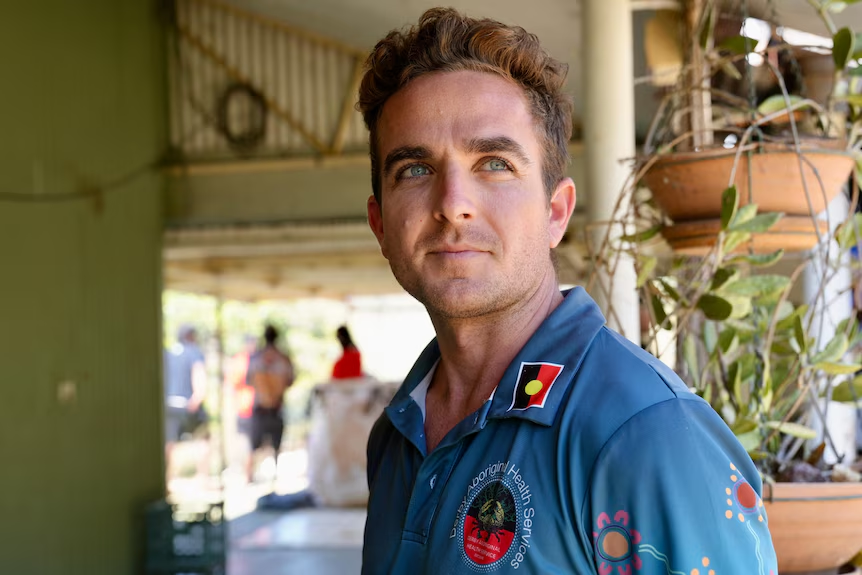
Derby Aboriginal Health Service programs coordinator Mick Leamy, who used to counsel domestic violence offenders in prison, said they were supporting the change the community had been asking for.
“When (a program) is community-led it is often much more successful because it’s coming from a place the community needs,” he said.
Read the full article here.
Mick Leamy from Derby Aboriginal Health Service says community-led initiatives are the most effective. (ABC Kimberley: Giulia Bertoglio)
Family and domestic violence support:
- 1800 Respect national helpline: 1800 737 732
- Women’s Crisis Line: 1800 811 811
- Men’s Referral Service: 1300 766 491
- Lifeline (24 hour crisis line): 131 114
- Relationships Australia: 1300 364 277
- NSW Domestic Violence Line: 1800 656 463
- Qld DV Connect Womensline: 1800 811 811
- Vic Safe Steps crisis response line: 1800 015 188
- ACT 24/7 Crisis Line: (02) 6280 0900
- Tas Family Violence Counselling and Support Service: 1800 608 122
- SA Domestic Violence Crisis Line: 1800 800 098
- WA Women’s Domestic Violence 24h Helpline: 1800 007 339
- NT Domestic violence helpline: 1800 737 732
Strengthening oversight for children in care confirmed, welcomed by advocates
The Joint Council on Closing the Gap has agreed to strengthen oversight of how governments implement existing commitments for Indigenous children, marking what advocates say is an important step toward changing outcomes for First Nations children and young people.
Meeting in Hobart on Friday, the Council committed to prioritising key reforms under Target 12 of Closing the Gap, which aims to reduce by 45 per cent the over-representation of Aboriginal and Torres Strait Islander children in out-of-home care (OOHC) by 2031.
“Right now this country is still failing too many of our kids in early childhood development, education, out-of-home care, youth justice and access to safe housing and services,” deputy lead convenor of the Coalition of Peaks, Scott Wilson, told reporters.
“These are failures of government systems — not about children and their families — and they demand action, not excuses.”
Mr Wilson said the Council was hopeful of making “progress on addressing the policies and practices that continue to disproportionately harm our young people and agree to work together with the Community-Controlled sector to support our kids”.
Read more here.

The Joint Council on Closing the Gap met in Hobart on Friday. (Image: supplied to National Indigenous Times)
2025 IAHA Leadership Program graduates
Yesterday Indigenous Allied Health Australia (IAHA) celebrated the successes of the graduates from the 2025 IAHA Leadership Program. Over the past 9 months, the leadership participants have developed a greater understanding of Aboriginal and Torres Strait Islander leadership, cultural governance, advocacy, influencing others, community development and Nation building approaches.
Guided by Aboriginal and Torres Strait Islander ways of working, including knowing, being and doing, the program develops the attributes and skills to become an effective, culturally responsive Aboriginal and or Torres Strait Islander leader.
Expressions of interest are now open for the 2026 program! For more information and to apply, visit the IAHA website.

Image source: Indigenous Allied Health Australia

Sector Jobs – you can see sector job listings on the NACCHO website here.
Advertising Jobs – to advertise a job vacancy click here to go to the NACCHO website current job listings webpage. Scroll down to the bottom of the page to find a Post A Job form. You can complete this form with your job vacancy details – it will then be approved for posting and go live on the NACCHO website.

Email us your story with some images to: NACCHOCommunicationsandMedia@naccho.org.au
and we will feature it in the news.