NACCHO Sector News: 30 May 2025

The NACCHO Sector News is a platform we use to showcase the important work being done in Aboriginal and Torres Strait Islander health, focusing on the work of NACCHO, NACCHO members and NACCHO affiliates.

We also share a curated selection of news stories that are of likely interest to the Aboriginal and Torres Strait Islander health sector, broadly.

Shining a light on trailblazers in Indigenous medicine

Tatum Bond is one of those “lucky people” who truly loves her job.

The Ngadjonji woman works in the emergency department at Cairns Base Hospital, and for the Royal Flying Doctors Service in Queensland.

Dr Bond is one of the Aboriginal and Torres Strait Islander medical professionals featured in the documentary series Our Medicine.

The series shines a spotlight on Aboriginal and Torres Strait Islander frontline workers across hospitals, ambulance services, traditional healing and other medical services who are working to improve health outcomes in their communities.

Dr Bond said, while she was initially nervous to be part of the six-part series, she hopes she can show others they can also achieve their dreams.

“The main reason I said yes is because this whole thing is empowering younger generations to come and do these jobs,” she said.

Read more here.

Watch ‘Our Medicine’ on SBS Demand here.

Dr Tatum Bond is one of the Indigenous medical professionals featured in the series Our Medicine. (Sbs/AAP PHOTOS) Credit: AAP

Reconciliation Week: Significant strides made in the South West but ‘long way to go’ still

A Noongar woman with more than 25 years experience in the First Nations health sector says there’s still “a long way to go” in the South West on the path towards reconciliation, despite significant improvements over the years.

Auntie Elsie Penny, OAM, has worked at the South West Aboriginal Medical Service since 1997, and is the cultural practice lead at Kwaba Bidi.

Despite the strides made in recent years, this Reconciliation Week Ms Penny said there was more to be done.

“We are getting there, we’ve still got a long way to go,” she said.

“On a personal level, having worked in Aboriginal health for over 30 years in Bunbury, I can see there’s been some good achievements.

“The opening of the South West Aboriginal Medical Service and other Aboriginal-controlled organisations which are doing their part towards reconciliation and closing the gap by delivering services that are important for our people and making a difference.”

Read the full article here.

Auntie Elsie Penny OAM. Credit: Sean Van Der Wielen

VACCHO community garden activity day

Last week, VACCHO’s Healthy Communities team joined GEGAC’s Community Garden Activity Day for a deadly day of learning, sharing, and connecting with Community.

The garden came alive with the energy of kinder kids, secondary school students, Elders, Community members, and staff as they planted seeds, prepared and shared food, got creative, and told stories together.

Grants were awarded to ACCOs to support the creation or expansion of health promotion and food initiatives for children and young people in their Communities.

These projects are all about Communities leading the way, creating gardens, sharing knowledge, and growing healthy futures, in line with the FoodPATH Project recommendations.

Image source: VACCHO.

Reconciliation News

This edition of Reconciliation News is about champions – champions of music, of advocacy, of culture, of education, of economic self-determination. Their legacies and ongoing work embody the spirit of the National Reconciliation Week 2025 theme: Bridging Now to Next.

Features:

  • Reconciliation Australia reflects on Corroboree 2000
  • Yorta Yorta man Ian Hamm on policy and the fundamental importance of the economy to progress
  • Shane Howard on his song Solid Rock – its genesis, its message and its enduring success
  • The impact of Reconciliation Action Plans in 2024
  • Island Stars’ cultural and economic leadership in Zenadth Kes (the Torres Strait Islands)
  • How Djarindjin’s award-winning Indigenous governance demonstrates the power of true economic self-determination.

Read it here.

Image source: Reconciliation Australia.

Sector Jobs – you can see sector job listings on the NACCHO website here.

Advertising Jobs – to advertise a job vacancy click here to go to the NACCHO website current job listings webpage. Scroll down to the bottom of the page to find a Post A Job form. You can complete this form with your job vacancy details – it will then be approved for posting and go live on the NACCHO website.

NACCHO Sector News: 29 May 2025

The NACCHO Sector News is a platform we use to showcase the important work being done in Aboriginal and Torres Strait Islander health, focusing on the work of NACCHO, NACCHO members and NACCHO affiliates.

We also share a curated selection of news stories that are of likely interest to the Aboriginal and Torres Strait Islander health sector, broadly.

RACGP launches new guide for First Nations healthcare

The Royal Australian College of GPs (RACGP) and the National Association of Aboriginal and Torres Strait Islander Health Workers and Practitioners (NAATSIHWP) have launched a new guide to help ensure the primary care Aboriginal and Torres Strait Islander patients receive is culturally safe and responsive.

Launched ahead of National Reconciliation Week at the College’s Practice Owners Conference 2025, the Aboriginal and/or Torres Strait Islander Health Workers and Health Practitioners in Primary Health Care – Guide for General Practice was developed by NAATSIHWP and is an RACGP-endorsed professional resource.

Dr Wright welcomed the launch of the guide.

“National Reconciliation Week is the perfect opportunity to promote this comprehensive resource,” he said.

“It’s designed to support practices across Australia in recruiting and retaining Aboriginal and Torres Strait Islander Health Workers and Health Practitioners as part of a multidisciplinary care team. These are workers who provide clinical skills, invaluable cultural knowledge and patient care with a focus on culturally safe practice for Aboriginal and Torres Strait Islander people. They play a vital role every day ensuring Australia’s healthcare system meets the needs of Aboriginal and Torres Strait Islander people.

Read the full article here.

New portal launched to support First Nations health in Queensland

Queensland Health and the Australian Indigenous HealthInfoNet have launched a new online portal to support those working or studying in First Nations health across the state.

The Queensland Portal provides state-specific health information and resources for students, academics, policymakers and health professionals.

Funded by the Queensland Department of Health, the portal includes a map feature that allows users to search by Hospital and Health Service region.

It connects users to relevant publications, programs, courses, organisations and job opportunities.

The portal also includes information on upcoming events and funding opportunities across the state.

Read the full article here.

Professor Bep Uink said the portal will provide accessible, evidence-based resources to support Queensland’s First Nations health workforce.

Professor Bep Uink said the portal will provide accessible, evidence-based resources to support Queensland’s First Nations health workforce.

How Aboriginal-led partnerships are shaping early childhood outcomes in WA

The Early Childhood Care and Development Policy Partnership (ECCDPP) recently met in Perth (19-20 March 2025), putting Aboriginal and Torres Strait Islander voices front and centre.

Co-chaired by SNAICC CEO Catherine Liddle, the group came together to push for community-led early childhood approaches, particularly improving access to early learning and family services for Aboriginal and Torres Strait Islander children under the National Agreement on Closing the Gap.

They discussed how to get more First Nations children into early education and how to fund Aboriginal Community Controlled Organisations (ACCOs). Everyone agreed that culturally safe learning environments and investing in ACCOs were absolutely crucial.

They also touched on the upcoming Child Care Subsidy changes, due to kick off in January 2026. All children will get at least three days of subsidised care a week, with Aboriginal and Torres Strait Islander children eligible for 100 hours a fortnight.

Read the full article here.

 Aboriginal flag

PHN partners with voice AI powered tool to close vaccination-gap

Northern Queensland PHN has partnered with Healthily to launch a new campaign, powered by voice AI technology, aimed at improving childhood vaccination rates across its region.

Recent figures indicate that fewer than 90% of children in northern Queensland are fully vaccinated by the age of two, which is below the national target of 95% coverage. Areas of concern include pockets of low immunisation rates across the region and significant under-vaccination in First Nations communities.

Healthily’s GoShare platform is a customisable content distribution platform, which enables the efficient and measurable sharing of health resources, tailored to patients’ information needs.

The platform includes a “Speaking from Experience” digital library of patient and carer experiences, access to information sheets maintained by industry partners, an

Read the full article here.

Spotlight on PHNs

Roadblock for traffic injury compensation for Aboriginal people

The magnitude and complexity of road traffic injuries for Aboriginal and Torres Strait Islander people is compounded by a problematic compensation system with structural barriers and systemic inequities according to new research by Flinders University.

Published in the Journal of Transport & Health the study highlights the experiences of Aboriginal and Torres Strait Islander people navigating Australia’s road traffic injury compensation system.

“Our findings make it clear that urgent and meaningful reform is needed in compensation schemes to ensure they are accessible, supportive, and culturally appropriate for Aboriginal and Torres Strait Islander peoples,” says Lead author Associate Professor Courtney Ryder, from FHMRI Trauma and Injury.

Road accidents are a major health concern for Aboriginal and Torres Strait Islanders, with transport-related injury being the second leading cause of fatal injury (23%) and the fourth leading cause of serious injury (8.2%).

The study – a first of its kind in Australia – comprised eight ‘yarning’ sessions – a First Nations research method for data collection – with Aboriginal adults living near major highways in metropolitan, rural and remote regions.

Read the full article here.

Compensation journey for Aboriginal individuals who have had a road traffic injury

Compensation journey for Aboriginal individuals who have had a road traffic injury


Sector Jobs – you can see sector job listings on the NACCHO website here.

Advertising Jobs – to advertise a job vacancy click here to go to the NACCHO website current job listings webpage. Scroll down to the bottom of the page to find a Post A Job form. You can complete this form with your job vacancy details – it will then be approved for posting and go live on the NACCHO website.

NACCHO Sector News: 28 May 2025

The NACCHO Sector News is a platform we use to showcase the important work being done in Aboriginal and Torres Strait Islander health, focusing on the work of NACCHO, NACCHO members and NACCHO affiliates.

We also share a curated selection of news stories that are of likely interest to the Aboriginal and Torres Strait Islander health sector, broadly.

Getting ready for the National Lung Cancer Screening Program: A checklist for primary healthcare services

From July 2025, some of your clients may be able to take part in the National Lung Cancer Screening Program.

Lung cancer screening involves a free low-dose CT scan every two years, or more often if needed, to check for early signs of lung cancer and monitor any changes. Screening helps detect cancer early – before symptoms appear, and when treatment is more likely to be effective.

Your health service and staff are essential to delivering the National Lung Cancer Screening Program in your community.

This checklist will provide information on how your service can prepare for the program:

  • Register with the National Cancer Screening Register (NCSR)
  • Complete lung cancer screening training and access program resources
  • Identify potential lung screening clients
  • Begin planning local implementation
  • Stay up to date with refresher courses to provide smoking cessation support

Learn more here.

Safety, food and hope replace youth crime at Fitzroy Crossing’s Night Place

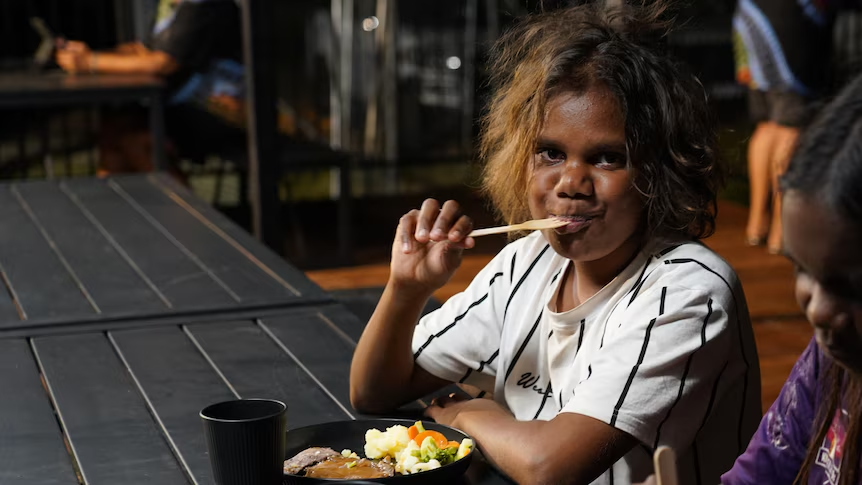
Since opening in September 2024, the Night Place, run by Marra Worra Worra Aboriginal Corporation (MWW), has become a central hub for youth in the remote town, 2,400 kilometres north of Perth.

The Aboriginal-led program was created in response to concerns over disengaged children wandering the streets and rising youth crime. Similar youth night spaces have also opened in Broome.

Research shows juvenile offenders make up just 3.7% of the Kimberley youth population, with poverty and disadvantage driving criminal acts. Services including night spaces are seen as part of the solution.

Nearly 400 young people have attended the space in its first seven months, with over 8,000 visits and 12,500 hot meals served.

The Night Place started as a pilot program but has since secured longer-term state government funding.

Read more here.

Cyeahni Wallaby, 11, attends the Fitzroy Crossing Night Place. (ABC Kimberley: Rosanne Maloney)

Groundbreaking NITV documentary series ‘Our Medicine’ shines a light on communities taking back control of Indigenous health

Powerful new documentary series, Our Medicine, takes viewers behind the frontline of Australia’s strained medical services, shining an important light on First Nations professionals working to achieve better health outcomes for Aboriginal and Torres Strait Islander patients and communities. The six-part observational series premieres on National Indigenous Television (NITV) and SBS and SBS On Demand from 29 May at 7.30pm.

Narrated by screen icon Leah Purcell AM (The Drover’s Wife: The Legend of Molly Johnson, High Country), the groundbreaking series offers unique access to Aboriginal and Torres Strait Islander doctors, nurses, paramedics, traditional healers and other medical professionals, following their day-to-day challenges as they support patients on their journey through the system.

Learn more here.

Image source: SBS.

RACGP 2025 Aboriginal and Torres Strait Islander health awards

Nominations are now open for the 2025 RACGP Awards. Aboriginal and Torres Strait Islander Health awards include:

  • Standing Strong Together Award: celebrating partnerships between GPs and communities
  • Growing Strong Award: recognising exceptional Aboriginal and Torres Strait Islander GPs in training
  • Rising Strong Medical Student Award: supporting current Aboriginal and Torres Strait Islander medical students currently studying at an Australian university
  • The Aunty Val Dahlstrom Award: for Aboriginal Health Excellence, recognising excellence in Aboriginal health by an RACGP staff member, supervisor or registrar

These awards celebrate outstanding contributions to general practice and shine a light on the GPs, practices, supervisors, medical educators and registrars going above and beyond for their communities.

Submit nominations by 9AM AEST, Monday 30 June.

Image source: RACGP

Western Australia announces long awaited Stolen Generations redress scheme

Stolen Generations survivors from Western Australia will soon be eligible for compensation for the harm and suffering caused by decades of forced removal policies.

Living survivors would be eligible for $85,000 under the state government scheme, which is expected to open for applications later this year. The scheme will only apply to people who were removed as children from their families in WA before July 1st 1972.

Stolen Generations survivor and Co-Chair of Bringing Them Home WA Tony Hansen said it was a important step forward.

“By acknowledging such a brutal history, and evil policies that ripped the hearts out of children and families, this day will go down in history as a powerful moment of truth-telling,” he said.

Read more here.

The announcement has been long awaited by the state’s Stolen Generations members. Source: AAP / Lukas Coch

Sector Jobs – you can see sector job listings on the NACCHO website here.

Advertising Jobs – to advertise a job vacancy click here to go to the NACCHO website current job listings webpage. Scroll down to the bottom of the page to find a Post A Job form. You can complete this form with your job vacancy details – it will then be approved for posting and go live on the NACCHO website.

NACCHO Sector News: 27 May 2025

The NACCHO Sector News is a platform we use to showcase the important work being done in Aboriginal and Torres Strait Islander health, focusing on the work of NACCHO, NACCHO members and NACCHO affiliates.

We also share a curated selection of news stories that are of likely interest to the Aboriginal and Torres Strait Islander health sector, broadly.

National Reconciliation Week – Bridging Now to Next

From 27 May to 3 June, we celebrate National Reconciliation Week. A time for all Australians to learn about our shared histories, cultures, and achievements, and to explore how each of us can contribute to achieving reconciliation in Australia.

This year’s theme ‘Bridging Now to Next,’ reflects the ongoing connection between past, present and future.

Bridging Now to Next calls on all Australians to step forward together, to look ahead and continue the push forward as past lessons guide us.

To learn more and for NRW2025 resources, go here.

To find an event near you, go here.

The National Reconciliation Week (NRW) 2025 theme, Bridging Now to Next, reflects the ongoing connection between past, present and future.

The National Reconciliation Week (NRW) 2025 theme, Bridging Now to Next, reflects the ongoing connection between past, present and future.

National Sorry Day marked by renewed warnings over rising First Nations child removals

First Nations advocate William Tilmouth warns that Australia is repeating the trauma of past child removals, as the number of First Nations children taken from their families continues to rise. Speaking on National Sorry Day, Tilmouth, Chair of Children’s Ground, emphasized that this isn’t a historical issue but an ongoing crisis.

Data from the Productivity Commission and the Closing the Gap report show a concerning increase in Indigenous child removals, with experts fearing another “Stolen Generation.” Nearly 43% of children in out-of-home care are First Nations, removed at almost ten times the rate of non-Indigenous children.

Children’s Ground stresses that true reconciliation requires justice, truth-telling, listening, and self-determination, not just symbolic gestures.

Read the full article here.

Arrernte Elder and co-founder of Children's Ground, William Tilmouth. (Image: Damon Van Der Schuit/NT News)

Arrernte Elder and co-founder of Children’s Ground, William Tilmouth. (Image: Damon Van Der Schuit/NT News)

‘Change Direction’ tackles Aboriginal suicide crisis

Content warning: this article contains reference to suicide. Please refer to the services at the bottom of this article for support.

Leading Aboriginal creatives, mental health professionals, and voices have partnered with Apparent and Photoplay to launch ‘Change Direction’, an awareness initiative focused on the staggering rate of suicide in Aboriginal communities. Apparent’s creative director Jackson Long gave Mumbrella an exclusive deep dive into the initiative.

‘Change Direction’ looks at disenfranchisement and disempowerment within Aboriginal communities. What began as a pro-bono partnership with Aboriginal-owned and operated counselling service King’s Narrative evolved into something bigger in the course of the project.

King’s Narrative works to retrain and connect young Aboriginal people, particularly men, to their culture. The service hopes to “change the narrative” around Aboriginal pride and culture, countering negative stories and finding the positive.

Learn more about this short movie here.

If this article brought up anything for you or someone you love, please reach out to, call or visit the resources listed below for support.

Actor Pedrea Jackson

Actor Pedrea Jackson

‘We Are Carrying on the Legacy of Our Old People’: Nyul Nyul Celebrate the Establishment of a First Nations Protected Area

The Kimberley Land Council (KLC) is proud to announce the declaration of the Nyul Nyul First Nations Protected Area (IPA), marking a significant milestone in the protection and management of Country on the Dampier Peninsula.

Covering 144,493 hectares of culturally and ecologically rich land, the newly established IPA will protect vital freshwater spring Country, monsoon vine thickets, threatened species like the greater bilby and short-nosed sea snake, and stretches of sea Country, extending the IPA network across the Dampier Peninsula.

The Nyul Nyul IPA not only safeguards these unique landscapes but also provides a nationally recognised framework for Aboriginal-led conservation and land management.

Read the full article here.

Source: Kimberley Land Council (KLC)

Source: Kimberley Land Council (KLC)

Sector Jobs – you can see sector job listings on the NACCHO website here.

Advertising Jobs – to advertise a job vacancy click here to go to the NACCHO website current job listings webpage. Scroll down to the bottom of the page to find a Post A Job form. You can complete this form with your job vacancy details – it will then be approved for posting and go live on the NACCHO website.

NACCHO Sector News: 26 May 2025

The NACCHO Sector News is a platform we use to showcase the important work being done in Aboriginal and Torres Strait Islander health, focusing on the work of NACCHO, NACCHO members and NACCHO affiliates.

We also share a curated selection of news stories that are of likely interest to the Aboriginal and Torres Strait Islander health sector, broadly.

National Sorry Day 2025

26 May 2025 marks the 28th anniversary of the tabling of the Bringing them home report in the Australian Parliament in 1997 and commemorates Stolen Generations survivors.

The Bringing them home inquiry was a landmark truth-telling process, bringing to light the extent of Australia’s Stolen Generations history, and sharing this with the nation.

In 1997 the report made a series of recommendations to go some way in righting these past wrongs, yet almost 30 years on many crucial actions have not been taken.

A Healing Foundation report released earlier this year – Are you waiting for us to die? The unfinished business of Bringing them home – found only 6% of the Bringing them home report recommendations have been clearly implemented

A generation on, we have already lost many Stolen Generations survivors. Those who are left are ageing. The urgency of acting now, to support elderly survivors in their last years and decades, cannot be overstated.

To learn more, go here.

Image source: Healing Foundation.

Barkly residents set to learn more about FASD

Tennant Creek and Barkly residents learnt more about Foetal Alcohol Spectrum Disorder (FASD) with Aboriginal health service Anyinginyi and an expert from Curtin University.

8CCC Big Brekky presenter Shauna Upton spoke to Curtin University Medical School’s Dr Robyn Williams alongside Anyinginyi Aboriginal Health Corporation’s Molly Huntjens about FASD and the workshops.

The workshops focused on culturally-appropriate practices on how people in the community can help children, adults and families impacted by FASD.

Dr Williams said FASD was a global health issue, but people impacted First Nations people, and the workshops – which are already fully booked – will provide more information about how to manage it, best to avoid its impact and how to help other family members deal with it.

Read more here.

Listen to the full interview on the Big Brekky Podcast here.

For FASD resources, go here.

Image source: 8CCC Radio.

Kambu Member Elders Group

Last week Kambu Family Wellbeing Service held the ‘Kambu Member Elders Group.’

Kambu Health shared event highlights on social media:

Uncle Henry and Aunty PJ painted stunning vases, while Aunty Rhonda created an incredible goanna artwork. Aunty Deb, Aunty Ruth, and Aunty Pam were totally focused on painting their vases — Aunty Pam even made herself a lovely coaster!

Uncle Robert and Uncle Henry gave jewelry making a go, and Aunty Janelle got crafty building a fairy house with resin. She’s making a whole Fairy Garden for her granddaughter — how special is that?

Uncle Jo continued his turtle painting, and Uncle Anthony was outside working on a new masterpiece. Meanwhile, the courtyard was alive with music as Uncle Mick, Aunty Kaylene, and Uncle Ernie rehearsed for the Choir — and they even roped in Aunty PJ for a singalong!

We were treated to a delicious lasagna and salad (no photo… too busy enjoying it!) — and Aunty Kaylene’s damper was the highlight once again. A huge thank you to Aunty Kaylene and the amazing Laidley Family Wellbeing Service team for making the day so special.

Quote of the day:

“Sometimes you just have to jump in a mud puddle because it’s there. Never get so old that you forget about having fun.” – Tom Giaquinto

Image source: Kambu Health

Sector Jobs – you can see sector job listings on the NACCHO website here.

Advertising Jobs – to advertise a job vacancy click here to go to the NACCHO website current job listings webpage. Scroll down to the bottom of the page to find a Post A Job form. You can complete this form with your job vacancy details – it will then be approved for posting and go live on the NACCHO website.

Maximise Medicare for your ACCHO!

NACCHO, with support from the National Indigenous Australians Agency has free online courses to help ACCHO staff improve Medicare claiming and utilisation of other primary care funding sources.

Earn CPD points! These courses are fully accredited by RACGP, ACRRM, & NAATSIWHIP.

To register, go here.

For more information, go here.

NACCHO Sector News: 23 May 2025

The NACCHO Sector News is a platform we use to showcase the important work being done in Aboriginal and Torres Strait Islander health, focusing on the work of NACCHO, NACCHO members and NACCHO affiliates.

We also share a curated selection of news stories that are of likely interest to the Aboriginal and Torres Strait Islander health sector, broadly.

Anniversary call to support Stolen Generations survivors “before it’s too late”

Ahead of National Sorry Day on 26 May, a national body has called for an urgent healing package for ageing Stolen Generations survivors, saying “we cannot wait another generation”.

“All survivors must have access to equitable redress and to the records that hold their stories,” The Healing Foundation said on Thursday.

National Sorry Day is about honouring survivors and also marks the 1997 tabling of the Bringing Them Home report, which shared Australia’s Stolen Generations history with the nation, and made a series of recommendations to address the damaging impacts.

28 years on, only six per cent of these recommendations have been fully implemented.

The Healing Foundation’s CEO Shannan Dodson urged all those with a responsibility to support Stolen Generations survivors to act without delay.

“Stolen Generations survivors have been through so much. Many suffered abuse in care, on top of the trauma of being separated from their families. They have seen how their trauma has affected their families. They deserve justice,” Ms Dodson said.

“A comprehensive and coordinated response is required from all sides of politics, all levels of government, police, churches and others, before it’s too late.

Read the full National Indigenous Times article here.

Image: Mick Tsikas (AAP).

Join the Evaluation of the Own It Campaign

NACCHO is looking for ACCHO staff to participate in a qualitative evaluation to understand how the cervical screening ‘Own It’ campaign has impacted cervical screening awareness and uptake in your Community.

If you would like to take part in the evaluation, please complete this short form and a member of the NACCHO Cancer Team will be in touch.

  • Will I be compensated for my time? Yes, from $150 and up, depending on your role in the form of an e-gift card
  • How long will it take? 1 hour
  • Where will the interviews take place? Interviews can be conducted at your convenience, either via phone or MS teams video and will be held across late May/early June.

Help shape a national education program on antidepressant use in young people

NACCHO, as part of the Quality Use of Medicines (QUM) Alliance is helping to develop a new education program to improve the use of antidepressants in young people.

The Alliance is seeking the following groups to get involved in the co-design process:

For more information, contact info@qumconnect.com.au or medicines@naccho.org.au

Construction begins on ACT Aboriginal health precinct

Work is underway on Canberra’s Watson Health Precinct redevelopment, the ACT Government has announced.

ACT Minister for Health, Rachel Stephen-Smith said the renewed Watson Health Precinct will enable delivery of better health services for young people and the Aboriginal and Torres Strait Islander community in Canberra.

The upgrades will provide new purpose-built facilities to support alcohol and other drug rehabilitation services, as well as residential mental health care for young people.

The precinct will also expand to include a new residential rehabilitation facility specifically for Aboriginal and Torres Strait Islander people – designed, constructed and operated by Winnunga Nimmityjah Aboriginal Health and Community Services.

“The new residential rehabilitation facility is designed to support the need for both cultural and therapeutic programs specifically designed indoor and outdoor spaces to allow for a holistic approach for all programs to be deliver seamlessly,” said Winnunga Nimmityjah Aboriginal Health and Community Services CEO, Julie Tongs.

Learn more here.

Roadmap unveiled to support Aboriginal and Torres Strait Islander LGBTQA+ youth

A new roadmap has detailed actions that family and community, services, and government can take to support Aboriginal and Torres Strait Islander LGBTQIA+ young people’s mental health and wellbeing, including creating visibility, seeking wider education and advocating for safe spaces.

“Five years ago, there was almost no research that had been done with Aboriginal and Torres Strait Islander LGBTQIA+ young people,” the roadmap’s lead author, The Kids Research Institute Australia (The Kids) researcher and UWA PhD student Mx Shakara Liddelow-Hunt said.

“But with the release of our national survey, and other research happening across Australia, we now have a body of evidence showing that there is a huge need to better support Aboriginal and Torres Strait Islander LGBTQIA+ young people.

“The roadmap provides concrete actions that we can all take to achieve this. Our end goal in releasing this roadmap is to empower individuals, families, communities and services to ensure Aboriginal and Torres Strait Islander LGBTQIA+ young people are safe, healthy and thriving.”

Learn more here.

If this article brought up anything for you or someone you love, please reach out to, call or visit the resources listed below for support.

Sector Jobs – you can see sector job listings on the NACCHO website here.

Advertising Jobs – to advertise a job vacancy click here to go to the NACCHO website current job listings webpage. Scroll down to the bottom of the page to find a Post A Job form. You can complete this form with your job vacancy details – it will then be approved for posting and go live on the NACCHO website.
NACCHO Sector News: 22 May 2025

The NACCHO Sector News is a platform we use to showcase the important work being done in Aboriginal and Torres Strait Islander health, focusing on the work of NACCHO, NACCHO members and NACCHO affiliates.

We also share a curated selection of news stories that are of likely interest to the Aboriginal and Torres Strait Islander health sector, broadly.

“Strong, Healthy, Deadly”: Maningrida Youth Week champions wellbeing and leadership

In the heart of West Arnhem Land, on the homelands of the Kunibídji people, something powerful unfolded last week.

From May 12 to 16, the inaugural Maningrida Youth Week brought together the strength, creativity, and spirit of a community determined to show its young people they matter — that their voices are heard, their dreams are valid, and their future is worth fighting for

This wasn’t just a week of activities — it was a heartfelt investment in healing, identity, and hope.

Remote communities across Australia often face challenges such as limited access to services, reduced opportunities for employment and education, and poorer health and wellbeing outcomes. But that doesn’t reflect the resilience, talent, and potential of the young people who grow up in these places. Too often, their stories are shaped by what’s missing — rather than what’s possible. Last week’s celebrations showcased exactly that: one of brilliance, and the boundless potential that exists when we walk alongside our young people and nurture their growth.

Read the full article here.

Some of the young people participating in Maningrida Youth Week. Image: supplied.

Some of the young people participating in Maningrida Youth Week. Image: supplied.

Helping First Nations families navigate genomic health

A new suite of culturally safe resources aims to empower First Nations families navigating genetic disease diagnoses. National Centre of Indigenous Genomics deputy director Azure Hermes highlighted that many individuals struggle with understanding genetic services, facing issues like limited appointment times and language barriers. This initiative addresses the growing need for accessible, bite-sized information.

Developed in collaboration with community organizations, these resources include animations, videos, and fact sheets explaining rare diseases, DNA, and genomic research. Translated into multiple First Nations languages, they aim to make complex health information understandable and to ensure First Nations people feel supported and informed throughout their genetic health journey.

Read the full article here.

Navigating the health system after a genetic disease diagnosis can be complex, Azure Hermes says. Photo: Azure Hermes/AAP PHOTOS

Navigating the health system after a genetic disease diagnosis can be complex, Azure Hermes says. Photo: Azure Hermes/AAP PHOTOS

Closing the gap by coming together

Meaningful conversations which focused on the importance of unity and engaging with First Nations people through local programs and services aimed at achieving better and stronger outcomes across health, education, justice, employment, and cultural aspects were among the highlights during the Clarence Valley Close the Gap Day 2025.

Held at the Clarence River Jockey Club (CRJC) on May 14, the annual event once again attracted a huge crowd including more than 700 local school students from across the region.

Read the full story here.

First Nations leaders accuse Queensland government of systemic harm in youth justice, child protection systems

Over 100 First Nations leaders have accused the Queensland government of intentionally harming Indigenous youth and families through policies that lead to the disproportionate removal of children. In a strong statement, leaders including Marcia Langton and Mick Gooda, decried the “ongoing violation of human and cultural rights,” arguing that the state’s actions are reminiscent of past policies that separated Indigenous families. They fear these acts are designed to “destroy our First Nations” by forcibly removing children from their communities and care.

Indigenous children in Queensland are 9.4 times more likely to be in out-of-home care and make up 70 percent of the state’s youth prison population. The leaders assert that this overrepresentation is not coincidental but a direct result of culturally unsafe services and policies that disregard Indigenous rights and leadership. They emphasized that true community safety begins by listening to and respecting the knowledge of those who have held this responsibility for generations.

Read the full article here.

Commissioners Katie Kiss, Scott McDougall and Natalie Lewis (Image: QHRC/Lewis James Media)

Commissioners Katie Kiss, Scott McDougall and Natalie Lewis (Image: QHRC/Lewis James Media)

Webinar recording: Good tucker and eye health

Presented by the National Aboriginal Community Controlled Health Organisation (NACCHO) and Diabetes Australia, this webinar discussed the link between vision and nutrition in preventing eye problems related to diabetes, and age-related macular degeneration.

The webinar was presented by:

  • Professor Vicki Flood, Head of Clinical School, Northern Rivers and Director of University Centre for Rural Health (UCRH), Northern Rivers, with Faculty of Medicine and Health, University of Sydney
  • Erich Barkmeyer, First Nations Peer Support Project Officer, Diabetes Australia.

Please note: The video is available by signing in to NACCHO Online Learning.

Access the webinar here.  

Sector Jobs – you can see sector job listings on the NACCHO website here.

Advertising Jobs – to advertise a job vacancy click here to go to the NACCHO website current job listings webpage. Scroll down to the bottom of the page to find a Post A Job form. You can complete this form with your job vacancy details – it will then be approved for posting and go live on the NACCHO website.

NACCHO Sector News: 21 May 2025

The NACCHO Sector News is a platform we use to showcase the important work being done in Aboriginal and Torres Strait Islander health, focusing on the work of NACCHO, NACCHO members and NACCHO affiliates.

We also share a curated selection of news stories that are of likely interest to the Aboriginal and Torres Strait Islander health sector, broadly.

Funding for Aboriginal health centre welcomed, but urgent gaps remain

Victoria’s peak Aboriginal and Torres strait Islander health body, VACCHO, welcomed the state budget’s $12.5 million for Dandenong and District Aborigines Co-Operative Ltd (DDACL) to reopen services in a new location.

This funding addresses critical issues at DDACL, whose previous facility was condemned due to flood damage and asbestos. While a significant win, VACCHO CEO Jill Gallagher emphasized it’s “interim relief,” and a permanent, fit-for-purpose home for DDACL remains the ultimate goal.

Read the full article here.

VACCHO CEO Dr. Jill Gallagher, stands on the steps of Parliament House with representatives of the Victorian ACCOs (Image: Supplied)

VACCHO CEO Dr. Jill Gallagher, stands on the steps of Parliament House with representatives of the Victorian ACCOs

Gogglebox’s Sarah Marie Fahd opens up on cervical screening

‘Gogglebox’ star and mum-of-two Sarah Marie Fahd prioritizes cervical screening, urging other mums to do the same despite busy schedules. She emphasizes that looking after her health is important: “It’s easy to put things off when life gets busy, but I remind myself that looking after my health is one of the most loving things I can do for my family”, and she wants to demystify the process for other women.

Read the full article here.

Gogglebox’s Sarah Marie Fahd and baby

(Image: Instagram)

First Nations-led projects among recipients of WA suicide prevention grants

Content warning: this article contains reference to suicide. Please refer to the services at the bottom of this article for support.

Community and First Nations organisations will receive a share of $1 million in Western Australia government grants to support suicide prevention.

Announced on Tuesday, the funds will be provided to community organisations across the state to help deliver culturally-appropriate, community-led programs which increase awareness and reduce stigma around mental health and suicide.

The Aboriginal Family Legal Service will receive funding for its Red Dress Wadjak Arts Healing project, which aims to improve the social and emotional wellbeing of Aboriginal women, children and young people who have experienced family and domestic violence by engaging in creative arts and workshops.

The Broome Regional Aboriginal Medical Service (BRAMS) will receive funding for its ‘Yarn with Me’ project. The project offers Aboriginal Mental Health First Aid training for BRAMS staff and accredited suicide prevention training for community members.

The Deadly Maaman Mooditj Kaat (Deadly Men Good Thinking-Head) program aims to help Aboriginal men and male youth increase mental health literacy, reduce stigma and build resilience.

Read the full article here.

If this article brought up anything for you or someone you love, please reach out to, call or visit the resources listed below for support.

Indigenous organisations are among recipient groups to receive funding from the Western Australian government to support suicide prevention. (Image: Jackson Flindell/The West Australian)

First nations organisations are among recipient groups to receive funding from the Western Australian government to support suicide prevention. (Image: Jackson Flindell/The West Australian)

Recognising excellence in developing a First Nations wellbeing index

Ngiyampaa/Wongaibon social epidemiologist and recipient of the 2023 NHMRC David Cooper Clinical Trials and Cohort Studies Award, Professor Raymond Lovett has focused his career on improving Aboriginal and Torres Strait Islander health. As an Associate Director of Yardhura Walani (Australian National University) and Director of Mayi Kuwayu: The national study of Aboriginal and Torres Strait Islander wellbeing, Professor Lovett’s research has influenced policy at state and national levels, as well as empowered communities at the local level. He is now aiming to take this to the global stage through the development of a world-first Indigenous wellbeing index.

Read the full article here.

Professor Raymond Lovett

Professor Raymond Lovett

First Nations peoples reveal key issues affecting their community

“Things are still being done for us and to us, and not with us,” First Nations person Leanne Erikesen said as she raised her concerns about the lack of support for the Aboriginal community in a discussion with an independent social justice representative in Kalgoorlie-Boulder this month.

First Nations peoples across Australia have been given the opportunity to tell their stories and inform the Australian Human Rights Commission’s Social Justice Commissioner on key issues affecting their lives as part of the Informing the Agenda project.

Commissioner Katie Kiss has been engaging in meaningful discussions with the Aboriginal and Torres Strait Islander community to ensure their concerns are heard and included in the social justice report.

Read the full article here.

Jennifer Davidson, Rex Weldon and Leanne Eriksen. Credit: Jessica Antoniou/Kalgoorlie Miner

Jennifer Davidson, Rex Weldon and Leanne Eriksen

Townsville radio host Arika Appleby selected for the Indigenous Marathon Project

Townsville radio host Arika Appleby is hoping to inspire young people across North Queensland, after being selected for the Indigenous Marathon Project 2025.

The project aims to bridge the health and wellbeing gap for Aboriginal and Torres Strait Islander Australians, training a select few and helping them work their way to a 42km marathon in New York.

Ms Appleby, a Gudjala, Juru and Gugu Budhun woman, said she applied for IMP to show her community they can do anything they set their mind to.

“This was very uncomfortable for me and just foreign, but I want to show them that we have the potential to do these hard things even when we feel like we can’t,” she said.

“I want to inspire and show our community that when an opportunity presents itself, sometimes we just have to go out and grab it.”

View the full article here.

Townsville’s Arika Appleby is one of 12 First Nations people selected for the Indigenous Marathon Project.

Townsville’s Arika Appleby is one of 12 First Nations people selected for the Indigenous Marathon Project.

Sector Jobs – you can see sector job listings on the NACCHO website here.

Advertising Jobs – to advertise a job vacancy click here to go to the NACCHO website current job listings webpage. Scroll down to the bottom of the page to find a Post A Job form. You can complete this form with your job vacancy details – it will then be approved for posting and go live on the NACCHO website.

NACCHO Sector News: 20 May 2025

The NACCHO Sector News is a platform we use to showcase the important work being done in Aboriginal and Torres Strait Islander health, focusing on the work of NACCHO, NACCHO members and NACCHO affiliates.

We also share a curated selection of news stories that are of likely interest to the Aboriginal and Torres Strait Islander health sector, broadly.

Strongbala Minds Walk-In Talk-In Space opens in Katherine: A new chapter in healing and hope

Monday marked a proud and powerful moment for the Katherine community with the opening of the Strongbala Minds Walk-In Talk-In Space, a culturally-led Medicare Mental Health Centre that blends cultural wisdom with clinical care.

Led by the Jawoyn Association Aboriginal Corporation and born from the vision of the Banatjarl Strongbala Wimun Group, the culturally-led Medicare Mental Health Centre stands as a testament to what can be achieved when local leadership, lived experience, and government partnership come together with a shared commitment to community care.

Located in Katherine’s Woolworths precinct, the space is welcoming — a calm, inclusive environment where anyone can walk in and be met with understanding. This is a “no wrong door” service, ensuring everyone — no matter their age, background, or level of need — receives support.

Read the full article here.

At the Strongbala opening. Image: Nicole Brown.

At the Strongbala opening. Image: Nicole Brown.

The Power of Sleep: Supporting mental health in First Nations children

A five-year national research project led by the University of the Sunshine Coast is aiming to improve the mental health of First Nations children through better sleep.

University of the Sunshine Coast sleep scientist Professor Fatima Yaqoot has been awarded a $5 million Childhood Mental Health Research Plan grant to lead the co-design and implementation of sleep health initiatives for Aboriginal and Torres Strait Islander children across 18 rural and remote Australian communities.

“Despite strong advocacy and compelling evidence, sleep has not previously been considered as a key intervention to reduce the risk and severity of mental health outcomes in First Nations children. This program will change that,” Professor Yaqoot said.

“While data is limited, previous analysis suggests that one-in-three children under eight struggles with poor sleep, while half experience emotional and behavioural issues,” she said.

“Sleep is considered as a key factor for everyone’s mental health and physical health, but in First Nations culture, there’s also a spiritual impact of poor sleep, which has not been documented before.

“That’s why this program is co-designed with community Elders and aligns with their cultural needs to improve children’s sleep and mental health outcomes.”
Research team member Aunty Joan Marshall OAM, a Kalkadoon Elder, said First Nations children needed sleep to clear their minds and connect with their culture.

Read the full article here.

Artwork by Aunty Judith-Rose Thomas, a direct descendant of Manalargenna from the Cape Portland tribe and Plangermaireener Nation. Artwork: Sleep on Country Artist Statement: “The artwork covers the Connection to Country and The Importance of Sleep. As we sleep our system is rejuvenated and the body and mind are refreshed. For our young children, sleep is important as it's the time of growth while they sleep. Shown in the artwork is a woven basket with a child sleeping. As we are star moon people I have the stars in the sky and two adults sitting watching the moon. The small petroglyphs are the connection, from the past to the present. Making that Spiritual connection on country while we sleep..”

Artwork by Aunty Judith-Rose Thomas, a direct descendant of Manalargenna from the Cape Portland tribe and Plangermaireener Nation. Artwork: Sleep on Country Artist Statement: “The artwork covers the Connection to Country and The Importance of Sleep. As we sleep our system is rejuvenated and the body and mind are refreshed. For our young children, sleep is important as it’s the time of growth while they sleep. Shown in the artwork is a woven basket with a child sleeping. As we are star moon people I have the stars in the sky and two adults sitting watching the moon. The small petroglyphs are the connection, from the past to the present. Making that Spiritual connection on country while we sleep..”

Calls for reconciliation echo across the Harbour Bridge 25 years on

In the lead up to National Reconciliation Week, a video of Goanna’s iconic 1982 hit song, Solid Rock, being performed at the summit of the Sydney Harbour Bridge has been released.

Launched by Reconciliation Australia, the video sees Goanna’s songwriter, Shane Howard, joined by the Sydney choir Barayagal and its leader, Gamilaraay songwriter Nardi Simpson, performing Solid Rock in celebration of reconciliation and justice for Aboriginal and Torres Strait Islander peoples across the country.

It comes in the lead up to the 25th anniversary of the historic walk for reconciliation across the Sydney Harbour Bridge, which saw more than 250,000 people walk across the iconic Sydney landmark for reconciliation on May 28, 2000.

Lasting for nearly six hours, it was the largest political demonstration ever held in Australia.

Read the full article here.

Crowds on Sydney Harbour Bridge during the Walk for Reconciliation, Corroboree 2000. (Image: National Museum of Australia)

Crowds on Sydney Harbour Bridge during the Walk for Reconciliation, Corroboree 2000. (Image: National Museum of Australia)

Grants NSW – Improving housing for positive health outcomes – Closes Fri 23.5.25

The Client Experience Initiative (CEI) focuses on improving a housing and social need that will achieve a positive outcome/s for Aboriginal people, families, and communities. This can include but not limited to initiatives around health, wellbeing, education, and employment.

We are calling for Aboriginal organisations to identify a housing and social need that is impacting your community and outline how it can be addressed.

Read more about this specific Grant here.

Find out about other grants opportunities available for Aboriginal Community Controlled Health Services here.


Sector Jobs – you can see sector job listings on the NACCHO website here.

Advertising Jobs – to advertise a job vacancy click here to go to the NACCHO website current job listings webpage. Scroll down to the bottom of the page to find a Post A Job form. You can complete this form with your job vacancy details – it will then be approved for posting and go live on the NACCHO website.


NACCHO Sector News: 19 May 2025

The NACCHO Sector News is a platform we use to showcase the important work being done in Aboriginal and Torres Strait Islander health, focusing on the work of NACCHO, NACCHO members and NACCHO affiliates.

We also share a curated selection of news stories that are of likely interest to the Aboriginal and Torres Strait Islander health sector, broadly.

Decolonising health to provide better care for patients

University of Adelaide senior researcher Kim O’Donnell said there’s currently an emphasis on a biomedical approach to health care, which treats individual parts rather than a person as a whole.

Dr O’Donnell said decolonising health care means a more holistic approach, led by Aboriginal and Torres Strait Islander ways of knowing, being and doing.

“Decolonised healthcare looks like what Aboriginal Community Controlled Health organisations were established for in the first place in the early 70s,” the Malyangapa and Barkindji woman told AAP.

“That is to provide a suite of healthcare in the one place that’s led by Aboriginal and Torres Strait Islander people.

“That makes the journey much better and much safer for Aboriginal and Torres Strait Islander people and comes from the place of health being delivered in a holistic way.”

Read the full NITV article here.

A health practitioner from Danila Dilba Health Service in Darwin. Cultural-informed care can make a world of difference for patients. Credit: SUPPLIED/PR IMAGE

What is Priority Reform One of the National Agreement on Closing the Gap?

Priority Reform One of the National Agreement on Closing the Gap is all about formal partnerships and shared decision-making between governments and Aboriginal and Torres Strait Islander people.

Priority Reform One focuses on changing the way governments work, making sure Aboriginal and Torres Strait Islander people are fully involved in decisions that affect their lives, at the national, state, regional and local levels.

It’s about recognising and embedding the leadership, expertise, and commitment of Aboriginal and Torres Strait Islander people in the work to close the gap.

Learn more here.

Gija mother-daughter duo leading rural health change

Dr Ellen Engelke, a Curtin Medical School graduate, and her mother Dr Catherine Engelke, a Curtin School of Nursing alumna and Senior Medical Officer in Kununurra, are contributing to better health outcomes in Aboriginal and Torres Strait Islander communities.

The Gija women have pursued careers in medicine that reflect their commitment to community and country.

Dr Ellen Engelke was supported during her studies by the Australian Rotary Health Indigenous Scholarship, which allowed her to focus on her goals and influenced her desire to give back.

For her, medicine is driven by a sense of purpose shaped by family and community.

“Mum studied while I was young, and I remember watching her practice clinical exams on me,” she said.

“She never pressured me to follow in her footsteps, but seeing her journey made me believe that if she could do it, so could I.”

Dr Catherine Engelke began her career in nursing, completing a Postgraduate Diploma in Clinical Nursing (Midwifery) at Curtin in 1996 before becoming a doctor.

“I wanted them to know they could achieve anything they set their minds to,” she said.

Read the full National Indigenous Times article here.

Gija mother and daughter Dr Catherine and Dr Ellen Engelke are improving rural and Indigenous health through medicine. (Image: Curtin University)

Sector Jobs – you can see sector job listings on the NACCHO website here.

Advertising Jobs – to advertise a job vacancy click here to go to the NACCHO website current job listings webpage. Scroll down to the bottom of the page to find a Post A Job form. You can complete this form with your job vacancy details – it will then be approved for posting and go live on the NACCHO website.

Maximise Medicare for your ACCHO!

NACCHO, with support from the National Indigenous Australians Agency has free online courses to help ACCHO staff improve Medicare claiming and utilisation of other primary care funding sources.

Earn CPD points! These courses are fully accredited by RACGP, ACRRM, & NAATSIWHIP.

To register, go here.

For more information, go here.