
- $5.9m for First Nations Cancer Scholarship program
- Uniting Health Professionals to Ignite Change:
Good Medicine Better Health Online Yarning Circle About Vaping
- Empowering Aboriginal and Torres Strait Islander Leadership in Mental Health
- WA government walks away from building Halls Creek renal centre before next state election
- Fulfilling cultural safety expectations in specialist medical education and training
- Outreach immunisation clinic brings care closer for families
- Sector Jobs
The NACCHO Sector News is a platform we use to showcase the important work being done in Aboriginal and Torres Strait Islander health, focusing on the work of NACCHO, NACCHO members and NACCHO affiliates.
We also share a curated selection of news stories that are of likely interest to the Aboriginal and Torres Strait Islander health sector, broadly.
$5.9m for First Nations Cancer Scholarship program
Applications are being sought for a ground-breaking new scholarship program for Aboriginal and Torres Strait Islander students, health professionals and researchers in the field of cancer. The First Nations Cancer Scholarship, led by the Aurora Education Foundation and backed by funding from the Australian Government through Cancer Australia, represents a significant investment of up to $5.9m over four years.
Aboriginal and Torres Strait Islander graduate students, early career researchers and health professionals can apply for financial support of up to $120,000 annually for up to 3 years, as well as academic, wellbeing and community support.
Cancer remains the leading cause of mortality among Aboriginal and Torres Strait Islander people, yet less than 1% of health professionals identify as Aboriginal and Torres Strait Islander.
Recognising the urgent need to strengthen the Indigenous cancer workforce, this scholarship program seeks to grow the capacity of Indigenous health professionals and researchers through advanced studies and research opportunities.
The goal of the scholarship program is to expand the network of Aboriginal and Torres Strait Islander people actively involved in cancer control, further embedding Indigenous voices into cancer policy making, research and care delivery.
Eligible candidates for the First Nations Cancer Scholarship must be Indigenous students engaged in full-time postgraduate studies or research within a cancer-related field covering health, research, or policy.
Expressions of Interest for the First Nations Cancer Scholarship are currently being accepted until Friday 30 August 2024.
To learn more about the scholarship program and to submit an application, click here. You can also view a flyer for scholarship program here.

Uniting Health Professionals to Ignite Change:
Good Medicine Better Health Online Yarning Circle About Vaping
NACCHO’s Good Medicine Better Health Program, in collaboration with Quit, is thrilled to announce the development of an innovative online Vaping Cessation learning module. This resource is designed specifically for Aboriginal Health Workers/Practitioners, and other Health Professionals working across the sector.
Our goal is to create a culturally relevant and effective learning module that addresses the unique needs and challenges faced by our communities. But before we begin crafting this crucial resource, we need your input!
We want to ensure this module is as impactful as possible, and that means hearing from you- the health professionals who are on the front lines. Your experiences, insights, and suggestions are invaluable to us.
Join us in this important yarning circle, and let’s work together to create a healthier future for all. Your voice is essential in developing a module that resonates with and supports our community effectively. Together, we can cook up something truly deadly!
Register your interest here.

Empowering Aboriginal and Torres Strait Islander Leadership in Mental Health
Gayaa Dhuwi (Proud Spirit) Australia says it recognises the urgent need for Aboriginal and Torres Strait Islander leadership to be fully supported and integrated across all parts of the Australian mental health system. Gayaa Dhuwi (Proud Spirit) Australia calls for comprehensive strategies to ensure the presence, visibility, and influence of Aboriginal and Torres Strait Islander leaders, while also fostering their self-care, peer support, and accountability to Aboriginal and Torres Strait Islander communities.
To increase the visibility and influence of Aboriginal and Torres Strait Islander leaders across the Australian mental health system, Gayaa Dhuwi (Proud Spirit) Australia recommends the following:
- Invest in comprehensive, culturally grounded leadership development programs tailored to the specific needs and aspirations of Aboriginal and Torres Strait Islander individuals. These programs should provide training in both Western and Indigenous leadership models, fostering a unique and powerful blend of skills and knowledge.
- Establish formal mentorship programs and create spaces for informal networking to connect emerging Aboriginal and Torres Strait Islander leaders with experienced mentors and peers, fostering a strong and supportive community of practice.
- Mandate comprehensive cultural responsiveness training for all mental health professionals, ensuring they understand and respect Aboriginal and Torres Strait Islander leadership styles, cultural protocols, and decision-making processes.
- Allocate dedicated funding streams to support the professional development, self-care, community engagement, and cultural leadership activities of Aboriginal and Torres Strait Islander mental health leaders. This funding should be sufficient to address the unique challenges and opportunities faced by Aboriginal and Torres Strait Islander leaders and enable them to thrive in their roles.
Gayaa Dhuwi (Proud Spirit) Australia firmly believes that centring Aboriginal and Torres Strait Islander leadership, knowledge, and self-determination within the mental health sector is paramount to achieving culturally safe, effective, and sustainable mental health outcomes for their communities.
To read the Dhuwi (Proud Spirit) Australia position paper in full, go here.

WA government walks away from building Halls Creek renal centre before next state election
The WA government has walked away from a pledge to build a dialysis centre in Halls Creek within this term of government, blaming COVID-19 and once-in-a-century flooding for the delay. Announced in 2021, the $24 million, 20-bed renal hostel would have eight dialysis machines, cater for up to 32 patients, and include accommodation for staff.
Local Indigenous health leaders lobbied for the facility to ensure residents in Halls Creek and the surrounding communities, 2,600 kilometres north of Perth, could receive life-saving treatment without having to leave their family and country. The Kimberley maintains some of the highest rates of kidney disease in Australia.
In late 2021, then Minister for Health Roger Cook told the ABC in a statement that the government was committed to building the renal centre within the parliamentary term. In February this year, the minister’s office said that statement still stood, but in a press conference in Kununurra in June, Mr Cook all but confirmed it was unachievable.
Local Indigenous health leaders are frustrated by the slow progress, saying the government has failed to meaningfully consult. Kimberley Aboriginal Medical Services (KAMS) said the proposed Halls Creek facility was a crucial addition to its large regional network of operations, which were under strain from increasing demand.
In a statement to the ABC, chief executive Vicki O’Donnell criticised comments current Minister for Health Amber-Jade Sanderson made in a parliamentary committee in May.
The minister said the government was working with the relevant Indigenous health organisations in the Kimberley on the “model of delivery”.
Ms O’Donnell said there had been no formal meeting between state government representatives and KAMS or the locally based Yura Yungi Medical Service in the past 18 months.
“I’m disappointed … it seems the minister has been ill-advised,” she said.
“Along with the Halls Creek community, I am concerned that there was no allocation in the recent state budget for the total project to build a renal centre, renal hostel, and staff accommodation.
“More broadly, I am also concerned that the state government will fail to deliver on their Kidney Disease Strategy.”
To read the full ABC News article, go here.
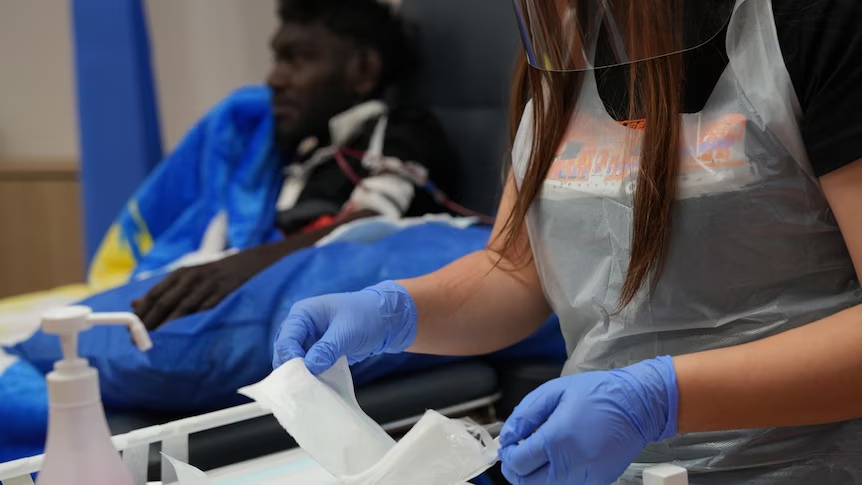
Dialysis is an essential treatment for people with end stage kidney disease. (ABC News: Lee Robinson).
Fulfilling cultural safety expectations in specialist medical education and training
It is increasingly evident that health inequities within Indigenous populations “are primarily due to unequal power relationships, unfair distribution of the social determinants of health, marginalisation, biases, unexamined privilege, and institutional racism,” prompting the need for attention at a variety of levels within health care, including at the systemic, organisational and individual levels.
Specialist medical colleges are prominently placed to promote, facilitate, and enact the principles of cultural safety within their institutions. If we are to close the gap in health outcomes between Indigenous and non‐Indigenous communities, colleges must fully appreciate their role and the ongoing commitment required to realise such outcomes for its staff, members and the Indigenous community.
Colleges must direct efforts to centre the development of critical allyship to support Indigenous peoples in managing cultural load, ensure Indigenous employees are respectfully engaged in the prioritisation of tasks and roles, and facilitate critical immersive activities for trainees and Fellows.
They must always be conscious of the expectations of the Indigenous communities they profess to serve. It is not simply enough to undertake this journey as a reaction to the nudging stick of accreditation, rather it must be a genuine, proactive commitment that recognises the injustice of doing the bare minimum, progressing at a slow pace, or, worse, not progressing at all.
To read the full article Fulfilling cultural safety expectations in specialist medical education and training: considerations for colleges to advance recognition and quality in the Medical Journal of Australia Special Issue in partnership with the Lowitja Institute: centring Indigenous knowledges, go here.

The Medical Journal of Australia Special Issue in partnership with the Lowitja Institute: centring Indigenous knowledges.
Outreach immunisation clinic brings care closer for families
In the heart of La Perouse lies the Aboriginal Community Health Centre, where every second Tuesday morning, a dedicated team provides opportunistic immunisations to Aboriginal bubs and their families. This outreach initiative, led by Sydney Children’s Hospital, Randwick (SCH), in collaboration with the Public Health Unit (PHU), works to educate and support families about childhood immunisations, with a current focus this winter on flu and RSV.
“We’re seeing significant increases in hospitalisations due to flu and RSV, so it’s crucial that we provide better access to these immunisations for bubs and their families within their own community,” Emma Birrell, Registered Nurse in the Opportunistic Child Immunisation Service at SCH said.
Flu and RSV can be serious, especially for young bubs. In NSW, all Aboriginal bubs born after 31 October 2023 are eligible for the free RSV immunisation, Beyfortus. In addition, the flu immunisation is available free for the whole family. These immunisations are offered at the La Perouse clinic.
The immunisation clinic is run through the support of many staff including pharmacy, medical professionals, Aboriginal Health Workers (AHWs), and nurses. The team work together to engage local schools and childcare centres, to drive community engagement and awareness.
The clinic aims to overcome barriers preventing families from immunising their bubs, striving not only to increase immunisation rates but also to enhance accessibility. Integration into the La Perouse community is vital in achieving these goals.
“During visits to the Centre, we provide immunisations for bubs through working closely with our staff including Aunty Bev, Aunty Lola, and child and family health to ensure culturally safe care for the families we see. Families can just drop in to La Pa or give us a call and book an appointment”, Kelsey Fletcher, Registered Nurse in the Opportunistic Child Immunisation Service at SCH said.
However, the team’s role extends beyond immunisations. “Sometimes it’s just about having a yarn, I enjoy just chatting and spending time with families, building rapport and relationships,” Emma said.
To read the article in full, go here.

Image source: NSW Government.

Sector Jobs – you can see sector job listings on the NACCHO website here.
Advertising Jobs – to advertise a job vacancy click here to go to the NACCHO website current job listings webpage. Scroll down to the bottom of the page to find a Post A Job form. You can complete this form with your job vacancy details – it will then be approved for posting and go live on the NACCHO website.
